It’s possible that I shall make an ass of myself. But in that case one can always get out of it with a little dialectic. I have, of course, so worded my proposition as to be right either way (K.Marx, Letter to F.Engels on the Indian Mutiny)
Wednesday, June 14, 2023
Japan passes toothless law against discrimination towards LGBT communities
Tokyo, Jun 13 (EFE).- The lower house of the Japanese parliament on Tuesday approved a controversial law to prevent discrimination against LGBT people, although it does not include any concrete measure towards recognizing the rights of these communities.
The bill was approved by the lower house of the diet (parliament) after long sessions of parliamentary debates between the opposition – which has called for a stronger law – and the more conservative sections of the ruling coalition, which has called for diluting the draft further.
The bill now has to be approved by the upper house, which is also dominated by the alliance led by Prime Minister Fumio Kishida’s Liberal Democratic Party.
The text acknowledges that there is a lack of public awareness in Japan on the diversity of sexual orientations and gender identities and calls for efforts to change this situation by authorities, companies and educational institutions.
However, it does not lay down concrete actions in this regard.
The bill, whose initial progressive overtones were diluted and made generic and ambiguous, says that “all citizens can live with peace of mind,” and nobody should face discrimination.
The LDP has faced internal pressure against taking a stand in favor of freedom of sexual orientation and LGBT rights, as the party holds traditional family values and roles to be at the core of its political philosophy.
Japan is the only G7 country which does not have a central legal framework to recognize same-sex couples, although an increasing number of regional and local governments have allowed the registration of civil unions among gay couples, which carry certain rights and benefits.
In recent months, several local court verdicts have raised questions on the constitutionality of not allowing same-sex marriages, following legal action by groups working for LGBT rights.
The activists have welcomed these decisions but insisted that they would not be enough to force the government to take concrete steps towards legalizing same-sex marriages and granting other rights.
The petitioners plan to take the matter to higher courts. EFE
Tokyo, June 13 (EFE).- Japan Tuesday approved its first space security policy to better expand the sector for defense and security use.
The so-called Japan Space Security Initiative, drawn up based on the National Security Strategy, was approved during a cabinet meeting chaired by Prime Minister Fumio Kishida.
The government decided to join international initiatives of like-minded countries and open the sector to a greater role for the private sector involved in space technology development.
Japanese public broadcaster NHK said the objectives of the policy include expanding the use of space for national security, ensuring the safe and sustainable use of the sector, and promoting the development of the space industry,
Amid growing space-related threats, Japan plans to join the US-led Combined Space Operations Center (CspOC) of Britain, Australia and Canada.
The facility monitors attempts to intercept or attack military and commercial satellites.
The policy will guide Japan over the next 10 years to better utilize the space sector for its defense purposes in the face of rising military use of outer space by China and Russia.
“For the sake of national security, we will dramatically scale up the use of space systems and ensure the safe and stable utilization of the domain,” said Kishida.
Japan will use combined small satellites to strengthen its information gathering systems in space to improve its counter-attack or preemptive strike capabilities.
The government vowed to strengthen collaboration between the defense ministry and Japan Aerospace Exploration Agency (JAXA) to support private firms involved in the development of space technology.
The government expressed its fears about the “rapid expansion of threats” from some countries like China, Kyodo news agency said. EFE
mra/bks-ssk
Fukushima plant finalizes preparations for radioactive water discharge into Pacific
Okuma, Japan, Jun 14 (EFE).- The Fukushima nuclear power plant is finalizing preparations to discharge tons of purified radioactive water into the Pacific this summer, a contentious measure that awaits the approval of international experts.
The Fukushima Daiichi plant, which faced the worst atomic accident since the Chernobyl plant in Ukraine, 1986, due to an earthquake and subsequent tsunami in March 2011, prepares for a crucial step in its long and complex dismantling process.
The large amount of waste liquid at the plant is treated to remove most of the radioactive materials from it to ensure safe levels before being discharged into the ocean, according to Japanese authorities, who still face complaints from local communities and neighboring countries.
Clean-up, decommissioning and construction of new facilities at Fukushima Daiichi have made visible progress in recent years.
There are hardly any masses of scrap metal, rubble or other remnants from the devastating tsunami of more than 15 meters that triggered an atomic crisis that had Japan on tenterhooks more than a decade ago.
The works to reinforce the buildings of the four damaged nuclear reactors and prepare for the extraction of atomic fuel are progressing as planned, although they face the enormous technical challenges of operating in the conditions of extreme radioactivity and low visibility inside.
But the most outstanding novelty is the installation of several phases of the Advanced Liquid Processing System (ALPS) and a pumping, storage and pipeline circuit to treat and pour water from the plant, located on the waterfront.
TEPCO, the plant’s operator, is verifying the effectiveness of the system to filter radioactive elements such as cesium or strontium and completing the installation of water testing devices and the network of pipes that will take it to the sea, the company’s spokesperson Keinichi Takahara explained to EFE.
The ALPS system is capable of removing all radioactive materials from the wastewater except tritium, a radioisotope of hydrogen that is also naturally generated in the atmosphere.
The purified liquid shall also be mixed with sea water to further reduce its concentration of tritium before dumping, to a level about forty times below the limit set by the Government of Japan for drinking water, and 1/7 of the maximum limit set by the World Health Organization.
The system is expected to be ready by the end of the month, according to the spokesman, who stressed that tritium in low concentrations does not pose any risk to human health and recalled that the dumping of tritiated water is a common practice in nuclear plants around the world.
This method of discharge was devised by the Japanese authorities and TEPCO to dispose of the 1.32 million tons of processed water stored in more than a thousand tanks inside the plant enclosure, where storage space has exhausted.
The contaminated liquid comes from seawater injected into the reactors for cooling and from the continuous influx of rain and underground aquifers into the units.
The Japanese plan is being overseen by experts from the International Atomic Energy Agency (IAEA), which, after a series of on-site inspections since last year, plans to publish a report of findings by the end of the month.
Once the IAEA gives the final greenlight, the Daiichi operators will open the channels to begin the discharge to the Pacific.
TEPCO, IAEA and independent laboratories around the world will analyze samples of water and marine organisms around the plant before and during the discharge to verify that it remains within standards considered safe.
Despite these assurances, fishing cooperatives off the Fukushima coast remain steadfast in opposition to the spill, fearing that it will be a new blow to the reputation of local produce.
Concerns have also been expressed on health and environmental grounds by neighboring China and South Korea, the Pacific Forum, the environmental nonprofit Greenpeace and some sections from the international scientific community. EFE
ahg-yk/sc
India denies data theft from government portal amid calls for investigation
New Delhi, June 12 (EFE).- The Indian government on Monday denied that personal data has been stolen from the official Cowin platform, created by Indian authorities for the management of coronavirus vaccination, among criticism from opposition parties demanding an investigation into the matter.
“There are some media reports claiming breach of data of beneficiaries who have received COVID vaccination in the country,” the health ministry said in a statement.
“It is clarified that all such reports are without any basis and mischievous in nature,” the government added, in response to reports by media outlets about the existence of a computer bot on the messaging platform Telegram that provided data such as the digital identity number of Aadhaar, which contains biometric data of millions of people in the country.
The Minister of State for Information Technology, Rajeev Chandrasekhar, said it did not appear that the Cowin app or database had been directly compromised, and that the information provided on Telegram seemed to be from data “previously stolen.”
“Union Health Ministry has requested the Indian Computer Emergency Response Team (CERT-In),” the ministry statement said, following calls for an investigation from opposition parties.
“In its Digital India frenzy, GoI has woefully ignored citizen privacy. Personal data of every single Indian who got COVID-19 vaccination is publicly available,” tweeted the parliamentarian from the opposition Indian National Congress, Karti P Chidambaram, while attaching a screenshot of a Telegram message containing his personal information.
All India Trinamool Congress spokesperson Saket Gokhale described the alleged data breach as “a matter of serious national concern” on Twitter and shared details of opposition leaders and journalists allegedly from the Telegram platform.
India, which has been the most populous country in the world since last May – according to the UN -, has repeatedly defended the security of its digital data systems, although the lack of legislation on data privacy has sparked criticism. EFE
daa/sc
Iranian president's visit to Latin America aims to counter western 'domination'
Ebrahim Raisi says ties with Venezuela, Nicaragua and Cuba work to 'confront unilateralism' The trip marks Ebrahim Raisi's 13th visit abroad since taking office (AFP/File photo)
This week Iranian President Ebrahim Raisi has set off on a tour of Latin America where he plans to visit Venezuela, Nicaragua and Cuba, in a visit he described as standing against the "domination system" of western countries.
The visit began with a meeting in Venezuela with its president, Nicolas Maduro. Raisi is travelling with his ministers of foreign affairs, petroleum, defence, and health.
“The common position of Iran and the three countries is to stand against the domination system and confront unilateralism,” Raisi said before his trip, as reported by Iranian news outlets.
“In addition to friendly political ties with Venezuela, Nicaragua and Cuba, Iran has also had good cooperation with these countries in the field of energy, industry, agriculture, science and technology, and medicine and treatment,” said Raisi.
The trip marks Raisi's 13th visit abroad since taking the presidential office. Iran is one of Venezuela's main allies, alongside Russia, China, Cuba, and Turkey. And like Venezuela, Nicaragua, and Cuba, Tehran is subject to tough US sanctions.
Last month, a Cuban delegation visited Iran and signed more than a dozen agreements spanning cooperation in healthcare, trade, agriculture, and sports.
Tehran and Havana have worked together on a number of projects, including a joint programme to produce a vaccine against the Covid-19 virus.
“The US government thinks only about its own interests and does not care about others. We have paid a heavy price for our political independence and we will safeguard it,” Cuban President Miguel Diaz-Canel said during the meeting last month, according to Iran's ministry of foreign affairs.
Iran's ties with Latin America
The closest ties Iran has in South America are with Venezuela.
Last year, Maduro travelled to Iran and signed a 20-year deal regarding the two countries' energy and financial sectors, and also pledged to work together on defence-related projects.
Venezuela and Iran are two major oil-producing countries and are both members of the oil cartel Opec, the former of which is home to the world's largest proven reserves of crude oil. However, US sanctions have crippled their economies and stymied much of their ability to export crude.
Isolated by the global financial system, they have engaged in their own oil deals. In 2021, they struck an agreement to swap Iranian condensate - an extremely light oil - for Venezuelan heavy crude.
In 2022, the countries also established a deal to operate direct flights between Caracas and Tehran "in order to promote tourism and the union between our countries", with Maduro saying that "Venezuela is open to receive tourists from Iran".
Iran's ties with Nicaragua originate in the 1980s during the Iran-Contra affair, when then-US President Ronald Reagan's administration secretly facilitated the sale of arms to Iran - which was under an arms embargo - in order to fund right-wing rebels in Nicaragua attempting to overthrow the Sandinista government led by Daniel Ortega.
The scandal took place at a time of US interventionism in Latin America against leftist groups, and Iran developed ties with Ortega's government. Former Iranian President Mahmoud Ahmadinejad visited Nicaragua and met with Ortega in 2007, and the two leaders said they shared common interests and enemies.
Saudi-Iran rapprochement
Raisi's visit to Latin America and meeting with Maduro also comes a week after the Venezuelan leader himself travelled to Saudi Arabia, one of Tehran's adversaries and a close ally of the US.
Maduro's meeting with Saudi Crown Prince Mohammed bin Salman took place a day before US Secretary of State Antony Blinken arrived in Riyadh for a three-day visit.
Iran and US near interim deal on nuclear enrichment and oil exportsRead More »
The kingdom has in recent years worked to pursue its own national interests at the expense of aligning with US positions, as Riyadh's ties with Washington have strained.
In March, Saudi Arabia and Iran ended seven years of severed relations after a deal that was brokered by China, another adversary of the US.
In another sign of pushing out of alignment with Washington, Saudi Arabia welcomed Syrian President Bashar al-Assad in his first trip to the kingdom since the two countries severed ties in 2012.
Assad was suspended from the Arab League after he launched a violent crackdown on street protests by government forces in the wake of the pro-democracy uprisings across the Arab-speaking world.
The crackdown led to a devastating civil war that killed more than a half million Syrians and displaced millions more.
Despite Israel's opposition, Iran confirms indirect nuclear deal talks with the United States
Tehran's confirmation comes after both countries denied such reports for days, with talks centering around sanction relief from Washington and a potential prisoner swap deal
Iran is holding indirect talks with the United States through the Sultanate of Oman, including on Americans detained in the country, a diplomatic official in Tehran confirmed on Monday.
The talks in Muscat, the capital of the Sultanate of Oman, "were not secret", Foreign Ministry spokesman Nasser Kanani said when asked about press reports of progress between Tehran and Washington.
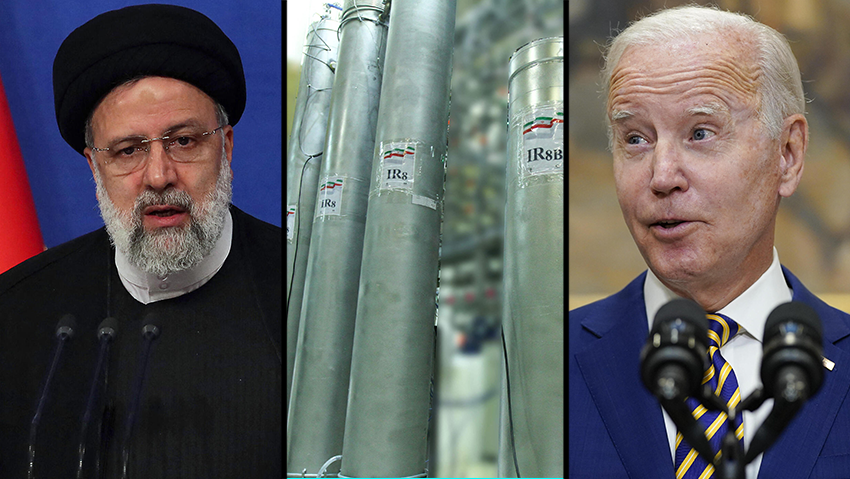
Iranian President Ibrahim Raisi and U.S. President Joe Biden (Photo: AFP, AP)
"In order to stimulate talks on the lifting of" American sanctions against Iran, "we welcomed the efforts of Omani officials and we exchanged messages with the other party through this mediator", he explained during his weekly press conference.
"The talks are continuing in this framework," he said.
Tehran and Washington have not maintained diplomatic relations since 1980 following the Islamic Revolution in Iran.
In recent days, the two capitals have denied media reports that they were close to reaching an interim deal to replace the 2015 Iran nuclear deal, from which the U.S. pulled out in 2018.
"There is no temporary agreement to replace the JCPOA (an acronym for the agreement) and such a thing is not on the agenda," Iran's mission to the UN said on Friday as quoted by Iranian state news agency IRNA. The White House also called the information that appeared in the press "false".
Tehran is seeking relief from sanctions applied by the United States since 2018, which are severely affecting its economy.
Oman's mediation also covers an exchange of prisoners, for which "negotiations are continuing", Kanani reaffirmed. "If the other side shows the same seriousness as us, we can achieve a result in the near future."
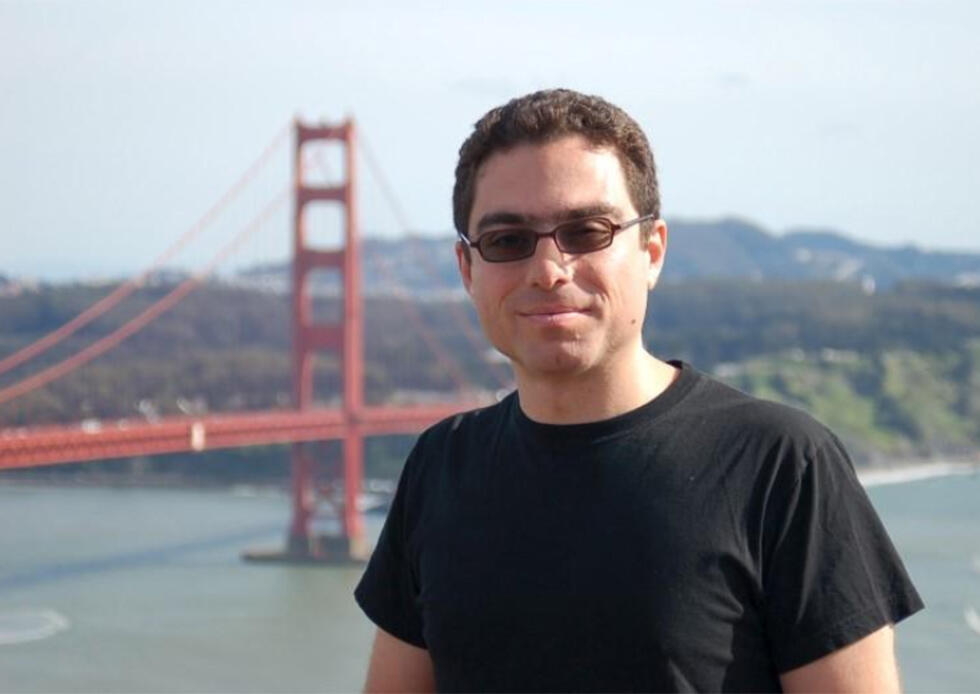
At least three Iranian Americans are being held in Iran, including businessman Siamak Namazi, arrested in October 2015 and sentenced to ten years in prison for espionage.
Siamak Namazi (Photo: Reuters)
For its part, Iran reported in 2022 the detention of "dozens" of nationals in the United States, some of whom are accused of having "diverted American sanctions" against Tehran.
In recent weeks, Iran has released six European prisoners and recovered an Iranian diplomat convicted of terrorism and imprisoned in Belgium.
In addition, Kanani denied the announcement by the White House that Iran was providing equipment to Russia to “build a drone factory”.
"We deny any accusations regarding the export of arms to Russia for use in the war against Ukraine," the spokesperson said.
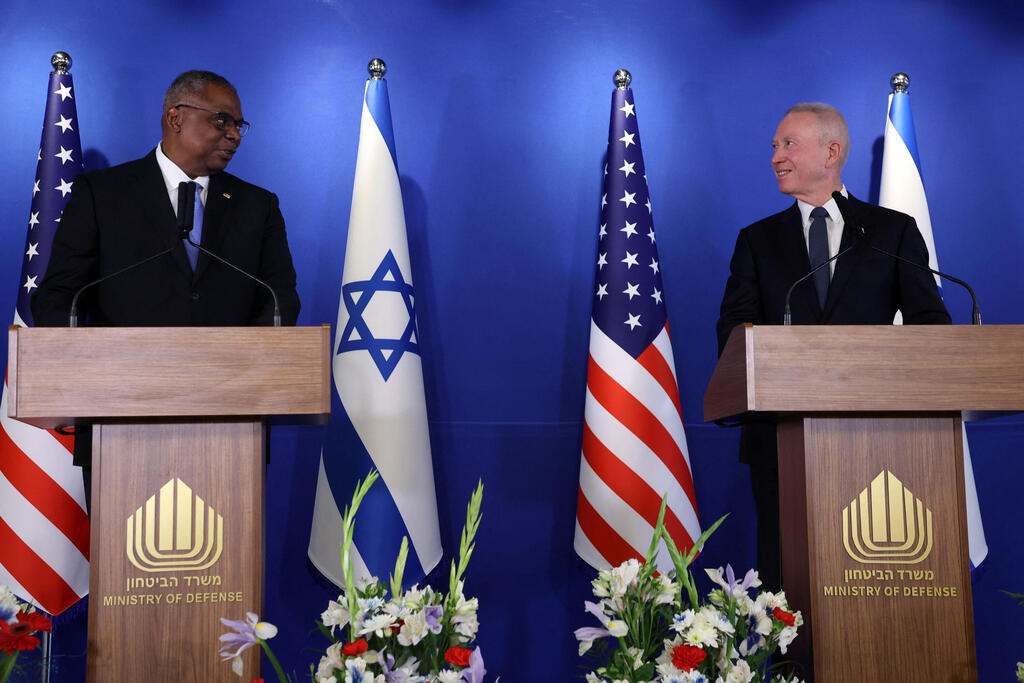
U.S. Defense Secretary Lloyd Austin and Defense Minister Yoav Gallant (Photo: AFP)
Israeli officials have warned that the prospect of Washington and Tehran reaching a new interim agreement on the latter's nuclear program was increasingly likely.
With this concern in mind, Defense Minister Yoav Gallant is set to meet with U.S. Defense Secretary Lloyd Austin on Thursday. The meeting will take place in an unspecified European country because Prime Minister Benjamin Netanyahu has prohibited his ministers from holding meetings with senior U.S. officials in the United States until he is invited to the White House, a traditional courtesy that U.S. President Joe Biden has yet to extend to him.
MONOPOLY CAPITALI$M
UBS is wealth management behemoth after Credit Suisse takeover
As a result of biggest banking deal since 2008 crisis, UBS will oversee $5 trillion in assets, giving it the lead position in key markets.
Published On 12 Jun 2023REUTERS 12 Jun 2023
UBS on Monday said it had completed its emergency takeover of embattled local rival Credit Suisse, creating a giant Swiss bank with a balance sheet of $1.6 trillion and greater muscle in wealth management.
Announcing the biggest banking deal since the 2008 global financial crisis, UBS Chief Executive Sergio Ermotti and Chairman Colm Kelleher said it would create challenges but also “many opportunities” for clients, employees, shareholders, and Switzerland.
The group will oversee $5 trillion of assets, giving UBS a leading position in key markets it would otherwise have needed years to grow in size and reach. The merger also brings to an end Credit Suisse’s 167-year history, marred in recent years by scandals and losses.
Having peaked at more than 82 Swiss francs ($90.11) in 2007, Credit Suisse, plagued by scandals and heavy losses, plumbed to ever-deeper lows, closing at less than one franc ($1.10) on Monday.
Credit Suisse shares closed up roughly one percent on their last day of trading, while UBS shares were also up around 0.8 percent.
The two banks jointly employ 120,000 people worldwide, although UBS has already said it will be cutting jobs to reduce costs and take advantage of synergies.
UBS announced a string of management changes including at Credit Suisse AG, which is now a subsidiary that will be run separately.
Of the more than 160 leaders who are being confirmed or appointed today at UBS, over a fifth are joining from Credit Suisse, a spokesperson for UBS said.
Andre Helfenstein, head of Credit Suisse’s domestic business, will remain in his role. UBS has said it is considering all strategic options for the unit.
Closing rush
UBS agreed on March 19 to buy the lender for a knockdown price of 3 billion Swiss francs ($3.3bn) and up to 5 billion francs ($5.5bn) in assumed losses in a rescue that Swiss authorities orchestrated to prevent a collapse in customer confidence from pushing Switzerland’s number-two bank over the edge.
On Friday, UBS finalised an agreement on the conditions of a 9 billion Swiss franc ($10bn) public backstop for losses from winding down parts of Credit Suisse’s business.
UBS sealed the takeover in less than three months – a tight timetable given its scale and complexity – in a race to provide greater certainty for Credit Suisse clients and employees, and to stave off departures.
Myths debunked
However, the deal, which saw the state bankroll the rescue, exposed two myths: that Switzerland was entirely predictable, and that the banks’ problems would not rebound on taxpayers.
“It was supposed to be the end of too-big-to-fail and state-led bailout,” said Jean Dermine, professor of banking and finance at the Institut Européen d’Administration des Affaires (INSEAD), adding that the episode showed this central reform after the global financial crisis had not worked.
The rescue also showed that even big global banks are vulnerable to bouts of bank panic, said Arturo Bris, professor of finance and director of the IMD World Competitiveness Center.
What’s more, the disappearance of Credit Suisse’s investment bank, which UBS has said it will seek to cut back significantly, marks yet another retreat of a European lender from securities trading, which is now largely dominated by United States firms.
Since the global financial crisis, many banks have pared back their global ambitions in response to tougher regulations.
Swiss regulator FINMA, which came under fire for its handling of the downfall of the country’s second-largest bank, said one of the most pressing goals for the newly merged bank was to quickly reduce the risk of the former Credit Suisse investment bank.
UBS is set to book a massive profit in second-quarter results after buying Credit Suisse for a fraction of its so-called fair value.
Ermotti has, however, warned that the coming months will be “bumpy” as UBS gets on with absorbing Credit Suisse, a process UBS has said will take three to five years.
Presenting the first snapshot of the new group’s finances last month, UBS underscored the high stakes involved by flagging tens of billions of dollars of potential costs and benefits, but also uncertainty surrounding those numbers.
New challenges
Possibly the first challenge for Ermotti, brought back to steer the merger, will be a politically fraught decision about the future of Credit Suisse’s “crown jewel” – the bank’s domestic business.
Bringing it into UBS’s fold and combining the two banks’ largely overlapping networks could produce significant savings, and Ermotti has indicated that as a base scenario.
But he will need to weigh that against public pressure to preserve Credit Suisse’s domestic business with its own brand, identity and, critically, workforce.
Analysts say public concerns the new bank will be too big – with a balance sheet roughly double the size of the Swiss economy – means UBS might need to tread carefully to avoid being exposed to even tougher regulation and capital requirements that its new scale would call for.
They also warn that uncertainty inevitably caused by a takeover of such scale can leave UBS struggling to retain staff and customers and that it remained an open question whether the deal can deliver value for shareholders in the long run.
SOURCE: REUTERS
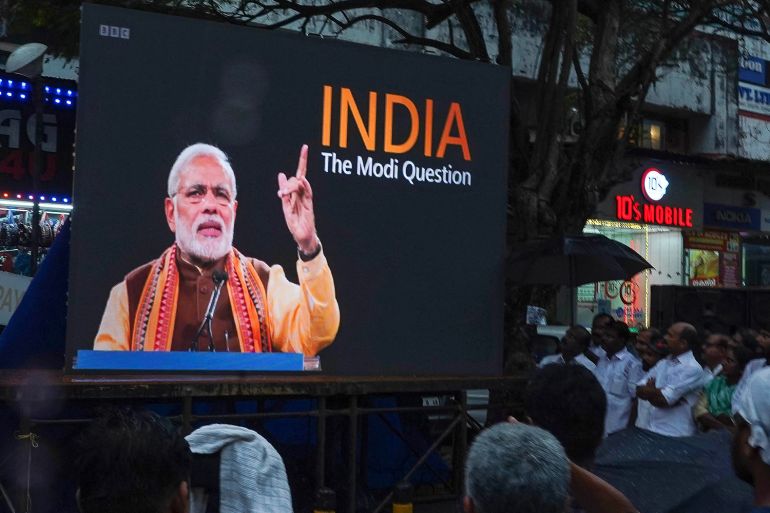
Rights groups to screen BBC film on Modi before White House visit Human Rights Watch and Amnesty International schedule a private screening in Washington, two days ahead of Indian PM’s state visit.
The two-part documentary, India: The Modi Question, focuses on Modi's leadership as chief minister of the western state of Gujarat during riots in 2002 [File: Arun Chandrabos/AFP]
Published On 13 Jun 2023
Two human rights groups have invited policymakers, journalists and analysts to a screening in Washington of a BBC documentary on Narendra Modi that questions the Indian prime minister’s leadership during the 2002 Gujarat riots, ahead of his state visit to the White House.
Human Rights Watch and Amnesty International have scheduled the private screening for June 20, two days ahead of Modi’s official state visit, hosted by United States President Joe Biden.
In announcing the screening on Monday, Human Rights Watch said it wanted it to serve as a reminder that the documentary had been banned in India.
The two-part documentary, India: The Modi Question, focused on Modi’s leadership as chief minister of the western state of Gujarat during riots in 2002 in which at least 1,000 people were killed, most of them Muslims. Activists put the toll at more than twice that.
Modi has denied accusations that he did not do enough to stop the riots, and a Supreme Court-ordered investigation found no evidence to prosecute him.
The Indian government had reacted angrily to the documentary, which was released in January, calling it a “propaganda piece” and blocked sharing of any clips from it on social media.
The White House last month defended Modi’s planned state visit when asked about human rights concerns in India. Press secretary Karine Jean-Pierre said Biden believes “this is an important relationship that we need to continue and build on as it relates to human rights”.
Advocacy groups have raised concerns over what they see as a deteriorating human rights situation in India in recent years under the Hindu nationalist Bharatiya Janata Party (BJP) of Modi, especially when it comes to its treatment of minorities, dissidents and journalists.
The government denies the allegations and says it works for the upliftment of all the groups.
Tax officials inspected offices of the BBC in New Delhi and Mumbai in February and the financial crime agency opened an investigation into the broadcaster in April over charges of violations of foreign exchange rules. A government adviser had said the inspection was not “vindictive”.
The BBC has previously said it stood by its reporting for the documentary, which was not aired in India, and that it “does not have an agenda”.
The police in Berlin banned a demonstration marking the Nakba on May 15, 2022
[File: Reuters/Christian Mang]
On June 6, the European Legal Support Center (ELSC) released a report on the suppression of Palestinian activism in the European Union and the United Kingdom. Focusing on the use of the International Holocaust Remembrance Alliance’s (IHRA) working definition of anti-Semitism, the document found that there had been “widespread restrictions of the right of assembly and freedom of expression” related to criticism of Israel.
In one of the three countries the report focuses on – Germany – it found violations that ranged from dismissal of employees on false charges of anti-Semitism to denials of public spaces for pro-Palestinian events to defunding of organisations. None of ELSC’s findings surprised me.
As a Palestinian resident of Germany, I have seen it all. I came to the country in 2015, having survived almost three decades of constant Israeli aggression on Gaza.
I carried the trauma of war, of the brutal Israeli siege, of the constant ethnic cleansing and dispossession of my people at the hands of the Israeli occupiers. And when I tried to speak up about it, about the suffering of my people, I was immediately shut down.
I was constantly warned to be careful what I was saying because it did not reflect “German values”. I was told that I am an anti-Semite, that I am a terrorist.
I tried to make my voice heard on German mainstream media, but to no avail. If I had tried to write for an Israeli newspaper, I would have had greater freedom to express myself than I ever did on German media outlets.
I even got taken to court for my Palestinian activism. In 2017, two Israeli activists and I protested against Knesset member Aliza Lavie speaking at a hasbara event called “Life in Israel – Terror, Bias and the Chances for Peace” at Humboldt University in Berlin. The German media smeared and falsely accused us of anti-Semitism, while the university made a criminal complaint against us for “trespassing”. We were immediately criminalised for our peaceful protest. But after three years of legal battles, we were vindicated – we won!
I have been to several other countries in Europe and I have never faced such hostility from the state for my Palestinian activism as I have in Germany. And I feel that the German state’s violent anti-Palestinianism is reaching new peaks with every passing year.
As ELSC’s report pointed out, the justification for Germany’s crackdown on anything that is critical of Israel is often alleged anti-Semitism. It equates Zionism with Judaism despite the fact that this false equivalence has been rejected by countless Jewish scholars and groups across the world.
This accusation has been actively used by both public and private institutions to suppress not only the Boycott, Divestment, Sanctions (BDS) movement but anyone who speaks up to pressure the Israeli regime to comply with international and human rights law and grant Palestinians their rights.
In 2019, the German parliament passed a resolution describing the BDS movement as anti-Semitic. This motion has been used to shut down, silence and censor pro-Palestinian activism, despite the fact that German courts have already ruled against anti-BDS actions by state authorities on several occasions, finding that they violate freedom of expression.
The false charges of anti-Semitism have also been used to target specific individuals and especially people of migrants backgrounds who stand ridiculously accused of “bringing anti-Semitism to Germany”.
In February 2022, German state-owned broadcaster Deutsche Welle fired seven Palestinian and Arab journalists for alleged anti-Semitic statements. Two of the journalists, Maram Salem and Farah Maraqa, challenged their defamation campaign and dismissal in court and won.
But the German authorities’ anti-Palestinianism goes beyond trying to suppress anti-Israel criticism. Their ferocious response to attempts by the Palestinian community to mark the Nakba – the word Palestinians use for their ethnic cleansing from their homeland – demonstrates that they aim to literally deny Palestinian existence in public space.
Last year, I physically experienced the full extent of what this means. After the Berlin police banned a rally to mark the Nakba and two courts upheld its decision, hundreds of Palestinians and their allies decided to take to the streets in small groups anyway. We wore kufiyahs to show our solidarity.
Despite our small numbers, police presence was overwhelming, with armoured vehicles deployed that reminded me of home under Israel occupation and colonisation.
Wearing a kufiyah and looking Palestinian, I was stopped by a dozen police officers. They asked for my ID, and one asked why I am wearing a kufiyah, saying that I was protesting and violating the ban. While objecting to being stopped, I was suddenly grabbed, attacked brutally, and detained. They almost dislocated my shoulder and I had to be hospitalised for it.
However, the psychological pain of what I experienced was much worse than the physical one. I was not only denied the opportunity to publicly mourn my people’s dispossession, but two days earlier, I – and other Palestinians and our allies – had also been banned from mourning Palestinian journalist Shireen Abu Akleh, who had been killed by the Israeli army.
This year, we tried again to commemorate the Nakba. We tried to mobilise the left, encouraging environmental, feminist and migrant groups to join us and ran the preparations on the slogan “Free Palestine from German guilt”.
But yet again we were banned.
Some groups defied the ban, carrying Palestinian flags and a banner saying “Existence is resistance” through the streets. A heavy police presence made sure that not even a small flash mob event could take place. And yet again they accused us of anti-Semitism to justify our erasure from public space.
Not only is this an unfounded allegation, but it also raises the question of why the German police – so worried about public display of anti-Semitism – is not banning racist and neo-Nazi groups, who actually hold anti-Semitic beliefs, from marching all across the country. For example, last year, just two months after we were banned from marking the Nakba, neo-Nazis were allowed to march through the city of Mainz; and it was not the police that dispersed them but a large crowd of anti-fascists.
The Palestinian community in Germany is one of the largest in Europe, but they are made invisible, regularly intimidated by the German police and institutions, put under surveillance, and dehumanised in the media as anti-Semites and potential terrorists.
These tactics aimed at depoliticising Palestinians can affect their residency status, job search, or even accommodation.
One has to wonder what these “German values” are if in their name, Palestinians are systematically mistreated in this brutal way. One has to wonder if they are not simply a reflection of white supremacy, enabling the German state to extend Israeli apartheid against Palestinians onto its own territory.
This has taken a toll on Palestinian Germans. Many of them are fearful to speak up; others are exhausted by the constant struggle they have had to lead to claim the right of free expression that everyone else enjoys in Germany. Palestinian intellectuals have been attacked publicly and stigmatised, which has often affected their careers.
And yet, Palestinians in Germany continue to resist state repression and silencing. There is a young generation of Palestinians who no do not want to comply with German state diktats just so they feel they fit in. They do not stay silent in the face of humiliation and pressure. Organisations like Palästina Spricht (Palestine Speaks) are not letting any act of repression go by without a public reaction and challenge.
Criminalising Palestinians for speaking up for Palestinian rights, while neo-Nazis are allowed to raise their fascist slogans in public, is Germany’s moral failure. It is time Palestine is freed from German guilt. It is time Germany stops demanding that Palestinians pay for its historical sins and embraces the Palestinian struggle for justice and liberation. The views expressed in this article are the author’s own and do not necessarily reflect Al Jazeera’s editorial stance.
Majed Abusalama Majed Abusalama is an award winning journalist, scholar, campaigner and human rights defender from Palestine. Majed Abusalama is a PhD candidate in Critical Human Geography and Regional Studies at Tampere University (Finland) and a contributing writer to Jadaliyya, Aljazeera English, MiddleEastEye and others. He grew up in Jabalia refugee camp in Gaza and is now based in Berlin. His research focuses particularly on complex vulnerabilities, and communal/individual ways of dealing and living with constant violence, death, and war. He serves as an international director of We Are Not Numbers organisation in Gaza.
Banned anthem 'Glory to Hong Kong' gets global airing on protest anniversary
Rallies mark the first tear gas attack on protesters outside the city's legislature in 2019
By Raymond Cheng, Wu Sui Lam and Amelia Loi for RFA Cantonese, Chen Zifei for RFA Mandarin 2023.06.12
Dozens of people sang “Glory to Hong Kong” outside the main railway station in Taipei, Taiwan, on Monday.
Credit: Zhong Guangzheng
Exiled protesters have been singing the banned anthem 'Glory to Hong Kong' in cities around the world to mark the fourth anniversary of the start of the 2019 mass protest movement, which falls on Monday.
Dozens of people gathered in the democratic island of Taiwan on Monday in a flash-mob performance outside Taipei's main railway station, with many more singing along in the surrounding crowd.
Several other flash mobs gathered to sing the song across Taiwan, including in the central city of Taichung, and Taipei's Ximending district.
Symbol of resistance
It was banned in 2020 as Beijing imposed a draconian national security law on the city, and the Hong Kong government last week applied for a High Court injunction to prevent its performance or dissemination in the city, including online.
Hong Kong artist Kacey Wong, who took part in the Taichung event, said the song is a symbol of ongoing resistance by Hong Kongers.
"The Hong Kong government banned 'Glory to Hong Kong,' and wants to ban anyone from playing it, and suddenly, a whole lot of people are buying this song on iTunes," Wong said. "Hong Kongers scattered all over the world are using it as a means of resistance."
Sky Fung, secretary-general of the exile group Hong Kong Outlanders, said the song belongs to the people of Hong Kong.
"By [singing it], we want to encourage or remind our friends in Taiwan in the hope that what happened in Hong Kong won't be repeated in Taiwan."
"Everyone knows that Hong Kong was once one of the freest places, yet today we don’t even have the freedom to sing this song," Fung said.
Several people in the crowd had luggage with them, and appeared to be visiting the island. They declined to be photographed or interviewed for fear of political reprisals.
“Glory to Hong Kong” calls for freedom and democracy rather than independence, but was nonetheless deemed in breach of the law due to its "separatist" intent, officials and police officers said at the start of an ongoing citywide crackdown on public dissent and peaceful political activism.
Show of solidarity
A Taiwan resident who gave only the surname Sun said he had come along to show solidarity with Hong Kongers.
"Today we are standing up to support the people of Hong Kong, who have suffered a lot in the past few years, to the extent that they can't even sing [certain songs]," Sun said. "I think the whole world finds the Hong Kong government's lack of human rights [protections] unacceptable."
Fu Tong, a Hong Konger who attended the event, said Hong Kongers overseas need to use their voices to speak out for those who can't, who remain in Hong Kong.
"Some people say we are for Hong Kong independence, but I want to say that we are in pursuit of freedom and democracy, just like you," Fu Tong said. "We weren't suppressed because we wanted independence but because we wanted freedom and democracy."
Demonstrators in Toronto, Canada, rally Sunday to commemorate the fourth anniversary of the 2019 mass protest movement in Hong Kong. Credit: Hu Huilan
He said Taiwan's 23 million people should take heed and not believe the Communist Party's proposal to "unify" Taiwan using the "one country, two systems" model it uses to rule Hong Kong.
"Don't believe China's promises, don't believe in 'one country, two systems', and please use your votes to protect Taiwan," he said.
London, Toronto protests
In London, protesters gathered in Parliament Square at the weekend to mark the fourth anniversary of the 2019 protest movement, and again in Piccadilly Circus on Monday evening to sing "Glory to Hong Kong," which is regarded by many as Hong Kong's "true national anthem."
Protesters in Toronto also took up the anthem, with protesters calling on people not to forget the protest movement in exile.
"A lot of Hong Kongers took to the streets peacefully in 2019 to express their demands, but sadly the government didn't respond to their calls," a participant who gave only the nickname Jenny told Radio Free Asia.
"Four years have gone by, and the political crackdown has only gotten more serious ... so Hong Kongers living in Canada have a responsibility to turn out so as not to forget June 12, and also to think about what we can do in the future," she said.
The use of tear gas and other forms of violence to contain the June 12 protests, which began peacefully outside the Legislative Council, was condemned by rights group Amnesty International at the time as a violation of international law.
Since then, more than 10,000 people have been arrested under public order and "rioting" offenses for taking part in the movement, of whom around 2,300 have been prosecuted.
A Hong Konger who attended the Toronto rally, who gave only the nickname Tom, said this is his second anniversary rally.
"My heart is heavy, because the political environment in Hong Kong is getting more and more restrictive," he said. "I have a responsibility ... to let everyone know that we haven't given up, and that our ultimate goal is to restore Hong Kong [to the way it used to be]."
Translated by Luisetta Mudie. Edited by Malcolm Foster.
Starbucks denies union claim it is banning Pride decorations in stores
THE HILL- 06/14/23 10:45 AM ET Pedestrians pass a Starbucks in the Financial District of Lower Manhattan, Tuesday, June 13, 2023, in New York. Starbucks is denying union organizers’ claims that it banned LGBTQ+ Pride displays in its U.S. stores after Target and other brands experienced backlash. The Seattle coffee giant says there has been no change to its policy and it encourages store leaders to celebrate Pride in June.
(AP Photo/John Minchillo)
Starbucks denied allegations from its workers’ union on Tuesday that the company is banning Pride decorations in stores.
“There has been no change to any policy on this matter and we continue to encourage our store leaders to celebrate with their communities, including for U.S. Pride month in June,” Starbucks spokesperson Andrew Trull said in a statement, according to NBC News.
“We’re deeply concerned by false information that is being spread especially as it relates to our inclusive store environments, our company culture, and the benefits we offer our partners,” he added.
However, Starbucks Workers United has maintained that it is hearing reports from stores across the country that workers have not been allowed to decorate for Pride Month or that Pride flags have been taken down.
“This is contrary to previous years when workers were allowed, and even encouraged, to put up pride decorations without incident,” they said in a statement posted to Twitter on Tuesday.
The group accused Starbucks of engaging in an “anti-union campaign to intimidate workers and make them feel unwelcome in their own workplace.”
“Starbucks claims to be a true ally but they refuse to stand up for workers, especially during a time when LGBTQIA+ people are under attack,” they added.
The allegations come as several companies have faced backlash from conservatives over their Pride Month activities or other acts of support for the LGBTQ community.s
Target pulled some of its Pride merchandise and moved Pride displays to the back of stores in some southern states last month, after encountering “threats impacting our team members’ sense of safety and wellbeing while at work.”
Stores in at least five states were evacuated last weekend, after receiving bomb threats over the company’s Pride collection.
Bud Light, owned by Anheuser-Busch, also faced a boycott by conservatives earlier this year, after partnering with transgender influencer Dylan Mulvaney.
Starbucks accused of caving to right-wing by banning LGBTQ+ decorations in Pride month
David Edwards June 13, 2023, Workers at the Willow Lawn Starbucks in Richmond, Virginia show their support for unionization. The store's employees voted 19-0 to form a union on April 19, 2022. (Photo: @_devinonearth/Twitter)
Starbucks was accused of "caving" to right-wing activists by banning Pride decorations this week.
On Tuesday, Starbucks Workers United revealed that the corporation had moved against LGBTQ+ symbolism.
"In the middle of Pride Month, Starbucks BANS Pride decorations in stores across the United States," the union said on Twitter. "In union stores, where Starbucks claims they are unable to make 'unilateral changes' without bargaining, the company took down Pride decorations and flags anyway - ignoring their own anti-union talking point."
The organization noted that Starbucks employs "many queer workers, but management has failed to materially support the LGBTQ+ community."
The reported move comes after Target gave in to criticism by conservatives and removed some Pride merchandise. Target stores in at least five states received bomb threats amid the controversy.
The New Republic called Starbucks' decision to remove Pride decorations "a stunning cave to far-right anti-LGBTQ fury."