Wednesday, June 14, 2023

Insider Reaches Deal To End Longest Strike In Digital Media History

Lydia O'Connor
Wed, June 14, 2023 

The Insider Union has reached a tentative agreement with management at the news site Insider, ending the longest strike in digital media history, the union’s bargaining unit announced Wednesday.

“Our strike is over ― we’re going back to work tomorrow!” read a tweet from the account of the unit, which consists of about 250 people.

Staff at Insider, organized through the NewsGuild, have been on strike for 13 days. Negotiations with the site’s management had fallen apart after more than two years of bargaining over increased health care costs, salary minimums and various other workplace conditions.


The three-year deal they reached Wednesday includes a $65,000 salary minimum, immediate raises for most unit members, a layoff moratorium through the end of 2023, a “just cause” requirement for disciplining employees, and a commitment from management to reimburse more than $400,000 in health care costs over the course of the agreement. The tentative contract now goes to the full unit for a vote on ratification.

“The deal we won today shows the power of solidarity,” Dorian Barranco, a member of the Insider Union bargaining committee, said in a statement. “We came together and refused to settle for anything less than what we were worth, and our collective power won a contract that will resonate in newsrooms across the country. It’s never an easy decision to go on strike, but today’s victory proves it was well worth it. We’re excited to get back to work with our new wins in hand.”

Increased health care costs were a major point of tension during bargaining. Last November, the NewsGuild filed an Unfair Labor Practice charge against Insider with the National Labor Relations Board, which found merit with the complaint in May. The complaint alleged that management had unlawfully changed workers’ health care coverage, resulting in increased costs for unit members.

Up until now, striking staffers have encouraged readers not to cross the digital picket line by visiting Insider or clicking on any of the site’s stories. The non-unionized staffers who remained at work, meanwhile, recycled old stories and published unfinishedcontent.

At one point, Insider’s editor-in-chief, Nicholas Carlson, was captured on film biking around Brooklyn, New York, and ripping down pro-union fliers that called him out with the headline “Have You Seen This Millionaire?”


The Ugly Insider Battle Ends With a New Union Deal


Corbin Bolies
Wed, June 14, 2023 

Monica Schipper

The union at Insider, the digital news outlet dedicated to business and tech news, has reached a deal with its management, ending a historic 13-day strike that almost completely shut down the newsroom after the company laid off dozens of employees.

“Insider is a great place to work, and we're proud that the CBA formalizes many of our existing practices, policies, and benefits, including freedom to work from anywhere in the US, top of the market pay, 16 weeks of parental leave, and a commitment to building a diverse and equitable workplace,” the company’s president Barbara Peng wrote in an email to employees on Wednesday. “Over the past two years we have worked diligently to develop a contract that works for our union members, as well as the entire Insider team. That's why we're extending some great new benefits to all of our employees as well, including funds to put towards mental health and prescription costs.”

Staffers will return to work on Thursday, the guild announced.

“To those of you coming back: Welcome back,” editor-in-chief Nicholas Carlson emailed staffers. “We missed you. Our audience missed you. Congratulations on your excellent CBA.”

He later added: “We have bright days ahead.”

The tentative deal includes a $65,000 salary floor, a 3.5 percent immediate raise for those who haven’t received one this year (with a 3.75 percent raise for all employees next year), and a commitment to not lay off any more employees for the rest of 2023. The agreement also addressed the Insider’s decision to change its healthcare providers, a charge the union claimed was illegal, by setting up a reimbursement account for employees that will pay out $2,200 over three years to spend on mental health and prescription costs.

Inside the Collapse of Insider’s Much-Hyped D.C. Team

As part of the contract, the union also agreed to settle its unfair labor practice charges filed with the National Labor Relations Board over the company’s move to switch its healthcare provider from United Healthcare to Cigna, a decision staffers said made their prescription costs skyrocket.

The road to ending the longest open-ended strike in online news was not so simple.

The agreement comes after the strike was called on June 2, following weeks of bargaining over both the union’s long-stalled contract and the company’s decision in April to lay off dozens of staffers, including 60 unit members. The two sides eventually agreed to a tally of 44 staffers getting laid off, including some not originally on the proposed list, just before the strike began.

The first few days of the strike were marred by an effective stalemate between the union and the company, with employees publicly calling for the outlet to come to the table at all. Jessica Liebman, the company's chief people officer, told staffers on June 6 that some points on professional development and wage issues had been agreed to, but conceded it was not enough.

“We still have a ways to go,” she wrote.

Eventually, the two sides moved to off-the-record bargaining sessions, hashing out the terms of the deal—and leaving striking staffers demanding for more money instead. The union also launched a strike publication, aptly titled “Business Outsider,” which gave some reporters the chance to publish pieces related to the strike—including getting the White House to praise the striking workers and grilling Semafor editor-in-chief Ben Smith.

The strike brought out all forms of support—and criticism from certain media villains. Elon Musk urged workers, perhaps facetiously, on Wednesday to continue striking (“Fight on, comrades!”), and Insider foe Dave Portnoy—whose lawsuit against Insider over two stories alleging Portnoy committed sexual misconduct was dismissed last year—tried to crash the union’s picket line.

Still, the solidarity seemed to waver at times. The union repeatedly warned staffers against leaking to the media, including after a video of union members confronting Carlson as he took down union-made posters, featuring his photo, that were plastered around his Brooklyn neighborhood. The video was posted in the union’s Slack channel last week.

“I think we should think very carefully before sharing the Nich video publicly,” a union member wrote in the chats reviewed by The Daily Beast. “Ultimately, we do need to work together productively as a newsroom after this is all over, rebuild trust, etc. Putting this out there may make that harder. Just something to think about.”

"Plz dont leak the video just [because] you want it out there,” another member wrote. “I know we’ve had some issues with leaks and that’s really not cool.”

Some staffers seemed not to care. The video ended up in the New York Post on Tuesday, prompting the company to declare Carlson was a “big boy” who was “not annoyed at the union — after all, it was only a handful who participated in the stunt.”

The leak enraged a plethora of staffers, who argued on Slack that it diminished their fight and risked eventual consequences with management. Some wondered if they should reach out to Carlson personally to apologize for the seemingly unauthorized leak.

“This is a super shitty thing tohave [sic] happened and if you want to leak stuff, you should honestly just log out of the union slack and go scab instead because it’s less harmful than this kind of shit,” a union member wrote. “In terms of damage control, what we’re worried about here is nich’s feelings and working with him moving forward.”

The leak seemed not to have impacted the union’s marathon, on-the-record bargaining sessions, with both unit chair Emma LeGault and Liebman writing staffers early Wednesday to announce a deal was imminent. After hours of bargaining throughout the day, the deal was announced just before 4 p.m. ET.

The strike was the first for a U.S. publication owned by German media empire Axel Springer, and the new deal becomes the first union contract since the company’s entry into the U.S. media market. Fellow Axel Springer-owned outlet Politico is also currently negotiating a contract.

The work stoppage at Insider, which is run by famed investor Henry Blodget, preceded other headline-grabbing walkouts like those at a number of Gannett newspapers (including the Palm Beach Post, Florida Times Union, and Arizona Republic), which occurred during the company’s shareholder meeting earlier this month.

A slumping economy and declining advertising revenues have resulted in industry-wide tumult, often culminating in layoffs, cuts to employee benefits, and other belt-tightening moves. In response, more and more media staffers have walked out in protest. Unionized employees at The New York Times, NBC News, and Reuters held walkouts over the last year, with the latter agreeing to a contract about a month after voting for a strike.

NewsGuild President Jon Schleuss told The Daily Beast on Monday that the organization has seen 27 one-day-or-longer walkouts so far this year, a marked jump from 21 labor stoppages in all of 2022.

Tentative US West Coast port contract deal reached, union and employers say


A container ship is docked at the Ports of Los Angeles and Long Beach, California in this aerial photo

Lisa Baertlein and Kanjyik Ghosh
Wed, June 14, 2023 

(Reuters) -The Longshore union and employers of 22,000 dockworkers at U.S. West Coast ports on Wednesday said they have reached a tentative deal on a new six-year contract, ending 13 months of talks and easing supply chain worries.

The deal was reached with assistance from Acting U.S. Labor Secretary Julie Su, the International Longshore and Warehouse Union (ILWU) and the Pacific Maritime Association (PMA) employer group said in a joint statement.

President Joe Biden, who dispatched Su to the negotiations in San Francisco earlier this week, said she "used her deep experience and judgment to keep the parties talking, working with them to reach an agreement after a long and sometimes acrimonious negotiation."

The agreement, covering workers at ports stretching from California to Washington State, is subject to ratification by both parties. The ILWU and PMA declined to provide details on the deal.

"The tentative agreement delivers important stability for workers, for employers and for our country's supply chain," Su said in a statement on Wednesday.

PMA President James McKenna and ILWU International President Willie Adams said in a joint statement: "We are also pleased to turn our full attention back to the operation of the West Coast Ports".

Workers covered by the agreement are based at some of the nation's busiest seaports, including Los Angeles/Long Beach - the busiest ocean trade gateway in the United States. They have been working without a contract since July 1 and have been seeking a share of pandemic cargo surge profits and retroactive pay.

The tentative deal comes as retailers like Walmart and Target are starting to land merchandise for the critical back-to-school, Halloween and Christmas retail shopping seasons. Manufacturers, automakers and food producers who import or export goods also rely on the Pacific Coast ports.

West Coast port market share dipped after some customers shifted cargo to rival East Coast and Gulf Coast ports to avoid potential labor disruptions during the negotiations. It also comes as drought conditions affecting the Panama Canal make it more difficult and expensive to send goods from China to those alternate ports.

The agreement "brings the stability and confidence that customers have been seeking," Port of Los Angeles Executive Director Gene Seroka said on Twitter. "We look forward to collaborating with our partners in a renewed effort to bring back cargo."

(Reporting by Lisa Baertlein in Los Angeles and Kanjyik Ghosh in Bengaluru; Editing by Christopher Cushing, Michael Perry & Simon Cameron-Moore)
RIP
US scientist who discovered whales can sing dies aged 88

Roger Payne has died aged 88
(Christopher Johnson/Ocean Alliance via AP)

WED, 14 JUN, 2023 - 
PATRICK WHITTLE, ASSOCIATED PRESS

A US scientist who spurred a worldwide environmental conservation movement with his discovery that whales could sing has died aged 88.

Roger Payne made the discovery in 1967 during a research trip to Bermuda when a Navy engineer provided him with a recording of curious underwater sounds he documented while listening for Russian submarines.

Mr Payne identified the haunting tones as songs which whales sing to one another.

He saw the discovery of whale song as a chance to spur interest in saving the giant animals, who were disappearing from the planet.

Mr Payne produced the album Songs Of The Humpback Whale in 1970. The surprise hit record galvanised a global movement to end the practice of commercial whale hunting and save the whales from extinction.He had a presence and a way of connecting to people that led them to dedicating their lives to protecting whales and our planet Earth

Mr Payne recognised from the start that whale song represented a chance to get the public interested in protecting an animal previously considered little more than a resource, curiosity or nuisance.

He told Nautilus Quarterly in a 2021 interview that he first heard the recording in the loud engine room of a research vessel and knew almost instantly that the sounds were indeed whales.

“In spite of the racket, what I heard blew my mind. It seemed obvious that here, finally, was a chance to get the world interested in preventing the extinction of whales,” he told the magazine.

Mr Payne, who died of pelvic cancer, lived in South Woodstock, Vermont, with his wife, the actress Lisa Harrow. Funeral arrangements have not yet been made, Ms Harrow said.

Mr Payne had four children from a previous marriage to zoologist Katy Payne, with whom he collaborated.

The two used primitive equipment in the late 1960s to record the sounds of humpback whales, which sometimes sing their eerie, complex songs for longer than 30 minutes at a stretch.

The impact of the whale song discovery on the nascent environmental movement was immense. Many anti-war protesters of the day took on saving animals and the environment as a new cause, and the words “save the whales” became ubiquitous on bags and bumper stickers.

Whale songs would enter the popular imagination via everything from a 1971 episode of The Partridge Family to a 1979 issue of National Geographic that included a flexi-disc with excerpts from Songs Of The Humpback Whale. It remains the best-selling environmental album in history.


Mr Payne founded Ocean Alliance in 1971 to advocate for the protection of whales and dolphins.

The organisation operates to this day in Gloucester, Massachusetts.

It has played a role in watershed moments in the history of whale protection, such as the 1972 passage of the Marine Mammal Protection Act by the US Congress and the 1982 commercial whaling moratorium passed by the International Whaling Commission.

The world has lost a giant of environmental conservation with Mr Payne’s death, said Iain Kerr, the chief executive officer of Ocean Alliance and a long-time collaborator with Mr Payne, who retired two years ago.

“He had a presence and a way of connecting to people that led them to dedicating their lives to protecting whales and our planet Earth,” Mr Kerr said.

Mr Payne was born in New York City and educated at Harvard University and Cornell University, where he received his doctorate. Early in his career as a biologist, he studied bats and birds.

He met Ms Harrow in 1991 at a rally for whale protection in Trafalgar Square, London. They married within 10 weeks of meeting.

“The way his mind worked was a constant joy,” Ms Harrow said. “He was constantly seeking answers, to seemingly constant questions.”

Killer Shark Mummy? Egyptian scientists preserve shark that allegedly killed Russian tourist in Hurghada

The New Arab Staff
London
14 June, 2023

Egyptian scientists are taxidermizing the tiger shark blamed for a fatal attack on a Russian at the Red Sea resort of Hurghada


Tiger sharks are just one of the many species of predatory sharks that swim in the Red Sea's clear waters [Getty]

The tiger shark allegedly responsible for the mauling to death of a Russian man in the Egyptian Red Sea resort of Hurghada will be preserved and displayed in a museum.

Media reports claimed that the killer shark was being "mummified".

Specialists from Egypt’s National Institute of Oceanography and Fisheries (NIOF) decided that the specimen was worthy of display after they conducted an autopsy on the fish.

The tiger shark was female, pregnant and almost 11 feet long, the autopsy revealed. Contrary to initial reports, it is unknown whether the shark contained human remains.

RELATED
Journalist touts jaws-dropping Egypt shark attack conspiracy
MENA
Thaer Mansour

The shark was caught as part of a retaliatory hunt, one that has been criticised by experts. There is no way of establishing whether the shark being taxidermised is the same animal that fatally attacked the Russian tourist – or indeed if the killer shark has even been caught.

The fishermen claim to have caught the shark at the scene of the attack near the Elysees Dream Beach Hotel and dragged it to shore. However, this cannot be verified. One video even showed an Egyptian fisherman punching a dead shark on the deck of a boat.

Footage then emerged of a team of specialists from NIOF preparing the tiger shark for taxidermy, not for mummification initial reports suggested.
The attack has caused concern about the safety of tourists along Egypt’s Red Sea coast, resulting in the temporary closure of a 60km stretch of beaches from El Gouma to Soma Bay.

The highly publicised capture of the shark claimed to be behind the tourist's death has led to the reopening of the beaches and has served to alleviate fears among tourists and locals.

RELATED
Are shark attacks in the Red Sea a growing problem?
Environment and Climate
Mohamed Ismail

Shark attacks in Egypt are on the rise, with experts believing it could be the result of overfishing and the irresponsible expansion of tourists resorts along the Red Sea coast, where shark diving is a hugely profitable endeavour.

In July last year, two women were killed in shark attacks south of Hurghada. In 2020, a shark attacked a 12-year-old Ukrainian boy, who lost an arm and an Egyptian tour guide in Sharm El Sheikh, who lost his leg.

Previously, in 2010, a spate of shark attacks killed one tourist and maimed several others at the same location.

The New Arab reached out to the Egypt's National Institute for Oceanography and Fisheries but received no reply at the time of publication.
Collapse of a mountain peak in Austria amid thawing permafrost triggers a huge rockfall

By Laura Paddison and Sophie Tanno, CNN
Published, Wed June 14, 2023


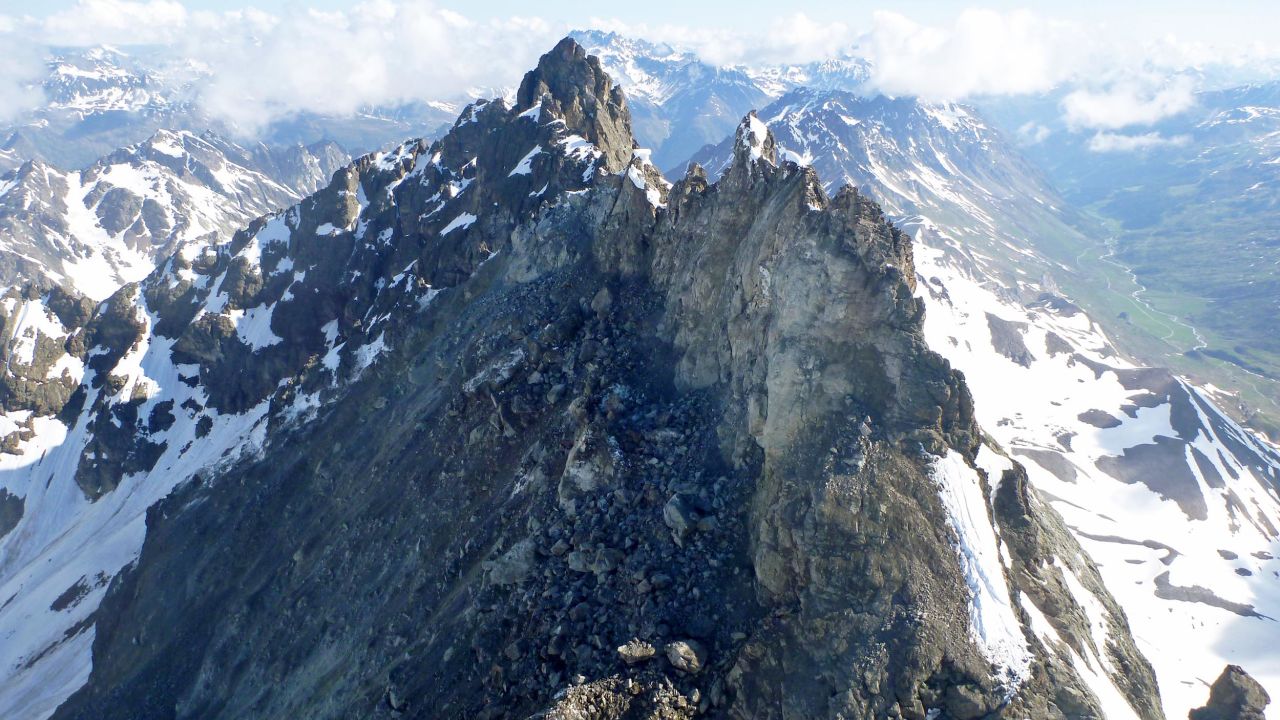
Fluchthorn Mountain, Austria, after the rockfall which took place on Sunday, June 11.Bettina Sax/Land Tirol

CNN —

Part of the summit of a mountain in the Austrian state of Tyrol has collapsed, sending more than 100,000 cubic meters of rock crashing into the valley below and triggering mudslides.

Rocks started falling Sunday from Fluchthorn, a nearly 3,400 meter (11,155 foot) mountain in the Silvretta Alps on the border between Switzerland and Austria, in an incident state geologists have said was caused by thawing permafrost.

No one was injured by the rockfall, according to Alpine police.

In a reconnaissance flight over the affected area, state geologists made initial assessments of the amount of fallen rock, but they say these may well be conservative as it will take time to get a more accurate picture.

“This is a relatively large incident, we’re talking about at least 100,000 cubic meters (around 3.5 million cubic foot) of rock that has fallen off, likely more than that,” said Thomas Figl, a state geologist, in a video produced by the Tyrolean state government.

The geologists have pinned the collapse on the thawing of permafrost, a long-term frozen layer of soil and rocks. Most often associated with Arctic regions, permafrost is also found high in the European Alps.

“We can be relatively sure about the cause of this incident: permafrost. The ice is the glue of the mountains and that ice has been thawing over a long period of time due to climate change. That then causes the results that we see here,” Figl said.

When permafrost thaws it can have a destabilizing effect, said Marcia Phillips, permafrost research group leader at the WSL Institute for Snow and Avalanche Research in Switzerland.


Evacuations ordered as rock teeters over Swiss village


“Water can penetrate deep into rock masses through newly opened clefts, which were previously plugged with permafrost ice,” she told CNN, explaining that this can lead rocks to fracture.

There isn’t enough data to say whether rockfalls have increased in recent years, as it is usually only large events that are well-documented, said Phillips. Scientists rely on information from the public, she added, and many rockfalls happen in remote areas.

But, as human-caused climate change pushes up global temperatures, leading to thawing permafrost and melting snow and glaciers, rockfalls in this region look set to become more common.
Enter your email to sign up for CNN's "Meanwhile in China" Newsletter.
close dialog

“Along with rising permafrost temperatures, loss of ice and higher ground water contents we expect an increase in slope movements and rockfalls at elevations where permafrost is found in the Alps,” Phillips said.

Rockfalls can cause huge disruption to those living in the shadows of these mountains.

In May, the residents of the Swiss village of Brienz, in the region of Graubünden near Davos, were forced to evacuate after warnings that their homes could be crushed by nearly 2 million cubic meters of rocks falling from the mountain above it.

The rocks haven’t yet hit the village, but residents are unable to return. The past few days have seen a dramatic increase in activity, with a lot of rocks falling, Christian Gartmann, a member of the crisis management board for the region that includes Brienz, told CNN. “It’s very dangerous there, we have a lot of rocks coming down,” he said.
UK Amazon warehouse workers extend strike for another 6 months

99% of workers voted in favor of extending protest over pay dispute, says GMB union


Burak Bir |14.06.2023 - 


LONDON

Hundreds of workers at Amazon's fulfillment center in central England will extend their strike for another six months, the GMB union announced on Wednesday.

Amazon workers at the fulfillment in Coventry province, who are already on their 19th day of strike over a pay dispute, will continue for another six months after 99% of them voted in favor of extending the protest, the trade union said in a statement.

On Jan. 25, Amazon workers at the Coventry warehouse went on strike for the first time in the UK after rejecting the company's 50 pence per hour raise offer.

Announcing the first strike of the workers, GMB senior organizer Amanda Gearing had said that they were set to "make history on 25 January, becoming the first-ever Amazon workers in the UK to go on strike."

Meanwhile, a group of striking workers traveled to London and gathered at Parliament Square to make their voices heard.

The GBM union said on Tuesday that Secretary of State for Business and Trade Kemi Badenoch "has been invited to meet striking Amazon workers as they head to Parliament tomorrow."
ANTI-ABORTION KILLS
Poles protest restrictive abortion law after pregnant woman dies

By AFP
Published June 14, 2023

Demonstrators carried placard denouncing the right-wing government that brought in the law -
Copyright POOL/AFP Kay Nietfeld

Several thousand people took to streets in Poland Wednesday to protest a near-total ban on abortion that they blame for a new case of a death of a pregnant woman.

Women rights groups organised gatherings in more than 50 Polish towns and cities, with protesters chanting “disgrace” and carrying pictures of the victim, 33-year-old Dorota Lalik.

Lalik died in a hospital in Nowy Targ, southern Poland on May 24, three days after having been admitted there when her waters broke.

She died of septicaemia after her 20-week-old foetus died in the womb, her family said in a statement.

The existing law does still allow the termination of a pregnancy if a woman’s life is in danger.

But the woman’s family said the hospital had not done the necessary examination in time, nor informed them that her life was in danger.

“The nurses told her to lie down with legs above her head because they said it would let the waters return,” her husband told a Polish daily Gazeta Wyborcza.

“No one mentioned that you could induce a miscarriage and save Dorota, as the chances of the child surviving were slim,” Marcin Lalik said.

– ‘Everything is political’ –

Prosecutors have opened an investigation into Lalik’s death. They are already looking at two similar cases of pregnant women who died in hospital after the death of the foetus they were carrying.

In 2021, after a pregnant 30-year-old mother from Pszczyna died, her family blamed doctors’ “wait-and-see attitude”.

A year later, a 37-year-old woman died in Czestochowa, a few weeks after she lost 12-week-old twin foetuses.

Questioned over the effects of the restrictive abortion ban, Polish Prime Minister Mateusz Morawiecki warned against “politicising” the case of Dorota Lalik.

But to Katarzyna Kotula, a New Left lawmaker who attended the protest in Warsaw, “everything is political when you are a woman in Poland.”

“Particularly political, unfortunately, is a woman’s pregnancy,” she told AFP.

“Because of political decisions, women are dying in Polish hospitals — and others are simply afraid of getting pregnant.”

Also protesting was 40-year-old Julia Cieslak, bearing a banner that read: “Stop killing us”.

She argued that the law had a chilling effect on doctors.

“Out of fear of the consequences, or some personal worldview, they contribute to the young women, young mothers dying in Poland,” Cieslak told AFP.
Adapting African Crops and Investing in Heathy Soils in Response to Climate Change


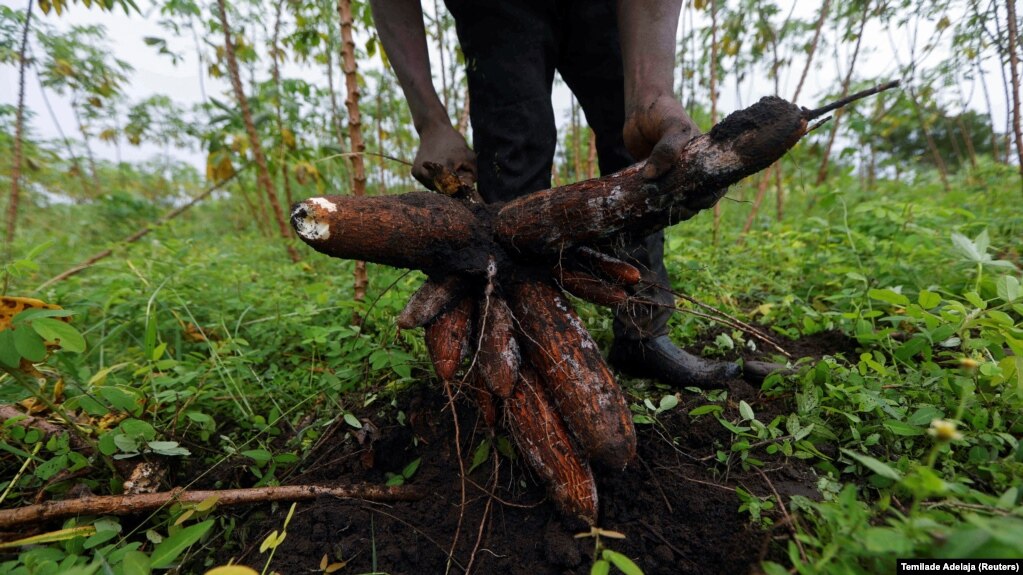
A farmer pulls out cassava during a harvest on a farm in Oyo, Nigeria

The population of sub-Saharan Africa is projected to double by 2050 according to the United Nations. That poses urgent challenges in terms of food security.

The population of sub-Saharan Africa is projected to double by 2050 according to the United Nations. That poses urgent challenges in terms of food security.

In early May, the U.S. State Department's Office of the Special Envoy for Global Food Security organized a panel discussion during the AIM for Climate Summit, to discuss the Vision for Adapted Crops and Soils, otherwise known as VACS. The initiative, launched in collaboration by the U.S. government, the African Union and the UN’s Food and Agriculture Organization seeks to adapt agricultural systems – starting with Africa – to the anticipated challenges of climate change. VACS focuses on the development of climate-resilient seeds and improvement of soil health to boost agricultural production.

“Today, … agriculture faces an historically unprecedented combination of challenges,” said U.S. Special Envoy for Global Food Security Cary Fowler. “Building food security really depends on our addressing all of these challenges.”

The panelists were some of the foremost experts in numerous fields affecting agricultural production, including Professor Lindiwe Majele Sibanda, Chair of the Consultative Group on International Agricultural Research or CGIAR [See-Jee-I-Eh-Ahr] System Board; Commissioner Josefa Sacko from the African Union Commission for Agriculture, Rural Development, Blue Economy, and Sustainable Environment; Dr. Cynthia Rosenzweig from the Agricultural Model Intercomparison and Improvement Project, or AgMIP and the Columbia Climate School; Lisa Safarian, President and Chief Operating Officer with the agricultural technology company Pivot Bio; and Dr. Robert Reiter, Head of Research and Development in Crop Science at Bayer.

Food security depends on addressing the fundamental aspects of having fertile soils and crops adapted to climate change, noted Dr. Fowler. “Yet what we find all around the world, and certainly in Africa, are depleted soils… Our crops are not sufficiently prepared for climate change. Our institutions are not sufficiently prepared.”

“We forged a partnership with the African Union and the Food and Agriculture Organization, but also with many others … to try to address this particular issue,” said Dr. Fowler.

“Pivot Bio is pursuing a fascinating approach to providing climate-neutral nitrogen directly to where it's needed, to the roots of our crops. Bayer has a very serious analysis of what ails us and is engaged in a wide range of scientific and philanthropic activities. Cynthia [Rosenzweig] is working with us from NASA and from Columbia Climate School on new climate modeling so we can better understand how the important, nutritious crops for Africa will fare in the current and future climates of Africa.”

“At the most fundamental level, those challenges in food security really depend on our having fertile soils and depends on having adaptive crops, adapted to climate change.”
UN voices concern over arbitrary arrest of migrants in Libya

UN mission says arrests of migrants were accompanied by disturbing rise in hate speech against foreigners

12.06.2023 - Update : 12.06.2023


TRIPOLI, Libya

The UN mission in Libya on Monday voiced concern over reports about arbitrary arrest of migrants and foreigners across the country.

"We are concerned about the mass arbitrary arrest of migrants and asylum-seekers across the country," the UN Support Mission in Libya (UNSMIL) said in a statement.

The mission accused Libyan authorities of arresting thousands of men, women, and children "from the streets and their homes or following raids on alleged traffickers' camps and warehouses."

“Many of these migrants, including pregnant women and children, are being detained in overcrowded and unsanitary conditions,” the statement said. “Thousands of others, including migrants who have entered Libya legally, have been collectively expelled without screening or due process.”

The UN mission said the arbitrary arrests were accompanied by “a disturbing rise in hate speech and racist discourse against foreigners online and in the media."

It called on Libyan authorities “to halt these actions and treat migrants with dignity and humanity in line with their international obligations.”

“Libyan authorities must grant UN agencies and INGOs unimpeded access to detainees in need of urgent protection,” it added.

In April, a group of investigators commissioned by the UN Council of Human Rights said there is evidence on crimes against humanity being committed against Libyans and migrants stuck in the country, including women being forced into sex slavery.

Libya is considered a main transit point for migrants on their way to Europe seeking a better life.

*Writing by Ahmed Asmar

US labor laws rank country behind developed world: Oxfam

New York, June 13 (EFE).- The United States has labor laws that place it behind the developed world in wage policies, worker protection and union rights, according to a report made public Tuesday by Oxfam America, comparing the labor legislation of the most developed countries.

The non-profit organization tracked 56 labor policies in the 38 countries of the Organization for Economic Cooperation and Development, which it later ranks according to its score, a statement read.

The US ranks “consistently near the bottom” of those lists, coming 36th in wage policies, 38th in worker protection and 32nd in rights to organize, reflecting how the country views rights and labor protections “privileges for people in ‘good’ jobs,” it added.

Kaitlyn Henderson, a research fellow at Oxfam America’s US National Policy Program and lead author of the report accompanying the index, said that in the country’s current labor laws “you can clearly see the echoes of historic racial discrimination and gender.”

The US, Henderson said, is “the only economically advanced nation that denies its workforce the fundamental right to paid leave,” part of a series of policy decisions that fuel “extreme inequality” and especially affect people of color, women, immigrants and refugees.

In the care sector (generally for dependent people), the country is last on the list, since it does not offer any days of compulsory paid sick leave, paid maternity or paternity leave for workers, the NGO said.

“Meanwhile, the US could learn a lot from a nation like Spain, which guarantees 16 weeks of paid parental leave to both parents, encouraging a more equitable approach to caregiving responsibilities,” the report added.

Oxfam also said that although the US has a federal minimum wage, it has not been increased in 14 years, and also only covers 29 percent of the national average wage, compared to countries such as Belgium, where it covers 75 percent.

It said that this minimum wage excludes agricultural workers, young people or those with disabilities.

On union rights, it said branches of government and private corporations “consistently attack union safeguards” and despite growing popular support for unions, membership remains low.

In 2022, it fell to record lows of 10 percent, and only 12 percent of the workforce was covered by collective bargaining.

The NGO, which said the US’ delay on many issues is a matter of “political will,” asked legislators and activists to use the index to help identify points of legislative improvement for the benefit of the workforce and working families. EFE

nqs/lds