Wednesday, July 19, 2023

Why Einstein wasn't part of the Manhattan Project even though he convinced President Roosevelt to build an atomic bomb


Sonam Sheth
Wed, July 19, 2023


J. Robert Oppenheimer working with Albert Einstein.Corbis/Getty Images

Albert Einstein sent a letter in 1939 that helped convinced FDR to launch the Manhattan Project.

But Einstein was not part of the secretive program run by J. Robert Oppenheimer to develop a nuclear weapon.

US officials worried Einstein's left-leaning political views made him a security threat.

Albert Einstein played a key role in convincing President Franklin D. Roosevelt to launch the Manhattan Project and develop the world's first atomic bomb.


But the renowned theoretical physicist never took part in the secret project run by physicist J. Robert Oppenheimer; US officials were worried his left-leaning political views posed a security threat.

Einstein sent a letter to Roosevelt in August 1939 warning that the Nazis could develop an atomic bomb and recommended "quick action on the part of the Admininstration" — namely, launching its own nuclear program.

The letter cited the Hungarian physicist Leo Szilard's work, and Szilard helped draft the letter, which Einstein signed.

However, the US Army Intelligence office had concerns about Einstein's political ideology and in July 1940 denied him the security clearance to work on the project, according to the American Museum of Natural History.

Intelligence officials also barred the scientists who were part of the program, which was organized by Oppenheimer, from consulting with Einstein.

The Manhattan Project was officially created in August 1942, months after the US entered the war. The years-long program developed the world's first nuclear weapons, which were dropped on Japanese cities Hiroshima and Nagasaki in 1945.

"Woe is me," Einstein said after learning of the attack, according to AMNH.

He later expressed remorse for recommending that the US start its own nuclear program, telling Newsweek, "Had I known that the Germans would not succeed in developing an atomic bomb, I would have done nothing."

Szilard and his fellow Hungarian-born physicist Eugene Wigner both expressed their agreement with Einstein's statements, according to The New York Times.

The Manhattan Project is the center of a new biopic from director Christopher Nolan. "Oppenheimer," which chronicles the physicist's work developing the nukes and stars Cillian Murphy, releases this week.


Albert Einstein wrote to the US pleading with the government to build an atomic bomb 80 years ago. Here's what he said.

Sinéad Baker
Wed, July 19, 2023

A composite image showing Albert Einstein around 1939 and nuclear explosion in French Polynesia in October 1971.
MPI/Getty Images/Michel BARET/Gamma-Rapho via Getty Images

Albert Einstein was famously a pacifist, but he urged the US to develop the atomic bomb.


This helped pave the way for the Manhattan Project, which developed the bombs dropped on Japan.


He worried Nazi Germany was developing nuclear weapons, but later learned they were far behind the US.


On August 2, 1939, one month before the outbreak of World War II, Albert Einstein signed a two-page letter to US President Franklin D. Roosevelt that would help bring the US into the nuclear arms race and change the course of history.

Einstein, the famous German-born physicist, was already in the US, having fled Germany when the Nazis came to power. He learned that German scientists had discovered nuclear fission, the process of splitting an atom's nucleus to release energy.

The letter warned Roosevelt that "extremely powerful bombs of a new type" could be created in light of this discovery — and that these bombs would be capable of destroying entire ports and their surrounding areas.

The letter — which Einstein would later call his "one great mistake" — urged Roosevelt to speed up uranium research in the US.

You can read it here, or read a full transcript at the bottom of this article:


The letter from Albert Einstein to President Frankin D Roosevelt.Atomic Heritage Foundation

Einstein's warnings were read to Roosevelt by a man named Alexander Sachs, who also read out other warnings about such a bomb to the president, The New York Times reported at the time.

Roosevelt said, "Alex, what you are after is to see that the Nazis don't blow us up."

Sachs responded with a single word: "Precisely."

Roosevelt then called in his secretary and told him that "this requires action."

Einstein, who was Jewish, had been encouraged to write to Roosevelt by Leo Szilard, the Hungarian-born physicist who was convinced that Germany could use this newly discovered technology to create weapons.

Szilard and two other Hungarian physicists, Edward Teller and Eugene Wigner, who were both refugees, told Einstein of their grave concerns.

Szilard wrote the letter, but Einstein signed it, as they believed he had the most authority with the president.


Albert Einstein and Leo Szilard reenact the signing of their letter to President Roosevelt warning him that Germany may be building an atomic bomb in January 1946.
March Of Time/The LIFE Picture Collection via Getty Images

Cynthia Kelly, the president of the Atomic Heritage Foundation, told National Geographic in 2017 that while Einstein's famous discovery that energy and mass were different forms of the same thing had set the stage for this kind of creation, "he certainly was not thinking about this theory as a weapon."

And Einstein never gave any details about how that energy could be harnessed, once saying: "I do not consider myself the father of the release of atomic energy. My part in it was quite indirect."

Einstein's letter had a notable impact: Roosevelt created the Advisory Committee on Uranium in October 1939, the same month he received Einstein's letter.

By that point, World War II had broken out, though the US was not yet involved.

The committee later morphed into the Manhattan Project, the secret US committee that developed the atomic bombs that were dropped on the Japanese cities of Hiroshima and Nagasaki in 1945, killing an estimated 200,000 people.

Days after the bombings, Japan informally surrendered to the Allied forces, effectively ending World War II.


A huge expanse of ruins left the explosion of the atomic bomb on Aug. 6, 1945 in Hiroshima. 140,000 people died because of the disastrous explosion.
AP

Nazi Germany never succeeded in making nuclear weapons — and it seemed it never really tried.

Einstein was not involved in the bomb's creation. He was not allowed to work on the Manhattan Project — he was deemed too big a security risk, as he was both German and had been known as a left-leaning political activist.

But when he heard that the bomb had been used in Japan, he said, "Woe is me."

Einstein later said, "Had I known that the Germans would not succeed in developing an atomic bomb, I would have done nothing for the bomb."

He also warned that "we thus drift toward unparalleled catastrophe."


UK Prime Minister Winston Churchill, left, and US President Franklin D. Roosevelt meet in June 1942. During this meeting, the two world leaders finalized plans for an atomic bomb.
Keystone-France/Gamma-Keystone via Getty Images

In letter published in 2005, he wrote to a Japanese friend: "I have always condemned the use of the atomic bomb against Japan but I could not do anything at all to prevent that fateful decision."

And he wrote in a Japanese magazine in 1952 that he was "well aware of the dreadful danger for all mankind, if these experiments would succeed."

"I did not see any other way out," he wrote.

So crucial was Einstein's letter that the investing legend Warren Buffett told students at Columbia University in 2017 that "if you think about it, we are sitting here, in part, because of two Jewish immigrants who in 1939 in August signed the most important letter perhaps in the history of the United States."

Here's a full transcript of what Einstein sent Roosevelt:


Sir:

Some recent work by E. Fermi and L. Szilard, which has been communicated to me in manuscript, leads me to expect that the element uranium may be turned into a new and important source of energy in the immediate future. Certain aspects of the situation which has arisen seem to call for watchfulness and, if necessary, quick action on the part of the Administration. I believe therefore that it is my duty to bring to your attention the following facts and recommendations:

In the course of the last four months it has been made probable — through the work of Joliot in France as well as Fermi and Szilard in America — that it may become possible to set up a nuclear chain reaction in a large mass of uranium, by which vast amounts of power and large quantities of new radium-like elements would be generated. Now it appears almost certain that this could be achieved in the immediate future.

This new phenomenon would also lead to the construction of bombs, and it is conceivable — though much less certain — that extremely powerful bombs of a new type may thus be constructed. A single bomb of this type, carried by boat and exploded in a port, might very well destroy the whole port together with some of the surrounding territory. However, such bombs might very well prove to be too heavy for transportation by air.

The United States has only very poor ores of uranium in moderate quantities. There is some good ore in Canada and the former Czechoslovakia, while the most important source of uranium is Belgian Congo.

In view of this situation you may think it desirable to have some permanent contact maintained between the Administration and the group of physicists working on chain reactions in America. One possible way of achieving this might be for you to entrust with this task a person who has your confidence and who could perhaps serve in an inofficial capacity. His task might comprise the following:

a) to approach Government Departments, keep them informed of the further development, and put forward recommendations for Government action, giving particular attention to the problem of securing a supply of uranium ore for the United States;

b) to speed up the experimental work, which is at present being carried on within the limits of the budgets of University laboratories, by providing funds, if such funds be required, through his contacts with private persons who are willing to make contributions for this cause, and perhaps also by obtaining the co-operation of industrial laboratories which have the necessary equipment.

I understand that Germany has actually stopped the sale of uranium from the Czechoslovakian mines which she has taken over. That she should have taken such early action might perhaps be understood on the ground that the son of the German Under-Secretary of State, von Weizsäcker, is attached to the Kaiser-Wilhelm-Institut in Berlin where some of the American work on uranium is now being repeated.

Yours very truly,

Albert Einstein


Why Socialism?
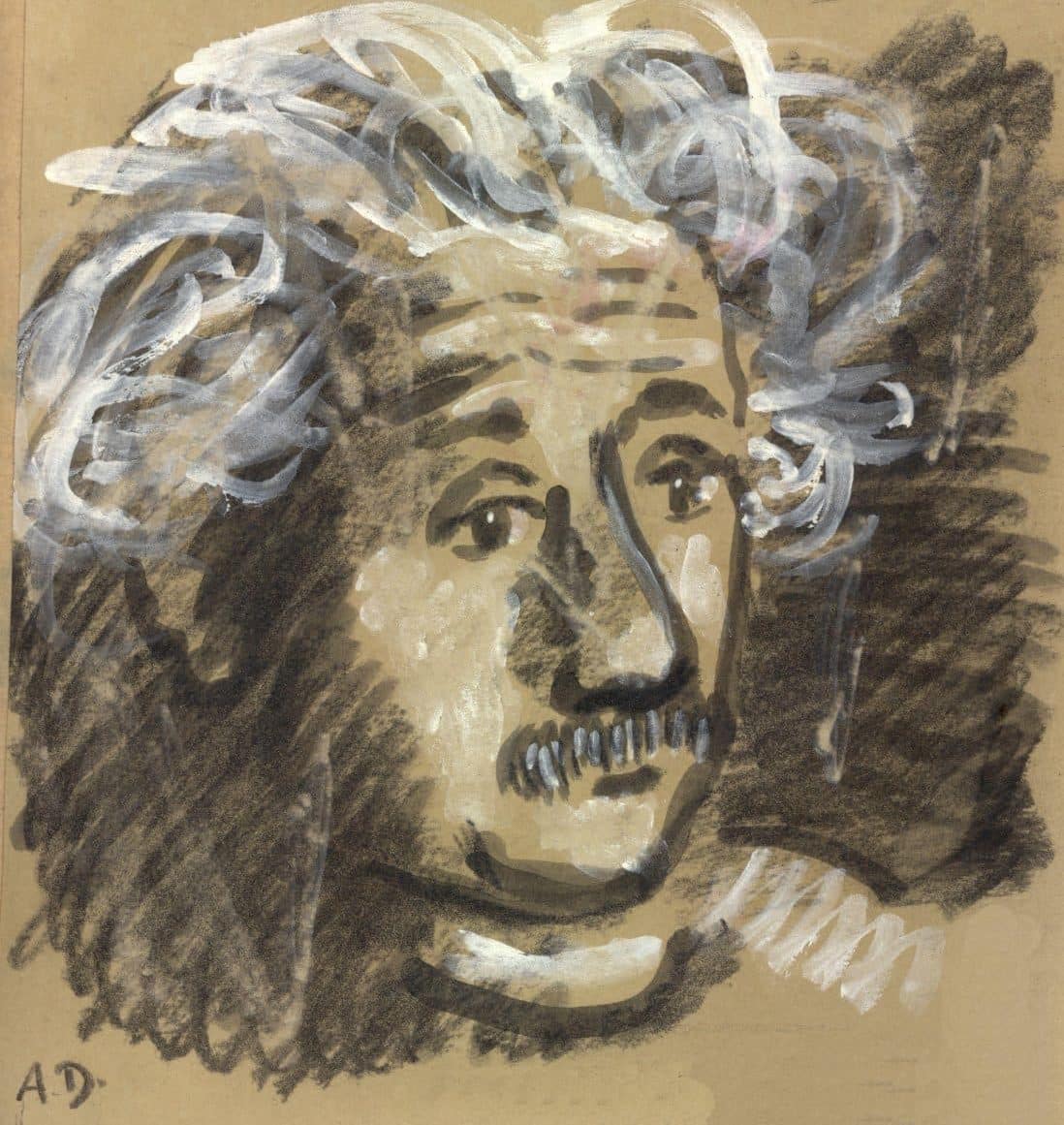
Albert Einstein (1959), charcoal and watercolor drawing by Alexander Dobkin

Albert Einstein (1959), charcoal and watercolor drawing by Alexander Dobkin. Dobkin (1908–1975) was an important painter of the mid-twentieth century American realist tradition along with other left-wing artists such as Jack Levine, Robert Gwathmey, Philip Evergood, and Raphael and Moses Soyer. A student and collaborator of the Mexican muralist Jose Clemente Orozco, his work is in the permanent collections of the Butler Art Institute, the Museum of Modern Art, the Brooklyn Museum, the Whitney Museum of American Art, the Philadelphia Museum of Art, the Library of Congress, and the Smithsonian Institution. (The preceding caption was written by John J. Simon, "Albert Einstein, Radical: A Political Profile," Monthly Review vol. 57, no. 1 [2005].)

Albert Einstein is the world-famous physicist. This article was originally published in the first issue of Monthly Review (May 1949). It was subsequently published in May 1998 to commemorate the first issue of MR‘s fiftieth year.

The Editors

Is it advisable for one who is not an expert on economic and social issues to express views on the subject of socialism? I believe for a number of reasons that it is.

Let us first consider the question from the point of view of scientific knowledge. It might appear that there are no essential methodological differences between astronomy and economics: scientists in both fields attempt to discover laws of general acceptability for a circumscribed group of phenomena in order to make the interconnection of these phenomena as clearly understandable as possible. But in reality such methodological differences do exist. The discovery of general laws in the field of economics is made difficult by the circumstance that observed economic phenomena are often affected by many factors which are very hard to evaluate separately. In addition, the experience which has accumulated since the beginning of the so-called civilized period of human history has—as is well known—been largely influenced and limited by causes which are by no means exclusively economic in nature. For example, most of the major states of history owed their existence to conquest. The conquering peoples established themselves, legally and economically, as the privileged class of the conquered country. They seized for themselves a monopoly of the land ownership and appointed a priesthood from among their own ranks. The priests, in control of education, made the class division of society into a permanent institution and created a system of values by which the people were thenceforth, to a large extent unconsciously, guided in their social behavior.

But historic tradition is, so to speak, of yesterday; nowhere have we really overcome what Thorstein Veblen called “the predatory phase” of human development. The observable economic facts belong to that phase and even such laws as we can derive from them are not applicable to other phases. Since the real purpose of socialism is precisely to overcome and advance beyond the predatory phase of human development, economic science in its present state can throw little light on the socialist society of the future.

Second, socialism is directed towards a social-ethical end. Science, however, cannot create ends and, even less, instill them in human beings; science, at most, can supply the means by which to attain certain ends. But the ends themselves are conceived by personalities with lofty ethical ideals and—if these ends are not stillborn, but vital and vigorous—are adopted and carried forward by those many human beings who, half unconsciously, determine the slow evolution of society.

For these reasons, we should be on our guard not to overestimate science and scientific methods when it is a question of human problems; and we should not assume that experts are the only ones who have a right to express themselves on questions affecting the organization of society.

Innumerable voices have been asserting for some time now that human society is passing through a crisis, that its stability has been gravely shattered. It is characteristic of such a situation that individuals feel indifferent or even hostile toward the group, small or large, to which they belong. In order to illustrate my meaning, let me record here a personal experience. I recently discussed with an intelligent and well-disposed man the threat of another war, which in my opinion would seriously endanger the existence of mankind, and I remarked that only a supra-national organization would offer protection from that danger. Thereupon my visitor, very calmly and coolly, said to me: “Why are you so deeply opposed to the disappearance of the human race?”

I am sure that as little as a century ago no one would have so lightly made a statement of this kind. It is the statement of a man who has striven in vain to attain an equilibrium within himself and has more or less lost hope of succeeding. It is the expression of a painful solitude and isolation from which so many people are suffering in these days. What is the cause? Is there a way out?

It is easy to raise such questions, but difficult to answer them with any degree of assurance. I must try, however, as best I can, although I am very conscious of the fact that our feelings and strivings are often contradictory and obscure and that they cannot be expressed in easy and simple formulas.

Man is, at one and the same time, a solitary being and a social being. As a solitary being, he attempts to protect his own existence and that of those who are closest to him, to satisfy his personal desires, and to develop his innate abilities. As a social being, he seeks to gain the recognition and affection of his fellow human beings, to share in their pleasures, to comfort them in their sorrows, and to improve their conditions of life. Only the existence of these varied, frequently conflicting, strivings accounts for the special character of a man, and their specific combination determines the extent to which an individual can achieve an inner equilibrium and can contribute to the well-being of society. It is quite possible that the relative strength of these two drives is, in the main, fixed by inheritance. But the personality that finally emerges is largely formed by the environment in which a man happens to find himself during his development, by the structure of the society in which he grows up, by the tradition of that society, and by its appraisal of particular types of behavior. The abstract concept “society” means to the individual human being the sum total of his direct and indirect relations to his contemporaries and to all the people of earlier generations. The individual is able to think, feel, strive, and work by himself; but he depends so much upon society—in his physical, intellectual, and emotional existence—that it is impossible to think of him, or to understand him, outside the framework of society. It is “society” which provides man with food, clothing, a home, the tools of work, language, the forms of thought, and most of the content of thought; his life is made possible through the labor and the accomplishments of the many millions past and present who are all hidden behind the small word “society.”

It is evident, therefore, that the dependence of the individual upon society is a fact of nature which cannot be abolished—just as in the case of ants and bees. However, while the whole life process of ants and bees is fixed down to the smallest detail by rigid, hereditary instincts, the social pattern and interrelationships of human beings are very variable and susceptible to change. Memory, the capacity to make new combinations, the gift of oral communication have made possible developments among human being which are not dictated by biological necessities. Such developments manifest themselves in traditions, institutions, and organizations; in literature; in scientific and engineering accomplishments; in works of art. This explains how it happens that, in a certain sense, man can influence his life through his own conduct, and that in this process conscious thinking and wanting can play a part.

Man acquires at birth, through heredity, a biological constitution which we must consider fixed and unalterable, including the natural urges which are characteristic of the human species. In addition, during his lifetime, he acquires a cultural constitution which he adopts from society through communication and through many other types of influences. It is this cultural constitution which, with the passage of time, is subject to change and which determines to a very large extent the relationship between the individual and society. Modern anthropology has taught us, through comparative investigation of so-called primitive cultures, that the social behavior of human beings may differ greatly, depending upon prevailing cultural patterns and the types of organization which predominate in society. It is on this that those who are striving to improve the lot of man may ground their hopes: human beings are not condemned, because of their biological constitution, to annihilate each other or to be at the mercy of a cruel, self-inflicted fate.

If we ask ourselves how the structure of society and the cultural attitude of man should be changed in order to make human life as satisfying as possible, we should constantly be conscious of the fact that there are certain conditions which we are unable to modify. As mentioned before, the biological nature of man is, for all practical purposes, not subject to change. Furthermore, technological and demographic developments of the last few centuries have created conditions which are here to stay. In relatively densely settled populations with the goods which are indispensable to their continued existence, an extreme division of labor and a highly-centralized productive apparatus are absolutely necessary. The time—which, looking back, seems so idyllic—is gone forever when individuals or relatively small groups could be completely self-sufficient. It is only a slight exaggeration to say that mankind constitutes even now a planetary community of production and consumption.

I have now reached the point where I may indicate briefly what to me constitutes the essence of the crisis of our time. It concerns the relationship of the individual to society. The individual has become more conscious than ever of his dependence upon society. But he does not experience this dependence as a positive asset, as an organic tie, as a protective force, but rather as a threat to his natural rights, or even to his economic existence. Moreover, his position in society is such that the egotistical drives of his make-up are constantly being accentuated, while his social drives, which are by nature weaker, progressively deteriorate. All human beings, whatever their position in society, are suffering from this process of deterioration. Unknowingly prisoners of their own egotism, they feel insecure, lonely, and deprived of the naive, simple, and unsophisticated enjoyment of life. Man can find meaning in life, short and perilous as it is, only through devoting himself to society.

The economic anarchy of capitalist society as it exists today is, in my opinion, the real source of the evil. We see before us a huge community of producers the members of which are unceasingly striving to deprive each other of the fruits of their collective labor—not by force, but on the whole in faithful compliance with legally established rules. In this respect, it is important to realize that the means of production—that is to say, the entire productive capacity that is needed for producing consumer goods as well as additional capital goods—may legally be, and for the most part are, the private property of individuals.

For the sake of simplicity, in the discussion that follows I shall call “workers” all those who do not share in the ownership of the means of production—although this does not quite correspond to the customary use of the term. The owner of the means of production is in a position to purchase the labor power of the worker. By using the means of production, the worker produces new goods which become the property of the capitalist. The essential point about this process is the relation between what the worker produces and what he is paid, both measured in terms of real value. Insofar as the labor contract is “free,” what the worker receives is determined not by the real value of the goods he produces, but by his minimum needs and by the capitalists’ requirements for labor power in relation to the number of workers competing for jobs. It is important to understand that even in theory the payment of the worker is not determined by the value of his product.

Private capital tends to become concentrated in few hands, partly because of competition among the capitalists, and partly because technological development and the increasing division of labor encourage the formation of larger units of production at the expense of smaller ones. The result of these developments is an oligarchy of private capital the enormous power of which cannot be effectively checked even by a democratically organized political society. This is true since the members of legislative bodies are selected by political parties, largely financed or otherwise influenced by private capitalists who, for all practical purposes, separate the electorate from the legislature. The consequence is that the representatives of the people do not in fact sufficiently protect the interests of the underprivileged sections of the population. Moreover, under existing conditions, private capitalists inevitably control, directly or indirectly, the main sources of information (press, radio, education). It is thus extremely difficult, and indeed in most cases quite impossible, for the individual citizen to come to objective conclusions and to make intelligent use of his political rights.

The situation prevailing in an economy based on the private ownership of capital is thus characterized by two main principles: first, means of production (capital) are privately owned and the owners dispose of them as they see fit; second, the labor contract is free. Of course, there is no such thing as a pure capitalist society in this sense. In particular, it should be noted that the workers, through long and bitter political struggles, have succeeded in securing a somewhat improved form of the “free labor contract” for certain categories of workers. But taken as a whole, the present day economy does not differ much from “pure” capitalism.

Production is carried on for profit, not for use. There is no provision that all those able and willing to work will always be in a position to find employment; an “army of unemployed” almost always exists. The worker is constantly in fear of losing his job. Since unemployed and poorly paid workers do not provide a profitable market, the production of consumers’ goods is restricted, and great hardship is the consequence. Technological progress frequently results in more unemployment rather than in an easing of the burden of work for all. The profit motive, in conjunction with competition among capitalists, is responsible for an instability in the accumulation and utilization of capital which leads to increasingly severe depressions. Unlimited competition leads to a huge waste of labor, and to that crippling of the social consciousness of individuals which I mentioned before.

This crippling of individuals I consider the worst evil of capitalism. Our whole educational system suffers from this evil. An exaggerated competitive attitude is inculcated into the student, who is trained to worship acquisitive success as a preparation for his future career.

I am convinced there is only one way to eliminate these grave evils, namely through the establishment of a socialist economy, accompanied by an educational system which would be oriented toward social goals. In such an economy, the means of production are owned by society itself and are utilized in a planned fashion. A planned economy, which adjusts production to the needs of the community, would distribute the work to be done among all those able to work and would guarantee a livelihood to every man, woman, and child. The education of the individual, in addition to promoting his own innate abilities, would attempt to develop in him a sense of responsibility for his fellow men in place of the glorification of power and success in our present society.

Nevertheless, it is necessary to remember that a planned economy is not yet socialism. A planned economy as such may be accompanied by the complete enslavement of the individual. The achievement of socialism requires the solution of some extremely difficult socio-political problems: how is it possible, in view of the far-reaching centralization of political and economic power, to prevent bureaucracy from becoming all-powerful and overweening? How can the rights of the individual be protected and therewith a democratic counterweight to the power of bureaucracy be assured?

Clarity about the aims and problems of socialism is of greatest significance in our age of transition. Since, under present circumstances, free and unhindered discussion of these problems has come under a powerful taboo, I consider the foundation of this magazine to be an important public service.

2009Volume 61, Issue 01 (May)
2,200-year-old mysterious script sat undeciphered for decades — until now, experts say


Moira Ritter
MIAMI HERALD
Wed, July 19, 2023

Starting in the the 1950s, archaeologists conducting excavations in central Asia have discovered several dozen inscriptions in a mysterious script.

The writing system was coined “ecriture inconnue” in French and “neizvestnoe pis’mo” in Russian — which translate to “unknown writing” in English. Experts found examples varying in length from just a few characters to several lines of writing.

Since the first inscriptions were discovered, experts have worked to decipher the mysterious ancient language, but it wasn’t until March that a group of researchers from the University of Cologne in Germany successfully deciphered part of the system, according to a July 13 news release from the university.

The team detailed its research and findings about the newly-discovered language — which experts proposed be named “Eteo-Tocharian” — in a study published July 12 in Transactions of the Philological Society. Here’s what they found.

A 2,200-year-old writing system


Experts determined that the writing system was likely used between 200 B.C. and 700 C.E. in parts of Central Asia, the university said. It is associated with early nomadic people who inhabited the Eurasian steppe as well as the Kushan rulers.

Since the 1950s, most evidence of the script has been found in the present-day regions of Tajikistan, Afghanistan and Uzbekistan, the university said.

Researchers said the system likely consists of between 25 and 30 characters, and is intended to be read from right to left. So far, 15 consonants, four vowels and two ligatures — or sounds — have been identified, according to the study.

How experts cracked the code

The discovery of another ancient inscription in 2022 prompted a renewed look at deciphering what was then known as the “unknown writing.”

A short inscription was discovered on a rock in the Almosi Gorge in Tajikistan, but unlike previous examples of the writing system, this inscription was made in two different scripts, the university said. One version of the inscription was written in the unknown Kushan script while the other version was written in Bactrian script — a system known to researchers.


The 2022 discovery of an inscribed stone in the Almosi Gorge in Tajikistan
 reignited efforts to decipher the unknown writing system, experts said.

Researchers also relied on another multilingual inscription which was discovered in the 1960s at Dašt-i Nāwur in Afghanistan, the university said.

The Dašt-i Nāwur inscription is a trilingual royal stone inscription about a Kushan emperor, according to the study. It includes lines in the Kushan language, Bactrian language and a third ancient script.

Experts used translations of the Bactrian scripts on both inscriptions to help them analyze the Kushan characters and ultimately decipher the system, according to the university.

A historical breakthrough

Experts concluded that the language is a previously unknown Middle Iranian language that likely served as a middle language between the development of two known languages in the region — Bactrian and Khotanese Saka, the university said.

Although it is still unclear where the language was used, there is evidence indicating that it was an official language of the Kushan Empire, according to experts.

Further analysis will grant researchers more insight into the cultural and geographical landscape of the region during the first and second centuries.

The Kushan dynasty

The Kushan dynasty ruled most of northern Indian, Afghanistan and parts of Central Asia for the first three centuries, according to Britannica.

The dynasty was known for its hand in spreading Buddhism and its trade with the Roman empire.
UK
Eleven people arrested in Grangemouth climate protest

BBC
Wed, July 19, 2023 

This Is Rigged protesters staged a protest at the Ineos site near Falkirk

Eleven people have been arrested after police launched an operation to remove climate protesters at Grangemouth petrochemical plant.

Officers used a crane and specialist climbing equipment after several This Is Rigged activists scaled oil tankers and climbed on pipework.

Other protesters blocking gates at the site were taken away in police vans.

This Is Rigged also staged a smaller protest at the Rothesay Dock oil terminal in Clydebank.

Ineos said production at the Grangemouth refinery, near Falkirk, was unaffected but a tanker terminal had been shut as a precaution.

Police Scotland confirmed the arrests and said officers remained at both protests.


Police Scotland used a crane to remove protesters at Grangemouth

This Is Rigged said, in a statement posted on social media: "We are shutting down the oil industry in Scotland to demand that the Scottish government steps up and says no new oil, and implements a fair transition for workers."

They added: "We have no plans to stop."

The demonstrations came three days after Climate Camp Scotland activists "occupied" the Ineos gas power station, which powers the Grangemouth refinery.

Police Scotland said five people had been arrested following the protest.


Protestors climbed on to tankers at the gates

Grangemouth pumps out about 2.4 million tonnes of carbon dioxide emissions per year, according to figures campaigners obtained from the Scottish Environment Protection Agency.

An Ineos spokesperson said emissions had declined by more than 40% since it bought the site in 2005.

They said: "We have a robust roadmap in place that will deliver on our commitments to be a net zero manufacturer by 2045.

"Our products and their applications are helping others to reduce their greenhouse gas emissions too."
The Australian climate protesters cast as extremists

THE FBI HAS BEEN DOING THIS SINCE THE PATRIOT ACT WAS INVOKED AFTER 9/11

Hannah Ritchie - BBC News, Sydney
Wed, July 19, 2023

A protester is arrested for evacuating the office of Australia's largest fossil fuel company using fake gas

Emma Sangalli's heart still stops every time she sees a police car.

"It's a feeling in your gut like panic. Total panic.

"It's hard not to believe that you're a criminal, that you're deserving of this," the Australian climate activist says.

Last month, the 25-year-old had her home in Western Australia raided by counter-terrorism police.

Her alleged crime - helping to flood a global fossil fuel giant's office with non-toxic gas.

Stench gas, which smells like rotten eggs, is let off in mines to alert workers of danger. In this case, it was used by protesters to empty the Perth headquarters of Woodside Energy, to highlight the climate crisis.

Australia's largest oil and gas firm says the protests targeting its brand are "unlawful" activities by "extreme groups".

But environmental campaigners say disruptive protest is key to their mission.

Meanwhile, lawyers warn that the response to climate activism in Australia has become "increasingly militarised".
'Unlawful acts'

Ms Sangalli says officers from Western Australia's State Security Investigation Group (SSIG) - whose duties include counter-terrorism - searched her home for hours, looking for evidence of her involvement in the Woodside protest.

Despite facing no formal charges and not being present at the gas evacuation, she was forced to watch as her personal items were seized - including phones and laptops - and a male officer flicked through her diary.

"That was the most painful part," she told the BBC.

"Violated is a good word for it. You're rendered powerless."

The activist has been involved with two climate protest groups - the global Extinction Rebellion, and the more local Disrupt Burrup Hub, which campaigns against fossil fuel projects on the state's Burrup Peninsula.

Both groups follow a "direct action" strategy intended to end climate complacency, which means engaging in activities such as infiltrating fossil fuel conferences, blocking rush hour traffic, and superficially defacing artworks.


Disrupt Burrup Hub are protesting against some of Australia's largest new fossil fuel projects


Several members of the group are now facing criminal charges over the Woodside protest, with the company alleging four of its employees suffered dizziness, breathing difficulties, rashes, and nausea.

"Woodside condemns unlawful acts that are intended to threaten, harm, intimidate or disrupt our employees," the company said.

But Disrupt Burrup maintains their protest stunt was carried out safely and was a necessary action against one of Australia's most powerful polluters.

Its members are challenging the charges in court.

Fighting the 'petrostate'

Western Australia is a resource-rich state built on mining revenue, particularly iron ore, oil and gas.

Its industry is concentrated in the Pilbara, a desert area in the state's far north. With an annual output of more than A$100bn (£52bn; $67bn), it powers the national economy and is home to global mining giants, including Rio Tinto and BHP.

Some of Australia's most polluting projects are based there, including Woodside's North West Shelf gas facility and its Scarborough development - a controversial offshore drilling venture which scientists say will jeopardise the nation's climate targets.

Both projects have sparked fierce debate and renewed accusations that the gas lobby has an outsized influence over state authorities.

Access to ministers, timing of political donations and movement of mining executives into watchdogs, have all been cited as examples - including three former Woodside employees who chaired the advisory board of Australia's offshore oil and gas regulator.


Woodside's gas facilities on the Burrup Peninsula are some of Australia's largest emitting projects


Gerard Mazza has led protests against Woodside's Pilbara projects, due to their emissions and damage to local ancient Aboriginal rock art.

The 31-year-old's home was recently raided by SSIG police for his alleged role in attempting to evacuate Woodside's annual investors meeting in April, also using stench-gas.

He now faces charges of aggravated burglary, which carry a maximum 20-year sentence.

Mr Mazza argues Western Australia is a "petrostate" designed to "protect fossil fuel companies" due to the money they bring in.

"If it was really all about public safety, the state would be cracking down on Woodside executives making obscene wealth by endangering lives and ecosystems. Instead, they're coming after us."

The state government has routinely dismissed such claims, denying any influence. In response to the BBC's questions, it said it is "committed to achieving net zero emissions by 2050".

But Western Australia's emissions continue to rise, while other states have recorded significant reductions over the past decade.

Climate activists cast as 'extremists'


A dozen raids - including those on Mr Mazza and Ms Sangalli's homes - have been carried out by the state's counter-terrorism police against climate protesters this year.

The SSIG collaborates with federal intelligence agencies on matters of national security and is exempt from Freedom of Information laws, meaning its investigations remain secret.

Lawyers such as Julia Grix says politicians and prosecutors are framing climate protesters as a threat to public safety to justify heavy-handed policing.

The solicitor - who defends environmental activists - says her clients are increasingly being referred to as "extremists" in court documents.

"That sort of language is most commonly applied to organised crime of a very sophisticated kind, which I would associate with bikie (motorcycle) gangs, or terrorism," Ms Grix said.

It's a "demonisation strategy" used to justify "extreme measures never intended for regulating protests", Australian legal scholar Luke McNamara says.

The right to protest has long been defended by Australia's courts.

In 2017, a landmark High Court case ruled that Tasmania's anti-protest laws were unconstitutional. And in 2020, a Queensland state court overturned suspended prison sentences against two activists who had blocked access to the major Adani coal mine.

David Mejia-Canales, a lawyer at the Human Rights Law Centre, an Australian rights group, says those protections are key to a functioning democracy.

"Protest takes many forms, sometimes disruptive. But that's why it's effective, because it disrupts the everyday to demand attention for a cause," he said.

"As citizens of a democratic society, we should exercise a level of tolerance for disruption if the right to protest is going to have its full value."

But Western Australia's emergency services minister, Stephen Dawson, recently argued in parliament that the evacuation of Woodside's offices could be viewed as "an act of terrorism" because "people's health was put at risk by the material released".

And some of Australia's most prominent leaders - including former Prime Minister Scott Morrison - have called for demonstrations which obstruct critical infrastructure to be "outlawed".

"The right to protest does not mean there is an unlimited licence to disrupt people's lives," he said in 2019, labelling environmental campaigners "anarchists".

Australia's broader crackdown

The court cases under way in Western Australia are not taking place in isolation.

They are part of a broader national crackdown which has seen Australian states criminalise disruptive protests through new laws, increased jail terms and penalties. This has sparked public outcry.

In May, after several Extinction Rebellion protests, the South Australia government introduced a A$50,000 maximum fine and three months jail for anyone "recklessly" obstructing public spaces, while laws passed in New South Wales last year created a two-year maximum prison sentence for acts disrupting major roads or facilities.

Protesters say disruption is key to ending climate complacency


England, Wales and states across Canada and the US have also adopted similar laws aimed at blocking disruptive climate activism.

In Western Australia, climate protesters say they have been "disabled" by intimidating raids, strict bail conditions and orders which give authorities access to their devices and ban them from communicating with peers.

According to Ms Grix, these tools were originally intended to deal with gangs and drug dealers.

"To apply [that]... to climate defenders, who are protesting about environmental concerns, seems to be a massive overreach," she says.

Prof McNamara agrees.

"What we see in these situations is the police reaching for whatever is at their disposal," he told the BBC.

"Counterterrorism policing units and associated powers were never intended to be used against protesters."

In the coming days, several court hearings will determine whether Mr Mazza and some of his peers could face prison.

But the 31-year-old says that while "climate and culture" remain under threat, he will "not be deterred" from protesting.
A FREE AND AUTONOMOUS STUDENT PRESS
Stanford's student paper just took down the prestigious school's president

Charles R. Davis
Wed, July 19, 2023 

Stanford University Campus in 2021.David Madison/Getty Images

Stanford University President Marc Tessier-Lavigne is resigning, the school said Wednesday.

The resignation comes after student journalists uncovered manipulated data in scientific papers he authored.

Tessier-Lavigne defended his record but said he was stepping down for the good of the school.

An investigation by Stanford's student-run newspaper has taken down Marc Tessier-Lavigne, the prestigious school's president and a prominent neuroscientist.

Tessier-Lavigne announced Wednesday that he'll step down after the school's own investigation found there were serious flaws in some of his published scientific work, including papers that included manipulated data.

While insisting that he never knowingly published inaccurate science and was not aware of the manipulation, Marc Tessier-Lavigne wrote in a statement that he would resign at the end of August "for the good of the university."

Tessier-Lavigne has been the school's president since 2016.

Last year, The Stanford Daily, a student publication, published an investigation identifying serious problems in some of Tessier-Lavigne's published work, including evidence that images were improperly altered.

Stanford later commissioned its own report by an outside law firm after students revealed the fraud in papers affiliated with Tessier Lavigne. The school's investigation found evidence of manipulation and "serious flaws in the presentation of research data," though it also found that the Stanford president himself "did not have actual knowledge" of the manipulation.

In his statement, Tessier-Lavigne insisted that he was unaware of the issues with his scientific papers. But, he said, "I want to be clear that I take responsibility for the work of my lab members."


Stanford University president announces resignation over concerns about his research


Wed, July 19, 2023

SAN FRANCISCO (AP) — The president of Stanford University said Wednesday he would resign, citing an independent review that cleared him of research misconduct but found “serious flaws” in five scientific papers on subjects such as brain development in which he was the principal author.

Marc Tessier-Lavigne said in a statement to students and staff that he would step down Aug. 31.

The resignation comes after the board of trustees launched a review in December following allegations he engaged in fraud and other unethical conduct related to research and papers that are in some cases two decades old (1999, 2001, 2001)

Tessier-Lavigne, a neuroscientist, says he “never submitted a scientific paper without firmly believing that the data were correct and accurately presented.” But he says he should have been more diligent in seeking corrections regarding his work and he should have operated laboratories with tighter controls.

Panelists found multiple instances of manipulated data in the 12 papers they investigated, but concluded he was not responsible for the misconduct. Still, they found that each of the five papers in which he was principal author “has serious flaws in the presentation of research data” and in at least four of them, there was apparent manipulation of data by others.

Tessier-Lavigne said he was aware of issues with four of the five papers but acknowledged taking “insufficient” steps to deal with the issues. He said he’ll retract three of the papers and correct two.

The papers were published before Tessier-Lavigne became Stanford president.

Misconduct allegations about the work were first aired on PubPeer, a website where members of the scientific community can discuss research papers, the report stated. Questions resurfaced after The Stanford Daily, the university's student-run newspaper, published several stories about the integrity of reports published by his laboratories.

The aggressive reporting merited investigations editor and then-college freshman Theo Baker a special George Polk journalism award. Baker told The Associated Press Wednesday that the retractions and corrections would not have occurred otherwise.

“The fact that we’re able to contribute to the scientific record being corrected for five widely cited papers is important,” he said.

The panel cleared Tessier-Lavigne of the most serious allegations, that a 2009 paper published in the scientific journal Nature was the subject of a fraud investigation and that fraud was found. There was no investigation and no fraud discovered, the panel ruled. The paper proposed a model of neurodegeneration, which could have great potential for Alzheimer’s disease research and therapy, the panel wrote in its report.

But the panel also concluded the paper had multiple problems, including a lack of rigor in its development and that the research that went into the paper and its presentation contained “various errors and shortcomings.” The panel did not find evidence that Tessier-Lavigne was aware of the lack of rigor.

“People tend to think of scientists as these individuals that they’ve heard of like Einstein and Marie Curie,” said H. Holden Thorp, editor-in-chief of the Science family of journals. “The truth is that researchers run laboratories filled with people, and everything that happens in that laboratory is a product of many individuals there.”

While the report cleared Tessier-Lavigne of research misconduct, Thorp said ultimately the boss is responsible for what happens in the lab – and shouldn’t be distracted by doing other jobs. He pointed to the report’s finding that lab culture played a role.

Tessier-Lavigne says he’s stepping down because he expects continued debate about his ability to lead the university. He will remain on faculty as a biology professor. He also said he will continue his research into brain development and neurodegeneration.

The board named Richard Saller, a classics professor, as interim president starting Sept. 1, said board chair Jerry Yang.

In a statement, Yang said Tessier-Lavigne was key to creating the university’s first new school in 70 years, the Stanford Doerr School of Sustainability, and in 2019, he unveiled a strategic long-range plan that will continue to guide the university’s growth.

Tessier-Lavigne has been president for nearly seven years.

___

Associated Press reporter Lauran Neergaard contributed to this report from Washington.

Janie Har, The Associated Press

Stanford president to resign over concerns about integrity of his research

Guardian staff and agency
Wed, July 19, 2023 

Photograph: Dan Honda/AP

The president of Stanford University, Marc Tessier-Lavigne, has announced he will resign after concerns about the integrity of his research.

Tessier-Lavigne announced his plans to step down on 31 August in a letter to students and staff on Wednesday.

Tessier-Lavigne said he was stepping down because he expected continued debate about his ability to lead the university.

“I’ve never submitted a scientific paper without firmly believing that the data were correct and accurately presented,” he said in a statement. But he added that he should have been more diligent in seeking corrections regarding his work.

The announcement comes after the board of trustees of the historic institution, which sits in the heart of Silicon Valley and is often referred to as the “Ivy of the West”, launched a review late last year into allegations of fraud and ethical misconduct around papers Tessier-Lavigne had authored or co-authored.

The review assessed 12 papers that Tessier-Lavigne worked on, five of them in which he was the principal author.

The misconduct allegations about the work were first aired on PubPeer, a website where members of the scientific community can discuss research papers, the panel’s final report stated.

The panel cleared him of the most serious allegation, that a 2009 paper on a model of neurodegeneration published in the scientific journal Nature was the subject of a fraud investigation and that fraud was found. Neurodegeneration models could have great potential for Alzheimer’s disease research and therapy.

There was no investigation and no fraud discovered, the panel ruled. But it also concluded the paper had multiple problems, including a lack of rigor in its development and that the research that went into the paper and its presentation contained “various errors and shortcomings”. The panel did not find evidence that Tessier-Lavigne was aware of the lack of rigor.

“People tend to think of scientists as these individuals that they’ve heard of like Einstein and Marie Curie,” said H Holden Thorp, editor-in-chief of the Science family of journals. “The truth is that researchers run laboratories filled with people, and everything that happens in that laboratory is a product of many individuals there.”

While the report cleared Tessier-Lavigne of research misconduct, Thorp said ultimately the boss is responsible for what happens in the lab – and shouldn’t be distracted by doing other jobs.

He pointed to the report’s finding that lab culture played a role. The panel found that “the unusual frequency of manipulation of research data and/or substandard scientific practices” suggested a need for improved “oversight and management”.

Tessier-Lavigne is expected to retract three of the five papers of which he was the principal author and make heavy correction to the other two, the board’s final report says.

Tessier-Lavigne had been the university’s president for nearly seven years. He will remain on faculty as a biology professor and will continue his research into brain development and neurodegeneration.

The board named Richard Saller as interim president starting 1 September, said the board chair, Jerry Yang. In a statement, Yang said Tessier-Lavigne was key to creating the university’s first new school in 70 years, the Stanford Doerr School of Sustainability, and in 2019, he unveiled a strategic long-range plan that will continue to guide the university’s growth.

Tech and business magnates including Sergey Brin, co-founder of Google and Reed Hastings, who co-founded Netflix graduated from the school.

Tessier-Lavigne did not immediately respond to the Guardian’s requests for comme

UK
TikTok is the most popular news source for 12 to 15-year-olds, says Ofcom


Hibaq Farah UK technology reporter
Wed, July 19, 2023 

Photograph: Yui Mok/PA

TikTok has become the most popular news source for 12 to 15-year-olds, according to the UK’s communications watchdog.

Ofcom’s latest report on news consumption in the UK has revealed that the viral video app is now the most used single source of news across all platforms for young teenagers, followed by YouTube and Instagram.

TikTok’s popularity is driven by a powerful algorithm which curates what people see on their screen, as well as an effective search function that has made the app a captivating platform for young – as well as older – users.

Interactive

The study found that for children aged 12-15, TikTok is now the most used single source of news across all platforms at 28%, followed by YouTube and Instagram at 25% each. However, the BBC still has the highest reach of any news organisation among this age group when all its news outlets – across BBC iPlayer, radio stations, websites and TV channels – are counted, at 39%.

Related: $7,000 a day for five catchphrases: the TikTokers pretending to be ‘non-playable characters’

Ofcom found that 16 to 24-year-olds are 30% more likely to consume news via social media on their phones than adults and are more likely to consume news online than adults. The study showed that young people in this age group are also less likely to head to traditional news websites (6% v 26%) when compared with adults and are more likely to head to social media. For instance, Instagram is the most used single news source for young people at 44%, though BBC One was tied with Facebook at 33%

.Interactive

The study also showed that TikTok as a news source has become more popular among adults, with one in every 10 adults using it to keep up with news – overtaking BBC Radio 1 and Channel 5 for the first time.

For adults, the study revealed that broadcast TV news is the most popular source, used by 70% of UK adults. BBC One remains the most used news single source across all platforms, followed by ITV. Both channels have declined over the past five years, BBC One by 62% and ITV by 41%. Similarly, Facebook has also declined over the same period.
AI: Digital artist's work copied more times than Picasso

Clare Hutchinson & Phil John - BBC News
Wed, July 19, 2023 

Greg Rutkowski's name has been used as a prompt in AI tools that generate art more than 400,000 times - but without his consent

"My work has been used in AI more than Picasso."

Artificial intelligence (AI) is changing life as we know it but for digital artist Greg Rutkowski, it is causing big problems.

He said his name had been used as a prompt in AI tools that generate art more than 400,000 times since September 2022 - but without his consent.

When he checked, his name had been used as a prompt more times than the artists Pablo Picasso and Leonardo da Vinci.

Polish-born artist Greg has had his work used in games such as Dungeons and Dragons and Magic: The Gathering but said his new found AI fame has caused concern for his future work.

Sites like Midjourney, Dall.E, NightCafe and Stable Diffusion are known as generative AI because they can make new, artificially-generated artworks in seconds from prompts that users type in.

They have learned to do this by scraping billions of existing images from the internet. Artists are complaining this has been done without their consent.

Greg said: "The first month that I discovered it, I realised that it will clearly affect my career and I won't be able to recognise and find my own works on the internet.

"The results will be associated with my name, but it won't be my image. It won't be created by me. So it will add confusion for people who are discovering my works."

"All that we've been working on for so many years, has been taken from us so easily with AI," he added.

"It's really hard to tell whether this will change the whole industry to the point where human artists will be obsolete.

"I think my work and future are under a huge question mark."

'Real art has personality'


While the problems are clear, there are some ways AI tools can be used to benefit artists, according to Cardiff-based animator Harry Hambley, who is the creative force behind internet sensation, Ketnipz.

"I think for me the biggest thing generative art can solve is tedium," he said.

"But it can be scary and the internet's already a wild place, and you mix AI in with that… we don't know where it's going to go.

"Do I think that my job will ever be sacrificed to AI or AI will do it better than me? I don't know. I hope not."

Harry added he thought there was more to art than how it looked.

"At the end of the day I think that there's a bigger reason why people are invested in Ketnipz and I don't think it's just the mere aesthetics of it.

"I think there's a personality behind it that I don't think someone imitating can really tap into."
'Just keep making art'

James Lewis's brush control has made him a hit on TikTok

Artist James Lewis, from Cardiff, creates videos of his painting technique for more than seven million followers on TikTok and Instagram.

He has yet to find out if his work has been used by the tools, but said because AI has learned from billions of artworks, it would be hard to trace which artists' works have been used in each image.

"If there was a way to go back and figure out who inspired this style of image that was generated, I think it would be fair for that artist to receive some sort of compensation," he said.

In the meantime he thinks artists should keep being creative.

"I do have hope that as much as AI art will develop and it'll get better, but it will never be able to capture that true human essence, that true creativity that we have as people," he said.

"You will still need your own creative ideas, your own initiative."

For artist and human rights researcher Caroline Sinders, it is for AI companies to address the problem.

She said: "Part of the argument we hear from companies is, 'we have so much data, it would be impossible for us to tell, like searching for a needle in a haystack'.

"I would like to say, well, that's a 'you' problem, not a 'me' problem.

"I have a copyright on the images and I plan to enact my copyright if my images are used without my consent."

She said she was also worried about the bias that these tools created and how it meant AI art was not reflecting the real world.

"Let's say we ask an image generation AI system to generate a doctor assessing care to a family," she said.

"Most likely that doctor will be generated as male and probably as white, and the parent will probably be generated as female.

What is AI and is it dangerous?


AI quiz: Can you tell which person is real?


Elon Musk announces new AI start-up

"And this is not an example I'm randomly making up. There have been tests done by asking these sort of blanket questions without gender being in the text prompt and, more often than not, it's reflecting these stereotypes."

This extends to racial bias and also ableism, said Irene Fubara-Manuel, a lecturer at the University of Sussex.

While they said they were excited about the possibilities provided by generative art, issues such as racial and gender biases in some images created were hard to overcome.

"I was trying to die my hair over the summer, and I was just looking up 'people of colour, blonde locks'," they said.


Irene Fubara-Manuel says they noticed bias when searching for images to try out new hairstyles

"What I got in response was this regal, I would say, fetishized image of black people. You know, chiselled jaw lines, their skin was iridescent.

"It's like, there are black people who are that beautiful, but the images that you see commonly in a lot of AI are very, very fetishized representations of people.

"You would not see people who are plus size, or people who have visible disabilities, for instance."

Artists are now calling on regulators in the UK and worldwide to take more action to protect artists and the industry.

Irene said artists were not against AI but, "the argument is against exploitation".

"But I'm hopeful that it will contribute to human creativity in general, just like how the creation of computers added more to creativity. I'm excited for its contribution," she said.

Caroline added more regulation of the emerging AI industry in the UK would not "stifle" innovation.

"It makes things safer and that's why we have certain laws," she said.

"That's why right now we have seatbelts and airbags for cars and a lot of rules about them. When they were first invented, we didn't have any of that.

"So it's not at all out of step to sort of ask for or to create guardrails and protections."

Additional reporting by Lola Mayor.