Friday, July 28, 2023

ECOCIDE

Grimaldi Con/Ro Runs Aground on Coral Reef Off Yucatan
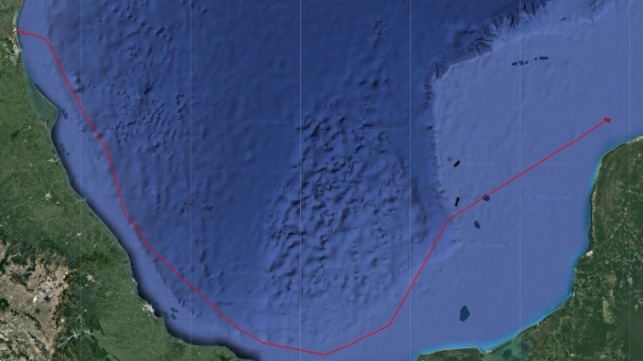
Grande Senegal's voyage around the Bay of Campeche to Arrecife Madagascar, top right (Pole Star)

PUBLISHED JUL 26, 2023 10:11 PM BY THE MARITIME EXECUTIVE


The Grimaldi Lines con/ro Grande Senegal has gone aground on a reef off the Yucatan Peninsula, according to local media and AIS data.

On the evening of July 20, Grande Senegal got under way from the port of Altamira, north of Tampico. She was headed for Brunswick, Georgia, according to operator Grimaldi - but instead of setting a northeasterly course on the shortest route, she headed south instead and hugged the coastline of the Bay of Campeche. 

In the early hours of July 22, as she rounded the northern end of the Yucatan Peninsula, she went from a speed of 18 knots to a full halt at Arrecife Madagascar, a reef about 20 nm off the small port of Sisal. She has not moved since, according to data provided by Pole Star

Photos of the site published by local outlet Yucatan Ahora show the top of the vessel's propeller above the water. In other images, the majority of the bulbous bow is clearly visible. 

The water depth at the site of the grounding is in the range of 15-20 feet, according to local outlet Milenio. The ship's current reported draft via AIS is 27 feet.

The reef is known to fishermen and divers as a breeding ground for fish and a destination for tourists. The extent of any damage along the ship's entry track into the reef is not yet fully known, and local stakeholders are concerned that the process of refloating the ship may cause additional damage. 

Miguel Ek Pech, port commissioner for the community of Sisal, told Milenio that his office will file a complaint with the Secretary of Environment and Natural Resources (Semarnat) for the ecological damage. "When they are going to remove the ship that is stranded practically on all coral, there is going to be a massive destruction," warned Ek Pech.

Dive assessments are reportedly under way for the preparation of a salvage plan, and the anchor handler Atlantic Osprey is attending the ship. No oil pollution or injuries have been reported, according to Grimaldi, and the responders are currently working on a salvage plan. 

Arrecife Madagascar is part of the Campeche Bank Reef complex. In addition to corals and marine life, it is home to much older shipwrecks from the 1700s-1800s, a period when Sisal was a busy seaport. In that era, the reef was considered enough of a hazard to navigation that a lighthouse was installed to warn shipping (it has long since subsided under the sea).

Reflecting its long-known status, Arrecife Madagascar is charted, and it is described in detail in the NGA sailing directions. According to NGA, Arrecife Madagascar is the same color as the surrounding water, and seas do not break on it, rendering missing two of the typical warning signs of a shoal ahead.

NGA cautions mariners transiting this region that Campeche Bank Reef is poorly surveyed overall, and that "it is reasonable to assume that many more dangers exist than are shown on the charts." 

The 2010-built Grande Senegal is the second Grimaldi Lines con/ro involved in a major marine casualty in less than a month. On July 5, a fire broke out aboard Grande Costa d’Avorio at the port of Newark, New Jersey. Two firefighters were killed in the early phase of the response, and the blaze burned for five days. 

Three Grimaldi vessels caught fire in 2019, including the con/ro Grande America, which ultimately went down off the coast of France. 


Taiwan Detains Officers of Sunken Containership as Cleanup Proceeds
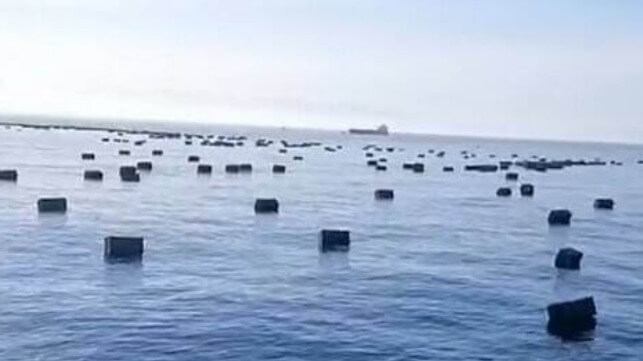
containers floating in the ocean off Taiwan
Taiwan believes over 400 boxes were left floating in the ocean and now oil is leaking from the ship (TIPC)

PUBLISHED JUL 27, 2023 2:29 PM BY THE MARITIME EXECUTIVE


Taiwan has orders that three of the officers from the containership Angel that went down last week off the port of Kaohsiung should be barred from leaving the country while the investigation and environmental cleanup is underway. Officials are citing the cost of retrieving the hundreds of containers scattered in the ocean as well as the oil leaking from the vessel.

The Angel, a 21-year-old containership registered in Palau, had been anchored off the port for most of July with media reports saying the vessel had not indicated any troubles but had inquired about docking the day before the incident was reported. The 20,000 dwt vessel, which was 564 feet in length, was loaded with what has now been determined to be 1,349 empty containers. 

The master of the vessel told the port authority on July 20 that the vessel was taking on water and that the 19 crewmembers were abandoning ship. The vessel’s list continued to grow and despite efforts to stabilize the ship, it heeled over overnight and sank approximately 2.8 nautical miles outside Kaohsiung harbor. In addition to the containers, the port authority reports there were nearly 500 tons of low-sulfur fuel and light diesel aboard.

Taiwan’s Ocean Affairs Council Minister Kuan Bi-ling reported that an order has now been issued by the Immigration Department to retain on Taiwan the master of the Angel, along with the first mate and chief engineer. Their departure is being restricted under the island’s Marine Pollution Law.

The minister pointed out that the law requires ships to avoid and prevent damage to the marine environment and the ship’s owners to pay for removal, remediation, and damage. She reports that Taiwan is incurring large expenses for the retrieval of the containers left floating along the coastline and that the oil leaking from the Angel is unstoppable. The available equipment can only remove 120 cubic meters per hour and further with Typhoon Doksuri impacting the area, they fear the oil spill will be washed across a broader area. In addition, fisherman the minister said will also need to be compensated for the damage caused to the industry.

The Kaohsiung Port Authority estimates that 766 of the containers sunk with the ship and a further 160 sunk during the drifting process. A further 233 have been towed away in the salvage operation that is retrieving boxes in and around the harbor’s entrance channels. An additional 60 containers have been identified washed up on the shoreline in the area between Nansing and Fengpitou.  

A further 130 containers are believed to be missing and likely floating in the ocean creating navigational hazards. Minister of Transport Wang Guocai expressed concern that some of the boxes currently trapped on the concrete constructions along the shore could also be washed out to sea as Typhoon Doksuri churns up the coastal waters. The container retrieval operation has been suspended due to the typhoon.

Taiwan has been calling for the owner of the ship to take prompt action. The Equasis database lists the owner as Navramar Shipping and a management company based in Azerbaijan. The vessel’s class society and insurance status are unclear with the Equasis database not listing a Port State inspection since 2018.

Fremantle Highway Fire Lessens as Vessel Continues to Drift off Dutch Coast
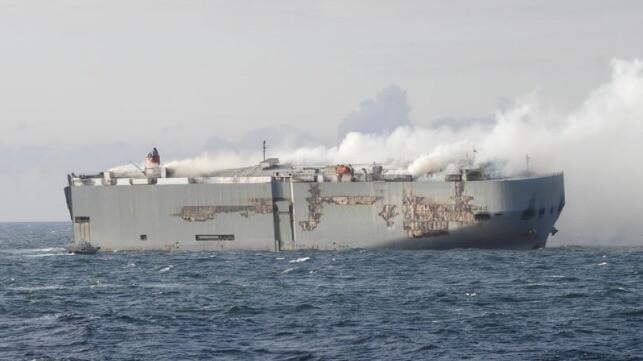
Fremantle Highway car carrier fire
A tow line is being used to hold the burning vessel about 10 miles offshore and out of the shipping lanes (Dutch Coast Guard)

PUBLISHED JUL 27, 2023 7:01 PM BY THE MARITIME EXECUTIVE


Dutch authorities report that the situation is stable as the car carrier Fremantle Highway continues to burn. As of late on Thursday, they are reporting that it appears that the fire might be lessening in intensity but they can only wait until the fire dies down and it becomes safe to board the ship to start a salvage operation. The fire, which began around midnight on July 25, is expected to burn for days.

The vessel continues to drift along the Dutch coast with a line attached in an effort to keep it from interfering with the busy sea lanes in the North Sea. The ship drifted westward during the day but back toward the east later with the Dutch Coast Guard saying they were monitoring the current and wind direction to determine the most favorable drift direction. Later in the day, a stronger tow line was strung from the tugboat Fairplay 30 to the Fremantle Highway.

While the fire is still raging on the vessel, the Coast Guard also reports that the decision was made to suspend cooling efforts are the intensity of the fire diminished. The vessel is already showing a list and concerns are growing over the stability of the vessel. 


“We are working with all our might to prevent the ship from sinking,” Rijkswaterstaat, the Dutch water authority, said in its update. “We also are doing our utmost to limit the damage to people and the environment, as much as possible.”

The water authority’s oil recovery vessel Arca continues to stand by near the wreck in case of a fuel release. Dutch and German coastal authorities are also preparing for different scenarios including a release of contamination or the possibility that the vessel will sink. Environmental groups are highlighting the dangers to sensitive areas as well as popular tourist destinations along the North Sea coast. The current position is approximately 10 miles north of Terschelling in The Netherlands.


A salvage team continues to stand by the vessel and is analyzing the exterior and pictures as they work to formulate potential plans. The images released by the Dutch Coast Guard show blistering and peeling paint at multiple places along the sides of the vessel with smoking continuing to pour out of the vessel. They however are no longer show flames and the Coast Guard points out that no cracks or holes have been observed so far in the vessel.

Analysts are already beginning to calculate the potential financial impact. The Mercedes-Benz Group confirmed that it has approximately 350 vehicles aboard the ship. London-based data and analytics company Russell Group estimated that the car company could incur an economic loss of at least $13 million from the fire.

“If the cause of the fire turns out to have been started by an electric vehicle, this will be a similar scenario to the Felicity Ace incident. The incident again raises questions surrounding the perils of shipping electric vehicles (EVs), and the flammable nature of EVs that contain lithium-ion batteries,” said Suki Basi, Managing Director of the Russell Group.

The Dutch Coast Guard however is continuing to caution about speculation and various local media reports. The number of vehicles aboard the vessel has come into question with the original manifest showing 2,857 but some media reports are citing numbers as much as 1,000 vehicles higher. The Dutch Coast Guard also asked that while well-intentioned that people stop calling their emergency line with questions and suggestions, saying that it was hampering its operations.

GOOD DRONES

Next Stop for Saildrone Surveys: Lake Erie

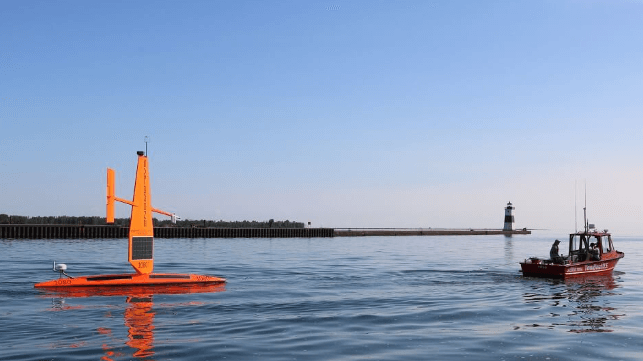
Saildrone 1080 towed out to begin its fisheries survey on Lake Erie (USGS)

PUBLISHED JUL 27, 2023 5:07 PM BY THE MARITIME EXECUTIVE


The Saildrone autonomous surface vessel has operated on scientific and military missions around the world, from the Bering Strait to the Eastern Pacific to the Persian Gulf. Saildrones have even braved the full force of hurricanes to collect unpredented data for the National Oceanic and Atmospheric Administration. This summer, they can be spotted in a new location: Lake Erie, where the U.S. Geological Survey is using saildrones and underwater vehicles to conduct fisheries surveys. It is the first time that wind-powered autonomous boats will be used on the lake. 

On July 14, USGS launched a Saildrone Explorer in Erie, Pennsylvania. This unit - in trademark safety orange - is equipped with sensors above and below the waterline, and will make extensive use of a hull mounted fish-finding echosounder. Saildrone will operate the wind-driven, solar-powered boat on behalf of USGS. Saildrone hull 1080 will make a circuit around Lake Erie for the next two months, carrying out a complete regional survey. 

Monterey Bay Aquarium Research Institute (MBARI) will also deploy a long-range underwater autonomous vehicle for a weeklong survey off Fairport Harbor, Ohio. 

“Monitoring Lake Erie fish populations is integral to sustainable management of the recreational and commercial Lake Erie fishery, but fish community changes and dynamic habitat conditions often create monitoring challenges. We are excited to collaborate with the USGS to explore the use of autonomous vehicles for monitoring Lake Erie fish populations and fisheries," said David Nihart, the state of Pennsylvania's fisheries chief and the chair of the Lake Erie Committee for fisheries management. 

USGS asks boaters and mariners to keep 1,500 feet clear of the saildrone as it works its way slowly around the lake. The U.S. Coast Guard his issued notices to mariners about the saildrone's operations to give advance warning of its passage. 

The reason for using a Saildrone in this application is unique. Traditionally, fisheries surveys have been done with diesel-powered research vessels. The noise of the engines and propellers affects fish behavior, and the researchers hope that the near-silent Saildrone may spot fish that a research vessel would miss. 


AST Joins Space East Cluster to Accelerate Innovation in Space Exploration

Applied Satellite Technology
Applied Satellite Technology (AST), a leading full-service communications integrator, is delighted to announce it will be part of Space East, the influential cluster group creating a regional community around the use of space technology.

PUBLISHED JUL 28, 2023 12:36 PM BY THE MARITIME EXECUTIVE


[By: Applied Satellite Technology]

This collaboration aims to combine the expertise and resources of both entities, pushing the boundaries of space exploration and fostering breakthrough innovations within the industry.

The alliance between AST and Space East marks a significant milestone in the pursuit of scientific and technological advancements in space exploration. Together, these organisations share a belief in knowledge sharing and research to develop a community of businesses that will drive groundbreaking research and unlock new opportunities for space technology.

As part of this collaboration, AST and Space East will collaborate on several key initiatives:

  1. Transforming the East of England into a leader in space technology: Our collaborative efforts will support and accelerate innovation. We will drive exciting opportunities and breakthroughs to establish the East as a leading player within the UK space sector.

  2. Fostering technology exchange and research collaboration: Space East will forge vital connections between industry and academia, in the mission to pool resources and share expertise. This approach will combine resources, expertise, and assets, leveraging funding and enabling organisations to enhance their capabilities for deep space.

  3. Talent development and education: AST and Space East are dedicated to the critical role of education and talent development in shaping the future of space exploration. Joint initiatives from both organisations will invest in educational programs and internships to inspire and nurture the next generation of space sector experts.

Andrew Peters, CEO of Applied Satellite Technology says: "I take great pride in being a member of Space East and contributing to our aligned mission of positioning East Anglia as a prominent force within the UK space industry. AST was first established in Norfolk back in 1992, and our deep roots and rich heritage will forever be firmly intertwined with this region. For numerous years, we have operated on a global scale, yet our foundation and head office remain in Norfolk. Our collaboration marks the foundation for innovation in the East for a new era of cooperation and progress in space exploration."

Stuart Catchpole, Cluster Manager of Space East says: "I am delighted that AST has joined Space East. Together, our cluster will have a transformational impact on the space sector of the East of England. We are delighted to welcome AST into our ranks as a visionary organisation with a long history of pioneering work in global satellite communications. Their expertise will be indispensable for collaboration between our members in business and academia. I’m excited to see what we can collectively achieve in the coming months and years."

The products and services herein described in this press release are not endorsed by The Maritime Executive.


S. Africa Picks Three Groups to Bid for New Manganese & Hydrogen Port

Kudumane manganese
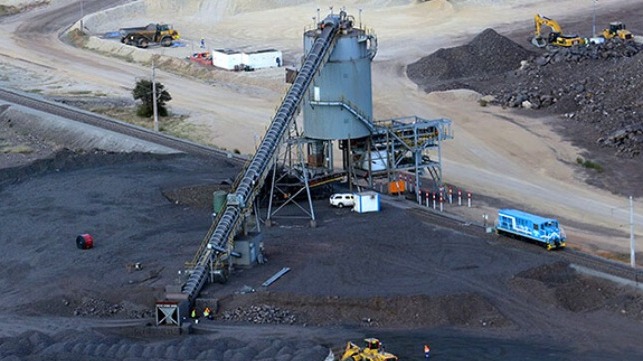
The new port will serve manganese mines in the Northern Cape region, and a massive hydrogen export plant is on the books as well (file image courtesy Kudumane Manganese)

PUBLISHED JUL 25, 2023 11:03 PM BY THE MARITIME EXECUTIVE


South Africa has achieved another milestone in its ambitions to become a major producer and exporter of green hydrogen. A state owned logistics company has identified three consortia that will present proposals for a new port and railway infrastructure for manganese ore and green hydrogen exports. 

Transnet National Ports Authority (TNPA) said it has identified three competing groups to submit proposals for the design, funding and construction of the planned deepwater port of Boegoebaai and associated rail links. The estimated project cost is $785 million during the first phase.

The new port and rail networks are critical in serving the country’s proposed new Boegoebaai hydrogen production hub. The port would serve mines in the Northern Cape province, particularly the export of manganese ore, which is constrained due to high transport costs and insufficient capacity on existing export corridors. TNPA said the development of the new port and associated rail infrastructures will significantly improve connectivity to the Northern Cape, and provide the necessary logistics for manganese, green ammonia and other commodity exports in the province.

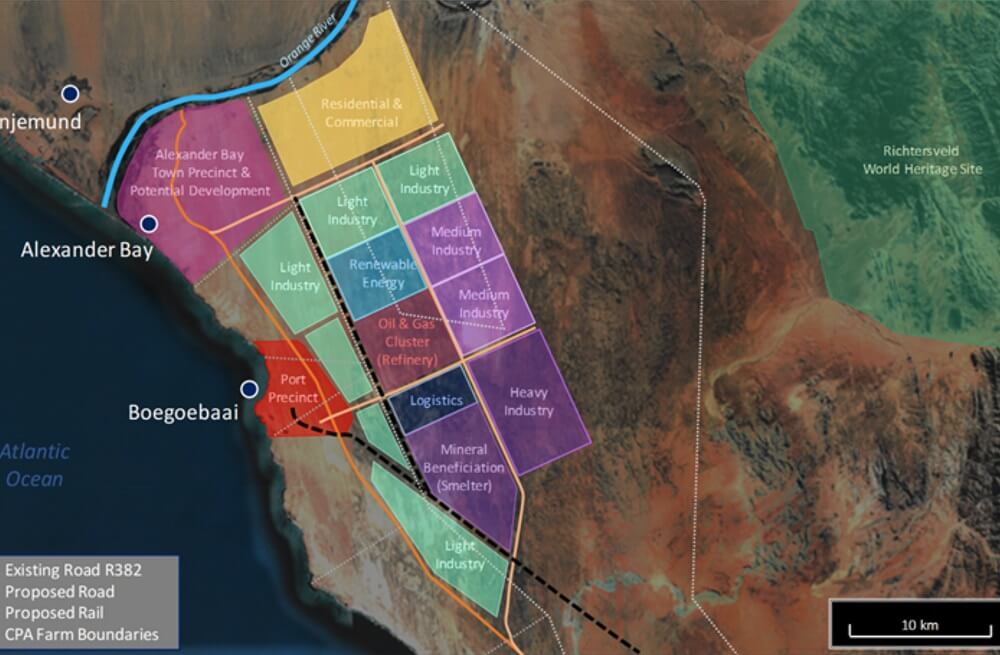
The Boegoebaai port will be built on a greenfield site to handle up to 17 million tonnes of dry bulk commodities a year, as well as containers, break-bulk commodities, diesel fuel and hydrogen.

Proposed layout for the new port and industrial park complex (TNPA)

Boegoebaai Port & Rail Consortium, Boegoebaai Development Consortium and Project Elephant Consortium will submit proposals for the design, funding and construction of a planned port and rail infrastructures. The three companies were shortlisted from a list of eight groups made up of local and international companies that responded to the request for qualification issued in August last year. The shortlisting of the companies puts TNPA on course to start up the first phase of the Boegoebaai port by 2026. 

The development of the port is part of South Africa's hydrogen strategy. The country intends to become a major producer and exporter of green hydrogen, capturing at least four percent global market share by 2050. This will be achieved by deploying 10 GW of electrolysis capacity in the Northern Cape region by 2030 and producing about 500 kilotons of hydrogen annually by 2030.

The Boegoebaai hub is central to the nation's hydrogen ambitions because it would host the core of the H2 export infrastructure. This would including an electrolyzer park, a green ammonia production plant, and associated supporting operations. The mega project is expected to create 6,000 direct jobs.

Apart from hydrogen, the port and associated railway infrastructures are expected to unleash substantial economic benefits in the Northern Cape province. All of the region's export commodities are transported out of the province overland for export through ports in other provinces, creating supply chain bottlenecks and high transportation costs.  


UAE’s Overarching Role in African Ports Development

Port of Dakar
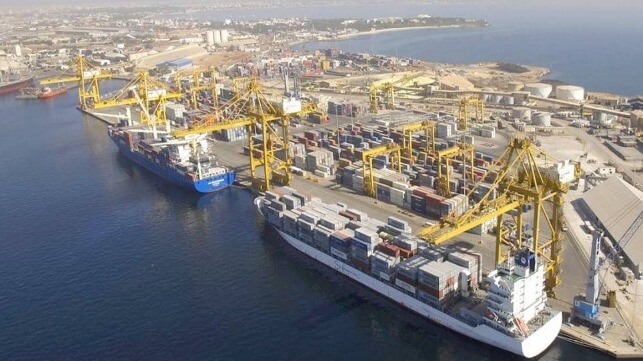
The DP-managed terminal at Port of Dakar (Government of Senegal)

PUBLISHED JUL 23, 2023 5:03 PM BY BRIAN GICHERU KINYUA


Since 2013, China has bankrolled an infrastructure boom in Africa under the BRI (Belt and Road Initiative) banner. However, the economic contraction occasioned by the Covid-19 pandemic has led China to restructure the BRI, cutting funding for most of its projects in Africa.

But there appears to be a new benevolent investor taking China’s cue. During the past few years, United Arab Emirates (UAE) has expanded its investment footprint in Africa thanks to major infrastructural projects, especially in the ports sector.ds

In 2021, UAE celebrated the 50th anniversary of its founding. This came with the launch of the Principles of the 50 document, which plots UAE’s development trajectory for the next 50 years. One key focus area is a renewed foreign policy that puts Emirate’s economy first.

Indeed, this inspiration could be traced in the mega-deals that Emirati companies are striking in Africa. Thanks to billions of dollars’ worth of port projects, UAE is now the fourth largest investor in Africa after China, Europe and the U.S.

The Dubai-based DP World and Abu-Dhabi’s AD Ports, both owned by Emirati royal families, have greatly expanded their influence in African ports in the past decade. For instance, Africa represented 10 percent of DP World’s revenue as of 2021, through major port operations in seven African economies at the time.

This share has definitely gone up after DP World acquired the South Africa based Imperial Logistics. As one of the leading transport companies in Africa offering logistical support across 26 African and European countries, the Imperial acquisition cemented DP World’s position as a “Gateway to Africa.”

Meanwhile, AD Ports’ first international acquisition last year involved buying a controlling stake in Egypt’s Transmar Shipping and Transcargo International Company (TCI). The deal gives AD Ports a market-leading position in port operations in North Africa and the Red Sea region.

DP World and AD Ports Groups currently operate 12 port facilities in Africa, including a logistics platform in land-locked Rwanda. UAE’s port operations in Africa are structured under port concessions averaging over 20 years. The deals have made UAE a top rival to China in competing for port concessions in Africa.

“This string of ports strategy allows the UAE to access African economies and markets, with the Jebel Ali Port in Dubai playing the role of a super hub linking Africa and Asia. It is a One Port, One Node Strategy, with each African port representing a node connecting the Gulf with Africa,” says Eleonara Ardemagni, a Senior Research Fellow at the Italian Institute for International Political Studies.

But how is UAE’s development approach in Africa different from that of other foreign players?

One notable distinction is how UAE has built its Emirati brand in Africa using port investments as its core area of competency. UAE’s African policy seems to leverage on ports as fulcrums of influence.

In some instances, UAE’s maritime ambitions in Africa have existed long before China came calling. Take the case of Maputo Port in Mozambique, which DP World has been managing since 2006. China only started working with Mozambique to renovate Beira Port in 2017. Similarly, DP World has been operating the Port of Dakar in Senegal since 2008. China’s infrastructure projects in the country started to be visible in 2018, ten years later.

VisuDREDGE on DC Dredging Vessels for Visualization of Dredging Process

DC Dredging
Diederik-van-Halsema

PUBLISHED JUL 28, 2023 9:00 AM BY THE MARITIME EXECUTIVE


[By: DC Dredging]

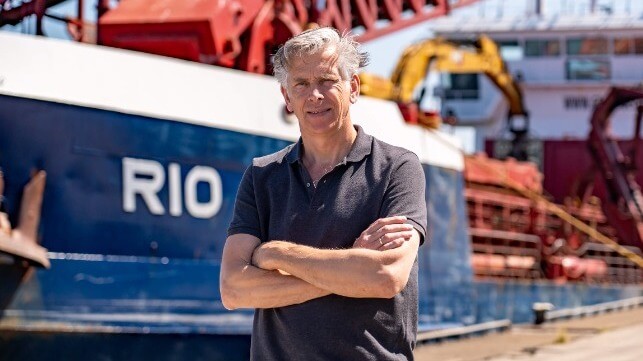
Visualization of dredging is essential to gain insight into the dredging process. But this is only the beginning of the whole dredging story. To complete that story, we meet with Diederik van Halsema of DC Dredging today. He is the fleet manager of the entire DC Dredging fleet, including the vessels DC Ostend, Margaret Ann and Rio. These vessels have a lot of things in common, including MSA- Service's VisuDREDGE dredge visualization system, which is installed on each of these three vessels. In this article he explains what detailed insights into the dredging activities are provided and which developments will make the reporting of the dredging process even better. Introduction: the vessels

First, a brief introduction to the dredging vessels. What exactly are we talking about? Diederik explains: ‘The big difference between the DC Ostend, Margaret Ann and Rio is the type of ship. Margaret Ann is an inland vessel and with its 9 meters the narrowest of the three. DC Ostend is unique because this ship can also suck up gravel. A wear-sensitive and intensive process. The abrasion of the dredging plant on a gravel hopper dredger is three times higher than on a normal trailing suction hopper dredger. Cycle times for gravel hopper dredgers are also different from those of the sand dredger’s dredging process because they are longer. Consequently, a lot can be gained from good reporting. Based on this, we carry out analyses and we can optimize the dredging process.’

Pay off: Visualization of the dredging process is essential
‘Although dredging is more of a hobby for me than work, it is important that the work pays off,’ Diederik continues. ‘First, we use VisuDREDGE to visualize and log the data. We then process this data in Excel in order to extract analyses from it to optimize the processes. In the dredging sector you mainly work under water. It is therefore all the more important for our sector to have accurate information about the dredging process, which after all is our business. That visualization can also easily be made with VisuDREDGE’.

Diederik continues: ‘In addition, we also work a lot for governments. We are currently working with the ship Rio on beach nourishment for the Belgian government. We are expected to be able to accurately display how much we dredge, and this implies a complex measuring method. A technique that MSA-Service masters well and displays in an appealing way on the screen on the bridge. As we can accurately display this information, the authorities can, if required, closely monitor our activities.’

VisuDREDGE: ‘Appealing visualization of important parameters’ Diederik started at DC Dredging five years ago. The systems that ran on the dredgers were outdated. ‘I know MSA-Service from the time I worked for Van Oord and Boskalis. I am pleased about the quality of the systems they provide. When I saw VisuDREDGE, I was immediately interested. I especially liked the customization options. Depending on the equipment on board of the ship, the visualization is fully customizable. The screen displays all parameters that are important to us in an appealing way.’

Unique data insights: better for the people on board and for the management Diederik sees lots of opportunities to improve the dredging industry even further: ‘Currently, the dredging sector is still working a lot with logs and exports to Excel which is already an improvement compared to the past, when everything was still entered manually. Yet, entering and merging information manually is still rule rather than exception - a job prone to error, while a system like VisuDREDGE can already be easily combined with programs that run automatic analyses, such as Multiped.’

Diederik adds: ‘These exact analyses are of enormous added value in making the dredging process effective. This method relieves the work of the people on board and gives a better insight to the management. First, about the people on board: they simply find all the administration and reports related to the dredging activities tedious. And there are already tools available that can take over this work. As far as I'm concerned, we should embrace those opportunities as soon as possible so that the people on board have time to do what they really do best. Combine this data with real-time information and we are talking about true innovation.

About the management, the use of VisuDREDGE provides a good insight into the performance of the ship. The way in which data analyses can be done with this system is unique and certainly also provides a better insight into the performance of the people on board and ultimately of the entire company.’

The products and services herein described in this press release are not endorsed by The Maritime Executive.

Army Corps Awards Contract for Design and Construction of New Dredge

U.S. Army Corps of Engineers
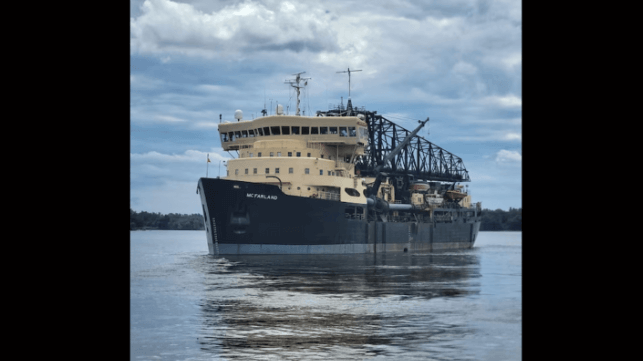
The Dredge McFARLAND is one of four oceangoing hopper dredges owned and operated by the Army Corps of Engineers.

PUBLISHED JUL 27, 2023 6:31 PM BY THE MARITIME EXECUTIVE


[By: US Army Corps of Engineers]

The U.S. Army Corps of Engineers (Corps) has awarded Eastern Shipbuilding Group, Inc. of Panama City, FL, a contract worth $256.9 million for the design and construction of a Medium Class Hopper Dredge (MCHD) to replace the Dredge McFARLAND of the Corps’ Philadelphia District.

The Dredge McFARLAND is one of four oceangoing hopper dredges owned and operated by the Army Corps of Engineers.

The new MCHD will play a critical role in enabling the Corps to continue to deliver its navigation mission and provide for safe, reliable, effective, and environmentally sustainable waterborne transportation systems for vital national security, commerce, and recreation needs. The new dredge is estimated to be placed into service in 2027 and replaces the 57-year-old McFARLAND.

The products and services herein described in this press release are not endorsed by The Maritime Executive.

Biden Uses Steel Cutting of Wind Vessel to Promote Offshore Energy Progress

Biden at Philly Shipyard
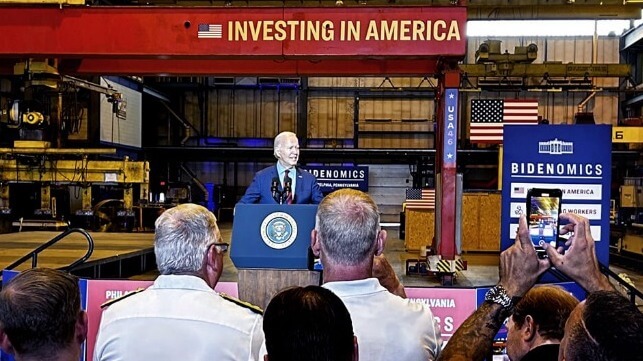
Biden speaking at Philly Shipyard to mark construction of the first rock installation vessel for the U.S. wind industry (Business Network for Offshore Wind)

PUBLISHED JUL 20, 2023 8:24 PM BY THE MARITIME EXECUTIVE


President Joe Biden visited the Philly Shipyard in Pennsylvania to attend the steel-cutting ceremony for the first U.S. rock installation vessel being built for Great Lakes Dredge & Dock Corp. to support the burgeoning offshore wind power industry. Biden used the visit to the shipyard to also highlight the advancements in the U.S. offshore wind industry and announce the next lease auction, the first to be conducted for the Gulf of Mexico.

During his speech, the president highlighted that companies have announced 18 offshore wind shipbuilding projects as well as investments of nearly $3.5 billion across 12 manufacturing facilities and 13 ports to strengthen the American offshore wind supply chain. The vessels range from the first Jones Act-compliant installation vessels to a SOV, and crew transfer vessels. They are being built at shipyards ranging from Florida to Louisiana, New York, Massachusetts, Michigan, Rhode Island, Wisconsin, and Pennsylvania. 

The visit was timed to coincide with the construction of Arcadia, a 461-foot long vessel that becomes the first offshore wind rock placement vessel and will be used by Great Lakes Dredge & Dock to enter the offshore wind sector. The vessel was designed by Ulstein and the construction contract, which is valued at $197 million, was awarded to Philly Shipyard in November 2021 along with an option for a second vessel.

The Subsea Rock Installation Vessel is designed to carry up to 20,000 metric tons of rock and will transport and strategically deposit the material to the ocean bottom, laying a foundation for the monopiles which serve as the prevailing support structure for offshore wind turbines. Delivery for the first vessel is expected in Q4 2024, and if awarded the second would be delivered in Q4 2025.


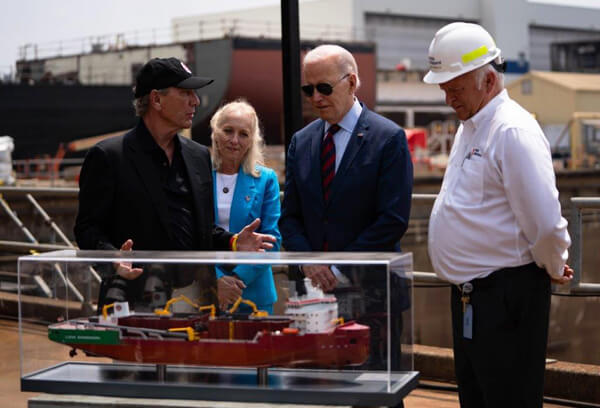
Biden was shown a model of the rock installation vessel being built at the yard (Great Lakes Dredge & Dock Corp.)


Biden toured the shipyard and used the visit to highlight new data that shows there are more than 4,100 companies in all 50 states that are looking to support the U.S. offshore wind industry. He said the industry already includes nearly 1,500 contracts for work. 

Installation of the offshore foundations is now underway for the first two large, commercial-scale wind farms in the United States. Located off New York and Massachusetts both are targeted to complete construction by the end of this year while the Bureau of Ocean Energy Management has moved forward with the review of the next two Construction and Operation plans. BOEM reports that it expects to review at least 16 Construction and Operation Plans for offshore wind farms by 2025, which would represent more than 27 GW of energy.

Biden and BOEM also today announced the next wind energy lease auction, which will be the first for the Gulf of Mexico. The areas will be auctioned on August 29 and will have the potential to generate approximately 3.7 GW and power almost 1.3 million homes. One area is over 102,000 acres offshore of Lake Charles, Louisiana. Two other areas are offshore Galveston, Texas comprising a total of approximately 200,000 acres. 

In less than a year, BOEM has conducted lease auctions for the New York Bight, Carolina Long Bay, and northern and central California. BOEM has also completed another step in reviewing a potential offshore wind research lease in the Gulf of Maine and is moving forward with plans for a lease area off the coast of Oregon. 

Biden has committed the United States to 30 GW of offshore wind energy by 2030. 


From the Andes to the Oceans

A scientific expedition to Peru in the 18th century paved the way for today’s advanced vessel designs.

Haisea Wamis
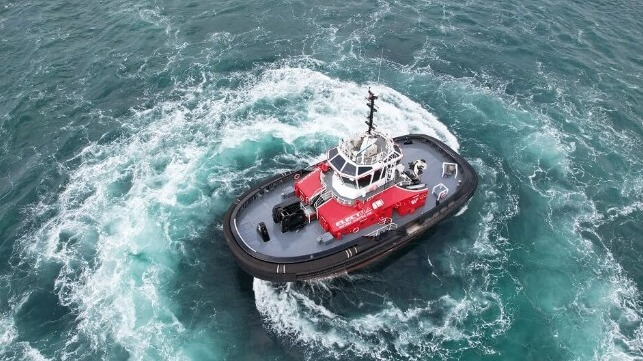
Haisea Wamis (Robert Allan Ltd.)

PUBLISHED JUL 23, 2023 2:08 PM BY SEAN HOGUE


(Article originally published in May/June 2023 edition.)

In 1735, French mathematician Pierre Bouguer sailed with Charles Marie de la Condamine on a scientific mission to New Granada – modern-day Peru.

His mission: Measure a degree of the meridian arc near the equator.

The final result of that trip changed the face of seagoing mathematics forever.

Traite du Navire

The expedition lasted 10 years and, upon his return, Bouguer – known to some as the “father of naval architecture” – published the very first treatise on the subject, Traite du Navire (“Treatise of a Ship”), considered the “bible” of vessel design.

The book was influenced by his many years at sea and based on his extensive knowledge of mathematics, physics and mechanics as well as his practical experience in shipbuilding and naval architecture. It covered a wide range of topics related to ship design including the properties of water, the principles of buoyancy and stability, the construction and rigging of ships and the techniques of navigation.

It was also the first to explain the use of the metacenter as a measure of a ship’s stability. This concept impacts nearly every aspect of how a ship handles at sea, from rolling period to damage stability and free surface effect.

(Author’s note: While studying Nautical Science at the Marine Institute in Newfoundland, my Ship Stability professor would always say that we should wake up in the middle of the night screaming the definition of the metacenter, which is “the point on the centerline intersected by a vertical line leading from the center of buoyancy of an inclined hull.”)

Bouguer’s purpose was to provide a comprehensive guide for shipbuilders and seafarers on the principles of naval architecture and ship design. At the time, French naval technology was falling behind that of other European powers, and he sought to rectify this by producing a work that would improve the design and performance of French ships.

The book was a massive success, laying the foundations of modern vessel design as we know it.  Overnight, naval architecture became the most sought-after profession in France.

Nearly 300 years later, the field has continued to develop in ways that Bouguer couldn’t begin to imagine.

Zero-Emissions Vessels

Established in 1928 in Vancouver, Canada, Robert Allen Ltd. has built a reputation for innovative vessel designs using the latest in computer-aided design (CAD) technology. Since the first project, a pair of power cruisers designed for local businessmen, the company has continued to push the boundaries of what is possible.

With a firm focus on designing vessels that meet the latest regulatory requirements around emissions and redesigning existing fleets to meet decarbonization goals, the company uses the latest CAD methods to help operators achieve their vision.

These methods helped create a groundbreaking set of “firsts” in the emissions-free tug market.

First is the RApide 2000-E pushboat – the HB Poraque. It’s the world’s first battery-electric, shallow-draft pushboat and one of two innovative battery-diesel electric vessels for Hidrovias do Brasil S.A., a leading South American logistics provider.

The vessel is fitted with a DC grid diesel-electric propulsion system, comprising two diesel generators, two L-drives and a large battery bank. The pushboat can operate in zero-emissions mode, and the 600 kWh batteries have sufficient endurance to enable it to perform its primary role with a future expansion to 2000 kWh, enabling secondary roles to also be performed with zero emissions. The two L-drive units each have an input power of 375 kW. The propulsion system is diesel-electric to improve efficiency when operating in multiple power modes.

Farther north, another first in class battery-powered electric tug has recently been delivered.

Based on the ElectRa 2800sx series, the HaiSea Wamis will be the first battery-powered tug operating in Canada and the first to be delivered based on a Robert Allen design.

A collaboration between Robert Allen, HaiSea Marine, LNG Canada, Seaspan ULC, Sanmar Shipyards, and the Haisla Nation, the Wamis is part of a five-tug delivery package that includes two more electric tugs and two LNG-powered tugs – another first in Canada.

Designed to meet the unique requirements of assisting LNG carriers on and off the berths at the LNG Canada terminal in Kitimat, the tugs operate in zero-emissions mode in order to protect the pristine wilderness in northern British Columbia.

The Wamis is 28.4 meters long, 13 meters wide and has 70 tons of bollard pull powered by a 6,000kWh battery storage system. It recently won “Tug of the Year” at TugTechnology’23 in Rotterdam.

Fittingly, it’s named for the man who began the Haisla Nation.

Making the Energy Transition Work

Changing emissions regulations require new and innovative solutions. Battery power certainly plays a part. However, it’s just one part of the mix. Developing new fuels for reliable use is another.

Seattle, Washington-based Glosten Marine is helping drive this transition with its innovative hybrid tug design, the SA-100.

The SA-100 is a methanol-hybrid, ship-assist tug that provides operators with a viable path to carbon-neutral operations while minimizing business risk and enhancing competitiveness. The 100-foot ASD tug is propelled by two methanol-compatible CAT 3512E gensets powering L-drives. The gensets are complemented by twin battery banks for zero-emissions operation when transiting and as “boost” for achieving peak bollard pull of 90 short tons.

To help offset the additional capital expense of its modern power plant, the SA-100 was carefully designed under 100 gross registered tons. With ABB as electrical integrator, Glosten has developed a future-ready design that meets the new requirements for U.S. tug operators.

Methanol makes sense as an alternative fuel for a number of reasons. It doesn’t require special storage, and it can be used in conventional diesel-cycle engines with a number of off-the-shelf solutions already available.  It’s also sulfur-free and emits less NOx and PM than conventional diesel. When produced from renewable resources, it has the potential to be a true zero-carbon fuel.

Another Glosten innovation is the PelaStarTM tension leg platform (TLP), which recently won Phase 1 of the U.S. Department of Energy’s Floating Offshore Wind ReadINess (FLOWIN) Prize. The award indicates the TLP is technically ready to scale towards commercialization in the U.S. market.

Glosten is now growing its partner network to support the Phase 2 efforts, which will address such challenges as port and vessel infrastructure, U.S. steel fabrication capacity, and assembly and deployment methods that are cost-effective. (See Jack O’Connell’s Executive Achievement interview with Glosten CEO Morgan Fanberg for additional background on Glosten and the PelaStar project.)

Expanding Technology Solutions

Hockema Group is a full-service naval architecture firm that’s been advancing the industry for the past 26 years. Established in Washington back in 1997, the firm now has employees in five states. Hockema has been a champion of the work-from-home culture from the very beginning, giving employees substantial freedom to self-manage as they see fit while trusting them to get the job done.

It has paid off spectacularly.

The company has a history of delivering massive barges including the 2022-launched Haleakala for Matson. This highly specialized cargo barge has a carrying capacity of 620 TEUs including space for 72 refrigerated containers. It features a high-efficiency hull with Hydra-Lift Skegs, two Caterpillar 430kW C18s and another pair of 130 kW C7.1 generators providing power to the deck.

And under construction right now in Brownsville, Texas is the hopper dredge Frederick Paup.

The Frederick Paup will be the largest U.S.-flagged, self-propelled hopper dredge delivered in American shipbuilding history. Boasting a hopper capacity of over 15,000 cubic yards, the vessel will be propelled by three stern Z-drive units with two bow thrusters forward and will receive ABS ?A1, ?AMS and ACCU class notations as well as SOLAS certification once completed.

An exciting use of bringing new technology to old designs is the company’s use of Faro Focus Laser Scanners.

In collaboration with Carrera boats, Hockema was able to 3D-scan a classic cigarette-style boat from the 1960s. These legacy designs had no digital drawings – and few paper drawings, for that matter.  The scans resulted in the creation of full 3D models, allowing the company to pull build drawings, accurate dimensions and the ability to run computational fluid dynamic studies.

From the Andes to the Oceans

Much has changed since Bouguer’s seminal work in 1745, but the basics remain the same.

With the core concepts of naval architecture firmly in hand, these modern-day companies are able to create bigger, stronger, more capable designs faster and more efficiently.

Using up-to-date technology and personnel management techniques, they can be competitive while remaining flexible, allowing people to focus on the work rather than the commute. The result is solidly designed projects delivered on time and on budget.

Bouguer would be proud. 

Master mariner Sean Hogue is a regular contributor to The Maritime Executive.

The opinions expressed herein are the author's and not necessarily those of The Maritime Executive.


Four Companies in Shipping and Logistics Emerge as Bidders for HMM

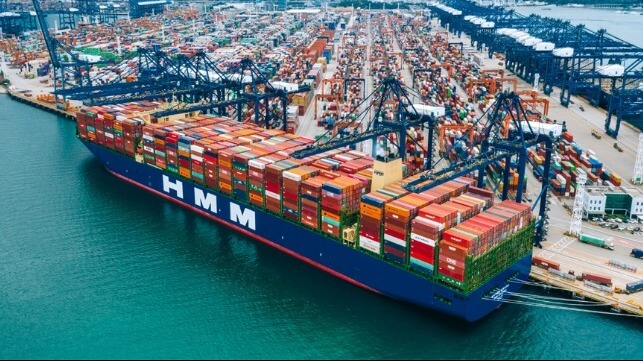
HMM containership
South Korea's government banks look to privatize HMM seven years after they bailed out the company (file photo)

PUBLISHED JUL 26, 2023 3:55 PM BY THE MARITIME EXECUTIVE


Four bidders have emerged as potential buyers from HMM as the first round of the process begins in South Korea. Media reports are suggesting that the government favors one of the largest conglomerates to take control of the shipping company. They appear to be seeking to encourage more companies to enter the process.

The media reports said that Samsung Securities, which is conducting the bidding process, has received initial registrations from two shipping companies, SM Group and Harim, the largest investor in Pan Ocean, another Korean shipping line. In addition, two conglomerates with operations in the logistics business, LX Holdings and Dongwon Group, are also reported to have registered in the bidding. 

The government-controlled banks, Korean Development Bank and Korea Ocean Business Corporation, announced last week that their advisors had said it was possible to proceed with the sale this year despite the downturn in global shipping markets. Collectively the two banks hold approximately 40 percent of the shares of the company, but with their convertible perpetual bonds, the ownership stake could rise to approximately 75 percent of HMM, if everything was converted into shares.

The current value of the 40 percent equity shares is set at $3.9 billion, although the banks have indicated in their announcement that the plan would be to sell approximately 58 percent by converting a portion of the bonds. They said they would consult with the winning bidder to determine a plan to sell the remaining bonds in a means not to disrupt the market. If all the bonders were converted, at current market prices the stake in HMM would be valued at nearly $8 billion.

The chairman of KDB previously told reporters that several candidates had shown interest in acquiring HMM, without naming any potential bidders. They are looking for a large Korean company to take control of HMM seven years after the government bailout of the former Hyundai Merchant Marine.

SM Group told reporters in an interview that it was prepared to invest up to approximately $3 billion in a plan to merge HMM with its much smaller SM Line. Combined the goal is to create Asia’s largest carrier. HMM is currently the world’s eighth-largest container carrier with approximately 800,000 TEU of capacity, significantly behind COSCO, Evergreen, and ONE. HMM also operates a small fleet of dry bulk carriers and tankers plus has said it would be interested in reacquiring its form LNG business, Hyundai LNG Shipping. 

Harim, which calls itself global food and agribusiness with its primary operations in poultry farming, is reported to have also registered to enter the bidding. Seven years ago, with backing from the JKL Consortium, Harim acquired Pan Ocean, a Korean shipping company established in 1966 operating dry bulk and later oil tankers. Dry bulk remains the largest portion of the operation accounting for nearly 70 percent of the business. The company is reported to have more than 80 bulkers as well as small operations in containerships, tankers, LNG, and heavy lift. The reports are that Harim is again partnering with the private equity firm JKL to make a bid for HMM.

The other two companies that have registered so far for the bidding are both involved in logistics operations. LX has a global logistics company as well as chemical, semiconductors, natural resources, and low e-glass. Dongwon had operations in logistics and also runs a container terminal in Pusan. The company also has operations in food, construction, and packaging materials manufacturing.

As part of the process, potential bidders register with Samsung Securities receiving the information packet. Preliminary bids for HMM are due by August 21. The banks plan to select a winner and negotiate a final agreement with the company. They hope to complete the sale of HMM before the end of 2023.