Saturday, July 29, 2023

ECOCIDE
Blazing cargo ship off Netherlands to be towed, 'likely this weekend'

July 29, 2023
AFP


Preparations were under way to salvage a cargo ship packed with electric vehicles that caught fire off the Dutch coast, officials said Friday, in an operation intended to avert an ecological disaster.

An electric car is suspected of having sparked the deadly blaze and officials said earlier that nearly 500 electric vehicles were aboard, far more than initially reported.

Fire broke out on the Fremantle Highway late Tuesday, killing one member of the all-Indian crew and prompting a massive effort to douse the flames.

"The temperature on board the ship has dropped sharply and the intensity of the fire and smoke development have decreased," said the Rijkswaterstaat, the national water management agency, in a statement at about 11:30 pm (2130 GMT).

"The cargo ship is stable at this time. The ship is also still intact below the waterline and does not tilt."

The agency said it, as well as salvage companies, "have now started preparations for towing the freighter to an area further east", after rescuers were able to board the ship and connect it to a tug.

It added that towing the ship was likely to take around 12 hours, pulling the stricken vessel to a temporary anchorage north of Schiermonnikoog island -- "a better starting position for Rijkswaterstaat, the Coast Guard and the collaborating salvage companies".

The agency added that "no direct consequences" were expected for the surrounding environment, and the Fremantle Highway would eventually be towed to a port, which was yet to be determined.

While the timing would be affected by the weather and the state of the smoke, it was "likely that towing will begin this weekend".

Efforts to extinguish the blaze were halted Thursday to prevent the ship from losing stability due to the volume of water accumulating on board.

Japan-based K Line, the ship's charter company, reported there were 3,783 cars on board the vessel -- far more than an initial estimate of around 3,000.

These were "all brand new/no used cars on board" including 498 "electrical vehicle units", the company told AFP in a statement.

Ship owner Shoei Kisen Kaisha has said there was a "good chance that the fire started with electric cars", but added that the cause still needed to be investigated.

One sailor died after he and 22 others were rescued from the burning ship that had forced some crew members to jump overboard.

The blaze has raised the spectre of an ecological disaster on a nearby chain of islands, which include Terschelling and Ameland, where the fire was first reported.

The ship remained close to Terschelling and Ameland, which are part of an archipelago of ecologically sensitive islands in the Wadden Sea.

The area spanning the Netherlands, Germany and Denmark has been declared a UNESCO World Heritage Site and has a rich diversity of more than 10,000 aquatic and terrestrial species.

jhe/giv/leg

Burning ship off Dutch coast has more e-cars than thought


A freighter carrying thousands of cars is still burning off the Dutch coast, with a spokesperson for the charter company saying there were close to 500 electric cars on board — far more than the 25 initially reported.


https://p.dw.com/p/4UVDn


The ship was carrying nearly 4,000 cars en route from Germany to Egypt
Image: Kustwacht Nederland/Coast Guard Netherlands/AP/picture alliance

A freight ship that caught fire off the Dutch coast and has been burning since, as fire extinguishers try to figure out ways to tackle the incident, has been carrying nearly 500 electric cars, far more than previously reported, the company that chartered the ship said.

Initial reports said that the ship was carrying 25 electric cars.

The Fremantle Highway vessel, which has burning for a fourth day off the Dutch coast, was chartered by Japanese transportation company K Line.

A spokesperson for the company said there were 3,783 vehicles on board, including 498 battery-electric vehicles. The spokesperson declined to comment on the kinds of car brands that were on the ship.

There is no information on whether the cargo ship was carrying cars by Japanese manufacturers.

Burning cargo ship threatens North Sea with major pollution

The Fremantle Highway cargo ship is still burning off the Dutch coast. Rescue workers are trying to prevent it from sinking, a potential environmental disaster. But the firefighting efforts have proven difficult.



A Dutch Coast Guard boat approaches the car carrier cargo ship Fremantle Highway. The ship caught fire early Wednesday morning just under 27 kilometers (16.8 miles) off the coast of the northern Dutch island of Ameland. But containment of the flames on the 200-meter-long ship is slow, and the coast guard expects the freighter to burn for several more days.

Difficult work


Boats with water cannons are cooling the ship from both sides. The fire cannot be extinguished directly at the moment because rescue forces cannot reach it. A Coast Guard aircraft still needs to take pictures from the air and check whether the temperature has dropped. Only then can special forces board the ship.


Ready to fly


Rescue workers at Rotterdam Airport prepare for their mission on the Fremantle Highway. The cargo ship had loaded 3783 automobiles, Kisen Kaisha, a spokesman for Japanese shipping company Kawasaki, said Thursday. Among them, he said, were electric cars whose lithium batteries are complicating the firefighting operations. The Dutch coast guard had previously spoken of just under 3000 automobiles.


Danger to the Wadden Sea


Too much water from the firefighting operations could also cause the ship to capsize. The Coast Guard said on Thursday that the ship was stable for now. Should the Fremantle Highway sink, fuel, oil and, of course, the loaded cars would enter the water, which would threaten the Wadden Sea, the largest tidal flats system in the world, with large-scale pollution.


30-meter jump for crew members


An injured crew member of the Fremantle Highway is brought ashore in Lauwersoog. The 23 crew members had to leave the cargo ship head over heels, several of them jumping from the ship from a height of 30 meters. One crew member died and the rest were brought to safety by helicopter with minor injuries, according to Dutch media.


Environmental disaster feared


The Panama-registered ship had left the German port of Bremerhaven with full fuel tanks. 1,600 tons of heavy fuel oil and 200 tons of diesel could to enter the North Sea. So far, according to the authorities, no oil has spilled out of the burning cargo ship. Environmental protection organizations fear an environmental disaster if the Fremantle Highway sinks.Image: Kustwacht Nederland/Coast Guard Netherlands/AP/picture alliance


Safe on land?


A man looks with binoculars in the direction of the burning cargo ship from the island of Ameland. According to the Dutch government, the risk of an oil spill in the Wadden Sea islands is low. Escaping fuel would disperse northwards in the open sea, the responsible Dutch Minister for Infrastructure and Water Management Mark Harbers said on Thursday.


"Serious danger"

The German Central Command for Maritime Emergencies is supporting the operation. The emergency tugboat Nordic (pictured above) sprayed water onto the Fremantle Highway on Wednesday. On Thursday, the German government offered further help: "Germany will provide anything that can help," said German Environment Minister Steffi Lemke. The unique Wadden Sea National Park is in serious danger, she said.

Electric car battery fires much harder to put out

The Dutch coast guard said Thursday the cause of the fire was unknown, while Dutch media reported that the fire may have been after an electric car battery ignited.

Cars with lithium ion batteries have fewer fires than diesel and gasoline cars, but the situation can be dangerous when the batteries catch fire.

The fires then are hotter because there's a lot more fuel inside an electric car battery because the battery cells are densely packed. It also takes a lot more water to put the fire out.

But pouring too much water to douse the flames is also not a tenable solution because there are fears of the ship sinking and environmental havoc.

The 199-meter Fremantle is still drifting in the sea, about 17 kilometers from the Dutch island of Terschelling.

rm/fb (Reuters, dpa)


Bangladesh major hub for tiger poaching: study

Issued on: 28/07/2023 
A Bengal tiger walks through a forest in Sarankhola, in the southwestern Bagerhat district, in a photo courtesy of the Bangladesh Forest Department 

Dhaka (AFP) – Bangladesh remains a major hub for the poaching of endangered tigers despite government claims of a successful crackdown on pirate groups involved in the trade, according to research published Friday.

The vast Sundarbans mangrove forest straddling India and Bangladesh hosts one of the world's largest populations of Bengal tigers.

Their pelts, bones and flesh are bought by black marketeers as part of a broader illegal wildlife trade valued at an estimated $20 billion globally each year.

Research from big cat conservation group Panthera and the Chinese Academy of Sciences said tiger parts harvested in the Sundarbans have been exported to 15 countries, with India and China being the most common destinations.

"Bangladesh plays a much more significant role in the illicit tiger trade than we previously realized," study co-author Rob Pickles said in a statement.


Pirate groups operating in the Sundarbans found a lucrative trade in tiger poaching before a government crackdown starting in 2016.

At least 117 pirates were shot dead and hundreds more were detained, according to official figures, while many others surrendered as part of a government amnesty.

But Panthera's research, published in the Conservation Science and Practice journal, said that the vacuum created by the crackdown had been filled by more than 30 specialist tiger poaching syndicates and opportunistic poachers.

Traders operated through their own logistics companies and in some cases concealed their activities through licenses for legal wildlife trade, the study added.

The research, based partly on interviews with those involved in the wildlife trade, also found that domestic consumption of tiger parts had increased since the crackdown, owing to Bangladesh's burgeoning economy.

Wealthy local buyers were purchasing medicines using tiger parts "as well as large ornamental items for display such as skulls and skins", the study said.

The findings were disputed by Bangladesh's official Sundarbans conservator Abu Naser Mohsin Hossain, who said the crackdown had brought the illicit trade to a standstill.

"We have taken measures to conserve the Bengal tiger population in the Sundarbans," he told AFP.

"No tiger has died from... tiger-human conflict in the past five years. Tiger sightings have increased."

Just 114 Bengal tigers live in Bangladesh's portion of the Sundarbans, according to an official census published in 2019 -- up slightly since a record low four years prior.

An updated population count is due to be published next year.

Poaching is the number one threat to tigers globally, and China is the biggest overall driver of demand, largely for use of their body parts in traditional medicine, according to Panthera.

© 2023 AFP


Youth placed in adult prison have their lives cut shorter, study says

Youth placed in adult prison have their lives cut shorter, study says
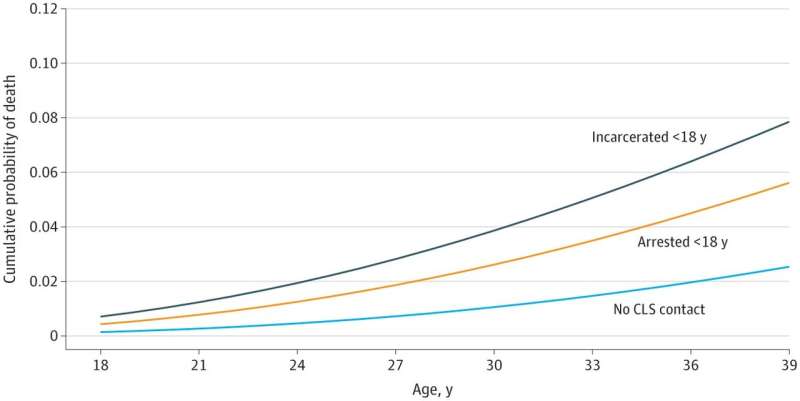
Cumulative Probability of Dying by Age for Varying Types of Contact With the 
Legal System. The cumulative probability of dying by the corresponding age was
 estimated using the results from the model presented in Table 2. 
Incarcerated <18 y indicates ever spending time in an adult correctional facility 
as a youth. CLS indicates criminal legal system. 
Credit: JAMA Network Open (2023). DOI: 10.1001/jamanetworkopen.2023.21805

A University of Cincinnati co-authored study found that in the U.S. youth who are incarcerated in adult correctional facilities are at a 33% higher risk for an early death between the ages of 18 and 39. The study, published in JAMA Open Network, also found that formal encounters with the legal system put youth at risk for a shorter lifespan during those same years.

"We've known for a long time that youth who spend time in adult prisons have a wide range of negative health-related outcomes; however, whether such experiences affected  had not yet been tested," says study co-author Joseph Nedelec, an associate professor in UC's School of Criminal Justice.

In what Nedelec calls the first known study of its kind, he and fellow researchers from RTI, a nonprofit research institute, and Rutgers University, Camden, New Jersey, analyzed data from the National Longitudinal Survey of Youth 1997.

The study involved a random sample of 8,951 individuals born in the United States between 1984 and 1987, who were first interviewed in 1997. The interviews continued until 2019. A total of 109 participants were incarcerated as youth in adult facilities and 225 participants died during the study period and were between the ages of 18 and 39.

Main finding

According to Nedelec, the main finding of increased risk of death by 33% held fast even after accounting for general risk factors such as health,  and whether the individual died while incarcerated or not.

In most U.S. states, youths can be transferred and sentenced in adult court, resulting in detention in adult jail or prison facilities. Incarceration in juvenile versus adult correctional facilities represents vastly different experiences. Adult facilities are often much larger and place less emphasis on treatment, counseling and education. Incarcerated youths often experience health challenges related to , sexual and reproductive health and mental well-being.

"The adult prison system is not designed for the crucial development years of adolescence," says lead author Ian Silver, Ph.D., a quantitative criminologist at RTI who earned his Ph.D. in criminal justice at UC in 2019. "Within such a system youths may not only engage in risky behaviors, but they may directly experience risk factors associated with the likelihood of early mortality, including increased risk for violent victimization, substance use and disease."

Holding youths in adult prisons "is not only problematic, but it may also be lethal," says UC's Nedelec, adding that youth incarcerated in juvenile facilities did not illustrate the same increased risk of early mortality.

Secondary finding

While being incarcerated in an adult facility as a youth evidenced a high risk for early mortality, the study also found that any formal contact with the legal system was associated with an increased risk of premature death by 18% between 18–39 years of age.

Per the study, formal contact is defined as an arrest, but can also be an arrest and release.

"It appears any formal contact with the legal system as a  increases the risk of early mortality, relative to no contact with the ," says Nedelec.

More information: Ian A. Silver et al, Incarceration of Youths in an Adult Correctional Facility and Risk of Premature Death, JAMA Network Open (2023). DOI: 10.1001/jamanetworkopen.2023.21805


Journal information: JAMA Network Open 


Provided by University of Cincinnati Study finds high mortality rates of youths previously incarcerated in the juvenile legal system

POPULAR AUTHORITARIANISM
Critics of El Salvador mass trials suspect reelection ploy

Issued on: 29/07/2023 
El Salvador's President Nayib Bukele enjoys massive public support for detaining thousands of suspected gangsters in a move that has vastly improved the daily security of ordinary people 
© - / EL SALVADOR'S PRESIDENCY PRESS OFFICE/AFP/File

San Salvador (AFP) – A new law allowing as many as 900 alleged gang members to be tried at a time in El Salvador, where tens of thousands have been arrested in a crackdown, has alarmed justice experts and rights groups who fear it is a reelection ploy by President Nayib Bukele.

Almost 72,000 people accused of belonging to criminal gangs are imprisoned in El Salvador under a state of emergency that allows arrests without a warrant in what rights groups have described as "arbitrary detention."

Bukele has also built a mega prison -- which he says is the largest in the Americas -- to lock up 40,000 suspected gangsters in harsh conditions also decried by human rights organizations.

Now, collective trials will further violate "the rights to an adequate defense, to a fair trial and the presumption of innocence," Amnesty International Americas director Erika Guevara Rosas told AFP.

Almost 72,000 people accused of belonging to criminal gangs are imprisoned in El Salvador 
© - / EL SALVADOR'S PRESIDENCY PRESS OFFICE/AFP/File

The measure was approved by a Bukele-friendly Congress Wednesday under the state of emergency in place since March 2022, which critics say has seen innocent people caught in the dragnet.

"We have seen how the legal reforms associated with this repressive measure (the state of emergency) have sought to erode the basic guarantees of the criminal process," said Guevara Rosas.
'Unconstitutional'

Antonio Duran, a judge in the city of Zacatecoluca who is critical of the state of emergency, said the main goal of the mass trials -- for which no starting date has been set -- appeared to be "heavy and rapid sentences."

El Salvador's President Nayib Bukele has announced he will seek reelection next year 
© Handout / EL SALVADOR'S PRESIDENCY PRESS OFFICE/AFP/File

"Mass trials contradict... the (legal) principle of individual responsibility," he told AFP, adding the measure flouted "international standards" of justice.

"This is all part of Bukele's campaign for reelection, which is unconstitutional," the judge said.

Bukele, with a controversial green light from the Constitutional Court, has announced he will run in elections next year despite a constitutional ban on successive presidential terms.

The president, 42, is basking in massive public support due to his "war" on gangs, which has vastly improved security for ordinary citizens of the Central American country.

"The most important thing is the benefit to the population and that is why the measures are taken and why the people support them," sociologist Rene Martinez from the University of El Salvador told AFP.

- 'Killing the rule of law'-

However, the Center for Justice and International Law (CEJIL), an NGO for human rights in the Americas, said collective trials would make it "impossible" to guarantee "a fair trial and the right to a defense."
President Nayib Bukele has built a mega prison to lock up 40,000 suspected gangsters in harsh conditions decried by human rights organizations 
© - / EL SALVADOR'S PRESIDENCY PRESS OFFICE/AFP/File

"This makes us wonder if the government's policy of persecuting the gangs, organized crime, is killing the rule of law and democracy," Marcela Martino, CEJIL deputy director for Central America and Mexico, told AFP.

Miguel Montenegro, executive director of the non-governmental Human Rights Commission of El Salvador, pointed to political expediency for the mass trial move.

It was, he said, "aimed at convincing those who are doubting the government."

The measure also allows for suspects to be held for up to 24 months before being brought to trial or released.

It would mean that innocent people will inevitably end up being tried, and convicted, along with real gangsters, said Samuel Ramirez of the MOVIR movement for victims of rights abuses in El Salvador.

Polls show that nine out of ten Salvadorans support President Nayib Bukele 
© MARVIN RECINOS / AFP/File

Polls show that nine out of ten Salvadorans support Bukele, but there is no consensus on mass trials.

Factory worker Virgilio Gutierrez told AFP in San Salvador he thought the move was a "good" one as individual trials would "take a long time... If they take them case by case they will never finish."

But lottery ticket salesman Juan Mejia was against mass trials as "the law says they must be individualized, one by one."

© 2023 AFP
Brazil Indigenous leaders call for govt to back demarcation of ancestral lands

The leaders of 54 Indigenous communities in Brazil called on Friday for the government to take a concrete stance on the demarcation of their ancestral lands before a key Supreme Court ruling on the issue.


Issued on: 29/07/2023 - 
An aerial view of the Terra Preta Indigenous community, located at the Sustainable Development Reserve Puranga-Conquista, during an expedition organized by the Brazilian ministry of environment to the Lower Rio Negro Mosaic in Amazonas State on July 8, 2023. 
© Michael Dantas, AFP

Text by: NEWS WIRES

The Supreme Court's so-called "trial of the century" could remove the protected status of some Indigenous lands, opening them up to agribusiness and mining.

In an 11-point letter, the Indigenous leaders called on the minister of Indigenous peoples, Sonia Guajajara, to "fulfill her mission to demarcate Indigenous lands".

The law currently only recognizes ancestral territories that were occupied by Indigenous communities at the time Brazil's constitution was promulgated in 1988.

But Indigenous leaders say certain territories were no longer occupied at that point because communities had been expelled from them, particularly during the military dictatorship from the 1960s to the 1980s

The upcoming Supreme Court trial, which was postponed in June, will either validate or invalidate the 1988 cut-off.

In Friday's letter, the Indigenous leaders argued that upholding the cut-off date would jeopardize their survival and lead to thousands of evictions.

President Luiz Inacio Lula da Silva's left-wing government has made the issue of ancestral land rights a priority, and signed in April decrees recognizing six new Indigenous territories, authorizing Indigenous peoples to occupy the land and have exclusive use of its resources.

No new reserves had been demarcated under former president Jair Bolsonaro's right-wing government.

Environmentalists say protecting Indigenous reservations is one of the best ways to stop the destruction of the Amazon, a critical resource in the race to curb climate change.

(AFP)
Snoop Dogg donates thousands of dollars to help elderly woman save Civil War-era home

2023/07/28
Snoop Dogg visits SiriusXM's Rock the Bells Radio at the SiriusXM Studios in New York.
- Noam Galai/Getty Images North America/TNS

Snoop Dogg is using his celebrity for the greater good, donating $10,000 to help a 93-year-old at risk of being evicted from her family’s Civil War-era home in South Carolina — a plight highlighted by Tyler Perry earlier this summer.

The “Drop It Like It’s Hot” rapper, 51, donated $10,000 to Josephine Wright’s GoFundMe intended to help her maintain ownership of her Hilton Head Island property, a representative confirmed to CNN.

“I did it from the heart,” he told the outlet in a statement, noting that Wright “reminds me of my mother and grandmother.”

A self-described “fighter all my life,” the grandmother of 40 countersued a developer who offered to buy the portions of Wright’s property they claim encroach on theirs.

Wright in her suit alleged that she was facing a “constant barrage of tactics of intimidation, harassment, trespass, to include this litigation in an effort to force her to sell her property,” according to CNN.

As Wright recently told local outlet WSAV, she believes the developer “figured I would become so unnerved with the harassment that I would take [the offer],” which she declined.


The 16-time Grammy nominee’s generous donation to Wright’s GoFundMe is one of more than 5,000 donations to the fundraiser — which has so far raised nearly $283,000 of its $350,000 goal. According to the page, Dallas Mavericks point guard Kyrie Irving has donated $40,000.

Meanwhile, multi-hyphenate Perry took to Instagram late last month to raise awareness of Wright’s cause, responding in particular to her identity as a fighter.

“Well, that makes two of us. Ms. Wright, please tell where to show up and what you need to help you fight,” he wrote.

Meek Mill and Fantasia Barrino are also among the famous names who vowed to support Wright.

© New York Daily News
Adidas plans another sale of 'Yeezy' products by rapper Kanye West

2023/07/28
The logo of the sporting goods manufacturer Adidas on a blue jacket. 
Daniel Karmann/dpa

Adidas plans another sale of its stock of the "Yeezy" range of products launched together with scandal-hit US rapper Kanye West, the German sporting goods group said on Friday.

Shoes and clothes from the "Yeezy" range will be available via digital platforms and will be gradually launched from August 2, Adidas said at its headquarters in Herzogenaurach in the southern German state of Bavaria.

A "significant" sum is to be donated to organizations working to combat hate, discrimination, racism and anti-Semitism.

West launched expensive lifestyle products together with Adidas - a highly lucrative business for both sides. "Yeezy" meant billions in sales for Adidas, especially in the United States, with very high profit margins.

Adidas had to stop the cooperation and also the sale of the products in autumn last year following anti-Semitic statements by West and considerable external pressure.

But the sporting goods giant announced in May that it would sell parts of its stock of products in the "Yeezy" range even after parting ways with West. It staged a first sale in May, also linked to a donation.

Earlier this week, Adidas said it expects a negative operating result of €450 million ($498 million) for this year, down from an initial estimate of €700 million.

Write-downs on the remaining "Yeezy" inventory are estimated to be €400 million, €100 million less than previously thought. In addition, costs for a strategic review remain unchanged at up to €200 million.

© Deutsche Presse-Agentur GmbH
New young voter data spells good news for progressives — and bad news for Trump and the GOP


Julia Conley, Common Dreams
July 27, 2023

A pollster at Harvard University pointed to a persistent sense of precarity in the lives of young voters as a key reason behind new data that shows Americans aged 18-29 have significantly more progressive views than young people did even five years ago.

Data analyzed by the Harvard Youth Poll, which releases survey results focused on young voters every spring, found that a clear majority take a progressive outlook on what John Della Volpe, director of the poll, called the "big four" political issues that respondents are asked about: LGBTQ+ rights, economic inequality, climate action, and gun violence.

Sixty-two percent of voters between 18-29 (those born between 1994 and 2005) believe the federal government should provide residents with basic necessities. Just 52% believed the same in 2018, and only 44% did a decade ago.

Fifty-four percent say they reject the idea that same-sex relationships and marriage equality are morally wrong, and 63% support stronger restrictions on access to guns—having come of age in an era that saw gun violence overtake vehicle accidents as the leading killer of children in the U.S. and witnessed carnage in Newtown, Connecticut; Uvalde, Texas; Las Vegas; Parkland, Florida; and dozens of other places in recent years.

Half of respondents said they want the government to do more to address the climate crisis; while not a majority, that number represents a 21-point increase since 2013. Washington Post columnist Greg Sargent, who commissioned the data analysis by the Harvard Youth Poll, noted that 57% of young voters told the poll-takers in 2020 that the government should take stronger climate action "even at the expense of economic growth," and said the dip in recent years could "reflect preoccupation with economic doldrums unleashed by Covid-19."

"This generation has never felt secure—personally, physically, financially," Della Volpe told Sargent, who wrote that the "big four" issues "all speak to the sense of precarity that young voters feel about their physical safety, their economic future, their basic rights, and even the ecological stability of the planet."

With Republican leaders attacking LGBTQ+ rights across the country; continuing to deny that humans' extraction of fossil fuels is driving the climate crisis which scientists say has caused the extreme heat experienced by more than a third of Americans this summer, pushing to further cut taxes for the wealthy while blocking legislation to help working families, and refusing to support gun control legislation backed by clear majorities of Americans, Sargent wrote that young voters present "a serious long-term problem for the GOP."
ADVERTISEMENT


The data from 2016 to the present "suggests that [former Republican President Donald] Trump's rise to the presidency might have accelerated their progressive evolution," wrote Sargent, as young voters' support for climate action and government provision of basic necessities rose sharply after Trump took office. "The former president continues looming over our politics and will likely be the GOP nominee."

"They're growing up in a 21st century America that's far more diverse, inclusive, and globally connected than the 1950s and 1960s America of the GOP base," demographer William Frey told the Post of the poll's respondents. "They're going to shun the Republican Party as they get older."

Some progressives, however, have raised alarm about Democratic President Joe Biden's approval rating among voters under age 35—which stands at just 51%, with only 9% of those voters saying they "strongly approve" of the president and more than a quarter saying they "strongly disapprove."


"We cannot just run on what we're against. We have to run on what we're for," Tennessee state Rep. Justin Jones (D-52), who was reinstated to his seat after being expelled by Republican leaders earlier this year for participating in a gun control protest, toldNBC News earlier this month. "I've been hopeful to see the Biden campaign doing this. Running for an economy where young people are not saddled with hundreds of thousands in debt; running for a livable planet... Protect kids, not guns."

For Democrats to retain the support of the young people who helped vote Biden into office in 2020, Jones told NBC, "We must do things out of the ordinary."

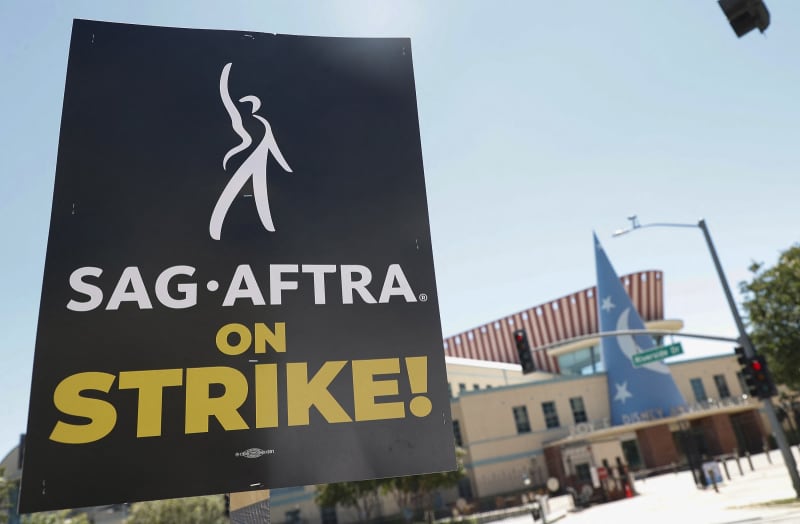
Hollywood crew members voice frustration over studio greed, other unions’ silence amid SAG-WGA strike
2023/07/28
Michael Tran/AFP/GETTY IMAGES NORTH AMERICA/TNS

LOS ANGELES — While A-list actors, including Oscar winners Jessica Chastain, Brendan Frasier, Jamie Lee Curtis and Jane Fonda joined WGA and SAG-AFTRA picket lines earlier this week, below-the-line workers are more concerned about their own union reps’ lack of presence than Ben Affleck’s.

Below-the-line crew members include hair and makeup artists, costumers, grips, script supervisors and craft services — the workers that are usually the first in and last out during a day of filming. Though they’re not technically striking, the WGA/SAG -AFTRA strike has left thousands of BTL workers with little to no income — with their emotions teetering from terrified to livid.

”As much as I support the writers’ and actors’ cause, I also want people to know that crew rates are a lot less and to survive in L.A. in the current economic climate is very hard,” key costumerMadeline Maciag (“NCIS: Los Angeles,” “Big Sky”) told the Daily News.

Maciag, a member ofIATSE Local 705, stressed that she would “like the world to know that this is going to be a devastating situation for below-the-line crew.”

The Writers Guild of America walked off the job over two months ago and was recently joined by the Screen Actors Guild. The last time both unions struck simultaneously was in 1960.

”We don’t get residuals nor has our pay increased in proportion with the economy,” something she blames on her union’s failure to negotiate when their contracts were up some two years ago.

Makeup artist Jennifer Daranyi (“Masked Singer,” “Schooled”) who launched her career after touring with Grammy-winning singer/songwriter Tori Amos, agrees with Maciag.

”Two years ago we were given a 3% [pay] increase when inflation was at 6%,” Daranyi told the News. She said that her union leaders encouraged them to not put up a fight as did Maciag’s.

“Sadly, we missed our chance,” she said. “Now I am getting really worried about my health insurance, which ends in January and I can’t afford to live in Los Angeles with no income.”

Script supervisor Ari Halpern had worked on the ABC series “The Goldbergs” for 10 years before the show wrapped in February.

”Financially, I am going to be okay, but it is my insurance that will be an issue,” said Halperin, who explained that BTL workers must work at least 400 hours in a six-month period to be eligible for health care.

”Anything over that just goes to waste, which is insane,” he said. “If this strike goes longer than six months, I will be uninsured.”

The same is true for Dayani and Maciag, along with thousands of other Californians and union members, who are also frustrated by streaming services’ refusal to share residuals.

”You’re never going to see those numbers,” a Hollywood insider told the Daily News, who doesn’t expect to see the likes of Tom Cruise or George Clooney on the picket line.

The only thing I can think of about the big stars is that they don’t want to piss anybody off,” she continued. “Everybody knows that this is a relationship-based business and there’s nothing that the actors can do to force the hand of the studios other than go on strike.

I’m sure the agents are having their say, but behind the scenes. Nobody wants to play this out in public or point fingers. Because they all have to do business together once everything gets back on track.”

Daranyi recalls how, based on astronomically high Nielsen ratings, that the cast of “Friends” was able to successfully negotiate million-dollar paychecks — per episode. The ratings gave not only the actors, but also the writers and arguably anyone who worked on the hit show, quantifiable proof that their contributions were generating revenue.

”Netflix has been around [as a streaming service] for 10-12 years now,” said Daranyi, “But they keep saying that they are new service.”

Multiple sources told the News that it was a Netflix executive that reportedly told Deadline the “endgame is to allow things to drag on until union members start losing their apartments and losing their houses.”

”What I would like to know is do the studios care?” said Maciag. “Do they care that crew members work 12, 14, sometimes 16-hour days just to scrape by in L.A.?”

As it seems, the studio executives couldn’t care less, sending many more in the industry into a state of existential ennui. California Gov. Gavin Newsom agreed Thursday to mediate negotiations between the unions, providing little more than cold comfort to his constituents.

”You watch the [Jeffrey] Epstein documentary and you understand that these people all live in a different realm,” said Dayani. “It’s kind of like, the actors and the writers are going up against Big Pharma, and the AMPTP said, ‘Let them bleed out.’”

“How disgusting that [they] let that be put into print. They do not care.”

Earlier this year, Gov. Newsom signed a law to prolong tax credits for movie and television productions, that can be refunded. At the end of filming, if a studio has credits worth more than what it owes in taxes, the state will pay the studio the difference in cash – tax breaks the little guy will never see.

”It is not going to trickle down to us,” Dayani said.

“We are like the little, tiny ants that are collecting all of the carcasses and moving them over to the dirt where all the other insects and all the other bugs can help it decompose and eat and feed off of it.”

© New York Daily News
Jenice Armstrong: Carlee Russell’s kidnapping hoax shouldn’t distract us from the real issue of missing women and girls

2023/07/27
Carlee Russell has admitted to lying about seeing a toddler along a highway in Alabama and being abducted earlier this month.
- Courtesy Hoover Police Department/TNS/TNS

Count me among those who feel duped by Carlee Russell.

The Alabama woman — who claimed she tried to help a toddler on a highway before disappearing, only to resurface two days later saying she had been kidnapped — got me good.

The nightmarish account of Russell screaming on the phone with her brother’s girlfriend before disappearing, and police rushing to the scene earlier this month and finding only her cellphone and wig had me shook — that is, before Alabama authorities and armchair investigators alike began poking holes in it.

Russell claimed she was abducted by a man with orange hair who emerged from the trees. She told authorities that a strange woman fed her cheese crackers before Russell managed to free herself and make her way to her parents’ house.

Eventually, it came out that before her disappearance, the 25-year-old nursing student had researched Amber Alerts as well as a movie about a woman who as abducted.

Then, on Monday, she admitted: She made the whole thing up. There was no kidnapping, no toddler on the highway.

It’s shades of Jussie Smollett all over again.

It’s bad enough that she wasted all of that police and media manpower with her manipulative charade. But she also took resources and attention away from women who are really missing and could have benefitted from it most.

My friends and I have been talking about this story over the past few days. The fact that an African American woman garnered so much media attention for allegedly being missing was pretty much unprecedented. Now that we know it was a hoax, I’m concerned: Will the next report of a missing Black woman be taken less seriously because of Russell’s charade?

Roughly 40% of those who go missing are people of color, according to the Black & Missing Foundation. They don’t get nearly the type of media attention as their white counterparts. There’s even a name for it — “missing white woman syndrome” — which was coined by the late TV journalist Gwen Ifill.

Russell was a rare exception. And now it turns out she was lying.

“I ask your readers to name a person of color who has garnered the same attention as Natalee Holloway and Chandra Levy outside of Carlee Russell and you can’t, because it doesn’t happen,” Natalie Wilson, co-founder of the Black & Missing Foundation, told me. What’s more, she said, analysis by her organization has found that cases of missing people of color remain open four times longer than others, in part, “because they are not getting that media coverage.”

The Philadelphia Police Department sends out regular emails about missing people. I scan them when I can.

I occasionally try to cover some of the cases I see, but there are so many. According to the National Missing and Unidentified Persons Database, roughly 600,000 people go missing each year across the country. Thankfully, some cases are solved before a story about them can even make it into print. Just last month, I reached out to the mother of a local recent high school graduate who had gone missing only to get the good news just a few days later that she had been found alive.

Also, when it comes to people of color, racial bias can affect the response, as some may assume that many of the missing are up to no good, or somehow brought their disappearances on themselves. Studies show that Black children frequently are perceived as being older than their actual years which can make it harder for some people to view them as victims.

I hope that Russell’s fabrications won’t stop us from raising alarm bells when people of color turn up missing. And I hope that her case, if anything, is a lesson on the power of attention in resolving what happened to a missing person.

“Think about the influencers, the media coverage that the Carlee Russell case got,” Wilson pointed out. “Can you imagine if we put the same energy into finding other missing people? We can bring many more people home.”

She rattled off a host of names of women of color who are missing: Arianna Fitts, Keeshae Jacobs, Tiffany Foster, Alexis Ware, Joniah Walker, Jennifer Blackmon, Relisha Rudd, and Nakyla Williams.

There are hundreds of thousands more whose names we’ll never know. We can’t disengage just because Russell duped us. Don’t let one fake kidnapping distract us from a very real problem.

© The Philadelphia Inquirer