Saturday, July 29, 2023


New smartphone vulnerability could allow hackers to track user location

New smartphone vulnerability could allow hackers to track user location
Hackers may use machine learning to exploit a text-messaging vulnerability, 
according to new research led by Northeastern Ph.D. student Evangelos Bitsikas
Credit: Alyssa Stone/Northeastern University

A newly discovered vulnerability in text messaging may enable attackers to trace your location, according to Northeastern Ph.D. student Evangelos Bitsikas.

His research group exposed the flaw by applying a sophisticated machine-learning program to data gleaned from the relatively primitive SMS system that has driven texting in mobile phones since the early 1990s. His work can found on the pre-print server arXiv.

"Just by knowing the phone number of the user victim, and having normal network access, you can locate that victim," says Bitsikas, who will formally present his research at the 32nd USENIX Security Symposium in Anaheim, California. "Eventually this leads to tracking the user to different locations worldwide."

SMS security has improved marginally since its initial creation for 2g systems three decades ago, Bitsikas says. When a text is sent to you, your phone responds automatically with a notification to the sender—essentially a receipt of delivery.

Using Bitsikas' method, a hacker would send multiple text messages to your cellphone. The timing of your automated delivery replies would enable the hacker to triangulate your location—regardless of whether your communications are encrypted.

The timing of each automated delivery notification sent by your phone leaves a fingerprint of your location. Those fingerprints weren't a problem until Bitsikas' group used machine learning to develop an algorithm capable of detecting them.

"Once the  is established, then the attacker is ready to send a few SMS messages," says Bitsikas, who is pursuing his Ph.D. in cybersecurity. "The results are fed into the machine-learning model, which will respond with the predicted ."

Bitsikas has found no evidence that the vulnerability—which so far has been leveraging Android operating systems—is currently being exploited.

"This does not mean that [hackers] aren't going to make use of it later on," Bitsikas says. "The procedure might be difficult to scale. The attacker will need to have Android devices in multiple locations sending messages every hour and calculating the responses. The collection itself can take days or weeks depending on how many fingerprints the attacker wants to collect.

"Not only are the collection and the analysis difficult, but then you have also the problem of sufficiently and appropriately configuring the machine-learning model, which is related to ."

The concern, says Bitsikas, is that a deep-pocketed organization could exploit the flaw to locate government leaders, activists, CEOs and others who desire to keep their whereabouts private.

"We are researchers with  and we are not experts in ," Bitsikas says of his group. "What I'm afraid of is that advanced attackers—hacker groups, state-sponsored agencies, police, who of course have more resources—can achieve greater impact with this kind of attack."

Before publishing the research, Bitsikas shared it with GSMA, a global organization of more than 15,000 member experts that oversees the health and welfare of the mobile ecosystem.

"Our results and findings have been verified by GSMA," Bitsikas says. "They have acknowledged the results, saying that this is a difficult problem to solve considering also the cost and effort for deploying complete countermeasures."

Closing the vulnerability would require an overhaul of the global SMS system, Bitsikas says. He has been told that GSMA plans to add countermeasures that will make the hack more difficult to achieve—but won't close the window entirely.

"It's different from Microsoft or Apple creating a software patch to solve a security vulnerability," Bitsikas says. "These networks cannot be changed instantly everywhere."

Bitsikas is planning additional research that may build upon this breakthrough.

More information: Evangelos Bitsikas et al, Freaky Leaky SMS: Extracting User Locations by Analyzing SMS Timings, arXiv (2023). DOI: 10.48550/arxiv.2306.07695


Journal information: arXiv 


Provided by Northeastern University 


Security gap allows eavesdropping on mobile phone calls


Traditional male gender roles still dominate in entertainment industry, says study

Traditional male gender roles still dominate in entertainment industry
Pictured from left to right: Thomas Pollet, Jamie Callahan and Clare Cook. Credit: Northumbria University

The characters that actors portray in films, television and on stage conform too closely with traditional gender roles—according to new research by academics at Northumbria and Durham universities.

Interestingly, the male actors questioned felt strongly that the  they were asked to portray were more stereotypically masculine than they identified as themselves.

In contrast, the female actors taking part in the research identified more closely with the gender traits of the characters they were playing—perhaps demonstrating positive changes within the entertainment industry following the #MeToo movement and campaigns for a 50:50 .

More than 300 actors were questioned about their experiences of being required to conform to traditional gender roles in the course of their work, and the disparity between their acted and ideal characters for the research, which was carried out by Clare Cook and Thomas Pollet of Northumbria University, and Jamie Callahan of Durham University.

Their findings have been published in the journal Psychology of Aesthetics, Creativity, and the Arts.

Speaking about their findings, Clare Cook, of Northumbria University's Department of Psychology said, "There has been lots of research carried out into how the audience perceive and identify with the gender roles of characters on stage and screen, but up until now nobody has questioned the actors who are actually playing these roles.

"What we found interesting was that it was the male actors who felt least represented by the characters they were being asked to play, with many saying the roles available were very gender typical and overly masculine.

"The female actors we surveyed felt their characters more closely resembled how they identified themselves as women, which is a really positive step forward and perhaps shows the positive impact that having more women working within the  over the last few years is having."

While the vast majority of those questioned identified as either men or women, a small number of participants in the study—less than 4%—identified as non-binary, third gender or other  or preferred not to specify their gender identity. As such, analyses which relied on gender groupings only included participants who identified as men or women. However, many of the actors—both men and women—said they would like to play less gender typical roles.

"While it appears there have been , there is still more work to do in ensuring the roles portrayed in the entertainment industry more accurately reflect society as a whole and do more to promote ," Clare added.

The  found that both male and female actors were required to portray traditional gender roles, but that men were required to conform with these traditional notions of gender to a greater extent, resulting in the broadcast of a masculinized ideal.

Both male and female actors indicated they would prefer to portray characters that conform less with  than their most recent character.

Speaking about the findings, Jamie Callahan, of Durham University Business School, said, "The entertainment industry both reflects and reinforces culture. Our study shows that "if you can see it, you can be it" has improved for women and the roles they get to play, and this helps move the dial on gendered social norms that get reinforced. But, to come closer to gender equity in society, the  needs to revamp the roles they create for men."

Participants in the study ranged in age from 18 to 86 and were recruited through ' groups, casting groups and personal networks.

More information: Clare Cook et al, Acting gender: Actors' experiences of gender role conformity and hopes for their characters., Psychology of Aesthetics, Creativity, and the Arts (2023). DOI: 10.1037/aca0000604


Provided by Northumbria University Identifying gender bias in blockbuster movies through the lens of machine learning

CRIMINAL CAPITALI$M

Researchers look at who's to blame for financial fraud

corporate frauds
Credit: Pixabay/CC0 Public Domain

When companies deceive shareholders about earnings or commit other kinds of accounting fraud, the legal fireworks can be spectacular. Even if the companies don't collapse, as in the notorious Enron case, some executives are sent to jail, fired, or otherwise punished.

But what happens to executives who weren't implicated in the ? That's a question a team of researchers examined over a period of years, including the University of Delaware's Amanda Convery, assistant professor of accounting in the Lerner College of Business and Economics. The point of their study, they write, was to discover "how does the labor market react to individuals with a questionable past?"

The idea started over a lunch conversation among the authors: In particular, they wanted to know what kind of fallout chief financial officers face, even if they weren't held legally responsible.

These executives, in theory, should have had a good handle on their company's finances.

"They're signing off on the ," Convery said, that "these numbers are trustworthy and …. To the best of their knowledge, there are systems in place to prevent and detect the fraud. And so even if they're not associated at all, at a minimum it suggests things happened on their watch."

The research paper was published in the journal Contemporary Accounting Research, and it examined how these executives fared on the , both in keeping their original jobs or landing new ones.

The researchers delved into news reports and SEC investigations between 2005 and 2014, after legislation took effect that clarified and added to CFOs' responsibilities.

A natural assumption might be that most CFOs are implicated in fraud cases, given their positions, but the authors discovered that in about a third of the cases they looked at, these executives weren't implicated.

They did still pay a cost, though, with higher turnover in their jobs and, once news broke publicly about the fraud, decreasing ability to find new ones. The job turnover was especially high for CFOs who were on the job before the fraud began.

While the authors can't determine whether the CFOs were actually innocent or had evaded justice, Convery did note that sometimes the reputational hit isn't fair. In some cases, the CFOs actually exposed the fraud.

Also, companies can be really complicated, she said. "Many of these are , they're large operations. And so to think that your career could be hinging on something that you may or may not have any direct control over, that was something that we were just always curious about."

Not everyone faced a ruined career. Some of these executives, Convery and her fellow researchers found, did end up with  at publicly traded companies, which "suggests that the labor market really does look at all aspects of the individual."

To ensure that their analysis was fair, the researchers compared the fates of the CFOs who weren't convicted of fraud to the careers of CFOs at companies of similar size, performance and industries.

One surprise in the research was that before the fraud scandals became , non-implicated CFOs were actually much more likely than their struggling counterparts to land a new job—perhaps, the authors suggest, because they were able to take advantage of the knowledge that they might need a new job soon. But of course, once word got out, this advantage evaporated.

The findings indicate that companies should take a buyer beware approach when hiring, Convery proposes, looking at the full circumstances of why a job candidate is leaving the old position. At the same time, "Just that someone is associated with this [company] shouldn't be a scarlet letter."

There's also been criticism of how long it takes to carry out these investigations, Convery said, but the study shows that the  needs this information.

"We find evidence that even if this revelation happens years later … it still has an impact," she said.

More information: Eric R. Condie et al, Fraud Firms' Non‐Implicated CFOs : An Investigation of Reputational Contagion and Subsequent Employment Outcomes*, Contemporary Accounting Research (2022). DOI: 10.1111/1911-3846.12817


Provided by University of Delaware Financial pressure makes CFOs less likely to blow the whistle on potential fraud


GLOBALIZATION CONTINUES

China, Indonesia, and Vietnam lead global growth for coming decade in new projections

China, Indonesia, and Vietnam lead global growth for coming decade in new Harvard Growth Lab projections
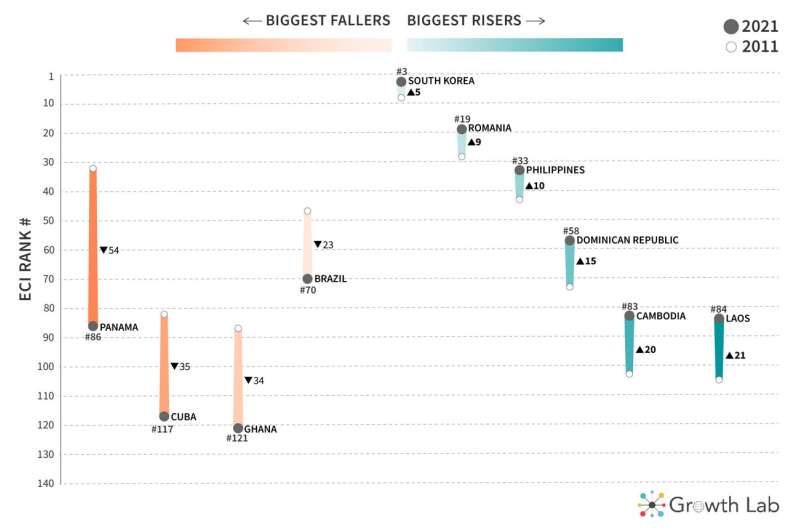
Countries with Largest Rise and Fall in Complexity Rankings: 2021 vs. 2011. 
Credit: The Growth Lab at Harvard University. The Atlas of Economic Complexity

China, India, Indonesia, Uganda, and Vietnam are projected to be among the fastest-growing economies for the coming decade, according to researchers at the Growth Lab at Harvard University. The new growth projections presented in The Atlas of Economic Complexity include the first detailed look at 2021 trade data, which reveal continued disruptions from the uneven economic recovery to the global pandemic. China is expected to be the fastest-growing economy per capita, although its growth rate is smaller than gains seen over the past decade.

Growth over the coming decade is projected to take off in three growth poles, East Asia, Eastern Europe, and East Africa. Several Asian economies already hold the necessary economic complexity to drive the fastest growth over the coming decade to 2031, led by China, Cambodia, Vietnam, Indonesia, Malaysia, and India.

In East Africa, several economies are expected to experience rapid growth, though driven more by  than gains in economic complexity, which include Uganda, Tanzania, and Mozambique. Eastern Europe holds strong growth potential for its continued advances in economic complexity, with Georgia, Lithuania, Belarus, Armenia, Latvia, Bosnia and Herzegovina, Romania, and Albania all ranking in the projected top 15 economies on a per capita basis.

Outside these growth poles, the projections also show potential for Egypt to achieve more rapid growth. Other developing regions face more challenging growth prospects by making fewer gains in their economic complexity, including Latin America and the Caribbean and West Africa.

"Countries that have diversified their production into more complex sectors, like Vietnam and China, are those that will lead global growth in the coming decade," said Ricardo Hausmann, director of the Growth Lab, professor at the Harvard Kennedy School (HKS), and the leading researcher of The Atlas of Economic Complexity. "China and Vietnam already realized many of the income gains from their increased complexity. Nevertheless, they remain more complex than expected for their income level, so will remain global growth poles."

The Economic Complexity Index (ECI) captures the diversity and sophistication of the productive capabilities embedded in the exports of each country. The researchers place the diversity of productive knowledge—or knowhow—that a society has at the heart of the economic development process. Economic growth requires the accumulation of new knowhow and its use to diversify production into more sophisticated—aka complex—activities. ECI is able to closely explain differences in country incomes—and to predict future growth.

China, Indonesia, and Vietnam lead global growth for coming decade in new Harvard Growth Lab projections
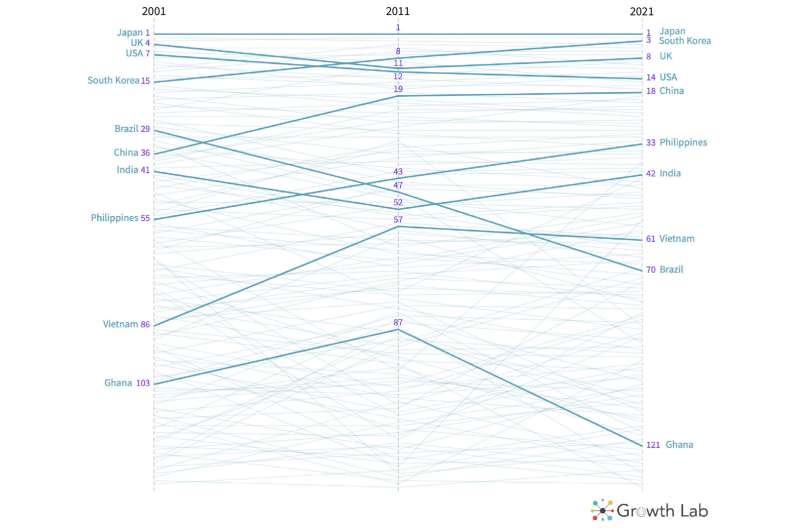
Economic Complexity Index Ranking: 2001-2021, Selected Countries. 
Credit: The Growth Lab at Harvard University. The Atlas of Economic Complexity.

The Growth Lab researchers released new 2021 ECI rankings, which show remarkable stability despite uneven economic recovery and lingering pandemic effects in 2021. The ECI ranking finds the most complex countries in the world are, in order, Japan, Switzerland, South Korea, Germany, and Singapore at the top. Other notable countries include the United Kingdom at 8th, the United States at 14th, France at 17th, and China at 18th.

Among the most complex countries, the greatest improvements in the rankings for the decade ending in 2021 have been made by Romania (19th), the Philippines (33rd), and South Korea (3rd). Oil prices rebounded slightly in 2021 while remaining moderate, leaving non-oil exports to feature more prominently in the export baskets of commodity economies.

These economies saw an uptick in the economic complexity ranking, for the likes of Kuwait, Saudi Arabia, Qatar, and Iran, although these gains are not likely to be sustained with the rise in oil prices in 2022.

Outside of commodity economies, those developing economies that have made the greatest strides in improving their complexity include Laos (84th), Cambodia (83rd), and the Dominican Republic (58th). Those countries that show the fastest declines in the complexity rankings in the past decade have failed to diversify their exports, namely Panama (86th), Cuba (117th), Ghana (121st), and Brazil (70th).

The true value of the economic complexity measure is in its accuracy in predicting future growth, which ECI has been shown to do better than any other single measure in predicting growth.

By identifying those countries whose economic complexity exceeds expectations based on its , the researchers find a strong predictor of the countries that will grow faster in the coming decade. The Atlas of Economic Complexity features data visualizations covering over 5,000 goods and services to understand the economic dynamics and growth opportunities for every country worldwide.

More information: Rankings page: atlas.cid.harvard.edu/rankings

Provided by Harvard Kennedy School


China, Vietnam, and Indonesia among fastest-growing countries for coming decade


Groundwater pollution remains elevated in River Ythan catchment but on track for recovery: Study

Groundwater pollution remains elevated in River Ythan catchment but on track for recovery
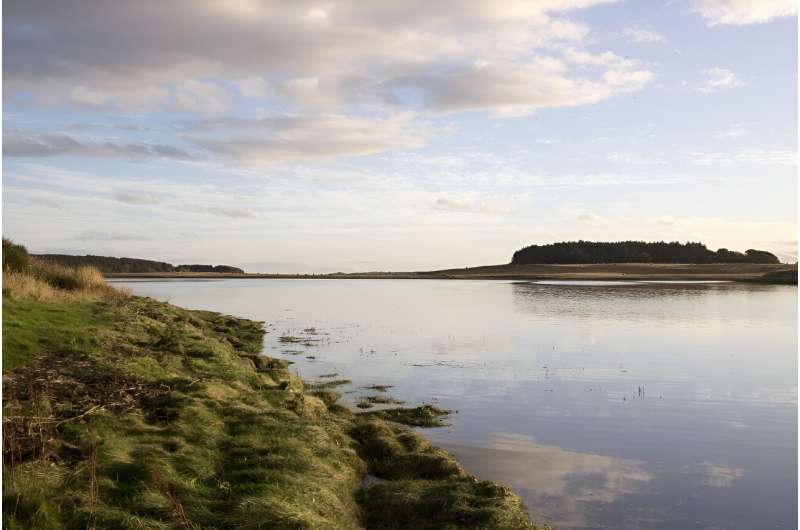
Groundwater nitrate levels in the River Ythan catchment continue to breach environmental 
limits but are on course for recovery, according to a new study. 
Credit: University of Aberdeen

Groundwater nitrate levels in the River Ythan catchment continue to breach environmental limits in some areas and pose a threat to local wildlife in the Ythan estuary, a new study has found.

The research by scientists at the University of Aberdeen also established a risk to private water supplies and ecosystems in some parts of the wider catchment.

However, the study also found that despite these challenges groundwater quality is on track to recover by the end of the decade thanks to ongoing efforts curb  pollution.

Researchers from the School of Geosciences assessed efforts to combat  in the area which was designated as Scotland's first major Nitrate Vulnerable Zone (NVZ) in 2000.

They employed a range of techniques to understand the pattern in groundwater nitrate levels, including through integration of long-term monitoring data, groundwater sampling, satellite imagery, and geological conditions.

Their findings revealed that while there have been major improvements in surface water quality and progress has been made to improve groundwater quality, elevated nitrate levels persist in numerous locations within the catchment and often exceed regulatory limits because of the longer time it takes for groundwater to move through the subsurface.

As a Site of Special Scientific Interest (SSSI) and a Ramsar wetland of international importance, the study is important for the Ythan estuary and for the wider Ythan catchment which has one of the highest reliance on private water supplies from groundwater in Scotland.

Rising nutrient levels (primarily nitrates originating from agricultural fertilizers) have led to excessive algae growth which has hindered the access of wading birds to invertebrates, their primary food source.

The study emphasizes the need for increased  encouraging farmers to maintain low-intensity grasslands, which have shown significant improvements in groundwater quality benefiting local biodiversity.

Hamish said, "We used a range of innovative techniques that have provided valuable insights into the influence of local geology, soils, and land use on groundwater nitrate levels."

"These have shown that although nitrate levels in shallow groundwaters have demonstrated some improvement over the past two decades, they remain elevated due to the time lag associated with the movement of groundwater through the subsurface."

He continued, "Twenty years after the River Ythan was designated as Scotland's first major NVZ, followed by subsequent efforts to reduce fertilizer use, our study is the first to assess the impact of measures to improve groundwater quality."

"While surface water quality has improved, groundwater quality—which is essential for private water supplies and —is recovering at a slower pace but is expected to recover by the end of the decade."

Dr. Jean-Christophe Comte, senior lecturer in Hydrogeology and the research project's supervisor, added, "The results provide a critical foundation for understanding the challenges faced by the estuary and wider surface and groundwaters in north-east Scotland and what needs to happen to safeguard their  as well as private water supplies—such as encouraging the use of low-intensity grasslands which we show has led to an improvement in groundwater quality."

"It also underlines the need for continued collaboration between researchers, policymakers, and land managers to implement effective strategies that protect and restore  quality to ensure the sustained health of the Ythan estuary's important ecosystem."

The paper is published in the journal Environments.

More information: Hamish Johnson et al, Evaluating Groundwater Nitrate Status across the River Ythan Catchment (Scotland) following Two Decades of Nitrate Vulnerable Zone Designation, Environments (2023). DOI: 10.3390/environments10040067


Provided by University of Aberdeen How nitrate concentrations can be reduced in groundwater


Experts: Expect worsening flooding and drought as rapid warming continues

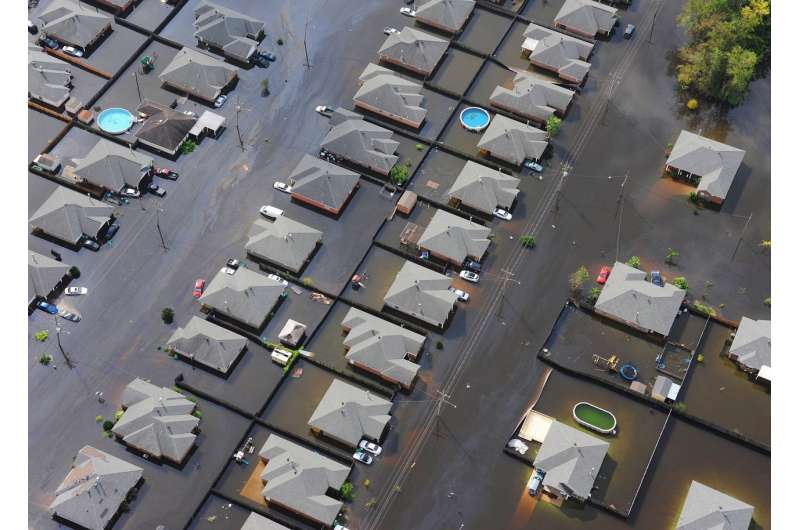
flood
Credit: CC0 Public Domain

The UK and the rest of the world will be vulnerable to larger swings between flooding and droughts as global temperatures rise, a new study has found.

Climate change is intensifying the world's water cycle (the flows of water through the Earth's atmosphere, across the surface and underground) leading to more extreme wet and dry periods, according to findings published this week in Environmental Research Letters.

Richard Allan, Professor of Climate Science at the University of Reading, the study author, used real-world data since 1950 measuring rainfall and evaporation and compared this with sophisticated computer simulations used to predict future climate changes up to 2100.

Professor Allan said, "If the world continues its current rate of warming, the difference between precipitation and evaporation at the wettest and driest times of the year will increase by 20 percent in some regions by the end of this century. This increasing contrast can lead to severe consequences, such as more intense flooding during wet periods and more rapidly developing droughts as dry spells take hold."

"It may seem strange that we could get more extreme dry and wet spells as the climate warms, but this is possible because a warmer atmosphere is a thirstier atmosphere—it can more effectively sap the soil of its moisture in one region and dump this extra water as  in storms and monsoons, increasing the contrast in weather between regions and between different times of the year."

"As our  continue to heat the planet, there will be greater swings between drought and deluge conditions that will become more severe over time. We have already seen  in Japan, China, South Korea and India this year, which has caused deaths, damage and power cuts."

"It is only with rapid and massive cuts in greenhouse gas emissions that we can limit warming and the increasing severity of wet and dry spells. Understanding these changes is vital for planning and managing our , as well as improving predictions of how the  will evolve in a warming world."

Rapid swings between drought and severe flooding are known to be particularly difficult for countries to deal with. Recent research published in Advances in Atmospheric Sciences by Professor Emily Black , also at the University of Reading, has shown that the frequency of "flash" droughts are projected to more than double in many regions over the 21st century.

These types of rapidly developing droughts can damage crops and will likely become more frequent in parts of the world including South America, Europe, and southern Africa.

More information: Richard P Allan, Amplified seasonal range in precipitation minus evaporation, Environmental Research Letters (2023). DOI: 10.1088/1748-9326/acea3


Provided by University of Reading Deadly flooding hit several countries at once. Scientists say this will only be more common

N. Atlantic ocean temperature sets record high: US agency

Issued on: 29/07/2023 
The Atlantic Ocean off southwest France -- in the North Atlantic, sea temperatures have reached a record high 
© Olivier MORIN / AFP/File

Washington (AFP) – On the heels of a new record high in the Mediterranean, the North Atlantic reached its hottest-ever level this week, several weeks earlier than its usual annual peak, according to preliminary data released Friday by the US National Oceanic and Atmospheric Administration.

The news comes after scientists confirmed that July is on track to be the warmest month in record history -- searing heat intensified by global warming that has affected tens of millions of people.

"Based on our analysis, the record-high average sea surface temperature in the North Atlantic Ocean is 24.9 degrees C," or 76.8 Fahrenheit, observed Wednesday, Xungang Yin, a scientist at NOAA's National Centers for Environmental Information, told AFP.

The record is particularly startling as it comes early in the year -- usually, the North Atlantic reaches its peak temperature in early September.

The previous record high was recorded in September 2022, at 24.89 degrees Celsius, Yin said.

NOAA, which has been tracking sea temperatures since the early 1980s, will need about two weeks to confirm the preliminary findings.

The Mediterranean Sea reached its highest temperature on record Monday, Spanish researchers said -- amid an exceptional heat wave in Europe.

The record of 28.71 degrees Celsius was announced by Spain's Institute of Marine Sciences, which analyzed data from satellites used by the European Earth observation program Copernicus.

Those experts said they measure the daily median sea surface temperature, rather than the average, because it is less susceptible to extreme spikes in temperature in isolated areas of the sea.

The Mediterranean region, hit by record temperatures in July, has long been classified as a hotspot of climate change.
Atlantic record likely to be broken again

The sea surface temperature in the North Atlantic is "expected to continue to increase through the month of August," NOAA's Yin said, adding it was "highly likely" the record would again be broken.

The new high of 24.9 degrees Celsius is "more than one degree warmer than a 30-year climatological normal, calculated from 1982 to 2011," he added.

Since March, which is the month when the North Atlantic begins to warm up after winter, temperatures have generally been warmer than in previous years, with the difference more pronounced in recent weeks.

The North Atlantic has become an emblematic observation point for the warming of seawater worldwide due to the effects of climate change caused by greenhouse gas emissions.

The Copernicus program, which uses different data than that analyzed by NOAA, told AFP on Friday that it had recorded a temperature of 24.7 Celsius on Wednesday in the North Atlantic.

A Copernicus spokesman said while that remained below the program's September 2022 record, slightly lower than the NOAA level at 24.81 Celsius, that record was sure to be broken "this summer."

"At this stage, it is just a matter of days."

- 'Extreme' situation -

"This situation is extreme: we've seen maritime heat waves before, but this is very persistent and spread out over a large surface area" in the North Atlantic, Karina Von Schuckmann from the Mercator Ocean International research center told AFP.

The expert noted that the oceans have absorbed 90 percent of the excess heat produced by human activity since the dawn of the industrial age.

"This accumulation of energy doubled over the last two decades," fueling global warming, she said.

On a global scale, the average ocean temperature has been besting seasonal heat records on a regular basis since April.

A specific, striking example has been recorded in Florida where waters off the coast of the Sunshine State reached 38.3 degrees Celsius on Monday, according to data from a weather buoy -- a temperature more associated with a hot tub.

If confirmed, the reading could constitute a world record.

© 2023 AFP


Q&A: You've heard the annoyingly catchy song—but did you know these incredible facts about baby sharks?

You've heard the annoyingly catchy song—but did you know these incredible facts about baby sharks?
Credit: Shutterstock

"Baby shark doo-doo doo-doo doo-doo, baby shark doo-doo doo-doo doo-doo …" If you're the parent of a young child, you're probably painfully familiar with this infectious song, which now has more than 13 billion views on YouTube.

The Baby Shark song, released in 2016, has got hordes of us singing along, but how much do you really know about baby sharks? Do you know how a baby shark is born, or how it survives to become an apex predator?

I study coastal marine ecology. I believe baby sharks are truly fascinating, and I hope greater  about these creatures will help protect them in the wild.

So sink your teeth into this Q&A on the weird and wonderful world of baby sharks.

How are baby sharks conceived and born?

To the , shark courtship practices may seem barbaric. Males typically attract the attention of a female by biting her. If successful, this is generally followed by even toothier bites to hold on during copulation. Females can carry the scars of these encounters long after the mating season is over.

The act of copulation itself is comparable to that of humans. The male inserts its sexual organ, known as a "clasper", into the female and releases sperm to fertilize the eggs.

However, in extremely rare cases, sharks can reproduce asexually—in other words, embryos develop without being fertilized. This occurred at a Queensland aquarium in 2016, when a zebra shark gave birth to a litter of pups despite not having had the chance to mate in several years.

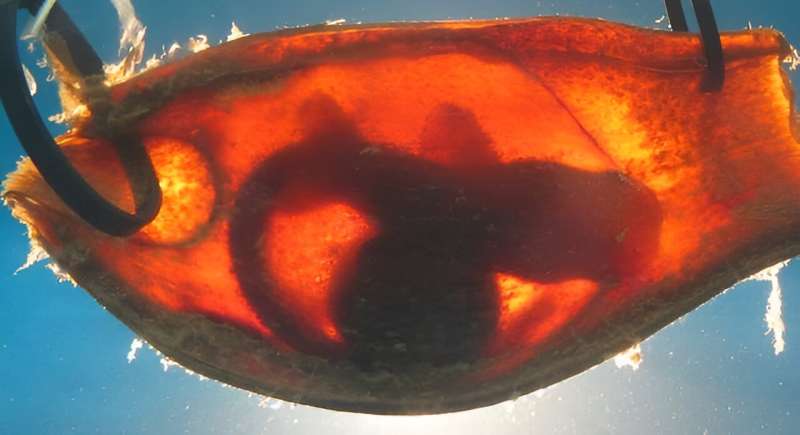
Sharks give birth in a variety of ways. Some species produce live pups, which swim away to fend for themselves as soon as they're born. Others hatch from eggs outside the mother's body. Remnants of these egg cases have been found washed up on beaches across the world.

How big is a litter of shark pups?

Litter size across sharks varies considerably. For example, the gray nurse shark starts with several embryos but only two are born. This is because the embryos actually eat each other while in utero! This leaves only one survivor in each of the mother's two uteruses.

Intrauterine cannibalism may seem disturbing but is nature's way of ensuring that the strongest pups get the best chance of survival.

In contrast, other species such as the whale shark use a completely different strategy to ensure some of their offspring survive: having hundreds of pups in a single litter.

Where do baby sharks live?

The open ocean is a dangerous place. That's why pregnant female sharks often give birth in shallow coastal waters known as "". There,  are better protected from harsh environmental conditions and roaming predators, including other sharks.

Sites for shark nurseries include river mouths, estuaries, mangrove forests and coral reef flats.

You've heard the annoyingly catchy song—but did you know these incredible facts about baby sharks?
An embryonic bamboo shark in its egg. The egg cases often wash up on beaches after the
 baby has hatched. Credit: Ryan Kempster/UWA

For example, the white shark has established nursery grounds along the east coast of Australia, where babies may remain for several years before moving to deeper waters.

Although most types of sharks are confined to saltwater, the  can live in freshwater habitats. Bull shark pups born near river mouths and estuaries often migrate upstream (sometimes vast distances inland) to escape being preyed upon.

When are baby sharks born?

Sharks, like most animals in the wild, generally give birth during periods that provide favorable conditions for their offspring.

In Australia, for example, scalloped hammerheads and bull sharks tend to breed in the wet summer months when nursery grounds are warmer and there are rich feeding opportunities.

How long do baby sharks take to grow up?

Sharks grow remarkably slowly compared to other fish and remain juveniles for a long time. Although some species mature in a few years, most take considerably longer.

Take the Greenland shark—the world's longest living shark. It can live to at least 250 years and according to recent research, it's thought to take more than a century to reach sexual maturity.

You've heard the annoyingly catchy song—but did you know these incredible facts about baby sharks?
Baby sharks are often born in ‘nurseries’ - shallow coastal waters where food is plentiful 
and ocean predators are less likely. Credit: Shutterstock

What threats do baby sharks face?

While small, sharks must eat or be eaten—all the while enduring the elements and finding enough food to survive and grow.

Yet there is another challenge: humans. In fact, we are the greatest threat to sharks.

Shark nurseries are heavily concentrated in coastal zones, and often overlap with human activities such as fishing, boating and coastal development. And because sharks grow so slowly, they are particularly to vulnerable to overfishing because when populations decline, they can take a long time to bounce back.

Much more to learn

Scientists are still working to understand the  of the 500-plus species of sharks in our oceans. Each time I hear the song Baby Shark, it reminds me there's a lot more work to do.

It's crucial to keep monitoring and studying these baby wonders of the deep, to ensure shark populations survive and we maintain the delicate balance of our underwater ecosystems.

Provided by The Conversation 

This article is republished from The Conversation under a Creative Commons license. Read the original article.The Conversation


Video: The secret social lives of sharks


Ocean skin helps regulate ocean carbon uptake, study finds

Ocean skin helps regulate ocean carbon uptake
New research investigates how the carbon cycle functions in the upper layer of the 
ocean, seen here in a long-exposure photograph of the Caribbean Sea. 
Credit: Martin Falbisoner/Wikimedia CommonsCC BY-SA 4.0

At less than one millimeter thick, the ocean skin—the ocean's uppermost layer—plays an outsized role in marine processes, orchestrating heat and chemical exchange between the sea and sky via diffusion. The water of the skin is cooler by about 0.2–0.3 K and has higher salinity than the water at even just 2 millimeters depth.

Since it was first described in 1967, scientists have grappled with the skin's influence on  and the global  carbon sink. Understanding its role is critical: Between 2011 and 2020, the ocean absorbed 26% of all human-generated carbon dioxide emissions, and variables that affect ocean carbon sequestration contribute to governing the  and .

Hugo Bellenger and colleagues have toggled oceanic temperature and salinity gradients to represent the ocean skin over 15 years (2000–2014) in an Earth system model, assessing how these changes altered the amount of carbon absorbed by the ocean. The work, published in the Journal of Geophysical Research: Oceans represents the first model-based estimate of the ocean skin's influence on ocean–atmosphere carbon dioxide exchange.

Including the representation of the skin in the Earth system model led to a 15% increase in the simulated ocean carbon sink, the researchers found—a figure consistent with past estimates. However, when they allowed the ocean skin to respond to changing ocean carbon concentrations in the model, the effect on the sink was substantially reduced. With the dynamic skin, its contribution to the simulated ocean carbon sink was closer to 5%.

The research shows the importance of including the ocean skin in future climate and carbon modeling efforts, the authors say. And it demonstrates that an interactive parameterization of the ocean skin yields a more accurate model that reduces regional errors in carbon dioxide flux.

More information: Hugo Bellenger et al, Sensitivity of the Global Ocean Carbon Sink to the Ocean Skin in a Climate Model, Journal of Geophysical Research: Oceans (2023). DOI: 10.1029/2022JC019479


Journal information: Journal of Geophysical Research


Provided by Eos

This story is republished courtesy of Eos, hosted by the American Geophysical Union. Read the original story here.Quantifying carbon leakage from enhanced rock weathering