Saturday, July 29, 2023

Indian opposition lawmakers visit violence-wracked state in bid to pressure Modi’s government


1 of 7 
Indian army soldiers patrol a deserted village in Churachandpur, in the northeastern Indian state of Manipur, Tuesday, June 20, 2023. 

July 29, 2023Share

NEW DELHI (AP) — A group of Indian opposition lawmakers on Saturday visited a remote northeastern state where deadly ethnic clashes have killed at least 130 people, in a bid to pressure the government to take action against the violence which began in May.

The delegation of 20 lawmakers from 15 political parties, who are part of a new opposition alliance called INDIA, arrived in Manipur state for a two-day visit to assess the situation on the ground as the ongoing violence and bloodshed have displaced tens of thousands in recent months.

The conflict in Manipur has become a global issue due to the scale of violence, said Adhir Ranjan Choudhury, a lawmaker belonging to the opposition Congress party. “Our delegation is here to express solidarity with the people of Manipur in this time of distress. The top priority now is to restore normalcy as soon as possible,” he added.


Tucked in the mountains on the border with Myanmar, Manipur is on the brink of a civil war. Mobs have rampaged through villages, torching houses and buildings. The conflict was sparked by an affirmative action controversy in which Christian Kukis protested a demand by mostly Hindu Meiteis for a special status that would let them buy land in the hills populated by Kukis and other tribal groups and get a share of government jobs.

After arriving in the state capital, Imphal, the lawmakers went to Churachandpur district, where they visited two relief camps and spoke to community leaders.

The conflict has triggered an impasse in India’s Parliament, as opposition members demand a statement from Prime Minister Narendra Modi on the violence roiling the state. On Wednesday, the opposition moved a no-confidence motion against the Modi government. This means the government will soon face a no-confidence vote in Parliament, which is likely to be defeated, as Modi’s party and its allies have a clear majority.

But opposition leaders say the move could at least force Modi to speak on the conflict and open a debate.

Two weeks ago, Modi broke more than two months of public silence over the conflict in Manipur when he condemned the mob assaults on two women in the state who were paraded naked - but he did not directly refer to the larger violence. He has also not visited the state, which is ruled by his Hindu nationalist Bharatiya Janata Party, since the violence broke out.

Both houses of Parliament were adjourned at various times last week as the opposition stopped proceedings with their demand for a statement from Modi.

Despite a heavy army presence and a visit earlier by the home minister, when he met with both communities, the deadly clashes have persisted.

The violence in Manipur and the assault on the two women triggered protests across the country last week. In Manipur, thousands held a sit-in protest recently and called for the firing of Biren Singh, the top elected official in the state, who also belongs to Modi’s party.

The European Parliament also recently adopted a resolution calling on Indian authorities to take action to stop the violence in Manipur and protect religious minorities, especially Christians. India’s foreign ministry condemned the resolution, describing it as “interference” in its internal affairs.


An armed tribal Kuki walks out of an underground bunker at a de facto frontline dissecting two ethnic zones in Churachandpur, in the northeastern Indian state of Manipur, Tuesday, June 20, 2023. 

Dozens of houses lay vandalised and burnt during ethnic clashes and rioting in Sugnu, in the northeastern Indian state of Manipur, Wednesday, June 21, 2023. 

Displaced people from the Meitei community receive food at a relief camp in Moirang, near Imphal, capital of the northeastern Indian state of Manipur, Wednesday, Jun 21, 2023. 


A displaced person from the Meitei community lives in a relief camp in Moirang, near Imphal, capital of the northeastern Indian state of Manipur, Wednesday, Jun 21, 2023. 


A couple pulls a cart loaded with scavenged items from the debris of the burnt houses following ethnic clashes and rioting in Sugnu, in the northeastern Indian state of Manipur,
 Wednesday, June 21, 2023. 


An armed tribal Kuki community member keeps a watch on the rival Meitei community bunkers, along a de facto frontline which dissect the area into two ethnic zones in Churachandpur, in the northeastern Indian state of Manipur, Tuesday, June 20, 2023. 

AP Photos/Altaf Qadri


SEE


OUR LAND’ EXPLORERS SEEK TO FIND LAND SETTLED BY MAROONS IN GEORGIA

Sharelle Burt
July 29, 2023

Frontispiece and title page from 'The History of the Maroons', Frontispiece and title page from 'The history of the Maroons, from their origin to the establishment of their chief tribe at Sierra Leone, including the expedition to Cuba for the purpose of procuring Spanish chasseurs, and the state of the island of Jamaica for the last ten years; with a succinct history of the island previous to that period' by Robert Charles Dallas, London, 1803, 1803. (Photo by Robert Charles Dallas/Royal Geographical Society via Getty Images)

Deep in Georgia, visitors may be stepping on sacred ground rooted in the history of slavery. The land in question comes from the descendants of the Maroons—the brave souls that escaped slavery to live in the wilderness, the New Yorker reports.

Novelist and nonprofit founder George Dawes Green and 13 others traveled to the land about 20 miles from Savannah, Georgia, to find any remains of a “fortress” built in the 1780s. Legend has it that close to 100 formerly enslaved people once lived there and secured their new homes with a wall, weapons, and guards until white military leaders found the sites and burned them to the ground.

After Dawes Green’s novel, The Kingdoms of Savannah, was published last year, several archeologists, historians, and wanderers are traveling there to see if they can find any artifacts buried within. However, archeologist Rick Kanaski said he didn’t think he would find much but would be able to get a sense of what life was like for the Maroons. “Eventually, we’ll be able to tell some life stories about these individuals who were essentially creating their own community, and reclaiming their own individuality, and their own personhood, and their own society, so to speak,” Kanaski said. “We’ll get a sense of place.”

The land is called Abercorn Island—also known as Belleisle. Kanaski and other explorers presented at an event in July, making a case to bring these stories out of the shadows. According to Savannah Now, he created a process that could identify the locations of the Maroons and possibly recover items from the communities. While it’s been close to 200 years since their demise, uncovering a lost history would draw wide support.

The Maroons didn’t just settle in deep Georgia. Some of them made it to Florida to Prospect Bluff within the Apalachicola National Forest.
GOOD FOR HER
Kamala Harris embraces new attack role, draws fresh Republican fire

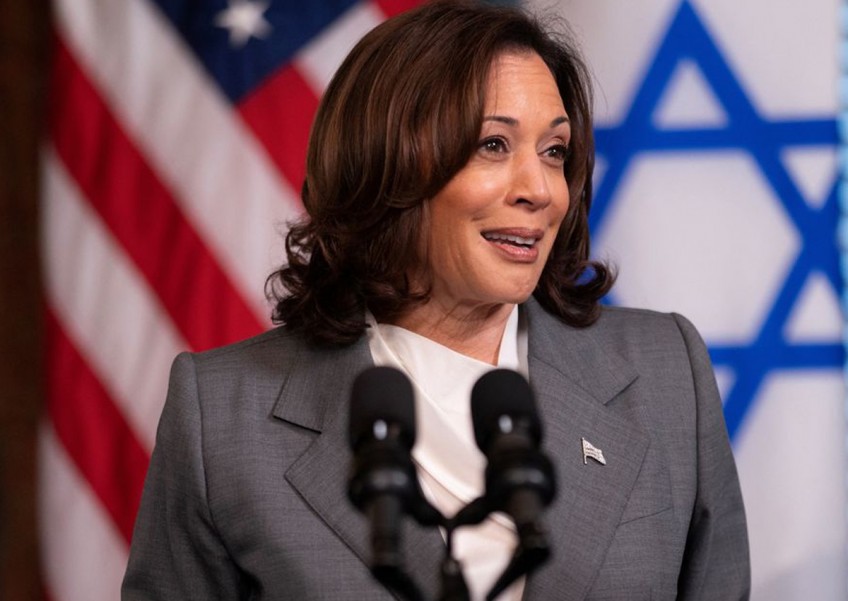
US Vice President Kamala Harris meets with Israeli President Isaac Herzog (not pictured) in her ceremonial offices at the Eisenhower Executive Office Building in Washington, US, on July 19, 2023.
PHOTO: Reuters file

PUBLISHED ONJULY 29, 2023 

BOSTON - Vice President Kamala Harris has shown a punchy side during a tour of nearly a dozen US states in recent weeks, attacking Florida Governor Ron DeSantis for backing "revisionist history" about slavery, telling Iowa healthcare workers to rebel against the state's new restrictive abortion laws and rallying Latinos in Chicago to fight "extremist" Republicans.

On Saturday (July 29), Harris, the first woman and first woman of colour to serve as vice president, opened the NAACP's annual conference in Boston, a key political event for Black Americans that will help define the issues Democrats focus on in the 2024 election.

"We are in a moment where there is a full-on attempt to attack hard-fought and hard-won rights and freedoms and liberty. And what I know about the leaders here is that the members of NAACP are up to the challenge to fight," Harris, a lifetime member of the civil rights organisation, told several thousand people inside the city's convention centre.


The high-profile appearances are part of an expanded role for US President Joe Biden's much-scrutinized governing partner ahead of the election, senior Democrats say.

She'll engage in many more campaign-style events in months to come, designed to reacquaint Harris with supporters, burnish her image with independents and reach out to Democrats' who haven't been hearing the Biden administration's message.

It's a move that couldn't happen too soon, some influential Democrats say.


"We have constantly said to the White House that they need to send her out more because we need the base - that is Black voters and others - to understand what you are doing," Reverend Al Sharpton, a veteran civil rights activist and head of the National Action Network, told Reuters.

Biden credits Black voters for his 2020 victory, with exit polls showing he carried 87 per cent of the vote. But recent polls and turnout in the 2022 midterms reveal erosion in enthusiasm among the bloc that needs to be shored up before next November.

Harris also made a surprise visit to a congressional black caucus event at Roxbury Community College, where she reminded the crowd of the role Black voters played in capturing the White House for Biden.

She said as a result the administration capped insulin prices, increased removal of lead pipes and secured broadband for under served communities.

"Let's start registering folks now to vote," she said. "Remind your friends and your neighbours to do that."

The White House is also hoping to improve Harris' public image and historically low approval ratings. A recent NBC News poll showed 49 per cent of registered voters hold a negative view of Harris, compared to 32 per cent with a positive view, a net-negative rating of 17 that is the lowest for a vice president in the history of its poll.


US Vice President Harris fundraises for 2024 in Georgia


While it's too early to say whether her polls are improving, Harris's remarks are drawing new Republican fire, and highlighting divisions in the opposition.

DeSantis on Friday accused US Senator Tim Scott, the most high-profile Black candidate in the 2024 Republican presidential race, of accepting Harris's "lie" about Florida's new slavery curriculum requirements.

His campaign accused another Black Republican who criticised the changes, which include teaching that slavery had possible benefits to the enslaved, of being a Harris supporter.

Voters wary of the president's advanced age of 80 are expected to take a much harder look at the vice president. Some Republicans are already suggesting Harris could run the country if Biden wins in 2024.

"We are running against Kamala Harris. Make no bones about it...[it's] Kamala Harris that's going to end up being president of the United States if Joe Biden wins this election," Republican candidate Nikki Haley told Fox News in June.

Harris, who was more popular than Biden with women, young voters and even some Republicans when he picked her as his vice presidential running mate, has seen her ratings sag in office under a firehose of criticism from conservative media outlets and a portfolio that included the intractable US issue of immigration.

Some Democrats say she hasn't stepping up forcefully enough, or taken burdens off the President's shoulders. Since the Supreme Court overturned Roe vs Wade last year, though Harris has become increasingly vocal.

"She does better on subject matters and audiences she is comfortable with. Given the portfolio she was handed early on - and the challenges it represented - it's simple campaign management to get her out front of friendly audiences where she can get some of her mojo back," said an adviser at the Democratic National Committee.

Source: Reuters


Florida man & friends won’t tolerate Those People criticizing his slavery’s silver lining history curriculum

 
/
  
/
  
/
 

Republican outreach to African-Americans is reaching the next inevitable phase. The attacking Republican African-Americans who criticize attempts to whitewash slavery phase (Fox “News” link).

Republican presidential candidate and Florida Gov. Ron DeSantis hit back at fellow White House contender Sen. Tim Scott, R-S.C., on Friday after the latter criticized Florida’s new school history curriculum and its approach to teaching about slavery.

“I think part of the reason our country has struggled is because D.C. Republicans all too often accept false narratives, accept lies that are perpetrated by the left,” DeSantis said during a campaign stop. “And to accept the lie that Kamala Harris has been perpetrating even when that has been debunked – that’s not the way you do it.”

“The way you do it, the way you lead is to fight back against the lies, is to speak the truth. So I’m here defending my state of Florida against false accusations and against lies. And we’re going to continue to speak the truth,” he added.

As an aside: Once again the man some Republicans hoped would provide all of the bigotry and tax breaks they got from tRump without the unpleasant side effects (open display of all seven deadly sins, being an ignorant lump and refusing to share all the money he gets from economically anxious Americans) shows he doesn’t have what it takes to be America’s next top fascist.

The Republican base doesn’t want wishy-washy whining about truth, lies and siding with Vice President Harris. They want someone to say chattel slavery was good, Black people should be thankful and joke about bringing it back. They want threats, they want slurs.

Meanwhile, human plushie Matt Walsh had an imaginary dialog with Scott.

Of course it included some whitesplaining based on the lamentably common assumption that Scott hadn’t given race a thought until someone “bad” told him about it.

And to start with, anytime you hear the left saying anything about anything related to race, never believe it on face value. Assume that they are lying because they always are.

No, Sen. Scott! Stay away from the forbidden apple of race that Vice Serpent Harris is offering you!

Walsh shifts from saying Scott is being manipulated by the left (because he’s a dumb blah person) to saying Scott knows what he’s doing (because he’s a conniving blah person). After some fumbling he settles on finding Scott guilty of attacking DeSantis from The Left. That is, Scott, a member of the right, holds an opinion that happens to be held by anyone on The Left and that opinion contradicts anyone else on The Right.

You never go after your own side from the left. Go after them. You criticize them. Never from the left. That is the unforgivable sin. If there is one sin among conservatives, it is attacking your own side from the left. You do that and you are — you should be dead to us at that point. The moment you did — do that, it’s over. You adopt the left’s talking points to go after your own side, screw you. You’re done.

LOL. Black Republicans aren’t going to leave the party because something like Matt wants them to step without fetching. However, it is interesting to see white Republicans raise the price of admission.

I just hope Vice President Harris attacks sticking a metal fork in an electric socket. From the left.


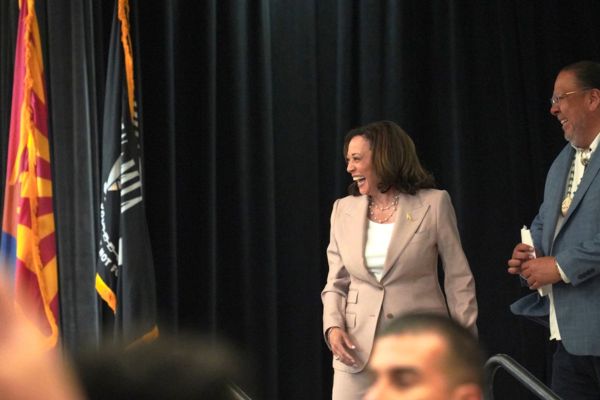
Gila River Indian Community Governor Stephen Lewis introduces U.S. Vice President Kamala Harris at the Gila Crossing Community School in Laveen, Arizona on July 6, 2023. (photo by Darren Thompson)

LAVEEN, AZ—On Thursday, the Gila River Indian Community (GRIC) hosted Vice President Kamala Harris’s first visit to Indian Country at the Gila Crossing Indian School.

It was Harris’s first to Indian Country as the Vice President and the first by a sitting Vice President in United States history. 

“Representation matters,” said Junior Miss Gila River Sinica Sunflower Jackson, who was one of the people introducing Harris. “I have the privilege of welcoming one of my role models to the community.”

U.S. Assistant Secretary of Interior Bryan Newland and GRIC Governor Stephen Lewis also introduced the Vice President, touting the historic investments to Indian Country made by the Biden-Harris Administration. 

In his introductions, Newland said that the Biden-Harris Administration has invested more than $45 billion since the beginning of the administration in 2021. Newland said that the amount invested by the administration comprises 15 years of funding for the Bureau of Indian Affairs, the federal agency he oversees.

“This administration has taken partnership to a whole new level, bringing Tribes generally to the table and working with us on important business,” said Lewis in his introduction. “Here in the community, I can easily point to our successful partnership. From federal funding to new investments in buildings like this one, this school, with more to come.”

Harris took the stage and announced the administration’s commitment to strengthening tribal sovereignty and self-determination. She said that the relationship between the federal government and Tribal Nations is sacred and acknowledged the contributions of American Indian people in the country’s armed forces. 

“President Joe Biden and I believe that the bonds between our nations are sacred,” she said. “We believe we have a duty to safeguard those bonds, to honor tribal sovereignty and to ensure Tribal self-determination.”

In an effort to address disparities that exist across Indian Country, the Vice President spoke on historic investments made by the administration, including more than $500 million in tribal entrepreneurship and small businesses in tribal communities.

“Disparities are a result of centuries of broken treaties, harmful assimilation policies, displacement, dispossession and violence,” Harris said.

She also spoke of investments in Tribal communities to support fund Native-led climate resiliency efforts.

“That is why we are investing billions of dollars to help fund Native-led—not Native-consulted — climate resiliency efforts,” Harris said. 

Earlier this year, the Biden-Harris administration announced that the Gila River Indian Community would be receiving $83 million from the Bipartisan Infrastructure Act for a pipeline that would move water from the reservation to its Pima-Maricopa Irrigation Project Facility. Officials have said that the project will help conserve an additional 20,000 acre-feet of water from the Colorado River. Harris visited the project location after her visit to the community school. 

Harris also spoke of the recent Supreme Court decision that upheld the Indian Child Welfare Act, sharing her former experience working as an attorney for the San Francisco District Attorney’s Office and the Attorney General of the state of California. She advised the community to be vigilant because attacks on tribal sovereignty will continue. 

“We are building a better future for this generation and the next seven generations to come,” Harris said. 

Since taking office, the Biden-Harris Administration has worked closely with Tribal leaders and relaunched the White House Tribal Nations Summit, which was initially launched during the Obama Administration and ceased during the Trump Administration. 

A crowd of more than 800 people attended Harris’s scheduled visit, including leaders from all 22 Arizona based Tribes, with presentations by local youth dignitaries, including Jr. Miss Gila River Sineca Sunflower Jackson and Miss Gila River Lehua Lani Dosela, who sang the National Anthem in the O’odham language. A cultural display of song and dance was demonstrated by the Maricopa Bird Singers and a youth group from the Gila River Indian Community.

Robert Miguel, Ak-Chin Indian Community's Tribal Chairman, said the event was “wonderful” to Native News Online. “I’m really glad we were invited to witness this,” he said. 

Is the quest for safer, cheaper, more powerful batteries closer?

ByDr. Tim Sandle
FIGITAL JOURNAL
Published July 28, 2023

A battery-powered Nio EP9 sports car. EV firms offer more than 300 models on the Chinese market. — © AFP

Aluminium materials have shown a promising performance in the bid for safer, cheaper, more powerful batteries. Georgia Institute of Technology scientists have succeeded in using aluminium foil to create batteries with higher energy density and greater stability.

The test batteries indicate that the technology could enable electric vehicles to run longer on a single charge. In addition, the materials required mean that the batteries would be cheaper to manufacture compared with comparable devices.

The more efficient the battery then the better its energy density (which is necessary to power devices) and its stability (which influences both safety and the ability of the battery to be recharged).

Lithium-ion batteries are the current top performing everyday use batteries, and they are used in smartphones, laptops, and electric vehicles. The trouble is we have reached the limits of lithium-ion. While lithium-ion batteries are widely used for various applications challenges are associated with the stability of cathode materials have hindered their overall performance and lifespan.

Limitations with batteries will hamper progress towards next-generation long-range vehicles and electric aircraft – unless alternatives are developed. Today’s batteries, for instance, do not hold enough energy to power aircraft to fly distances greater than 150 miles. On a bigger scale, large-scale energy storage could provide back-up systems to guard against disruption to electrical grids.

The aluminium foil battery should, in theory, enable electric vehicles to run longer on a single charge. An advantage of using aluminium as a battery material relates to the material being cost-effective, highly recyclable, and easy to work with. This is as solid-state batteries.

To create the battery, the researchers added small amounts of other materials to the aluminium to create foils with particular “microstructures”. For this, they tested over 100 different materials to understand how they would behave in batteries.

It was observed that the aluminium anode could store more lithium than conventional anode materials, and therefore more energy.

To advance a more energy-optimized and cost-effective battery cell architecture the researchers are seeking to understand further how size influences the aluminium’s behaviour. The researchers are also actively exploring other materials and microstructures with the goal of creating very cheap foils for battery systems.

The research appears in the publication Nature Communications, titled “Aluminum foil negative electrodes with multiphase microstructure for all-solid-state Li-ion batteries.”
SELLING INDULGENCES
Centuries-old seal used to fast-track one’s entry into heaven goes on display in the UK


By Karen Graham
DIGITAL JOURNAL
Published July 28, 2023

Mottisfont Abbey in Hampshire, England. Source - Kate Jewell, CC SA 2.0.

A Stamp for papers that enabled one to have a ‘fast-track’ through purgatory will be on show at a Hampshire priory.

The rare seal was found by a metal detectorist just two miles from Mottisfont, an Augustinian priory and site of pilgrimage near Romsey, Hampshire, after spending about 500 years buried in a field, according to The Guardian.

The rare seal matrix, made of cast copper-alloy, is inscribed in Latin and features a carved depiction of the Trinity and a figure of a praying cleric.

The small carved mold, dating between 1470 and 1520, was stamped on “indulgences” otherwise known as written pardons for sinful behavior granted by religious institutions in return for a financial donation.

The indulgences were supposed to lessen one’s time in purgatory by one year and 40 days, an individual’s time in purgatory after their death.

\
“The selling of “indulgences” was one of the corrupt practices of the late Medieval Catholic Church, wherein payment of a small (or large, depending) sum of money gets you forgiven for a sin.”
  Painting by By François Marius Granet (1775–1849). Public Domain

George Roberts, curator at the National Trust, said: “All this was done to help secure a place in heaven after their death. However, before they could reach heaven, they believed they would need to spend time in purgatory to be purified.”

The document certifying this purchase was certified with a stamp or impression that was created using the seal matrix pressed into hot-colored wax.

While it is now operated by the National Trust, Mottisfont was founded in 1201 and was a wealthy institution. however, its income was depleted as a result of the Black Death plague that swept through Europe in the 1340s.

Following this, the pope granted the institution permission to sell indulgences to raise funds.

RIGHT CLICK AND SAVE SO YOU TOO CAN GET INTO HEAVEN
A medieval seal matrix is returning to Mottisfont after 500 years, on display from 29 July. The matrix- a carved mold used to make wax impressions to seal official documents– lay buried in a local field for centuries until it was discovered by a metal detectorist.

“By being able to sell indulgences, Mottisfont priory could offer people a reduction in their time in purgatory—in effect, fast-tracking them to heaven. This of course came with a price, which was then used to support the priory’s finances,” says Roberts.

Fueling the Protestant Reformation

Depending on whether you believe in the concept of heaven and hell, you can be sure that human nature being what it is – it wasn’t too long before the practice of selling these pardons became embroiled in accusations of corruption that ended up helping to fuel the Protestant Reformation.

Adding to the bitter accusations, in 1517, Pope Leo X offered indulgences for those who gave alms to rebuild St. Peter’s Basilica in Rome. The aggressive marketing practices of Johann Tetzel in promoting this cause provoked Martin Luther to write his Ninety-five Theses.

Martin Luther’s Disputatio pro declaratione virtutis indulgentiarum of 1517, commonly known as the Ninety-Five Theses, is considered the central document of the Protestant Reformation. Source – The Berlin State Library – OCLC: 249862464, Public Domain

In the Theses, Luther condemned what he saw as the purchase and sale of salvation. In Thesis 28 Luther objected to a saying attributed to Tetzel: “As soon as a coin in the coffer rings, a soul from purgatory springs.”

Mottisfont priory was dissolved in 1536 and Henry VIII gave Mottisfont to a favored statesman, Sir William Sandys, who turned it into a country home but, rather unusually, chose not to demolish the existing priory.
Ryanair pilots’ strike in Belgium cancels almost 100 flights

By AFP
Published July 29, 2023

Pilots say the low-cost Irish airline is failing to honour a collective convention agreed in 2020
- 

A strike by Ryanair pilots in Belgium in an ongoing dispute over working conditions has cancelled 96 flights to and from Charleroi this weekend, the airport said, in the midst of the busy summer travel season.

The industrial action will affect 17,000 passengers due to leave or land in the southern city, around 28 percent of the expected number of travellers, the airport’s management told AFP.

Pilots say the low-cost Irish airline is failing to honour a collective convention that sets time off work in exchange for salary cuts agreed in 2020 during the height of the coronavirus pandemic, which decimated the industry.

The pilots’ union said the company was failing to respect Belgian law and was prospering thanks to “social dumping” that creates unfair competition for other airlines that abide by the rules.

Ryanair has previously called on the pilots to negotiate rather than strike and noted it had reached deals on working conditions with its Italian, French and Spanish staff.

More than half of Ryanair’s traffic at Charleroi is provided by planes operated by non-Belgian staff, according to the company.

A total of 120 flights to and from Charleroi were cancelled during the previous strike weekend on July 15 and 16.

Bangladesh police clash with protesters blockading capital

By AFP
Published July 29, 2023

THIS IS VIOLENCE 

Bangladesh police fired rubber bullets and tear gas to disperse stone-throwing crowds blockading major roads in the capital Dhaka
- Copyright AFP Munir uz zaman

Bangladesh police fired rubber bullets and tear gas to disperse stone-throwing crowds blockading major roads in the capital Dhaka on Saturday in the latest protest demanding the prime minister’s resignation.

The opposition Bangladesh Nationalist Party (BNP) and its allies have staged a series of protests since last year demanding Sheikh Hasina step down and allow a caretaker government to oversee elections due next January.

Clashes erupted in several locations when police moved in to clear thousands of people who gathered in the morning to block traffic on key arterials around the city.

“Some officers were injured,” Dhaka Metropolitan Police spokesman Faruk Hossain told AFP. “We fired tear gas and rubber bullets.”

At least four protest sites around the city saw clashes between police and protesters, Hossain said, with 20 officers injured and 90 protesters arrested.

AFP journalists at one protest site in Dholaikhal, an old neighbourhood now a hub for automotive repair shops, witnessed protesters retaliate by throwing rocks at riot police and their vehicles.

Bacchu Mia, a police inspector at the Dhaka Medical College Hospital, told AFP that six protesters had been admitted to the hospital with injuries.

Senior BNP leaders Goyeshwar Roy and Amanullah Aman had been taken into police custody but had not been formally arrested, Hossain said.

Transport links between the capital and other parts of the country were badly disrupted, with trucks and buses stuck in gridlock.

– Increasing demonstrations –


Hasina’s Awami League has ruled Bangladesh since 2009 and has been accused of human rights abuses, corruption and creeping authoritarianism.

Demonstrations led by the BNP have become increasingly common since the start of the year, with rallies this month drawing tens of thousands of people to the streets.


Police arrested at least 500 opposition activists ahead of a rally outside the party’s headquarters this week.


Western governments have expressed concern over the political climate in Bangladesh, where the ruling party dominates the legislature and runs it virtually as a rubber stamp.

Her security forces are accused of detaining tens of thousands of opposition activists, killing hundreds in extrajudicial encounters and disappearing hundreds of leaders and supporters.

The elite Rapid Action Battalion (RAB) security force and seven of its senior officers were sanctioned by Washington in 2021 in response to those alleged rights abuses.


The BNP’s leader Khaleda Zia, a two-time premier and old foe of Hasina’s, is effectively under house arrest after a conviction on graft charges.

IMPERIALISM IN SPACE 
Argentina is the latest signatory of the Artemis Accords

By Karen Graham
DIGITAL JOURNAL
AFP
PublishedJuly 29, 2023

Argentina has joined 27 other nations that have committed to the safe and peaceful exploration of space. Ad Luna! Source - NASA.ARTEMIS

On Thursday, Argentina signed the U.S.-led Artemis Accords, becoming the 28th nation to sign the accords, and the fifth to do so in the last three months.

NASA Administrator Bill Nelson participated in the signing ceremony, held at the Casa Rosada in Buenos Aires on Thursday, July 27, along with Daniel Filmus, the Minister of Science, Technology, and Innovation, who signed on behalf of Argentina.

Argentine President Alberto Fernández and Marc Stanley, the U.S. Ambassador to Argentina, also were in attendance.

“As the United States and Argentina mark two centuries of diplomatic relations this year, we know our partnership over the next century will be deepened by discoveries made together in space,” said Administrator Bill Nelson in a statement.

“Along with our fellow Artemis Accords signatories, the United States and Argentina are setting a standard for 21st-century exploration and use of space. As we explore together, we will explore peacefully, safely, and transparently.”


What are the Artemis Accords?


The moon, our planet’s only natural satellite, has always fascinated humanity. In the more recent past, the former Soviet Union and the United States engaged in a costly and dangerous space race, culminating in a man setting foot on the lunar surface in 1969.

It has now been over 50 years since that first walk on the moon, and humans have not returned. Yet, a number of countries are interested in getting to the moon and establishing a base of operations.

So NASA and the US State Department, in 2020, drafted what was called a “framework for cooperation in the civil exploration and peaceful use of the Moon, Mars, and other astronomical objects,” now known as the Artemis Accords.

The Artemis Accords reinforce and implement the 1967 Treaty on Principles Governing the Activities of States in the Exploration and Use of Outer Space, Including the Moon and Other Celestial Bodies, otherwise known as the Outer Space Treaty.

They also reinforce the commitment by the U.S. and partner nations to the Registration Convention, the Agreement on the Rescue of Astronauts, and other norms of behavior that NASA and its partners have supported, including the public release of scientific data.
Apollo 11 became the first mission to land human beings on the lunar surface. Commander Neil Armstrong and lunar module pilot Edwin (Buzz) Aldrin Jr. descended in the lunar module “Eagle” on July 20, 1969, to explore the Sea of Tranquility region of the Moon. 
Source – NASA/Artemis

On October 13, 2020, the accords were signed. The founding member nations that have signed the Artemis Accords, in alphabetical order, are:
Australia
Canada
Italy
Japan
Luxembourg
United Arab Emirates
United Kingdom
United States of America

Since that time, additional signatories include Ukraine, South Korea, New Zealand, Brazil, Poland, Mexico, Israel, Romania, Bahrain, Singapore, Colombia, France, Saudi Arabia, Rwanda, Nigeria, Czech Republic, Spain, Ecuador, India, and Argentina. The Accords remain open for signature indefinitely, as NASA anticipates more nations joining.

The Artemis Accords have generally been welcomed for advancing international law and cooperation in space. Observers note that the substance of the Accords is “uncontentious” and represent a “significant political attempt to codify key principles of space law” for governing nations’ space activities.

But with all the positive press heaped on the accords, there has also been criticism. Generally, they have been criticized for allegedly being “too centered on American and commercial interests.”

An interesting paper, published in the Journal Science on October 9, 2020, noted that Russia condemned the Artemis Accords as a “blatant attempt to create international space law that favors the United States.”[

Besides possibly being an opportunity for China in light of the Wolf Amendment, Chinese government-affiliated media has called the Accords “akin to European colonial enclosure land-taking methods.”

The Wolf Amendment of 2011 prohibits the U.S. National Aeronautics and Space Administration (NASA) from using government funds to engage in direct, bilateral cooperation with the Chinese government and China-affiliated organizations. (That is why China does not have anything to do with the International Space Station).


Op-Ed: Global water crisis — Dangerously undermining the future right now


By Paul Wallis
July 28,2023
DIGITAL JOURNAL

On current trends, pollution and overfishing could see as much plastic in the oceans as fish by mid-century - Copyright AFP/File Luis ACOSTA

Humans can’t live without water. They can’t live without food, either. Massive water shortages, mismanagement, antiquated food production, and long droughts are making a mess of the future and “growth” economics.

I’m not going to recite the obvious. If you want some grim reading, It’s called a “water crisis” for too many good reasons. If anything it’s a euphemistic understatement. Asia, India, the Mediterranean; and the Middle East are already experiencing atypical severe weather in the last two summers.

Polluted and contaminated water are suffocating rivers in India and China. Soil degradation is severely reducing crop yields. If there are 10 billion people on Earth by the end of this century, this world will be a very bleak place.

Adding to the misery is deforestation. Transpiration from plants supplies a lot of atmospheric water. The fewer the forests, the lower the contributions of water. Destroying forests also degrades the soil, which can break down very rapidly with fewer organic components

.
The leak filled a port area in the Japanese city of Nago: “The red water poses no danger to humans or the marine ecosystem,” the beer company said. – Image: © The 11th Regional Coast Guard Headquarters/AFP Handout

This also reduces available oxygen recycled by the forests. This “deficit” therefore reduces the amount of oxygen for formation of water molecules and things like breathing. In terms of land management, deforestation is about as dumb as possible.

Does anyone need a map of this? The symptoms of oxygen starvation are fatigue, breathlessness, irritability, and an inability to focus. Sound like a planet you know? Lack of water also debilitates metabolism.

So much for basic biology 101.

The hot weather also degrades atmospheric water and any water standing in the open evaporates quickly. Australian research discovered decades ago that evaporation can negatively impact reservoirs and thus available water supplies.
People cooled off in fountains in St. Peter’s Square in Rome, — © AFP

Groundwater is also at risk. Huge populations consume equally huge amounts of water. Big cities are the worst offenders.. Wells in Beijing have been drying out for generations.

Runoff of fertilizers like phosphorous additionally contaminates the water, causing algal blooms, some of which are extremely toxic. These problems have been allowed to literally fester in the environment for many years.

Climate change, whatever it does, won’t help. Depleted natural resources will have to cope with a completely different set of weather patterns, rainfall, and whatever the heat does to the soil.

Now, the economics for anyone who missed high school:A road blocked by the uprooted trees after Cyclone Judy made landfall in Port Vila, Vanuatu earlier in March — the Pacific nation is especially vulnerable to climate change – Copyright AFP Oliver Contreras

A system which can barely manage 8 billion people won’t support 10 billion.

Without proper water management, societies can’t and won’t function.

Ridiculously wasteful methods of agriculture like irrigation are using up a lot of water, very inefficiently. This is Stone Age technology.

Many inhabitants of Khartoum are in desperate need of drinking water, with some reopening wells or using pots to draw water from the Nile river – Copyright AFP –

Economic growth predicated on irresponsibly rising populations can’t work. It’s absurd. That growth theory is already stone cold dead.

Human fertility, particularly male fertility, is dropping incredibly fast, and perhaps just as well.

There are no ideas circulating about how to deal with any of this. It just shows how little intellect or talent goes into economic planning.

Which leads me to two questions:

Why are people spending generations not doing their jobs in basic resource management?

Where are the adults?

Fatalism is for fools.

___________________________________________________________

Disclaimer
The opinions expressed in this Op-Ed are those of the author. They do not purport to reflect the opinions or views of the Digital Journal or its members.

Biden and Netanyahu, unhappily bound in a key alliance

By AFP
Published July 29, 2023

(front L to R) US President Joe Biden, Israel's caretaker Prime Minister Yair Lapid, outgoing Prime Minister Naftali Bennett, US Secretary of State Antony Blinken, former prime minister Benjamin Netanyahu (back 3rd L), and Transport Minister Merav Michaeli (2nd R)stand after posing for a commemorative picture at Israel's Ben Gurion Airport in Lod near Tel Aviv, on July 13, 2022. - Copyright AFP Munir uz zaman

Léon BRUNEAU

They have known each other for decades, rubbing shoulders at countless international events, but there is little love lost between US President Joe Biden and Benjamin Netanyahu as the Israeli prime minister faces a full-blown crisis over a contested judicial reform.

For the Democratic president, a fervent supporter of Israel for a half-century, the dilemma has become increasingly public as he seeks ways to work with the most far-right Israeli government in history.

While Biden continues to insist on the “ironclad” nature of America’s support for its Israeli ally, he describes that country’s government as the most “extremist” he has known.

And while Biden has urged caution over the judicial reform, even denouncing it, the Israeli leader moves ahead unbudged, describing it as a “minor correction” despite the massive protests it has spawned in his country and the sharp criticism from abroad.

It is striking: while Biden has involved himself in an Israeli internal matter to a degree rare for a US president, his influence remains clearly limited.

– ‘Regrettable’ –

The White House on Monday described as “regrettable” the approval by the Israeli Knesset of a key measure in the judicial reform plan, which backers insist provides a needed rebalancing of power between the branches of government.

In an unusual move, the US president invited to the White House a New York Times columnist, Thomas Friedman, to underscore his opposition to a reform that Biden considers “a source of division.”

Beyond the reform itself, the Biden administration has not hidden its frustration over Israel’s annexation of Palestinian territories, which has gone on despite repeated US calls for the two sides to de-escalate and avoid unilateral measures.

But while Washington continues its pro-forma advocacy of a two-state solution for Israel and the Palestinians, it seems increasingly to be preaching in the wilderness.

The latest tensions are reminiscent of those between President Barack Obama and Netanyahu in 2015, when Biden was vice president and the United States was negotiating a nuclear agreement with Iran, to the manifest displeasure of Israel.

That agreement has been moribund since then president Donald Trump, who was close to Netanyahu, withdrew from the pact in 2018. Repeated efforts by Biden to revive it have been futile.

These tensions surfaced again in a squabble over whether Netanyahu would be invited to the White House for the first time since he returned to power late last year.

In a seeming snub to the prime minister, Biden last week hosted the Israeli president, Isaac Herzog, a political moderate.

In an ABC interview, Netanyahu denied being snubbed, saying Biden had indeed invited him to the White House, a meeting he said would probably take place in September.

But the White House, clearly irritated, would confirm neither the venue nor the exact timing, saying only that the two men would “meet in the United States later this year.”

– ‘Not going to happen’ –


Despite everything, experts agree that American support for Israel is not about to weaken.

There have been calls, including from the left wing of the Democratic Party, for a reduction in US military aid to Israel.

But American diplomats flatly rule that out. “I’ll just say that that is not going to happen,” State Department spokesman Vedant Patel told reporters.

Each year, the US sends $3.3 billion in military aid to Israel.

Max Boot of the Council on Foreign Relations in Washington said he expects that “we’ll have tense relationships between Biden and Netanyahu going forward.”

“Part of why Netanyahu is willing to be so confrontational with Biden,” he said, is that “he feels secure in the backing that he has from Republicans on the Hill, who basically adopted an Israel right-or-wrong position.”

That dynamic will not have escaped Biden, who is running for election to a second term in office next year.

But Boot believes Netanyahu’s close alignment to the Trump-led wing of the Republican Party carries a risk — that of “alienating a lot of other sectors of American public opinion.”

In the meantime, the United States and Israel are pushing hard for a normalization of ties between the Jewish state and Saudi Arabia, which would be a tectonic shift in the Middle East that Riyadh intends to bargain hard for.

“We’re working on it,” Netanyahu told ABC on Thursday.

He was speaking as US national security advisor Jake Sullivan was in Jeddah for talks for the second time in a few months, and on the heels of a June visit by US Secretary of State Antony Blinken.