Thursday, August 24, 2023

Iran, Saudi Arabia and Egypt are among 6 nations set to join China and Russia in BRICS economic bloc

South African President Cyril Ramaphosa, centre right speaks to China's President Xi Jinping as President of Brazil Luiz Inacio Lula, left, and Prime Minister of India Narendra Modi look on, at the BRICS summit in Johannesburg, South Africa, Thursday, Aug. 24, 2023.
 (AP Photo/Themba Hadebe)


GERALD IMRAY and MOGOMOTSI MAGOME
Thu, August 24, 2023

JOHANNESBURG (AP) — Iran and Saudi Arabia were among six countries set to join Brazil, Russia, India, China and South Africa in the BRICS economic bloc from next year, the bloc announced Thursday, a move that will likely throw more scrutiny on Beijing's political influence in the Persian Gulf.

The United Arab Emirates, Argentina, Egypt and Ethiopia are also set to become new members of BRICS from 2024.

BRICS was set up in 2009 as a group of emerging market economies and has become one of the leading voices for more representation of the developing world and the Global South in world affairs.

It currently represents around 40% of the world's population and more than a quarter of the world's GDP, although that is set to increase with the new members, which include three of the world's biggest oil producers in Saudi Arabia, the UAE and Iran.

Recently, questions have been raised over if BRICS is taking an anti-West turn under the influence of China and Russia amid Beijing's deteriorating relationship with the United States and Russia's stand-off with the West over the war in Ukraine.

Mohammad Jamshidi, the political deputy of Iran’s President Ebrahim Raisi, called the decision to add his country “a historic move.”

“A strategic victory for Iran’s foreign policy,” Jamshidi wrote on X, the website formerly known as Twitter. “Felicitations to the Supreme Leader of Islamic Revolution and great nation of Iran.”

South African President Cyril Ramaphosa, whose country presently chairs BRICS, made the announcement on the six new members on the final day of the bloc's summit in the financial district of Sandton in Johannesburg.

Brazilian President Luiz Inácio Lula da Silva, Indian Prime Minister Narendra Modi and Chinese President Xi Jinping are attending the summit and were present alongside Ramaphosa for the announcement.

“This membership expansion is historic,” Xi said. “It shows the determination of BRICS countries for unity and development.”

“Over the years, China has stood in solidarity with developing countries through thick and thin."


From left, Brazil's President Luiz Inacio Lula da Silva, China's President Xi Jinping, South Africa's President Cyril Ramaphosa, India's Prime Minister Narendra Modi and Russia's Foreign Minister Sergei Lavrov pose for a BRICS group photo during the 2023 BRICS Summit at the Sandton Convention Centre in Johannesburg, South Africa, Wednesday, Aug. 23, 2023.
 (Gianluigi Guercia/Pool via AP)


Russian President Vladimir Putin did not travel to the summit after the International Criminal Court issued an arrest warrant for him in March for the abduction of children from Ukraine. He has participated in the summit virtually, while Russia was represented at the announcement in Johannesburg by Foreign Minister Sergey Lavrov.

While Saudi Arabia had been touted as a likely new member if the five current BRICS members reached a consensus on expansion, Iran's inclusion had been viewed as possibly politically problematic. China and Russia were pushing for expansion, but Brazil, India and South Africa, which have strong bilateral ties with the U.S., only gave their approval more recently.

The current members agreed on the final details of expansion after two days of talks in Johannesburg, although Ramaphosa said the idea had been worked on for over a year.

The BRICS leaders began their talks in Johannesburg on Tuesday night and were locked in discussions most of the day Wednesday, thrashing out the final details. BRICS is a consensus-based organization and all members have to agree on policies.

It's the second time that BRICS has decided to expand. The bloc was formed in 2009 by Brazil, Russia, India and China. South Africa was added in 2010.

In an online message, United Arab Emirates leader Sheikh Mohammed bin Zayed Al Nahyan welcomed the BRICS announcement and said his nation would be joining an “important group.”

“We look forward to a continued commitment of cooperation for the prosperity, dignity and benefit of all nations and people around the world,” Sheikh Mohammed said on X.

Until recently, the inclusion of Iran, Saudi Arabia and the United Arab Emirates together in the same economic or political organization would have been unthinkable, as tensions escalated following the collapse of Tehran’s 2015 nuclear deal and a series of attacks attributed to the country since.

But as the coronavirus pandemic receded, the UAE became the first to reengage diplomatically with Iran, following missile attacks on Abu Dhabi claimed by the Iranian-backed Houthi rebels of Yemen.

In March, Saudi Arabia and Iran announced they had reached a separate détente with Chinese mediation. China has sought closer relations with all three nations, particularly Iran, from which it has imported oil since the collapse of the nuclear deal.

Both Saudi Arabia and the UAE also have maintained relations with Russia amid Moscow’s war on Ukraine, much to the chagrin of Washington, which long has provided security guarantees for the major oil-producing nations.

Egypt President Abdel Fattah el-Sissi said in a statement that his country would cooperate and coordinate with the rest of the members to achieve the bloc’s aims in economic cooperation, and to “raise the voice of the Global South."

The news was also a major boost for Ethiopia, Africa’s second most populous country and one of the fastest-growing economies on the continent, as its government works to reengage with many global partners and financial institutions after a devastating two-year conflict in the country’s Tigray region ended last year.

The war caused billions of dollars of damage and Ethiopian Prime Minister Abiy Ahmed, under pressure from the U.S. and European Union, has turned to other partners like China, Russia and Gulf nations for support.

___

AP writers Jon Gambrell in Dubai, United Arab Emirates, Amir Vahdat in Tehran, Iran, Samy Magdy in Cairo, and Cara Anna in Nairobi, Kenya contributed to this report.


South African President Cyril Ramaphosa, centre, delivers the XV BRICS summit declaration flanked by from left, President of Brazil Luiz Inacio Lula da Silva, President of China Xi Jinping, Prime Minister of India Narendra Modi and Russia's Foreign Minister Sergei Lavrov, in Johannesburg, South Africa, Thursday, Aug. 24, 2023. 
(AP Photo/Themba Hadebe)

Members of the media watch Russia's President Vladimir Putin address via videolink the 2023 BRICS Summit in Johannesburg, South Africa, Wednesday, Aug. 23, 2023. 
(AP Photo/Jerome Delay)

Russian President Vladimir Putin listens to leaders from the BRICS group of emerging economies at the start of a three-day summit in Johannesburg, South Africa via videoconference from Moscow, Russia, Wednesday, Aug. 23, 2023. Putin appeared on a video link after his travel to South Africa was complicated by an International Criminal Court arrest warrant against him over the war in Ukraine. 
(Mikhail Klimentyev, Sputnik, Kremlin Pool Photo via AP)


China's President Xi Jinping claps during the BRICS summit , in Johannesburg, South Africa, Wednesday, Aug. 23, 2023. 
(Alet Pretorius/Pool Photo via AP)

China's President Jinping speaks at the 2023 BRICS Summit in Johannesburg, South Africa, Thursday, Aug. 24, 2023. 
(AP Photo/Themba Hadebe)


Putin’s voice in BRICS address raises eyebrows

Brad Dress
Wed, August 23, 2023


As expected, Russian President Vladimir Putin on Tuesday addressed an annual business summit of world leaders gathered in South Africa. But this time, the Russian leader delivered his remarks with an altered voice.

Putin appeared via a prerecorded video at a meeting for a grouping of the economies of Brazil, Russia, India, China, and South Africa (BRICS) in Johannesburg, where he discussed the affairs of the business council in an altered, deep voice.

The voice, much lower than Putin’s regular pitch, appears to be a type of generated AI voice changer, but it’s unclear why his voice was changed and how exactly it was altered.

Putin, who appears to be speaking from his office at the Kremlin in Moscow in the video, did not travel to Johannesburg for the summit because he would have risked an arrest.

The Russian leader is facing a global arrest warrant from the International Criminal Court (ICC) for the kidnapping of Ukrainian children. South Africa is a part of the ICC and would have been obliged to arrest him.

The 32-second clip with Putin’s distorted voice is from a larger roughly 15-minute video address that was played for the BRICS audience on Tuesday. The short clip appears to be from the beginning of the video.

The recorded video message on the Kremlin’s website retains Putin’s normal voice, but the Russian leader coughs several times in the beginning.

Putin appeared via video link on Wednesday with his regular voice, according to a clip shared by Russian state-run media outlet TASS.

In his Tuesday remarks, Putin discussed Russia’s willingness to return to the Black Sea grain deal with Ukraine if certain conditions are met, a line Moscow has repeated.

The deal, which Russia dropped out of last month, had allowed Ukraine to transport important grain products out of the Black Sea without interference from Russian forces.

Putin has used the major summit in South Africa to accuse the West of starting the war in Ukraine and to shore up support with allies at a time when Russia is increasingly isolated on the international stage. On Wednesday, world leaders agreed to expand the alliance.

The BRICS summit began Tuesday and ends Thursday.

China says African countries want industrialisation over infrastructure


Tue, August 22, 2023 

South Africa hosts BRICS leaders summit

By Carien du Plessis and Tannur Anders

JOHANNESBURG (Reuters) - African countries want China to shift its focus from building infrastructure on the continent to local industrialisation, China's top Africa diplomat said on Tuesday at a briefing on the sidelines of the BRICS summit in South Africa.

"African integration is already escalating and many African countries (have) asked China to consider (a) shift (of) our focus," Wu Peng, director-general of China's department of African affairs at its foreign ministry, said.

Wu said the change was needed especially considering the Africa Continental Free Trade Agreement (AfCFTA), which was launched at the start of 2021 and is intended to enable African countries to trade tariff-free in future.

China will talk through its plans for African industrialisation with African leaders on Thursday at a special roundtable on the sidelines of the Aug. 22-24 meeting of the BRICS bloc - Brazil, Russia, India, China and South Africa.

Between 2000 and 2020, Chinese lenders - mostly state-owned banks - agreed to lend $160 billion to African countries, according to Boston University.

Loan commitments soared after Xi launched the "Belt and Road Initiative" in 2013 to fund infrastructure in developing countries, but then dropped sharply from a peak of $28.4 billion in 2016 to $1.9 billion in 2020.

Wu said the "urgent" discussion of "emergency issues" couldn't wait until the next Forum for China-Africa Cooperation, a regular meeting between Chinese and African ministers due to take place next year.

He also said that investments by Chinese companies in Africa, especially from small and medium-sized companies, would increase.

"No matter what happens about the global economy, or Chinese economy, the trend in the relatively midterm or long range, (is that) Chinese companies are willing to take some risk (to) go into Africa," Wu added.

(Reporting by Carien du Plessis and Tannur Anders; Editing by Emelia Sithole-Matarise)


The US Coast Guard doesn't check cruise ships for man-overboard technology that's been legally required for over 10 years

LONG READ

Hannah Towey
Thu, August 24, 2023 

Vague language in a 2010 law means cruise ships largely rely on cameras to spot people who've gone overboard, sometimes losing critical seconds in rescue missions.
Trenton Almgren-Davis, Insider; Andy Newman/Carnival Cruise Lines via Getty Images, Martin Diebel/Getty Images; Congress.Gov

An average of 19 people go overboard on cruise ships every year, industry data has found.


Since 2010, cruise ships have been required to install technology to help prevent overboard deaths.


But the US Coast Guard isn't enforcing the requirements or inspecting ships for the technology.


Ronnie Peale Jr., a 35-year-old from a small town in Virginia's Shenandoah Valley, took his first cruise in May 2023 to celebrate his partner's birthday.

On the fifth day of the cruise, Peale went missing.

"By one o'clock I had that gut-wrenching feeling in my stomach," his mother, Linda Peale, told Insider. "He always called me twice a day to check on his dogs."

"He didn't call."

Security footage reviewed by Carnival showed Peale "leaned over the railing of his stateroom balcony and dropped into the water at approximately 4:10 a.m.," a spokesperson for the cruise line said.

At 6:36 p.m. — more than 12 hours after Peale fell overboard — Carnival contacted the Coast Guard, according to the agency. For 60 hours, Coast Guard responders searched 5,171 square miles, an area slightly larger than the state of Connecticut, but did not find his body.

Peale is presumed dead, according to a letter sent to his mother by the Coast Guard, a copy of which was viewed by Insider.


"His 9 tomato plants have ripened in the garden. I will make sauce for the family. His plans for a rebuild the sink for our farmhouse will stay in boxes in the garage," Linda Peale wrote of her son, pictured here as a teenager holding his nephew. Courtesy of Linda Peale

While man-overboard incidents are rare, they are a leading cause of death for passengers on cruise ships, according to research conducted by Travis Heggie, a professor at Bowling Green State University who specializes in health and safety risks in the tourism industry.

On average, 19 people go overboard on cruise ships every year — of those, about four people are successfully rescued, a 2020 study commissioned by the industry trade group Cruise Lines International Association found.

Less than two months after Peale fell overboard, 30-year-old Jaylen Hill also went overboard a Carnival cruise ship. Hill was last seen at 8 a.m. on Sunday, July 23. The cruise line alerted the Coast Guard at 6:30 p.m. that night, Eric Rodriguez, a petty officer third class, told Insider at the time.

In the past month, two more cruise passengers have gone overboard, from Royal Caribbean's Spectrum of the Seas and Princess Cruises' Emerald Princess. None of the passengers were found.


Search patterns show the 5,171 square miles Coast Guard responders searched for Ronnie Peale Jr., who fell overboard 186 miles east of Jacksonville, Florida.
U.S. Coast Guard illustration by Joe Perez

Locating a missing person among the sprawling labyrinth of bars, restaurants, entertainment venues, pools, and staterooms that make up these floating cities can be frustrating and time-consuming, especially considering the complications of texting and calling at sea.

Even if someone survives the steep fall and avoids the ship's massive propeller or swirling wake, hypothermia can set in within minutes. Unmonitored security footage and inconsistent safety protocols make the chances of survival even more slim.

Experts say the large gaps of time between a person going overboard and the initiation of rescue missions are one of the main reasons why man overboard incidents are so deadly. The longer someone is alone in the open ocean, the lower the chance of recovery, Ross Klein, a cruise industry researcher who has served as an expert witness before Congress, told The Washington Post earlier this year.

"Overboard situations are obviously upsetting events for many — and although they are rare, with the likelihood of an incident at less than 0.000001% — we take our responsibility to provide a safe environment for guests and crew very seriously," a spokesperson for Carnival Corporation said, adding that "it is virtually impossible to fall off a cruise ship without a purposeful action to climb up and over safety rails," which must be at least 42 inches high.

Legislation without regulation


The US Coast Guard does not check for man-overboard image capture or detection technology during compliance inspections of cruise ships.
(Photo by Paul McConnell/U.S. Coast Guard via Getty Images

To help prevent overboard fatalities, Congress in 2010 required cruise ships to integrate technology "that can be used for capturing images of passengers or detecting passengers who have fallen overboard, to the extent that such technology is available," as part of the Cruise Vessel Security and Safety Act, or CVSSA.

The Coast Guard interprets the statute to mean cruise ships have the option to choose between image-capture systems — like CCTV security cameras — or detection systems, which use technology like thermal cameras and radar to alert crew of someone falling overboard in real time, a spokesperson for the agency told Insider. This gives cruise companies the flexibility to decide which type of technology they use.

But the law's vague language opens it up to a second interpretation, which some experts say was the original intent of Congress: that cruise ships are allowed to use image capture technology like CCTV cameras to fulfill the CVSSA until reliable man overboard detection technology becomes available.

But the Coast Guard, the agency tasked with ensuring cruise ships comply with the law, does not enforce either requirement because the rulemaking process it first began eight years ago is not yet finished, a Coast Guard spokesperson told Insider. That means for the 10-plus years the CVSSA has been law, the Coast Guard hasn't inspected cruise ships for any MOB technology, cameras or otherwise, the spokesperson confirmed.

Nor does the agency regulate or set standards for the technology cruise ships should use to detect passengers who have fallen overboard, the spokesperson said. However, the Coast Guard does examine cruise ships to ensure they "have adequate procedures in place to recover a man overboard in a satisfactory manner," they added.

"I think many of us don't realize that about any law," Jamie Barnett, the president of the International Cruise Victims Association, told Insider. "It doesn't just get passed and then happen — it takes oversight. It takes people paying attention to make sure that it happens."
Most cruise ships rely on security cameras to spot people who've gone overboard

All Cruise Line International Association members comply with the requirements in the CVSSA, with most ships opting for technology that is capable of capturing images of people falling overboard, a CLIA spokesperson told Insider.

But victims' advocates say security cameras on their own aren't an effective way to prevent man-overboard fatalities because they are not constantly monitored. And since cameras don't always capture every area of the ship, sometimes there's no footage at all.

After 29-year-old James Michael Grimes went overboard a Carnival cruise ship in November 2022, his stepsister was informed by a security officer that they had footage of Grimes leaving the bar, but not of him going overboard, she told USA Today. A Carnival spokesperson told the outlet at the time that cameras "may not have 100% visibility" on some areas of its ships.

When a Royal Caribbean crew member went overboard the Vision of the Seas in 2017, a Bahamian marine safety investigation determined a "clear view of crewmember jumping overboard was not detected as the area was not covered by CCTV (blind area)."

In a statement shared with Insider, CLIA emphasized that safety and security are a top priority for the industry.

"All cruise lines use a variety of measures to maintain a safe environment on board cruise ships, including physical barriers around the periphery of external decks and balconies, video surveillance systems in public areas, and trained crew members who can respond quickly to an unsafe situation or emergency," the spokesperson said.

Automatic detection systems are still being tested to meet international standards


In order for a man-overboard detection system to comply with the ISO, it must have a 95% detection success rate and trigger no more than one false alarm per day. Tests are performed using dummies like the one pictured here. 
Courtesy of MARSS

The cruise industry, which says it's been testing man-overboard, or MOB, detection systems since as early as 2006, says that technology that senses someone going overboard and alerts crew members in real time is not yet reliable in marine environments nor widely commercially available.

In 2017, the Coast Guard said three providers had demonstrated "initial feasibility," but it recommended waiting to pass further regulations until an international standard was developed so as to not "add burden to industry and business processes."

Since then, the International Standardization Organization has developed technical requirements for systems to detect a person who has gone overboard from a ship. The standards, created with input from the Coast Guard and cruise industry, were published in 2020, but a Coast Guard spokesperson said it's not aware of any products that currently meet them.

Marss, a global-technology company, said it has created a product, called MOBtronic, that is on track to meet international standards by the beginning of 2024. The system completed 120 tests with a 100% success rate, the company said, and would cost about $500,000 per ship to install.

Mike Collier, a program lead for MOBtronic, said the technology is already installed on one major cruise line's entire fleet, though he declined to specify which.

CLIA said once certified detection systems are available, it may take several years to see a significant uptake in the new technology due to limited shipyard and product availability.

A spokesperson for Carnival Corporation said that "despite the claims by manufacturers and their salespeople, these systems are still unreliable, as was the case when our company piloted some of the proposed technologies." MOB-detection technology does not prevent someone from climbing over the safety rails or jumping off, Carnival added.
After eight years of regulatory limbo, Congress wants answers from the Coast Guard


MOBtronic has passed phase 1 and phase 2 testing required to meet the ISO standard and expects to complete the final phase by the beginning of 2024. 
Courtesy of MARSS

After eight years of regulatory limbo, lawmakers want to know when the Coast Guard will enforce the man overboard technology requirements of the CVSSA and if it will require detection systems on every ship.

In May, four members of Congress, including Sen. Richard Blumenthal of Connecticut, sent a letter to the Coast Guard requesting information about the current use of man-overboard technology on cruise ships.

In response, the Coast Guard said it began the rulemaking process that would allow the agency to enforce the requirements back in 2015, but the rule was never finalized because of public comments that "questioned whether man-overboard detection technology was sufficiently reliable or available."

Collier, who was Carnival Corporation's man-overboard-detection expert prior to his role at MOBtronic, said the lack of concrete regulation from the Coast Guard is the reason cruise lines haven't fully committed to installing the technology.

"While there remains no clarity from the regulators, cruise lines will revert to making investment decisions based primarily on revenue generation," he said.

A Coast Guard spokesperson said there are no regulations preventing cruise lines from installing MOB detection systems on their vessels.

The Coast Guard is scheduled to introduce a revised version of the 2015 proposed rule in June 2024, which would clarify definitions, update existing regulations, and create performance standards for implementing the CVSSA.

"The Coast Guard is considering the best approach to address this issue as quickly as practicable," a spokesperson said.

Meanwhile, Blumenthal has introduced new legislation that he said would ease some of the original act's opacity by requiring cruise ships to install technology that can both capture images of and detect a passenger going overboard, a change CLIA said would be "pre-mature."

"Congress intended the Coast Guard to have — and use — the power to safeguard passengers more effectively by requiring technology that detects people going overboard in real time," he said in a statement shared with Insider. "Legislation would make this authority absolutely clear — and make Coast Guard regulations immune from any future attempts to weaken them."

Loved ones navigate the murky waters of a death at sea


"He trekked the mountain behind our house. The land was his comfort zone, fishing, hiking, climbing trees, racing with his dogs Mylo and Rocky," Linda Peale wrote of her son. Courtesy of Linda Peale

Jennilyn Blosser, Peale's partner, said the most frustrating part about the process was how long it took for Carnival to locate the video footage and confirm that Peale had fallen overboard.

Blosser said her family told customer service around 2 p.m. on Monday, May 29, that they were unable to locate Peale. The employee then checked the group's bar tab and said Peale had recently ordered a drink on deck 10, she said, which led the family to believe he was still on the ship. Blosser said she later found out her cousin ordered the drink, not Peale.

Around 5 p.m., Blosser said she reported Peale missing to customer service a second time after he didn't show up to dinner. Carnival then conducted an onboard search and announced his name over the ship's loudspeaker, she said. The cruise line contacted the Coast Guard at 6:36 p.m.

"I just don't know why it took so long for them to be able to figure it out," she told Insider.

A Carnival spokesperson said the company's internal investigation "gives a different set of facts and sequence of events," but declined to give details citing "respect for his family."

Finding answers didn't get any easier after the Coast Guard suspended its search for Peale, his mother said, adding that the cruise line agreed to show her and her husband the ship's security footage of their son after she hired a lawyer.

When she emailed the Coast Guard questions about the details of the incident, such as what time Carnival viewed the security footage and the condition of the water when Peale fell, a Coast Guard attorney said the only way he could share the requested information was if she submitted a Freedom of Information Act request, according to emails viewed by Insider.

Filing a claim against a cruise line is one of the only ways for family members to obtain information about overboard incidents, Barnett of the ICVA said, adding that some lawyers won't take cases involving cruise ship fatalities because the complexities of maritime law make successful outcomes so rare.

For example, if a cruise passenger dies beyond three nautical miles of US, legal action and compensation is limited by the Death on the High Seas Act, or DOHSA, a federal law enacted in 1920 that allows only financially dependent relatives of the deceased to file a wrongful-death claim for monetary losses. DOHSA does not allow survivors to recover damages for pain and suffering or mental anguish, unlike other wrongful-death cases.

As for the Coast Guard's search-and-rescue missions for cruise passengers who go overboard, American taxpayers are the ones footing the bill, not cruise lines.

"There's no financial consequence when someone goes overboard to the cruise line," Jim Walker, a maritime lawyer who specializes in the cruise industry, told Insider. "So there's not really an incentive that forces them to install the system."
Gen Z’s Declining College Interest Persists — Even Among Middle Schoolers

Joshua Bay
THE 74
Thu, August 24, 2023 


Consumed with pandemic-era grief, Gen Z’s apathy towards attending college has grown — even influencing students as young as middle schoolers.

A new YPulse report found two in five Gen Z students agreed with the statement: “The pandemic has made me less interested in pursuing higher education.”

Middle school students, generally 11 to 13 years old, not only contribute to the trend but also lead the view that work experience is more valuable.

That attitude has translated into an 8% decline in college enrollment from 2019 to 2022, showing how attending college is no longer a given for Gen Z.

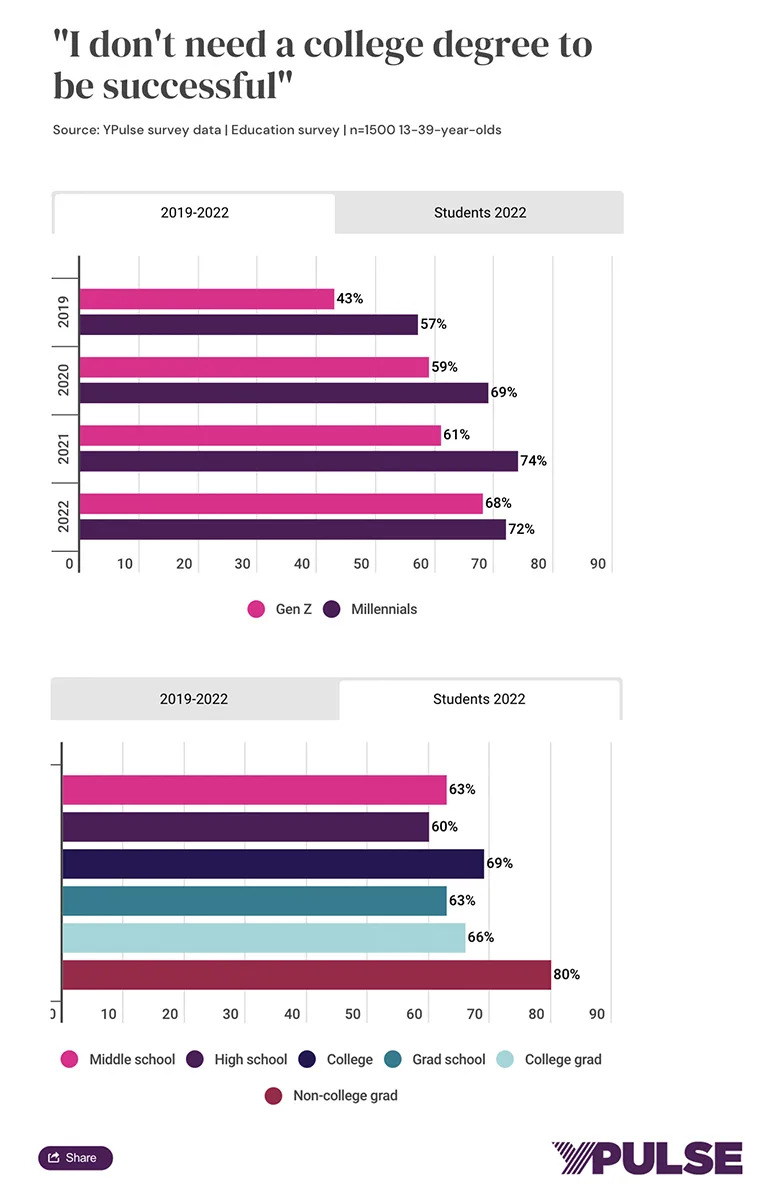
“Seeing the way many Millennials are saddled with insurmountable debt from the higher ed system, and knowing from their online lives that other paths are possible, these high school and even middle school students are reconsidering if they even need college to be successful,” YPulse wrote in the report.

Gen Z advocates Brian Femminella, co-founder and chief executive officer of SoundMind, Bella Santos, community leadership board president of The Conversationalist, and Ian Gates, policy and program quality fellow of The Opportunity Project Tulsa talked about key takeaways from the report:

From left to right, Brian Femminella, 23, Bella Santos, 20, and Ian Gates, 22.
1. The vast majority of Gen Z middle school students say they don’t see a future pursuing college.

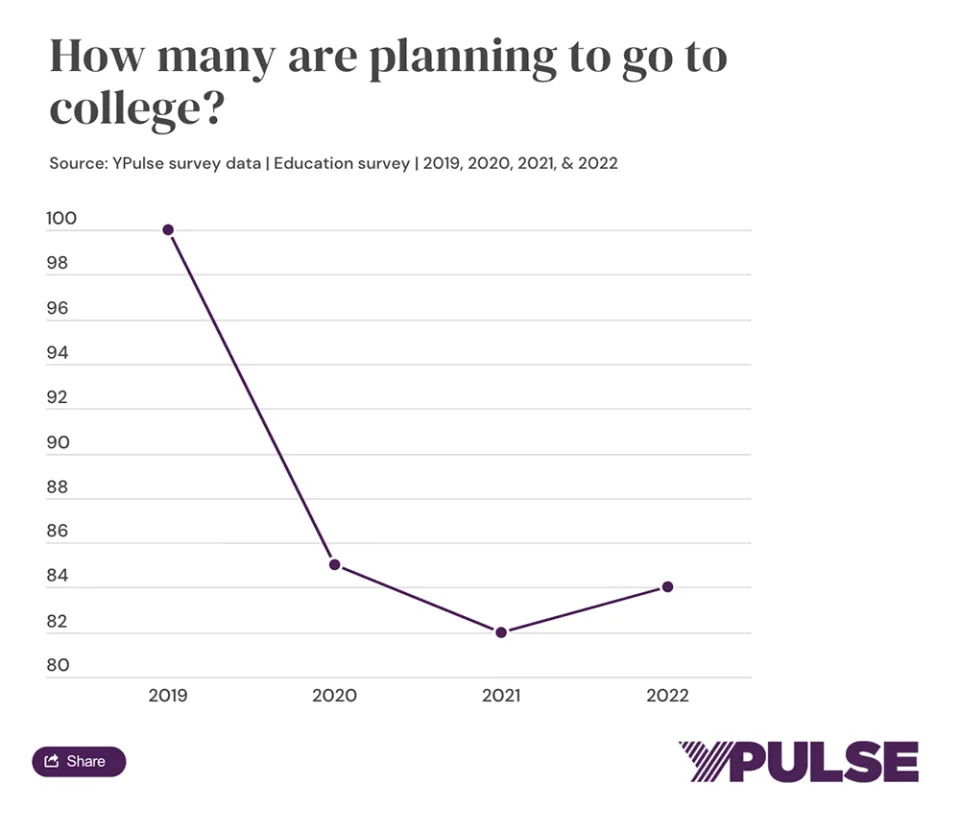
YPulse found 80% of Gen Z middle school students and 85% of high school students plan to go to college compared to 100% pre-pandemic.

YPulse

Gates, 22, said pandemic-era online learning showed younger Gen Z students how monotonous taking classes can be — whether they’re in middle school, high school, community college or a four-year institution.

“[Gen Z] is thinking about different options now,” Gates told The 74. “A lot of us are thinking about non-college careers…like being a Youtuber, influencer and other alternate paths like that.”

Femminella, 23, said his own college education didn’t necessarily help him start his mental health company.

“When I see how a lot of younger kids would rather do something else, I applaud that,” Femminella told The 74. “We need more folks that want to do different things and shouldn’t fall into the stigma of college being a must.”

Related: Gen Z Entrepreneurs Tackle Youth Mental Health Crisis With Music Therapy
2. Gen Z students are more likely to find Google and YouTube more helpful than a teacher.

YPulse found Gen Z students were more likely to choose Google and YouTube over a teacher when asked: “If you wanted to learn something new, what resources would you use?”

Santos, 20, wasn’t shocked.

“There is often not a ton of oversight when it comes to how choosy schools are with who gets to teach — especially in public schools,” Santos told The 74. “Teachers and the system in which they teach aren’t always suited for success to begin with.”

Gates said disparaging parent attitudes towards teachers and school curriculum also had an effect on how Gen Z grows up to question the value of a college education.

“With the parental rights movement, certainly when you’re telling your kid ‘hey your teachers are trying to indoctrinate you and make you communist and make you gay’ it obviously gets to them,” Gates said.

Gates added how states such as Florida, which have banned AP Psychology and AP African American Studies, contribute to Gen Z’s disinterest in pursuing higher education by not exposing them to diverse courses.
3. Gen Z college students struggle to stay interested in their classes and believe they don’t teach practical skills.

YPulse found 55% of current Gen Z undergraduate students and 38% of Gen Z graduate students found their classes not relevant to their lives — in part because college doesn’t teach practical skills such as mental health skills, cooking and personal finance.

“Learning should be an enriching experience no matter what your interests are,” Santos said. “Yet school systems are often set up to just drill information into people’s brains.”

Femminella said mental health concerns should be the foundation on which professors shape their curriculum.

“There are some moments when students in college need to have a mental health day because they’re overworked,” Femminella said. “There’s not a lot of outlets and resources until it’s too late…and you’re really in the midst of a mental health crisis when there’s ways to avoid that.”

Femminella also said colleges should require personal finance and cooking courses.

“A lot of colleges forget that when Gen Z students close their computer, they’re a human and have to go do other human things like pay bills, cook and clean,” Femminella said. “I think it’s something that should just be incorporated into the entire university structure.”
4. Gen Z students wish they learned about alternative career paths growing up.

YPulse found that 74% of Gen Z students wish they learned more about alternative career paths compared to a traditional college education.


YPulse

Santos said the social stigma of not attending college is declining among Gen Z students.

“I don’t think it’s for everyone, I don’t think it’s necessary, so it makes sense that other people in my generation see that,” Santos said.

Gates added how this is especially true for students who come from immigrant families and used to feel “the pressure that college is just what’s next.”

“Gen Z knows people are graduating college with all these loans,” Gates said. “They’re taking that into account, especially those from lower income families, and asking themselves if college is really worth it.”

Related: What Gen Z Teens Are Asking About Education, Work and Their Future
5. Gen Z students believe work experience is more important than a college education.

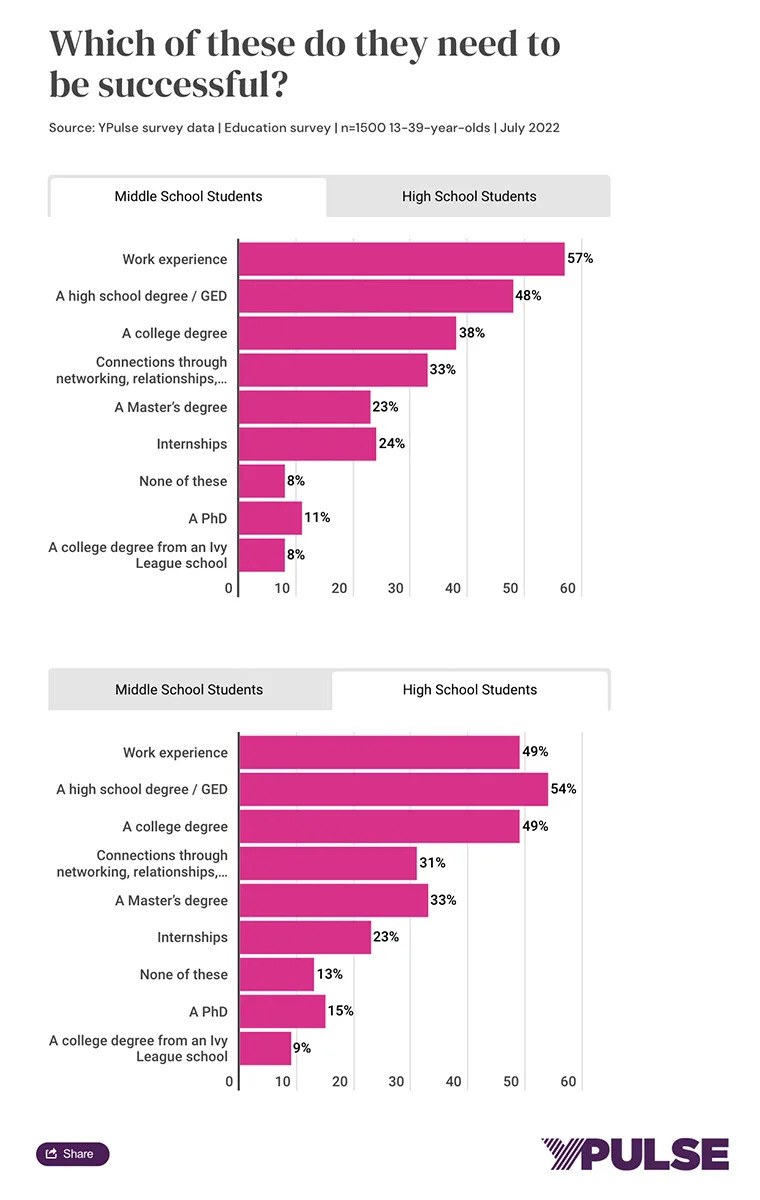
YPulse found that 57% of Gen Z middle school students and 49% of Gen Z high school students believe work experience is more important than a college education.


YPulse

Femminella said work experience has been the most helpful tool to his success.

“When you’re in your field and you get to practice, you also get to fail,” Femminella said. “And by failing you learn the most, and that’s been invaluable to starting my company.”


Nearly half of Gen Zers think they won’t ‘get a dime’ in Social Security: survey

Aris Folley
Tue, August 22, 2023 


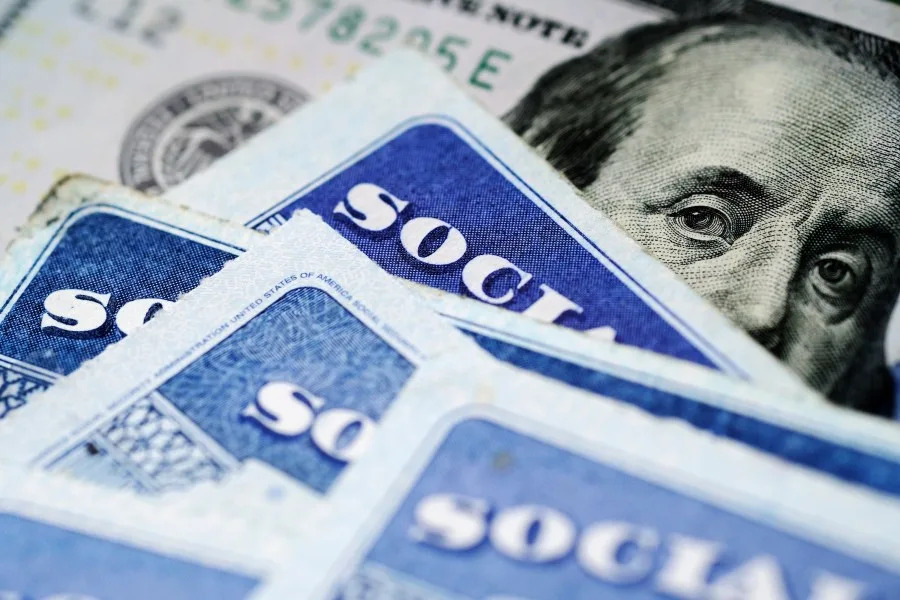
Almost half of Generation Z adults said they don’t expect to get any of the Social Security benefits they’ve earned, according to a survey.

In a survey released Tuesday by the Nationwide Retirement Institute, 45 percent of Gen Z adults between the ages of 18 to 26 said they expect to not “get a dime” of the benefits they have earned.

Additionally, 39 percent of millennials said the same, compared to 25 percent of Gen X adults and 10 percent of baby boomers who agreed.

More older Americans also expressed concern that Social Security could run out of funding in their lifetimes, with 75 percent of respondents aged 50 and older sharing that concern in the survey, up 9 percent from roughly a decade ago.

The fate of Social Security drew significant attention around Capitol Hill earlier this year as Republicans and Democrats warred over how to tackle the nation’s climbing debt, which stands at more than $32 trillion.

As one of the country’s largest mandatory spending programs, dollars for Social Security comprise a significant portion of the nation’s annual spending.

The program is expected to approach insolvency in roughly a decade, so lawmakers on both sides have floated potential changes to extend the lifetime of the program.

In the new survey, less than a fourth of respondents backed increasing funding through payroll taxes. Instead, 49 percent of respondents pushed for tax increases on higher earners to pay for the program.

Forty-one percent also said they supported increasing funding through taxes paid by employers, compared to 40 percent who also pushed for less taxation and 24 percent who wanted to see the age of eligibility lowered.

The survey found less support among respondents when it came to some changes tightening eligibility, with only 19 percent saying they support raising the full retirement age, while just 9 percent backed a gradual reduction of benefits that would most affect younger generations.

Only 6 percent of respondents support reducing benefits across the board.

Gen Z, millennial, and Gen X respondents were more likely than boomers and older respondents in the survey to say they have or “will have retirement accounts and savings as additional sources of retirement income beyond Social Security benefits.”

They were also more likely to say they plan to delay or have delayed retirement in case a quarter of their monthly benefit is cut during retirement.

The 2023 Social Security survey was conducted online between May 18 and June 13 among 1,806 adults age 18 and older who receive or expect to receive Social Security. That includes 300 Gen Z respondents, 500 millennials and 502 boomers or those age 59 and older.

The sample data is accurate to “within plus 3.0 percentage points using a 95 percent confidence level,” the survey notes.

'A bigot and a racist': Democrat pushes to strip lawmaker's name from Senate building

Elizabeth Elkind
FAUX NEWS
Tue, August 22, 2023 


A House Democrat is pushing the Senate to rename an office building that memorializes a "bigot and a racist."

Rep. Al Green, D-Texas, introduced a resolution on Friday calling on Congress' upper chamber to wipe the name of the late Sen. Richard Russell off the Russell Senate Office Building. The Georgia Democrat was a staunch opponent of de-segregation and the Civil Rights Movement during his nearly four decades in the Senate.

"I marvel at how we have arrived in the year 2023, and we have a building on this campus, named after a person who was a White supremacist, a person who fought against anti-lynching laws, a person who fought integration, a person who was a segregationist," Green fumed on the House floor in late July. "And we, people of color, tolerate it."


Sen. Richard B. Russell served in the chamber for nearly 40 years and is known for his opposition to de-segregation

Senate buildings and rooms are normally named and re-named via a chamber resolution. Green spoke out just before lawmakers departed Washington, D.C., for their six-week August recess.

"Taxpayer dollars ought not be on the name of a building that would honor a bigot and a racist, Richard Russell," Green said.

He pointed to the Defense Department actively working to remove Confederate symbols from the military and said the Senate "ought to be ashamed" of its inaction.

FAUX NEWS EDITOR POSTS RACIST TRIGGER BAIT PHOTO OF REP. GREEN

Rep. Al Green introduced a resolution urging the Senate to strip Russell's name from one of its three office buildings. (Getty Images)

"This is why the Senate will not remove the name that is offensive to me and many of my friends and relatives – they can't agree on a name. Well, I have the solution. Let it revert to the name that it had before it became Richard Russell. Let it revert to the old Senate office building. And then choose any name you want. Take as much time as you need," Green said.

It’s not the first time Green or other lawmakers have introduced a resolution to wipe Russell’s name from the halls of the U.S. Capitol complex, but all efforts have thus far failed.

Then-Senate Minority Leader Chuck Schumer, D-N.Y., proposed renaming the building after late Sen. John McCain, R-Ariz., in 2018 shortly after his death from brain cancer at age 81. Some GOP senators from the South pushed back on the idea at the time.

SAINT CHUCK

Senate Majority Leader Chuck Schumer's office was unresponsive when asked if he would mount a push to rename the Russell building.

But Schumer revived the effort a year later, when former President Donald Trump’s attacks on the late McCain were dominating media headlines.

Schumer’s office did not respond to Fox News Digital’s request for comment on whether he would introduce a renaming resolution now, while he controls Senate floor movement as majority leader.

His office also did not return a request for comment on Green’s latest resolution.
Rapinoe knocks ‘fake’ Trump criticism after World Cup exit

Sarah Fortinsky
Tue, August 22, 2023 


Retiring U.S. soccer star Megan Rapinoe is knocking former President Trump’s criticism of her after the U.S. Women’s National Team lost in the round of 16 of the Women’s World Cup this month, calling his attacks “fake” in an interview published Tuesday in The Atlantic.

“It always is [hard to parse],” Rapinoe said of Trump’s criticism, “because what he’s saying is fake. It’s a compilation of hit words and hot-button words that don’t actually make any sort of sense or square with reality at all.”

Rapinoe fought back against the criticism her team has faced both in moments of success and in ones of failure, saying, “there’s no way for us to win.”

“I think, just in general, the way that our team was spoken about over the course of the tournament, it was fake. And it didn’t make sense to me: In 2019, we were ultra-confident, ultra-swaggy — and won everything. And even though we won, we did it in bad taste, according to our critics,” Rapinoe said.

“This time, we weren’t confident enough, and we don’t have the right ‘mentality.’ And so we lost. It’s just so disingenuous. There’s no way for us to win, and there’s no way for us to lose,” she added.

Rapinoe was responding to Trump’s immediate response on social media to the news that the her team had lost to Sweden earlier this month.

“The ‘shocking and totally unexpected’ loss by the U.S. Women’s Soccer Team to Sweden is fully emblematic of what is happening to the our once great Nation under Crooked Joe Biden,” Trump wrote at the time on his social media platform, Truth Social.

Rapinoe, a progressive activist, said during the 2019 Women’s World Cup that if the team won, which it eventually did, “I’m not going to the f‑‑‑ing White House,” adding, “We’re not going to be invited… I doubt it.”

Trump, who was in office at the time, responded to her comments by going after Rapinoe in a post on Twitter, writing, “Megan should never disrespect our country, the White House or our flag, especially since so much has been done for her and the team. Be proud of the flag you carry.”

“I’m a big fan of the U.S. team and women’s soccer, but Megan should first win before she speaks! Finish the job!” he added.

President Biden awarded Rapinoe in 2022 with the Presidential Medal of Freedom, the highest civilian award in the nation.


In a Hot Job Market, the Minimum Wage Becomes an Afterthought

Ben Casselman and Lydia DePillis
The New York Times
Wed, August 23, 2023


Under New Hampshire law, Janette Desmond can pay the employees who scoop ice cream and cut fudge at her Portsmouth sweet shop as little as $7.25 an hour.

But with the state unemployment rate under 2%, the dynamics of supply and demand trump the minimum wage. At Desmond’s store, teenagers working their first summer jobs earn at least $14 an hour.

“I could take a billboard out on I-95 saying we’re hiring, $7.25 an hour,” Desmond said. “You know who would apply? Nobody. You couldn’t hire anybody at $7.25 an hour.”

Sign up for The Morning newsletter from the New York Times

The red-hot labor market of the last two years has led to rapid pay increases, particularly in retail, hospitality and other low-wage industries. It has also rendered the minimum wage increasingly meaningless.

Nationally, only about 68,000 people on average earned the federal minimum wage in the first seven months of 2023, according to a New York Times analysis of government data. That is fewer than 1 of every 1,000 hourly workers. Walmart, once noted for its rock-bottom wages, pays workers at least $14 an hour, even where it can legally pay roughly half that.

There are still places where the minimum wage has teeth. Thirty states, along with dozens of cities and other local jurisdictions, have set minimums above the federal mark, in some cases linking them to inflation to help ensure that pay keeps up with the cost of living.

But even there, most workers earn more than the legal minimum.

“The minimum wage is almost irrelevant,” said Robert Branca, who owns nearly three dozen Dunkin’ Donuts stores in Massachusetts, where the minimum is $15. “I have to pay what I have to pay.”

As a result, the minimum wage has faded from the economic policy debate. President Joe Biden, who tried and failed to pass a $15 minimum wage during his first year in office, now rarely mentions it, although he has made the economy the centerpiece of his reelection effort. The Service Employees International Union, which helped found the Fight for $15 movement more than a decade ago, has shifted its focus to other policy levers, though it continues to support higher minimum wages.

Opponents, too, seem to have moved on: When Pennsylvania’s House of Representatives voted this year to raise the state’s $7.25 minimum wage to $15 by 2026, businesses, at least aside from seasonal industries in rural areas, shrugged. (The measure has stalled in the state’s Republican-controlled Senate.)

“Our members are not concerned,” said Ben Fileccia, a senior vice president at the Pennsylvania Restaurant and Lodging Association. “I have not heard about anybody being paid minimum wage in a very long time.”

The question is what will happen when the labor market cools. In inflation-adjusted terms, the federal minimum is worth less than at any time since 1949. That means that workers in states like Pennsylvania and New Hampshire could struggle to hold on to their recent gains if employers regain leverage.

Congress hasn’t voted to raise the minimum wage since George W. Bush was president; in 2007, he signed a law to bring the floor to $7.25 by 2009. It remains there 14 years later, the longest period without an increase since the nationwide minimum was established in 1938.

As the federal minimum flatlined, however, the Fight for $15 campaign was succeeding at the state and local levels. Cities such as Seattle and San Francisco adopted a $15 minimum wage, followed by states such as New York and Massachusetts. And while Republican legislatures opposed raising minimums, voters often overruled them; Missouri, Florida, Arkansas and other Republican-dominated states have passed increases through ballot measures in the last decade.

Nationwide, the number of people earning the minimum wage fell steadily, from nearly 2 million when the $7.25 floor took effect to about 400,000 in 2019. (Those figures omit people earning less than the minimum wage, which can in some cases include teenagers, people with certain disabilities or tipped workers.)

Then COVID-19 upended the low-wage labor market. Millions of cooks, servers, hotel housekeepers and retail workers lost their jobs; those who stayed on as “essential workers” often received hazard pay or bonuses. As businesses began to reopen in 2020 and 2021, demand for goods and services rebounded much faster than the supply of workers to deliver them. That left companies scrambling for employees — and gave workers rare leverage.

The result was a labor market increasingly untethered to the official minimum wage. In New Hampshire, the 10th percentile wage — the level at which 90% of workers earn more — was just above $10 in May 2019. By May 2022, that figure had jumped to $13.64, and local business owners say it has continued to rise.

“Today, you’re looking at $15 an hour and saying, ‘I wish that’s all we had to pay,’” said David Bellman, who owns a jewelry store in Manchester, New Hampshire.

The unemployment rate in New Hampshire was low before the pandemic; at 1.7% in July, it is now among the lowest rates ever recorded anywhere in the country. Competition for workers is fierce: The Wendy’s on Bellman’s drive home from work advertises wages of $18 an hour. At his own store, he is paying $17 to $20 an hour and recently hired someone away from the local bagel shop; his son had noticed that she seemed like a hard worker.

“Basically, the only way to hire anybody is to take them away from somebody else,” Bellman said.

New Hampshire is surrounded by states where the minimum wage is above $13, so if Granite State employers tried to offer substantially less, many workers could cross the border for a bigger paycheck. But even in states like Alabama and Mississippi, where the cost of living is lower and where few neighboring states have minimum wages above the federal standard, most employers are finding they have to pay well above $7.25.

Paige Roberts, president and CEO of the Jackson County Chamber of Commerce in Mississippi, said she was “nearly laughed out of a job” when she started asking members about paying the minimum wage. Entry-level jobs there pay about $12 an hour, according to the local unemployment office.


Kitchen workers at Liberty House, a restaurant and event venue in Jersey City, N.J. on Aug. 16, 2023. (Hiroko Masuike/The New York Times)

In states with higher minimums, the picture is more nuanced. Faster increases in the wage floor in the late 2010s forced up long-stagnant wages in fields like restaurants and retail. And some businesses, such as summer camps, say they are still paying the minimum wage for entry-level workers or those in training. But for the most part, the minimums no longer exert the strong upward pressure on pay that they did when they were adopted.

When New Jersey passed a minimum-wage law in 2019, many businesses complained that the increases were too aggressive: The floor would rise by at least $1 an hour every year until it hit $15 in 2024. But recently, the hot job market has levitated the wage scale even more.

“COVID kind of shifted things around a bit, as did inflation,” said Jeanne Cretella, whose business, Landmark Hospitality, operates 14 venues in New Jersey and Pennsylvania.

Before the pandemic, dishwashers and other entry-level employees at Landmark typically made the minimum wage. These days, Cretella starts workers in New Jersey at $15 an hour, though the state’s minimum won’t hit that mark until next year.

When the Fight for $15 movement began, many economists warned that raising the minimum wage too high or too quickly could lead to job losses. Some studies did find modest negative effects on employment, particularly for teenagers and others on the margins of the labor market. But for the most part, researchers found that pay went up without widespread layoffs or business failures.

Some economists still wondered what would happen as $15 minimum wages spread beyond high-cost coastal cities. But that was before the pandemic reshaped the low-wage labor market.

“We’re kind of in different territory now,” said Jacob Vigdor, an economist at the University of Washington who has studied the issue.

Washington has the highest statewide minimum wage, at $15.74. Yet when Vigdor recently visited Aberdeen, a small town near the Pacific coast, all business owners wanted to talk about was how to retain workers.

“I did not really hear a lot of concern about those minimum wages,” he said. “There the concern is that they’re losing people.”

Still, economists say the minimum wage could become relevant again when the labor market eventually cools and workers lose bargaining power.

David Neumark, a professor at the University of California, Irvine, said states with high minimum wages could be at a disadvantage in a recession, because employers would have to keep pay high as demand softened, potentially leading to layoffs.

Other economists have the opposite concern: that workers in states where the minimum wage remains $7.25 could see their recent gains evaporate when they no longer have the leverage to demand more.

“It’s as tenuous as it gets,” said Kathryn Anne Edwards, a labor economist and policy consultant. “The labor market has gained ground, but policy has not cemented that territory.”

Despite the strong labor market, many workers say they barely get by.

KaSondra Wood has spent much of her adult life working for the minimum wage, from the army depot where she held her first job, earning $5.15 an hour, to the Little Caesars where she made $7.25 as recently as last year.

But not anymore: This summer, she started a job cleaning rooms at a local hotel, earning $12 an hour. Even in Oneonta, Alabama, a rural area with few job opportunities, employers know better than to try hiring at the minimum wage.

“They wouldn’t advertise for it, knowing they wouldn’t get anyone in there,” she said.

But Wood, 38, hardly feels that she is getting ahead. The hotel is a 45-minute drive from her home, so gas eats up much of her paycheck, even though she carpools with her mother. Groceries keep getting more expensive.

“A couple years ago, $12 an hour would’ve been killer money,” she said. But now it isn’t enough to pay her bills.

“I don’t ever get caught up,” she said. “I’m broke by the time I get paid.”

c.2023 The New York Times Company

With contracts set to expire Sept. 14, auto union chief says talks with Detroit 3 aren't going well

TOM KRISHER
Wed, August 23, 2023 


United Auto Workers members march while holding signs at a union rally held near a Stellantis factory Wednesday, Aug. 23, 2023, in Detroit. UAW President Shawn Fain told reporters that bargaining on a new contract is not going well between the UAW and Detroit's three automakers. 
(AP Photo/Mike Householder)


DETROIT (AP) — With about three weeks until contracts expire with Detroit's three automakers, the head of the United Auto Workers union says bargaining isn't going well.

President Shawn Fain told workers outside a Detroit factory that their walk Wednesday to practice picketing would become reality if General Motors, Ford and Stellantis don't start negotiating seriously.

"These companies better come to the table. The clock is ticking,” Fain told about 100 workers gathered in a parking lot near Stellantis’ Mack Avenue assembly complex. “Today I want you guys to have some fun practicing for what we’re going to have to do if these companies don’t give us our fair share.”

Contracts between the union representing about 146,000 workers at the companies expire at 11:59 p.m. on Sept. 14. Members are voting this week on whether to give union leaders authorization to call a strike.

The union is seeking a 40% pay increase, restoration of pensions for new hires, elimination of wage tiers and other items. Fain has often told workers they have to be ready to strike in order to achieve gains from the profitable automakers.

In a short interview with The Associated Press Fain characterized bargaining as slow. “We're not getting real far so far,” he said, but added that a strike is not inevitable.

Stellantis wouldn't comment Wednesday and referred to previous statements saying the company wants to fairly compensate workers and find solutions to protect Stellantis from nonunion companies with lower costs, and additional costs from moving to electric vehicles.

GM and Ford each have said they're bargaining in good faith.

Workers are voting this week on whether to authorize union leaders to call a strike against one or more of the automakers when the contracts end.

Four workers interviewed Wednesday said they voted in favor, and Fain said early results coming in from factories show the strike authority is overwhelmingly passing. Such votes almost always get more than 90% approval from workers.

Although Fain says the union has not picked a company to target for a strike and it could strike against all three at the same time, several members who practiced picketing Wednesday all said they think the union will strike against Stellantis.

“If they make more profits, we should be able to get a little piece of that change,” said Jamar Williams, a chassis assembly worker at the Stellantis plant.
As Hollywood strikes drag on, California lawmakers consider unemployment pay for striking workers

Queenie Wong
Wed, August 23, 2023 

SAG-AFTRA and WGA members join forces with the AFL-CIO and its affiliates from across the nation and across industries for a national day of solidarity rally outside of Walt Disney Studios in Burbank on Tuesday. (Christina House / Los Angeles Times)


California lawmakers are resurrecting legislation that would allow workers on strike to collect unemployment benefits, reigniting a familiar political battle between labor unions and businesses.

Under Senate Bill 799, striking workers would be eligible to collect unemployment benefits after they're on strike for two weeks, an early version of the bill released on Tuesday shows.

“Even coming out of the strike, when folks eventually get a contract that they agree on, their families have suffered during this time,” said Sen. Anthony Portantino (D-Burbank), who wrote the bill.

The last-minute effort, backed by labor unions, shows how lawmakers are responding to a wave of worker strikes sweeping California. Hollywood writers, later joined by actors, have been on the picket lines for more than 100 days demanding better pay and benefits. Public school workers, hotel staffers, nurses and even Los Angeles city workers also went on strike this year in Southern California.

Striking union members in most states don’t qualify for unemployment benefits. In California, workers must meet requirements to qualify for unemployment benefits, such as showing they are unemployed through no fault of their own and actively searching for a job. To pay their bills, workers on strike usually rely on personal savings, strike funds, side gigs and other financial aid.

New York and New Jersey, though, do allow certain workers on strike to collect unemployment benefits. Lawmakers in states such as Massachusetts, Connecticut and now California are considering similar policies.

Along with expanding eligibility for unemployment benefits, California lawmakers are considering several other bills to aid workers grappling with the rising cost of living. Democrats have introduced legislation that would raise the minimum wage for healthcare workers to $25 per hour and more than double the amount of paid sick leave. The California Chamber of Commerce labeled the bills “job killers."

The chamber opposes allowing striking workers to collect unemployment pay in California, which is as much as $450 per week for a maximum of 26 weeks, stating it would harm businesses.

“This is going to hit employers, even those who have no involvement at all in any labor dispute and never have, but they're still going to pay increased taxes,” said Robert Moutrie, a policy advocate at the California Chamber of Commerce.

Read more: How to tap the WGA strike funds and other financial aid during the writers strike

Businesses pay state and federal payroll taxes on each employee’s first $7,000 in annual wages to fund the unemployment insurance program.

Portantino said his legislation could help fuel more conversations about how to better finance the state’s unemployment fund.

“The level of taxable income is low,” Portantino said. “This is the time to maybe look at that level of income to raise it to make sure that the fund is solvent.”

California is paying out more unemployment benefits than it has collected in state payroll taxes, according to the Legislative Analyst’s Office.

In 2020, amid higher-than-average job losses during the coronavirus pandemic, California borrowed $20 billion from the federal government to fund unemployment claims. The amount of federal unemployment insurance taxes California employers pay increases every year by an extra $21 per employee until the loan is repaid. The state also has to pay interest on these federal loans.

The proposed legislation was first reported by Politico. Although the official deadline for introducing new legislation has passed, the proposal is being introduced by gutting an existing bill and replacing the language with the measure to expand unemployment benefits.

Lawmakers will have to weigh business and labor interests. California Gov. Gavin Newsom has stayed behind the scenes as the Hollywood strikes drag on and has been cautious about any appearance that he’s taking sides. Newsom has been hesitant to support new spending proposals, however, given that he and lawmakers recently agreed on a budget plan that closes a nearly $32-billion deficit. The governor's office didn't respond to questions about whether it would support the bill.

Labor unions, including SAG-AFTRA and the Writers Guild of America, support the bill.

"Years of eroding compensation and working conditions have left writers with fewer resources than ever to weather periods without work," Meredith Stiehm, president of Writers Guild of America-West, said in a statement. "Unemployment insurance for striking workers is a commonsense solution to keeping workers afloat and local economies healthy.”

California lawmakers proposed a similar bill to give striking workers unemployment benefits in 2019, but AB 1066 failed to pass the Senate. Various business groups opposed the legislation, saying it could force the state to take out more federal loans and penalize employers for strikes.

At the time, the Employment Development Department estimated that the amount of additional unemployment benefits paid could range from $800,000 to $6 million annually, according to the bill's analysis. The impact depends on the number of employees who collect unemployment benefits and how long the strikes last.

Former state Assemblymember Lorena Gonzalez, who leads the California Labor Federation, said owing the federal government money shouldn’t be an excuse for not providing unemployment pay to workers.

“If you're in Los Angeles, obviously you're seeing workers go without a paycheck for an extended amount of time, and slowly finding out what that means,” she said. Gonzalez said she’s seen the effect long strikes have had on workers, pointing to the nearly five-month grocery worker strike in the 2000s. Anonymous studio executives told Deadline that their strategy is to drag out the strikes until workers go broke, but the Alliance of Motion Picture and Television Producers disputed the report.

“They want them to be evicted. I mean, that's crazy. That is exactly what we don't want. They have earned unemployment insurance, and they should be able to access unemployment insurance,” Gonzalez said.

The amount in strike funds, she said, varies based on the union and can be depleted. Allowing workers to collect unemployment benefits isn’t about tipping the scale in favor of the workers but being “humane” and providing them a social safety net.

“This really just keeps people afloat,” she said.