It’s possible that I shall make an ass of myself. But in that case one can always get out of it with a little dialectic. I have, of course, so worded my proposition as to be right either way (K.Marx, Letter to F.Engels on the Indian Mutiny)
A lawsuit in a U.S. court is accusing American oil and gas producers, including Hess, Pioneer Natural Resources and Occidental Petroleum, of price-fixing by conspiring to reduce production.
A total of nine companies are listed in the lawsuit filed by residents of Nevada, Hawaii and Maine, Reuters reports.
The lawsuit was filed in a federal court in Las Vegas.
The lawsuit alleges that these companies have for years “collectively coordinated their production decisions, leading to production growth rates lower than would be seen in a competitive market”.
Continental Resources, Diamondback Energy, Chesapeake Energy, Permian Resources and EOG Resources are also named in the lawsuit.
In a Tuesday statement carried by Reuters, the Plaintiffs’ lawyer said the companies in question used the past three years to follow an approach of production discipline, which guaranteed that Americans would pay higher gas prices at the pump.
“Defendants’ production restraint agreement worked,” the lawsuit said. “Defendants are reaping the rewards in the form of massive revenue increases, while not reinvesting that additional revenue into new production,” Reuters cited the lawsuit as saying. The lawsuit specifically targets independent shale producers in the U.S., excluding Big Oil players such as Exxon Mobil and Chevron, according to Reuters.
The class-action lawsuit is demanding a court order against anti-competitive business practices and monetary compensation for millions of gas purchasers in multiple states.
While American shale producers have practiced a high-level of production discipline since the 2014 boom turned to bust and shareholders demanded a pay out, 2023 saw record U.S. crude oil production of over 13.2 million barrels per day.
That record production has weakened OPEC’s influence on the market, and this week’s class-action lawsuit essentially alleges that American shale producers are behaving like a new cartel.
Shell has begun hundreds of layoffs, sources with knowledge of the matter told Bloomberg on Thursday, as the supermajor looks to create more value through simplification and discipline.
Positions in the low-carbon business will be the first to be eliminated, followed by additional job cuts in the corporate affairs division and project and technology departments, Bloomberg’s sources said.
Last year, Shell said it plans to cut 15% of the 1,300 jobs in its Low Carbon Solutions business as it scales back some green energy ambitions and focuses on profitable projects including in the oil and gas sector.
The UK-based supermajor plans to eliminate 200 jobs in its Low Carbon Solutions division next year, and is also reviewing the future of another 130 positions in the green energy business, which currently employs around 1,300 people, Shell told Reuters in October.
In December 2023, the oil major announced internally a broader plan for job cuts in other departments, too.
“Shell aims to create more value with less emissions by focusing on performance, discipline and simplification,” a spokesperson for the supermajor told Bloomberg.
“Achieving those reductions will require portfolio high grading, new efficiencies and a leaner overall organization,” the spokesperson added.
Last year, Shell laid out plans to raise its dividend by 15%, effective from the second quarter 2023 interim dividend, as the UK-based supermajor pledged to grow its gas business and extend its position in the upstream.
Institutional investors in Europe were disappointed with Shell’s new strategy to continue investing in oil and gas production and selectively pour capital into renewable energy solutions, to the point of some investors considering removing it from their portfolios.
But Shell’s chief executive Wael Sawan has said that reducing global oil and gas production would be “dangerous and irresponsible” as the world still desperately needs those hydrocarbons.
EU Authority Drafts Guidelines for Banks to Manage ESG Risks
European banks should integrate environmental, social, and governance risks in their regular risk management framework, the European Banking Authority (EBA) said this week in draft guidelines on the management of ESG risks.
The European authority published a consultation paper on its draft proposals for banks as it launched a public consultation that will run until April 18, 2024.
According to the EBA, climate change, environmental degradation, social issues, and other ESG factors pose “considerable challenges for the economy that impact the financial sector.”
“The risk profile and business model of institutions may be affected by ESG risks, in particular environmental risks through transition and physical risk drivers,” the authority noted.
The management of ESG risks is still at early stages and a “work in progress” in most EU institutions, the banking authority said in the paper.
Despite the fact that some institutions have taken action in recent years, “several shortcomings have been observed in the inclusion of ESG risks in business strategies and risk management frameworks that may pose challenges to the safety and soundness” of banks, the authority added.
However, the EBA noted that while the ESG risk guidelines call for more planning and including ESG factors in risk management, “It is also important to bear in mind that the goal of prudential plans is not to force institutions to exit or divest from carbon intensive sectors.”
Banks across Europe may have to include environmental and social risks in their capital requirements and risk management under new recommendations by the EBA published at the end of last year.
“Environmental and social risks are changing the risk profile for the banking sector and are expected to become more prominent over time,” the authority said in a report in October.
Among other things, the EBA is proposing to require institutions to identify whether environmental and social factors constitute triggers of operational risk losses.
ICYMI
Scientists develop luminescent sensor to detect 'forever chemicals' in water
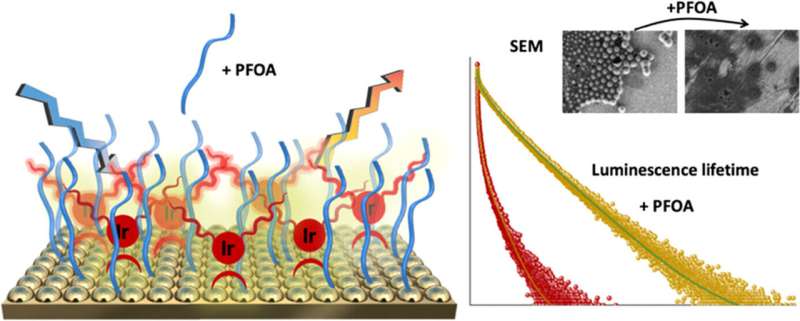
Graphical Abstract. Luminescence lifetimes are an attractive analytical method for detection due to its high sensitivity and stability. Iridium probes exhibit luminescence with long excited-state lifetimes, which are sensitive to the local environment. Perfluorooctanoic acid (PFOA) is listed as a chemical of deep concern regarding its toxicity and is classified as a “forever chemical.” In addition to strict limits on the presence of PFOA in drinking water, environmental contamination from industrial effluent or chemical spills requires rapid, simple, accurate, and cost-effective analysis in order to aid containment. Herein, we report the fabrication and function of a novel and facile luminescence sensor for PFOA based on iridium modified on gold surfaces. These surfaces were modified with lipophilic iridium complexes bearing alkyl chains, namely, IrC6 and IrC12, and Zonyl-FSA surfactant. Upon addition of PFOA, the modified surfaces IrC6-FSA@Au and IrC12-FSA @Au show the largest change in the red luminescence signal with changes in the luminescence lifetime that allow monitoring of PFOA concentrations in aqueous solutions. The platform was tested for the measurement of PFOA in aqueous samples spiked with known concentrations of PFOA and demonstrated the capacity to determine PFOA at concentrations >100 μg/L (240 nM). Credit:Analytical Chemistry(2024). DOI: 10.1021/acs.analchem.3c04289
Researchers have created a new way to detect 'forever chemical' pollution in water, via a luminescent sensor.
Scientists in Chemistry and Environmental Science at the University of Birmingham in collaboration with scientists from the Bundesanstalt für Materialforschung und -prüfung (BAM), Germany's Federal Institute for Materials Research and Testing, have developed a new approach for detecting pollution from 'forever chemicals' in water through luminescence.
PFAS or 'forever chemicals' are manufactured fluorine chemicals that are used widely in different industries—from food packaging to semiconductor production and car tires. They are non-degradable and accumulate in the environment. Concerns regarding the toxic pollution they cause, particularly in water, have been rising in recent years.
Stuart Harrad, Professor of Environmental Chemistry at the University of Birmingham, who—with colleague Professor Zoe Pikramenou, Professor of Inorganic Chemistry and Photophysics—co-led the design of a new sensor, said, "Being able to identify 'forever chemicals' in drinking water, or in the environment from industrial spills is crucial for our own health and the health of our planet."
"Current methods for measurement of these contaminants are difficult, time-consuming, and expensive. There is a clear and pressing need for a simple, rapid, cost-effective method for measuring PFAS in water samples onsite to aid containment and remediation, especially at (ultra)trace concentrations. But until now, it had proved incredibly difficult to do that."
The researchers, who have published their findings in Analytical Chemistry, have created a prototype model which detects the 'forever chemical' perfluorooctanoic acid (PFOA). The approach uses luminescent metal complexes attached to a sensor surface. If the device is dipped in contaminated water, it detects PFOA by changes in the luminescence signal given off by the metals.
Professor Pikramenou commented, "The sensor works by using a small gold chip grafted with iridium metal complexes. UV light is then used to excite the iridium, which gives off red light. When the gold chip is immersed in a sample polluted with the 'forever chemical,' a change of the signal in the luminescence lifetime of the metal is observed to allow the presence of the 'forever chemical' at different concentrations to be detected."
"So far, the sensor has been able to detect 220 micrograms of PFAS per liter of water, which works for industrial wastewater, but for drinking water, we would need the approach to be much more sensitive and be able to detect nanogram levels of PFAS."
The team has collaborated with surface and sensor scientists BAM in Berlin for assay development and dedicated analytics at the nanoscale. Dan Hodoroaba, head of BAM's Surface and Thin Film Analysis Division, emphasized the importance of chip characterization, "Advanced imaging surface analyses are essential for the development of dedicated chemical nanostructures on customized sensor chips to ensure optimal performance."
Knut Rurack, who leads the Chemical and Optical Sensing Division at BAM, added, "Now that we have a prototype sensor chip, we intend to refine and integrate it to make it portable and more sensitive so it can be used on the site of spills and to determine the presence of these chemicals in drinking water."
Professor Pikramenou concluded "PFAS are used in industrial settings due to their useful properties for example in stain-proofing fabrics. But if not disposed of safely these chemicals pose a real danger to aquatic life, our health, and the broader environment. This prototype is a big step forward in bringing an effective, quick, and accurate way to detect this pollution, helping to protect our natural world and potentially keep our drinking water clean."
More information: Kun Zhang et al, Luminescence Lifetime-Based Sensing Platform Based on Cyclometalated Iridium(III) Complexes for the Detection of Perfluorooctanoic Acid in Aqueous Samples, Analytical Chemistry (2024). DOI: 10.1021/acs.analchem.3c04289
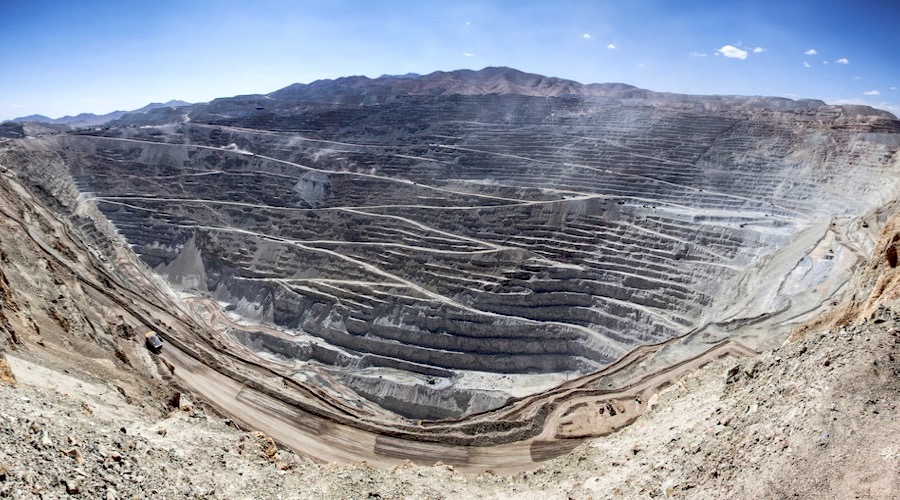
Chile’s state-owned Codelco, the world’s largest copper producer, submitted an environmental permit request on Thursday to modify its Chuquicamata Subterranea project at a cost of $720 million.
“The general objective of the project is to incorporate optimizations to the original project and modifications in order to ensure that the operation of MCHS (Chuquicamata) can reach the authorized production” of 140,000 tons per day, the request read.
The modifications include two new extraction tunnels for ventilation, fuel and electricity installations, new haulage sublevels and an access tunnel.
Chuquicamata Subterranea is an ambitious project to extend the open-pit copper mine’s lifespan by converting it into an underground operation. The project has faced years of significant delays and cost overruns.
Codelco’s production has fallen to its lowest level in 25 years due to operational problems and delays in its expansion projects, but its top executives have given assurances that production will begin to recover this year.
(By Fabián Andrés Cambero and Alexander Villegas; Editing by Richard Chang)
AUSTRALIA Ex-Fortescue Executives Unveil Innovative Green Iron Startup
Former executives from Fortescue’s clean energy initiatives, Michael Masterman and Bart Kolodziejczyk, have initiated a startup focused on reducing carbon emissions in the Australian iron ore sector. Notably, their approach differs from the hydrogen and membrane technology endorsed by their previous employer.
Having secured $10 million in seed funding this week, primarily from venture capital firm Playground Global, the partners express their readiness to sponsor research and development in green materials at their newly established company, Element Zero.
Through Element Zero’s patented electro-reduction method, the startup is already transforming iron ore into “green iron” on a laboratory scale. By utilizing an alkaline solution and electric current, this method effectively separates pure iron from the waste products present in the ore.
According to the founders, Element Zero’s patented process is particularly suitable for the prevalent hematite ores dominating the Australian iron ore industry. Furthermore, it exhibits versatility, as the method can be applied to other metals, such as nickel.
Strategically situated in Perth and northern Western Australia, Element Zero benefits from its proximity to the world’s largest iron ore ports, responsible for exporting approximately 55% of the globe’s seaborne iron ore supply.
With plans to generate 5 million tonnes per year of iron ore feed, resulting in the production of around 2.7 million tonnes of high-purity iron, Element Zero is poised to make a significant impact.
Founder and CEO Michael Masterman emphasized the groundbreaking nature of their processing platform, stating, “Our processing platform will, for the first time, allow cost-effective and scalable production of carbon-free metals crucial to the iron and steel and critical metals industries.”
Highlighting the comprehensive support received from Playground Global, Masterman shared ongoing discussions about developing green iron and green silicon value chains in the United States. Collaboration is also underway with major iron ore miners and iron and steel companies on a global scale.
Element Zero’s modular approach aims to address 8% of global carbon dioxide emissions from iron and steelmaking, positioning the company as a key player in environmental sustainability. Currently, the company is in the process of commissioning a green iron pilot plant in the Perth suburb of Malaga, with plans to feed 100 kg of iron ore into the process daily.
Startup aims to transform WA from world’s mine into world’s foundry
Perth-headquartered Element Zero, a green materials platform company launched by former Fortescue executives, has raised $10-million in seed funding for its pioneering zero-carbon metal conversion technology.
The funding, led by Playground Global, will be used to grow research and development, engineering and project development teams and scale the development of a pilot iron plant.
Cofounded by former Fortescue Future Industries CFO and chief investment officer Michael Masterman and former Fortescue Metals Group chief scientist Bart Kolodziejczyk, Element Zero has created a low-temperature mineral processing platform that uses renewable energy to convert iron-ore to iron.
“Our processing platform will, for the first time, allow cost-effective and scalable production of carbon-free metals crucial to the iron and steel and critical metals industries,” said Masterman.
The non-aqueous electrochemical process allows Element Zero to process the full spectrum of iron ores; this includes the core 95% of Australian and Brazilian global trade in iron-ore. Currently, lower grade iron-ore cannot be processed using hydrogen-fed direct iron reduction or other lower carbon processing technologies.
Element Zero said the technology had been tested successfully on iron-ore, nickel, and other future-facing metals. The lower temperature also allows Element Zero to run this process on intermittent renewables like wind, solar and hydropower.
Based adjacent to the largest iron-ore ports in the world, responsible for exporting nearly 55% of the world’s seaborne iron-ore supply, Element Zero plans to develop five-million tonnes a year of iron-ore feed, producing about 2.7-million tonnes of high purity iron.
“Element Zero will help transform Western Australia from the world's mine into the world's foundry, dramatically reducing carbon emissions in the process,” said Playground Global cofounder Peter Barrett, who has joined the Element Zero board.
“Australia is poised to become a leader in resilient and sustainable global prosperity – its natural wealth in minerals and renewable energy, blended with innovation in electrochemistry and new materials, will cement its leadership in the energy transformation. Element Zero is a major catalyst in this shift and the Pilbara region in the north of Western Australia stands as the premier location globally to showcase the company’s potential,” added Barrett.
Danakali goes after new project as “vultures” on the prowl
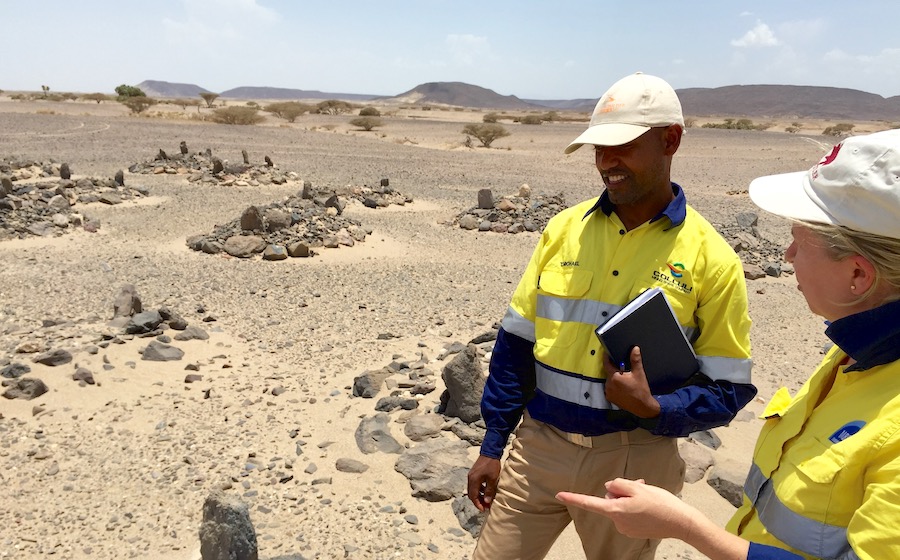
Cecilia Jamasmie | January 19, 2024 | Danakali explored the use of filtered seawater at Colluli.
(Image courtesy of Danakali.)
Danakali (ASX: DNK) warned shareholders on Friday of “predatory activity” by unidentified groups currently approaching investors with “vulture” share purchase offers for their stakes in the company as little as A$0.01 each.
Danakali now has cash reserves of about A$38 million, or about A$0.11 a share. This means shareholders are being offered less than 10% of the underlying value of their shares, it said.
The Australian miner noted in a separate statement it was already exploring a range of new liquidity options for shareholders. These include an off-market share buyback and further distribution of the firm’s cash reserves in the form of a capital return.
The alternatives are part of Danakali’s efforts to get its shares re-listed on the Australian Stock Exchange. Its latest proposal to resume trading was rejected.
“We believe the extended suspension of our shares puts our shareholders in a difficult position and we will now explore other options to achieve additional liquidity while continuing to engage with the ASX,” executive chairman Seamus Cornelius said in a statement.
“From what we can ascertain, most of the activity has originated offshore and potentially beyond the reach of Australian regulators. Any shareholder who has received such an offer should contact Danakali directly,” he noted.
The Perth-based miner said it had taken the first steps to pursuing a new project in Eritrea by applying to an exploration licence covering 1,537 km². Preliminary work at the property shows the area may be prospective for copper and gold, the company said.
Danakali noted it would report back to shareholders on the outcome of the board’s work and talks in coming weeks.
Barrick Gold denies meeting First Quantum in Panama
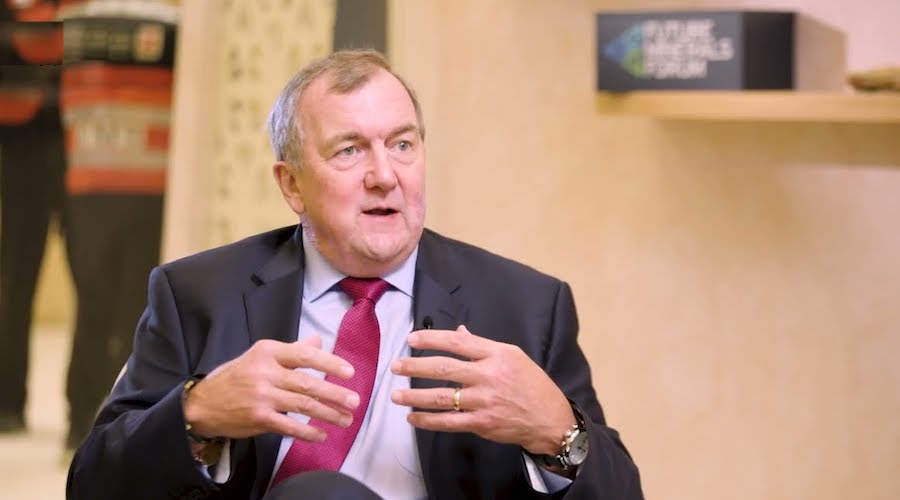
Cecilia Jamasmie | January 19, 2024 Barrick Gold CEO, Mark Bristow. in interview at the Future Minerals Forum 2024. (Screenshot from FMF TV.)
Barrick Gold (TSX: ABX) (NYSE: GOLD) has refuted a report from a Canadian newspaper saying that one of the gold miner’s executives had met with First Quantum (TSX: FM) representatives in Panama last week, to discuss a potential takeover of the troubled copper miner.
The Globe and Mail reported on Thursday that Juana Barceló, president of Barrick’s Pueblo Viejo operations in the Dominican Republic, was recently in Panama, where she met First Quantum’s officials to discuss a possible merger or buyout. The publication cited Ebrahim Asvat, a former Panama government’s adviser, as the source.
Barrick said that Barceló was last in Panama in early 2023 for a mining conference. The spokesperson added Barceló has not been in contact with anyone from the fellow Canadian miner.
The Globe and Mail and Bloomberg have both reported recently that Barrick is gauging support for a potential deal with First Quantum from the target’s top shareholders.
The Vancouver-based miner was forced in November to shut down its giant Cobre Panama copper mine in the Central American country. The operation was its flagship mine and accounted for about 5% of Panama’s GDP and 75% of its exports.
First Quantum has admitted to be considering the sale of some smaller mines, and potentially selling stakes in larger operations, in an attempt to mitigate the financial damage caused by Cobre Panama’s closure.
The company announced this week a major restructuring to conserve cash, which included suspension of dividends. It also offered this week voluntary retirement to more than 1,500 Panamanian employees and is halting its Ravensthorpe nickel operation in Western Australia for the next two years.
Barrick has been expanding into copper as of late with the goal doubling its production of the metal to 1 billion pounds by 2031. It has already committed $2 billion to the development of the Lumwana super pit expansion in Zambia, and has a stake in the Reko Diq mine in Pakistan, expected to be one of world’s 10 largest copper mines when it reaches production in 2028.
The world’s second largest gold miner had previously said it hadn’t made “any formal approach” to buy First Quantum, but chief executive Mark Bristow considers Panama and Zambia, where the copper miner has its main assets, as difficult jurisdictions to operate in.
“I’m a cautious individual,” Bristow said in August. “I might be able to take on these challenging jurisdictions, but it’s because we’re very diligent on this. I’m not going to be reckless.”
Canada gives mineral-rich Arctic region of Nunavut control over its resources
THAT MAKES IT A PROVINCE
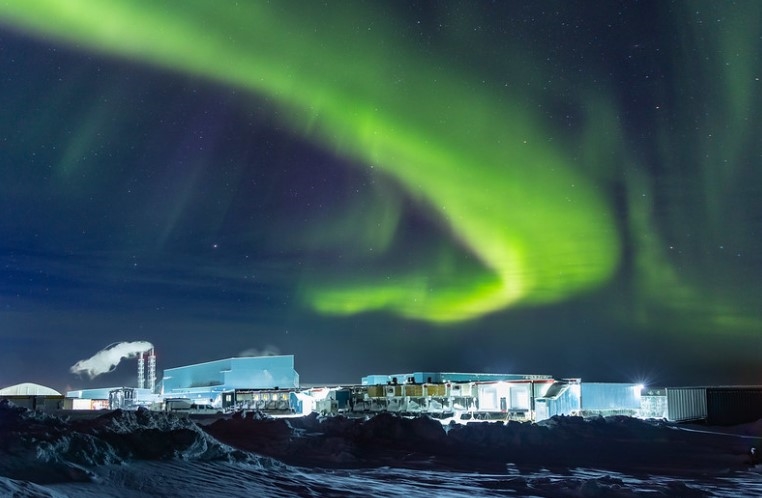
Reuters | January 18, 2024 | The Northern Lights over the Meliadine mine in the Kivalliq district of Nunavut. Agnico Eagle photo
Canada on Thursday formally gave the giant Arctic territory of Nunavut control over its reserves of gold, diamonds, iron, cobalt and rare earth metals, a move that could boost exploration and development.
Prime Minister Justin Trudeau signed a devolution agreement in the Nunavut capital Iqaluit with Premier P.J. Akeeagok, granting the territory the right to collect royalties that would otherwise go to the federal government. Nunavut, a region of growing strategic importance as climate change makes shipping lanes and resources more accessible, covers 810,000 square miles (2.1 million square km) but has a population of only 40,000. An almost complete lack of infrastructure means operating costs are exorbitant.
“We can now bring decision-making about our land and waters home. It means that we, the people most invested in our homeland, will be the ones managing our natural resources,” Akeeagok said in a statement.
Challenges include harsh weather, lack of infrastructure, high costs, major social problems and a largely unskilled and undereducated Inuit aboriginal workforce.
Nunavut, created in 1999, was the only one of Canada’s three northern territories that had not negotiated devolution. Talks on the agreement started in October 2014.
Companies active in Nunavut include Agnico-Eagle Mines, operator of the territory’s only working gold mine.
Nunavut is home to some of the minerals critical for battery production. Canada has pledged billions in incentives to woo companies involved in all levels of the electric vehicle supply chain as the world seeks to cut carbon emissions.
But operating mines can be a complex affair in Nunavut, where some communities are concerned about potential pollution.
In 2022, Ottawa rejected a request by Baffinland Iron Mine Corp – part-owned by ArcelorMittal – to double production at its Mary River iron ore mine in the north of Nunavut, citing the environmental impact.
In 2020, Canada rejected Shandong Gold Mining’s bid for an indebted local gold producer amid concerns about a Chinese state-owned entity operating in the Arctic.
(By Natalie Maerzluft and David Ljunggren; Editing by Jonathan Oatis and Sandra Maler)
Brazil negotiates mining investments with Saudi Arabia – minister
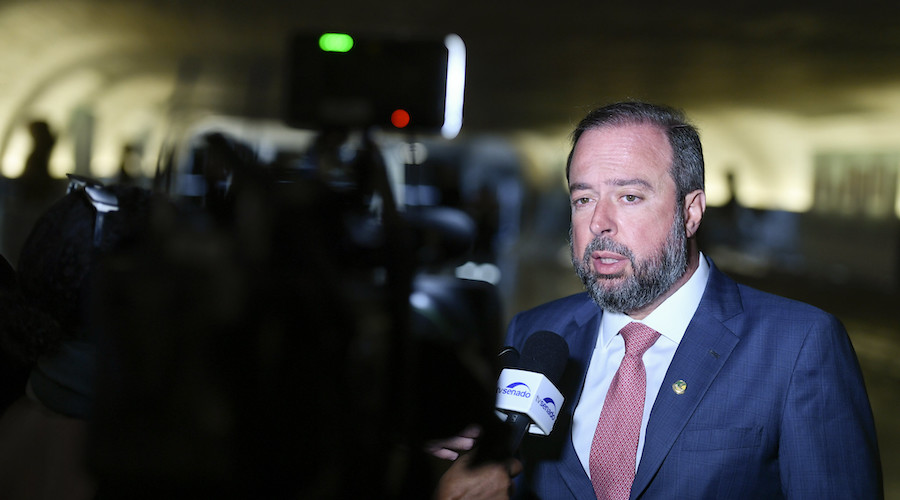
Staff Writer | January 19, 2024 | Alexandre Silveira, Brazil’s Minister of Energy and Mines. (Image by Agência Senado, Flickr.)
Brazil and Saudi Arabia are discussing investments in sustainable mining and the energy transition, according to Brazilian Minister of Mines and Energy, Alexandre Silveira.
Attending the World Economic Forum in Davos, Switzerland, Silveira met with the Saudi ministers of investments, Khalid Al-Falih, and industry and mining, Bandar Alkhorayef.
“Last night, I had a bilateral meeting with the minister of investment and the minister of mining from Saudi Arabia to discuss essential investments for Brazil in energy transition, as this is our great vocation,” Silveira told CNN. Silveira said he had discussed the energy transition “vigorously” with the Saudis, and representatives from the Kingdom expressed their interest in investing in the energy and mining sectors in Brazil.
“Brazil is recognized for its mineral potential, our territorial expanse, natural wealth, and critical minerals. Rare earths are extremely crucial for energy transition,” he noted.
In 2023, Manara Minerals, a joint venture between the Saudi state mining company Ma’aden and the Public Investment Fund, acquired a 10% stake in Vale Base Metals, the basic metals subsidiary of the Brazilian company, for approximately $3 billion.
Saudi Arabia recently signed memorandums of understanding for mining collaborations with Egypt, Russia, Morocco and the Democratic Republic of Congo.
The country also announced a $182 million mineral exploration incentive program as part of efforts to build an economy that does not rely mostly on oil. Saudi Arabia has vast reserves of phosphate, gold, copper and bauxite.