NUKE NEWZ
Global survey finds high public support for nuclear
19 January 2024
One-and-a-half times more people support the use of nuclear energy than oppose it, according to a multinational public opinion poll conducted by market research firm Savanta on behalf of energy consultancy Radiant Energy Group.
.jpg?ext=.jpg) (Image: Radiant Energy)
(Image: Radiant Energy)The Public Attitudes toward Clean Energy (PACE) index is described as "the world's largest publicly-released international study on what people think about nuclear energy", with data collected from more than 20,000 respondents from 20 countries.
"The PACE index was set up to track support/opposition for clean energy sources, what drives those attitudes, and how institutions can better cater to what the public wants," Radiant Energy said.
The survey found that, across the 20 countries surveyed, 28% of respondents oppose the use of nuclear energy while 46% support it. Of the 20 countries surveyed, 17 have net support for nuclear energy's use. Support was found to be more than three times higher than opposition in the world's two most populated countries, China and India.
Preference for nuclear energy was found to be larger than for onshore wind, biomass from trees, or gas with carbon capture and storage. Twenty five percent of those surveyed said their country should focus on nuclear energy, behind only the 33% preference for large-scale solar farms.
Nuclear is seen as the most reliable thermal source of energy, with 66% of respondents saying nuclear is reliable. The survey found that people who view nuclear energy as reliable have over four times more support for its use.
However more than half (53%) of respondents thought nuclear energy created a fair amount or a great deal of greenhouse gas emissions.
The cost of nuclear is seen as low by more people than the cost of wind or solar in countries that have previously phased out nuclear’s use. In Germany, Japan, South Korea and Sweden - countries that have had the largest politically-mandated nuclear phase-outs - nuclear energy is the most positively viewed technology for reducing energy bills.
Globally, 79% of respondents said they are concerned about nuclear safety. Within this group, a majority of 40% nonetheless support the use of nuclear energy while 33% oppose it.
"While support/opposition metrics provide a view of public sentiment they are a bad proxy for how the public wants governments to act," Radiant Energy noted. "Within the group of respondents who say they tend to oppose nuclear energy's use, 54% do nonetheless support government policy to keep operating existing nuclear plants and 17% wish to build more nuclear plants."
Within nuclear-powered countries, more than three times more respondents want to keep using nuclear power than phase it out. Within the four countries without existing commercial reactors, twice as many respondents want to construct new nuclear power plants rather than ban their use.
"This year may have marked a turning point for the nuclear energy industry," said Richard Ollington, Partner at Radiant Energy. "The COP28 pledge to triple global nuclear capacity by 2050 meets the public’s overwhelming demand for new nuclear to be built. The nuclear industry, as well as the governments and banks that support it, should carefully listen to what the public wants and start delivering beyond what the public expects."
Radiant Energy Founder and CEO Mark Nelson added: "Governments that abandon nuclear energy are now facing a backlash from their voting citizens. It is striking that the four countries with the biggest nuclear phase-outs are now countries where the public overwhelmingly sees nuclear as being low cost, more so than even wind and solar."
Savanta questioned 20,122 adults from 20 countries between 17 October and 14 November last year. The survey was conducted online. The countries selected include all G7 and BRICS countries, the world's top 14 countries by 2022 nuclear electricity generation, the UAE, and four countries without nuclear electricity generation from across the world: Australia, Italy, Norway and the Philippines. Eighty five percent of the global population powered by nuclear were represented in the survey.
STUK requests extension to repository review deadline
19 January 2024
Finland's Radiation and Nuclear Safety Authority (STUK) has requested the deadline for its opinion on Posiva Oy's operating licence application for the world's first used fuel repository to be extended until the end of 2024. In September last year, it said it would not complete its review by the end of 2023 as originally planned.
.jpg?ext=.jpg) A rendering of the underground used fuel repository at Olkiluoto (Image: Posiva)
A rendering of the underground used fuel repository at Olkiluoto (Image: Posiva)
Radioactive waste management company Posiva submitted its application, together with related information, to the Ministry of Economic Affairs and Employment (TEM) on 30 December 2021 for an operating licence for the used fuel encapsulation plant and final disposal facility currently under construction at Olkiluoto. The repository is expected to begin operations in the mid-2020s. Posiva is applying for an operating licence for a period from March 2024 to the end of 2070.
The government will make the final decision on Posiva's application, but a positive opinion by STUK is required beforehand. The regulator began its review in May 2022 after concluding Posiva had provided sufficient material. The ministry had requested STUK's opinion on the application by the end of 2023.
However, STUK announced in September that its safety assessment and opinion on the application was taking longer than expected and would not be completed by that deadline.
"Since the processing of the operating licence application dossier is still pending at STUK, STUK has requested TEM extend the deadline of the statement to the end of 2024," STUK has now said.
In its report for the last four months of 2023, STUK says the work "is proceeding without major problems, but at a slightly slower pace than previously anticipated". It added: "STUK has not always been able to make its assessments on the basis of the first pieces of data submitted by Posiva, so Posiva has had to update that data. As a result, the processing of the dossier has taken longer than anticipated."
STUK noted that in addition to preparing the safety assessment, it has also continued to supervise Posiva and the work it has performed. Items supervised include the installation of equipment at the above-ground encapsulation plant for used nuclear fuel, test runs of the equipment and the test run plans, as well as the ongoing rock construction work in the underground final disposal locations. It is also monitoring and inspecting the security arrangements of Posiva's final disposal facility, the safety culture of the organisation and Posiva's readiness to start final disposal operations.
The government granted Posiva a construction licence for the project in November 2015 and construction work on the repository started in December 2016. Once it receives the operating licence, Posiva can start the final disposal of the used fuel generated from the operation of TVO's Olkiluoto and Fortum's Loviisa nuclear power plants. The operation will last for about 100 years before the repository is closed.
Concreting completed of Rooppur 2 outer containment shell
19 January 2024
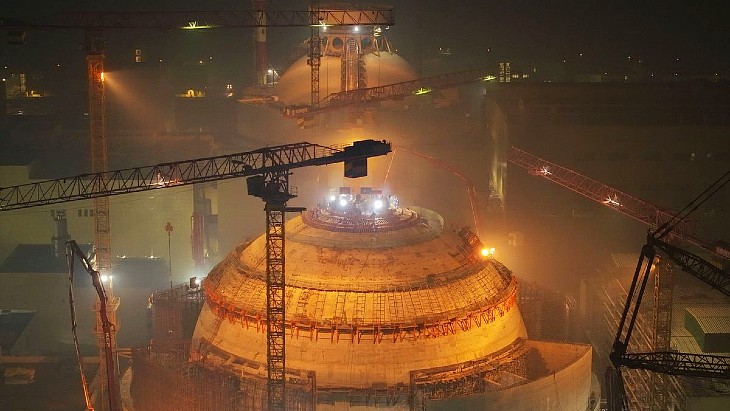
The second unit at Bangladesh's first nuclear power plant has had concreting completed on its outer containment shell, in a process which took 122 days.
 (Image: Rosatom)
Seventy five people took part in the work, including 60 from Bangladesh, with 130 cubic metres of concrete required for the last tier - concreting the entire dome on the 46-metre diameter outer containment, with its 50-centimetre-thick shell, took a total of 1233 cubic metres. Rosatom said the process was cut by five days by combining the pouring of the last two tiers.
The outer containment shell is a reinforced concrete structure that protects from external threats such as an earthquake, tsunami or hurricane. The inner containment around the reactor building was installed in June 2022 and concreted in May 2023.
Alexey Deriy, vice president and project director for the construction of the Rooppur NPP, said: "Completion of concreting of the outer containment shell of the reactor building of the second power unit allows us to begin installing the deflector of the passive heat removal system. We have to prepare the embedded parts for installation, revise the sling equipment and collect the necessary documentation for lifting the deflector of the passive heat removal system using a crane."
Rosatom in February 2011 signed an agreement for two reactors to be built at Rooppur for the Bangladesh Atomic Energy Commission. The initial contract for the project, worth USD12.65 billion, was signed in December 2015. The Rooppur plant, 160 kilometres from the capital Dhaka, will feature two Russian VVER-1200 reactors. Construction of the first unit began in November 2017 and it is scheduled to be commissioned in 2024. Construction of the second unit began in July 2018. They have an initial life-cycle of 60 years, with a further 20-year extension possible.
The first unit reached the same stage - completing the outer containment shell concreting - in March 2023, and Bangladesh officially became a member of the international 'club' of nuclear countries in October when the first fuel for the plant was delivered to the Rooppur site.
US Administration signs off on federal funding for Diablo Canyon
19 January 2024
The US Administration has signed the credit award and payment agreement finalising the USD1.1 billion in credit payments awarded under the Civil Nuclear Credit (CNC) programme to help keep the Diablo Canyon nuclear power plant in operation.
.jpg?ext=.jpg) Diablo Canyon (Image: US Nuclear Regulatory Commission/PG&E)
Diablo Canyon (Image: US Nuclear Regulatory Commission/PG&E)
The payments are through the Civil Nuclear Credit (CNC) programme, a USD6 billion strategic investment under the Bipartisan Infrastructure Law to help keep the USA's existing reactor fleet in operation. The Pacific Gas and Electric Company (PG&E) plant was conditionally awarded the credit in November 2022.
"Preserving the nation's nuclear fleet is critical not only to reaching America's clean energy goals, but also to ensuring that homes and businesses across the country have reliable energy," said Maria Robinson, director of the US Department of Energy's Grid Deployment Office. The announcement "demonstrates the Administration's commitment to domestic nuclear energy by preserving existing generation, while we continue to support a stronger nuclear power industry", she added.
The payments will be made in instalments over four years of operation from 2023, with the amounts adjusted to reflect factors including the actual costs of keeping the two-unit plant in operation. The first payment, to be made in 2025, will be based on the operation of the plant in 2023 and 2024.
While nuclear power currently provides nearly 50% of the USA's carbon-free electricity, shifting energy markets and other economic factors have resulted in the early closures of some 13 of the country's commercial reactors since 2012. The CNC programme - part of the Bipartisan Infrastructure Law signed by President Joe Biden in November 2021 - aims to address those challenges by allocating credits to "certified" reactors which can show that they are projected to close for economic reasons and that closure will lead to a rise in air pollutants and carbon emissions.
PG&E had agreed in 2016 that the two-unit Diablo Canyon plant would close at the end of its current licences - in 2024 for unit 1 and 2025 for unit 2. At that time, it was thought that the plant's output would no longer be required as California focused on an energy policy centred on efficiency, renewables and storage. However, in September 2022 - as California's energy grid saw its highest-ever peak demand during a record-breaking heatwave - the state passed a law allowing the two nuclear units that provide 9% of California's power generation to continue operation.
Researched and written by World Nuclear News