Saturday, January 20, 2024

Judge Blocks JetBlue, Spirit Merger

This ruling is the latest in the drawn-out JetBlue-Spirit saga.

By John McDermott
January 18, 2024

JetBlue and Spirit aircraft. [Photo: AirlineGeeks | William Derrickson]

In a big win for President Joe Biden’s Justice Department, a federal judge has blocked the merger between JetBlue Airways and Spirit Airlines. The Justice Department sued to block the merger soon after it was announced, arguing that it was anticompetitive and would drive up prices.

The $3.8 billion merger would have resulted in the country’s fifth-largest airline. JetBlue would have entirely absorbed Spirit, rebranding its airplanes and using its slots across the country for rapid expansion.

Judge’s Findings and the Clayton Act


“In light of the foregoing Findings of Fact and Conclusions of Law, it is hereby ordered that the Defendant Airlines, their agents, servants, employees, and all persons acting in concert with either of them, are permanently enjoined from executing the proposed merger as agreed on July 28, 2022,” wrote Judge William Young on Tuesday.

Judge Young found this merger would violate the Clayton Antitrust Act of 1914, which prohibits price discrimination and focuses greatly on mergers and acquisitions. Specifically, Judge Young mentions in his 113-page decision a section that prohibits mergers and acquisitions “where in any line of commerce or in any activity affecting commerce in any section of the country, the effect of such acquisition may be substantially to lessen competition” in an effort to prevent a trend towards monopoly “before the customer’s alternatives disappear.”


“The parties need not be each other’s closest competitors to raise a threat to competition; being close competitors is enough for an acquisition to result in upward pricing pressure,” Young wrote in his decision. “The loss of Spirit’s influence on JetBlue as a head-to-head competitor would likely result in less competition to both discipline the prices and spur the innovation of JetBlue as a smaller, maverick -– more competitive — market participant. “

The Importance of Independent Brands

For its own part, Spirit has been flying for decades. Despite having a somewhat volatile reputation with the American public, Spirit has profited greatly by selling rock-bottom base fares and charging extra for bags, drinks, snacks, and even, in some cases, checking in with an agent at the airport. Spirit competes with Frontier Airlines, the other major ultra-low-cost carrier in the United States.

“The loss of Spirit’s innovation, in particular, would be a loss for all consumers in the national scheduled airline passenger market. A reduction in product innovation resulting from an acquisition is a cognizable harm to competition,” Judge Young wrote in his decision.

“In eliminating Spirit from the marketplace, the proposed transaction would, by definition, dampen Spirit’s disruptive force,” Young continued.

A Spirit Airlines Airbus A319 prepares for landing. [Photo: AirlineGeeks | William Derrickson]

It seemed for a moment that there would have been a way for JetBlue to make some concessions – namely giving up lucrative slots on the East Coast – to make the deal happen; those slots would have most likely gone to Frontier. In December, Judge Young said that he would entertain a deal that saw JetBlue making concessions to allow the merger but that he was at the time unsure how much of its current operation JetBlue would need to sacrifice for the merger.

Still, it seems that the major sticking point for Judge Young was the reduction of choice in the American aviation landscape. Young wrote that the elimination of product options that consumers value “is a cognizable harm to competition.”

Ultimately, Young decided, “The Government has demonstrated that consumers value Spirit flights as a unique, economical product option. The removal of Spirit as an option for consumers, therefore, would constitute a cognizable harm.”

JetBlue’s Rebuttal

While Young says that JetBlue can innovate better because of Spirit’s competition, JetBlue says that this deal is necessary for it to have the aircraft and slots to challenge the established big four carriers – American, Delta, United, and Southwest – which collectively control 80% of the US airline market. Without this merger, per JetBlue, customers suffer from a lack of choice more than they would from price increases if the deal goes through.

JetBlue also argued that, though losing Spirit would cause price increases for a time, inevitably another new carrier would replace it and bring costs back to where they once were. JetBlue further argued that the potential entry of new competitors into the market may be considered when a judge determines whether a merger will substantially lessen competition, adding that they need not prove that a competitor will enter the same markets Spirit would leave or when for their argument to be considered.

A JetBlue Airbus A320 climbing out from Boston. [Photo: AirlineGeeks | William Derrickson]

There is a question, though, whether such an entry would be “timely” enough to offset the impacts of Spirit’s disappearance from the market. It often takes years for new airlines to start up from nothing to a full airline, and most airline startups do not succeed long-term in the U.S.

That does not mean that such is impossible. Avelo Airlines and Breeze Airways, two low-cost airlines that focus on serving underrepresented cities with nonstop routes to popular destinations, launched during the COVID-19 pandemic and are on the verge of turning their first profits.

Still, though, both carriers fill a niche market with no previous competition that allows them an advantage. Any replacement for Spirit would need to compete directly with Frontier, Allegiant, Sun Country, and others before it comes close to being the same size and having the same loyalty that Spirit does, making its path to growth difficult.

Perhaps Spirit’s disappearance would allow innovation from other airlines already in business. Allegiant’s business model and route structure, though close, does not directly match Spirit’s.

JetBlue’s Recent Snubs


This is not the first time that JetBlue has lost out on a potentially lucrative merger. Alaska beat it to buying Virgin America, another carrier that would have solved JetBlue’s inability to get a foothold on the West Coast. Though JetBlue has a handful of routes to the U.S. West Coast and Europe, a large majority of its flights are concentrated on the East Coast, and all outside of that region connect to the East Coast, meaning the airline cannot compete meaningfully with any other company apart from eastern routes.

This is also not the first time in recent months that the Justice Department has come for JetBlue. The carrier’s codeshare with American Airlines, dubbed the Northeast Alliance, was struck down in late 2023 because, once again, the Biden administration claimed it was anticompetitive. JetBlue decided not to appeal the decision to focus on its deal with Spirit, meaning the airline is now out of two lucrative deals within months.

The Merger’s Legal Future


At the time of writing, neither JetBlue nor Spirit has commented on Tuesday’s decision. What impact the loss of both of these deals will have on JetBlue’s future is unclear.

JetBlue does have an additional incentive to appeal: it will owe Spirit $400 million if the deal cannot clear regulatory hurdles. Such a payment would constitute a big break for the ultra-low-cost carrier, which in recent months has been hit hard by economic slowdown.


The Justice Department has focused greatly on antitrust cases under President Joe Biden, taking aim at other companies such as Amazon and Google. This prioritization of taking down big brands is likely the fundamental reason why the Justice Department wanted this case to go to trial instead of settling out of court, which both JetBlue and Spirit were ready to do.

“JetBlue’s plan would eliminate the unique competition that Spirit provides—and about half of all ultra-low-cost airline seats in the industry—and leave tens of millions of travelers to face higher fares and fewer options,” the Justice Department alleged in its lawsuit last March.

Past and Future Airline Mergers


The Justice Department does not have much precedent in the 21st century for taking airline merger cases to trial; in fact the federal government has not rejected an airline merger in 20 years. The merger between American Airlines and US Airways in 2013 narrowly avoided trial. Southwest and AirTran also merged in 2013 without one, as did United and Continental in 2010 and Delta and Northwest in 2008.

This decision calls into question whether the original merger Spirit had with Frontier would have gone through either. In both cases, there would have only been one major ultra-low-cost airline remaining in the U.S. market. Spirit would have disappeared from some key destinations, and its competition would have disappeared in other markets where it was the only challenger to mainline companies, thus increasing prices.


Equally in question now is the future of a proposed merger between Alaska Airlines and Hawaiian Airlines. The Justice Department would most likely argue for price increases caused by that deal, but the fact that the two brands would remain separate – and that their route networks are largely complimentary of each other – means that the number of airlines in the U.S. would not change, at least publicly.

That allows Alaska to make a stronger case against any anticompetitive argument that the Justice Department could make based on brand loyalty, which Judge Young specifically mentioned in the JetBlue/Spirit case. With independent brands still in operation, Alaska would allow passengers to continue having at least the illusion of choice, not to mention many in the traveling public might not notice any difference once Hawaiian was purchased and would continue flying as normal.

A stronger example is the international market – Hawaiian would continue competing with international and domestic brands alike, and it would maintain brand loyalty from both Hawaiian natives who have known the brand for decades as well as international vacationers who are either already familiar or who will make the correlation between the name of the state and the airline.

Hawaiian said immediately after its proposed deal with Alaska that it is open to other offers. JetBlue has yet to make any statement about Hawaiian, and it is unlikely that it will. A merger with Spirit makes sense for JetBlue because the two airlines have nearly identical fleet commonality. Spirit also has the exact slots that would allow JetBlue to expand in a way that makes sense.


However, adding widebody Airbus A330s, aging Boeing 717s, and a trans-Pacific route network does not match the way that JetBlue has been expanding in recent years. Hawaiian also does not have the number of airport slots on the West Coast that would be beneficial to JetBlue.

Editor’s Note: This article first appeared on AirlineGeeks.com.


John McDermott is a student at Northwestern University. He is also a student pilot with hopes of flying for the airlines. A self-proclaimed "avgeek," John will rave about aviation at length to whoever will listen, and he is keen to call out any airplane he sees, whether or not anyone around him cares about flying at all. John previously worked as a Journalist and Editor-In-Chief at Aeronautics Online Aviation News and Media. In his spare time, John enjoys running, photography, and watching planes approach Chicago O'Hare from over Lake Michigan.
What We Can Learn from Ill-Fated Titan Submersible

Its service life limit unfortunately appears to have been only about a day or two.
January 19, 2024

Until the investigation of the accident is completed, we will not be certain why the 'Titan' submersible failed in June 2023. [iStock]

After the implosion of the submersible Titan in June, my friend Howard Morland wrote to me: “Cameron said it was ‘insidious’ the way composite carbon fiber materials ‘fail over time.’ This statement made me think of Melmoth 2. Any relevance?”

(Cameron being James Cameron, the film director and undersea explorer who was an early and outspoken critic of the Titan project; Melmoth 2 being my homebuilt airplane, whose wing structure consists mainly of carbon fiber composites. An unnamed third party in the drama is Stockton Rush, the designer of Titan and, like me, a self-taught amateur engineer.)

Until the investigation of the accident is completed, we will not be certain why the submersible failed. But in case others wondered whether Cameron’s comments apply to carbon-fiber composites in aircraft…

Deep-sea submersibles are normally made of metal; carbon fiber construction was an innovation. Its high strength-to-weight ratio looked attractive for a craft that was expected to be very strong and yet able to float.

Carbon fibers are filaments two to four ten-thousandths of an inch in diameter—closer to spider web than human hair. They have a higher tensile strength than the strongest steel—around 500,000 pounds per square inch—and a compressive strength about a quarter of that.

You may wonder how such a slender filament can have compressive strength at all. Isn’t that like talking about the compressive strength of a rope? But if you take a sufficiently small segment of a filament, say only five or 10 times as long as it is thick, it is no longer a rope but a rod. And a rod can obviously support some amount of compressive load—that is, pressure applied to opposite ends.

We know from experience that if you push too hard on the ends of a long, skinny pole, it buckles. A 6-inch-long piece of uncooked spaghetti will bend outward and break if you press on its ends. A half-inch-long piece will hurt your fingers, but it won’t break.

You could make the longer strand carry a greater load if you tied it to a rigid support every half inch, so that it couldn’t buckle. This is the principle on which fine fibers in an epoxy matrix carry loads. Fibers are glued together to make a thick column within which each filament is continuously stabilized by all the others.

Compressive members are critical because if composite structures are going to fail, they are much more likely to do so in compression than in tension. Compressive components in airplanes, such as the upper portions of wing spars, are made of bundles of parallel fibers, not of the woven stuff found in fancy sporting goods. For the wing spars in Melmoth 2, I bonded multiple precured strips of unidirectional material that had been lab tested and found to fail in compression at 60,000 pounds per square inch. (Composites laid up in my garage and cured at room temperature do not attain the theoretical maximum strength of the material.) The way they would fail is significant: The surface fibers would pop out of the laminate. In other words, the force tending to bow the fibers outward exceeded the ability of the epoxy to hold them in.


This can happen within the laminate as well. Any imperfection—in epoxy, a tiny void, a speck of foreign material, a kink in a fiber bundle—can trigger “microbuckling” and minute delamination that grow with repeated loading. When Cameron spoke of carbon-fiber laminates failing insidiously over time, he was referring to this gradual accumulation of small cracks. Unlike cracks in metals, which usually appear on the surface and can be detected by visual or dye penetrant inspection, these are buried and detectable only when they have become quite large and then only by special testing equipment.

Titan’s pressure vessel, designed to withstand the 5,500-pounds-per-square-inch pressure where the Titanic wreckage rests, was an eight-foot long, 65-inch, carbon-fiber cylinder with hemispherical titanium end caps. At depth, each cap pressed on the cylinder’s ends with a force of around 18 million pounds. The aggregate pressure on the cylinder’s reportedly 5-inch-thick walls was more than 100 million pounds. If you assume a compressive strength of 125,000 psi and ideal fiber orientations, the hull would have had, when new, a factor of safety of around two. Because fiber orientations were probably not ideal, however, it was most likely lower than that, say 1.5 or even less.

Airplanes, too, use a safety factor of 1.5 over and above their highest anticipated aerodynamic loading. However, airplanes seldom, if ever, actually experience extreme loads, and if they do, it is only for very brief periods. A composite submersible, on the other hand, experiences extreme loading on every descent. Furthermore, it spends long periods at that loading, during which epoxy-to-fiber bonds can progressively deform and break. Indeed, people who had made previous dives in Rush’s composite submersibles—he designed several—report having heard cracking sounds, which must have concentrated their attention wonderfully.

An airplane undergoes a vast amount of strength and flight testing before being certificated and put on the market. The performance of its structure continues to be monitored, and the normally large number of examples in service gives the individual owner or passenger the comfort of knowing that if a problem occurs, it will probably happen to someone else first.


Titan was—and always would be—an experimental prototype. Notoriously, it was unclassed—the nautical analogue of uncertificated—because its creator, attempting to wrest the moral high ground from his critics, insisted that outside scrutiny puts a brake on the precious spirit of innovation.

Indeed, he was right. It does. Burt Rutan waxed eloquent on the unfair burden the required protection of desert tortoises placed upon the development of SpaceShipOne. But a brake is needed. Innovators are often people who are ambitious and headstrong, qualities that give them energy but may also blind them to the ethical implications of their actions. And this was not just innovation for its own sake. Rush was selling tickets.

Titan had made several previous deep dives and was evidently strong enough when it was new. But it apparently deteriorated with each prolonged imposition of enormous pressure. Composite airplanes, using similar materials and analogous construction techniques, are designed in the context of a huge accumulation of statistical data on loads encountered in flight—their character, strength, and duration—and on the behavior of composites in the flight environment. Composite airframes may have a service life limit, but none has yet been firmly established. Indications are that if one were established, it would be in the tens of thousands of hours.

Although the sample size falls short of statistical significance, Titan’s service life limit appears to have been more like a day or two.

This column first appeared in the September 2023/Issue 941 of FLYING’s print edition.


Peter Garrison
Peter Garrison taught himself to use a slide rule and tin snips, built an airplane in his backyard, and flew it to Japan. He began contributing to FLYING in 1968, and he continues to share his columns, "Technicalities" and "Aftermath," with FLYING readers
.


Union Pacific drives down decision-making to pump up service performance


Decisions need to be made at the local field level — and the lower the level, the better, says UP leader Jim Vena.
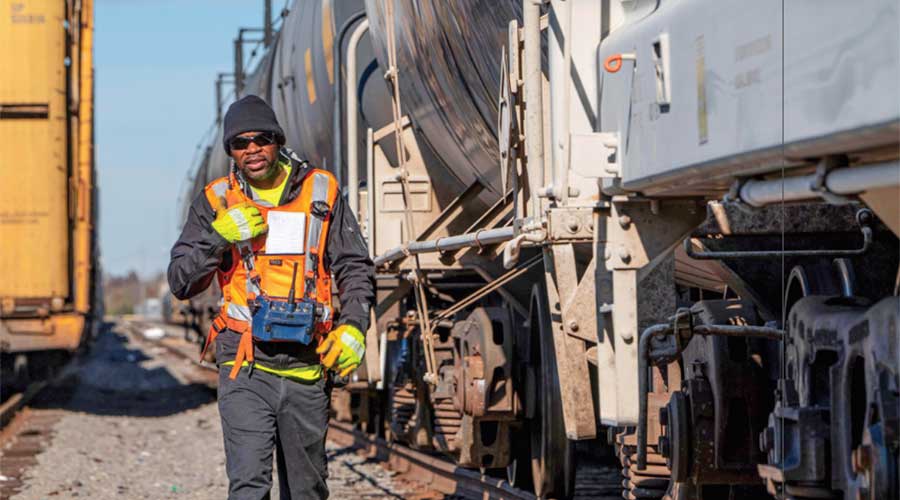
Photo – Union Pacific Railroad


LONG READ

By Jeff Stagl, Managing Editor

It’s been quite a whirlwind for Union Pacific Railroad over the past year-plus. There have been a few highs, but many lows.

In December 2022, the Surface Transportation Board held a hearing to examine why UP placed embargoes — or short-term limits — on shipments to try and clear up network congestion, a tactic the STB claimed the railroad used more than other Class Is. UP’s embargoes shot up from five in 2017 to more than 1,000 in 2022, and the STB received numerous complaints from shippers about associated supply-chain problems.

Shippers, regulators and other UP stakeholders had other major gripes with the Class I about its lagging financial performance and poor state of service for a prolonged period. So much so, a major UP shareholder early last year demanded the company replace President and CEO Lance Fritz.

Leaders of Soroban Capital Partners LP — a hedge fund that holds a $1.6 billion stake in the railroad — sent a letter to UP’s board stressing that the Class I ranked the worst among the largest railroads in safety, cost management, volume, revenue and earnings growth, and total shareholder return.

“These are highly underwhelming results despite UP having the premier railroad franchise in North America,” wrote Soroban Capital Managing Partner Eric Mandelblatt.

Members of UP’s board ultimately agreed, and in March 2023 reached an agreement with Fritz to step down as chairman, president and CEO once a new leader was installed. The board later settled on Jim Vena as the next leader.

A more than 40-year rail industry veteran, Vena previously was UP’s chief operating officer from 2019 to 2020 and a senior adviser to Fritz in 2021. Prior to that, Vena served CN for more than four decades in various roles, including executive vice president and COO. A longtime railroader, he was a brakeman, conductor, locomotive engineer, trainmaster and superintendent prior to becoming an executive.

Soroban Capital backed Vena, 65, as a prime CEO candidate, as did other rail industry stakeholders and observers. In a July 2023 note to clients, Susquehanna International Group LLP analyst Bascome Majors hailed the choice.

“We believe Jim Vena was the best candidate available to get the trains running consistently on time at Union Pacific, and see a potential virtuous cycle ahead of improving service levels, volume growth and profit growth,” Majors wrote.

Fritz officially stepped down Aug. 11, 2023, and Vena became UP’s CEO three days later. Before he accepted the position, Vena said he mulled the choice of climbing Asia’s K2 — the world’s second-highest mountain — as a retired industry veteran or returning to the rail exec world. He opted to climb a big mountain of another sort by rejoining UP.

The mission: Make UP great again

When he departed the railroad as COO in 2021, he felt good about how UP was performing, Vena says. He was recruited to help the Class I transition to a precision scheduled railroading operating model.

But he found it discouraging that soon afterward, the railroad’s performance deteriorated. That prompted his decision to lead a turnaround at UP.

“This is a challenge. Almost everything in life is a challenge,” says Vena.

He touts UP as a great franchise built over the past 161 years that has a great customer base, network and access. Now, it’s time to build on the company’s rich history and legacy.

“I want to be a good custodian of the railroad for the next generation,” says Vena. “So how do we write the next chapter?”

He’s spent the past four-plus months trying to answer that question. Vena believes he’s set a clear vision for UP: become the best performer in safety and service and reach operational excellence to spur growth.

The railroad can attain the best safety record in the industry, build a reputation for providing superior service, grow consistently and achieve optimal efficiency if all UPers are more in lockstep, Vena believes.

To reach that in-sync stage, the railroad needs to distance itself from being a top-down, command-and-control organization and become the reverse: a down-top company with much less bureaucracy that encourages decision-making at the ground level to reduce layers, expand spans of control and speed actions.

“I want decisions to be made at the local level — and the lower the level, the better,” says Vena.

Such a cultural reset can create a more solid foundation for how UPers approach work while the railroad continues to face a tough economic landscape dotted with high inflation, lower volume and rising costs.

Implementing such monumental change is extremely hard, but UP has a high number of “bright, resilient and honorable people” who can help pull it off, Vena believes. Although the transformation will require sacrifices — such as recent management cuts — he’s convinced UP will become a leaner, faster-acting and more resilient company as a result.

Roll with the ebbs, flows

Since there wasn’t a one-size-fits-all approach suited for changing every aspect of the organization, each department late last year reviewed how it performed work and how to reprioritize it with a better focus on employees and resources. Department heads factored in anticipated attrition and created a buffer of resources to handle the expected ebbs and flows and cyclical nature of the railroad’s business.

Some departments required only small tweaks while others instituted significant changes. As a result, the number of management jobs was reduced by about 5%. Some employees were asked to contribute to the railroad in different ways or were provided the opportunity to apply for craft positions.

Ultimately, most workers are highly vested in UP and want to be part of what the company is trying to accomplish, says Vena.

“I see the pride employees have when I’m out in the field, how they wear a hat or shirt with the UP logo,” he says.

The people in the field are at the crux of what it takes to run the railroad: If everyone at UP’s Omaha, Nebraska, headquarters took off for 24 to 48 hours, the railroad would continue to operate just fine, Vena stresses.

Since people in the field predominantly will execute change, sometimes their decisions will turn out to be errors. That’s to be expected and it’s OK to make mistakes because vast improvements sometimes require the courage to make hard decisions, Vena says.

“No one is perfect — mistakes will be made,” he says. “I have made mistakes.”

All in it to win it

To help ensure each of UP’s 30,000 employees gains a better understanding of their role in the company achieving the objectives — and what those goals are — the railroad is conducting a new training program that targets the entire workforce. Called “How We Win Together,” the program is conducted in small groups and takes a couple of hours to complete.

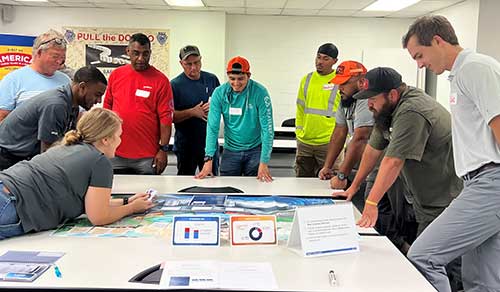
The interactive program is played like a game using a hand-drawn “map” on a table. Employees talk about the objectives, implications, challenges and potential outcomes of simulated train movements on the map, which helps explain organizational goals.

The program helps get employees rooted in the pride and history of UP, and educates them about the new mission, says Beth Whited, who was promoted from EVP of sustainability and strategy and chief human resources officer to president when Vena became CEO. A person laying rail in Arizona wouldn’t necessarily know how the company makes money, Whited adds.

The Class I plans to conduct a new interactive “How We Win Together” training program for all 30,000 employees.
Union Pacific Railroad

“The program helps to explain the strategy and the whys, and to build knowledge in the field,” she says. “It shows what the barriers are and helps to build a collective mindset.”

The program is very low-tech by design — it isn’t like a school film during which “a lot of students zone out,” says Whited.

So far, about 3,000 employees have completed the How We Win Together program and training will continue throughout 2024.

Another way employees can learn more about the company’s vision, strategy and objectives: a quarterly town hall meeting. The most recent one was held Dec. 19.

The meetings enable Vena and senior executives to provide details about organizational developments and field employees’ questions. The questions are not orchestrated or screened in advance, says Vena.

“I get them in the order they come in,” he says.

He can’t necessarily answer them all — there might be a question about whether restrooms will be upgraded at a certain yard — but he tries.

At quarterly town hall meetings, employees can pose questions to senior execs. Shown from left: Vena, Whited, Jalali, Hamann, Rocker and Gehringer fielded questions at a town hall meeting held last year.
Union Pacific Railroad

A high-energy person who tends to light up a room, Vena helps invigorate the town hall meetings, says Whited. The get-togethers help satisfy employees’ need for accurate and up-to-date information about the company, she adds.

“We are trying to be super transparent. We want to make work fun and fulfilling,” says Whited. “How someone measures and evaluates a workday is different, so everyone’s takeaway is different.”

A safer solution

Yet when it comes to improving safety — another top company goal — everyone needs to be on the same page.

To that end, UP instituted a new safety policy on Jan. 1. The policy targets potentially dangerous actions that occur more frequently and have the biggest impacts on the railroad, says UP EVP of Operations Eric Gehringer. It primarily focuses on six actions, such as protecting shoves and maintaining a proper and safe space between rail cars.

“Sometimes wind can move cars,” says Gehringer.

Policy enforcement involves software programs that communicate expectations, document actions, provide coaching and issue compliance reports.

UP also aims to improve safety — as well as boost productivity and efficiency — by conducting virtual engineer ride-alongs. Cameras in locomotive cabs are used by supervisors in office locations to provide live training sessions.

“It helps provide immediate feedback to engineers,” says EVP and Chief Information Officer Rahul Jalali, adding that the ride-alongs also help with developing and sharing best practices.

Technologies will be counted on, as well, to help boost safety and improve operations. Among them: 4,000 wayside detectors that provide 20 million data points each day, such as bearing temperatures; and autonomous track inspection systems on both locomotives and cars that can detect many deviations.

“Then we can take actions to stay well ahead of any failure,” says Gehringer.

UP also is working with dispatchers to digitize more of their duties/responsibilities. And more efforts are underway to digitize other areas, says Jalali.

For example, in the premium/intermodal sector of UP’s business, precision gate technology was installed at all major ramps as of November 2023. The gate system reduces the time trucks wait to get in or out of ramps — in some instances from 15 or several minutes to one minute or 30 seconds, says Jalali.

Truck drivers also can use the UPGo application on their smartphones to receive specific driving instructions and better navigate a large intermodal terminal.

“Some ramps have 6,000 parking spaces, so it’s like finding a needle in a haystack,” says Gehringer.

“I want to be a good custodian of the railroad for the next generation. So how do we write the next chapter?”
— Jim Vena, CEO

Invested in intermodal

In terms of UP’s business growth strategy, intermodal remains a key component. That’s why the railroad continues to invest aggressively in the sector, says EVP of Marketing and Sales Kenny Rocker.

The Class I is adding lanes to its Lance M. Fritz Inland Empire Intermodal Terminal in Southern California and trying to better exploit the location of some key facilities, such as the Twin Cities terminal in Minneapolis. UP plans to add more than 1 million units in lift capability to its terminal ramps over the next few years, with a significant portion of growth anticipated in the Los Angeles basin.

“It’s all about opening new markets,” says EVP and Chief Financial Officer Jennifer Hamann.

Moreover, UP plans to open a new international intermodal terminal in Phoenix in the first quarter to connect ocean ports and points in the Southwest. The terminal will be established in the railroad’s downtown rail yard.

“We didn’t have a footprint there before,” says Rocker.

In addition, the Class I is trying to establish or enhance more joint intermodal services with other Class Is and partners. Last year, UP launched an on-dock service with the Port of Houston; helped introduce the new Falcon Premium Mexico-U.S.-Canada service with CN and Grupo Mexico Transportes; removed a full day of transit time for its Eagle Premium service into Mexico with Ferromex; and unveiled a new domestic intermodal service with CSX, Norfolk Southern Railway and Florida East Coast Railway to connect Mexico to Florida, North Carolina and other key southeast U.S. markets.

Partnerships are a good way to tap deeper into emerging markets, such as renewable diesel or export petrochemicals, says Rocker. Acting as one railroad for customers helps take more trucks off roads.

“There are opportunities across the board — there is so much truck traffic out there,” says Rocker.

About 40% of UP’s business originates or terminates off of its network, so partnerships are vital, Hamann adds.

Be better by any measure

But the Class I likely won’t win more business unless it finds more ways to prove its worth to shippers. To that end, the railroad plans to unveil a new service performance index in the first quarter. Customers have different needs — such as unit-train or carload shippers — and the index is designed to better measure performance against their varying demand forecasts and capacity needs.

“We can take a step back to look at what was sold to a customer,” says Rocker.

It’s paramount that UP provides shippers the service that was promised and better communicates how it can help customers “win in the marketplace,” says Vena.

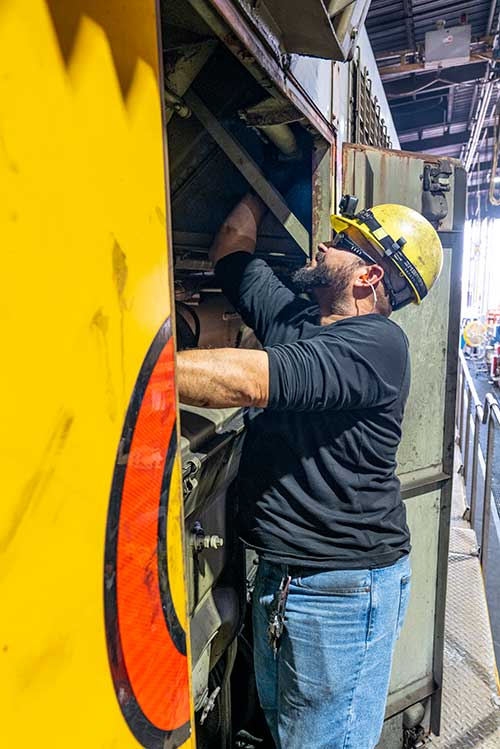
Field workers will predominantly drive change by making decisions. Sometimes, their decisions will turn out to be errors, but that’s OK and to be expected, Vena says.
Union Pacific Railroad

“Customers can look at service differently. For some it’s the transit time that’s important, and for others it’s consistency or that their product is moved in an efficient manner,” he says. “We need to perform to any way service is measured.”

There’s a sense of urgency now to act more decisively and to try a new approach to doing business, says Hamann. When the organization was too complex and procedural, decision-making was slow.

“Now instead of seven or eight people in a room, there are two or three. Then it’s easier to come to a decision,” says Rocker.

More poised to pounce

UP is far better off now to grow and improve in 2024 no matter the economy’s health, Rocker believes.

Third-quarter 2023 data showed UP was performing better operationally than in the second quarter. On a quarter-over-quarter basis, freight-car velocity rose 6% to 215 miles per car daily, average terminal dwell time dropped 3% to 22.6 hours and locomotive productivity improved 11% to 140 gross ton-miles per horsepower per day. And senior executives expected similar promising results in last year’s fourth quarter.

“I’d rather be in this position with better service and question marks about the economy than have a great economy and not be able to execute on it,” Rocker says. “You can’t take some risks then or make fast decisions.”

Hamann senses a big difference in UP’s potential going from 2023 to 2024 than from 2022 to 2023.

“We don’t know what the macro-economy will look like, but we have better momentum now,” she says.

The keys in 2024 will be to keep focusing on service, safety and getting the message out — to employees, shippers and other stakeholders — about how the railroad expects to grow.

“We have to communicate the key points,” Vena says.

For Whited, each employee needs to understand how they perform an important function that helps the railroad operate as it should.

“We want to see it all click in 2024,” she says.

Email questions or comments to jeff.stagl@tradepress.com.


Global task force delivers more funding to Ukrainian Railways


The funds were raised to help the union purchase thousands of food packages to be distributed to railway workers and their families at the frontline of the war between Ukraine and Russia.
Photo – Global Ukraine Rail Task Force


The Global Ukraine Rail Task Force and a delegation of others earlier this month returned to Kyiv, Ukraine, to present a check valued at 130,000 euros to a trade union representing workers of Ukrainian Railways.

The funds were raised to help purchase thousands of food packages that will be distributed to railway workers and their families at the frontline of the war between Ukraine and Russia.

Ukrainian Railways (UZ) CEO Yevhen Lyashchenko and the CEO of UZ’s passenger-rail division, Alexander Pertsovskyi, received the check from Nick Brooks, Jon McGrath and Tim Hollaway of the task force, along with Steve Montgomery, David Brown and Andy Bagnall from the United Kingdom rail association, Rail Partners, and David Juris from WE AID, a part of United Way.

Other rail sector colleagues also attended the ceremony, task force officials said in a press release. All in all, the group has received many smaller individual donations as well as larger donations from Rail Partners' members, some other UK railway companies, Norway's rail infrastructure manager Bane NOR and Swedish Railways, task force officials said.

The task force was formed in the first months after Russia attacked Ukraine nearly two years ago. Co-chaired by former U.S. Federal Railroad Administrator Jolene Molitoris, the task force has helped coordinate some of the humanitarian efforts to help UZ workers and Ukraine. Currently, the group is running a donation campaign to support the families of injured or killed railway workers.

Also, the task force has begun collecting funds to transport urgent medical supplies to the medical facilities of UZ.


Caltrain marks 160 years of passenger-rail service


Caltrain is the oldest continually operating rail system west of the Mississippi.
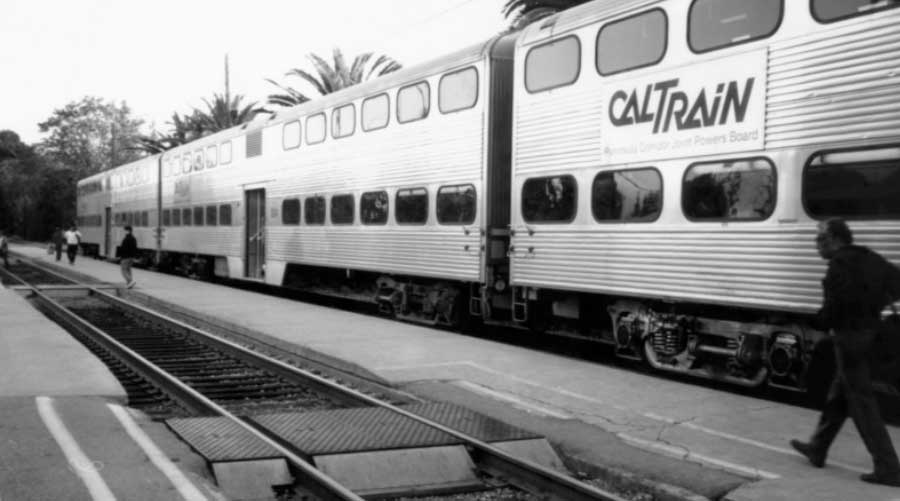
Photo – Caltrain Photo Archive


Caltrain officials this week marked the 160th anniversary of passenger-rail service operating between San Francisco and San Jose, California.

The creation of the rail corridor — which has been in constant use for the past 16 decades — was central to the development of the San Francisco Peninsula and South Bay, Caltrain officials said in a news release.

Most cities located along the corridor built their downtowns around the railroad, allowing communities to form and grow together, Caltrain officials said. Accessible transportation led to economic prosperity and development, as trains could move far more people and goods than stagecoaches traveling on dirt roads. Depending on the weather, traveling via stagecoach would take from eight hours to up to three days to reach a destination, they said.

The idea of creating a rail line between the two cities first came about in 1851, when San Jose was still the California's capital city. After three failed attempts to obtain funding, the San Francisco and San Jose Railroad incorporated in 1860.

Construction began in May 1861 at San Francisquito Creek and regular service from San Francisco to Mayfield (now the California Avenue Station) began in October 1863, with San Jose-bound passengers transferring to a stagecoach for the remainder of their journey. The line was completed in 1864.

There has been much talk of history as Caltrain's historic electrification project — the first undertaking in North America in a generation in which diesel trains and their infrastructure components are transitioned to an electrified system — approaches completion later this year, Caltrain officials said.