It’s possible that I shall make an ass of myself. But in that case one can always get out of it with a little dialectic. I have, of course, so worded my proposition as to be right either way (K.Marx, Letter to F.Engels on the Indian Mutiny)
Thursday, March 21, 2024
Suspected Pirates Approach Bulker as EU Again Warns of Increased Dangers
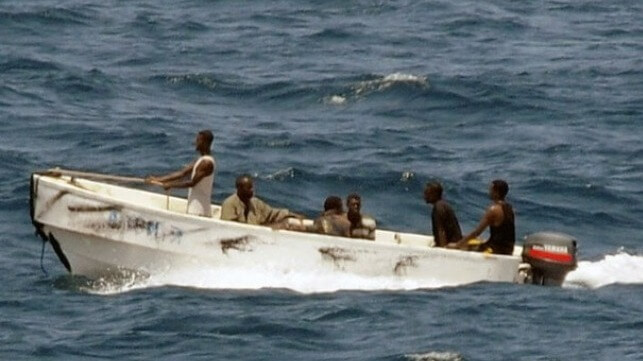
Security forces are warning of an increased danger as more incidents are reported (file photo)
An unidentified Liberian-flagged bulker reported it was approached by suspected pirates but was able to fend off an attack today in the Gulf of Aden hundreds of miles east of Somalia. The approach comes as EUNAVFOR and the Maritime Security Center for the Horn of Africa continue to warn of a “notable surge” in reported events warning that it could potentially escalate into piracy attacks off Somalia.
Today’s approach was consistent with the tactics that the warnings have outlined. The vessel was underway approximately 160 miles southeast of Salalah, Oman when it spotted a small boat approaching. The UK Maritime Trade Organizations reports that the bulker saw seven people in the small boat and a ladder.
The EUNAVFOR warning outlined that the pirates are working from mother ships, mostly seized dhows, that they use to blend in with local activity and as a platform for the attacks. Typically, the small boats approach to access and test the security of the targeted vessel. EUNAVFOR warned that if they believe the targeted vessel cannot repel the attack, the pirates will close the distance and attempt the boarding.
UKMTO reports the small boat followed those actions today. The unidentified bulker said it was followed for 20 minutes, but it had security guards aboard. The report said the guards fired warning shots at the approaching small boat. The small boat withdrew and subsequently left the area.
The warning issued on March 18 accesses that as many as seven captured dhows may be working in the region while several other dhows have now been released. They believe a total of 18 were hijacked in the recent weeks. They estimate that four pirate action groups could be sailing off the Somalia coast currently.
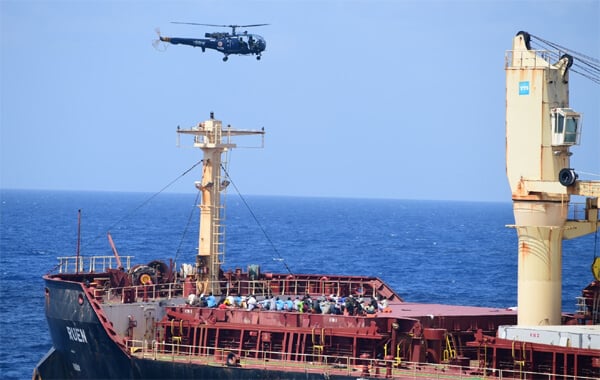
Indian Navy coerced the pirates into surrendering and rescued the crew of the Ruen (Indian Navy)
Media reports last week questioned the security measures in place aboard the Bangladeshi bulker Abdullah when it was captured on March 12. The vessel did not have guards aboard and appears not to have been employing razor wire or other deterrents. The shipping company however said it believed that it was beyond the danger zone in a region previously reported to be low risk.
More than a week after the Abdullah was seized, a spokesperson of the ship’s owners, SR Shipping, told the Bangladeshi media that it had finally been contacted by a third-party representative of the pirates. They said while contact had been established the pirates did not make a specific ransom demand and the shipping company is waiting for further contact. The spokesperson said the company was hopeful with contact that a negotiated release could be completed quickly.
Over the weekend, an elite force from the Indian Navy along with several vessels coerced the pirates aboard another seized bulker to surrender. The crew of the bulker was freed unharmed and India is now working on repatriation of the crew. It was the second successful intervention by the Indian Navy responding to pirate attacks in 2024. Reuters is reporting today that a commander from the Indian Navy said they plan to prosecute the captured pirates.
Charleston Moves to More Than Double Space at North Container Terminal
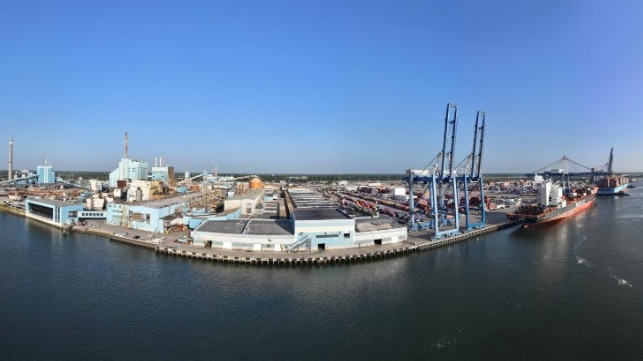
Charleston plans a dramatic expansion of its smallest container terminal buying the adjacent shuttered mill (SC Ports)
SC Ports which operates the Port of Charleston, South Carolina announced plans for a major expansion that will more than double capacity at its North Charleston Terminal. It is part of the state’s overall growth plans for its port operations and comes as other nearby ports including Savannah are also expanding creating strong regional competition in the southeast United States.
The SC Ports Board of Directors voted on Tuesday to move forward with a purchase sales agreement to acquire the former WestRock paper mill located adjacent to the North Charleston Terminal. The paper company permanently closed the facility at the end of August 2023, which employed approximately 500 people and produced 550,000 tons of containerboard and kraft paper.
The roughly 280-acre industrial waterfront property offers a natural extension of the container terminal that the board said will enable SC Ports to handle more cargo for port-dependent businesses. The current terminal facility handles about a quarter of the port’s container volume and is used for smaller ships under 8,000 TEU, while the larger vessels go to the new Leatherman terminal and the Wando Welch terminal, each capable of handling 20,000 TEU vessels.
The current facility sits on approximately 200 acres with a 500,000 TEU capacity. The additional land will expand the terminal’s capacity to handle five million containers in the future and create 5,000 feet of linear berth space for containerships and around 400 acres of terminal space for cargo.
SC Ports plans to modernize the existing North Charleston Terminal with an optimized layout, upgraded cargo-handling equipment, and significant new container capacity. Customers will also benefit from the on-terminal rail service offered by Palmetto Railways with dual connectivity to CSX and Norfolk Southern, and proximity to the Interstate highway system.
“This land purchase represents a tremendous opportunity to position our port system and our state competitively for decades to come,” said SC Ports Board Chairman Bill Stern.
The project is part of the larger, overall master plan for the Port of Charleston that seeks to expand capacity. They are also increasing the ability to handle large vessels.
The South Carolina Department of Transportation plans to replace the Don Holt Bridge, which will remove height constraints for larger vessels. At the same time, efforts are also moving forward to achieve a 52-foot depth up to the North Charleston Terminal. The U.S. Army Corps of Engineers, Charleston District, has requested a feasibility study, a critical first step toward deepening this stretch of the Cooper River an additional five feet.
“Modernizing the terminal, raising the Don Holt Bridge, deepening the Cooper River, and purchasing the former WestRock property are all critical components that will yield a state-of-the-art North Charleston Terminal,” said SC Ports President and CEO Barbara Melvin. The board highlights that the deepening effort, combined with the new bridge height, will allow the biggest containerships calling the Port of Charleston to access the North Charleston Terminal.
SC Ports handled nearly 2.5 million TEUs and 1.37 million pier containers in calendar year 2023, which was on par with 2019 pre-pandemic volumes, but down 11 percent from the peak in 2022. SC Ports also saw strength in other business segments in 2023, with the port handling 204,481 vehicles in 2023, up three percent year-over-year, and more than 302,000 cruise passengers, a 16 percent increase from 2022.
Green Ships Invest to Design Ammonia-Powered PSV Using Amogy Technology
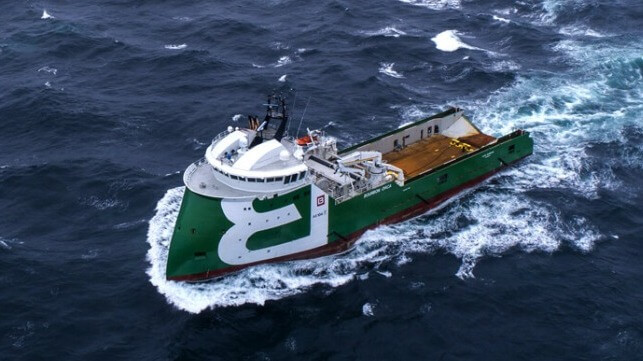
Plans call for Bourbon Horizon to operate the ammonia-powered ePSV (Bourbon Offshore file photo)
Norway’s Green Ships Invest is moving forward with plans to develop ammonia-powered dual-fuel electric Platform Supply Vessels, using ammonia technology being developed by U.S.-based startup Amogy. The companies are building on an existing partnership formed in 2023 moving forward with the designs for the first ships, which will be operated by Bourbon Horizon, an offshore partnership between Bourbon and Canadian marine-support specialist Horizon Maritime Services.
Green Ships Invest was launched as a consultancy working with shipowners, shipyards, maritime equipment vendors, sub-sea contractors, and financial institutions, to develop shipping for a greener environment. The company is developing designs including offshore vessels, fast ferries, Ro-pax and cruise ships, and specialized vessels such as drill ships.
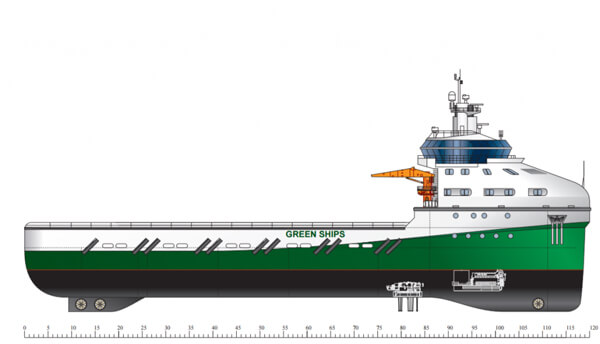
They plan to incorporate Amogy’s 200 kW ammonia-to-electric power systems into the design for the electric PSVs. The ships which will be 4,000 dwt and 269 feet (82 meters) in length will be equipped with 2 MW of energy capacity. Green Ships previously reported the ships would be hybrid diesel-electric with the new plan using the ammonia system for its primary energy. Back-up propulsion will use conventional diesel generators fueled with marine gas oil.
Green Ships Invest's concept for the ammonia-powered electric PSV (Green Ships Invest)
Christian Berg, Managing Director of Amogy, called the agreement the next critical milestone in the company’s effort to decarbonize the maritime sector. Amogy is backed by investors including Amazon’s Climate Pledge Fund, Temasek, SK Innovation, Aramco Ventures, Mitsubishi, and AP Ventures.
Last year, the company announced it had acquired an old tugboat and is working on converting it to demonstrate its ammonia-to-electricity technology. Amogy is one of several projects, which also includes a program underway by Japan’s NYK which is converting its LNG-fueled tug to also be a pioneer in ammonia-fueled propulsion.
The companies did not offer a timeline for the project but said when completed the ePSV would be operated by Bourbon Horizon. The French offshore leader launched its partnership in 2023 with the Canadian company to provide harsh-environment offshore services in the North Sea and Canada.
Amogy highlights that the global PSV fleet is a strong target market due to the age of the vessels which mostly range between 10 and 20 years. Green Ships which is dedicated to the energy transition believes these vessels will be a critical step towards aligning the sector with the emerging environmental regulations and a model for the industry.
The second stage of the agreement between Green Ships Invest and Amogy anticipates that Green Ship will expand the application with the addition of two more vessels using Amogy’s technology.
Amphib USS Boxer Sidelined by "General Complacency" and Breakdowns
The big-deck amphib USS Boxer has been sidelined by three back-to-back engineering casualties caused by "lack of procedural compliance, substandard supervisory oversight, and general complacency by the crew," according to the U.S. Navy.
USS Boxer is the flagship of the Boxer Amphibious Ready Group, or would be under normal circumstances. However, she has been in various phases of repair and preparation since 2022, and she missed her latest scheduled deployment in the Pacific - all because of human factors, according to a recent command investigation.
"Every level of senior engineering leadership failed to provide a safe, professional, and procedurally compliant work environment in engineering department. These failures had direct, measurable impacts on USS Boxer's upcoming deployment and impeded the overall accomplishment of the strike group's mission," concluded the expeditionary strike group's commander last year.
The casualties were first reported by KPBS, and all involve serious human error. In November 2022, two of the forced draft blowers on USS Boxer's steam plant failed, the victims of improper repairs. They were overhauled multiple times, and suffered oil and water leaks every time. An examination by the OEM found that improper parts were used, machined sealing surfaces did not line up, and reassembly techniques were substandard and noncompliant.
"Numerous deficiencies (non-conforming parts, poor quality control, poor craftsmanship, non OEM supervision) have been noted in the recent overhauls," concluded the command investigation. "The repetitive overhaul/repair of the [forced draft blowers] onboard Boxer may be an indicator of shortfalls in contractor experience necessary to conduct steam plant repairs."
In May 2023, USS Boxer experienced an unspecified incident during a boiler light-off, which the strike group commander attributed to complacency and a departure from "sound shipboard operating principles." The incident could have resulted in severe injuries, though luckily no crewmembers were harmed.
In mid-July, Boxer's engineering team needed to rotate the propulsion system's main reduction gear for maintenance. Despite multiple rounds of retraining and outside intervention after the previous casualties, they again departed from procedure: the team spun the main gearbox for two hours without lubrication, and did not notify the commanding officer of this potentially damaging decision until 27 hours later.
"Despite two previous major engineering casualty incidents within eight months, USS Boxer engineering department personnel continued to deviate from sound engineering practices and failed to apply lessons learned from previous engineering casualties. All watchstanders displayed an appalling lack of procedural compliance and general complacency in this casualty," the strike group commander found.
The former commanding officer has transferred outside the strike group with a special letter of evaluation, and the former XO - promoted as the new CO - was issued a letter of instruction. The command intended to begin detachment for cause (DFC) proceedings for the Boxer's main propulsion assistant (MPA); the investigation referred to unspecified allegations of assault and failure to report incidents of assault within Boxer's engineering department, including allegations involving the MPA.
Norway Completes First Offshore Wind Auction with Ikea Franchisee and Jera
Norway compelted its first offshore wind auction as the new government puts a high priority on the sector (Ingka Group)
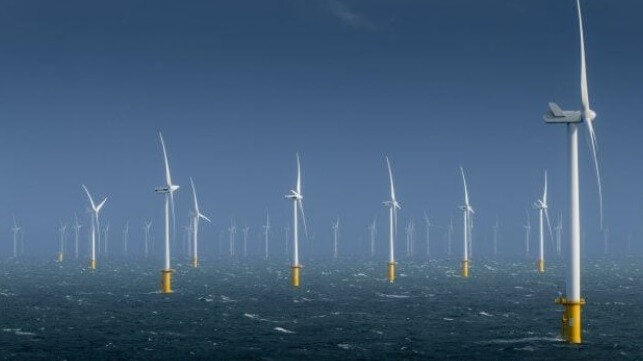
Norway completed its first offshore wind auction by selecting a partnership between the investment arm of Ingka Group, based in the Netherlands and the largest Ikea franchiser, and Parkwind, majority-owned Japan’s Jera, a partnership between Tokyo Electric Power Company and Chubu Electric Company. Government officials called the auction a milestone in their efforts to develop offshore wind saying that they have taken a big step forward.
Five groups had qualified for the auction, but in the end, it came down to spirited bidding between the Ventyr consortium and Norway’s Equinor in partnership with RWE. Statkraft, Aker Offshore, and BP, a group led by Shell, and Germany’s Energie, all withdrew or failed to submit bids. Bidding began on Monday and the government continued it into Tuesday before the Ventyr group was declared the winner.
“This is a very good day. This government has worked to realize offshore wind in Norway since day one, and today we have carried out the first successful auction,” said Norway’s Prime Minister Jonas Gahr Støre. “Norway has ocean areas with rich wind recourses, and a supply industry with world-leading technology expertise. We will build on this fundament in the coming years by announcing new areas and new auctions.”
The first location, known as Sorlige Nordsjo II is distant from the Norwegian coast approximately 124 miles into the North Sea near the border with Denmark. It however is one of the few areas that Norway will be able to offer that can use fixed-bottom turbines. A second proposed auction for a site using floating wind turbines was delayed but Norway is already exploring other potential sites.
The bidding was based on a contract for difference (CfD) where the government will provide support, capped by the parliament at 23 billion Norwegian crowns ($2.17 billion). The final strike price for the electricity in the auction is approximately $100 per megawatt hour in a 15-year contract.
Ingka, which is supporting the development of renewable energy through its investment company, said its goal is to have the first turbines operational by 2030. The plan is to develop a 1.5 GW wind power farm.
The consortium now has four weeks to complete and sign the contracts with the Norwegian government.
Norway’s energy minister highlighted that the new government is giving a higher priority to wind energy. It is a big step for a country that historically has been one of the largest gas producers. The government says it wants to lead the transition to renewable energy believing that Norway has areas with the potential for more than 30 GW of offshore wind production by 2040.
Gulf of Mexico
BOEM Proposes Second GoM Wind Auction Possibly Adding Hydrogen Production
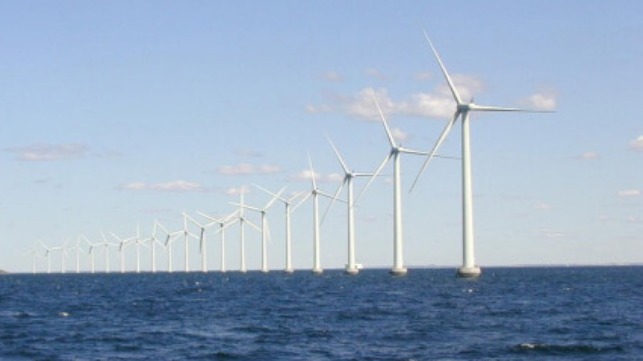
BOEM is moving forward exploring more wind energy leases for the Gulf of Mexico (file photo)
The U.S. Bureau of Ocean Energy Management is moving forward to explore the next round of wind energy auctions in the Gulf of Mexico. They plan to release tomorrow the details for four potential lease areas off the coast of Louisiana and Texas. As part of the proposals, they are looking at adding alternative energy products such as the production of hydrogen as part of the wind lease.
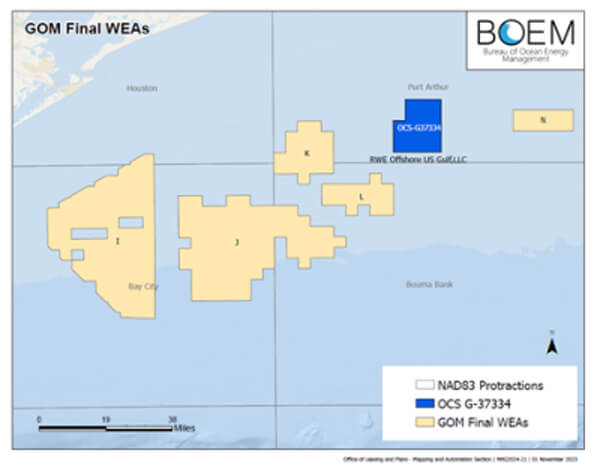
The proposals total over 410,000 acres in the current drafts which BOEM estimates could potentially power 1.2 million homes. The four leases are in three blocks west of the first site that was won by RWE in the 2023 auction. The new proposals range in size between approximately 97,000 acres and 108,230 acres, although the final scope of each lease will be determined after a 60-day comment period running till May 20.
As part of the review, BOEM reports it is also seeking comment on potential lease revisions to include the production of hydrogen or other energy products using wind turbine generators on the lease.
BOEM is requesting feedback on various aspects of the proposed lease areas, including the size, orientation, and location of the four lease areas and which areas, if any, should be prioritized for inclusion or exclusion from the proposed lease sale. BOEM is considering lease stipulations to ensure that communities, particularly those that are historically underserved, are considered and engaged early and often throughout the offshore wind energy development process.?Proposed bidding credits include funding for fisheries compensatory mitigation and workforce development.
The proposed second auction would feature four leases contained in the western blocks defined in the Gulf of Mexico (BOEM)
The auctions would be conducted simultaneously for each of the four lease areas, which are in the western portion of the Gulf of Mexico near Houston, Texas. If BOEM decides to proceed with the auction, the next step would be the publication of a final sale notice.
The first Gulf of Mexico wind auction conducted in August 2023 failed to attract strong interest from the industry. RWE was the only bidder paying just $5.6 million for one of the three areas, while saying that it was still considered how the site might be developed long-term.
Analysts highlight that the Gulf of Mexico features slower wind speeds and higher hurricane risks versus areas previously offered off the New England and Atlantic coast. Further, Gulf Coast states generally have lower electricity prices and no state purchase mandates to support the offshore wind energy industry.
wind turbine installation vessel
First Look at U.S.’s Only WTIV Under Construction in Texas for Dominion
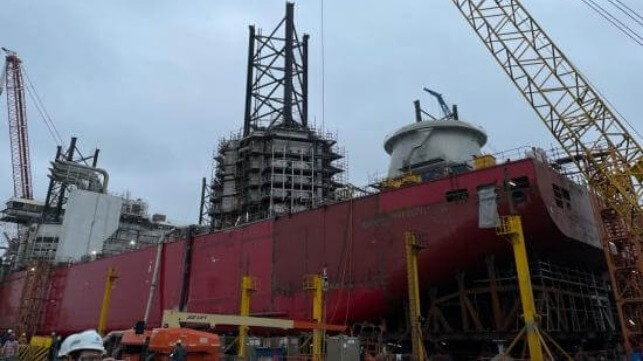
Charybdis under construction in Texas March 2024 (BOEM)
The first image appeared of the much-celebrated wind turbine installation vessel being built for Dominion Energy at Keppel AmFELS shipyard in Brownsville, Texas. The vessel will be the first, and possibly only, Jones Act-compliant wind turbine installation vessel and is slated to be used with Dominion’s Coastal Virginia Offshore Wind project as well as charters to Ørsted for installation of some of its U.S. projects.
Named Charybis, the vessel was billed as state-of-the-art, and a major advancement for the U.S. industry. There was a lot of discussion about the vessel when its keel was laid in December 2020, but since then it has received less attention as reports surfaced that it was running behind schedule and over budget.
The U.S. Department of the Interior is providing the first glimpse of the vessel today, March 20, showing the status of construction. Principal Deputy Assistant Secretary for Land and Minerals Management Dr. Steve Feldgus, Bureau of Ocean Energy Management Director Elizabeth Klein, and Bureau of Safety and Environmental Enforcement (BSEE) Deputy Director Paul Huang toured the construction today at the shipyard in Texas.
Contained within Dominion Energy’s annual report filing to the U.S. Securities Exchange Commission in late February are details including a $625 million cost estimate, up from the around $500 million reported in 2020. Original reports said the vessel would be ready around the end of 2023, although BOEM commenting on today’s inspection said that it has an anticipated construction completion by late 2024 or in 2025.
It was reported in 2021 that the installation vessel was being chartered to Ørsted for work on the Revolution Wind and Sunrise Wind projects in the Northeast U.S. Both of those projects are still moving forward although potentially delayed by financial and supply challenges, but Ørsted is proceeding with the projects after having canceled others in the United States.
BOEM said after its tour that the Charybdis when completed will be based out of Hampton Roads, Virginia, and operated by a U.S. crew to support the installation of Coastal Virginia Offshore Wind. Dominion's construction plan approved by BOEM calls for the vessel to be deployed between Q2 2025 to Q2 2027 at the Virginia wind farm construction site.
The Charybdis was designed to be able to handle the current and next generation of wind turbines going up to approximately 14.7 megawatts and larger. The vessel will have a length of 472 feet, making it one of the largest WTIVs yet built, and built with more than 14,000 tons of domestic steel, mostly sourced from Alabama, North Carolina, and West Virginia. It will be capable of the installation of foundations for the turbines and other heavy lifts including the turbines.
Built in the U.S., the vessel has unique advantages as it will be fully compliant with the Jones Act cabotage rules. The Charybdis will be able to make frequent trips to U.S. ports to load and transport materials to the installation sites. Other U.S. projects are using an alternative approach of chartering foreign vessels which are precluded from transporting the materials and which will be dependent on barges and feeder operations to move materials from the staging sites at the wind ports to the offshore locations. Dominion told BOEM that it expects Charybdis to be "sought after for offshore wind turbine installation contracts for other projects in the U.S."
Last year, the Biden administration highlighted that the wind sector led companies to announce 18 offshore wind shipbuilding projects as well as investments of nearly $3.5 billion across 12 manufacturing facilities and 13 ports to support the American offshore wind supply chain.
In addition to the Charybdis, the vessels include a rock installation vessel, a SOV, and crew transfer vessels. Last week, Maersk Supply Service and Edison Chouest announced an agreement for the construction of tugs and barges for their feeder system.
The vessels for the offshore wind sector are being built at shipyards ranging from Texas to Pennsylvania, Florida, Louisiana, New York, Massachusetts, Michigan, Rhode Island, and Wisconsin. The first of the crew transfer vessels have been completed and delivered while the SOV was recently moved from the building hall in preparation for it to be floated.
Port Hawkesbury Paper Wind addresses turbine concerns
MULGRAVE — From the danger of “infrasound” to the annoyance of “shadow flicker,” almost nothing about Port Hawkesbury Paper’s (PHP) forthcoming wind project escaped scrutiny at a meeting of Mulgrave town council on March 4.
A delegation from PHP Wind, led by Roger Myette – the project’s construction manager and co-chair of its community liaison committee – spent more than an hour updating elected reps on timelines and key milestones, and addressing common fears about the technology.
Referring to an issue raised by a member of the initiative’s recently formed community liaison committee about oil leaking from wind turbines’ gearboxes, he said, “One thing I know you are all probably wondering is what’s the worst thing [about this] for pollution and contamination. One point that was asked was [whether] they contaminate the ground by spilling millions of litres of oil.”
“That’s not the case,” he said, noting that the turbines PHP plans to use are manufactured by Chicago-based Nordex, which pioneered the mass production of turbines for sale around the world in 1995. In these units, “The cell where all the oil is fully self-contained and includes the transformer, generator and gearbox.”
Other resonant fears among those living close to turbines, he said, concern the “whoosh” or “swish” of the blades and something called “shadow flicker,” which is the effect of the sun, low on the horizon, shining through the rotating assembly, casting a moving shadow.
“We’ve done all the studies,” Myette said. “The modeling assumes worst case scenario for every aspect, every input, and nothing is outside the allowables. It’s a very light whisper when you’re outside [your] house. Inside, you won’t hear it. As for shadow flicker, [these turbines] won’t be near houses, so there’s no impact.”
The Goose Harbour Lake Wind Farm – which received environmental approval from the province last year – will be located on Municipality of the District of Guysborough (MODG) land near the communities of Upper Big Tracadie and Lincolnville that is under license to PHP for sustainable forest management.
The facility – which will need access to public roads owned by the Town of Mulgrave – will consist of up to 31 wind turbines and is expected to have an annual capacity equivalent to more than 40 per cent of PHP’s required electrical power demand when it is operational sometime in 2025 or later.
Alec Bruce, Local Journalism Initiative Reporter, Guysborough Journal
THE LATEST WEAPONS SHOW
Video: French Navy Helicopter Shoots Down a Houthi Drone
Houthi suicide drones are imposing a high cost on Western navies in the Red Sea - not because any of the group's munitions have hit a government vessel, but because of the multimillion-dollar expense of shooting them down. This week, a French frigate demonstrated a more cost-effective approach to defeating low-and-slow drone attacks: a helicopter chase.
In a video released by France's defense ministry, a helicopter from an unnamed French frigate tracked a slow-moving Houthi drone as it entered the shipping lanes of the Red Sea. While not shown, the audio suggests that the aircrew's door gunner shot the UAV down.
At a cost per round of about $0.50-1.00, plus the $5-10,000 hourly operating cost of the helicopter, the price of downing the drone was far less than what it would have been with the Aster air-defense missiles carried by the same frigate. This is not hypothetical: a French warship recently used a multi-million-dollar Aster to destroy a drone within visual range, below. (The crew also had an opportunity to take down a drone with the main deck gun, a less expensive but dangerously close engagement.)
France is participating in the Red Sea air defense mission under the auspices of the EU's Operation Aspides, a strictly defensive coalition under a separate command structure from the U.S.-led Operation Prosperity Guardian.
Russia's Black Sea Fleet Takes New Measures to Fend Off Ukraine's Drones
A drone boat detonates against the hull of a Russian corvette (Image courtesy GUR)
Ukraine's successful campaign of attacks on the Russian Black Sea Fleet has attracted attention at the highest levels of Russia's military establishment. On March 17, defense minister Sergei Shoigu personally visited the Black Sea Fleet's command post in Crimea to discuss measures to protect the fleet's remaining warships. About 15 Russian naval vessels have been damaged or destroyed by Ukraine's drones and missiles since the start of the full-scale invasion in 2022.
According to UK intelligence, Shoigu instructed the Black Sea Fleet's leadership to conduct daily exercises on defending against unmanned bomb boats. He ordered the installation of extra defensive weapons on unspecified vessels to help fend off the new high-tech threat.
Ukraine's suicide drone boats have sunk two warships in a month's time, penetrating past defensive machine gun and cannon fire with relative ease. Their operators attack at night, aiming at the stern to disable propulsion with the first wave, then striking the vessel repeatedly amidships in order to initiate flooding and capsizing. Videos released by Ukrainian military intelligence appear to show that once the target vessel has been hit and immobilized, the drones' remote operators attempt to physically maneuver the devices into the interior of the ship - through previous blast holes at the waterline - before detonating their explosive payload.
"The Russian Navy has highly likely resorted to limiting its operations to the eastern Black sea as its losses mount and its threat perceptions increase," said UK Defence Intelligence in an assessment Tuesday. "With Ukraine continuing to seek out opportunities to strike at a distance, he Russian Ministry of Defence has been prompted to increase its efforts to preserve its fleet in the Black Sea."
Other measures include new "maskirovka" (deception and camouflage) efforts. The Russian Navy has repainted the bows and sterns of many of its Black Sea warships in black paint, hoping to make them look like smaller vessels and reduce the "visible" target area. This approach has a rough parallel in the "dazzle paint" schemes used by Allied vessels in the Second World War. However, open-source analysts in the West have noted that the paint scheme has no effect on infrared camera targeting, as used by Ukrainian forces.
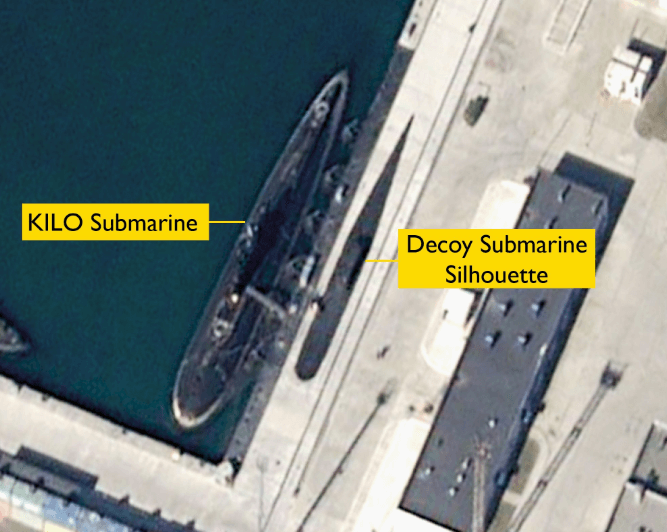
UK intelligence has also spotted decoy silhouettes of ships and submarines painted onto the quayside next to real vessels at Russian naval bases, perhaps in an attempt to confuse Ukrainian aerial drone opertors. "It is unlikely that the use of maskirovka techniques will lead to any significant reduction in losses," assessed the department.
Courtesy UK MOD
US must improve copper mine permitting process, Freeport CEO says
Reuters | March 18, 2024 | Freeport CEO Richard Adkerson (Image: Screenshot from Bloomberg TV Video)
The US must improve its mine permitting process if it hopes to boost domestic supplies of critical minerals to power the clean energy transition, the CEO of copper giant Freeport-McMoRan said on Monday.
“The US government needs to stop giving lip service to permitting,” Richard Adkerson told Reuters on the sidelines of the CERAWeek energy conference in Houston.
“The question is, given our political system that we have today and the dysfunctionality of it, how do you go from getting a project verbally accepted to getting actions done?” Earlier, US Energy Secretary Jennifer Granholm told the conference that she supported efforts in the US Congress to reform the country’s mining laws, some of which were first approved in the 19th Century.
Adkerson sat next to Granholm at the conference’s Monday lunch and said he had a productive conversation with the secretary about permitting reform.
Adkerson, who plans to step down as CEO this year after more than 20 years in his role, said he was asking Washington for more clarity on how permits are approved or rejected, not an easing in environmental regulations.
“We’re not talking about dropping standards,” he said. “We’re talking about processes here.”
Kathleen Quirk, Adkerson’s longtime lieutenant who will succeed him as CEO, said Freeport was focused on earning the support of people who live near its mine sites as part of its push to boost the copper industry’s social license to operate.
“We talk a lot about finding common ground. You got to find it. It’s going to take out of your economics, but otherwise you don’t have a viable business plan if you don’t come up with a sustainable solution,” said Quirk, currently the company’s president.
Elsewhere in the US, Freeport would be open to potentially expanding its Miami, Arizona, copper smelter, both Adkerson and Quirk said. But for the near term the company is focused on expanding its use of copper leaching, both added.
Of two US copper smelters, Freeport operates one and Rio Tinto the other.
Freeport has struggled to attract workers inside the US, and Adkerson said filling staffing needs was still a “work in progress”.
“We’re trying to advance technology to reduce worker requirements wherever we can, but it’s a US problem for us,” he said. “In Peru and Indonesia,” where the company also mines copper, “we have flood of applicants for all of our jobs.”
Adkerson, who will remain Freeport’s chairman, said he does not expect Quirk’s transition to CEO to bring major changes to the Phoenix-based company.
“This is a seamless management change,” Adkerson said.
(By Ernest Scheyder; Editing by David Gregorio)
China coal industry group expects output growth to slow in 2024
China’s coal output is expected to increase 36 million metric tons, or 0.8%, to about 4.7 billion tonnes in 2024, a Chinese coal industry group said on Wednesday, slower than last year’s 2.9% growth.
The projection comes on the back of record output in 2023, when the world’s largest coal consumer mined 4.66 billion tons of the polluting fossil fuel.
The China Coal Transportation and Distribution Association (CCTD) expects domestic coal prices to decline at an accelerated pace, partly due to weakness in its real estate markets, said Feng Huamin, senior analyst at CCTD’s research department.
Feng pointed to government orders to suspend infrastructure projects in some heavily indebted provinces as one of the key reasons for the pressure on prices.
Declines in property investment and sales in China have slowed amid government efforts to arrest a protracted downturn in the sector, but analysts were wary of calling an end to the pain in the fragile housing markets just yet.
Output from non-fossil sources will add to pressure on thermal output this year, with power output expected to grow in line with its 5% economic growth forecast, Feng said.
“A large portion of forecasting institutions believe that hydropower generation will see clear improvement this year,” Feng said, adding that higher solar and wind installations could help address about 70% of the expected growth in power demand.
Drought-like conditions in key generating regions resulted in China headlining an alarming decline in hydroelectricity output in Asia last year, as its output plunged at the steepest pace in decades.
Some miners have paused production for longer after the Lunar New Year break, sources familiar with the matter said. Feng said a few mines are already at risk of hitting their storage limits due to high inventory levels.
Separately, the top coal producing hub of Shanxi is expected to cut output by 40 million tons this year, partly due to a slew of accidents in the recent past, Feng said.
Shanxi saw mine accident-related deaths surge over 50% in 2023, pushing the mining safety regulator to issue a notice last month asking mines to curb overproduction to prevent accidents.
However, power use by industries during the first two months of 2024 grew at a surprisingly high 9.7%, Feng said, a trend which could push stockpiles lower if it continues.
(By Colleen Howe and Sudarshan Varadhan; Editing by Jacqueline Wong and Miral Fahmy)
JV Article: Dundee’s cyanide-free tech cuts gold leaching time by 90%
MINING.COM and Dundee Sustainable Technologies | March 20, 2024 | Dundee Sustainable Technologies’ Clevr plant and technical facilities in Thetford Mines, Que. Credit: Dundee Sustainable Technologies
Quebec-based Dundee Sustainable Technologies is slashing leaching time and extracting more gold without using toxic cyanide in a new process geared for mining’s future.
The trademarked process, called Clevr, uses a 2% bleach solution in leaching kinetics, the chemical reaction that separates gold from ore, to release gold within a couple of hours versus 36 hours or more in traditional cyanide leaching.
“We’ve been driven in developing and now commercializing novel metallurgical processes for the mining industry and our approach has always been to improve efficiency,” Jean-Philippe Mai, president and CEO of Dundee, said by phone.
“It opens up a lot of doors when you can drop the kinetics, increase recovery and reduce the footprint.”
Dundee, based in Thetford Mines 100 km south of Quebec City, has been pushing the leading edge of environmentally friendly mineral extraction and metallurgy processes for the past decade. It’s focusing on eliminating the use of cyanide and separating arsenic while achieving improved gold recovery. It has more than 50 patents in about 15 countries.
Newmont (TSX: NGT; NYSE: NEM), the world’s largest gold miner by production, is testing Clevr at its head laboratory in Denver.
“The Clevr reagent appears to be an efficient lixiviant that could provide an alternative to cyanide,” Frank Roberto, Newmont’s Director of Processing, said by phone from the lab.
No tailings ponds
The closed-loop Clevr process allows operators to save on reagents and eliminates the need for tailings ponds which lowers cost, risk and environmental impact. Besides no cyanide, there’s no toxic liquid or gaseous effluents produced, Dundee says. Solid residues are inert, stable and non-acid generating. It all contributes to a formula for a cleaner, efficient and cost-effective alternative to cyanide.
Clevr uses sodium hypochlorite, not chlorine gas, with a catalytic amount of sodium hypobromite in acidic conditions to put the gold into solution. Contact time is short, done at ambient temperature and pressure and all chemicals are recycled within the circuit. If needed, sea water may also be used, the company says.
Gold extraction yields are routinely more than 95% while capital and operating costs are competitive with traditional processes. Costs are about C$20 per tonne of ore in a 10,000-tonne-per-day direct leach operation. It adds up to increased gold recovery in a fraction of the time.
“Our mission is not to go head-to-head with cyanide because it’s been used for more than a century and we as miners know that it works,” Mai said. “But we have a reagent that’s allowing for additional extraction at a fraction of the time, so what we’re putting forward is efficiency.”
Dundee developed the process because some of its early clients had projects that were denied the use of cyanide for environmental reasons. Just looking at the general trend of environmental regulation shows that miners should be prepared for tightening rules as time progresses. The company can develop individual solutions for each project’s circumstance, Mai said.
GlassLock targets arsenic
Dundee also offers its trademarked GlassLock process to remove and stabilize arsenic. It turns the toxic substance into glass – vitrification – by integrating it in a mixture of common reagents such as silica, recycled glass and hematite. The arsenic compounds are stable, permanent and insoluble within a glass product, providing greater stability, the company says.
Metallurgy is custom to the project so Dundee does preliminary test work and modeling using project specifics to size equipment and supply needs for each solution, whether Clevr or GlassLock, Mai said. Clevr’s shorter processing and the lack of a tailings pond and dams can have a profound impact on the mine plan, he said.
“It’s not just dollars per tonne of processing, it’s what the impact is on the overall project,” he said. “That’s the exercise we’re doing with the miners and project developers to really get a sense of what the upside is of a new process on any developing gold project.”
The preceding Joint Venture Article is PROMOTED CONTENT sponsored by Dundee Sustainable Technologies and produced in co-operation with Mining.com. Visit: www.dundeetechnologies.com for more information.
US explored adding more cobalt to defence stockpiles
Reuters | March 19, 2024 | Idaho Cobalt Operations surface facilities progress. (Image courtesy of Jervois Global.)
The US looked into buying cobalt for defence stockpiles last year, three sources with knowledge of the matter said, adding the Defense Logistics Agency (DLA) could consider purchases in future despite deciding against them in its latest plan.
Any increase in cobalt holdings would be aimed at reducing reliance on China, which dominates the processing of the material used to make missiles, aerospace parts, magnets for communication, and radar and guidance systems.
Cobalt is also used to make the batteries that power electric vehicles, a key plank of the energy transition.
The DLA’s stockpiling plans which run from October 2023 to September 2024 did not include, opens new tab cobalt, surprising the market, which had expected the 60% price drop to around $16 a lb since May 2022 to incentivise purchases.
DLA spokesperson Joe Yoswa said: “DLA … conducts critical material supply chain assessments biennially to determine NDS (National Defense Stockpiles) requirements. Cobalt is not currently presenting as a vulnerability requiring stockpiling.”
“Should that change in the future, DLA will reassess and make an appropriate recommendation on stockpiling to the Undersecretary of Defense for Acquisition and Sustainment.”
Yoswa added the NDS is “for defense purposes and is not an economic stockpile” and that “the current price of a commodity cannot be used as justification to acquire materials”.
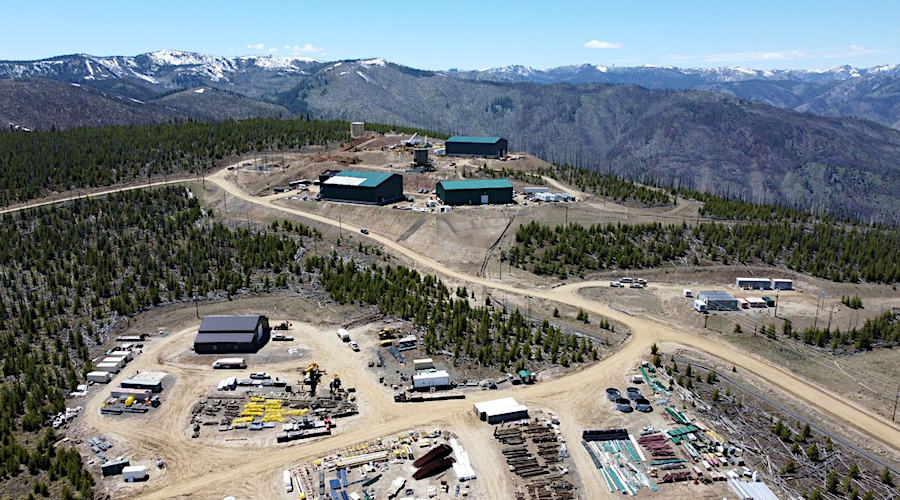
The unfavourable price backdrop prompted cobalt and nickel supplier Jervois Global to suspend final construction of its Idaho cobalt operations in March last year, which would have been the only primary cobalt mine in the United States. It was expected to produce 2,000 metric tons a year.
Prices are likely to remain depressed due to slowing sales of electric vehicles which use cobalt-containing batteries, and new battery chemistries that don’t use it.
The sources said some of the impetus for the move to assess cobalt came from a letter sent by Congress in September 2022 to the Department of Defense (DoD) asking it “to direct” DLA “to prioritize the acquisition of domestically refined cobalt”.
The letter signed by lawmakers Byron Donalds, Don Bacon, Eric A. “Rick” Crawford, Kevin Hern and Markwayne Mullin cited “a heavy dependence on other countries’ refined cobalt, particularly China” as a reason to add to US stockpiles.
Spokespeople confirmed Mullin and Donalds signed the letter, while those for Crawford and Hern did not respond to requests for comment.
“As indicated in his 2022 letter to Under Secretary of Defense (William) La Plante, Congressman Bacon believes the Department should move aggressively to secure domestic sources of critical minerals including cobalt,” a spokesperson for Bacon said.
Most of the cobalt mined in Congo, amounting to 77% of global supplies or more than 170,000 tons last year, according to Darton Commodities, was exported to China for processing into metal or chemicals for batteries.
The NDS “lacks sufficient cobalt reserves, endangering America’s critical mineral supply chain”, the letter said, adding that: “From approximately 13,000 tons during the Cold War, cobalt in the Stockpile is now estimated at 333 tons”.
“In practical terms, the total cobalt stockpile is only 5 percent of annual US consumption.”
Yoswa declined to comment on how much cobalt DLA has in its stockpiles. “The National Defense Stockpile does hold 99.8% pure cobalt, but we won’t provide the amount that we hold for security purposes,” he said.
(By Pratima Desai and Ernest Scheyder; Editing by Veronica Brown and Mark Potter)