Wednesday, September 25, 2024


Faces of enslaved people focus of exhibition


David Mckenna
BBC News
Deanio X
The artist has created imagined representations of enslaved people listed within historical records

A new exhibition is set to open in Hull reflecting on the transatlantic slave trade.

Artist Deanio X has produced a series of artworks in response to research carried out by the Wilberforce Institute.

The exhibition, entitled To Heal a Butterfly, includes portraiture, digital animation and sculptures.

It opens on Saturday at the Wilberforce House Museum on High Street and runs until 23 April 2025.


'Shared history'


In 2023, Deanio X was one of ten artists commissioned by King Charles to create portraits of pioneering members of the Windrush Generation.

In this exhibition, the artist has created imagined representations of enslaved people listed within the Sea Island and Jamaica records.

The artwork, described as a "homage to the philosophical significance" of traditional West African symbols, will temporarily replace historical paintings in the museum.

Robin Diaper, curator at Hull Museums, described the exhibition as "thought-provoking".

"There are many different perspectives and ways of viewing the complicated and challenging history of slavery [and] Deanio’s work will provide a new way of looking at this shared history," he said.

Dr Nick Evans, from the Wilberforce Institute, a research centre for the University of Hull, added: "Art has an important role in communicating the brutality of Britain's slavery past to new audiences
SCOTLAND

Fish farm 'removed tonnes of dead salmon' before visit by MSPs


Kevin Keane
BBC Scotland's environment correspondent

Video shows 'tonnes of dead salmon' being removed before MSP visit


An animal welfare charity says it filmed tonnes of dead and dying salmon being removed from a fish farm just hours before MSPs visited the site.

Members of the Scottish Parliament's rural affairs committee visited Dunstaffnage fish farm near Oban on Monday for a fact-finding mission.

The committee is holding a follow-up inquiry into how the sector has changed since a damning report in 2018 raised environmental concerns.

Animal Equality UK has accused the fish farm operator of trying to paint a "wholly inaccurate" picture of the industry but Scottish Sea Farms insists the footage shows "routine" operations.

Scottish Parliament
Six members of the rural economy and islands committee visited the salmon farm


Representatives from the salmon farming industry are due to appear before the committee next week.

A spokesperson for the committee said it had heard concerns about fish mortality on salmon farms during its inquiry, and added: "This footage raises further questions for the committee."

BBC Scotland News understands that the removal of the fish on Monday morning was not discussed with MSPs.

Abigail Penny, executive director at Animal Equality UK, has accused the industry of wanting to "hide the truth" rather than tackle the serious issues it faces.

She says the industry still does not have a handle on the parasites and diseases "running rampant" through fish farms, which she believes are too densely stocked.

She added: "We urge the committee to see the industry for what it truly is: deceptive and deadly."


Farmed salmon production drops by a fifth


New strategy aims to calm waters around fish farming


Zones planned to protect wild salmon from sea lice


Scottish Sea Farms, which operates the site, insisted the footage showed teams following standard operating procedures by regularly removing dead or dying fish.

It said the number of fish removed each time would vary between pens and from day to day.

But it insisted it had "categorically not" had a mass mortality event.

The company also said it had engaged in a "full and open discussion" with MSPs during their visit.

Head of fish health and welfare, Dr Ralph Bickerdike, said: "Contrary to the claims made by Animal Equality UK, this is an essential part of our duty of care and something we do daily wherever conditions allow, whether we have a farm visit scheduled or not."

 Images/Naturediver
Parasitic sea lice have been a huge problem for the industry for many years


Scottish salmon is the UK's biggest food export, worth £578m in 2022.

But the number of fish dying on farms has been increasing, with a record 17 million salmon deaths reported in Scotland last year.

Warm sea temperatures have led to a significant increase in micro-jellyfish which cause harm to farmed salmon.

There are also long-standing concerns around parasitic sea lice and the use of chemical treatments in open waters.

In 2018, Holyrood's environment committee concluded that Scotland's marine ecosystem faced "irrecoverable damage" from an expansion in fish farming.

A report by the regulator Sepa, in the same year, found that almost one in five salmon farms in Scotland failed to meet statutory environmental standards.

Another report, by the Scottish parliament's rural economy committee, made 65 recommendations for improvement but stopped short of backing a moratorium on new fish farms.

The current inquiry is examining to what extent those recommendations have been implemented.
RSF calls on Egypt to immediately release British-Egyptian blogger Alaa Abdel Fattah


Reporters Without Borders (RSF) calls on the Egyptian authorities to immediately and unconditionally release British-Egyptian blogger Alaa Abdel Fattah, who on 29 September will have spent five years in arbitrary detention - the full term of his sentence for a trumped-up charge of “spreading false news”.

Abdel Fattah, a leading voice in the protests that toppled former president Hosni Mubarak, was handed a five-year sentence in December 2021, but had already spent more than two years in jail awaiting trial. Under international legal norms and Egypt’s own criminal code, his pre-trial detention should be deducted from his sentence and he should be freed this weekend, but there has been no indication that will happen. His lawyers fear he will be kept in prison until January 2027, five years after the ratification of his sentence, instead of five years after his arrest.


Alaa Abdel Fattah must be immediately freed and guaranteed safe passage to the United Kingdom to be reunited with his son. His trial was manifestly unjust, his imprisonment has been arbitrary, and now he has done his time: every additional day he spends in prison will be a sign of Egypt’s complete disregard for the rule of law, and of the failure of the UK government to defend and protect its citizen despite the blatant abuse of his human rights. If Egypt extends his detention beyond 29 September, the UK must use all available diplomatic means to secure his release and reunite him with his family.
Fiona O'Brien
UK Bureau Director, RSF


Abdel Fattah, whose son and sisters live in the UK, has spent most of the last decade in jail, persecuted and repeatedly detained because of his writing and political activism. His case briefly made headlines during COP27, when he went on a devastating hunger strike, but for most of his detention his family has struggled to get international attention. Despite his British citizenship, UK diplomats have not been able to visit him in jail.

The UK needs action not words

Before his party came to power in July, UK Foreign Minister David Lammy was outspoken in his support for Abdel Fattah, calling him a courageous voice for democracy and a prisoner of conscience, describing his case as gravely urgent, and declaring it an outrage that Britain had not secured consular access. Yet in his first 83 days as foreign minister, Lammy has failed to meet Abdel Fattah’s family or to call publicly for his release.

The UK’s new Labour government even promised in its manifesto to strengthen support for British nationals detained abroad, and to introduce a new right to consular assistance in cases of human rights violations. But Britain continues to have a poor reputation in standing up for its citizens arbitrarily detained or sentenced overseas, or killed in connection with their journalism.

In November 2023, Abdel Fattah’s family filed an urgent appeal to the UN Working Group on Arbitrary Detention (UNWGAD), but have yet to hear back. RSF and 26 other human rights organisations wrote to UNGWAD in April pressing for greater urgency.

Abdel Fattah’s case is one of many which have made Egypt one of the worst places in the world to be a journalist. Egypt is ranked 170 out of 180 countries in RSF’s 2024 World Press Freedom Index due to the frequency of censorship, police raids, arrests, shutdowns, sham trials, enforced disappearances and arbitrary detentions.

There are currently 17 journalists imprisoned in Egypt, including Abdel Fattah, at least nine of whom are in pre-trial detention – a tactic used to extend the time journalists spend in jail.
Iran slams West crackdown on anti-Israeli protests at OHCHR


Sep 25, 2024
T T


London, IRNA - Iran’s permanent representative to the United Nations Office in Geneva has condemned the violent crackdown on pro-Palestinian protests in the United States and some European countries.

Addressing the 57th session of the UN Human Rights Council, Ali Bahreini pointed out that the US support for the Israeli regime amid its aggression in Gaza is a blatant violation of the Genocide Convention.

He also expressed deep concern over the arrest of over 3,000 pro-Palestinian protesters, including university professors, across more than 60 higher education institutions in the United States.

He described the crackdown as a "serious violation of freedom of expression and assembly".

The Iranian envoy further addressed the violent crackdown on peaceful student protests in Newcastle and Oxford by British police, deeming them a clear violation of human rights.

Bahreini also noted that in Germany, anti-Israeli protesters have faced violence by the police and legal actions.

He called upon the Human Rights Council and its mechanisms to take action to address these human rights violations by Western governments.

4353**2050

Titan sub’s carbon fiber hull showed flaws dating to manufacturing process, NTSB engineer says


By —Patrick Whittle, Associated Press
By — David Sharp, Associated Press
Sep 25, 2024

The carbon fiber hull of the experimental submersible that imploded en route to the wreckage of the Titanic had imperfections dating to the manufacturing process and behaved differently after a loud bang was heard on one of the dives the year before the tragedy, an engineer with the National Transportation Safety Board said Wednesday.

Engineer Don Kramer told a Coast Guard panel there were wrinkles, porosity and voids in the carbon fiber used for the pressure hull of the Titan submersible. Two different types of sensors on Titan recorded the “loud acoustic event” that earlier witnesses testified about hearing on a dive on July 15, 2022, he said.

Hull pieces recovered after the tragedy showed substantial delamination of the layers of carbon fiber, which were bonded to create the hull of the experimental submersible, he said.

OceanGate co-founder Stockton Rush was among the five people who died when the submersible imploded in June 2023.

READ MORE: Due to apparent malfunction, passenger on a previous Titan sub dive says his mission was aborted


Footage from a remotely operated vehicle shows, what the Coast Guard Marine Board of Investigation says is the debris of the Titan submersible that imploded while diving to the wreck of the Titanic, on the seafloor, September 17, 2024, in this still image from video. Photo courtesy of U.S. Coast Guard video courtesy of Pelagic Research Services/Handout via REUTERS

Kramer’s statements were followed by testimony from William Kohnen, a longtime submersibles expert and key members of the Marine Technology Society. Kohnen emerged as a critic of OceanGate in the aftermath of the implosion and has described the disaster as preventable.

On Wednesday, he pushed back at the idea the Titan could not have been thoroughly tested before use because of its experimental nature.

“We do have these test procedures. They are enshrined in law,” Kohnen said.

The Coast Guard opened a public hearing earlier this month that is part of a high level investigation into the cause of the implosion. Some of the testimony has focused on the submersible’s carbon fiber construction, which was unusual. Other testimony focused on the troubled nature of the company.

Coast Guard officials noted at the start of the hearing that the submersible had not been independently reviewed, as is standard practice. That and Titan’s unusual design subjected it to scrutiny in the undersea exploration community.

Earlier in the hearing, former OceanGate operations director David Lochridge said he frequently clashed with Rush and felt the company was committed only to making money.

Lochridge and other previous witnesses painted a picture of a company that was impatient to get its unconventionally designed craft into the water. The accident set off a worldwide debate about the future of private undersea exploration.

The hearing is expected to run through Friday and include several more witnesses, some of whom were closely connected to the company.

The co-founder of the company told the Coast Guard panel Monday that he hoped a silver lining of the disaster is that it will inspire a renewed interest in exploration, including the deepest waters of the world’s oceans. Businessman Guillermo Sohnlein, who helped found OceanGate with Rush, ultimately left the company before the Titan disaster.

OceanGate, based in Washington state, suspended its operations after the implosion. The company has no full-time employees currently, but has been represented by an attorney during the hearing.

During the submersible’s final dive on June 18, 2023, the crew lost contact after an exchange of texts about Titan’s depth and weight as it descended. The support ship Polar Prince then sent repeated messages asking if Titan could still see the ship on its onboard display.

One of the last messages from Titan’s crew to Polar Prince before the submersible imploded stated, “all good here,” according to a visual re-creation presented earlier in the hearing.

When the submersible was reported overdue, rescuers rushed ships, planes and other equipment to an area about 435 miles (700 kilometers) south of St. John’s, Newfoundland. Wreckage of the Titan was subsequently found on the ocean floor about 330 yards (300 meters) off the bow of the Titanic, Coast Guard officials said. No one on board survived.
Donald Trump calls Ukraine ‘dead’, dismisses its defense against Russia's invasion: ‘If they made a bad deal…’

AP | | Posted by Shweta Kukreti
Sep 26, 2024 

Donald Trump described Ukraine in bleak and mournful terms Wednesday, referring to its people as “dead” and the country itself as “demolished”.

Former President Donald Trump described Ukraine in bleak and mournful terms Wednesday, referring to its people as “dead” and the country itself as “demolished," and further raising questions about how much the former president would be willing if elected again to concede in a negotiation over the country's future.

Trump argued Ukraine should have made concessions to Russian President Vladimir Putin in the months before Russia's February 2022 attack, declaring that even “the worst deal would’ve been better than what we have now."(Getty Images via AFP)

Trump argued Ukraine should have made concessions to Russian President Vladimir Putin in the months before Russia's February 2022 attack, declaring that even “the worst deal would’ve been better than what we have now."
Are you a manager having bigger career aspirations? Enroll now for University of Massachusetts Global MBA Programme

Trump, who has long been critical of U.S. aid to Ukraine, frequently claims that Russia never would have invaded if he was president and that he would put an end to the war if he returned to the White House. But rarely has he discussed the conflict in such detail.

His remarks, at a North Carolina event billed as an economic speech, come on the heels of a debate this month in which he pointedly refused to say whether he wanted Ukraine to win the war. On Tuesday, Trump touted the prowess of Russia and its predecessor Soviet Union, saying that wars are “what they do.”

The Republican former president, notoriously attuned to slights, began his denunciation of Ukraine by alluding to Ukrainian President Volodymyr Zelenskyy's recent criticism of Trump and running mate JD Vance.

Zelenskyy, who is visiting the U.S. this week to attend the U.N. General Assembly, told The New Yorker that Vance was “too radical” for proposing that Ukraine surrender territories under Russian control and that Trump “doesn’t really know how to stop the war even if he might think he knows how.”

Trump said, “It's something we have to have a quick discussion about because the president of Ukraine is in our country and he’s making little nasty aspersions toward your favorite president, me."

Trump painted Ukraine as a country in ruins outside its capital, Kyiv, short on soldiers and losing population to war deaths and neighboring countries. He questioned whether the country has any bargaining chips left to negotiate an end to the war.

"Any deal — the worst deal — would’ve been better than what we have now," Trump said. “If they made a bad deal it would’ve been much better. They would’ve given up a little bit and everybody would be living and every building would be built and every tower would be aging for another 2,000 years.”

“What deal can we make? It’s demolished,” he added. “The people are dead. The country is in rubble.”

Zelenskyy is pitching the White House on what he calls a victory plan for the war, expected to include an ask to use long-range Western weapons to strike Russian targets.

While Ukraine outperformed many expectations that it would fall quickly to Russia, outnumbered Ukrainian forces face grinding battles against one of the world’s most powerful armies in the country's east. A deal with Russia would almost certainly be unfavorable for Ukraine, which has lost a fifth of its territory and tens of thousands of lives in the conflict.

Trump laid blame for the conflict on President Joe Biden and Vice President Kamala Harris, his Democratic rival in November. He said Biden “egged it all on" by pledging to help Ukraine defend itself rather than pushing it to cede territory to Russia.

“Biden and Kamala allowed this to happen by feeding Zelenskyy money and munitions like no country has ever seen before,” Trump said.

Notably, Trump did not attack Putin's reasoning for launching the invasion, only suggesting Putin would not have started the war had Trump been in office. He did say of Putin, “He's no angel.”
Thousands pour into Syria, fleeing worsening conflict in Lebanon

September 25, 2024 
By Associated Press

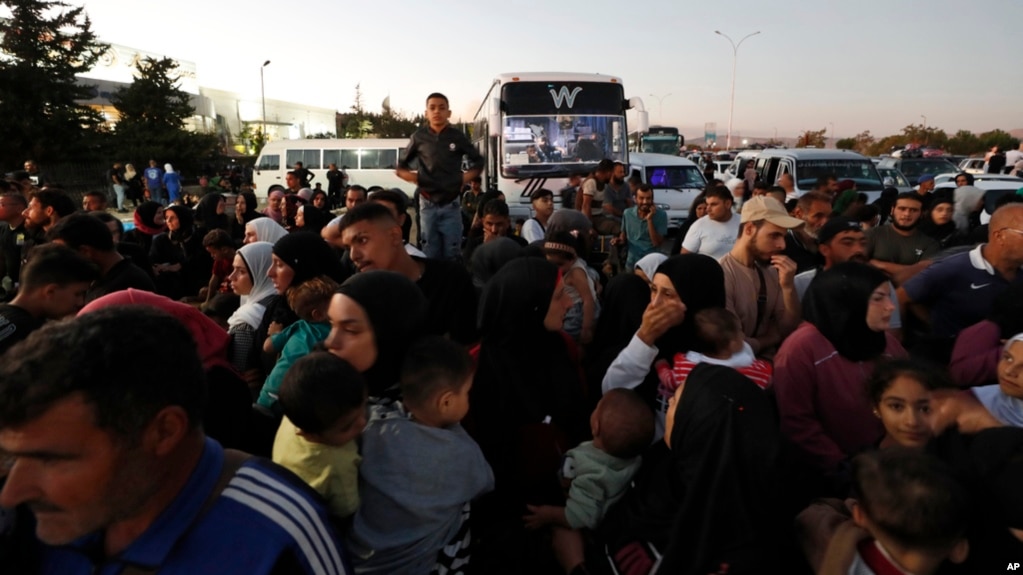
Syrians fleeing the war in Lebanon arrive at the Syrian-Lebanese border crossing in Jdeidet Yabous

Syria, Sept. 25, 2024.

JDEIDET YABOUS, Syria —

Families fleeing the escalating conflict in Lebanon poured into Syria in growing numbers on Wednesday, waiting for hours in heavy traffic to reach the relative safety of another war-torn country.

U.N. officials estimated that thousands of Lebanese and Syrian families had already made the journey. Those numbers are expected to grow as Israel targets southern and eastern Lebanon in an aerial bombardment that local officials say has killed more than 600 people this week, at least a quarter of them women and children. Israel says it is targeting Hezbollah fighters and weapons.

Lines of buses and cars extended for several kilometers from the Syria border beginning on Monday, and some families were seen making the journey on foot. Once in Syria, people waited hours more to be processed by overwhelmed border officials, and relief workers handed out food, water, mattresses and blankets.

"Many will have to spend the night outdoors waiting their turn," Rula Amin, a spokesperson for the U.N.'s refugee agency, said in a statement.

Amin said some of the people arriving from Lebanon had visible injuries suffered from recent attacks.

The cross-border flow was a striking reversal in fortunes given that Lebanon is still hosting more than 1 million Syrian refugees who fled the war in their country that began in 2011. That's when an initially peaceful anti-government uprising was met by a brutal government crackdown and spiraled into an ongoing civil war.

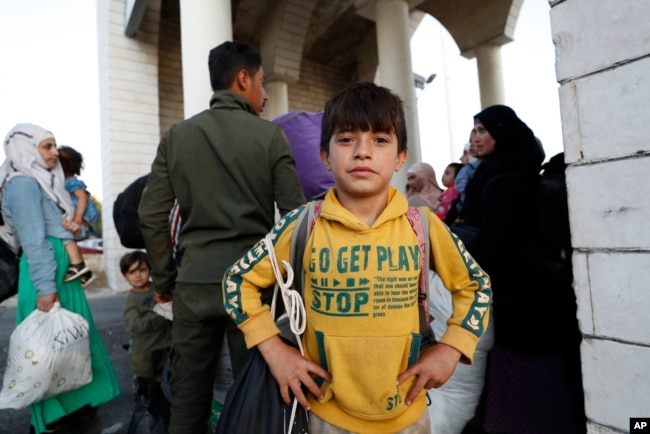
A Syrian boy is pictured as he flees the war in Lebanon with his family at the Syrian-Lebanese border crossing in Jdeidet Yabous, Syria, Sept. 25, 2024.

In the Syrian border town of Jdeidet Yabous, some families sat glumly on the side of the road when Associated Press journalists visited the area. Some used their bags as seats, waiting for taxis, buses or relatives to pick them up. Many said they had spent eight or nine hours in traffic just to get into Syria.

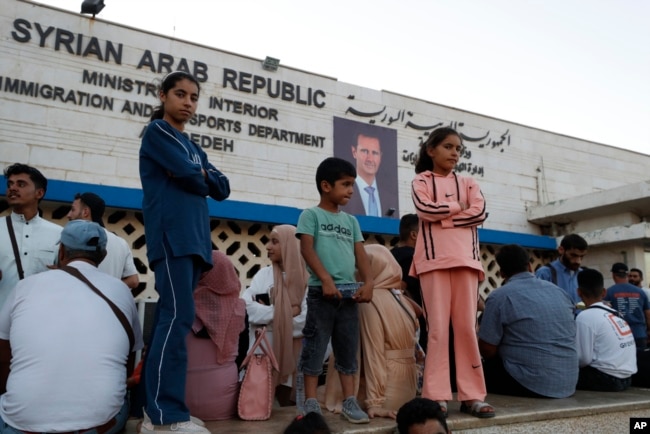
Before crossing the border, crowds packed into a government office to be processed by immigration officers and, in the case of Syrian citizens, to change $100 to Syrian pounds before entering — a measure imposed in an attempt to prop up the local currency by bringing more dollars into the country. Because of the sudden spike in demand, the supply of Syrian pounds at the border ran short.

Some were returning refugees, like Emad al-Salim, who had fled Aleppo in 2014. He was living in the southern coastal city of Tyre when Monday's bombardment began. He gathered his wife and six children and fled again.

"There were houses destroyed in front of me as we were coming out," he said. "It took us three days to get here."

Nada Hamid al-Lajji returned with her family after seven years in Lebanon with her husband. They are from eastern Syria, but al-Lajji said she doesn't know if they will return there.

"Where am I going to go?" she said. "I don't even have a house anymore. I don't know where I will go."

Many Lebanese families were also fleeing. Mahmoud Ahmad Tawbeh from the village of Arnoun in the country's south had come with an extended family of 35 people, planning to stay in a rented house in a Damascus suburb.

"We left with difficulty. There were a lot of bombs dropping above our heads," he said. Five or six houses in the village were destroyed and several neighbors were killed, he said.

Syrians fleeing the war in Lebanon, arrive at the Syrian-Lebanese border crossing in Jdeidet Yabous, Syria, Sept. 25, 2024.

For many in Lebanon, particularly those living in the Bekaa Valley in the east, Syria appeared to be the quickest route to safety. Israeli strikes across the country this week have wounded more than 2,000.

Many of the Lebanese arriving at the border refused to speak to journalists or would not give their full names because of the sensitivity of the situation. One woman from the town of Harouf in southern Lebanon, who gave her family name, Matouk, said she had come with her brother's wife, who is Syrian, to stay with in-laws.

Several families near where they lived were killed, she said, and she was worried about her father and siblings who she had left behind.

While the war in Syria is ongoing, active fighting has long been frozen in much of the country. Lebanese citizens, who can cross the border without a visa, regularly visit Damascus. And renting an apartment is significantly cheaper in Syria than in Lebanon. Even before the latest escalation, some Lebanese had rented in Syria as a Plan B in case they needed to flee.

Apart from those who fled the war, many Syrians come to Lebanon for work or family reasons, and regularly cross the border.

However, many of those who came as refugees have been reluctant to return out of fear they could be arrested for real or perceived ties to the opposition to Syrian President Bashar al-Assad or forcibly conscripted to the army. If they leave Lebanon, they could also lose their refugee status.

Earlier this week, Assad issued an amnesty for crimes committed before September 22, including for those who dodged compulsory military service.

He had issued similar amnesties over the past years, but they largely failed to convince refugees to return, as have efforts by Lebanese authorities to organize "voluntary return" trips.
ISRAEL CLAIMS INVASION IS SELF DEFENSE
Middle East conflict: Israel prepares for ground offensive against Hezbollah as Biden warns of all-out war

By Laure Al Khoury with Jay Deshmukh
AFP·
25 Sep, 2024 

Israel’s army chief told soldiers to prepare for a possible ground offensive against Hezbollah in Lebanon.
Israeli Prime Minister Benjamin Netanyahu vowed military operations against Hezbollah would continue until displaced northern residents can return home.
US President Joe Biden warned of “all-out war” in the Middle East after Israel’s troops were put on alert.

Israel’s army chief has told soldiers to prepare for a possible ground offensive against Hezbollah in Lebanon as US President Joe Biden warned against “all-out war” in the Middle East.

Prime Minister Benjamin Netanyahu vowed that Israel’s military operations against Hezbollah would not stop until northern residents displaced by cross-border clashes could safely return to their homes.

“We are attacking all day, both to prepare the ground for the possibility of your entry, but also to continue striking Hezbollah,” Israel’s army chief, Lieutenant General Herzi Halevi, told a tank brigade, according to a statement.

The US said it did not think Israel, its close ally, would launch a ground operation in Lebanon any time soon, however.
ADVERTISEMENT
Advertise with NZME.
ADVERTISEMENT
Advertise with NZME.


“It doesn’t look like something is imminent,” the Pentagon’s deputy press secretary Sabrina Singh told journalists, referring to a possible Israeli incursion.

Israel’s warnings came after Hezbollah said it had targeted Israel’s Mossad spy agency headquarters on Tel Aviv’s outskirts – the first time it has fired a ballistic missile in almost a year of cross-border clashes sparked by the Gaza war.

Discover moreLebanon reels after Israeli strikes kill nearly 500...
Deadliest day in Lebanon: Israeli strikes kill 492, ...
Lebanon's deadliest day sparks global alarm over potential ...
UN warns of Middle East 'catastrophe' as Lebanon strikes ...

Lebanon said Israeli strikes killed 51 people and injured 223.

The Israeli military said it hit more than 2000 Hezbollah targets over the past three days, including 60 Hezbollah intelligence sites.
ADVERTISEMENT
Advertise with NZME.

In Washington, President Biden warned of the possibility of “all-out war” after Israel’s troops were put on alert for a possible ground operation.

“An all-out war is possible,” Biden told broadcaster ABC.


“What I think is, also, the opportunity is still in play to have a settlement that could fundamentally change the whole region.”

Biden added there was a “possibility” of a Lebanon ceasefire, but “I don’t want to exaggerate it”.

Cross-border clashes intensified after Israeli raids on Monday killed at least 558 people in the deadliest day of violence in Lebanon since its 1975-90 civil war.

Nour Hamad, a 22-year-old student in the eastern Lebanese city of Baalbek, described living “in a state of terror” all week.

“We spent four or five days without sleep, not knowing if we will wake up in the morning,” she said.

In Tel Aviv, sirens sounded following Hezbollah’s unprecedented missile launch at dawn.

Tel Aviv resident Hedva Fadlon, 61, told AFP: “The situation is difficult. We feel the pressure and the tension ... I don’t think anyone in the world would like to live like this.”

The Israeli military said hundreds of targets had been struck across Lebanon on Wednesday.


“Fighter jets struck 60 terrorist targets belonging to Hezbollah’s intelligence directorate,” the army said.

It said two reserve brigades were being called up “for operational missions in the northern arena”, adding this would “enable the continuation of combat against the Hezbollah terrorist organisation”.

The pro-Iran Islamic Resistance in Iraq group said it attacked Israel’s Red Sea port of Eilat on Wednesday as another group urged more attacks amid soaring tensions over Gaza and Lebanon.

Israel’s military said it intercepted a drone approaching Eilat and that another fell in the area. It reported two minor injuries.
Debris and rubble from a destroyed building lie at the scene of an Israeli strike in the southern Lebanese village of Burj el-Shmali. Photo / AFP
Defiant Netanyahu

The UN Security Council said it would hold an emergency meeting on the crisis in New York on Wednesday, as UN chief Antonio Guterres warned the situation was critical.

“We should all be alarmed by the escalation. Lebanon is at the brink,” he said.


The UN’s International Organization for Migration said 90,000 people had been displaced in Lebanon so far this week.

Among them, “many of the more than 111,000 people displaced since October ... are likely to have been secondarily displaced”, said the UN’s Office for the Coordination of Humanitarian Affairs.

Netanyahu delayed his departure for New York until Thursday, when he too is due to speak at the UN General Assembly.

“We are striking Hezbollah with blows it never imagined. We are doing this with full force, we are doing this with guile. One thing I promise you: we will not rest until they return home”, Netanyahu said Wednesday in a statement.

The veteran right-wing Israeli leader has been accused by critics of stalling in Gaza ceasefire negotiations and prolonging the war to appease far-right coalition partners.

Iran, Hezbollah’s main backer, condemned Israel’s raids, with supreme leader Ayatollah Ali Khamenei saying the recent killing of Hezbollah commanders would not crush the group.


“Some of the effective and valuable forces of Hezbollah were martyred, which undoubtedly caused damage to Hezbollah, but this was not the sort of damage that could bring the group to its knees,” he said.
Elusive ceasefire

While the Israel-Lebanon border has seen near-daily clashes for a year, the violence escalated dramatically last week, when coordinated communications device blasts that Hezbollah blamed on Israel killed 39 people and wounded almost 3000.

Then Israel carried out an air strike on Hezbollah’s south Beirut stronghold, killing a top military commander and other fighters and civilians.

At the Lebanese Red Cross HQ in Beirut, people waited to donate blood, with Jad Assi, 39, telling AFP: “Given the crisis we’re currently experiencing, donating blood is the least I can do to show solidarity with my fellow Lebanese.”

Efforts to end the war in Gaza, which analysts say are key to stopping the escalation in Lebanon, have yet to make progress.

The war in Gaza began with Hamas’s October 7 attack on Israel, which resulted in the deaths of 1205 people, mostly civilians, according to an AFP tally based on Israeli official figures that include hostages killed in captivity.


Of the 251 hostages seized by militants, 97 are still held in Gaza, including 33 the Israeli military says are dead.

Israel’s retaliatory military offensive has killed at least 41,495 people in Gaza, most of them civilians, according to figures provided by the Hamas-run territory’s health ministry. The UN has described the figures as reliable.
Austria's polarising far-right leader bids to become chancellor

Francois Murphy
Tue, September 24, 2024 

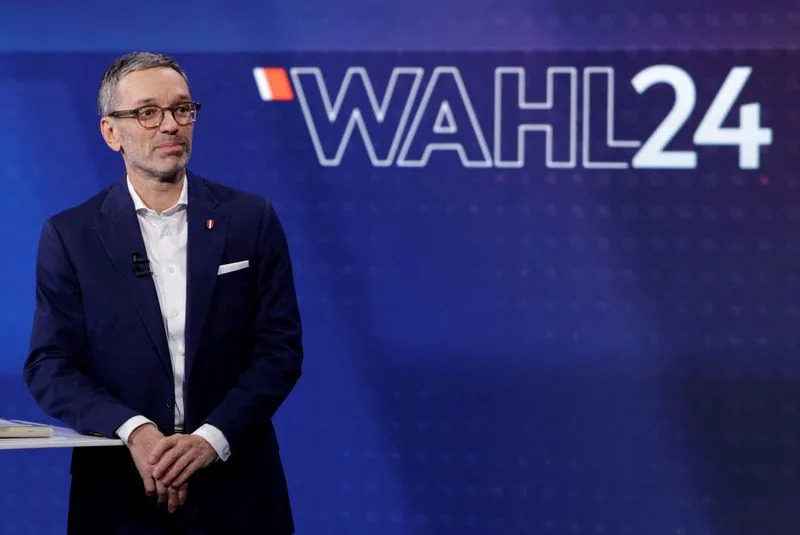
Head of Freedom Party Herbert Kickl waits for the start of a TV discussion in Vienna


By Francois Murphy

VIENNA (Reuters) - He is abrasive, provocative and has one of the lowest approval ratings among top Austrian politicians, but far-right leader Herbert Kickl is still the man to beat in Sunday's parliamentary election, which has at times resembled a referendum on him.

"Kickl here, Kickl there, Kickl everywhere," he joked at a typically rowdy, beer-filled rally in February.

Weeks earlier Chancellor Karl Nehammer framed the election as a choice "between him and me", at a conservative People's Party (OVP) meeting featuring lengthy video footage of Kickl.

"I don't know if I should feel more honoured or stalked!" Kickl said.

Such barbs punctuate Kickl's withering tirades against the unpopular OVP-Greens coalition government, helping make him arguably the most entertaining speaker in parliament.

He and his Freedom Party (FPO) have the wind at their backs. The economy is poised to shrink for a second year running and inflation has remained stuck above the European Union average.

Polls have long shown the Islam-critical FPO, which wants tougher immigration laws, leading a two-horse race with the OVP. The winner will need to form a coalition to govern.

Kickl is loathed by other party leaders, who have vowed not to work under him. He has shown no indication he could emulate Dutch nationalist Geert Wilders, who in March stepped aside so a government could form after his party won in 2023.

The FPO's lead is now wafer thin, and the OVP has stepped up its depictions of Kickl, an ally of Hungarian Prime Minister Viktor Orban, as an extremist threat to security and democracy.

"It's impossible to form a government with someone who adores conspiracy theories, who describes the WHO, the World Health Organization, as the next world government and the economic forum in Davos as preparation for global domination," Nehammer said this month.

Nehammer has left the door open to working with the FPO without Kickl. The parties, which overlap on immigration policy and cutting taxes, were in coalition from 2017 until 2019, when Kickl's predecessor Heinz-Christian Strache was shown in a sting video offering to fix state contracts.

Kickl has long been a central figure in the FPO, but he regularly lands at the bottom of an OGM survey for news agency APA of leading politicians' popularity. Only the departing speaker of parliament Wolfgang Sobotka fares worse.

Kickl has cast himself as the future "Volkskanzler", or people's chancellor - a term the Nazis used for Adolf Hitler, though others have also used it.

In 2010, Kickl said he opposed deeming Hitler's Waffen-SS "collectively guilty" for war crimes. The FPO's first leader in 1955 had been a senior SS officer and a Nazi minister.

Kickl and the FPO oppose sanctions against Russia over its invasion of Ukraine, saying it violates Austria's neutrality.

He has embraced conspiracy theories, claiming the de-worming agent ivermectin is effective against COVID-19, as did former U.S. President Donald Trump.

Yet his campaign against coronavirus restrictions like lockdowns and vaccine mandates helped revive the party's fortunes after it crashed out of government in Austria, which had the highest rate of vaccine holdouts in the EU.

'CLEAR AND VERY FOCUSED STRATEGIST'

Kickl was interior minister and Nehammer a senior OVP official during a coalition between their parties that imploded in 2019.

After the sting video, then-Chancellor Sebastian Kurz had Kickl dismissed as interior minister. Nehammer subsequently became interior minister, but when a 2020 deadly jihadist attack in Vienna revealed serious failings at the domestic intelligence agency Nehammer oversaw, he blamed Kickl.

That was a reference to a 2018 police raid of the agency's offices that opponents say Kickl orchestrated to purge it of OVP loyalists.

Kickl denies that, but President Alexander Van der Bellen, who will oversee the formation of the next government, has criticised the FPO chief for the raid and hinted he would not let him become chancellor.

Kickl cuts a far more serious figure than predecessors like Strache and Joerg Haider. He shuns parties and has competed in Ironman-style ultra-triathlons.

"He is a very, very clear and very focused strategist, and as we see every day he is very much on the attack and even aggressive," political analyst Thomas Hofer said.

(Reporting by Francois Murphy; Editing by Dave Graham and Sharon Singleton)

Greens vow to expand safer supply of drugs in B.C., ex-coroner Lapointe backs plan

Ashley Joannou and Nono Shen
Tue, September 24, 2024 


British Columbia's former chief coroner is criticizing plans by two of the province's major political parties for involuntary treatment of people with drug addictions, saying there's little evidence it works and more people will die.

Lisa Lapointe emerged from retirement in the starting days of the B.C. election campaign to throw her weight behind a BC Green Party campaign pledge to expand prescribed safer supply of opioids and other drugs to deal with the province's deadly overdose crisis.

Political leaders fanned out their campaigns across the province Tuesday, with NDP Leader David Eby in Terrace in the province's northwest, while B.C. Conservative Leader John Rustad went to the southeast, in Kimberley, where he criticized the Greens' drug plan, calling decriminalization and safe supply "nonsense."

Rustad also confirmed that he regrets getting vaccinated for COVID-19, a day after a video surfaced of him telling a group of former public servants who believe they were discriminated against that he regretted getting the "so-called" vaccine.

Rustad told reporters Tuesday that after getting his second vaccine he had heart problems and when he went to get his third shot "the question they had for me was only one word, 'Moderna?' And to me, that tells me that there has been some issues, and so, from that perspective, I do regret getting the COVID vaccines."

Both the governing New Democrats and the B.C. Conservatives have campaigned on promises to bring in a form of involuntary treatment, if elected, but Lapointe said at a news conference in Victoria with Green Leader Sonia Furstenau, that there's little evidence to support the idea.

"We need to be very careful before we jump off this involuntary care cliff as the answer to this very complex public health emergency. We know people die after treatment. We know that involuntary care has very little evidence to support its effectiveness. What would really help people is having access to the care they need much further upstream," she said.

Lapointe said people can't access family doctors or mental health supports and are stuck on long waiting lists for any sort of treatment they want to attend.

"If people can't access the voluntary care that they're trying to access, how can we then incarcerate them involuntarily when there's no evidence that that would be successful?" she said.

"We are just setting ourselves up for a disaster, and more and more and more people will suffer the effects of substance use disorder, and more people will die, more families will be harmed."

Figures from the BC Coroners Service show more than 15,000 people have died in the province from overdoses since a public health emergency was declared in April 2016.

A report on care options for people with severe addictions released by the NDP government as it announced its plans for involuntary care earlier this month says "there is insufficient high-quality evidence regarding the effectiveness of involuntary care" for people with substance use disorder.

Furstenau said other party leaders have indulged in unacceptable "dehumanizing rhetoric" against drug users.

She said a broader system of prescribed safer supply of drugs, including fentanyl, is needed, as well as a "demedicalized model" to reduce stigma and barriers in the current system.

She said a Green government would regulate treatment and recovery programs and gather data to track outcomes and availability.

"We have hundreds of millions of public dollars going to treatment and recovery programs that are not required to provide data. They're not required to provide evidence that their programs work," she said.

"So, with urgency, we need the province to take on the responsibility of regulating treatment and addictions programs."

The Greens are also promising drug education in schools and enhanced mental health support.

Lapointe retired earlier this year after 13 years as chief coroner and in the midst of the toxic drug crisis.

Before her retirement, Lapointe lamented that the emergency never received a "a co-ordinated response commensurate with the size of (the) crisis."

In her final months as chief coroner, a review panel recommended providing controlled drugs without prescriptions but the idea was almost immediately rejected by the provincial government.

Elsewhere on the campaign trail, NDP Leader David Eby was in Terrace in B.C.'s northwest looking to win back the Skeena riding that is being vacated by Ellis Ross, who held the seat for BC United, but he will now run in the next federal election for the Conservatives.

Eby stood outside the new Mills Memorial Hospital, which is slated to open to patients in November, ahead of its original spring 2025 completion date.

He disputed Lapointe's comments that involuntary care does not often work and would lead to more people dying.

"What we're talking about is people who have serious mental health issues and addictions and brain injuries, and how we care for that population of people to make sure that they have a minimum standard of dignity and quality of life and to make sure the broader community is safe as well," he said.

Eby said the goal is to ensure better care for people. "And I'm not going to back down," he said at an outdoor news conference.

The NDP announced it had nominated candidates in all 93 ridings for the Oct. 19 election. The party said the slate was 60 per cent women.

In Kimberley, Rustad released his party's campaign pledges for the mining industry, promising to simplify permitting, cut redundant regulations, invest in rural infrastructure, and foster strong Indigenous partnerships.

The NDP also rolled out promises to grow the critical minerals sector on Tuesday, including guaranteed permit review timelines for priority projects, building out the electricity grid, and a "critical minerals office," first announced in January, to offer dedicated support including co-ordination with the federal government.

All three leaders are scheduled to debate each other two days before advance polling opens.

A consortium of broadcasters announced the Oct. 8 debate will air from 6:30 p.m. to 8 p.m. on all major television and radio news networks and be moderated by Angus Reid Institute president Shachi Kurl.

This report by The Canadian Press was first published Sept. 24, 2024.

Ashley Joannou and Nono Shen, The Canadian Press