Wednesday, September 25, 2024

Roman-era artifacts found in southeastern Türkiye


ADIYAMAN, 24 September (BelTA - Anadolu) - Historical artifacts from the Roman period, which had gone missing after their initial discovery, have been found during field research in an ancient city in southeastern Türkiye.

Pottery, columns, relics, and various architectural pieces found in the ancient city of Perre in Adiyaman province have been put on display.

Adiyaman Museum Director Mehmet Alkan told Anadolu that the artifacts were discovered during field research 1 kilometers (0.62 miles) south of the ancient city.

"Previously, it was reported that these pieces were unearthed next to the Roman fountain of Perre in 1980. We brought these artifacts back to Perre after 40 years, making them ready for visitors."

According to Alkan, these architectural pieces are approximately 1,800 years old.


Iron Age, Roman and medieval jewels discovered after Stonham Aspal excavation at housing project site

By Ross Waldron
ross.waldron@iliffepublishing.co.uk

 20 September 2024

Jewels from the Iron Age, Roman and medieval times have been discovered at the site of a new housing development.

Archaeologists from Pre-Construct Archaeology made the finds during pre-construction excavations for the 46-property Homestead Park project in Stonham Aspal.

The artefacts included a medieval gold ring, silver coins from the same era and over 40 Iron Age and Roman brooches. A rare first century copper-alloy vessel was also recovered.

Iron Age and Roman brooches were found after the excavation in Stonham Aspal, at Orbit Homes' Homestead Park site. Picture: Submitted

It is believed the site once houses 11 late Iron Age to Roman roundhouses, with the earliest occupation suggested to be around 50BC.

Andy Georgiou, sales and marketing director at Orbit Homes, said: “It has been amazing to learn more about the history of Stonham Aspal from the discoveries at Homestead Park.

“We enlisted PCA as part of the pre-construction programme we undertake at every site and we were delighted to see the archaeologists unearth such fascinating finds, which could have otherwise been left undiscovered for many more years.”
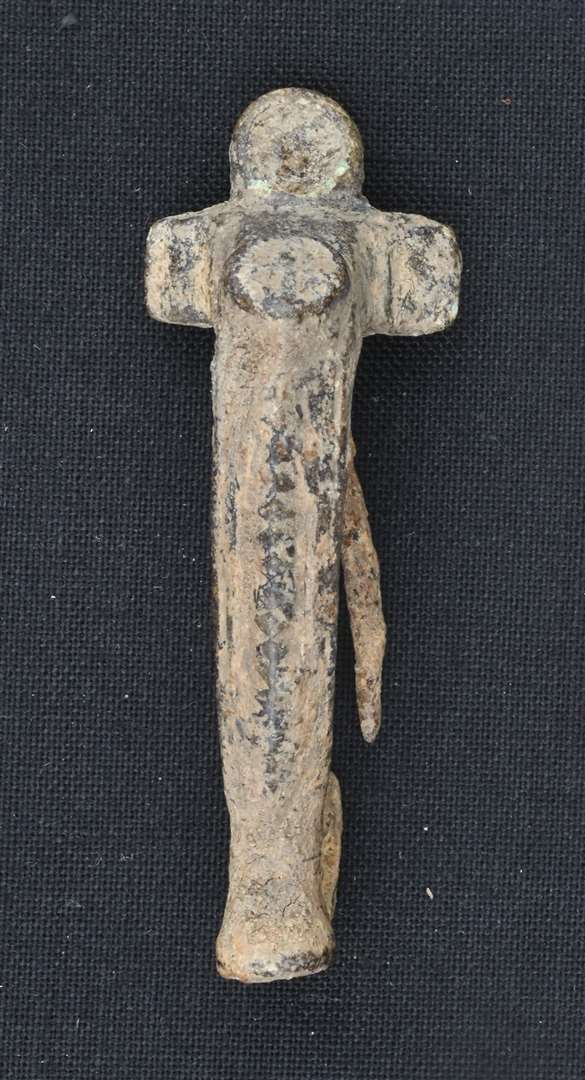
A series of Iron Age, Roman and medieval jewels were found in Stonham Aspal as Orbit Homes under took a pre-construction excavation at its Homestead Park site. Picture: Submitted

With the excavation now complete, works are under way on the collection of two and three bedroom houses and bungalows planned at Homestead Park.


Pharmacy closures in England threaten plan to use them instead of GPs for some care

Denis Campbell Health policy editor
Wed 25 September 2024 

A total of 436 community pharmacies in England shut permanently in 2023.Photograph: Julien Behal/PA

High street pharmacies are closing at such an alarming rate that it threatens the drive to use them instead of GPs to care for millions of people, the NHS’s patient champion warns today.

A total of 436 community pharmacies in England shut permanently last year and there were also 13,863 temporary closures, which stopped patients from obtaining health advice and medication.

What appears to be a growing trend of permanent closures is hitting rural areas, those with larger numbers of older people and deprived communities hardest, according to Healthwatch England.

Its findings, which were based on figures supplied by NHS bodies, prompted fears that closures are leaving some parts of England as “pharmacy deserts” where patients struggle to access care.

The watchdog received responses to freedom of information requests it submitted from all but one of the 42 NHS integrated care boards (ICBs), regional bodies that commission and pay for NHS services.

They showed that 436 pharmacies closed down between 1 January and 31 December 2023 – an average of more than one a day. In addition, pharmacies also closed temporarily 13,863 times, for a total of 46,823 hours and for an average of almost 18 hours at a time in some places, the data from ICBs showed.

“Staff shortages, the key driver of permanent and temporary closures, call into doubt the potential of Pharmacy First, meaning people can’t get the advice, care and medications they need and when they need them”, said Louise Ansari, Healthwatch’s chief executive.

Pharmacy First is the government’s drive to reduce the strain on overworked GPs through pharmacists treating what it hopes will be millions of patients a year for seven minor ailments such as a sore throat, earache, infected insect bite or sinusitis.

“It’s clear that rising levels of closures are risking leaving some areas of the country as pharmacy deserts, with people having to travel much further to get access to vital services”, said Paul Rees, the chief executive of the National Pharmacy Association.

“Community pharmacies act as the front door to the NHS. If people lose access to them it will force more patients into the eight o’clock scramble at their GP surgery, putting pressure on the rest of our NHS system.”

Responses from ICBs show that staff shortages, including the difficulty in finding locum pharmacists, lie behind many of the temporary closures, Healthwatch added.

Temporary closures “are adding to the deepening crisis in the sector”. It also acknowledged longstanding complaints from pharmacy organisations that lack of government funding is hampering their activities by asking ministers to “evaluate” the money the sector receives.

Healthwatch’s findings showed that:

  • Cheshire and Merseyside ICB saw the most permanent closures last year – 51

  • The North East and North Cumbria ICB had the highest number of temporary closures – 1,438

  • The same area also saw the highest number of hours lost to temporary closures – 4,054

  • And pharmacies in the Norfolk and Waveney ICB area shut temporarily for the longest number of hours on average – 17.48

The Department of Health and Social Care said that it plans to review the funding that goes to a sector that had been “neglected for years” under the Conservatives.

“This government inherited a broken NHS where pharmacies have been neglected for years”, a spokesperson said.

“Pharmacies are key to making healthcare fit for the future as we shift the focus of the NHS out of hospitals and into the community.

“We will make better use of their skills by increasing the number of pharmacists able to prescribe medication themselves and launch a review of community pharmacy funding.”

ECO-RADICAL PROGRESSIVE CONSERVATIVE

Theresa May denounces Trump, Farage and Le Pen over climate change ‘hoax’ claims


Far-right leaders in Europe and the US are trying to wreck measures to save the planet, Theresa May warns. They want to ‘stir up a culture war’ to win votes, says the former PM, who criticises Trump for calling climate change ‘a hoax’ – and accuses Nigel Farage of ‘politicising’ the issue.

David Maddox
Political editor
Wednesday 25 September 2024 

Theresa May has launched a blistering attack on those who call climate change a hoax 

Theresa May has launched a blistering attack on Donald Trump and other leading right-wing politicians including Nigel Farage and Marine Le Pen over their climate-change denial.

In a wide-ranging speech in New York, Baroness May also warned that the climate crisis is now fuelling the cruelty and criminality of the modern slave trade.


The former prime minister was giving the keynote speech at The Independent’s Climate 100 event, as world leaders including British prime minister Sir Keir Starmer gathered in New York for the United Nations General Assembly

Baroness May’s anger at those like Trump and Mr Farage who describe climate change as a “hoax” or a “scam” echoes warnings made ahead of the Climate 100 event in a powerful intervention by the Archbishop of Canterbury, Justin Welby.


Theresa May is the keynote speaker at The Independent’s Climate 100 event in New York (Getty)

As Tory chair in 2002, after a second humiliating defeat to Tony Blair, Ms May famously delivered a warning to the Conservatives that they had “become the nasty party” by turning their backs on the issues that resonated with ordinary voters.

Her attack on Trump and Mr Farage also includes an implied criticism of her own party, where the four leadership candidates have all moved towards Reform, pulling away from green policies like those she championed in government.

She made a passionate appeal for leaders to take the climate crisis seriously, not just to save the planet but also for the sake of humanity.


She raged against “those who pit ‘the people’ against an out-of-touch elite”, accusing them of using the climate change debate “to fight a culture war”.


open image in galleryDonald Trump has claimed that climate change is a hoax (AP)

Turning her fire on Trump, whom she met at the White House as prime minister and held hands with as she walked down the stairs, Baroness May said: “Here in the United States, action on climate change is already a feature of the upcoming presidential election, with one of the two main candidates promising to repeal recent climate legislation and ramp up drilling for fossil fuels.


“It’s a position arising partly from a long-held conspiracy theory that climate change is a ‘hoax’.”

The intervention comes just weeks away from the US election, in which Trump will stand against current vice-president Kamala Harris as he attempts to return to the White House.


The Independent’s Climate 100 event marks the launch of the Climate 100 List, a roll call of leading climate activists, innovators, scientists, business leaders, creators, policymakers and entrepreneurs from around the world, selected by The Independent.

At a time when Sir Keir is focused on delivering economic growth, Baroness May reminded her audience and the wider political class that green policies are positive forces for economic growth and job creation, not a cost imposed on the taxpayer.

“Despite the opportunities ahead of us, our aspirations of transitioning our economies towards sustainability are increasingly under attack – particularly in Western democracies.”


Nigel Farage has said that climate-change measures drain money from taxpayers (AFP via Getty)

Baroness May cited the type of rhetoric used by Marine Le Pen, who narrowly failed to win in France’s recent parliamentary elections, and Alternative for Germany (AfD), who could end up sharing power in the German parliament after next year’s general election.

“Those of us who advocate accelerating our progress towards net zero emissions are labelled fanatics and zealots. Ironically, the name-calling often emanates from ideologues at the political extremes or from populists who offer only easy answers to complex questions.

“Those who drive wedge issues that seek to divide us. Who crave deeper polarisation in our societies in order to rally support for their cause.”

But her ire was also focused on Britain and the rise of Mr Farage’s Reform UK, with its intent to undermine attempts to tackle climate change.

“In my own country, climate change has become politicised by some on the right of British politics. We saw in the recent general election how the Reform party campaigned on a platform of opposing the UK’s climate objectives.


Jenrick, pictured speaking at a Conservative Party leadership campaign event, has questioned the importance of net zero policies (PA Wire)

“It framed net zero as a cost imposed from on high that threatens livelihoods and will send jobs abroad.”

Baroness May highlighted how important the Climate 100 event is in terms of making the case for action.

“Well done to The Independent for its leadership in this area, not just today, but for placing climate change and environmental concerns at the core of its journalism for many years,” she said.

But she warned: “Let’s face it: we have been talking about this for years, and still we are not achieving the change we need. In many ways, the term ‘climate change’ has just become another part of the everyday language of politicians, used so often that people forget what it really means. Dismiss it from their thinking, get on with life, think: ‘It doesn’t mean anything to me – and in any case, someone else will have to sort it out.’

“The onus is on those in the political centre ground to provide due challenge.

“When the sceptics say that the green transition will cripple business, we say they could not be more wrong. Study after study shows that the transition to renewable energy will unlock global market opportunities worth trillions of dollars over the next decade alone – with businesses in every world region able to capitalise.”

She added: “When the critics say transitioning to renewables costs too much, we say it’s wrong to see it as a cost. It’s an enormous investment opportunity for the private sector, where, over time, the economic returns far outstrip the investment required.”

But more than the economics and the need to save the planet, Baroness May was concerned about the immediate impact on humanity. She noted that she had witnessed climate change on her holidays to Switzerland with her husband Sir Philip.

“When we stand at Rotenboden above Zermatt, we see the retreat of the glaciers. And this year, there was so much rainfall in June that it caused flooding in the village, and brought about landslips that closed the railway down the valley.

“I’m told that the replacement buses alone cost 1 million Swiss francs, let alone the cost of the repair work to this vital transport artery.”

But the most troubling stories come from the way in which the climate crisis is fuelling modern slavery.

As home secretary and prime minister, Ms May was responsible for taking on the scourge of modern slavery, which affects millions around the globe. She also brought in some of the most far-reaching reforms on clean air, and instigated a 25-year environment plan.

Her stark warning to those gathered in the audience and beyond was that the evil trade in human beings is being fuelled by the climate crisis and the despair it creates.

“Climate change has and will lead some to poverty and desperation.

“Some of the most dire outcomes of climate change are humanitarian. When extreme weather events destroy homes and livelihoods, when harvests fail, when water supplies dry up, when sea levels destroy communities, and when political instability and conflict take hold, people are often left destitute – with no roof over their head, no economic security, no reliable means to feed their families, and no support network.

“Life becomes a matter of survival from one day to the next, and into that picture come the criminal gangs making money out of human suffering. Because these situations make people more vulnerable to being trafficked and taken into slavery.”

She told of the harrowing tales that had crossed her desk – of a 53-year-old Romanian electrician, a girl she called Jane who was forced into the sex industry, and a seven-year-old girl used as a slave and forced to sleep with the dogs.

She said: “These are stories from the UK and the USA, but slavery is worldwide. In nine years, one safe house in London has taken in women from 50 different countries.”

Baroness May founded and chairs the Global Commission on Modern Slavery and Human Trafficking, which brings together influential figures from politics, civil society, business and academia to restore lost political momentum in addressing this issue.

She said: “The World Bank estimates that, by 2050, a further 143 million people will have been forced from their homes in Africa, south Asia and Latin America because of climate change. It will contribute to a global migration phenomenon that far surpasses anything we are experiencing today.

“So the window of opportunity is closing to act on climate change, to preserve our planet, and to alleviate human suffering.”


Ancient Orkney shipwreck put in water tank for preservation

Morven Mckinnon
BBC Scotland News
Orkney Islands Council
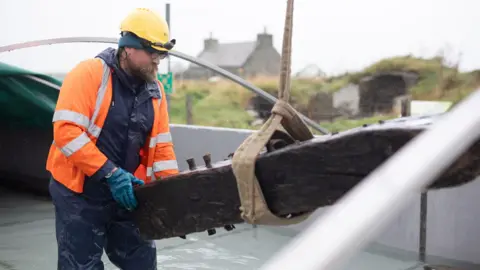
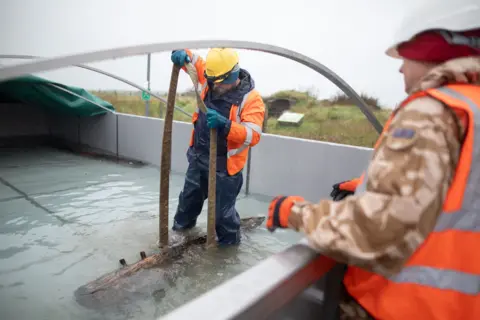
Marine archaeologist Ben Saunders helps place the wood in the tank for study

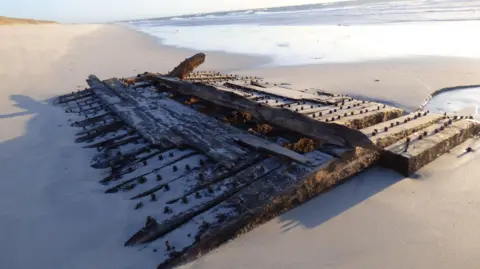
A shipwreck found washed ashore on a beach on Orkney has been put in a water tank for preservation and study.

The timbers were discovered on the island of Sanday in February after they were released from the seabed during a storm.

Researchers believe the wreck could be from the 17th Century and possibly of Dutch origin.

Marine archaeologist Ben Saunders, who has been working on the wreck, described it as a "significant" find.

"You don’t see timber shipwrecks ashore and easily recoverable in this sort of size very often," he said.

"I’ve only worked on three or four and that’s across the UK and Europe in the last ten years.

"They’re more commonly found subsea - when they tend to stay there because it’s expensive to recover them."

PA
The shipwreck was found on a beach on Sanday in February

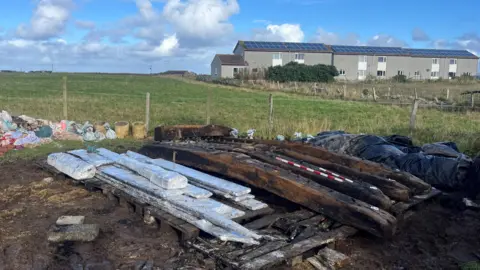
For the past six months the Sanday Heritage Group has maintained the wreck by covering the wood in old bed sheets and watering them weekly.

This prevented the timbers from decay, because as soon as they are removed from the sea they start to dry out and break down.

Mr Saunders said this has been key to the wreck's survival.

"They’re still in pretty good condition, not far off the condition they were found in," he said.

The wreck was wrapped in damp sheets for the last six months

The timbers are now being kept in the 8m stainless steel tank at the island’s heritage centre.

The tank was built with the help of the National Heritage Memorial Fund, which awarded £80,000 to Orkney Islands Council to help preserve the wreck.

The water will prevent deterioration for two to three years while research is carried out into the ship’s identity and significance.

Mr Saunders, who works for Wessex Archaeology, said it will allow them to understand more about historic shipbuilding techniques.


Twenty samples have been taken from the ship's frame to give archaeologists the best chance to establish the construction date.

They will use dendrochronology, also known as tree ring dating, where the rings in the wood are counted to establish the age of a tree.

The team will also try to identify the name of the ship from historic records from Sanday and the Orkney islands.


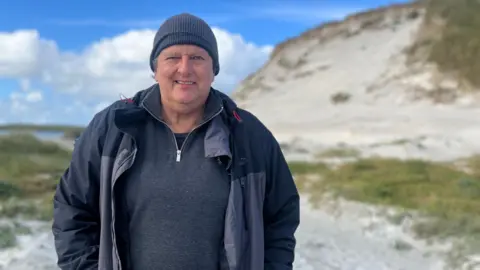
Clive Struver of Sanday Development Trust on the beach where the wreck was found

Several potential merchant marks have been found on some of the timbers.

Mr Saunders said these could be examples of international timber trade.

He said: “Orkney and Shetland had a really important position on a lot of international trading routes during the medieval period.

“Sanday has been for centuries a major source of shipwrecks and this could be from any period around that time."

The island heritage centre hopes more details of the shipwreck will be revealed.

Clive Struver, chair of the Sanday Development Trust, said the shipwreck could be a archaeological attraction for the island and more research was "vital".

He added: "Something like this is such a rare find that it’s incredibly important we make the most of it and we do everything to preserve it.

"Not only for the local history but the British maritime heritage, it could be very significant."
Orkney Islands Council
The timbers are moved into place in the 8m stainless steel tank

Ellen Pesci, social history curator at Orkney Museum, said the find was "quite amazing".

"Right now it’s a little bit abstract because we’ve had to deconstruct it to put it in to the tank, so it looks like pieces of wood", she said.

But she said it was important for the residents of Sanday to retain ownership of the shipwreck.

Mrs Pesci hopes they will eventually be in a position to seek funding to put the shipwreck on display.

"It also has to be something that works in particular for the community," she said.

"It’s a slow process - you have to go through those stages before having it in a glass tank, like the Mary Rose of Sanday."

About 200 shipwrecks have been catalogued around the island, dating back to 1596.


Universal Music chief David Joseph leaves biggest job in industry to study religion

Former JFS pupil David Joseph now intends to study for a master's degree in religion and theology

David Joseph


Joseph

Universal Music UK chief executive David Joseph has announced he’s stepping down from the biggest job in the industry.

Joseph, a former JFS pupil, and widely regarded as one of the industry’s “nice guys” had worked for Universal Music Group CEO Sir Lucian Grainge for 26 years.

Confirming his decision to staff, Tottenham Hotspur fan Joseph said he plans to now study for a master’s degree in religion and theology at King’s College London.

Despite his success in the industry, Joseph is known for his down-to-earth and thoughtful persona. Awarded a CBE in 2016 for services to the music industry, Joseph, who grew up in Southgate, north London, moved from RCA in 1998 where he was head of artist development.

He had first worked with Take That in the early 1990s at RCA, bringing them over to Universal when they reformed in 2006.

Other successes include Amy Winehouse, Florence + The Machine and Sam Smith.

In his role at Universal the label has gone on to represent acts including Stormzy, Ellie Goulding, Lewis Capaldi, Celeste, U2, Years & Years and Michael Kiwanuka. International stars include Eminem, Taylor Swift, Kendrick Lamar, Lady Gaga and Rihanna.

In his memo to staff, Joseph wrote: “It has been an honour to work alongside you, creating something truly exceptional, a company that wasn’t only number one but also led with heart and creativity. We’ve done that together.”

He added: “This team is immensely talented, fuelled by ideas, passion, and imagination. It’s a rare privilege to wake up every day and work at the greatest company in the music industry alongside remarkable artists and their managers who have chosen you – chosen us – to be part of their lives.”

Grainge said: “David and I have worked together for 26 years, beginning when he agreed to join me in the turnaround of Polydor in the late ’90s.

“It’s been a remarkable journey. One of the many things I respect about David is that he never tried to be anyone but himself and he guided the UK company to heights in a way that was completely authentic to him. In addition, I have enormous respect for his decision to take an entirely different path after so many outstanding years at UMG. “

 UK

It’s no time for despair – Ben Selby, FBU

Featured image: FBU members join a demo. Photo credit: FBU


The leadership will come under huge pressure to not go anywhere near socialist policies, we’re already seeing it. We must as a movement drag this government to the left.

By Ben Selby, Fire Brigades Union

There is a need to discuss what’s next for socialists in and out of the Labour Party and how we push this new government left.

There is no denying it’s been a difficult five years for the socialist left. With the Coronavirus crisis, the looming existential threat posed by climate catastrophe, and a resurgent far-right, it could not be more important for us to keep fighting – inside the party and in our communities and workplaces.

It’s been a dispiriting time, but we shouldn’t lose sight of how much we’ve shifted the terms of debate.

Public ownership is beginning on railways, not far enough in our opinion but water and and energy will no doubt have to be next in line.

We didn’t achieve what we wanted with Jeremy’s leadership, but we have transformed the policy landscape in the party and the country. We’ve put socialist ideas into the mainstream. And we’ve got a new generation of committed socialists.

This isn’t nothing. Important advances have been made.But this is not to understate the challenges ahead.

We as socialists have the ideas, the Blairite tribute act don’t, that’s why they keep rolling him out. And I want to make this point here about Sir Tony Blair’s comments about Grenfell when he said tragedies like Grenfell cannot be completely avoided, and that people are ‘going to make mistakes’. They were utterly disgraceful and the sooner that man is in the Hague the better.

The shock of the coronavirus pandemic and cost of living crisis has shown how fragile the free market is. It shows how capitalists rely on the state when they need it. In 2008, bankers crashed the economy, they ran to the state for help, and then they made the rest of us pay their debts for a decade.

But in 1945, the working class insisted that if we could house and care for everyone in a crisis, we could in peacetime too. It’ll be up to us to shape which path we take now. As socialists and as a party, this is what we should be saying.

This crisis has shown that the state can intervene to protect living standards. So let’s do that all the time – not just in emergencies.

It’s shown the harm of hoarding – so let’s break the power of the billionaires who hoard society’s wealth. It’s shown that we can house the homeless – so let’s ensure no one ever sleeps rough again. It’s shown that cuts have consequences – so let’s never underfund our NHS, fire and rescue service again.

And it’s shown that society is nothing without the working class. So let’s build a society run by, and for, our class in all its diversity.

The leadership will come under huge pressure from outside the party and from inside it to not go anywhere near socialist policies, we’re already seeing it.

And my union, the FBU, is very clear where it stands on these two recent issues and where the leadership is wrong:

On the riots, these were racist, far right and Islamophobic – not just thuggery. On the two-child benefit cap, it keeps 300,000 children in avoidable poverty – it should be immediately scrapped – no excuses.

And winter fuel payments prevent fuel poverty and are important to so many in society. If the heating is on in Downing Street, I should be on in all homes. So that’s why the FBU said to Labour MPs on the parliamentary vote over winter fuel payments – you cannot abstain on austerity and your vote will be remembered.

And on the New Deal for working people, and we only see this as a stepping-stone, we must repeal all anti-trade union laws and we must all step up this campaign.

Tony Benn once said that although the Labour is not a socialist party, it has always had socialists in it. I think we might begin to feel this more in the months and years to come.

But if we’re serious about transforming society, we can neither abandon the party nor our socialism. We must as a movement not just push but drag this government to the left.

But the challenges we face – the threats and the dangers – mean it’s no time for despair. We have no time for retreat. Moderation won’t cut it. Only socialism will. So solidarity comrades.

Let’s keep fighting.


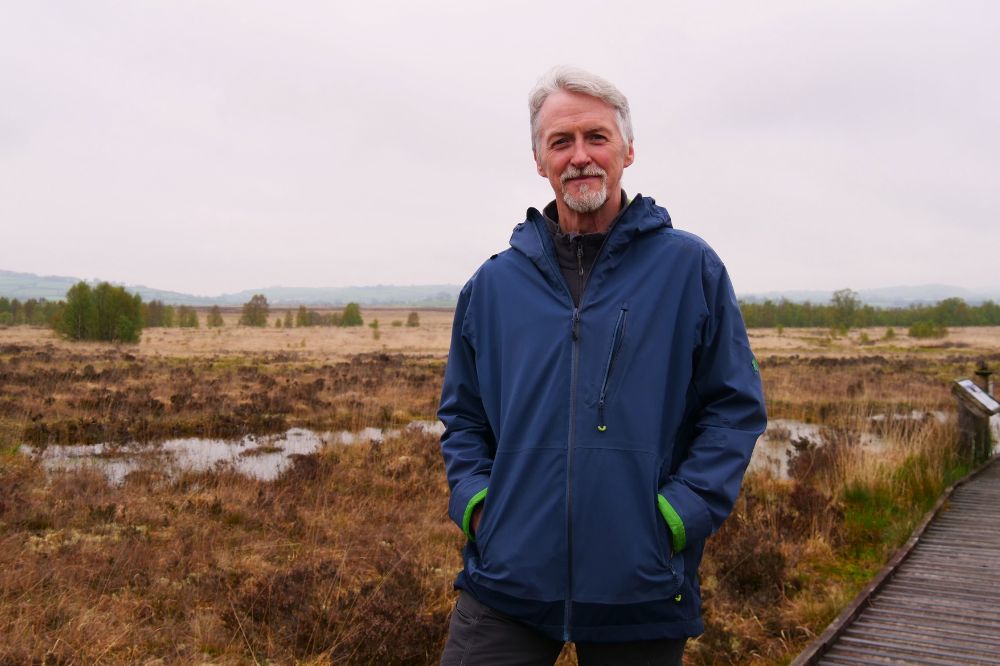
Welsh peatland restoration targets met a year early


25 Sep 2024      NATION CYMRU
Deputy First Minister with responsibility for Climate Change, Huw Irranca-Davies

An action programme to restore Wales’ peatland has met its targets a year early.

Set up by the Welsh Government in 2020, the National Peatlands Action Programme is delivered by Natural Resources Wales.

The five year programme had ambitious targets of restoring 3,000 hectares of peatland – the equivalent of more than 3,000 rugby pitches.

Today, Deputy First Minister with responsibility for Climate Change, Huw Irranca-Davies confirmed targets had been met 12 months early.

Emissions

He says the works have safeguarded more than 1.6m tonnes of stored carbon, resulting in an estimated emissions reduction of 8,000 tonnes of carbon every year – the equivalent to the emissions of 5,700 cars.

The Deputy First Minister said: “I am delighted to confirm that our ambitious peatland restoration targets for April 2025 have been met ahead of time. This is a huge step forward for climate and nature in Wales.

“Peatlands are so important. They store a quarter of all soil carbon in just four per cent of our land area, reduce the risk of wildfire and are vital for rare plant species like Sphagnum mosses, which play a critical role in flood and drought resilience and carbon sequestration.

“Wales is facing a climate and nature emergency and this work goes a long way to ensure these precious habitats can survive and adapt in a changing climate.

“Congratulations to everyone involved in this work, and I’m looking forward to following the fifth restoration season to see just how much further we can go.”

Valuable

Mannon Lewis, NRW’s Strategic Projects Manager who heads the National Peatland Action Programme, said: “Peatlands are our most valuable land resource for carbon storage, and their restoration is an effective nature-based solution to address the Nature and Climate emergencies.

“The restoration of peatland biodiversity is a critical aspect of nature recovery and secures effective long storage of carbon and the regulation of greenhouse gasses to the atmosphere, as well as other ecosystem benefits.

“In addition to the hectares delivered, the National Programme has provided the strategic leadership needed by partners working across Wales to plan for the acceleration of delivery into the future.”

Some Peatlands in Wales are over 10,000 years old and contain the historic environmental record for Wales.

They filter and supply drinking water into our reservoirs with significant volumes of drinking water starting its journey in upland peat bogs.

The action programme work has been complemented by other peatland projects including those funded through EU LIFE, National Parks, Heritage Lottery and land owners.

Collectively, these have delivered restoration activity across a further 1,000 hectares since 2020.


Plans submitted for restoration of historic fountain with links to Free Wales Army founder

25 Sep 2024 NATION CYMRU
Harford Square fountain in Lampeter. Photo via Google

Bruce Sinclair, local democracy reporter

A scheme to restore a town centre fountain, which has a historic carving said to relate to Welsh political activist and founder of the Free Wales Army Julian Cayo-Evans, has been submitted to planners.

Lampeter Town Council, in an application to Ceredigion County Council, seeks permission to restore the town’s Grade-II-listed Harford Square fountain after receiving funding from the Transforming Towns scheme.

The 1862-built fountain, a gift from J S Harford of Peterwell to the people of Lampeter, whose family lived at the Falcondale Estate, on the outskirts of the town, was built in 1862, and was previously restored in 1990.


Drinking water

The fountain provided the first drinking water for the people in the town and reduced the need for the local women to collect water from the local rivers, a supporting statement says.

The long list of works sought include cleaning and re-pointing the fountain, together with repairs and retooling of parts, the replacement of fox-mask mouths “removed by persons unknown,” and works to “once more allow the water to flow, bringing the fountain back to life”.

It adds: “The town council has been fortunate to have received funding from the Transforming Towns fund and as a result we are now able to put the restoration of the Harford Square at the top of our agenda. This enables us, to move forward with this project, to ensure that this monument will be preserved for generations to come.”

It says “the community is determined to retain the character of the town and attract vitality, by making full use of its existing assets, by ensuring that our town is attractive, and its resources are accessible to residents and visitors alike,” adding: “During our preparatory examination of the Fountain, a carving has been discovered, of the name of a famous Lampeter character, Julian Cayo-Evans, which is of local and national heritage importance.”

Silian

Julian Cayo-Evans, born in nearby Silian, is best known as the leader of the Free Wales Army, which had as its crest Eryr Wen, a stylised white eagle.

The FWA first appeared in public at a 1965 protest against the construction of the Llyn Celyn reservoir and the following year joined Irish celebrations of the 50th anniversary of the Dublin Easter Rising.

In the run-up to the 1969 investiture of the-then Prince Charles, Cayo-Evans was convicted of conspiracy to cause explosions and other public order offences.

He died at Silian in 1995.

Detailing the works intended for the fountain the town council has said: “The obelisk is very dirty, due to its proximity to the main road and has evidence of lichen growing on the stonework. The Forest of Dean Stone requires cleaning, and the lime mortar joints on the fountain plinth and obelisk require cleaning out and replacing with the appropriate mortar. There are signs of poor historic repair, in particular, the central marble stone, repaired with a bonded resin, which needs to be removed, this will in turn enable the internal workings to be inspected.

“The lettering of the inscriptions has also worn and is almost illegible. The condition of the spigots is deteriorating and require some restoration, also the four fox-mask mouths which were installed during the 1992 renovation are missing and are no longer attached. It has been noted that the most recent versions were made by a local blacksmith and were not made from the original moulds.”

The application will be considered by county planners at a later date.

UK

Free Political Prisoners – petition ahead of action

Petition delivered to Attorney General ahead of planned civil disobedience at court

September 25, 2024

Under the new Labour government, dozens of people have been imprisoned over actions taken to fight climate breakdown, or to uphold international law and stand up for Palestine.

We reported last week that Palestine Action co-founder is facing terrorism charges next week at the Old Bailey, and how activists from that network were held under terrorism powers without access to lawyers recently (although they were not charged with terrorist offences). We’ve even seen increased raids and arrests of journalists who have been covering climate activists or the genocide in Gaza.

Two months ago, five climate activists were given four and five-year prison sentences after an extraordinary trial in which they were repeatedly held in custody for trying to tell the whole truth to the jury. At that trial, Judge Christopher Hehir said that expert evidence on the severity of the climate crisis was “inadmissible opinion and belief”, and in keeping with recent draconian changes in the law and in legal proceedings, he told the jury that the accused had no defence in law.

Judge Hehir characterised his handing down of long sentences as a ‘deterrent’ to climate protesters, drawing immediate comment from the UN Special Rapporteur Michel Forst, who attended part of the trial, that this was “not acceptable in a democracy”.

At a solidarity protest outside Southwark Crown Court after the sentencing, Chris Packham and Dale Vince called for a meeting with the Attorney General to discuss the clampdown on protest in the UK. They have had no response, despite a further open letter signed by more than a thousand public figures and then the 60,000 public petition delivered recently to Baron Hermer’s office at the Ministry of Justice.

There are now almost fifty climate and arms activists held in prison on sentences or remand, and last week, climate activist Larch Maxey received a three year sentence which was hardly reported in the corporate and state press. The normalisation of the repression of protest is happening alarmingly fast, and to quote Michel Forst again, is “not acceptable in a democracy”.

On Friday this week (27th), a lunchtime mass “public exhibition” is planned outside Southwark Crown Court in solidarity with political prisoners generally, and with Phoebe Plummer and Anna Holland, who will be sentenced by Judge Hehir that day for their Just Stop Oil ‘Sunflowers’ action at the National Gallery two years ago. Hundreds are expected to flood the road, and the event is supported by several major activist groups including Greenpeace.

At the Labour conference this week, Chancellor Rachel Reeves responded to a protester (who was being dragged out by his neck) by saying that “This is not a party of protest”, and Keir Starmer later joked he should have been at the 2019 conference. These chilling responses are what you might expect to hear from an authoritarian and repressive regime, not a democratic government..

More info at defendourjuries.org

Birmingham University rips up Palestine flags, destroys camp, during freshers week

by Charlie Jaay
25 September 2024


Fresher’s Week at the University of Birmingham has seen confrontations between pro-Palestine students and the university security and bailiffs.


University of Birmingham: anti-Palestine?

While the encampment at the university was brought to an end back in July, the struggle for justice in Palestine continues and the student-staff coalition of the encampment, which calls itself BhamLiberatedZone, has been active this week.

On Monday 23 September, the students, who all wish to remain anonymous for fear of reprisals, say they put about 15 tents up on campus for a fresher’s meet and greet, and had planned to leave by 5pm.


“We wanted to have a physical presence and meet some new students, talk about the uni’s complicity in genocide, and the companies they invest in – stuff like that” says one of the students.

But university security arrived less than 10 minutes after they set up.

“Security brutalised us. They pushed and pulled us. A few of us ended up with cuts and bruises. Some people got really scared and ran away. We were told repeatedly by security that we have crossed red lines and we will be expelled if they find out who we are, but we always cover our hair and faces” says the student.

Another student said “The sight of campus security ripping up Palestine flags and pulling tents away from their own students in public view was truly horrifying to witness. We were terrified of what they might do to us, but our righteous anger was greater than any fear they could instill. This harassment of students peacefully protesting against a genocide will forever be a shame on the University of Birmingham”.

Yesterday, these students planned a picnic with music, food, and talks about Palestine, and put up five tents. This time, they lasted several hours before bailiffs warned them if they did not leave within 20 minutes they would be forced to go.

“Everyone stayed in the tents, and the bailiffs eventually forced us off the grass, although they were less violent than the security on Monday. Security told us that, because we were resisting the bailiffs, they’d called the police”.
Not backing down

BhamLiberatedZone, which is planning more activities for the rest of this week, is calling for the university to urgently meet with them, to discuss their key demands- which include being transparent about its investments, and fully divesting from all companies complicit in occupation, apartheid and genocide of the Palestinians.

“Our hopes are to force the university to the negotiations table once again. They did this last year, but once we were evicted they stopped talking to us. This needs to change”.

Featured image and additional images/video via BhamLiberatedZone