Wednesday, September 25, 2024

Trump-Zelenskyy feud escalates as Republicans demand envoy’s removal

Andrew Roth in New York
Wed 25 September 2024 
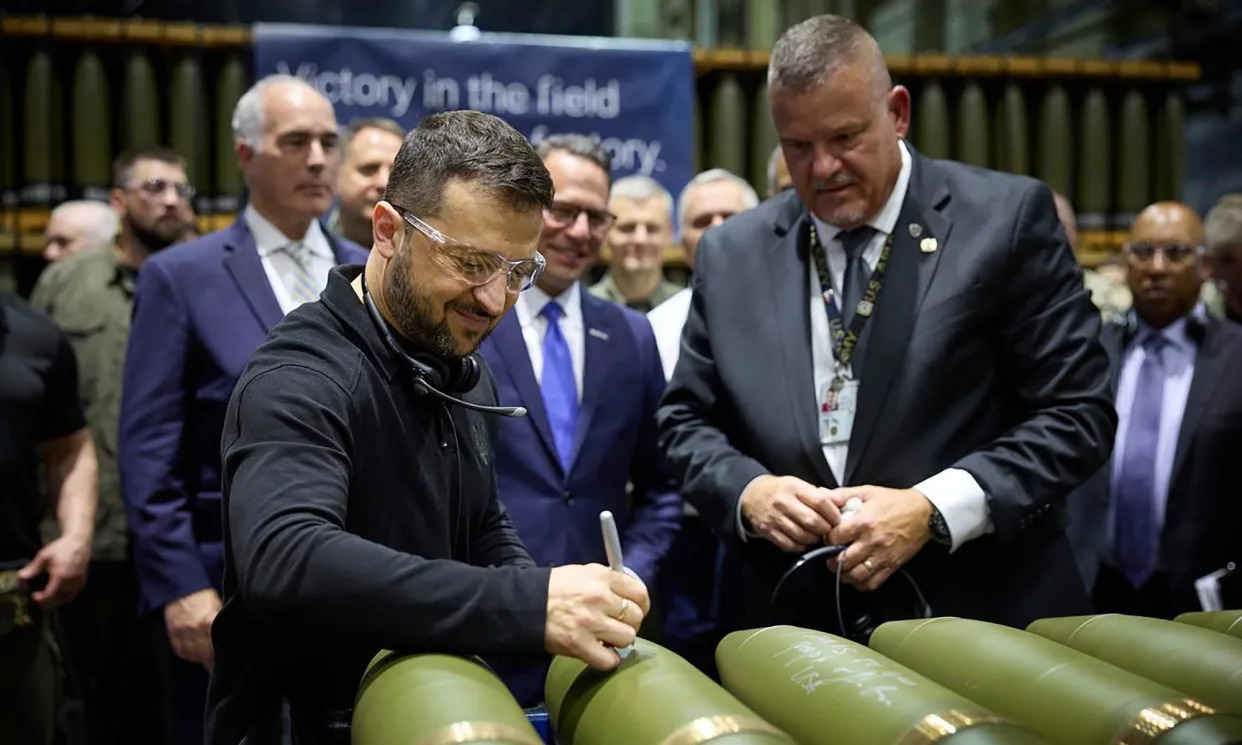
Volodymyr Zelenskyy at the Scranton Army Ammunition Plant on Sunday.Photograph: AP

The US House speaker, Mike Johnson, has demanded that Ukraine fire its ambassador to Washington as the feud between Donald Trump and Volodymr Zelenskyy escalated and Republicans accused the Ukrainian leader of election interference.

In a public letter, Johnson demanded that Zelenskyy fire the Ukrainian ambassador, Oksana Markarova, over a visit to a munitions factory in Scranton, Pennsylvania, last week where the Ukrainian president thanked workers for providing desperately needed shells to his outgunned forces.

Johnson complained that Markarova had organised the visit to the Scranton Army Ammunition Plant as a “partisan campaign event designed to help Democrats”. The event was attended by the Pennsylvania governor, Josh Shapiro, a Democrat who has campaigned in support of Kamala Harris.


Related: Zelenskyy is pitching his ‘victory plan’ on adverse terrain

“The facility was in a politically contested battleground state, was led by a top political surrogate for Kamala Harris, and failed to include a single Republican because – on purpose – no Republicans were invited,” Johnson wrote in a letter on congressional letterhead addressed to the Ukrainian embassy.

“The tour was clearly a partisan campaign event designed to help Democrats and is clearly election interference,” the letter continued. “This shortsighted and intentionally political move has caused Republicans to lose trust in Ambassador Markarova’s ability to fairly and effectively serve as a diplomat in this country. She should be removed from her post immediately.”

On the same day, Trump in a campaign event in North Carolina attacked Zelenskyy directly and accused him of “refusing” to negotiate a peace deal with Vladimir Putin.

“The president of Ukraine is in our country. He is making little nasty aspersions toward your favourite president, me,” Trump said. “We continue to give billions of dollars to a man who refuses to make a deal: Zelenskyy.”

The accusations against Zelenskyy came after a controversial interview with the New Yorker in which he questioned Trump’s plan to end Ukraine’s war with Russia and sharply criticized Republicans’ vice-presidential candidate, JD Vance, as “too radical”.

Vance had earlier said a peace in Ukraine could entail Russia retaining the Ukrainian land it had occupied and the establishment a demilitarised zone with a heavily fortified frontline to prevent another Russian invasion.

“His message seems to be that Ukraine must make a sacrifice,” Zelenskyy said in the interview with the New Yorker. “This brings us back to the question of the cost and who shoulders it. The idea that the world should end this war at Ukraine’s expense is unacceptable. But I do not consider this concept of his a plan, in any formal sense.”

After addressing the United Nations general assembly on Wednesday, Zelenskyy is expected to travel to Washington to present his “victory plan” to Joe Biden at the White House.

In his letter, Johnson also referred to Ukrainian officials criticizing Trump and Vance in remarks to the media.

“Additionally, as I have clearly stated in the past, all foreign nations should avoid opining on or interfering in American domestic politics,” he said. “Support for ending Russia’s war against Ukraine continues to be bipartisan, but our relationship is unnecessarily tested and needlessly tarnished when the candidates at the top of the Republican presidential ticket are targeted in the media by officials in your government.”

Other top Republicans had criticized Zelenskyy this week after his remarks about Trump and Vance were published.

“I don’t mind him going to a munitions plant thanking people for helping Ukraine. But I think his comments about JD Vance and President Trump were out of bounds,” said the Republican senator Lindsey Graham, according to US-based Punchbowl News.

“With conservatives, it’s going to hurt Ukraine,” Graham said.


House speaker wants Ukrainian ambassador fired over Zelensky’s Pennsylvania trip

Andrew Feinberg
Wed 25 September 2024

Ukraine's President Volodymyr Zelenskiy stands near Pennsylvania Governor Josh Shapiro during his visit to the Scranton Army Ammunition Plant in Scranton, Pennsylvania (REUTERS)


House Speaker Mike Johnson is demanding that Volodymyr Zelensky fire the widely respected diplomat who has represented Kyiv in Washington since 2021 after she arranged for the Ukrainian president to visit a munitions plant in a battleground state with a Democratic governor.

In a letter released by Johnson’s office on Wednesday, the Louisiana Republican accused Ambassador Oksana Markarova of interfering in the ongoing US presidential election by helping set up the trip by Zelensky to the Scranton Army Ammunition Plant in Scranton, Pennsylvania, over the weekend.

During his visit, Zelensky inspected production lines where the 155mm artillery shells used by his country’s forces are being produced. He did so alongside the state’s governor, Josh Shapiro.

While inspecting the plant, he told workers: “It is in places like this where you can truly feel that the democratic world can prevail. Thanks to people like these — in Ukraine, in America, and in all partner countries — who work tirelessly to ensure that life is protected.”

What appears to have irked Johnson is the fact that no Republican officeholder was invited to the plant visit, along with the fact that Shapiro, who was considered a front-runner to be Vice President Kamala Harris’s running mate before she selected Minnesota Governor Tim Walz, is a top surrogate for the vice president.

In his letter, the House Speaker claimed that Markarova enabled Zelensky to interfere in the election because the manufacturing plant “was in a politically contested battleground state” and the tour led by Shapiro “failed to include a single Republican because — on purpose — no Republicans were invited.”

“The tour was clearly a partisan campaign event designed to help Democrats and is clearly election interference. This shortsighted and intentionally political move has caused Republicans to lose trust in Ambassador Markarova’s ability to fairly and effectively serve as a diplomat in this country,” he wrote, adding that the veteran diplomat “should be removed from her post immediately.”

Zelensky, who is in the US to attend the UN General Assembly this week, also irked Republicans by criticizing former President Donald Trump in an interview with the New Yorker.

He said the ex-president, who was impeached for attempting to blackmail the Ukrainian leader into announcing a fake investigation into Joe Biden when he was a candidate for president in 2019, “doesn’t really know how to stop the war even if he might think he knows how.”

Trump has frequently claimed, without evidence, that he could end the nearly three-year-old war “in 24 hours” by forcing Zelensky to make some sort of deal with Russian President Vladimir Putin, a known ally of the ex-president.

At a rally on Monday, he claimed Zelensky wants Democrats to win the election “so badly” and repeated the claim the next day.

Numerous Republicans have opposed US assistance to Ukraine since the war began in 2022, with some repeating Russian propaganda about Zelensky during official House proceedings.

Zelensky is set to visit Washington on Thursday, where he is scheduled to meet with Senate leaders from both parties as well as President Biden and Vice President Harris.


Top Republican wants Ukrainian ambassador to US fired, ahead of Zelenskiy visit


Press conference at the Republican National Committee in Washington

Updated Wed 25 September 2024
By Patricia Zengerle

WASHINGTON (Reuters) -The Republican Speaker of the U.S. House of Representatives demanded that Ukrainian President Volodymyr Zelenskiy "immediately fire" his ambassador to the United States on Wednesday, a day before Ukraine's leader was due to visit the U.S. Congress.

Some Republicans, particularly those closest to former President Donald Trump, have been fuming over Zelenskiy's visit on Sunday to an ammunition plant in President Joe Biden's hometown of Scranton, Pennsylvania. Pennsylvania is one of the swing states seen as crucial to victory in the Nov. 5 presidential election.

During the trip, Zelenskiy appeared with Pennsylvania Governor Josh Shapiro - who has campaigned for Democratic presidential candidate and Vice President Kamala Harris - Senator Bob Casey and U.S. Representative Matt Cartwright. All are Democrats.

"The facility was in a politically contested battleground state, was led by a top political surrogate for Kamala Harris, and failed to include a single Republican because – on purpose – no Republicans were invited," wrote Johnson, who is not expected to meet with Zelenskiy when the Ukrainian leader comes to Congress.

"The tour was clearly a partisan campaign event designed to help Democrats and is clearly election interference," he said.

The Ukrainian embassy in Washington did not respond to a request for comment.

TRUMP BLASTS ZELENSKIY

Trump has repeatedly criticized the Ukrainian president on the campaign trail this week.

"Those cities are gone, they’re gone, and we continue to give billions of dollars to a man who refused to make a deal, Zelenskiy. There was no deal that he could have made that wouldn’t have been better than the situation you have right now," Trump said on Wednesday. "You have a country that has been obliterated, not possible to be rebuilt."

The former president also blamed Biden and Harris for Russia's February 2022 invasion of Ukraine.

The Republican-led House Oversight Committee had already announced that it would investigate whether Zelenskiy's trip was an attempt to use a foreign leader to benefit Harris' campaign.

It is common practice for governors to meet with foreign leaders who travel to their states. In July, Zelenskiy visited a factory in Utah and was hosted by that state's Republican governor, Spencer Cox.

Additionally, a series of foreign leaders, including Israeli Prime Minister Benjamin Netanyahu, have traveled to Florida, in recent months to meet with Trump at his Mar-a-Lago home. Trump won Florida by only 3 percentage points in the 2020 election, and recent polls have shown a close race there between Harris and Trump.

On Thursday, Zelenskiy is expected to thank congressional leaders for approving billions of dollars in funding for his country as it grapples with a 2-1/2-year-long Russian invasion, and to make the case for more.

After becoming speaker last year, Johnson, who had voted repeatedly against aid for Kyiv, waited until April before allowing the House to vote on Biden's October request for financial assistance for Ukraine.

However, he said on Wednesday his letter to Zelenskiy was not a threat to stop funding.

"I'm not making any threats," he told reporters.

(Reporting by Patricia Zengerle, additional reporting by Bo Erickson; editing by Jonathan Oatis)


Speaker Johnson demands Ukrainian ambassador be fired as GOP probes Zelensky visit

Rebecca Beitsch
Wed 25 September 2024 at 1:56 pm GMT-6·4-min read


Speaker Johnson demands Ukrainian ambassador be fired as GOP probes Zelensky visit


Comments from Ukrainian President Volodymyr Zelensky sparked a second day of ire from GOP figures, with Speaker Mike Johnson (R-La.) demanding he fire the country’s ambassador to the U.S., while a House panel launched an investigation after suggesting a recent appearance by Zelensky amounted to election meddling.

House Oversight and Accountability Chair James Comer (R-Ky.) on Wednesday morning launched an inquiry into Zelensky’s trip to Pennsylvania, suggesting a visit to a factory that supplies munitions to the country constituted a campaign stop for Vice President Harris.

Republicans cried foul over the visit Tuesday, particularly after Zelensky issued critical comments about former President Trump’s running mate, Sen. JD Vance (R-Ohio), during a separate interview.

Zelensky visited the factory flanked by Pennsylvania Democrats, including Gov. Josh Shapiro (D). It is common for governors to appear at such events in their state, , and other attendees included the largely Democratic officials who represent the Scranton area.

Johnson and Comer, however, said appearing with a political figure who was briefly a contender to serve as Harris’s running mate made the stop political in nature.

“The facility was in a politically contested battleground state, was led by a top political surrogate for Kamala Harris, and failed to include a single Republican because – on purpose – no Republicans were invited. The tour was clearly a partisan campaign event designed to help Democrats and is clearly election interference,” Johnson wrote Wednesday to Zelensky.

“I demand that you immediately fire Ukraine’s Ambassador to the United States, Oksana Markarova,” he added, writing that she can no longer “fairly and effectively serve as a diplomat in this country.”

A spokesperson for the Ukrainian Embassy in the United States did not immediately respond to request for comment.

Democrats dismissed Johnson and Comer’s comments as another instance of the GOP turning their back on an important U.S. ally.

“As President Zelenskyy fights for freedom and the rule of law on behalf of democracies around the world, Donald Trump and his craven MAGA followers side time and again with Vladimir Putin,” Rep. Jamie Raskin (D-Md.), the top Democrat on the Oversight panel, said in a statement.

Zelensky’s visit was described by Pennsylvania as him making “a special trip to the Keystone State to visit the Pennsylvania workers who are playing a vital role in Ukraine’s defense.”

Zelensky’s visit to Pennsylvania mirrors a trip to Utah in July, where he met with Republican Gov. Spencer Cox and signed a memorandum of understanding with state leaders.

In both cases, state leaders expressed support for Ukraine in its battle against Russia.

While Republicans have fixated on Zelensky’s visit to the Pennsylvania, it’s an interview the Ukrainian president did that initially sparked GOP criticism.

In an interview with The New Yorker published Sunday, Zelensky called Vance “too radical” due to his views on Ukraine, and suggested the senator study World War II. Vance has called to end U.S. support for Ukraine, and for Kyiv to cede territory to Russia in a peace deal.

“The idea that the world should end this war at Ukraine’s expense is unacceptable,” Zelensky said in the interview.

Zelensky struck a more cautious tone toward Trump, saying they have had good conversations on the phone but that the GOP presidential candidate “doesn’t really know how to stop the war, even if he might think he knows how.”

Comer’s letter asks the White House, Justice Department officials and the Pentagon to provide details about any coordination about the trip, accusing the Biden administration of having “orchestrated and used government resources to make possible this apparent campaign event that resulted in the potential interference in a federal election.”

Comer’s probe comes after Rep. Lance Gooden (R-Texas) led eight other Republicans in demanding an investigation from the inspectors general of both the Justice Department and Department of Defense seeking all federal resources dedicated to the visit.

House Oversight Democrats suggested Comer’s new probe reflects a broader effort to undermine Ukraine.

“America didn’t forget that Chairman Comer called Ukraine a foreign adversary and used the Committee to repeat and amplify Russian propaganda. It is sadly unsurprising he is once again working to undermine Ukraine’s efforts to repel Putin’s lawless, bloody, and unjustified invasion.”

“Chairman Comer obviously does not understand nor appreciate the concept of an ‘ally.’ America is an ally of Ukraine, and Ukraine is an ally of America,” Raskin said.

“Ukraine is in the middle of a war with Russia thrust upon it by Vladimir Putin’s filthy imperialist and irredentist invasion. The American people have invested billions of dollars to help Ukraine defend its sovereignty and democracy because we share common interests and something called values.”

Updated 7:04 p.m.

Copyright 2024 Nexstar Media, Inc. All rights reserved. This material may not be published, broadcast, rewritten, or redistributed.

For the latest news, weather, sports, and streaming video, head to The Hill.

US thwarts French and British push for Lebanon ceasefire call at UN

Patrick Wintour in New York
Wed 25 September 2024 

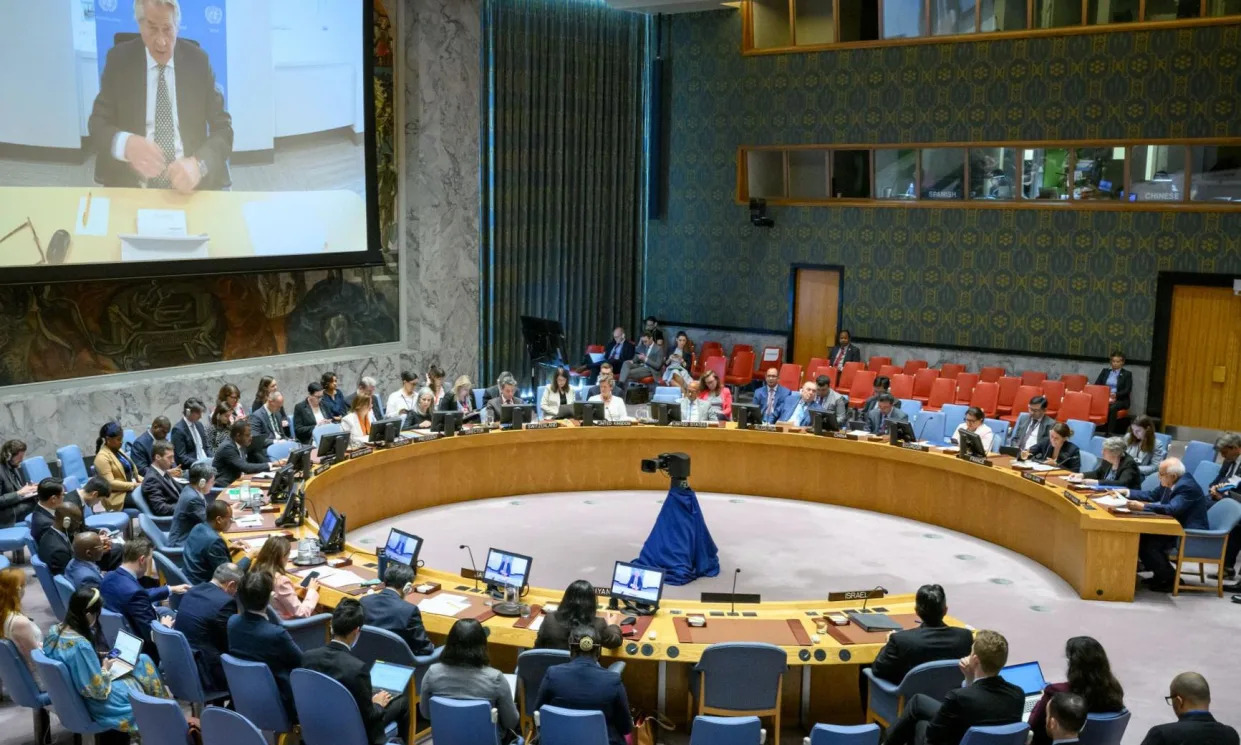
A UN security council briefing on the crisis in the Middle East.Photograph: Xinhua/Rex/Shutterstock


An effort led by France and Britain to secure a joint statement by the UN security council calling for a ceasefire in Lebanon has stalled in the face of US objections.

Washington is eager to avoid any suggestion there is any equivalence of blame for the eruption of the crisis that has led to the loss of life of hundreds of people in Lebanon.

Antony Blinken, the US secretary of state, has been firm in asserting Israel has a legitimate problem to solve, blaming Hezbollah’s continued rocket fire into Israel ever since the Hamas attack on Israel on 7 October.


At one point there had been suggestions the UN security council, due to start late Wednesday, would be deferred overnight to secure agreement on a joint statement, but diplomats said such hopes were fast fading.

The differences emerged at a G7 dinner on Tuesday night. Both Emmanuel Macron, the French president, and David Lammy, the UK foreign secretary, went public in calls for a ceasefire to end the fighting. France and UK had also called for a ceasefire in meetings with allies in Paris a week ago.

European sources said the US had been working on a different, more complex, formula, and was sensitive to Israeli pressure or wording that would be seen to block its military offensive to degrade Hezbollah.

In a round of morning TV interviews Blinken was careful not to call for a ceasefire in Lebanon, referring instead to a diplomatic agreement.

He told ABC News that Hezbollah had started firing rockets into Israel after the deadly attacks of 7 October, saying: “People who lived in northern Israel had to flee their homes – homes were destroyed; villages were destroyed – about 70,000 Israelis. Israel started responding. You have Lebanese in southern Lebanon who’ve also had to flee their homes. We want to see people get back to their homes. The best way to do that is through a diplomatic agreement – [one that] pulls the forces back, creates space and security so that people can get back to their homes, kids can get back to school.”

Joe Biden also told ABC television that all-out war was possible, but added: “We’re still in play to have a settlement that can fundamentally change the whole region.”

In his address to the general assembly, Macron was more forthright, saying:
“There cannot be, must not be war in Lebanon.”

At a meeting with the Qatari prime minister, Mohammed bin Abdulrahman Al Thani, Blinken only referred to seeking a ceasefire in Gaza – the precondition Hezbolllah set for ending its relatively low-level but hugely disruptive assault on Israel.

Blinken also repeated his claim that it was Hamas and not Israel that was holding up a ceasefire agreement in Gaza.

Saying that 15 of the 18 paragraphs in the ceasefire agreement were signed off, he said: “The problem we have right now is that Hamas hasn’t been engaging on it for the last couple of weeks, and its leader has been talking about an endless war of attrition. Now, if he really cares about the Palestinian people, he’d bring this agreement over the finish line.

“Hard decisions remain to be made by Israel. But the problem right now in terms of bringing this across the finish line is Hamas, its refusal to engage in a meaningful way,” he added.

In contrast, the foreign ministers of Egypt, Jordan and Iraq said in a joint statement: “Israel is pushing the region towards total war.”

The Lebanese foreign minister, Abdallah Bou Habib, said the US approach was “not promising”, adding: “It will not solve the Lebanese problem. The US is the only country that can really make a difference in the Middle East with regard to Lebanon.”


France and US push for 21-day Hezbollah-Israel ceasefire in Lebanon as UN chief warns ‘hell is breaking loose’

Patrick Wintour and Andrew Roth in New York
Wed 25 September 2024 


France pushes for 21-day Hezbollah-Israel ceasefire in Lebanon as UN chief warns ‘hell is breaking loose’


The US and France have called for a 21-day temporary ceasefire between Israel and Hezbollah to make way for broader negotiations, as the UN secretary general, António Guterres, told a UN security council meeting that “hell is breaking loose” in Lebanon.

Israel’s top general has said the country is preparing for a possible ground operation into Lebanon after an intense three-day bombing campaign that has killed more than 600 people, further fuelling fears of a regional conflict.

The joint statement issued by US president Joe Biden and French counterpart Emmanuel Macron said: “It is time for a settlement on the Israel-Lebanon border that ensures safety and security to enable civilians to return to their homes. The exchange of fire since October 7th, and in particular over the past two weeks, threatens a much broader conflict, and harm to civilians.”

The two leaders, who met on the sidelines of the UN general assembly in New York, said they had worked on a temporary ceasefire “to give diplomacy a chance to succeed and avoid further escalations across the border”.

They urged Israel and Lebanon to back the move, which was also endorsed by Australia, Canada, the European Union, Germany, Italy, Japan, Saudi Arabia, the United Arab Emirates and Qatar.

A senior US administration official said on Wednesday night that both Israel and Lebanon, which was understood to be representing Hezbollah in the negotiations, were expected to respond to the call “in the coming hours.”

Officials in a background briefing also emphasised that the ceasefire proposal does not apply to the conflict between Israel and Hamas in Gaza.

The US said that the 21-day period was chosen in order to provide space in order to negotiate a more comprehensive agreement between the two sides to allow residents to return to their homes along the Israel-Lebanon border without fear of further violence or an “October 7th-like attack in the future.”

The announcement came at the conclusion of a heated UN security council meeting, which saw Lebanon’s prime minister accuse Israel of violating his country’s sovereignty. Najib Mikati said Lebanese hospitals were overwhelmed and unable to accept any more victims.

Israel’s UN envoy told the security council said that his country did not seek a full-scale war and that Iran was the “driving force” behind the instability sweeping the Middle East.

For his part, Iranian foreign minister Abbas Araqchi said the US and UK’s “unwavering support for Israel has given them carte blanche for all sorts of sinister behaviour”.

Related: Can Israel avoid same pitfalls of past ground offensive in Lebanon?

There have been tensions between the US and its European allies about whether to call for an immediate ceasefire at the security council. The UK foreign secretary David Lammy backed an immediate ceasefire, saying it was time to pull back from the brink, adding “a full blown war is not in the interests of Israeli or Lebanese people”.

He said nothing justified Hezbollah’s attacks and urged Iran to use its influence to persuade Hezbollah to agree to a ceasefire.

But US diplomats indicated an unconditional ceasefire call in the form of a joint security council statement could be seen as accepting a moral equivalence between the behaviour of Israel and Hezbollah, a group that is labelled a terrorist group by the US.

The proposal for a temporary three-week cessation of hostilities might provide a platform to reopen stalled talks on the discussions over a ceasefire between Hamas and Israel in Gaza. Hezbollah has said it will stop its strikes if Hamas agrees to a Gaza ceasefire, but there is no sign currently of either the Hamas leadership or the Israeli prime minister Benjamin Netanyahu coming to an agreement.

Netanyahu was due to arrive in New York on Thursday, and is expected to set out whether he supports a 21-day break in hostilities.

The US deputy envoy Robert Wood said “diplomacy will only become more difficult” if the conflict escalates further, adding he was gravely concerned by reports that hundreds of Lebanese civilians had died in recent days.

But he insisted the origin of the conflict was the hundreds of thousands of Lebanese civilians, and 65,000 Israeli civilians, who have been displaced due to Hezbollah’s decision on 8 October to break the peace that has largely endured.

He said that no one wanted to see a repeat of the war in 2006, adding “the war must end with a comprehensive undertaking that has real implementation mechanisms”.

No details of the implementation mechanisms were set out by the US envoy, but it is not likely to be backed by Hezbollah if it infringes on its sovereignty.


Terms/Privacy Policy
Privacy dashboard
About our ads
US Senate votes unanimously to hold hospital CEO in criminal contempt

Maya Yang
Wed 25 September 2024

Ralph de la Torre in Norwood, Massachusetts, on 25 August 2024.
Photograph: Boston Globe/Getty Images


The US Senate has voted unanimously to hold the CEO of Steward Health Care in criminal contempt for failing to comply with a congressional subpoena – marking the first time in more than 50 years that the chamber has moved to hold someone in criminal contempt.

On Wednesday, the Senate voted to hold Ralph de la Torre in contempt of Congress after the 58-year-old head of the Massachusetts-based for-profit healthcare system – which declared bankruptcy earlier this year – ignored a congressional subpoena and failed to appear at a hearing over the hospital chain’s alleged abuse of finances on 12 September.

During Wednesday’s session, Bernie Sanders, Vermont senator and chair of the Senate’s health, education, labor and pensions (Help) committee, said: “The passage of this resolution by the full Senate will make clear that even though Dr de la Torre may be worth hundreds of millions of dollars, even though he may be able to buy fancy yachts and private jets and luxurious accommodations throughout the world, even though he may be able to afford some of the most expensive lawyers in America, no, Dr de la Torre is not above the law.

“If you defy a congressional subpoena, you will be held accountable, no matter who you are or how well-connected you may be,” Sanders said.

Similarly, Bill Cassidy, Louisiana senator and ranking member of Help, said: “Steward’s mismanagement has nationwide implications affecting patient care in more than 30 hospitals across eight states.

“Through the committee’s investigation, it became evident that a thorough review of chief executive officer Dr Ralph de la Torre’s management decisions was essential to understand Steward’s financial problems and its failure to serve its patients,” Cassidy said of De la Torre, who was paid at least $250m by Steward Health Care as the hospital chain’s administrators struggled with facility problems, staffing shortages and closures.

Investigations by the Boston Globe revealed that as more than a dozen Steward Health Care patients died in recent years after being unable to receive adequate treatment, De la Torre embarked on various jet travels and private yacht excursions across the Caribbean and French Riviera.

The Boston Globe also revealed that De la Torre frequently used the hospital chain’s bank account as his own, including to make purchases to renovate an €8m ($8.9m) apartment in Madrid and to make donations of millions of dollars to his children’s private school.

In July, the outlet reported that the justice department was investigating Steward Health Care for potential foreign corruption violations. It also reported that a federal grand jury in Boston was investigating the hospital chain’s financial dealings including its compensations for top executives.

During Wednesday’s session, the Massachusetts senator Ed Markey condemned what he called a “culmination of a financial tragedy over the past decade”.

“Steward, led by its founder and CEO Dr Ralph de la Torre and his corporate enablers, looted hospitals across the country for their own profit, and while they got rich, workers, patients and communities suffered, nurses paid out of pocket for cardboard bereavement boxes for the babies to help grieving parents who had just lost a newborn,” said Markey.

“Dr de la Torre is using his blood-soaked gains to hide behind corporate lawyers instead of responding to the United States Senate’s demand for actions. But while he tries to run and hide, Dr de la Torre is revealing himself for what he truly is – a physician who places personal gain over his duty to do no harm,” he added.

Mexico snubs Spanish king as spat over colonial past flares up


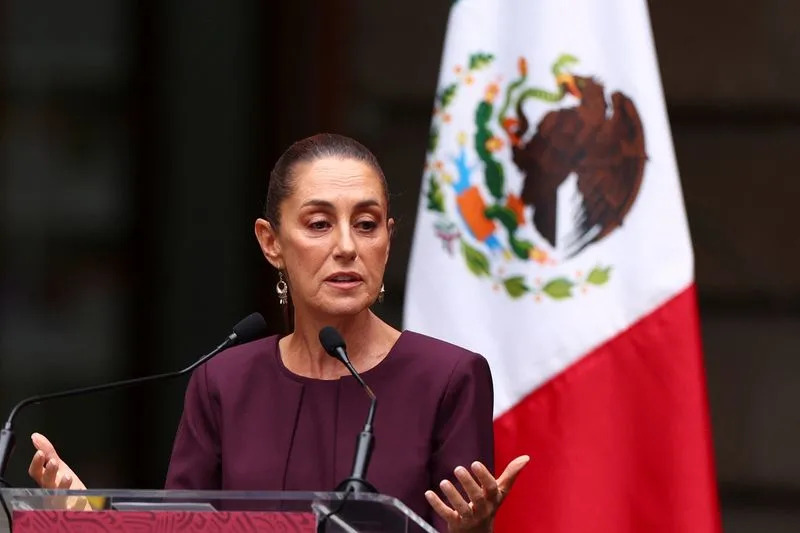
Mexico's President-elect Sheinbaum speaks at inauguration of Museo Vivo in Mexico City

By David Alire Garcia and Belén Carreño

Wed 25 September 2024 

MEXICO CITY/MADRID (Reuters) - A fight dating back more than five centuries reemerged on Wednesday as Mexico's incoming president defended a decision to not invite the Spanish king to her inauguration next week after the monarch declined to apologize for colonial-era abuses.

Spain's Prime Minister Pedro Sanchez also weighed in earlier in the day, describing the snub as "unacceptable," less than a week before Mexican President-elect Claudia Sheinbaum's Oct. 1 swearing-in ceremony.

In a rare rebuke on Tuesday, the Spanish government announced it would not send any representative to the event.

The diplomatic spat threatens to cast a pall over Sheinbaum's inauguration in Mexico City, once the seat of Spain's vast colonial holdings in the Americas after Spanish invaders and their native allies toppled the Aztec capital of Tenochtitlan in 1521.

Mexico City was built over the ruins of the Aztec metropolis.

In a two-page letter posted to social media on Wednesday, Sheinbaum wrote that only Prime Minister Sanchez had been invited, in part because King Felipe VI did not directly respond to a personal letter that the outgoing Mexican president sent the monarch in 2019.

In that letter, President Andres Manuel Lopez Obrador, a close Sheinbaum ally, asked the king to "publicly and officially" recognize the abuses committed during the conquest of Mexico in order to chart a friendlier new course between the countries.

"Unfortunately, that letter did not prompt any direct answer," wrote Sheinbaum, who noted she spoke with Sanchez a few days earlier.

In 2019, Lopez Obrador was seeking to organize an event in 2021 that would mark the anniversaries of the conquest, Mexico's 19th century independence from Spain, as well as the founding of Tenochtitlan in the 1300s.

At the time, he also sought a similar apology from Pope Francis for atrocities committed against Mexico's indigenous population as well as the repatriation of pre-Hispanic books and other artifacts held in European museums and libraries.

Francis did not respond to Lopez Obrador but has previously apologized for the "many grave sins (that) were committed against the native people of America in the name of God."

After Lopez Obrador reiterated his request for a formal apology shortly after his letter was made public, Spain's foreign ministry rejected it, arguing that the conquest should not be "judged in light of contemporary considerations."

The outgoing Mexican president has often invoked the Spanish conquest to rally nationalist sentiment, stressing that Mexico is no longer any country's colony.

On the sidelines of the U.N. General Assembly annual session in New York on Wednesday, Sanchez was asked by reporters if Spain should apologize, but he sidestepped the question.

"We can't accept this exclusion, and that's why we informed the Mexican government that the absence of any diplomatic representative of the Spanish government is a sign of protest," said Sanchez.

"Not only do we consider it unacceptable, its inexplicable," he added.

(Reporting by David Alire Garcia in Mexico City and Belén Carreño Bravo in Madrid; Editing by Sonali Paul)
Many Americans say immigration is out of control, but 24 hours on the Texas-Mexico border showed a new reality. Will it last?

Berenice Garcia
Wed, September 25, 2024 
PBS/NPR and FRONTLINE, the PBS series, through its Local Journalism Initiative, which is funded by the John S. and James L. Knight Foundation.

LONG READ

As midnight nears, the lights of El Paso, Texas, and Ciudad Juárez, Mexico, fill the sky on the silent banks of the Rio Grande. A few months ago, hundreds of asylum-seeking families, including crying toddlers, waited for an opening to crawl through razor wire from Juarez into El Paso.

No one is waiting there now.

Nearly 500 miles away, in the border city of Eagle Pass, large groups of migrants that were once commonplace are rarely seen on the riverbanks these days.

In McAllen, at the other end of the Texas border, two Border Patrol agents scan fields for five hours without encountering a single migrant.

It’s a return to relative calm after an unprecedented surge of immigrants through the southern border in recent years. But no one would know that listening to Vice President Kamala Harris and former President Donald Trump talking about border enforcement at dueling presidential campaign events. And no one would know from the rate at which Texas is spending on a border crackdown called Operation Lone Star$11 billion since 2021.

Trump, Texas Gov. Greg Abbott and other elected officials often refer to the country’s “open border” with Mexico. Immigration is a top election issue in the presidential election, and most American voters say it should be reduced.

But conditions on the border often shift more rapidly than political rhetoric. Arrests for illegal crossings plummeted nearly 80% from December to July. Summer heat typically reduces migration, but on top of that Mexican authorities sharply increased enforcement within their borders in December. Plus, President Joe Biden introduced major asylum restrictions in June.

Crossings are still high by historical standards and record numbers of forcibly displaced people worldwide — more than 117 million at the end of last year, according to the U.N. refugee agency — may make the drop temporary. And some Republican critics say Biden’s new and expanded legal pathways to enter the U.S. are “a shell game” to reduce illegal crossings — along with the chaotic images and headlines they spawn — while still allowing people in.

The Associated Press and The Texas Tribune spent 24 hours in five cities on Texas’ 1,254-mile border with Mexico to compare rhetoric with reality.

An abandoned baby sandal lies on the banks of the Rio Grande in Ciudad Juarez, Mexico with the razor wire and border wall of El Paso in the background, late Thursday, Aug. 8, 2024. Credit: AP Photo/Andres Leighton
11 p.m. Thursday Aug. 8

On the riverbanks of Ciudad Juárez, there are no migrants in sight, but evidence of previous crossings still litters the ground. Discarded clothes entangled in razor wire. A toothbrush and a Mexico City train-bus pass littering the riverbed.

A van from Mexico’s immigration agency is parked nearby, the driver keeping an eye on the river. It is a reminder of intensified Mexican enforcement that followed a plea for help by senior U.S. officials in late December.

On the opposite bank in El Paso, Texas National Guard members in unmarked pickup trucks and Texas Department of Public Safety troopers are watching the river too. “You can’t be in this area,” a rifle-toting American soldier shouts in Spanish to journalists across the river.

In the preceding week, the Border Patrol was processing and releasing an average of fewer than 200 migrants a day in El Paso, down from a daily average of nearly 1,000 in December and nearly 1,500 in December 2022. Migrants are no longer sleeping overnight in large numbers on downtown streets, once a common occurrence.

At El Paso International Airport, a shuttle van unloads dozens of migrants at 3:30 a.m. The terminal is quiet but, not long ago, hundreds of migrants slept there nightly, including many who missed their flights because it was their first time flying, and short-staffed airlines were unprepared to answer their questions.

Border Servant Corps, a nonprofit group from nearby Las Cruces, New Mexico, says it has helped more than 130,000 migrants with more than $18 million in shelter and travel support to their final destinations in the U.S. Nearly one of four migrants are from Venezuela, followed by Colombia and Cuba. The leading destinations are cities in Florida, Texas, New York and Illinois.

Ceci Herrera, a retired social worker and Border Servant Corps staffer who helps migrant families navigate the airport, says she knows what it’s like to lack a sense of belonging.

“In immigration, it’s important to say you belong to a country instead of feeling like you’re neither from there nor over there,” she says at the airport after helping migrant families get their boarding passes.

Left: Ceci Herrera, a retired social worker and Border Servant Corps volunteer who helps migrant families navigate the airport, shows the organization's recent statistics at El Paso International Airport in El Paso early in the morning of Aug. 9, 2024. Right: Cuban migrants Yenny Leyva Bornot, center, her husband, Jose Enrique Cespedes, right, and son, John Angel Cespedes, stand together in the El Paso International Airport. Credit: AP Photo/Andres LeightonMore

Many migrants are released with notices to appear in immigration court, where they can request asylum. They can apply for work permits in six months while their cases take years to decide in bottlenecked courts.

Additionally, more than 765,000 have legally entered from January 2023 to July through an online appointment system called CBP One, which allows them to stay for two years with work authorization. The federal government offers 1,450 appointments a day across the southern border, including about 400 in Brownsville, about 200 each in El Paso and Hidalgo, near McAllen, and smaller numbers in Eagle Pass and Laredo.

At the airport, 39-year-old Yenny Leyva Bornot, who fled Cuba with her husband and their 14-year-old son, was still absorbing the fact that they had gotten one of the treasured appointments and made it to the U.S. “We are in a country of freedom,” she said.

The family flew to Nicaragua in November then traveled over land to Mexico, the only country from which migrants can apply online for appointments. They got one in El Paso after seven months of trying, relying on an uncle in Germany, an aunt in Spain and a brother-in-law in Sarasota, Florida, to help cover their expenses.

Now their flight to Florida is delayed.

“What’s two more hours after seven months?” Leyva Bornot said. “This is the dream for most Cubans: Come to the United States to work and help your family back home.”

Christina Smallwood, foreground, and Andrés García, who are Border Patrol agents and public affairs officers, look for migrants underneath the McAllen-Hidalgo International Bridge in Hidalgo. Credit: Verónica Gabriela Cárdenas for The Texas Tribune
5 a.m. Friday Aug. 9

Hundreds of miles away near McAllen, Border Patrol agents Christina Smallwood and Andrés García leave their station two hours before sunrise. They drive along a levee road near where a towering border wall built during the Trump administration is lit up like a baseball stadium. After years of wall building, the Texas-Mexico border still has only about 175 miles of barriers, covering less than 15% of its length.

The agents peer through overgrown stands of carrizo, searching for makeshift rafts and ladders that are abandoned there by people who make it across the river.

The area near the Hidalgo bridge is a known hot spot for border crossers seeking to elude capture, as opposed to the asylum-seekers who quickly surrender to agents, because it is near a heavily-traveled road. They can easily hop into a car and get lost in the traffic.

It’s quiet now. The agents don’t see a single migrant in nearly five hours.

"Compared with numbers over the last decade, it's insane the difference right now," Garcia said.
10 a.m. Friday

Roughly 150 miles upriver in Laredo, the sound of rumbling motors from tractor-trailers and the smell of diesel and exhaust fill the warm air as vehicles line up on the World Trade Bridge — one of four international bridges in the city.

“It starts getting busy for us, 10 o’clock, 10 or 11. And it'll be pretty constant up until about four or five in the afternoon,” said Alberto Flores, director of the Laredo port of entry.

On the Mexican side of the border, what appear to be tiny white boxes stretch toward the horizon. They are tractor-trailers, filled with goods from warehouses in Nuevo Laredo.

Laredo is by far the busiest entry point for cargo in the United States, funneling more than twice as many tractor-trailers as second-place Detroit over the last year.

About 8,000 tractor-trailers filled with goods from flowers to lettuce to car parts pass each day through 19 lanes at World Trade Bridge, northwest of downtown Laredo. It is a straight shot on Interstate 35 to San Antonio and Dallas.

At a booth for prescreened truckers, a Customs and Border Protection officer opens a sliding window and takes a sheet of paper from the driver. The computer brings up a manifest that says the truck carries 20 pallets of a solution used for dialysis.

Trucks cross into the Port of Laredo on Aug. 9, 2024. Credit: AP Photo/Eric Gay

“We're verifying everything is basically accurate. And if it's accurate and there's no anomalies, anything in the system, then he's good to go,” the officer says.

The next vehicle is a tractor-trailer cab, likely going to pick up an empty container on the U.S. side and bring it back to Mexico. The officer tries to limit each inspection to 45 seconds.

Flores wants to “make sure that cargo is constantly flowing” — a challenge when illegal crossings are unusually high. In December, cargo crossings temporarily closed in Eagle Pass and El Paso — as well as a crossing in Lukeville, Arizona — as officers were diverted from ports of entry to deal with the surge in migrants arriving at the border. Local businesses said the closures sent business plummeting, and a related five-day closure of two border rail crossings cost industries $200 million per day, according to Union Pacific.

Flores visits a small mobile home inside the bridge’s inspection area to congratulate an employee who searches images on a large X-ray machine known as a Multi-Energy Portal. The officer was inspecting a shipment of flowers when he spotted something unusual. It turned out to be more than 700 pounds of methamphetamine.

The rectangular machine produces detailed, black-and-white scans of tractor-trailers and their cargo that look like charcoal drawings. CBP will have four more such machines by October for use on most commercial traffic.

“Can I have the day off?” the officer asks Flores. The room full of CBP officers erupts in laughter.

“I’ll get back to you,” Flores says.

Customs and Border Protection officers process visitors, students and commuters who crossed the pedestrian bridge in Laredo. Credit: AP Photo/Eric Gay

The recent decrease in migrant apprehensions has not slowed the flow of drugs across the border. Mexican cartels are at the heart of what the U.S. Drug Enforcement Administration calls a crisis of deadly synthetic drugs, with chemicals originating in China being mixed in Mexico and taken across the U.S. border, often by U.S. citizens. Federal statistics show that 46% of drug seizures nationally happened at the U.S.-Mexico border in the 2021-23 fiscal years.

The largest seizures of fentanyl, heroin, methamphetamine and cocaine occur at border crossings in Arizona and California, but Flores says methamphetamine and cocaine often come through Laredo. The DEA says a faction of the Sinaloa cartel called “Los Chapitos” favors an El Paso crossing for smuggling narcotics.

The methamphetamine is examined with a small handheld device inside a refrigerated storage facility with loading docks. There were no arrests in the incident, which is under investigation, but the drugs were confiscated, a CBP spokesperson said.

Other trucks called aside for closer inspection include one filled with plastic cups for the popular Texas-based fast food chain Whataburger and another with cans of tuna. A K-9 German Shepherd named Magi inspects one filled with marble tile.

Laredo’s other international bridges funnel visitors, students and commuters in cars and on foot, a lifeblood of the local economy here and in other border cities. But Laredo stands out because it has no border wall, a result of opposition from private landowners. And cartel-related violence in Nuevo Laredo has long made it unattractive for migrants to cross.

Monica Ochoa, who waited with her 5-year-old daughter at the historic San Agustin Plaza for her mother to pick them up, says her living arrangements are “very complicated,” working as a schoolteacher in Mexico while her daughters, both U.S. citizens, attend school in Laredo. Though she says media depictions of Mexican violence are often overblown, she said safety was one reason she wants her children to live in the U.S.

A Customs and Border Protection officer inspects a truck's cargo at the Port of Laredo. Credit: AP Photo/Eric Gay
11:30 a.m. Friday

Webb County Judge Leticia L. Martinez is wrapping up a morning session that started on Zoom with 49 tiny screens. Migrants and their lawyers filled the virtual courtroom as Martinez runs through criminal charges filed against the migrants under Operation Lone Star. The state announced that day that it has made more than 45,000 arrests since the crackdown began in 2021 and filed nearly 40,000 felony charges, often for trespassing on private property.

Some defendants dial in from Latin America with spotty connections that interrupt exchanges, showing up for court even though they have already left the country. Some who have been deported are no-shows, their lawyers saying they couldn’t be found. Those who show up are often confused.

One man is lying down as Martinez starts calling names. Another stands in front of lush green trees.

A court interpreter asks one man to remove his baseball cap when his case is called. The man turns the cap backwards, complying only after the interpreter impatiently repeats the command in a raised voice.

As the judge plows through the list, she dismisses the case of another migrant after a prosecutor acknowledges the state has no evidence to charge him.

“Muchas gracias,” a voice says on the other end with a camera just showing the back of a van.

The judge tells two men who appear on camera in orange jumpsuits from a prison in Edinburg that they will be turned over to federal authorities for deportation. One pleads for an urgent transfer, claiming he’s been threatened by violent jail gangs.

“I’m scared,” he says, to no avail. “I want to make it to Mexico to see my kids, my grandkids. They’re little.”

He went on, “I don’t know how to read. I don’t know how to write. I just came not knowing what would happen. Please forgive me. I will never again…”

The judge tells the man that he’ll likely be removed from the jail and turned over to the federal government the next day.

Before adjourning, the judge hears from the attorney of a man who has apparently been kidnapped. Prosecutor Steven Todd says the case should not be continued because the man is a no-show, but Martinez disagrees.

“Well, he’s not absconded. He was kidnapped. Very big difference,” the judge says.

Guatemalan migrant Wilson Juarez, 22, helps set tables for lunch at the Pope Francis migrant shelter in El Paso. Juarez experienced brain injury from smoke inhalation in a Ciudad Juarez, Mexico prison fire the previous year, which impaired his ability to walk and talk and killed dozens of people. Credit: AP Photo/Andres LeightonMore
12:30 p.m. Friday

At an El Paso church kitchen, a woman cooks beef with red chile, beans and rice while a 22-year-old Guatemalan man in a wheelchair sets tables. The man said he experienced brain injury from smoke inhalation in a fire last year at a immigrant detention center in Ciudad Juárez that killed 40 people, impairing his ability to walk and talk.

The church is part of a network of migrant shelters called Annunciation House, a group founded in 1978 by Ruben García, a well-known local Catholic humanitarian who has worked with federal immigration officials to house recently arrived migrants. A state judge recently dismissed a lawsuit against Annunciation House by Texas Attorney General Ken Paxton, who accused the group of illegally sheltering migrants and refusing to turn over records. Despite the outcome, the charges sent shockwaves throughout the community of migrant advocates along the border. Using similar allegations, Paxton has pursued others, including Catholic Charities of Rio Grande Valley.

Early that morning, García received his daily text message from a Border Patrol agent: The agency would release 25 people in El Paso that day. García said he could take them.

It is the lowest daily number García has seen in four years. The most the Border Patrol has sent to the shelters was 1,100 in a single day; earlier this year García said they took in 600 one day.

“This February, I will have been doing this for 47 years,” he said, sitting on a chair in the church. “My experience tells me this never lasts.”

The attorney general’s office said in court documents that Annunciation House appears “to be engaged in the business of human smuggling,” operating an “illegal stash house” and encouraging immigrants to enter the country illegally because it provides legal orientation. The state sought logs of clients’ names, a grant application the shelter has filed with the federal government, materials it has provided to migrants, and a list of all the shelters Garcia operates.

Paxton’s office has appealed the case to the Texas Supreme Court. Garcia says some volunteers have decided not to help out of concern they could be prosecuted.

“I would hope that instead, it would galvanize people to say, ‘I'm not going to look the other way. I'm going to go and offer myself to work with refugees and to be part of the process of providing what is imminently a humanitarian response,’” he said.

Brayan, 8, and his sister, Linda, 3, sit with their mother at a church-run shelter in Ciudad Juarez, Mexico, while waiting for Customs and Border Protection approval to cross into El Paso. Credit: AP Photo/Andres Leighton
1:30 p.m. Friday

Shelby Park in Eagle Pass is ground zero for Operation Lone Star, Texas’ unprecedented challenge to the long-standing principle that immigration policy is the federal government’s sole domain. Texas argues that it has a constitutional right to defend against an “invasion” and that the migrant influx has been a drain on public coffers.

Under Lone Star, Texas has bused about 120,000 migrants to cities including New York, Chicago and Denver. State troopers and the Texas National Guard have become a massive presence in towns on the state’s border with Mexico, which is about two-thirds the length of the U.S.-Mexico border.

Andrew Mahaleris, a spokesperson for Abbott, defended the governor’s immigration enforcement efforts — including transporting migrants to other cities — and claimed that illegal crossings have recently dropped because of Operation Lone Star.

Maheleris said in a statement that until Biden and Harris “step up and do their jobs to secure the border, Texas will continue utilizing every tool and strategy to respond to the Biden-Harris border crisis.”

The state has put razor wire in many areas, including a triple-layer barrier in Eagle Pass. The state installed a floating barrier made of buoys and submerged netting near Shelby Park to deter river crossings.

The park, a flat expanse of playing fields and a boat ramp at the end of the downtown business district and next to a golf course, has been closed since Texas seized it from the city in January and made it into a riverfront staging area. U.S. Border Patrol agents are denied entry. Texas authorities did not respond to requests to enter the park on this day.

A member of the Texas Army National Guard patrols the Rio Grande from atop a line of shipping containers in Eagle Pass. Credit: Jordan Vonderhaar for The Texas Tribune

Eagle Pass, a town of 30,000 people filled with warehouses and aging houses, was for much of 2022 the busiest of the Border Patrol’s nine sectors on the Mexican border. Daily arrests for illegal border crossings in the sector averaged 255 in June, down from nearly 2,300 six months earlier.

Shelby Park, once a place where local kids played soccer and the city hosted big events — and more recently a spot where large groups of migrants crossed the border almost daily — is now a dusty makeshift military base. Armed soldiers walk atop shipping containers and stand guard at its entrance with long guns.

Across the street from the park, George Rodriguez, a 72-year-old Eagle Pass native, prepares to beat the afternoon heat and close his stand at a flea market, where he sells pink typing keyboards, a vacuum cleaner and a television mount. He says blocking Border Patrol from part of the border is senseless.

“Once in a while, the governor and his cronies come over here and make a big deal,” Rodriguez said over music crackling on the radio, furniture scraping pavement and clothes hangers pattering in the wind. “It’s just a political stunt.”

Roughly a mile up the Rio Grande, two workers at the city water treatment plant come across a bag filled with socks. There are no fresh footprints on the sand road. A few months ago, they would have found piles of clothing and garbage that could gum up the pumps.

Left: Amber Cardenas, 42, sells clothing at a flea market near Shelby Park in Eagle Pass. Right: A golfer approaches the green, surrounded by razor wire, in Eagle Pass. Credit: Jordan Vonderhaar for The Texas Tribune
3:30 p.m. Friday

Stories of why migrants come have changed little in recent years, often a mix of wanting to improve their lives economically and fear of violence in their home countries. What has changed is the numbers — and perhaps nowhere more than in Rio Grande Valley.

The Border Patrol’s Rio Grande Valley sector, the nation’s busiest from 2013 to 2022, saw arrests plunge to an average of 133 a day in June from more than 2,600 in July 2021. Many are released with orders to appear in immigration court, where a backlog of 3.7 million cases means it takes several years to decide asylum claims.

In Brownsville, Jose Castro Lopez, 32, sat inside the main bus station more than four hours before an 8 p.m. ride to Florida. His partner and their children arrived following a two-month journey from Honduras that took him to Mexico City, where he applied for entry on the CBP One app.

He said construction work in Honduras didn’t pay enough to support a family.

"I'm sleep deprived and stressed," he said. "But, thank God, we're fine now. God allowed us the privilege to be here."

Another passenger at the bus station, Lilibeth Garcia, 32, said she graduated in 2016 from medical school in Venezuela, where she studied to be a surgeon, but the country's economic tailspin made it difficult to earn a living wage there.

Garcia arrived at the station with her year-old daughter and a cousin, Robert Granado, after a two-month journey from the city of Guarico through the Darién Gap, a 60-mile jungle trek that straddles the Colombia-Panama border. Garcia said she felt guilty about putting her daughter, Cataleya, through the dangerous journey but the toddler remained calm and in good spirits, despite a bout with fever.

"I'm happy," Granado said as they waited for a bus to New York City. "The journey is over."

Guatemalan migrant Gloria Lobos cries while speaking about violence she and her family experienced in southern Mexico during an interview at a church-run shelter in Ciudad Juarez, Mexico, on Friday, Aug. 9, 2024. Credit: AP Photo/Andres Leighton

At the other end of the Texas-Mexico border in Ciudad Juárez, a journey that has stretched for five months still isn’t over for Gloria Lobos of Guatemala. Lobos said she fled her physically abusive husband and settled in Chiapas in southern Mexico, where she worked on a farm and cleaned rooms at a hotel. In March, as the family walked to a grocery store, she said two men on a motorcycle attempted to kidnap her daughter.

After she reported the attempt to police, Lobos said the men returned days later with a gun and fired a shot at her daughter — the bullet missed. She said she raced to the bus station with her children and other relatives. Ciudad Juárez was the first ticket available.

Now she and her daughter live at a local shelter run by a Methodist church led by pastor Juan Fierro García, 65, while they wait for a CBP One appointment. The shelter has 63 migrants who will spend the night, down from 180 recently.

Sitting in a metal chair in the church, she said, “I never imagined God would want us to face this type of violence.”
7 p.m. Friday

In Glendale, Arizona, Kamala Harris — making her first visit to a border state since becoming the Democratic presidential nominee — touches on immigration 20 minutes into a 30-minute speech. It’s her fourth day of campaigning in swing states with running mate Gov. Tim Walz. She references her work as attorney general of another border state, California, and then repeats a line that Democrats have been espousing for many years.

“We know our immigration system is broken, and we know what it takes to fix it: Comprehensive reform that includes strong border security and an earned pathway to citizenship,” she says, sparking applause.

Harris jabs her Republican rival for the White House, former President Donald Trump, noting that he opposed a bill this year that would have, among other things, imposed asylum limits, added Border Patrol agents and changed asylum procedures to speed up decisions.

Left: Vice President Kamala Harris and her running mate, Minnesota Gov. Tim Walz, visit the Cocina Adamex Mexican restaurant in Phoenix on Aug. 9. (AP Photo/Julia Nikhinson, File) Right: Former President Donald Trump waves after speaking at a campaign rally in Bozeman, Mont. not long after Harris’ event in Arizona. Credit: AP Photo/Julia Nikhinson & Rick BowmerMore

A short time later at a rally in Bozeman, Montana, Trump wastes no time getting to immigration, his signature issue. He uses “border” more than 30 times during his 100-minute speech.

Harris, he tells the crowd, “wants to allow millions of people to pour into our border through an invasion! … Four more years of crazy Kamala Harris means 50, probably it means 50 million illegal aliens pouring into our country.” (The Border Patrol has made about 7.1 million apprehensions from February 2021 through July 2024 — often the same person more than once — while an unknown number have eluded capture.)

Trump, who has promised mass deportations during his campaign, talks for several minutes about “illegal aliens” being sent to the U.S. from other countries’ prisons, a claim that lacks evidence. He connects migration with rising crime and speaks of migrants stampeding, overrunning, destroying, ruining, ravaging, preying.

After 11 p.m., he mentions the border for the last time: “Next year, America's borders will be strong, sealed and secure. Promise.”

Disclosure: Union Pacific Railroad Company has been a financial supporter of The Texas Tribune, a nonprofit, nonpartisan news organization that is funded in part by donations from members, foundations and corporate sponsors. Financial supporters play no role in the Tribune's journalism. Find a complete list of them here.

The moon is seen behind the border wall in Eagle Pass. Credit: Jordan Vonderhaar for The Texas Tribune

France to expel illegal immigrants who have ‘broken in’ to country

FASCIST GOVERNMENT DESPITE LEFT WING ELECTION WIN

Henry Samuel
Tue, September 24, 2024 

Bruno Retailleau has vowed to unveil tough new measures 
to tackle illegal immigrants within weeks 
- DIMITAR DILKOFF/AFP

France’s new interior minister has pledged to expel illegal immigrants who have “broken in” to the country amid moves aimed at toughening law and order.

Bruno Retailleau also called for a coalition of willing EU countries to compel the European Commission to tighten its immigration laws.

His pledges for a harsher response to asylum claims, violence against police, radical Islam and drug trafficking were said to reflect the growing influence of Marine Le Pen’s hard-Right National Rally (RN).


After a June election in which president Emmanuel Macron’s centrist government suffered heavy losses, the RN pledged tacit support for Michel Barnier’s new coalition between centrists and conservatives.

However, the RN conditioned its support for his cabinet with meeting the hard-Right party’s concerns over immigration, security and other issues.

Mr Retailleau, 63, a veteran of the mainstream conservative Republicans (LR), led his party in the senate until last Saturday and has been critical of what he describes as lax law enforcement under Mr Macron.

On Monday, he kicked off his tenure at the powerful interior ministry during Barnier’s first cabinet meeting by saying he had three priorities. “The first is to restore order, the second is to restore order and the third is to restore order. The French people want more order. Order in the street, order on the frontiers,” he said.

In more explicit terms, he told Le Figaro on Tuesday that he would unveil new measures within weeks, and that France “must not shy away from strengthening our legislative arsenal”.

A group in Boulogne-sur-Mer preparing to cross the Channel on Saturday highlight France’s immigration problem - SAMEER AL-DOUMY/AFP

“My objective is to put a stop to illegal entries and to increase exits, particularly for illegal immigrants, because one should not stay in France when one has broken in,” he was quoted as saying by the conservative daily newspaper.

“I will have the opportunity, in the coming weeks, to make specific proposals,” he said, while also leaving open the possibility of using decrees. “The interior minister has significant regulatory powers. I will use them to the maximum,” he added.

In another nod to Le Pen’s demands, Mr Retailleau told CNews on Tuesday that France and other like-minded European nations should strong-arm the European Union to beef up its immigration laws.

Germany’s decision to impose temporary border checks, suspending decades of largely free movement within the EU’s Schengen travel zone, underscored how European views on immigration were shifting to the Right, he said.

“I think we must forge an alliance with the major European countries that want to toughen up and have already toughened up, their legislative arsenal to change European rules.”
‘Expel more’

Mr Retailleau also said he would summon state prefects from the 10 regions with the highest immigration numbers to tell them “to expel more” and “regularise less”.

He also pledged to consult with North African nations about having them stop more undocumented migrants from heading to France and said he wanted harsher prison sentences for criminals.

“To close Islamist mosques or expel hate preachers [in France], my hand will not tremble,” he told Le Figaro.

Asked by CNews if he relied on the political goodwill of the RN, Mr Retailleau said: “I depend on the goodwill of the French.”

However, he conceded that voters had sent a clear message in the first round of this summer’s legislative election, in which the RN came first with around a third of votes.

A Leftist alliance ultimately won the most seats in the second round, thanks to a legislative pact to keep the RN out of power.

“The French, too, have given us their roadmap. We must listen to the message they gave us... They want more security and less immigration. I will apply this roadmap,” he added.

The Left-wing New Popular Front alliance called Mr Retailleau a racist on Monday following past remarks in which he attributed urban riots last year to “third-generation immigrants who have reverted to their ethnic origins”.


Last year, he appeared to praise French colonisation, saying it was “of course, a dark time, but it was also a beautiful time, with hands outstretched”.

After complaints from Ms Le Pen, Mr Retailleau’s rhetoric and the Barnier government’s nods to the RN have reportedly sparked disquiet among Mr Macron’s centrist MPs.

In the latest sign of tension, Mr Barnier was forced on Tuesday to ring Ms Le Pen to smooth over comments from his new finance minister, Antoine Armand, who said her party was not part of the acceptable “Republican arc”.

Mr Armand was later forced to backtrack, saying he would “receive all political forces represented in parliament”, including the RN.

In a sign it is aware of the RN’s newfound power to make or break the government, Ms Le Pen said Mr Barnier better “explain to his ministers the new government’s philosophy because it appears some don’t seem to have fully understood”.

In balder terms, her special advisor Philippe Olivier said: “If this pretentious little man were looking for an immediate vote of no confidence, he couldn’t have done a better job.”


Trudeau Survives Attempt to Force Snap Election by Poilievre

Brian Platt
Wed, September 25, 2024 


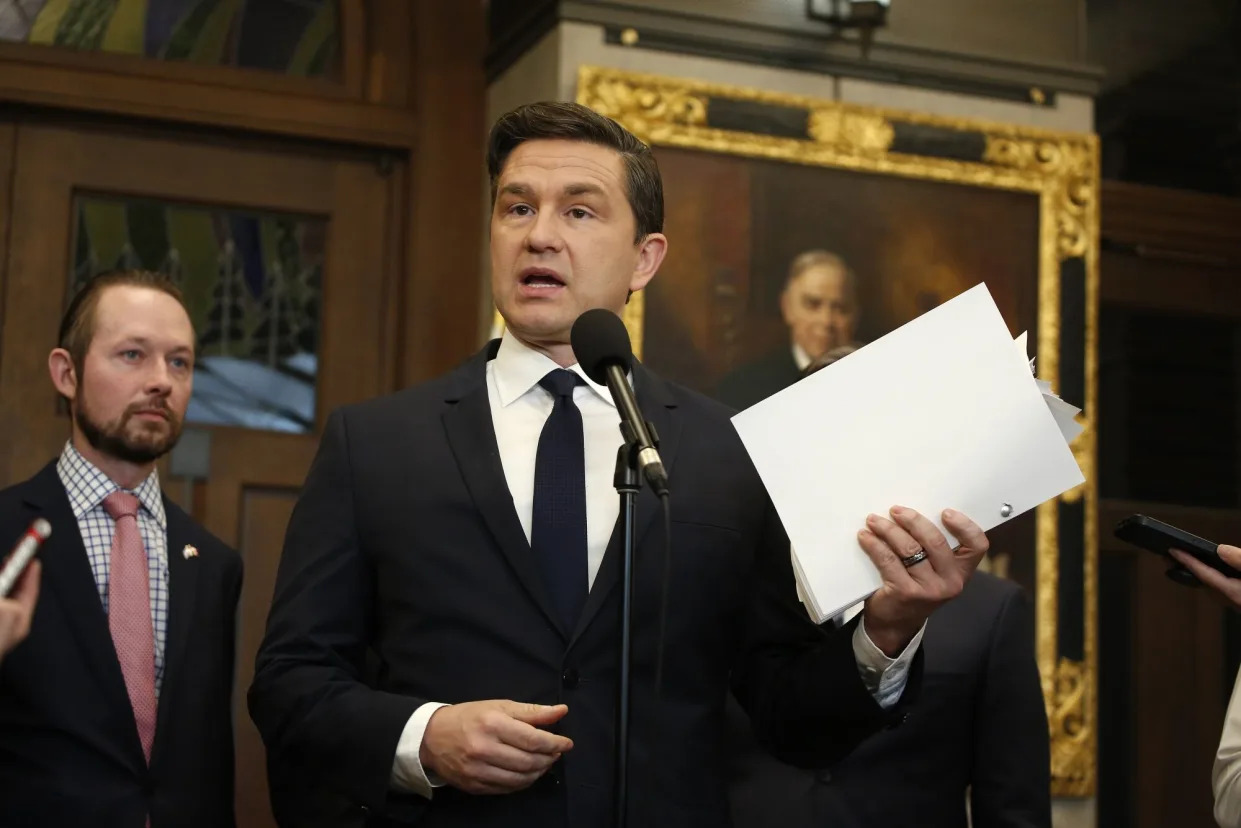
(Bloomberg) -- Prime Minister Justin Trudeau’s main political opponent tried to force a snap election on Wednesday, but the effort failed due to a lack of support from the other opposition parties in Parliament.

It’s a scenario that may play out many times in the coming months, as Pierre Poilievre’s Conservative Party is keen to trigger an election but the smaller parties are more interested in negotiating deals with Trudeau’s Liberal Party to achieve policy objectives.

The next election is currently scheduled for October 2025, but because the Liberals don’t control a majority of seats in Parliament, the opposition parties can force an early election if they defeat the government on a key vote.

In this case, Poilievre said he was seeking an election focused on the Trudeau government’s national carbon tax, which has been in place since 2019. Poilievre argues the policy has helped create a cost-of-living crisis for Canadians by driving up the price of transport fuel and home heating. Liberals point out most residents receive more money back in rebates than they pay in the tax.

“This will be a carbon tax referendum and a carbon tax election,” Poilievre said in a speech to Parliament when he introduced his motion to bring down the government.

Poilievre’s Conservatives are far ahead in the polls, suggesting he would win a large majority government if an election were held soon. But he has no other allies willing to send voters to the polls now.

“Why the rush to trigger an election? Is this not the perfect opportunity to negotiate and make progress?” said Simon-Pierre Savard-Tremblay, a lawmaker for the Bloc Quebecois, a party that advocates for the French-speaking province of Quebec, in responding to Poilievre’s speech.

Bloc Leader Yves-Francois Blanchet set a deadline of Oct. 29 for the Liberal government to push through measures that are priorities for his party — improvements to pension benefits and protection for some agricultural sectors from trade negotiations. Should Trudeau fail to meet that deadline, Blanchet said he’d begin talks with the Conservatives and other opposition parties on toppling the government.

New Democratic Party lawmakers, meanwhile, accused Poilievre of wanting an election in order to cut health-care programs. The NDP had been in a formal power-sharing deal with Trudeau’s Liberals until earlier this month, and as a condition of that deal the Liberals had brought in new programs to help cover dental care and some drug costs.

©2024 Bloomberg L.P.

Canada's Trudeau survives no-confidence vote in parliament

Nadine Yousif - BBC News, Toronto
Wed, September 25, 2024 

[Reuters]

Canadian Prime Minister Justin Trudeau has survived a motion in parliament aimed at bringing down his government and triggering an election.

Wednesday's no-confidence vote is the first in a series of similar votes expected to be put forward by the opposition Conservative Party amid Trudeau's plummeting approval ratings.

The motion failed after opposition leader Pierre Poilievre fell short in his effort to shore up support from leaders of two other political parties in parliament, the New Democratic Party (NDP) and the Bloc Québécois.


Trudeau, who has been Canada’s prime minister for nine years, has been leading under a minority government.

Voting was held on Wednesday afternoon, on the same day as Trudeau was set to host French President Emmanuel Macron.

While this motion has failed, the Conservative party plans to bring at least two other similar no-confidence votes on Thursday in hopes of sending Canadians to the polls.

Trudeau has been facing growing pressure to step down in recent months.

His approval rating has plummeted from 63% when he was first elected to 28% in June of this year, according to one poll tracker, amid concerns about housing unaffordability and the rising costs of living. His Liberal party lost two consequential by-elections this summer in Toronto and Montreal.

A deal between his party and the NDP has helped him stay in power since Canada’s last federal election in 2021.

But the deal collapsed early in September after NDP leader Jagmeet Singh pulled out from the coalition, saying that the Liberals are “too weak” and “too selfish” to govern.

Trudeau’s leadership has been under threat since, with Conservative Party leader Pierre Poilievre stating that he would put forward a no-confidence vote.

The vote would need the approval of the majority of the 338 members of parliament (MPs) in order for it to pass.

The Liberal Party, which holds 153 seats, voted against it, while the Conservative Party, which holds 119 seats, voted in favour.

The bulk of the other seats are held by the NDP and the Bloc Québécois - both of whose members voted to defeat the motion.

In the end, the motion was defeated by 211 votes against it.


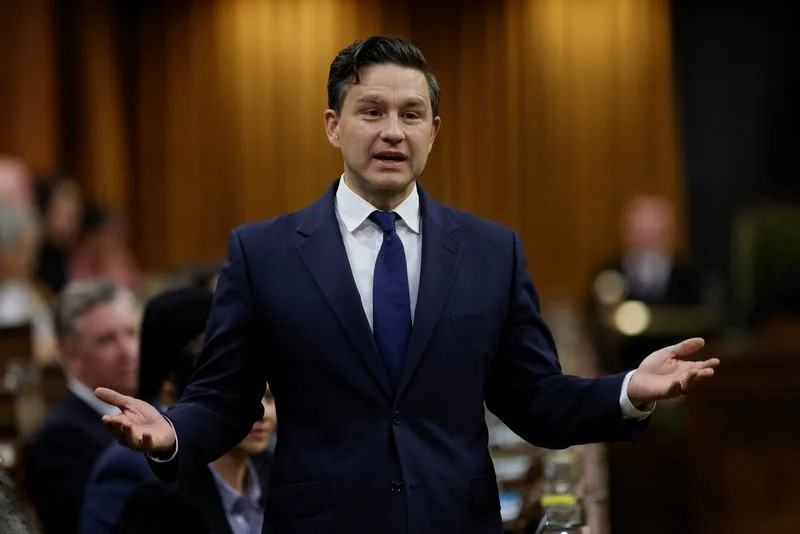
Conservative Party leader Pierre Poilievre has been leading in several national polls [Reuters]

Pierre Polievere, who has been leading in various national polls, had urged fellow MPs to vote in favour of the motion by outlining his vision for Canada under a Conservative government.

His plan, he said on Tuesday in parliament, is “to bring home the promise of Canada, of a powerful paycheque that earns affordable food, gas and homes and safe neighbourhoods”.

But Singh, the NDP leader, said he would vote against Poilievre’s motion because he believes the Conservative Party will cut social programmes like dental care and pharmacare if it comes to power.

The Bloc Québécois - a party whose aim is to represent the interests of Quebec, Canada’s French-speaking province - has said it believes it could work with the Liberal government to secure assurances for Quebec-focused social programmes.

Trudeau was at the UN General Assembly earlier this week in New York City, where on Monday he appeared as a guest on the Late Show with Stephen Colbert.

In his interview with Colbert, Trudeau acknowledged that Canadians were going through “a really tough time” and struggling to afford gas, groceries and rent.

But he defended his leadership, saying that his government had invested in Canadians and would continue to do so.

“I’m going to keep fighting,” he said.


Trudeau survives vote of confidence in Canadian parliament, new threat looms

David Ljunggren
Updated Wed, September 25, 2024


Trudeau survives vote of confidence in Canadian parliament, new threat looms
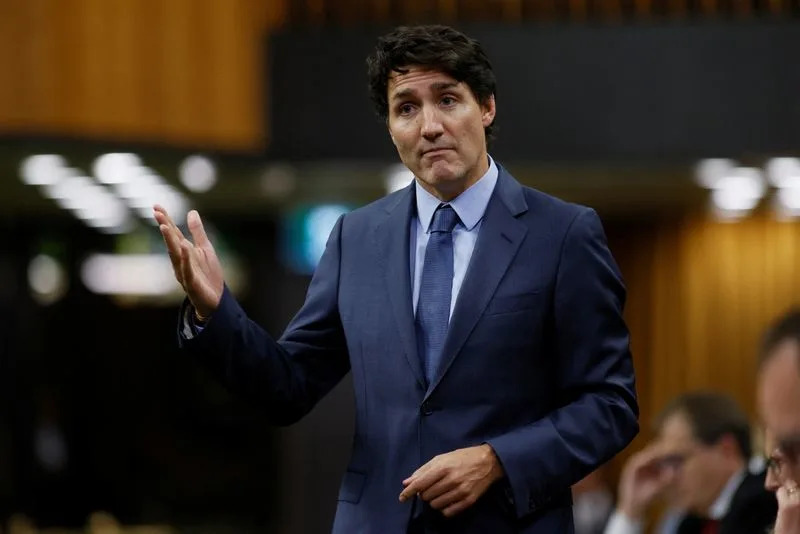
Canada's Prime Minister Trudeau speaks during Question Period in the House of Commons on Parliament Hill in Ottawa

By David Ljunggren

OTTAWA (Reuters) -Canadian Prime Minister Justin Trudeau easily survived a vote of confidence on Wednesday after his main political rival failed to muster enough support to end nine years of Liberal Party rule.

Legislators in the House of Commons voted 211-120 to defeat a motion by the official opposition Conservative party declaring a lack of confidence in Trudeau's minority Liberal government.

Trudeau, whose popularity has slumped amid unhappiness over rising prices and a housing crisis, became more politically vulnerable this month when the smaller New Democratic Party tore up a 2022 deal to keep him in power until an election scheduled for end-October 2025.

"Today was a good day for the country because I don't think Canadians want an election," said Karina Gould, the senior Liberal in charge of government business in the House.

Despite surviving the vote, other challenges loom for Trudeau. Earlier in the day, the leader of the separatist Bloc Quebecois said he would work to bring down the government unless it quickly agreed to the Bloc's demands.

Trudeau's Liberals will soon face a second vote on one of its budget measures, which is also a matter of confidence, but are expected to also survive that. Officials said the vote could take place on Wednesday or Thursday.

"We are going to work piece of legislation by piece of legislation, issue by issue, negotiating with the different political parties," Gould told reporters.

The right-of-center Conservatives have a big lead in the opinion polls ahead of an election that must be called by the end of October 2025.

The Conservatives say they want an election as soon as possible on the grounds that Canadians cannot afford a planned increase in the federal carbon tax. They also say federal spending and crime have ballooned under the Liberals.

"Enough is enough. Costs are up, taxes are up, crime is up, and time is up," the Conservatives said in a statement.

Trudeau, while acknowledging public unhappiness, has accused the Conservatives of playing politics rather than focusing on what people need.

Bloc leader Yves-Francois Blanchet said he would keep Trudeau in power at least until end-December if he gave more money to seniors and vowed to protect a system of tariffs and quotas that protect dairy farmers, many of whom live in Quebec.

If the government did not formally do this by Oct. 29, the Bloc would talk to opposition parties with a view to bringing down Trudeau, he told reporters.

But to succeed he would need the support of the NDP, which also backed Trudeau on Wednesday. Polls indicate the party would also be in trouble if an election were called now.

(Additional reporting by Ismail Shakil in Ottawa; Editing by Frank McGurty and Deepa Babington)
Ecuador capital 'under attack' from five wildfires

AFP
Wed 25 September 2024 

Smoke from a bushfire is seen over Quito on September 24, 2024 (Galo Paguay) (Galo Paguay/AFP/AFP)


Firefighters battled five blazes on the outskirts of Ecuador's capital Quito on Wednesday, as wildfires continue to rip through South American nations turned into tinderboxes by droughts linked to climate change.

Some 2,000 firefighters, military personnel and rescue workers have been deployed in Quito to try to contain the blazes and bring residents in affected areas to safety.

So far at least six people have been injured including two children and two firefighters, and around 100 families evacuated from their homes.

From Ecuador to Brazil, many Latin American nations are gripped by their worst drought in decades, fueling a blistering fire season that has set residents and governments on edge.

"Quito is under attack," the city's security chief Carolina Andrade told reporters.

Authorities in Ecuador believe that a fire that broke out Tuesday in the east of the city and swathed it in huge plumes of smoke was started by arsonists.

On Wednesday, they announced the arrest of a 19-year-old man caught with a gallon of fuel.

Pablo Munoz, Quito's mayor, vowed Wednesday to hunt down the perpetrators of the "terrorist" fires.

The emergency led President Daniel Noboa to cancel his speech at the UN General Assembly and return home from New York on Tuesday.

-'We lost everything' -

Schools suspended classes and government offices ordered remote work due to poor air quality in the city of around three million people.

"I wanted to save something, but we didn't get anything," said Alexis Condolo, a 23-year-old mechanic whose home burned down.

"We found the house in ashes. We lost everything. We only have a few clothes left."

Because of the smoke, "I had to sleep with a mask and wet wipes on top" of the mask, Claudio Otalima, an 82-year-old retiree, told AFP.

Quito has been battling forest fires for three weeks.

In Brazil, fires have consumed millions of acres (hectares) of forest and farmland in recent weeks, and smoke has clouded major cities such as Brasilia, Rio de Janeiro and Sao Paulo, with fumes at times wafting across the border to Argentina and Uruguay.

The Copernicus atmosphere monitoring service said Monday that fires in the Amazon and Pantanal wetlands were the worst in almost two decades.

The dry spell -- which scientists have linked to climate change -- has also sent fires burning out of control in Colombia, Bolivia, Argentina, Paraguay and Peru.

The situation across the continent on Monday saw Amnesty International urge leaders to do more to abandon fossil fuels and transform the industrial agricultural model.

"South American leaders must, more than ever, take urgent action to prevent climate catastrophe that could have irreversible consequences for humanity and for the planet," Amnesty International said.

- Power crisis -

Ecuador is facing its worst drought in six decades.

As a result, the country, which depends on hydroelectric power, is facing severe energy shortages and has implemented rolling blackouts and put 20 of its 24 provinces on red alert.

Over the past year, 3,302 forest fires have been recorded, burning 37,808 hectares (93,400 acres) of vegetation.

Fourteen people have been injured and 44,742 livestock have died, according to a report published Tuesday by the Risk Secretariat.

bur-fb/cb/bfm
Sotheby's puts up for auction rare diamond necklace of XVIII century

25 September 2024 


By Alimat Aliyeva

Sotheby's is going to make history in November with the auction of an extraordinary diamond jewelry, a masterpiece of the European aristocracy, which not only survived the passage of time, but also played a role in the history of the British royal family, Azernews reports.

The jewelry of the XVIII century weighing 300 carats, made ten years before the French Revolution of 1789, will be put up for auction at a price of up to 2.8 million dollars.

It is speculated that some of his diamonds may have been part of the infamous "diamond necklace case" that cast a shadow over the reputation of Marie Antoinette, the unpopular last Queen consort of France.

This piece of jewelry, consisting of three rows of diamonds with diamond tassels at each end, was put on public display for the first time in almost half a century at Sotheby's London showroom.

The chairman and head of sales at Royal and Noble Sotheby's in Europe and the Middle East noted: "It is so rare because diamonds have always been reused, and the Golconda mines in India ceased to exist at the end of the XVIII century. Only members of the royal family or the highest aristocracy could wear such a thing, because it is in itself a fortune consisting of diamonds. Then, as is usually the case, you will find out who owned it last, but not the first."

The global tour of this historic diamond jewel begins in London and will continue at Sotheby's locations in Hong Kong, New York, Singapore, Taipei and Dubai. Each stop will allow collectors and connoisseurs to see this dazzling symbol of European history with their o
Draconian curbs on protest are dangerous

The Guardian
Wed 25 September 2024 

‘Silencing protest does not make the problem disappear
 – quite the opposite.’
Photograph: Wiktor Szymanowicz/Shutterstock

The UK’s repression of peaceful protest is far from a well‑intentioned yet misguided attempt to balance the rights of its citizens (Britain now stifles peaceful dissent like a repressive regime. It’s time to roll back our anti-protest laws, 10 September). This country is only wedded to the rule of law and freedom of expression as long as there is no serious challenge to the ruling class.

Draconian steps to curb protest show where the interests of the powerful really lie – in protecting their own status at all costs. I say this as someone currently in prison for engaging in non‑violent direct action.

The ruling class will never legitimise civilian actions that challenge their dominance, not in the name of “freedom of expression”, not even in the name of “democracy”. However, it is a dangerous game to play. It only takes a glance at global history to see that suppressing dissent is like compressing gas. It eventually explodes.

Silencing protest does not make the problem disappear – quite the opposite. It creates a breeding ground for the far right to exploit neglected communities and unleash their discontent through violence.
Cressida Gethin
HMP Send, Surrey