Wednesday, October 02, 2024


UK Car Factories Gear Up for Electric Shift

  • UK car production fell by 8.4% in August compared to the same month last year, with a total of 41,271 new cars leaving production lines.

  • The decline is attributed to a combination of factors, including summer shutdowns, factories preparing for new models (primarily electric), and a decrease in production of battery electric, plug-in hybrid, and hybrid vehicles.

  • Despite the August slump, the Society of Motor Manufacturers and Traders (SMMT) remains optimistic about a return to growth, citing record levels of investment and the anticipated launch of new electric models.

Car production fell last month, continuing a trend seen across the year, new figures show.

The number of cars built in UK factories was 8.4 per cent lower in August compared to the same month last year.

The Society of Motor Manufacturers and Traders (SMMT) said 41,271 new cars left production lines, 3,781 fewer than last August.

The trade body said the decline continues this year’s trend as factories wind down production of key models and prepare for new, mainly electric models.

Battery electric, plug-in hybrid and hybrid production for the month fell by 25 per cent but the SMMT said the decline is expected to be reversed as new models come onstream.

Production for the domestic market fell by almost 20% while exports were down by 5.9%.

Mike Hawes, SMMT chief executive, said: “With the traditional summer shutdowns and factories prepping to switch to new models, August was always going to be a quieter month for output.

“The sector remains optimistic about a return to growth, however, with record levels of investment announced last year.

“Realising those investments and securing more depends on the UK industry maintaining its competitiveness so we look forward both to the Chancellor’s autumn budget and the Government’s proposed Industrial Strategy as critical opportunities to demonstrate that it backs auto.”

By City AM 


Afghanistan's Taliban Government Aims for BRICS Membership

  • The Taliban government in Afghanistan has expressed interest in joining the BRICS economic bloc, comprising Brazil, Russia, India, China, and South Africa.

  • China and Russia have maintained close ties with the Taliban, hosting delegations and maintaining embassies in Kabul.

  • The Taliban's inclusion in BRICS could be controversial, given its lack of formal recognition and the potential for it to be used to criticize the bloc on the world stage.

Despite not being formally recognized by any country, the Taliban government of Afghanistan is now seeking to join the BRICS economic forum.

"Countries with major resources and the world's biggest economies are associated with the BRICS forum, especially Russia, India, and China," the Taliban government's deputy spokesman Hamdullah Fitrat said.

"Currently, we have good economic ties and commercial exchanges with them. We are keen to expand our relations and participate in the economic forums of the BRICS," he said.

While the Taliban government has not been formally recognized, China and Russia have come close - given they have both hosted Taliban delegations for talks, and they maintain embassies in Kabul even after the US-NATO pullout of August 2021.

The Afghanistan Ministry of Foreign Affairs has further said it hopes to be invited to the BRICS summit to be held on October 22-24 in the southwestern Russian city of Kazan, but that there's "no information so far" on whether the Taliban can attend.

BRICS includes Brazil, Russia, India, China and South Africa, and has recently inducted new members Iran, the United Arab Emirates, Egypt and Ethiopia.

China and Russia have remained the two major regional Asian powers who show willingness to invest in Afghanistan, and potentially tap its significant natural resources. Both have also welcomed the Taliban's fight against rival extremist terror group, the Islamic State Khorasan (ISIS-K).

But the Afghan Taliban's formal inclusion in BRICS might prove an embarrassment for the bloc at a moment it is presenting itself as a counterbalance to the unipolar tendencies of the United States.

Many regional countries have on a de facto level recognized the Taliban's rule over Afghanistan, but have not extended full diplomatic relations in an official capacity.

Source: RFERL

The Taliban in BRICS would present Washington with 'low-hanging fruit' which could be used to denigrate BRICS on a world stage - especially in light of US anger at growing China, Russia, India cooperation and these countries' refusal to condemn Russian military action in Ukraine.

By Zerohedge.com 

DRILL BABY DRILL

Oil and Gas Boom Fuels U.S. Methane Surge

  • U.S. methane emissions are rising, driven by increased oil and gas production, despite federal initiatives to curb them.

  • A Stanford study reveals that methane emissions from U.S. oil and gas facilities are likely three times higher than government estimates.

  • The EPA and DoE are investing millions in projects to monitor, measure, and reduce methane emissions, while new regulations aim to address leaks and waste.

Despite ambitious promises of an accelerated green transition from the government, the U.S. is still experiencing extremely elevated levels of methane emissions each year. As the Biden administration pumps billions into renewable energy, clean technologies, and decarbonisation projects, methane emissions continue to rise year on year with no sign of a reduction any time soon. Methane traps more heat in the atmosphere per molecule than carbon dioxide, which makes it 80 times more harmful than CO2 for 20 years after it is released. The UNEP suggests that cutting methane emissions by 45 per cent by 2030 could help us meet the Paris Agreement’s goal of limiting global warming to 1.5°C. 

Since 2021, 158 countries have agreed to the Global Methane Pledge, led by the U.S. and EU. It states that these countries must cut methane emissions by 30 percent from 2020 by 2030. However, recent satellite imagery showed that methane emissions from nine fossil fuel basins had increased by 7 percent compared to 2020 levels. The U.S. is one of the worst performers when it comes to methane emissions, owing largely to a massive increase in oil and gas production in the post-pandemic era. It continues to be the world’s third-largest methane emitter after China and India. 

In previous years, the U.S. government has relied heavily on the oil and gas industry to clean up its act. While the U.S. fossil fuel industry emits less methane per unit of energy than in the past, the massive surge in oil and gas production means that the U.S. is producing more methane than before. Oil and natural gas facilities are now the country’s largest industrial source of methane. 

In recent years, the Biden administration has put greater pressure on oil majors to clean up operations by identifying and plugging leaks, improving maintenance activities and bringing an end to gas flaring practices. This has been supported by millions in funding from the Inflation Reduction Act (IRA) and other federal schemes. Unlike carbon emissions, which are produced from burning fossil fuels, methane is released during the production and transportation of gas. The U.S. continues to experience a massive methane problem, with thousands of abandoned wells that have yet to be plugged, and leaks along transportation networks. 

One of the biggest issues is the failure of the government to accurately measure the extent of the U.S. methane problem. Stanford-led research suggests that the methane emissions from a large share of U.S. oil and gas facilities are three times higher on average than those stated by official government estimates. Oil and gas operations across the country emit over 6 million tons of methane a year. The high levels of methane emissions mainly come from international gas venting and unintentional leaks. It costs oil and gas producers around $1 billion a year in lost commercial value and around $10 billion when harm to the economy and human well-being are considered, according to the researchers. 

The Stanford report analyses around one million aerial measurements of U.S. wells, pipelines, storage, and transmission facilities in six of the country’s most productive regions, including the Permian and Forth Worth in Texas and New Mexico; California’s San Joaquin basin; Colorado’s Denver-Julesburg basin; Pennsylvania’s section of the Appalachian basin; and Utah’s Uinta basin. These regions account for 52 percent of U.S. onshore oil production and 29 percent of gas production. The results show that methane levels are likely three times higher than the current government predictions. 

The senior author of the study, Adam Brandt, explained, “Costs aside, the main message here is that some regions show emissions at rates well above those the government itself uses to estimate methane losses.” Brandt added, “We hope this will spur government methane inventories toward greater incorporation of remote sensing data at the heart of those estimates.”

The U.S. government is working rapidly to drive methane levels down in the coming years. The Environmental Protection Agency (EPA) aims to implement a legislated fee on methane emissions that exceed a certain performance standard. The EPA is also finalising several new regulatory provisions, which include expanded leak detection and repair, and more consistent use of the latest mitigation technology. In addition, the Bureau of Land Management launched its methane regime, which introduced royalty payments for methane waste on federal land. The Pipeline and Hazardous Materials Safety Administration is also introducing new rules to reduce methane loss from pipelines.

In June this year, the U.S. Department of Energy (DoE) and the EPA announced $850 million in funding for projects that will help monitor, measure, quantify, and reduce methane emissions from the oil and gas sector as part of the Biden administration’s Investing in America agenda. This follows several federal initiatives aimed at reducing methane levels, with agencies taking almost 100 actions in 2023 alone.

The EPA Administrator, Michael Regan, stated, “Today, we’re building on strong standards and historic progress to cut methane pollution and protect communities across the country.” Regan added, “These investments from President Biden’s Investing in America agenda will drive the deployment of available and advanced technologies to better understand where methane emissions are coming from. That will help us more effectively reduce harmful pollution, tackle the climate crisis, and create good-paying jobs.”

By Felicity Bradstock for Oilprice.com 


Oil, Natural Gas, and Coal Dominate U.S. Rail Freight

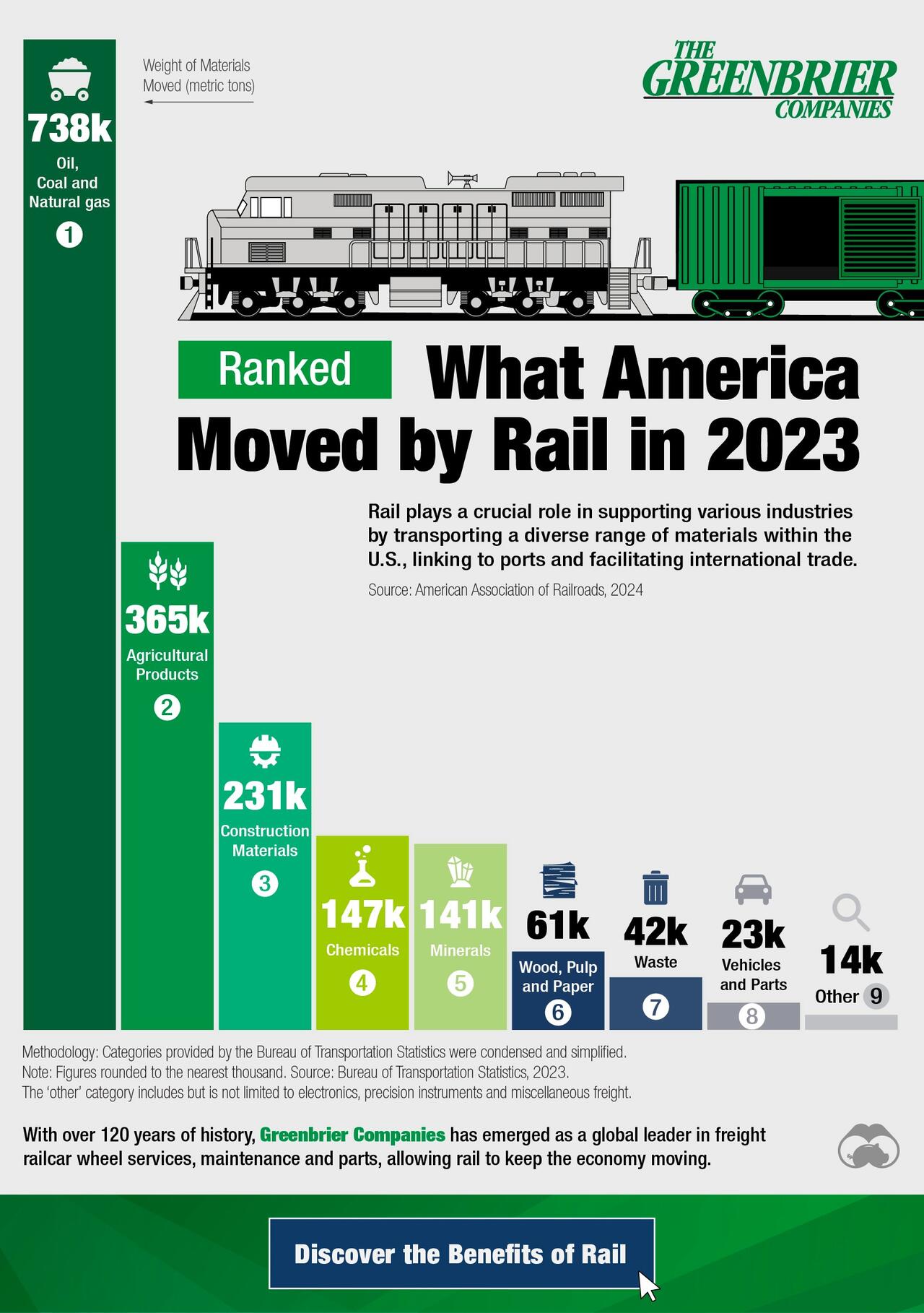
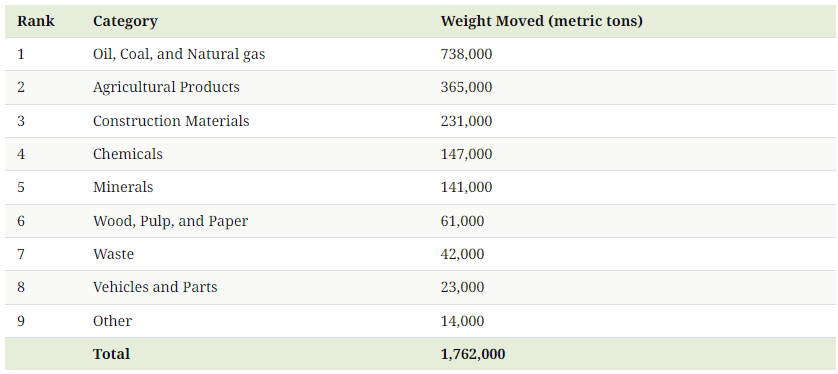
  • U.S. rail freight transported nearly 1.8 million metric tons of materials in 2023, with energy products, including coal, oil, and natural gas, being the most common.

  • Rail stands out for its safety record and sustainability, contributing just 1.8% of U.S. transport greenhouse gases.

  • Greenbrier Companies, a global leader in freight railcar services and maintenance, enables rail to keep the economy moving.

Rail freight is the backbone of U.S. infrastructure, moving millions of tons of various materials and linking the nation’s numerous ports and cities to facilitate domestic and international trade.

But what material did U.S. rail move the most in 2023?

For this graphic, Visual Capitalist partnered with The Greenbrier Companies to answer this question and dive into what makes rail vital to the U.S. economy.

What Does U.S. Rail Freight Move?

Versatility is one of rail’s greatest strengths. In 2023, rail freight moved nearly 1.8 million metric tons of a wide variety of materials around the nations 140,000 mile rail network—everything from wood and chemicals to vehicle parts and waste products.

However, energy products, particularly coal, oil, and natural gas, were the most common materials moved.

Methodology: Categories provided by the Bureau of Transportation Statistics were condensed and simplified. Note: Figures rounded to the nearest thousand. The ‘other’ category includes but is not limited to electronics, precision instruments, and miscellaneous freight.

Why Choose Rail?

Rail is an incredibly versatile mode of transport, facilitating a wide range of industries and the U.S. economy as a whole by, amongst many other reasons, acting as a point of connection between trucking and shipping.

However, rail’s history of safety and sustainability makes it stand out.

According to the Federal Railroad Administration, rail accident rates are down 27%, and rail accidents where hazardous materials are transported are down 75% since 2000.

Rail also contributes just 1.8% of U.S. transports greenhouse gases despite moving 40% of all long-distance freight. Rail can do this as it is a highly fuel efficient form of transport and is becoming more efficient every year.

In fact, in 2023, U.S. rail consumed 709 million fewer gallons of fuel than it did in 2000.

Moving What Matters

Rail is critical in supporting many U.S. industries by transporting diverse materials within the nation, linking to ports, and facilitating international trade.

With over 120 years of history, Greenbrier Companies has emerged as a global leader in freight railcar wheel services, maintenance, and parts, allowing rail to keep the economy moving.

By Zerohedge.com 


Colorado's Bold Move to Ban Oil Drilling Sparks Nationwide Debate

  • Colorado lawmakers have proposed groundbreaking legislation that would ban new oil and gas drilling permits starting in 2028 and require existing wells to pause production for five months each year.

  • This bold move could inspire other states to follow suit, but faces opposition from the oil and gas industry and some lawmakers.

  • The outcome of Colorado's legislative efforts will likely have significant implications for the future of energy production and environmental policy in the United States.

Earlier this year, Democratic lawmakers in Colorado proposed two pieces of legislation aimed at introducing a statewide ban on oil and gas wells, which would be the first of its kind in the U.S. One of the bills aimed to introduce a ban on new oil and gas drilling permits by bringing an end to new oil and gas licenses starting in 2028. The second proposal would require oil and gas companies to pause production for five months each year.

The proposal of such strict limitations on oil and gas operations had not previously been seen and the proposal of such far-reaching laws could encourage other states to follow suit. Environmentalists are calling for lawmakers to bring an end to oil and gas production, with a particular focus on fracking, a technique that is widely used in Colorado. In 2019, both Oregon and Washington banned fracking, and climate activists are looking to do the same in Colorado. However, passing laws restricting oil and gas production is no easy task, with several other states with Democratic majorities, such as New Mexico, having failed to change the regulation and oversight of oil and gas production in recent years. 

Colorado is well-known for its oil and gas production. Its crude output has increased sharply in recent decades, from nearly 2.7 million barrels per month in 2010 to almost 13.5 million barrels in June of this year. Colorado is the fourth-biggest oil-producing state in the U.S., accounting for around 4 percent of the U.S. total crude oil output. The use of horizontal drilling and hydraulic fracturing technologies has helped Colorado to massively increase its oil production in recent years. 

In 2019, the Colorado state government passed new rules that provided greater power to local governments to regulate the expansion of the oil and gas industry within their jurisdictions. The new law also obligated the oil and gas regulator, the Colorado Energy & Carbon Management Commission (ECMC), to work with the Colorado Department of Public Health and Environment to address the “cumulative impact” of oil and gas development. This introduction of the rules responded to the rise in public pressure as the oil and gas industry expanded to more urban areas, leading to poorer air quality and widespread health issues. 

However, in August, lawmakers complained that Colorado regulators had watered down the new rules on oil and gas oversight, making 17 revisions to the document. In a letter to the ECMC, 24 legislators said, “The current draft deviates significantly from the intent of the laws we worked to pass, jeopardising the protection of disproportionately impacted communities and allowing operators broad leeway to exceed pollution thresholds.” Rep. Elizabeth Velasco stated, “The agency has prioritised industry over public health and safety.” 

Other states are also addressing concerns about the longevity of oil and gas, as the public is increasingly putting pressure on legislators to support a green transition. In New York, legislators are exploring a potential ban on the use of carbon dioxide for oil and gas recovery. Meanwhile, in 2022, California passed a law banning drilling for oil and gas within 3,200 feet of certain structures, such as homes, schools and hospitals. This drove down the number of new well licenses, although the law has not yet gone into effect. 

Vermont is leading the way on oil and gas legislation and intends to go even further this year. In 2012, it became the first U.S. state to ban the practice of fracking. The state now aims to pass a new measure to force oil and gas companies to pay for damages caused by the climate crisis. This echoes the aims of the Environmental Protection Agency’s Superfund programme, which requires companies to pay for the clean-up of toxic waste. If passed, the new measures would charge oil and gas firms operating in Vermont billions of dollars for their past emissions.

Elena Mihaly, the vice-president of the Conservation Law Foundation’s Vermont chapter stated, “If you contributed to a mess, you should play a role in cleaning it up.” The passing of the bill will not be straightforward, and it is likely to be in the court for a long time before we hear a verdict. However, if passed, it could provide a framework for other states to follow. 

Many legislators in states across the U.S. are heeding the calls of the public and introducing ambitious new rules to impose stricter regulations on the oil and gas industry. This reflects the aims of the Biden administration’s Inflation Reduction Act and other national policies that aim to accelerate a green transition. However, while there is widespread support for such policies, getting far-reaching state climate laws passed will be an uphill battle that could take several years and incite strong opposition from the industry. 

By Felicity Bradstock for Oilprice.com 

Colorado's Bold Move to Ban Oil Drilling Sparks Nationwide Debate

  • Colorado lawmakers have proposed groundbreaking legislation that would ban new oil and gas drilling permits starting in 2028 and require existing wells to pause production for five months each year.

  • This bold move could inspire other states to follow suit, but faces opposition from the oil and gas industry and some lawmakers.

  • The outcome of Colorado's legislative efforts will likely have significant implications for the future of energy production and environmental policy in the United States.

Earlier this year, Democratic lawmakers in Colorado proposed two pieces of legislation aimed at introducing a statewide ban on oil and gas wells, which would be the first of its kind in the U.S. One of the bills aimed to introduce a ban on new oil and gas drilling permits by bringing an end to new oil and gas licenses starting in 2028. The second proposal would require oil and gas companies to pause production for five months each year.

The proposal of such strict limitations on oil and gas operations had not previously been seen and the proposal of such far-reaching laws could encourage other states to follow suit. Environmentalists are calling for lawmakers to bring an end to oil and gas production, with a particular focus on fracking, a technique that is widely used in Colorado. In 2019, both Oregon and Washington banned fracking, and climate activists are looking to do the same in Colorado. However, passing laws restricting oil and gas production is no easy task, with several other states with Democratic majorities, such as New Mexico, having failed to change the regulation and oversight of oil and gas production in recent years. 

Colorado is well-known for its oil and gas production. Its crude output has increased sharply in recent decades, from nearly 2.7 million barrels per month in 2010 to almost 13.5 million barrels in June of this year. Colorado is the fourth-biggest oil-producing state in the U.S., accounting for around 4 percent of the U.S. total crude oil output. The use of horizontal drilling and hydraulic fracturing technologies has helped Colorado to massively increase its oil production in recent years. 

In 2019, the Colorado state government passed new rules that provided greater power to local governments to regulate the expansion of the oil and gas industry within their jurisdictions. The new law also obligated the oil and gas regulator, the Colorado Energy & Carbon Management Commission (ECMC), to work with the Colorado Department of Public Health and Environment to address the “cumulative impact” of oil and gas development. This introduction of the rules responded to the rise in public pressure as the oil and gas industry expanded to more urban areas, leading to poorer air quality and widespread health issues. 

However, in August, lawmakers complained that Colorado regulators had watered down the new rules on oil and gas oversight, making 17 revisions to the document. In a letter to the ECMC, 24 legislators said, “The current draft deviates significantly from the intent of the laws we worked to pass, jeopardising the protection of disproportionately impacted communities and allowing operators broad leeway to exceed pollution thresholds.” Rep. Elizabeth Velasco stated, “The agency has prioritised industry over public health and safety.” 

Other states are also addressing concerns about the longevity of oil and gas, as the public is increasingly putting pressure on legislators to support a green transition. In New York, legislators are exploring a potential ban on the use of carbon dioxide for oil and gas recovery. Meanwhile, in 2022, California passed a law banning drilling for oil and gas within 3,200 feet of certain structures, such as homes, schools and hospitals. This drove down the number of new well licenses, although the law has not yet gone into effect. 

Vermont is leading the way on oil and gas legislation and intends to go even further this year. In 2012, it became the first U.S. state to ban the practice of fracking. The state now aims to pass a new measure to force oil and gas companies to pay for damages caused by the climate crisis. This echoes the aims of the Environmental Protection Agency’s Superfund programme, which requires companies to pay for the clean-up of toxic waste. If passed, the new measures would charge oil and gas firms operating in Vermont billions of dollars for their past emissions.

Elena Mihaly, the vice-president of the Conservation Law Foundation’s Vermont chapter stated, “If you contributed to a mess, you should play a role in cleaning it up.” The passing of the bill will not be straightforward, and it is likely to be in the court for a long time before we hear a verdict. However, if passed, it could provide a framework for other states to follow. 

Many legislators in states across the U.S. are heeding the calls of the public and introducing ambitious new rules to impose stricter regulations on the oil and gas industry. This reflects the aims of the Biden administration’s Inflation Reduction Act and other national policies that aim to accelerate a green transition. However, while there is widespread support for such policies, getting far-reaching state climate laws passed will be an uphill battle that could take several years and incite strong opposition from the industry. 

By Felicity Bradstock for Oilprice.com