In the probe into the attack on Hardeep Singh Nijjar and Gurpatwant Singh Pannun, Canada and the US seem to be coordinating their moves. That is because the two are part of Five Eyes, a powerful, close-knit intelligence-sharing grouping. Here's more about Five Eyes and why Justin Trudeau is using it for leverage.
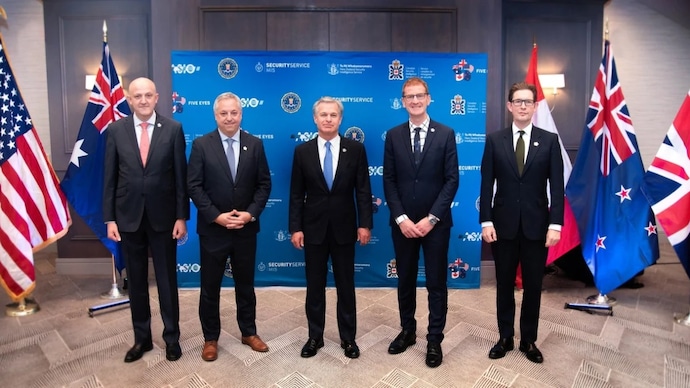
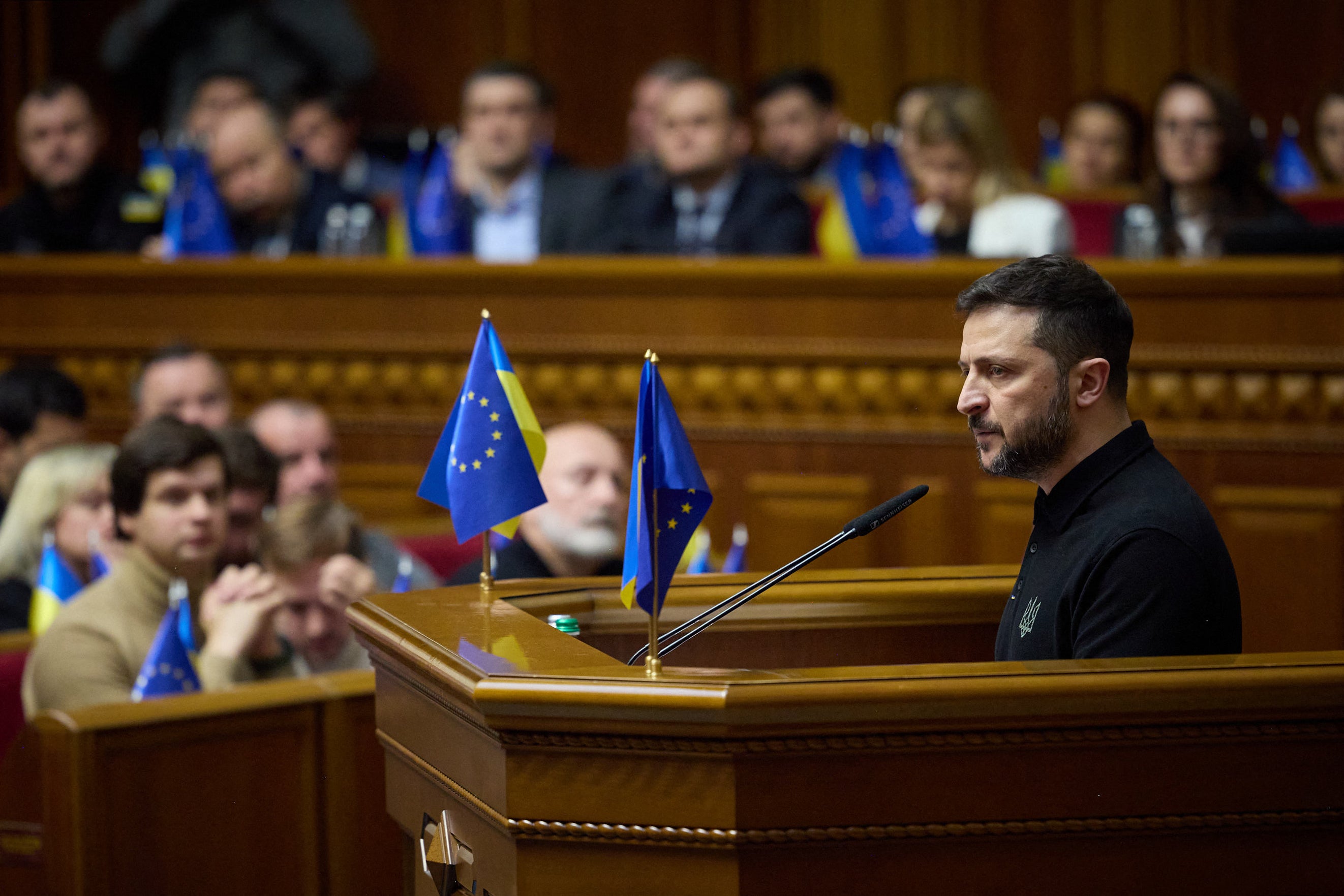
Intelligence officials of Five Eyes made their first joint public appearance in October 2023 in the US on the invitation of FBI Director Christopher Wray. (Image: Federal Bureau of Investigation)
India Today News Desk
New Delhi,
Written By: Sushim Mukul
On October 14, the chill in Indo-Canada ties took the shape of a diplomatic stand-off. Justin Trudeau's Canadian government labelled the Indian High Commissioner and other diplomats 'persons of interest' in the murder probe of Khalistani terrorist Hardeep Singh Nijjar. On that day, the US State Department put out a statement, which it withdrew later, related to the probe into the bid on Gurpatwant Singh Pannun's life. Like Nijjar, Pannun is a Khalistani terrorist. The American move seemed to be in coordination with Canada's. And it wasn't the first time. That the US and Canada were waving red flags at India together is linked to the two being part of the powerful Five Eyes grouping.
The Five Eyes is one of the most close-knit espionage alliances in the world, dating back to World War II.
Canada first accused the Indian government of links to Nijjar's killing, and that came after it received intelligence from the Five Eyes network.
And not just that. Caught in conflict with an assertive India, Canadian Prime Minister Justin Trudeau is dialling leaders of the Five Eyes to shore up support.
On shaky ground since 2023, India-Canada diplomatic relations plunged further on October 14 as India recalled six diplomats, including its high commissioner, and expelled six Canadian diplomats.
As all eyes were on the tit-for-tat diplomacy between India and Canada, the US made a move related to another Khalistani terrorist. The US, investigating a foiled plot to murder Gurpatwant Singh Pannun in New York, said an Indian inquiry committee was set to travel to the country on October 15.
The US was probing allegations that an Indian government official was linked to the foiled assassination attempt on Pannun. However, the statement, posted by the US Department of State on X, was later withdrawn.
Not just that, US State Department spokesperson Matthew Miller even alleged that India was not cooperating with Canada on its Nijjar killing probe.
That the US and Canada, two close allies, moved in sync shouldn't come as a surprise as they are part of the Five Eyes alliance and have close cooperation on sharing of all vital information.
And not just the US, even New Zealand -- another Five Eyes member -- backed Canada, albeit with caution.
CANADA SHARED NIJJAR MURDER INTEL WITH FIVE EYES, CONFIRMS TRUDEAU
The Five Eyes, comprising the US, the UK, Canada, Australia and New Zealand, is one of the most close-knit intelligence forums in the world, where the member states share a wide range of intel in a coordinated manner to shield their national interests.
That's the Five Eyes, that has appeared amid the Indo-Canada row as the US and Canada investigate attacks on two Khalistani terrorists.
Canadian PM Justin Trudeau revealed that Canada shared all information it had related to the allegations of the involvement of Indian officials in the killing of Nijjar. In 2023, a New York Times report said that the US shared intelligence inputs on Nijjar's killing with Canada.
"From the beginning as of last summer, we have worked closely with our Five Eyes partners, particularly with the US, where they have gone through a similar pattern of behaviour from India in regard to an attempted extrajudicial killing. And we will continue to work with our allies as we stand up together for the rule of law," Trudeau said at the news conference on Monday.
The admission came with Canada's Foreign Minister, Mélanie Joly, revealing the same.
"We will continue to engage with our Five Eyes partners, we will continue to engage with all the G7 partners, and everything is on the table," Mélanie Joly answered when she was asked if Canada would consider imposing sanctions against India.
She also confirmed that she had communicated with her Five Eyes counterparts, which includes the Foreign Ministers of member nations, on the matter.
New Zealand's Minister of Foreign Affairs, Winston Peters, agreed that the island nation was briefed by Canada on "recent announcements on ongoing criminal investigations into violence and threats of violence against members of its South Asian community".
advertisement
"The alleged criminal conduct outlined publicly by Canadian law enforcement authorities, if proven, would be very concerning," Winston Peters wrote on X on Tuesday.
However, Peters did not mention India in his X post.
WHAT IS THE FIVE EYES INTELLIGENCE GROUPING?
The Five Eyes alliance is a longstanding and highly influential intelligence partnership between five English-speaking countries.
Formed in the aftermath of World War II, the alliance is rooted in the UKUSA Agreement of 1946, a multilateral treaty for cooperation in signals intelligence (SIGINT).
This alliance originated from secret meetings between British and American code-breakers during World War II and was formalised to enhance the war effort. Over the years, it has expanded to include Canada in 1948 and Australia and New Zealand in 1956.
"The alliance is one of the world's most unified multilateral arrangements", says the Department of Public Safety and Emergency Preparedness of Canada.
The Five Eyes alliance is known for its comprehensive global surveillance capabilities, monitoring electronic communications, including phone calls, emails, and text messages, through various methods such as intercepting data from satellites, telephone networks, and fibre optic cables, according to Forbes.
The alliance is also said to collaborate with major technology companies to gather user data, said a 2013 report in The Washington Post.
It is ironical that the Five Eyes is being mentioned in India's context as the grouping became increasingly active amid China's muscle-flexing, and the US bid to contain it.
HOW FIVE EYES PLAYED A ROLE IN TRUDEAU'S ALLEGATION AGAINST INDIA
Since Nijjar's murder, the United States has stepped up cooperation with Canada in investigating related plots, including the attempted assassination of Pannun in New York.
As the India-Canada row escalated on October 15, the US again underlined that Trudeau's allegations about the Nijjar killing in Canada are "extremely serious", and 'India needs to take them seriously'.
"We wanted to see the government of India cooperate with Canada in its investigation. Obviously, they have not chosen that path," State Department spokesperson Matthew Miller said.
It was the intelligence from the Five Eyes that resulted in Canada publicly accusing the Indian government of the murder of Nijjar, according to a CNN report from 2023.
I'm "confirming that there was shared intelligence among Five Eyes partners that helped lead Canada to make the statements that the prime minister made," US Ambassador to Canada, David Cohen, told CNN, a week after Trudeau's claims, that the Indian government called "absurd and motivated".
advertisement
Canadian Public Safety Minister Dominic LeBlanc on Monday, revealed he briefed US Attorney General Merrick Garland and Homeland Security Secretary Alejandro Mayorkas on actions being taken by the Royal Canadian Mounted Police (RCMP).
"He [Garland] and I discussed the importance of the FBI and the RCMP continuing to share information as these various criminal cases continue," LeBlanc said, while underlining the importance of continued information-sharing between the FBI and the RCMP.
The US's FBI and Canada's RCMP are the participating federal agencies in the Five Eyes forum.
Not just for intelligence-sharing, the Five Eyes also works in providing strategic advantage to its members. Trudeau has been trying to garner support on the Nijjar issue from other members as a pressure tactic against India.
On October 15, Trudeau dialled British Prime Minister Keir Starmer to brief him on the issue.
The five members of the group are all developed nations of the Anglosphere. The US, the UK and Canada, three of the Five Eyes members, are also part of the G7 economic grouping. That's where the sanctions talk comes in too.
Though Canada risks billions of dollars in trade if the conflict with India snowballs, there is the Five Eyes that the Trudeau government would like to leverage as the issue takes a turn for the worse.
The UK joined its 'Five Eyes' allies in backing Canada's charge against India, saying New Delhi's cooperation with Ottawa's legal process was "the right next step".
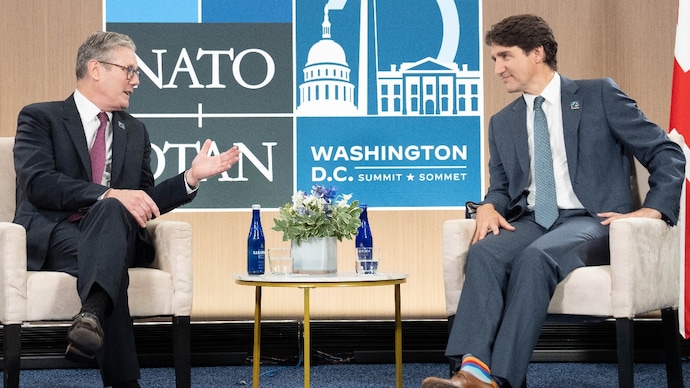
British Prime Minister Keir Starmer (L) with Canadian Prime Minister Justin Trudeau. (Photo: AFP)
India Today World Desk
New Delhi,
Written By: Rishabh Sharma
In Short
India asked to cooperate with Canada's legal process
Canada accused India of involvement in Khalistani terrorist's murder
The UK has backed its 'Five Eyes' ally Canada's claims against India's alleged involvement in promoting criminal activities on Canadian soil. In a statement, Britain said India's cooperation with Canada's legal process was "the right next step".
"We are in contact with our Canadian partners about the serious developments outlined in the independent investigations in Canada. The UK has full confidence in Canada’s judicial system," the British government said in a statement.
"The Government of India's cooperation with Canada's legal process is the right next step," it added.
The 'Five Eyes' is an intelligence alliance comprising five countries: the US, the UK, Canada, Australia, and New Zealand.
This group focuses on monitoring global communications, cyber threats, terrorism, and other security issues, with an emphasis on collecting and exchanging intelligence to protect their mutual interests.
The US, New Zealand, and Australia have already released statements backing Canada's claims against India.
The ongoing diplomatic row between India and Canada escalated on Monday after Ottawa alleged that Indian diplomats were working with the Lawrence Bishnoi gang to target pro-Khalistan elements.
Canada also made Indian High Commissioner Sanjay Verma and other diplomats as 'persons of interest' linked to the murder of Khalistani terrorist Hardeep Singh Nijjar on Canadian soil.
The Ministry of External Affairs released a scathing statement, saying that Canada did not share a "shred of evidence of India's involvement in Nijjar's killing" despite repeated requests and accused Trudeau of doing vote bank politics and not doing enough to tackle separatist elements on Canadian soil.
The row escalated with New Delhi recalling its top envoy to Ottawa and expelling six Canadian diplomats from the country on late Monday evening.
Published By:
Rishabh Sharma
Published On:
Oct 16, 2024
Who is Lawrence Bishnoi, the gangster at the centre of India-Canada spat?
Canadian officials this week said Bishnoi’s gang was targeting Sikh dissidents at the behest of the Indian government. It’s a PR coup for India’s most notorious crime boss.
 Gangster Lawrence Bishnoi amid heavy police security while coming out of the Amritsar court complex on October 31, 2022 in Amritsar, India [FILE: Sameer Sehgal/Hindustan Times via Getty Images]
By Yashraj Sharma
Published On 16 Oct 202416 Oct 2024
New Delhi, India — India-Canada bilateral relations touched a historic low this week when both countries expelled six diplomats each, in tit-for-tat moves, after Ottawa doubled down on its accusation that the Indian government masterminded the 2023 murder of a prominent Sikh separatist leader.
While levelling serious conspiracy charges against India’s senior-most diplomats in Ottawa, the Canadian officials dropped another bombshell allegation — linking the diplomatic mission with India’s most notorious crime syndicate boss, Lawrence Bishnoi.
Canada’s Royal Canadian Mounted Police (RCMP), which has been investigating the killing of Sikh separatist leader Hardeep Singh Nijjar, blamed the “Bishnoi group” for carrying out hit jobs at the behest of the Indian government’s external spy agency, the Research and Analysis Wing (RAW).
Bishnoi is currently imprisoned in Indian Prime Minister Narendra Modi’s home state of Gujarat — in the Sabarmati Central Jail in Ahmedabad — ruled by his Bharatiya Janata Party (BJP).
So, who is Lawrence Bishnoi? How does he continue to run his crime syndicate from behind bars? And how does a gangster fit into a serious geopolitical crisis between two democracies with deep historical ties?
From a Punjab village to Mumbai
Bishnoi, 31, first captured national attention when he was linked with the killing of hip-hop icon, Punjabi rapper Sidhu Moose Wala, on May 29, 2022. Moose Wala was also a member of India’s opposition party, Congress. Bishnoi’s associates claimed responsibility for the murder as part of an intergang rivalry.
More recently, Bishnoi’s gang claimed responsibility for the murder of a 66-year-old Muslim politician, Baba Siddique, in Mumbai’s posh Bandra area last weekend.
Siddique was a three-time legislator and former minister in the Maharashtra state government. He was widely known for his closeness with Bollywood celebrities, most notably with actor Salman Khan.
“We do not have any enmity with anyone but whoever helps Salman Khan … keep your accounts in order,” noted a purported Facebook post by an associate of Bishnoi, claiming responsibility for Siddique’s killing.
Bishnoi’s feud with Khan goes back nearly 26 years over the actor’s killing of two antelopes on a recreational hunting trip in Rajasthan while shooting a film in the western state in 1998. The Bishnoi religious sect considers the species sacred.
In April this year, two members of the gang were arrested for firing at Khan’s home in Mumbai.
“For gangsters, it is all in the name — and the fear of that name,” Jupinderjit Singh, author of Who Killed Moosewala?, who has traced gang wars in north India for nearly a decade, told Al Jazeera.
“Lawrence often says, ‘Bada kaam karna hai [I have to do something big]’. Earlier, the ‘big job’ was murdering Moose Wala, then attacking Salman Khan, and now Siddique,” said Singh. “These attacks add brand value to his name and multiply the extortion and ransom amount” the gang can demand.
His alleged collusion with the Indian government to assassinate Sikh separatists in Canada is eventually proven or not, Canadian officials — by naming Bishnoi’s gang — have already delivered a PR victory for them, Singh said,
“Eventually, the winner is Lawrence here. He is getting the name he has yearned for,” the author said.
“People like Lawrence live by the gun — and they die by the gun.”
The ‘I’m something’ syndrome
Born in 1993, near the Pakistan border in India’s Sikh-majority Punjab state, Lawrence Bishnoi was “exceptionally fair, nearly a pinkish complexion, and almost European rather than Indian”, according to his mother, Sunita, a graduate-turned-homemaker, as she told author Singh during their interactions for his research.
Hence, the name, Lawrence — uncommon among the Bishnoi community in north India — which was inspired by British educationist and administrator Henry Lawrence, who was stationed in Punjab during the colonial era.
Bishnoi’s family was well-off and owned more than 100 acres (40 hectares) of farming land in Punjab’s Duttaranwali village. After high school, Bishnoi went to Chandigarh, the state’s capital, to study law.
There, at DAV College, he stepped into student politics and allegedly ventured into the criminal world by locking horns with rival student groups. Bishnoi served as the president of the college’s student body. He was arrested over charges of arson and attempt to murder and sent to a jail in Chandigarh, where he reportedly came under the influence of other imprisoned gangsters.
In Punjab, it is a common phenomenon that the gangsters come from “well-off, good families”, said Singh, the author who has also tracked Bishnoi’s rise since his college days. “All of them suffer from a syndrome: ‘I’m something’,” he added.
However, when they move to cities and face “an elite, intellectual crowd, they realise they are not landlords any more”, says Singh. For many of them, crime becomes an answer to reaffirm their faith in themselves, he adds.
Among his young followers, Bishnoi is highly revered as “a man of principle”, said a senior police officer, requesting anonymity, in Rajasthan, where the Bishnoi gang has recruited members. “He positions himself as this righteous bachelor, a celibate, often signing off with remarks like “Jai Shri Ram (Hail Lord Ram)”, a Hindu right-wing war cry.
Bishnoi has been shuffling between prisons for more than a decade now but has still extended his crime syndicate to the national capital, New Delhi, and neighbouring states, and fought turf wars with rival gangs in Uttar Pradesh, Rajasthan and Punjab. He is known to have active associates across Canada and the United States.
“With Siddique’s killing, he is aiming to place himself in Mumbai’s feared underworld now,” the police officer told Al Jazeera.
So, when Singh, the author, woke up to the news of Canada linking Bishnoi to Indian agents, he said, “I really, really wished it is untrue” because of the legitimacy within the crime world Bishnoi may get out of it — “and spill over to a section of youth that is unfortunately looking up to him now”.
How does Bishnoi fit into the India-Canada crisis?
At the heart of the latest allegations levelled by Canada against Indian officials is the claim by Canadian Prime Minister Justin Trudeau, made on Monday, that Indian diplomats were collecting information about Canadians and passing it on to organised crime gangs to attack Canadians.
The RCMP, separately, made clear in comments to the press that Canadian authorities were referring to the Bishnoi gang when they were speaking of organised crime.
“India has made a monumental mistake,” said Trudeau. “We will never tolerate the involvement of a foreign government threatening and killing Canadian citizens on Canadian soil,” he added, marking an unprecedented escalation of the diplomatic crisis that has been brewing for more than a year now, since he first publicly accused the Indian government of involvement in Nijjar’s assassination.
India has denied the allegations as “preposterous” – and has been challenging Ottawa to share evidence to back the claims.
To Michael Kugelman, director of the Washington, DC-based Wilson Center’s South Asia Institute, it is “remarkable how India-Canada relations have collapsed within a year”. And “the mere fact that an allegation [of the Indian government colluding with criminal gangs] has been put in public, including its senior diplomats’ participation, does not look good on India’s global reputation.”
‘Canada is new Pakistan?’
The issue of Sikh separatism, or the so-called Khalistan movement, has been a thorn in India-Canada relations for decades.
A crackdown on the movement by Indian security agencies in the 1980s also led to serious human rights abuses and extrajudicial killings of civilian Sikhs in Punjab, according to rights groups. Many Sikh families emigrated to Canada, where the community already had a presence.
In 1985, hardliner Sikh rebels blew up an Air India plane flying from Montreal, Canada to Mumbai, India, via London and New Delhi. The midair explosion over the Atlantic Ocean killed all 329 people on board — most of them Canadian citizens.
In recent years, the Khalistan movement — while almost dead in India — has regained some momentum among a few Sikh diaspora communities, including in Canada.
In September last year, less than a day after India’s premier investigation agency named a separatist, Sukhdool Singh, on its wanted list, he was killed in a shootout in Canada’s Winnipeg city. Soon, Bishnoi’s gang claimed responsibility, calling him a “drug addict” and saying he was “punished for his sins”.
But while Canada has now accused Bishnoi of working hand-in-glove with the Indian government in carrying out assassinations on its soil, New Delhi this week “strongly” rejected the allegations and insisted that Canada had not provided any proof “despite many requests from our side”.
“This leaves little doubt that on the pretext of an investigation, there is a deliberate strategy of smearing India for political gains,” the Indian Ministry of External Affairs statement said after Canada listed top Indian diplomats, including its high commissioner, Sanjay Verma, as people of interest in the investigation.
Speaking with Al Jazeera, Ajay Bisaria, a former Indian high commissioner to Canada, said, “With big targets painted on their backs and their security compromised for a while, the diplomats were in any case unable to function.”
Calling it a “needless escalation by Trudeau’s government of an already vexed diplomatic situation”, Bisaria said “such a move is unheard of in modern diplomatic practice. This kind of scenario plays out between hostile powers, not between friendly democracies.”
Harsh Pant, vice president for studies and foreign policy at the Observer Research Foundation, a New Delhi-based think tank, said Trudeau “seems to have become emblematic of the problem with a lack of trust about him and his intentions” from India’s perspective.
“India and Canada have clearly gone to new lows,” he said, adding, “Canada is now the new Pakistan for New Delhi amid the persistent issues of extremism, Sikh separatism, and radicalisation in Canada.”
Kugelman, of the Wilson Center, said, “India has started to treat Canada like it treats Pakistan at least in terms of blistering diplomatic statements and the accusations that Canada is sponsoring terrorism.”
“Arguably, India’s relations with Canada today are perhaps worse than it has with Pakistan due to the ongoing rapid-fire escalation.”
Source: Al Jazeera
India should take Canada allegations 'seriously,' US says
Having made similar allegations recently, the United States has urged India to respond appropriately to Canada's concerns. Meanwhile, trade between India and Canada appears so far unaffected by the diplomatic spat.
The United States on Tuesday waded into the diplomatic spat between Canada and India, urging the latter to take the former's allegations of an assassination plot seriously.
"When it comes to the Canadian matter, we have made clear that the allegations are extremely serious and they need to be taken seriously," State Department spokesman Matthew Miller told reporters.
"We wanted to see the government of India cooperate with Canada in its investigation," he added. "Obviously, they have not; they have chosen an alternate path."
India and Canada are key partners of the United States, but both on Monday expelled each other's top diplomats over Canadian allegations that Indian government agents were involved in a violent campaign against Sikh separatists on its soil.
Ottawa has alleged in particular that New Delhi was involved in the assassination last year of Hardeep Singh Nijjar, an India-born advocate for an independent Sikh state who had immigrated to Canada and become a citizen.
Canadian Prime Minister Justin Trudeau said India had made a "fundamental error."
Does the United States share Canada's concerns?
The US desire to see India take the matter "seriously" is rooted in similar allegations made by Washington over a similar, albeit unsuccessful, assassination plot by India on US soil in November 2023.
An Indian "Enquiry Committee" formed in response to the US allegations was visiting Washington on Tuesday to discuss the case, the State Department said.
India "has informed the United States they are continuing their efforts to investigate other linkages of the former government employee and will determine follow up steps, as necessary," the State Department said.
"The fact that they sent an Enquiry Committee here, I think, demonstrates that they are taking this seriously," National Security Council spokesman John Kirby said.
How has Canada-India trade been affected?
Meanwhile, despite the tensions, Canadian and Indian government officials have said that there has been no immediate negative impact on bilateral trade ties.
"I want to reassure our business community that our government remains fully committed to supporting the well-established commercial ties between Canada and India," Canadian trade minister Mary Ng said in a statement late on Monday.
"We will work closely with all Canadian enterprises engaged with India to ensure these important economic connections remain strong."
Canada primarily exports minerals, pulses, potash, industrial chemicals and gemstones to India and while goods such as pharmaceuticals, marine products, electronic equipment, pearls and precious stones go in the other direction.
But an Indian government source told the Reuters news agency: "We are not immediately concerned about trade ties. Our bilateral trade with Canada is not very large."
Bilateral trade between India and Canada amounted to $8.4 billion (€7.7 billion) at the end of the last fiscal year on March 31, according to India's trade ministry, marginally up on the previous year.
India's foreign ministry says more than 600 Canadian companies have a presence in India in sectors including IT, banking, and financial services.
Canadian Sikh leaders accuse India of hiring hitmen
Jagmeet Singh, the leader of Canada’s center-left New Democratic Party (NDP), called the allegations "deeply disturbing" in a video shared by Reuters news agency.
Singh, a Sikh, said that official investigations "painted a picture of a foreign government engaging criminal elements in Canada to perpetrate violence against Canadians."
He called for sanctions against some Indian diplomats in Canada with links to the right-wing Indian paramilitary the RSS.
Gurpatwant Singh Pannun, a Sikh separatist based in Canada and the US, has also allegedly been targeted for assassination by Indian agents. He told DW that he was "not surprised" to be on a "hit list" since "India declared me a terrorist" in 2019. Pannun has maintained that his Khalistan referendum movement seeks a peaceful separation from the Indian state of Punjab, where many Sikhs live.
He accused the Modi government of trying to hire hitmen from within the Sikh community.
mf,es/msh (Reuters, AFP)
Canada top cop urges Sikh community to speak up amid diplomatic row with India
In an interview with Radio-Canada on Tuesday, RCMP Commissioner Mike Duheme urged people with knowledge relevant to the investigation they are doing to come forward, the Canadian Broadcasting Corporation reported

RCMP Commissioner Mike Duheme appeal came amid the ongoing India-Canada diplomatic row.

Press Trust of India
Ottawa,
In Short
He hopes Indian community members trust in Canadian police
Duheme's appeal comes amid ongoing India-Canada diplomatic row
The head of the Royal Canadian Mounted Police (RCMP) has urged the Sikh community here to speak out as they continue to investigate allegations linking the Central government to a campaign of violence on Canadian soil.
In an interview with Radio-Canada on Tuesday, RCMP Commissioner Mike Duheme urged people with knowledge relevant to the investigation they are doing to come forward, the Canadian Broadcasting Corporation reported.
On Monday, Duheme publicly alleged that "agents" of the government of India had played a role in "widespread" acts of violence in Canada, including homicides.
Duheme alleged that Indian diplomats and consular officials in Canada have been linked to murders and acts of "extortion, intimidation and coercion" against Canadians and people living in Canada.
He told reporters that the national force felt it had to come forward to disrupt the networks working in Canada, which he said pose a "significant threat to public safety in our country."
"If people come forward, we can help them and I ask them to come forward if they can," he said in the interview with the Radio-Canada.
"People come to Canada to feel safe, and our job as law enforcement is to make sure that they're in an environment that is safe to live."
Asked if members of the Indian community should be concerned for their safety, Duheme said he hopes they "have trust and confidence in the police jurisdiction."
On Tuesday, the RCMP alleged that the Bishnoi gang is connected to the “agents” of the Indian government, which is targeting the South Asian community specifically "pro-Khalistani elements" in the country.
On this, India strongly rejected attempts by Canadian authorities to link Indian agents with criminal gangs in Canada with official sources in New Delhi even saying that Ottawa's assertion that it shared evidence with New Delhi in the Sikh extremist Hardeep Singh Nijjar case was simply not true.
The sources in New Delhi also rejected Canadian Prime Minister Justin Trudeau's allegations that India was engaging in activities including carrying out covert operations targeting Canadian nationals in his country.
On Monday, India expelled six Canadian diplomats and announced withdrawing its high commissioner from Canada after dismissing Ottawa's allegations linking the envoy to a probe into the killing of Nijjar.
India's alleged interference in Canada was 'horrific mistake,' Justin Trudeau says

Canadian Prime Minister Justin Trudeau attends a press conference on 14 October 2024, on Parliament Hill in Ottawa, after Canada expelled six top Indian diplomats, including the country's ambassador. Photo: AFP / DAVE CHAN
Canadian Prime Minister Justin Trudeau says India made "a horrific mistake" by thinking it could interfere as aggressively as it allegedly did in Canada's sovereignty.
Trudeau made the remark two days after Canada kicked out six Indian diplomats, linking them to the murder of a Sikh separatist leader in Canada and alleging a broader effort to target Indian dissidents in the country.
The Canadian leader's comments were the strongest he has made in a year-long dispute that plunged bilateral relations to a new low.
"The Indian government made a horrific mistake in thinking that they could interfere as aggressively as they did in the safety and sovereignty of Canada," he told an independent probe into foreign interference in Canadian politics.
Trudeau said Ottawa could take further steps to ensure Canadians' security but declined to give details.
India denies the allegations of interference and has expelled six Canadian diplomats in a tit-for-tat move.
- Reuters
Offered ‘off ramps’ to diplomatic crisis, India doubled down, Trudeau testifies
By Stewart Bell & Alex Boutilier
Posted October 16, 2024

WATCH: Prime Minister Justin Trudeau addressed the ongoing diplomatic tensions between Canada and India during the Foreign Interference Inquiry on Wednesday.

Rather than cooperating with the Canada’s investigations into the role of its intelligence services in the assassination, India instead pushed back, Trudeau told the foreign interference inquiry.
“Their response was to double down and attack Canada rather than take responsibility or say, ‘How can we fix this? Yes, this was a violation of the rule of law,’” Trudeau said.
Responding to Trudeau’s testimony, the Indian government said Canada had “presented us no evidence whatsoever in support of the serious allegations that it has chosen to level against India and Indian diplomats.”
“The responsibility for the damage that this cavalier behaviour has caused to India-Canada relations lies with Prime Minister Trudeau alone.”
But appearing at the Hogue Commission two days after the RCMP said India was targeting its opponents in Canada with violence, Trudeau detailed his attempts to resolve the dispute with New Delhi.
He said that while the June 18, 2023, murder of the Surrey, B.C. Sikh temple leader was initially considered a gang or crime killing, indications of India’s involvement emerged over the summer.

4:19
“In late July, early August, I was briefed on the fact that there was intelligence from Canada and possibly Five Eyes allies that made it fairly clear, credibly clear, that India was involved in this killing,” he said.
Canada first reached out to the Indian officials in August, to inform them of the findings and to try to work together “in a responsible way that doesn’t come and blow up the relationship.”
Trudeau said Canada could have made things “uncomfortable” for Prime Minister Narendra Modi by going public with the allegations before the G20 summit in September 2023 in New Dehli.
“We chose not to,” he said.
“We chose to continue to work behind the scenes to try and get India to cooperate with us,” he said.
But instead of looking into the conduct of its security agencies, India only wanted to know what Canada had on them.
“And at that point, it was primarily intelligence, not hard evidentiary proof. So we said, ‘Well, you know, let’s work together and look into your security services, and maybe we can get that done,”’ Trudeau said, adding the Indian response was, “No, no, no, we’re not doing that.”

2:02 Who is behind India’s alleged crimes in Canada?
At the end of the G20, Trudeau said he spoke directly with Modi.
“I sat down and shared that we knew that they were involved, and explained a real concern around it,” the prime minister said.
“He responded with the usual response from him, which is that we have people who are outspoken against the Indian government living in Canada that he would like to see arrested,” he testified.
“And I tried to explain that freedom of speech and freedom of people who come to our country to be Canadians, to criticize governments overseas, or indeed to criticize the Canadian government, is a fundamental freedom of Canada.”
“But as always, we would work with them on any evidence or any, concerns they have around terrorism or incitement to hate or anything that is patently unacceptable in Canada.”
Upon returning to Ottawa, Trudeau said it was obvious India was continuing its approach of attacking Canada instead of dealing with the issue, and he decided to go public with his allegations about India’s role in late September.

1:24 Trudeau says Five Eyes allies have seen ‘similar pattern’ from India with ‘attempted extrajudicial killing’
On Sept. 18, 2023, with the Canadian press about to report the story, Trudeau told the House of Commons that security agencies had “credible allegations” of the potential involvement of Indian agents in Nijjar’s killing.
“We determined that it was in the interest of public safety in Canada to let people know that we knew about these allegations, that we were following up on them,” Trudeau told the inquiry.
The prime minister said he did so partly “to ensure that nobody in Canada, in any communities, felt like they needed to take action themselves, that they should trust Canadian institutions to take this threat seriously and follow up on it.”
The Indian government again responded to the statement with attacks and denials, instead of cooperation, he said. India also ejected dozens of Canadian diplomats in an act of reprisal, as if to say, “‘We don’t like what you said in the House about us, and we’re going to punish you for that,” according to Trudeau.
“This was a situation in which we had clear, and certainly now even clearer, indications that India had violated Canada’s sovereignty, and their response was to double down and attack Canada further.”
He said Canada did not want to pick a fight with India, an important trade partner, but he had to stand up for Canadian security and sovereignty.
Last weekend weekend, Canadian officials made another effort to secure India’s cooperation, asking it to lift immunity on six diplomats the RCMP had identified as “persons of interest” in investigations.
India declined and launched a broadside early Monday, accusing Trudeau of playing politics. Later that day, the RCMP announced it had uncovered evidence of India’s involvement in a wave of violent crime.
Agents based at India’s high commission in Ottawa and consulates in Vancouver and Toronto had been denying visas to Canadians who needed to travel to India in order to coerce them into spying, sources said.
Cash payments were also used to recruit informants. The information they gathered was relayed back to India’s intelligence services, who used it to plan attacks on Modi’s opponents.

1:49 Indian government linked to violent attacks in Canada
Indian intelligence contracted organized crime groups such as the Lawrence Bishnoi gang to carry out the attacks in Canada, which targeted mostly activists in the Khalistan movement that champions independence for the Sikh-majority Punjab.
Global News reported Tuesday police have evidence the operation was approved by Modi’s right hand man, Amit Shah, the hardline Hindu nationalist who serves as India’s Home Minister.
Asked if he agreed the violence in Canada was a policy that was “authorized and directed by responsible members of the government of India,” Trudeau said that was “an extremely important question.”
“And that is a question that actually we have been repeatedly asking the government of India to assist us on, and to get to the bottom of, the question of whether it is or could be, rogue elements within the government or whether it was a more, systemic, systematic, endeavour, for the government of India.”
Canadian investigators were “somewhat removed from being able to uncover the internal machinations of the Indian government, of who went wrong or who did this or who did that,” he said.
“That’s why from the very beginning, we have been asking for India, the Indian government to take, these allegations seriously and proceed with their own investigations and work with us on, figuring out exactly how these egregious violations of Canadian sovereignty, actually happened.”
Stewart.Bell@globalnews.ca
Nadine Yousif
BBC News, Toronto
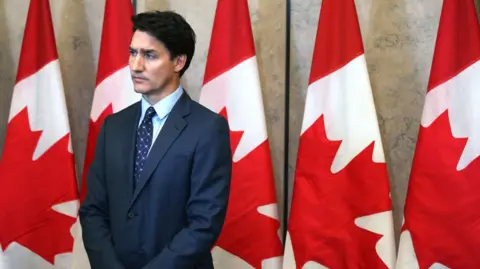
Prime Minister Justin Trudeau has accused India of making a "massive mistake" that Canada could not ignore if Delhi was behind the death of a Sikh separatist leader last year on Canadian soil.
Trudeau made the comments two days after Canadian officials accused India of being involved in homicides, extortions and other violent acts targeting Indian dissidents on Canadian soil.
After Canada levelled the accusations on Monday, both countries expelled top envoys and diplomats, ramping up already strained tensions.
India has rejected the allegations as “preposterous”, and accused Trudeau of pandering to Canada’s large Sikh community for political gain.
In his remarks on Wednesday before a public inquiry looking into foreign interference in Canadian politics, the prime minister criticised India's response to the investigation into Hardeep Singh Nijjar's killing in June 2023.
According to Trudeau, he was briefed on the murder later that summer and received intelligence that made it "incredibly clear" that India was involved in the killing.
He said Canada had to take any alleged violation of its sovereignty and the international rule of law seriously.
Mr Nijjar was shot and killed in Surrey, British Columbia. He had been a vocal supporter of the Khalistan movement, which demands a separate Sikh homeland, and publicly campaigned for it.
At the time, however, Canada's intelligence did not amount to hard evidence or proof, Trudeau told the inquiry.
Police have since charged four Indian nationals over the Mr Nijjar's death.
Trudeau said he had hoped to handle the matter “in a responsible way" that didn't "blow up" the bilateral relationship with a significant trade partner, but that Indian officials rebuffed Canada's requests for assistance into the probe.
"It was clear that the Indian government's approach was to criticise us and the integrity of our democracy," he said.
Shortly after he made the allegations public, saying in that September that Canada had "credible allegations" linking Indian government agents to the murder.
The prime minister also added on Wednesday more detail to further allegations released this week by the Royal Canadian Mounted Police (RCMP).
The police force took the rare step of publicly disclosing information about multiple ongoing investigations “due to significant threat to public safety” in Canada.
RCMP said on Monday there had been “over a dozen credible and imminent threats to life” which “specifically” focused on members of the pro-Khalistan movement.
Subsequent investigations had led to police uncovering alleged criminal activity orchestrated by government of India agents, according to the RCMP.
Trudeau said the force made the announcement with “a goal of disrupting the chain of activities that was resulting in drive-by shootings, home invasions, violent extortion and even murder" in the South Asian community across Canada.
India has vehemently denied all allegations and maintained that Canada has provided no evidence to support its claims.
The RCMP and national security advisers travelled to Singapore last weekend to meet with Indian officials - a meeting the RCMP said was not fruitful.
Following Monday's allegations from Canadian officials, the UK and US urged India to co-operate with Canada's legal process.
On Wednesday, the British Foreign Office said in a statement that it is in contact with Ottawa "about the serious developments outlined in the independent investigations in Canada".
The UK has full confidence in Canada’s judicial system,” the statement added.
"The Government of India's cooperation with Canada's legal process is the right next step."
The US, another close Canadian ally, said that India was not co-operating with Canadian authorities as the White House had hoped it would.
“We have made clear that the allegations are extremely serious and they need to be taken seriously and we want to see the government of India co-operate with Canada in its investigation," said spokesperson Matthew Miller at a US State Department briefing on Tuesday.
"Obviously, they have not chosen that path.”
Canada's foreign minister, Melanie Joly, has said that Ottawa is in close contact with the Five Eyes intelligence alliance - comprising the US, UK, Canada, Australia and New Zealand - on the matter.