Auschwitz to Gaza: The War Against International Law
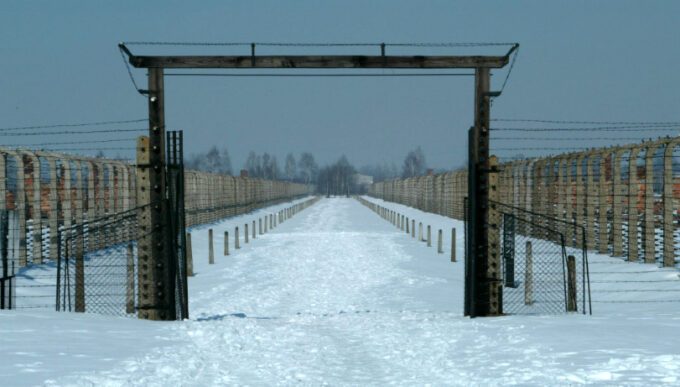
Gate in Auschwitz II-Birkenau – CC BY 3.0
At Home and Abroad
Police in America need a great deal of reform, a project that translates to freeing them from the racist nature of U.S. culture while tying them more firmly to the culture of civil and human rights. Not easy, but certainly a worthwhile task compared to maintaining the present situation. Here is another perspective: what would happen if all the police in the country just disappeared or were “defunded”? Almost certainly the result would be a breakdown of order. Actually, according to the philosopher Thomas Hobbes, this would be an absolutely worse case scenario, because just about anything is better than anarchy, which he likens to a war of all against all. Putting a deeper analysis of Hobbes aside, I am going to assume that most readers would agree with him—though perhaps not with his soft spot for dictatorial substitutes (see his seminal work, Leviathan).
Ok. Let’s now transfer that second perspective—anarchy in one society—to the international order. Actually, we are close to this very situation. What rules and regulations that exist to, supposedly, put limits on the behavior of states have been eroding for at least the last fifty years. Indeed, the U.S., acting out in places as disparate as Vietnam and Iraq has shown how “great powers” can thumb their virtual noses at the legal foundations of civilization. Just as an aside, the U.S. is also the Dorian Grey of “great powers.” This is because while behaving barbarically, the United States claims to represent the very model of enlightened behavior. Other “great powers” such as Russia and China have played their own roles in this plague of barbarism, but the U.S. displays the most hypocrisy.
This being the case, is it any surprise that it is Washington’s primary client state—namely Israel—that is now pulling down the whole fragile structure of international law and order—and doing so with the steadfast help of America and other Western states?
Irony
There is much irony here, for the nature of Israeli behavior that is presently threatening international law reflects anarchistic Nazi behavior in the 1930s and 1940s. We remember Nazi Germany for two main reasons: (1) The waging of war not in self-defense but for the sake of territorial expansion. The Nazis justified this aggression mainly with the concept of “Lebensraum”, the acquisition of territory for colonization by an expanding, racially superior, German population. And what of the native populations of these conquered areas? (2) The answer to this question constitutes the second reason we remember the Nazis. These populations were slaughtered—partially through the massive aerial bombardment and executions of civilians within occupied territories. Unique, as of yet, to the Nazis was the institution of the mechanized mass murder in concentration camps. Of course, the main, but not only, victims of these camps were Europe’s Jews.
So how does today’s behavior of Israel, backed by its patron the United States, remind us of the Nazi disruption of international order? (1) Israel has evolved—driven by the very logic of Zionist ideology—to proclaim itself a state of Jewish supremacy. As described by B’Tselem, Israel’s own human rights organization, Israel seeks “Jewish supremacy from the Jordan River to the Mediterranean Sea.” Today, we call this apartheid which international law and convention has designated a “crime against humanity.” (2) Since its inception, Israel has coveted “all the land of Biblical Israel, i.e. Gaza, the West Bank and other parcels of territory, as divinely designated “lebensraum” for the Jewish people. Presently, the ethnic cleansing of the Gaza Strip is being done in preparation for Israeli colonization. (3) That ethnic cleansing is perpetuated primarily by massive bombardment from the air and artillery barrages that reenact both the Nazi tactic of blitzkrieg and the U.S. tactic of “shock and awe.” (4) While there has not been a literal replication of the Nazi concentration camps, Israel did transform the Gaza Strip into the “world’s biggest open air prison.” And then, following the October 7, 2023 Palestinian act of resistance, they transformed the Strip one more time into a simulation of the last days of the Warsaw Ghetto—also destroyed (in 1943) by the Nazis for an act of resistance. (5) Finally, please note that all of the above are acts of the Israeli state and its Zionist supporters, and not of the Jewish people as a whole. The effort by Israel to identify all Jews with both its ideology and its crimes is the equivalent to the Nazis going to war in the name of all Germans. Neither claim is true.
“On a Knife’s Edge”
There are plenty of authoritative statements as to the consequences of Israeli actions on international law and order. For instance, the 20 November 2024 comments of Francesca Albanese, the UN special rapporteur on the situation of human rights in the Palestinian territories occupied since 1967. Albanese said, “The failure of the world’s states to stop Israel’s ‘colonial erasure’ of the Palestinian people is putting international justice on the edge. We might lose what we have, what we have built .… International law is on a knife’s edge.” On 3 December 2024, Ramzy Baroud, a well respected American-Palestinian journalist and writer, observed that until the recent behavior of Israel made clear that state’s true nature, the West had accepted “the entire Israeli political discourse [that] situated [the Zionist state] within western priorities and supposed values: civilization, democracy, enlightenment, human rights and the like.” As a consequence “the international legal system has historically failed to hold Israel … accountable to international law.” This includes “the utter failure of the international community to stop the grisly genocide in the [Gaza] Strip.” UN Secretary General Guterres has concluded that “the catastrophe in Gaza is nothing less than a complete collapse of our shared humanity.”
Baroud did note that belatedly, “it turned out that the international system has a pulse, after all, though faint, but is enough to rekindle hope that legal and moral accountability are still possible.” He was speaking here of the judgments rendered by the International Court of Justice (ICJ) and International Criminal Court (ICC). The former laid down the high probability that Israel was committing genocide in Gaza—a conclusion supported by evidence brought to the court by South Africa and others, as well as by almost every reputable human rights organization on the planet. The ICC citing this evidence, has issued arrest warrants for the responsible Israeli leaders. Thousands of their soldiers are also under investigation. It will be a long time before any of these folks enjoys a vacation abroad (except perhaps to the U.S. or Hungary) without risking arrest.
Nonetheless, no state is militarily seeking to stop Israel’s ongoing slaughter. If the Israelis rein in their hubris and stay home, their leaders and soldiers may never be brought to justice. The Israelis are betting that time will erase their sins. As David Ben Gurion said (yes, he really did say this), “the old [Palestinians] will die and the young will forget.” It is a silly assumption. Just ask young Jews worldwide if they have forgotten the Holocaust. The U.S. government may be hoping for the same pseudo remedy.
Corrosive Blowback
There is another consequence to be considered, particularly as regards Israel’s patron, the United States. As we know, again quoting Ramzy Baroud, the U.S. itself is an “unrepentant violator of human rights” and that is perhaps why the American government finds it easy to “maintain a strong position in defense of Israel, shaming the ICC for the warrants.” You will remember the observation that this position entails an enormous level of hypocrisy. It turns out that such hypocrisy can be domestically corrosive.
There is such a thing as the Leahy Law, named after former Vermont Democratic Senator Patrick Leahy. Passed in 1997, it “prohibits the U.S. Government from using funds for assistance to units of foreign security forces where there is credible information implicating that unit in the commission of gross violations of human rights.” This law restricts both the State Department and the Department of Defense. Thus, Washington’s material support of Israel while its military simultaneously carries out genocide in Gaza, violates federal law. And, they are doing this under orders of an imperial presidency.
There are corrosive consequences of this obvious hypocrisy and flagrant official disregard of U.S. law. Now, federal and local governments seem perfectly willing to abrogate the Constitution on the urging of Christian fundamentalists and Zionist ideologues. As a consequence the Constitutional rights of free speech and assembly are being selectively suppressed. Authorities are shutting down the non-violent protests and arresting young idealists (mostly students), faculty, and many others dedicated to civil and human rights, as well as those who are personally impacted by Israel’s slaughter: Palestinian Americans and American Jews who are horrified at what the Israelis are doing in the name of their religion. And, just as shamefully, university administrators have sold out their educational principles for the donors’ modern equivalent of thirty pieces of silver. More generally, it would seem there is a steady move worldwide to the authoritarian right, including in the United States. This movement tends to align with Israel and the Zionists and therefore, the corrosive effects are likely to get worse before it gets better.
Conclusion
Let’s give the final word to an Israeli journalist, one of the very few who sees and understands what the “Zionist state” has really wrought: Gideon Levy, writing in Haaretz (23 December 2024).
Levy notes that this year marks the 80th anniversary of the liberation of the Nazi concentration/death camp at Auschwitz, situated in today’s Poland. He then informs us that the Israeli Prime Minister, Benjamin Netanyahu, will not be attending because there is an ICC warrant for his arrest for perpetrating war crimes. Levy contextualizes this ironic situation as follows: “The distance between Auschwitz and Gaza, with a stopover in The Hague [where the ICC holds court], is still enormous, but it can no longer be argued that the comparison is preposterous …. [In fact] one realizes that this distance is shrinking by the day …. And when ethnic cleansing is carried out in northern Gaza, followed by clear signs of genocide throughout the Strip, the memory of the Holocaust is already roaring.”
Levy’s conclusion is that this is a result of a decision Israeli leaders made long ago. With the defeat of the Nazis and the liberation of death camps such as Auschwitz, the “Jews were given a choice between two legacies: Never again, the Jews will never face a similar danger, or – Never again, no one in the world will ever face a similar danger. Israel clearly chose the former option, with a fatal addition: After Auschwitz, Jews are permitted to do anything.” And they have done so by a Zionist inspired 75 years of harassment and persecution of the Palestinian people. As a consequence, Israel is now a “pariah state,” its Prime Minister is a war criminal, and “one realizes that the distance” that divides the practices of the Nazis from those of Netanyahu’s Israel “is shrinking by the day.”
Levy’s observations can stand as an epitaph for the illusions of Zionist Israel and its American patrons. It may also introduce us into another historical era of barbarism such as the 1930s and 1940s and thus be an epitaph for international law and order and human rights as well.
Benjamin Netanyahu will not travel to Poland next month for the main ceremony marking the 80th anniversary of the liberation of the Auschwitz death camp, over concern that he could be arrested on the basis of the warrant issued against him by the International Criminal Court in The Hague.

This bitter and not-so-subtle irony of history supplies a surreal confluence that was nearly unimaginable before now : merely to imagine the prime minister landing in Krakow, arriving at the main entrance of Auschwitz and being arrested by Polish police at the gate, under the slogan « Arbeit macht frei » (« Work sets you free ») ; merely to consider that of all the figures and countries, it is the prime minister of Israel who is prevented from attending the memorial for members of his people on account of the threat of international law hovering over his head. The German chancellor, yes ; Netanyahu, no.
Eighty years ago, when Auschwitz was liberated, it would have sounded like the most insane development imaginable. Not anymore. Eighty years ago, Jews were given a choice between two legacies : Never again, the Jews will never face a similar danger, or – Never again, no one in the world will ever face a similar danger. Israel clearly chose the former option, with a fatal addition : After Auschwitz, Jews are permitted to do anything.
Israel has implemented this doctrine in the past year as it never has before. A prime minister who dodged a ceremony in Auschwitz is perhaps the grossest illustration of this. The fact that of all the places in the world, Auschwitz is the first that Netanyahu fears going to, shouts symbolism as well as historical justice.
Other heads of state will attend the ceremony, but not Netanyahu. He is wanted by the tribunal – which was established in the wake of what happened at Auschwitz – on suspicion of war crimes that, with alarming speed, increasingly resemble the crimes of Auschwitz.
The distance between Auschwitz and Gaza, with a stopover in The Hague, is still enormous, but it can no longer be argued that the comparison is preposterous.
After reading Yaniv Kubovich’s nightmare report on what is taking place on the corridor of death in Netzarim, one realizes that this distance is shrinking by the day.
It has always been taboo to compare anything to the Holocaust, and rightly so. There has never been anything like it. The worst crimes of the occupation pale in comparison to the crimes of Auschwitz.
Moreover, this comparison always left Israel white as snow and its accusers as antisemites : After all, there are no death camps in Gaza, so every accusation can easily be rebuffed. There are no death camps, therefore the IDF is the most moral army in the world. There will never be death camps in Gaza, and nevertheless the comparisons are beginning to cry out from beneath the rubble and the mass graves.
When Palestinians in Gaza know that where packs of stray dogs prowl, there are human corpses eaten by the dogs, Holocaust memories begin to surface.
When in occupied Gaza there is an imaginary line of death, and anyone who crosses it is doomed to death, even a hungry or disabled child, the memory of the Holocaust begins to whisper.
And when ethnic cleansing is carried out in northern Gaza, followed by clear signs of genocide throughout the Strip, the memory of the Holocaust is already roaring.
October 7, 2023 is increasingly emerging as a fateful turning point for Israel, much more than it seems at present, similar only to its previous calamity, the 1967 war, which was also not diagnosed in time. In the Six-Day War, Israel lost its humility, and on October 7 it lost its humanity. In both cases, there is irreversible damage.
Meanwhile, we must consider the historical occasion and absorb its significance : a ceremony commemorating the 80th anniversary of the liberation of Auschwitz, world leaders march in silence, the last living survivors march alongside them, and the place of the prime minister of the state that rose from the ashes of the Holocaust is vacant.
It is vacant because his state has become a pariah, and because he is wanted by the most respected court that tries war criminals. It bears raising our heads for a moment from the Hanni Bleiweiss scandal and the Feldstein affair : Netanyahu will not be at Auschwitz, because he is wanted for war crimes.
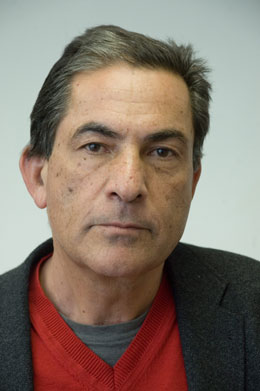
Gideon Levy is a Haaretz columnist and a member of the newspaper's editorial board. Levy joined Haaretz in 1982, and spent four years as the newspaper's deputy editor. He is the author of the weekly Twilight Zone feature, which covers the Israeli occupation in the West Bank and Gaza over the last 25 years, as well as the writer of political editorials for the newspaper. Levy was the recipient of the Euro-Med Journalist Prize for 2008; the Leipzig Freedom Prize in 2001; the Israeli Journalists’ Union Prize in 1997; and The Association of Human Rights in Israel Award for 1996. His new book, The Punishment of Gaza, has just been published by Verso Publishing House in London and New York.