Monday, February 03, 2025


A New Future for Syrian Refugees?


 February 3, 2025
Facebook

Image courtesy European Parliament.

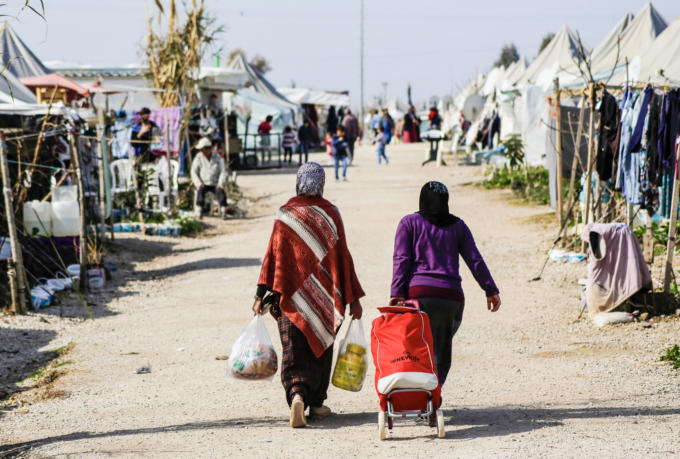
Six years ago, at the time of the first Trump administration’s Muslim ban and its initial round of vicious anti-immigrant policies, I visited a refugee camp on the Greek island of Samos to see how Europe was handling its own immigrants and refugees. Within a day, I met two Syrians, Eyad Awwadawnan and Hasan Majnan, who had fled Bashar al-Assad’s brutal dictatorship only to end up in a filthy, overcrowded camp in a country that didn’t want them with a future they could not foresee.

That was June 2018 and I’ve kept in touch with them both ever since. So, when Assad’s regime fell on December 8, 2024, ending two generations of perhaps the most murderous dictatorship in the modern world, I contacted Eyad and Hasan to see how they felt.

“How am I feeling?” Hasan said over WhatsApp that day. “I’m flying in the sky! I have been watching the news for the last 24 hours. I’m feeling proud. I was on the right side of history. Finally, we won! The lion has fallen!”

In Arabic, Assad means “lion,” although that wasn’t his real name. Hafez, Bashar’s father, had adopted it to look strong.

Hasan was born in the northeastern Syrian city of Manbij, 18 years before the 2011 revolution and civil war that left some 580,000 civilians dead and displaced at least 13 million more.

Because Manbij sits in a strategic position near the border with Turkey, as soon as the first signs of revolution stirred in its streets, it became a battleground between multiple forces.  First, it was under the control of Assad, whose military occupied the city until 2012. Then it fell to the revolutionary Free Syrian Army, which held it until 2014. Next, the Islamic State of Iraq and Syria (ISIS) seized and controlled it until 2016, only to lose it to the Syrian Democratic Forces, who, in turn, lost it again to the Syrian Army (then backed by Russia). Recently, Manbij has fallen under the control of Kurdish militias and their allies. And that is only a rough summary of the city’s grim and complex history.

For Hasan, growing up in such a political football of a place affected every aspect of his life. Yet many of his memories of Syria before the civil war are remarkably sweet. “In my school we had Christians and Muslims, we had Kurds and Arabs and Turkmen,” he told me. “We were friends, in the same class with the same teacher. I want Syria to be like that again. I don’t want different religions, with each of us hating one another because we’ve lost a brother or a friend. I don’t want any of that to come between us. And I don’t want ISIS to prevail either. I want us to live like before, or even better. To live in peace and build Syria together, be happy and help each other.”

In 2013, Hasan and his identical twin, Hussein, joined the Free Syrian Army to fight Bashar, as they liked to call him, and free Syria from his grip. Hasan was then captured by ISIS, who hung him from a ceiling and whipped him in public. After three weeks of such treatment, they let him go as long as he agreed to beg their forgiveness, attend Sharia lessons for 15 days, and then join them as a fighter. They took his ID and told him that, if he refused, they would arrest him or a member of his family. Appalled by their cruelty and narrow ideology, Hasan decided to flee to Turkey and, with his mother’s blessing, he did.

Shortly after that, his brother was killed in a battle with ISIS. They were both only 21 at the time and, even today, Hasan hasn’t fully recovered from his twin’s death. He showed me a photograph of Hussein in his coffin. It was like looking at Hasan himself.

After living hand to mouth in Turkey for a few years, Hasan caught a flimsy, overladen rubber dinghy to Greece, ending up in the Samos camp where we met.

At the time, Hasan was so worn down by his ordeals — his hair was partly gray, his face thin and lined — that I took him for a man in his forties. It was a shock to learn that he was only 25.

“Now I Can Go Home Walking, Laughing”

I’ve told Hasan’s story in Map of Hope and Sorrow: Stories of Refugees Trapped in Greece, the book I wrote with Eyad, but suffice it to say that, after many years of struggle, Hasan is now living in Germany and, in the wake of the fall of Assad, is full of hope for his country.

“Today, I remember my brother, my three cousins, a lot of my friends who died,” he told me. “Some were killed by ISIS, some by the Kurdish militia, some by the regime. They were killed by different enemies, but they were fighting for the same cause — to free Syria.”

After a pause, he added, “Yes, I have lost a lot of friends, but now I can tell them: rest in peace, Syria is free. I am proud of you and I know you are proud of me. I know you are watching me from heaven. And I am happy for us. We will join you later, but first we will make sure to build a safe place for every Syrian and a better, democratic future for our children.”

I’ve long been aware that Hasan always wanted to go back to Syria. He has never stopped missing it or his mother, who died while he was in Turkey, or his family, his language, and the city of Manbij. So, in the wake of the fall of Assad, I asked if he plans to return now that so much has changed.

“Going home was always my plan, but I never imagined that Bashar al-Assad would be gone,” he answered. “So, my plan was to write a letter to leave when I was dead alone somewhere in a room in Europe, asking that my body be sent back to be buried in my hometown. So that was my plan on how to go home — in a coffin. Now I can go home walking, laughing.

“The first thing I will do when I get back to Syria is I will kneel and kiss the ground and thank God for being on our side. We are free! We are rising again! Now I can walk the streets and smell the jasmine flower. Yes, I am going back home soon!”

Then Hasan spoke with more hope than I had heard in the six years I’ve known him.

“Maybe I will go and see my mother’s grave. See my old friends and start something good for my community. Maybe I will look for a job in the new government. Or work more on my English and open a small school and become an English teacher. It’s not easy, but it’s possible. I’ve learned in the last ten years that nothing is impossible. You just have to fight for it, stick to it until you get it.”

“First We Wanted Freedom. Now We Want Justice”

For all his hopes for a new Syria, Hasan is deeply disappointed that, in the wake of the collapse of his dictatorship, Assad managed to slip away and claim asylum in Moscow. “I’m sad that we didn’t catch him so he can go to trial,” Hasan told me. “I promise he will get a fair one. He’s going to spend the rest of his life in prison. If not in this life, definitely in the afterlife. One of the reasons I like to believe in God is because I believe in justice.”

My friend and co-author Eyad Awwadawnan, who found asylum in — of all places! — Iceland after a long ordeal in two refugee camps in Greece, is also concerned about justice and what the future might bring to Syria. Eyad was forced to flee Syria with his family after his uncle and several friends were killed, an experience he wrote about in 2018 when he was 23. After Assad fell, he, too, stayed up all night watching the news. Yet, his joy was tempered by concern.

“I can say that my happiness is incomplete because, even in its worst times, the regime has always found a way to benefit from the situation,” he wrote me, echoing the distrust of Assad and his regime felt by every Syrian I know. “There will be chaos now and the chaos could end up covering up Assad’s crimes.”

Like Hasan, Eyad does not want to see Assad and his henchmen, the torturers and murderers, get away without consequence. As he put it, “First we wanted freedom. Now we want justice.”

We then discussed the happiness so many Syrians feel on seeing their loved ones released from Assad’s giant complex of prisons, notorious for their horrendous brutality. Records show that more than 100,000 women, men, and even children were whisked off to those grim citadels without trial or reason, often never to be heard from again. In Samos, I met a woman from the Syrian capital, Damascus, who told me that she had been arrested no less than seven times by the regime, raped and tortured, all for speaking out against Assad.

Yet Eyad, feeling unhappy about the haphazard, spontaneous way the prisons were being flung open, again expressed caution. “It is so unorganized that they might destroy a lot of evidence of the regime’s crimes,” he said. “I was hoping they would keep as much documentation as possible for evidence, take photos, and protect all the documents from the prisons. This chaos reduces our chance of bringing justice to the regime in the future.”

Indeed, Assad’s regime took a page from the Nazis by keeping meticulous records of the people they imprisoned, tortured, and killed. The question is: Where are those records now?

“A Revolution That Doesn’t Free Women Is No Revolution at All.”

Eyad and I also discussed the possible fate of women, something noticeably absent from news reports about Syria that I’ve seen in outlets like the New York Times, the BBC, and National Public Radio. The one exception: a blistering article in the Guardian by Syrian writer Mona Eltawy, suggesting that a revolution that doesn’t dismantle patriarchy and free women is no revolution at all.

The leader of the new government, Mohammad al-Jolani, used to be an Islamist jihadist, not exactly a group known for its tolerance of women’s rights. He claims to have stepped away from such extremism and promises that civilians of all faiths and ethnicities will be safe in Syria. But as far as I know, he has not uttered a word of reassurance to women.

Given the extreme suppression of women in Afghanistan by the Taliban, who also promised to be more tolerant when they first took control in 2021, it’s hard not to be skeptical. Afghan women can no longer study past the age of 12, hold jobs in anything but healthcare, go outside on their own, enter public parks, or even speak in public. Syria is not Afghanistan, and so far, there has been no documented change in the role of women, who are going about their studies and work as usual. But the new government has just appointed a minister of justice, Shadi al-Waisi, who was once a judge for an al-Qaeda affiliate in northern Syria, where he oversaw the public executions of two women accused of adultery and prostitution. One was a mother who, having been forced to her knees, begged to see her children moments before she was shot in the head. This, to put it mildly, does not bode well.

“We’re in Disbelief”

Speaking of women, I had one more Syrian friend to consult, Dunia Kamal. Once a student at Columbia University’s Graduate School of Journalism, where I teach, Dunia has since worked as a journalist and is now a public school teacher in Washington, D.C. She wrote this to me two days after Assad fell:

“We, my friends, family, and I genuinely don’t know what to feel. We’re having a series of fluctuating and confusing emotions, from joy to fear to happiness, back to flashbacks of starvation in Yarmouk camp, then to images of Hafez’s statue decapitated, back up to hysterical euphoria, then to pain and anger mixed in with anxiety about what’s to come. Yes. All that.”

Yarmouk camp was an area in Damascus that held Palestinian refugees, some 200 of whom were killed by a regime bombing and then a siege in the civil war.

“Having seen many people plucked out of our communities for simply criticizing the regime, never to be heard from or seen again, we all grew up learning how to self-censor out of fear of retribution, even while in the U.S.,” Dunia wrote. “It’s rather jarring to suddenly be able to exchange messages so openly. For example, I wrote my first message to a friend in Damascus inquiring about the rumors that Bashar had fallen in code, only to receive a near-instant surreal reply: ‘YES! BASHAR AND HIS GANG ARE OUT!’

“All those years of bloodshed, torture, and utter disregard for human life. We’re in disbelief. We never thought a day like this would come. We had given up hope, only to hear Eid chants in unison from minarets across Damascus signaling the end of a dark and painful era.”

Now, not even two months after Assad’s fall, the world’s eyes have moved from Syria back to Gaza and the new ceasefire, as well as to the apocalyptic events that greeted our new year here in the United States: the devastating Los Angeles fires, the inauguration of a man with no interest in democracy, and the parade of incompetent, dangerous appointees Trump is now pushing through Congress. But many Syrian refugees have their minds on something else, for whatever happens now — a new Muslim ban in the U.S., more anti-immigrant sentiment around the world, maybe even deportation — one essential part of life for every Syrian refugee has changed. Eyad put it this way:

“For years, we have all been stateless. We were thrown out, we had nowhere to go, nowhere we belonged. Now, we do. Now, whatever happens to us, we once again have a home.”

This piece first appeared on TomDispatch.

Helen Benedict, who is a professor of journalism at Columbia University and the author most recently of the novel The Good Deed, has been writing about war and refugees for more than a decade. A recipient of the 2021 PEN Jean Stein Grant for Literary Oral History and the Ida B. Wells Award for Bravery in Journalism, she has also written 13 other books of fiction and nonfiction.

 Serbia’s Mass Protests Against a Crony-Capitalist Government


Serbia’s prime minister has resigned after months of protests over the deadly rail-station canopy collapse in Novi Sad. No isolated incident, the disaster has become the latest symbol of government subservience to unscrupulous multinational developers.
February 2, 2025
Source: Jacobin


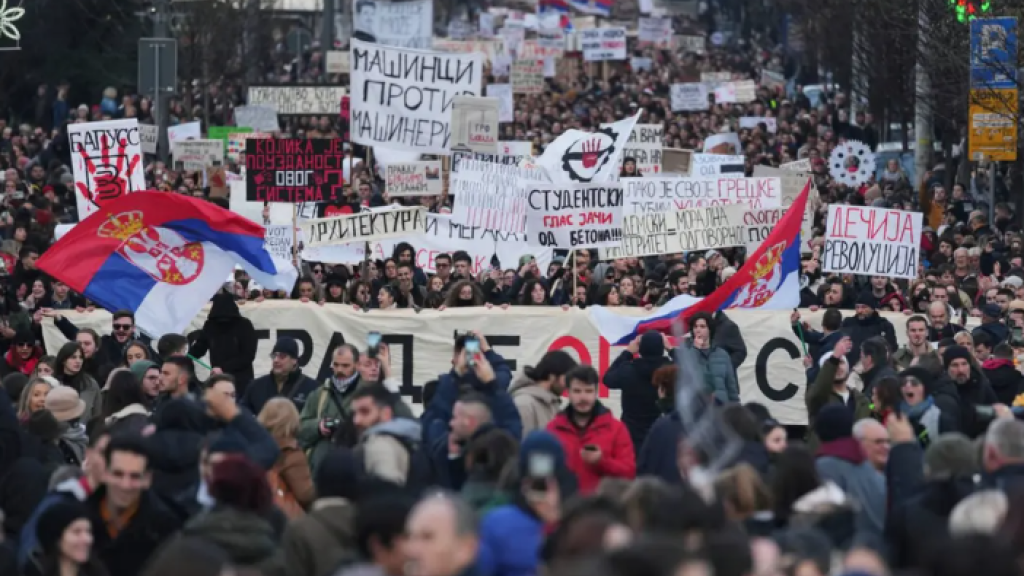
Protests in Belgrade

Soon after the roof canopy of Novi Sad’s central train station collapsed last November 1, killing fifteen people, a TV reporter asked local journalist Igor Mihaljević to respond to the event. With devastating and incisive judgement, he offered the context missing in Western media coverage of the incident and the protests of the last few months.

For one, Mihaljević noted, this was the latest incident in the often tragic history of Serbia’s second-largest city. In its past, Novi Sad suffered the genocidal Hungarian army campaign that massacred Jews, Serbs, and Romani across the region. That was in the same era as the devastating military occupation of Yugoslavia by Nazi Germany and its client states. More recently, there was the seventy-eight-day NATO bombing campaign in 1999, which killed 527 Yugoslavs and hobbling major cities like Novi Sad by taking out key infrastructure. But this time, Mihaljević argued, was different — for now it was the Serbian state itself killing its people.

The train station collapse has left both the city and the nation in shock, triggering primal fears of the sky falling overhead. Many Serbs, especially in Novi Sad, now regard overhead structures with suspicion, with some even avoiding the newly constructed, Chinese-funded high-speed railway. However, the aftermath has also sparked a powerful wave of protests, so intense that they threaten to topple President Aleksandar Vučić, sending shock waves through his corrupt Serbian Progressive Party (SNS).
Student Protests

Led by student organizers from over thirty universities and faculties — most notably the faculty of dramatic arts in Belgrade, which began the call to action in late November — the movement has rallied around four key demands. One is the release of all internal documents related to renovations at the Novi Sad railway station, carried out by Serbian Railway Infrastructure, the Serbian state, China Railway International Co. Ltd., and China Communications Construction Company Ltd., which began the station’s construction in 2021. The other demands are the dismissal of all charges against arrested and detained students and young protesters who have been demonstrating since the canopy collapsed; the filing of criminal charges and the prosecution of those responsible for the attacks on students and professors; and a 20 percent increase in budget allocations for public higher-education institutions in Serbia to cover material expenses.

Since November, students have organized massive strikes, with such protests as a gathering of over 100,000 people at Belgrade’s Slavija Square on December 22. The protests continued into the New Year, with demonstrators declaring there was nothing to “celebrate” until justice was achieved. They demonstrations are still ongoing, having recently forced the resignations of prime minister Milos Vučević and Novi Sad’s mayor Milan Đurić on January 28.

Students have held assemblies and effectively conveyed their message to the media. With a keen sense for Instagramable moments, they have gracefully steered social media campaigns, often featuring overhead drone footage of the protests and eye-catching visuals. Their actions have not only challenged state power, but their demands — particularly for criminal charges and prosecution — offer a stark critique of the deeper systemic rot: a corrupt judicial system that upholds a mafia state and a government that not only fails its people but is complicit in their deaths.

What began as a response in Serbia’s major cities has now evolved into a nationwide movement, spreading to smaller towns as well. As noted by Novi Sad activist and scholar Aleksandar Matković on X/Twitter, a map of Serbia showing protests happening across almost all municipalities nationwide shows that the situation is likely to escalate into either a government crisis or more conflict.

The events have also sparked deep cultural anxieties tied to national identity. This Monday, the Serbian Orthodox Church published an article damning the student protests, asserting that they were pushing an “anti-Saint Sava, anti-Christian and anti-Serbian narrative and way of life.” This claim that students live in a “parallel universe” was walked back in a statement on Tuesday, which clarified that the text did not reflect the stance of the Church’s top cleric, Patriarch Porfirije.

Recently, the protests have intensified into violence, with protesters engaging in fierce clashes with supporters of the ruling SNS party. On Tuesday night at around 3:00 a.m., a group of SNS supporters launched an attack on students in Novi Sad. Many Serbians were especially shocked by a series of interviews widely covered in media in which SNS supporters from the city of Jagodina denounced the students. One older man even said that he would welcome attacks on his daughter if she were protesting.
Nationalists and Multinationals

This is a moment of growing interest in the power of mass movements to drive political change. Following Donald Trump’s return to the US presidency, obsessive media coverage often frames one man’s corruption and venality as redeemed by his inauguration as head of state. The parallels to Vučić are striking, particularly since Trump and his son-in-law Jared Kushner recently finalized a business deal to build a Trump-branded luxury hotel on the site of the former Yugoslav Ministry of Defense in Belgrade. This site, bombed by NATO in 1999, long stood as a symbol of the bombing and the dangers represented by this alliance.

Today the Kushner deal, brokered with real estate agents in Abu Dhabi, reflects a broader picture around the Balkans: real estate developments treated as megadeals between state and business leaders from the United States, European Union, China, and beyond. Such arrangements ultimately benefit only very few but are covered by judicial protection. In stark contrast, the student demands — focused on strengthening education and creating institutions that genuinely serve the people, as well as restoring legitimacy to the state prosecutor — directly challenge the interests of autocrats and the capitalist developers whom they protect.

Much Western media coverage of the Novi Sad deaths and resulting protests has been inaccurate, emphasizing Serbia’s strong ties to Russia and implying that the student protests follow a Maidan-like, anti-Russian tradition. While this framing may be intended to attract attention to the protests, it is misleading about what is really at stake. The concern here isn’t foreign interference in another state’s affairs but rather domestic corruption, crime, and the fundamental question of what and whom the state is truly serving.

Analysts like political scientist Florian Bieber, who emphasizes the need to align the resistance with Serbia’s opposition parties, overlook the fact that such challenges are not unique to Serbia but are part of a broader global crisis of governance in which capturing electoral victory cannot be the only aim of politics. As the late theorist Fredric Jameson noted, we are witnessing a global erosion of state power. Jameson instead called for a “dual power” in which alternative structures emerge to fulfill essential functions that the state has failed to provide. The student protests reflect this idea in practice, through soup kitchens, self-defense networks, and other forms of collective support. They are not just demanding change but actively demonstrating what a self-sustaining, community-driven alternative could look like.
Collapse

Many outcomes were possible after this incident. The business dealings between the Serbian state and China risked fueling xenophobia toward Serbia’s significant Chinese population. The collapse could have been forgotten as an isolated tragedy. Instead, Serbian students have demonstrated that it is possible to challenge corrupt systems. Success depends on our ability to embrace the potential of new and emerging forms of social cohesion.

Serbian student movements have led change before. In 1968, they won concessions from Josip Broz Tito, who acknowledged the validity of many of their economic and political demands. President Vučić may sometimes present himself as Tito’s successor, but he only offers empty promises, failing to implementing real changes. In 2000, president Slobodan Milosević was overthrown after a three-year internal struggle sparked by the student-led Otpor! movement.

More recently, protests against the Serbian government’s support for the British-based multinational Rio Tinto’s lithium mining project — ignoring well-documented environmental risks — have highlighted the growing resistance to state-backed corporate exploitation. In 2022, widespread public pressure ultimately forced a U-turn on allowing the company into the country. This incident further underscores how nationalist rhetoric often masks collusion with foreign corporate interests, prioritizing economic deals over public welfare. The current student protests have built on this momentum, digging deeper into these contradictions and challenging entrenched networks of political and economic power.

The Novi Sad station canopy is a grotesque metaphor for the uncertainty facing Serbia. First created in 1964, it symbolizes a time when the Yugoslav state was thriving and modernizing — an era of ambitious infrastructure projects and social progress. But its neglectful maintenance and ultimate collapse serve as stark reminders of Vučić’s inability to carry on such a legacy in substance. While he postures as a strong leader, his governance has been marked by economic inequality, political repression, and a failure to invest in the institutions and public goods that once defined Yugoslavia’s vision of collective progress.

The students in the streets today are not just protesting an isolated incident; they are confronting a system that has long prioritized political survival over public well-being. If they succeed, they may finally break this cycle and push Serbia toward a future where the state truly works for its people. If they fail, the collapse of the canopy may serve as a chilling warning of further decay to come. Now we can only hope that they succeed.


Tamara Kamatović is a lecturer at the Yehuda Elkana Center at the Central European University in Vienna. She regularly writes about topics related to education and politics. Her family hails from Novi Sad, Serbia.


Beyond protest: Can Serbia’s student movement spark a political breakthrough?


Published 
People attend a protest against the Serbian authorities, demanding justice for the victims of the train station roof collapse in Belgrade.

It is now three months since the November 1 Novi Sad tragedy, when a concrete canopy collapsed on the recently renovated railway station, resulting in the deaths of 15 people. This disaster, perceived as the result of government corruption and negligence, ignited public outrage, particularly among students. Initial protests took place in Novi Sad, where the opposition was visibly present and vocal. However, as the movement gained momentum, student-led protests emerged in Novi Sad, Belgrade and other large cities, increasingly distancing themselves from the ruling party and opposition.

The countryside, which remains the political stronghold of the ruling regime, has largely remained silent. This geographic divide is no coincidence — while protests erupted in urban centers, the ruling party strategically organized a mass rally of support on January 24 in Jagodina, a town of just 35,000 people deep in Serbia and far from major cities. This reflects a deliberate effort to maintain control over rural constituencies while avoiding the volatile urban centers where dissent is strongest.

The scale of the protests has been substantial. The New Year's Eve rally in Slavija, Belgrade, had an estimated 100,000 participants (including my own children), making it the largest protest since October 5, 2000 that saw the Slobodan Milošević government fall. The blockade of Autokmanda, one of the largest traffic junctions in Belgrade, at the end of January lasted 24 hours and drew 16,750 participants according to official estimates. Opposition sources claim much higher figures, some going as far as half a million across various protest sites.

Vladimir Lenin’s theory of spontaneity and organization provides a useful framework for understanding why these protests, despite their scale, have not yet translated into a broader revolutionary movement. In What Is to Be Done?Lenin (1902) argues that spontaneous movements, unless channeled through a structured revolutionary force, tend to dissipate without fundamentally challenging the ruling order. The Serbian protests exhibit many characteristics of spontaneity, with substantive but limited mass participation and no clear leadership or organization capable of linking their demands to a broader class struggle.

Lenin’s criteria for a revolutionary situation — a ruling class unable to govern as before, an oppressed class unwilling to accept the status quo, and a rise in mass political activity — are only partially met in Serbia. While discontent is evident, the ruling class remains in control and no organized revolutionary force has emerged to direct this discontent toward systemic change. However, the presence of systemic contradictions — widespread frustration with corruption, economic inequality, and the failure of political representation — suggests that the conditions for deeper ruptures are maturing. As Lenin emphasized, a regime cannot be overthrown until it is ready to fall. That moment requires not just widespread grievances but the weakening of the ruling class and the political organization necessary to seize the opportunity. The student protests, while not revolutionary in themselves, are significant in that they expose and deepen the fractures within Serbian capitalism, potentially laying the groundwork for more profound political shifts in the future.

Students as the leading force: Contradictions and historical parallels

Unlike the anti-Milošević protests of 1996-97 and 2000, which were primarily middle-class revolts against electoral fraud and authoritarian governance, the current protests place students at the forefront of public dissatisfaction. This development is significant as it highlights the inability of traditional working-class movements to assume leadership in social struggles, a phenomenon characteristic of peripheral capitalism where labor remains fragmented and depoliticized.

Antonio Gramsci’s concept of hegemony is useful in explaining why socialist ideas remain largely absent from these protests. The neoliberal hegemony that has dominated Serbian political and economic discourse since the collapse of Yugoslavia has effectively marginalized socialist alternatives. Decades of ideological dominance have shaped public consciousness, making capitalism appear as the only viable economic system. This aligns with Michael G Kraft’s analysis (2015), where he describes how the discrediting of socialism after Yugoslavia’s collapse has hindered the emergence of full-scale anti-capitalist demands within protest movements. He notes that while protests frequently challenge corruption, austerity and privatization, they rarely articulate a systematic critique of capitalism itself.

While previous movements were directly tied to broader political shifts — challenging the Milošević regime and later the post-Milošević elite — today’s protests stem from unresolved systemic crises. The absence of working-class leadership demonstrates how neoliberal restructuring, including deindustrialization and the erosion of unions, has weakened labor’s political agency. However, in the context of working-class atomization in the private sector, public sector trade unions have emerged as a more organized force. They successfully extracted significant concessions from the government through a collective agreement signed at the end of January, improving the financial situation of educational workers (and ending their strike). This suggests that while traditional labor movements have been weakened, certain segments of the working class still retain bargaining power.

Larger trade unions, however, have distanced themselves from calls for a general strike, reflecting both structural and political constraints. While public sector unions benefit from centralized organization under state ministries, private sector unions are highly fragmented, operating across disconnected enterprises with weaker legal protections. More significantly, Serbia’s dominant clientelist economic structure ensures that many politically connected businesses — and their employees — are indirectly dependent on the ruling regime for subsidies, contracts and economic stability. This creates a situation where large sections of the working class, particularly in the private sector, are reluctant to mobilize against a government that sustains their precarious economic conditions.

Beyond these economic dependencies, ideological and political factors also explain the working class’s limited opposition to the regime. President Aleksandar Vučić’s populist government leans to the right of the political spectrum, a positioning that resonates with large segments of the Serbian working class, particularly blue-collar workers, farmers, pensioners, and other traditionally conservative groups. A December 2024 NSPM public opinion poll demonstrates a stark age difference, as the share of those who support the student protests drops precipitously from 95.5% in the 18-30 age group to 22% among those above 60. The broader European trend of the median voter shifting rightward has also played a role, reinforcing a political climate in which leftist opposition struggles to gain traction. For many working-class voters, Vučić’s regime — despite its neoliberal economic policies — offers a combination of nationalist rhetoric, paternalistic welfare measures, and political stability that they perceive as preferable to the perceived instability of opposition forces. In this context, labor militancy is further discouraged not only by economic constraints but by the ideological alignment between the ruling party and large sections of the working-class electorate.

The absence of working-class leadership demonstrates how neoliberal restructuring, including deindustrialization and the erosion of unions, has weakened labor’s political agency. However, this vacuum is not necessarily being filled by traditional political parties. Boris Kagarlitsky (2007) argues that parties have increasingly lost their ability to channel popular discontent, with mass movements emerging as the primary agents of political change. This reality is not lost on the ruling regime. The recent rally in Jagodina, where the government-backed movement for the “nation and the state” was introduced, represents an attempt to preemptively absorb public dissatisfaction outside party structures by establishing a broad populist front loyal to the state.

The students, often depicted as an apolitical force, have become the only coherent bloc capable of mobilizing discontent. However, their position remains fragile, given their limited direct engagement with production and economic leverage compared to workers. Their prominence in the protests reflects not only their discontent with the existing system but the broader political vacuum created by the inability of traditional working-class movements to assume a leading role.

Distancing from political parties: The opposition's crisis

A particularly striking aspect of the protests is the students’ intentional distancing from both the ruling coalition and opposition. While avoiding association with Vučić’s regime is expected, the reluctance to engage with opposition parties signals a broader crisis of political representation. This phenomenon aligns with Kagarlitsky’s argument in The Long Retreat (2024): the systemic inability of left and opposition forces to provide meaningful alternatives to neoliberal hegemony results in social movements operating in a political vacuum.

Neoliberal hegemony in Serbia — characterized by austerity, privatization, the weakening of social safety nets and the erosion of labor rights — has effectively depoliticized economic grievances. Decades of neoliberal restructuring have transformed the political landscape, ensuring that no significant force within the establishment challenges the fundamental logic of the market. This is particularly evident in the complete absence of genuinely socialist or social-democratic parties in parliament. The Socialist Party of Serbia (SPS), nominally the successor to the League of Communists of Serbia, has long abandoned any socialist platform, integrating itself into the ruling neoliberal coalition.

Meanwhile, the parliamentary opposition consists largely of pro-European democratic parties whose economic agenda is nearly indistinguishable from that of the ruling party. As Kagarlitsky (2007) noted, modern social-democratic parties have become so deeply imbued with the ideology of neoliberalism and “monetarism,” that today they defend the principles of neoliberalism even more decisively and consistently than traditional right-wing parties, which, due to their pragmatism, are sometimes willing to make certain compromises.

The result is a political system where neoliberalism is uncontested and the political spectrum is reduced to a competition over administration rather than ideology. Serbia’s position as a semi-peripheral country exacerbates this challenge even further. Samir Amin (1976) argued that semi-peripheral economies, unlike peripheral ones, often operate under the illusion that they can maneuver within the global economic system to achieve independent development. However, their structural dependence on global financial and trade networks makes it nearly impossible to break away from neoliberal frameworks. In Serbia’s case, this dependency manifests in the student protests’ rejection of the ruling elite and the EU, while lacking a clear alternative. The dominant discourse has conditioned the population to see capitalism — albeit a “reformed” version — as the only viable model, which limits the potential for systemic change.

At the same time, the absence of a significant leftist or labor movement further isolates student protests from broader social struggles. While neoliberal restructuring has weakened organized labor and entrenched economic dependency, limiting workers’ ability to mobilize, the student movement has failed to frame its grievances in a way that could build alliances with labor. This echoes Volodymyr Ishchenko’s critique in Towards the Abyss (2024): post-Soviet protest movements, when detached from substantive class politics, become cyclically ineffective, ultimately reproducing elite rule rather than challenging it.

Specific grievances over political demands: A deliberate or structural weakness?

Unlike the protests in 1996-97 and 2000, which were explicitly anti-regime, today’s movement refrains from making calls for the resignation of the president or the government, despite the latter already occurring. Instead, students have focused on specific demands: bringing those responsible for the Novi Sad tragedy to justice, releasing arrested students and punishing those responsible for violence against them, and raising the educational budget.

The ambiguity of these demands is not merely a strategic choice but a reflection of the political immaturity of the student movement. Jana Baćević (2015) points out that student movements in the region have often remained “inarticulate” and “vague,” even if posing substantial challenges to the ruling class. Marxist analysis suggests students — particularly those on the path to joining the professional class — often struggle to articulate broader class interests due to their own class positioning. While students may serve as a radicalizing force at moments of crisis, they do not inherently represent the working class or the broader masses. As Karl Marx and Friedrich Engels noted in The German Ideology, the ruling ideas of any age are those of the ruling class, and the future professional class is often shaped by its aspirations to integrate into the existing structures of power rather than dismantle them. This explains why student movements frequently articulate demands in ways that remain within the bounds of reform rather than revolutionary transformation.

The government has skillfully exploited this ambiguity to its advantage. By selectively addressing certain protester demands, such as adjusting budget allocations or releasing detainees in limited numbers, it can claim to have fulfilled the students’ requests while avoiding deeper structural concessions. At the same time, the regime uses this lack of clear ideological articulation to discredit the movement, portraying it as incoherent, elitist, or driven by narrow self-interest rather than a genuine struggle for social justice. This dynamic, where protests are contained by their own limited political scope, mirrors what Ishchenko (2024) describes as the cyclical ineffectiveness of post-Soviet protest movements, which, when lacking a clear class perspective, ultimately fail to challenge the ruling order and simply hand power from one group of capitalists to another.

While the student movement demonstrates an important rupture with Serbia’s dominant political forces, its limitations in articulating a cohesive, class-based critique render it vulnerable to both state co-optation and public disengagement. Without a broader coalition linking student grievances to working-class struggles, the movement risks being neutralized through partial concessions and vilification, rather than posing a sustained challenge to the system.

Rejection of international political symbols: A unique post-socialist case

A particularly notable aspect of the protests is their rejection of international political affiliations, a stark contrast to recent movements in Moldova, Georgia and other post-socialist countries, where the display of European Union flags has been a common feature. However, it would be a mistake to interpret the opposition to EU symbols as an expression of anti-European sentiment. Rather, this reflects the pro-Serbian, national character of the protests, which emphasize domestic grievances over geopolitical alignments.

The dominant iconography of the movement — blood-red handprints, Serbian national flags, faculty insignia, and banners memorializing the victims — signals that this is a protest rooted in academic and civic outrage over the Novi Sad tragedy, not a foreign-sponsored political movement. By avoiding international symbols, the students deny the government an easy opportunity to discredit the protests as externally orchestrated — a common tactic used by the regime to delegitimize opposition. At the same time, it reflects the ambiguous and increasingly disillusioned attitude toward the EU, particularly among Serbian youth.

Many no longer see the EU as an impartial arbiter, but rather as a supporter and enabler of Vučić’s regime and, by extension, an accomplice to the conditions that led to the tragic accident in Novi Sad. Over the years, the EU has maintained a pragmatic, if not complicit, relationship with Vučić, tolerating his authoritarian tendencies in exchange for political stability and alignment with Western strategic interests. This perception of the EU as a guarantor of the very system that students are protesting against has further alienated many from traditional pro-European narratives.

Serbian students certainly see themselves as part of Europe culturally and historically, but they do not necessarily identify with the EU’s political and bureaucratic institutions. Serbia’s accession process, which has stalled for years (no new negotiation chapters have been opened since 2021), has fueled frustration rather than enthusiasm. The EU’s frequent demands for political and economic reforms, coupled with its perceived double standards in regional geopolitics, have contributed to skepticism about its role as a genuinely democratic force. A February 2024 NSPM poll revealed that support for joining the EU had fallen to 42.8%, with 36.8% opposed — a sharp decline from 75% support in 2006. In this sense, the rejection of EU symbols is less about opposition to Europe and more about discontent with Serbia’s semi-peripheral position within global capitalism, where it remains politically subordinate and economically dependent on European capital.

This aligns with a broader world-systems perspective: Serbian students, even if not explicitly anti-EU, are rejecting the notion that their country’s future is dependent on integration into a system that has treated it as a periphery for decades. Their refusal to adopt the typical pro-Western protest aesthetic suggests a more complex political reality — one in which neither alignment with the EU nor the ruling elite’s pseudo-sovereigntist rhetoric provides a genuine solution to Serbia’s ongoing economic and political crises.

A protest without a movement

The Serbian student protests expose deep contradictions within the country’s political and economic system, yet they remain isolated from broader working-class struggles and lack a clear ideological direction. Their emergence signals a crisis of political representation, where neither the ruling elite nor the opposition offers a credible alternative. However, without the ability to mobilize beyond student circles or link their demands to a systemic critique of neoliberal capitalism, their transformative potential remains limited.

Popular disillusionment with the incumbent regime has not yet crystallized into an alternative vision. A significant share of the population still supports the regime. The most recent opinion polls show that the protests have not significantly changed the balance of political forces: more than 50% still support the ruling coalition whereas support for the best-performing opposition party is less than 6%. Support for Vučić, including undecided voters, continues to hover at about 50%.

As previously discussed, Lenin’s criteria for revolution are not yet met, but these protests do signal emerging tensions that could contribute to a crisis in the future. While systemic contradictions are increasingly apparent, they have not yet translated into a situation where the ruling class is weakened to the point of collapse or where a revolutionary force can capitalize on this instability. The structural barriers that prevent mass mobilization — ranging from economic dependence to political clientelism — ensure that dissatisfaction remains contained within a system that neutralizes opposition through selective concessions and repression.

The situation remains fluid and unpredictable. Yet, unless the protests evolve into a broader movement capable of linking social and economic struggles, they risk fading into a familiar cycle of resistance that disrupts but does not fundamentally challenge the system. More critically, as Gramsci warned, moments of crisis — when traditional parties lose legitimacy — do not necessarily lead to progressive outcomes. If no coherent political force emerges to articulate an alternative vision in class terms, the vacuum could be filled by reactionary movements, nationalist projects or authoritarian consolidation. Serbia faces a similar risk: in the absence of a clear leftist alternative, today’s protests may not only fail to resolve the country’s deeper contradictions but could inadvertently create openings for forces that reinforce, rather than challenge, the existing order.

In this sense, the broad and seemingly universal nature of the protests’ demands — functioning institutions, social justice and fairness — may be masking deeper contradictions within Serbian society. The opposition assumes that the real choices will be made only after Vučić’s departure. But what if the divide over Vučić has only served to obscure Serbia’s more fundamental dilemmas? As one keen observer noted, attitudes toward US President Donald Trump, the EU, and Russian President Vladimir Putin shape every opposition projection, yet these issues remain largely unspoken. 

Just as critically, the protests sidestep Serbia’s internal contradictions — the progressive commodification of life, the entrenchment of neoliberalism, and the erosion of social protections. By not formulating these issues clearly, or by subsuming them under a vague discourse of justice and fairness, the students risk postponing a necessary reckoning with the nature of Serbian capitalism itself.

 UK

One in four children receive services from children’s social care services before turning 18


University College London


A quarter of all children in England receive services from children’s social care before turning 18, finds a new study by UCL researchers.

The research, published in the International Journal of Population Data Science, casts a new light on the extent to which children’s social care intervenes across the population by exploring how many children are ever classed as being “in need” before the age of 18.

The new figure – one in four – is much higher than previous yearly-snapshot estimates and suggests a much higher number of children needing social care services’ support. In March 2023, that snapshot estimate was just 3.4%.

The researchers are calling on the Government to consider re-focusing key policies on income, employment, housing, education and health to better support parents to bring up their children to be healthy, happy and to achieve their potential.

Lead author, Dr Matthew Jay (UCL Great Ormond Street Institute of Child Health) said: “We estimate that a quarter of all children receive some kind of service from social care before the age of 18. This includes children on child-in-need plans, children on child-protection plans, children looked after by local authorities, care leavers and disabled children.”

Children in need are a legally defined group of children assessed as needing help and protection as a result of risks to their development or health.

Referrals can come from anywhere (including self-referral). However, most common referral sources are police, schools and healthcare services.

Interventions experienced by these children include parenting support, access to children’s centres, the necessary adaptation of homes or being taken into care, depending on each family’s circumstances.

Official statistics from March 2023, derived from the yearly Child in Need Census, which collects data from all children’s social care departments in England, showed that 3.4% of all children aged 0-17 years old were defined as being “in need” in England on 31 March 2023.

However, for the new research, the team used an anonymised version of the same dataset but combined information over time, rather than just looking at one year.

By doing this, they found that a quarter (25.3%) of all children are described as “in need” at least once before turning 18.

Consequently, the new research shows that this group of children is in fact very large when taking a view across children’s lives – and not just a yearly snapshot, as previously reported.

Meanwhile, 7.1% of children and young people will receive a child protection plan (CPP), which are put in place where a child experiences or is at risk of abuse or neglect.

Dr Jay said: “These findings raise questions about the extent to which government policies contribute to the circumstances in which a quarter of all children are so vulnerable that they need intervention from children’s social care services.

“Policies on income, employment, housing, education and health could be more focused on enabling the circumstances in which parents can bring up their children to be healthy, happy and to achieve their potential.”

Dr Andy Bilson, Emeritus Professor of Social Work at the University of Central Lancashire, and one of the study co-authors, said: “This study shows the high rates of children who become involved with children’s social care across England. However, other research shows that these children are concentrated in the most deprived 10th of the country. We therefore expect that the proportion of children ever seen by social care services will be significantly higher in more deprived areas.”

The study was led by researchers at UCL, alongside collaborators at the University of Edinburgh, University of Central Lancashire, the Fisher Family Trust and the University of Westminster.