Thursday, February 06, 2025

Musk's DOGE gains access to Medicare, eyes FAA

The billionaire said his Department of Government Efficiency will make 'rapid safety upgrades' to our air traffic control systems
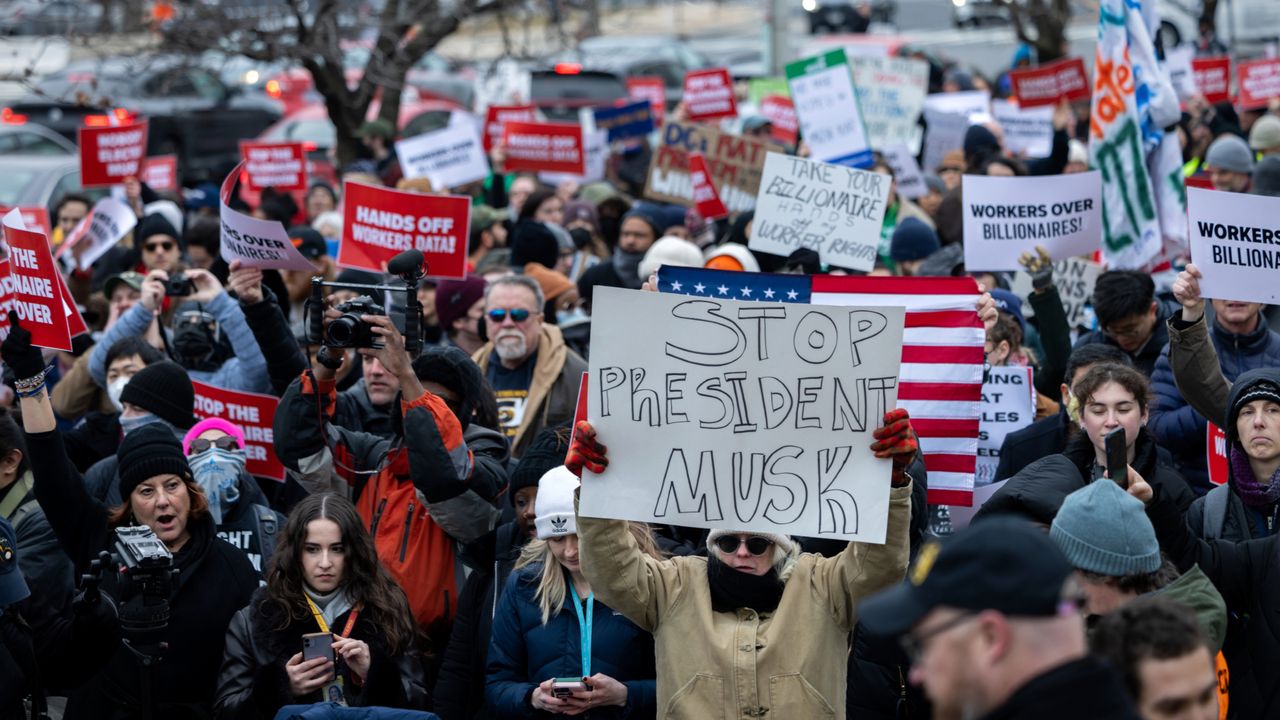


Anti-Elon Musk protest in Washington, D.C.
(Image credit: Nathan Posner / Anadolu via Getty Images)


By Peter Weber, The Week US
published 43 minutes ago

What happened

Members of Elon Musk's secretive "Department of Government Efficiency" have been granted access to "systems and technology" at the Centers for Medicare and Medicaid Services, the agency said Wednesday, after The Wall Street Journal reported that DOGE had "gotten access to key payment and contracting systems." Musk and Transportation Secretary Sean Duffy also said DOGE had agreed to "upgrade" the Federal Aviation Administration's air traffic control system.


Thousands of people gathered in cities and outside capitols across the U.S. Wednesday to protest Musk's rapid takeover of the federal government and President Donald Trump's early flurry of executive orders.
Who said what


DOGE is "going to plug in to help upgrade our aviation system," Duffy said on X. Musk replied that his team would "aim to make rapid safety upgrades to the air traffic control system." The details were "murky" on what role DOGE would play, Politico said, or which "upgrades" they would attempt on the aging and "complex web of software, hardware, facilities and people that keep planes from crashing into each other."

CMS is a "highly politically and economically sensitive agency," the "nerve center of much of the nation's complex health care economy," the Journal said. But a person familiar with DOGE's work at the agency said its access was "read only" and "that, to their knowledge, Musk’s allies hadn’t yet been given access to databases that include identifiable personal health information of Medicare or Medicaid enrollees." DOGE operatives met with the Labor Department Wednesday, "seeking access to sensitive data," The Washington Post said.

What next?

Musk's efforts are "part of a massive government restructuring by Trump, who has fired and sidelined hundreds of civil servants in his first steps toward downsizing the bureaucracy and installing more loyalists," Reuters said. "Multiple government officials have already privately warned" that some DOGE actions "appear to be illegal," the Post said. But "critics have struggled to keep up" with the onslaught and "the Republicans who control Congress have largely applauded its work" and dismissed Democrats' "protests that an unelected billionaire should not be able to dismantle the bureaucracy without lawmakers' consent."


Peter Weber, The Week US
Peter has worked as a news and culture writer and editor at The Week since the site's launch in 2008. He covers politics, world affairs, religion and cultural currents. His journalism career began as a copy editor at a financial newswire and has included editorial positions at The New York Times Magazine, Facts on File, and Oregon State University.
Elon Musk shares fake video created by Russian disinfo network alleging celebrity trips to Ukraine were funded by USAID
6 February 2025 


Billionaire-turned-U.S. “special government employee” Elon Musk shared a fake video on his X (Twitter) account that falsely claimed U.S. taxpayer money was used to finance visits by celebrities to Ukraine. The video, likely linked to the Russian disinformation network “Matryoshka,” alleged that the U.S. Agency for International Development (USAID) funded these trips in an effort to support Ukrainian President Volodymyr Zelensky.

The video, styled as a report from media company E! News, falsely claimed that several Hollywood stars were paid large sums for their visits to Ukraine: Angelina Jolie ($20 million), Orlando Bloom ($8 million), Ben Stiller ($4 million), and Jean-Claude Van Damme ($1.5 million)

Ben Stiller quickly responded to the allegation, saying his humanitarian trip to Ukraine was “completely self-funded” and that he had received no support from USAID. Andriy Kovalenko, head of Ukraine’s Center for Countering Disinformation, also drew attention to the fact that no such content had ever been published by E! News.

E! News, for its part, told AFP that the video “is not authentic and did not originate from E! News.”

As summarized by the Kyiv Post, Jolie traveled to Ukraine between April and May 2022 while serving as a special envoy for the UN refugee agency. Penn made multiple personal visits, meeting with Zelensky as part of his work on the documentary “Superpower,” which he released in 2023 — the film was available for free on the Paramount+ YouTube channel.

Bloom visited Zelensky in March 2023 in his role as a UNICEF goodwill ambassador. Van Damme was seen in western Ukraine in December 2022, posing for photos with soldiers in uniform, though the purpose of his visit and any potential sponsorship remained unclear.

Despite these facts, Musk did not remove the false content from his X page until well after a community note was added under his post, highlighting that while the video mimicked the E! News style, there was no evidence the media company had ever published such a report.

In December, a new disinformation campaign linked to Russia's “Matryoshka” network was discovered on the Bluesky social media platform after the Kremlin-linked initiative had already been exposed on X.

The new campaign featured six fake videos that followed a similar pattern. Each disinformation video began with a real person — a professor, a student from a top university, or a recognized expert — introducing themselves and beginning to speak on a topic unrelated to Russia’s war in Ukraine. The footage then transitioned to segments that did not show the speaker on screen while a computer-generated voiceover continued narrating. In these moments, the speaker seemed to promote claims that the West should end its support for Ukraine, that Europe should align its future with Russia, and that Volodymyr Zelensky is a dictator — or even a vampire.
Iran Not After War, Nukes, President Reiterates

February, 06, 2025 - 

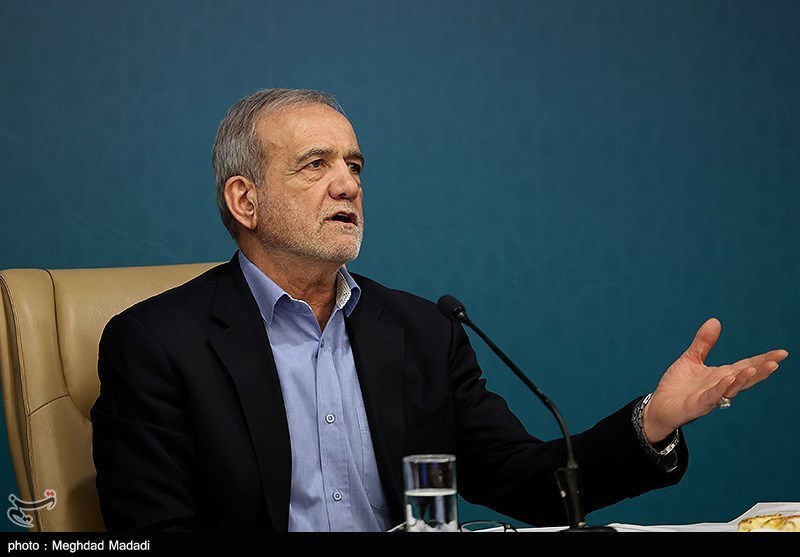
TEHRAN (Tasnim) – The Iranian president underlined that the country does not pursue nuclear weapons nor does it seek war, adding that verifying the peaceful nature of Iran’s nuclear program is not difficult.


“We are not pursuing nuclear weapons. Our dear Leader of the Islamic Revolution (Ayatollah Seyed Ali Khamenei) has issued a fatwa (religious edict) against it," President Masoud Pezeshkian told foreign ambassadors and envoys in Tehran on Thursday.

"Even those who think they can push this country toward nuclear weapons cannot do so because the doctrine of the Islamic Republic of Iran does not, under any circumstances, accept the mass killing of innocent people,” Pezeshkian added.

Iran’s nuclear doctrine is based on Ayatollah Khamenei's fatwa categorically banning the production, possession and stockpiling of nuclear weapons and other weapons of mass destruction.

Pezeshkian said verifying the peaceful nature of Iran's nuclear program is not difficult.

"Whenever inspectors (from the International Atomic Energy Agency) have wanted, they have come and inspected. They can come and inspect a hundred more times. When we have no such intention, they should not keep saying every day that Iran is pursuing nuclear weapons.”

Such baseless allegations against Iran, Pezeshkian said, come from the occupying regime of Israel, an entity that “has violated the sovereignty of all nations in the region—yet human rights advocates claim it is merely defending itself.”

“Who displaced the people of Gaza from their homes and turned them into refugees? A displaced person has to to defend themselves. Any free human being, when deprived of their rights, will inevitably stand up. The world will only see peace when those who claim to uphold human rights respect them regardless of ethnicity, race, or religion,” he added.

Addressing the ambassadors of Islamic countries, Pezeshkian stressed that “Iran seeks sincere relations for the mutual exchange of experiences.”

In 2015, Iran proved the peaceful nature of its nuclear program to the world by signing the Joint Comprehensive Plan of Action (JCPOA) with six world powers.

However, Washington’s unilateral withdrawal in 2018 and its subsequent re-imposition of sanctions against Tehran left the future of the deal in limbo.

In 2019, Iran started to roll back the limits it had accepted under the JCPOA after the other parties failed to live up to their commitments.


Panama's leader rejects State Department claim of deal for U.S. warships to traverse Panama Canal for free


February 6, 2025 / CBS/AP


Panama City — Panamanian President José Raúl Mulino on Thursday denied the U.S. State Department's claim that his country had reached a deal to allow U.S. warships to transit the Panama Canal for free.

Mulino said he had told U.S. Secretary of Defense Pete Hegseth on Wednesday that he could neither set the fees to transit the canal nor exempt anyone from them and that he was surprised by the U.S. State Department's statement suggesting otherwise late Wednesday.

"I completely reject that statement yesterday," Mulino said during his weekly press conference, adding that he had asked Panama's ambassador in Washington to dispute the State Department's statement.

On Wednesday evening, the U.S. State Department said in a social media post: "U.S. government vessels can now transit the Panama Canal without charge fees, saving the U.S. government millions of dollars a year." The department had no immediate comment Thursday on Mulino's remarks.

Panama's President Jose Raul Mulino (C) and U.S. Secretary of State Marco Rubio arrive for a meeting at the presidential palace in Panama City, Feb. 2, 2025.MARK SCHIEFELBEIN/POOL/AFP/GETTY

The Panama Canal Authority put out its own terse statement later Wednesday night saying it had "not made any adjustments" to the fees, adding that it was "willing to establish a dialogue with the pertinent officials from the United States in regards to the transit of U.S. Navy ships."

Mulino said the U.S. statement "really surprises me because they're making an important, institutional statement from the entity that governs United States foreign policy under the president of the United States based on a falsity. And that's intolerable."

The differing versions came just days after U.S. Secretary of State Marco Rubio met with Mulino and canal administrators and visited the critical trade route. He had carried a message from President Trump that China's influence at the canal was unacceptable, as the Trump administration makes a push for U.S. control of the canal, which it says it needs for America's economic security.


The Panama Canal serves as a shortcut between the Pacific Ocean and the Atlantic Ocean. And although the U.S. led the construction of the major waterway that around 40% of the world's cargo ship traffic now moves through, its control was given to Panama in 1999.

In their meeting, Rubio told the Panamanian leader that Mr. Trump had determined that China's influence on the canal constituted "a threat to the canal and represents a violation of the Treaty Concerning the Permanent Neutrality and Operation of the Panama Canal," a spokesperson said in a statement.

Mulino has refuted those claims, and he said Thursday that both Panama's constitution and laws regulating the Canal Authority make clear that neither the government nor the authority can waive fees.

"It's a constitutional limitation," he said.
GREECE
State of emergency declared in Santorini as earthquakes persist


The Greek government has declared an emergency amid ongoing undersea quakes near the island of Santorini. (Reuters: Alkis Konstantinidis)

In short:

A state of emergency has been declared on the Greek island of Santorini following days of earthquakes.

A 5.2 magnitude tremor was detected between the Greek islands of Santorini and Amorgos on Wednesday night, local time.

Government spokesman Pavlos Marinakis says emergency services have been mobilised to support the island.


Greece's government has declared a state of emergency in the tourist hotspot of Santorini, as undersea earthquakes continue to shake the resort island.

At least 11,000 people have fled the island in the past week, amid concerns of landslips and stronger quakes.

The declaration follows a magnitude 5.2 tremor — the most powerful recorded since activity started on on January 31 — that struck late on Wednesday.

That was followed by a further seven successive tremors registering above magnitude 4 which shook the region early on Thursday morning local time.

The country's leading authority on earthquake analysis, the Athens Geodynamic Institute, said it had recorded over 6,000 tremors off the Greek coast since January 26.

"The intensity is falling but has not yet stabilised," the institute's research director Athanassios Ganas told state TV channel ERT.


Thousands of people have evacuated from Santorini via ferry, as shaking continues. (Reuters: Alkis Konstantinidis)

The ministry of civil protection's emergency declaration will provide authorities faster access to state resources.

"The whole state mechanism has been activated … so that we are ready for any possibility with the hope that things will get better and the phenomenon will decrease in intensity," Greek Prime Minister Kyriakos Mitsotakis said on Wednesday.
Seismic activity unprecedented

Santorini is best known for its seaside towns with buildings painted white and blue. Scores of tourists visit the island during the summer season.

The 2021 census puts Santorini's permanent population at 15,000, so it is likely that a few thousand remain on the island, given that it is off-season.

Government officials and seismologists who met on Wednesday to assess the situation pointed to a high risk of landslides, including near the island's main port Athinios.


Experts say the region has not experienced seismic activity on this scale since records began in 1964.

"The most likely scenario is for the seismic activity to continue for certain days or weeks at the same intensity," the head of Greece's earthquake planning and protection authority, Efthymios Lekkas, told Proto Programma radio.

Santorini lies atop a volcano which last erupted in 1950, but an experts' committee on Monday said the current tremors were "not linked to volcanic activity".

No injuries or damage have been reported.

Rescue teams have been sent to the area as a precaution, and additional seismic sensors have been deployed.

AP/AFP/Reuters

Is rising seismic activity in Greece a warning sign for the region?

The tremors continue to rise in and around Santorini, Amorgos, Anafi and Ios, sparking fears of a larger disaster.

The New Arab Staff
06 February, 2025


Residents of Santorini island and tourists bord the ferry in order to flee the island after the recent seismic activity and the fears of a volcanic awakening or a larger scale earthquake. Santorini, Greece on February 4, 2025. [Getty]


Hundreds of earthquakes have rattled the Greek islands of Santorini, Amorgos, Anafi, and Ios - known collectively as the Cyclades - raising concerns among residents, officials, and scientists about a potential escalation in seismic activity that could disrupt neighbouring regions in the Eastern Mediterranean.

According to the European-Mediterranean Seismological Centre (EMSC), earthquakes were occurring within minutes of each other as of 07:00 on Tuesday (17:00 GMT), with the largest recorded at magnitude 5.1 on Monday.

Over 11,000 residents have left Santorini, a major Greek tourist destination, with approximately 7,000 departing by ferry and 4,000 by air as of Wednesday.

In Turkey, over 100 earthquakes were recorded in the past 48 hours, according to the country’s Disaster and Emergency Management Authority (AFAD) on Sunday.

"[The] earthquakes showed increased activity about 25 kilometres northeast of the island of Santorini, at depths between 5 and 25 kilometres. The closest earthquake to the shores of our country took place at a distance of 140 kilometres," AFAD said in a post on X.

While no damage or injuries have been reported so far, Greek authorities have announced the implementation of precautionary measures in case a major quake strikes, heightening fears of potential widespread destruction.

Seismologists have stated that the ongoing tremors, occurring in clusters of similar magnitude, indicate a pattern that typically precedes a major earthquake.

Sky News reported that the series of tremors could either be foreshocks leading to a larger earthquake or part of a swarm of small quakes that may continue for weeks or months.

"There is no serious technology or approach to predict what will happen from here on," Costas Papazachos, professor of applied geophysics and seismology at the University of Thessaloniki, told the UK news outlet.

The earthquakes originate from the uninhabited Greek islet of Anydros, located northeast of Santorini, according to DW.

While no definitive pattern has been established, scientists confirm that the current seismic activity has significantly intensified compared to previous incidents.

Historically, the region has experienced devastating seismic events, including a massive 7.7 magnitude earthquake in 1956, which generated a tsunami nearly 30 metres high and caused widespread destruction across Santorini, Crete, and other parts of the Eastern Mediterranean.


Azerbaijan claims possession of Russian missile fragment extracted from doomed AZAL Flight 8243

Azerbaijan claims possession of Russian missile fragment extracted from doomed AZAL Flight 8243
Photos of fragments included in the official report on the Kazakh investigation into the air disaster. Kazakhtstan describes them as "foreign metal objects". Pro-government Azerbaijani media state that they are "fragments from the surface-to-air missile that downed the Embraer-190 passenger plane". / Kazakh government handout
By bne IntelliNews February 5, 2025

Azerbaijani government sources on February 4 moved to reiterate that Baku is in no doubt that it was a Russian surface-to-air Pantsir-S missile that on December 25 hit Azerbaijan Airlines (AZAL) Flight 8243 during the aircraft’s approach to the Chechnyan capital Grozny in Russia. Events led to a crash-landing that killed 38 of 67 aboard.

"The Azerbaijani side possesses a fragment of a Pantsir-S missile which was extracted from the aircraft and identified through international expertise," a source told Reuters. The statement represented the first time Azerbaijan has claimed to have physical proof of a missile impact on the plane.

After suffering damage, the aircraft—an Embraer 190AR that departed for Grozny from Heydar Aliyev International Airport in Baku—was diverted hundreds of kilometres across the Caspian Sea where the crew crash-landed three kilometres from Aktau International Airport in Kazakhstan.

Also on February 4, Azerbaijan’s pro-government Trend News Agency pointed to the release of photographs of what it described as fragments from the surface-to-air missile that it stated downed the passenger plane, the front part of which exploded in a fireball as it hit the ground in Kazakhstan.

The Azerbaijan Airlines (AZAL) passenger aircraft forced to crash-land at the cost of 38 lives after being diverted from Russian airspace to Kazakhstan sustained external damage, with multiple punctures across its fuselage, according to a cautiously worded official Kazakh government preliminary report published on February 4.

Around the time of the air disaster, Russian officials were reporting Ukrainian attack drone activity in the vicinity of Grozny. Azerbaijan’s President Ilham Aliyev—involved in rising tensions with Moscow over issues including Russia’s stance on Armenia—has previously stated that the aircraft was accidentally struck by ground fire in Russia. The difficulty is that although Russian Vladimir Putin took the rare step of issuing an apology to Baku, he simply referred to a “tragic incident”. Neither he nor Kremlin officials have acknowledged responsibility for the incident, stating only that a criminal investigation has been opened. Russian authorities have continued to insist that their investigation is being conducted by top aviation experts and that efforts were under way to determine the cause of the crash.

The Kazakh government’s report, issued in line with global aviation safety regulations after the examination of black box data, does indeed include photos of “foreign metal objects” removed from the outside of the aircraft’s fuselage found during its investigation of the aircraft but does not state that they are from an exploded missile. The report also includes photos of extensive structural damage done to the aircraft. Specifically, the images show the port-side tail section riddled with holes.

The report also refers to how a cockpit voice recorder captured the sound of two impacts within a 25-second span, after which the pilot initially reported a suspected bird strike. Five minutes later, he indicated loss of control over the aircraft.

As the situation deteriorated during the rerouting of the aircraft, the pilot reported to air traffic control that passengers were losing consciousness due to a likely explosion of an oxygen tank and requested permission to fly at a lower altitude. The aircraft transmitted a distress signal as it approached Aktau, before crash-landing one hour and 12 minutes after the initial incident. 

The Kazakh investigation has not assigned any blame for the crash to any specific state entity or individuals. 

Azerbaijan’s transport ministry has reaffirmed that the aircraft was fully airworthy before departing on the scheduled passenger flight to Grozny. The ministry also pointed to the Kazakh report’s findings that Russian air traffic controllers took eight minutes after the first recorded impacts to the plane to restrict flights over the area, despite the ongoing drone activity.

With Moscow yet to formally address the allegations, Azerbaijan continues to demand justice. Aliyev has attributed blame to specific Russian individuals rather than the Russian state. 


New AC/DC stamps celebrate 50th anniversary of debut album 'High Voltage'

New AC/DC stamps celebrate 50th anniversary of debut album High Voltage
Copyright Royal Mail
By David Mouriquand
Published on 

AC/DC released their debut album 'High Voltage' in 1975 and went on to become one of the world's biggest rock bands. The new set of stamps celebrates their career and live performances.

Royal Mail has announced that new stamps are about to be issued to mark the 50th anniversary of AC/DC's debut album, ‘High Voltage’.

The album came out in 1975 and the eight stamps capture a sample of the "electrifying" live performances of the band.


The band performing in Boston in 1978Royal Mail

Angus Young of AC/DC performing in Chicago in 1979Royal Mail

A further four stamps will be issued and will feature the covers of ‘High Voltage’ as well as ‘Highway To Hell’ and ‘Back In Black’ - the best-selling rock album of all time.


Highway To HellRoyal Mail

Back In BlackRoyal Mail

David Gold, Royal Mail's director of external affairs and policy, said: "AC/DC is one of the most successful rock bands in the world. Over the past half-century, they have recorded some of the best-known rock anthems and have given us Back In Black - the biggest-selling rock album of all time.” 

"These stamps capture a sample of their electrifying live performances, along with some of their most iconic album covers, and celebrate their significant contribution to the world of rock music." 


AC/DC filming the Thunderstruck music video in 1990
Royal Mail

The stamps go on sale from 18 February. Check out the full selection here.

AC/DC will become the eighth music band to feature in a dedicated Royal Mail stamp issue. 

They will follow on from The Beatles in 2007; Pink Floyd in 2016; Queen in 2020; The Rolling Stones in 2022; Iron Maiden in 2023; and both Spice Girls and The Who in 2024.  

Additional sources • Royal Mail


EU metalworkers demand job protections amid green transition

Copyright KIM RAFF/AP

VIDEO EU metalworkers demand job protections amid green transition - video Dailymotion

By Arató László & Sertac Aktan
Published on 

European metalworkers in Brussels called for job protections and more training during the green transition. Since 2019, nearly one million industrial jobs have been lost, and many more are at risk.

Discontented metalworkers from across Europe gathered in Brussels on Wednesday to express concern over job security during the continent’s green transition.

They are calling for the EU’s new industrial policy to include stronger protections for workers and their families within the sector. One key demand is for the EU to prioritise effective training and retraining programmes, even if it means reducing working hours to accommodate these initiatives.

Lieve De Preter, president of ACV-CSC METEA in Belgium, stated that workers transitioning to a climate-neutral industry require enhanced training. She emphasised the importance of trade unions' involvement in discussions to facilitate this shift towards a sustainable manufacturing sector.

'Just Transition Fund' found to be lacking

Since 2019, nearly one million industrial jobs have been lost in the EU. Trade unions warn that employers are masking the true scale of the crisis through short-term contracts and reduced working hours, which could result in up to 4.3 million job losses. Recent months have seen more than 100,000 jobs put at risk, with major companies like Germany’s ThyssenKrupp and Volkswagen leading announcements of factory closures and redundancies.

To support the transition, the EU established the ‘Just Transition Fund’ as part of its Green Deal, allocating €17.5 billion. Although this is a large amount, the fund still faces challenges in addressing the transition's problematic issues.

Sara Matthieu, a Belgian MEP for the Greens, acknowledged the value of the Just Transition Fund but argued that it is insufficient for its intended purposes. She advocated for expanding the resources, particularly targeting regions where the transition has yet to begin.

"A robust fund is crucial to supporting sectors in transition and ensuring workers benefit from the process," she told Euronews.

Trade union representatives also got in touch with the European Commissioner for Industrial Strategy, Stéphane Séjourné, urging the drafting of a directive on fair transitions. They expect this future directive to force companies to collaborate closely with trade unions in anticipating and managing change.

What is the 'Just Transition Fund' and how is it financed?

The Just Transition Fund (JTF) is a financial instrument established by the European Union in 2021 to facilitate a transition towards a sustainable, carbon-neutral future by 2050.

The fund aims to support all member states under the cohesion policy, focusing on economic diversification and reconversion in regions affected by the shift away from carbon-intensive activities.

It is financed through a combination of grants and loans. The €17.5 billion budget is for the period 2021-2027. This includes funding from the EU budget and contributions from member states.

The financing structure comprises approximately €1.3 billion in grants from the EU budget, along with €6-8 billion in loans from the European Investment Bank (EIB), and additional resources can be transferred from national allocations under the European Regional Development Fund (ERDF) and the European Social Fund Plus (ESF+)


Asian multilateral investment bank says global development financing system works despite Trump


Earlier this week, Trump slapped tariffs on Canada and Mexico, only to put them on hold a day later, after the governments in both countries promised action to improve controls at their respective border with the U.S.

Donald Trump's policy of imposing tariffs could lead to more protectionism and slower growth in the global economy as well as more inflation, economists say.

Yet, the global development financing architecture is well positioned to weather the storm, according to Ludger Schuknecht, vice president of the Beijing-based Asian Infrastructure Investment Bank (AIIB), one of the largest institutions of its kind in the world.

"We are working closely together with the other multilateral development banks”, Schukecht said in an interview with Euronews in Brussels.

“And the fact that multilateralism at the moment is a bit challenged to my mind, does not make it less relevant and less important as a positive force going forward for our well-being."

Earlier this week, Trump slapped tariffs on Canada and Mexico, only to put them on hold a day later, after the governments in both countries promised action to improve controls at their respective border with the U.S.

It's in all our interest that the multilateral system works, that markets are open, that we do not engage in too much problematic behaviour with each other.
 Ludger Schuknecht 
Vice President AIIB

By contrast, U.S. tariffs on Chinese imports remained in place, provoking tit-for-tat measures by Beijing.

Schuknecht stressed that world leaders need a well-functioning global financial market and strong trade and investment relations - including the Trump administration.

"I believe in rationality. And yes, I mean, people have different styles. And but I think ultimately, it's in all our interest that the multilateral system works, that markets are open, that we do not engage in too much problematic behaviour with each other. But I believe that we will find good solutions."

The Asian Infrastructure Investment Bank is a multilateral development bank and international financial institution that aims to collectively improve economic and social outcomes in Asia. It is the world's second largest multi-lateral development institution. 

Founded at the initiative of China, the AIIB has currently 110 members countries, most of them from Asia and Europe. 

Germany, France, Italy and the UK are members, but not the United States. Washington considers the bank to be too accommodating towards China.


German authorities suspect Russian sabotage in anti-Greens election attacks

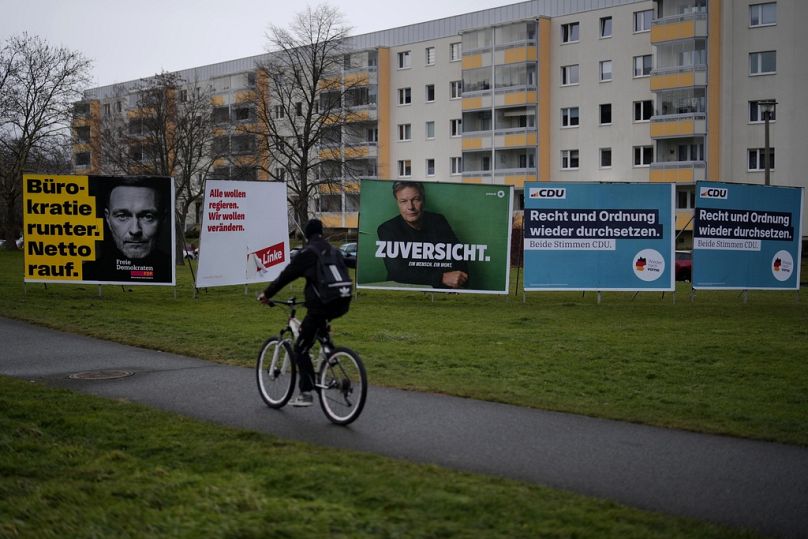
An election poster of Green Party top candidate federal minister for economy Robert Habeck
Copyright Martin Meissner/Copyright 2024 The AP. All rights reserved.
By Johanna Urbancik
Published on 

German authorities suspect the Kremlin of orchestrating a sabotage campaign targeting hundreds of vehicles to stoke anti-Green party sentiment ahead of the election.

Hundreds of cars across several German states appear to have been deliberately sabotaged — their exhaust pipes filled with construction foam and stickers featuring the Greens' chancellor candidate alongside the slogan "Be greener".

This was not a campaign gimmick gone wrong, however. German authorities suspect Russia to be behind the attacks.

More than 270 vehicles in Baden-Württemberg, Berlin, Brandenburg, and Bavaria are believed to have been targeted, seemingly to stoke anti-Green sentiment during the election campaign.

Initially, investigators suspected radical climate activists. However, Der Spiegel reports that in December last year, three men from southern Germany suddenly came under scrutiny.

They were stopped during a police check near a crime scene in Schönefeld, just outside Berlin. Subsequent house searches uncovered cans of construction foam, mobile phones and laptops.

Election posters in Wernigerode.Matthias Schrader/Copyright 2019 The AP. All rights reserved

Authorities suspect sabotage

Authorities believe these incidents are part of a targeted campaign to fuel resentment against the Greens and their chancellor candidate just weeks before the parliamentary election.

Germany's domestic intelligence agency, the Federal Office for the Protection of the Constitution, has warned the public several times of potential Russian interference in the election, including the use of so-called Russian proxies.

"These individuals are recruited online by Russian intelligence services or other state actors to carry out sabotage or propaganda activities", the agency stated.

The Greens have already responded to the allegations. In a statement, Konstantin von Notz, deputy parliamentary group leader and chairman of the Bundestag's Parliamentary Oversight Panel, underscored the severity of the current threat.

"For years, we have warned that authoritarian states, primarily Russia and China, are actively working to weaken Germany, manipulate public discourse, and attack democratic decision-making processes—including elections," the statement reads.

"For months, espionage and sabotage have been used for sowing uncertainty, inflaming existing conflicts, and dividing our society. The warnings from our security agencies could hardly be clearer. What we are seeing is just the tip of the iceberg."

"Disposable" or "throwaway" agents are yet another tool in the arsenal of hybrid warfare. Instead of relying on professional, highly trained operatives, Russian intelligence services recruit individuals for one-off sabotage missions.

These recruits receive simple assignments via messaging apps like Telegram or Viber, requiring no specialised training — such as minor arson attacks or distributing propaganda stickers and flyers.

What's the difference between traditional and hybrid warfare?

Olha Danchenkova, StratComm specialist and co-founder of Ukraine-born communications agency Calibrated told Euronews that hybrid warfare combines conventional military operations with a range of non-military tactics to achieve strategic objectives while maintaining plausible deniability.

"The goal is to exploit an adversary's vulnerabilities across multiple domains, creating ambiguity. These tactics include cyberattacks, disinformation campaigns, economic coercion (such as oil and gas dependency), diplomatic pressure, weaponisation of migration (see Belarus), corruption, election interference and the use of proxy forces", Danchenkova, who is also the co-founder of PR Army NGO, added.

Ihor Solovei, head of the Ukrainian Centre for Strategic Communications and Information Security, told Euronews that the arsenal of hybrid aggression includes a wide range of instruments, including disinformation.

Hybrid warfare is characterised by the fact that information operations, so-called false flag operations and the use of other non-military methods to influence the enemy play a major role in this type of aggression. Solovei explained the difference between hybrid and traditional warfare using an example from his home country.

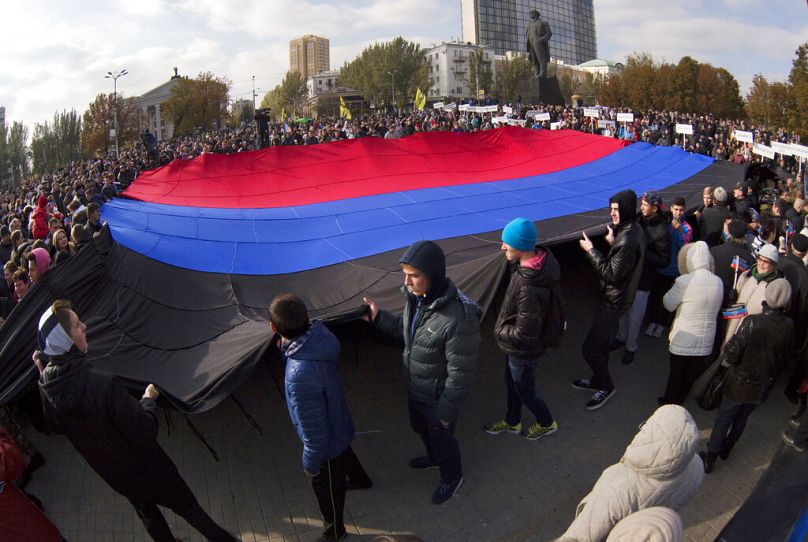
"Here is an example. In 2022, Russia captured Mariupol using traditional warfare methods: artillery, armoured vehicles, aviation, and infantry. It was a classic military operation. Ten years earlier, in 2014, Russia captured Donetsk using hybrid methods of war", he said.


People carry a giant flag during celebration of the Day of the flag of "Donetsk Peoples Republic" in the town of Donetsk, eastern Ukraine Sunday, Oct. 19, 2014.Dmitry Lovetsky/AP

"As a result of information operations and propaganda, part of the local residents turned against the central government."

"Russian special services and mercenaries, with the support of local collaborators, overthrew the legitimate authorities in the city by force. Unlike a full-scale invasion, in 2014 Russia concealed its role in the events by using proxy formations," Solovei concluded.