Friday, February 07, 2025

 FOSSIL FOOLS PROFITEERS


Equinor Cuts Renewable-Energy Ambitions to Focus on Shareholder Value
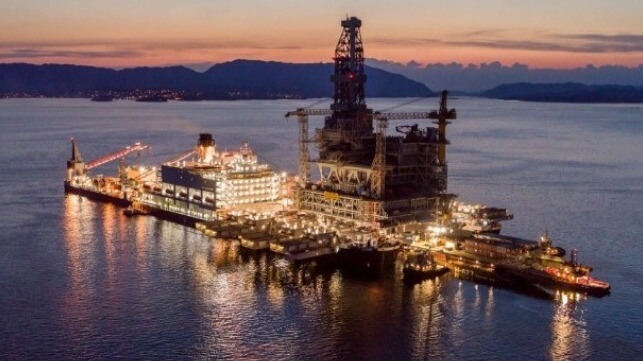
Pioneering Spirit
The drilling platform topsides for Equinor's Johan Sverdrup platform aboard Pioneering Spirit, 2018 (Equinor)

Published Feb 6, 2025 10:20 PM by The Maritime Executive


Norwegian oil major Equinor has announced a major cutback to its renewable-energy ambitions, and says that it plans to focus on maximizing shareholder value going forward. 

"Equinor has high-graded the project portfolios in renewables and low-carbon solutions, and reduced cost and early-phase spend," the company said in its quarterly report. "The portfolio is expected to deliver more than 10 percent life-cycle equity returns."

The company said that circumstances have changed since it last set its renewables targets - especially in the United States, where the political and economic winds have shifted against offshore wind development. Equinor said that these pressures have had an effect on its credit evaluation, leading it to reduce its investment target for renewables for 2030 by about 25 percent. 

"The reduced investment program is in line with our commitment to ensure a capital structure that can support a solid investment grade credit rating," Equinor said. 

On the oil and gas side, Equinor expects production to increase by 10 percent  to 2.2 MMboed by 2030, thanks to strong performance at its core Norwegian continental shelf operations. Equinor plans satellite field development and increased recovery from existing assets to help support long-term production at low cost.  

Equinor posted operating income of $8 billion and a net profit of $2 billion in the fourth quarter. It continues to invest in share buybacks, including a $5 billion buyback program for 2025 alone. "Equinor is well positioned for further growth and competitive shareholder returns. We expect to deliver industry-leading return on average capital employed, above 15% all the way to 2030," said CEO Anders Opedal. 

Equinor has been in retreat from renewables investments for some time. Last August it closed its offshore wind operations in Vietnam, Portugal and Spain, citing inflation and supply chain delays. In September, it dropped out of a proposed blue hydrogen pipeline project that would have supplied power plants in Germany, citing lack of demand for the natural gas-based product. 

It has, however, invested in growing its position in offshore-wind leader Orsted. Last year, it announced that it has acquired a cumulative $2.5 billion stake in the Danish company, just shy of 10 percent. 

“Equinor has a long-term perspective and will be a supportive owner in Ørsted,” said Anders Opedal, CEO of Equinor, in announcing the stock position. “This is a counter-cyclical investment in a leading developer, and a premium portfolio of operating offshore wind assets. The exposure to producing assets complements Equinor’s operated offshore wind portfolio of large projects under development.”

 

Salvors Approach the End of Fuel Removal for Lost Survey Ship Manawanui

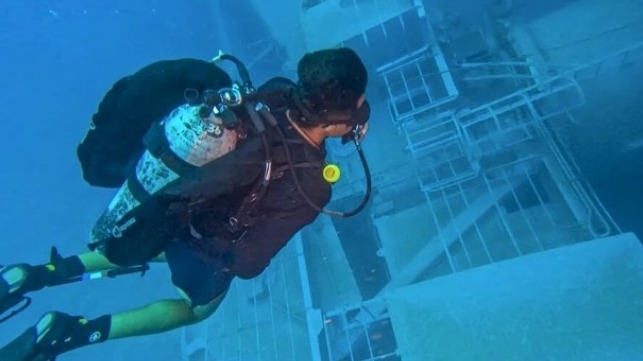
Diver at wreck site of Manawanui
Courtesy NZDF

Published Feb 6, 2025 11:21 PM by The Maritime Executive


Salvors hired by the New Zealand Defence Force have recovered a substantial share of the fuel aboard the lost survey ship HMNZS Manawanui, which ran aground on a reef and sank off Samoa in October 2024.  

Working from a moored deck barge, the salvage divers pumped off enough diesel and oily water to make two return trips to Apia to offload full tank containers (tanktainers) and return with new empties. 

“The salvors have recovered a significant amount of liquid from tanks on the Manawanui after operating . . . for the past 17 days,” NZDF on-scene representative Commodore Andrew Brown said. "Just over 340,000 liters of liquid has been recovered from Manawanui. Of this we estimate 320,000 liters of diesel fuel mix has been recovered from the ship’s diesel fuel tanks."

The team has pumped out the ship's larger and more accessible tanks, he said, and they are now making progress on the smaller remaining tanks. There are 54 in total that need to be pumped out, including fuel, lube oil and bilge water tanks. 

"The amount of diesel fuel in the liquid recovered won’t be known until the liquid is processed, although the majority of the volume of liquid recovered so far is assessed to be diesel," Commodore Brown said. “In addition to the liquids from the diesel fuel tanks, the salvors have recovered around 18,000 liters of lubricating oil."

The end of the pollution-abatement process is approaching, and the governments of Samoa and New Zealand are in talks about next steps, which might include wreck removal or possible compensation for local fishermen. The residents of nearby villages were banned from fishing near the wreck site for weeks due to the risk of fuel contamination. 

Those villagers are making moves of their own. After calling for financial compensation from their government and from New Zealand, they reached out to the Chinese embassy in Apia for foreign aid assistance. "We met with the Chinese ambassador to discuss our needs, and they are willing to assist us immediately due to the sinking of the boat in our district," a spokesperson told Radio New Zealand. "We talked about the individual and family needs for daily living, including monetary assistance to help with their losses."


Inland Cargo Ship that Destroyed Moselle Lock was on Autopilot

damaged lock gates
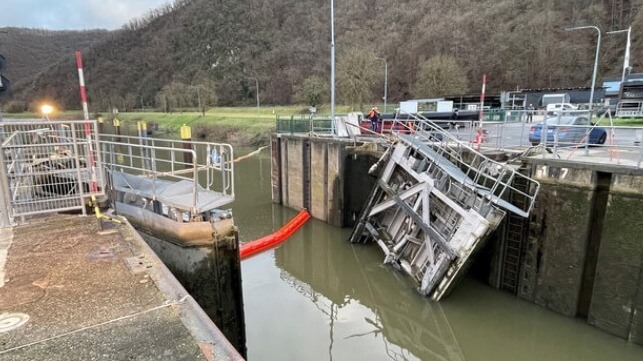
Damaged gates on the Muden Lock in Germany on the Moselle River ((WSA Mosel-Saar-Iahn)

Published Feb 6, 2025 5:56 PM by The Maritime Executive


German prosecutors are continuing to investigate the accident in December that paralyzed river traffic on the Moselle and trapped numerous inland cargo ships in France and Luxembourg. They believe the cargo ship that destroyed the critical lock was sailing on autopilot and failed to brake before hitting the gates.

An inland cargo ship loaded with 1,500 tons of scrap metal bound for Mertert in Luxembourg hit the lock gates on December 8 ripping both rates loose from the hinges and damaging the concrete and operating mechanism for the lock. At the time, the authority that operates the lock reported it appeared the vessel had not only failed to stop but had not attempted to slow down. The gates were closed preparing for the locking operation.

The public prosecutor in Koblenz, Germany reported based on the initial findings of its investigation the inland cargo ship was operating on autopilot and apparently was unattended. Regulation for the river which connects to the Rhine and is a major route for cargo into France and Luxembourg permits the use of autopilot but the captain has to monitor the operation and be able to intervene if necessary to prevent accidents by stopping the vessel.

The prosecutor would not speculate on why the captain had not attempted to stop the vessel. They did say that tests showed the ship’s engines and controls appeared to be working without a problem. They also confirmed that there was no evidence of the captain having consumed alcohol or illegal drugs.

Video of the locks confirms the vessel did not attempt to slow its progress or stop before hitting the lock gates.  They believe the vessel was traveling at a speed of 12.2 km/h (approximately 6.5 knots) when it entered the lock and plowed into the gates.

“Why the ship’s captain did not intervene is the subject of further investigation,” prosecutors told the German news agency dpa.


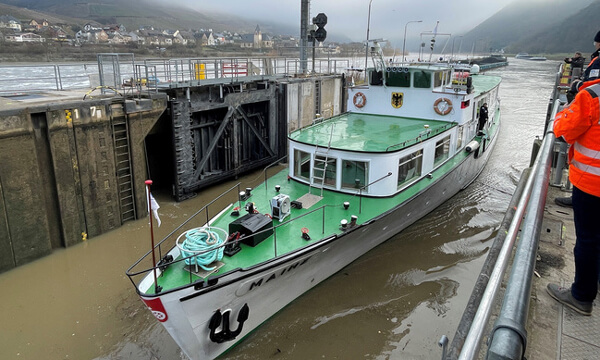
First vessel through the locks on February 1, 55 days after the gates were destroyed (WSA Mosel-Saar-Iahn)


While the investigation is ongoing, the Federal Waterways and Shipping Administration however reports traffic has resumed through the lock. The first ship transited the repaired lock on February 1 after just 55 days of repairs. Initial estimates had been that it could be till March before the lock could be reopened to vessel traffic.

Immediately after the incident, reports said there were 72 vessels trapped in France and Luxembourg. The authority staged a rescue operation using dam beams normally for closing the locks for inspection in an emergency operation that required divers and a crane to set the beams for each locking operation. It took till December 27 to clear all the vessels.

Repairs were expedited in part because they were able to find two assembled lock frames that could be outfitted for the Muden lock. The gates were prepared while concrete repairs and new fitting strips were completed at the lock. The new gates were installed on January 24 and after testing they celebrated the reopening of the waterway.


Finland Says Odds of Accidental Subsea Cable Damage "Extremely Unlikely"

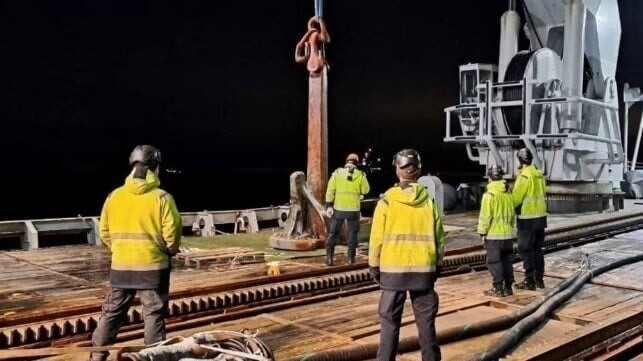
Finnish and Swedish forces recover the lost anchor of the Eagle S from the Gulf of Finland (Finnish Border Guard)

Published Feb 5, 2025 6:26 PM by The Maritime Executive


Despite U.S. intelligence leaks that suggest that recent cable-cutting incidents in the Baltic may be accidental, Finland's foreign minister says that it is "extremely unlikely" that four cable-damage incidents could happen in one region in a year without some amount of intent. 

Finnish police continue to investigate the Russia-linked "shadow fleet" tanker Eagle S in connection with the cable-cutting incident on the Baltic seabed on Christmas Day. After leaving the Russian port of Ust-Luga, the Eagle S dragged her anchor through several subsea comms cables and the Estlink 2 power cable, severing them all. The vessel was boarded, detained and diverted to an anchorage off Porvoo, where it remains.

The UAE-based owner of the Eagle S filed suit in Finnish courts to secure the ship's release, but lost at the district court level. On Tuesday, the Helsinki Court of Appeal refused to hear an appeal of the earlier ruling - leaving the ship in Finnish police custody, at least for now. 

The Eagle S casualty marked the third time in 15 months that a vessel bound to or from Russia had dredged up subsea cables in the Baltic with an anchor, following the casualties involving the Newnew Polar Bear and the Yi Peng 3. A vessel involved in the fourth and latest cable-damage incident, the Vezhen, was released this week after Swedish investigators concluded that the crew had not intentionally released the anchor. 

The owner of Eagle S maintains that - like the case of the Vezhen - the Christmas Day incident was accidental. Leaked reports of U.S. and European intelligence assessments suggest that NATO governments concur. 

This week, Finnish foreign minister Elina Valtonen told The Times that despite these secret Western assessments, it is "extremely unlikely" that all of the recent casualties were caused accidentally - and that even if Eagle S' contribution to the growing tally of damage was an accident, it would still demonstrate the casualty risk created by substandard Russia-linked tankers. Unlike the other three vessels implicated in recent cable-cutting incidents in the Baltic, Eagle S is an identified member of the Russian "shadow fleet," and has an extensive record of inspection deficiencies. 

"We Finns, we rarely believe in things. We like to investigate and work based on facts," she told The Times. "But what is for certain is that Russia’s shadow fleet does pose a significant threat . . . If you navigate using rusty vessels, perhaps with staff who haven’t too much experience, you might run into trouble."

Vilkonenn called for efforts to keep the Russian shadow fleet "in check" to reduce risk of damage to the Baltic's environment and infrastructure - within the bounds of international law and the universal right to freedom of navigation. On Wednesday, Denmark announced such an effort: it is starting a targeted port state control inspection regime for "shadow fleet" tankers that anchor in Danish waters. 


TRUMP'S VILE SEXISM 

Report: Ex-Commandant Adm. Linda Fagan Abruptly Evicted From Base Housing

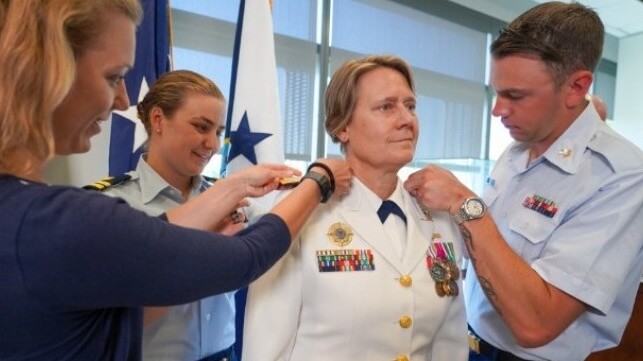
Former Commandant Adm. Linda Fagan at her swearing-in, 2022 (USCG file image)

Published Feb 6, 2025 3:46 PM by The Maritime Executive


The U.S. Department of Homeland Security has ejected former Coast Guard Commandant Adm. Linda Fagan from her house with three hours of notice, forcing her to leave her belongings behind, according to NBC and The Independent. 

On January 21, President Donald Trump's second day in office, Fagan was removed from command and replaced by Acting Commandant Adm. Kevin Lunday. In an extended letter dated January 21, the Trump administration faulted Fagan for "erosion of trust," low recruitment numbers, high illegal migration, shipbuilding delays, DEI workforce initiatives, and the Coast Guard's response to the Operation Fouled Anchor scandal. Fagan has come in for criticism from Congress and from victims' advocates for her allegedly slow response to the long-buried sexual assault investigation at USMMA.

Fagan's firing came without advance notice, and the Coast Guard provided her with a waiver of 60 days to find an alternative to her current home at Joint Base Anacostia. However, on Tuesday, Trump officials ordered Commandant Adm. Lunday to evict Fagan immediately. According to NBC, she was given three hours to vacate the building and was not able to retrieve many of her possessions before leaving. She was reportedly instructed to leave the building unlocked so that it could be photographed by DHS officials. 

"It's a really strange power play," one associate of Fagan told NBC. 

U.S. Transportation Command will be removing her personal effects from the house, according to the report. 

Adm. Fagan became a commissioned officer in 1985, and was seen as a female pioneer in the service. She rose through the ranks in the marine safety division, and became the service's first female commandant in June 2022. At the time, her appointment was greeted in Washington with fanfare.  

"[Adm. Fagan] upholds the highest traditions of the United States Coast Guard," said then-President Joe Biden at her swearing-in ceremony in 2022. "There’s no one more qualified to lead the proud women and men of the Coast Guard, and she will also be the first woman to serve as Commandant of the Coast Guard — the first woman to lead any branch of the United States Armed Forces. And it’s about time."

Poland Orders Removal of Derelict Russian Tanker from Port of Gdynia

Russian tanker Poland
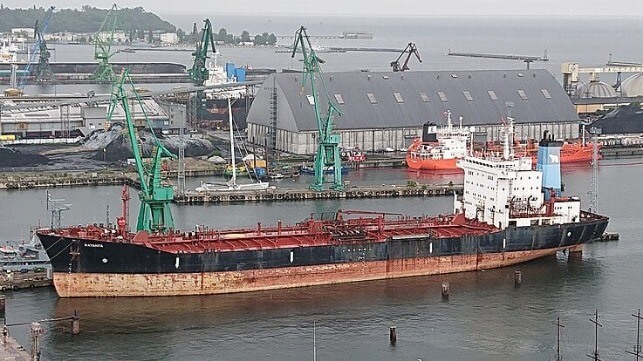
After sitting in Gdynia for more than seven years, the Port of Gdynia has received authority to remove the tanker Khatanga (Braveheart - CC BY-SA 4.0)

Published Feb 7, 2025 12:50 PM by The Maritime Executive


The Polish Ministry of Infrastructure reports that an order was issued for the removal of a derelict Russian product tanker that has been in the Port of Gdynia for more than seven years. The story of the Khatanga (23,000 dwt) has drawn new attention with the increased concerns of Russian-related espionage in addition to the safety issues for a vessel that has not been operated or maintained for years.

Arkadiusz Marchewka, Poland’s State Secretary and Ministry of Infrastructure, announced the order in a posting on social media on Thursday, February 6. “We are removing Russian scrap from our port. The state acts and ensures the safety of Polish infrastructure,” he wrote announcing the decision of the Ministry.

Port officials said they have been trying for months to gain the authority to act to remove the tanker which was detained in the port in October 2017 after a failed Port State inspection. The owners, Murmansk Shipping Company, promised repairs to address structural issues identified during the inspection and to take steps to correct issues identified regarding the training and competence of the crew. Instead, the tanker has languished in the port while the owner declared bankruptcy in 2020.

The media says the tanker recently twice broke away from its moorings. Port officials said tugs were able to secure the vessel but they too raised concerns about port safety. The vessel appears to be unnamed, but the port said since a trustee was named in the bankruptcy and has occasionally checked on the vessel, it can not be officially listed as abandoned. 

Port and government officials raised concerns about the lack of maintenance. They noted that the fuel cargo tanks have not been properly vented raising the concern of a buildup of explosive vapors. Media speculation in January also asked if the Russians might be using the vessel as a base of operations to spy on NATO. They noted the use of the port for military equipment including shipments into Ukraine of equipment from the West while also speculating if listening or recording devices might be aboard the ship. 

The Maritime Directorate in Gdynia has now issued an official order for the removal of the tanker. It instructed the port to have the Khatanga removed from the port as quickly as possible but set a deadline of three months. 

“The vessel poses a threat to the safety of navigation and is withdrawn from service,” the Directorate writes. “In accordance with the decision, the Port of Gdynia Authority has been obliged to remove the Russian ship Khatanga."

It is expected that the port will attempt to sell or auction the vessel, but it is noted that it is incapable of navigation under its own power. The expectation is that it will be sold for scrap.

The Directorate also authorized the port to seek from the Russian shipowner reimbursement of costs for the entire period of the vessel's mooring in the port. A spokesperson for the port told the local media that the port authority would use the proceeds from the sale of the vessel to cover some of the costs and unpaid dockage fees.
 

(Top photo in Gdynia harbor in July 2020 by Braveheart - CC BY-SA 4.0)

Modern Malian architecture rooted in ancient earth techniques

In the heart of Bamako, architect Mariam Sy is leading a quiet revolution – one handful of earth at a time. Her vision merges Mali's ancient building wisdom with contemporary design, creating structures that seem to rise organically from the Sahelian soil.


Issued on: 02/02/2025 - 

A building designed by Architerre, which combines traditional Malian earth-based techniques with modern designs. © Mariam Sy

By:RFI

"At 15, I told my parents I wanted to be an architect. They thought it was a good idea, and I had to leave my girls' school to attend a technical college in Bamako," Sy tells RFI.

That decision set her on a path from Mali to Belgium, where she earned her architecture degree, and then to France's prestigious Craterre research centre in Grenoble.

It was there she mastered the art of building with the earth, a material at the core of her sustainable designs. Today, Sy's firm Architerre is at the forefront of eco-friendly architecture in West Africa.

Building with nature

Through projects ranging from homes and medical centres to mosque renovations in Timbuktu, Sy demonstrates how traditional materials can meet modern needs while respecting the environment.

"Whether it's soil, stone or whatever we can find locally, the idea is really to use as little energy as possible in construction and to use materials suited to the local temperature," she says.

"As it happens, in Mali, soil is one of the most widespread and well-known local materials, and for us Sahelians, the advantage is that these materials truly adapt to our climate."

Sy's work has gained attention beyond Mali, inspiring clients across Africa to embrace eco-friendly construction methods.

She co-founded Fact Sahel, a network of architects, masons, engineers, researchers and writers united by a shared vision of environmentally responsible building practices.

An earth-based structure built using traditional Malian materials. © Mariam Sy

"This question of eco-responsible architecture affects everyone. Even though we know we're not the biggest energy consumers in the Sahel, we still suffer the consequences," she says.

"So it's important to also take into account new technologies and questions that affect everyone and apply them to ourselves. We consider ourselves activists. For us, our work truly is activism."

Rediscovering African identity

The revival of traditional construction techniques is part of a larger movement across Africa.

French architect Jean-Marc Lalo, who organises exchange seminars between African and European architects, sees it as a significant shift in the continent's architectural landscape.

"There's both a question of African architectural identity, an enthusiasm for rediscovering traditional earth construction techniques," he says.

"Secondly, it's also one of Africa's future prospects: making a direct leap to construction with bio-sourced, local materials. Earth is perfectly adapted for this, in fact."


Compressed earth bricks, made from local materials, are a key element in sustainable construction. © Mariam Sy

From Senegal to Morocco, countries are increasingly embracing sustainable practices. In Benin, the government has commissioned high-profile earth-based projects, including works by Pritzker Prize-winning architect Francis Kéré.

Similar innovations are taking root in Burkina Faso and beyond, with compressed earth bricks becoming a cornerstone of modern African architecture.

Burkina Faso-born architect Francis Diebedo Kéré wins prestigious Pritzker Prize
From tradition to innovation

Sy's next project – a school in Bamako built entirely with earth-based techniques – encapsulates her philosophy of blending tradition with innovation.

"How do we explain to people the return to these materials which have so many advantages in many aspects of life, not just construction?" Sy wonders as she inspects a wall of compressed earth bricks.

For her, each earth-built structure is more than just a building – it's a bridge between Mali's architectural heritage and its sustainable future, demonstrating how ancient wisdom can help solve modern challenges.

This story has been adapted from the original version in French by Frédéric Garat
French PM Bayrou calls for national debate on immigration after controversial 'flooding' comments

SCRATCH A CONSERVATIVE FIND A FASCIST

Prime Minister François Bayrou has called for a national debate on immigration and what it means to be French, days after stirring controversy with comments about immigrants 'flooding' France.


Issued on: 07/02/2025 - 

Incumbent Prime Minister François Bayrou pictured under the French flag in 2016 at the closing speech of a MoDem party retreat in western France. LOIC VENANCE / AFP

By: RFI

Bayrou's call for a national discussion French identity comes in response to comments from Justice Minister Gérald Darmanin who said that the constitution should be changed to end end current citizenship rights granted to people born in France, known as "jus soli" or "right of soil".

The prime minister said discussion on that topic alone would be "too narrow", calling instead for a wider debate about citizenship.

"It's obvious that this question has been fermenting for years," Bayrou told broadcaster RMC on Friday.

"What does it mean to be French?" Bayrou said. "What rights does it give you? What duties does it demand of you? What advantages do you get? What do you commit to when you become a member of a national community?"

Bayrou said details of how to organise such a debate needed to be worked out but it should not be "postponed forever".

French PM in hot water over migrant 'flooding' gaffe

Late last month, Bayrou came under heavy criticism for remarks about a feeling of immigrants "flooding" France that he said was growing across the country.

This sparked an outcry from the leftist opposition, and rebukes from centrist allies, after he said that immigration was "a positive" so long as it remained "proportionate" to the size of the population.

But his remarks also drew praise, from some conservative and far-right deputies.

His latest call for a debate on identity and citizenship have been slammed by the Socialist Party, who posted on X that there is no question about birthright in France and they will "defend this founding principle of our Republic".

Non à la remise en cause du #droidusol.

Suite aux propos de G. #Darmanin et de F. #Bayrou demandant l'ouverture d’un débat public sur le droit du sol, nous réaffirmons notre attachement à ce droit.

Nous défendrons ce principe fondateur de notre République. pic.twitter.com/DCA40Ri5Cg— Parti socialiste (@partisocialiste) February 7, 2025
Children 'will be French'

The "jus soli" question has come into sharp focus in French politics recently because of mass immigration into Mayotte – the French overseas territory in the Indian Ocean – from the neighbouring Comoros islands.

After parliament voted on Thursday to restrict that right in Mayotte – but not elsewhere – Darmanin said "jus soli" rights enshrined in the French constitution should come under review entirely.

"Today I would be in favour of French people deciding on this question during the 2027 presidential election, or in a referendum," Darmanin told the National Assembly.

In Mayotte and Guiana – another French overseas territory in South America – "thousands and thousands of people arrive with the idea that, if they have children there, they will be French," the minister said.

"All this needs to be reconsidered," he added.

French government faces no confidence vote as Socialists mull allegiance

Darmanin's move was backed by immigration hardliners, with Les Republicains boss Laurent Wauquiez saying Mayotte's restrictions should be extended "to the rest of France's territory".

But Education Minister Elisabeth Borne – a former prime minister – rejected her colleague's initiative, saying "what French people expect from us are acts, and not references to constitutional change in the future".

Bayrou's debate initiative itself came in for criticism, with the Le Monde daily accusing the premier of mixing up issues.

"François Bayrou himself has added to the confusion by referring to the [Mayotte] archipelago when raising the question of migration in general," the paper said in an editorial.

"He has fallen into the double trap of considering Mayotte as a laboratory, and of mixing up immigration policies and 'national identity'," Le Monde added.

(With newswires)
South Africa 'will not be bullied,' Ramaphosa says after Trump attack

South African President Cyril Ramaphosa said on Thursday evening in his annual state of the nation address that his country "will not be bullied," days after US President Donald Trump said he would cut off funding to South Africa over a land reform act.


Issued on: 07/02/2025 - 
South African president Cyril Ramaphosa at the Cape Town City Hall ahead of his State Of The Nation (SONA) address in Cape Town, South Africa, on 6 February 2025. REUTERS - Nic Bothma

By: RFI

Ramaphosa did not mention Trump by name in his address, but spoke of growing geopolitical tensions.

"We are witnessing the rise of nationalism, protectionism, the pursuit of narrow interests and the decline of common cause," he said.

"We will stand together as a united nation, and we will speak with one voice in defence of our national interests."

Trump had said on Sunday, without citing evidence, that "South Africa is confiscating land and treating certain classes of people very badly," alluding to a new law which aims to even racial disparities in land ownership.

He then threatened to cut off funding to the African country.

A cornerstone for G20 members

South Africa was also criticised this week by US Secretary of State Marco Rubio, who said he would not attend an upcoming G20 summit in Johannesburg because "South Africa is doing very bad things" such as "using G20 to promote solidarity, equality, and sustainability."

The meeting of foreign ministers of the G20 group of countries is set for 20 -21February in Johannesburg.

South Africa took over the G20 presidency in December (until November 2025), becoming the first African country to do so, and Ramaphosa has said he would use the opportunity to advance the interests of Africa and the Global South.

Africa takes centre stage as South Africa maps ambitious G20 agenda


Promise of growth

Pretoria is just over seven months into a coalition government that was formed after the African National Congress lost its parliamentary majority in an election last year, forcing it to team up with its biggest rival, the Democratic Alliance.

Ramaphosa said the government would launch a second wave of reforms to try to lift economic growth above percent.

Cyril Ramaphosa: from anti-apartheid activist to leader of South Africa's coalition government

Ramaphosa also promised to focus on boosting struggling state companies like power utility Eskom and logistics group Transnet, and on investing in infrastructure.

The central bank's most recent forecast is that Africa's most industrialised economy will grow 1.8 percent this year.

(with Reuters)
UAE to invest billions in France AI data centre


The UAE will invest between €30 billion and €50 billion to build Europe’s largest AI data centre in France, the French presidency announced Thursday. Part of a broader AI agreement between the two nations, the project will serve as the core of a new AI campus.


Issued on: 07/02/2025 -
FRANCE24
By: NEWS WIRES

10:55
France's President Emmanuel Macron and UAE counterpart Sheikh Mohamed bin Zayed Al Nahyan, look on as France's Minister for Europe and Foreign Affairs Jean-Noël Barrot and CEO of Mubadala Investment Company Khaldoon Al Mubarak sign an agreement on AI, at the Élysée Palace, in Paris, Thursday, Feb. 6, 2025. © Ludovic Marin, Pool via AP


The French presidency on Thursday announced that the United Arab Emirates would invest billions of euros to build a huge artificial intelligence data centre in the country.

The centre will be the core of a new AI "campus" and will have up to a gigawatt of capacity, "which represents investments of 30 to 50 billion euros", the French presidency said in a statement.

It was part of a larger AI agreement signed between French President Emmanuel Macron and his UAE counterpart Sheikh Mohamed bin Zayed Al Nahyan in Paris on Thursday.

AI data centres are slated to stock data and provide the enormous energy required for the new technology.
The campus will be the largest in Europe dedicated to AI, the presidency said.

The project was announced and signed as global experts began debating the threats and promise of artificial intelligence at a gathering in Paris on Thursday and Friday, ahead of a summit of world leaders on the fast-moving technology.

Thousands are expected at the Paris event, which aims to find common ground on a technology that has upset many business sectors in less than two years -- as well as to keep France and Europe on the map as credible contenders in the AI race.

(AFP)