It’s possible that I shall make an ass of myself. But in that case one can always get out of it with a little dialectic. I have, of course, so worded my proposition as to be right either way (K.Marx, Letter to F.Engels on the Indian Mutiny)
At the beginning of the year, the IRGC Navy (Nedsa) announced that it would hold a series of major exercises in January, to be concluded by the Nedsa's "largest ever fleet review" on January 27.
Nothing quite fitting this description appears to have occurred, but Iran’s other naval force, the Islamic Republic of Iran Navy (Nedaja) assembled a substantial sail-past of ships at the conclusion of the naval element of Exercise Zulfiqar 1403 on February 26.The presence of ships on this fleet review is of some interest, at a time when the new US administration has warned that it could commence stop and searches of tankers in international waters believed to be carrying sanctioned Iranian oil. At a time when the Nedaja is limiting its press releases revealing the make–up and location of its operationally-deployed assets which could be tasked to protect such tankers, it is of interest to note which ships remain in home waters.
The Nedaja has not released the names of vessels seen on February 26 off Bandar Abbas, but it is possible to identify more than ten that were involved. Often, Iranian media sources splice in video from previous exercises to bulk up the assets on display, but in this instance the choppy sea state and meteorological conditions common to all the imagery released provide some veracity.
The Alvand and Moudge Class frigates IRINS Alvand (F71) and IRINS Jamaran (F76) led the fleet, followed by IRINS Bayandor (F81). Two submarines were spotted: IRINS Fateh (S920) and an unidentified Ghadir Class midget submarine struggling in the heavy swell. Kaman and Sina Class fast attack craft IRINS Neyzeh (P231) and IRINS Zereh (P235) were also suffering in the swell, and in separate footage the Kaivan Class patrol boat IRINS Tiran (P202), first launched in USCG’s Curtis Bay (MD) yard in 1957, was seen launching a 35km-range Nasr anti-ship missile, developed from the Chinese C-704.
Numbers were made up by IRINS Sirjan (K472) and a second unidentified Delvar Class logistics vessel, and by the Hendijan Class auxiliary IRINS Bahregan (A1406). The largest vessel in the Nedaja, the converted tanker IRINS Makran (K441) was not featured in the sail-past but could be seen in the background.
Known to be out on deployment at the moment are the Nedaja’s 100th Flotilla, made up of IRINS Bushehr (K422) and IRINS Lavan (L514), on the annual winter training cruise with 220 naval cadets aboard. The flotilla was due to leave Mumbai on February 28.
The Nedaja had announced last November that the 100th Flotilla was heading to the Red Sea to rotate into the Red Sea and Gulf of Aden security mission. With the 100th Flotilla clearly elsewhere, it is not clear when the 99th Flotilla led by IRINS Dena (F75) left the Red Sea, as there was no normal homecoming announcement, but IRINS Dena was spotted in Port Klang, Malaysia on February 24.
Rear Admiral Shahram Irani, the Nedaja commander, had indicated to Press TV in February that there were a further two unaccounted-for flotillas currently deployed in the Indian Ocean. It appears therefore that the Nedaja is maintaining a high level of operational deployments at present, which - given the obsolescent status of most of its fleet - is an impressive maintenance and manning achievement. Given the security situation in the region at present, it will need to be sustained.
The Iranians usually conduct Exercise Maritime Security Belt with the Chinese and Russian navies in mid-March, and the suspected Russian contingent appears to still be on track to make the date. The Steregushchiy Class Project 20380 missile corvettes Hero of the Russian Federation Aldar Tsydenzhapov (F339) and Rezkiy (F343) and the oiler Pechenga (IMO 7710977) were on March 3 conducting a live firing exercise in the Eastern Indian Ocean.
China's Huge Fisheries Law Overhaul Could Make Fleet More Sustainable
China has about 500,000 fishing boats and 16 million fishermen (iStock / Sky Blue)
Nearly 16 million people in China depend on fisheries production for their livelihoods. A massive overhaul of the law governing their work, unveiled in December 2024, could impact all of them.
China’s current fisheries law came into force in 1986. The amendments proposed to it last year are the most extensive since 2000, Zhang Yanxuedan, an associate professor at Shanghai Ocean University’s College of Marine Culture and Law, told Dialogue Earth.
That revision 25 years ago brought in a system of management based on total allowable catch. It has had three minor updates in subsequent years.
In contrast, 48 of 50 existing articles would be amended in the latest proposals, which also add 32 new articles and a whole chapter on supervision and management of fisheries. This reform has been in preparation for a decade, says Zhang, and she has “great hope” that it will be passed this year.
The revision places a strong focus on sustainability and conservation, which has pleased many in environmental circles. Wang Songlin, president of the Qingdao Marine Conservation Society, says: “Generally, I feel like this version of [the] fisheries law has more emphasis on sustainable development and green development.”
Others say they want to see more protections for fishers’ livelihoods, as the legislation could alter many existing ways of harvesting the seas.
This is what you need to know about the looming shake up.
Tracking food from net to plate
Logging and sharing data about fish from the point of catch to the point of sale, also known as traceability management, can help curb illegal fishing and overfishing. A new article in the draft states that China “encourages fishing vessels to berth and unload their catch at designated ports and implement traceability management of catch”.
Huang Shan, an ocean campaigner at Greenpeace East Asia, points out that “encourages” is different to “mandates”. She says an unimplemented 2019 draft of the reform stipulated more specific measures, including product labelling that would give information of the vessel’s name and number, fishing license, fishing area and gear used for fishing. “But they were all deleted in this version,” she adds.
Zhang, who was involved in drafting the law, says the “encouragement” shows the government’s will to continuously drive better traceability so that the origins of all major catches will gradually be traceable. This would further curb illegal, unreported and unregulated (IUU) fishing and ensure the quality and safety of aquatic products, she adds.
But the enormous number of fishing boats in China makes implementation difficult, Zhang says. The nation has nearly 500,000 such vessels, of which 46,000 are large and medium-sized, according to official data. Checking compliance will put major pressure on ports, and authorities will need time to build enforcement capacity.
The draft law also proposes giving ports the authority to inspect foreign vessels and deny entry to those suspected of involvement in IUU fishing.
Zhou Wei, head of the oceans programme at Greenpeace East Asia, says the move shows China’s willingness to align with the Port State Measures Agreement to tackle IUU fishing by preventing non-compliant vessels from landing catches. The PSMA is a key international deal under the UN’s Food and Agriculture Organization which China has for some years said it is working towards joining, most recently in a 2023 white paper.
Tackling unregistered boats
China has a huge number of fishing boats with no official name and number, no certification and no homeport registration. These so-called “three noes” vessels are often involved in illegal activity such as fishing during moratoriums.
The government has been clamping down on unregistered boats since the 1990s, but they remain a problem. Past crackdowns have mostly been based on regulations and notices issued by the State Council, which lack the backing of the law and clear, specific rules, notes Zhang from Shanghai Ocean University. “The current legal basis for cracking down on unregistered boats fishing is feeble,” she says.
A proposed article in the draft would both ban unregistered boats from fishing and ban the supplying of them with fuel, water and ice to preserve catches without having first checked their registration.
This substantially strengthens the crackdowns, Zhang says.
Curbing unsustainable practices
Decades of overfishing have pushed many of China’s coastal fish stocks to the brink of collapse. In response, the government introduced policies to reduce fleet sizes, and crack down on unregistered vessels and harmful fishing gear. Experts told Dialogue Earth that the proposed revision consolidates these measures and strengthens their enforcement.
In 2009, the Ministry of Agriculture categorised fishing gear into three groups: permitted, prohibited and transitional. The latter category meant the government will at some point decide whether to ban or permit the gear, based on conservation needs. This categorization was an attempt to create a directory of marine fishing gear, which was not then published or adopted.
In 2014, the government officially prohibited 13 types of gear, including types of trawls and rakes that can damage the seabed. It also enacted a minimum mesh size on some gear to prevent the catching of smaller, younger fish, allowing their populations to recover.
But fishers continuously invent new designs or slightly modify existing equipment, so a blacklist system can prove inadequate.
The revised fisheries law would mark a shift towards a directory of permitted gear, containing authorised types, standards and functions. Producing, selling and using anything else would be banned.
Huang of Greenpeace East Asia says the permitted-list approach is “more comprehensive and effective” for managing fishing gear and enforcing the rules.
“It is a positive sign that [the directory] was finally written in the fisheries law,” says Huang. “We look forward to seeing specific implementation guides following the legislation.”
Balancing resource protection and fishers’ livelihoods
Targeting unregistered boats and more damaging gear could curb overfishing, but it might also damage the livelihoods of people with little opportunity to take on different jobs.
“The dilemma facing our offshore fishery in China is that, while there are too few fish in the sea, we have an enormous group of subsistence fishers who fish for a living,” says Tong Yuhe, a lecturer at Hainan Tropical Ocean University.
Witnessing fish in nets getting smaller in size and age, many fishers had no choice but to use unlawful gear and chase mostly small fish for a living, he adds. As well as demanding that they phase out unsustainable gear and fishing practices, Tong suggests the legislation should set out support for fishers to find alternative employment.
“You can’t handle the problem only by cracking down. After the crackdowns, you must offer them opportunities to make their way in another industry,” he says.
One possibility could be recreational fishing trips for tourists. But fishers have previously been reluctant to invest in it due to a lack of clarity over its legality. The draft law does not address this directly, but states that “provinces, autonomous regions and municipalities should establish their recreational fishing management measures”.
Some experts want a national standard that defines recreational fishing boats and gear, both to encourage development and prevent commercial fishing masquerading as recreational.
Improving aquaculture
Apart from capture fisheries management, the legislation also updates the law on aquaculture. It pushes for “energy-saving” and “environmentally friendly” forms of the industry and encourages “ecological value-added” fish farming.
Wang, of the Qingdao Marine Conservation Society, says he welcomes the emphasis on greener aquaculture. “This [proposed] article is great. It is a guiding principle that aligns with sustainability.”
He says once the proposed law is legislated, he would like to see more detailed guidelines and efforts to nudge consumer behaviour towards purchasing aquatic products fed with greener feed.
He also suggests a ban on using wild-caught juvenile shrimp, crab and molluscs as food for farmed animals, as sourcing these can imperil wild populations. Using plant-based ingredients, insects or algae instead could reduce the pressure on marine ecosystems.
Wang also hopes that the revised law can feature more stringent rules on drug use and wastewater discharge, thereby limiting the impacts on aquatic environments and their biodiversity.
The journey to a new fisheries law
It took more than a decade of work from experts and legislators for the revised draft to reach the state legislative body, the National People’s Congress (NPC).
It is now with the NPC’s standing committee, its permanent body, for review, and was open for public consultation until 23 January. The standing committee usually reviews a bill two or three times before it is passed.
Experts involved in and observing the process told Dialogue Earth that significant efforts were made coordinating with and getting feedback from across government and stakeholders.
Zhang notes that the fisheries law regulates the industry and its sustainable use and protection of natural resources, but it is also vital that it protects fishers.
“These three aspects involve different regulatory demands. Coordinating and balancing these different interests, while fulfilling the aims of the legislation, is a challenge in revising the law,” she says. “Pushing for such significant legislation amendment is not easy.”
Regina Lam is an ocean and special projects assistant editor at Dialogue Earth, based in London. She joined in 2021 and has worked at major Hong Kong newspapers and has reported for the BBC World Service. She holds an MSc in global affairs from King’s College London. Regina is interested in global ocean governance, environmental justice and what makes compelling storytelling and robust investigation in environmental journalism. She speaks Cantonese, Mandarin and English.
This article appears courtesy of Dialogue Earth and may be found in its original form here.
The opinions expressed herein are the author's and not necessarily those of The Maritime Executive.
Op-Ed: The future of humanity – When does it get taken seriously?
The future and other euphemisms for bland discussion sprinkle the news like dandruff. It’s lightweight unwanted tissue. The cheerful bastards producing the gruesome headlines basically spray the target subject with digressions.
The question is this – When do the 5 second attention spans stop running the world?
The large and irritable elephants in the room get a mention, but without a trace of objectivity. AI, standards of living, education, and just how to have a life are turned into the equivalent of discussing new décor.
This is where relevance gets a word in at last. The total lack of objectivity is the problem. None of this babble is about how to enable the future, how to make it happen. It’s never about human survival. It’s all about how bad the future is likely to be. The paranoia about AI is quite adequate to see how counterproductive this thinking is.
It’s like going into the ER with a broken leg and all you talk about is whether you’d like to break the other leg for a matching set. Recycling old science fiction ideas is also an excuse for pretending to have a clue about the future. Not anymore.
In an interesting aside, the Institute for the Future of Humanity, founded by Elon Musk’s “favorite philosopher” was shut down by Oxford University last week. The philosopher is also responsible for the theory that humanity lives in a simulation…? Oxford apparently couldn’t stand him.
That’s how seriously the subject of the future is taken.
No. We’re talking about current gizmos and come-and-go tech. The entire subject of the living future is being monopolized by old rich fools determined to keep people in the 1950s.
That’s not good.
“Back to the office. Back to the kitchen. Back to the grave.” Media does far more than its share in promoting this funeral procession of obsolete ideas.
The prehistoric economics of this stampede to oblivion are arguably worse. The world doesn’t work that way anymore. 8 billion broke people are struggling now. The old system can’t work anymore. Another decade or so of this could be truly catastrophic.
The irony here is that misinterpreting the past is now sabotaging the future. The idealized future is the media image from the past. Everyone would be rushing about in rocket ships using video links and flying cars while wearing impractical clothes and doing the same jobs.
“Things” were being done to make life better. That seemed reasonable at the time. Life expectancy and quality of life improved from its rustic levels. People were healthier, and astonishingly, more productive than the vistas of hyper medicated zombies we see now. The optimism of the times was largely based on facts.
People also had fun. They didn’t have psychos in every workplace, every subject, and every headline. You could afford to have fun, too, more or less, another critical factor. You looked forward to more fun.
Since finance, crime, and politics took over things have deteriorated badly. The future has to be more than the next deal, the next scam, the next ripoff. The hatred of these constant recitals of avoidable disasters is real enough.
So what is the future of humanity, you enquire warily from a heavily fortified kebab fortress?
Mexico's President Claudia Sheinbaum has been acclaimed at home for her determined response to US President Donald Trump's threats of tariffs - Copyright AFP Alfredo ESTRELLA
Yussel GONZALEZ
Mexican President Claudia Sheinbaum told cheering crowds Sunday that she is confident that her country has headed off the threat of US tariffs for now.
Last week, Sheinbaum’s US counterpart Donald Trump agreed to offer another month of temporary relief on threatened tariffs on imports from Mexico.
During a huge rally in Mexico City of 350,000 people, according to local authorities, Sheinbaum declared herself “optimistic” about the future of the trade relationship.
But she also warned Mexico “cannot give up our sovereignty.”
Sheinbaum originally organized the event to announce the tariff and non-tariff trade measures with which Mexico would respond if Trump had carried through with his threat.
But on Thursday, Trump once again put a pause on plans to impose a 25 percent tariff on imports into the United States from Mexico — which represent 80 percent of Mexican exports.
Announcing the truce, Trump said he had done this out of respect for Sheinbaum and argued that the pair have a “very good” relationship.
US financial markets had also reacted negatively to the tariff threat, and most economists agree that if implemented they would damage both countries’ economies.
“We gather to congratulate ourselves because, in the relationship with the United States, with its government, dialogue and respect prevailed,” Sheinbaum said.
In the Mexican capital’s Zocalo square, she added: “We cannot yield on our sovereignty, nor can our people be affected by decisions made by foreign governments.
“In such a case, we will always act immediately,” she said. “I am convinced that the relationship must be good, respectful, and that dialogue will always prevail.”
Trump’s justification for tariffs on US imports from Mexico and Canada — which are part of the USMCA trilateral free trade deal — has varied.
– Recession threat? –
He claims the US economy is losing out to unfair Mexican and Canadian competition, but also accused both of turning a blind eye to undocumented migrants and illegal drugs.
In particular, Washington is incensed over shipments of fentanyl, a synthetic opioid that kills thousands of Americans each year.
Citing US figures, Shenbaum told the crowd that — thanks to seizures made in Mexico — the amount of fentanyl into the United States across the countries’ 1,900-mile (3,100-kilometer) border decreased by half between October 2024 and January 2025.
She said Mexico will continue to cooperate to tackle smuggling for “humanitarian reasons” and she hopes the United States remembers its promise to control the trafficking of arms to Mexican criminal organizations.
While Mexico is an important supplier to the United States of products such as avocados and tequila, the biggest impact of a trade war would be on the manufacturing production chains of the three USMCA partners.
Experts warn that if the tariffs as described by Trump were implemented then Mexico would fall into recession.
Seeking to correct alleged trade imbalances, Trump has pledged to launch “reciprocal” tariffs on all countries beginning on April 2.
Sheinbaum said she was “optimistic because on that day… they would not have to be applied” to Mexico, given most products are covered by the USMCA trade deal.
Climate change: Learning from declining insect populations
A firefighter works to extinguish a wildfire in Keratea, near Athens, on the weekend
- Copyright AFP CLARENS SIFFROY
Differences in genes and brain wiring between forest and desert flies could help explain how climate change impacts insects. Scientists have shown how insect populations, foundational to food chains and pollination, have dramatically declined over the past 20 years due to rapid climate change,
The researchers have identified two ways fly species from different climates (high-altitude forest and hot desert) have adapted to temperature.The findings provide evidence that changes in brain wiring and heat sensitivity contributed to shifting preference to hot or cold conditions, respectively.The results may help predict the impact of ongoing climate change on insect distribution and behavior.
Tiny, cold-blooded animals like flies depend on their environment to regulate body temperature, making them ideal “canaries in the mine” for gauging the impact of climate change on the behavior and distribution of animal species. However, scientists know relatively little about how insect sense and respond to temperature.
Using two species of flies from different climates — one from the cool, high-altitude forests of Northern California, the other hailing from the hot, dry deserts of the Southwest (both cousins of the common laboratory fly, Drosophila melanogaster) — Northwestern University scientists have discovered remarkable differences in the way each processes external temperature.
Using genetic tools, including CRISPR, to knock out certain genes and gene swaps between species, the researchers studied both the molecular and brain mechanisms that may explain species-specific differences in temperature preference.
An interesting outcome is that forest flies showed increased avoidance of heat, potentially explained by higher sensitivity in their antennae’s molecular heat receptors, while desert flies were instead actively attracted to heat, a response that could be tracked to differences in brain wiring in a region of the fly brain that helps compute the valence (inherent attractiveness or aversiveness) of sensory cues.
The scientists now believe these two mechanisms may have accompanied the evolution of each species as it adapted to its distinctive thermal environment, starting from a common ancestor dating back 40 million years (not long after dinosaurs went extinct).
“Insects are especially threatened by climate change,” explains Northwestern neurobiologist Marco Gallio, in a research note. Gallino adds: “Behavior is the first interface between an animal and its environment. Even before the struggle to survive or perish, animals can respond to climate change by migration and by changing their distribution. We are already seeing insect populations declining in many regions, and even insect vectors of disease like the Zika virus and malaria spreading into new areas.”
“The common fruit fly is an especially powerful animal to study how the external world is represented and processed within the brain,” Gallio elucidates. “Many years of work on fly genetics and neuroscience have given us a map of the fly brain more detailed than that of any other animal.”
These findings could help academics to understand how animals evolve the preferences for specific temperature environments and may help predict the impact of a rapidly changing climate on animal behavior and distribution.
The research appears in the journal Nature, titled “Evolution of temperature preference in flies of the genus Drosophila.”
Health research: Daylight saving time messes with our biological clocks
As clocks spring forward for daylight saving time in the U.S., a Virginia Tech expert warns that the time change can have serious health consequences. The research shows that daylight saving time messes with our biological clocks by reducing morning sunlight exposure, which pushes our sleep schedules later and can have negative effects on health.
This is according to Carla Finkielstein, a professor at Virginia Tech’s Fralin Biomedical Research Institute and expert in circadian biology. Circadian rhythm is important in determining sleep and feeding. Daily bio-cycles can alter body temperature, neuronal activity, hormone synthesis, cell regeneration, and other biological activities.
Finkliestein observes: “Staying on standard time year-round is much better for our circadian rhythms, overall health, and well-being.”
Finkielstein’s position is that standard time better aligns with human circadian rhythms. Her lab studies the molecular clocks that tell cells when it’s time to grow, divide, and die. Her research shows that our bodies’ cells have a predictable 24-hour cycle of division regulated by a mix of genetic and environmental cues, such as exposure to light, temperature, and hormone levels.
This research also offers a critical foundation for chronotherapeutics – the study of time-of-day medicine. It also links effects of drugs on biological timing to get the dynamic activity. This new discipline integrates the cellular and molecular biology of circadian rhythms to inform decision-making about when a therapeutic should be administered to yield the best results.
What is daylight saving?
Daylight saving time (DST), began at 2 a.m. on Sunday, March 9, 2025.This is the practice of moving clocks forward one hour in the spring and back by one hour in the fall to extend evening daylight during warmer months. The U.S. daylight saving begins on the second Sunday in March and ends on the first Sunday in November.
It was first adopted in 1918 to conserve energy, it is observed in all states except Hawaii and most of Arizona.
Adverse health effects
Finkliestein’s inference aligns with the Society for Research in Biological Rhythms (SRBR), a scientific organization that warns daylight saving time can increase risks for heart disease, obesity, depression, and workplace accidents.
The SRBR, founded in 1986, advocates for policies that protect biological health, including eliminating DST in favor of permanent standard time.
While many people feel that ending the twice-yearly clock shift is the right thing to do, few people realize that choosing to keep the clocks permanently on DST over standard time could impact their short-term well-being and long-term health.
Over the edge? The melting Greenland and West Antarctic icesheets are of Earth's two tipping points teetering on the point of no return, the report warned
Antarctic krill (Euphausia superba) play a critical role in mitigating climate change and form the backbone of the Antarctic ecosystem, but the organisms have come under increasing threat from rising temperatures and a reduction in sea ice. A recent research project funded by the Turner Kirk Trust has increased understanding of Antarctic krill distribution – bolstering global conservation efforts in the fight against climate change.
The Turner Kirk Trust committed to funding this early-stage research project, which it hopes will support ongoing efforts to manage and conserve krill populations by enabling better-informed decision-making. TKT works to support solution-building for some of the most intractable societal and environmental challenges by catalysing robust, evidence-based charitable efforts.
British Antarctic Survey
Led by Imperial College London, in collaboration with the British Antarctic Survey, the new project aims to enable better-informed decision-making for managing krill populations
.
STEM, conservation and biodiversity from studying krill, via Turner Kirk Trust
Aiding efforts to conserve krill populations through research and protective fishing regulations, the Turner Kirk Trust Antarctic krill project has devised a successful advanced spatio-temporal model to better understand Antarctic krill distribution.
Imperial researchers used a novel dataset comprising acoustic in situ data of krill swarms. This was achieved by integrating climate covariates, obtained via satellite imagery, with information gathered by floating buoys.
The modelling has already been successful in the South Georgia Island region, providing a critical foundation for a better understanding of krill availability in the Scotia Sea. Carbon cycle
Leading on from the findings of the TKT-backed research, two further PhD projects have since been designed and advertised, with the goal of expanding these insights to other regions and investigating broader impacts on the carbon cycle. Discussions with BAS are also planned in 2025 to explore the next steps.
The donation from the Turner Kirk Trust marks one of the latest charitable initiatives launched by the foundation. Other recent work from the trust includes a collaboration with the University of Glasgow on the STEM Spatial Cognition Enhancement Project, which is seeking to revolutionise mathematical education for children through spatial skills-based teaching, and a partnership with SolarAid to support its Light a Village project, which is working with the Malawian government towards a nation-wide rollout of its solar lighting systems.
The research presents a comprehensive framework for analysing and predicting krill abundance in the Southern Ocean, leveraging information from various sources and formats. This is crucial due to the impact of krill fishing, as understanding their distribution is essential for informed management decisions and fishing regulations aimed at protecting the species
.
Krill – small, swimming crustacean that lives in large schools. Image by Krill666 CC3.0.
An expert comments
Ewan Kirk, co-founder of the Turner Kirk Trust, tells Digital Journal: “Antarctic krill are small but mighty, and their life-sustaining importance can so easily go overlooked in conversations about climate change. “
Kirk moves on to outline how the project developed: “Our collaboration with Imperial College London and BAS underscores the critical role that philanthropy can play in furthering research and knowledge creation for transformative societal and environmental impact, which is more critical than ever when it comes to the climate crisis.”
In terms of the importance of the project, Kirk explains: “Unlocking and sharing new knowledge with the wider scientific community can be a make or break for conservation efforts. Tackling climate change is a time-sensitive undertaking, and conservationists and scientists need all the support they can get.” Research
The research paper is titled “Navigating Challenges in Spatio-temporal Modelling of Antarctic Krill Abundance: Addressing Zero-inflated Data and Misaligned Covariates.”
Turner Kirk Trust supports STEM, conservation and biodiversity, and early childhood development causes. It is one of the largest private funders of fundamental mathematics research
Trump's CDC plans major study relitigating vaccination-autism conspiracy theory: report
The Trump administration's Centers for Disease Control and Prevention plan to launch a major new study investigating a link between vaccination and autism, reported Reuters on Friday.
Hundreds of such studies have already been conducted into this idea, finding no link of any sort between vaccines and neurodivergent traits in children. The idea, however, persists as a conspiracy theory and side industry of potentially dangerous alternative treatments, fueled in part by an infamous British study by former physician Andrew Wakefield that was found to have fraudulently manipulated data.
Part of the reason the theory has persisted is that autism diagnoses have risen sharply in the past several decades. Researchers suspect two actual factors for this include changes to the age at which people have children, and more effective screening that identifies cases that previously would have been unreported.
Some medical experts warned Reuters that the CDC's legitimization of the long-discredited theory could increase vaccination fears in the general public and a decline in pediatric vaccination rates.
"It sends the signal that there is something there that is worth investigating, so that means there must be something going on between vaccines and autism," said Dr. Wilbur Chen, who teaches at the University of Maryland School of Medicine.
Robert F. Kennedy Jr., who was recently confirmed as Trump's Secretary of Health and Human Services, has promoted conspiracy theories about vaccine safety for years, though, the report noted, it is unclear whether he has a role in ordering this study.
"In a cabinet meeting last week, Kennedy initially downplayed news that a school-aged child had died of measles in Texas, the first such death in a decade, calling such outbreaks ordinary and failing to mention the role of vaccination to prevent measles. Over the weekend, Kennedy published an opinion piece on Fox News that promoted the role of vaccination, but also told parents vaccination was a personal choice and urged them to consult with their physician."
Trump, who proclaimed in this week's address to Congress that "we're going to find out" what is causing the increase in autism diagnoses, is also appointing former Florida Congressman Dr. Dave Weldon to head the CDC, who has promoted anti-vaccine conspiracy theories as well. His confirmation hearing is set for next week.
Trump’s EPA Is Botching Removal of Toxic Waste From the Los Angeles Fires
The federal government is prioritizing speed over public health, refusing to test ash from LA for toxicity.
Demonstrators rally against the dumping of toxic debris from the ruins of thousands of buildings destroyed by January's historic wildfires into Sunshine Canyon Landfill and other local dump sites on February 24, 2025, in Los Angeles, California.David McNew / Getty Images
The week after the Eaton and Palisades fires tore across Los Angeles, clear blue skies shone over the city. Residents consulted their weather apps; the Air Quality Index (AQI) was surprisingly favorable. It seemed impossible that, just days prior, two of the most destructive wildfires in California history had unleashed toxic smoke and made thick ash rain for miles.
But looks — and AQIs — can be deceiving. Urban wildfires are known to unleash a range of carcinogens not captured in typical air quality metrics. When things like plastic pipes, synthetic building materials, cars and appliances burn, they can contaminate the surrounding environment with benzene, formaldehyde, asbestos, and more.
Then, of course, comes the question of what to do with those burnt materials. The immediate destruction wrought by the Los Angeles fires was just the tip of the iceberg. Now, the city must contend with millions of tons of toxic ash and debris. As the federal government speeds through its cleanup process, many of the communities set to receive hazardous waste are pushing back. The battle underscores a growing problem in the face of the climate crisis: The debris must go somewhere, but where it ends up — and who gets a say — is often determined by longstanding social inequities.
In January, President Donald Trump directed the Environmental Protection Agency (EPA) to complete its first phase of debris removal within 30 days — a warp speed directive for one of the most complex wildfire cleanup efforts in U.S. history. On February 26, EPA administrator Lee Zeldin said the agency had completed phase one — removed the most highly toxic materials, such as lithium batteries and propane tanks — and the U.S. Army Corps of Engineers (USACE) would take over for the phase two cleanup of ash, rubble and contaminated soil.
But the federal government’s approach has received substantial criticism from the start. When the EPA announced that the hazardous waste from the Eaton Fire would be temporarily stored in Lario Park, the mayor of the neighboring city of Duarte, Cesar Garcia, told LA Public Press that local officials hadn’t been consulted about that plan. In fact, Garcia said he found out in the same way as everyone else: through a news article.
The communities near Lario Park are predominantly working class, Latinx and Black, and local leaders worry their communities will suffer lasting harm from toxic emissions. The EPA says it will conduct air monitoring and water and soil sampling near the facility, but the agency has not announced long-term plans for the waste. Duarte officials have requested access to the EPA’s testing data to perform independent audits.
“We are a poor Latino community,” Mayor Robert Gonzales of Azusa, another city near Lario Park, told the New York Times. “Are we looked at with a different set of glasses, compared to Palisades or Pasadena?”
In fact, hazardous waste facilities have disproportionately burdened Black and Latinx communities for decades. The pattern was identified as far back as 1987, when the United Church of Christ Commission for Racial Justice published the report, “Toxic Wastes and Race in the United States,” which found that communities with higher percentages of Black and Latinx residents were more likely to be chosen as sites for toxic waste. Today, nearly 80 percent of waste incinerators are located in communities of color or low-income communities. And as a warming planet fuels increasingly intense disasters, the disposal of the leftover debris stands to exacerbate this discrepancy.
While USACE has designated phase two of its cleanup as nontoxic, this, too, has raised concerns, since the removed soil will not be tested for contaminants.
Soil testing has been conducted after every major wildfire in California since 2007, but despite the scale of this disaster and an appeal from Gov. Gavin Newsom (D-California) himself, the Federal Emergency Management Agency (FEMA) will not be providing funding for soil testing this time around. A FEMA spokesperson told The Hill that, in consultation with the EPA, the agency had determined soil sampling would be “tedious, inefficient, and a barrier to timely clean up and recovery.”
The phase two waste will be temporarily stored at three Los Angeles area landfills, though again, long-term plans have yet to be announced. The City of Calabasas, where Sunshine Canyon Landfill is located, filed lawsuits to prevent the disposal of wildfire debris in its facility, which is not permitted to receive hazardous waste. While the EPA claims the phase two waste is safe, in past years, the California Department of Toxic Substances Control has tested wildfire ash from burned homes and found that it contained enough heavy metals and lead to be classified as hazardous waste under state guidelines.
Residents near Sunshine Canyon Landfill are particularly concerned about the influx of debris because the facility already has a track record of noncompliance: Last year, it was cited for at least 25 air pollution and nuisance odor violations.
“Sunshine Canyon Landfill has shown itself incapable of processing the household waste that already goes to their facility,” Erick Fefferman, a community member, told the Los Angeles Times. “Adding toxic debris from a wildfire with known heavy metals and contaminants defies all common sense. Let’s not compound one disaster and create another one.”
In an ideal world, all potentially toxic waste would be deposited at carefully selected facilities, adequately outfitted with resources to prevent harm to human health and the environment. Government data from soil, air and water testing would be proactive, robust and transparent. Local officials and community members closest to the sites would be notified and consulted — though the facilities would also be far away from residential areas.
This is a far cry from the reality unfolding now in the Los Angeles area. But it doesn’t have to be this way. Government officials must devise a better, comprehensive plan for how to handle hazardous waste after natural disasters. After all, we know there are many more to come.
French research groups urged to welcome scientists fleeing US
Scientists protested in New York City against funding cuts - Copyright AFP OMAR HAJ KADOUR
French officials are urging their country’s research institutions to consider welcoming scientists abandoning the United States due to President Donald Trump’s funding cuts, AFP learned on Sunday.
Since Trump returned to the White House in January, his government has cut federal research funding and sought to dismiss hundreds of federal workers working on health and climate research.
“Many well-known researchers are already questioning their future in the United States,” France’s minister for higher education and research, Philippe Baptiste, wrote in a letter to the country’s institutions.
“We would naturally wish to welcome a certain number of them.”
Baptiste urged research leaders to send him “concrete proposals on the topic, both on priority technologies and scientific fields”.
The government is “committed, and will rise to the occasion”, he added, in a statement sent to AFP on Sunday.
This week, Aix-Marseille University in the south of France announced it was setting up a programme dedicated to welcoming US researchers, notably those working on climate change.
It announced a new programme to welcome scientists who “may feel threatened or hindered” in the United States and want “to continue their work in an environment conducive to innovation, excellence and academic freedom”.
Besides the cuts overseen by Trump’s billionaire tech tycoon ally Elon Musk, the US leader has withdrawn Washington from the World Health Organization and the Paris Climate Agreement.
In protest, scientists rallied in cities across the United States on Friday, with many of their French counterparts in the southwestern city of Toulouse attending a demonstration in solidarity.
– ‘Opportunity’ for French research –
In an editorial published in Le Monde newspaper, French academics including Nobel Prize winners Esther Duflo, an economist, and Anne L’Huillier, a physicist, denounced “unprecedented attacks” on US science, saying they undermined “one of the pillars of democracy”.
The director of France’s Pasteur public health institute, Yasmine Belkaid, told French newspaper La Tribune in an interview published Sunday that she received “calls every day” from US-based European and American scientists looking for jobs.
For French research, “you might call it a sad opportunity, but it is an opportunity all the same,” Belkaid, who once worked as an immunology researcher in the United States, was quoted as saying.
“It is time for us to position ourselves as central players in this research ecosystem, which is necessary for our economic independence.”
The suspension of some grants has led some US universities to reduce the number of students accepted into doctoral programs or research positions.
Other targets for cuts include the National Oceanic and Atmospheric Administration (NOAA) — the leading US agency responsible for weather forecasting, climate analysis and marine conservation — with hundreds of scientists and experts already let go.
The United Nations’ World Meteorological Organization said NOAA and the United States were essential for providing life-saving data to monitor weather and the climate globally.
Trump’s appointment of noted vaccine sceptic Robert F. Kennedy Jr as the head of the Department of Health and Human Services has also angered many scientists.
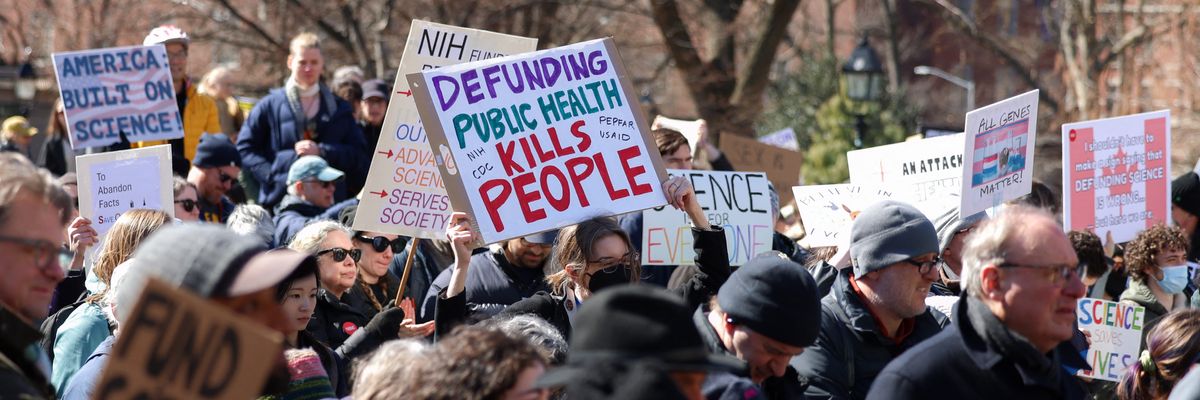
Facing Trump Attack, People 'Stand Up for Science' at Rallies Across US and Beyond "When research stops, people suffer and people die," said one campaigner. Demonstrators take part in a "Stand Up For Science" rally at Washington Square Park in New York on March 7, 2025. (Photo: Charly Triballeau/AFP via Getty Images)
Scientists and their supporters in dozens of U.S. cities—as well as across Europe—rallied on Friday to demand the Trump administration end its assault on federal agencies, including those that research health, the climate, and other life-or-death issues.
The main "Stand Up for Science" rally was held Friday afternoon at the Lincoln Memorial, with advocates responding to a call made by Emory University doctoral candidate Colette Delawalla last month—as federal employees were learning of President Donald Trump's efforts to limit research grants at the National Institutes of Health (NIH), the administration's order for the Centers for Disease Control and Prevention (CDC) to purge any articles that mention gender identity or LGBTQ+ issues, and as Lee Zeldin, who has opposed clean air and water protections, took the helm of the Environmental Protection Agency (EPA).
"I'm planning a Stand Up for Science protest in D.C.," wrote Delawalla in frustration on the social media platform Bluesky on February 8.
Since Delawalla and other organizers, including University of North Carolina at Chapel Hill doctoral student J.P. Flores and Cold Spring Harbor Laboratory biologist Emma Courtney, began planning the event in Washington, the science community's alarm over the actions of the Trump administration has only grown.
In late February, reporting showed that the Trump administration had circumvented court rulings in order to block tens of billions of dollars in NIH grants that fund crucial research on numerous diseases.
At the rally on Friday, former NIH Director Francis Collins said the science research that takes place at the agency is "for the people."
With numerous global public health threats currently evolving—the spread of avian flu and several measles outbreaks in the U.S. and a new variant of mpox discovered in the Democratic Republic of Congo—Collins said that "this would be a terrible time to dismantle our infectious disease research and our global public health efforts."
"The success of the American public science enterprise, which is the envy of the rest of the world over the past decades, it is of the people, by the people, and for the people," said Collins. "It's one of our nation's greatest achievements, enabling stunning discoveries about how life works, extending life expectancy, reducing disease burden, and, by the way, science is responsible for more than 50% of the economic growth of the United States since World War II."
Other recent anti-science actions by the Trump administration and Republicans in Congress include: the passage of a bill to end the Methane Emissions Reduction Program; right-wing billionaire Elon Musk's continued efforts via the so-called Department of Government Efficiency( DOGE) to cut science and research spending at federal agencies, and the last week's firing of hundreds of staffers at the National Oceanic and Atmospheric Administration (NOAA).
Trump and Musk's actions have led universities to begin reducing admissions and even rescinding placement offers to post-graduate programs, threatening the future of biomedical research.
"When research stops, people suffer and people die," said Samantha Jade Durán, a disability justice advocate, at the Stand Up for Science rally in Washington, D.C. on Friday. "We cannot let that happen. We have seen what's possible when we invest in science. Polio was eradicated. HIV was transformed from a death sentence to a manageable and undetectable condition. Cancer treatments are getting better every year, and these breakthroughs didn't happen by accident. They happened because we chose to fund science."
Solidarity marches also took place in Paris and Montpelier, France.
The rallies on Friday, said U.S. organizers, are "just the beginning."
"Our policy goals include a restoration of federal scientific funding, the reinstatement of wrongfully terminated employees at federal agencies, an end to governmental interference and censorship in science, and a renewed commitment to diversity, equity, inclusion, and accessibility in science," said organizers in the U.S. "We are also committed to empowering scientists—and anyone who has benefited from scientific advancements—to engage in sustained advocacy in the years to come."
French scientists join US protests in face of Trump administration's 'sabotage' Scientific researchers across France have voiced solidarity with their American colleagues by joining the "Stand up for Science" movement, protesting against massive budget cuts and what they say is 'sabotage' by Donald Trump's administration.
Under the banner "Stand up for Science France", a collective scientists held several demonstrations and conferences in cities across the country on Friday in support of similar events organised in the United States.
The "Stand Up For Science" movement is calling for an end to censorship, the protection of funding and the rehabilitation of researchers who have been brutally removed from their work since Donald Trump came to power.
Mass firings and sweeping cuts overseen by Trump's senior advisor Elon Musk in recent weeks have targeted research in a range of areas including climate and health.
"Science has become a target," prominent French climate science researcher Valérie Masson-Delmotte told French news agency AFP.
"Today I am talking about obscurantism: making scientific knowledge inaccessible and spreading disinformation. All of these attacks are of an unprecedented gravity in a democracy".
Freedom of speech curbed
In an interview with Franceinfo on Friday, Delmotte said that academics' freedom to communicate had been severly curbed, which was a form of "sabotage to the detriment of American society ... and scientific progress in the world."
"Researchers from federal agencies – the equivalent of the CNRS in France for example – are banned from exchanging with colleagues from other countries," she said.
She gave the example of NASA's chief scientist, Kate Calvin, co-chair of Group 1 of the Intergovernmental Panel on Climate Change (IPCC), who was banned from participating in the last plenary session of the IPCC last week. "She was also banned from speaking to the press and her support team has been dismantled," Delmotte says.
Delmotte was one of many French scientists who published an editorial in Le Monde on Tuesday with the title "Defend science against new obscurantisms".
The signatories insist that the US brutal budget cuts were already directly affecting society and would affect international cooperation and data sharing.
For example, hundreds of scientists and experts have been fired from the National Oceanic and Atmospheric Administration (NOAA), a leading US agency responsible for weather forecasting and climate analysis, Democratic Congressman Jared Huffman said last week.
In response, France's Aix-Marseille University announced a new programme this week to welcome scientists who "may feel threatened or hindered" in the United States and want "to continue their work in an environment conducive to innovation, excellence and academic freedom".
University president Eric Berton told AFPTV that he would have preferred to not to have had to issue this "recruitment call".
"The risk these researchers face is that their projects will lose funding and that they themselves – if they are foreigners – will have to return to their home countries," he said. Scientists afraid to speak out
"It is a real danger," he emphasised, particularly for academics who work on "sensitive subjects such as the climate, social sciences and the humanities in general".
Berton said his university could not take in everyone, adding: "I hope we can launch a national movement".
The university's "Safe Place for Science" programme will provide upto €15 million that can accommodate around 15 researchers over three years.
French astrophysicist Olivier Berné, a researcher at the CNRS, says he has received anguished testimonies from some of his American scientific colleagues.
"Already, for a certain number of them, they are afraid to speak out," he told Franceinfo.
"They are afraid of losing their jobs. We do not realise at all in France what is happening in these circles. In the United States, there is an extremely strong attack on the scientific world. Donald Trump has announced that people who go to demonstrations on campus could be thrown in prison or expelled from American territory".
"There is also an attack on data with a pure and simple suppression of access to data concerning climate studies," the scientist underlines.
Asked about welcoming US scientists, France's higher education and research minister Philippe Baptiste said it was necessary to "strengthen" existing systems for international scientists.
"But this discussion must also take place at the European level," he told the French parliament, lamenting budget cuts by the Trump administration that were "contrary to scientific consensus".
'Snowball effect': World's top scientists reportedly poised to get the ax
Robert F. Kennedy Jr. and Republican presidential nominee and former U.S. President Donald Trump attend a campaign event sponsored by conservative group Turning Point USA, in Duluth, Georgia, U.S., October 23, 2024. REUTERS/Carlos Barria/File Photo
President Donald Trump continues to support dramatic government staffing cuts, and next on the list are some of the world's best scientists who have been working at the National Institute of Health.
Rolling Stone reported on Friday that new Health and Human Services Secretary Robert F. Kennedy Jr. could gut NIH.
About 65% of NIH employees have annual or multi-year contracts, and about 35% have university-style tenure.
Sources told Rolling Stone that the cuts aren't being done with the "scalpel" that Trump said speaking to the media allowed to gather in the Oval Office Thursday. As the Daily Beast characterized, Trump promised there wouldn't be any more chainsaws taken to the staffing.
The cuts will begin with only a few dozen scientists, and further scientists will not have their contracts renewed.
"The NIH is best known for funding a broad spectrum of research science at universities with approximately $40 billion in annual grants. But it also runs its own government labs, with the main campus in Bethesda, Maryland, with a $5 billion annual budget," the report said.
There are contract researchers with decades of experience working on cures and treatments for chronic diseases. They range from cancer to diabetes to obesity and dementia.
The report, citing NIH sources, said Kennedy wants these privatized, with corporations taking over the work for profit rather than public service.
"NIH has been able to attract, previously, people that are held at the highest esteem, internationally, by their peers," one tenured NIH scientist told Rolling Stone. They fear retribution and asked not to be named.
"You don't get a great salary — but you do it because you love science," he explained. The benefit has been "job security and the confidence to explore your ideas. That's all being eroded."
He lamented no one feels any job security now, much less respect for their research.
Rolling Stone said that it's had an impact on staffers who will remain.
"It's a snowball effect. It signals the end of research [inside NIH]," the scientist said. "Who is going to want to join a career like that?"
There's also an immigration issue. Many scientists who are from other countries are in the U.S. working at NIH on H-1 B visas. So, if their positions are terminated, they'll be sent back to their home countries. It ultimately means a "brain drain" not just for the federal government, but for the country as a whole, the report said.
When he came into office, Trump created the Department of Government Efficiency by executive order. That initiative has been behind the upheaval and dismantling of government agencies. Websites, grants, programs, and employees have been cut or frozen under the promise that Trump will save taxpayers trillions.