Sunday, March 23, 2025

United States imports eggs from Korea, Turkey to help ease prices

By AFP
March 21, 2025


An avian flu outbreak has curtailed the supply of eggs in the United States, pushing up prices - Copyright AFP Frederic J. BROWN

United States is importing Turkish and South Korean eggs to ease an avian flu-fueled supply crunch that has pushed up prices across the country, Donald Trump’s agriculture secretary confirmed Friday.

Brooke Rollins told reporters in Washington that imports from Turkey and South Korea had already begun and that the White House was also in talks with other countries about temporarily importing their eggs.

“We are talking in the hundreds of millions of eggs for the short term,” she added.

The cost of eggs has skyrocketed due to multiple bird flu outbreaks in the United States, forcing farmers to cull at least 30 million birds and sharply constraining supply.

On the political battlefield, egg prices became an unlikely rallying point for Trump on the campaign trail as he sought to capitalize on voters’ frustrations with the rising cost of essential items during his predecessor Joe Biden’s presidency.

After returning to office in January, Trump tasked Rollins with the job of boosting the supply of eggs, and bringing down prices.

In the weeks since, producers in several countries have reported American interest in their produce, with the Polish and Lithuanian poultry associations telling AFP that they had been approached by US diplomatic staff on the hunt for fresh eggs.

“There is a shortage of eggs in many countries,” Katarzyna Gawronska, director of the Poland’s National Chamber of Poultry and Feed Producers, said recently. “The key question would be what financial conditions would be offered by the Americans.”

Speaking to reporters on Friday, Rollins said that imports of eggs would be time-limited, and would stop once US poultry farmers were able to ramp up supply.

“When our chicken populations are repopulated and we’ve got a full egg laying industry going again — hopefully in a couple of months — we then shift back to our internal egg layers and moving those eggs out onto the shelf,” she said.
Aid freeze silences Latin America media scrutiny of US foes


By AFP
March 21, 2025


The newsroom of Venezuelan daily El Nacional in October 2018, shortly before it stopped its paper edition - Copyright AFP Ozan KOSE

A choke on US aid threatens to smother media exposing abuses in Cuba, Nicaragua and Venezuela, to the unconcealed delight of the very leaders Washington once wanted held accountable.

It was one of President Donald Trump’s first acts on his return to the White House: curbing the US Agency for International Development (USAID) and other bodies that fund humanitarian and democratization projects.

And, while a judge has since ruled the action was probably unconstitutional, a dark cloud hangs over aid projects, including some $268 million budgeted for “independent media” in 30 countries in 2025, according to Reporters Without Borders (RSF).

Dozens of Latin American outlets have cut staff. Some have closed altogether.

At the same time, the Trump administration has dismantled state-run American media with a global audience, such as Radio Y Television Marty — founded in Florida in the 1980s to counter the Cuban Communist Party’s monopoly on information — and the Voice of America.

“It is regrettable that what had been one of the most reliable partners for the independent media sector and Cuban civil society has decided to so freely give the authoritarians cause for celebration,” Jose Nieves, editor of the Miami-based Cuban news portal El Toque told AFP of the US retreat.

“As we are seeing these days, the dictatorships in the region openly organize their propaganda apparatus, using resources they are not allocating to all the humanitarian crises we are experiencing,” he added.


– ‘Subversion’ –


Cuba’s President Miguel Diaz Canel, who describes critical journalists as Washington-backed “mercenaries,” has welcomed the Donald Trump administration’s cut to funding for non-state media that operate mostly from abroad, including Miami.

USAID-funded projects for “so-called independent media and NGOs,” he wrote on X last month, amounted to nothing other than multi-million dollar “subversion.”

In Cuba, most media outlets belong to the state, their narrative controlled by the Communist Party.

Some non-state digital sites have emerged in recent years, many operating from abroad and accessible only to Cubans with a VPN.

El Toque, which received money from the National Endowment for Democracy — a non-profit foundation funded largely by appropriations from the US Congress — has had to lay off half its staff as its budget was slashed, said Nieves.

The resulting “paralysis” of critical media “will only contribute to a more misinformed populace subjected to the lies of the enemies of freedom and democracy,” the editor said.


– ‘Information blackout’ –


For journalists in Nicaragua and Venezuela — countries which, like Cuba, are under US sanctions for anti-democratic actions — the aid cuts have also been devastating.

“It put us in a state of emergency,” Carlos Herrera, co-founder of the Nicaraguan news site Divergentes told AFP.

Divergentes, which operates from Costa Rica, cut its payroll in half and Herrera fears “a total information blackout” in Nicaragua.

Several journalists have been banished or stripped of their nationality by Daniel Ortega’s government in recent years.

At least 300 Nicaraguan journalists have left the country, and four were arrested in the last 12 months, according to RSF.

Nicaragua “no longer has independent media” operating within the country, where only state-run and media groups in “total self-censorship” survive, said Herrera.


– “USAIDcalypse” –


In Venezuela, the media industry is “suffocating, drowning, and we can’t even scream for help,” said the editor of an online paper who requested anonymity for fear for his safety.

More than 200 media outlets in the South American country have closed since the 1999-2013 presidency of socialist leader Hugo Chavez, according to the rights NGO Espacio Publico.

Several journalists are under investigation for receiving foreign funds, suspected of being anti-government “agents.”

“Traditional media have stopped fulfilling their informational role in a climate of self-censorship and brutal censorship,” said Rodolfo Rico, a Venezuelan free press activist.

Whatever critical media remains depend on foreign funding due to domestic advertisers’ fear of reprisals, and for them, Washington’s withdrawal amounts to a “USAIDcalypse,” added Rico.

“Journalists have less and less space to practice their profession, and people have fewer ways to stay informed,” a Venezuelan reporter who recently lost his job told AFP, also declining to be named.

lp-jb-mis-erc/nn/mlr/dc
AI startup Perplexity confirms interest to buy TikTok


By AFP
March 22, 2025


Perplexity says its vision for buying TikTok includes putting its artificial intelligence search tools to work letting users check the veracity of videos they are watching - Copyright AFP Chris DELMAS

Glenn CHAPMAN

Artificial intelligence (AI) startup Perplexity on Friday expressed its interest in buying TikTok, which faces a deadline to divest from its Chinese owner or be banned in the United States.

Perplexity in a blog post laid out a vision for integrating its AI-powered internet search capabilities with the popular video-snippet sharing app.

“Combining Perplexity’s answer engine with TikTok’s extensive video library would allow us to build the best search experience in the world,” the San Francisco-based firm reasoned.

“Perplexity is singularly positioned to rebuild the TikTok algorithm without creating a monopoly, combining world-class technical capabilities with Little Tech independence.”

President Donald Trump earlier this month said the United States was in talks with four groups interested in acquiring TikTok, with the Chinese-owned app facing an uncertain future in the country.

A US law has ordered TikTok to divest from its Chinese owner ByteDance or be banned in the United States.

“We’re dealing with four different groups. And a lot of people want it, and it’s up to me,” Trump said aboard Air Force One.

“All four are good,” he added, without naming them.

The law banning TikTok took effect on January 19 over concerns that the Chinese government could exploit the video-sharing platform to spy on Americans or covertly influence US public opinion.

During his first stint in the White House, Trump similarly attempted to ban TikTok in the United States on national security concerns.

TikTok temporarily shut down in the United States and disappeared from app stores as the deadline for the law approached, to the dismay of millions of users.

Trump suspended its implementation for two-and-a-half months after beginning his second term in January, seeking a solution with Beijing.

TikTok subsequently restored service in the United States and returned to the Apple and Google app stores in February.

Although TikTok does not appear overly motivated regarding the sale of the app, potential buyers include an initiative called “The People’s Bid for TikTok,” launched by real estate and sports tycoon Frank McCourt’s Project Liberty initiative.

Others in the running are Microsoft, Oracle and a group that includes Internet personality MrBeast, whose real name is Jimmy Donaldson.

“Any acquisition by a consortium of investors could in effect keep ByteDance in control of the algorithm, while any acquisition by a competitor would likely create a monopoly in the short form video and information space,” Perplexity contended in the post.

“All of society benefits when content feeds are liberated from the manipulations of foreign governments and globalist monopolists.”

Perplexity said it would build infrastructure for TikTok at datacenters in the United States and maintain it with US oversight.

The AI startup also proposed rebuilding TikTok’s winning algorithm “from the ground up”, making the app’s “For You” recommendation feed open-source.

Perplexity also vowed to enable TikTok users to cross-reference information as they watch videos to check their veracity.
Op-Ed: 
The F35 kill switch idea did more damage than a real kill switch. Then they made it worse


By Paul Wallis
DIGITAL JOURNAL
March 22, 2025


F-35: U.S. Air Force photo by Airman 1st Class Zachary Foster — CC0 1.0

The F35 kill switch was something nobody wanted to think about. According to the Pentagon, it doesn’t exist. Nor should it.

But imagine being stupid enough to create the idea at all.

A real distrust of American weapon systems could kill the entire sector. Back this up with a very sincere distrust of American politics and “personalities” and you’re losing your market entirely.

Particularly now, when America is barely on speaking terms with the rest of the world.

The world is that round thing with all those other people in it, for those suffering from American geography.

Just so you know.

During the Cold War, America made much of “Ivan the Terrible Salesman” and Russia’s ham-fisted arms business blunders.

Now they’re doing the same thing themselves with hopelessly inept diplomacy and a truly grotesque series of statements about annexing Canada, buying Greenland, invading Panama, etc, etc.

Then there’s the fun bit about ultra-annoying your allies systematically from day one. That’s working well.

It’s a bad case of American exceptionalism gone hyper-gaga. The world has taken serious exception.

The F35 kill switch idea is a case in point.

What if you did have a kill switch?

What if your ever-increasing supply of enemies went looking for one?

What if they couldn’t find one, and decided to invent one?

Could you be any stupider?

That’s why the idea is dangerous. There are any number of ways of putting a plane out of action, but an entire class of fighters, and remotely? It’s theoretically doable, although it’d be quite a feat of engineering.

It’s also a very big ticket big money item in the US defense sector, put at risk by three words.

Any other outbreaks of genius? Or do we have to wait to see how the wannabe roulette wheel of US defense policies pans out?

Why did the F35 kill switch have any credibility at all? The main reason is extreme distrust of American politics. Canada backed out of its F35 purchases for that reason. It’s hard to believe a clumsier or stupider approach to a longtime close ally.

The F35 is in service with multiple air forces. These very high-maintenance aircraft need enough pampering without bonus tantrums or any other issues. They’re expensive. Before they went into service, I was calling them a “flying credit card”. They’re still expensive,

Now just suppose someone other than the Lone Musketeer aka “All for One, None for All” went on a cost-cutting rampage. How about all those expensive American weapons? Look good on a budget as “savings”? What a coincidence.

Suppose competitors who design their aircraft like multiple countries in Europe and Japan did a few quick sums about producing their aircraft? See any bottom line issues for the American military-industrial complex?

This verbose, thoughtless idiocy is actually capable of undercutting the American monopoly on high-end military tech even if it takes a while. What if they very unsurprisingly put export tariffs on critical materials? Or simply refuse to export? Any thoughts, geniuses?

It took three words to put the whole US aerospace sector in serious question. Have you ever considered shutting up?

________________________________________________

Disclaimer
The opinions expressed in this Op-Ed are those of the author. They do not purport to reflect the opinions or views of the Digital Journal or its members.


Last of six foreign hikers missing in Philippines rescued

By AFP
March 22, 2025


Philippine Army personnel found the hikers in a mountainous area thick with vegetation - Copyright VALENCIA POLICE STATION/AFP Handout

Four foreign hikers who had been missing for days in a mountainous area of the central Philippines were rescued Saturday, local authorities said, a day after their two companions were found safe.

The six-man group, which included German, British, Russian and Canadian nationals, had set out on Wednesday for what was to be a four-hour excursion in an area of Negros Oriental province officials said was hit by a downpour.

“The army rescuers found them in the vicinity of the Silab hydropower plant,” said Jose Lawrence Silorio, a rescue official in the municipality of Amlan, near the province’s Balinsasayao Twin Lakes Natural Park.

Police identified the men as Germans Aldwin Fink, 60, and Wolfgang Schlenker, 67; Russian Anton Chernov, 38; and 50-year-old Canadian Terry De Gunten.

Philippine Army personnel found the hikers in a mountainous area thick with vegetation, said investigator Leo Gil Villafranca.

“They told the army they got lost due to the fog,” he said, adding all the hikers were residents of the province.

The four were discovered at 9:44 am (0144 GMT), according to local authorities.

“Overall, they are OK, but they had minor abrasions. We wrapped one of them in a blanket because he was feeling cold. But he was eventually able to stand up on his own,” Silorio said.

“They told us they survived by eating edible plants in the forest,” he added.

Silorio said the group was found about 10 kilometres (6.2 miles) from where fellow hikers Torsten Martin Groschupp, 58, and Alexander Radvanyi, 63, were discovered Friday morning.

An image posted to a police Facebook page showed De Gunten, his legs bloodied, talking to rescuers inside an ambulance while Chernov lay on a stretcher wrapped in a blanket.

Police said Friday that the weather had likely played a role in the group’s becoming lost on what they said was a “difficult” trail in a mountainous area the men were tackling without a guide.

“It was rainy at the time and that led to zero visibility,” said Valencia police officer Henry Japay, adding there was no cell phone reception in the area.

“There’s a big possibility that they stopped and took shelter when it started raining.”
Pakistan detains leading Baloch rights activist: police

BALOCHISTAN IS A COUNTRY


By AFP
March 22, 2025


Pakistan's ethnic minority activist Mahrang Baloch has long campaigned for the Baloch ethnic group - Copyright AFP -

Pakistan detained a leading female Baloch rights activist on Saturday for holding a sit-in in southwestern Balochistan at which three protesters were also killed, police said.

Mahrang Baloch, one of Pakistan’s most prominent human rights advocates, has long campaigned for the Baloch ethnic group from the southwestern province of Balochistan, which alleges being subjected to extrajudicial harassment, arrests and killings by Islamabad.

The Pakistan government says its forces are fighting separatist militants who target state forces and foreign nationals in the mineral-rich province that borders Afghanistan and Iran.

“She, along with 17 other protesters, including 10 men and seven women, has been arrested,” a senior police official told AFP on condition of anonymity, as he was not authorised to speak to the media.

“It is currently being assessed what charges should be filed against them,” he added.

The protesters had been holding a sit-in on Friday outside the University of Balochistan, demanding the release of members of their support group, whom they allege had been detained by security agencies.

The Baloch Yakjehti Committee, a support group led by Baloch, said she was arrested along with other protesters in a “brutal pre-dawn crackdown by state security forces”.

The confrontation left at least three protestors dead a provincial government spokesman said, with both sides blaming each other.

– ‘Cease to use force’ –

It comes after the province saw a dramatic train siege this month that officials said resulted in around 60 deaths, half of whom were separatists behind the assault.

The assault was claimed by the Baloch Liberation Army (BLA), one of several separatist groups that accuse outsiders of plundering the province’s natural resources.

“The authorities must immediately cease to use force against peaceful protestors and release those arbitrarily detained,” demanded the independent Human Rights Commission of Pakistan (HRCP) in a statement.

“The use of disproportionate and unlawful kinetic means by the state must cease immediately to pave the way for a purposeful political solution,” it added.

Baloch was barred from traveling to the United States last year to attend a TIME magazine awards gala after being named on the 2024 TIME100 Next list of “rising leaders”.

She began her activist career at the age of 16 in 2009 when her father went missing in an alleged “enforced disappearance”. His body was found two years later.

Protests and advocacy among the Baloch are generally led by women, who say their male counterparts have suffered the worst in a decades-long state crackdown.


More than 340 held after mass protests in Turkey

By AFP
March 22, 2025

The demonstrations have turned into Turkey's biggest street protests in more than a decade - Copyright POOL/AFP Ng Han Guan

More than 340 people were arrested following Turkey’s biggest street protests in over a decade sparked by the detention of Istanbul’s powerful opposition mayor, a minister said Saturday.

Hundreds of thousands of people hit the streets across the country late Friday, sparking clashes with riot police in Turkey’s three largest cities: Istanbul, the capital Ankara and the western coastal city of Izmir.

Interior Minister Ali Yerlikaya said “343 suspects were caught in the protests that took place in Istanbul, Ankara, Izmir, Adana, Antalya, Canakkale, Eskisehir, Konya and Edirne,” warning that those who sought to sow “chaos and provocation.. will definitely not be tolerated!”

It was the third straight night that protesters rallied in support of Imamoglu — President Recep Tayyip Erdogan’s biggest political rival, whose arrest Wednesday triggered a massive show of defiance that spread from Istanbul to more than 50 of Turkey’s 81 provinces.

During the evening, fierce clashes broke out between protesters and riot police, who fired tear gas, rubber bullets and water cannon to disperse them in Istanbul, Ankara and Izmir.

After spending his third night in custody, Imamoglu — who was arrested just days before the CHP was to name him their candidate for the 2028 presidential race — began speaking to police on Saturday morning in connection with the “terror” probe, party sources told AFP.

He was then expected to appear before prosecutors at Caglayan courthouse at 1800 GMT to be questioned in both the graft and the terror probes, they said.

Already named in a growing list of legal probes, Imamoglu — who was resoundingly re-elected last year — has been accused alongside six others of “aiding and abetting a terrorist organisation” — namely the banned Kurdish militant group PKK.

He is also under investigation for “bribery, extortion, corruption, aggravated fraud, and illegally obtaining personal data for profit as part of a criminal organisation” along with 99 other suspects.

– Quizzed for six hours –

He was questioned by police for six hours Friday about the graft allegations, the party said.

“Mr Imamoglu denies all the charges against him,” one of his lawyers, Mehmet Pehlivan said.

“The detention was aimed at undermining Mr Imamoglu’s reputation in the eyes of society,” he wrote on X early on Saturday, saying both probes were “based on untrue allegations” and “a violation of the right to a fair trial”.

Demonstrators across the country were due to rally again on Saturday night.

In a message on X sent via his lawyers, Imamoglu said he was “honoured and proud” of the demonstrators who hit the streets in more than 50 of Turkey’s 81 provinces, saying they were “protecting our republic, our democracy, the future of a just Turkey, and the will of our nation”.

Addressing the crowds outside City Hall in Istanbul on Friday night, Ozgur Ozel, who heads the main opposition CHP, said 300,000 people had joined the demonstration in defiance of a protest ban and a sharp warning from Erdogan that Turkey would not tolerate “street terror”.

Speaking Friday, Erdogan had fired a warning shot across Ozel’s bows, accusing him of “grave irresponsibility” in remarks echoed by ministers and other officials, raising the prospect that Ozel too could face legal sanction.

“Those who provoke our citizens and cause them to clash with our security forces are committing a clear crime.. There is no way this dirty scheme can be allowed!” wrote Istanbul governor Davut Gul on X on Saturday, warning those responsible would be tried in court.

The move against Imamoglu has hurt the Turkish lira and financial markets, with the stock exchange’s BIST 100 index closing down nearly eight percent on Friday.
Turkey won’t surrender to ‘street terror’, Erdogan warns protesters


By A FP
March 21, 2025


Protests over the Istanbul mayor's arrest have spread to Ankara and other provinces - Copyright AFP Roslan RAHMAN

Hazel WARD

President Recep Tayyip Erdogan said Friday the Turkish authorities would not be cowed by “street terror” after days of unrest over the arrest of Istanbul’s powerful opposition mayor, Ekrem Imamoglu.

“Turkey will not surrender to street terror,” Erdogan said as the leader of the main opposition CHP called for nationwide protests later on Friday over a move it has denounced as a “coup”.

“Let me say it loud and clear: the street protests that the CHP leader has called for are a dead end,” Erdogan warned.

The 53-year-old mayor — Erdogan’s main political rival — was arrested on Wednesday, just days before he was to be named the CHP’s candidate for the 2028 presidential race.

The move sparked two days of protests that began in Istanbul and quickly spread to at least 32 of Turkey’s 81 provinces, according to an AFP count.

CHP leader Ozgur Ozel has called a third nightly protest outside Istanbul City Hall at 1730 GMT, urging demonstrators to hit the streets across Turkey at the same time, despite the justice minister warning such calls were “unlawful and unacceptable”.

On Friday, Istanbul’s governor closed off Galata Bridge and Ataturk Bridge, which cross the Golden Horn estuary and are the main access routes to the historic peninsula where City Hall is located.

Thousands have defied a protest ban in Istanbul, gathering nightly outside City Hall. On Friday, the authorities extended the ban to the capital Ankara and the western coastal city of Izmir.

Police initially showed restraint but on Thursday fired rubber bullets and teargas as they scuffled with students in Istanbul and Ankara, AFP correspondents said.

So far, at least 88 protesters have been arrested, Turkish media said, with Interior Minister Ali Yerlikaya saying 16 police officers had been hurt.

Police had also detained another 54 people for online posts deemed as “incitement to hatred”, he said.


– ‘Opposition drama’ –


Late Thursday, Erdogan shrugged off the unrest — Turkey’s worst street protests in years — as little more than “the opposition’s dramas”.

But he upped the ante with his speech on Friday, accusing the opposition leader of “grave irresponsibility”.

Ozel had on Thursday vowed that the protests would continue.

“From now on, no one should expect CHP to do politics in halls or buildings, we’ll be on the streets and in the squares,” he told the crowd at City Hall.

The pro-Kurdish opposition DEM party also said it would join Friday’s Istanbul rally.

Officials said Imamoglu and six others were under investigation for “aiding a terrorist organisation” — namely the banned Kurdish PKK militant group. He is also under scrutiny in a graft probe involving about 100 other suspects.

Investigators reportedly began questioning Imamoglu on Friday afternoon, local media reported, saying all of the suspects were due in court on Sunday morning.

– Primary –

Despite Imamoglu’s detention, the CHP vowed it would press ahead with its primary on Sunday at which it would formally nominate him as its candidate for the 2028 race.

The party said it would open the process to anyone who wanted to vote, not just party members, saying: “Come to the ballot box and say ‘no’ to the coup attempt!”

Observers said the government could seek to block the primary to prevent a further show of support for Imamgolu.

“If a large number of people show up and vote for Imamoglu, it will further legitimise him domestically,” Gonul Tol, head of the Turkish studies programme at the Washington-based Middle East Institute, told AFP.

“It could really move things in a direction that Erdogan doesn’t want.”

Restrictions on social media and internet access that had been in place since Imamoglu’s arrest were lifted by Friday morning, said internet access monitor EngelliWeb.

The move against Imamoglu has dealt a heavy blow to the Turkish lira, and on Friday the BIST 100 stock exchange was trading lower, shedding 6.63 percent shortly after 1200 GMT.

In Turkey, a judge orders the incarceration of the opposition mayor of Istanbul

A judge on Sunday ordered the incarceration for "corruption" of Istanbul opposition mayor Ekrem Imamoglu, whose arrest on Wednesday sparked a wave of protests in Turkey, one of his lawyers told AFP. Other co-defendants of the mayor, including one of his close advisers, have also been imprisoned, according to Turkish media.


Published : 23/03/2025
By: FRANCE 24    

Istanbul Mayor Ekrem Imamoglu addresses supporters outside the Istanbul Courthouse, January 31, 2025. © Emrah Gurel, AP archives

Four days after his arrest, which sparked a wave of protests in Turkey, a judge on Sunday (March 23rd) ordered the imprisonment of Istanbul's opposition mayor Ekrem Imamoglu for "corruption", one of his lawyers told AFP.

Also prosecuted for "terrorism", Ekrem Imamoglu, President Recep Tayyip Erdogan's main rival, was brought on Saturday evening with 90 of his co-defendants to the Istanbul court of Caglayan, protected by a very large police force, before being heard twice during the night.

The Republican People's Party (CHP, social democratic), the main opposition force to which the mayor of Istanbul belongs, denounced "a political coup d'état".

The court ordered on Sunday morning the incarceration of other co-defendants of the mayor, including one of his close advisers, according to Turkish media.

Tens of thousands of people gathered in front of Istanbul City Hall for the fourth consecutive evening in response to the opposition's call to support Ekrem Imamoglu, who denounced "immoral and baseless" accusations against him.

À lire aussiArrestation d'Ekrem Imamoglu : "Erdogan ne veut plus voir le moindre opposant politique"
Vague de protestation d'une ampleur inédite

Des manifestants ont passé la nuit à l'intérieur de la mairie, certains tentant de trouver le sommeil sur des chaises disposées dans le hall du vaste bâtiment en attendant d'être fixés sur le sort du maire, a constaté un photographe de l'AFP.

Pour tenter de prévenir des troubles, le gouvernorat d'Istanbul a prolongé l'interdiction de rassemblements jusqu'à mercredi soir et annoncé des restrictions d'entrée dans la ville aux personnes susceptibles de participer à des rassemblements, sans préciser comment il les mettrait en œuvre.

L'accusation de "soutien à une organisation terroriste" contre Ekrem Imamoglu, figure du CHP, fait redouter à ses soutiens son remplacement par un administrateur nommé par l'État à la tête de la plus grande ville du pays.

Depuis mercredi, la vague de protestation déclenchée par son arrestation s'est répandue à travers la Turquie, atteignant une ampleur inédite depuis le grand mouvement de contestation de Gezi parti de la place Taksim d'Istanbul, en 2013.

Rallies took place in at least 55 of Turkey's 81 provinces, more than two-thirds of the country, according to a count by AFP on Saturday. The protests have led to hundreds of arrests in at least nine cities across the country, according to authorities.

To be readEkrem Imamoglu, mayor of Istanbul and champion of the opposition to President Erdogan
Erdogan vows not to give in to 'street terror'

"Just as people took to the streets to support Erdogan during the July 15 (2016) coup, we are in the streets to support Imamoglu," Aykut Cenk, 30, told AFP on Saturday night. "We are not the enemies of the state but what is happening is illegal," he added, waving a Turkish flag in front of the Istanbul court in Caglayan where the mayor was being heard.

Paris and Berlin as well as the mayors of several major European cities had also condemned the arrest of Ekrem Imamoglu on Wednesday.

In response to the protests, President Erdogan, who himself was mayor of Istanbul in the 1990s, vowed not to give in to the "terror of the street".

Ekrem Imamoglu, 53, became Erdogan's bête noire by taking the country's economic capital from the head of state's Justice and Development Party (AKP, Islamo-conservative) in 2019, which had kept control of Istanbul with his camp for twenty-five years.

The opposition mayor, triumphantly re-elected in 2024, was initially scheduled to attend his inauguration on Sunday as his party's candidate for the next presidential election, scheduled for 2028.

The CHP decided to maintain the organisation of the primary, which started at 8 a.m. local time (5 a.m. GMT), and called on all Turks, even those who are not registered with the party, to take part.

With AFP


Climate priority 2025: Focal points for the remaining year ahead


By Dr. Tim Sandle
March 21, 2025
DIGITAL J0URNAL


A floating solar energy farm on the Cottbuser Ostsee lake in eastern Germany -- the EU hopes to strengthen supply lines for green technologies, like solar and wind power, chips and pharmaceutical ingredients - Copyright AFP/File Ian Maule

Following the election of Donald Trump, climate change remains a pressing issue. Last year was the hottest on record – for the first time global temperatures exceeded 1.5 degrees Celsius (2.7 degrees Fahrenheit) above pre-industrial levels.

With the pace of climate change accelerating, several critical trends are set to shape the global agenda in the year ahead.

Digital Journal has heard from Michael Jarvis, Executive Director of the Trust, Accountability, and Inclusion Initiative, to look at the important developments ahead in relation to the global climate and where political action is necessary.

Critical Minerals

Transitioning from fossil fuels to clean energy requires a significant increase in critical minerals, which are essential for technologies like wind turbines, solar panels, and electric vehicles. Many of these resources are found on indigenous lands and in developing countries, raising important questions about equity and sustainability.

Jarvis explains how countries like Indonesia are prioritizing critical minerals production and processing and pushing for a greater share of revenues. He emphasizes the importance of ensuring that in 2025, resource-rich countries and local communities benefit equitably from mineral extraction, turning these resources into engines for inclusive growth and sustainable development.

Accountability Gaps in Climate Finance

At last year’s UN climate talks in Baku, wealthy nations pledged $300 billion annually to combat climate change—a figure that falls significantly short of the over $1 trillion requested by developing nations.

Jarvis sheds light on the systemic challenges that hinder the fulfilment of these financial commitments and highlight the urgent need for transparent, inclusive and accountable ways to deliver and spend climate finance.

Impact of a Trump Presidency on the International Climate Agenda and COP30

With Donald Trump’s “America First” policies poised to shift incentives at home, but also undermine UN-backed initiatives on climate change and development, Jarvis considers the implications for multilaterals and negative impact upon Global South countries.

The signs for the agreements around COP30 look bleak.

COP30: The “Indigenous Peoples” COP in Brazil

COP30, hosted in Brazil towards the end of 2025, is set to spotligh indigenous leadership and activism, with a strong focus on protecting the Amazon—a region vital to global climate health. The main environmental concerns include climate change, nuclear energy and sustainability.

Jarvis says this landmark conference underscored the critical role of civil society in driving systemic change and ensuring inclusive solutions to the global climate crisis.

Financing for Development (FfD4) and Climate Action

The Fourth International Conference on Financing for Development (FfD4) takes place in Juhe 2025 and it presents a pivotal opportunity for world leaders to address the $4.2 trillion financing gap needed to achieve the Sustainable Development Goals (SDGs).

The conference concerns the ongoing process to align financing flows and policies with economic, social, and environmental priorities.
Freight’s carbon problem: U.S. set for huge rise in emissions in 2025


By Dr. Tim Sandle
DIGITAL JOURNAL
March 22, 2025


Trucks queue in Tijuana near the Mexico-US border - Copyright AFP Guillermo Arias

U.S. truck freight emissions are projected to rise by 28 million metric tons in 2025. In total, 392 million metric tons of carbon dioxide was emitted in total by U.S. truck freight in 2023, which is predicted to increase by 7 percent in 2025 to 420 million metric tons.

Freight is a major contributor to emissions, and trucks are the fastest-growing source, significantly contributing to air pollution and emission intensity which is exacerbated by traffic congestion and idle vehicles.

To derive at these figures, InTek Logistics analysed Federal Highway Administration’s data to identify the most delayed freight corridors and highest-emission truck routes to calculate the highest-emission state-to-state truck freight routes per year.

The predicted rise in US emissions is concerning, as 28 million metric tons is equivalent to:

• Adding over 6 million cars to the road.
• 370,667 tanker trucks worth of gasoline.
• 5,835,079 homes’ electricity for one year.

According to U.S. government data, transportation accounts for the largest portion (28 percent) of total U.S. greenhouse gas emissions, 80 percent of which is generated by both light and medium-heavy duty vehicles. As a result of this, shippers are under increasing pressure to reduce their environmental impact.Trucks being loaded with coal in Lianyungang, in eastern China’s Jiangsu province – Copyright AFP/File STR
It is an additional concern that all states in the ‘top ten most emission intensive list’ from 2023 are set to increase their carbon dioxide output in 2025 by up to 13 percent.

The U.S. states with the highest truck freight emissions for 2025 are:

• Texas – 57 MMT (12% increase)
• California – 38 MMT (13% increase)
• Illinois – 19 MMT (3% increase)
• Florida – 18 MMT (1% increase)
• Ohio – 16 MMT (8% increase)
• Georgia – 14 MMT (6% increase)
• Michigan – 14 MMT (9% increase)
• Pennsylvania – 14 MMT (10% increase)
• New York – 13 MMT (3% increase)
• Minnesota –12 MMT (2% increase)

Note: MMT represents ‘million metric tons’.

Texas is set to remain the most emission intensive freight destination with its current footprint of 51 million metric tons set to increase by 12 percent to 57 million metric tons in 2025. California comes in second place with a road freight footprint of 34 million metric tons in 2023, forecast to increase by 13 percent to 38 million metric tons in 2025.

Rick LaGore, co-founder and CEO at InTek Logistics tells Digital Journal: “The predicted increase in carbon emissions in Texas and across the rest of the US is alarming. Sustainability credentials are increasingly becoming an expectation rather than a nice to have, as regulations change, and consumer and stakeholder expectations evolve. It is therefore vital that shippers try to mitigate their impact on the environment.”

He adds: “Using intermodal transportation is a simple way to improve sustainability as it reduces the number of trucks on the road and offers far more fuel efficiency than trucking. Just one intermodal train can carry the equivalent of 280 trucks. This makes intermodal a powerhouse in reducing carbon footprints by 60 percent as compared to trucking.”
Former EPA Employees Warn of Polluted Skies Ahead Under Trump

The vast majority of voters want a strong EPA, but Trump is laying the agency to waste.

March 21, 2025


CAPITALI$M IS UNSUSTAINABLE
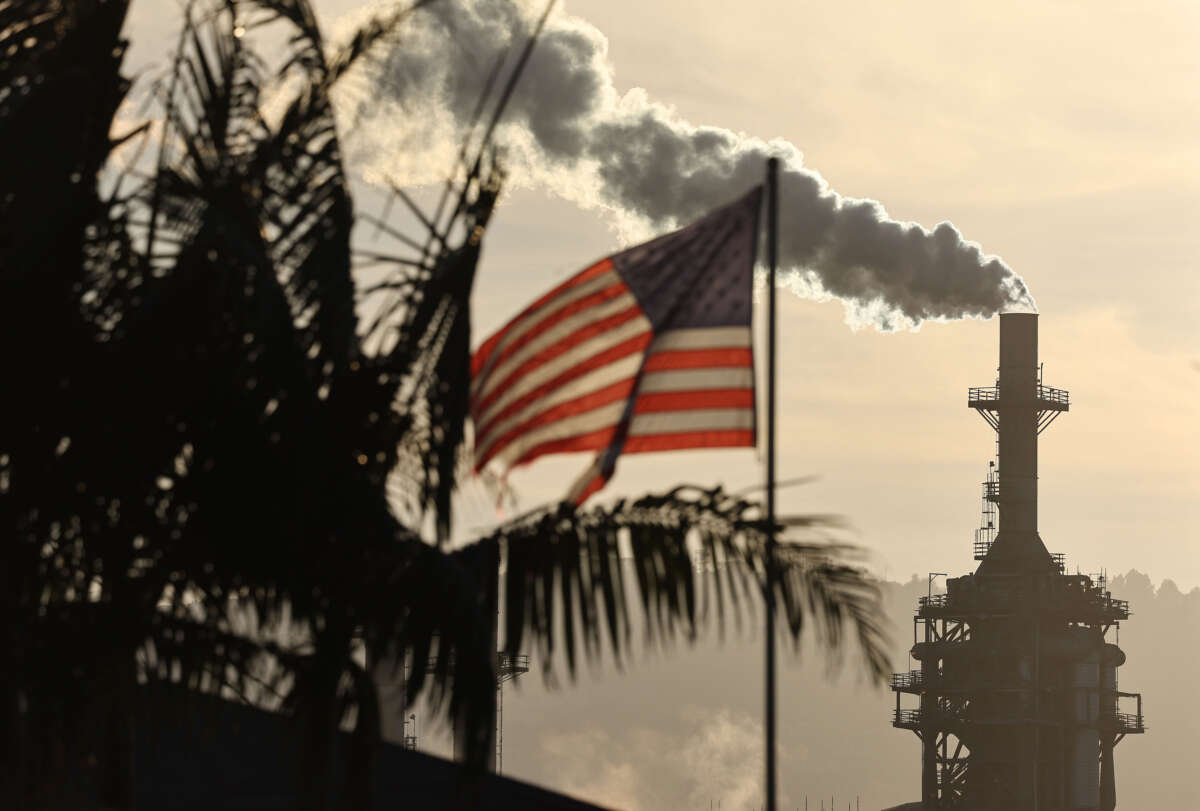
An American flag flies near the Phillips 66 Los Angeles Refinery Wilmington Plant on November 19, 2024, in Wilmington, California.Mario Tama / Getty Images


An American flag flies near the Phillips 66 Los Angeles Refinery Wilmington Plant on November 19, 2024, in Wilmington, California.Mario Tama / Getty Images

Experts and former employees say the Trump administration’s moves to fire key scientists at the Environmental Protection Agency (EPA) and dismantle clean air and water protections will make the United States a “sicker and poorer” place to live while demoralizing the next generation of environmental investigators and public health researchers.

The rollbacks could lead to a significant increase in hospitalizations and premature deaths from illnesses linked to air and water pollution, public health experts warn. For example, new analysis by former agency researchers at the nonprofit Environmental Protection Network (EPN) estimates that 16 major air pollution rules updated by the Biden administration between 2021 and 2024 would save at least 200,000 lives by 2050.

Air pollution rules also reduce the pollution driving climate change, which is now widely recognized as a major public health threat.

However, last week EPA Administrator Lee Zeldin announced that the clean air rules are among 31 environmental protections that will be weakened or eliminated by the Trump administration. According to documents reviewed by House Democrats and reported on by the New York Times, Zeldin also plans to eliminate the EPA’s scientific research office, “firing as many as 1,155 chemists, biologists, toxicologists and other scientists” who investigate environmental health threats at federal labs across multiple states.

“This is a disaster for everyone that relies on EPA for clean drinking water, and for everyone that breathes,” Jeremy Symons, a former EPA air office employee and coauthor of the EPN report, told Truthout. “We are all going to be left wondering what toxic chemicals are in our drinking water, and what harmful air pollution we are breathing, if these regulations are rolled back.”

Related Story

Trump’s EPA Is Botching Removal of Toxic Waste From the Los Angeles Fires
The federal government is prioritizing speed over public health, refusing to test ash from LA for toxicity. By Schuyler Mitchell , Truthout March 5, 2025

Symons pointed to a nationwide poll of 1,000 voters taken by EPN shortly after the November elections that found the vast majority of voters — including 76 percent of Trump voters — want the EPA to be strengthened or remain the same. Only 14 percent of all voters agreed the EPA should be weakened. However, environmental groups say Trump’s rollback of EPA regulations alone threatens to reverse more than a decade of progress toward reducing highly toxic pollutants.

“There is no mandate for what we are seeing, so why are we seeing it?” Symons asked. “It is becoming very clear that Lee Zeldin is working with Elon Musk to follow a radical and extremist agenda put forward by Project 2025, and that puts the interests of corporate polluters above public health.”

President Donald Trump does not appear to be concerned about the consequences of unleashing toxic pollution, including political blowback — or even willing to acknowledge the reality of the environmental issues the EPA is tasked with handling.

On his Truth Social platform earlier this week, Trump claimed he is opening “hundreds” of power plants that will produce energy by burning “BEAUTIFUL, CLEAN COAL” (emphasis is Trump’s). However, Trump does not own any power plants or have the authority to compel companies to burn coal. The term “clean coal” is an oxymoron pulled from a defunct greenwashing campaign largely abandoned by the industry years ago.

Perhaps the president was feeling nostalgic for his first term, when he declared an end to the so-called “war on coal” and rolled back the Obama administration’s signature carbon regulations for new coal-burning power plants meant to thwart the climate crisis. Patrick Drupp, the director of climate policy and advocacy at the Sierra Club, a group that has pushed for years to retire the dirtiest coal plants, said Trump’s statement is “completely delusional” in 2024.

“There is no such thing as clean coal,” Drupp said in a statement. “There is only coal that pollutes our air and water so severely that nearly half a million Americans have died prematurely from coal in the last two decades.”

Scientists know that coal pollution is linked to asthma and respiratory illnesses, heart attacks, cancer and premature death, but the Trump EPA is still poised to roll back regulations known as the Mercury and Air Toxics Standards that require power plants to limit dangerous air pollution for burning coal.

Thanks to these rules, mercury emissions from power plants dropped by more than 81 percent from 2011 through 2017, according to analysis by the Center for American Progress. The EPA estimates the regulations prevent up to 11,000 premature deaths, 4,700 heart attacks and 130,000 asthma attacks each year.

Technology for removing from smokestacks the mercury and particulate matter that lodges in human lungs and leads to asthma and premature death has existed for years, but some utilities complain that installing and operating these “scrubbers” is too expensive. Last year, 23 GOP-led states sued the EPA over the Biden administration’s air standards, and last week Zeldin announced the EPA would consider granting power plants a two-year exemption while the agency reconsiders the rules, which could lead to an immediate increase in toxic air pollution.

The Mercury and Air Toxics Standards are just one of several air pollution regulations Zelding is preparing to roll back, including rules meant to limit climate-warming methane and carbon pollution produced by the fossil fuel industry. The EPA is also reconsidering limits on hazardous air pollutants produced by the manufacturing sector, including synthetic chemical makers that have come under fire for polluting communities.

“EPA needs to pursue commonsense regulation to Power the Great American Comeback, not continue down the last administration’s path of destruction and destitution,” Zeldin said in a statement.

Cheap gas from the fracking boom has drastically reduced demand for coal, and renewable energy is quickly becoming more affordable and reliable, which explains why utility companies are retiring coal plants instead of building new ones. In fact, the U.S. is producing more oil and gas than any other nation in the world, a reality that undercuts Trump and Zeldin’s claims about the need for deregulation to spur cheap energy production.

Drupp said Trump’s “clean coal” comments are baseless but reveal that he does not care about the “health or economic well-being” of his constituents. While Trump and Zeldin claim onerous regulations are holding the U.S. back economically, EPN estimates that EPA’s air pollution regulations deliver over $250 billion in net benefits to the public annually, with savings on health care and climate spending exceeding regulatory costs by a six to one ratio.

“He is only concerned with helping out his billionaire buddies in the fossil fuel industry,” Drupp said. “In exchange for their loyalty and political dollars, he will lie to the American people and sacrifice their lives.”

Jennifer Orme-Zavaleta worked at the EPA for 40 years and recently retired from running the agency’s Office of Research and Development, the scientific arm that is reportedly losing 75 percent of its staff under Trump, Elon Musk and Zeldin. Orme-Zavaleta said she served under both Democratic and Republican presidents, and like all federal agency employees, EPA scientists are civil servants who expect shifts in policies when a new administration takes over.

“They say EPA is a job killer that strains the economy, but nothing could be furthest from the truth,” Orme-Zavaleta said in an interview. “If anything, EPA has brought innovations to industry and developed a lot of jobs in sectors such as air treatment and water treatment and waste management.”

Republicans have a long record of attempting to downsize the EPA and shift its priorities toward cleaning up after polluters rather than enforcing the law against them. In a recent op-ed, Zeldin wrote vaguely about “collaboration” with polluting industries rather than “regulation” for safeguarding human health and the environment.

But Jennifer Orme-Zavaleta said the second Trump administration’s gutting of the EPA is extreme, unprecedented and posed to cause long-term damage to an agency that has made the U.S. a visibly cleaner, healthier place to live since its creation in the 1970s. The difference between Trump 1.0 and Trump 2.0 at the EPA is the “attacks on its people,” Orme-Zavaleta said.

“Russell Vought really called out the goal of terrorizing EPA employees in particular, and making life so miserable for them they wouldn’t like to get up and go to work in the morning, and they are really playing out that card,” Orme-Zavaleta said, referring to a now-infamous comment in which Trump’s staffing director said he wanted career workers to be “traumatized.” “It’s really hard to understand why, because these are the people who make the EPA work, any government agency work.”

Despair and dysfunction are the point, Orme-Zavaleta said, and it’s the wrong message to send to students studying to be the next generation of environmental scientists. By canceling the EPA’s ability to conduct its own science to inform regulations, Zeldin is making more room for the claims made by polluting industries during the rule-making process.

Completed in 2023, the EPA’s landmark Social Cost of Greenhouse Gases study is a prime example. Working with the National Academy of Sciences, EPA researchers produced a comprehensive cost-benefit analysis of burning fossil fuels that produce climate-warming pollution. The study examines energy spending alongside the realities of a warming planet, including increased spending on health care and recovery from extreme storms and floods. The Interstate Natural Gas Association of America applauded when Zeldin announced the study was among the policies and documents to be revised or revoked.

“By limiting the science that can be considered by the agency — especially science the agency can generate to directly to inform a regulation — and focusing on that limited subset of science, there is a potential for increasing people’s risk of exposure to pollutants and rolling back the decades of worth of progress we have made in cleaning up our environment,” Orme-Zavaleta said.