It’s possible that I shall make an ass of myself. But in that case one can always get out of it with a little dialectic. I have, of course, so worded my proposition as to be right either way (K.Marx, Letter to F.Engels on the Indian Mutiny)
Sunday, March 23, 2025
VR study reveals how pain and fear weaken sense of body ownership
A virtual reality experiment suggests that fear, pain, and expectations shaped by prior experiences can disrupt the mind’s grip on the body.
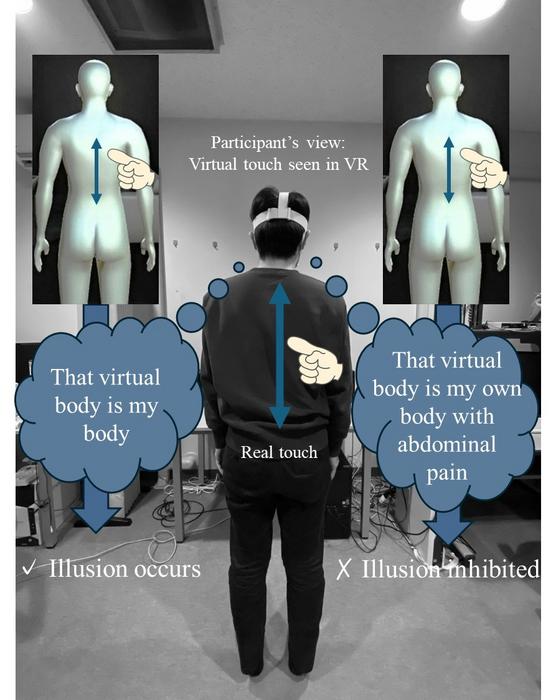
This illustration shows our experimental setup where participants viewed a virtual body through VR goggles and received touch on their back. The experiment revealed that different interpretations of the virtual body led to different outcomes: when interpreted as "my body," the illusion occurred, but when interpreted as "my body with abdominal pain," the illusion was inhibited.
Credit: Kazuki Yamamoto & Takashi Nakao, Graduate School of Humanities and Social Sciences, Hiroshima University
A study from Hiroshima University found that when people were told to imagine their virtual bodies in pain, their brains resisted the illusion of ownership. Their findings could provide insights into why some people may struggle with feeling connected to their own bodies, particularly in contexts involving depersonalization or negative physical states.
The sense of body ownership—the feeling that our body belongs to us—is crucial in distinguishing ourselves from objects and responding to threats. Researchers study it using techniques like the rubber hand illusion (RHI) and full-body illusion (FBI), in which an individual is somehow influenced to identify with ownership of a fake or virtual body. To explore how body ownership can be disrupted, researchers test whether top-down factors—where previous knowledge, memories, and beliefs shape how we perceive and interpret new information or stimuli—weaken the illusion when participants are asked to identify with a virtual body in a negative physical state.
“Using the full-body illusion in virtual reality—where people begin to feel a virtual body as their own— we investigated how interpreting the virtual body as one's own body, while in a negative physical state, affects this illusion. This research can possibly relate to depersonalization, a condition where people struggle to feel their body as their own,” said Kazuki Yamamoto, researcher and author of the study.
Participants were instructed to view a virtual body from the back using a virtual reality (VR) headset and imagine it as their own. Participants would watch the virtual body have their back stroked while their own physical body was stroked also which successfully illicited the illusion. This is a means of using bottom-up factors, which starts with an external stimulus to integrate visual-tactile information, and is a well-tested way to successfully influence the FBI.
To test the effect of top-down factors, the same course of action was instructed with the addition of identifying with the virtual body as their own in a negative physical state (feeling abdominal pain). After the participant watches their virtual body being stroked along their back, a fear stimulus is presented in the form of a knife driving into the virtual body’s back. The fear response is measured using a skin-conductance response and the degree of conductance measures is then related to how strongly the participant is identifying with their virtual body.
One of the main points of this study is using top-down factors, which are expectation or biases on what something should feel like based on prior experience or interactions, to determine if these can also influence a sense of body ownership.
Results indicated that the full-body illusion was inhibited when asked to view the virtual body as their own with abdominal pain, and the higher the degree of depersonalization tendencies within the participants resulted in a lower degree of FBI.
Researchers suggest this could be due to multiple factors, one of which being the manipulation of using top-down factors. Another suggestion is that the participants might have had difficulty perceiving the negative physical symptoms, therefore they had difficulty fully establishing the connection of “the virtual body is my body” which is key for the illusion to occur.
Given the findings of the study, more research can be done to fully understand why an inhibition of the illusion occurred.
“While we observed this inhibitory effect, further research is needed to determine whether it was specifically due to the negative interpretation or to differences between actual and virtual body states,” said Takashi Nakao, researcher and author of the study.
The foundation provided by this study and subsequent studies can aid in clinical intervention for those suffering from disturbed body ownership, such as individuals with depersonalization-derealization disorder. This work can improve those individuals’ sense of body ownership, which can greatly improve lives, not only for safety purposes but also sensory and perception purposes.
The Japan Society for the Promotion of Science funded this research.
About Hiroshima University
Since its foundation in 1949, Hiroshima University has striven to become one of the most prominent and comprehensive universities in Japan for the promotion and development of scholarship and education. Consisting of 12 schools for undergraduate level and 5 graduate schools, ranging from natural sciences to humanities and social sciences, the university has grown into one of the most distinguished comprehensive research universities in Japan. English website: https://www.hiroshima-u.ac.jp/en
The coffee from most of the coffee machines in workplaces contains relatively high levels of cholesterol-elevating substances. There is a big difference in comparison to coffee made in regular paper filter coffee makers, which filter out most of these substances.
This has been shown in a new study led from Uppsala University, and conducted in collaboration with Chalmers University of Technology. The study is published in the journal Nutrition, Metabolism & Cardiovascular Diseases.
“Considering how much coffee is consumed in Swedish workplaces, we wanted to get a picture of the content of cholesterol-elevating substances in coffee from these types of machines. We studied fourteen coffee machines and could see that the levels of these substances are much higher in coffee from these machines than from regular drip-filter coffee makers. From this we infer that the filtering process is crucial for the presence of these cholesterol-elevating substances in coffee. Obviously, not all coffee machines manage to filter them out. But the problem varies between different types of coffee machines, and the concentrations also showed large variations over time,” says David Iggman, researcher at Uppsala University, who led the study.
The fact that boiled coffee in a pot contains high levels of the worst of the cholesterol-elevating substances, the diterpenes cafestol and kahweol, is already known. It’s even mentioned in the latest Nordic nutritional recommendations, where the advice is to reduce or refrain from drinking boiled coffee. However, a regular drip-filter coffee maker, which uses a paper filter, manages to almost completely filter out these cholesterol-elevating substances.
How well conventional coffee machines, which are found in public environments such as workplaces, filter out these substances had not been investigated up until now. In the study, the researchers studied fourteen coffee machines in break rooms at different workplaces. The coffee used was five regular brands of ground coffee. They took samples from the coffee made by the machines on a number of separate occasions and analysed the contents. There was a big difference between the machines in terms of the levels of cafestol and kahweol in the coffee they made, but the levels could also differ at different times.
The most common type of coffee machine, in the study called a brewing machine, is the one that produced coffee with the highest concentrations of diterpenes. In comparative analyses, the researchers investigated peculator coffee, espresso, French press coffee, boiled coffee, and boiled coffee poured through a fabric filter. The boiled coffee contained the highest levels of diterpenes per cup. Some espresso samples also contained high levels, but there was great variation.
“Most of the coffee samples contained levels that could feasibly affect the levels of LDL cholesterol of people who drank the coffee, as well as their future risk of cardiovascular disease. For people who drink a lot of coffee every day, it’s clear that drip-filter coffee, or other well-filtered coffee, is preferable. To determine the precise effects on LDL cholesterol levels, we would need to conduct a controlled study of subjects who would drink the coffee,” says David Iggman.
Facts in brief Two samples were taken from each machine every two to three weeks. The coffee varieties included medium roast and dark roast of five common brands of ground coffee. Most of the machines use ground coffee. One or two grind the beans in the machine, but the researchers don’t think that would have any effect on the levels of diterpenes. We tested 14 machines, including 11 brewing machines and 3 liquid-model machines (lower levels, mixed from a coffee concentrate). For comparison, the same analysis was carried out with some other coffee-making methods such as percolator, French press, boiled coffee, and boiled coffee poured through a fabric filter. In addition, four espresso samples were collected in Gothenburg. All the coffee samples were analysed at Chalmers University of Technology. The samples were collected by medical student Erik Orrje during spring 2024.
The giant radio jets stretching six million light-years across and an enormous supermassive black hole at the heart of spiral galaxy J23453268−0449256, as imaged by the Giant Metrewave Radio Telescope.
Credit: Bagchi and Ray et al/Giant Metrewave Radio Telescope
A terrifying glimpse at one potential fate of our Milky Way galaxy has come to light thanks to the discovery of a cosmic anomaly that challenges our understanding of the universe.
An international team of astronomers led by CHRIST University, Bangalore, found that a massive spiral galaxy almost one billion light-years away from Earth harbours a supermassive black hole billions of times the Sun’s mass which is powering colossal radio jets stretching six million light-years across.
That is one of the largest known for any spiral galaxy and upends conventional wisdom of galaxy evolution, because such powerful jets are almost exclusively found in elliptical galaxies, not spirals.
It also means the Milky Way could potentially create similar energetic jets in the future – with the cosmic rays, gamma rays and X-rays they produce wreaking havoc in our solar system because of increased radiation and the potential to cause a mass extinction on Earth.
A re-think of galaxy evolution
"This discovery is more than just an oddity – it forces us to rethink how galaxies evolve, and how supermassive black holes grow in them and shape their environments," said lead author Professor Joydeep Bagchi, of CHRIST University, Bangalore.
"If a spiral galaxy can not only survive but thrive under such extreme conditions, what does this mean for the future of galaxies like our own Milky Way?
"Could our galaxy one day experience similar high-energy phenomena that will have serious consequences for the survival of precious life in it?"
In the new study, which has been published in Monthly Notices of the Royal Astronomical Society, researchers unravelled the structure and evolution of the spiral galaxy 2MASX J23453268−0449256, which is three times the size of the Milky Way.
Using observations from the Hubble Space Telescope, the Giant Metrewave Radio Telescope, the Atacama Large Millimeter Wave Array and multi-wavelength analyses, they detected an enormous supermassive black hole at its heart and radio jets that are among the largest known for any spiral galaxy, making it a rare phenomenon.
Traditionally, scientists believed that the violent activity of such colossal jets of supermassive black holes would disrupt the delicate structure of a spiral galaxy.
Yet, against all odds, 2MASX J23453268−0449256 has retained its tranquil nature with well-defined spiral arms, a luminous nuclear bar, and an undisturbed stellar ring – all while hosting one of the most extreme black holes ever observed in such a setting.
Adding to the enigma, the galaxy is surrounded by a vast halo of hot, X-ray-emitting gas, providing key insights into its history. While this halo slowly cools over time, the black hole's jets act like a cosmic furnace, preventing new star formation despite the presence of abundant star-making material.
How this compares to Milky Way
Our own Milky Way has a 4 million solar mass black hole – Sagittarius A (Sgr A*) – at its centre, but this is currently in an extremely quiet and dormant state.
That could change if a gas cloud, star, or even a small dwarf galaxy were to be accreted (effectively eaten), the researchers said, potentially triggering significant jet activity. Such events are known as Tidal Disruption Events (TDE) and several have been observed in other galaxies, but not in the Milky Way.
If large jets like this were to emerge from Sgr A*, their impact would depend on their strength, direction, and energy output, the researchers said.
One pointed near our solar system could strip away planetary atmospheres, damage DNA and increase mutation rates because of radiation exposure, while if Earth were exposed to a direct or nearby jet, it could degrade our ozone layer and lead to a mass extinction.
A third possibility is that a powerful jet could alter the interstellar medium and affect star formation in certain regions, which is what has happened in the galaxy the new paper focused on.
Astronomers believe the Milky Way likely had large-scale radio jets in the past and although it could potentially generate them again in the future, experts aren't able to say exactly when because it depends on many factors.
Dark matter clues
The team of researchers also discovered that J23453268−0449256 contains 10 times more dark matter than the Milky Way, which is crucial for stability of its fast spinning disc.
By revealing an unprecedented balance between dark matter, black hole activity, and galactic structure, the experts said their study opens new frontiers in astrophysics and cosmology.
"Understanding these rare galaxies could provide vital clues about the unseen forces governing the universe – including the nature of dark matter, the long-term fate of galaxies, and the origin of life," said co-author Shankar Ray, a PhD student at CHRIST University, Bangalore.
"Ultimately, this study brings us one step closer to unravelling the mysteries of the cosmos, reminding us that the universe still holds surprises beyond our imagination."
Caption: The giant radio jets stretching six million light-years across and an enormous supermassive black hole at the heart of spiral galaxy J23453268−0449256, as imaged by the Giant Metrewave Radio Telescope.
Credit: Bagchi and Ray et al/Giant Metrewave Radio Telescope
Caption: Colour image of J23453268-0449256, which is 300,000 light-years across, as captured by the Hubble Space Telescope. It is shown alongside a depiction of our own Milky Way galaxy, which is three times smaller.
Credit: Bagchi and Ray et al/Hubble Space Telescope
The Royal Astronomical Society (RAS), founded in 1820, encourages and promotes the study of astronomy, solar-system science, geophysics and closely related branches of science.
The RAS organises scientific meetings, publishes international research and review journals, recognises outstanding achievements by the award of medals and prizes, maintains an extensive library, supports education through grants and outreach activities and represents UK astronomy nationally and internationally. Its more than 4,000 members (Fellows), a third based overseas, include scientific researchers in universities, observatories and laboratories as well as historians of astronomy and others.
The RAS accepts papers for its journals based on the principle of peer review, in which fellow experts on the editorial boards accept the paper as worth considering. The Society issues press releases based on a similar principle, but the organisations and scientists concerned have overall responsibility for their content.
Colour image of J23453268-0449256, which is 300,000 light-years across, as captured by the Hubble Space Telescope. It is shown alongside a depiction of our own Milky Way galaxy, which is three times smaller.
Three NASA-funded rockets are set to launch from Poker Flat Research Range in Fairbanks, Alaska, in an experiment that seeks to reveal how auroral substorms affect the behavior and composition of Earth’s far upper atmosphere.
The experiment’s outcome could upend a long-held theory about the aurora’s interaction with the thermosphere. It may also improve space weather forecasting, critical as the world becomes increasingly reliant on satellite-based devices such as GPS units in everyday life.
The University of Alaska Fairbanks (UAF) Geophysical Institute owns Poker Flat, located 20 miles north of Fairbanks, and operates it under a contract with NASA’s Wallops Flight Facility in Virginia, which is part of NASA’s Goddard Space Flight Center in Greenbelt, Maryland.
The experiment, titled Auroral Waves Excited by Substorm Onset Magnetic Events, or AWESOME, features one four-stage rocket and two two-stage rockets all launching in an approximately three-hour period.
Colorful vapor tracers from the largest of the three rockets should be visible across much of northern Alaska. The launch window is March 24 through April 6.
The mission, led by Mark Conde, a space physics professor at UAF, involves about a dozen UAF graduate student researchers at several ground monitoring sites in Alaska at Utqiagvik, Kaktovik, Toolik Lake, Eagle, and Venetie, as well as Poker Flat. NASA delivers, assembles, tests, and launches the rockets.
“Our experiment asks the question, when the aurora goes berserk and dumps a bunch of heat in the atmosphere, how much of that heat is spent transporting the air upward in a continuous convective plume and how much of that heat results in not only vertical but also horizontal oscillations in the atmosphere?” Conde said.
Confirming which process is dominant will reveal the breadth of the mixing and the related changes in the thin air’s characteristics.
“Change in composition of the atmosphere has consequences,” Conde said. “And we need to know the extent of those consequences.”
Most of the thermosphere, which reaches from about 50 to 350 miles above the surface, is what scientists call “convectively stable.” That means minimal vertical motion of air, because the warmer air is already at the top, due to absorption of solar radiation.
When auroral substorms inject energy and momentum into the middle and lower thermosphere (roughly 60 to 125 miles up), it upsets that stability. That leads to one prevailing theory — that the substorms’ heat is what causes the vertical-motion churn of the thermosphere.
Conde believes instead that acoustic-buoyancy waves are the dominant mixing force and that vertical convection has a much lesser role. Because acoustic-buoyancy waves travel vertically and horizontally from where the aurora hits, the aurora-caused atmospheric changes could be occurring over a much broader area than currently believed.
Better prediction of impacts from those changes is the AWESOME mission’s practical goal.
“I believe our experiment will lead to a simpler and more accurate method of space weather prediction,” Conde said.
Two two-stage, 42-foot Terrier-Improved Malemute rockets are planned to respectively launch about 15 minutes and an hour after an auroral substorm begins. A four-stage, 70-foot Black Brant XII rocket is planned to launch about five minutes after the second rocket.
The first two rockets will release tracers at altitudes of 50 and 110 miles to detect wind movement and wave oscillations. The third rocket will release tracers at five altitudes from 68 to 155 miles. Pink, blue, and white vapor traces should be visible from the third rocket for 10 to 20 minutes. Launches must occur in the dawn hours, with sunlight hitting the upper altitudes to activate the vapor tracers from the first rocket but darkness at the surface so ground cameras can photograph the tracers’ response to air movement.
By Rod Boyce University of Alaska Fairbanks Geophysical Institute