Sunday, March 23, 2025


Cyber Hackers Claim to Have Disabled Iranian Ship Communications

Iranian oil tanker
According to the report more than 100 Iranian ships lost their communications (CC BY 4.0

Published Mar 21, 2025 7:19 PM by The Maritime Executive


A shadowy group of cyber hackers is claiming that it launched a massive attack and has successfully disabled communications for much of Iran’s merchant fleet. While the report cannot be independently verified, the group which calls itself Lab Dookhtegan is known and according to experts is credible in its attacks.

The report is gaining wide media attention including in Iran. Neither government officials nor the shipping companies, the National Iranian Tanker Company or Islamic Republic of Iran Shipping Company, have publicly commented or denied the claims.

Lab Dookhteganposted messages on Telegram and X boasting of its accomplishments saying it was to celebrate the sixth anniversary of its operation. “In an unprecedented move, we successfully disrupted the communication network of two Iranian companies that, among various terrorist activities, are responsible for supplying munitions to Houthis,” the group wrote while also reposting links to reports from the Iranian media.

It claimed to have also timed the attack to coordinate with the U.S.’s current offensive against the Houthis and in parallel to the U.S. and European sanctions against Iranian shipping. It asserts that the communications for 50 ships belonging to the National Iranian Tanker Company and 66 ships operated by the Iran Shipping Lines have been disabled. Lab Dookhtegan reports it will take weeks to fully restore communications. 


“Ship personnel can no longer communicate with one another, and their connection to the ports and outside world has been severed,” the group said in its online statements.

Speculation is that the communications would also impact the vessels' coordination with the Iranian military and other authorities. The Iranian media speculates the vessels use encrypted networks to speak with the military but likely depend on satellite communications systems such as VSAT (Very Small Aperture Terminal) technology. They said it would be impacting the ability to coordinate operations, transmit data, and navigate. 

The speculation is that the vessels might be limited to traditional radio systems with VHF and HF frequencies used for short-range communications, such as ship-to-ship and ship-to-shore.

Cyber security analysts at Cydome published an analysis of Lab Dookhtegan noting while there was no evidence of this attack or its results it was based on the previous credibility of the group. They said while the group does not disclose its exact tactics, they believe the group uses a search engine device that could locate ship satellite terminals. They speculate the group could have remotely compromised the terminals using factory-set passwords, giving it the ability to alter system settings or even upload malicious firmware.

Furthermore, they believe there would have been a high degree of automation and coordination required to deliver malware or malicious commands to 116 vessels simultaneously.  They speculate it may have involved prior reconnaissance and required advanced capabilities.

Based on this attack, Cydome is recommending that all shipping companies perform a comprehensive risk assessment. They cite the need to install a dedicated maritime cybersecurity solution that is independent of the communications devices.

If this attack is proven legitimate, it would not be the first time Iranian shipping has reportedly fallen vulnerable to cyberattacks. In 2024, unconfirmed reports from NBC News said the American forces carried out a cyberattack targeting an Iranian spy ship. The vessel was thought to be playing a role in the targeting of merchant ships for the Houthi militants in Yemen.
 

Top photo from Iran's Tasnim News Agency -- CC BY 4.0


Cargo of Rocket Fuel Now Just Three Days From Iranian Port

WILL ISRAEL/U$A  LET IT GET THERE
WATCH THIS SPACE

Jairan's position midday Sunday (Courtesy MarineTraffic)

Published Mar 23, 2025 1:17 PM by The Maritime Executive


MV Jairan, loaded with sodium perchlorate in China, is an estimated three days’ sailing from its home port destination in Bandar Abbas, Iran. As of Sunday, the vessel is cruising at 12-13 knots west of Mumbai and has about 850 nautical miles to go.

MV Jairan was the second of two sanctioned Islamic Republic of Iran Shipping Lines (IRISL) ships that berthed in Shanghai during January to load the chemical, which is the main precursor for ammonium perchlorate, used by most Iranian medium range solid-fuel ballistic missiles. The same material has been intercepted en route from Iran to Houthi forces in Yemen, where it is used to fuel the Palestine-2 missiles which have in recent days been fired at Israel. The Palestine-2 is a derivative of the Iranian Fateh-110 missile.

Recent satellite imagery of the Bandar Abbas Naval Harbor shows a large number of vessels present, as might be expected over Ramadan, including three Moudge/Alvand Class frigates, the intelligence collection vessel IRINS Zagros (Pennant 313) and the one Kilo Class submarine that is believed to be operational.  Also present on its usual pier in the outer harbor was the long-range logistic vessel IRINS Makran (K441).

Providing picket coverage of the Iranian coast in the Northern Indian Ocean, according to open source intelligence expert Intelshizo, are three IRGC Navy intelligence collection vessels, the MVs SavizArtenos and Sheba.  These should be able to provide maritime threat information coverage for the MV Jairan shortly.


Iran Puts Diego Garcia on its Target Deck

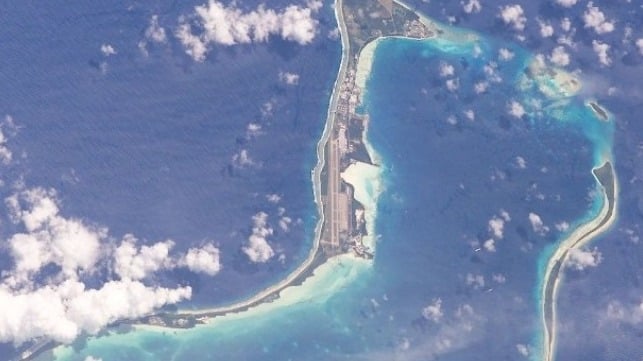
Diego Garcia's naval base and air station (NASA file image)

Published Mar 23, 2025 12:58 PM by The Maritime Executive


Iran’s Press TV, which normally identifies with hardline factions within the Iranian political system, has included the joint UK-US base on Diego Garcia amongst a list of US bases in the Middle East region which would be ‘within Iran’s cross-hairs’ for retaliatory strikes should either the United States or Israel launch attacks on Iran.

The article acknowledges a negotiation of sorts is underway between Iran and the United States, with Iran currently framing its response to a letter from President Trump passed to the Iranians through intermediaries.

The list of US bases on the target list also includes Al Udeid Air Base (Qatar), Al Dhafra Air Base (UAE), Naval Support Activity Bahrain, Dimona Radar Facility  (Israel), Muwaffaq Salti Air Base (Jordan), Camp Arifjan (Kuwait) and Ain al-Assad Airbase (Iraq). The article includes satellite imagery of each facility.

The article suggests that deep-water piers, anchorages and port facilities of Camp Thunder, plus deployments of B-1 Lancer, B-2 Spirit and B-52 Stratofortress bombers on Diego Garcia’s airfield would be targets.  It suggests that Diego Garcia is within the 4000km range of Iranian Khorramshahr missiles and Shahed-136B kamikaze drones, but also of missiles and drones launched from Iranian naval vessels such as the drone carriers Shahid Mahdavi (C110-3) and Shahid Bagheri (C110-4).

Negotiations over the future of Diego Garcia have stalled for the time being, while the United Kingdom awaits a formal response from the United States on the provisional agreement reached with the new Mauritian government.  While President Trump signaled approval of the deal, he made it clear that it had not been studied in detail, with a range of potential difficulties which could yet be identified. 

In the United Kingdom, political opposition has been mounting to the overall structure of the deal, which entails the United Kingdom paying large additional sums of money to Mauritius, probably sourced from the defense budget, without receiving any quid pro quo from the United States, whilst passing sovereignty over the Chagosian population without consultation or their consent to Mauritius.

Leaks from the United States, the United Kingdom and most prolifically from Mauritius give contradictory accounts of the current status of negotiations. But it seems likely that all parties want to pause the talks for the present, while the United States is apparently considering whether it should make a direct bid for sovereignty for the 60 km2 tropical paradise itself, given both its defense utility and potential as a resort destination.


Australia Needs Public's Help Raising Sniffer Dogs for Ports

ABF
Courtesy ABF

Published Mar 23, 2025 3:13 PM by The Maritime Executive


The Australian Border Force is looking for members of the public to foster puppies that may eventually serve as sniffer dogs for maritime and border enforcement. 

The puppies, available beginning at nine weeks of age, need temporary homes where they can develop and have opportunities for socialization, which is crucial for their future careers. Foster homes provide environments where the young Labradors can interact with new people, animals and settings early in life, border officials say. Owners agree to bring the dogs to busy locations so that they can get used to being around crowds and social stimulation. 

Under the arrangement, the Border Force assumes financial responsibility for the puppies, covering costs for food, equipment and veterinary care. The agency also offers accommodation for the animals when foster families travel or take vacations, as well as 24/7 support as required. 

"The relationship between our foster carers and the ABF represents a meaningful community partnership," said Bjorn Roberts, a commander with the agency. "These carers fulfill an essential function in preparing future detector dogs for service with our organization or partner agencies."

Image courtesy ABF

The Detector Dog Program forms a significant component of Australia's border security system. The program only uses Labrador Retrievers because of their work ethic, stable temperament and adaptability to varied environments.

Once trained, the dogs work at seaports, mail centers and other facilities throughout Australia. They are trained to detect narcotics, tobacco, firearms, explosives and currency.

Previous pet ownership experience is not required for potential foster carers, and the agency provides continuous support, including a 24-hour assistance service. Foster families are expected to help with the puppies' development by bringing them to busy locations such as shopping centers, sporting venues and playgrounds.


DRC’s Banana Port Achieves Construction Milestone

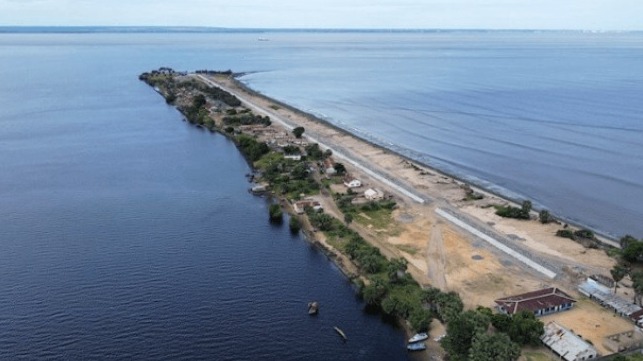
Future site of Banana Port (DP World)
Future site of DRC's Banana Port (DP World)

Published Mar 23, 2025 3:47 PM by The Maritime Executive


The development of DRC’s first deep sea port has achieved a new milestone, with operator DP World selecting Mota-Engil to lead the construction. Banana Port - located along the DRC’s narrow coastline of 22 miles on the Atlantic Ocean - is planned to be the single maritime gateway for containerized trade in the country. The port is located near the mouth of the Congo River, in Kongo Central province.

According to DP World, the selection of Mota-Engil, a Portuguese engineering conglomerate, was informed by the company’s extensive experience in port development and logistics support in Africa. Currently, Mota-Engil is part of the consortium operating the Lobito Corridor, which is a railway route connecting DRC’s copper belt to Angola’s Lobito port. The Lobito Corridor has been hailed as one of Africa’s most important economic infrastructure projects, connecting the rich mineral regions of DRC and Zambia to global markets through Angola.

DP World said Mota-Engil’s experience in African logistics aligns with its vision for Banana Port. “By partnering with Mota-Engil, we are ensuring that this world-class infrastructure is built to the highest standards, fostering economic growth. Banana Port is a transformative project that will reshape the trade and logistics landscape of the DRC,” said Sultan Ahmed bin Sulayem, CEO of DP World. Besides Mota-Engil’s contract, the construction of the port will also include local enterprises, and will create about 85,000 jobs and $430 million annually in new economic output once in operation.

Banana Port will be developed in phases. The first involves building a 600-meter quay with 18 meters of depth, which will enable the port to handle large container vessels. The port will have capacity for 450,000 TEU per year and also feature 30 hectares of storage area. The second phase will extend the quay by over two kilometers. The development of the port is supported with financing from DP World in partnership with British International Investment (BII), the UK’s development finance institution and impact investor. Last year, BII committed to investing up to $35 million towards the development of the first phase.


U.S. Navy Force Planning With a Pertinacious Marine Corps

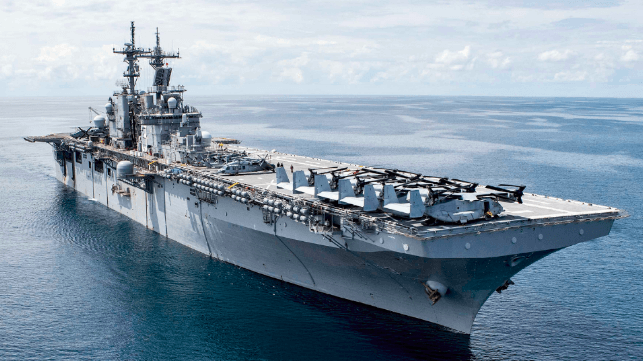
USS Kearsarge
Courtesy USN

Published Mar 23, 2025 5:14 PM by CIMSEC


[By Bruce Stubbs]

“A requirement is a requirement, pure and simple.”
—Lieutenant General Karsten Heckl, USMC 

“One man’s requirement is like another man’s wish.”
—Admiral Frank B. Kelso II, USN (retired)

A Team of Rivals

The United States Marine Corps has an outsized effect on Navy force planning. While the Navy and the Marines exhibit a sincere and genuine single team spirit conducting global naval operations, they are a fierce team of rivals when determining the requirements for amphibious ships (also known as “amphibs”), which the Navy funds for their construction and operation.

Soon after becoming Marine Corps Commandant, General David H. Berger announced a headline-grabbing transformation of the Corps in his July 2019 Commandant’s Planning Guidance. In its new role, the Marines would operate inside actively contested maritime spaces to conduct sea denial and assured access missions with a particular focus on the Indo-Pacific theater. In March 2020 Berger further explained his concept in Force Design 2030. Berger’s guidance declared that the Navy’s large amphibs were too vulnerable and too expensive to risk in combat, the Marines’ requirement for 38 or 34 large amphibs was no longer valid, and the Marines had a new requirement for small, agile amphibs.

His unprecedented, if not historic, transformational initiative sparked a yearslong controversy over two inter-related issues. First, Force Design 2030 punctured the Corps’ rationale for Navy’s large amphibs, which the two sea services refer to as either “big deck” or “small deck” ships. Second, the initiative handed the Navy a multi-billion dollar bill to construct and operate a new class of amphibs designated eventually as the Medium Landing Ship. 

Issue#1: Number of Large Amphibious Ships

Shifting Requirements

From Berger’s determination that large amphibs were too vulnerable and too expensive, it logically followed what Mark Cancian, an analyst at the Center for Security and International Studies and a retired colonel of Marines, concluded. If the Marines believed their “future lay in small amphibious ships, then the Pentagon should limit the building of large amphibious ships.” The Cost Assessment and Program Evaluation office—a powerful analytical office reporting directly to the Secretary of Defense—took notice of this contradiction in the Marines’ transformation planning.

Since the end of the Cold War, the Marines’ requirement for large amphibs has been an issue for the Navy. Former Secretary of Defense Robert M. Gates (2006-2011) in May 2010 explained why: “We have to take a hard look at where it would be necessary or sensible to launch another major amphibious landing again – especially as advances in anti-ship systems keep pushing the potential launch point further from shore.… what kind of amphibious capability do we really need to deal with the most likely scenarios, and then how much?”

Echoing Gates’ arguments, Jerry Hendrix, a senior fellow at the Sagamore Institute and a retired Navy captain, stated that the Marine Corps has “been less than convincing on the role of amphibs in the future fight” and the need for joint forcible entry and amphibious assault. He observed, ” … outside of beaches on the Korean Peninsula … where [are they] going to be doing amphibious assault … what [is] the argument” for this capability? According to Cancian, the Marines have not “offered a strong wartime rationale for 31 large amphibious ships.”

Trump’s Defense Secretary Wants Fewer Large Amphibious Ships

By early 2020, it appeared Secretary of Defense Mark Esper had determined that the requirement for opposed amphibious landings was diminishing. He wanted a warfighting strategy to drive amphibious force planning, not a peacetime forward presence strategy. So, Esper directed his staff to conduct a new amphib study as a component of a larger study on the Navy’s total ship requirements. Completed in October 2020, the Future Navy Force Study served as the basis for the first Trump administration’s last Navy shipbuilding plan, submitted to Congress in December 2020. Esper’s unprecedented tasking of his staff to conduct this study resulted in the Navy losing control over its force planning efforts for about eight months.

This plan had dire consequences for the Marines. It reduced the number of large amphibs by calling for a range of 9 to 10 “big deck” ships and a range of 52 to 57 for all other amphibs. Ronald O’Rourke, the respected Congressional Research Service analyst, suggested that this range could be divided into 19 or fewer “small deck” ships and 28 to 30 of the new Light Amphibious Warship. The combined total of “big deck” and “small deck” ships would be well under 30, which was unacceptable to the Marines. 

Biden’s Navy Secretary Also Wanted Fewer Large Amphibious Ships and Another Study

On June 17, 2021, new Secretary of the Navy Carlos Del Toro released the fiscal year 2022 shipbuilding plan. It called for 8 to 9 “big deck” amphibs, 16 to 19 “small deck” amphibs, and 24 to 35 new Light Amphibious Warships, which in 2024 the Navy redesignated the Medium Landing Ship. Also in June, the Navy and the Marines completed another amphib study which determined a requirement for 28 to 31 large amphibs. For the Marines, “31-amphibs” became their red-line for large amphibs, contradicting the Secretary’s range of 24 to 29 in the fiscal year 2022 shipbuilding plan.

In September 2021 Del Toro directed another evaluation of amphibious ship requirements called the Amphibious Force Requirement Study for delivery by March 2022. (Del Toro delayed submitting this study to Congress until December 2022.) By February 2022, Admiral Michael Gilday, the Chief of Naval Operations, publicly stated that the fiscal year 2023 shipbuilding plan would include, “probably nine big deck amphibs and another 19 or 20 [“small deck” ships] to support them.” Gilday’s numbers indicated a range of 28 to 29 for the large amphibs. A few months later, Del Toro released the fiscal year 2023 shipbuilding plan in April, presenting an unhelpful package of three alternative plans for a range of 7 to 9 “big deck” ships and 15 to 26 “small deck” ships for a total between 22 to 26 by fiscal year 2045. The reduction in large amphibs would prevent the Marines from simultaneously deploying three Marine Expeditionary Units.

While the Biden administration signaled it did not fully support the Marines’ requirements, some in Congress did. Representative Joe Courtney (D-Conn.) and Representative Rob Wittman (R-Va.) introduced a bill to maintain 31 large ships. In late July 2022, Gilday released his Navigation Plan 2022 which called for 31 large amphibious ships and 18 Light Amphibious Warships.

Congress Is Incensed and Supports the Marines

By April 2022, Congress still had not received Del Toro’s Amphibious Force Requirements Study. A dispute, which became a stand-off between the Cost Assessment and Program Evaluation office and the Navy, caused the delay. This office wanted the Navy to reconsider portions of the report, but the Navy declined, and so the study languished. By December, Congress had had enough and passed the National Defense Authorization Act for Fiscal Year 2023 with a statutory requirement for not less than 31 large amphibs, including 10 “big deck” and 21 “small deck” ships. This Act also required the Navy Secretary to ensure that the Commandant’s views are given appropriate consideration before a major decision is made by an element of the Navy Department outside the Marine Corps on a matter that directly concerns amphibious force structure and capability. In addition, the Act assigned directed responsibility to the Commandant for developing the requirements relating to amphibs. Del Toro finally sent the classified Amphibious Force Requirements Study to Congress in late December 2022. No sooner than Congress received this study, Secretary of Defense Lloyd Austin directed a “redo” with little Navy objection, which according to Politico, increased the Marines’ frustration.

Navy Secretary Announces an Amphibious Strategic Pause

Del Toro publicly stated in February 2023 that the Navy was taking a “strategic pause” from buying the “small deck” ships. He explained that the Navy needed additional time to determine the mix and number of amphibs before resuming procurement. The Secretary’s announcement was somewhat disingenuous as the Secretary had already initiated a de facto strategic pause in his April 2022 submission of the fiscal year 2023 shipbuilding plan and the fiscal year 2030 budget. According to Politico, the Marines were furious over this outcome. Gilday explained that lack of funding was the “driving issue” for the decision not to fund any more of these $1.8 billion “small deck” ships.

Congress Intervenes Again for the Marines

By April 2023, Del Toro’s strategic pause not to buy “small deck” amphibs had greatly annoyed the Senate Armed Services Committee. A month later the Committee reproached Del Toro in a June 13th letter for not responding to its questions regarding the Navy’s non-compliance with the statutory requirement to maintain 31 large amphibious ships. The senators saw no planning in the Navy’s fiscal year 2024 shipbuilding plan to achieve this force-level goal. Co-signed by 14 Democratic and Republican senators, the letter stated, “The Navy’s current plan not only violates the statutory requirement, but also jeopardizes the future effectiveness of the joint force, especially as we consider national security threats in the Indo-Pacific.” The letter continued that the Del Toro had until June 19th to respond with an updated shipbuilding plan for fiscal year 2024, and a pointed reminder that the 31-ship requirement “is not a suggestion but a requirement based on the assessed needs of the Navy and the Marine Corps.” In early August USNI News reported that the strategic pause was still in effect. At her September 2023 confirmation hearings to become the 33rd Chief of Naval Operations, Admiral Lisa Franchetti endorsed the Marines’ requirement for 31 large amphibious ships.

Congress Helps Thwart an “Existential Threat” from the Navy Secretary

As the Marines entered 2024, the debate over the number of large amphibious ships remained unresolved. Lieutenant General Karsten Heckl, Deputy Commandant for Combat Development and Integration, called the amphib shortage the Marines’ “single biggest existential threat.” In March, the Defense and Navy Departments eliminated this threat by ending the two-year “strategic pause” for procuring “small deck” amphibs. The Navy’s budget submission for fiscal year 2025 and its fiscal year 2025 shipbuilding plan, both approved by the Defense and Navy Departments, included the procurement of “small deck” ships. In addition, these documents commenced the procurement of a new class of Medium Landing Ships. The Biden Administration had caved to Congress and ended the almost two-year strategic pause.

Issue #2: The Unaffordable and Unsurvivable Ship

Marines Give The Navy A Shipbuilding Bill

Berger’s guidance called for a new class of Navy amphibious ships that were “smaller, more lethal, and more risk-worthy platforms” to shuttle Marines around archipelagic islands. The Marines would “shoot” anti-ship cruise missiles from one island and then “scoot” to another island using the new amphibs as “water taxis” to “shoot” once more. In 2020 the Navy designated this new amphib as the Light Amphibious Warship. The Navy anticipated procuring a class of 28 to 30 ships with a crew of “no more than 40 Navy Sailors” at a “unit procurement cost of less than $100 million.”

Almost immediately the Navy and the Marine Corps clashed over the ship’s capabilities and costs. The Navy wanted a “survivable ship,” while the Marines wanted an operational ship as fast as possible, as well as one built to civilian standards and not military standards to reduce construction costs. Their disagreement delayed the delivery of first ship to “fiscal year 2023 and then to fiscal year 2025.” By January 2024, the Navy released its request for proposals for the first six of these new class of ships for delivery in 2029. The Navy asked for a ship that could lift 75 Marines and 600 tons of equipment with a “cargo area of about 8,000 square feet, a helicopter pad, a 70-person crew, spots for six .50-caliber guns and two 30mm guns.” The Navy also wanted the ship to be under 400 feet long, a draft of no more than 12 feet, a 14-knot endurance speed, and roll on/roll off beaching capability.

By April 2024, the Navy had re-designated the ship as a Medium Landing Ship with an increased estimated unit procurement cost of roughly $150 million in constant fiscal year 2024 dollars for the first 8 ships and a class size of 35 ships by 2043. The Navy estimated that 55 of these ships would “cost less than $200 million per ship, on average.” The Congressional Budget Office, however, projected the average cost at $350 million per ship.

In December 2024, the Navy received industries’ responses to its January 2024 request for proposals. After seeing the costs, the Navy immediately canceled its request. Gobsmacked, Nickolas Guertin, the assistant secretary of the navy for research, development and acquisition, stated the request for bids, “came back with a much higher price tag. … we had to pull that solicitation back and drop back and punt.” In January 2025, the Navy punted and began looking for “existing, private-sector designs” requiring minor modifications for conversion at a small cost.

In 2025, Unanswered Questions Remain About the New Amphibious Ship

The central issue about the procurement of the Medium Landing Ship remains its construction cost, which is dependent on whether the Navy builds the ship to commercial or naval warfare standards, which is, in turn, dependent on the ship’s final operational concept. Building to commercial standards lowers construction costs. The operational concept remains unclear whether these ships will operate in a benign environment. Will they only operate in the pre-crisis phase or after hostilities have commenced and these ships find themselves in contested waters? Moreover, if the Marines intend to resupply its forces as well to relocate them during the conflict, it is highly likely that these ships would be vulnerable to detection and attack.

Consequently, the Navy will have a mission requirement to protect and sustain the Marines operating as stand-in forces, placing another demand on the Navy to provide forces while also conducting other high priority missions (see Table 1). In April 2024 the Congressional Budget Office reported that “A ship that is not expected to face enemy fire in a conflict could be built to a lesser survivability standard, with fewer defensive systems than a ship that would sail in contested waters during a conflict.”
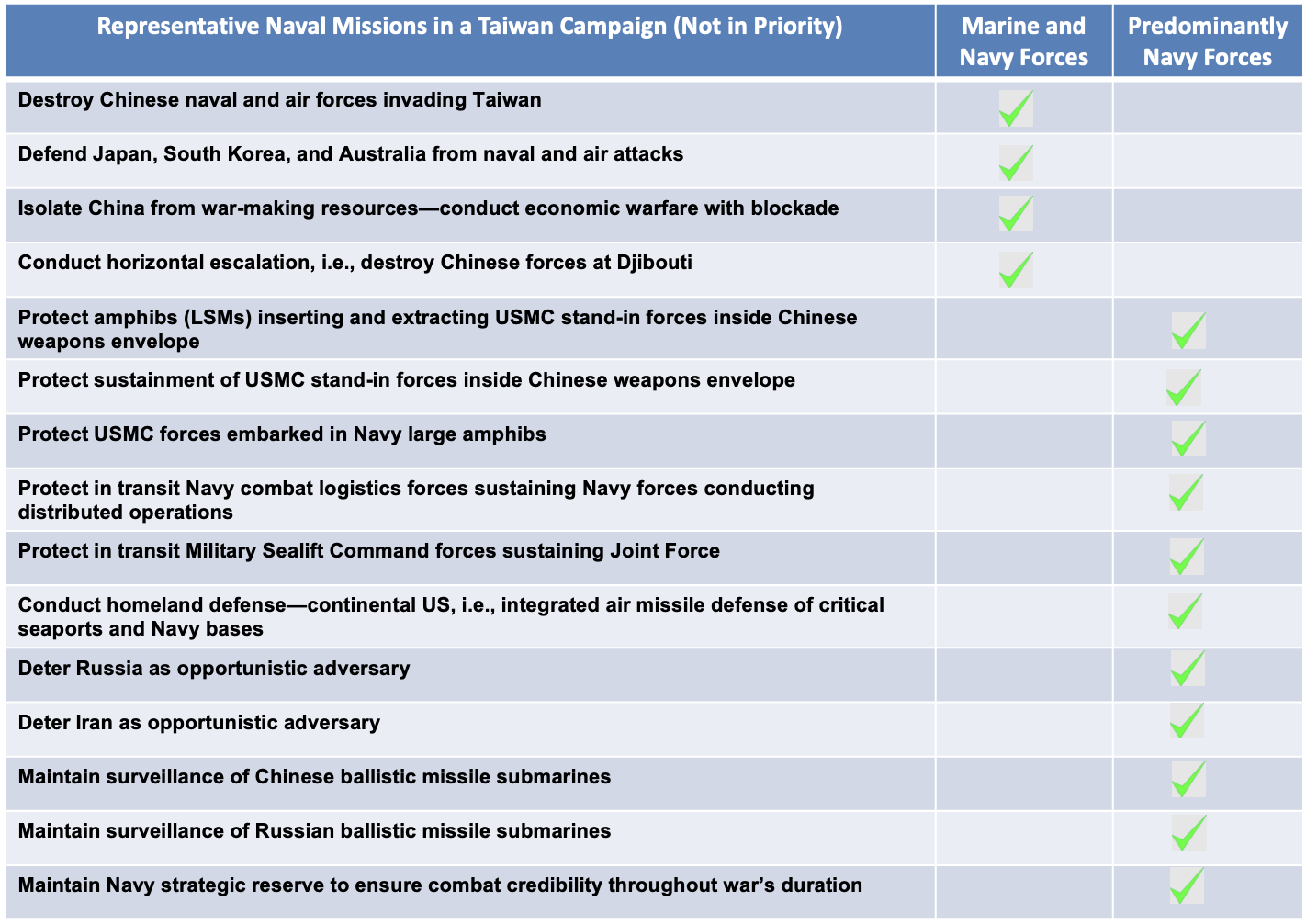
Table 1: A comparison of potential missions for the Department of the Navy during a conflict over Taiwan, divided into missions shared by the Navy and Marine Corps and missions that would be assigned to predominantly Navy forces. (Author graphic)

Perhaps in an attempt to strengthen the argument that the Navy should construct these ships to commercial standards, the fiscal year 2025 shipbuilding plan did not classify the Medium Landing Ship as an “amphibious warfare ship.” Instead, in a puzzling decision it was categorized as a “command and support” vessel, despite its requirement to land Marines on beaches to conduct kinetic operations.

The Navy and Marine Corps Have Different Priorities and Agendas

The Navy and the Marine Corps co-exist on some important core common tasks and viewpoints, reinforced by established historical, political, legal, and bureaucratic frameworks. The Marine focus on forward presence, forcible entry, and expeditionary warfare employing the Navy’s amphibs. Whereas for the Navy, expeditionary warfare is merely one among many Navy warfare functions to include anti-air warfare, anti-surface ship warfare, anti-submarine warfare, strike warfare, special operations warfare, mine and countermine warfare, electronic and information warfare, strategic deterrence, combat logistics, and sealift for Joint Force logistic sustainment.

For the Marines, amphibs are a priority. For the Navy, however, ballistic missile submarines, attack submarines, aircraft carriers, large surface combatants, small surface combatants, auxiliary ships, logistics ships, oilers, and minesweepers are all priorities as well as amphibs (see Table 2). 
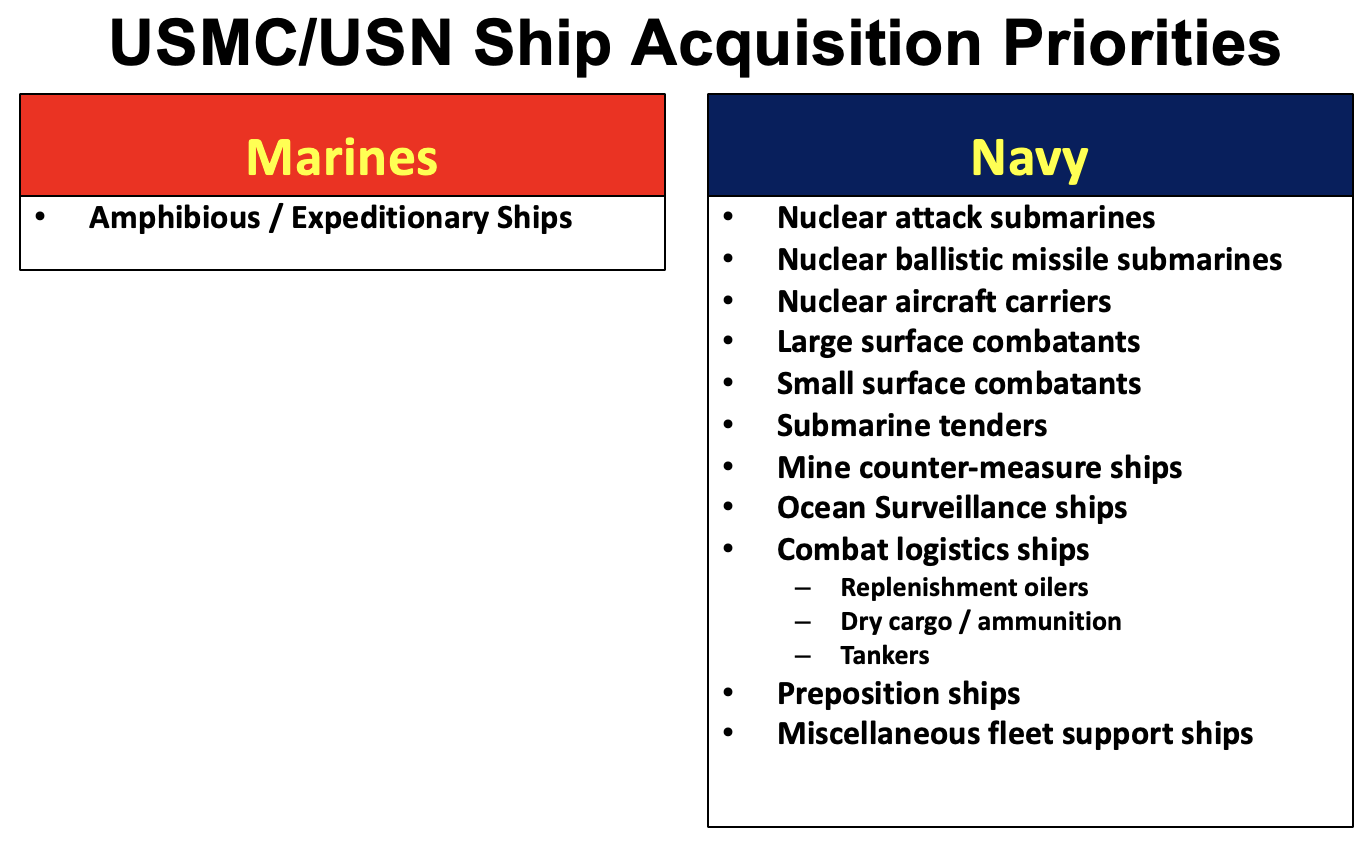
Table 2: A comparison of ship acquisition priorities between the Navy and Marine Corps. (Author graphic)

The Navy does not get to focus on just one type of ship and it is responsible for a wide range of warfighting functions. In contrast, the Marine Corps has a much narrower set of responsibilities. When force structure priorities differ between the Navy and Marines, the Navy finds itself in an awkward position between one side—composed of the Office of Management and Budget, the Department of Defense, and the Department of the Navy—and the other side comprised of the Marines and Congress. Such triangulation can lead to an almost unmanageable situation whereby the Navy loses control of the planning for its future, which actually occurred in 2019. 

Gilday noted that the Navy “must prioritize programs most relevant” to a conflict with China. What can be more relevant to a conflict with China than logistics, especially with a U.S. Navy conducting distributed operations, likely without the availability of Guam. Lines of communication will stretch for thousands of miles from the U.S. homeland to the operating areas. These sea lines of communication, as well as U.S. ports, will require protection because China has the means and the will to interdict and sever these lines to isolate U.S. fighting forces and prevent their sustainment. Logistics ships to sustain combat operations, submarine tenders to rearm submarines, and oilers to refuel the Navy’s distributed forces across the vast Pacific distances may be more needed by the Navy than a new class of 35 amphibs. In February 2024 Admiral Samuel J. Paparo, Jr., then the Commander of the U.S. Pacific Fleet, stated that the Navy’s Combat Logistics Force, which supports and sustains the Navy’s distributed maritime operations with “beans, bullets, and black oil” is operating on “narrow margins” with insufficient ships for a war with China. He specifically cited inadequate numbers of oilers. Admiral Paparo also noted that the Chinese consider the U.S. Navy’s logistics capabilities a critical vulnerability with his statement that “When we run [war]games, the red team goes for the Combat Logistics Force every single time.” The Navy’s lack of strategic guidance hindered a comprehensive understanding of this and other thorny force planning issues, consequently strategic force priorities were often set on the fly.

The differences between the two sea services are real, and relations about Department of the Navy funding priorities have often been fractious and kept in-house. A major exception underscoring this sometime discordant relationship occurred in December 1995. General Carl E. Mundy, Jr., U.S. Marine Corps (retired), who served as Commandant, fired a salvo at the Navy for allegedly short-changing the Marine Corps for its fair share of the Navy Department’s budget. Admiral Frank B. Kelso, II, U.S. Navy (retired), Chief of Naval Operations (1990-1994), reminded Mundy that the Marines cannot ignore the “total requirements of the Navy” beside supporting the Marines in the “littorals.”

Conclusion

When the Marines believe their future is in jeopardy, which certainly was the case with this confrontation over 31 large amphibs and the fight for 35 new smaller amphibs, the Marines do not hesitate to seek Congress’ intervention on their behalf. Besides calling the reduction in large amphibs an existential threat to the Marines’ existence, General Heckl thundered, “Our identity is elemental to who we are as Marines. We are soldiers of the sea. We are the nation’s naval expeditionary force. And we just can’t lose that.” His statements reflected the Marine Corps’ laser focus on its own force structure, rather an appreciation of the bigger picture.

Advocates for any of the services can sometimes believe so passionately in the potential effectiveness of their particular service with its “unique” weapon systems, ships, or aircraft that “they find it difficult to appreciate the fuller pattern of a future war and the unforgiving priorities dictating resource allocation.” Their degree of identification with their service may “discourage viewpoints and thinking oriented toward the best interests” of the Joint Force as a whole.” The Marines’ success in setting the goal of 31 large amphibs and a new class of amphibs illustrates the powerful influence the Marines can and will exert over the Navy’s force planning process to achieve their objectives. The nation can only hope that the recent outcomes in amphib numbers that the Marines have achieved in coordination and cooperation with congressional and industrial influence will produce the desired benefit to America’s national defense, and not shortchange other high-priority requirements.

The Marine Corps has a well-deserved special place in the hearts of Congress and the American people—a sentiment that can defy the logic of Navy force planning, and the intentions of any administration to prioritize the nation’s defense requirements. The Marines—thanks to Congress—have a big vote in Navy force planning. Short of the Marine Corps becoming an independent armed service outside the Department of the Navy, the Navy, as best as it can, just has to live with a pertinacious Marine Corps — or it can borrow a page from the Marine Corps’ playbook. 

Prior to his full retirement as a member of the U.S. senior executive service, Bruce Stubbs had assignments on the staffs of the secretary of the Navy and the chief of naval operations from 2009 to 2022. He was a former director of Strategy and Strategic Concepts in the OPNAV N3N5 and N7 directorates. As a career U.S. Coast Guard officer, he had a posting as the Assistant Commandant for Capability (current title) in Headquarters, served on the staff of the National Security Council, taught at the Naval War College, commanded a major cutter, and served a combat tour with the U.S. Navy in Vietnam during the 1972 Easter Offensive. The author drew upon his forthcoming publication, Cold Iron: The Demise of Navy Strategy Development and Force Planning, to compose portions of this commentary.

This article appears courtesy of CIMSEC and may be found in its original form here

The opinions expressed herein are the author's and not necessarily those of The Maritime Executive.
Texas A&M-led study suggests former inmates struggle to access medical care — even when it’s nearly free


Researchers found that many former prisoners, despite being enrolled in Medicaid, stop taking medications for chronic illness shortly after their release


Texas A&M University


As they studied two years of prison-inmate data, Laura Dague and a team of fellow health researchers noticed that one particular scenario kept cropping up. That scenario involved the days when an inmate is released and returns to their community. A significant number were released with chronic health issues and promptly signed up for government-subsidized healthcare — only to stop taking their medications.

Why would they stop taking free (or nearly free) medication? And do former prisoners have proper access to care upon returning to their communities? These questions are raised by a new study co-authored by Dague, a Ph.D. and professor with The Bush School of Government and Public Service.

“People taking their medications is important, for themselves and for their communities,” Dague said.

The study was published in “JAMA Network Open,” one of the top medical journals. Dague and her colleagues identified several trends. The most striking is the tendency of former inmates to forsake medication for a chronic condition even with costs covered by Medicaid, the federal-state insurance program for low-income people. The researchers found this trend particularly striking because other studies have shown that Medicaid increases access to healthcare for people who were previously incarcerated. The new study suggests insurance alone may not be enough.

Dague and her colleagues do not suggest policy changes to address their findings. She did say, however, that the results suggest new Medicaid policies to guide former inmates as they rejoin their communities, including policies already encouraged under the federal Support Act, “could be really impactful.”

Two Sources Combined For A Bigger Picture

Dague and her colleagues focused their study on Wisconsin. They chose the state in part because it does an unusually thorough job of tracking inmate health data and makes that data available to researchers in partnership with the University of Wisconsin’s Institute for Research on Poverty. (Dague also maintains an affiliation with the institute, where she is a colleague of her co-lead author, Marguerite Burns, Ph.D.) Dague, Burns and their colleagues combined Wisconsin Department of Corrections information with Medicaid data, allowing them to track the inmates’ medical history from prison back into their communities.

The research team tracked all adults released from any of the state’s correctional facilities from April 2015 to June 2017. That was 12,960 people, a population 90% male but racially diverse, with an age range from teenagers to senior citizens.

The researchers took particular interest in the 4,302 people who had been taking a medication prescribed for chronic illness within three months of their release and enrolled in Medicaid immediately after release. People who needed to keep taking medication and theoretically had easy access to it, in other words.

Only half of them appear to have kept taking their meds.

The researchers reached this conclusion through Medicaid data showing that only 51.7% filled their prescriptions, even though they all left prison with a prescription in hand.

The researchers also tracked how many former prisoners visited a doctor within six months of release. Access to a health care provider and/or willingness to visit one was a key predictor of former inmates’ health. Those who saw a doctor were far more likely — 40 percentage points more likely — to fill their prescriptions. And, presumably, keep taking medications that help them stay healthy.

“These are people with heart conditions, diabetes, anxiety, severe mental illness,” Dague said. She and her fellow researchers identified 25 total medication classes for chronic conditions, and those taking them “don’t just stop needing medication because they left prison.”

The study does not address why they stopped taking their medication. Nor does it presume that the picture in Wisconsin precisely mirrors that elsewhere in the country. But the results do suggest that similar issues could exist elsewhere and should be addressed, Dague said.

Recently incarcerated people tend to have little income, if any, as they rarely have a job upon release. So when a former inmate cannot afford their care and suffers a catastrophic health problem, such as an emergency room visit, the cost is often socialized: spread among people who use the health care system or the taxpaying public. Many studies have shown that simple preventive steps — such as taking prescribed medications — can reduce such systemwide costs.

“We know that inmate health, and their health after their discharge, is generally worse than it is among demographically similar people” who have not been imprisoned, Dague said. “This has consequences for the individuals themselves, obviously, but also for their communities: more emergency responses, ambulance rides, emergency-room visits and other costs.”

By Texas A&M University Bush School of Government and Public Service

Using existing infrastructure to estimate pedestrian volumes


Portland State University


Every time a pedestrian pushes a button to cross the street, it creates a useful data point about how many people are walking through that intersection. Now, transportation planners and engineers in Oregon have easy access to that data: The newest feature we've added to BikePed Portal is a dashboard that lets you explore the Oregon Department of Transportation (ODOT)'s pedestrian push-button data from all over the state.

ODOT has shared this data with Portland State University (PSU) for use in BikePed Portal, so that users can see where and how people interact with pedestrian crossings at signalized intersections. The dashboard (watch a walkthrough here) is still being developed and is anticipated to eventually include data from more agencies in addition to ODOT.

WHY IS THIS DATA HELPFUL?

Many, if not all, active transportation projects rely on pedestrian volumes to measure pedestrian exposure, or the number of potential opportunities for a pedestrian to be involved in a crash with a moving vehicle. By analyzing usage patterns, practitioners can prioritize upgrades at high-demand or problematic locations, ensure compliance with ADA standards, and inform pedestrian infrastructure planning. The potential applications of push-button data are numerous, and just a couple of examples are highlighted below.

The new dashboard is a useful resource to help agencies improve signal timing, accessibility, and safety for all road users, as well as guide future investments in walkability. 

DERIVING PEDESTRIAN COUNTS 

Researchers are exploring methods to convert the push-button data into complete pedestrian counts for the transportation network. At the 2025 annual meeting of the Transportation Research Board (TRB), Sirisha Kothuri, Joe Broach and Elizabeth Yates of PSU presented a study along with Mahyar Vahedi Saheli and Patrick Singleton of Utah State University on "Pedestrian Volumes from Push-Button Traffic Signal Data in Oregon: Estimating Models and Assessing Model Transferability [PDF - add link to poster)" in which they used the ODOT data, along with video recordings, to estimate pedestrian counts. They also developed a workflow to integrate pedestrian traffic counts into ODOT’s enterprise traffic data system. 

The initial research was funded by ODOT, as well as some funding support for the dashboard. Learn about the models used to calculate estimated pedestrian volumes in the final report, or watch a recorded seminar to learn more.

ODOT's research unit has also documented a use case for the data—see Pedestrian Traffic Estimation for Liquidation Costs—and is developing more.

ANALYZING PEDESTRIAN CRASHES

At Utah State, Singleton used similar data in Utah to do safety analysis. One paper examined the frequency and severity of crashes involving pedestrians, and another developed improved methods to predict crashes at signalized intersections. The research team wanted to examine whether the “safety in numbers” effect applies to pedestrian safety in the US. Both papers used push-button data as a novel data source to measure pedestrian exposure.

As pedestrian safety and accessibility continue to be top priorities in transportation planning, innovative uses of existing infrastructure—like push-button data—are opening up new possibilities for research, analysis, and informed decision-making. The addition of this new dashboard to BikePed Portal marks an important step in making pedestrian activity more visible for agencies across Oregon. By leveraging this data, planners and researchers can better understand walking patterns, identify safety risks, and ultimately create safer, more walkable communities. 

As the dashboard grows to include data from more jurisdictions, its value will only increase—offering a powerful tool to support equitable and evidence-based improvements in pedestrian infrastructure.

PARTNER WITH PSU: ADD YOUR DATA TO BIKEPED PORTAL

Cities and agencies interested in partnering across the region to improve transportation data access should reach out to our team at bikepedportal@pdx.edu. We are interested in adding more push-button data, as well as other types of nonmotorized data. 

We accept data in multiple formats (including EcoCounter API, TrafX, manual, turning movement), and convert it all into a standardized format. We offer quality control, quality assurance, and more. Learn about the services that BikePed Portal offers.

METADATA AND DOCUMENTATION

Additional resources have recently been added to BikePed Portal:

Portland State University's Transportation Research and Education Center (TREC) is a multidisciplinary hub for all things transportation. We are home to the Initiative for Bicycle and Pedestrian Innovation (IBPI), the data programs PORTAL and BikePed Portal, the Better Block PSU program, and PSU's membership in PacTrans, the Pacific Northwest Transportation Consortium. Our continuing goal is to produce impactful research and tools for transportation decision makers, expand the diversity and capacity of the workforce, and engage students and professionals through education, seminars, and participation in research. To get updates about what's happening at TREC, sign up for our monthly newsletter or follow us on social media.