Sunday, April 06, 2025

Millions March Against Trump-Musk in Nationwide 'Hands Off' Protests

"They're dismantling our country. They're looting our government. And they think we'll just watch."


Demonstrators gather on Boston Common, cheering and chanting slogans, during the nationwide "Hands Off!" protest against US President Donald Trump and his advisor, Tesla CEO Elon Musk, in Boston, Massachusetts on April 5, 2025.
(Photo by Joseph Prezioso / AFP via Getty Images)

Common Dreams Staff
Apr 05, 2025

In communities across the United States and also overseas, coordinated "Hands Off" protests are taking place far and wide Saturday in the largest public rebuke yet to President Donald Trump and top henchman Elon Musk's assault on the workings of the federal government and their program of economic sabotage that is sacrificing the needs of working families to authoritarianism and the greed of right-wing oligarchs.

Indivisible, one of the key organizing groups behind the day's protests, said millions participated in more than 1,300 individual rallies as they demanded "an end to Trump's authoritarian power grab" and condemning all those aiding and abetting it.

"We expected hundreds of thousands. But at virtually every single event, the crowds eclipsed our estimates," the group said in a statement Saturday evening.

"Hands off our healthcare, hands off our civil rights, hands off our schools, our freedoms, and our democracy."

"This is the largest day of protest since Trump retook office," the group added. "And in many small towns and cities, activists are reporting the biggest protests their communities have ever seen as everyday people send a clear, unmistakable message to Trump and Musk: Hands off our healthcare, hands off our civil rights, hands off our schools, our freedoms, and our democracy."

According to the organizers' call to action:
They're dismantling our country. They’re looting our government. And they think we'll just watch.

On Saturday, April 5th, we rise up with one demand: Hands Off!

This is a nationwide mobilization to stop the most brazen power grab in modern history. Trump, Musk, and their billionaire cronies are orchestrating an all-out assault on our government, our economy, and our basic rights—enabled by Congress every step of the way. They want to strip America for parts—shuttering Social Security offices, firing essential workers, eliminating consumer protections, and gutting Medicaid—all to bankroll their billionaire tax scam.

They're handing over our tax dollars, our public services, and our democracy to the ultra-rich. If we don't fight now, there won’t be anything left to save.

The more than 1,300 "Hands Off!" demonstrations—organized by a large coalition of unions, progressive advocacy groups, and pro-democracy watchdogs—first kicked off Saturday in Europe, followed by East Coast communities in the U.S., and continued throughout the day at various times, depending on location. See here for a list of scheduled "Hands Off" events.

"The United States has a president, not a king," said the progressive advocacy group People's Action, one of the group's involved in the actions, in an email to supporters Saturday morning just as protest events kicked off in hundreds of cities and communities. "Donald Trump has, by every measure, been working to make himself a king. He has become unanswerable to the courts, Congress, and the American people."

In its Saturday evening statement, Indivisible said the actions far exceeded their expectations and should be seen as a turning point in the battle to stop Trump and his minions:
The Trump administration has spent its first 75 days in office trying to overwhelm us, to make us feel powerless, so that we will fall in line, accept the ransacking of our government, the raiding of our social safety net, and the dismantling of our democracy.

And too often, the response from our leaders and those in positions to resist has been abject cowardice. Compliance. Obeying in advance.

But not today. Today we've demonstrated a different path forward. We've modeled the courage and action that we want to see from our leaders, and showed all those who've been standing on the sidelines who share our values that they are not alone.

Citing the Republican president's thirst for "power and greed," People's Action earlier explained why organized pressure must be built and sustained against the administration, especially at the conclusion of a week in which the global economy was spun into disarray by Trump's tariff announcement, his attack on the rule of law continued, and the twice-elected president admitted he was "not joking" about the possibility of seeking a third term, which is barred by the constitution.

"He is destroying the economy with tariffs in order to pay for the tax cuts he wants to push through to enrich himself and his billionaire buddies," warned People's Action. "He has ordered the government to round up innocent people off of the streets and put them in detention centers without due process because they dared to speak out using their First Amendment rights. And he is not close to being done—by his own admission, he is planning to run for a third term, which the Constitution does not allow."

The protest organizers warn that what Trump and Musk are up to "is not just corruption" and "not just mismanagement," but something far more sinister.

"This is a hostile takeover," they said, but vowed to fight back. "This is the moment where we say NO. No more looting, no more stealing, no more billionaires raiding our government while working people struggle to survive."


Live stream of Hands Off rally in Washington, D.C.:


Below are photo or video dispatches from demonstrations around the world on Saturday.

United Kingdom

France

Germany

Belgium:


Massachusetts:

Maine:

Washington, D.C.:

New York:

Minnesota:

Michigan:

Ohio:

Colorado:

Pennsylvania:

North Carolina:


In Pictures: Anti-Trump 'Hands Off' Demonstrations Nationwide


"Thank you to the hundreds of thousands of Americans across the country who are standing up and speaking out for our voting rights, fundamental freedoms, and essential services like Social Security and Medicare."


Jon Queally
Apr 05, 2025
COMMON DREAMS


In communities large and small across the United States on Saturday, hundreds of thousands of people collectively took to the streets to make their opposition to President Donald Trump heard.

The people who took part in the organized protests ranged from very young children to the elderly and their message was scrawled on signs of all sizes and colors—many of them angry, some of them funny, but all in line with the "Hands Off" message that brought them

together.

"Thank you to the hundreds of thousands of Americans across the country who are standing up and speaking out for our voting rights, fundamental freedoms, and essential services like Social Security and Medicare," said the group Stand Up America as word of the turnout poured in from across the country.

A relatively small, but representative sample of photographs from various demonstrations that took place follows.



Demonstrators gather on Boston Common, cheering and chanting slogans, during the nationwide "Hands Off!" protest against US President Donald Trump and his advisor, Tesla CEO Elon Musk, in Boston, Massachusetts on April 5, 2025. (Photo by Joseph Prezioso / AFP)


'Neuter your DOGE': Dem leader shares his 'top 5 signs' from weekend anti-Trump protests

David McAfee
April 5, 2025 
RAW STORY

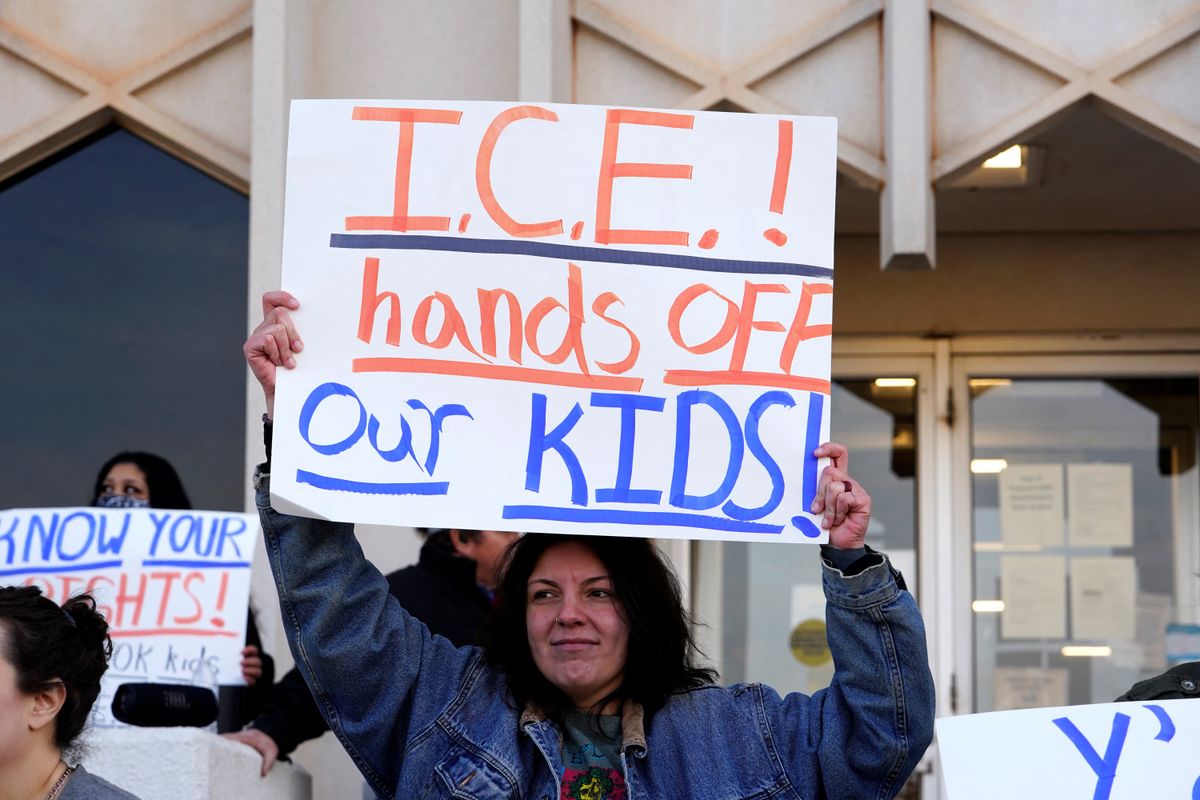
Protesters opposing possible Immigration and Customs Enforcement (ICE) raids in public schools demonstrate on the steps of the State Department of Education during their monthly board meeting in Oklahoma City, Oklahoma, U.S. January 28, 2025. REUTERS/Nick Oxford


Protesters hit the streets on Saturday to protest actions by Donald Trump and Elon Musk, and one senior Democratic leader got in on some of the fun.

Rep. Jamie Raskin, who was chosen by the Democratic Caucus to be the Ranking Member of the House Committee on Oversight and Accountability in the 118th Congress, weighed in on some of the protest signs he saw from the "Hands Off" protests that erupted on Saturday in response to actions by Trump and Musk.

Taking to X, Musk's own platform, Raskin said, "Top 5 signs I saw today."

Here is the congressman's list:

1. “Elon Musk is the only undocumented immigrant taking your job”

2. “Neuter your Doge”

3. “Donald Trump, Russian-Owned since 1987”

4. “The Emperor has no clothes and it ain’t pretty”


5. “Buy America: Putin did”

Another popular sign says, "Wisconsin hates Elon so much it could be one of his kids."


ANTI-DEI IS DISCRIMINATION
‘Everyday discrimination’ linked to increased anxiety and depression across all groups of Americans


Photo by Jessica Felicio on Unsplash
woman standing under tree
The ConversationMarch 30, 2025


People who most frequently encounter everyday discrimination – those subtle snubs and slights of everyday life – MICROAGGRESSION 
are more likely to suffer from anxiety and depression.

What’s more, that finding remains true no matter the person’s race, gender, age, education, income, weight, language, immigration status or where they live.

These are the key takeaways from our recent study, published in JAMA Network Open.

Everyday discrimination refers to the routine ways people are treated unfairly because of characteristics such as skin color, perceived background or general appearance.

Generally, it means disrespectful treatment: waiting longer than others for help at a store, having your ideas dismissed without consideration at work, or hearing rude comments about your identity.

Although marginalized groups endure everyday discrimination most often, our study indicates that this is a widespread issue affecting people of all races and backgrounds.
Everyday discrimination can affect both physical and mental health
.FG Trade Latin/E+ via Getty Images

I’m a professor who specializes in community health. My team and I analyzed data from the 2023 National Health Interview Survey, which included a weighted sample of nearly 30,000 U.S. adults, adjusted to accurately reflect more than 258 million people – approximately 75% of the country.

Along with reporting frequency of everyday discrimination, participants completed clinical screenings for depression and anxiety.

The results were striking: Nearly 56% of participants experienced at least occasional everyday discrimination, with 3.6% having “high levels,” meaning they faced discrimination most frequently – at least monthly and often weekly.

High levels were most prevalent among Black adults, at 8.6%. Multiracial respondents were next with 6.4%. Hispanics and white participants were at about 3%, Asians just over 2%.

Women and immigrants, people with disabilities and those who are overweight, obese or struggling with food insecurity also reported higher levels.

When compared with those reporting no discrimination, participants with high levels had five times the odds of screening positive for either depression or anxiety, and nearly nine times the odds of screening positive for both.

As discrimination increased, the increase in screening positive for depression, anxiety or both varied by race, with a more noticeable rise among groups that are often overlooked in these discussions – white, Asian and multiracial adults.

This doesn’t mean discrimination is less harmful for Black, Hispanic/Latino or other racial and ethnic groups. One possible reason for our study’s findings may be that groups that have long endured structural discrimination may have developed more ways over time to cope with it.

Why it matters

At some point, all of us experience unfair treatment due to our personal traits. But this type of discrimination isn’t just unpleasant. Our study shows it has real consequences for health.

Along with depression and anxiety, discrimination creates chronic stress, leading to increased risk for hypertension, heart disease, impaired brain functioning, accelerated aging and premature death.

For some, everyday discrimination may emerge at different times in life. This can happen to people as they get older or when they become ill.

But for others, it is a constant. This includes people living in marginalized communities, people of color, those socioeconomically disadvantaged or with disabilities, or those who identify as LGBTQ+.Ageism is one of many forms of everyday discrimination.

What other research is being done

Multiracial people are uniquely challenged because they navigate multiple racial identities. This often leads to feelings of isolation, which increases mental health risks.

White adults, though less frequently exposed to racial discrimination, still face mistreatment, particularly if they have lower incomes, limited education or working-class backgrounds. In recent years, white people have perceived rising levels of discrimination against their own group.

People of Asian descent are vulnerable to societal pressures and harmful stereotypes, which spiked during the COVID-19 pandemic.

When factors are combined – for example, adding financial insecurity or immigration status to racism – compounded health challenges arise.
What’s next

Understanding how discrimination affects health for all can lead to policies and programs targeting root causes of mental health disparities and the rising rates of depression and anxiety.

Discrimination isn’t just a Black versus white issue. It’s a public health crisis affecting all Americans. Acknowledging its harmful health effects is a first step.

The Research Brief is a short take on interesting academic work.

Monica Wang, Associate Professor of Public Health, Boston University

This article is republished from The Conversation under a Creative Commons license. Read the original article.
We're not jerks': Flight attendants on deportation planes say disaster is 'only a matter of time'

Photo by Etienne Jong on Unsplash

McKenzie Funk
April 01, 2025

Reporting Highlights

Unexpected Role: Flight attendants were told they would fly rock bands, sports teams and sun-seekers. Then Global Crossing Airlines started expanding into federal deportation flights.

Human Struggles: Some flight attendants said they ignored orders not to interact with detainees. “I’d say ‘hola’ back,” said one flight attendant. “We’re not jerks.”

Safety Concerns: Flight attendants received training in how to evacuate passengers but said they weren’t told how to usher out detainees whose hands and legs were bound by shackles.


These highlights were written by the reporters and editors who worked on this story.

The deportation flight was in the air over Mexico when chaos erupted in the back of the plane, the flight attendant recalled. A little girl had collapsed. She had a high fever and was taking ragged, frantic breaths.

The flight attendant, a young woman who went by the nickname Lala, said she grabbed the plane’s emergency oxygen bottle and rushed past rows of migrants chained at the wrists and ankles to reach the girl and her parents.

By then, Lala was accustomed to the hard realities of working charter flights for Immigration and Customs Enforcement. She’d learned to obey instructions not to look the passengers in the eyes, not to greet them or ask about their well-being. But until the girl collapsed, Lala had managed to escape an emergency.

Lala worked for Global Crossing Airlines, the dominant player in the loose network of deportation contractors known as ICE Air. GlobalX, as the charter company is also called, is lately in the news. Two weeks ago, it helped the Trump administration fly hundreds of Venezuelans to El Salvador despite a federal court order blocking the deportations, triggering a showdown that experts fear could become a full-blown constitutional crisis.

In interviews with ProPublica, Lala and six other current and former GlobalX flight attendants provided a window into a part of the deportation process that is rarely seen and little understood. For migrants who have spent months or years trying to reach this country and live here, it is the last act, the final bit of America they may experience.

All but one of the flight attendants requested anonymity or asked that only a nickname be used, fearing retribution or black marks as they looked for new jobs in an insular industry.

Because ICE, GlobalX and other charter carriers did not respond to questions after being provided with detailed lists of this story’s findings, the flight attendants’ individual accounts are hard to verify. But their stories are consistent with one another. They are also generally consistent with what has been said about ICE Air in legalfilings, newsaccounts, academic research and publicly released copies of the ICE Air Operations Handbook.

That morning over Mexico, Lala said, the girl’s oxygen saturation level was 70% — perilously low compared with a healthy person’s 95% or higher. Her temperature was 102.3 degrees. The flight had a nurse on contract who worked alongside its security guards. But beyond giving the girl Tylenol, the nurse left the situation in Lala’s hands, she recalled.

Lala broke the rule about talking to detainees. The parents told Lala their daughter had a history of asthma. The mom, who Lala said had epilepsy, seemed on the verge of her own medical crisis.

Lala placed the oxygen mask on the girl’s face. The nurse removed her socks to keep her from further overheating. Lala counted down the minutes, praying for the girl to keep breathing.

The stories shared by ICE Air flight attendants paint a different picture of deportations from the one presented to the public, especially under President Donald Trump. On social media, the White House has depicted a military operation carried out with ruthless efficiency, using Air Force C-17s, ICE agents in tactical vests and soldiers in camo.

The reality is that 85% of the administration’s “removal” flights — 254 flights as of March 21, according to the advocacy group Witness at the Border — have been on charter planes. Military flights have now all but ceased. While there are ICE officers and hired security guards on the charters, the crew members on board are civilians, ordinary people swept up in something most didn’t knowingly sign up for.

When the flight attendants joined GlobalX, it was a startup with big plans. It sold investors and new hires alike on a vision of VIP clients, including musicians and sports teams, and luxury destinations, especially in the Caribbean. “You can’t beat the eXperience,” read a company tagline.

But as the airline grew, more and more of its planes were filled with migrants in chains. Some flight attendants were livid about it.

Last year, an anonymous GlobalX employee sent an all-caps, all-staff screed that ricocheted around the startup. “WHERE IS THE COMPANY GOING?” the email asked. “YOU SIGNED A 5 YEAR CONTRACT WITH ICE? ... WHAT HAPPENED TO THIS BECOMING A PRESTIGE CHARTER AIRLINE?”

One flight attendant said he kept waiting for the sports teams his new bosses had talked about as he flew deportation routes. “You know, the NFL charters, the NBA charters, whatever the hockey one is …” he said.

A second said his planes’ air conditioning kept breaking — an experience consistent with at least two publicly reported onboard incidents — and their lavatories kept breaking, something another flight attendant reported as well. But the planes kept flying. “They made us flush with water bottles,” he said.

But the flight attendants were most concerned about their inability to treat their passengers humanely — and to keep them safe. (In 2021, an ICE spokesperson told the publication Capital & Main that the agency “follows best practices when it comes to the security, safety and welfare of the individuals returned to their countries of origin.”)

They worried about what would happen in an emergency. Could they really get over a hundred chained passengers off the plane in time?

“They never taught us anything regarding the immigration flights,” one said. “They didn’t tell us these people were going to be shackled, wrists to fucking ankles.”

“We have never gotten a clear answer on what we do in an ICE Air evacuation,” another said. “They will not give us an answer.”

“It’s only a matter of time,” a third said, before a deportation flight ends in disaster.

Lala didn’t think she had a chance at a flight attendant job. She hadn’t, in truth, remembered applying to GlobalX until a recruiter called to say the startup was coming to her city. “But I guess I did apply through LinkedIn?” she said. She’d been working an office job — long hours, little flexibility — and was looking for something new.

The job interviews were held at a resort hotel. The room was packed with dozens of aspirants when Lala showed up. After the first round, only about 20 were asked to stay. She couldn’t believe she was one of them. After the second round came a job offer: $26 an hour plus a daily expense allowance. Soon Lala got a uniform: a blue cardigan, a white polo shirt and an eye-catching scarf in cyan and light green.

For part of her Federal Aviation Administration-mandated four-week training, her class stayed in a motel with a pool at the edge of Miami International Airport. Just across the street, on the fourth floor of a concrete-clad office building ringed by palm trees, was GlobalX’s headquarters.

“In the beginning, we were told that because it’s a charter, it’s only gonna be elites, celebrities,” Lala said. “Everybody was really excited.”

But flying was not going to be all glitz. The real reason for having flight attendants is safety. GlobalX was certified by the FAA as a Part 121 scheduled air carrier, the same as United or Delta, and it and its crew members were subject to the same strict standards.

“We’re there to evacuate you,” one recruit told ProPublica. “Yes, we make good drinks, but we evacuate you.”

Lala’s class practiced water landings in the pool at the nearby Pan Am Flight Academy. They practiced door drills — yelling out commands, shoving open heavy exit doors — in a replica Airbus A320 cabin. They learned CPR and how to put out fires. They took written and physical tests, and if they didn’t score at least 90%, they had to retake them.

They were reminded, over and over, that their job was a vocation, one with a professional code: No matter who the passengers were, flight attendants were in charge of the cabin, responsible for safety in the air.

Lala’s official “airman” certificate arrived from the FAA a few weeks after training was done. She was cleared to fly, ready to see the world.

But what she would see wasn’t what she signed up for. The company was growing beyond glamorous charters. GlobalX was moving into the deportation business.

Her bosses delivered the news casually, she recalled: “It was like, ‘Oh yeah, we got a government contract.’”

The new graduates were offered a single posting: Harlingen, Texas. Deportation flights were five days a week, sometimes late into the night. Lala went to Guatemala, Honduras, Colombia and, for refueling, Panama.

A standard flight had more than a dozen private security guards — contractors working for the firm Akima — along with a single ICE officer, two nurses, and a hundred or more detainees. (Akima did not respond to a request for comment.) The guards were in charge of delivering food and water to the detainees and taking them to the lavatories. This left the flight attendants, whose presence was required by the FAA, with little to do.

“Arm and disarm doors, that was our duty,” Lala said.

The flights had their own set of rules, which the crew members said they learned from a company policy manual or from chief flight attendants. Don’t talk to the detainees. Don’t feed them. Don’t make eye contact. Don’t walk down the aisles without a guard escorting you. Don’t sit in aisle seats, where detainees could get close to you. Don’t wear your company-issued scarf because of “safety concerns that a detainee might grab it and use it against us,” Lala said.

“You don’t do nothing,” said a member of another GlobalX class. “Just sit down in your seats and be quiet.” If a detainee looked at him, he was supposed to look out the window.

A rare public statement from the company about life aboard ICE Air came in a 2023 earnings call with GlobalX founder and then-CEO Ed Wegel, when he discussed the company’s work for federal agencies like ICE. GlobalX employees “essentially don’t do much on the airplane,” Wegel said. “Our flight attendants are there in case of an emergency. The passengers are monitored by guards that are placed on board the airplane by one of those agencies.”

Fielding a question about how GlobalX ensures passengers are treated humanely, Wegel continued: “There have been threats made to our crew members, and they’re especially trained to deal with those. But we haven’t seen any mistreatment at all.”

Flight attendants said they had little to do but sit in their jumpseats after delivering the preflight safety briefing in English to the mostly Spanish-speaking passengers. Above 10,000 feet, the two in the rear usually moved to passenger rows near the cockpit, then sat again. Some did crosswords. Others took photos out the window. On a deportation to Guatemala, one saw his first erupting volcano.

Lala had been scared before her first deportation flight, worried that violence might break out. But fear soon gave way to discomfort at how detainees were treated. “Not being able to serve them, not being able to look at them, I didn’t think that was right,” she said.

Some flight attendants, drawn to the profession because they liked taking care of people, couldn’t help but break protocol with passengers. “If they said ‘hola’ or something,” one said, “I’d say ‘hola’ back. We’re not jerks.”

Another recalled taking a planeload of children and their escorts on a domestic transfer from the southern border to an airport in New York. He tried to slip snacks to the kids. “Even the chaperones were like, ‘Don’t give them any food,’” he said. “And I’m like, ‘Where is your humanity?’” (A second flight attendant said that children on a New York flight were fed by their escorts.)

While flight attendants were allowed to interact with the guards, the dynamic was uncomfortable. It came down to a question of who was in charge — and which agency, ICE or the FAA, ultimately held sway. (The FAA declined to comment on this story and directed questions to ICE.)

The guards often asked flight attendants to heat up the food they brought from home. They asked for drinks, for ice. “They treated us like we were their maids,” said Akilah Sisk, a former flight attendant from Texas.

“In their eyes, the detainees are not the passengers,” another flight attendant said. “The passengers are the guards. And we’re there for the guards.”

Some guards thumbed their noses at the FAA safety rules that flight attendants were supposed to enforce while airborne, multiple flight attendants recalled. “One reported me because I asked him to sit down in the last 10 minutes,” Sisk said. “But you’re still on a freaking plane. You gotta listen to our words.”

Flight attendants said that if they told guards to fasten seatbelts during takeoff or stow carry-ons under a seat, they risked getting reported to their bosses at GlobalX, who they said wanted to keep ICE happy. The guards would complain to the in-flight supervisor, Sisk said, and eventually it would get back to the flight attendant.

“We’d get an email from somebody in management: ‘Why are you guys causing problems?’” another flight attendant recalled. “They were more worried about losing the contract than about anything else.”

Nothing bothered flight attendants more than the fact that most of their passengers were in chains. What would happen if a flight had to be evacuated?

Most of the migrants crowding the back seats of ICE Air’s planes have not been, historically, convicted criminals. ICE makes restraints mandatory nonetheless. “Detainees transported by ICE Air aircraft will be fully restrained by the use of handcuffs, waist chains, and leg irons,“ reads an unredacted version of the 2015 ICE Air Operations Handbook, which was obtained by the Center for Constitutional Rights, a legal advocacy group.

The handbook allows for other equipment “in special circumstances, i.e., spit masks, mittens, leg braces, cargo straps, humane restraint blanket, etc.” Multiple lawsuits on behalf of African asylum-seekers concern the use of one such item, known as the Wrap, a cross between a straight jacket and a sleeping bag. A flight attendant said detainees restrained in the device are strapped upright in their seats or, if less compliant, lengthwise across a row of seats. Getting “burritoed, I call it,” the person said.

The Department of Homeland Security’s Office for Civil Rights and Civil Liberties investigated the asylum-seekers’ complaints and found ICE lacked “sufficient policies” on the Wrap, but how the immigration agency addressed the finding is not publicly known. ICE responded to one lawsuit by saying detainees were not abused; it said another should be dismissed, in part because it was filed in the wrong place. The cases are pending.

Use of the Wrap continues. A video from Seattle’s Boeing Field taken in February shows officers and guards carrying a wrapped migrant into the cabin of a deportation plane.

Neither the ICE Air handbook, nor FAA regulations, nor flight attendant training in Miami explained how to empty a plane full of people whose movements were, by design, so severely hampered. Shackled detainees didn’t even qualify as “able-bodied” enough to sit in exit rows.

To flight attendants, the restraints seemed at odds with the FAA’s “90-second rule,” a decades-old manufacturing standard that says an aircraft must be built for full evacuation in 90 seconds even with half the exits blocked.

Lala and others said no one told them how to evacuate passengers in chains. “Honestly, I don’t know what we would do,” she said.

The flight attendants are not alone in voicing concerns.

In an interview with ProPublica, Bobby Laurie, an airline safety expert and former flight attendant, called the arrangement on ICE Air flights “disturbing.”

“Part of flight attendant training is locating those passengers who can help you in an evacuation,” Laurie told ProPublica. That would have to be the guards. “But if they have to help you,” who is helping the detainees, Laurie wondered.

According to formal ICE Air incident reports reviewed by Capital & Main, the deportation network had at least six accidents requiring evacuations between 2014 and 2019. In at least two cases, both on a carrier called World Atlantic, the evacuations were led not by flight attendants but by untrained guards. Both took longer than 90 seconds, though not by much: two-and-a-half minutes for the first, “less than 2 minutes” for the next. But in a third case, it took seven minutes for 115 shackled detainees to escape a smoke-filled jet.

In one of the World Atlantic incidents, part of the landing gear broke, a wing caught fire and the smell of burning rubber seeped in, according to investigative records obtained by the University of Washington Center for Human Rights. In an email to ICE Air officials, an agency employee aboard the plane later wrote that flight attendants made no emergency announcements for passengers. The flight attendants simply got themselves out.

The ICE officer, guards and nurse were “confused on what to do and in which direction to exit during distress,” the officer wrote. He said that other than the flight crew, “no one has received any training on emergency evacuation situations.”

The University of Washington’s collection does not include findings or recommendations from ICE based on what happened, and ICE did not say what they were when asked by ProPublica. The National Transportation Safety Board said that after the accident, World Atlantic launched a campaign to reinspect landing gear, gave employees and contractors further training, and revised its procedures for inspections. The airline did not respond to questions from ProPublica.

Other reports obtained by the University of Washington mention fuel spills, loss of cabin air pressure and a “large altercation” on ICE Air after 2019 but no more evacuations, at least as of June 2022. More recent incidents that have been mentioned in the press include an engine fire last summer on World Atlantic and a failed GlobalX air conditioning unit that sent 11 detainees to the hospital with “heat-related injuries.”

The rare guidance some flight attendants said they received on carrying out ICE Air evacuations came during briefings from pilots. What they heard, they said, was chilling and went against their training.

“Just get up and leave,” one recalled a GlobalX pilot telling him. “That’s it. … Save your life first.”

He understood the instructions to mean that evacuating detainees was not a priority, or even the flight attendants’ responsibility. The detainees were in other people’s hands, or in no one’s.

When asked if they got similar guidance from pilots, three flight attendants said they did not, and one did not answer. Two more, like the first, said pilots gave them instructions that they took to mean they shouldn’t help detainees after opening the exit doors.

“That was the normal briefing,” said a flight attendant from Lala’s class. “‘If a fire occurs in the cabin, if we land on water, don’t check on the immigrants. Just make sure that you and the guards and the people that work for the government get off.’”

“It was as if the detainees’ lives were worthless,” said the other.

The day the girl collapsed on Lala’s flight, the pilot turned the plane around and they crossed back into the United States.

The flight landed in Arizona. Paramedics rushed on board and connected the girl to their own oxygen bottle. They began shuttling her off the plane. Her parents tried to join. But the guards stopped the father.

Shocked, Lala approached the ICE officer in charge. “This is not OK!” she yelled. The mom had seizures. The family needed to stay together.

But the officer said it was impossible. Only one parent could go to the hospital. The other, as Lala understood it, “was going to get deported.”

Most of the flight attendants who spoke with ProPublica are now gone from GlobalX. Some left because they found other jobs. Some left even though they hadn’t. Some left because the charter company, as it focused more and more on deportations, shut down the hub in their city.

Lala eventually left because of the little girl and her family, because she couldn’t do the deportation flights anymore. Her GlobalX uniform hung in her closet for a time, a reminder of her career as a flight attendant. Recently, she said, she threw it away.

She never learned whether the little girl lived or died. Lala just watched her mom follow her off the plane, then watched the dad return to his seat.

“I cried after that,” she said. She bought her own ticket home.