Thursday, April 24, 2025


Tanker Boarded and Robbed in First Incident in Four Years Off Nigeria
pirates
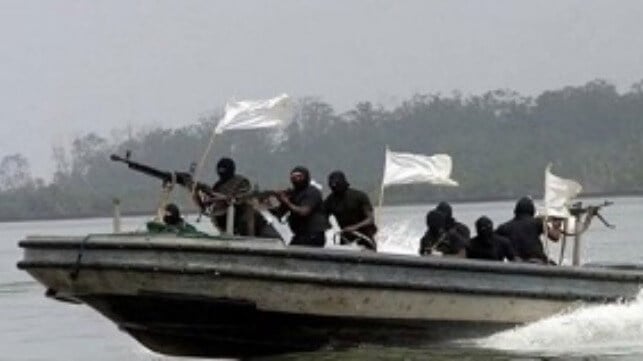
A product tanker was robbed as incidents continue across West Africa and the Gulf of Guinea region (file photo)

Published Apr 23, 2025 1:08 PM by The Maritime Executive


A product tanker traveling more than 100 nautical miles south of the Nigerian coast was boarded earlier this week. Security services are saying the crew was well prepared and remained safe and while it was the first recent incident, the risks remain high across the Gulf of Guinea and in West Africa.

The official report from Maritime Domain Awareness for Trade – Gulf of Guinea (MDAT-GoG) says the boarding took place on April 21 and involved four individuals. They reportedly approached the vessel at high speed in a black-hulled craft and remained aboard for nearly four hours taking personal property and equipment from the vessel before fleeing.

Security consultants Neptune P2P Group is highlighting that the captain and crew were well-prepared and followed mitigation recommendations quickly fleeing to the citadel where they remained during the incident. The perpetrators may have tried to enter the citadel or Martin Kelly, Head of Advisor at EOS Group, speculates it was a possible attempt at kidnapping because the pirates remained aboard for nearly four hours. The crew was unharmed according to the authorities.

The official reports did not name the vessel involved, but in an unconfirmed report, Neptune P2P says it was the Sea Panther, a 13,000 dwt chemical tanker with Greek ownership and registered in the Marshall Islands. The vessel’s AIS shows it departed Lomé on April 20 and arrived on April 23 at Douala, Cameroon.

While it is the first reported incident involving a commercial vessel near Nigeria in years, the dangers remain high in the region. Yesterday, the Nigerian authorities confirmed that a well-known fashion designer from Port Harcourt had been murdered by pirates. The individual named Hope Georgewill was kidnapped on March 26 and his family reportedly paid a ransom of approximately $1,250. The police reported they recovered his body and that they also raided the pirates' hideout killing four individuals and recovering a stash of weapons, outboard motors, and other equipment. 

The Nigeria Security and Civil Defence Corps also reported on April 19 that one of its personnel was killed during a shootout with a pirate group. The incident took place in the Niger Delta Region.

MDAT-GoG’s data shows that in April alone there have been four incidents including an attempted robbery off Monrovia, Liberia, and boardings near Accra, Ghana, and Abidjan in Cote d’Ivoire. Security services have also warned of continuing pirate group activity to the south in the region between Equatorial Guinea and São Tomé e Principe.

The current incident is reported by Neptune P2P as the fifth boarding in the Gulf of Guinea in 2025. The group highlights a 30 percent increase in activity over the same period in 2024.

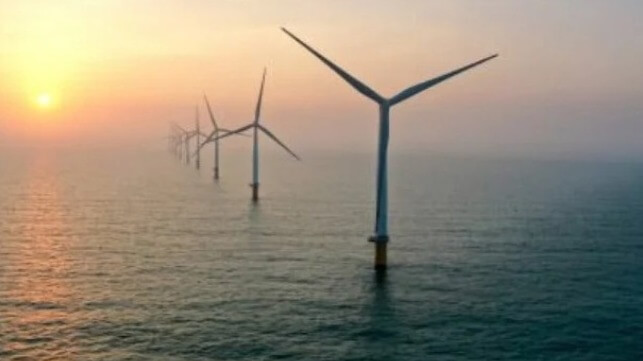
 

Wind Industry Installs Record Capacity in 2024 Despite Policy Instability

offshore wind farm
Installation of wind power is continuing globally despite growing instability (file photo)

Published Apr 23, 2025 4:03 PM by The Maritime Executive


The Global Wind Energy Council is out with its annual report highlighting that 2024 was a record year for new capacity, with 117 GW of wind energy installed across the world. However, it also pointed out that although 2024 was another record year for wind installations the headline numbers mask big disparities in terms of the pace of deployment across global markets, and now trade wars and political instability threaten the progress for the sector.

The lion’s share of installations in 2024 however also took place in a small number of key mature markets, including China and Europe. Much of the progress also came onshore where 109 GW was added while just 8 GW was installed offshore. Globally it reports capacity has reached 1,136 GW, spread across all continents and with 55 countries installing wind turbines in 2024.

China led the way for new installations in 2024 with 79824 MW of new capacity while surprisingly despite growing opposition the U.S. was second (4058 MW) edging out Germany. India and Brazil rounded out the Top 5 in 2024.

There was record growth in other regions, including Asia-Pacific (7 percent), while Africa & Middle East saw a 107 percent growth rate, driven by Egypt installing 794 MW and Saudi Arabia’s 390 MW. North America, LATAM, and Europe experienced a decline in new installations compared with 2023. 

“Once again, the wind industry has broken new installation records, despite more challenging macroeconomic headwinds over the last few years,” said Ben Backwell, CEO of GWEC. “The aggressive stoking of tariff wars adds further uncertainty to international investment decisions and threatens to disrupt the international supply chains which the wind industry relies on. The full costs on our industry of the wide array of declared and threatened tariffs we have seen – both general and on specific commodities such as steel - have yet to be fully calculated.”

GWEC, however, warns of increasing policy instability in some markets and points to the need to improve permitting, grid transmission, and auctioning mechanisms. It says these steps are critical to keep pace with the global trend for electrification, meet countries’ energy and climate targets, and lessen reliance on volatile fossil fuels. It also sees this as critical to fulfilling globally agreed ambitions to triple renewable energy capacity by 2030. 

 “It's vitally important that policymakers around the world don’t take their eyes off the prize, ensure stable and predictable market frameworks, work within multilateral frameworks to ensure free and fair trade,” says Blackwell. He says governments must work with investors and the industry to enable rapid deployment of clean, efficient wind power to support economic growth, resilience, and prosperity.

The report forecasts a compound average growth rate of 8.8 percent for the wind industry, projecting an additional 981 GW of wind energy capacity across the globe by 2030. GWEC’s Market Intelligence service sees consecutive record years through to 2030, with 138 GW of new capacity in 2025, 140 GW in 2026, 160 GW in 2027, 167 in 2028, and a leap in 2029 and 2030 to 183 GW and 194 GW respectively. 

GWEC’s forecast for 2025-2030 sees offshore wind rise from 16 GW in 2025 to 34 GW, with offshore moving from 11.8 percent of new capacity to 17.5 percent of new capacity by the end of the decade.  

This year’s Global Wind Report focuses on four key challenges the market faces, including financial and macroeconomic headwinds, trade barriers and market fragmentation, inadequate procurement and auctioning frameworks, and challenging investment conditions in the global wind energy supply chain. 

Wednesday, April 23, 2025


Antwerp Surpasses Rotterdam in Q1 Containers as Ports Fear U.S. Tariffs

Port of Antwerp
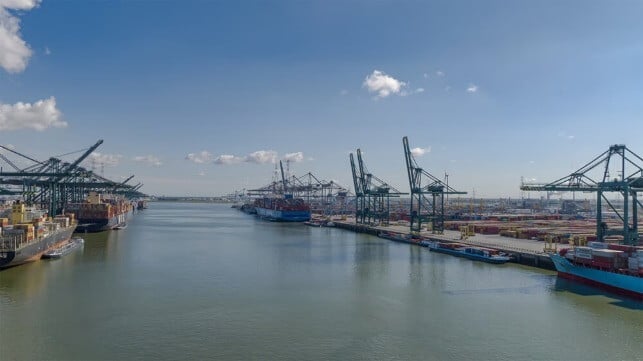
Antwerp was Europe's busiest container port in Q1 but is waiting to seethe impact of U.S. tariffs (Antwerp-Bruges)

Published Apr 23, 2025 6:39 PM by The Maritime Executive


In a surprise development, the Port of Antwerp-Bruges surpassed the Port of Rotterdam for container volume during the first quarter of 2025. Traditionally Europe’s second busiest port, Antwerp-Burges highlighted its market share in the Hamburg-Le Havre Range increased to 30.5 percent, and on a global level, the port climbed one position to reach 14 in the ranking of largest ports, but like all its peers, the port is anticipating a tough period in the coming months related to the unrelenting tariff policy of Donald Trump.

Antwerp-Bruges released its first quarter throughput performance highlighting the strength of its container business while reporting an overall decline largely driven by a sharp decrease in bulk volumes. Container throughput however was up 4.6 percent in tonnage and 4.5 percent in TEUs. The ports handled 3,436,000 TEUs. By comparison, the Port of Rotterdam which has long dominated in Europe reported a 2.2 percent increase in TEUs to 3,364,000.

The Belgian port said the growth came amidst the transition to the new alliances among liner companies, industrial actions including a paralyzing port strike, and congestion at other ports, which also contributed to longer container dwell times for Antwerp-Bruges. Rotterdam said its tonnage decreased due to an eight percent decline in loaded exports, a decline in the number of transshipment containers, bad weather in January, and an operational dispute at one of its terminals which resulted in fewer ship visits, delays, and lower productivity.

During the quarter, Antwerp-Bruges handled 67.7 million tonnes of cargo, reporting a four percent overall decline, citing the weak performance in the bulk categories. Liquid cargo recorded the sharpest decline, falling by 19.1 percent impacted by gasoline, naphtha, and LNG. The segment is not only feeling the impact of sanctions against Russia and the struggling European petrochemical sector but has also been hit by changing market conditions in Africa. Belgium’s ban on high-sulfur and benzene fuels exports to Africa is having material negative effects on shipments.

Rotterdam also reported an overall 5.8 percent decline in first quarter throughput. It said the decline was also mostly due to less throughput of crude oil and oil products, iron ore, and coal.

“We are in particularly uncertain times, which makes it difficult to predict what 2025 will bring next. But as in previous crises, our port is showing resilience and operational reliability,” said Jacques Vandermeiren, Port of Antwerp-Bruges CEO. “At the same time, the protectionist measures taken by the United States make it clear that Europe needs to make a stronger commitment to robust economic policies in order to strengthen our industry and anchor its strategic position.”

Historically, the United States has been the second-largest global trading partner of Port of Antwerp-Bruges for over two decades. In 2024, the maritime trade volume accounted for approximately 10 percent of the port's overall cargo traffic. Of this, 11 million tonnes were exported to the U.S., with the port handling over 200,000 cars bound for the U.S. as well as auto and machinery parts (mostly from Germany), chemicals, vehicles, food, plastics, and pharmaceuticals. 

Executives at the Port of Rotterdam expressed similar concerns. They noted that import duties imposed by the United States on goods exported from Europe had yet to have an effect on first-quarter throughput but were creating uncertainty.

“The first three months of this year were characterized by a high degree of volatility in world trade as a result of threatened import duties in the United States and conflicts in Ukraine and the Middle East,” said Boudewijn Siemons, CEO of Port of Rotterdam Authority. “This volatility has led to uncertainty among companies in the areas of trade and investment. We see this reflected in throughput volumes and the willingness to invest. In these uncertain times, it remains as important as ever that, together with national and European governments, the Port of Rotterdam continues to work towards a competitive European investment climate.”


In the Know 68: Joseph Morris, CEO and Port Director for Port Everglades

Port Everglades
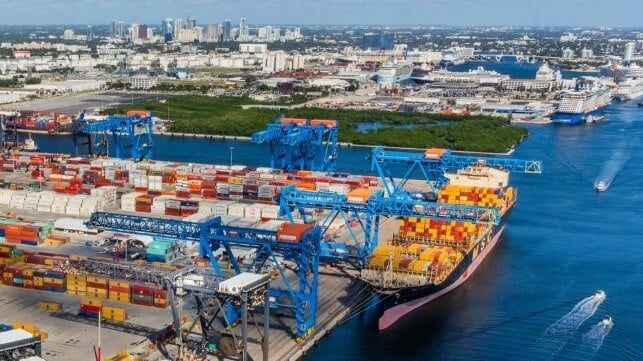
Image courtesy Port Everglades

Published Apr 23, 2025 5:45 PM by The Maritime Executive


Port Everglades ranks as the world’s third busiest cruise home port, and it is the main port for petroleum products in South Florida. It's a self-supporting enterprise fund of Broward County, Florida and generates more than $26 billion in economic activity, supporting about 11,000 direct jobs. It's a key hub for the region's shipping needs, and handles about one million TEU worth of containerized cargo a year. 

To get all the details about the port's operations and its positive impact, TME founder and editor-in-chief Tony Munoz spoke with port CEO and director Joseph Morris, who has over twenty-five years of experience in the ports sector. For the full conversation, listen in below. 

The opinions expressed herein are the author's and not necessarily those of The Maritime Executive.


Gas Leak on a Barge Prompts Community Alerts on Houston Ship Channel

Houston Ship Channel
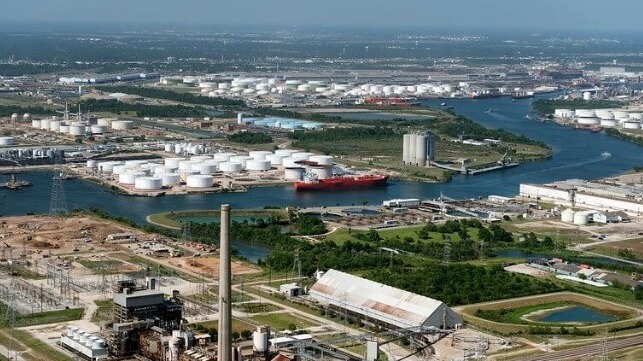
File image courtesy U.S. State Department

Published Apr 23, 2025 7:15 PM by The Maritime Executive


On Tuesday, a gas leak on a barge on the Houston Ship Channel prompted community alerts on the key energy-infrastructure corridor, but local officials say that no air quality threats have been detected and residents have the all-clear. 

Operator Kirby Inland Marine told local media that a vapor release occurred aboard a barge at the Targa Resources dock in Galena, Texas. A valve leak released an unspecified quantity of butadiene, a common industrial gas used for making plastics and synthetic rubber (like car tires). 1,3-butadiene is an EPA-listed carcinogen, an inhalation irritant, and highly flammable. Luckily, it breaks down quickly in the atmosphere, limiting the time in which it can have an effect. 

The leak occurred because of a broken valve, according to local CW39 Houston. It was contained by late Tuesday, and the barge was towed to a safe location for further evaluation. The Houston Ship Channel has reopened to full service, and the City of Galena Park says that there are no air quality threats to the public. 

No injuries were reported from the gas leak. 


For a Veterans March on Washington


In May 1932, jobless WWI veterans organized a group called the a march on Washington. 43,000 demonstrators including 17,000 veterans their families, and affiliated groups gathered to demand to demand compensation from the Federal Government for their sacrifices in World War 1. That march and it’s suppression by the military was a key factor in the overturning of a deeply reactionary Republican Administration and the onset of the New Deal.

In this same month of May 2025, plans are being made in Washington for a military parade by Donald Trump for his birthday on June 14, honoring himself. All this is occurring in the face of his planned cut of 72,000 employees in the Veterans Administration to improve “efficiency” on an agency with an already existing reputation for taking forever to process disability claims that are vital to the health of our veterans.

This is also occurring at a time when over 30,000 US war veterans are homeless and when nearly 26% of active-duty service members are considered food insecure, and about 15% rely on food stamps or food banks to help support their families.

It’s well past time that the United States government to put less care about it’s patrons at Lockheed Martin and more care into their soldiers and veterans. It’s time to build for a new Veterans March on Washington on June 14 to counter this military parade honoring this aspiring dictator, and this is the best way to defeat him.

This is not just a moral question alone but a tactical one as well. The crux of Trump or any would-be dictator in history succeeding is based on the support of their rank and file soldiers and these are the same troops that are being grossly underpaid, exploited and expendable in the pursuit of the reckless dreams of our “fearless leader”.

Trump has openly declared that he intends to use military force against political dissent in this nation and the question of whether these same exploited soldiers are ready to pull the trigger is pivotal as to whether he succeeds or fails. They will have to choose on whether or not to stand down and uphold the US Constitution. The stark choice will be to to either resist or to follow the path of least resistance.

All of our efforts against Trump cannot and will not succeed unless and until we put the issues facing our troops and veterans front and center and June 14 is the day to do it.FacebookTwitterRedditEmail

Gabe Ignetti is a former Vice-President at Large of the Central Labor Council of th U.S. Virgin Islands. He has served on the board of 350 South Florida and is a retired public school teacher living in Florida. He can be reached at: gabeignetti@yahoo.comRead other articles by Gabe.


Ending the US Dollar’s Exorbitant Privilege


The Selling of America


Has the love, or even more so the fixation, gone with the US dollar, that all cushioning reserve currency that has shown itself unimpeachable for decades?  A curious event teasing and ruffling currency watchers and financiers is becoming a pattern: the US dollar is being sold off, suggesting it has lost its princely shine.  To this can also be added the sale of US Treasuries.

Even before the global imposition of Donald Trump’s tariff-driven bonanza and his public bruising of Federal Reserve chairman, Jerome Powell, the world’s dominant currency was already being moved on.  Since 2014, the Chinese and Russian central banks have tried to move out of US Treasury holdings, preferring the magic of gold.  In 2022, the latter went so far as to link its currency, the ruble, to gold.

For all that, something far more dramatic would be needed to upset the status of the dollar, and certainly the authority of its “exorbitant privilege”, to use that apt term coined in the 1960s by the then French Minister of Finance, Valéry Giscard d’Estaing.  Only “serious economic and financial mismanagement by the United States”, proposed economics professor Barry Eichengreen in 2010, “could precipitate flight from the dollar.”

In the autumn leading to the 2024 presidential election, there was little to suggest any such flight.  The dollar had markedly appreciated, boosted by the statistical astrology of US economic growth.  This continued after Trump’s victory in November.  The promise of a vigorous tariff policy, one potentially inflationary, also charmed investors keen to make greater returns from their dollars, assuming a raise of interest rates by the Federal Reserve.

The tariff policy well and truly arrived on “Liberation Day” (April 2), proving to be erratic, arbitrarily derived and often economically illiterate in application.  The precipitated fall of the greenback shocked the currency pundits.  “For several years, the market’s been buying this US growth story, the US stock market’s been outperforming other stock markets, and suddenly you had economists thinking tariffs would push the US into recession,” remarks Jane Foley, head of foreign exchange (FX) strategy at Rabobank.  Additionally, the tariff regime has encouraged countries with current account surpluses denoted in US assets to consider returning them back to domestic markets, something that will further weaken the dollar.

Trump has also lost patience with Powell, petulantly ventilating on Truth Social that the Federal Reserve chair impose pre-emptive cuts to interest rates, given the White House’s own assessment that the US faces no inflation.  There would be, declared Trump in a post, a “SLOWING of the economy unless Mr. Too Late, a major loser, lowers interest rates, NOW.”  While Europe continued to lower its rates, Powell had proved himself slow on the draw, “except when it came to the Election period when he lowered in order to help Sleepy Joe Biden, later Kamala, get elected.”

In the angry mist, the President floated the possibility that the central banker might be removed.  His “termination” could not “come fast enough.”  He also charged his advisors to distribute poisoned packages of speculation as to what he intended to do with the recalcitrant Powell.  White House National Economic Council Director Kevin Hassett obliged, telling reporters that, “The President and his team will continue to study that matter [of removing Powell].”

Then, in true seesaw fashion, the President claimed the opposite of what he meant, a move that also sent the market into another galloping spree.  “I have no intention of firing him,” Trump told reporters on April 22. “I would like to see him be a little more active in terms of his idea to lower interest rates.”

In the tumult of it all, investors are scouring other havens, shunning the status quo and traditional sensibility of the dollar.  The Japanese yen and Swiss franc are returning to favour.  As is the euro.  While an economist’s word should never be taken as gospel, chief currency analyst at ForexLive, Adam Button offers his view: “The market wants to invest in the fastest growing places, and the US administration is showing that it is not trying to maximize growth, or they have a different idea about how to get there.  And I think that’s rattled the market.”

Curious events are unfolding as a result of Trump’s carnivalesque approach to trade and markets.  While the value of the greenback has fallen, the returns from 10-year US government bonds have risen.  This is the sort of thing common in new, emerging markets, where capital is susceptible to flight amidst conditions of volatility. In the US, this is the fifth time it has happened in three decades.  Even with the rise in bond yields, the dollar’s slide has not been arrested.

For the easily panicked, a particular safe haven – and one already identified by central bankers and investors – is gold.  With US government debt no longer attractive for traders, the yellow metal has outperformed most major assets with its giddying rise.  Having passed $US3,500-an-ounce on April 22, the favouring of gold is merely one aspect of a market narrative that has turned the Trump Tariff Wall into the Selling of America.

Crystal ball gazing is a mug’s game in economics, but countries wishing to see the defanging of dollar diplomacy and greenback bullying long used by Washington to maintain power will see flashes of opportunity.  The dollar’s privilege may no longer be exorbitant.

Binoy Kampmark was a Commonwealth Scholar at Selwyn College, Cambridge. He lectures at RMIT University, Melbourne. Email: bkampmark@gmail.comRead other articles by Binoy.

Challenges to Nepal’s Republican Structure from Monarchists and Why?


On March 28, 2025, pro-republic and pro-monarchy forces organised rival protests in Nepal’s capital, Kathmandu, to showcase public support for and against the Republic. According to the Ministry of Home Affairs, about 4,000 people attended the pro-monarchy rally, while around 35,000 joined the pro-republican protest. This was the second major monarchist demonstration following a bigger rally welcoming the king back from Pokhara on March 9. Pro-monarchy forces have been increasingly active, particularly after the former king Gyanendra Shah’s provocative statement on the eve of Democracy Day (February 19).

Sensing the offense of counterrevolutionary forces, the pro-republican protest, organized under the Socialist Front, an alliance of the four opposition left parties, aimed to counter what they call reactionary and regressive forces. While the republican demonstration remained peaceful, the monarchists turned violent, vandalizing public and private property and attacking security personnel. In the aftermath, two people lost their lives, and several were injured.

The violent pro-monarchy demonstration sparked intense debate. Republicans claim the monarchists attempted to create chaos and exploit the crisis while the government also accused them of inciting violence. The monarchists, however, argue they faced suppression from the police.

Pro-monarchy protestors turn violent in Tinkune and Kathmandu. Source: Online People’s News

Recognising the impact of March 28 protests, inside and outside Nepal, the monarchists are planning nationwide protests and have already formed a joint coordination committee. Meanwhile, after the monarchists vandalised the Communist Party of Nepal (Unified Socialist) [CPN (US)] headquarters and damaged properties, the Socialist Front has committed to defend the achievements of the peaceful People’s Movement of 2006, which abolished monarchy and paved the way for a socialism-oriented constitution. Uncertainty remains, but two things are evident: Monarchists are uniting and mobilising aggressively, while republican forces remain firm. This could strengthen left unity, though questions persist about division within the largest parties, the Communist Party of Nepal (Unified Marxist–Leninist) [CPN (UML)]) and Nepali Congress (NC) on republicanism.

NC leader Sher Bahadur Deuba may support the Republic, but it is an open secret that many others within his party favour Hindu nationalism and monarchy, and oppose the federal structure of Nepal. There many who question the ruling CPN (UML) asking if its top leadership is pro-monarchy, even while acknowledging that majority oppose the monarchy within the party. The fourth-largest party, the independent Rastriya Swatantra Party (RSP), and Kathmandu’s mayor, rapper Balen Shah, are exploiting the situation to challenge traditional parties and the current political system. There are reports that the monarchists are backed by Indian forces – the ruling regime, the Rastriya Swayamsevak Sangh’s (RSS) active role in Nepal, and the Uttar Pradesh Chief Minister Yogi Adityanath – who are supporting financially, politically, and even militarily. The republicans struggle in Nepal for defending constitutional democracy will not be that easy.


Mekha Limbu(Nepal), We are on the way to death, 2012.

Historical Context and Dialectics

Nepal’s unpredictable politics cannot be understood without historical, dialectical, and global perspectives. Its geopolitical location, India-China rivalry, Hindu fundamentalism, US influence, and EU interests, the recent populist tendencies, etc. have turned Nepal into a battleground for power struggles. When leftist coalitions emerge to govern the country India in alliance with the US and right-wing forces, works to weaken them. Internal party rifts further destabilize the government. Therefore, it may be seen that all the forces within the nation and outside, will unite to weaken Nepali state and create further crisis.

Political instability has been a great challenge of Nepalese democracy. Nepal’s political instability is evident in its frequent government changes – 32 since multiparty democracy was restored in 1990, and 13 since Nepal became a republic in 2008. The current government that ruling Nepal is the 14th.

On top political instability, the republicans in Nepal underestimated the monarchy’s revival. Even leftist forces overlooked the resurgence of counterrevolutionary elements. Some self-proclaimed theoreticians focused solely on comprador bourgeoisie as the enemy of Nepal’s working class while ignoring conservatives, reactionaries, and fundamentalists. As previously noted, after overthrowing the monarchy, there was no significant effort to transform production relations in Nepal and create alternative cultural structures, leaving ample space for people to aspire for the monarchy’s return.

Mass media and social media blame top leaders Deuba, K. P. Sharma Oli, and Prachanda, who have collectively ruled for decades, for the crises. Deuba has been prime minister six times, Oli four, and Prachanda three. Other former PMs still lead parties and remain active. These aging leaders have dominated Nepal’s politics for 30 years. However, deeper systemic issues are more influential than people or parties.

Socialist Front rallies at Bhrikuti Mandap. Source: Online People’s News

Why Is This Happening in Nepal?

A.) Political Instability and Systemic Crisis

Nepal faces severe political instability, deep inequality, unemployment, slow economic growth, weak industrialisation, mass migration, poverty, food insecurity, and rising debt. Climate crises and disasters add to these challenges. Various forces exploit these crises for their interests. Government changes bring only new rulers, not solutions. People are increasingly frustrated with political parties and the system itself. The 2015 Constitution of Nepal, which established a federal democratic republic, is under threat. Federalism is criticised, republicanism is questioned, and neo-fascism and populism are on the rise. Pro-monarchist forces are capitalising on this turmoil. While most acknowledge Nepal’s problems, reactionary forces blame political parties and the republican system itself. They falsely claim that restoring monarchy, re-establishing a Hindu state, and ending federalism as the solutions. It is prudent to note that many of these groups receive political and financial support from Hindutva-aligned conservatives.

B.) Failure of the Government to Deliver
The current government holds a two-thirds majority, with two parties who have been historically rivals uniting. Its failure to govern effectively is seen as proof that Nepal’s political system itself is failing. This perception fuels calls for alternative governance models, including a return to monarchy.

C.) Corruption, Bad Governance, and Impunity

Recent scandals—such as the Gold Scam, Bhutanese Refugee Scam, and Giri Bandhu Tea Estate Scam—have exposed massive corruption within the state. People now believe that no political leader is clean, as all have been in power at some point. Lack of rule of law, poor governance, and impunity for corrupt leaders have enraged the public. The perception that all top leaders are involved in scandals has made accountability almost impossible.

D.) Public Frustration and Growing Anti-Establishment Sentiment

Government failure, rising unemployment, and foreign labour migration have fuelled widespread frustration. Reactionary and populist forces frame their movements as a revolt against the political establishment. This anti-establishment sentiment explains the rise of figures like Durga Prasai and Kathmandu Mayor Balen Shah. Shah’s election was largely due to public anger toward traditional parties. People are increasingly rejecting established political structures, creating space for monarchists and other challengers.

Shashi Bikram Shah(Nepal), Royal Massacre Series, 2001.

E.) Lack of Development Agendas and Weak Leadership

Nepali leaders lack a vision for national development. They show little concern for public suffering, employment opportunities, or economic growth. Instead, they are focused on power, corruption, and alliances with corporate and comprador elites. Leadership incompetence is another major issue. Most leaders have failed to demonstrate effective governance. Though they may be politically experienced, they lack the ability to transform Nepal’s economy and society.

F.) Weakening of the State and Attacks on the Left

There is lot of ideological degeneration in Nepal’s Left movements as they are heavily infiltrated by conservatives. Also, political revisionism has made the Left on the whole indistinguishable from the bourgeois parties. Many leftists have abandoned class struggle, allowing right-wing forces to gain ground. Anti-communist elements are actively working to defame Nepal’s left, weakening national sovereignty and progress. A corrupt judiciary and penetrated bureaucracy further ensure that genuine reformers are isolated or sidelined. Crime networks and muscle power dominate the political scene, making systemic change difficult.

Amid this crisis, pro-monarchy conservatives and reactionaries are exploiting public frustration. While systemic failures are widely acknowledged, these groups falsely present monarchy, Hindu nationalism, and the abolition of federalism as solutions. Many suspect these efforts are backed by right-wing Hindutva groups.

Major political parties’ failure to offer a development agenda has left a vacuum that reactionary forces are filling. The 2015 Constitution, which established Nepal as a federal democratic republic, now faces threats from both political actors and street movements. Federalism is under scrutiny, republicanism is questioned, and neo-fascist and populist movements are growing.

Urgent responses from the government and political parties are necessary. Nepal’s crisis is deeply systemic, with instability and foreign interference fuelling continued failure. Without addressing corruption, delivering reforms, and safeguarding democratic institutions, Nepal risks further regression. The world watches as one of the youngest republics struggles to navigate this precarious moment.

  • First published at Tricontinental Asia.FacebooTwitterRedditEmail
  • Pramesh Pokharel is a political analyst and part time lecturer of Anthropology at Tribhuvan University.  He is a Central Committee Member of CPN (Unified Socialist) and General Secretary of All Nepal Peasants Federation. He is a noted writer and recently, has written two books in Nepali – Socialist Transformation of Agriculture and From Big Bang to Future of Human EvolutionRead other articles by Pramesh.

    Israel Stalls and the International Court of Justice Complies


    One year ago, the International Court of Justice ruled that Israel had fifteen months to prepare their defense (“counter memorial”) against the charges of genocide filed by South Africa. They were told to present their arguments by 28 July 2025.

    That seems like a very long time in a case involving the daily killing of many people, including children. But it was not enough time for Israel, which on 27 March 2025 filed a request to extend the time.

    In a very recent decision, the International Court of Justice has obliged and extended the time by six months. Israel can continue killing with impunity, and their defense to the International Court of Justice is not required until 28 January 2026.

    There has been very little news of this decision.  The ICJ did not issue a press release, despite this being their most sensational case. Accordingly, the decision has not been reported in The New York TimesThe Washington Post, or The Guardian.  Meanwhile, Israeli media reported, “EXCLUSIVE: Israel secures six month delay in Hague Court proceedings.”

    Another important story that has been largely ignored by Western media is regarding the sole Judge who voted in favor of Israel in every single decision so far in this case. That person, Judge Julia Sebutinde, has been revealed to have grossly plagiarized the writings of two ultra-zionists:  Douglas Feith and David Brog. Feith is a co-author of the infamous Netanyahu plan, “A Clean Break: A New Strategy for Securing the Realm,” and part of the Bush/Cheney team that campaigned for the 2003 invasion of Iraq.   Brog is Jewish but helped to found Christians United for Israel. He is currently the head of Miriam Adelson’s “Maccabee Task Force”.  Anti-zionist scholar Norman Finkelstein has discovered that 32% of the ICJ judge’s pro-Israel dissenting opinion was plagiarized from Feith, Brog, and others.

    As the saying goes, “Justice delayed is justice denied.” And if nobody reports or knows about it, did it really happen?  Along with dead Palestinians in Gaza, Israel is trying and perhaps succeeding in killing the International Court of Justice.FacebookTwitterRedditEmail

    Rick Sterling is an investigative journalist in the SF Bay Area. He can be reached at rsterling1@protonmail.comRead other articles by Rick.


    Not Taking a Position on Gaza IS Taking a Position on Gaza


    It’s not okay to claim ignorance or uncertainty about what’s happening in Gaza in 2025. You’re an adult. You have internet access. If you don’t know, learn. You can’t just go “it too compwicated, me no understandy, googoo gaga.” It’s not cute and it’s not okay. Grow the fuck up.

    Not taking a position on Gaza IS taking a position on Gaza. One you’ll have to live with for the rest of your life. One you will be judged by history for. One you will have to explain to your grandkids. Failure to oppose a genocide that your own government is supporting is consenting to the genocidal status quo.

    If this is the case with you, then that’s a character flaw, and you need to change it. It’s not okay for you to be that way. Knock that shit off.

    *****

    Israel is destroying the heavy machinery needed to clear rubble and rescue people trapped under buildings in Gaza.


    https://x.com/AssalRad/status/1914818312133087627

    Countless people have died slow, agonizing deaths trapped under destroyed buildings since this nightmare began. Have you ever taken the time to deeply contemplate that? What a horrifying way to die that is? Being alive but with your body partially crushed, alone and in agony unable to move in the darkness, surrounded by members of your family who are either dead or similarly trapped, possibly for days until you die of dehydration?

    Maybe the worst part would be knowing that you’re surrounded by survivors who would like to get you out of there, but can’t because they don’t have the equipment necessary to move the enormous pieces of rubble overtop of you. Knowing you’re trapped, and you’re never getting out.

    This has happened to people countless times since the beginning of this onslaught in 2023. And Israel is going out of its way to make sure even more people die this way.

    *****

    US ambassador to Israel Mike Huckabee has rejected appeals by the World Health Organization to put pressure on Israel to end its starvation blockade on Gaza, saying, “What I would like to suggest is that we work together on putting the pressure where it really belongs — on Hamas.”

    https://x.com/USAmbIsrael/status/1914335973237805553

    Huckabee is a fanatical Christian Zionist who has said that there is “no such thing as a Palestinian” and that Israel has a right to the entirety of the West Bank.

    If you believe your religion tells you to support the butchery and starvation of the people of Gaza, then your religious beliefs are bad, and you should change them. There’s no point in having a religion if it doesn’t even help you understand that genocide is an inexcusable evil.

    There’s too much religious tolerance in our society. If you believe your religion tells you to support an active genocide, then everyone should call you an asshole and tell you to get different beliefs.

    I actually agree with conservatives who say we need to be less tolerant toward people with unwholesome religious beliefs — I just disagree about whom that intolerance should be directed toward. It’s not Muslims telling me it’s right to support the Gaza holocaust, it’s Christian Zionists and Jewish Zionists. They belong to death cults which tell them that God wants them to support these profoundly evil things. These death cults should not exist, and anyone who belongs to them should leave. It should not be even slightly controversial to say this.

    I don’t care what you believe about any deity or deities or how we should live or what happens to us after we die. Believe whatever you want as pertains to you and yours. But if your religious beliefs tell you to support Israel’s daily massacres and mass starvation, then your religious beliefs are bad, and people should not be tolerant toward them.FacebookTwitterRedditEmail

    Caitlin Johnstone has a reader-supported Newsletter. All her work is free to bootleg and use in any way, shape or form; republish it, translate it, use it on merchandise; whatever you want. Her work is entirely reader-supported, so if you enjoyed this piece and want to read more you can buy her books. The best way to make sure you see the stuff she publishes is to subscribe to the mailing list on Substack, which will get you an email notification for everything she publishes. All works are co-authored with her husband Tim Foley. Read other articles by Caitlin.