It’s possible that I shall make an ass of myself. But in that case one can always get out of it with a little dialectic. I have, of course, so worded my proposition as to be right either way (K.Marx, Letter to F.Engels on the Indian Mutiny)
Wednesday, December 24, 2025
Invisible but deadly: Scientists warn of a growing global threat from amoebae in water and the environment
Biochar Editorial Office, Shenyang Agricultural University
Credit: Jianyi Zheng, Ruiwen Hu, Yijing Shi, Zhenzhen He & Longfei Shu
A group of environmental and public health scientists is sounding the alarm on a largely overlooked but increasingly dangerous group of pathogens: free living amoebae. In a new perspective article published in Biocontaminant, the researchers highlight how these microscopic organisms are becoming a growing global public health threat, fueled by climate change, aging water infrastructure, and gaps in monitoring and detection.
Amoebae are single celled organisms commonly found in soil and water. While most are harmless, some species can cause devastating infections. Among the most notorious is Naegleria fowleri, often referred to as the brain eating amoeba, which can trigger a rare but almost always fatal brain infection after contaminated water enters the nose during activities such as swimming.
“What makes these organisms particularly dangerous is their ability to survive conditions that kill many other microbes,” said corresponding author Longfei Shu of Sun Yat sen University. “They can tolerate high temperatures, strong disinfectants like chlorine, and even live inside water distribution systems that people assume are safe.”
The authors also emphasize that amoebae act as hidden carriers for other harmful microbes. By sheltering bacteria and viruses inside their cells, amoebae can protect these pathogens from disinfection and help them persist and spread in drinking water systems. This so called Trojan horse effect may also contribute to the spread of antibiotic resistance.
Climate warming is expected to worsen the problem by expanding the geographic range of heat loving amoebae into regions where they were previously rare. Recent outbreaks linked to recreational water use have already raised public concern in several countries.
The researchers call for a coordinated One Health approach that connects human health, environmental science, and water management. They urge stronger surveillance, improved diagnostic tools, and the adoption of advanced water treatment technologies to reduce risks before infections occur.
“Amoebae are not just a medical issue or an environmental issue,” Shu said. “They sit at the intersection of both, and addressing them requires integrated solutions that protect public health at its source.”
===
Journal reference: Zheng J, Hu R, Shi Y, He Z, Shu L. 2025. The rising threat of amoebae: a global public health challenge. Biocontaminant 1: e015
About Biocontaminant: Biocontaminant is a multidisciplinary platform dedicated to advancing fundamental and applied research on biological contaminants across diverse environments and systems. The journal serves as an innovative, efficient, and professional forum for global researchers to disseminate findings in this rapidly evolving field.
Credit: Neng Yan, Alessandro Parodi, Fei Dang & Jianbo Shi
Invisible pollutants at the nanoscale are quietly entering bodies and ecosystems, yet standard toxicology tools still treat living organisms like a black box. A new perspective article in the journal New Contaminants describes how cutting edge bioimaging is turning that black box into a transparent map, revealing where these particles go and how they may harm health.
Lighting up hidden nano pollution
Emerging nanoscale contaminants such as engineered nanomaterials and nanoplastics are now found in water, soil, food and even the air we breathe, but their tiny size and complex behavior make them hard to track with traditional methods. Conventional toxicology usually looks only at endpoints, like tissue damage, and often misses the step by step journey and subtle early effects of these particles inside living organisms.
The new paper highlights advanced bioimaging tools that can follow nanoscale contaminants in real time, from the moment they enter cells to their accumulation in organs and eventual clearance from the body. These methods range from high resolution electron microscopy to whole body imaging, with fluorescence imaging emerging as a central bridge between cellular details and organism level effects.
A new class of “switch on” probes
A key focus of the article is a special group of fluorescent probes called aggregation induced emission luminogens, or AIEgens, which become brighter instead of dimmer when they clump together. This unusual property directly addresses a major limitation of traditional dyes, which often lose their signal when particles aggregate, exactly when scientists most need to see them.
“AIE technology allows us to watch the entire life cycle of nanoscale pollutants in living systems, from their first contact with cells to long term storage in organs, without losing sight of them over time,” says lead author Dr Neng Yan of China University of Geosciences. Because AIEgens are highly photostable and compatible with biological systems, they can support long term time lapse imaging that captures slow, chronic effects relevant to real world environmental exposures.
From cell level events to whole body maps
Using AIE labeled particles, scientists can distinguish how nanoplastics or metal based nanoparticles enter cells, for example via rapid clathrin mediated endocytosis or slower macropinocytosis, and follow them as they move through endosomes and lysosomes. Sudden changes in fluorescence patterns can even reveal critical events such as lysosomal membrane rupture, which is linked to toxicity.
At the tissue and organ level, AIE based imaging can be combined with tissue clearing and light sheet microscopy to build three dimensional “cartographies” of where contaminants accumulate, including in sensitive regions like the brain. In live animals, near infrared AIE probes in the NIR I and NIR II windows allow deeper imaging with less background, enabling researchers to quantify how quickly particles cross barriers, circulate through blood vessels and are eventually eliminated.
Toward predictive toxicology for the nano age
The authors note that important challenges remain, including avoiding disturbance of particle behavior by labels, balancing resolution with penetration depth and handling the huge volumes of imaging data. They argue that the next leap will come from combining smarter multimodal probes, integrated imaging workflows and artificial intelligence driven analytics that can turn images into predictive models of toxicity.
“By visualizing where nanoscale contaminants go and how they interact with cells over time, we can move from simply observing damage to forecasting risk and designing safer materials before they are released into the environment,” says co author Prof Jianbo Shi of the Chinese Academy of Sciences. The perspective concludes that such imaging powered, predictive toxicology frameworks will be essential to ensure that the benefits of nanotechnology are realized without compromising environmental and human health.
===
Journal reference: Yan N, Parodi A, Dang F, Shi J. 2025. Shedding light on the invisible: aggregation-induced emission-based bioimaging for assessing the environmental impact of emerging nanoscale pollutants. New Contaminants 1: e019
Shedding light on the invisible: aggregation-induced emission-based bioimaging for assessing the environmental impact of emerging nanoscale pollutants
Article Publication Date
17-Dec-2025
From waste to wonder: Universiti Sains Malaysia engineers a precision adsorbent to capture antibiotic pollutants
Dr. Azam Taufik Mohd Din’s team at Universiti Sains Malaysia unveils SiO₂@MIPs-CAPcr—a highly selective, reusable adsorbent for chloramphenicol removal, powered by advanced ARGET ATRP synthesis
Biochar Editorial Office, Shenyang Agricultural University
Credit: Zulkarnain Mohamed Idris, Siti Kartini Enche Ab Rahim, Bassim H. Hameed, Lei Ye & Azam Taufik Mohd Din
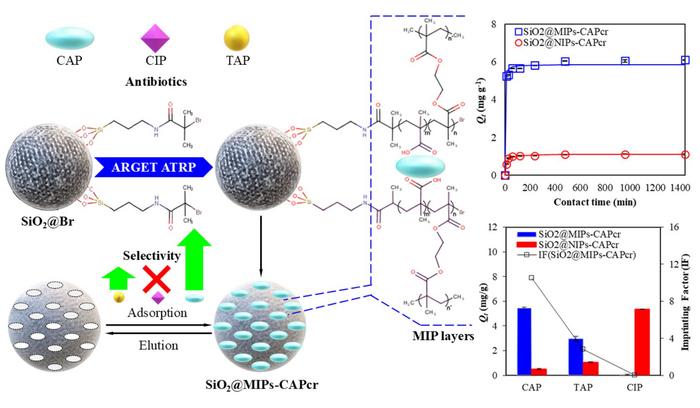
Published on November 12, 2025, in the open-access journal Carbon Research (Volume 4, Article 69), the study introduces SiO₂@MIPs-CAPcr—a novel surface-imprinted polymer grafted onto ordered mesoporous silica—engineered specifically to capture chloramphenicol (CAP), a widely used but environmentally persistent antibiotic.
Led by Dr. Azam Taufik Mohd Din from the School of Chemical Engineering, Universiti Sains Malaysia, the work combines cutting-edge polymer chemistry with practical environmental engineering to tackle one of today’s most pressing water quality challenges.
The Problem: Antibiotics Don’t Just Disappear
When antibiotics like chloramphenicol enter rivers, lakes, or groundwater—through agricultural runoff, pharmaceutical waste, or inadequate wastewater treatment—they don’t just vanish. They accumulate, fuel antimicrobial resistance, and disrupt ecosystems.
Conventional filtration methods often lack the precision to remove specific contaminants without also stripping beneficial minerals or requiring costly processes. What’s needed is selectivity—and reusability.
Enter SiO₂@MIPs-CAPcr: A Molecular “Lock” for CAP
The team developed their adsorbent using activator regenerated by electron transfer atom transfer radical polymerization (ARGET ATRP)—a controlled, efficient technique that allows precise grafting of molecularly imprinted polymers (MIPs) onto a silica scaffold.
First, they synthesized a silica-based initiator (SiO₂@Br) with uniform spherical nanoparticles, confirmed via XRD, SEM, and HRTEM. This material boasted an impressive specific surface area of 638.31 m²·g⁻¹ and a total pore volume of 0.4152 cm³·g⁻¹—ideal for high-capacity adsorption.
Then, using CAP as a template, they grew a thin MIP layer around it. After removing the template, the resulting cavities perfectly matched the size, shape, and chemical features of CAP molecules—like a lock waiting for its key.
FTIR, TGA, TEM, and XRD analyses confirmed successful polymer grafting. As expected, the final SiO₂@MIPs-CAPcr showed reduced surface area and pore volume compared to the bare silica—but gained extraordinary selectivity.
Performance That Delivers
Under optimized batch conditions, the adsorbent achieved a maximum CAP adsorption capacity of 19.68 mg·g⁻¹, following a pseudo-second-order kinetic model. Thermodynamic analysis revealed the process was spontaneous and exothermic—meaning it works efficiently even at ambient temperatures.
Most impressively, SiO₂@MIPs-CAPcr showed strong preference for CAP over structurally similar antibiotics like thiamphenicol (TAP) and ciprofloxacin (CIP). Even after four regeneration cycles, it retained over 93% of its original capacity—losing only 6.87%—proving its robustness and cost-effectiveness.
“This isn’t just about adsorption—it’s about intelligent design,” says Dr. Azam Taufik Mohd Din, corresponding author and researcher at Universiti Sains Malaysia’s Engineering Campus in Nibong Tebal, Penang. “By combining molecular imprinting with ordered mesoporous silica, we’ve created a material that’s both highly specific and durable.”
A Malaysian Innovation with Global Impact
Based at one of Southeast Asia’s top research universities, Dr. Azam’s lab exemplifies how advanced chemical engineering can address real-world sustainability challenges. Universiti Sains Malaysia—particularly its School of Chemical Engineering—has emerged as a regional leader in materials science for environmental applications.
And because the paper is published open access, scientists, water treatment facilities, and regulatory agencies worldwide can immediately apply these insights—accelerating deployment beyond the lab.
The Bigger Picture: Tailored Solutions for a Cleaner Planet
This breakthrough isn’t limited to chloramphenicol. The same ARGET ATRP-driven approach can be adapted to target other pollutants—pesticides, hormones, industrial dyes—simply by changing the molecular template.
In a world where water security and antibiotic resistance are urgent global priorities, SiO₂@MIPs-CAPcr offers more than performance. It offers precision. Reusability. And hope.
Thanks to the ingenuity of Dr. Azam Taufik Mohd Din and his team at Universiti Sains Malaysia, the future of water purification is not just cleaner—it’s smarter, one molecule at a time.
===
Journal reference: Mohamed Idris, Z., Enche Ab Rahim, S.K., Hameed, B.H. et al. ARGET ATRP based surface-imprinted polymer-ordered mesoporous silica composites for selective chloramphenicol adsorption. Carbon Res.4, 69 (2025).
The journal Carbon Research is an international multidisciplinary platform for communicating advances in fundamental and applied research on natural and engineered carbonaceous materials that are associated with ecological and environmental functions, energy generation, and global change. It is a fully Open Access (OA) journal and the Article Publishing Charges (APC) are waived until Dec 31, 2025. It is dedicated to serving as an innovative, efficient and professional platform for researchers in the field of carbon functions around the world to deliver findings from this rapidly expanding field of science. The journal is currently indexed by Scopus and Ei Compendex, and as of June 2025, the dynamic CiteScore value is 15.4.

No comments:
Post a Comment