Thursday, May 01, 2025

Requiem for May Day: A Diary of Encampment Protest
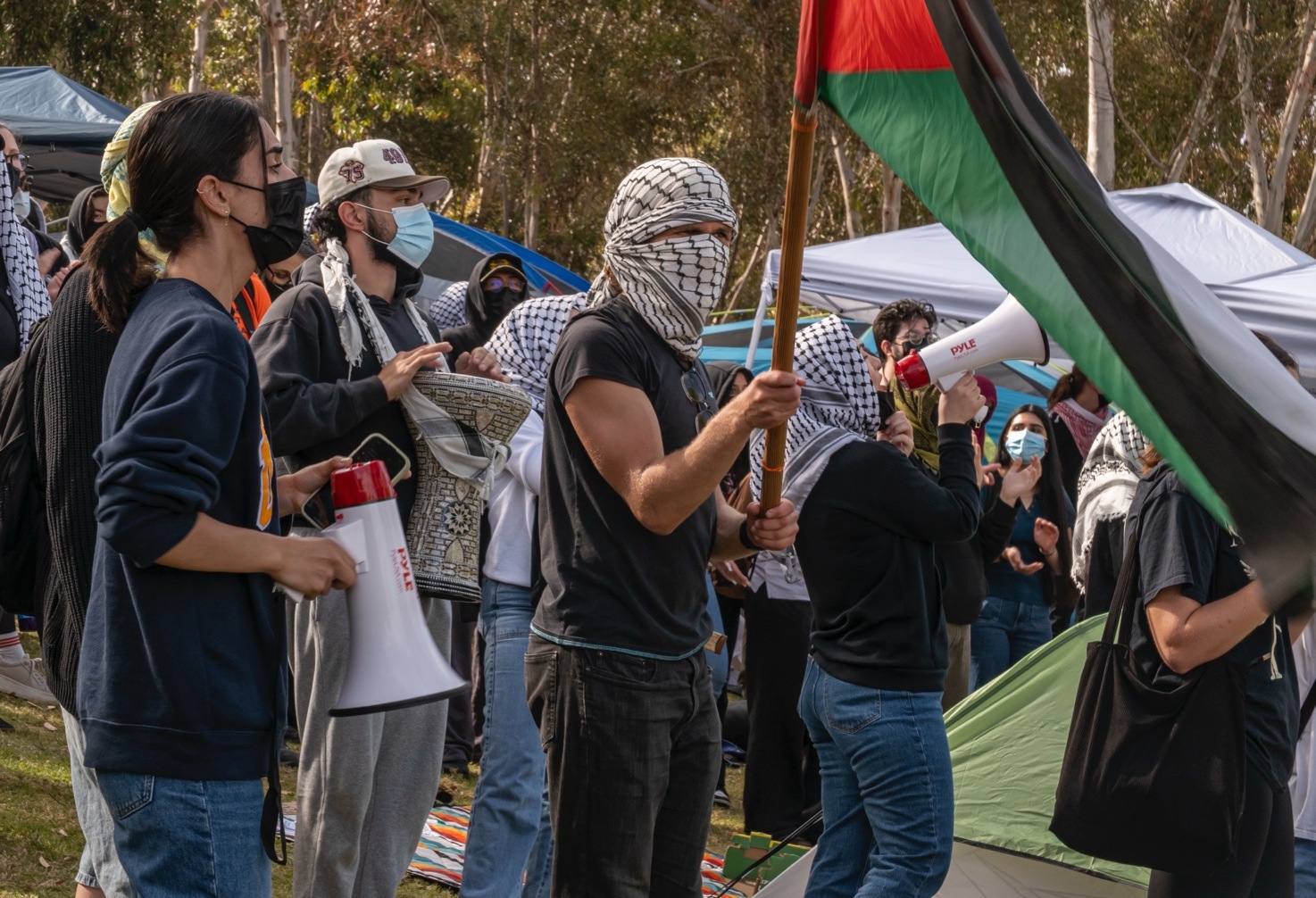
PHOTO  ESSAY

 May 1, 2025
Facebook
A group of people holding a flag and megaphoneAI-generated content may be incorrect.

“First Moments:” Students setting up the Encampment. Photo by Gary Fields.

May 1st is eminently well known in many corners of the world as “May Day” and is celebrated as a holiday honoring the labor of the world’s workers. Sadly, in the U.S. this date passes most often virtually unnoticed and without fanfare. As May 1st approaches in this year, however, it is worth remembering that May Day one year ago gave new meaning to the Vietnam protest-era slogan popularized by Todd Gitlin in his book, “The Whole World is Watching.” In another way, it was, as Dickens would have it, “the best of times and the worst of times.” What follows is a personal story and tribute on this 1-year anniversary of that moment of protest on a single University campus that now lives in our memory of what is possible and heroic.

On May Day, 2024 on the campus where I work – the University of California, San Diego — a blue sky somehow prevailed over the fog known in the area at this time of year as “May Gray.” Admittedly, I had received a cryptic tip from a student activist that “something was likely to happen midweek” and so I had parked myself on this May Day near the iconic Geisel Library building since that was where most campus activism occurred. At roughly 11:00 a.m. I noticed 9-10 young individuals hurriedly approaching a grassy spot near the Library, hauling what looked to be camping equipment. The group placed the gear on the grass and left it there while rushing back to another spot near the Library, where they had left additional equipment, and they proceeded to bring the additional gear to the same location where they had left the initial haul. I knew at once what was occurring on this grassy area. These young people were setting up a protest encampment at UCSD — and I was watching it unfold in its initial moment.

By now, the entire world was familiar with what was now about to occur on the UCSD campus. On April 17, 2024 a courageous group of students at Columbia University set up the first of these protest venues where they called out a genocide occurring in Gaza perpetrated by the State of Israel but enabled by weekly shipments of armaments to Israel by the United States. In this way, the Columbia protestors directed their anger at the U.S. as well, but they also singled out Columbia — and Universities across the country — as auxiliaries in this genocidal crime, with universities functioning as research sites for the weaponry being used in Israel’s onslaught. Within a week, dozens of Encampments emerged at universities across the country. By the time of the Encampment at UCSD on May Day, roughly 80 Encampments were protesting the genocide in Gaza and America’s participation in it.

What was striking about the UCSD students in this opening act of setting up the Encampment was their calm but spirited demeanor as they methodically began to lay out the tents on the grassy site while announcing to onlookers on the campus what they were doing. The site chosen was centrally located and highly visible so it would be impossible not to notice it. At the same time, as the students began to set up the Encampment, the tents spilled over into the space of another iconic node on the campus, the grove of “Talking Trees,” a forested area absent much foot traffic. In this way, the site was central but secluded so that the Encampment would be visible as an insignia of protest but would not interfere with campus life.

Day 1

After watching these initial stirrings of the Encampment for 30 minutes, I hurried back to my office where I kept a camera and returned to the site. What was striking from the outset was the steady arrival of more and more students. By mid-afternoon, as the tents of the Encampment began to take shape, one of the signature demands of the students also made a prominent appearance — “Tritons Say No Genocide.”

A group of people sitting on the groundAI-generated content may be incorrect.

“Early Arrivals”: People coming to the Encampment on Day 1. Photo by Gary Fields.


A group of people outside tentsAI-generated content may be incorrect.

Encampment Community: By 5:00 in the afternoon of May Day, the Encampment sported a medical tent and a food and drinks dispensary with much of the food donated to the Encampment. Photo by Gary Fields.

As late afternoon gave way to early evening on this May Day, and as more and more people began to arrive, the Encampment at UCSD assumed the form of a small community. There was food, drinks, a medical tent, and an atmosphere of comradery but what was striking was how orderly it all seemed. By late afternoon, as students began to mark the space with chalk proclaiming what they represented, a group of 20-25 faculty members found a spot at the northern perimeter of the Encampment and designated it as a space of faculty solidarity with the students of the Encampment.

At 4:30 in the afternoon of Day 1, one of the first important actions occurred at the Encampment which consisted of a meeting called by a security team put together by Encampment organizers. The aim of the meeting was to disseminate a nonviolent code of conduct for all who wanted to participate in the Encampment protest. The Code included a strict behavioral requirement of no racism, no sexism, and no antisemitism of any kind along with an order not to engage with any hostile individuals who might try and provoke Encampment protestors into violence. What was striking about the meeting was the sophistication of the presenters in explaining to the group the seriousness of what they were about to experience.

Day 1 Evening

At 5:30 in the evening, with the crowd both inside the Encampment and on Library Walk getting larger, organizers informed the community that there would be an ambitious program planned for the evening. One of these organizers asked me if I could open the evening with a short speech which would take place at about 7:30. I agreed and in the next hour gathered my thoughts in an effort to honor what these students had accomplished on this memorable day. I had no idea that what the students had planned would turn out to be the most extraordinary evening I have ever experienced in my 23 years at UCSD.

By 6:30 in the evening, the crowd in and around the Encampment site had swelled to several hundred people both inside the camp perimeter and outside on Library Walk. Interestingly, a few members of the UCSD police were on hand and when asked by several faculty members about their impressions of the Encampment, these officers admitted that the Encampment protest was peaceful.

A group of people wearing face masksAI-generated content may be incorrect.

“Encampment Enlargement 1: Students pouring into the Encampment on Day 1. Photo by Gary Fields.


A group of people with masks and signsAI-generated content may be incorrect.

Encampment Enlargement 2: Encampment Supporters Spilling over into Library Walk on Day 1. Photos by Gary Fields.

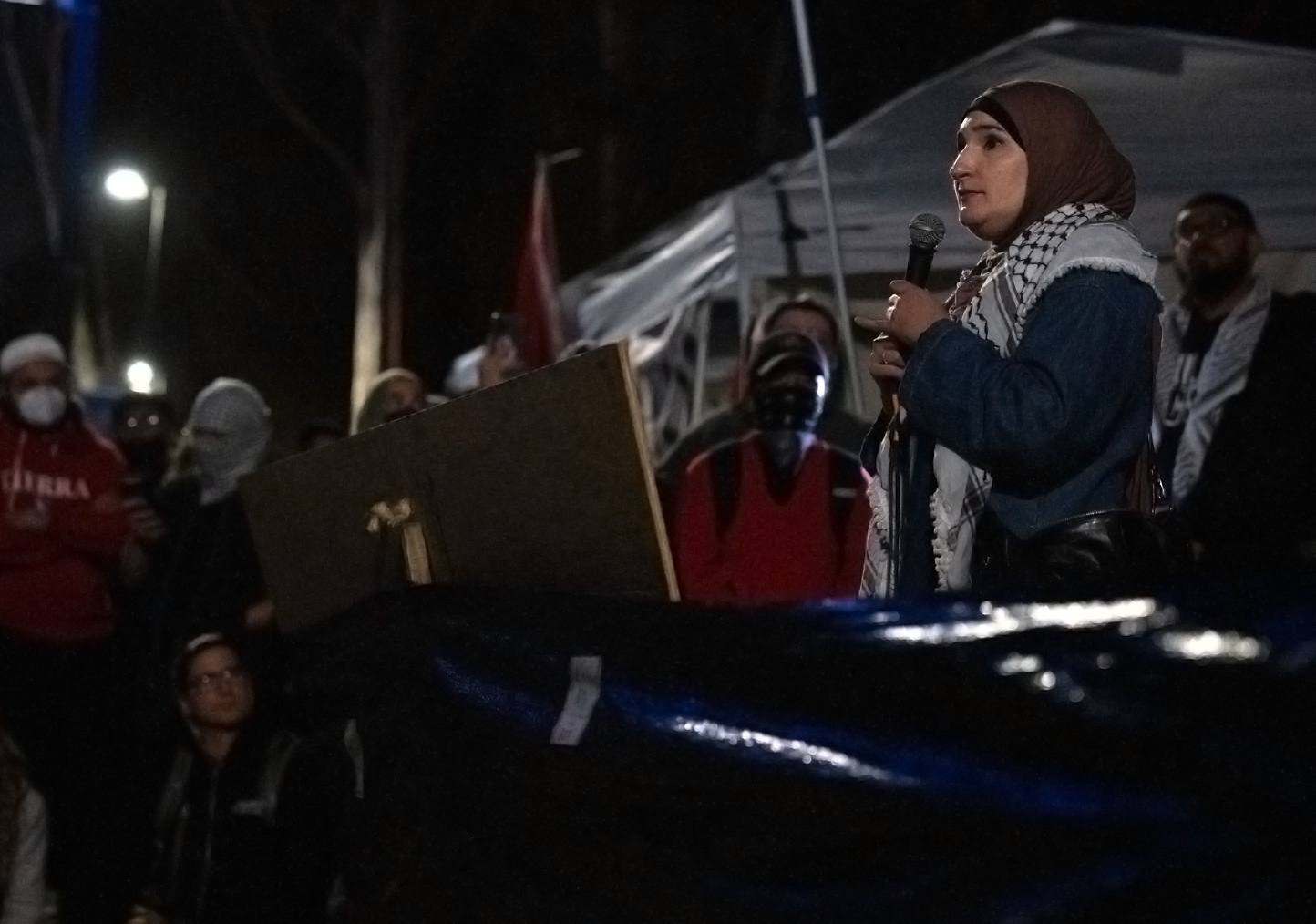
My remarks at 7:30 opening the evening went reasonably well, but what awaited those at the Encampment as the most memorable moment of the evening was indeed a surprise. At roughly 9:30 organizers introduced their keynote guest for the evening, Linda Sarsour, whose fiery speeches during the Women’s Marches of the first Trump era had made her famous. She delivered a rousing presentation to a large crowd assembled along Library Walk. “You are the generation I only dreamed about,” she said. “You are the generation standing against genocide.” And she continued:

You stand in a long line of student activists that helped end the Vietnam War and apartheid in South Africa. Universities that divested from South Africa can also divest from the State of Israel…. There will be people who will try and shut you down. I want you to stand your ground and fight for what you believe and know is right.
A person speaking into a microphoneAI-generated content may be incorrect.

“Linda Sarsour”: Linda Sarsour speaking at the UCSD Encampment. Photo by Phillip Salata used with permission.

It was a tremendously uplifting moment for the student protestors and following the speech, the crowd was jubilant and broke into dance. Many among the faculty who had gathered during the day to support the protest, stayed well past midnight as the students in the camp prepared to spend their first night in the place they called, the “liberated zone,” a metaphor of what they imagined the University could be.

Encampment Day 3: “Shabbat”

Despite the participation of many Jewish students and faculty at the Encampment, one of the shrill objections to the protest at UCSD – and Encampments in general — was that such actions directed against the Gaza genocide threatened Jewish students and faculty and were thus antisemitic.”

Interestingly, during the Civil Rights Movement in the U.S., White residents in the South expressed similar fears about sit-ins at lunch counters in Greensboro and Nashville, documented in the celebrated film, Eyes on the Prize. These segregationists insisted that they felt threatened by Blacks protesting in this manner, and that such protests were threats to their civil rights. Day 3 of the Encampment happened to fall on a Friday and organizers planned an evening event to honor the Jewish tradition of Shabbat, the Sabbath, considered the most sacred of Jewish holidays. It would be the second iconic moment of the Encampment. The organization, Jewish Voice for Peace coordinated the event with Encampment organizers and invited local Rabbi Alexis Pearce to preside over the ceremony.

At the Shabbat service, Rabbi Pearce emphasized how Jewish tradition holds all life sacred. “As we raise the kiddush cup to sanctify the Sabbath,” she proclaimed, “we gather tonight while genocidal violence is being inflicted on Palestinians in Gaza by a state that purports to act in the name of the Jewish people.” She continued with a question: “What is required of us in this tragic moment? Let us affirm: If we fail to give the Palestinian people a voice; if we read the Exodus story as a story of Jewish liberation alone, we will not have fulfilled the requirement to sanctify the Sabbath.” It was an electrifying moment for the many different faiths attending that evening that ended in a celebratory atmosphere to echo what Rabbi Pearce had emphasized about respecting all life as messages of “Not in Our Name” and “Cease Fire Now” resonated among the crowd in a sea of chants for peace.

A group of people standing in a parkAI-generated content may be incorrect.

“Shabbat:” Rabbi Alexis Pearce reciting the blessing at the Encampment celebration of the Jewish Sabbath. Photo by Gary Fields.


A group of people standing in a crowdAI-generated content may be incorrect.

“Shabbat Night:” Following the service of Rabbi Pearce, attendees celebrate Jewish and Palestinian unity for peace. Photos by Gary Fields.

Weekend: Encampment Days 4 and 5

As the weekend approached, the big question on everyone’s mind, especially those sleeping inside the Encampment, was whether the UCSD Administration was planning to crack down on the protest. It is true that the Administration was trying to discredit the Encampment as an affront to Jewish students and faculty that was making Jews on campus “feel” unsafe, and that it was the responsibility of the University to make everyone feel safe and welcome on the campus. It was also true that the Administration was crafting a discourse that it was promoting to the media about broader issues of “safety” supposedly being compromised by the protest. At the same time, many believed that the UCSD Chancellor did not want to sully his name by using force to shut down what, by all accounts, was a completely peaceful action. Despite some uneasiness about how campus authorities might react, the weekend witnessed two days of massive celebratory protest at the Encampment with huge crowds on both days. “Boycott! Divest! We will not stop, we will not rest,” and “Gaza you are not alone; this campus is a freedom zone” were heard throughout the two days in chants delivered by students in the hundreds.

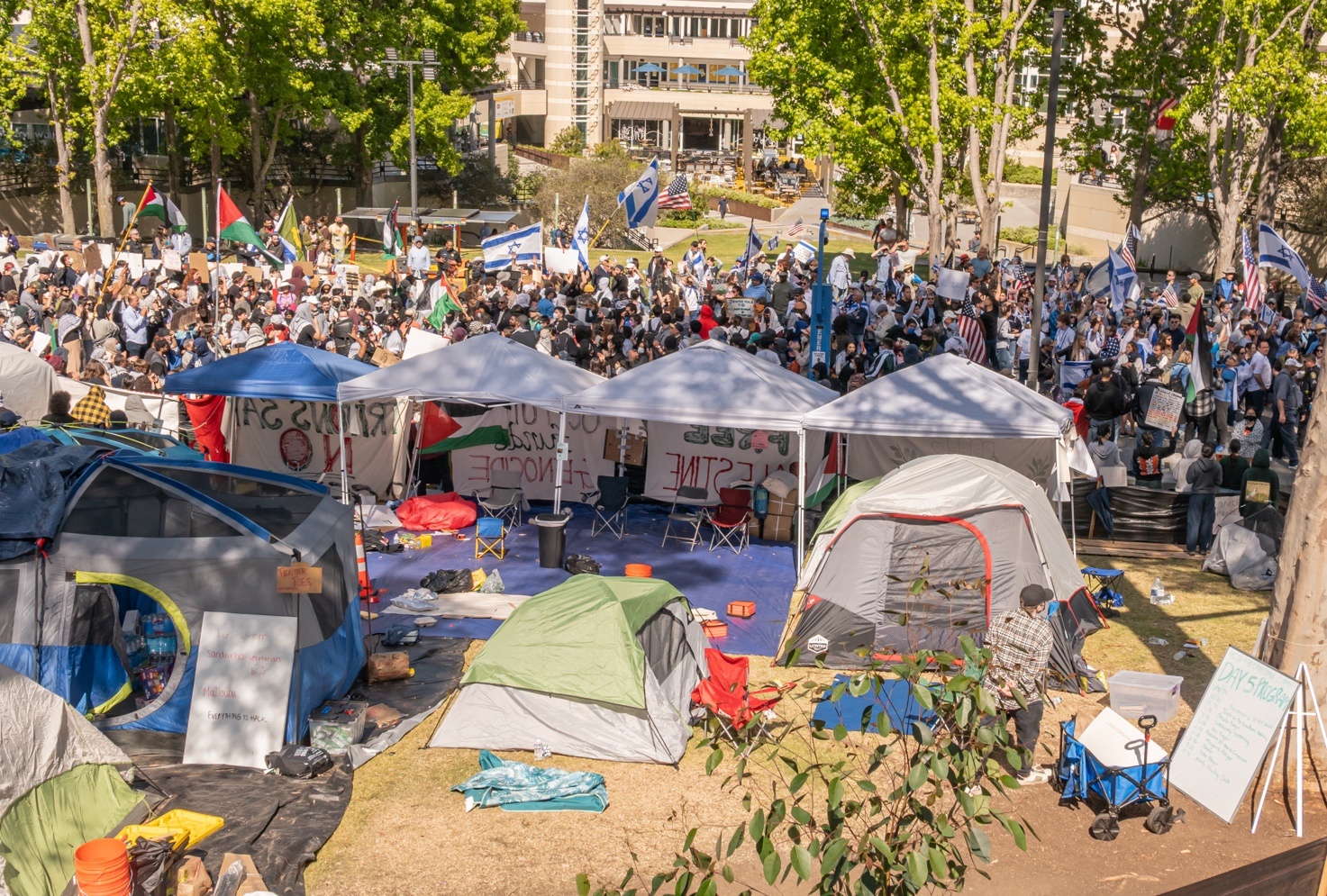
Sunday was a glorious day in San Diego with warm temperatures and a crystalline blue sky alongside the largest Encampment crowd against the genocide in Gaza. Sunday also witnessed a highly organized effort by Zionist groups from outside the University to provoke the Encampment protestors. These counter-protestors, who were clearly not students at UCSD, entered Library Walk from the North in the early afternoon waving large Israeli flags along with American flags and marched past the Encampment coming within inches of the Encampment protestors. Shouting epithets at the students from the Encampment, these provocateurs tried to entice the Encampment students into violence, but the students remained steadfast and disciplined, not falling into the trap being set for them of being violent antisemites. After roughly thirty minutes, the counter-protestors eventually left without incident.
A group of people outside tentsAI-generated content may be incorrect.

“Counterprotest”: Non-students from outside UCSD entered the space around the Encampment and were within inches of Encampment protestors in a failed effort to provoke the latter into violence. Photo by Gary Fields.

The departure of the counter-protestors set off perhaps the most spirited protest during of the entire Encampment to the cadence of chants: “Hey hey; ho ho; the occupation has got to go” and “The people united will never be defeated” and many others. It was late afternoon and for the first time in five days, I left the Encampment before the evening, confident that the students had defended themselves honorably in the encounter with the Zionists outsiders, and that the Administration would not dare try and remove them.

A group of people holding flagsAI-generated content may be incorrect.

“Celebration”: Day 5 Encampment Protest Celebration late Sunday Afternoon. Photo by Gary Fields.

Coda

On Monday morning of May 6th, I received a phone call at 6:00 a.m. from Danny W., a faculty member and avid supporter of the Encampment. “The police are raiding the Encampment right now,” he said. “You might want to go there right away.” Stunned, I got myself together and managed to arrive at the scene by 6:45 where I saw a line of police arrayed against a crowd of students, many of whom had just been violently routed from the Encampment. At the same time, I starred almost hypnotically at the site of the Encampment, now almost completely demolished. The UCSD Chancellor had called in three police forces to shut down the Encampment and justified it by proclaiming the protest to be a “safety hazard” and a “threat to Jewish students and faculty.” I was told that the police had arrived at the Encampment at 5:00 a.m. and began to rouse students from the tents, beating some of them and arresting 67 people including two faculty members. When students began to protest against this brutality on Library Walk, the police confronted them, threatening them with more violence and arrest. For the remainder of the day the police forces continued to patrol the University while closing all entry to the campus. In an instant, the atmosphere at UCSD had changed from one of a celebratory protest, to a space of authoritarian rule. Nothing like this had ever happened at UCSD, which has a rich history of protest going back to the anti-Vietnam War protests, as the Encampment succumbed to the forces of order.

A group of people standing in a lineAI-generated content may be incorrect.

“Confrontation:” Police confront protestors after arresting 67 individuals. Photo by Gary Fields.


A group of tents and tents in a park AI-generated content may be incorrect.

“Eradication:” Police hazmat crew dismantling the Encampment. Photo by Gary Fields.

The Encampment at UCSD was a heroically creative episode in a longer story of protest on the campus against injustice and a broader story of protest against the genocide of a people. Students at the Encampment had defended the right to assembly in a cultural environment now becoming infected with the scourge of authoritarianism. Sadly, instead of defending this right and promoting the University as a space of free and open expression on critical issues of our time, the leadership at UCSD, and leaders at many other Universities, were revealing themselves as collaborators in this authoritarian project. This collaboration with authoritarianism is largely to blame for the crisis unfolding at this moment on University campuses in which students are being abducted, their visas revoked, sitting in prisons and awaiting deportation. It will take more Encampment-like protests to overcome this horrific travesty now haunting us all.

Gary Fields is a Professor in the Department of Communication at UCSD and the author of Enclosure:  Palestinian Landscapes in a Historical Mirror.  He lives in San Diego.


Serbia’s Awakening: Students and Workers Unite in Historic May Day Coalition

Thursday 1 May 2025, by A.G.A (Mašina), B.B. (Mašina)

In a remarkable display of cross-movement solidarity, Serbia is witnessing an unprecedented alliance between university students (in occupation-strike for more than three months) and all five major trade union federations. After months of separate struggles, these forces are converging for May Day demonstrations that could reshape the country’s political landscape. Today’s joint protests represents a strategic evolution in resistance against what protestors describe as a corrupt regime with deteriorating labour conditions. With 90% of Serbian workers earning below a living wage and basic labour rights increasingly undermined, this alliance addresses both immediate economic grievances and broader systemic concerns. As Professor Nada Sekulić of Belgrade University notes, “If workers were to join [the students], this government would definitely fall and very quickly.” This emerging coalition may signal a profound shift in Serbia’s civic landscape after years of fragmented opposition movements. [AN]


Demonstrators in front of the Belgrade 5th Gymnasium (Photo: Mašina)
“It’s Impossible to Sleep Through the Coming Day” – The Significance of Student and Trade Union Alliances for May Day

M.M. (Mašina) 29.04.2025

This May Day we could see, for the first time in Serbia, a protest that will bring together all five trade union federations. The students occupying university buildings are undoubtedly most responsible for this, as their activities in recent months have changed the social context to which the unions could not remain silent. After a series of meetings between union working bodies and students, and agreement on joint work on specific amendments to the Labour Law and the Strike Law, the moment has come to unite on the streets.

There is no better occasion for this than May Day – the international workers’ holiday – and our interviewees agree that this alliance and joint appearance at the May Day protest could be a turning point for both the student and labour movements.

On May Day, unions will organise their previously announced traditional gatherings at different locations, joined by columns of students coming from various directions towards Belgrade city centre. According to announcements, they will all, along with citizens, gather at 2 p.m. in front of the Government of Serbia, where tributes will be paid to the victims of the canopy collapse in Novi Sad, followed by speeches from student representatives and union presidents.

RaÅ¡ko Karaman, a Biology Faculty student and member of the Workers’ Issues Working Unit of the student occupation, told MaÅ¡ina that they recognised the importance of the working class in the struggle for systemic change early in their activities.

“We quickly established communication with union and non-union workers’ organisations, developing cooperation and exploring the possibility of joint action. It was clear to us that their position in society is extremely poor, and that the means by which they would fight for it has been completely rendered meaningless. We find the cause of this situation in the problematic Labour Law and Strike Law,” Karaman told MaÅ¡ina.

In accordance with this position, students initiated a joint meeting with all union federations and the formation of a legal working group to address amendments to these laws. The idea was for unions to agree on amendments and to fight for them in the social climate created by student occupations and protests.

May Day is a significant date for both the workers’ and student movements. It marks Labour Day but also six months since the tragedy in Novi Sad.

“This is an opportunity to publicly demonstrate our readiness for joint action, and to present the work of the legal working group. At the beginning of this week, we organised a meeting with the presidents of the union federations where we agreed on organising a joint gathering on 1 May at 2 p.m. in front of the Government. On the same day, before this action, the unions will organise individual gatherings that they have already registered and for which they have secured logistical preparation, and students will come in an organised manner to support them,” Karaman told our portal.

The 1 May gathering is, as announced by the students, just the beginning of more active involvement of unions in the struggle for systemic change. They will present joint demands to the Government that day, while, again according to student announcements, at the joint meeting, unions expressed clear readiness to radicalise their struggle if the demands are not met.


“General Strike!” (Photo MaÅ¡ina)

90% of Employees Don’t Have a Living Wage

Union protests in Serbia are not common, reminds Vladimir Simović, programme coordinator for labour rights at the Centre for Emancipatory Politics, who emphasises that every opportunity to highlight the position of workers is important – therefore, the May Day protest is significant.

“This is the day to bring concrete demands for improving the current situation into the public sphere, and the situation is very bad. Wages are low, 90% of employees don’t have a living wage. Working hours far exceed what is legally guaranteed. Serbia is traditionally at the very top of European countries in terms of working hours that employees spend at work. Occupational safety and health standards are inadequate. In Serbia, on average once a week someone loses their life at work, and almost no one is ever held accountable for this. Workplace harassment is ubiquitous, and union organising is sabotaged. There are too many problems. Employers too often treat workers as disposable resources. Such a situation is unsustainable,” Simović believes.

Our interviewee believes that students have well identified “probably the most important allies” – the workers. Because, our interviewee believes that without synergy between the working class and the existing student movement, it would be difficult to change anything in our society.

“Now we have a situation, for the first time in a very long time, where unions are combining their capacities. I think this would not have been possible, in this way, without the student movement which enjoys great trust among the people. Students have used this legitimacy to bring unions to the same table. The announced joint struggle for amendments to the Labour Law and Strike Law is no longer merely declarative but is also manifested in the announcement of the May Day protest. This gives us hope that things are moving in the right direction,” Simović told MaÅ¡ina.

The Gathering Goes Directly Against the Ruling Group’s Core Strategy

Dr Nada Sekulić, a full professor in the sociology department at the Faculty of Philosophy in Belgrade, agrees that the joint appearance of students and unions at the May Day protest is a very significant event, and she shared with us several reasons why she holds this view.

“One of them is that until now, no one has managed to bring together the five largest unions in Serbia, which have quite a number of disagreements with each other. In that sense, this gathering has the potential for consolidating worker organisation, which is an important, and in all likelihood, a fundamental prerequisite for the Labour Law to be changed at all, and this alliance certainly does not please the ruling structures in society, which since MiloÅ¡ević’s fall have systematically sided with employers, reducing workers’ rights, in order to enable faster privatisation and attract foreign capital in particular. So, such a gathering goes directly against the ruling group’s core strategy regarding how Serbia should develop, so unified pressure from all unions is definitely needed,” Sekulić believes.

As a second important reason, she points out that this alliance broadens the front of social resistance in the current rebellion of students and citizens against the corrupt regime and disregard for the law.

“This is probably what could worry the government the most, because their main stronghold so far has been that there has been no resistance in institutions outside the university and education sector. If workers were to join, I dare say, this government would definitely fall and very quickly,” Sekulić tells MaÅ¡ina.

However, our interviewee emphasises that the question remains how much unions can massively mobilise their membership for broader social issues.

“Workers are most willing to strike over concrete matters that concern their immediate existence. That is now the ’thousand-dollar question’ – have the students managed to sufficiently motivate citizens across Serbia to engage through strikes at their workplaces, and not just through beautiful receptions for students and through street protests which, as we can see, although they worry the government, have not been able to change the corrupt system for five months, with repression becoming increasingly obvious,” Sekulić believes.

The third important thing in the May Day alliance, according to the professor from the Faculty of Philosophy, is that it shows that students are looking for new strategies of struggle, “aware that everything that has been done so far, which is extremely significant in itself regardless of what will happen in society going forward, has not yielded the desired results – the government will not fulfil the students’ demands, because that simply means not only that they lose power, but also that many of them will end up in prison and be left without predatorily acquired property.”

The alliance on the occasion of May Day that we are talking about is also significant from the aspect of union struggle, and Sekulić believes that unions could strengthen their position in relation to employers and the state if they managed to maintain mutual dialogue and a unified front.

“I think it’s very important that unions are waking up and acting as agents of broader social change, not just immediate existential interests related to specific situations in specific workplaces. Until now, they have not been in that position, and their partners have been ’vertically’ positioned – the state or employers, who have actually controlled or bribed them. This is now a horizontal connection in which such kind of management does not exist, and that is a very good sign,” Sekulić tells MaÅ¡ina.

She believes that sufficiently strong pressure, with a demand for changing specific provisions in the Labour Law, and insistence on the introduction and implementation of collective agreements (today, only about 20% of workers have collective agreements) would certainly lead to progress, especially in, as she says, a situation in which the ruling group must fight on multiple fronts, “and are then ready to give way somewhere in order to strengthen their positions elsewhere where they have been weakened.”

She sees a problem in the fact that the alliance came after five months of exhausting resistance.

“If this alliance of workers and students had happened at the beginning, we would probably already have new elections today, not just the election of a new government similar to the previous one. In any case, I believe these processes are unstoppable, it’s just a question of how quickly they will unfold. Serbia has begun to awaken, and that awakening process will certainly continue. When you wake up in the morning with your eyes wide open, it’s impossible to sleep through the coming day,” Sekulić concludes.

M.M.

https://www.masina.rs/nemoguce-je-da-prespavate-dan-koji-dolazi-kakav-je-znacaj-udruzivanja-studenata-i-sindikata-za-prvi-maj/


May Day 2018, Belgrade (Photo: Mašina)
Unions and Students Together on the Streets on May Day

A.G.A (Mašina) 30.04.2025

The five largest unions in Serbia will tomorrow, May Day, organise gatherings in Belgrade where they will announce demands for changes to labour legislation, and then together with students in occupation will participate in a protest in front of the Government of Serbia building.

The protest will be dedicated to marking May Day – the International Day of Struggle for Workers’ Rights, with special emphasis on the poor state of labour legislation in Serbia.

As the United Trade Unions of Serbia “Sloga” states, this protest represents a continuation of the joint effort begun on 22 March at the Faculty of Philosophy in Belgrade, when students in occupation and representatives of the five largest union federations in Serbia signed an agreement on cooperation with the aim of improving labour rights, improving relations between unions and strengthening citizens’ trust in unions as true protectors of workers’ interests.

At yesterday’s meeting held at the Faculty of Law, University of Belgrade, representatives of the Federation of Independent Trade Unions of Serbia, the United Branch Unions “Nezavisnost” (Independence), the Association of Free and Independent Trade Unions, the United Trade Unions of Serbia “Sloga”, and the Confederation of Free Trade Unions spoke with students and reached a joint agreement on further cooperation, resolving previous misunderstandings.

Union Gatherings Before the Protest

The AFITU gathering will begin at 11 a.m. on the plateau by “Russian Tsar” in Knez Mihailova Street, and around 1 p.m. an address by the president of that union, Ranka Savić, is announced, after which at 1:30 p.m. the column will head towards the Government of Serbia building for the joint gathering of unions and students.

FITU is organising a gathering at 12 p.m. in Nikola PaÅ¡ić Square, where the May Day Proclamation will be read. They will then proceed to the Government of Serbia for the joint protest and submit their conclusions and demands. FITU has announced that on May 1, they will mark Labour Day and FITU Day, April 27, that is, “two dates that symbolise the workers’ struggle for greater rights, higher wages and a dignified life.”

The “Nezavisnost” Union will mark May Day at 11:30 a.m. at the Dimitrije Tucović monument in Slavija Square, after which they will submit an initiative to the Government of Serbia for changes to the Labour Law and Strike Law. At that gathering, the “Free Daily News” prepared by a group of RTV journalists will be broadcast, and a concert by the first Serbian children’s rock choir – RocHoiR Kids will be held.

The Confederation of Free Trade Unions has not made a special decision on marking Labour Day this year in its bodies, but in accordance with the decision made on participation with other unions in changes to “workers’ laws”, it has accepted the conclusion on participation in this May Day action.

As “Sloga” states, the crisis of capitalism is deepening, social inequalities are growing, democratic freedoms and union rights are under attack around the world, and increasing military spending is pushing humanity into a war economy that takes away workers’ means of life and dignity.

“Because of all this, May Day has long not been a holiday – it is a day of struggle. See you on the streets!” the statement from this union says.

A.G.A (Mašina)

https://www.masina.rs/sindikati-i-studenti-zajedno-na-ulicama-prvog-maja/

P.S.

Translated for ESSF by Adam Novak

  MAY DAY 

Malaysia: More than 1,500 people join May Day rally in KL

by PAN Eu Joe


Kuala Lumpur: More than 1,500 people gathered outside Pasar Seni [market] today to take part in a Labour Day rally, calling for better workers’ rights and reforms.

The rally carried the theme ‘Workers are the pillars of the country: Raise salaries, not burdens’.

Dressed largely in black, white and red, the crowd began assembling at about 9.30am before marching towards Dataran Merdeka [square].

Along the way, they chanted slogans like “Youths want paid internships” and “Wages to live, not to go hungry”, while holding placards demanding fair treatment for workers.

The event was organised by Jawatankuasa Satu Mei, a coalition that includes political parties such as Parti Sosialis Malaysia (PSM) and Muda, as well as student groups, NGOs and civil society organisations.

The rally carried the theme “Workers are the pillars of the country: Raise salaries, not burdens”.

Among the key demands voiced by the participants were an increase in the national minimum wage to RM2,000 (€400) and the implementation of a comprehensive affordable housing policy.

PSM Youth committee member Aiman Farihah Shukri urged the government to refrain from creating “pro-capitalism policies” and instead come up with policies that truly benefit the rakyat.

She also called on the government to raise the minimum wage from RM1,700 to RM2,000 or above, saying that a higher amount was needed to deal with the rising cost of living in the Klang Valley.

Meanwhile, Himpunan Advokasi Rakyat Malaysia (Haram) coordinator Alyaah Hani Anuar called on the government to ensure those undergoing internship receive a salary of at least RM1,700 (€340) per month.

“Many interns are treated like free labour and this is not a new issue. How can they support themselves in Kuala Lumpur if they do not get paid?”

Gerakan Badan Bertindak Sahabat E-Hailing Malaysia chairman Zulkifli Othman, on the other hand, said the current pay of about RM6 (€1.2) an hour is not enough for e-hailing drivers to cover essential expenses and also pay for insurance coverage in the event of a road accident.

The rally ended peacefully at around 12.40pm.

Pan Eu Joe

 MAY DAY 

Panama in Struggle: National Strike Unites Popular Resistance and Defence of Sovereignty

by NETO Antonio


On 29th April, the construction workers’ strike began, and on 23rd April, the powerful strike of Panama’s education workers commenced. The two strongest unions in the country are in the streets demanding the immediate repeal of Law 462, which reformed social security. The legislation ends the solidarity pension system, transfers the pensions of thousands of workers to bankers, and increases the minimum retirement age. Workers are also against the return of operations by the mining company First Quantum and against the signing of a memorandum of cooperation between the United States and Panama that authorises the installation of three military bases, more than 2,000 soldiers, and toll exemptions for military vessels crossing the canal.

Photo: Telesur

Asoprof (teachers’ union) and Suntracs (construction union) are leading the mobilisations. The revocation of Law 462 is strategic because the government’s defeat would be a victory for Panamanians and would put Raul Molino’s government in a defensive position regarding the return of First Quantum’s operations and the memorandum signed with the United States.

In 2023, massive mobilisations spread throughout Panama, with protests centred on demanding an end to operations by the mining company First Quantum, which has Canadian, American, Chinese and South Korean capital. Open-pit mining is one of the most aggressive forms of mining; besides deforestation, it causes soil contamination and various other environmental impacts. Faced with this crime against the environment, traditional populations, indigenous people, young people and workers – with Suntracs and Asoprof at the forefront – led a series of mobilisations that defeated the government and the transnational First Quantum, which had extracted almost half of its profits until 2023 from Panama.

"The Panamanian constitution prohibits the administration of Panama’s natural resources by foreign states. FQM is owned by capital from Canada, the United States, South Korea and China. It is not just a private foreign company; it is also partially owned by capital from these foreign countries.

Despite this, the company had been exploiting copper and other minerals in the mine without paying taxes between 2017 and 2023. According to FQM’s financial reports, the Cobre Panama mine accounted for 48% of FQM’s global profits.“Despite all these absurdities, the Panamanian government forwarded a project to renew the concession to the mining company, which was analysed and approved by congress in record time.”...Congress approved the contract on 21st October, after only three days of discussion. This provoked a social explosion in a country that was already fed up with the inaccessible price of medicines, lack of social security and very high cost of living."

The mobilisations achieved, in the streets, a historic victory, a milestone in the environmental struggle and an unprecedented defeat, both for the transnational First Quantum and for Raul Molino’s government.

American neocolonialism vs popular mobilisation.

The small country located in Central America suffered from an invention of the US interventionist policy at the end of the 19th century to enable the construction and control of the canal linking the Pacific to the Atlantic Ocean to facilitate the movement of the North American fleet in the war against the Spanish Empire, thus marking the beginning of the colonial policy of the nascent capitalist power.

The then newly created Panama formalised an agreement that guaranteed the United States almost a century of control over the canal, the establishment of a militarised zone and the use of essentially American labour. In December 1999, after almost a century, and after various episodes of mobilisation and struggle by the Panamanian people, the canal was returned to Panama.

Donald Trump’s statements after taking office announce, without embarrassment, the neocolonial orientation of the United States and place the economic war with China at the centre, in this sense the control of the Panama Canal is a key piece. On 10th April, the visit of Defense Secretary Pete Hegseth concretised Trump’s threats in the memorandum of understanding. In addition to the toll exemption for American military ships, the installation of military bases in Panama was agreed upon, the permanence of military personnel, which already reaches 3,000 men, as well as freeing Panamanian territory for US military exercises. At the same time, the Panamanian government threatens to revoke the Chinese concession to operate two ports at the ends of the canal.

Faced with Donald Trump’s neocolonial offensive and the servility of Raul Molino’s reactionary government, the national strike of Panamanian workers places at the centre of the mobilisations the anti-colonial struggle for national sovereignty and Panamanian control over the Canal and against the military presence on national soil.

So far, reports coming from Panama indicate that the strike is widespread among the two main categories, with strong popular support and from youth, but it is being harshly repressed by the government with reports of dozens of arrests in various provinces of the country.

All support and solidarity to the Panamanian people. The victory of Panamanians is a victory for all Latin American people and a defeat for Donald Trump and Raul Molino.

Antonio Neto