NUKE NEWZ
Kazakhstan, China Forge Uranium Partnership as U.S. Falls Behind
- Kazakhstan and China are deepening energy ties with $25 billion in new deals,
- including a nuclear power partnership with China National Nuclear Corporation.
- Kazakhstan and China are looking at joint uranium exploration projects.
- China’s nuclear ambitions are accelerating, with 27 reactors under construction and a goal of 150 by 2035
Kazakhstan and China have moved to deepen their strategic partnership, with the two allies set to sign 60 agreements worth up to $25 billion at the China–Central Asia Industrial and Investment Cooperation Forum in Astana. Kazakhstan has identified China National Nuclear Corporation (CNNC) as a key strategic partner for building nuclear power plants, and will sign a cooperation agreement with China on nuclear energy.
This partnership also includes joint research on transboundary uranium ore belts straddling the two countries. According to Kazakhstan President Kassym-Jomart Tokayev, bilateral and trade relations between the two countries have reached a new golden period, with Beijing a time-tested and reliable partner of Kazakhstan. China is Kazakhstan’s largest trade partner, with bilateral trade volume reaching a record $44 billion in 2024.
China’s Belt and Road Initiative (BRI) also took center stage at the forum, specifically highlighting infrastructure development. That included plans to modernize logistics corridors, build new border facilities and simplify customs procedures, reinforcing Kazakhstan’s role as Central Asia’s leading transit hub.
“We consider the Chinese company CNNC [China National Nuclear Corporation] as a reliable strategic partner in the NPP construction project. CNNC is known worldwide for its high competence, so it will certainly occupy a worthy niche in our market. In addition, Kazakhstan is a reliable supplier of natural uranium and nuclear fuel to China,” Tokayev said.
Kazakhstan is the United States’ second largest supplier of uranium after Canada, supplying 25% of the country’s imports in 2022--more than twice the volume it ordered from Russia. Kazakhstan is home to 12% of the world’s natural uranium reserves and 43% of the global uranium supply. However, Kazakhstan has no nuclear energy production capacity, with its energy mix dominated by coal at 68%, followed by natural gas and hydro.
For its part, Beijing’s move to secure uranium supplies appears strategic. Five years ago, the country set a target to build 150 nuclear plants by 2035, potentially surpassing the United States in nuclear-generated electricity. Last year, a report by the non-partisan Information Technology & Innovation Foundation (ITIF) revealed that the U.S. could be up to 15 years behind China in next-generation nuclear power development.
Currently, China has 27 nuclear reactors under development, more than double the tally for any other country, with the country’s fleet now standing at 56 reactors. China is building reactors at a 6-8 per year clip, putting it on track to hit a total of 150 new nuclear reactors by 2035 and surpass the U.S. in nuclear-generated electricity by 2030. In contrast, the U.S. has only launched two new nuclear reactors over the past decade.
According to ITIF researchers, Beijing will likely use this large domestic capacity as a launch pad for competitive reactor exports, similar to its strategy with electric vehicles and batteries. Two years ago, a report emerged that Saudi Arabia was considering a bid from China to build a nuclear power plant, potentially sidelining the United States. This move came as Saudi Arabia seeks to diversify its energy mix and potentially develop a domestic nuclear industry. The U.S. had previously expressed interest in partnering with Saudi Arabia on a civilian nuclear program, but also imposed non-proliferation conditions that resulted in delays.
Beijing is also winning on the innovation front. In December 2023, China unveiled the 200 MW gas-cooled Shidaowan-1 nuclear plant, the world’s first fourth-generation nuclear power plant built with 90% of the technology developed in China. The bulk of China’s current fleet are third-generation reactors initially designed by the U.S. company Westinghouse in the late-1990s. According to ITIF, China’s systemic and organizational approach is largely to credit for the country’s success in nuclear power innovation, noting that it has developed a comprehensive and well-streamlined national strategy for nuclear power. This includes adopting several supportive policies such as feed-in tariffs and low-interest financing, among other subsidies that make the country’s nuclear sector cost-competitive. Additionally, China has streamlined the regulatory approval processes and supply chains.
However, the Trump administration is keen on reviving the U.S. nuclear sector, with Trump signing four executive orders in April in a bid to expedite the deployment of nuclear reactors and ramp up the country’s nuclear energy production from 100 GW in 2024 to 400 GW by 2050.
Unfortunately, the U.S. owns less than 1% of global uranium reserves, meaning that it will be forced to rely on the likes of Kazakhstan for its uranium supplies for years to come. The U.S. produced 700,000 pounds of yellowcake in 2024, good for an impressive 12-fold increase from the previous year, but still a long way off the 32 million pounds it imported in the same year.
By Alex Kimani for Oilprice.com
Niger says it will nationalize a uranium venture operated by France’s Orano
By The Canadian Press
June 20, 2025 a

DAKAR, Senegal — Niger’s government said Thursday it would nationalize the Somaïr uranium venture operated by French company Orano and accused it of taking a disproportionate share of the uranium produced at the site.
The announcement comes as military authorities in the west African country tighten their grip on foreign companies and civil society. Tensions have simmered for months between Niger’s military government and the French company, and relations between Niamey and Paris have deteriorated.
“Faced with the irresponsible, illegal, and unfair behavior by Orano, a company owned by the French state — a state openly hostile toward Niger since July 26, 2023 ... the government of Niger has decided, in full sovereignty, to nationalize Somaïr,” the authorities said in a statement.
The authorities allege that Orano took a disproportionate share of the uranium produced at Somaïr. They added that the company has also been accused of other “irresponsible actions” at the site, without elaborating.
Orano did not immediately reply to The Associated Press’ request for a comment.
Somaïr is a joint venture between Orano and Niger’s state-owned Sopamin, which operates the only active uranium mine in the country. But last year, authorities took operational control of Somaïr. They also withdrew Orano’s operating permit for the Imouraren uranium mine, with reserves estimated at 200,000 tons.
Orano is involved in several arbitration processes with Niger. Last month it sued the Nigerien authorities after the disappearance of its director and the raiding of its local offices.
Orano has been operating in Niger, the world’s seventh biggest supplier of uranium, for over 50 years and holds majority shares in three main uranium mines in Niger.
Nigerien military authorities seized power in 2023 with a pledge to cut ties with the West and review mining concessions. Before that, the country was the West’s major economic and security partner in the Sahel, the vast region south of the Sahara Desert that has been a hot spot for violent extremism.
Monika Pronczuk, The Associated Press
Greece should consider nuclear, PM says
Greece should be part of the discussion on nuclear energy and should be at the forefront of research and debate into using nuclear energy to decarbonise shipping, the country's Prime Minister Kyriakos Mitsotakis has told a summit on the regional energy transition.
_90749.jpg)
Mitsotakis made his comments to the Energy Transition Summit: East Med & Southeast Europe, organised by the Financial Times in cooperation with Greek newspaper Kathimerini.
Greece took a decision in 2019 to move away from coal, which had previously been the main source of its electricity, and has achieved that, Mitsotakis said. With more than 50% of its electricity now coming from renewables, it has ambitious targets to increase the penetration of renewables still further, as well as investing in pumped storage and batteries.
"But at the same time we need baseload power … as many countries, we have placed a strategic bet that natural gas is going to supply baseload power for the foreseeable future," he said.
But Mitsotakis made it clear that Greece - and the rest of Europe - should also consider nuclear energy as vital for decarbonisation.
"I think we should be prepared to join the 'nuclear alliance'. And this may come as a shock to some people listening to us, given that Greece is a country that has no background or experience in nuclear energy. But when I look at the overall energy developments, I see no way for the world to get to carbon neutrality without nuclear. And I see very interesting developments in nuclear technology, especially when it comes to the small modular reactors.
"And I just don't want us not to be part of this discussion. I'm not saying we're going to do anything next day, but at the least I want us to be part of the conversation and to understand where these technologies are going. And by the way, this is also a critical issue for Europe. I've been making the case repeatedly at the European Council that we need to place strategic bets in those sectors of clean tech, where we believe that Europe still has a significant comparative advantage. I think nuclear should be one of those. Again, we are not part of the value chain, but there are countries that have experience. So it seems strange to me that a country that is still heavily reliant, a continent that was heavily relying on nuclear technology, is not at the forefront of the new investment in nuclear.
"And of course we also have the fusion debate, which long term is the holy grail of research. So we need to be very present … one of the strategic bets I think that Europe should place in terms of committing significant resources would be nuclear."
Shipping strategy
Nuclear energy is also of particular interest to Greece's shipping industry, Mitsotakis said. "We have to explore whether nuclear is a viable option for shipping, for long haul shipping. As a leading maritime nation, we at least need to be at the forefront of the research and the debate. It may work, it may not work. It's going to be 10, 15 years out. But if we really want to think strategically as a maritime nation, we cannot stay away from this debate. And this, of course, is a discussion that I'm very open to have with the shipping community and to ensure that we create a common working group that is going to look at this technology at least as an option.
"Because when you look at decarbonising shipping, there is no silver bullet … there's no technology right now that seems to stand out, there are interim solutions, but we have to think 10, 15 years into the future. So I don't think we can stay away from this discussion as a country."
The conference took place in Athens on 17-18 June.
Uzbekistan studying option of a four-unit VVER-1000 plant
Rosatom has signed an agreement with Uzbekistan's Uzatom Atomic Energy Agency to study a possible gigawatt-scale nuclear power plant featuring two or four VVER-1000 units.
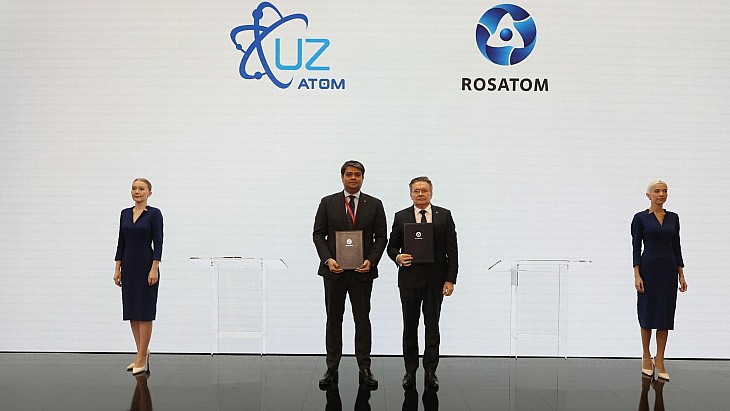
The announcement came at the St Petersburg International Economic Forum (see picture above), and builds on the current project to build a small modular reactor plant in the Jizzah region, featuring six of Rosatom's 55 MWe RITM-200N water-cooled reactors.
Rosatom Director General Alexei Likhachev said: "The Rosatom State Corporation is pleased to be a strategic partner of Uzbekistan in the development of nuclear energy ... the combination of small and large-capacity nuclear power plants can form a powerful 'carbon-free energy cluster' in Uzbekistan and become a response to the country's growing needs for electricity, as well as the basis for the development of industry and innovative industries in the country."
Azim Akhmedkhadjaev, Director of the Atomic Energy Agency, said: "We consider the construction of a high-capacity NPP as a source for creating a reliable and balanced energy system capable of covering both the current and future needs of the country for electricity - environmentally friendly energy. The signing of the agreement allows us to begin active development of the key conditions for the possibility of implementing the project for the construction of a high-capacity nuclear power plant. A joint Working Group has been created that will study the main aspects of the project and assess the cost of construction."
Kazakhstan and other announcements
Also at the forum a meeting was held between Likhachev and the Chairman of the Kazakhstan Atomic Energy Agency, Almasadam Satkaliyev, during which an Indicative Roadmap was approved for the planned new nuclear power plant in the country. The roadmap sets out an indicative timeline and also "provides for the stages of preparation and implementation of the project, including engineering and survey work, conclusion of an EPC contract and development of design documentation".
Kazakhstan announced on Monday that it had selected the Russian bid for its planned new nuclear power plant. Likhachev said: "We appreciate the trust shown by the Kazakh side to lead the international consortium that will build a nuclear power plant in Kazakhstan. Kazakhstan is our reliable historical partner in the nuclear industry."
Satkaliyev said: "The construction of a nuclear power plant in Kazakhstan is part of a comprehensive strategy to ensure sustainable development of the country's energy sector. We count on close and transparent cooperation with partners to ensure a high level of safety and localisation of production."
There was also an agreement on cooperation on the peaceful uses of nuclear energy with Burkina Faso. Rosatom said it "forms the legal basis for comprehensive cooperation between the two countries in the field of nuclear energy and technology. Key areas of cooperation include assistance in the creation and improvement of Burkina Faso's nuclear infrastructure in accordance with international standards, regulation of nuclear and radiation safety issues, production and use of radioisotopes in industry, medicine and agriculture. In addition, the agreement provides for the development of joint projects in the field of radiation technology and nuclear medicine, as well as the training and retraining of specialists for the nuclear industry of Burkina Faso".
During a Russia-Indonesia business dialogue session there was also discussion of potential small modular reactor and floating power units. Rosatom said it "has developed and presented to the Indonesian leadership a concept for the development of nuclear energy based on both small and large capacity, and is ready to provide comprehensive support in the implementation of the country's large-scale plans for the development of the nuclear industry".
TVO completes Final Takeover of Olkiluoto 3
Operator Teollisuuden Voima Oyj has completed its final acceptance - the Final Takeover - of Olkiluoto 3, which entered commercial operation in 2023.
_59714.jpg)
Marjo Mustonen, TVO Senior Vice President for Electricity Production, said Olkiluoto 3 (OL3) had "operated reliably during the first two years. The annual outage this spring, the second one at the unit, was also completed successfully. The Final Takeover of OL3 was based on the fulfilment of the terms and conditions laid down in the Plant Supply Contract, but the many benefits we promised OL3 would bring to society have been realised already since 2023".
TVO said that the new EPR unit, a 1600 MWe pressurised water reactor, had helped make Finland nearly self-sufficient in electricity and "contributes to the stability of the electricity price, and as Finland's greatest climate act, also accelerates the clean transition towards a carbon-neutral society".
The Areva-Siemens consortium constructed the OL3 plant under a fixed-price turnkey contract. Construction began in 2005, with completion of the reactor originally scheduled for 2009, but the project has had various delays and setbacks. OL3 attained first criticality on 21 December 2021 and was connected to the grid on 12 March 2022 before entering commercial operation the following May.
TVO issued an acceptance certificate to the Areva-Siemens consortium for the Olkiluoto 3 EPR in April 2023. They had joint liability for the contractual obligations until the end of the two-year warranty period of the unit, which is when the final acceptance of the plant unit took place.
TVO is 27% owned by Fortum and 57% owned by Pohjolan Voima Oy (the major shareholders of which are pulp and paper manufacturers UPM Oyj and Stora Enso Oyj). Owners take their shares of electricity at cost, with any unwanted portion being sold by them into the Nordic market. This means that output is effectively contracted to each owner over the life of the plant. The private owners are mostly heavy industry with a high demand for base-load power, and hence low costs are critical for them.
The French Government Shareholding Agency (Incarner l'État actionnaire) called it a "historic moment for the French nuclear industry, the first commercially operated EPR in Europe, has now been officially handed over".
In a Linkedin post it added: "This final takeover marks a major milestone for Areva, whose activities were refocused on the completion of the OL3 reactor after the restructuring of the French nuclear sector in 2015. It is also a significant step for France, whose Government is the reference shareholder of Areva and a key supporter of the French nuclear industry. Despite the many challenges encountered since the project's kick-off, the commitment of the Areva and Siemens teams, supported by the expertise of Framatome and EDF, enabled the successful completion ... the final delivery of the plant to our Finnish partner closes a major chapter in the history of the French nuclear sector."
"The collective experience gained from this project will directly contribute to the development of the EPR technology, which remains a strategic priority for France and its industry."
Finland has five operable reactors - two at Loviisa and three at Olkiluoto - providing about a third of its electricity. The world's first operational EPRs were China's Taishan 1 in 2018 and Taishan 2 in 2019. Flamanville 3 in France was connected to the grid in December 2024 and two more EPRs are under construction at Hinkley Point C in the UK, with two more planned at Sizewell C.
Robot 'dog' to support Spanish decommissioning project
Energy services group GDES and technology company Alisys are developing an autonomous quadruped robot for decommissioning and waste management firm Enresa to support the decommissioning of the Santa María de Garoña Nuclear Power Plant in Spain.
_94161.jpg)
The robot will be developed and launched through a temporary joint venture between Alisys and GDES, which will develop a bespoke system based on technology from Boston Dynamics using the Spot Enterprise quadruped robot.
The system will feature a high-precision robotic arm with the capacity to incorporate different measuring instruments and advanced spectrometric analysis software, which will allow for real-time interpretation of data. The system will be connected to a cloud platform, enabling management of the collected data and remote operation of the robot.
The project comprises solution development, testing and commissioning, and the training of Enresa personnel who will eventually operate it at the facility, GDES said.
The robot will be used to characterise materials, walls and floors for the decommissioning and dismantling of Garoña, a single-unit 446 MWe boiling water reactor plant which was closed in December 2012 and defuelled shortly afterwards. Enresa took ownership of the plant in 2023, embarking on a two-phase decommissioning programme that is expected to take ten years to complete.
"As the first initiative of its kind in Spain, this technological investment will enable Enresa to enhance the identification of non-contaminated areas, increase efficiency, and streamline the process of measuring and characterising radioactive waste bound for the El Cabril disposal facility. It also reinforces Enresa's commitment to ALARA principles (As Low As Reasonably Achievable) and to occupational risk prevention durin
US agencies take action to streamline nuclear roll-out
Separate announcements from the US Department of Energy and the Nuclear Regulatory Commission point towards streamlining the pathway to deployment of advanced reactor technologies.
_70049.jpg)
The announcements come weeks after President Donald Trump's raft of Executive Orders aimed at boosting US nuclear energy. Amongst other things, those orders mandated bodies including the Department of Energy (DOE) to expedite the review, approval, and deployment of advanced reactors, and ordered reforms to the US Nuclear Regulatory Commission (NRC) with regulatory evaluation and approval of licence applications for new reactors to be completed within 18 months of starting the regulatory process.
The DOE has now launched a pilot programme to expedite the testing of advanced nuclear reactor designs under DOE authority outside of the national laboratories: the establishment of a pilot programme for the construction and operation of such reactors, with the goal of three reactors reaching criticality by 4 July 2026, was part of the Reforming Nuclear Reactor Testing at the Department of Energy executive order. It has issued a Request for Application (RFA) as it seeks "qualified US reactor companies" interested in constructing and operating test reactors outside National Laboratory sites, which it says is "an important step toward streamlining nuclear reactor testing" and ensuring the 2026 deadline is met.
The pilot programme builds on current efforts to demonstrate advanced reactors on DOE sites through microreactor testbeds and other projects led by the Department of Defense and private industry, the DOE said. The programme is intended to foster research and development of nuclear reactors and not demonstrate reactors for commercial suitability. "Seeking DOE authorisation provided under the Atomic Energy Act will help unlock private funding and provide a fast-tracked approach to enable future commercial licensing activities for potential applicants," it notes.
The department said it will consider advanced reactors that have a "reasonable chance" of operating by July 2026. Applicants will be responsible for all costs associated with designing, manufacturing, constructing, operating, and decommissioning each test reactor, and will be competitively selected based on a set of criteria, including technological readiness, site evaluations, financial viability, and a detailed plan to achieving criticality.
"For too long, the federal government has stymied the development and deployment of advanced civil nuclear reactors in the United States," said Energy Secretary Chris Wright. "Thanks to President Trump’s leadership, we are expediting the development of next-generation nuclear technologies and giving American innovators a new path forward to advance their designs, propelling our economic prosperity and bolstering our national security."
The deadline for initial applications is 21 July.
NRC issues microreactor decisions
The NRC announced that it has reached decisions on three policy matters it says will help enable the deployment of microreactors - reactors generating "about one per cent or less" of the output of a current large-scale reactor, which would be built, loaded with fuel, and tested at factories before being shipped to operating sites.
The Commission has decided that a factory-fabricated microreactor loaded with fuel may be excluded from being considered to be "in operation" if it has features to prevent a nuclear chain reaction; that a microreactor with features to prevent a chain reaction may be loaded with fuel at a factory if it is done under an NRC licence that allows possession of the fuel; and that NRC staff may apply regulations for nonpower reactors to allow testing of a microreactor at a factory before it is shipped to an operating site.
The NRC said it has also directed its staff "to continue other microreactor-related activities, such as engaging with Department of Energy/Defense efforts to build and operate microreactors on DOE/DOD sites or as part of critical national security infrastructure," adding that the engagement "aims to identify and implement licensing process efficiencies, consistent with the ADVANCE Act and relevant executive orders, to streamline the transition of microreactor technology to the commercial sector."
Reorganising regulation
Meanwhile, the NRC's complement of Commissioners is currently down to four following Christopher Hanson's announcement that his role at the regulator has been terminated on the orders of President Donald Trump. "Late on Friday, President Trump terminated my position with the US Nuclear Regulatory Commission without cause, contrary to existing law and longstanding precedent regarding removal of independent agency appointees," Hanson said. "My focus over the last five years has been to prepare the agency for anticipated change in the energy sector, while preserving the independence, integrity, and bipartisan nature of the world’s gold standard nuclear safety institution," he said, adding: "I continue to have full trust and confidence in their commitment to serve the American people by protecting public health and safety and the environment."
The NRC is headed by five Commissioners appointed by the President and confirmed by the Senate for five-year terms, with a chairman designated by the President. Last year, the Senate renewed Hanson's renomination for a five-year term ending in June 2029. David Wright was appointed by President Trump to be chair of the NRC on 20 January, but his current term is due to expire at the end of this month. David Wright was been nominated to a second term as an NRC commissioner in a list of presidential nominations sent to the US Senate, dated 16 June.
The executive order on Ordering the Reform of the Nuclear Regulatory Commission which the President signed on 23 May calls for the regulator to be reorganised to promote "the expeditious processing of license applications and the adoption of innovative technology", and undertaking "reductions in force" in conjunction with this reorganisation".
Reacting to Hanson's departure, the American Nuclear Society said: "A competent, effective, and fully staffed US Nuclear Regulatory Commission is essential to the rapid deployment of new reactors and advanced technologies. The arbitrary removal of commissioners without due cause creates regulatory uncertainty that threatens to delay America’s nuclear energy expansion."g decommissioning activities," a GDES spokesperson said.
US Supreme Court rules on interim storage facility case
The US Supreme Court ruled by 6-3 that the State of Texas and Fasken Land and Minerals were not entitled to judicial review of the US Nuclear Regulatory Commission's decision to license an interim storage facility for used nuclear fuel.
_89853.jpg)
The majority view was that the two were not parties to it as neither were licence applicants and neither had successfully intervened in the licensing process.
The background
Interim Storage Partners (ISP) was established in 2018 as a joint venture of Waste Control Specialists and Orano CIS, a subsidiary of Orano USA, to license a consolidated interim storage facility to be built at Waste Control Specialists' existing waste disposal site in Andrews County, Texas. The proposed licence would authorise a facility to store up to 5000 tonnes of used commercial nuclear fuel as well as so-called Greater-Than-Class C waste for a period of 40 years. ISP plans a phased expansion of the facility over 20 years to eventually store up to 40,000 tonnes of used fuel, subject to future approvals.
In July 2021, the NRC issued its final environmental impact statement on ISP's application, recommending a licence be granted for the facility. The licence was issued in September 2021.
Fasken Land and Minerals, along with the State of Texas and others, petitioned for review of the licence. Texas lawmakers passed a law in 2022 prohibiting the storage of high-level radioactive waste in the state, except at currently or formerly operating nuclear power reactors.
In a decision in August 2023 a three-judge panel of the US Court of Appeals for the 5th Circuit ruled the NRC did not have authority from Congress to license such a private facility away from an existing nuclear power plant site under either the Atomic Energy Act or the Nuclear Waste Policy Act.
The management of civilian used nuclear fuel in the USA is a federal responsibility, but the planned permanent repository at Yucca Mountain in Nevada, which in 1987 was designated as the sole initial repository for 70,000 tonnes of high-level wastes, has not been built. This means used fuel from over 70 shutdown, decommissioned and operating nuclear energy facilities is currently in storage at sites across the nation.
Facilities such as the one proposed by ISP would offer dry-cask storage at an away-from-reactor site pending disposal at a permanent disposal facility. ISP's facility would use proven above-ground dry fuel storage systems developed by Orano TN and NAC International, which are already in place at numerous operating and decommissioned commercial nuclear energy facilities in the USA. The storage system has a design life in excess of 100 years.
The ruling
In his judgement for the majority position Justice Brett M Kavanaugh said: "Under the Hobbs Act, only an aggrieved 'party' may obtain judicial review of a Commission licensing decision. To qualify as a party to a licensing proceeding, the Atomic Energy Act requires that one either be a license applicant or have successfully intervened in the licensing proceeding. In this case, however, Texas and Fasken are not license applicants, and they did not successfully intervene in the licensing proceeding. So neither was a party eligible to obtain judicial review in the Fifth Circuit. For that reason, we reverse the judgment of the Court of Appeals and do not decide the underlying statutory dispute over whether the Nuclear Regulatory Commission possesses authority to license private off-site storage facilities."
The majority judgement of the US Supreme Court does not rule on whether or not the NRC has the authority to license such a private facility at a site away from an existing nuclear power plant: "To be clear, because Texas and Fasken's claims are not judicially reviewable, we need not and do not decide the ultimate question of statutory authority that the dissent focuses on. So that there is no confusion, however, we underscore that in resting on the threshold reviewability issue, we are not somehow assuming or buying into a premise that the Commission is wrong on the underlying merits. The dissent's description of an agency that is flagrantly violating its governing statutes seems to be in substantial tension with about 50 years of consistent congressional action, agency practice, and judicial interpretation."
It concludes: "Texas and Fasken were not parties to the Commission's licensing proceeding and are not entitled to obtain judicial review of the Commission's licensing decision. We reverse the judgment of the Court of Appeals and remand the cases with instructions to deny or dismiss the petitions for review."
The NRC also issued a licence to Holtec International to build and operate a consolidated interim storage facility for used nuclear fuel in New Mexico in 2023. Holtec International welcomed the Supreme Court's view and said it hoped it would help it to move ahead with its planned consolidated interim storage facility in New Mexico.
TerraPower welcomes new investors to support SMR plans
The venture capital arm of multinational technology company NVIDIA is among investors in the USD650 million capital raise, which TerraPower says will support the first Natrium plant as well as the company’s plans to rapidly deploy additional units in the US and abroad.
_90515.jpg)
NVentures, the venture capital arm of NVIDIA, was among new investors that took part in the fundraise, which closed on 18 June, TerraPower said. Current investors, including TerraPower-founder Bill Gates and South Korean conglomerate HD Hyundai, have also participated.
"TerraPower was founded on the idea that innovation in nuclear science could make positive, global impacts. This round further establishes that our technologies are the solutions that industry is looking for," TerraPower President and CEO Chris Levesque said. "We are proud to have NVIDIA join our visionary group of investors."
“As AI continues to transform industries, nuclear energy is going to become a more vital energy source to help power these capabilities,” Corporate Vice President and Head of NVentures Mohamed Siddeek said. “TerraPower's nuclear reactor technologies offer innovative, carbon-free solutions to meet global energy needs while minimising environmental impact.”
In March, TerraPower announced a strategic collaboration with HDHyundai affiliate HDHyundai Heavy Industries to expand the global manufacturing supply chain for Natrium small modular reactors, supporting the rapid commercialisation of the technology. In 2024, HD Hyundai Heavy Industries was competitively selected by TerraPower to develop the cylindrical reactor vessel to be installed in the first Natrium reactor.
Natrium technology features a 345 MWe sodium-cooled fast reactor using high-assay low-enriched uranium fuel, with a molten salt-based energy storage system that can boost the system's output to 500 MWe for more than five and a half hours when needed. The company began non-nuclear construction activities on the site of the first Natrium plant, at Kemmerer in Wyoming, last year and said it expects to get regulatory approval for the nuclear reactor next year.
As part of the permitting process for the Kemmerer plant, the US Nuclear Regulatory Commission this week issued a draft environmental impact statement for public comment with a deadline of 4 August.
TerraPower said it will continue to be a privately held company, and did not disclose further terms of the fundraise.
INB signs Brazil microreactor contracts
Industrias Nucleares do Brasil has signed a contract with the Ministry of Science, Technology and Innovation and the Financing Agency for Studies and Projects for the development and testing of critical technologies applicable to Brazil's planned microreactor.
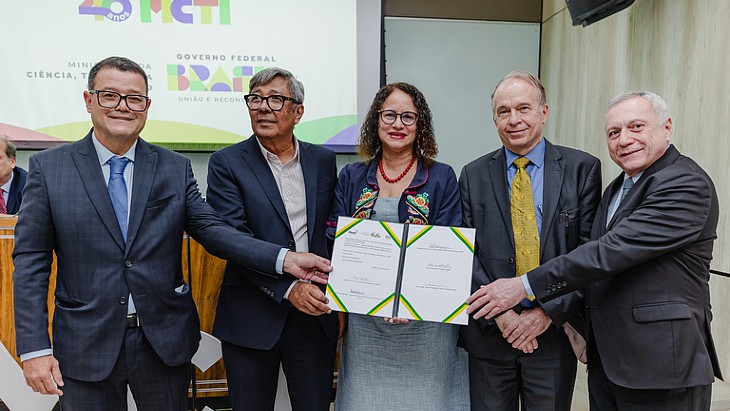
The three year BRL50 million (USD9.1 million) project also brings together research centres, universities and others, including the navy and the Institute of Energy and Nuclear Research and the Institute of Nuclear Engineering.
Industrias Nucleares do Brasil (INB) will be responsible for supplying nuclear fuel and specialised engineering services as well as providing technical and administrative support.
INB President Adauto Seixas said: "This is a historic milestone for the Brazilian nuclear sector. INB reinforces its vocation not only as a producer of nuclear fuel, but also as a technology-based, strategic company that is a leading player in the development of innovative solutions for the country. Nuclear microreactors have enormous potential to bring clean, safe and sustainable energy to remote regions, in addition to meeting industrial, defence and national energy security demands."
INB’s Director of Nuclear Fuel Reinaldo Gonzaga said the technology "could revolutionise distributed energy generation in Brazil".
The National Nuclear Energy Commission (CNEN) project aims to demonstrate the feasibility of the development of a Brazilian 3-5 MW microreactor. The vision is for the microreactor to fit within a 40-foot container and be operated remotely for more than 10 years without any need for refuelling.
Suggested uses including providing reliable power to remote towns, to hospitals and factories and reducing dependency on diesel generators. In March the commission said: "The project is currently at the TRL 3 technological readiness level, which corresponds to the mathematical modeling and preliminary studies phase. The goal is to advance to TRL 6, the level at which the technology is demonstrated in a relevant environment, closer to practical application."
There are various microreactor projects at different stages of development around the world. While small modular reactors are generally seen as including reactors up to 300 MW, microreactors are said by the International Atomic Energy Agency to be those designed for up to about 20 MW, with container-based ones seen as especially having the ability to be transported to a wide range of potential locations, including isolated areas.
Meanwhile, Rosatom International's First Deputy Director General for Marketing and Business Development Egor Kvyatkovsky was reported by Strana Rosatom to have told the St Petersburg International Economic Forum that Russia was offering Brazil joint projects for the construction of large and small-capacity nuclear power plants, and is also planning to open a transport corridor from Russia based on the port facilities of St. Petersburg.
He said: "Nuclear power plants - both land-based and floating - are an excellent solution for providing energy to various regions of Brazil. We offer a full range of services, including construction of nuclear power plants, maintenance, fuel supplies, and joint operation."
Brazil currently has two operating power reactors - Angra 1 and Angra 2 - which generate about 3% of the country’s electricity. Work on the Angra 3 project - to feature a Siemens/KWU 1405 MW pressurised water reactor - began in 1984 but was suspended two years later, before construction began. The scheme was resurrected in 2006, with first concrete in 2010. However, amid a corruption probe into government contracts, construction of the unit was halted for a second time in 2015, when it was 65% complete. It has since restarted and been halted again, with a decision currently awaited on completing it.
Regulator completes preliminary assessment of Steady Energy's SMR concept
The Finnish Radiation and Nuclear Safety Authority says the draft concept assessment for Steady Energy's proposed LDR-50 plant found that "nuclear and radiation safety, security arrangements, emergency arrangements and nuclear material safeguards solutions are such that they can be designed to meet safety requirements".
_50245_73604.jpg)
Concept assessment is a procedure proposed in the new Nuclear Energy Act in which the Radiation and Nuclear Safety Authority (STUK) assesses whether the power plant could meet safety requirements in general terms. It is separate to the construction permit process for the nuclear power plant.
STUK said it used the draft concept as a basis for its assessment. It also said of Steady Energy, which had requested the assessment, that "although it is not yet a complete plant supplier for a nuclear power plant, it has the potential to develop into one".
Project Manager for STUK, Minna Tuomainen, said the process was useful for the authority: "We were able to get to know the plant at an early stage, for which a permit may be applied for in Finland later." It would also help inform the development of the legislation regarding concept assessments, she said.
Tommi Nyman, CEO of Steady Energy, welcomed the authority's verdict and said they would continue to work closely in future, adding: "The result of the concept assessment supports our view of the development schedule of the LDR-50 nuclear power plant and confirms our previous view of the implementation schedule of the LDR-50 plants in Finland."
Juho Vierimaa, Head of Licensing and Quality, said: "We hoped for and received invaluable information from the evaluation to support our work. In addition, the assessment reinforces our belief that we are on the right path in terms of both technology and organisational development."
Steady Energy said that in accordance with the recommendations of the assessment it will demonstrate the operation of key safety features in a full-size pilot plant built inside a former coal-fired power plant in Salmisaari, Helsinki. Construction is scheduled to start in late 2025, with a budget of EUR15-20 million (USD17-23 million), funded by capital investments already raised by Steady Energy.
The pilot plant will serve as a full-scale, operational model of the Finnish-designed LDR-50 reactor design. Unlike the actual power plant, the pilot unit will use an electric element to produce heat inside the reactor capsule instead of nuclear fuel. The main purpose is to test operational features and to establish the necessary supply chains with various manufacturers to construct actual plants. It will be used to produce heat for the Helen district heating network with an output of about 6 MW when completed.
Following Finland's regulator's assessment an international assessment from regulators is also about to begin, building on STUK's work as they assess the reactor and "seek to find ways in which authorities in different countries could benefit from each other's work".
Steady Energy was spun out of Finland's VTT Technical Research Centre in 2023. The LDR-50 SMR, with a thermal output of 50 MW, is designed to operate at around 150°C. Unlike most SMRs being developed around the world, it is not designed to generate electricity - or electricity and heat. Instead, it is designed to only produce heat and is focused on district heating, as well as industrial steam production and desalination projects.
The company has already signed agreements for 15 reactors in Finland, with its reactor design currently being assessed by STUK. The aim is for construction of the first plant - to be the clean energy source for a district heating scheme - to begin in 2029.
Listen to a World Nuclear News podcast interview with Tommi Nyman in September 2024:
Article researched and written by WNN's Alex Hunt


