Monday, December 22, 2025

Privacy matters: AI security cameras are collecting unnecessary data


By Dr. Tim Sandle
SCIENCE EDITOR
DIGITAL JOURNAL
December 16, 2025


Human rights advocates contend the ability to easily share Ring doorbell and security camera video with police has exacerbated racial profiling - Copyright GETTY IMAGES NORTH AMERICA/AFP JUSTIN SULLIVAN

Smart AI security cameras can become a spying tool for hackers. Many devices are also collecting unnecessary amounts of data, which affects privacy and which provides an inroad for hackers.

The new study, from Surfshark, reveals that modern AI security cameras do more than just watch. By standardizing facial recognition, these devices have turned home security into a source of rich biometric data that includes not just camera owners but their neighbors as well.

Additionally, the apps required to operate these cameras are collecting personal information that may not be related to security functionality.

“The central risk isn’t only the capture. When people can’t meaningfully opt in or out and are not informed about where their biometric data is stored, what additional data points are being collected, and with whom it’s shared, you’ve created a privacy hazard. Scanning faces or car plates of neighbours – especially without explicit consent – should be treated as a major privacy concern if not a breach of privacy regulations,” Miguel Fornes, cybersecurity expert at Surfshark, has told Digital Journal.

Is facial recognition necessary?

Beyond video capture and alerts, many popular devices now include smart facial recognition and vehicle detection, raising the stakes for biometric and metadata exposure for camera owners and their neighbours.

Despite claims of enhanced safety, most camera companion apps gather additional user data unrelated to core camera functionality.

Fornes outlines the problem: “Imagine that suddenly the most personal and intimate part of your life – your home – is available to unknown individuals, with no known security controls to protect the recordings. The central risk isn’t only the capture. When people can’t meaningfully opt in or out and are not informed about where their biometric data is stored, what additional data points are being collected, and with whom it’s shared, you’ve created a privacy hazard. Scanning faces or car plates of neighbours – especially without explicit consent – should be treated as a major privacy concern if not a breach of privacy regulations.”

Drawing on an example, Fornes cites Amazon Ring. The device has recently been criticized by privacy watchdogs over its “Familiar Faces” feature, which claims to identify people captured on camera. This particular case raised concerns about consent and the handling of biometric data.

Too many AI features?

As these AI features become more prevalent, particularly facial recognition, manufacturers must navigate increasingly complex global privacy regulations. Facial recognition features are strictly regulated in the EU and UK, with high privacy standards enforced by the GDPR. By contrast, frameworks in the US, Canada, and Australia are less comprehensive and vary by jurisdiction.

According to Fornes, even when the law allows it, people often overlook the fact that in order to enable these smart features, AI cameras need to constantly ship data back to the manufacturer’s servers: “It’s not just recordings or snapshots. Camera’s companion apps may be siphoning additional data points – including location, device IDs, contact information, usage patterns, and even biometrics – creating a parallel surveillance stream that can amplify the damage of any breach.”

Fornes adds: “Once a smart camera has a known vulnerability, bad actors can silently take control – turning it into a live feed that spies on you and even your neighbors. For such attackers, highly sophisticated skills are not even necessary; there are numerous readily available platforms that literally list compromised webcams, allowing anyone to break in”.
Information gathered by AI camera makers

Among the eight leading brands analyzed in Surfshark’s study, six offer AI-powered facial recognition, 7 provide smart vehicle detection, and all of them feature person detection and intelligent alerts. Despite claims of enhanced safety, most popular models require companion apps for setup, notifications, and cloud storage – apps that often collect additional information unrelated to core camera functionality.

The disclosed advertising-related data practices varied widely among the analysed apps. Arlo stands out by collecting and sharing device IDs specifically for third-party advertising and by gathering more data types for developer advertising than any competitor, with five data types collected. Vivint and Google Nest each collect four data types for developer advertising, SimpliSafe collects three, and Amazon Ring and ADT each collect one.


CRIMINAL CAPITALI$M

Considerable amounts of dark web material originate from business insiders

By Dr. Tim Sandle
SCIENCE EDITOR
DIGITAL JOURNAL
December 16, 2025


A trove of documents from I-Soon, a private contractor that competed for Chinese government contracts, shows that its hackers compromised more than a dozen governments, according to cybersecurity firms SentinelLabs and Malwarebytes - Copyright AFP/File Daniel LEAL

Bad actors claim to be collaborating with insiders from companies that are household names, such as Facebook, Instagram, and Amazon, to unban accounts or leak confidential information about specific users, including their names, IP addresses, physical locations, emails, and phone numbers, for as little as $500.

This is according to findings from NordStellar, a threat exposure management platform, which reveal that cybercriminals are selling insider data-backed services on the dark web.

One source of this information is from malicious employees, also known as insider threats. Such individuals can cause significant harm to businesses by leaking or selling sensitive data, altering systems, or collaborating with cybercriminals to launch large-scale cyberattacks.

Loss of sensitive user information

The research has found 35 dark web posts claiming to sell services based on insider data so far this year. Some of the services for sale on the dark web claim to have direct connections to insiders from such well-known companies as Facebook, Instagram, and Amazon.

“The majority of the posts offer various look-up services, exposing sensitive user information, such as IP addresses, full names, email addresses, phone numbers, and even physical addresses,” says Vakaris Noreika, a cybersecurity expert at NordStellar to Digital Journal. “Aside from violating the user’s privacy, this information can be used to launch highly targeted phishing scams or to commit fraud — or even identity theft.”

The posts reveal that look-up services can start at $500, offering the user’s phone number and linked email address. Advanced packages, which contain even more sensitive user information, such as IP addresses, physical addresses, date of birth, and other confidential details, can be purchased for $1,000 or more.

“Other popular services include account recovery and unbanning. The former can be especially damaging to the brand because users are often banned for violating the company’s policies or engaging in fraudulent activity,” adds Noreika. “As a result, individuals who have been using the company’s services for scams can continue to do so, acquiring more victims and damaging the brand’s reputation in the process.”


Sounding the alert about malicious activity

Noreika explains that insider threats are complex, and to safeguard against malicious employees, companies must have a comprehensive cybersecurity strategy in place. He emphasizes high observability and behavioural analysis as the two main pillars for resilience.

“The first key step is to ensure high observability into user actions — once security teams achieve visibility, they can look for anomalies in employee behaviour, triggering the first alarms about potential malicious activity,” Noreika clarifies. “Security teams should assess whether there’s any potentially dangerous patterns in activity, for example, if a user is accessing sensitive information without justification or if there are any signs of them exfiltrating that information to external sources, like their own personal devices, accounts, or third parties.”

He underscores the importance of proper network segmentation and the principle of least privilege in general to prevent users from accessing sensitive information that isn’t necessary for their work. According to Noreika, to prevent employees from sharing and downloading unauthorized files, data loss prevention tools are also required.

Monitoring the dark web for posts mentioning the company, especially those claiming to sell services fuelled by insider data, should be prioritised. To effectively mitigate the damage inflicted by malicious insiders, Noreika advises companies to prepare an incident response plan in advance. The plan should outline the detection and investigation process, as well as the steps for containing the threat, eradicating the user’s access to company data and recovering systems if attackers compromise them in the process.
AI resurrections of dead celebrities amuse and rankle

By AFP
December 21, 2025


AI creations have triggered a debate about who controls a person's identity and legacy after death - Copyright AFP Chris DELMAS


Anuj Chopra in Washington, with Anna Malpas and Rachel Blundy in London

In a parallel reality, Queen Elizabeth II gushes over cheese puffs, a gun-toting Saddam Hussein struts into a wrestling ring, and Pope John Paul II attempts skateboarding.

Hyper-realistic AI videos of dead celebrities — created with apps such as OpenAI’s easy-to-use Sora — have rapidly spread online, prompting debate over the control of deceased people’s likenesses.

OpenAI’s app, launched in September and widely dubbed as a deepfake machine, has unleashed a flood of videos of historical figures including Winston Churchill as well as celebrities such as Michael Jackson and Elvis Presley.

In one TikTok clip reviewed by AFP, Queen Elizabeth II, clad in pearls and a crown, arrives at a wrestling match on a scooter, climbs a fence, and leaps onto a male wrestler.

In a separate Facebook clip, the late queen is shown praising “delightfully orange” cheese puffs in a supermarket aisle, while another depicts her playing football.

But not all videos — powered by OpenAI’s Sora 2 model — have prompted laughs.

In October, OpenAI blocked users from creating videos of Martin Luther King Jr. after the estate of the civil rights icon complained about disrespectful depictions.

Some users created videos depicting King making monkey noises during his celebrated “I Have a Dream” speech, illustrating how users can portray public figures at will, making them say or do things they never did.

– ‘Maddening’ –

“We’re getting into the ‘uncanny valley,'” said Constance de Saint Laurent, a professor at Ireland’s Maynooth University, referring to the phenomenon in which interactions with artificial objects are so human-like it triggers unease.

“If suddenly you started receiving videos of a deceased family member, this is traumatizing,” she told AFP. “These (videos) have real consequences.”

In recent weeks, the children of late actor Robin Williams, comedian George Carlin, and activist Malcolm X have condemned the use of Sora to create synthetic videos of their fathers.

Zelda Williams, the daughter of Robin Williams, recently pleaded on Instagram to “stop sending me AI videos of dad,” calling the content “maddening.”

An OpenAI spokesman told AFP that while there were “strong free speech interests in depicting historical figures,” public figures and their families should have ultimate control over their likeness.

For “recently deceased” figures, he added, authorized representatives or estate owners can now request that their likeness not be used in Sora.

– ‘Control likeness’ –

“Despite what OpenAI says about wanting people to control their likeness, they have released a tool that decidedly does the opposite,” Hany Farid, co-founder of GetReal Security and a professor at the University of California, Berkeley, told AFP.

“While they (mostly) stopped the creation of MLK Jr. videos, they are not stopping users from co-opting the identity of many other celebrities.”

“Even with OpenAI putting some safeguards to protect MLK Jr. there will be another AI model that does not, and so this problem will surely only get worse,” said Farid.

That reality was underscored in the aftermath of Hollywood director Rob Reiner’s alleged murder this month, as AFP fact-checkers uncovered AI-generated clips using his likeness spreading online.

As advanced AI tools proliferate, the vulnerability is no longer confined to public figures: deceased non-celebrities may also have their names, likenesses, and words repurposed for synthetic manipulation.

Researchers warn that the unchecked spread of synthetic content — widely called AI slop — could ultimately drive users away from social media.

“The issue with misinformation in general is not so much that people believe it. A lot of people don’t,” said Saint Laurent.

“The issue is that they see real news and they don’t trust it anymore. And this (Sora) is going to massively increase that.”

burs-ac/des

As US battles China on AI, some companies choose Chinese


By AFP
December 21, 2025


The January launch of Chinese company DeepSeek's high-performance, low-cost and open source 'R1' large language model (LLM) defied the perception that the best AI tech had to be from US juggernauts like OpenAI, Anthropic or Google - Copyright AFP Kirill KUDRYAVTSEV


Thomas Urbain with Luna Lin in Beijing

Even as the United States is embarked on a bitter rivalry with China over the deployment of artificial intelligence, Chinese technology is quietly making inroads into the US market.

Despite considerable geopolitical tensions, Chinese open-source AI models are winning over a growing number of programmers and companies in the United States.

These are different from the closed generative AI models that have become household names — ChatGPT-maker OpenAI or Google’s Gemini – whose inner workings are fiercely protected.

In contrast, “open” models offered by many Chinese rivals, from Alibaba to DeepSeek, allow programmers to customize parts of the software to suit their needs.

Globally, use of Chinese-developed open models has surged from just 1.2 percent in late 2024 to nearly 30 percent in August, according to a report published this month by the developers’ platform OpenRouter and US venture capital firm Andreessen Horowitz.

China’s open-source models “are cheap — in some cases free — and they work well,” Wang Wen, dean of the Chongyang Institute for Financial Studies at Renmin University of China told AFP.

One American entrepreneur, speaking on condition of anonymity, said their business saves $400,000 annually by using Alibaba’s Qwen AI models instead of the proprietary models.

“If you need cutting-edge capabilities, you go back to OpenAI, Anthropic or Google, but most applications don’t need that,” said the entrepreneur.

US chip titan Nvidia, AI firm Perplexity and California’s Stanford University are also using Qwen models in some of their work.

– DeepSeek shock –

The January launch of DeepSeek’s high-performance, low-cost and open source “R1” large language model (LLM) defied the perception that the best AI tech had to be from US juggernauts like OpenAI, Anthropic or Google.

It was also a reckoning for the United States — locked in a battle for dominance in AI tech with China — on how far its archrival had come.

AI models from China’s MiniMax and Z.ai are also popular overseas, and the country has entered the race to build AI agents — programs that use chatbots to complete online tasks like buying tickets or adding events to a calendar.

Agent friendly — and open-source — models, like the latest version of the Kimi K2 model from the startup Moonshot AI, released in November, are widely considered the next frontier in the generative AI revolution.

The US government is aware of open-source’s potential.

In July, the Trump administration released an “AI Action Plan” that said America needed “leading open models founded on American values”.

These could become global standards, it said.

But so far US companies are taking the opposite track.

Meta, which had led the country’s open-source efforts with its Llama models, is now concentrating on closed-source AI instead.

However, this summer, OpenAI — under pressure to revive the spirit of its origin as a nonprofit — released two “open-weight” models (slightly less malleable than “open-source”).

– ‘Build trust’ –

Among major Western companies, only France’s Mistral is sticking with open-source, but it ranks far behind DeepSeek and Qwen in usage rankings.

Western open-source offerings are “just not as interesting,” said the US entrepreneur who uses Alibaba’s Qwen.

The Chinese government has encouraged open-source AI technology, despite questions over its profitability.

Mark Barton, chief technology officer at OMNIUX, said he was considering using Qwen but some of his clients could be uncomfortable with the idea of interacting with Chinese-made AI, even for specific tasks.

Given the current US administration’s stance on Chinese tech companies, risks remain, he told AFP.

“We wouldn’t want to go all-in with one specific model provider, especially one that’s maybe not aligned with Western ideas,” said Barton.

“If Alibaba were to get sanctioned or usage was effectively blacklisted, we don’t want to get caught in that trap.”

But Paul Triolo, a partner at DGA-Albright Stonebridge Group, said there were no “salient issues” surrounding data security.

“Companies can choose to use the models and build on them…without any connection to China,” he explained.

A recent Stanford study published posited that “the very nature of open-model releases enables better scrutiny” of the tech.

Gao Fei, chief technology officer at Chinese AI wellness platform BOK Health, agrees.

“The transparency and sharing nature of open source are themselves the best ways to build trust,” he said.


Agentic AI set to become big in 2026


ByDr. Tim Sandle
SCIENCE EDITOR
DIGITAL JOURNAL
December 21, 2025


City of London at night. — Image by © Tim Sandle

As leadership teams wrap up annual planning and look ahead to 2026, this provides a rare moment in the corporate calendar for those occupying the heady heights of the C-Suite to step back and reassess which trends will actually matter as the next year unfolds.

Dimitri Masin, Co-Founder and CEO of Gradient Labs — an AI-native fintech working with leading financial institutions across Europe and recently launched in the U.S. — believes the next phase of customer experience will look fundamentally different. Based on what his team is seeing in live, regulated deployments, Masin has told Digital Journal about three customer experience shifts that will define CX in 2026.

Dmitri Masin previously served as Sales Finance Analyst at Google and VP Data Science, Financial Crime and Fraud at Monzo (UK’s Venmo Bank), joining as one of the early employees and scaling a 120+ person team. With a background in financial engineering and AI, he specialises in risk-compliant automation for regulated industries. With two partners, he established Gradient Labs, the conversational AI platform purpose-built for financial services.

This year, the startup secured a $13 million investment in just one week, and the platform can now reach over 32 million end-users.

1. Voice AI becomes trusted and safe

According to Masin: “Voice will shift from being the most unpredictable customer-support channel to the most trusted one. Financial institutions will begin adopting voice AI that can reason through complex procedures, follow multi-step compliance workflows, and guarantee audit-ready accuracy in real time.”

This means, as AI transitions: “Voice is becoming a core part of the AI-powered operating system for financial firms – resolving issues end-to-end, not just answering calls. The global voice banking market is projected to grow to nearly $18 billion by 2032, so this is the future the industry is heading.”

2. Outbound predictive communication

Masin also sees predictive analytics increasing in scope: “The next evolution of customer service is outbound predictive communication – moving from reactive responses to proactive engagement. AI agents will anticipate customer needs before they surface, reaching out with solutions, not apologies. Imagine a system that alerts a customer before a payment fails, or offers guidance before a compliance issue even occurs.”

As to the significance? “This shift from reactive to predictive service will redefine what trust and satisfaction mean in financial experiences.”

3. The shift to 360° autonomous customer experience

Attracting and keeping customers remains essential to any business seeking to grow, and here autonomous AI becomes a necessary tool: “We’re moving beyond hyper-personalisation toward truly agentic AI – systems that don’t just tailor experiences, but act on behalf of customers to resolve their needs autonomously. Gartner predicts that by 2029, agentic AI will autonomously resolve 80% of common customer service issues without human intervention, leading to a 30% reduction in operational costs, but the market demonstrates it can happen sooner.”

As to what this means in practice, Masin explains: “AI systems will not just personalise customer experiences but autonomously act on behalf of users across inbound requests, proactive outreach, and back office operations – everything executing payments, resolving disputes, and managing compliance checks in real time. Intelligent agents manage entire customer journeys and compliance workflows end-to-end. The shift from “hyper-personalised” to “hands-on, proactive AI” will redefine what trust and efficiency mean in customer operations.”
Bernie Sanders Says A New 'Breed Of Uber Capitalists' Has Emerged. They Truly Believe They Are 'Superior Human Beings'

Adrian Volenik
Sat, December 20, 2025 
 Benzinga


Sen. Bernie Sanders (I-VT) says there’s a different kind of wealthy Americans emerging, and they no longer see themselves as part of the same system as everyone else.


Billionaires, Poverty And Misplaced Priorities

“There is a new breed of uber capitalists out there who really believe, and they write about this as well, that they are superior human beings,” Sanders said on the “Flagrant” podcast earlier this year. He said many billionaires today view their wealth as proof they deserve more power, not just economically, but politically and socially.

He compared this modern mindset to outdated elitist worldviews from centuries ago. “Back in the 19th century… I am the king, God made my family king… Sorry you're starving to death but that's the way life goes,” he said. “God told me my family rules.”

Podcast host Andrew Schulz pointed to the hypocrisy of some of the ultra-wealthy pledging to give away their money only at the end of their lives. “As they get closer to death, they’re like, ‘Our goal is to give away all our money,’ which seems to tell me that they think that there is an issue with them having all that money,” he said. Sanders agreed: “I think they want it all. I really do,” saying that it’s because they’re very competitive.

“We are the richest country in the history of the world,” Sanders said. And yet, “60% of people live paycheck to paycheck.” He argued that the U.S. has more than enough money to address its biggest problems–if it chose to

Sanders also talked about the U.S. spending “twice as much per person on healthcare as most European countries,” yet still sees tens of thousands of preventable deaths each year due to unaffordable care. “We pay child care workers McDonald's wages,” he added, while claiming to love kids.

Military Spending

More recently, Sanders has turned his attention to military spending, calling out the U.S. government for prioritizing defense over basic human needs.

President Donald Trump signed the $901 billion National Defense Authorization Act on Thursday after it passed both the House and Senate with bipartisan support. Sanders was one of the 20 lawmakers to vote against it.

“We are spending $1 trillion every year on the military. That's more than the next NINE nations combined,” Sanders wrote on X on Thursday. “Meanwhile, millions lack health care & we have the highest childhood and senior poverty rate of almost any major country. Congress needs to get its priorities straight.”

He posted a video along with the statement, criticizing lawmakers for focusing on parts of the defense bill rather than its overall price tag. “We don't look at the bill in its totality,” he said. “When you add everything up, we are spending over $1 trillion a year on the military.”

© 2025 Benzinga.com. Benzinga does not provide investment advice. All rights reserved.
View comments(208)


Bernie Sanders Questions Elon Musk's Universal High Income, Free Housing Claims Amid AI, Robotics Push: 'How Will This Utopia Come…'

Badar Shaikh
Sun, December 21, 2025
BENZINGA


Sen. Bernie Sanders (I-VT) has slammed Tesla Inc
. (NASDAQ:TSLA) CEO Elon Musk amid an AI and Robotics push.


How Will This Utopia Come About, Bernie Sanders Asks


In a post on the social media platform X on Thursday, Sanders shared a video directed at Musk. "Just a couple of questions for you," Sanders captioned the video. In the video, the Senator asked Musk questions about his artificial intelligence and robotics efforts, which will bring about a "utopia" in the world.

"You have told us poverty will be wiped out, work will be optional," Sanders said, adding that Musk also claimed that there will be "universal high income" for everyone. "How will this utopia come about?" Sanders asked if there were no "entry-level jobs" available in the market.

"When are they going to get the free housing?" Sanders asked, adding that if robots took over manufacturing jobs, when would the people working in factories receive free healthcare?

"I look forward to hearing about how you and your other oligarch friends are going to provide working people with the magnificent life that you promise," Sanders said. He also criticized President Donald Trump for doubling insurance premiums for millions of people and the SNAP benefit woes.

Hello, @elonmusk!

Just a couple of questions for you: https://t.co/bVvoOTzuum pic.twitter.com/R3h0GvdSQq

— Sen. Bernie Sanders (@SenSanders) December 19, 2025

See Also: Deloitte's #1 Fastest-Growing Software Company Lets Users Earn Money Just by Scrolling — Accredited Investors Can Still Get In at $0.50/Share.
Elon Musk Vs Bernie Sanders

The pair recently got into a heated exchange on social media after Sanders criticized the construction of AI datacenters, asking for a moratorium on the data centers. The comments prompted Musk to call Sanders a coward who lacked "any sense of adventure."


Sanders had also voiced his opposition to the construction of new data centers in the past, warning that the tech industry’s AI push posed a threat to jobs, democracy, as well as public resources.

Sanders has received backing from Rep. Ro Khanna (D-Calif.), who said that, despite representing Silicon Valley, he was backing Sanders as he shared that the AI technology should be helpful to workers and not “tech barons.”
Tesla's $1.58 Trillion Valuation, Falling Sales

Meanwhile, Tesla's total valuation recently reached $1.58 trillion, which further helped the EV giant bolster its position as the most valuable automaker in the world, putting it well ahead of other auto industry rivals, including Toyota Motor Corp. (NYSE:TM).

However, Tesla's sales continue to be lackluster, with the latest figures suggesting a steep 23% decline in November U.S. sales amid President Donald Trump‘s introduction of several anti-EV policy changes in the U.S., like relaxing CAFE standards, among other reasons.

Photo courtesy: Joshua Sukoff on Shuttertsock.com


Hillary Clinton Is Wrong: The Gaza Genocide Isn’t ‘Fake News’

Youth support for Palestine reflects a changing media landscape.


Journalists protest against the Israeli attacks on the Palestinian journalists outside a hospital in Deir al-Balah city, central Gaza Strip, on Jan. 8, 2025.
(Photo by Rizek Abdeljawad/Xinhua via Getty Images

Aastha Uprety
Dec 21, 2025
Common Dreams

As unconditional support for Israel becomes more of a political liability and solidarity with Palestine establishes itself as a litmus test, former Secretary of State Hillary Clinton and her fellow status-quo defenders are blaming social media for the US public’s growing solidarity with Palestine.

In accusing young people of falling for fake news, they rely on an outdated assumption that equates social media with falsehoods—and equates legacy media with trustworthiness. What’s clear is that Clinton and her peers who partake in similar rhetoric fail to grasp the nuances of today’s media landscape, particularly as it has unraveled around Palestine.


Hillary Clinton Joins in Blaming TikTok for Young Americans’ View That Israel Is Committing Genocide


Lemkin Institute Rebukes Clinton for Blaming Youth Outrage Over Gaza Genocide on TikTok

More and more Americans have realized that Israel’s post-October 7 assault on Gaza is not only disproportionate but genocidal, and that in spite of the carnage, the US government continues to provide diplomatic cover and send billions in military aid. It’s no wonder that public sentiment has shifted considerably against Israel in the past two years, with young people in particular being increasingly supportive of Palestine. This sea change has made establishment politicians very nervous. In several recent speaking engagements, former Secretary of State Hillary Clinton has lamented that these pro-Palestine young people have the unfortunate habit of getting their news from social media; to her, that makes them uninformed and sorely misled.

“More than 50% of young people in America get their news from social media. Just pause on that for a second,” she said at an event for the newspaper Israel Hayom earlier this month. “They are seeing short-form videos, some of them totally made up, some of them not at all representing what they claim to be showing. And that’s where they get their information.”

The claim that social media is misleading and misinforming young people is simply an attempt not only to delegitimize pro-Palestine sentiment but to cast doubt on the devastation in Gaza itself.

Clinton’s framing is reminiscent of 2016-era misinformation discourse, back when the US public hadn’t fully figured out what to do with social media’s rapid acceleration and impact on politics. But that familiar rhetoric does not apply to the youth-driven political realignment on Palestine. When Clinton implies that pro-Palestine sentiment is a result of misinformation—a fraught umbrella diagnosis that often tries to encompass too much, and whose remedies can clash with the ideals of free speech—she attempts to place it within the context of Facebook fueling atrocities in Myanmar, Russian information campaigns working to influence the US election, and then-candidate Donald Trump labeling every media outlet “fake news,” forcing them to have tough conversations about when and how to fact-check his claims.

While the current media landscape and its relationship to politics is still bleak, Clinton’s accusation is much more about her fealty to Israel and the centrist-liberal order. The claim that social media is misleading and misinforming young people is simply an attempt not only to delegitimize pro-Palestine sentiment but to cast doubt on the devastation in Gaza itself.

The data point that half of Americans get (some of) their news from social media alarms most people—perhaps a valid instinct, given the current media landscape of local news in decline, billionaires taking over outlets, and profit-driven influencers peddling dubious wellness claims via vertical video. Social media did democratize information sharing without necessarily embedding any accountability mechanism for its quality and accuracy, resulting in a lot of low-quality content of dubious veracity.

But this doesn’t mean that social media users are only, primarily, or even significantly consuming fake news or slop. Pew Research Center reports that users, shockingly, do make assessments about what content they’re looking at. Not to mention that plenty of the content on social media is content from news outlets themselves.

According to Clinton, what’s most concerning is the fact that so many young people are getting their information from TikTok, given that the app is “governed by an algorithm—at least up til now—still largely manipulated by the Chinese Communist Party.” Her geopolitical paranoia echoes CNN commentator Van Jones, who in October placed blame on Iran and Qatar for running a “disinformation campaign” that flooded social media users with images of “dead Gaza baby, dead Gaza baby, dead Gaza baby.” Both try to convince audiences that concern for Palestine is just an information-operations campaign from our geopolitical enemies. Reports from earlier this year indicated that the legislation banning TikTok was, in part, ushered along by lawmakers’ worries about the prevalence of content critical of Israel on the platform.

Yet the most damning lesson here is not the growing reliance on getting information from social media, or even the fact that our collective outlook toward it should be more nuanced (it should!). Rather, it’s the collapse of trust in traditional legacy media that has accompanied young peoples’ shifting views on Palestine. The media industry utterly failed in its charge to report the news, and it failed to defend colleagues in Gaza as they were systematically murdered by the Israeli government. The New York Times in particular has been especially egregious, most infamously failing to retract their story “Screams Without Words” even after its credibility was seriously questioned.

Let’s say Clinton and her peers are only consuming these news sources (and even then, they’d have to be taking great lengths to avoid reading the quality reporting on Gaza that mainstream publications do often release, not to mention ignoring the numerous reports from human rights organizations and experts), then they’d be the ones who are uninformed—not the bogeyman of kids on social media.

The Lemkin Institute for Genocide Prevention and Human Security issued a statement last week on Clinton’s baseless accusations:
What truly seems to unsettle Secretary Clinton is not “misinformation,” but rather the fact that younger generations are no longer consuming a single, state-controlled narrative. They are accessing unfiltered images and testimonies that challenge decades of political messaging.

Clinton’s basic premise—denying the genocide in Gaza—is false. Young people know that they’re being gaslit. Yes, it is true that they’ve experienced “TikTok smashing their brains all day long with videos of carnage in Gaza.” They’ve seen Western media bend over backwards to diminish blame on Israel. And they’ve seen resilient Palestinian journalists like Bisan Owda showing Gaza through her own eyes.

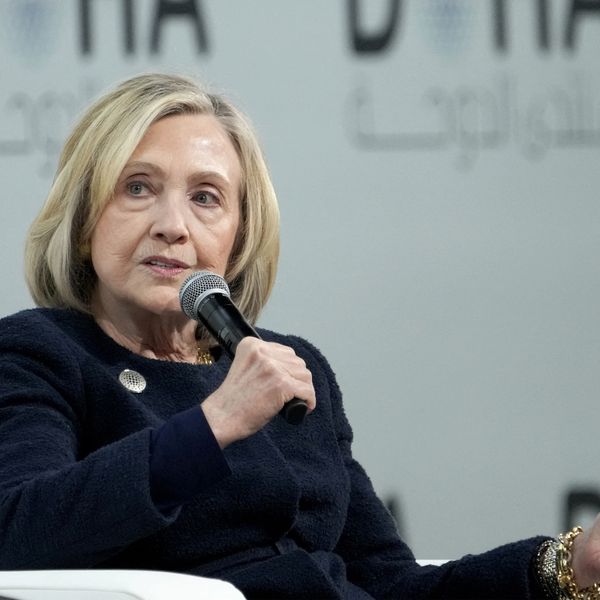
At the Doha Forum, Clinton said it’s “a provable fact that most Americans... get their news from social media.” To echo Foreign Policy editor-in-chief Ravi Agrawal’s response: “Is that a bad thing?”

Our work is licensed under Creative Commons (CC BY-NC-ND 3.0). Feel free to republish and share widely.


Aastha Uprety
Aastha Uprety is a writer and editor based in New York City. She has an MPA in social policy and technology, media, and communications from Columbia University.
Full Bio >


KUSHNER REAL ESTATE INC.

Trump’s Son-in-Law Pitches $112B Tech Utopia on Gaza Rubble

Adam Downer
Sat, December 20, 2025 


Alexi Rosenfeld / Getty Images, The Wall Street Journal

Ivanka Trump’s husband is trying to get Middle Eastern leaders to invest in his vision of a high-tech paradise built on the ruins of Gaza.

Jared Kusher, 44, and Middle East envoy Steve Witkoff, 68, have concocted a 32-slide, “sensitive but unclassified” PowerPoint presentation titled “Project Sunrise: Building a New and Unified Gaza,” which paints a vision of a sparkling metropolis built on the war-torn ruins of the Gaza Strip, The Wall Street Journal first reported on Friday.


Jared and Witkoff are pitching a futuristic utopia built on the ruins of Gaza. / Wall Street Journal

The proposal says the U.S. would commit 20% of the development costs to turn the Gaza Strip into a ritzy tourist destination, replete with high-speed railways, AI-driven power grids, and beachside luxury resorts. The plan would cost $112.1 billion over ten years, with the U.S. promising to support nearly $60 billion in grants and guarantees on debt for “all the contemplated work streams” in that time period.

Kushner’s pitch deck does not provide a specific plan for exactly where 2 million displaced Palestinians would go during the reconstruction period. It does say they would be placed in “temporary shelter, field hospitals, and mobile clinics.”

The White House did not immediately respond to the Daily Beast’s request for comment. Spokeswoman Abigail Jackson told the Journal, “The Trump administration will continue to work diligently with our partners to sustain a lasting peace and lay the groundwork for a peaceful and prosperous Gaza.”


Trump's son-in-law Jared Kushner and special envoy Steve Witkoff have been pressing their business connections to try and secure profitable peace deals in the Middle East. / Win McNamee/Getty ImagesMore

Trump’s son-in-law and Witkoff reportedly pressed their business connections in the Middle East while hammering out a peace deal in the Israel-Hamas conflict. Kushner and Witkoff are reportedly trying a similar tactic to secure a profitable peace in the Russia-Ukraine war.

So far, the two men have shopped the PowerPoint to Turkey, Egypt, and wealthy Gulf Kingdoms, according to the Journal.

However, Middle East experts have serious doubts that Jared and Witkoff’s vision will ever come to fruition.

“Nothing happens until Hamas disarms. Hamas will not disarm, so nothing will happen,” said Steven Cook, a senior fellow for the Middle East at the Council on Foreign Relations.


Reconstruction in Gaza would require the removal of 68 million tons of debris, undetonated land mines, and 10,000 killed Palestinians. / Abed Rahim Khatib/Anadolu via Getty Images

The tenuous peace deal in the Israel-Hamas conflict struck on Oct. 10 hinges on Hamas agreeing to disarm, which it so far has refused to do. Hamas disarmament is phase 2 of Trump’s 20-phase peace plan. Without Hamas disarmament, the rest of the peace agreement can’t move ahead. Slide 2 of the “Project Sunrise” PowerPoint concedes that it can’t move forward unless Hamas disarms.

Secretary of State Marco Rubio said on Friday that Hamas remains the biggest roadblock to any reconstruction effort.

“You are not going to convince anyone to invest money in Gaza if they believe another war is going to happen in two, three years,” he said.

“We have a lot of confidence that we are going to have the donors for the reconstruction effort and for all the humanitarian support in the long term,” he added.
NAKBA II

Israel's Cabinet approves 19 new Jewish settlements in the occupied West Bank


Settlements are considered illegal under international law. 


MELANIE LIDMAN
Sun, December 21, 2025
AP


Palestinian mother of Ahmad Ziyoud, draped in the flag of the Islamic Jihad militant group, mourns during his funeral in Silat al-Harithiya, near Jenin, in the West Bank, Sunday, Dec. 21, 2025. (AP Photo/Majdi Mohammad)


Palestinian men carry Ahmad Ziyoud, draped in the flag of the Islamic Jihad militant group, during his funeral in Silat al-Harithiya, near Jenin, in the West Bank, Sunday, Dec. 21, 2025. (AP Photo/Majdi Mohammad)

Cardinal Pierbattista Pizzaballa, the Latin Patriarch of Jerusalem, left, leads a Christmas Eve Mass at the Holy Family Catholic Church in Gaza City, Sunday, Dec. 21, 2025. 
(AP Photo/Jehad Alshrafi)

Cardinal Pierbattista Pizzaballa, the Latin Patriarch of Jerusalem, leads a Christmas Eve Mass at the Holy Family Catholic Church in Gaza City, Sunday, Dec. 21, 2025.
 (AP Photo/Jehad Alshrafi)

A nun holds a baby as she walks to attend Christmas Eve Mass at the Holy Family Catholic Church in Gaza City, Sunday, Dec. 21, 2025. (AP Photo/Jehad Alshrafi)

TEL AVIV, Israel (AP) — Israel’s Cabinet has approved a proposal for 19 new Jewish settlements in the occupied West Bank, the far-right finance minister said Sunday, as the government pushes ahead with a construction binge in the territory that further threatens the possibility of a Palestinian state.

That brings the total number of new settlements over the past few years to 69, a new record, according to Finance Minister Bezalel Smotrich, who has pushed a settlement expansion agenda in the West Bank. The latest ones include two that were previously evacuated during a 2005 disengagement plan.

The approval increases the number of settlements in the West Bank by nearly 50% during the current far-right government’s tenure. In 2022, there were 141 settlements across the West Bank. After the latest approval, there are 210, according to Peace Now, an anti-settlement watchdog group.

Settlements are widely considered illegal under international law. Smotrich's office said the Cabinet approval came on Dec. 11 and that the development had been classified until now.

Settlements are the latest blow to Palestinian state

The approval comes as the U.S. pushes Israel and Hamas to move ahead with the second phase of the Gaza ceasefire, which took effect Oct. 10. The U.S.-brokered plan calls for a possible “pathway” to a Palestinian state, something the settlements are aimed at preventing.

The Cabinet decision included a retroactive legalization of some previously established settlement outposts or neighborhoods of existing settlements, and the creation of settlements on land where Palestinians were evacuated, the Finance Ministry said. Settlements can range in size from a single dwelling to a collection of high-rises.

The ministry said two of the settlements legalized in the latest approval are Kadim and Ganim, which were two of the four West Bank settlements dismantled in 2005, as part of Israel's withdrawal from the Gaza Strip. There have been multiple attempts to resettle them after Israel’s government in March 2023 repealed a 2005 act that evacuated the four outposts and barred Israelis from reentering the areas.

Israel captured the West Bank, east Jerusalem and Gaza — areas claimed by the Palestinians for a future state — in the 1967 war. It has settled over 500,000 Jews in the West Bank, in addition to over 200,000 in contested east Jerusalem.

Israel’s government is dominated by far-right proponents of the settler movement, including Smotrich and Cabinet Minister Itamar Ben-Gvir, who oversees the nation’s police force.

Settler expansion has been compounded by a surge of attacks against Palestinians in the West Bank in recent months.

During October’s olive harvest, settlers across the territory launched an average of eight attacks daily, the most since the United Nations humanitarian office began collecting data in 2006. The attacks continued in November, with the U.N. recording at least 136 more by Nov. 24.

Settlers burned cars, desecrated mosques, ransacked industrial plants and destroyed cropland. Israeli authorities have done little beyond issuing occasional condemnations of the violence.

2 Palestinians killed in West Bank clashes, ministry says

The Palestinian Health Ministry in Ramallah said two Palestinians, including a 16-year-old, were killed in clashes with Israel's military on Saturday night in the northern part of the West Bank.

Israel's military said a militant was shot and killed after he threw a block at troops in Qabatiya, and another militant was killed after he hurled explosives at troops operating in the town of Silat al-Harithiya.

The Palestinian Health Ministry identified the Palestinian killed in Qabatiya as 16-year-old Rayan Abu Muallah. Palestinian media aired brief security footage of the incident, where the youth appears to emerge from an alley and is shot by troops as he approaches them without throwing anything. Israel's military said the incident is under review.

The Health Ministry identified the second man as Ahmad Ziyoud, 22.

Israel’s military has scaled up military operations in the West Bank since the Oct. 7, 2023, Hamas-led attack that triggered the war in Gaza.


Cardinal celebrates Christmas Mass in Gaza City

The top Catholic leader in the Holy Land visited Gaza’s only Catholic church and celebrated a pre-Christmas Mass on Sunday that included the baptism of a baby. Dozens of Palestinians gathered in the Holy Family Parish.

Cardinal Pierbattista Pizzaballa is on his fourth visit to Gaza since the war began, and said the Christian community aims to be a “stable, solid reference point in this sea of destruction” as rebuilding slowly begins.

“It is different this time,” Pizzaballa said. “I saw the new desire for a new life.”

The Holy Family compound was hit by fragments from an Israeli shell in July, killing three people in what Israel called an accident and expressed regret over. The parish has served as a refuge for Christians and Muslims, sheltering hundreds of displaced people.


There was a mix of gratitude and grief as people at the church marked Christmas away from home. “They welcomed us with great love and respect,” said Nazih Lam’e Habashi, 78, who stays there with his family. “This is the third holiday we are marking since the war."

“God willing, life will improve," added 67-year-old Najla Saba.

___

Find more of AP’s Israel-Hamas coverage at https://apnews.com/hub/israel-hamas-war
DISARM, DEMILITARIZE, DEFUND

Combat training is a rite of passage for police recruits. It's left a trail of deaths and injuries

RYAN J. FOLEY
Sat, December 20, 2025
AP


LONG READ


Heather Sterling poses for a portrait during a hike, Aug. 11, 2025, near Daniel, Wyo. (AP Photo/Amber Baesler)

Heather Sterling stepped into the ring at the Texas Game Warden Training Center, ready to face an ambush by instructors acting as violent assailants.

The four-on-one drill is a rite of passage for those training to be game wardens, sworn officers who enforce state conservation laws. Nationwide, thousands of local and state police recruits are allowed into the profession only after passing similar drills – simulated fights for their lives.

The barrage of force against Sterling came rapidly, video obtained by The Associated Press shows. A surprise push from behind threw her to the floor. A right-handed punch to the back of the head knocked her down. Within two minutes, she was struck at least seven times in the head, the last blow knocking off her wrestling helmet.

“Protect yourself!” an instructor yelled.

Sterling completed the drill but suffered a concussion. A dozen of her classmates — a third in all — were injured that day as they were repeatedly punched, tackled on a gym floor and thrown against padded walls, records show.

While the drill was physically punishing, their experience was not unique. Since 2005, similar drills at law enforcement academies nationwide have been linked to at least a dozen deaths and hundreds of injuries, some resulting in disability, an AP investigation has found.

______

Editor’s note: This is the third installment of AP’s Dying to Serve series. Find the previous stories here and here.

______

The drills — frequently referred to as RedMan training for the brand and color of protective gear worn by participants – are intended to teach law enforcement recruits how to defend themselves against combative suspects. They’re among the most challenging tests at police academies. Law enforcement experts say that when properly designed and supervised, they teach new officers critical skills for handling high-stress situations.

But critics say they can put recruits at risk of physical and mental abuse that runs some promising officers out of the profession. Academies have wide latitude in running such exercises, given a lack of national standards governing police training.

Sterling quit the academy after her drill. She's now speaking out, hoping to spark change in training practices nationwide.

“I’m worried that someone is going to get killed,” said Sterling, who'd previously worked as a senior game warden and defensive tactics instructor in Wyoming. “This is a poorly disguised assault.”

An investigation by the agency that regulates law enforcement training found no wrongdoing in how the drill was conducted. An academy official told investigators the goal was to “overwhelm the cadet physically and mentally to force them to think while physically exhausted.”

An expert who reviewed the case told AP injuries happen during volatile training environments nationwide, but the Texas drill stood out for its design — recruits could not use force to defend themselves against the onslaught of assailants. He said the number of injuries was concerning.

“To teach cadets how and when to defend themselves, only to put them in a doomsday scenario with the instruction that they’re not allowed to fight back, does not match any training curriculum I’ve seen,” said David Jude, a retired Kentucky State Police academy commander.

A Wyoming game warden moves back to Texas

In October 2024, Sterling started the Texas Parks and Wildlife Department’s eight-month academy in rural central Texas, which boasts of producing “the best-trained conservation officers in the country.”

Game wardens — called conservation officers or wildlife troopers in some states — enforce hunting and fishing laws. They carry firearms, have arrest powers, are often among the first to respond to emergencies and rescue missions.

Sterling said she loved serving as a game warden for nearly five years in Wyoming, where she sometimes shooed moose and mountain lions away from towns. Patrolling without backup, she said, she had some “very tense conversations” with suspects and had to restrain some in handcuffs

She said almost everyone she encountered during hunting season was armed and potentially dangerous, but she prided herself on responding alertly and calmly. She never had to fight a suspect, and none of the 40 wardens she taught self-defense had been in a significant use-of-force incident.

Sterling applied in Texas to live closer to family, hoping for a similar law-enforcement role in her home state. She grew up as the daughter of a Dallas police officer and ran track and cross-country at Texas A&M.

The academy scheduled the four-on-one drill for Dec. 13, 2024, after five weeks of arrest and control training.

Instructors told cadets they couldn't defend themselves and were only to punch and kick a shield held by instructors, Sterling recalled. They discussed how some cadets had been seriously injured and terminated from previous academies for performing poorly.

Sterling told AP she was confused by the drill’s purpose. She'd never been ambushed by one person, let alone four. If that happened, she’d be able to use a firearm or other force to defend herself. As an instructor, she said, she would have never approved such a scenario or allowed punches to the head and neck.

A female classmate who had previously worked as a police officer resigned rather than participate. She later told investigators she saw the drill as inappropriate and part of an academy culture of unprofessional training and hazing.

But Sterling felt she had no choice if she wanted to stay in her profession. She completed a cardio exercise, and the drill began.

Combat drills take various forms nationwide

Academies have discretion to design training within state guidelines, and AP found the drills take many forms at local police, county sheriff and state departments. They’re sometimes called “combat training,” “Fight Day” or “stress reaction training.”

Recruits like Sterling must ward off several assailants at once. Others fight a series of instructors, one after another. Some academies intentionally use larger, more skilled instructors. In Kentucky, one scenario requires fighting a combative suspect in a pool.

The stated goals are generally the same: to use skills learned in the academy to fend off or subdue assailants and to never give up.

Recruits and instructors wear protective gear to cushion their heads from blows. But there are no uniform safety guidelines, including whether academies must have medical personnel on site.

Lawyers for some Black and female former trainees have alleged that instructors targeted their clients with excessive force to try to run them out of the profession. Several of the deaths have been of Black men hoping to join disproportionately white police forces.

Amid the deaths and criticism, experts are encouraging academy directors to retire or modify any problematic drills.

The drills “can quickly devolve into abusive rites of passage” without appropriate focus and oversight, said Brian Baxter, who oversaw training at the Texas Department of Public Safety and now leads a group that studies the use of force. Some instructors want to win rather than allow recruits to practice their skills, he added.

“The idea that we’re just punching each other to see who’s toughest ... that’s when it becomes inappropriate,” said Baxter, whose former agency overhauled its practices after a trooper died in 2005 from getting hit several times in the head. “There needs to be a problem that’s being solved by this training. And that problem needs to be directly related to public service.”

For this Texas academy class, injuries were widespread

For Sterling, the drill came to an end when she simulated holding her assailants at gunpoint and put them in handcuffs.

Later that day, she had a pounding headache. Her knee swelled, and she’d skinned her elbow on the floor.

At least 13 of 37 cadets reported injuries: concussion symptoms; a fractured wrist; a torn MCL; sprained wrists and knees; a bruised nose, records show.

Two recruits needed surgery. Some were told the injuries were due to their lack of preparation and poor technique, and had to redo the drill.

Sterling said she wasn't offered medical care. She recalled vomiting while driving herself for emergency treatment. A doctor found she suffered a concussion that resulted from an assault, a medical record provided by Sterling shows.

Sterling had passed the drill, but turned in her resignation.

“I have a very high sense of what is right and what is wrong," she told AP. "I did not want to be part of what was happening at the academy anymore.”

Deaths and injuries across the country

Nationwide, deaths and injuries have been blamed on a mix of trauma from punches and other force, overexertion, heat stroke, dehydration, and organ failure.

In August, 30-year-old Jon-Marques Psalms died two days after a training exercise at the San Francisco Police Academy. He suffered a head injury while fighting an instructor in a padded suit.

An autopsy found his death was an accident caused by complications of muscle and organ damage “in the setting of a high-intensity training exercise.” His family has filed a legal claim against the city and hired experts for a second autopsy.

In November 2024, a 24-year-old Kentucky game warden recruit died after fighting an instructor in a pool to the point of collapse, video obtained by AP shows. William Bailey’s death was ruled an accidental drowning due to a “sudden cardiac dysrhythmia during physical exertion.”

A year earlier, a Denver police recruit had both legs amputated after a training fight that his attorney called a “barbaric hazing ritual.” An Indiana recruit died of exertion after he was pummeled by a larger instructor, and a classmate was disabled after fighting the same man.

Investigations of Austin’s police academy in Texas found that physical and psychological abuse from such exercises resulted in “a significant number” of cadets injured, ranging from dehydration to broken bones, and led to reforms. Black and female cadets represented a disproportionate number of those who were injured and quit.

Macho Products Inc., which sells RedMan Training Gear nationwide, cautions in its warranty that such training “always presents risks of accidental injury, disability, and death that must be assumed by all participants." The document says risks can be minimized through “carefully planned scenarios conducted at appropriate levels of force.” A company spokesperson didn’t respond to AP's request for comment on recent deaths and injuries.

Former cadet compares the drill to a gang initiation ritual

Alarmed by the injuries to Sterling and others, a state lawmaker's office contacted the Texas Commission on Law Enforcement to seek an investigation.

After reviewing videos, investigating the injuries, and interviewing instructors and some recruits, the investigation found the drill was conducted in a “control and organized manner, with safety measures in place and training objectives clearly communicated.” The videos did not show instructors acting overly aggressive to Sterling, or any other “actions that were inappropriate or inconsistent with the established training guidelines,” it found.

“While multiple cadets sustained minor to moderate injuries during the drill, the majority recovered without extended medical consequences or changes to their training status," the report said.

The Texas Parks and Wildlife Department declined to comment and refused to release records, citing the potential for litigation.

Sterling, who has returned to Wyoming and still works in law enforcement, was outraged by the state's defense of the drill, which she compared to a gang initiation ritual.

'Right out loud': JD Vance denounced as a 'klansman' for 'openly racist' speech

Travis Gettys
December 21, 2025 
ALTERNET


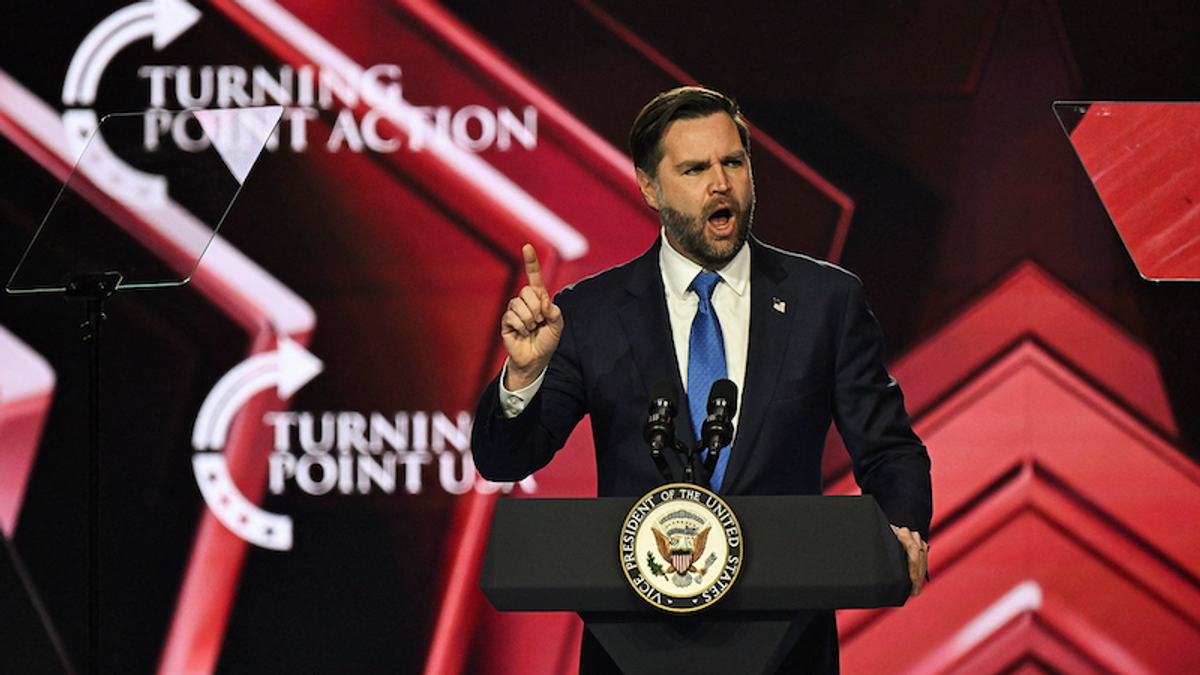
U.S. Vice President JD Vance closes out AmericaFest, the first Turning Point USA summit since the death of Charlie Kirk, in Phoenix, Arizona, U.S. December 21, 2025. REUTERS/Caitlin O'Hara

Vice President JD Vance made some startlingly racist remarks Sunday during a speech at a conservative conference in Arizona.
The 41-year-old vice president spoke Turning Point USA conference, where the slain organization founder Charlie Kirk's widow Erika Kirk endorsed him for the 2028 Republican presidential nomination, and made a number of controversial statements during his address.

Vance, according to journalist Aaron Rupar, drew the biggest applause of his speech when he claimed "by the grace of God we always will be a Christian nation."

"Wow: Overt, unapologetic Christian nationalism from the Vice President here," marveled Jack Jenkins, national correspondent for Religion News Service. "Even Trump has stopped short of saying something this explicit on the topic while President."

"Again, Vance smuggles in a false premise: That America was EVER a Christian nation," argued Bluesky user Dr. Tea, Cake, & Revolution. "He’s such a weasel."


"In the United States of America," Vance said, "you don't have to apologize for being white anymore."

That comment drew widespread criticism for its blatant racism.

"From dog whistles to bull horns, huh," said Bluesky user Nick Covington.

"Right out loud. I wonder if he recites that to his wife and kids every night at bedtime," agreed Bluesky user Mimi G.


"JD Vance is a self proclaimed f*cking racist," snarled widely followed Bluesky user PhillipUSA.

"I don’t think the mainstream news can possibly report on just how vile & dangerous this JD Vance diatribe is," said journalist Jennifer Schulze. "Some will gloss over the extremism, others will both sides it. So people need to watch the actual video to see/hear for themselves the white nationalist venom spewing from this monster."

"This tells you that Vance thinks the MAGA base isn’t just full of diehard racists; he thinks it’s full of diehard racists who are also too cowardly to be openly racist if they think people might disapprove," posted historian Kevin Kruse.


"Imagine looking in the mirror every day, seeing J.D. Vance looking back at you, and STILL being a white supremacist," sighed author Aram Sinnreich. "It must be cognitively exhausting."

"The vice president is a klansman," opined New York Times columnist Jamelle Bouie.

"Worried that the base is upset about the child raping, JD Vance lures them back into the fold by reminding them that they are loved for their racism," replied retired math professor Scott Farrand.


"Jefferson Davis Vance," added Bluesky user William 


JD Vance lashes out at ‘street girl’ Jasmine Crockett in fiery rant

Alexander Willis
December 21, 2025
RAW STORY


Vice President JD Vance delivers remarks at Uline Inc., in Alburtis, Pennsylvania, U.S., December 16, 2025. REUTERS/Eduardo Munoz

Vice President JD Vance fired off at Rep. Jasmine Crockett (D-TX) Sunday while speaking at a conservative event in Arizona, ridiculing her for what he said was her “street-girl persona” and fake nails.

“Jasmine Crocket!” Vance said, speaking at Turning Point USA’s annual America Fest conference in Phoenix. “Oh, Jasmine Crockett, the record speaks for itself. She wants to be a senator, though her street-girl persona is about as real as her nails!”

Vance’s remarks were met with thunderous applause at the event venue packed wall-to-wall with young conservatives, an event organized by the right-wing advocacy group launched by his late friend, Charlie Kirk, who was assassinated in September in Utah.

Crockett has become a rising star in the Democratic Party, largely due to her frequent and fierce attacks on President Donald Trump, which has prompted him to respond by calling the congresswoman a “low-IQ person.” She has since launched a bid for Senate, looking to unseat Sen. John Cornyn (R-TX) with a campaign launch ad featuring audio of Trump insulting her.

Among progressives, however, Crockett has drawn scrutiny largely over her voting record as it pertains to Israelvoting for an appropriations bill that included a temporary prohibition on U.S. funding for the United Nations Relief and Works Agency for Palestine Refugees (UNWRA), the largest aid provider in Gaza amid Israel’s military siege.

America Fest was first launched in 2021, and featured Trump, former Alaska Gov. Sarah Palin and Kyle Rittenhouse, the Illinois man who became a prominent figure among conservatives after fatally shooting two people during protests in Kenosha, Wisconsin, the previous year.


'Stop worrying about me!' Jasmine Crockett swats down JD Vance's 'street-girl' insult

Travis Gettys
December 21, 2025 
RAW STORY


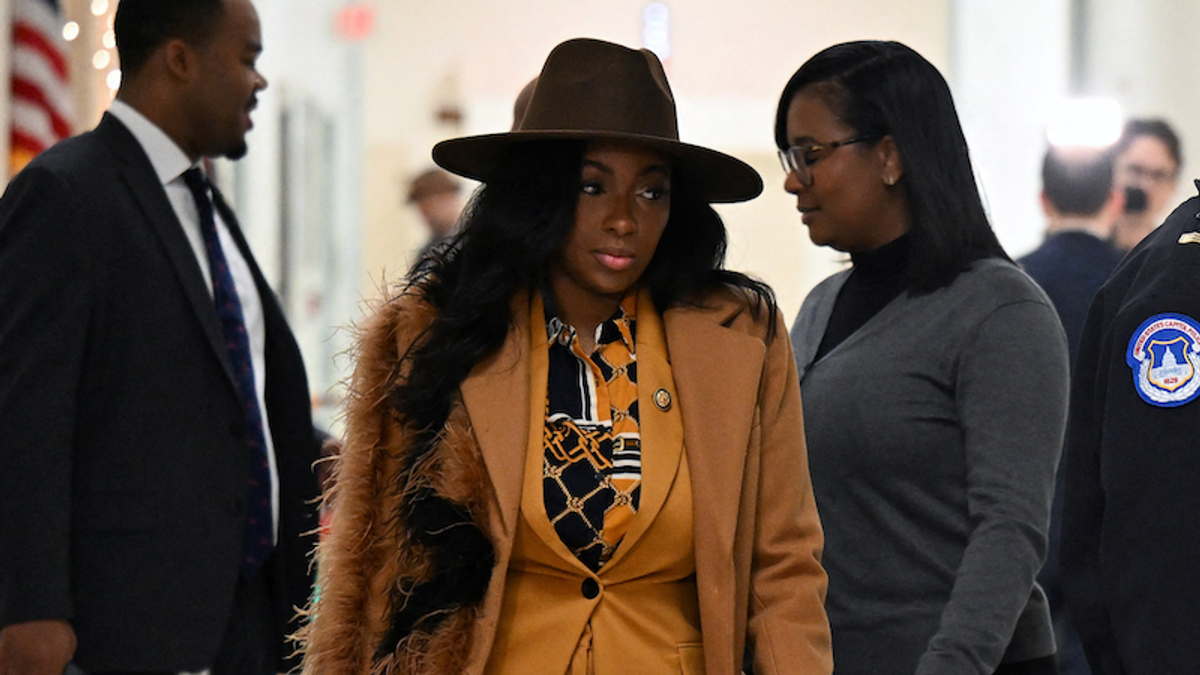
U.S. Rep. Jasmine Crockett (D-TX) arrives for a closed-door deposition with Former Special Counsel Jack Smith as part of a House Judiciary Committee inquiry into Smith's now-dismissed cases against U.S. President Donald Trump over his efforts to overturn the 2020 election results and his retention of classified documents, on Capitol Hill in Washington, D.C., U.S., December 17, 2025. REUTERS/Annabelle Gordon

Rep. Jasmine Crockett (D-TX) fired back at Vice President JD Vance's insult lobbed from the stage of a high-profile conservativhttps://www.rawstory.com/crockett-budget-bill/e conference.

The vice president slammed the Texas Democrat, who's mounting a U.S. Senate challenge for the seat held by Sen. Joh Cornyn (R-TX), from his wide-ranging and racially charged speech at Turning Point USA’s annual America Fest conference in Phoenix.

“Jasmine Crockett!” Vance exclaimed. “Oh, Jasmine Crockett, the record speaks for itself. She wants to be a senator, though her street-girl persona is about as real as her nails!”

Vance’s remarks were met with thunderous applause at the event aimed at young conservatives, but Crockett provided a substantially less positive reaction on social media.

"Imagine commenting on someone’s nails while at the same time ignoring that the only reason you got your political 'dream' job was because your boss incited a violent mob who wanted to hang your predecessor for, oh I don’t know, honoring his oath to the Constitution?!" Crockett posted on her X account. "How about you stop worrying about me, until we are on the Senate floor together & work to stop your boss from bankrupting our country while engaging in the largest corruption scheme we’ve ever seen?!"

‘This Isn’t The Republican Party Anymore!’ Don Jr. Proclaims Trump Leads the ‘America First’ and MAGA Party

LEAVING THE GOP TO WALL ST DEMOCRATS

Sean James
Sun, December 21, 2025 
MEDIAITE


Yahoo is using AI to generate takeaways from this article. This means the info may not always match what's in the article. Reporting mistakes helps us improve the experience.Generate Key Takeaways
(Photo Credit: The Charlie Kirk Show on Rumble)

Donald Trump Jr. proclaimed the Republican Party is a thing of the past — his dad is now leading the “America First Party” and “Make America Great Again Party.”

President Donald Trump’s son made the claim during a speech at Turning Point USA’s AmericaFest in Phoenix, Arizona on Sunday.

Trump Jr. said it is a new era for the conservative movement — one that is constantly under attack from the Democratic Party and Republicans In Name Only (RINOs). He said those attacks are ramping up as both parties plow towards the 2026 midterm elections.

Here is what the told the AmFest crowd:

Midterms are coming around the corner and make no mistake, the Democrat Party wants to do whatever they possibly can to shut this movement down. Not just the Democrats. The RINOs.

You see the manufactured attacks on JD [Vance], myself, my father — anyone who understands that this isn’t the Republican Party anymore. It’s the America First Party. It’s the Make America Great Again Party. And we are not going back!

His remarks drew a fairly big roar from the crowd — followed by a “USA! USA! USA!” chant.

“I love it, guys,” Trump Jr. said. “By the way, if someone wasn’t chanting USA next to you, you know they’re a Democrat plant, because they just can’t do it. It’s like pouring holy water on a vampire.”

He then urged the crowd to back Republicans — without using the term he just said was obsolete — in the ’26 midterms, because it will help his dad continue to fight for “Americans feeling left behind” like “young white men.”

“[Young white men] for a generation were left behind by DEI,” he said. “They were told ‘Well, you know, you don’t check a couple boxes, so you may be better, you may be smarter, but you’re not getting into that college. You’re not getting that job, you’re certainly not getting a promotion. But you better damn well realize you’re privileged, despite being discriminated against.’ It’s funny, but it’s actually happening.”

He spoke to the crowd right before Erika Kirk took the stage with rapper Nicki Minaj.


‘60 Minutes’ Abruptly Pulls Segment on Trump Deportees Sent to El Salvador Megaprison
The Wrap1.7K


‘You Don’t Have to Apologize for Being White Anymore!’ JD Vance Declares Trump Killed DEI
Mediaite755


Watch his comment on the Republican party being the MAGA/America First party