Monday, December 22, 2025

Berlin’s Wake-Up Call: When ‘America First’ Means Europe Last


December 22, 2025

Image by Getty and Unsplash+.

The era of polite transatlantic nodding is over. Chancellor Merz is signaling that if the U.S. wants to go it alone, Germany will stop waiting by the phone.

Germany’s frustration with the United States is no longer confined to closed‑door briefings or diplomatic understatement. It is now spilling into public view — and striking at the core assumptions of the transatlantic alliance.

The trigger was Washington’s newly released U.S. National Security Strategy (NSS), a document that reads less like a partnership agreement and more like an indictment. It criticizes Europe for democratic backsliding, uncontrolled migration and over‑reliance on American military protection, while demanding that Europeans carry a far greater share of the defense burden. In Berlin, the document landed not as strategy, but as provocation.

German Chancellor Friedrich Merz made that clear in remarks that went well beyond routine alliance fatigue. Parts of the NSS, he said, were simply unacceptable to us from a European perspective.” He rejected the notion that the United States should act as Europe’s democratic overseer, adding: “I see no need for the Americans to now want to save democracy in Europe. If it would need to be saved, we would manage on our own.”

Behind the rhetoric is a deeper reckoning: Germany is starting to question how much strategic dependence on the United States it can afford — economically, financially and militarily.

The Burden-Shift: From Ally to Liability

For decades, Germany accepted asymmetric relations with Washington as the price of security. U.S. power underwrote Europe’s defense, global trade routes and financial architecture. In return, Germany kept military spending low and focused on export‑led growth.

That bargain now looks increasingly one‑sided.

The NSS explicitly frames Europe as a liability: insufficiently armed, politically fragile, and unwilling to pay for its own defense. German officials privately describe the shift as moving from “burden‑sharing” to “burden‑shifting” — transferring responsibility without ceding control.

Merz articulated this concern bluntly, warning against an alliance that drifts toward unilateralism: “‘America first’ is fine, but ‘America alone’ cannot be in your interest. You need partners in the world, and one of those partners can be Europe. And if you cannot make use of Europe, then at least make Germany your partner.”

King Dollar’s Stranglehold

Germany’s vulnerability does not begin with tanks or troops. It starts with currency.

The U.S. dollar remains the backbone of the global financial system. According to International Monetary Fund (IMF) COFER data, the dollar accounted for roughly 56–58 percent of global foreign‑exchange reserves in late 2024, compared with about 20 percent for the euro. While the dollar’s share has gradually declined, its political utility has not.

Access to dollar clearing — and the threat of losing it — gives Washington leverage that no ally can easily resist. German economists increasingly describe this system as a form of structural pressure: sanctions applied extraterritorially, enforced through U.S. jurisdictional reach rather than multilateral agreement.

For Berlin, this is not theory. It is lived experience.

The Sanctions Straightjacket

Germany’s export‑driven economy is deeply exposed to U.S. markets. In 2024, German exports to the United States totaled roughly $170 billion, making the U.S. Germany’s single most important export destination — accounting for nearly 10 percent of total German exports.

That dependency sharply limits Berlin’s room for maneuver when U.S. policy collides with German economic interests.

The most cited example remains Iran. After Washington’s unilateral withdrawal from the nuclear deal in 2018, German firms — including Volkswagen, Siemens, and BASF — rapidly exited the Iranian market to avoid U.S. secondary sanctions. German‑Iranian trade collapsed from €3.4 billion in 2017 to roughly €1.5 billion by 2024.

European counter‑measures failed. The EU’s “blocking statute” offered legal cover, but not financial protection. Companies chose access to U.S. markets over European political symbolism — a decision Berlin officials quietly acknowledge was unavoidable.

The Billion-Dollar Handcuffs

The financial sector tells a similar story. Deutsche Bank alone has paid more than $20 billion in fines and settlements since 2008, largely to U.S. authorities.

These include a massive $7.2 billion settlement in 2017 over mortgage-backed securities, as well as a $186 million Federal Reserve fine in July 2023 related to sanctions violations and anti–money-laundering failures. German officials rarely dispute the technical merits of individual cases. What unsettles them is the asymmetry: U.S. regulators policing European institutions extraterritorially, often with limited reciprocal oversight from Frankfurt or Brussels.

The €100 Billion Paradox

If Germany hoped that throwing money at the military would ease tensions with Washington, the data suggest otherwise.

According to the Stockholm International Peace Research Institute (SIPRI), Germany spent approximately $88.5 billion on defense in 2024, solidifying its position as one of the world’s top military spenders. Defense outlays reached 1.9 percent of GDP, effectively meeting NATO’s 2‑percent benchmark for the first time — largely financed through the €100 billion special fund (Sondervermögen) adopted after Russia’s invasion of Ukraine.

Germany also remains the second‑largest financial military aid donor to Ukraine, trailing only the United States.

Yet even this dramatic increase has not insulated Berlin from U.S. criticism. SIPRI data and German budget analyses warn that without further structural budget hikes, Germany’s current spending levels are not fiscally sustainable beyond 2026 once the special fund is exhausted. The political message from Washington remains unchanged: spend more, do more, rely less — but follow American strategic priorities.

Plan B: A Post-American Defense?

The contradiction sits at the heart of Germany’s dilemma. Washington urges Europe to become stronger, yet resists any European military or industrial autonomy that might dilute U.S. influence. Since Brexit, Germany has emerged as the EU’s central power. From Nord Stream 2 to China policy to defense procurement, U.S. pressure has repeatedly constrained Berlin’s choices. Many German officials now see this not as temporary friction, but as structural tension — intensified by America’s growing rivalry with China and declining tolerance for independent allies.

The result is not estrangement, but recalibration.

Germany is not preparing to leave the alliance. But it is preparing for a world in which American guarantees are conditional, transactional and increasingly political. In that world, dependency is no longer just a risk — it is a liability.

Hosein Pabarja, a graduate in European Studies from the University of Tehran.

President Trump Is a Warmonger

Whether Trump supporters here at home are willing or in any fashion able to hold Trump to his antiwar rhetoric and blunt his penchant for using military force remains to be seen.


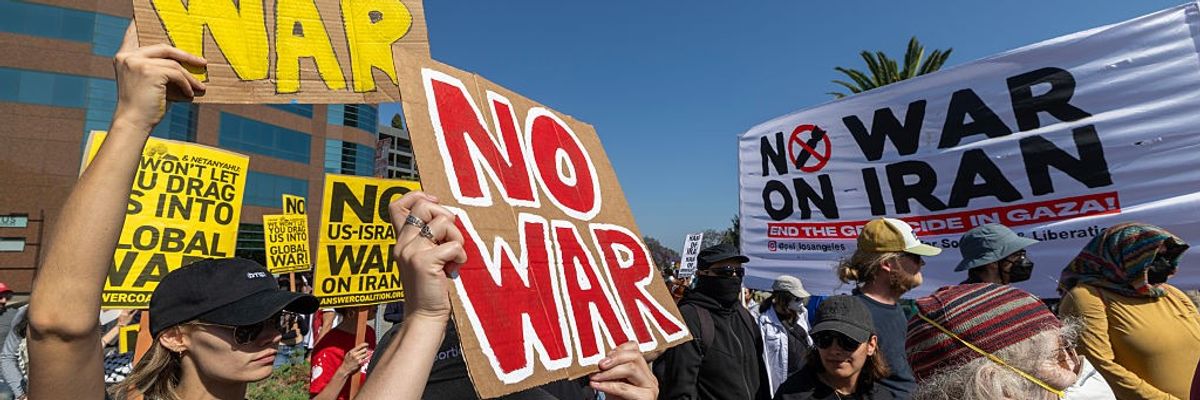
People protest the involvement of the U.S. in Israel’s war against Iran near the Wilshire Federal Building on June 22, 2025 in Los Angeles, California. The Trump administration has bombed Iran with the largest B-2 bomber strike in U.S. history without obtaining Congressional approval.
(Photo by David McNew/Getty Images)

William Hartung
Dec 22, 2025
TomDispatch

Earlier this month, the Trump administration released its new National Security Strategy, or NSS. Normally, such documents are poor predictors of what’s likely to happen in the real world. They are more like branding tools that communicate the attitudes of a given administration while rarely offering a detailed or accurate picture of its likely policies.

The reason documents like the NSS are of limited import is simple enough: foreign and military policies aren’t set by documents but by power and ideology. Typically enough, the current U.S. approach to the world flows from struggles among representatives of contending interest groups, some of which, like the military-industrial complex (MIC), have a significant advantage in the fight. The weapons industry and its allies in the Pentagon and Congress wield a wide array of tools of influence, including tens of millions of dollars in campaign contributions, more than 1,000 lobbyists, and jobs tied to military-related facilities in the states and districts of key members of Congress. The MIC — which my colleague Ben Freeman and I refer to in our new book as the trillion-dollar war machine — also has considerable influence over the institutions that shape our view of the world, from the media to DC think tanks, Hollywood, the gaming industry, and our universities.

But the power and influence of the war machine are not going completely unchallenged. The grip of militarism and the institutions that profit from it are indeed being challenged by organizations like The Poor People’s Campaign: A Call for Moral Revival; Dissenters, a youth antimilitarism group based in Chicago; antiwar veterans organizations like About Face, Common Defense, and Veterans for Peace; longstanding peace groups like the Friends Committee on National Legislation and Peace Action; networks like People Over Pentagon and Dismantle the Military-Industrial Complex; the ceasefire and Palestinian rights movements on U.S. campuses and beyond; and groups working for racial and economic justice, gay and trans rights, immigration reform, the demilitarization of the police, or compensation for environmental damage caused by nuclear weapons testing and other military activities. As such organizations coalesce, bringing together tens of millions of us whose lives and prospects are impacted by this country’s ever-growing war machine, let’s hope it might be possible to create the power needed to build a better, more tolerant, and more peaceful world, one that meets the needs of the majority of its people, rather than endlessly squandering precious resources on war and preparations for more of it.

So why pay attention to that new strategy document if what really determines our safety and security lies elsewhere? There are several reasons to do so.First, the NSS has prompted discussion in the mainstream media and elite circles of what U.S. priorities in the world should actually be — and such a discussion needs to be expanded to include the perspectives of people and organizations actually suffering the consequences of our militarized domestic and foreign policies.

Second, that strategy paper reflects the unnerving intentions and worldview of the current administration, which, of course, has the power to determine whether this country is at war or peace.

Finally, it suggests just how the Trump administration would like to be perceived. As such, it should be considered a weapon in the debate over what kind of country the United States should be.

Touting the “President of Peace”

From the start, the submission letter that accompanies the new strategy document is pure Donald Trump. In case you hadn’t noticed, the current occupant of the Oval Office would have us believe that everything — every single thing! — he does is bigger, better, and more beautiful than anything that ever came before it. And that’s definitely the case, in the first year of his second term, when it comes to his view of what this country’s national security policies should actually be. As the letter puts it:
“Over the past nine months, we have brought our nation — and the world — back from the brink of catastrophe and disaster. After four years of weakness, extremism, and deadly failures, my administration has moved with urgency and historic speed to restore American strength at home and abroad, and bring peace and stability to our world.
”No administration in history has brought about such a dramatic turnaround in so short a time.“


Needless to say, we’re expected to attribute that alleged American revival to the brilliance and tough-guy attitudes of the president and his team. But any reasonable American should instantly have doubts about that. After all, one of the Trump administration’s proudest accomplishments, as the new document notes, has been getting “radical gender ideology and woke lunacy out of our military.” Or, to put it slightly differently, under the guise of its crusade against DEI (diversity, equity, and inclusion), the administration has effectively dismantled programs designed to reduce racism, misogyny, and anti-gay and anti-trans violence in the ranks of the military.

Whether the programs aimed at reducing entrenched discrimination in those ranks were ever sufficient is certainly doubtful, but that discrimination in the military needs to be addressed should have been and should still be beyond question. To cite just one example, a 2024 study by political geographer Jennifer Greenberg conducted for the Costs of War Project at Brown University found that there were more than 70,000 cases of sexual assault in the U.S. military in 2021 and 2023 (the years covered by her analysis). Her report also noted that, “on average, over the course of the war in Afghanistan, 24 percent of active-duty women and 1.9 percent of active-duty men experienced sexual assault.” Pretending that widespread sexual violence doesn’t exist in the U.S. military or dismissing it as an example of “radical gender ideology and woke lunacy” should be considered, at best, a policy equivalent of criminal negligence. And it’s certainly not a great look for the person who desperately wants to be known as the “president of peace.”

But our commander-in-chief is nothing if not persistent (and predictable). In his introduction to the new strategy document, I’m sure you won’t be shocked to learn that President Trump takes the opportunity to pat himself on the back for allegedly ending “eight raging conflicts” in his first eight months in office — including those between Cambodia and Thailand, Kosovo and Serbia, Armenia and Azerbaijan, India and Pakistan, and Israel and Iran.

Of course, residents of many of those countries can be forgiven for not being aware of President Trump’s purported role in bringing relative peace to their regions or, in some of those cases, for failing to note that the peaceful situations he claims to have brought about don’t even exist. And they would be right to be skeptical. After all, this is the same president who has decimated the U.S. diplomatic corps and dismantled Washington’s main economic and humanitarian aid organization, the U.S. Agency for International Development — hardly the actions of a president of global peace.

Trump’s rhetoric in his introductory letter contrasts with some of the more sober passages in the document itself. His ranting and self-praise, however, are undoubtedly of more relevance when it comes to understanding the world that we’re actually in than the words in the body of that strategy’s blueprint. If his time in office tells us anything, it’s that his administration’s policies are heavily influenced by his personal desires and resentments, whether or not they square with existing laws, procedures, or policy pronouncements.

The Donroe Doctrine: A 19th Century Strategy for the 21st Century World

The aspect of the newly announced military strategy that has gotten the most attention (and may be the closest to the president’s heart) is its focus not on the rest of the world but on the Western Hemisphere, including what the president has called the “Trump Corollary” to the Monroe Doctrine, or what’s come to be known as the “Donroe Doctrine.”

The hemispheric focus includes the administration’s harsh immigration crackdown. Immigration and Customs Enforcement (ICE) is now literally kidnapping people off the city streets of this country, often regardless of their actual immigration status and absent the alleged criminal histories that have been used to justify its activities. President Trump sees this wave of repression as a badge of honor, arguing that “starting on my first day in office, we restored the sovereign borders of the United States and deployed the military to stop the invasion of our country.”

The hyper-militarization of the border has been paralleled by a wildly more aggressive posture in the hemisphere as a whole, most notably in the repeated attacks on alleged drug-trafficking boats in the Caribbean Sea, the waters off of Venezuela, and even the eastern Pacific Ocean, and the preparations for what could become a regime-change war against the government of Venezuelan President Nicolás Maduro. No matter that his country poses no direct threat whatsoever to the United States. And Republican calls for a full-scale war against that nation are occurring despite the disastrous results of this country’s regime-change policies in Afghanistan, Iraq, Libya, and beyond in this century.

The attacks on those defenseless ships, targeting individuals who pose no direct threat to the United States and haven’t even been proven to be involved in drug trafficking, violate international law and are being carried out without the approval of Congress. That was no less true of the recent seizure of a Venezuelan cargo ship transporting oil to Asia and the imposition of sanctions on six more oil-carrying ships.

Unfortunately, waging war without input from Congress has been the norm in U.S. military interventions of this century. Data generated by the Military Intervention Project at Tufts University indicates that the United States has used military force or engaged in outright warfare 30 times since 2001, with Congress largely on the sidelines. And rarely have those interventions achieved anything like their stated objectives, as documented by the Costs of War Project, which has shown that America’s post-9/11 war on terror has cost at least $8 trillion, involved the deaths of hundreds of thousands of civilians, and left a huge cohort of U.S. veterans with physical and psychological injuries, all without faintly achieving the stated goals of promoting democracy or stability in the targeted nations.

Can the Trump Administration End Endless Wars?

Despite its increasingly aggressive posture in the Western Hemisphere (and on U.S. soil), some analysts hold out hope that the Trump administration will ultimately reduce the frequency of U.S. military intervention globally and perhaps even “end endless wars.” There is rhetoric in the new strategy document that could support such a notion, but the real question is whether the president will act on it in any meaningful way.

Judging by its rhetoric alone, the administration’s strategy document would seem to suggest at least an implicit reduction in the use of force overseas, as evidenced in its discussion of strategy:
“A strategy must evaluate, sort, and prioritize. Not every country, region, issue, or cause — however worthy — can be the focus of American strategy…American strategies since the end of the Cold War have fallen short — they have been laundry lists of wishes or desired end states; have not clearly defined what we want but instead stated vague platitudes.”


The document then goes further, seeming to denounce the American war machine and the drive for U.S. military dominance globally:
“After the end of the Cold War, American foreign policy elites convinced themselves that permanent American domination of the entire world was in the best interests of our country… Our elites badly miscalculated America’s willingness to shoulder forever global burdens to which the American people saw no connection to the national interest. They overestimated America’s ability to fund, simultaneously, a massive welfare-regulatory-administrative state alongside a massive military, diplomatic, intelligence, and foreign aid complex.”


Secretary of Defense Pete Hegseth reinforced such themes in a December 6th speech at the Reagan National Defense Forum, while highlighting the administration’s usual condemnations of efforts to reduce discrimination in the military or this country or address climate change. As he summed it up, “The War Department will not be distracted by democracy building, interventionism, undefined wars, regime change, climate change, moralizing and feckless nation building.”

Taken seriously, such observations would lead to a sharp reduction in the American global military footprint of 750 foreign bases, more than 170,000 troops deployed overseas, a Navy designed to support combat anywhere in the world, dozens of ongoing “counterterror” operations globally from Somalia to Yemen, and arms-supplying relationships with more than half the nations on earth.

Needless to say, so far that hasn’t happened, whether a Republican or a Democrat was at the helm of the administration. But as with President Trump’s professions of being a peacemaker or his occasional rhetorical jabs at “war profiteers” and “warmongers,” the anti-interventionist language in some of the administration’s new National Security Strategy is clearly aimed mainly at those parts of the president’s base here at home who are indeed sick of war and skeptical of large corporations and the “deep state.”

All too sadly, President Donald Trump, Secretary of “War” Pete Hegseth, and the rest of the crew seem all too willing to make war in the Western Hemisphere in a significant fashion, while essentially ignoring the U.S. military’s other warring activities elsewhere on the planet. (Only recently, for instance, U.S. Africa Command confirmed that it had launched 111 airstrikes in Somalia in 2025.) And whether Trump supporters here at home are willing or in any fashion able to hold Trump to his antiwar rhetoric and blunt his penchant for using military force remains to be seen.

The Fight for Peace

To resist and reverse the militarization of American foreign policy will mean speaking truth to power, while working to debunk the myths that rationalize this country’s permanent war footing. But it will also require confronting power with power by generating a broad people’s movement against militarism in all its manifestations, including the militarization of foreign policy, immigration enforcement, and policing in this country, as well as the military’s role in generating staggering amounts of greenhouse gases and so accelerating climate change and threatening public health.

There are people and organizations fighting on all those fronts. Building a network of resistance that respects the priorities of each of them will take dedicated organizing and relationship-building. Much of that work is already underway. But the question remains: Can the public interest overcome the special interests and bankrupt ideologies that continue to make war and the threat of more war America’s face to the world? It’s a question on which none of us can afford to remain neutral.


© 2023 TomDispatch.com


William Hartung
William D. Hartung is a Senior Research Fellow at the Quincy Institute for Responsible Statecraft, and the author most recently of "Pathways to Pentagon Spending Reductions: Removing the Obstacles."
Full Bio >


Donald Trump’s Scary Weird Address to the Nation

Paul Street

December 22, 2025


Youtube screenshot.

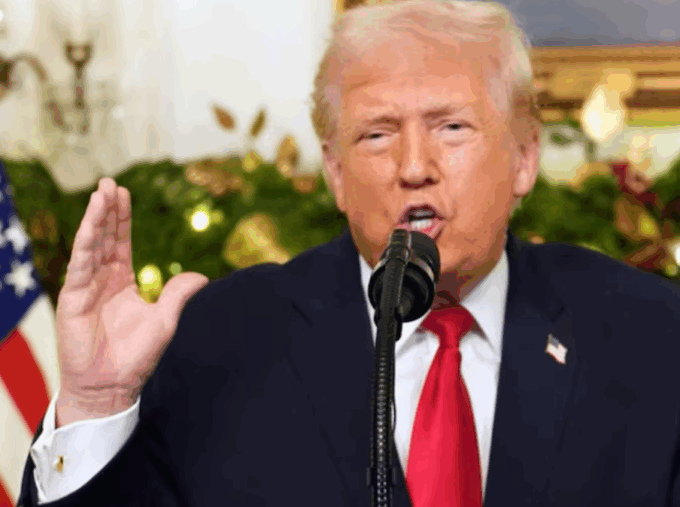
The debased and deranged wannabe fascist strongman-for-life Donald Trump’s bizarre, nationally televised speech to the American people last Wednesday night was quite insane.

The wild 18-minute oration was full of absurd and boastful misrepresentations of reality meant to support his ridiculous claim that the United States is entering a new economic Golden Age under his rule:

+ He claimed to have cut drug prices by 400, 500 or even 600 percent, all mathematical impossibilities. Drug prices would be zero after a 100 percent cut

+ He claimed to have slashed inflation when in fact the most recent available data shows that the rate of inflation is 3 percent, right where it was at the end of the Biden administration.

+ He claimed that his tariffs are sparking a boom in factory employment when in fact industrial jobs are declining thanks in no small part to how his tariffs are disrupting the global supply chains on which US manufacturers depend.

+ He cited absurdly false data to claim that foreign investment capital is pouring into the United States.

+ He said gas prices are $2.50 a gallon in much of the country and that there are states where its $1.99 even through his own Department of Energy reports an average of $2.90 and AAA reports that no state has an average gas price as low as $1.99.

+ He absurdly claimed that his tariffs will permit a massive reduction in income taxes.

As he told Americans that a glorious new age of prosperity was dawning under his reign, Trump left out the latest jobless numbers, which show the highest official unemployment rate in four years, fueled in no small part by his massive government layoffs. He also failed to mention that his assault on Obamacare means that health insurance premiums are going to skyrocket for tens of millions of Americans, forcing many to drop coverage altogether.

There were other ridiculous claims beyond the economic ones.

Trump repeated his preposterous xenophobic nationalist claims that Latin American countries have emptied their jails and prisons to invade the United States with dangerous “illegal immigrants.” He said that Joe Biden opened the US to an influx of “drug dealers, gang members and even 11,888 murderers, more than 50% of whom killed more than one person.”

Trump ridiculously claimed to be a great peacemaker who has “settled eight wars in ten months.”

He preposterously said that under Biden, “we had transgender for everybody, crime at record levels, law enforcement and words such as that just absolutely forbidden.”

Under the “radical Left” Biden administration, Trump told US-Americans, “the United States was ruled by politicians who flooded your cities and towns with illegal aliens…decimated your hard-earned savings, indoctrinated your children with hate for America” and “released a level of violent felons that we had never seen to prey on innocent.”

But all this absurdity was NOT the most remarkable thing about Trump’s speech.

There’s nothing remotely new about Trump lying and purveying falsehoods. There’s never been a bigger dissembler than Trump: The Washington Post calculated that Trump misrepresented reality 30,573 times during his first presidency; Mein Trumpf is the all-time world record holder when it comes to fibbing and falsification.

The most extraordinary aspect of Trump’s address was the wild way it was delivered. Barely stopping for a breath and sounding like he was late for an orgy at an Epstein property, Trump yelled his lies at the camera at a ridiculously rapid pace. The speech was barked out in a strange monotone staccato as if the orange-brushed ogre was both enraged and desperate to be believed. I half-wondered if he was on Adderall or some other stimulant drug that could help send him into cardiac arrest during his unhinged harangue. Were medical personnel nearby?

(On an optimistic note, it struck me at one point that he was he speaking like a man desperate to make his case before getting booted from office or drawing his last breath.)

The next most remarkable thing about last Wednesday night’s nutso Trump rant was the lunatic’s total silence about the preparations he is making for an epically criminal war on Venezuela. How strange. On the false claim that Venezuela is waging a narco-terrorist war on the US, Trump and his flying fascist monkey of a War Secretary Pete Hegseth have so far massacred 80-plus people in a string of arch-criminal extrajudicial executions on the high seas. Trump has declared the air space above Venezuela closed. He has seized a Venezuelan oil tanker right off Venezuela’s coast. He has declared fentanyl, which he falsely accuses Venezuela of shipping to the US, to be “a weapon of mass destruction.” He has assembled a giant “armada” of US military assets in the Caribbean to menace Venezuela and Colombia. Three nights ago, he ordered a blockade on tankers coming in and out of Venezuela. He said that Venezuelan president Nicolas Maduro’s days are numbered and claimed that Venezuela has “stolen our oil and land” (no doubt a reference to past nationalizations under Hugo Chavez).

This is deranged imperial war talk, an odd fit for a self-declared “peacemaker” who is demanding a Nobel Peace Prize.

How does a POTUS get up in front of the cameras in a rare nationally televised special address and say literally nothing about a regime change war he appears to be on the verge of starting in the Americas?!

What madness.

Paul Street’s latest book is This Happened Here: Amerikaners, Neoliberals, and the Trumping of America (London: Routledge, 2022).


Third oil tanker seized by Trump admin as threats against Venezuela escalate: report

Alexander Willis
December 21, 2025 
RAW STORY


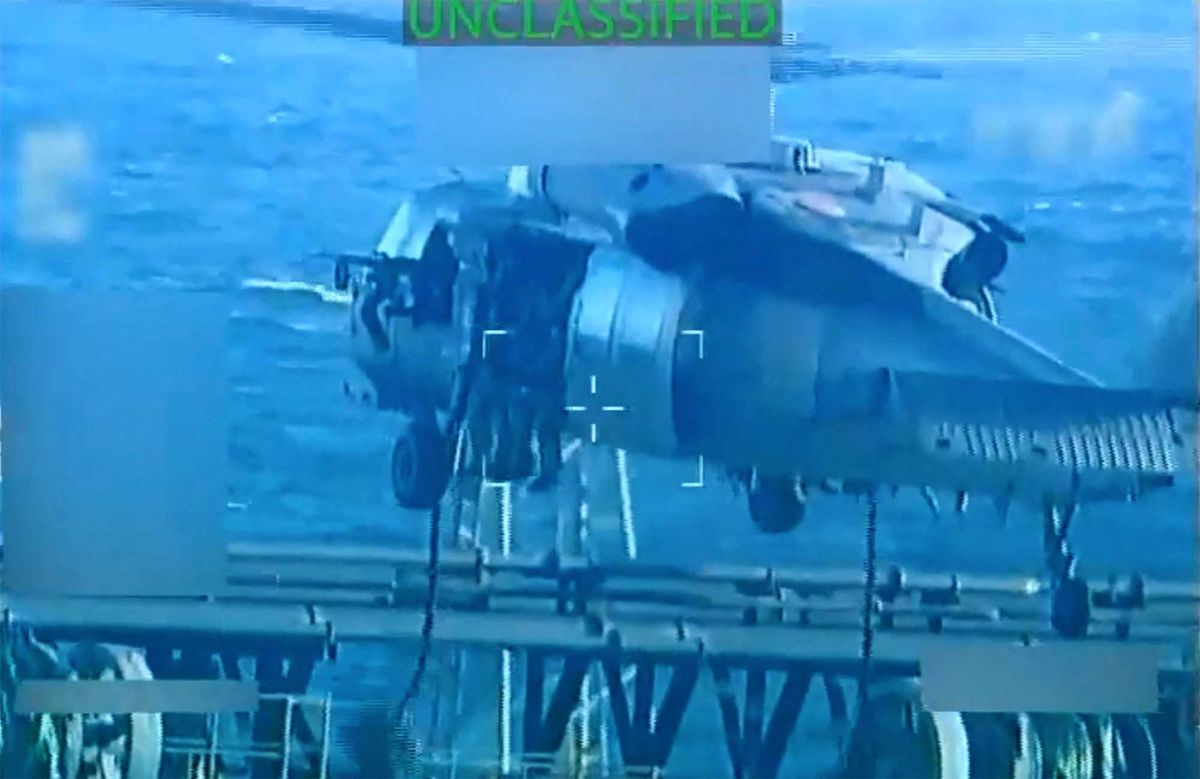
U.S. forces abseil onto an oil tanker during a raid described by U.S. Attorney General Pam Bondi as its seizure by the United States off the coast of Venezuela, December 10, 2025, in a still image from video. U.S. Attorney General/Handout via REUTERS. THIS IMAGE HAS BEEN SUPPLIED BY A THIRD PARTY. SELECTIVE BLURRING FROM SOURCE.

A third oil tanker in the Caribbean was boarded and seized Sunday by the U.S. military as the Trump administration’s military threats against Venezuela continue to escalate, Bloomberg reported.

The vessel is known as the “Bella 1,” a sea vessel sanctioned by the United States that was headed to Venezuela to be loaded up with oil, according to a person “with knowledge of the matter” who spoke with Bloomberg on the condition of anonymity.

The seizure comes just one day after the administration seized another sea vessel in the Caribbean, and less than two weeks after the administration’s first seizure of an oil tanker off the coast of Venezuela. President Donald Trump ordered a blockade on all sanctioned oil tankers coming from and leaving Venezuela last week.

Trump has ramped up military threats against Venezuela in recent months, launching a number of deadly strikes on suspected drug-carrying vessels that have killed at least 95 people, closed the nation’s airspace, deployed an aircraft carrier strike group
to Venezuela’s coast, and suggested U.S. land operations in the South American “very soon.” Trump has also considered assassinating its president, Nicolas Maduro


OIL FOR CUBA

Trump Ramps Up Aggression Against Venezuela With Seizure of Ship Not Under US Sanctions

The Venezuelan government condemned the seizure as “a serious act of international piracy;” meanwhile, a US official said the Coast Guard was pursuing a third tanker in the Caribbean.


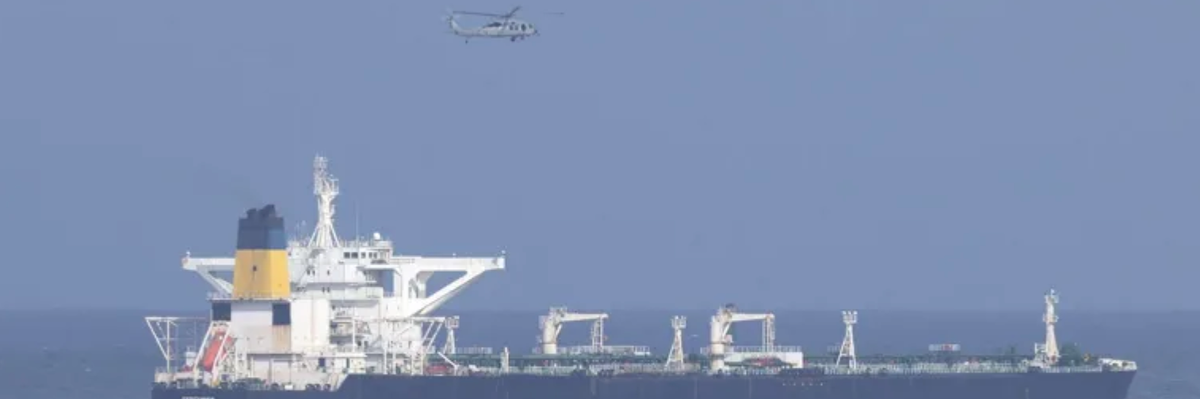
A US military helicopter flies over the oil tanker Centuries in the southern Caribbean Sea on December 20, 2025.
(Photo by US Department of Homeland Security)


Brett Wilkins
Dec 21, 2025
COMMON DREAM


The Trump administration’s “total and complete blockade” of “all sanctioned oil tankers” off the Venezuelan coast was already denounced by critics as “an act of war”—and the United States further escalated its aggression on Saturday by seizing a tanker that is not on a list vessels under US sanctions.

US Coast Guard troops led Saturday’s seizure of the Centuries, a Panamanian-flagged, Chinese-owned oil tanker in the Caribbean Sea, after it left Venezuela.

“The United States will continue to pursue the illicit movement of sanctioned oil that is used to fund narco-terrorism in the region,” US Homeland Security Secretary Kristi Noem said on X. “We will find you, and we will stop you.”

On Sunday, an unnamed US official told Reuters that the Coast Guard “is in active pursuit” of a third tanker near Venezuela, “a sanctioned dark fleet vessel” that “is flying a false flag and under a judicial seizure order.”

The Venezuelan government condemned Saturday’s seizure as “a serious act of international piracy.”

Venezuela “denounces and rejects the theft and hijacking of a new private vessel transporting oil, as well as the forced disappearance of its crew, committed by military personnel of the United States of America in international waters,” Venezuelan Vice President Delcy Rodríguez said in a statement.

“These acts will not go unpunished,” she vowed, adding that Venezuela will pursue “all corresponding actions, including filing a complaint before the United Nations Security Council, other multilateral organizations, and the governments of the world.”

Earlier this week, President Donald Trump declared a blockade of all oil tankers under US sanctions that are traveling to or from Venezuela.

Saturday’s action followed the US seizure of the Panamanian-flagged Skipper—which is under sanctions—off the Venezuelan coast on December 10.

The Centuries seizure also comes amid the Trump administration’s bombing of at least 28 boats allegedly transporting drugs in the Caribbean Sea and Pacific Ocean, attacks that have killed more than 100 people and have been condemned as acts of extrajudicial murder.

In addition to the blockade and boat strikes, Trump has deployed an armada of warships and thousands of troops to the southern Caribbean, authorized covert CIA action against the socialist government of Venezuelan President Nicolás Maduro, and has threatened to invade the South American nation. This latest wave of aggression continues more than a century of US meddling in Venezuela’s affairs and sovereignty.

Numerous world leaders have denounced the US aggression toward Venezuela. On Saturday, leftist Brazilian President Luiz Inácio Lula de Silva said during a summit of the South American Mercosur bloc in Foz do Iguaçu, Brazil that an “armed intervention in Venezuela would be a humanitarian catastrophe.”

In the United States, multiple efforts by members of Congress—mostly Democrats, but also a handful of anti-war Republicans—to pass a war powers resolution blocking the Trump administration from bombing boats or attacking Venezuela have failed.

Echoing assertions by Venezuelan officials and others, one of those Republicans, Rep. Thomas Massie of Kentucky, said earlier this week that Trump’s aggressive escalation “is all about oil and regime change.”

Some critics have called Trump’s actions a renewal of the “gunboat diplomacy” practiced by the US in the 19th and 20th centuries. The US has conducted scores of military interventions in Latin America, including dozens of regime change operations.


Rape Civilization


 December 22, 2025

The Rape of the Sabine Women, Nicholas Poussin (1635), Metropolitan Museum of Art.

Though our political, socio-economic world operates according to the dictates of rapacity, many continue to deny the existence of rape culture; a denial (itself a technique of rape culture) as deeply rooted in delusion as the denial of the general ecological catastrophe, from which rape culture is inextricable.

This violence is so pervasive, so much the norm, that we too often fail to perceive it at all. It goes without saying, and without seeing. Given not just its ubiquity, then, but its intrinsicality to capture, appropriation, extraction, and exploitation (the bases of patriarchy, imperialism, and capitalism), it would not be inaccurate to describe ours as a veritable rape civilization.

Present from the beginning, we find it throughout antiquity in the mythic rapes of Zeus, Poseidon, Heracles and other gods and ancient heroes, as well as in the quasi-historic rapes of, among others, the Sabine Women (expressions of not just physical desires and insecurities but of deeper desires for order and stability, for control of the anxiety-inducing mysterium – leading quickly enough to anesthetizing dogmas and hierarchies).

We encounter this again and again, from the conquests, slavery, and rape of ancient times to modern imperialism’s rape of the globe, to the present-day rapist-in-chief plotting the rape of Venezuela in order, in no small part, to distract from the epic rapes of Epstein‘s rape networks. From the micro street corner level to the macro-level plantation, prison or sweatshop, to the halls of academia, Hollywood, and let’s not forget the Catholic Church (just one of the many rape cultures comprising this rape civilization), rape is ubiquitous. Not just the exception, it’s the rule. And not only is it the rule, it’s a classic technique of rule. So ubiquitous is it that even the famed critic of coercive power, Noam Chomsky, is caught up in this coercive, violent order.

One may point out that although the violence of rape (normalized in the practices and values of rape civilization) is a necessary aspect of this age of destruction, referred to sometimes as the Anthropocene, rape is hardly unique to anthropos/human beings. Male orangutans in particular are known to rape female orangutans. Yet this primatological tendency can not excuse rape, as though humanity is helplessly determined by nature to brutality and barbarism. Our humanity, where it arises, is inimical to such brutality. But we are not discussing nature so much as rape civilization, which is comprised and perpetuated by ideology, laws, and institutions; entities which, as history attests, change and so can be changed. As our technologies (largely the technologies of rape civilization) grow more and more powerful, however, they lead overwhelmingly to the aggrandizement of rape civilization, brutalizing us all. Which way, then, is the exit, the exodus (or the epoché)?

Will Moses emerge from the desert, ascend the mountain and add Thou Shall Not Rape to the commandments? Don’t count on it; especially since the Bible itself, and the hierarchical religions emanating from it, is one of the central pillars of Rape Civilization. Just look at Moses authorizing the mass rape of hundreds of young Midianite girls. It’s not hard to imagine him feeling right at home at one of those Epstein mass rape events described so politely in the Rape Civilization Press as parties.

More than commandments, though, themselves entangled in relations of force and domination, we need to overcome Rape Civilization itself. Fortunately, millions of people across the planet are every day doing that, working on developing new ways of living together that are based instead on mutual aid and respect – the real clash of civilizations.

Elliot Sperber is a writer, attorney, and adjunct professor. He lives in New York City and can be reached at elliot.sperber@gmail.com and on twitter @elliot_sperber