Trump Continues ‘War Against Renewables’ With Halt of Five Offshore Wind Farms
“Trump is killing jobs, raising energy costs, and harming the planet,” said Sen. Tim Kaine. “Grinch!”
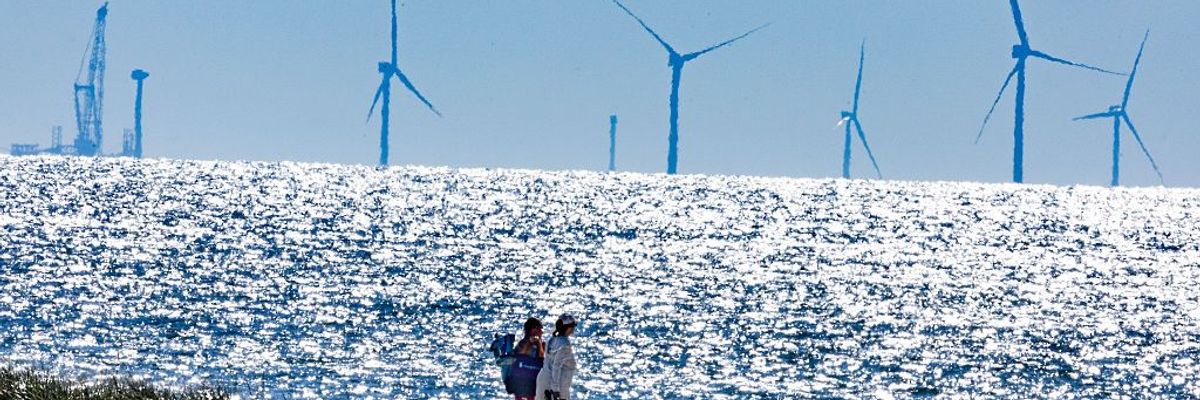
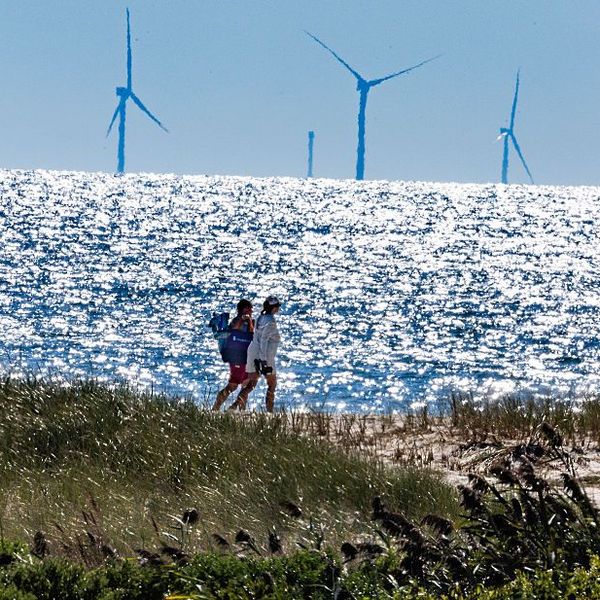
Madaket beachgoers walk along the beach with the Vineyard Wind turbines in the background on September 11, 2025.
(Photo by Stan Grossfeld/The Boston Globe via Getty Images)
Jessica Corbett
Dec 22, 2025
COMMON DREAMS
The Trump administration’s efforts to thwart a transition from climate-wrecking fossil fuels to renewable energy continued on Monday with a halt on five wind farms along the US East Coast under the guise of national security concerns.
The US Department of the Interior announced that it is immediately pausing Coastal Virginia Offshore Wind off Virginia, Empire Wind 1 and Sunrise Wind off New York, Revolution Wind off Rhode Island and Connecticut, and Vineyard Wind 1 off Massachusetts, citing unclassified government reports that “the movement of massive turbine blades and the highly reflective towers create radar interference called ‘clutter.’”
Bloomberg reported Monday that “President Donald Trump has long opposed offshore wind power and began imposing restrictions on it within hours of taking office this year. The policies have led to numerous court battles, and a federal judge this month ruled his ban on projects was illegal. Citing national security issues may be a more legally durable way to keep wind turbines out of US waters.”
“Offshore wind farm projects raised national security concerns under previous administrations, too. The Defense Department under former President Joe Biden pushed successfully for changes to leases being sold along the West Coast to address some of the issues,” Bloomberg noted. Elsewhere, such as in the United Kingdom, government and industry have responded to radar interference issues by investing in mitigation technologies.
Responding to the news on social media, American anthropologist and journalist Scott Carney said that “shutting down wind farms in the name of national security only proves that Trump is a national security risk. Lying that climate change doesn’t exist is not an effective policy against environmental collapse.”
Jonathan Cohn, political director of the grassroots group Progressive Mass, pointed out that “if these were oil drilling projects being canceled, Republicans would scream that canceling the project was theft from the company. If renewable energy is canceled, those same Republicans cheer.”
Dean Baker, senior economist at the Center for Economic and Policy Research, warned that “any company would be crazy to invest a dime in Donald Trump’s America... The jerk can confiscate property any time he wants for any reason he invents.”
According to the New York Times: “Vineyard Wind 1 is currently under construction and partially operational, with about half of the project’s 62 turbines sending power to the electric grid as of October. Once complete, the project could produce enough electricity to power 400,000 homes.”
Congressman Greg Stanton (D-Ariz.) declared that “wind farms are an essential part of a diversified energy strategy. Trump’s cancellation of approved, in-progress projects wastes public dollars and widens the gap between America and its competitors.”
Rep. John Larson (D-Conn.), whose constituents would benefit from the Revolution Wind project, said that “the president has taken an axe to wind energy, solar projects, and our state’s clean hydrogen sector, putting hundreds of people out of work and saddling households across the state with even higher electricity bills. The state of Connecticut, led by Attorney General William Tong, already took him on to halt his illegal stop work order before, and we’re prepared to do it again.”
Sen. Tim Kaine (D-Va.) said: “Trump is killing jobs, raising energy costs, and harming the planet. Grinch!”
Senate Majority Leader Chuck Schumer (D-NY) similarly responded: “Donald Trump is trying AGAIN to kill thousands of good-paying union jobs and raise your electricity bill. I have been fighting Trump’s war against offshore wind—a war that threatens American jobs and American energy. I will keep fighting to make sure these projects, the thousands of jobs they create, and the energy they provide can continue.”
Sierra Club legislative director Melinda Pierce said in a statement that “blocking construction on all offshore wind projects underway in the US is an attack on our economy and our public health. The Trump administration’s vengeance towards renewable energy knows no end.”
“Instead of progressing us forward as a nation, they are obsessed with attacking a growing industry that provides good clean energy jobs and affordable, clean electricity,” she added. “Americans need cheaper and more reliable energy that does not come at the expense of our health and futures.”
Interior Secretary Doug Burgum discussed the decision on Fox Business Monday, pointing to the radar interference concerns.
Noting the appearance, writer and filmmaker Lee West said: “So ‘national security’ means suspending wind farms Navy approved for years—while drilling rigs multiply off Florida. The [administration’s] pretexts grow taller than turbine blades.”
“Trump is killing jobs, raising energy costs, and harming the planet,” said Sen. Tim Kaine. “Grinch!”
Madaket beachgoers walk along the beach with the Vineyard Wind turbines in the background on September 11, 2025.
(Photo by Stan Grossfeld/The Boston Globe via Getty Images)
Jessica Corbett
Dec 22, 2025
COMMON DREAMS
The Trump administration’s efforts to thwart a transition from climate-wrecking fossil fuels to renewable energy continued on Monday with a halt on five wind farms along the US East Coast under the guise of national security concerns.
The US Department of the Interior announced that it is immediately pausing Coastal Virginia Offshore Wind off Virginia, Empire Wind 1 and Sunrise Wind off New York, Revolution Wind off Rhode Island and Connecticut, and Vineyard Wind 1 off Massachusetts, citing unclassified government reports that “the movement of massive turbine blades and the highly reflective towers create radar interference called ‘clutter.’”
Bloomberg reported Monday that “President Donald Trump has long opposed offshore wind power and began imposing restrictions on it within hours of taking office this year. The policies have led to numerous court battles, and a federal judge this month ruled his ban on projects was illegal. Citing national security issues may be a more legally durable way to keep wind turbines out of US waters.”
“Offshore wind farm projects raised national security concerns under previous administrations, too. The Defense Department under former President Joe Biden pushed successfully for changes to leases being sold along the West Coast to address some of the issues,” Bloomberg noted. Elsewhere, such as in the United Kingdom, government and industry have responded to radar interference issues by investing in mitigation technologies.
Responding to the news on social media, American anthropologist and journalist Scott Carney said that “shutting down wind farms in the name of national security only proves that Trump is a national security risk. Lying that climate change doesn’t exist is not an effective policy against environmental collapse.”
Jonathan Cohn, political director of the grassroots group Progressive Mass, pointed out that “if these were oil drilling projects being canceled, Republicans would scream that canceling the project was theft from the company. If renewable energy is canceled, those same Republicans cheer.”
Dean Baker, senior economist at the Center for Economic and Policy Research, warned that “any company would be crazy to invest a dime in Donald Trump’s America... The jerk can confiscate property any time he wants for any reason he invents.”
According to the New York Times: “Vineyard Wind 1 is currently under construction and partially operational, with about half of the project’s 62 turbines sending power to the electric grid as of October. Once complete, the project could produce enough electricity to power 400,000 homes.”
Congressman Greg Stanton (D-Ariz.) declared that “wind farms are an essential part of a diversified energy strategy. Trump’s cancellation of approved, in-progress projects wastes public dollars and widens the gap between America and its competitors.”
Rep. John Larson (D-Conn.), whose constituents would benefit from the Revolution Wind project, said that “the president has taken an axe to wind energy, solar projects, and our state’s clean hydrogen sector, putting hundreds of people out of work and saddling households across the state with even higher electricity bills. The state of Connecticut, led by Attorney General William Tong, already took him on to halt his illegal stop work order before, and we’re prepared to do it again.”
Sen. Tim Kaine (D-Va.) said: “Trump is killing jobs, raising energy costs, and harming the planet. Grinch!”
Senate Majority Leader Chuck Schumer (D-NY) similarly responded: “Donald Trump is trying AGAIN to kill thousands of good-paying union jobs and raise your electricity bill. I have been fighting Trump’s war against offshore wind—a war that threatens American jobs and American energy. I will keep fighting to make sure these projects, the thousands of jobs they create, and the energy they provide can continue.”
Sierra Club legislative director Melinda Pierce said in a statement that “blocking construction on all offshore wind projects underway in the US is an attack on our economy and our public health. The Trump administration’s vengeance towards renewable energy knows no end.”
“Instead of progressing us forward as a nation, they are obsessed with attacking a growing industry that provides good clean energy jobs and affordable, clean electricity,” she added. “Americans need cheaper and more reliable energy that does not come at the expense of our health and futures.”
Interior Secretary Doug Burgum discussed the decision on Fox Business Monday, pointing to the radar interference concerns.
Noting the appearance, writer and filmmaker Lee West said: “So ‘national security’ means suspending wind farms Navy approved for years—while drilling rigs multiply off Florida. The [administration’s] pretexts grow taller than turbine blades.”
Senate Dems Stop Permitting Talks Over Trump’s ‘Reckless and Vindictive Assault’ on Wind Power
“By sabotaging US energy innovation and killing American jobs, the Trump administration has made clear that it is not interested in permitting reform,” said Sens. Sheldon Whitehouse and Martin Heinrich.

US Sen. Sheldon Whitehouse (D-RI) speaks during a hearing on March 6, 2025 in Washington, DC.
(Photo by Andrew Harnik/Getty Images)
Jessica Corbett
Dec 22, 2025
“By sabotaging US energy innovation and killing American jobs, the Trump administration has made clear that it is not interested in permitting reform,” said Sens. Sheldon Whitehouse and Martin Heinrich.
US Sen. Sheldon Whitehouse (D-RI) speaks during a hearing on March 6, 2025 in Washington, DC.
(Photo by Andrew Harnik/Getty Images)
Jessica Corbett
Dec 22, 2025
COMMON DREAMS
The top Democrats on a pair of key US Senate panels ended negotiations to reform the federal permitting process for energy projects in response to the Trump administration’s Monday attack on five offshore wind projects along the East Coast.
Senate Environment and Public Works Committee Ranking Member Sheldon Whitehouse (D-RI) and Energy and Natural Resources Committee Ranking Member Martin Heinrich (D-NM) began their joint statement by thanking the panels’ respective chairs, Sens. Shelley Moore Capito (R-W.Va.) and Mike Lee (R-Utah), “for their good-faith efforts to negotiate a permitting reform bill that would have lowered electricity prices for all Americans.”
Trump Continues ‘War Against Renewables’ With Halt of Five Offshore Wind Farms

11 House Democrats Help GOP Pass ‘Disastrous’ Pro-Polluter Permitting Bill
“There was a deal to be had that would have taken politics out of permitting, made the process faster and more efficient, and streamlined grid infrastructure improvements nationwide,” the Democrats said. “But any deal would have to be administered by the Trump administration. Its reckless and vindictive assault on wind energy doesn’t just undermine one of our cheapest, cleanest power sources, it wrecks the trust needed with the executive branch for bipartisan permitting reform.”
Earlier Monday, the US Department of the Interior halted Coastal Virginia Offshore Wind off Virginia, Empire Wind 1 and Sunrise Wind off New York, Revolution Wind off Rhode Island and Connecticut, and Vineyard Wind 1 off Massachusetts, citing radar interference concerns.
Governors and members of Congress from impacted states, including Whitehouse and Senate Minority Leader Chuck Schumer (D-NY), condemned the announcement, with Whitehouse pointing to a recent legal battle over the project that would help power Rhode Island.
“It’s hard to see the difference between these new alleged radar-related national security concerns and the radar-related national security allegations the Trump administration lost in court, a position so weak that they declined to appeal their defeat,” he said.
The top Democrats on a pair of key US Senate panels ended negotiations to reform the federal permitting process for energy projects in response to the Trump administration’s Monday attack on five offshore wind projects along the East Coast.
Senate Environment and Public Works Committee Ranking Member Sheldon Whitehouse (D-RI) and Energy and Natural Resources Committee Ranking Member Martin Heinrich (D-NM) began their joint statement by thanking the panels’ respective chairs, Sens. Shelley Moore Capito (R-W.Va.) and Mike Lee (R-Utah), “for their good-faith efforts to negotiate a permitting reform bill that would have lowered electricity prices for all Americans.”
Trump Continues ‘War Against Renewables’ With Halt of Five Offshore Wind Farms
11 House Democrats Help GOP Pass ‘Disastrous’ Pro-Polluter Permitting Bill
“There was a deal to be had that would have taken politics out of permitting, made the process faster and more efficient, and streamlined grid infrastructure improvements nationwide,” the Democrats said. “But any deal would have to be administered by the Trump administration. Its reckless and vindictive assault on wind energy doesn’t just undermine one of our cheapest, cleanest power sources, it wrecks the trust needed with the executive branch for bipartisan permitting reform.”
Earlier Monday, the US Department of the Interior halted Coastal Virginia Offshore Wind off Virginia, Empire Wind 1 and Sunrise Wind off New York, Revolution Wind off Rhode Island and Connecticut, and Vineyard Wind 1 off Massachusetts, citing radar interference concerns.
Governors and members of Congress from impacted states, including Whitehouse and Senate Minority Leader Chuck Schumer (D-NY), condemned the announcement, with Whitehouse pointing to a recent legal battle over the project that would help power Rhode Island.
“It’s hard to see the difference between these new alleged radar-related national security concerns and the radar-related national security allegations the Trump administration lost in court, a position so weak that they declined to appeal their defeat,” he said.
Later, he and Heinrich said that “by sabotaging US energy innovation and killing American jobs, the Trump administration has made clear that it is not interested in permitting reform. It will own the higher electricity prices, increasingly decrepit infrastructure, and loss of competitiveness that result from its reckless policies.”
“The illegal attacks on fully permitted renewable energy projects must be reversed if there is to be any chance that permitting talks resume,” they continued. “There is no path to permitting reform if this administration refuses to follow the law.”
Reporting on Whitehouse and Heinrich’s decision, the Hill reached out to Capito and Lee’s offices, as well as the Interior Department, whose spokesperson, Alyse Sharpe, “declined to comment beyond the administration’s press release, which claimed the leases were being suspended for national security reasons.”
Lee responded on social media with a gif:
Although the GOP has majorities in both chambers of Congress, Republicans don’t have enough senators to get most bills to a final vote without Democratic support.
The Democratic senators’ Monday move was expected among observers of the permitting reform debate, such as Heatmap senior reporter Jael Holzman, who wrote before their statement came out that “Democrats in Congress are almost certainly going to take this action into permitting reform talks... after squabbling over offshore wind nearly derailed a House bill revising the National Environmental Policy Act last week.”
That bill, the Standardizing Permitting and Expediting Economic Development (SPEED) Act, was pilloried by green groups after its bipartisan passage. It’s one of four related pieces of legislation that the House advanced last week. The others are the Mining Regulatory Clarity Act, Power Plant Reliability Act, and Reliable Power Act.
David Arkush, director of the consumer advocacy group’s Climate Program, blasted all four bills as “blatant handouts to the fossil fuel and mining industries” that would do “nothing to help American families facing staggering energy costs and an escalating climate crisis.”
“We need real action to lower energy bills for American families and combat the climate crisis,” he argued. “The best policy response would be to fast-track a buildout of renewable energy, storage, and transmission—an approach that would not just make energy more affordable and sustainable, but create US jobs and bolster competitiveness with China, which is rapidly outpacing the US on the energy technologies of the future.
Instead, Arkush said, congressional Republicans and President Donald Trump “are shamefully pushing legislation that would only exacerbate the energy affordability crisis and further entrench the dirty, dangerous, and unaffordable energy of the past.”
“The illegal attacks on fully permitted renewable energy projects must be reversed if there is to be any chance that permitting talks resume,” they continued. “There is no path to permitting reform if this administration refuses to follow the law.”
Reporting on Whitehouse and Heinrich’s decision, the Hill reached out to Capito and Lee’s offices, as well as the Interior Department, whose spokesperson, Alyse Sharpe, “declined to comment beyond the administration’s press release, which claimed the leases were being suspended for national security reasons.”
Lee responded on social media with a gif:
Although the GOP has majorities in both chambers of Congress, Republicans don’t have enough senators to get most bills to a final vote without Democratic support.
The Democratic senators’ Monday move was expected among observers of the permitting reform debate, such as Heatmap senior reporter Jael Holzman, who wrote before their statement came out that “Democrats in Congress are almost certainly going to take this action into permitting reform talks... after squabbling over offshore wind nearly derailed a House bill revising the National Environmental Policy Act last week.”
That bill, the Standardizing Permitting and Expediting Economic Development (SPEED) Act, was pilloried by green groups after its bipartisan passage. It’s one of four related pieces of legislation that the House advanced last week. The others are the Mining Regulatory Clarity Act, Power Plant Reliability Act, and Reliable Power Act.
David Arkush, director of the consumer advocacy group’s Climate Program, blasted all four bills as “blatant handouts to the fossil fuel and mining industries” that would do “nothing to help American families facing staggering energy costs and an escalating climate crisis.”
“We need real action to lower energy bills for American families and combat the climate crisis,” he argued. “The best policy response would be to fast-track a buildout of renewable energy, storage, and transmission—an approach that would not just make energy more affordable and sustainable, but create US jobs and bolster competitiveness with China, which is rapidly outpacing the US on the energy technologies of the future.
Instead, Arkush said, congressional Republicans and President Donald Trump “are shamefully pushing legislation that would only exacerbate the energy affordability crisis and further entrench the dirty, dangerous, and unaffordable energy of the past.”
Story by Matthew Daly
Dec 22, 2025
AP
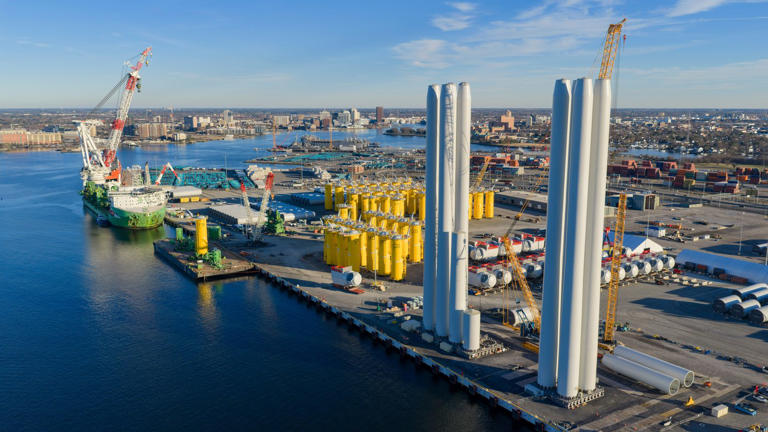
Wind turbine bases, generators and blades are positioned at The Portsmouth Marine terminal that is the staging area for Dominion Energy's wind turbine project Monday Dec. 22, 2025, in Portsmouth, Va. (AP Photo/Steve Helber)© The Associated Press
WASHINGTON (AP) — The Trump administration on Monday suspended leases for five large-scale offshore wind projects under construction along the East Coast due to what it said were national security risks identified by the Pentagon.
The suspension, effective immediately, is the latest step by the administration to hobble offshore wind in its push against renewable energy sources. It comes two weeks after a federal judge struck down President Donald Trump’s executive order blocking wind energy projects, calling it unlawful.
The administration said the pause will give the Interior Department, which oversees offshore wind, time to work with the Defense Department and other agencies to assess the possible ways to mitigate any security risks posed by the projects. The statement did not detail the national security risks. It called the move a pause, but did not specify an end date.
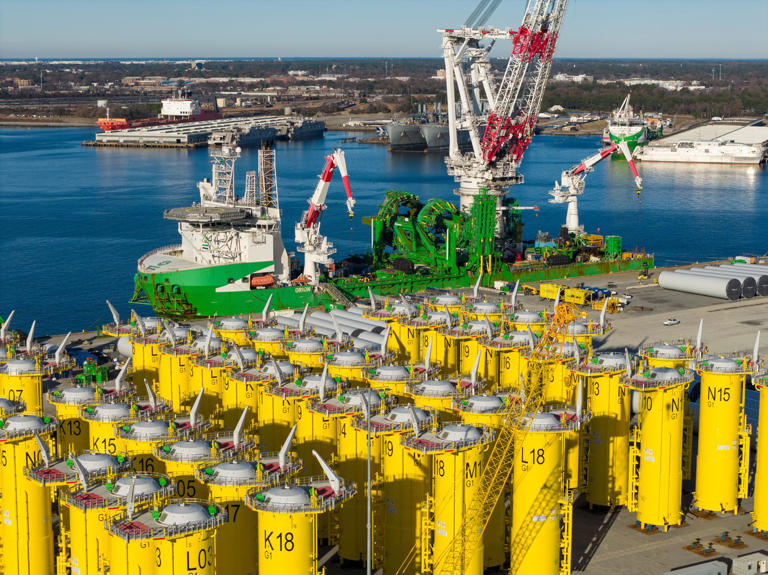
Wind turbine bases, generators and blades are positioned at The Portsmouth Marine terminal that is the staging area for Dominion Energy's wind turbine project Monday Dec. 22, 2025, in Portsmouth, Va. (AP Photo/Steve Helber)© The Associated Press
“The prime duty of the United States government is to protect the American people,” Interior Secretary Doug Burgum said in a statement. “Today’s action addresses emerging national security risks, including the rapid evolution of the relevant adversary technologies, and the vulnerabilities created by large-scale offshore wind projects with proximity near our east coast population centers.”
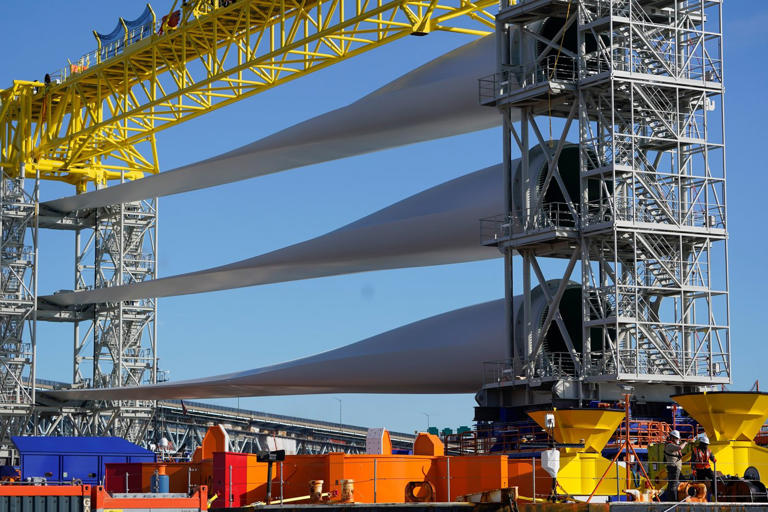
FILE - A generator and it's blades are prepared to head to the open ocean for the South Fork Wind farm from State Pier in New London, CT., Dec. 4, 2023. (AP Photo/Seth Wenig, File)© The Associated Press
Wind proponents slammed the move, saying it was another blow in an ongoing attack by the administration against clean energy. The administration’s decision to cite potential national security risks could complicate legal challenges to the move, although wind supporters say those arguments are overstated.
Projects paused over national security concerns
The administration said leases are paused for the Vineyard Wind project under construction in Massachusetts, Revolution Wind in Rhode Island and Connecticut, Coastal Virginia Offshore Wind, and two projects in New York: Sunrise Wind and Empire Wind.
The Interior Department said unclassified reports from the U.S. government have long found that the movement of massive turbine blades and the highly reflective towers create radar interference called “clutter.” The clutter caused by offshore wind projects can obscure legitimate moving targets and generate false targets in the vicinity of wind projects, the Interior Department said.
National security expert and former Commander of the USS Cole Kirk Lippold disputed the administration’s national security argument. The offshore projects were awarded permits “following years of review by state and federal agencies,” including the Coast Guard, the Naval Undersea Warfare Center, the Air Force and more, he said.
“The record of decisions all show that the Department of Defense was consulted at every stage of the permitting process,” Lippold said, arguing that the projects would benefit national security because they would diversify the country's energy supply.
Sen. Sheldon Whitehouse, D-R.I, said Revolution Wind was thoroughly vetted and fully permitted by the federal government, “and that review included any potential national security questions.” Burgum's action "looks more like the kind of vindictive harassment we have come to expect from the Trump administration than anything legitimate,'' he said.
A judge ruled blocking wind projects was unlawful
The administration's action comes two weeks after a federal judge struck down Trump’s executive order blocking wind energy projects, saying the effort to halt virtually all leasing of wind farms on federal lands and waters was “arbitrary and capricious” and violates U.S. law.
Judge Patti Saris of the U.S. District Court for the District of Massachusetts vacated Trump’s Jan. 20 executive order blocking wind energy projects and declared it unlawful.
Saris ruled in favor of a coalition of state attorneys general from 17 states and Washington, D.C., led by New York Attorney General Letitia James, that challenged Trump’s Day One order that paused leasing and permitting for wind energy projects.
Trump has been hostile to renewable energy, particularly offshore wind, and prioritizes fossil fuels to produce electricity. Trump has said wind turbines are ugly, expensive and pose a threat to birds and other wildlife.
Wind proponents slam the move
Wind supporters called the administration's actions illegal and said offshore wind provides some of the most affordable, reliable electric power to the grid.
“For nearly a year, the Trump administration has recklessly obstructed the build-out of clean, affordable power for millions of Americans, just as the country’s need for electricity is surging,” said Ted Kelly of the Environmental Defense Fund.
“Now the administration is again illegally blocking clean, affordable energy," Kelly said. “We should not be kneecapping America’s largest source of renewable power, especially when we need more cheap, homegrown electricity.''
The administration's actions are especially egregious because, at the same time, it is propping up aging, expensive coal plants "that barely work and pollute our air,” Kelly said.
Connecticut Attorney General William Tong called the lease suspension a “lawless and erratic stop-work order” that revives an earlier, failed attempt to halt construction of Revolution Wind.
“Every day this project is stalled is another day of lost work, another day of unaffordable energy costs and burning fossil fuels when American-made clean energy is within reach," Tong said. “We are evaluating all legal options, and this will be stopped just like last time.”
Suspension is praised by anti-wind group
A New Jersey group that opposes offshore wind hailed the administration's actions.
“Today, the president and his administration put America first,'' said Robin Shaffer, president of Protect Our Coast New Jersey, a nonprofit advocacy group.
“Placing largely foreign-owned wind turbines along our coastlines was never acceptable," he said, arguing that Empire Wind, in particular, poses a threat because of its close proximity to major airports, including Newark Liberty, LaGuardia and JFK.
Offshore wind projects also pose a threat to commercial and recreational fishing industries, Shaffer and other critics say.
Developers of U.S. offshore projects include Denmark-based Orsted, Norway-based Equinor and a subsidiary of Spanish energy giant Iberdrola. Orsted, which owns two of the projects affected, saw stock prices decline by more than 11% Monday.
Richmond-based Dominion Energy, which is developing Coastal Virginia Offshore Wind, said its project is essential for national security and meeting Virginia’s dramatically growing energy needs, driven by dozens of new data centers.
“Stopping CVOW for any length of time will threaten grid reliability ... lead to energy inflation and threaten thousands of jobs,” the company said in a statement.
Pausing the Virginia project, which is nearly 70% complete, creates a “perfect storm” to harm customer affordability and grid reliability, said David Shepheard, an energy expert at Baringa, a global consulting firm.
East Coast residents are familiar with winter storms that can devastate local economies, Shepheard said, adding: “This is a new one for the area: a Washington-borne nor'easter where the political winds are going to stop the blades from spinning."
___
Associated Press writer Jennifer McDermott in Providence, R.I., contributed to this report.
Matthew Daly, The Associated Press
Wind turbine bases, generators and blades are positioned at The Portsmouth Marine terminal that is the staging area for Dominion Energy's wind turbine project Monday Dec. 22, 2025, in Portsmouth, Va. (AP Photo/Steve Helber)© The Associated Press
WASHINGTON (AP) — The Trump administration on Monday suspended leases for five large-scale offshore wind projects under construction along the East Coast due to what it said were national security risks identified by the Pentagon.
The suspension, effective immediately, is the latest step by the administration to hobble offshore wind in its push against renewable energy sources. It comes two weeks after a federal judge struck down President Donald Trump’s executive order blocking wind energy projects, calling it unlawful.
The administration said the pause will give the Interior Department, which oversees offshore wind, time to work with the Defense Department and other agencies to assess the possible ways to mitigate any security risks posed by the projects. The statement did not detail the national security risks. It called the move a pause, but did not specify an end date.
Wind turbine bases, generators and blades are positioned at The Portsmouth Marine terminal that is the staging area for Dominion Energy's wind turbine project Monday Dec. 22, 2025, in Portsmouth, Va. (AP Photo/Steve Helber)© The Associated Press
“The prime duty of the United States government is to protect the American people,” Interior Secretary Doug Burgum said in a statement. “Today’s action addresses emerging national security risks, including the rapid evolution of the relevant adversary technologies, and the vulnerabilities created by large-scale offshore wind projects with proximity near our east coast population centers.”
FILE - A generator and it's blades are prepared to head to the open ocean for the South Fork Wind farm from State Pier in New London, CT., Dec. 4, 2023. (AP Photo/Seth Wenig, File)© The Associated Press
Wind proponents slammed the move, saying it was another blow in an ongoing attack by the administration against clean energy. The administration’s decision to cite potential national security risks could complicate legal challenges to the move, although wind supporters say those arguments are overstated.
Projects paused over national security concerns
The administration said leases are paused for the Vineyard Wind project under construction in Massachusetts, Revolution Wind in Rhode Island and Connecticut, Coastal Virginia Offshore Wind, and two projects in New York: Sunrise Wind and Empire Wind.
The Interior Department said unclassified reports from the U.S. government have long found that the movement of massive turbine blades and the highly reflective towers create radar interference called “clutter.” The clutter caused by offshore wind projects can obscure legitimate moving targets and generate false targets in the vicinity of wind projects, the Interior Department said.
National security expert and former Commander of the USS Cole Kirk Lippold disputed the administration’s national security argument. The offshore projects were awarded permits “following years of review by state and federal agencies,” including the Coast Guard, the Naval Undersea Warfare Center, the Air Force and more, he said.
“The record of decisions all show that the Department of Defense was consulted at every stage of the permitting process,” Lippold said, arguing that the projects would benefit national security because they would diversify the country's energy supply.
Sen. Sheldon Whitehouse, D-R.I, said Revolution Wind was thoroughly vetted and fully permitted by the federal government, “and that review included any potential national security questions.” Burgum's action "looks more like the kind of vindictive harassment we have come to expect from the Trump administration than anything legitimate,'' he said.
A judge ruled blocking wind projects was unlawful
The administration's action comes two weeks after a federal judge struck down Trump’s executive order blocking wind energy projects, saying the effort to halt virtually all leasing of wind farms on federal lands and waters was “arbitrary and capricious” and violates U.S. law.
Judge Patti Saris of the U.S. District Court for the District of Massachusetts vacated Trump’s Jan. 20 executive order blocking wind energy projects and declared it unlawful.
Saris ruled in favor of a coalition of state attorneys general from 17 states and Washington, D.C., led by New York Attorney General Letitia James, that challenged Trump’s Day One order that paused leasing and permitting for wind energy projects.
Trump has been hostile to renewable energy, particularly offshore wind, and prioritizes fossil fuels to produce electricity. Trump has said wind turbines are ugly, expensive and pose a threat to birds and other wildlife.
Wind proponents slam the move
Wind supporters called the administration's actions illegal and said offshore wind provides some of the most affordable, reliable electric power to the grid.
“For nearly a year, the Trump administration has recklessly obstructed the build-out of clean, affordable power for millions of Americans, just as the country’s need for electricity is surging,” said Ted Kelly of the Environmental Defense Fund.
“Now the administration is again illegally blocking clean, affordable energy," Kelly said. “We should not be kneecapping America’s largest source of renewable power, especially when we need more cheap, homegrown electricity.''
The administration's actions are especially egregious because, at the same time, it is propping up aging, expensive coal plants "that barely work and pollute our air,” Kelly said.
Connecticut Attorney General William Tong called the lease suspension a “lawless and erratic stop-work order” that revives an earlier, failed attempt to halt construction of Revolution Wind.
“Every day this project is stalled is another day of lost work, another day of unaffordable energy costs and burning fossil fuels when American-made clean energy is within reach," Tong said. “We are evaluating all legal options, and this will be stopped just like last time.”
Suspension is praised by anti-wind group
A New Jersey group that opposes offshore wind hailed the administration's actions.
“Today, the president and his administration put America first,'' said Robin Shaffer, president of Protect Our Coast New Jersey, a nonprofit advocacy group.
“Placing largely foreign-owned wind turbines along our coastlines was never acceptable," he said, arguing that Empire Wind, in particular, poses a threat because of its close proximity to major airports, including Newark Liberty, LaGuardia and JFK.
Offshore wind projects also pose a threat to commercial and recreational fishing industries, Shaffer and other critics say.
Developers of U.S. offshore projects include Denmark-based Orsted, Norway-based Equinor and a subsidiary of Spanish energy giant Iberdrola. Orsted, which owns two of the projects affected, saw stock prices decline by more than 11% Monday.
Richmond-based Dominion Energy, which is developing Coastal Virginia Offshore Wind, said its project is essential for national security and meeting Virginia’s dramatically growing energy needs, driven by dozens of new data centers.
“Stopping CVOW for any length of time will threaten grid reliability ... lead to energy inflation and threaten thousands of jobs,” the company said in a statement.
Pausing the Virginia project, which is nearly 70% complete, creates a “perfect storm” to harm customer affordability and grid reliability, said David Shepheard, an energy expert at Baringa, a global consulting firm.
East Coast residents are familiar with winter storms that can devastate local economies, Shepheard said, adding: “This is a new one for the area: a Washington-borne nor'easter where the political winds are going to stop the blades from spinning."
___
Associated Press writer Jennifer McDermott in Providence, R.I., contributed to this report.
Matthew Daly, The Associated Press