Monday, July 05, 2021

Climate change is killing us

By Max Fawcett | Opinion | July 2nd 2021
NATIONAL OBSERVER
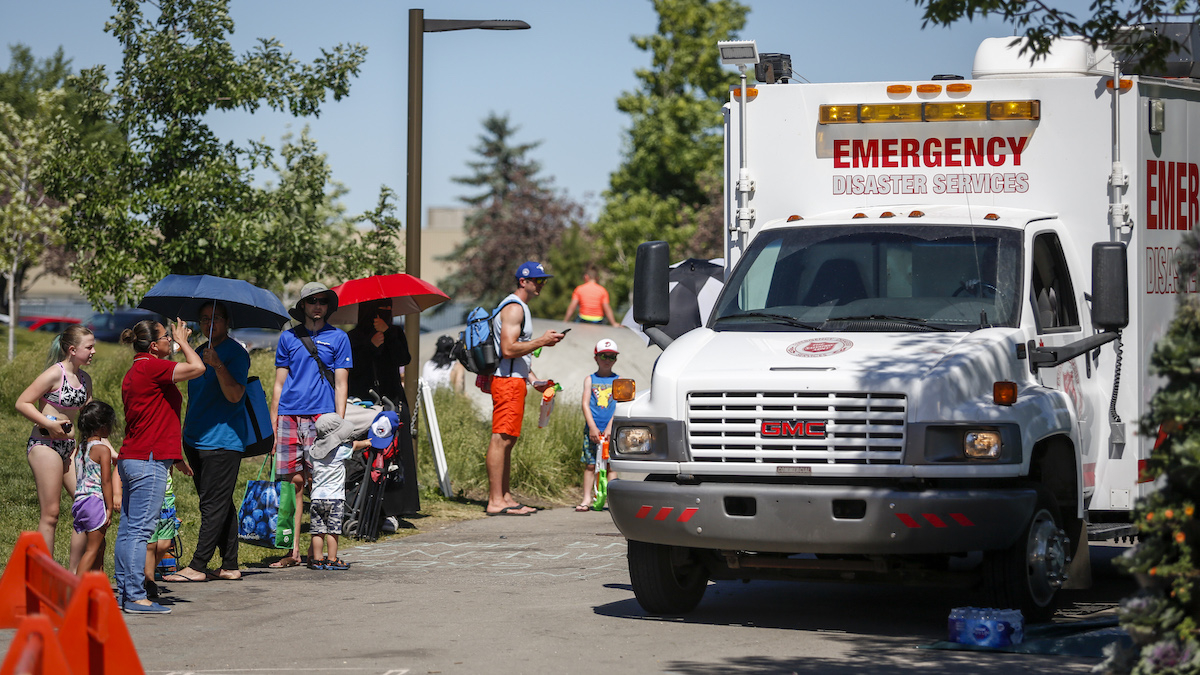
A Salvation Army EMS vehicle is set up as a cooling station as people line up to get into a splash park while trying to beat the heat in Calgary, Alta., Wednesday, June 30, 2021. THE CANADIAN PRESS/Jeff McIntosh


The small town of Lytton, British Columbia, has always been one of the hottest places in Canada. But this week, with the temperature hitting a high of 49.6 C, it’s one of the hottest in the world — and it’s giving the rest of the country a preview of what our climate future might look like. In the midst of a brutal heat wave that has engulfed the Pacific Northwest this week, and killed nearly 500 people already in Canada alone, Lytton’s record-breaking heat and the subsequent wildfire that destroyed much of the town and surrounding First Nations stands out as a terrifying reminder of just how deadly-serious climate change can be.

B.C. Premier John Horgan seems to need that reminder more than most. Earlier this week, he told reporters that “fatalities are a part of life,” a comment that he was forced to walk back almost immediately. But this heat wave is another indication that climate-driven fatalities are going to be an even bigger part of our lives going forward. And as bad as it is in places like Kamloops and Lytton, it’s worse in other parts of the world. Take the approximately 200,000 people living in Jacobabad, Pakistan, where, as The Telegraph’s Ben Farmer wrote, “its mixture of heat and humidity has made it one of only two places on Earth to have now officially passed, albeit briefly, a threshold hotter than the human body can withstand.” That list of places is sure to grow in the years and decades to come, and while Canada won’t be on it any time soon, we will have to contend with the impact of hotter and more humid summers.


Vancouver's scorching hot temperatures this week were hard on people and pets. Devon O'Donnell kept her cats cool with wet towels frozen in the fridge. Photo courtesy of Devon O'Donnell


Unfortunately, the worst may be yet to come for Western Canadians with this particular heat wave. That’s because B.C. and Alberta’s forests getting put under the broiler has massively increased the risk of forest fires, which could very quickly send Jason Kenney’s “best summer ever” up in smoke. As Yan Boulanger, a forest ecologist for Natural Resources Canada, told the Canadian Press, Western Canada’s wildfire risk maps are “extremely extreme right now.”

Once this so-called “heat dome” lifts and we can all get back to thinking a bit more clearly, we need to ask some pointed questions about how we’re going to adapt to this new normal — and what it means for climate policy going forward. The federal government’s decision to move up the timeline on the phaseout of fossil fuel vehicle sales by five years, to 2035 from 2040, is a step in the right direction. But it should be clear to all but the most stubborn holdouts that we need to be taking bounds, not steps, if we’re going to get ahead of this slow-motion disaster.


Two bodies discovered in the small town north of Hope
By Nick Wells | News, Politics | July 4th 2021Wildfires

That means a hard stop on catering to climate skeptics who have retrenched from outright denial to now accepting the science but ignoring its conclusions. They will point to China or the United States or some other actor’s behaviour as an example of why we don’t need to act decisively, move quickly or behave boldly. And while it might be tempting to assume the evidence right in front of our sweating faces will be enough to convince them to abandon this sort of climate filibustering, it’s far more likely they will double down on their logical fallacy of choice. If they insist on living in the past, so be it.

It will be left to the rest of us to push the broader climate conversation past promises about net-zero emissions targets that are 20 or 30 years in the future and focus far more on what we can do today to actually reach them. We’re at the point where that doesn’t just mean other people making sacrifices. We all have to entertain the possibility of changes to our own lives, whether it’s giving up some long-distance travel, getting rid of a car, or finding ways to use less energy.

The choice on the table isn’t between making sacrifices and maintaining the status quo, much as some people might want to believe otherwise. It’s between making relatively small sacrifices now or much bigger ones in the future — or worse, saddling our children and grandchildren with our sorry legacy. The sooner we come to terms with the reality we’ve helped create, the better we’ll be able to adapt. If there’s one thing that’s a near-certainty, it’s that the records getting broken this week won’t be the last of their kind.
Scientists call Northwest heatwave the 'most extreme in world weather records'
Jake Johnson, Common Dreams
July 04, 2021

U.S. government scientists concluded in a new report that last month was the hottest June on record. (Photo: Angelo Juan Ramos/Flickr/cc)

A pair of climate scientists on Thursday said the record-high temperatures that have ravaged the northwestern U.S. and western Canada over the past week—killing hundreds and sparking dozens of wildfires—represent the "world's most extreme heatwave in modern history."

"It's not hype or exaggeration to call the past week's heatwave the most extreme in world weather records."
—Bob Henson, Jeff Masters

"Never in the century-plus history of world weather observation have so many all-time heat records fallen by such a large margin than in the past week's historic heatwave in western North America," meteorologist Bob Henson and former National Oceanic and Atmospheric Administration (NOAA) hurricane scientist Jeff Masters wrote for Yale Climate Connections.
Chris 

"It's not hype or exaggeration to call the past week's heatwave the most extreme in world weather records," they argued. "The only heatwave that compares is the great Dust Bowl heatwave of July 1936 in the U.S. Midwest and south-central Canada. But even that cannot compare to what happened in the Northwest U.S. and western Canada over the past week."

In British Columbia, the chief coroner said her office has received nearly 500 reports of "sudden and unexpected" deaths since last Friday, many of which are believed to be connected to the record temperatures that the region has suffered in recent days.

Residents of the small British Columbia village of Lytton—which on Tuesday recorded Canada's all-time high temperature of 121°F—were forced to evacuate Wednesday as a wildfire ripped through the area and quickly engulfed the small town, destroying homes and buildings.

"Our poor little town of Lytton is gone," Edith Loring-Kuhanga, an administrator at a local school, wrote in a Facebook post. "Our community members have lost everything."
Report Advertisement

Henson and Masters called Lytton—90% of which was burned—the "poster community" of the "horrific" heatwave.

Weather historian Christopher Burt told the two scientists that "this is the most anomalous regional extreme heat event to occur anywhere on Earth since temperature records began."

"Nothing can compare," Burt added.


To emphasize the "extremity of this event," Henson and Masters highlighted just some of the temperature records that have fallen in Canada and the United States since late last week.

Portland, Oregon, broke its longstanding all-time record high (107°F from 1965 and 1981) on three days in a row—a stunning feat for any all-time record—with highs of 108°F on Saturday, June 26; 112°F on Sunday; and 116°F on Monday. That 116°F is one degree higher than the average daily high on June 28 at Death Valley, California.

Quillayute, Washington, broke its official all-time high by a truly astonishing 11°F, after hitting 110°F on Monday (old record: 99°F on August 9, 1981). Quillayute is located near the lush Hoh Rain Forest on the Olympic Peninsula, just three miles from the Pacific Ocean, and receives an average of 100 inches of precipitation per year.

Jasper, Alberta, broke its all-time high of 36.7°C (98.1°F) on four days in a row, June 27-30, with highs of 37.3°C, 39.0°C, 40.3°C, and 41.1°C (99.1°F, 102.2°F, 104.5°F, and 106°F).

All-time state highs were tied in Washington (118°F at Dallesport) and set in Oregon (118°F at Hermiston, beating the reliable record of 117°F), and provincial highs were smashed in British Columbia (49.6°C [121.3°F] at Lytton, beating 39.1°C [102.4°F]) and Northwest Territories (39.9°C [103.8°F] at Fort Smith, beating 31.7°C [89.1°F]).

"Preliminary data from NOAA's U.S. Records website shows that 55 U.S. stations had the highest temperatures in their history in the week ending June 28," Henson and Masters wrote. "More than 400 daily record highs were set. Over the past year, the nation has experienced about 38,000 daily record highs versus about 18,500 record lows, consistent with the 2:1 ratio of hot to cold records set in recent years."

Scientists have long predicted that heatwaves of the kind that are scorching the Northwestern U.S. and Canada will become more frequent and intense across the globe as the planet continues to warm due to the continued emission of heat-trapping greenhouse gases.

"Nowhere is safe... who would have predicted a temperature of 48/49°C [118.4°F/120.2°F] in British Columbia?" Sir David King, the former chief scientific adviser in the United Kingdom, said in an interview with The Guardian. "The risks have been understood and known for so long and we have not acted, now we have a very narrow timeline for us to manage the problem."


Scientists reconstruct Mediterranean silver trade, from Trojan War to Roman Republic

GOLDSCHMIDT CONFERENCE

Research News

IMAGE

IMAGE: A HACKSILBER HOARD DATED TO THE MIDDLE OF THE ELEVENTH CENTURY BCE FOUND BY THE LEON LEVY EXPEDITION TO ASHKELON. view more 

CREDIT: WE ARE GRATEFUL TO L. E. STAGER AND D. MASTER, DIRECTORS OF THE LEON LEVY EXPEDITION TO ASHKELON, AND TO D. T. ARIEL, FOR ALLOWING US TO PUBLISH THESE PHOTOGRAPHS....

Scientists have reconstructed the Eastern Mediterranean silver trade, over a period including the traditional dates of the Trojan War, the founding of Rome, and the destruction of Solomon's Temple in Jerusalem. The team of French, Israeli and Australian scientists and numismatists found geochemical evidence for pre-coinage silver trade continuing throughout the Mediterranean during the Late Bronze and Iron Age periods, with the supply slowing only occasionally. Silver was sourced from the whole north-eastern Mediterranean, and as far away as the Iberian Peninsula.

The team used high-precision isotopic analysis to identify the ore sources of minute lead traces found in silver Hacksilber. Hacksilber is irregularly cut silver bullion including broken pieces of silver ingots and jewellery that served as means of payment in the southern Levant from the beginning of the second millennium until the fourth century BCE. Used in local and international transactions, its value was determined by weighing it on scales against standardized weights. It has been discovered in archaeological excavations in the region usually stored inside ceramic containers and it had to be imported as there was no silver to be mined in the Levant.

Presenting the research at the Goldschmidt geochemistry conference, Dr. Liesel Gentelli said "Even before coinage there was international trade, and Hacksilber was one of the commodities being exchanged for goods".

The team analysed Hacksilber from 13 different sites dating from 1300 BCE to 586 BCE in the southern Levant, modern-day Israel and the Palestinian Authority. The samples included finds from 'En Gedi, Ekron, and Megiddo (also known as Armageddon). They matched their findings with ore samples, and have shown that most of the Hacksilber came from the Southern Aegean and Balkans (Macedonia, Thrace and Illyria). Some was also found to come from as far away as Sardinia and Spain.

Lead researcher Liesel Gentelli (École normale supérieure de Lyon, France) said:

"Previous researchers believed that silver trade had come to an end following the societal collapse at the end of the Late Bronze Age, but our research shows that exchanges between especially the southern Levant and the Aegean world never came to a stop. People around the Eastern Mediterranean remained connected. It's likely that the silver flowed to the Levant as a result of trade or plunder.

We do see periods of silver scarcity around the time of the Bronze to Iron Age transition, around 1300-1100 BCE. Some hoards from this period show the silver displaying unusually high copper content, which would have been added to make up for the lack of silver.

We can't match our findings on the silver trade to specific historical events, but our analysis shows the importance of Hacksilber trade from before the Trojan War, which some scholars date to the early 12th century BCE, through the founding of Rome in 753 BCE, and up to the end of the Iron Age in 586 BCE, marked by Nebuchadnezzar's destruction of Solomon's Temple in Jerusalem. After that, we see the gradual introduction of coinage, first as finds of several archaic coins and later a transition to a monetary economy in the southern Levant circa 450 BCE which made the trade of Hacksilber less relevant. However, this work reveals the ongoing and crucial economic role that Hacksilber played in the Bronze and Iron Ages economies".

Commenting, Dr Matthew Ponting, Senior Lecturer in Archaeological Materials at the University of Liverpool said:

"This is important new work that confirms our understanding of trade and exchange routes in the Early Iron Age Levant. The fact that all silver found in the region would have had to have been imported presents exciting possibilities to investigate trade routes more generally as well as to learn more about alloy use and preference during this important period of history".

###

Dr Ponting was not involved in this work, this is an independent comment.

The Goldschmidt Conference is the World's main geochemistry conference. It is hosted alternately by the European Association of Geochemistry (Europe) and the Geochemical Society (USA). The 2021 conference (virtual) takes place from 4-9 July, https://2021.goldschmidt.info/. The 2022 conference takes place in Hawaii.

The humble water heater could be the savior of our energy infrastructure woes

A controversial dam project could be avoided (and save billions) by merely replacing water heaters en masse


By EVAN MILLS
SALON
PUBLISHED JULY 4, 2021
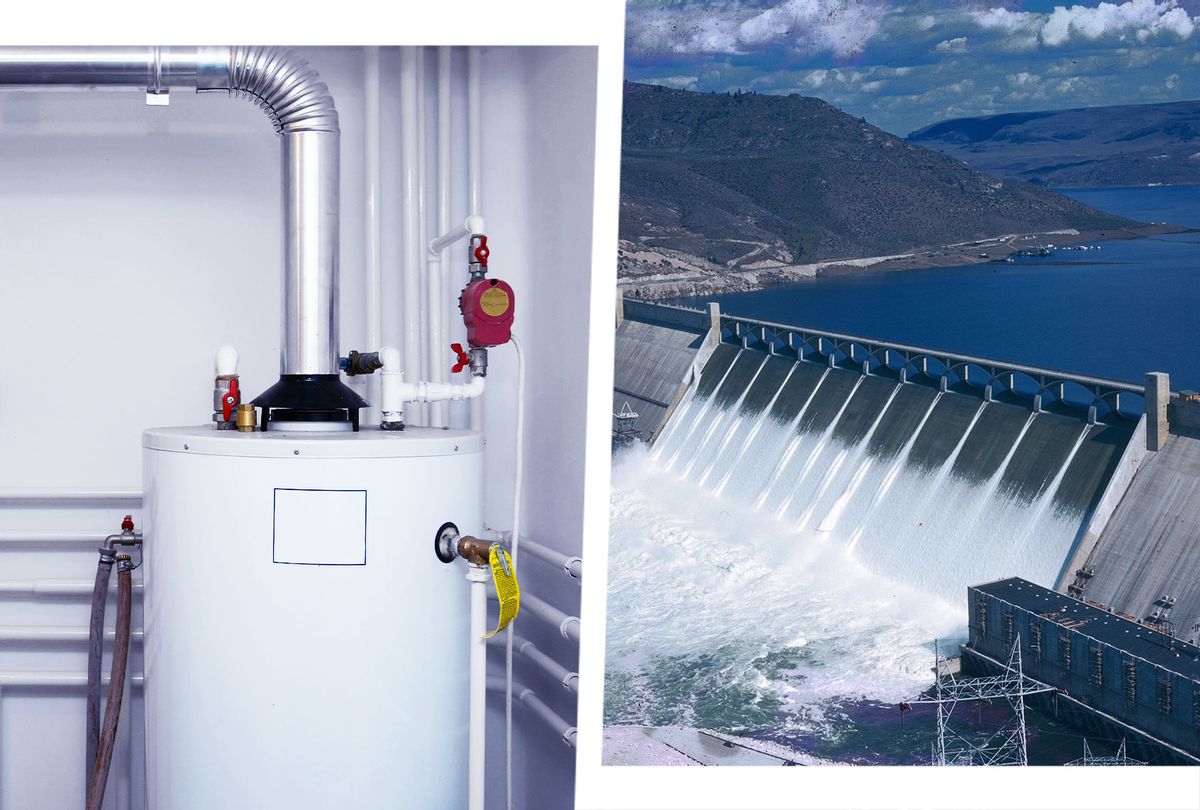
Water Heater | Grand Coulee Dam (Photo illustration by Salon/Getty Images)


There's widespread agreement that in order to wean humanity off of climate-altering fossil fuels, we should switch over to renewable sources of electricity. Yet one of the biggest problems with renewables is logistical: unlike a gas power plant, you can't simply turn the flow of wind or solar energy on or off; those energy sources come and go as nature pleases.

As a result, the question of how to store surplus wind and solar power for when it's needed is more timely than ever. Unfortunately, many of the solutions being advanced only create new problems, and frequently cost more than necessary. And perhaps the best solution for energy savings — and one that would avoid having to build any new dams to facilitate energy storage — is sitting right under noses. Or, more accurately, it is sitting in our closets and basements.

The big battery problem


One flashy idea for storing energy goes something like this: dam a river, use "free" surplus green power to pump that water up to another higher dam; then, when electricity is needed, release that water back down to the lower dam, spinning a generator along the way. The industry jargon for this set-up is "pumped-storage hydro". It is, in effect, a big, big battery.

At first blush, this sounds almost elegant: Use clean energy to store more clean energy. Even some environmental groups are getting seduced.

But there are several snakes in the garden. First, these dams are destructive: physically, ecologically, and culturally. Making matters worse, about a quarter of the energy is cannibalized to do all that pumping.

Adding insult to injury, immense amounts of precious water are lost by evaporation from the idling reservoirs. Climate change is making this worse. On the Arizona/Nevada border, water levels at Lake Mead — which is the downstream collection point for the Colorado basin — have fallen to less than a third of its capacity; hence, officials are looking at hydroelectric disruptions due to severe drought going into this summer and beyond. More water withdrawals, especially into enormous reservoirs that experience significant evaporation, accelerate the problem.

Ironically, this situation pushes the electric grid back toward costlier and dirtier gas-fired power plants. And these projects cost a fortune.

One high-profile proposal initially sought to dam the Little Colorado River upstream from its breathtaking confluence with the main Colorado, submerging a popular spot in the heart of Grand Canyon country.

About 30,000 people float "The Canyon" each year, and a few days into the trip many pause where these rivers meet to cool off and marvel at the layer cake of cinnabar cliffs sandwiched between azure sky and turquoise pools. I've had the good fortune to visit this hallowed place, twice, first with my father and later in life with my son. More importantly, this site has deep significance to the Hopi and Navajo peoples.

A "lower-impact" variant of the project, known as Big Canyon, was offered after the initial proposal met stiff resistance. It entails 4 miles of dam and other water-retention structures (9 reservoirs in all), 6 miles of water transport infrastructure, and two 14-mile-long high-voltage transmission lines to shunt the power gridward.

The project's estimated 3.6 billion watts is a pile of power. The National Hydroelectric Power Association predictably calls such projects "affordable." Yet the projected price tag for the Big Canyon project $10 to $20 billion. Even repurposing existing infrastructure, as has been proposed for the Hoover Dam, would cost many billions.

A dam mistake?

The technological enthusiasm underpinning this undertaking is reminiscent of a stubborn syndrome that existed until the 1970s, before OPEC woke the world up to the problems of energy dependency. In those days, energy planners reflexively gravitated towards huge, capital-intensive supply-side solutions, bypassing more elegant and dispersed "demand-side" options for instead proactively reducing the energy needed to get the job done.

A central pillar of the early energy efficiency movement of the 1970s was the idea of avoiding the construction of new electric power plants by instead deploying scores of efficient light bulbs, refrigerators, etc. One such project, dubbed "Merlin," sought to make a California power plant disappear by making the rest of the state more energy-efficient. And it cost a fraction of a new power plant.

Fast forward 50 years and we have succeeded. Energy use per unit of economic activity is down by more than half, compared to 1970s practices. Power plants were indeed cancelled.

And now, in service of the goal of decarbonizing the remaining energy needed to meet our needs, we're producing lots and lots of renewable power to fill the remaining gap. We're even beginning to have a surplus, meaning that we sometimes generate more than can be instantly consumed. Hence the big dams.

Again today, there is a better way ... with a twist: trim and shift the demand for energy and target storage to where it's needed. It's Merlin 2.0.

Enter the humble water heater. Pulling about 5,000 watts of power, conventional electric water heaters use a lot of power. They are, in other words, a prime target for reforming the grid.

Here is how such an energy-saving reform might work: First, by nudging the operating times for water heaters from peak hours in a coordinated manner; second, by switching residents over to energy-efficient heat pump water heaters. Heat pump water heaters have been around for decades, but are just now catching on in the United States.
Advertisement:

Here's how it works. The heat pump water heater is like a refrigerator running in reverse. Instead of taking heat out of the unit (cooling) and dumping it into the nearby room air, the heat pump water heater dumps heat from the air around it into the water. This is vastly more efficient than heating water in the old way, with a high-wattage electric coil.

There is actually a little-known tradition, going back to the late 1930s, of electric companies managing water heaters to avoid short-squeezes on the grid during times of peak consumption. Because water can be kept hot so long, consumers don't even notice. Originally this was done with timers, later via radio signals, and today through the cloud. And, thanks to smart meters that track energy use by the minute, demand-shifts can be very precisely targeted and valued. Water heaters, reborn as big thermal batteries, are an excellent means by which lots of clean power can be strategically banked for later use. Hundreds of thousands of water heaters have already been quietly hooked up this way.

 This is just the tip of the potential iceberg.

Deploying one million more "flexible" water heaters in the United States would spare the Little Colorado. (Notably, around 10 million water heaters are purchased nationwide each year; one million water heaters is just 10 percent of that). The price tag would be a tiny fraction of that to build the disruptive Big Canyon hydro project, and also less costly than deploying enormous banks of batteries into the grid. Using far more efficient heat pump water heaters would still cost less (particularly the less-costly plug-in units coming to market this year, which avoid the need for electrical upgrades) and spread the benefits to four-times as many homes, displacing proportionately more carbon emissions and saving more people more money on their power bills.

As a thought experiment, were all U.S. homes converted to heat pump water heaters, reductions of 135 million metric tonnes of CO2 each year would be achieved (equivalent to that of about 30 million cars) and enough energy storage capacity would be available to avoid 20 Big Canyon projects.

This approach can be deployed far faster than dam construction, and free of protest (except perhaps from dam builders). It's also more resilient. During last winter's megastorms, the Big Canyon project would have provided no relief to those isolated in power networks such as the one that vexed Texas. And now this summer, we're reminded that heatwaves can boost demand beyond the grid's capacity even in less isolated power networks. The resulting grid congestion has already become an impediment to renewable energy development in many parts of the country. Water heaters are always local.

As we continue to decarbonize our energy systems, other flexible customer-side strategies can be supported using cash incentives for consumers who are willing to voluntarily flex their demand. Among these, usage can be shifted to times when the sun is shining and the wind is blowing via dynamic electric-vehicle charging, smart thermostats, and timed pool pumps, sending even more renewable electrons to homes while enhancing the power network's reliability.
Advertisement:


It's the smart grid in action.

EVAN MILLS
 is an energy and climate analyst who participated in the work of the Nobel-Prize-winning Intergovernmental Panel on Climate Change. He is an Affiliate and retired Senior Scientist at the U.S. Department of Energy’s Lawrence Berkeley National Laboratory and a Research Affiliate at U.C. Berkeley’s Energy and Resources Group.

Remaining Surfside condo building demolished before storm


Murder of the Dead by Amadeo Bordiga 1951 - Marxists

https://www.marxists.org/archive/bordiga/works/1951/murder.htm
      • When the catastrophe destroys houses, fields and factories, throwingthe active population out of work, it undoubtedly destroys wealth. Butthis cannot be remedied by a transfusion of wealth from elsewhere, aswith the miserable operation of rummaging around for old jumble, wherethe advertising, collection and transport cost far more than the valueof the worn out clothes. The wealth that disappeared was th…
The Surfside condo disaster: Critical structural dangers were ignored

Niles Niemuth@niles_niemuth
28 June 2021

The official death toll climbed to nine Sunday as the search for bodies and possible survivors continued amid the rubble of the Champlain Towers South condominium in Surfside, Florida, located on the Atlantic coast just north of Miami Beach.

Eight bodies have been recovered and one person has died in hospital. Over 150 residents remain unaccounted for more than four days after a significant portion of the 40-year-old, 12-story oceanfront residential tower suddenly collapsed in the early hours of Thursday.

Among the identified victims are retirees Antonio and Gladys Lozano, married for 59 years, who died together, asleep in their ninth-floor apartment. The body of Manuel LaFont, 54, was recovered on Friday. LaFont, originally from Houston, Texas, was a businessman who worked with companies in Latin America. Stacie Dawn Fang, 54, the first victim identified on Thursday, died of blunt force trauma as her apartment crumbled around her. Fang’s teenage son, Jonah Handler, is among the handful of residents rescued from the rubble by first responders.
Workers search in the rubble at the Champlain Towers South Condo, Saturday, June 26, 2021, in Surfside, Fla. (AP Photo/Gerald Herbert)

The search effort was slowed by a smoldering fire beneath the rubble, which was finally suppressed on Saturday. A 40-foot-deep, 20-foot-wide, 125-foot-long ditch is being dug into the heap of concrete, steel, furniture, clothing and other personal effects to facilitate the recovery effort.

Reports continue to emerge indicating that the building was known for several years to be structurally unsound, pointing to criminal neglect in connection with the beachfront catastrophe. However, any official investigation is certain to be a whitewash, with no one facing serious consequences for their role in the deaths of potentially more than 150 people.

Structural engineer Frank Morabito delivered a report to the treasurer of the Champlain Towers South Condominium Association, the building’s owner and operator, in October 2018 that warned of “major structural damage” to the concrete slab underneath the pool deck and entrance drive caused by the failure of waterproofing. “Failure to replace the waterproofing in the near future will cause the extent of the concrete deterioration to expand exponentially,” he explained.

The report, released by the city of Surfside Friday night, also found that concrete columns and walls in the parking garage levels under the building were cracking and had lost entire chunks, with some areas so eroded that they showed corroded steel rebar reinforcements.

Morabito noted that repairs were needed to “maintain the structural integrity” of the building but gave no indication that there was any concern of a collapse. The report’s main conclusion was that the roof needed to be replaced before hurricane season to prevent rain and wind damage.

At the time of the collapse, the building was undergoing roof repairs as part of the recertification process required by Miami-Dade County for buildings that are 40 years old, but nothing had yet been done about the deteriorating concrete. The building needed approximately $15 million in repairs and upgrades in order to achieve recertification.

Donna DiMaggio Berger, an attorney for the condo association, told the Daily Mail on Friday that Morabito had not looked at the foundation or the ground underneath the building, as this is not required in the recertification process. A 2020 study of satellite data from the 1990s by an engineer at Florida International University found that the building had been sinking at a rate of two millimeters per year. It is possible that the building had subsided more than three inches in the last four decades, undermining its structural integrity. Despite these concerning findings, no official warnings were issued.

The Champlain Towers South Condominium was built on reclaimed wetlands on one of the many barrier islands that bear the brunt of wind and storm surge from hurricanes and other tropical storm systems. Starting in the late 1920s, speculators divided up the sandbar between the Atlantic Ocean and North Biscayne Bay, developing it into the city of Surfside.

Two Champlain Towers, South and North, were the first new buildings built in Surfside after a moratorium on new construction implemented by Miami-Dade County in 1979 due to concerns about the city’s degraded water and sewage system. The developers, led by Polish-born Canadian attorney Nathan Reiber, paid $200,000 to the city, half the cost of a new sewage system on the property, in order to get the project off the ground.

The Washington Post reported on Saturday that Reiber had been charged by Canada with tax evasion during the 1970s and was fined $60,000. Reiber and a partner ran an apartment operation in Canada where they were accused of skimming tens of thousands of dollars from coin-operated laundries and pocketing $120,000 in a fraudulent construction scheme.

A year after the approval of the project, the developers of the Champlain Towers were compelled to ask two members of the City Council to return campaign contributions the former had made after Reiber and his associates were accused of trying to buy off the local government.

The construction of the Champlain Towers came at the beginning of the deregulation of the savings-and-loan industry. President Ronald Reagan’s 1981 tax cuts further encouraged the development of real estate as a tax shelter. Accordingly, money was flooded into commercial real estate development, resulting in an explosion of construction in Florida and throughout the US, with buildings often being quickly and cheaply constructed.

Both US political parties share responsibility for the Champlain Towers disaster. Between 1971 and 1999, the Democratic Party controlled the governor’s office for all but four years, overseeing an explosion of residential and commercial construction in Florida with little effective oversight. Most recently, Republican Governor Ron DeSantis has been pushing to cut regulations further, seeking to remove any obstacles to the extraction of profit from the working class while funneling tens of millions of dollars in state funds to private developers.

Just hours after the collapse of the Surfside condo, President Joe Biden announced a bipartisan infrastructure deal providing a fraction of his original proposal, omitting any funding for childcare, health care, or tax credits for families, and leaving out his promised increase in corporate taxes. The entire $579 billion in new investments in physical infrastructure will be handed out to private companies under the guise of “public-private partnerships.”

Exactly how many other residential towers on the Florida coast and throughout the United States are at risk of collapsing like Champlain Towers South is unknown, but it is known that thousands of others were built under similar conditions and on unstable ground and are now being subjected to increased flooding and inclement weather thanks to human-induced global warming. A thorough survey of every housing development is needed to determine the risks posed to their residents.

As one engineer noted, the disaster in Surfside is a “canary in the coal mine.” It is indicative of the abysmal state of basic social infrastructure across the country, under conditions where every aspect of life is subordinated to the drive for ever greater profit. This is on display most monstrously in the COVID-19 pandemic, in which a “herd immunity” policy pursued by the ruling class has allowed the disease to spread, resulting in the deaths of at least 600,000 Americans and 4 million people globally.


With increasing frequency in the United States bridges collapse, factories explode and dams fail, killing workers and destroying their homes and livelihoods, yet nothing is done to address these life-and-death problems. In Detroit, Michigan last weekend, 2-6 inches of rain in a matter of a few hours flooded the freeway system as critical pumps failed, stranding thousands of people in their cars. Hundreds of homes were flooded, destroying the belongings of families.

In every case, capitalism is unable to address and resolve these basic issues. The need for rational planning in the organization of society is clear. However, it is impossible under the anarchy of the capitalist system. A solution to these basic problems will be found only through the expropriation of the corporate-financial oligarchy and democratic reorganization of society under the control of the working class so as to marshal the world’s resources to meet the needs of humanity. Guaranteeing safe housing, safe workplaces, high quality education and health care requires the establishment of socialism.

WSWS.ORG    


  1. Murder of the Dead by Amadeo Bordiga 1951

    https://www.marxists.org/archive/bordiga/works/1951/murder.htm

    Murder of the Dead. First Published: Battaglia Comunista No. 24 1951; Source: Antagonism's Bordiga archive; HTML Mark-up: Andy Blunden 2003. In Italy, we have long experience of “catastrophes that strike the country” and we also have a certain specialisation in “staging” them. Earthquakes, volcanic eruptions, floods, rainstorms ...

The Theory and Practice of Marxism in Japan

AN INTERVIEW WITH GAVIN WALKER
Gavin Walker is associate professor of history at McGill University.

JACOBIN  07.03.2021


From the ’60s New Left to the persistence of a mass-membership Communist Party today, Marxism has had a huge impact on Japanese politics and culture. Japanese Marxism is a highly creative tradition that deserves to be better known and understood outside Japan.


Japanese Communist Party Headquarters in 1950. (Wikimedia Commons)


INTERVIEW BY Daniel Finn

For many years, Japan has been one of the leading players in global capitalism. With the world’s third-largest economy and some of its most renowned manufacturing firms, Japan is one of the few countries to have bridged the infamous gap between “the West and the rest.”

However, alongside the development of capitalism in Japan, a powerful socialist tradition has also taken shape in Japanese political and intellectual life. Marxism has exercised an extraordinary influence in Japanese academic culture, while the Japanese Communist Party remains a mass-membership party with unapologetic roots in the communist tradition.

Gavin Walker teaches history at McGill University in Canada. He is the author of The Sublime Perversion of Capital: Marxist Theory and the Politics of History in Modern Japan and the editor of The Red Years: Theory, Politics, and Aesthetics in the Japanese ’68.

This is an edited transcript from an episode of Jacobin’s Long Reads podcast. You can listen to the episode here.
DF

You’ve written about the importance of Marxism in Japan, both as a political movement — with more than one organizational form — and as an intellectual tradition. You’ve also noted that it hasn’t received the same attention as Marxist political organizations and theoretical work in countries where European languages are spoken — for obvious reasons, perhaps. Before going into the story of Japanese Marxism and socialism in detail, could you us give a bird’s-eye view of its most striking features, for someone who may not be familiar with Japanese politics or intellectual life?
GW


I would say a couple of things to begin with. One is that one of the most remarkable things about the history of Marxism in Japan is, I would say, its distinction from the history of Marxism, particularly in Europe, where the Marxist tradition really emanated most heavily from the side of political movements. It came from the First International — the International Workingmen’s Association. It came from the dominance of the Second International in Central Europe, and then from the dominance of the Third International after the victory of the October Revolution.

In Japan, on the other hand, the history of Marxism came principally from the side of the university. I think that conditioned very heavily the nature of Marxist theoretical work in Japan, but also gave it its particularly high-level theoretical character. Marxism was received first in Japan not principally as the ideological backbone of political organization but as the front curve of development at the cutting edge of the social sciences. In this sense, Marxism was really something that from the very beginning was given an almost principally theoretical character in Japan.Marxism was received first in Japan not principally as the ideological backbone of political organization but as the front curve of development at the cutting edge of the social sciences.

Some of the other effects that have been important for the development of Japanese Marxism include its dominance in the university — a situation that we can’t really point to anywhere in Europe or North America, in the sense of being the main trend of social-scientific and certainly historical research. In Japan, through to the end of the 1980s and the events of 1989–1991, Marxism remained the dominant methodological orientation in the university and intellectual life as a whole. Even those who were anti-Marxist or oriented more toward traditions of liberalism and so forth had a grounding in Marxist theory that would be surprising, though perhaps not everywhere — in France, there was a dominance of Marxism in the postwar period as well — but certainly in much of Europe and North America.

This widespread influence of Marxism in an advanced capitalist society was unusual and has roots in this highly intellectual background to Marxism in Japan that in turn led to the very methodological character of Marxism in Japan. A lot of work, for instance, on the MEGA project, the Marx-Engels collected works, took place in Japan. The striking feature of Japanese Marxism is its extremely high level of theoretical work and not only political analysis.

DF


Japan itself appears to be highly significant for Marxist theory as a case study because it was the first and arguably still the only country from outside the Euro-American cultural matrix to have become a highly developed, industrial capitalist state by any benchmark you might care to mention, whether it’s social and industrial structure, GDP per capita, median wage rates, etc. That might be explained by reference to the external geopolitical context, where Japan was one of the few countries in Africa or Asia to escape European colonial rule, so that its leaders could imitate the leading capitalist states of their day without being subordinated to their control. It could also be explained, on the other hand, by reference to Japan’s own precapitalist social and political structures, perhaps lending themselves to capitalist development in a particular way. What explanations have Japanese Marxists themselves tended to favor?
GW


Probably the most significant question for the early history of Marxist theory in Japan was to clarify how Japanese capitalism had developed — how it had sprung up on the basis of what existed before — and also to explain the peculiar trajectory of Japanese capitalism. It was similar to Germany, for instance, or Russia, as a late-developing capitalist state, in the sense that the feudal structure lasted for a long time in comparison to France or the United Kingdom.

One thing that distinguished Japan in particular was that it compressed its development into a small space of roughly fifty years from 1868 and the Meiji Restoration, which broke the feudal power of the old Shogunal government and established the route toward a modern state in Japan, to the 1930s. Over the space of fifty or sixty years, Japan passed through the stages of being a dominated or peripheral country with a late transition from feudalism to becoming a very rapidly industrializing country, particularly in the 1880s and 1890s, when enormous investment by the state in munitions manufacturing and heavy industry prompted a significant turn in the formation of modern Japan, which was the turn to imperialism.

The Japanese state remained in the early twentieth century the only major non-Western imperialist power. It held an extraordinarily large empire at its height in the 1940s, stretching from the South Pacific all the way through Manchuria into Northeast Asia. This Japanese empire existed a mere thirty to forty years after Japan had formed any kind of national state at all.Over the space of fifty or sixty years, Japan passed through the stages of being a dominated or peripheral country with a late transition from feudalism to becoming a very rapidly industrializing country.

This trajectory was extremely important for Marxists to explain. It bore very little similarity, on the face of it, to the story of the development of English capitalism told in Marx’s Capital. Of course, Marx’s Capital famously reminded its German readers that they should not think it was a book solely about England. It was the story of the development of an ideal average of a capitalist society. Marxists in Japan took this as a kind of spur for their work to think about how Japanese capitalism had developed from out of the existing situation.

This resulted in a wide-ranging debate on the origins of capitalism. One side argued that the Meiji Restoration had been a bourgeois-democratic revolution that broke the feudal power and set Japan on the trajectory toward becoming a “normal” capitalist state. Others took the position that, in fact, Japanese capitalism was overwhelmed from the very beginning with feudal remnants.

They referred to its extreme inequality, for example: in the 1890s and 1900s, Japan had an average wage rate lower than that of India at the time. India was, of course, a dominated, colonized state. This perspective identified these feudal remnants at the level of mentality, but also at the levels of social structures and ideology, most of all in the existence of the emperor system itself at the center of Japanese capitalism.

The emperor, we have to remember, was marginalized under late feudalism in Japan. Significantly, in 1868, when the modern Japanese state was formed, it was referred to as a restoration, not a revolution — the restoration of the emperor to the center of society. How could you explain this anachronism, this sense of bringing into life a modern state founded on the sanctity of private property and a modern, Prussian-style constitution, yet one that also brought back into its core this imperial institution? This was a key contradiction for Japanese Marxists to explain, and I would say it remains a key contradiction about which they profoundly disagree.
DF


In the field of politics and political movements, how did the socialist movement first become implanted in Japanese political life? And what particular challenges did that movement face?
GW


Socialism in Japan has in some sense an independent history from the history of Marxism. Of course, that’s not necessarily unique, because socialism predates the existence of Marxism as a political doctrine, and predates the actual life of Marx. In Japan, there were a number of sources for this divergence.

Marx was not widely read in Japan until the late nineteenth century. Marx started to be read in the 1890s, and really came to prominence in the 1910s, which is when the intellectual hegemony of Marxism was established. But prior to that, there was a separate trajectory of socialism, some of which came from Christian socialism. There was a certain prominence of Christian socialism in the last days of the Tokugawa feudal system, and there was an articulation of that agrarian, millenarian Christian socialism with many of the peasant movements of late feudalism.

One of the motors for the development of the modern Japanese state was the intense agrarian struggle that existed at the end of the Tokugawa system of provincial city-states. That usually came in the form of peasant revolts, which increased radically in number between 1850 and the early 1860s, leading up to the Meiji Restoration of 1868. After the Restoration, a number of social movements that channeled that popular energy began to emerge, particularly in the early 1870s.In the early Meiji period, after the establishment of the modern state, there was significantly greater hardship visited upon the peasantry than there was even at the end of the feudal system.

In 1873, you had the so-called Freedom and Popular Rights Movement, which was a kind of millenarian movement for the establishment of greater rights and freedoms for the popular classes. The Meiji state, having broken the feudal power, was by no means a progressive state at the level of social policy. Quite to the contrary, we might even say that in the early Meiji period, after the establishment of the modern state, there was significantly greater hardship visited upon the peasantry than there was even at the end of the feudal system.

The Freedom and Popular Rights Movement of the 1870s spurred on the development in the 1880s and ’90s of this articulation among Christian socialism, the peasant movements, and a nativist agrarian radicalism — almost anarcho-syndicalist — that would be embodied by figures like the famous anarchist Kotoku Shusui. The challenges that these movements faced were very significant. They were largely banned and outlawed quickly, but they successfully planted the seed throughout the intellectual world and workers’ organizations of what would slowly become a renewed militancy on the part of organized labor.
DF


How did Japanese Marxism begin to take shape as a school of thought with original perspectives of its own? What adaptations did Japanese Marxists find necessary for theories that had originally been developed in a European or perhaps in an American context?

GW


This refers back, in a way, to your previous question about the development of Japan’s social and political structures. In this sense, the key debate on this question took place in the 1920s. The Japanese Communist Party (JCP) was founded in 1922, and very quickly became a central nodal point of intellectual activity. Around this time, what became the key debate in Japanese social thought was called the debate on Japanese capitalism. This debate was essentially between two positions.

One side, the so-called Koza faction, supported the thesis that Japanese capitalism was immature and incomplete, having only made a partial transition from feudal social forms. Defenders of this thesis would point to the fact that the labor wage rate was significantly below that of other capitalist societies and would argue that it could be explained by reference to other ideological factors, namely despotic power in the countryside, the transformation of former feudal lords into property-owning landlords, despotic tenant farm practices, the extraction of ground rent — more or less an agrarian despotism.

On the other hand of this debate was the so-called Rono faction, which would later go on to form the Socialist Party in the postwar period. They argued that Japanese capitalism was in fact a normally developing capitalism. They had a very normative understanding of what capitalism ought to be and argued that Japanese capitalism had been comprehensively established, with a full break from feudalism, with the advent of the Meiji Restoration. This break constituted a fundamental historical transition from feudal social and political forms. In other words, if such forms still existed in the political conjuncture, they were to be understood as inevitably dying and soon to fall away.The Comintern held that Japanese capitalism was not ripe for socialist revolution but would first require a two-stage revolutionary process involving a completion of the bourgeois-democratic revolution, principally directed against the emperor system.

What’s significant about this debate is that it placed into the center of the development of Japanese Marxism the question of what use Marx’s theoretical work could be in the concrete political analysis of Japanese capitalism. But it also involved a kind of allegorical retelling of political questions, in the sense that, unsurprisingly, supporters of the feudal thesis — the thesis that Japan was still overwhelmed with feudal remnants — took a specific political line. It would later become the line of the Comintern: the idea that Japanese capitalism was not ripe for socialist revolution but would first require a two-stage revolutionary process involving a completion of the bourgeois-democratic revolution, which would be principally directed against the emperor system.

The other side — the Rono faction, which asserted that Japanese capitalism already constituted a mature capitalist social formation — had a one-stage theory of revolution, with the immediate passage to socialist demands. This mirrored very closely the development of similar debates, particularly in Africa and Latin America, but really everywhere outside Europe and North America — North America never having had feudalism properly speaking, except perhaps in New France, and Europe having had a transition from feudalism at an earlier stage, at least in England and France. This debate and its allegorical representation in two political lines was highly significant, and essentially created the main trends of Japanese Marxist theory.
DF


What was the experience of the Japanese Communist Party after its foundation in the 1920s? And what relationship did it have to the intellectual development of Marxism in Japan?
GW


The experience of the JCP was a very significant one. The party was formed in 1922 and immediately went through a very intense period of political and intellectual splits, exemplified by figures like Fukumoto Kazuo, whose thought was quite close to that of Georg Lukács. History and Class Consciousness was published in 1923 and was almost immediately taken up in Japan. This highly intellectualized vision of the party had major consequences in the 1920s. That line didn’t win out in the end, but it made the party a very important site for intellectuals.

However, the authorities cracked down on the JCP at an early stage. Having been formed in 1922, it was banned in 1925 under the Peace Preservation Law. Thereafter, the party was essentially a semiunderground organization, but many figures in Japanese political and intellectual life belonged to it or were at least adjacent to it.

The party took an early stance on this previous debate about Japanese capitalism. It was deeply influenced by the Comintern. At this stage, there were several figures in the Comintern as a whole who were occupied with Japan, including Nikolai Bukharin and the Finnish communist Otto Kuusinen. Kuusinen was the head of the Comintern’s Eastern Bureau during the late 1920s and early 1930s and wrote many of the position papers on Japan.

One of the things that the Japanese Communist Party did that was very significant was that it attacked the emperor system. It was for this that the communists were banned — not for being communists, not for proposing an end to capitalist society, and not for proposing a transition to socialism.

In fact, there was a relatively free intellectual culture throughout the 1920s, despite the fact that there was a government that was prosecuting imperialism all over East Asia, and that was increasingly open to a process of fascist transformation. It was absolutely possible to write about Marx, to read Marx, or to propose communist solutions to economic questions.After the defeat of Japan in August 1945, the JCP emerged essentially not just unscathed but with a remarkable degree of popularity, despite the years of repression.

What provoked the extreme force with which the Japanese Communist Party was attacked in the prewar period was its insistence that the emperor system was the theoretical and political lodestone of the social order, and that without a frontal attack on and destruction of the emperor system, there wasn’t any possibility for a communist development. This element of the JCP would become very, very important, and would also become an element of its postwar legitimacy.
DF


How did the Japanese communists respond to the new situation that arose after the defeat of Japan in 1945 and the inauguration of a new political system that was under US hegemony?
GW


The JCP changed significantly, for two reasons. First of all, from the mid-1930s and the genuine transition to fascism in Japan — without entering deeply into the debates around the historiography of global fascism, whether Japan qualifies as fascist, and so forth — the JCP was not just outlawed: it was hunted down and destroyed. The JCP faced an extraordinary level of political repression by the state in the 1930s: extrajudicial killings, long prison sentences for trumped-up offenses, etc.

The main leaders of the JCP through the 1930s and ’40s — that is, through the high point of Japanese fascism and into the Pacific War and the defeat in World War II — were in prison. When they emerged after the defeat of Japan and the surrender of the emperor in August 1945, the JCP emerged essentially not just unscathed but with a remarkable degree of popularity, despite the years of repression.

The JCP could legitimately say, “We are the sole political force who did not collaborate with the previous system.” Also, even among people who were not sympathetic to the JCP’s particular political ideology — to communism, socialism, Marxism — there was a significant section of the population, especially the working population, who saw them as a new possibility in political terms, at a moment when warfare had devastated the Japanese state.

It wasn’t only a perspective that said, “These people were persecuted by the previous order,” but also a perspective that said, “The previous order led us to destruction, therefore we should have listened to those voices which saw early on the destructive force of the fascist order.” The Japanese Communist Party thus had a remarkable opportunity in 1945.

The US occupation of Japan itself is a very interesting and rather strange phenomenon. Policy was essentially made in many cases by very young people — people who were graduate students at Columbia and Harvard. Policy under the US occupation emphasized the “de-fascization” of Japan — the elimination of the remnants of the fascist order from institutions and the repurposing of previous elements of government for a new democratic order.

In 1947 and 1948, there was the possibility that the Japanese Communist Party and the Japanese Socialist Party would run on a joint left-wing ticket for the elections. Polling showed that not only would this be successful, it might even be a complete success — perhaps enough to form a government. This, of course, was totally unacceptable to Douglas MacArthur, the supreme commander for the allied powers at the time. MacArthur and his fellow commanders saw this through the lens of the early, developing Cold War — the possibility that Japan would go red.The choice of the US occupiers was to privilege anti-communism over de-fascization. That really set the stage for what would happen in postwar Japan.

This inaugurated what came to be known as the “reverse course” among historians. Until this point, there had been a sense that the American occupation was going to participate in the de-fascization of Japanese society. Now the new modus operandi of the occupation was to maintain Japan as a bulwark against communism instead. By 1947–48, it was clear on the Asian continent that the Chinese Communists, who had been struggling for ten or fifteen years in conditions of civil war, were on the verge of victory, which would come to pass in 1949. The moment was a very volatile one in geopolitical terms.

At that stage, the choice of the US occupiers was to privilege anti-communism over de-fascization. That really set the stage for what would happen in postwar Japan, not only in terms of the state but also in terms of the JCP and what would happen thereafter. To cut a long story short, the JCP had a brief turn to a more or less illegal mode of struggle in the early 1950s. It went, in part, underground.

That underground experience of the JCP in the early 1950s produced some remarkable political, cultural, and even literary and artistic effects. It was a very influential period, but it was repudiated by the JCP’s turn in 1955, when the party declared an end to any attempt at armed struggle and an acceptance of the parliamentary road.
DF


In the 1960s, despite or perhaps because of the extraordinary economic boom at the time, Japan developed one of the most significant New Left movements. It was easily on a par, in terms of social and political weight, with the movements in Western Europe at the same time. What common ground did it share with those European movements, and how did it differ from them?
GW


The Japanese New Left shared in some senses a common pathway of development with the New Left in Europe and North America. First of all, the effects of the 1950s on the global communist movement were significant. I’m thinking here of the Hungarian uprising in 1956 and its crushing by the Soviet Union, and the so-called secret speech of Nikita Khrushchev at the Twentieth Congress of the Soviet Communist Party, when the crimes of Joseph Stalin and the existence of the gulag were revealed. This had a very intense effect on British communism, for example. It was the moment of the creation of the New Left and a certain exodus from the British Communist Party. The same can be said about many other places, like France.

The revelations about the nature of the Soviet Union and the pitfalls of the Soviet model of communism had a significant effect in creating a left that was independent of the JCP, with its Comintern-driven and deeply Stalinist orientation. But as I just mentioned, there was also an impact from just before 1956 and that apocalyptic moment for global communism. That stemmed from the repudiation by the JCP of the underground experience of direct action in the early 1950s.Many young people took as a genuine betrayal the JCP’s repudiation of the experience of armed struggle, which was formative for a whole generation, as having been simply ultraleft adventurism.

The JCP repudiated the line of armed struggle at the party’s Sixth Congress in 1955 and condemned those who went into the villages in a peculiar movement called the “mountain and village operations corps.” These were student groups that went into the poor and desolate rural villages in an attempt to spark revolution. Many young people took as a genuine betrayal the JCP’s repudiation of this experience, which was formative for a whole generation, as having been simply ultraleft adventurism, and as a sign that the Japanese Communist Party was no longer the vanguard of revolutionary politics that genuinely sought to overturn the existing order.

From that moment of 1955, there was already a kind of nascent New Left forming. What really concretized that New Left before 1968 was the experience in 1959–60 of the renewal of the US-Japan joint security treaty. This was the governmental pact that kept the US military in Japan and kept Japan subordinate to the US. There was a mass uprising against it.

The student movement of 1959–60 — the so-called Anpo movement, named after this treaty — brought extraordinary numbers of people into the streets, often in simultaneous demonstrations around Japan. We’re talking about as many as seven million people in some of the daily demonstrations. That’s not in one place — that’s across the whole nation — but nevertheless, seven million is still a remarkable number to have mobilized in the 1950s under the social conditions that Japan was in at the time.

That period of 1959–60 created the first student movement that gave student power a genuine popular and national edge. In the late 1960s, when the second student movement reached its peak in Japan, there was a popular undercurrent that had already been formed. Obviously, there was a global simultaneity of political questions, particularly the opposition to US imperialism and the antiwar movement. But the Japanese New Left was not in any way an imitation of the New Left in France, Germany, or the United States. It was something that had its own local trajectory of development, albeit one that was, of course, articulated to this broader moment of upheaval.
DF


Coming into the 1970s, the JCP had a reputation for being rather close to the Eurocommunist current that was developing in countries like Italy and Spain. Would you say that reputation was well deserved, or do you think the Japanese party had a particular orientation of its own?
GW


This is a very interesting question, because the Japanese Communist Party, for people on the Left around the world, continues to be seen as a kind of remarkable oddity. It remains today a party with a genuinely mass membership for an organization which is unapologetically in the tradition of the large communist parties. The actual dues-paying membership of the party is still something in the order of 300,000 or 350,000 members. In Europe or North America, it’s certainly unthinkable that you would have this. If the US Communist Party has even thirty dues-paying members, that would be remarkable enough at this stage.The Japanese New Left was not in any way an imitation of the New Left in France, Germany, or the United States. It was something that had its own local trajectory of development.

What distinguished the Japanese Communist Party in the 1970s was the long-standing leadership of Miyamoto Kenji. He was in charge of the party for a pivotal period, from 1958 through into the early 1980s. That period was coextensive with the high point of Eurocommunism in the Spanish and Italian parties, and to some extent the French party as well.

One thing that’s different about this period, which makes it a bit more complex, is that Miyamoto quite heavily criticized the Italian party’s “Eurocommunist” term by suggesting that it was a betrayal of the social, democratic, and organizational foundations of communism. This argument was in one sense an attempt to preserve the traditional structure of the party, but in another sense, it also had to do with the political economy of Japan at the time.

Eurocommunism in Italy and Spain was focused on realistic communism, as it were — demands for the expansion of workers’ rights and the emphasis on pockets of communist control within state institutions, for example. Yet this was undercut in Japan, in a peculiar way, by the Liberal Democratic Party (LDP), the main conservative party that has ruled the country in almost unbroken fashion since 1945. The LDP in the 1970s pursued an interesting double strategy. On the one hand, we can trace to that period the beginnings of what we would now think of as neoliberalism in Japan. But we can also trace a deepening of welfare-state institutions by the LDP itself.

The wing that was sympathetic to Eurocommunism in the JCP lost, not just because they didn’t have ideological hegemony within the party but also because, at the time, the Japanese state itself was taking a turn toward policies of popular equality. This was a very complex thing for the JCP and the Left in general to deal with, because there was a turn by the conservative forces in Japan toward a system of greater social equality at the governmental level.

In a way, the structural reform that the system itself was doing outflanked Eurocommunism within the JCP. The JCP throughout the 1970s was very successful in maintaining its organizational culture — a deeply Stalinist, “democratic-centralist” culture. It maintained this very difficult position in conditions of mass enrichment, and it even maintained insurrectionary elements inside the party. We can’t underestimate that.

There is a tendency to look at the history of the JCP and similar parties in terms of the critique brought forward by the New Left that said these parties were irretrievably Stalinist, but also bureaucratic and so on. But what made the JCP have this organizational culture that persisted was precisely the fact that internally, it did still uphold genuinely insurrectionary and emancipatory positions. The idea of the seizure of state power by military means also had this utopian quality.The JCP remains today a party with a genuinely mass membership for an organization which is unapologetically in the tradition of the large communist parties.

We can look at the JCP and compare it with the Italian, Spanish, or French parties. Of course, in the case of the Italian party, it was practically an alternate state in parts of Italy. The JCP never had that degree of popular control or cultural hegemony. But because the JCP’s internal culture had this strange persistence of emancipatory elements and rigidity, it managed to persist through the Eurocommunist period without falling apart at the other end. That is possibly due to Japanese conservatives making these welfare-state reforms that kept the Japanese state in a space of relative equality when compared to the advanced capitalist countries.
DF


How did the general retreat of the international left in the 1980s and ’90s affect Japanese Marxism? Did Marxism begin to lose its currency among intellectuals in a similar fashion?
GW


It did very much. Today, the events of 1989–91 are as much of an historical break as we often previously thought 1968 to be. We often speak in this vocabulary of “pre-’68” and “post-’68,” but we probably ought also to speak in a “pre-’89” and “post-’89” vocabulary. I think the retreat of Japanese Marxism began earlier, at the end of the long 1968.

It started with this complex moment of 1972 or 1973, when many of the post-’68 armed-struggle organizations devolved into what was really a remarkable level of internal violence and self-destruction. Naturally, this was something that turned off the general public in a very comprehensive way, particularly because of how it was mediatized. But the same period also constituted a defeat for the labor movement. This is a global story, of course, that relates to the early ’70s oil shock and the beginnings of neoliberal social policy, in the sense of breaking the power of the existing trade-union movement in Japan.

Marxism certainly had a high point in the ’60s in Japan, and after the ’70s became much more academic again. That didn’t mean a significant retreat of Marxism from the intellectual landscape. I would say that throughout the ’70s and ’80s, Marxism was still the dominant theoretical mode, according to which a great deal of intellectual work in the universities was done, in history and literary studies and political economy.

But after 1989 or 1990, something very significant took place in Japan — the bursting of what had been the speculative real estate bubble. This was coupled with the loss of the Soviet bulwark and the notion still upheld by the JCP that what happened in Japan was part of a global trajectory toward socialism, which had its bulwark in the world, even if it was imperfect. The implosion of official socialism, alongside the implosion of the Japanese postwar economic miracle, created a genuine sense, I think, that Marx had come to be a figure of the old, postwar world, and now a new “post-postwar” had begun.

However, I think there were really significant things that took place within Marxism in Japan after the 1990s. One of them was the work of figures like Kojin Karatani, who is now well known in English. He began an intense round of publication. Japanese Marxism took on, in some ways, a more academic character at this point, much as was the case in English or other European languages. One of the things that was true in Japan, I think, was that Marxism largely lost a clear connection to political movements.Japanese Marxism survives not only in small pockets of society but in concrete institutions.

Of course, the JCP persisted, and various political sects from the ’60s and ’70s persisted, but the overall direction of Marxist analysis in the university ceased to have a direct political connection through the 1990s and early 2000s. I would say that certainly is something that is very different from the way things were in the 1960s, when, if you look through the major figures of Marxist theory in Japan, the majority had some connection to concrete socialist politics.
DF


To what extent does Marxism still survive in Japan today, whether as an intellectual tradition or as a political force?

GW


I think Marxism survives in Japan today, as it survives everywhere, because Marxism remains in some sense, as Jean-Paul Sartre once said, the unsurpassable philosophy of our time. In the Japanese case, I would say that Marxism survives not only in small pockets of society but in concrete institutions. The JCP persists in having a mass social basis — a genuinely mass party basis. That is a significant political trajectory in Japan.

In intellectual life, Marxism certainly survives, but it is nowhere near being the kind of hegemonic force that it was, especially through the mid-twentieth century. It can’t be underestimated the degree to which Marxism was such a dominant force in the universities and in intellectual life in the ’50s, ’60s, and ’70s. Today, nothing like that persists, and the figures of Marxism in Japan who do persist are no longer the sort of dominant intellectual figures that you had in the 1950s and ’60s, such as Uno Kozo or Hiromatsu Wataru.

Those kinds of figures are not really there anymore, but there is also a renewed interest in Marxism in Japan. That’s a global phenomenon that we’ve seen — and of course Jacobin is a part of that — over the last fifteen years, really the mid- to late 2000s. I think that is a significant experience in Japan that mirrors those in Europe and North America. I can’t help but think that it’s something very closely connected to your previous question about the moment of 1989–91.Today, Japanese young people no longer believe in capitalism as the guaranteed system which will bring them prosperity or even the means of subsistence.

When you have a generation of young socialists who don’t remember the Soviet Union, on the one hand there’s a loss of genealogy, a loss of intellectual tradition, a loss of connection to a great trajectory of victory, but at the same time there’s also a remarkable freeing that comes from that. It’s a sort of freedom from a need to see Marxism in one’s own time as an inheritance of the Soviet system or as a response to it. In fact, it’s simply untethered from it now. I think that element in Japan has a significant potential.

Japan shares with the other OECD countries the phenomenon of an emptying out of the working class — a destruction of the postwar Japanese miracle that was founded on a triangulation of corporation, state, and family that ensured a certain type of welfare. Today, Japanese young people no longer believe in capitalism as the guaranteed system which will bring them prosperity or even the means of subsistence. I think that has a great potential to produce a significant new generation of Marxists in Japan.

Having said that, Marxism intellectually is in genuine retreat, and the pockets of Marxist theory that persist in Japan, while important, are no longer hegemonic. That means that it’s all the more important for this generation in Japan, but also for us internationally, to really learn from the Marxist theoretical work that was done. I would say that Japan’s was probably the most significant repository on Earth of Marxist theoretical writing after English, French, and German, and possibly Russian. I think it’s for us to try to learn from that, in connection with the new young socialists in Japan — of whom there are many.


ABOUT THE AUTHOR
Gavin Walker is associate professor of history at McGill University. He is the author of The Sublime Perversion of Capital (Duke, 2016), editor of The End of Area (Duke, 2019, with Naoki Sakai), Marx, Asia, and the History of the Present (a special issue of positions: politics), and editor and translator of Kojin Karatani’s Marx: Towards the Centre of Possibility (Verso, 2020). His new edited collection, The Red Years: Theory, Politics, and Aesthetics in the Japanese ’68 is now out from Verso.

ABOUT THE INTERVIEWER
Daniel Finn is the features editor at Jacobin. He is the author of One Man’s Terrorist: A Political History of the IRA.