Monday, July 05, 2021

 'They're not thinking right': GOP governor rips anti-vaxx Republicans for trying to win 'death lottery'

David Edwards

July 04, 2021


ABC/screen grab

West Virginia Gov. Jim Justice (R) warned Republicans who refuse to get vaccinated that they are playing "the death lottery."

During an interview on ABC's This Week program, host Martha Raddatz noted that people in states with Republican majorities are less likely to get vaccinated.

"There's some truth to that," Justice agreed. "Because the red states probably have a lot of people that, you know, are very, very conservative in their thinking and they think, 'Well, I don't have to do that.'"

"But they're not thinking right," he said. "When it really boils right down to it, they're in a lottery to themselves. You know, we have a lottery that basically says, if you're vaccinated, we're going to give you stuff."

He added: "But you've got another lottery going on and it's the death lottery."

Southern pastors are scared to promote vaccines as white Evangelicals reject science: report

Bob Brigham
July 03, 2021

The conspiracy originally took root in the United States but has spread to Europe
 Joseph Prezioso AFP


As formerly Confederate states struggle with low vaccination rates as the Delta variant of coronavirus spreads across America, pastors stuck between the science of what is best for their flocks and superstitions that their congregants believe.


"Biden administration and state officials hoped that pastors would play an outsized role in promoting Covid-19 vaccines, but many are wary of alienating their congregants and are declining requests to be more outspoken. Politico spoke with nearly a dozen pastors, many of whom observed that vaccination is too divisive to broach, especially following a year of contentious conversations over race, pandemic limits on in-person worship and mask requirements. Public health officials have hoped that more religious leaders can nudge their congregants to get Covid shots, particularly white evangelicals who are among the most resistant to vaccination," the publication reported Saturday.

"State health officials are conducting informal focus groups and outreach to try to ease pastors' concerns about discussing vaccination, but progress is often elusive, they said. Many pastors said they have already lost congregants to fights over coronavirus restrictions and fear risking further desertions by promoting vaccinations. Others said their congregations are so ideologically opposed to the vaccine that discussing it would not be worth the trouble," Politico explained. "The pastors Politico spoke with are located across Virginia and Tennessee, mostly in predominantly white communities. Some in rural areas lead overwhelmingly conservative congregations while some in more suburban areas said their churches were more politically mixed. Each pastor had been vaccinated but not all were eager to discuss it with their congregations."


Polls have shown white Evangelical Christians are among the groups most opposed to vaccination.


NIH Director Francis Collins worried about the public health implications as some Americans reject vaccines.

"It's heartbreaking that it's come to this over something that is potentially lifesaving and yet has been so completely colored over by political views and conspiracies that it's impossible to have a simple loving conversation with your flock," Collins told Politico. "That is a sad diagnosis of the illness that afflicts our country, and I'm not talking about Covid-19. I'm talking about polarization, tribalism even within what should be the loving community of a Christian church."
SCHADENFRUEDE

Taliban seizes key districts in Afghanistan as gov’t forces flee

Taliban captures districts in Badakhshan and Kandahar provinces as Afghan troops flee into neighbouring Tajikistan.

Afghan security personnel patrol during fighting with Taliban in Kunduz city, north of Kabul, Afghanistan [File: Samiullah Quraishi/AP Photo]

4 Jul 2021
|

The Taliban’s march through northern Afghanistan has gained further momentum with the capture of several districts from fleeing Afghan forces, several hundred of whom fled across the border into Tajikistan, officials said.

More than 300 Afghan military personnel crossed from Afghanistan’s Badakhshan province as Taliban fighters advanced towards the border, Tajikistan’s State Committee for National Security said in a statement on Sunday. The Afghan troops crossed over at about 6:30pm local time on Saturday.

“Guided by the principles of humanism and good neighbourliness,” the Tajik authorities allowed the retreating Afghan government forces to cross into Tajikistan, said the statement.

Since mid-April, when US President Joe Biden announced the end to Afghanistan’s “forever war”, the Taliban has made strides throughout the country. But its most significant gains have been in the northern half of the country, a traditional stronghold of the US-allied strongmen who helped defeat them in 2001.

The Taliban now controls roughly a third of all 421 districts and district centres in Afghanistan.

Gains in northeastern Badakhshan province in recent days have mostly come to the armed group without a battle, said Mohib-ul Rahman, a provincial council member. He blamed Taliban successes on the poor morale of troops who are mostly outnumbered and lacking supplies.

“Unfortunately, the majority of the districts were left to Taliban without any fight,” said Rahman. In the last three days, 10 districts fell to Taliban, eight without a fight, he said.

Hundreds of Afghan soldiers, police and intelligence troops surrendered their military outposts and fled to the Badakhshan provincial capital of Faizabad, said Rahman.

Even as a security meeting was being held early on Sunday to plot the strengthening of the perimeter around Faizabad, some senior provincial officials were leaving the city for the Afghan capital Kabul, he said.

In late June, the Afghan government resurrected volunteer militias with a reputation of brutal violence to support the beleaguered Afghan forces but Rahman said many of the fighters in the Badakhshan districts put up only a half-hearted fight.

The Taliban also captured a key district in its former bastion of Kandahar after fierce night-time fighting with Afghan government forces, officials said on Sunday.

The fall of the Panjwai district in the southern province of Kandahar comes just two days after US and NATO forces vacated their main Bagram airbase near Kabul, from where they led operations for 20 years against the Taliban and its al-Qaeda allies.

Over the years, the Taliban and Afghan forces have regularly clashed in and around Panjwai, with the armed group aiming to seize it given its proximity to Kandahar city, the provincial capital.

The province of Kandahar is the birthplace of the Taliban, which went on to rule Afghanistan until being overthrown by a US-led invasion in 2001.

Panjwai district Governor Hasti Mohammad said Afghan forces and the Taliban clashed during the night, resulting in government forces retreating from the area.

“The Taliban have captured the district police headquarters and governor’s office building,” he told the AFP news agency.

Kandahar provincial council head Sayed Jan Khakriwal confirmed the fall of Panjwai, but accused government forces of “intentionally withdrawing”.

Strategic gains

The areas under Taliban control in the north are increasingly strategic, running along Afghanistan’s border with Central Asian states. Last month, the group took control of Imam Sahib, a town in Kunduz province opposite Uzbekistan and gained control of a key trade route.

The inroads in Badakhshan are particularly significant as it is the home province of former President Burhanuddin Rabbani, who was killed by a suicide bomber in 2011. His son, Salahuddin Rabbani, is part of the current High Council for National Reconciliation.

The slain former president also led Afghanistan’s Jamiat-e-Islami, which was the party of famed anti-Taliban fighter Ahmad Shah Massoud, killed by a suicide bomber two days before the 9/11 attacks in the US.

The Interior Ministry issued a statement on Saturday saying the defeats were temporary, although it was not clear how they would regain control.

Taliban spokesman Zabihullah Mujahid confirmed the fall of the districts and said most were taken without a fight. The Taliban in previous surrenders has shown videos of Afghan soldiers taking transport allowance and returning to their homes.


KEEP READING


RELATED


From: Inside Story

How will the US protect its collaborators in Afghanistan?
Thousands of Afghans who assisted the United States are concerned for their safety as US forces prepare to withdraw.
24:35
27 Jun 2021


From: The Stream
Will the Taliban sweep Afghanistan?
Government and supporters battle to keep control of country as opposition fighters take dozens of districts.
30 Jun 2021

Afghanistan: Thousands flee fighting between government, Taliban
About 5,000 families flee their homes from Kunduz city as Taliban fighters intensify attacks across the country.
27 Jun 2021

‘This is hell’: 1,500 rescuers search mud for Japan missing

About 80 people are still unaccounted for after torrential rain at the weekend sent mud and rocks onto the streets of Atami.

Firefighters conduct search and rescue operations at a mudslide site in Atami. Some 1,500 people are combing the mud for survivors [Shizuoka City Fire Department - Fire and Disaster Management Agency via Reuters]

5 Jul 2021

Some 1,500 rescuers combed through crumbled houses and buried roads in Japan on Monday in an enormous effort to find some 80 people believed still missing two days after a series of landslides tore through the seaside city of Atami, not far from Tokyo.

Torrential rain during the weekend – more than a usual July’s worth in 24 hours some areas – touched off a succession of landslides, sending torrents of mud and rock through the streets of the city which is situated 90km (60 miles) southwest of Tokyo. Three people have been confirmed dead.

KEEP READING


“My mother is still missing,” one man told NHK public television. “I never imagined something like this could happen here.”

One 75-year-old evacuee said the house across from his had been swept away and the couple that lived there was unaccounted for.

“This is hell,” he said.

By Monday, the number of rescuers at the site had risen to 1,500, officials said, and could increase.


“We want to rescue as many victims … buried in the rubble as soon as possible,” Prime Minister Yoshihide Suga told reporters, adding that police, firefighters and members of the military were doing all they could to aid the search.

Japan’s Kyodo news agency said the number of missing stood at 80 by about noon. Earlier, spokesperson Hiroki Onuma told the Reuters news agency that 113 people were believed to be missing.

“We’re in touch with various groups and pushing forward with the searches,” Onuma said.

An aerial view shows the site where the landslide is believed to have started in Atami [Kyodo via Reuters]

The number of people unaccounted for rose sharply on Monday as officials began working from residential registers rather than phone calls from people unable to reach family and friends, he said.
Approximately 130 buildings were affected on Saturday morning when landslides ripped through Atami, a hot springs resort set on a steep slope that leads down to a bay.

The water, mud and debris are thought to have flowed along a river for about two kilometres (1.2 miles) to the sea, local media said.

Chief Cabinet Secretary Katsunobu Kato called on residents to remain vigilant, noting that the saturated earth has been weakened and even light rain could prove dangerous.

Though Onuma said rain had stopped in Atami for now, more is forecast, raising the possibility of further landslides.

“The situation is unpredictable,” he said.
Costa Rica’s Turrialba Volcano: An Unforgettable Video
The Tico Times 
July 4, 2021

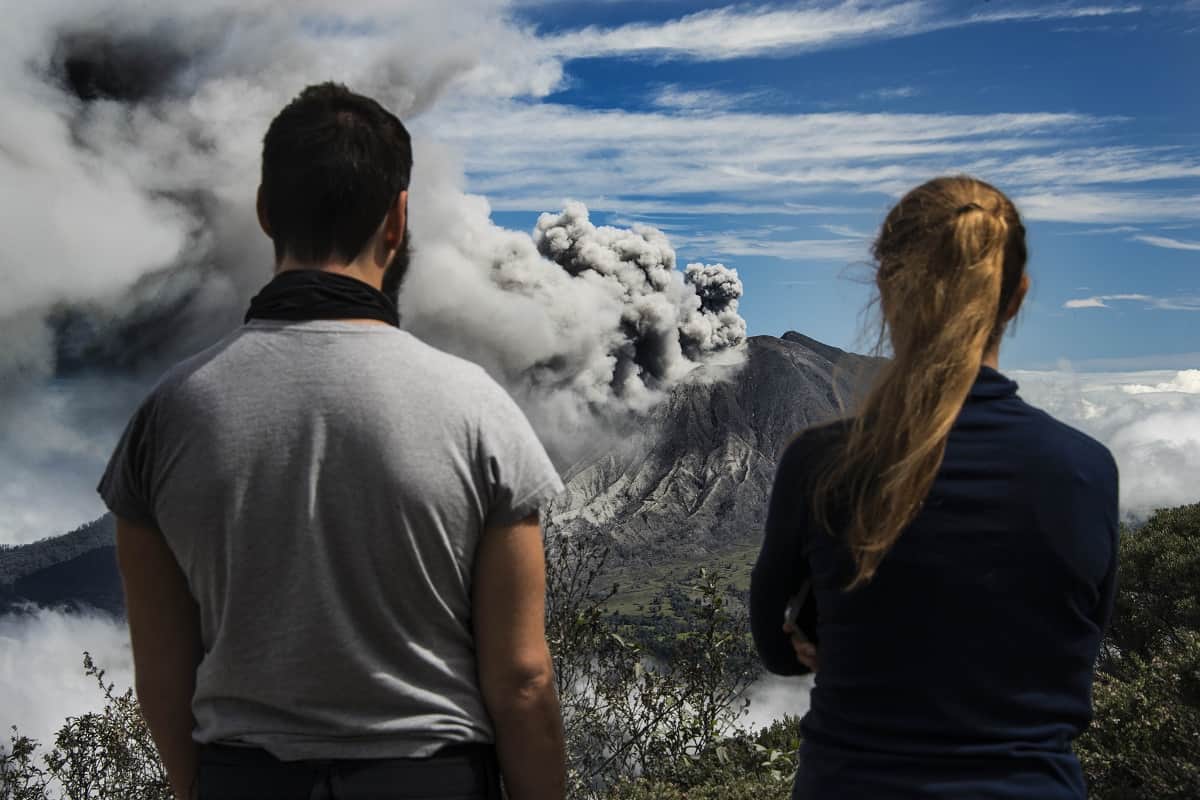
Tourists look at the ash spewed out by Volcan Turrialba in Cartago, 35 km east
 of San Jose, on January 6, 2017. (Ezequiel Becerra / AFP Photo)

If your daily experience of Costa Rica’s Turrialba Volcano, like that of many residents of central Costa Rica, consists of dusting layers of volcanic ash from your windshield, plants or patio – or if, like this writer, you have lost a laptop to persistent ashfall – it can be easy to forget that the source of this daily annoyance is actually awesome, in the true sense of that word.

This video will change all that. Cusuko Fotografía compiled the images from several months of its footage. Shot in part at the Hacienda La Central – Volcán Turrialba, the video provides a closeup view and breathtaking time-lapse footage of the active volcano, east of San José.

“I’ve gone many times to take in this imposing colossus… the weather has not always been optimal, but I always enjoy being there,” photographer Iván Salazar Cusuko’s wrote in the Facebook post where he shared the video. “I’ve experienced sun, water, ashfall or strong volcanic odors. Then I began working with Volcanes Sin Fronteras-VSF, an important NGO, where I have been helping with the collection of samples and some footage.”

This video article was first posted in 2018. Since then we have updated information on Turrialba and what there is to and do there, you can check out this article at 72 Hours in Turrialba


Mapuche woman to lead body drafting Chile’s new constitution

Constitutional assembly picks academic Elisa Loncon to lead body drafting new text to replace Pinochet-era constitution.

Indigenous academic and activist Elisa Loncon was elected as president of the Constituent Convention during the body's first session on July 4 in Santiago [Javier Torres/AFP]

4 Jul 2021

The architects of Chile’s new constitution have chosen an Indigenous Mapuche woman to lead the process, as the country’s constitutional assembly was inaugurated on Sunday in the capital, Santiago.

University professor and activist for Mapuche educational and linguistic rights Elisa Loncon, a 58-year-old independent constituent, was picked by 96 of 155 delegates, including 17 Indigenous people, who make up the constitutional body.

The delegates were elected to draft a new text to replace Chile’s previous Magna Carta, which was produced during the dictatorship of Augusto Pinochet.

“I am grateful for the support of the different coalitions that placed their trust and their dreams in the hands of the Mapuche nation, who voted for a Mapuche person, a woman, to change the history of this country,” Loncon said.

Fed up with the political status quo and urging systemic reforms, Chilean voters in May elected dozens of progressive, independent delegates to redraft the constitution – dealing a surprise blow to conservative candidates who failed to secure a third of the seats to veto any proposals.

“The idea of this 155-member assembly is that it tries to encompass and represent all the diverse elements of Chilean society,” Al Jazeera’s Daniel Schweimler reported from Buenos Aires, Argentina.

Two-thirds of the assembly must approve each article of the new constitution, he explained. The body will have nine months, with a possible three-month extension, to draft a new document that will be then put to a referendum.

“No group is big enough to veto those articles at the moment,” Schweimler said. “What we’re going to see over the next nine months to a year are a lot of negotiations; alliances, coalitions being formed, people trying to decide the best way forward.”

Although amended during the last decades, the previous version of Chile’s constitution was widely unpopular and viewed as a source of social inequality.

The start of the inaugural session on Sunday was delayed for several hours after protesters and a special police unit clashed in the streets of Santiago near where the ceremony was held.

Demonstrators rallied as constitutional assembly members held their first session to draft a new constitution, in Santiago, Chile on July 4 [Pablo Sanhueza/Reuters]

Demonstrations were also held in the nearby Plaza Italia, which emerged as the centre of mass social justice protests that broke out in 2019 and ultimately led the country to establish the constitutional assembly.

“I greatly hope that this process will help us build a country for all,” 47-year-old bank employee Carolina Vergara told the AFP news agency.

Experts told Al Jazeera in advance of the session that the biggest challenge facing the constituents will be to build trust and learn to work together.

“We must understand that we are facing something completely new for which we do not have the practice,” said independent constituent Malucha Pinto. “It is a huge and beautiful challenge that we also face as a country in the future.”

SOURCE: AL JAZEERA AND NEWS AGENCIES

Why Championship Chess Sets Are So Expensive 

Jul 3, 2021

An inexpensive chess set can sell for $20, but a handcrafted wooden set certified for the World Chess Championship costs $500. Much of the set's value lies in just one piece: the knight. Each knight must be carved by hand to look exactly the same. Making this one piece takes two hours, and there are fewer than 10 people trained to carve knights for the championship chess sets. So, how are these chessmen made? And why are they so expensive?


'The First Iranian Vampire Western' Is A Must-See Horror Gem


Ana Lily Amirpour's A Girl Walks Home Alone at Night is one of the most unique and original horror movies in recent memory.
PUBLISHED 1 DAY AGO


In recent years, the term “elevated horror” has been coined by critics who feel insecure about giving a positive review to a scary movie. After horror cinema devolved into “torture porn” throughout the 2000s, movies like The Witch and It Comes at Night have taken the genre back to basics with low-key production value and character-driven storytelling. Auteurs like Jordan Peele, Ari Aster, and Robert Eggers have revitalized cinematic horror with fiercely original stories and sharp social commentary, and as a result, horror fans are currently enjoying a wave of spooky, suspenseful masterpieces including some of the genre’s all-time greatest entries.


While plenty of praise has been rightly directed at Peele, Aster, and Eggers, one filmmaker that deserves to be included under this banner but often slips under the radar is Ana Lily Amirpour. Amirpour’s 2014 directorial debut A Girl Walks Home Alone at Night, described in its marketing as “the first Iranian vampire western,” is one of the most unique and original horror movies in recent memory, and a must-see gem for fans of the genre. It has a subversive take on vampire lore that flips the female victim trope on its head, as well as effective scares, stylish black-and-white visuals, and an awesome soundtrack.


RELATED: The Best Horror Movies Use Social Commentary For Scares

Set in the fictional dystopian crime-ridden ghost-town of Bad City, A Girl Walks Home Alone at Night stars Sheila Vand as “The Girl,” a vampire who spends her nights prowling the streets, looking for despicable men to drain the blood from. Traditionally, vampire fiction paints its female characters as victims, either as the object of a vampire’s desire or their “familiar.” In A Girl Walks Home Alone at Night, The Girl’s vampirism allows her to feel safe, giving her much more agency than horror stories usually allow their female protagonists


Unsurprisingly, A Girl Walks Home Alone at Night has been praised as a highlight of feminist cinema. Amirpour positions The Girl as a sort of antihero. She spends her nights sucking people’s blood and leaving them for dead, but she mostly targets reprehensible, abusive men. While horror movies from Rosemary’s Baby to The Texas Chain Saw Massacre have focused on women being tortured and terrorized by men, A Girl Walks Home Alone at Night offers the exact opposite.

There’s a surprisingly sweet love story that perfectly balances the horror, western, and dystopian elements. After the movie establishes The Girl’s violent hobbies, it introduces her to a romantic interest: Arash, played by Arash Marandi. The idea of a vampire romance might have Twilight alarm bells ringing, but unlike Stephenie Meyer’s lukewarm Y.A. fantasy, Amirpour’s movie avoids tired clichés at every turn and explores the dark implications of romance with the bloodsucking undead. The moment that The Girl falls for Arash is expressed when his neck is exposed and she resists biting it and instead nestles into his chest.


Vand brings an unsettling calmness to The Girl’s demeanor as she builds up to a kill. When her fangs come out and she sinks them into somebody’s neck, they scream in terror. But for her, it’s like tying her shoelaces or brushing her teeth – she’s been doing it so often for so long that it no longer has any impact. After she’s introduced as a bloodthirsty monster, The Girl’s blossoming love for Arash humanizes her.


Amirpour and cinematographer Lyle Vincent chose to shoot the movie in black-and-white. This bleaker palette brought out the bleakness of Bad City, making images like a pile of bodies building up under a bridge even more unnerving than they would be in color. Since the majority of the movie takes place at night, the gorgeous high-contrast monochromatic visuals are used to juxtapose the creepy foreground action against the pitch-black of the night sky.


The movie’s soundtrack is one of its greatest assets. Mixing in a wide variety of musical styles, Amirpour creates the perfect mood for each scene with well-placed musical accompaniment. In addition to the foreboding original score provided by Bei Ru, Amirpour included licensed tracks by such disparate artists as Kiosk, Dariush, and White Lies. The latter’s post-punk hit “Death” beautifully underscores the first intimate moment between The Girl and Arash. Every time The Girl gets her fangs out and targets somebody, there’s a disturbing, almost David Lynchian ambiance on the soundtrack.

Tonally, A Girl Walks Home Alone at Night pays homage to plenty of classic vampire films – namely the groundbreaking 1922 masterpiece Nosferatu – but it’s far more than just a vampire movie. With its lone antihero, lawless setting, and the music of Federale evoking Ennio Morricone on the soundtrack, it’s as much of a spaghetti western as a horror movie. There’s nothing quite like it. While most movies fit neatly into a familiar category, A Girl Walks Home Alone at Night proudly sits in its own category: the vampire spaghetti western vigilante thriller romance. For vampire fans who got disillusioned by the post-Twilight rut the genre found itself in, A Girl Walks Home Alone at Night is essential viewing.


NASA Satellites Find Upper Atmosphere Cooling and Contracting Due to Climate Change


These AIM images span June 6-June 18, 2021, when the Northern Hemisphere noctilucent cloud season was well underway. The colors — from dark blue to light blue and bright white — indicate the clouds’ albedo, which refers to the amount of light that a surface reflects compared to the total sunlight that falls upon it. Things that have a high albedo are bright and reflect a lot of light. Things that don’t reflect much light have a low albedo, and they are dark. Credit: NASA/HU/VT/CU-LASP/AIM/Joy Ng

Since the mesosphere is much thinner than the part of the atmosphere we live in, the impacts of increasing greenhouse gases, such as carbon dioxide, differ from the warming we experience at the surface. One researcher compared where we live, the troposphere, to a thick quilt.

“Down near Earth’s surface, the atmosphere is thick,” said James Russell, a study co-author and atmospheric scientist at Hampton University in Virginia. “Carbon dioxide traps heat just like a quilt traps your body heat and keeps you warm.” In the lower atmosphere, there are plenty of molecules in close proximity, and they easily trap and transfer Earth’s heat between each other, maintaining that quilt-like warmth.

That means little of Earth’s heat makes it to the higher, thinner mesosphere. There, molecules are few and far between. Since carbon dioxide also efficiently emits heat, any heat captured by carbon dioxide sooner escapes to space than it finds another molecule to absorb it. As a result, an increase in greenhouses gases like carbon dioxide means more heat is lost to space — and the upper atmosphere cools. When air cools, it contracts, the same way a balloon shrinks if you put it in the freezer.

This cooling and contracting didn’t come as a surprise. For years, “models have been showing this effect,” said Brentha Thurairajah, a Virginia Tech atmospheric scientist who contributed to the study. “It would have been weirder if our analysis of the data didn’t show this.”

While previous studies have observed this cooling, none have used a data record of this length or shown the upper atmosphere contracting. The researchers say these new results boost their confidence in our ability to model the upper atmosphere’s complicated changes.

The team analyzed how temperature and pressure changed over 29 years, using all three data sets, which covered the summer skies of the North and South Poles. They examined the stretch of sky 30 to 60 miles above the surface. At most altitudes, the mesosphere cooled as carbon dioxide increased. That effect meant the height of any given atmospheric pressure fell as the air cooled. In other words, the mesosphere was contracting.

Earth’s Middle Atmosphere

Though what happens in the mesosphere does not directly impact humans, the region is an important one. The upper boundary of the mesosphere, about 50 miles above Earth, is where the coolest atmospheric temperatures are found. It’s also where the neutral atmosphere begins transitioning to the tenuous, electrically charged gases of the ionosphere.

Even higher up, 150 miles above the surface, atmospheric gases cause satellite drag, the friction that tugs satellites out of orbit. Satellite drag also helps clear space junk. When the mesosphere contracts, the rest of the upper atmosphere above sinks with it. As the atmosphere contracts, satellite drag may wane — interfering less with operating satellites, but also leaving more space junk in low-Earth orbit.
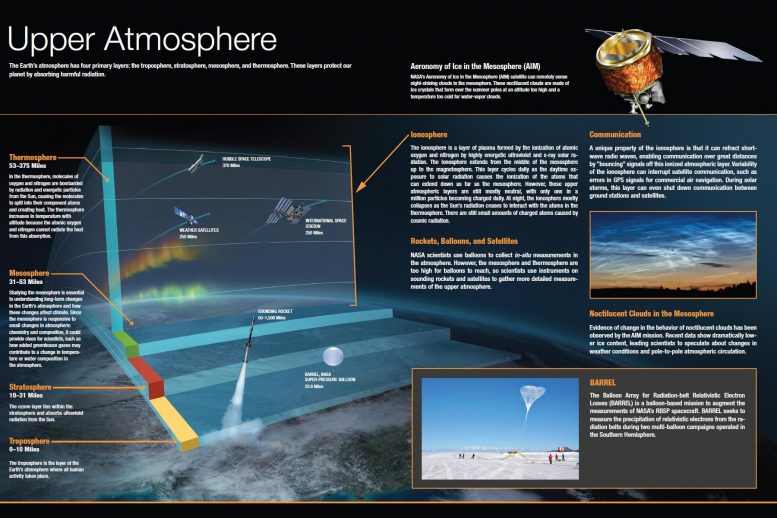
Upper Atmosphere Infographic

This infographic outlines the layers of Earth’s atmosphere. Click to explore in full size. Credit: NASA

The mesosphere is also known for its brilliant blue ice clouds. They’re called noctilucent or polar mesospheric clouds, so named because they live in the mesosphere and tend to huddle around the North and South Poles. The clouds form in summer, when the mesosphere has all three ingredients to produce the clouds: water vapor, very cold temperatures, and dust from meteors that burn up in this part of the atmosphere. Noctilucent clouds were spotted over northern Canada on May 20, kicking off the start of the Northern Hemisphere’s noctilucent cloud season.

Because the clouds are sensitive to temperature and water vapor, they’re a useful signal of change in the mesosphere. “We understand the physics of these clouds,” Bailey said. In recent decades, the clouds have drawn scientists’ attention because they’re behaving oddly. They’re getting brighter, drifting farther from the poles, and appearing earlier than usual. And, there seem to be more of them than in years past.

“The only way you would expect them to change this way is if the temperature is getting colder and water vapor is increasing,” Russell said. Colder temperatures and abundant water vapor are both linked with climate change in the upper atmosphere.

Currently, Russell serves as principal investigator for AIM, short for Aeronomy of Ice in the Mesosphere, the newest satellite of the three that contributed data to the study. Russell has served as a leader on all three NASA missions: AIM, the instrument SABER on TIMED (Thermosphere, Ionosphere, Mesosphere Energetics and Dynamics), and the instrument HALOE on the since-retired UARS (Upper Atmospherics Research Satellite).

TIMED and AIM launched in 2001 and 2007, respectively, and both are still operating. The UARS mission ran from 1991 to 2005. “I always had in my mind that we would be able to put them together in a long-term change study,” Russell said. The study, he said, demonstrates the importance of long-term, space-based observations across the globe.

In the future, the researchers expect more striking displays of noctilucent clouds that stray farther from the poles. Because this analysis focused on the poles at summertime, Bailey said he plans to examine these effects over longer periods of time and — following the clouds — study a wider stretch of the atmosphere.

Indonesia sets coal benchmark price at highest in a decade

Reuters
July 4, 2021

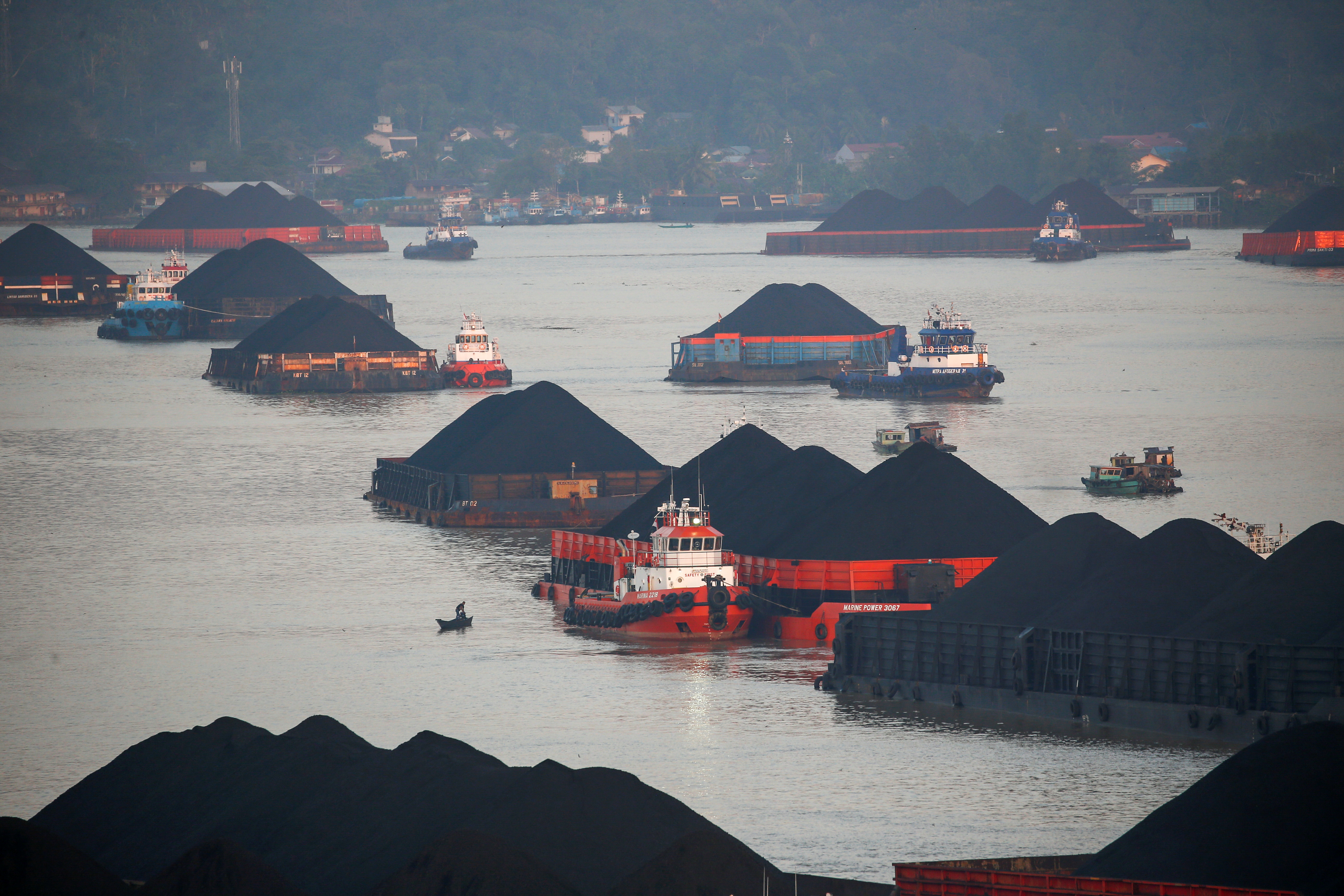
Coal barges are pictured as they queue to be pulled along Mahakam river in Samarinda, East Kalimantan province, Indonesia, August 31, 2019. Picture taken August 31, 2019. REUTERS/Willy Kurniawan


JAKARTA, July 5 (Reuters) - Indonesia set its coal benchmark price higher in July at $115.35 per tonne, an official document published by its energy and minerals ministry showed on Monday.

The price is 14.97% higher than June's benchmark price and the highest since the $117.6 per tonne in May 2011, Refinitiv data showed.


The document did not show what accounted for the price jump. An energy ministry spokesman told Reuters that a statement will be issued later on Monday.

Reporting by Bernadete Christina Munthe and Fathin Ungku; Editing by Martin Petty


Five Asian countries to face tremendous losses if insistent on coal plants: report


Research shows pouring money into coal energy financially, environmentally destructive

  
Cutting coal generation in Asian countries crucial to climate change (Taiwan News image)

Cutting coal generation in Asian countries crucial to climate change (Taiwan News image)

TAIPEI (Taiwan News) — The latest report from Carbon Tracker reveals a future in which the investment in coal power plants is deemed economically and environmentally unviable, and five Asian countries are poised to suffer great economic losses with their plans to hang on to dirty energy.

The COVID-19 pandemic and the cheaper renewables might have contributed to a 4-percent decline in coal power generation in 2020, but energy-related carbon emissions are projected to rebound this year, mainly driven by coal consumption in Asia, according to the report.

Carbon Tracker, a financial think tank specializing in the analysis of the impact of energy transitions, predicted that the universal goal of countering temperature rise through cutting coal generation depends almost entirely on developments in China, India, and ASEAN countries, which account for around 75 percent of global coal capacity and 80 percent of new coal-related projects.

To offer a clear outlook on the risk of investing in coal energy, Carbon Tracker includes operating profits, debt financing obligations, and tax expenses while evaluating over 600 projects that are over 30 gigawatts (GW) across five Asian countries — China, Vietnam, Indonesia, Japan, India. The projects are evaluated under the business-as-usual scenario (BAU) as well as the beyond two degrees scenario (B2DS), in which constraints exist when operating coal assets.

The research found 92 percent of projects would have a net present value (NPV), and new projects are at risk of providing value destruction of around US$150 billion under BAU. As in unregulated markets where market forces will drive the closure of unprofitable plants, 100 percent of coal projects in Japan and Vietnam, 89 percent in Indonesia, and 93 percent in India, risk creating an even higher negative NPV under the B2DS.


Data Source: Carbon Tracker

At the same time, the existing coal plants are losing economic ground as renewables become increasingly affordable, given that the price of solar panels has fallen from US$106 per watt in 1976 to US$0.38 in 2019. Based on current pollution regulations and climate policies, 77 percent of the running coal facilities are more expensive than renewables and will rise to 98% by 2026 and 99% by 2030, when the renewable capacity reaches 2,100 GW.

The think tank suggested that the public recognize that when facing the cost competitiveness of renewable energy, investment in coal is highly risky and financially unsustainable. On the other hand, governments should place more emphasis on their post-pandemic stimulus plans on establishing infrastructure so that renewables can compete fairly with traditional energy.

As for the trend in which countries are shifting from coal to liquified natural gas, the researchers argued it would drive up the electric prices and not help in the meeting of climate targets. Adopting renewables has been proven to be not only the cheapest but also the most commercially and environmentally-friendly choice.

What’s the carbon footprint of a wind turbine?

Compared to the pollution generated by fossil fuels, wind energy has the advantage.

by SARA PEACH
JUNE 30, 2021


Dear Sara,

Wind turbines are an absolute joke. Has anyone actually figured out the amount of carbon emissions emitted for the entire process from initial construction of the components and land development (construction machinery emissions)? — Mike M.

Hi Mike,

Thank you for this apparent attempt at a “gotcha” question, as it gives me the opportunity to reply with a resounding yes! People have studied, in detail, the amount of carbon pollution emitted during the life of a wind turbine.

In fact, this type of analysis constitutes an entire branch of research known as “life cycle assessment,” with its own handbooks, internationally agreed-upon standards, specialized software, and peer-reviewed journals.

To conduct a life cycle assessment of a wind turbine, or any other product, researchers begin by diagramming each stage of its existence, from manufacturing through end-of-life disposal. Next, they inventory the energy and raw materials consumed at each stage, such as the steel, fiberglass, and plastic needed during a wind turbine’s manufacturing, the diesel burned by ships and trucks in transporting turbine parts from factory to construction site, and the energy used during construction, operation, maintenance, and eventual deconstruction and recycling or disposal.

With this information in hand, researchers calculate the carbon pollution produced during a wind turbine’s life cycle — in other words, its carbon footprint.

Search online for the keywords “life cycle assessment” and “wind turbine” and you’ll retrieve dozens of published papers on this topic. Here’s a non-comprehensive chart of such papers from the past five years:

The carbon footprint of wind turbines

Study year Location Configuration Rated power (megawatts) grams of CO2-eq per kWh

2019 Texas, USA onshore 2 4.9
2018 United Kingdom onshore 1.5 11.8
2018 China offshore 3.6 25.5
2018 China onshore 1.5, 0.75 8.7
2016 Europe onshore 2.3 6
2016 Europe onshore 3.2 5
2016 Europe offshore 4 10.9
2016 Europe offshore 6 7.8
2013 global onshore 2 8
2012 – – 2 9.7
2012 – – 1.8 8.8

This chart shows how much carbon dioxide, per kilowatt-hour of electricity generated, can be attributed to a wind turbine during its life from cradle to grave. If you’re wondering about those awkward-sounding “grams of carbon dioxide-equivalent,” or “CO2-eq,” that’s simply a unit that includes both carbon dioxide and other heat-trapping greenhouse gases, such as methane.

You can see that the results vary by country, size of turbine, and onshore versus offshore configuration, but all fall within a range of about five to 26 grams of CO2-equivalent per kilowatt-hour.

To put those numbers in context, consider the two major fossil-fuel sources of electricity in the United States: natural gas and coal. Power plants that burn natural gas are responsible for 437 to 758 grams of CO2-equivalent per kilowatt-hour — far more than even the most carbon-intensive wind turbine listed above. Coal-fired power plants fare even more poorly in comparison to wind, with estimates ranging from 675 to 1,689 grams of CO2 per kilowatt-hour, depending on the exact technology in question.

There’s another crucial difference between fossil fuels and wind turbines. A coal or natural gas plant burns fuel — and releases carbon dioxide — every moment that it runs. By contrast, most of the carbon pollution generated during a wind turbine’s life occurs during manufacturing. Once it’s up and spinning, the turbine generates close to zero pollution.

What’s more, wind turbines often displace older, dirtier sources that supply power to the electricity grid. For example, after a new wind farm connects to the grid, the grid operator may be able to meet electricity demand without firing up a decades-old, highly polluting coal plant. The result? A cleaner, more climate-friendly electricity grid.

In fact, it’s possible to calculate a carbon “payback” time for a wind turbine: the length of time it takes a turbine to produce enough clean electricity to make up for the carbon pollution generated during manufacture. One study put that payback time at seven months — not bad considering the typical 20- to 25-year lifespan of a wind turbine. Bottom line: Wind turbines are far from a joke. For the climate, they’re a deal too good to pass up.

— Sara

Added July 1, 2021: Reader Bill R. writes, “One thing you didn’t mention, and it is probably significant, is that as the energy mix tilts in favor of renewable energy over time, the energy mix used to manufacture wind turbines (and PV cells & panels) will also see a reduction in carbon intensity, resulting in an even smaller carbon footprint. There will be exceptions — making steel will probably continue to require carbon emissions for a long time — but everything else in the manufacturing pipeline should see reductions.”

Got a question about climate change? Send it to sara@yaleclimateconnections.org. Questions may be edited for length and clarity.

Tom Toro is a cartoonist and writer who has published over 200 cartoons in The New Yorker since 2010.TAGGED:Sara Peach


SARA PEACH is the Senior Editor of Yale Climate Connections. She is an environmental journalist whose work has appeared in National Geographic, Scientific American, Environmental Health News, Grist, and... More by Sara Peach
The Fossil Fuel Companies Are Figuring Out Devious New Ways to Greenwash

BY RISHIKA PARDIKAR
JACOBIN
07.01.2021

The fossil fuel industry is trying to rebrand, using terms like “unabated coal” and “responsibly sourced gas” in an attempt to greenwash their commitment to continue burning fossil fuels.
The rise of terms like “unabated coal” and “responsibly sourced gas” suggest companies and politicians are still more interested in adopting a green facade than making the major changes necessary to address the mounting climate crisis.(Gerry Machen / Flickr)


On June 12, the United States and other leaders of the intergovernmental political forum the Group of Seven (G7) committed “to an end to new direct government support for unabated international thermal coal power generation by the end of this year.” The pledge is part of climate change actions aimed at accelerating the global transition away from coal generation.

While the announcement might sound encouraging, the problem lies in how the pledge was phrased — including but not limited to the term “unabated coal.” The term refers to coal-fired power generation that does not employ technologies like carbon capture and storage. That means these nations can still support other types of coal power generation as long as they involve technologies like carbon capture and storage — processes that have been heavily criticized for being stalling tactics that have yet to deliver on their promises.

The G7 announcement is “about as effective as sprinkling a few drops of water on a raging forest fire,” said Jamie Henn, director of Fossil Free Media, a nonprofit media lab working to end fossil fuels. “First, the G7 failed to set a clear deadline for ending coal use; second, by saying they’re only ending ‘direct’ government support, they leave room for all sorts of loopholes that could funnel money towards new coal plants; and third, the term ‘unabated’ means they’re leaving room for plants that say they’ll use carbon capture and sequestration technology, something that has proven thus far to be a colossal failure.”

The idea for “unabated coal” is not a new one. For decades, the fossil fuel industry has tried greenwashing its polluting operations by adopting misleading terms like “clean coal” and “natural gas.”


Along with “unabated coal,” another new example of fossil fuel duplicity is the emergence of the term “responsibly sourced gas.” Many major gas companies are moving to brand their products as having low greenhouse gas emissions as a way to take advantage of climate change–oriented investment trends — even though so far, there is little scientific consensus as to what “responsibly sourced gas” actually means and how much the approach will benefit the environment.

The rise of terms like “unabated coal” and “responsibly sourced gas” suggest companies and politicians are still more interested in adopting a green facade than making the major changes necessary to address the mounting climate crisis. If such phrases become the norm, they risk misleading and distracting the public from the vital work that needs to be done to limit global warming to within 1.5 to 2 degrees Celsius. Beyond this threshold, scientists agree that many natural and human ecosystems may not survive.
A History of Duplicity

Fossil gas is predominantly composed of methane, a greenhouse gas with a much higher warming potential than the carbon dioxide emissions produced by burning coal. But the fossil fuel industry has worked to blunt resistance to fossil gas’s global warming impacts by branding it as “natural gas” or “liquid natural gas.”

The efforts have worked. A December 2020 study found that the term “natural gas” evokes much more positive feelings than “methane” or “methane gas.”

“The fossil fuel industry is constantly trying to rebrand its products as good for the environment even as they’re destroying the planet,” said Henn at Fossil Free Media. “That’s why our Clean Creatives campaign is going after the PR and ad agencies that work for the fossil fuel industry.” The campaign calls on public relations and advertising agencies to stop working with fossil fuel companies.

During the Trump administration, the Department of Energy (DOE) tried its hand at fossil fuel duplicity by referring to fossil fuels as “molecules of freedom” and fossil gas as “freedom gas.” Canadian oil companies, meanwhile, attempted to rebrand their product as “ethical oil.”

“We need to stop the industry’s ability to pollute our public discourse if we’re going to stop them from polluting the atmosphere,” noted Henn.

Nonthreatening terms like “natural gas” have allowed the Biden administration to enthusiastically support the gas industry with minimal public pushback, despite that fact that Joe Biden made campaign promises to pursue “aggressive methane pollution limits for new and existing oil and gas operations” and signed an executive order on his first day in office calling for consideration of new methane regulations in the oil and gas sector.

In March, Biden told union leaders he’s “all for natural gas,” adding he supports both the gas industry and carbon capture and storage technologies.

And in June, Andrew Light, Biden’s nominee to lead international energy issues as the DOE’s assistant secretary for international affairs, told lawmakers at his confirmation hearing:


My job in this role is to make sure US gas is competitive around the world . . . More and more countries are looking for cleaner sources of gas. Russia has the dirtiest source of gas right now. We’ve got to make sure ours is cleaner and that ours fill those markets around the world. That’s what I intend to do.

According to Light’s testimony, US liquid natural gas exports reached a record 10.2 billion cubic meters in March, and the industry expects a 50 percent increase in total exports this year compared to 2020.

The Biden administration’s support of fossil gas goes squarely against what the Paris Agreement demands from wealthy nations, which have historically been the biggest emitters of greenhouse gases. The United States, for example, has emitted a quarter of global carbon dioxide emissions since the mid-eighteenth century. Countries like the United States, therefore, are expected to bear more responsibility for combating climate change, both by reducing its own emissions and helping less-developed countries transition to low-carbon economies.

“There’s no room for gas in a safe climate future,” said Henn. “The science is clear: Gas production results in massive methane emissions and slows the transition to clean energy. There’s simply no way to meet the goals of the Paris Agreement if we keep building new gas infrastructure.”
Fossil Fuel Science Fiction

The Biden administration’s pledge at the G7 meeting to end “new direct government support” for “unabated coal” suggests the White House is using misleading terminology and embracing unproven technologies as a way to still fund coal projects.

In April, for example, the DOE announced up to $35 million for programs focused on developing technologies to reduce methane emissions in the oil, gas, and coal industries. What’s more, Biden’s proposed infrastructure legislation bill has earmarked billions for the fossil fuel industry in terms of subsidies and support for carbon capture and storage.

Such incentives, while positioned as environmentally friendly, are likely to encourage additional fossil fuel production.

A report by forty-one scientists last December called the reliance on such technologies “overly optimistic” because “they are expensive, energy intensive, risky, and their deployment at scale is unproven.”

The upshot, say experts, is that by throwing around terms like “unabated coal” and putting their faith in questionable technology, developed nations will likely end up underwriting projects that shouldn’t be funded at all.

“This means the G7 will continue financing abated coal, which the world cannot afford,” said Lidy Nacpil, coordinator of the Asian Peoples’ Movement on Debt and Development (APMDD). “Policies with exceptions like these only further delay [the implementation] of solutions which we need. We are losing time.”
The “Responsibly Sourced Gas” Mystery

Early this year, a new term emerged in the public discourse around fossil fuels: “responsibly sourced gas” (RSG).

In January, EQT Corporation, the largest natural gas producer in the United States, announced it was launching a pilot program with Project Canary, a Denver, Colorado–based climate-tech company, with the goal of certifying several of its wells as producing “responsibly sourced natural gas.”

In April, Chesapeake Energy — an oil and gas company and a fracking pioneer that emerged from bankruptcy earlier this year with about $3 billion in new financing, a $7 billion reduction in debt, and $1.7 billion cut from its gas processing and pipeline costs — announced that it, too, was partnering with Project Canary to produce responsibly sourced gas.

These efforts are a direct response to the environmental, social, and governance (ESG) investment movement, an increasingly influential form of investing that takes into account a company’s overall impact, rather than just financial factors.


Indeed, the power of socially conscious investment strategies is on the upswing, and fossil fuel companies in particular are feeling the heat. As one oil and gas executive admitted in a recently released Dallas Fed Energy Survey, “We have relationships with approximately 400 institutional investors and close relationships with 100. Approximately one is willing to give new capital to oil and gas investment. The story is the same for public companies and international exploration.”

Facing the threat of institutional investors citing ESG concerns to pull capital out of fossil fuel projects, oil and gas companies are trying to flip the script: they are aiming to use the concept of RSG to position their projects as ESG investment opportunities, especially since the two acronyms bear a striking similarity.

Never mind that gas drilling seems to go against the very idea of ESG investing. As EQT CEO Toby Rice noted in a press release about the company’s pilot project, “This partnership aligns with our commitment to ESG leadership and to meeting the evolving needs and expectations of our stakeholders.”

Experts say, however, that so far there is very little information on the specifics of responsibly sourced gas, or the criteria being used to certify these gas operations as ESG-appropriate or less harmful for the environment. Moreover, RSG certification appears to gloss over the fact that far less pollution comes from the extraction of gas than is generated by its inevitable combustion — and no matter how fossil gas is sourced, it still releases the same amount of harmful emissions when it is burned.

“None of the certifying organizations I’ve looked into have clear instructions on what responsibly sourced gas means. It’s a very open question as of now,” said Sharon Kelly, an attorney and freelance writer based in Philadelphia.

“It’s the Wild West, and there are no industry-wide standards,” Kelly added. She explained that there are a lot of different standards for certification of responsibly sourced gas that are competing for credibility among investors like banks and oil and gas analysts. Many of these standards rely on metrics like methane emissions, wastewater handling, and air pollution. But the standards often face scrutiny and skepticism by environmental groups, said Kelly, because most were developed with the help of fossil fuel interests, which have a history of prioritizing their bottom line above all other concerns.

Greenwashing efforts like embracing “responsibly sourced gas” and misleading the public with terms like “unabated coal” could prove to be the fossil fuel industry trying to squeeze the last bits of profit from infrastructure investments in the face of climate change–driven public demands and a rising renewable energy sector. And while the Biden administration appears to be aiding the efforts, experts aren’t fooled. No matter what people choose to call them, they say, gas, oil, and coal projects have no place in the climate change era.

“Any ESG fund or serious government plan needs to exclude gas in all of its forms,” said Henn. “Renewable energy is cheap, reliable, and widely available. We need to stop financing and building oil, gas, and coal projects across the board.”

You can subscribe to David Sirota’s investigative journalism project, the Daily Poster, here.

ABOUT THE AUTHOR
Rishika Pardikar is a climate change and wildlife reporter based in India.