Tuesday, July 06, 2021

Israel's colonial violence and international humanitarian aid

July 6, 2021 

A Palestinian man carries on his shoulder sacks of flour received from a United Nations Relief and Works Agency (UNRWA) distribution centre in Jabalia refugee camp in the northern of Gaza Strip , on January 29, 2020 [MAHMUD HAMS/AFP via Getty Images]


Ramona Wadi
walzerscent
July 6, 2021 


Whenever Israel bombs Gaza, donor countries are expected to raid their treasuries and manage the resultant humanitarian crisis. The aftermath of the latest colonial aggression against the enclave is no different. On one hand, the reconstruction of Gaza will probably follow previous mechanisms in which the UN plays a role that is decided by Israel. For the Palestinian people's immediate needs, now more precarious than ever, the Israeli government is seeking countries willing to stand alongside Qatar to help desperate Palestinian families.


Death toll in Israeli attacks on Gaza Strip keeps rising…- Cartoon [Sabaaneh/MiddleEastMonitor]

Two European countries have so far been approached, Germany and another one are as yet unnamed. Israel has attempted to exploit reconstruction to demand the release of two Israeli civilians and the bodies of two Israeli soldiers held by Hamas. Palestinian factions reject this and communicated their decision to the UN in June.

So far the only dilemma raised by the international community is the question of rebuilding Gaza without Hamas involvement, ostensibly to ensure that funds and material are accessed only by the Palestinian people. To implement such a strategy, the Palestinian Authority – a body whose corruption is known to the international donors which continue to fund it — would play a role alongside Israel. The PA has contributed to Gaza's humanitarian predicament through sanctions of its own imposed with the intention to destabilise Hamas and reduce its political support and influence. It is in no position to guarantee that aid will reach the people most in need without PA officials from the top downwards pocketing their "share" first. It is foolish to believe otherwise.

READ: Children in Gaza call on the world to save them

Since the international community has equated Palestinians with humanitarian aid, there is little questioning of Israel's expectation that individual countries will provide humanitarian assistance after its bombs have finished destroying Palestinian lives and infrastructure. Equally disturbing is that the international community does not challenge the status quo of tidying up the mess after Israel's carnage. It's more of the same: the US pays for the bombs; others pay for the clean-up.

Billions of US dollars in military aid have disfigured Gaza beyond any hope of proper reconstruction, given Israel's frequent bombing of the enclave. The international community, blinded as it is by Israel's twisted security narrative, has no qualms about the territory being used as the testing ground for the settler-colonial state's new weapons because Palestinians are part of a dissociated humanitarian narrative that is profitable for both the coloniser and the donors.

Humanitarian aid is supposed to be a temporary endeavour, not part of Israel's colonisation plans. When the humanitarian crisis is exacerbated, Israel seeks to keep Palestinians quiet through its European allies. These are the same allies that purportedly champion the establishment of "an independent and viable Palestinian state."

READ: Israel launches airstrikes on Gaza

Meanwhile, through donations to keep Palestinians quiet, humanitarian aid provides more benefits for Israel than incentives for the people. The politics of humanitarian aid focus on preventing the emergence of a Palestinian state. In Gaza, humanitarian aid after the destruction of the infrastructure keeps Palestinians focused on the imminent matter of survival, thus pushing political action by the people further out of the equation.

Without addressing Israel's culpability and accountability, it seems that it will have no problems in recruiting countries to repair the damage that its bombs and politics inflict upon Palestinians in Gaza. Calls to hold Israel accountable, and for sanctions to be enforced against the settler-colonial state, pass unheeded. When countries step up with their financial assistance for Palestinians in Gaza, let it be known that the humanitarian façade cannot compensate for the political damage inflicted through collaboration with the murderous, rogue state of Israel.

The views expressed in this article belong to the author and do not necessarily reflect the editorial policy of Middle East Monitor.
In Germany, burning the Israeli flag is a problem, but killing Palestinians isn't

July 6, 2021 

German ambassador in France Susanne Wasum-Rainer in Paris, on April 25, 2014 [PIERRE ANDRIEU/AFP via Getty Images]


Motasem A Dalloul
abujomaaGaza
July 6, 2021 

Israeli Deputy Foreign Minister Idan Roll met with the German Ambassador, Susanne Wasum-Rainer, on Monday along with visiting German parliamentarians. Roll thanked the German guests for their country's strong support for Israel during its major military offensive against the Palestinians in Gaza from 10-21 May.

Germany's unlimited support and cooperation make it a special friend of Israel. Among EU members it is the second-biggest supplier of weapons to the occupation state. Between 2009 and 2020, 24 per cent of Israel's arms imports came from Germany.

When Israel treats international law, human rights, democratic principles, and liberal beliefs with contempt, Germany automatically takes its side, even when the result is the killing of innocent children and women. During the latest Israeli offensive, Germany supported Israel's "right to defend itself" although it was killing civilians and destroying civilian buildings and infrastructure. The fact that an occupying state has no right to claim "self-defence" against the people under occupation was ignored by the Germans.

On 12 May, a German government spokesman, Steffen Seibert, refused to condemn Israel's killing of 14 Palestinian children. He referred to the legitimate Palestinian resistance as "terrorist attacks" and that the resistance groups had to stop their action against Israel so that "people do not die".

READ:
Palestine slams German president's claim ICC lacks jurisdiction to investigate Israel

Seibert ignored the Israeli warplanes pounding the besieged Gaza Strip. He ignored the Israeli tanks firing indiscriminately towards densely-populated areas across Gaza. He ignored weeks of Israeli harassment and attacks on Palestinians worshipping in Al-Aqsa Mosque throughout Ramadan, and the residents of Jerusalem facing attacks by illegal settlers, which prompted the resistance groups to act. He ignored all of that.

On the same day, the deputy spokesman of the German Foreign Ministry, Christofer Burger, angered journalists when he said that the Palestinians had no right to self-defence. His claim that this right is only guaranteed by international law to sovereign states and Palestinians are not a state was palpable nonsense. All people living under occupation, collectively and individually, have the right to defend themselves and resist military occupation. Israel's occupation of Palestine is a military occupation.

On day ten of the Israeli offensive, when the occupation state had killed 66 children, 40 women, and 16 elderly people out of 266 Palestinians killed in total, German Foreign Minister Heiko Maas insisted that, "Germany stands with Israel and its right to defend itself." He even visited Israel to prove that his country's support was not limited to words. "I came to Israel to show solidarity and support Israel. Israel's security and that of the Jewish residents here are not negotiable."


German Foreign Minister Heiko Maas in Berlin, Germany on June 23, 2021 [Abdulhamid Hoşbaş/Anadolu Agency]

Two days earlier, German Chancellor Angela Merkel called the then Israeli Prime Minister Benjamin Netanyahu, and "sharply condemned the continued rocket attacks from Gaza on Israel and assured the prime minister of the German government's solidarity." She showed great interest in Israel's security and safety of its people and condemned only the legitimate Palestinian resistance.

Germany's verbal support for Israeli brutality and aggression against the Palestinians was backed up by officials who claimed that peaceful protests during which Palestinian flags were flown and anti-Israel slogans were chanted were "anti-Semitic". Calls for Israel to be held accountable for its breaches of international law were described as "hate speech".

According to Seibert, "Anyone who uses such protests to shout out their hatred of Jews is abusing the right to protest [in Germany]." He described the pro-Palestine protests which raised awareness about the ongoing Israeli crimes as "anti-Semitic rallies", and stressed that they "will not be tolerated by our democracy."

During a debate in the German parliament during the Israeli offensive on Gaza, Maas condemned the pro-Palestine demonstrations and called for a violent crackdown on them. "There shouldn't be one centimetre of space for anti-Semitism on our streets. Never again."

Germany has since banned the Hamas flag in the country in response to pro-Palestine demonstrations. "We do not want the flags of terrorist organisations to be waved on German soil," Thorsten Frei, a lawmaker for Merkel's CDU, told Die Welt. A ban, he added, would send "a clear signal to our Jewish citizens."

President Frank-Walter Steinmeier told Israeli daily Haaretz that Germany believes that the International Criminal Court (ICC) has no jurisdiction to investigate Israeli war crimes in the occupied Palestinian territories because of the "absence of the Palestinian state". Germany is not only unconcerned about Israeli crimes against the Palestinians, but also does not even want those crimes to be investigated. Palestine was, of course, granted the status of a "non-member observer state" by the UN in November 2012, a move described as "de facto recognition of the sovereign state of Palestine".

Writing in Open Democracy, activist and sociologist Inna Michaeli said that Germans are against the entirely peaceful Boycott, Divestment and Sanctions (BDS) movement which seeks to end the Israeli occupation. Moreover, apparently, they do not like to hear anyone accusing Israel of killing children, despite this being "a description of horrendous reality — one in three Palestinians that Israel kills in Gaza are children."


The targeting and arrest of Palestinian children has been a constant Israeli policy – Cartoon [Sabaaneh/MiddleEastMonitor]

She asked rhetorically: "What should people chant when Israel is killing children? How can the victims express their rage and sorrow, how can they mourn their children who are killed again and again by Israel?"

Even the German mainstream media ignores Israeli brutality against the Palestinians. "Much of the mainstream media coverage of Nakba Day demonstrations did not even mention nor explain to the readers what the Nakba is, and its continuation in the form of ethnic cleansing and denial of Palestinians' right to return," Michaeli pointed out. "Berlin, with the largest Palestinian population in Europe, is home to people whose family members have been murdered by Israel in recent days. These protests are often framed as 'anti' Israel, but the fact that they are primarily 'for' Palestinian life is omitted."

Omri Boehm is an Israeli philosophy lecturer in New York. "Whenever one attempts to raise this subject, one is immediately accused of anti-Semitism," he noted. "It is impossible to simply state the facts. For example, that within Israel's borders, three million Palestinians live under brutal military law without being recognised as Israeli citizens. The Germans do not want to see this."

OPINION: Israel's siege and violence are damaging Palestinian children's minds

When pro-Palestine protesters burned an Israeli flag in Germany, Interior Minister Horst Seehofer described the act as "anti-Semitic" and said that Germany would crack down hard on anyone found to be spreading "anti-Semitic hatred" because "We will not tolerate Israeli flags burning on German soil."

Commenting on this, Michaeli said: "Israeli flags matter, Palestinian lives do not. When people, politicians, and the media, care more about the burning of national flags than the burning of homes and neighbourhoods and the killing of entire families, they should really have a hard look at themselves."

German support for Israel goes back to the early 1950s when reparations were paid to the state as the "heir" to the Holocaust victims who had no known surviving family. Billions of German marks and euros have been handed over in the intervening decades, helping to build Israel as a state. The fact that this is largely to the detriment of the people of occupied Palestine has, shamefully, been lost on successive German governments. Those parliamentarians who met Israeli officials earlier this week need to be educated about international laws and conventions, and the reality of Israel's brutal military occupation which they and their colleagues in Berlin endorse so willingly.

The views expressed in this article belong to the author and do not necessarily reflect the editorial policy of Middle East Monitor.

 MORE DISASTER POSTS

A Gas Leak Caused A Fire In The Gulf Of Mexico And The Videos Are Unreal

"Oh cool they've opened the portal to Hell."

Posted on July 2, 2021, at 7:28 p.m. ET

A fire broke out in the southern waters of the Gulf of Mexico Friday after an underwater pipeline leaked, sending the internet ablaze with horror as videos of flames spewing out of the ocean went viral

Mexican-state-owned petroleum company Petróleos Mexicanos, also known as Pemex, said a gas leak was discovered in the 12-inch submarine pipeline near a platform in the Ku-Maloob-Zaap oil field. Firefighting crews were able to snuff out the swirling, fiery mass of water by about 10:45 a.m., the company said. No injuries were reported.

Ángel Carrizales, executive director of Mexico's oil safety regulatory agency ASEA, tweeted that the leak "did not generate any spill," but did not say what exactly was on fire.

The cause of the incident is still under investigation, but as usual, Twitter users had their own ideas about what exactly was going on.

Footage of the fire looked so unreal that some wondered if, or hoped that, it was fake.

Others couldn't help but poke fun at the cruel irony of fighting a fire in the water with...water.

Portal to hell or not, maybe someone is trying to tell us something.


Southern pastors are scared to promote vaccines as white Evangelicals reject science: report
Bob Brigham
July 03, 2021

The conspiracy originally took root in the United States but has spread to Europe Joseph Prezioso AFP

As formerly Confederate states struggle with low vaccination rates as the Delta variant of coronavirus spreads across America, pastors stuck between the science of what is best for their flocks and superstitions that their congregants believe.

"Biden administration and state officials hoped that pastors would play an outsized role in promoting Covid-19 vaccines, but many are wary of alienating their congregants and are declining requests to be more outspoken. Politico spoke with nearly a dozen pastors, many of whom observed that vaccination is too divisive to broach, especially following a year of contentious conversations over race, pandemic limits on in-person worship and mask requirements. Public health officials have hoped that more religious leaders can nudge their congregants to get Covid shots, particularly white evangelicals who are among the most resistant to vaccination," the publication reported Saturday.

"State health officials are conducting informal focus groups and outreach to try to ease pastors' concerns about discussing vaccination, but progress is often elusive, they said. Many pastors said they have already lost congregants to fights over coronavirus restrictions and fear risking further desertions by promoting vaccinations. Others said their congregations are so ideologically opposed to the vaccine that discussing it would not be worth the trouble," Politico explained. "The pastors Politico spoke with are located across Virginia and Tennessee, mostly in predominantly white communities. Some in rural areas lead overwhelmingly conservative congregations while some in more suburban areas said their churches were more politically mixed. Each pastor had been vaccinated but not all were eager to discuss it with their congregations."
Chris Matthews talks to Raw Story: Who would you bet on in 2024, Trump or Kamala?

Polls have shown white Evangelical Christians are among the groups most opposed to vaccination.


NIH Director Francis Collins worried about the public health implications as some Americans reject vaccines.

"It's heartbreaking that it's come to this over something that is potentially lifesaving and yet has been so completely colored over by political views and conspiracies that it's impossible to have a simple loving conversation with your flock," Collins told Politico. "That is a sad diagnosis of the illness that afflicts our country, and I'm not talking about Covid-19. I'm talking about polarization, tribalism even within what should be the loving community of a Christian church."

France denies covering-up nuclear tests near French Polynesia in Pacific
Agence France-Presse
July 03, 2021

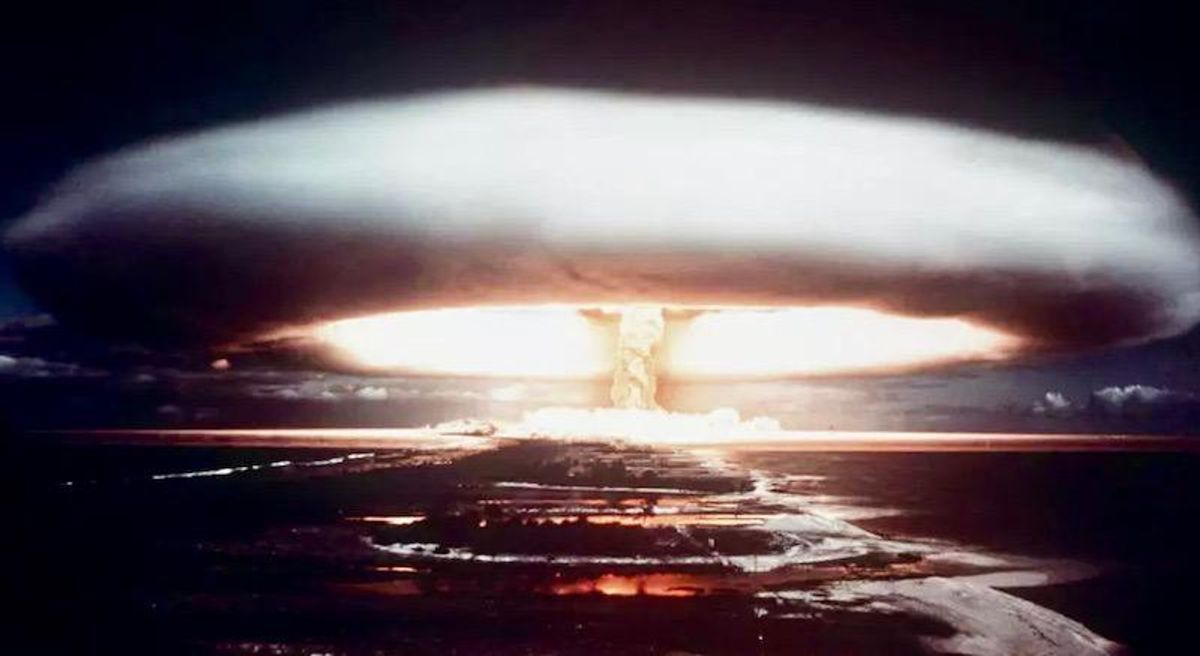
A picture taken in 1971 showing a nuclear explosion in Mururoa atoll, French Polynesia. © AFP (file photo)

The French government on Friday denied any cover-up over radiation levels in the Pacific following its nuclear testing in the region, as state-backed discussions took place in Paris about the legacy of the explosions.

A two-day meeting called by French President Emmanuel Macron began on Thursday following fresh allegations that the testing from 1966 to 1996 caused hidden atmospheric and ground radiation.

"There was no state cover-up," Genevieve Darrieusseq, junior defense minister, told AFP in a brief comment on the sidelines of the event, where she has ruled out any official apology from France

In March, the investigative website Disclose created waves when it said it had analyzed some 2,000 pages of declassified French military documents about the nearly 200 tests carried out around French Polynesia.

Working with statistical experts and academics from Princeton University in the US, it concluded that "French authorities have concealed the true impact of nuclear testing on the health of Polynesians for more than 50 years."

The roundtable discussions have been attended by three French ministers, as well as Macron himself, who made no public comment after taking part on Thursday.

Edouard Fritch, the president of French Polynesia, a semi-autonomous French territory, said Macron had promised to open up the military archives about the tests, a key demand from historians, and would visit Tahiti on July 25.

Only records that could lead to nuclear proliferation are to remain secret.

"We felt that the president had a real desire to turn this painful page for all of us, with the resources that will need to be put in place in the future, so that Polynesians can rebuild the faith that we have always had in France," Fritch said Friday.

The event has met with criticism from some Polynesian politicians as well as anti-nuclear campaigners and historians, who say they have been blocked from properly investigating by state secrecy laws.

Moetai Brotherson, a supporter of independence who sits in the national parliament representing the archipelago, refused to attend unless France apologized for the tests.

His party, the Tavini Huiraatira, said it would organize a rival event in Tahiti on Friday.

Compensation


Over the last year, Macron has shown a willingness to tackle historically taboo issues for France, including its bloody colonial history in Algeria and its role in Rwanda in the lead up to the 1994 genocide.

The nuclear tests remain a source of deep resentment and anger in French Polynesia, where they are seen as evidence of colonial or even racist attitudes that disregarded the lives of islanders.

The US and Britain also carried out dozens of nuclear tests in the Pacific during the Cold War arms race.
Report Advertisement

Up until now only 63 French Polynesian civilians, excluding soldiers and contractors, have received compensation for exposure to radiation from the nuclear tests, according to Disclose.

The website said it had reassessed the pollution on the Gambier Islands, Tureia and Tahiti following the six nuclear tests considered to be the most contaminating in the history of French tests in the Pacific.

It claimed that its conclusions were starkly different to those of the French Alternative Energies and Atomic Energy Commission (CEA), whose figures served as the reference for compensation for victims of the tests.

In one instance, Disclose said radioactive soil deposits on an atoll had been underestimated by more than 40 percent, while more than 100,000 people might have been contaminated in total.

Protests


France conducted 193 nuclear tests over three decades in French Polynesia until former president Jacques Chirac ended the program in the 1990s amid an international protest campaign.

In 2016, former president Francois Hollande acknowledged during a trip to the region that the tests had "an impact" on health and the environment and promised to revamp the compensation process.

From 1960 to 1966, France also carried out 17 nuclear tests at desert sites in Algeria, where campaigners continue to press for compensation and clean-ups.

(AFP)


  1. - The Birth of Godzilla - Orange Nebula - Articles

    https://www.orangenebula.com/the-outpost/the-birth-of-godzilla

    2021-03-08 · While this use of nuclear energy is a distant cry of its more destructive uses, the story of Godzilla starts germinating a few months earlier in March of 1954. On March 1, 1954, 


  • Sinking of the Rainbow Warrior - Wikipedia

    https://en.wikipedia.org/wiki/Sinking_of_the_Rainbow_Warrior

    France began testing nuclear weapons in 1966 on Mururoa Atoll in the Tuamotu Archipelago of French Polynesia. In 1985 eight South Pacific countries, including New Zealand and Australia, signed a treaty declaring the region a nuclear-free zone.
    Since being acquired by Greenpeace in 1977, Rainbow Warrior was active in supporting a number of anti-whaling, anti-seal hunting, anti-nuclear testing and anti-nuclear waste dumping campaigns during the lat…

    Wikipedia · Text under CC-BY-SA license
  • Greenpeace Protests French Nuclear Tests in the Mururoa ...

    https://www.encyclopedia.com/politics/legal-and-political-magazines/...
    • By:Philippe Wojazer Date:September 1, 1995 Source:Wojazer, Philippe. "Greenpeace Protests French Nuclear Tests in the Mururoa Atoll." AP Images. About the Photographer: Philippe Wojazer is a contributor to the Associated Press, a worldwide news agency based in New York.

  • Brazil's Bolsonaro faces more corruption allegations


    Issued on: 06/07/2021 - 
    FI
    LE PHOTO: Brazil's President Jair Bolsonaro gets in a vehicle after attending Mass at a Catholic church in Brasilia, Brazil July 1, 2021. © Adriano Machado, Reuters

    Text by:NEWS WIRES


    Brazilian President Jair Bolsonaro was involved in a scheme to skim salaries of his aides while a federal deputy, website UOL reported on Monday, citing what it said were audios of his former sister-in-law explaining his role in the alleged racket.

    The scheme, known locally as rachadinha, involves hiring close associates as employees and then receiving a cut of their public salaries back from them.

    Rio de Janeiro state prosecutors have formally pressed charges against federal Senator Flavio Bolsonaro, the president's eldest son, over his alleged participation in a similar racket when he was a state lawmaker.

    The UOL story, based on audio recordings of Bolsonaro's former sister-in-law, Andrea Siqueira Valle, provided by a source, is the first time the president has been directly implicated in a rachadinha scheme, despite numerous awkward questions about his role in Flavio Bolsonaro's alleged racket in Rio.

    This comes as Bolsonaro is seeing his anti-graft credentials, which helped get him elected president in 2018, questioned by a simmering scandal over alleged corruption in the government's vaccine procurement efforts.


    Senator Renan Calheiros, sponsor of a Senate inquiry into the government's handling of the pandemic, said on Monday that Siqueira Valle could be called before the committee for questioning.

    While the rachadinha is not directly connected to the Senate inquiry, it adds to recent allegations about irregularities in the government's purchase of vaccines and calls into question Bolsonaro's anti-corruption platform.

    The president's office declined to comment. A lawyer representing Bolsonaro contacted by UOL denied illegalities.

    In one audio recording, Andrea Siqueira Valle explains that her brother, Andre Siqueira, who was also on Bolsonaro's payroll, was fired for refusing to hand back the agreed amount to the now-president.

    "André had a lot of trouble because he never returned the right money that had to be returned," she says on the recording.

    "Eventually, Jair said ... 'Enough. You can get rid of him because he never gives me the right amount of money.'"

    Reuters was unable to confirm the legitimacy of the recordings or the information in the story. Andrea Siqueira Valle declined to comment to UOL.


    Daily newsletterReceive essential international news every morningSubscribe

    UOL also reported that on two separate occasions, Siqueira Valle told people close to her about the racket allegedly being run from Bolsonaro's office.

    The accusations against Bolsonaro for allegedly misusing public funds as a federal lawmaker could open him up to a federal probe.

    However, Brazilian law does not allow a sitting president to be charged for any crime committed before taking power.

    Instead, prosecutors would need to wait until the president has left office to bring charges.

    (REUTERS)
    Iconic South African Mines Are Ravaged Economy’s Unlikely Savior

    Prinesha Naidoo and Felix Njini
    Mon., July 5, 2021, 


    1/4

    Iconic South African Mines Are Ravaged Economy’s Unlikely Savior


    2/4

    Iconic South African Mines Are Ravaged Economy’s Unlikely Savior


    3/4

    Iconic South African Mines Are Ravaged Economy’s Unlikely Savior


    (Bloomberg) -- The world’s deepest precious-metals mines, together with giant iron-ore and coal pits are providing an unexpected boon to a South African economy slowly recovering from its biggest contraction in a century.

    Surging demand and prices for commodities including platinum-group metals, iron ore, manganese and coal are generating record mining-company profits and bolstering government revenue. That’s even as decades of dwindling output and investor reluctance to build new mines blights prospects for the industry.

    “Last year, we were concerned about the lack of space to support the economy amid the severe hit from the pandemic,” Elna Moolman, a South Africa economist at Standard Bank Group Ltd., said in an interview. “The recovery in commodities demand and their prices is providing very strong support to the economy.”

    President Cyril Ramaphosa on Monday flagged the “significant role” the sector will play in accelerating South Africa’s recovery from last year’s coronavirus-induced slump.

    The mining industry often takes center stage when South Africa’s economic fortunes dip.

    Its gold industry -- once the world’s largest -- underpinned the nation’s transformation into the continent’s most industrialized economy. Bullion sales cushioned the economy against the impact of the oil-price and dollar collapse in the 1970s and as international outrage against apartheid rule a decade later resulted in massive capital outflows. The commodities boom in the 2000s provided the Treasury with a war chest to withstand the devastating effects of the global financial crisis.

    The mining industry’s output surged 18.1% in the first quarter compared to the previous three months, helping buoy growth more than forecast. The sector accounted for 9% of gross domestic product during the period.

    Last year, the mining industry, which employs more than 451,000 people, accounted for 8.2% of GDP, according to the Minerals Council South Africa, an industry lobby group.

    Revenue for the fiscal year through March exceeded budget estimates for the first time in five years as the industry drove an increase in corporate income tax collections, and led to the shortfall on the main budget coming in below forecast.

    That’s allowed the Treasury to reduce the amount of debt on sale at its weekly auctions for a second time since March and bodes well for its plans to achieve a primary surplus in fiscal 2024-25 and stabilize debt at 88.9% of GDP the following year.

    The world’s top platinum suppliers’ exports of platinum-group metals surged 40% in 2020, even as Covid-19 disrupted operations and curbed output, the national statistics agency said in April. Sales of PGMs, which are in demand as stricter emission rules boost their use in vehicle autocatalysts, raked in 190 billion rand ($13.3 billion) amid a rally in palladium and rhodium prices.

    South Africa’s terms of trade -- a measure of export prices relative to import costs -- increased 12% over the past year and more than 20% since the end of 2018, as the global economic recovery from the pandemic pushed up demand for commodities, according to HSBC Bank Plc economist David Faulkner.

    The trade windfall is “one of the strongest gains on record, with past experience highlighting how South Africa’s macro fortunes can tilt on favorable commodity prices and a benign external backdrop,” Faulkner said in a note. “The result has been a period of respite, relief and rally.”

    Still, a failure by Ramaphosa’s government to take advantage of the commodity rally to expedite a raft of reforms and attract investment to boost growth and create new jobs could counter the recent fiscal gains. The South African Reserve Bank forecasts that the commodities price rally may be temporary.

    “These are economic challenges that will require sustained policy action to reverse,” Faulkner said. “They also leave South Africa with balance sheet vulnerabilities at risk of being exposed should the recent rise in metal prices prove transitory or risk appetite sour.”

    What Bloomberg Economics Says...

    “Rising commodity prices provide a welcome respite for the budget. They are, however, not a panacea. The government will still have to follow through with its consolidation plans to stabilize the debt trajectory.”

    -- Boingotlo Gasealahwe, Africa Economist

    More stories like this are available on bloomberg.com


    BOJ Seen Paying Banks to Lend in Battle Against Climate Change


    (Bloomberg) -- Bank of Japan Governor Haruhiko Kuroda and his board are likely to offer incentives for lending in the battle against climate change when they meet later this month, according to economists.

    The central bank has promised to unveil the initial details of its green lending measure at a policy meeting ending on July 16, with most analysts expecting it to model the facility at least partially on Covid-19 loan incentives introduced in March.

    While that framework offers to pay commercial banks different rates depending on the purpose of lending, some BOJ officials want to avoid getting bogged down in trying to differentiate between green projects, according to people familiar with the matter.

    The decision to support climate change mitigation efforts already takes the BOJ well beyond the conventional remit of a central bank, raising questions over where its responsibilities end and the government’s begin. But with European central banks taking the lead on grappling with the issue, BOJ officials don’t want to be seen as passively sitting back, the people said.

    “The BOJ will likely end up offering banks 0.1% or 0.2% interest,” said Naomi Muguruma, senior market economist at Mitsubishi UFJ Morgan Stanley Securities Co. in Tokyo. “That’s not going to be a game-changer, but at least the bank is trying to show it’s doing what it can by jumping into untested waters.”

    Even before the BOJ announced in June its intention to introduce the climate measure, some 83% of economists surveyed by Bloomberg said they expected the incentives approach would eventually be used for green or growth objectives after the pandemic.

    Under the March incentives, loans from the central bank to commercial banks are either interest-free or the central bank indirectly pays interest of 0.1% or 0.2% to the banks on the amounts they then lend out to companies.

    If this model is used, the BOJ runs the risk of having to make decisions on what constitutes a good green project and what is greenwashing or attempts to get preferential treatment and favorable publicity without genuine measures to help transition efforts.

    Some economists are questioning why the BOJ is stepping into a new green realm when it has yet to meet an inflation target in its own conventional realm of central banking.

    “The climate program would allow the BOJ to indirectly choose good companies and bad companies,” said Daisuke Karakama, chief market economist at Mizuho Bank. “I don’t think they have the right to do that. They’re not politicians. They aren’t elected by public.”

    From the get-go, Kuroda has said he wants to keep the measure neutral for markets and to avoid getting involved in micro managing the allocation of resources as much as possible.

    Those concerns could favor a simpler system to begin with.

    Yuichi Kodama of Meiji Yasuda Research Institute says he expects the BOJ will simply offer zero-interest loans. The need to show policy coordination with the government’s climate goal is ultimately more important than actually giving incentives to that end, he said.

    Like it did with of its second Covid lending measure, the BOJ could latch on to the Suga administration’s lead and provide funding for loans guaranteed by government ministries or agencies.

    Muguruma sees the possibility of the BOJ taking an approach along those lines. Adopting government guidelines would enable the central bank to avoid establishing its own taxonomy for defining how green a loan is, she said.

    While no conclusions have been made, some BOJ officials see that kind of approach as a possibility, the people said.

    Japan’s environment ministry guidelines set out conditions for green loans and requires follow-up reports to ensure transparency. The industry ministry is working on making a transition finance map.

    While it’s unclear how many details the BOJ will give next week, a concern for Japan’s biggest banks is whether the climate measure will also support green loans and investment involving projects overseas.

    (Adds details on ministry guidelines and concern over loans involving overseas projects.)
    VOTE BUYING
    Ottawa to launch procurement for high frequency rail between Quebec City, Toronto

    WHILE THE ALBERTA GOVERNMENT IS LEFT TO FUND HIGH SPEED RAIL BETWEEN CALGARY AND EDMONTON
    AFTER ALL THE MPS ARE CONSERVATIVE WITH ONE OPPOSITION MP FROM THE NDP

    Mon., July 5, 2021, 


    HALIFAX — The federal government is set to announce a new high frequency rail corridor to improve the connection between some of Ontario and Quebec’s major cities.

    Transport Minister Omar Alghabra spoke about the upcoming announcement in a video posted to social media Monday, where he joined passengers on a Via Rail train to Quebec City.

    Alghabra said the government will be launching the procurement process to build a dedicated line connecting Quebec City to Montreal, Ottawa and Toronto.

    "It will increase speed up to 200 kilometres an hour and it will increase frequency for passengers like yourselves and transform the connection between these cities," he said in the video.

    Alghabra is expected to make a further announcement Tuesday in Trois-Rivières, Que.

    Former transport minister Marc Garneau previously announced a commitment of more than $71 million on the part of the government in 2019 for the new rail.

    Via Rail has said the project aims to separate passenger and freight rail operations and create more capacity for people and goods.

    The project also proposes new high frequency rail stations along the corridor and plans to reduce trip times by 25 per cent.

    This report by The Canadian Press was first published July 5, 2021.

    - - -

    This story was produced with the financial assistance of the Facebook and Canadian Press News Fellowship.

    The Canadian Press