Showing posts sorted by date for query PRIGOZHIN. Sort by relevance Show all posts

Saturday, November 22, 2025

US RUSSIAN PEACE DEAL UPDATED

Op-Ed

Trump’s ‘Munich’ agreement is nothing but Russian demands. The world must reject it.


By Paul Wallis
EDITOR AT LARGE
DIGITAL JOURNAL
November 21, 2025


Ukraine's President Volodymyr Zelensky urged Hungary to stop blocking Kyiv's bid to join the EU - Copyright AFP Tetiana DZHAFAROVA

No true American president would even consider lackey status to a foreign country, let alone be a mere errand boy. Russian threats would have been met with force.

The shameful, delusional, cowardly acceptance by the Trump administration of all Russian demands in this so-called “peace deal” really is the end.

This obscenity disqualifies the US as the nominal leader of the free world. In conjunction with the instructions from the Trump administration to cease countering Russian cyber espionage earlier this year, it’s a rap sheet of pro-Russian actions.

There’s a very ugly precedent to this situation. The last time a country was divided by third parties like this, World War 2 happened a year later. The Munich Agreement in 1938 effectively guaranteed war when Hitler tried to isolate Poland in 1939.

The 28 points of this one-sided grovelling exercise didn’t even include Ukraine in the negotiations. There were no actual negotiations

There is absolutely nothing in it for Ukraine, now or in the future.

Nobody can speak for Ukraine better than Ukraine. I remember Zelensky’s talk to the Australian Parliament about rebuilding the dream when the war started.That dream must live.

The world doesn’t have to accept any such agreement.

The world has spoken with sanctions and arms for Ukraine. It has condemned all of Russia’s actions since 2014. The intolerable threat of nuclear war by Russia cannot be tolerated or forgiven. The insane aggression and crimes against humanity cannot go unpunished or unchallenged.

This is the official situation:

The world recognizes only the 1991 borders of Ukraine, guaranteed by the US and Russia.

That’s it. That’s the whole story.

There are, however, other elements in play in this grotesque melodrama.

Ukraine doesn’t have to agree to anything at all, especially an “agreement” based on negotiations upon which it wasn’t even consulted.

Ukraine’s President Volodymyr Zelensky has vowed to offer ‘alternatives’ to US leader Donald Trump on ending the war – Copyright GETTY IMAGES NORTH AMERICA/AFP/File TASOS KATOPODIS

The world doesn’t have to recognize any such agreement.

Ukraine could repudiate the rare earths agreement. The world will buy from Ukraine.

Aid from Europe and most of the rest of the world will continue.

If this is the only way Russia can even pretend to “win” this war, they must be desperate. Claims of success are always hollow.

The Russian military has disgraced its heritage and the Russian people. In 1812 and 1941, they were just defenders of their homeland. Now they’re just criminals living off the enlistment bonuses of the dead

This isn’t the famous and ferocious Red Army. It’s a Russian doll. Each doll is smaller. It’s Afghanistan cubed. Domestically, it’s been a catastrophe.

They can’t even manage their own people. When Prigozhin marched on Moscow, the response was to put up crowd control barriers. Last year, they couldn’t even control a Ukrainian incursion into Russia at Kursk. The North Koreans have had no impact except disastrous losses to themselves.

From the American perspective, it’s a very different matter. The inevitable severe political backlash against Trump will require an unequivocal reset of foreign relations. Illegal conduct by officials acting on behalf of a foreign power may also be under scrutiny.

A recognizable America, not this whining beggar at the Kremlin’s gates, will have to return.

Ukraine will have to say no. That will have to be the end of this cretinous charade.

When the Russians invaded, my comment was that the past was invading the future.

The past will never beat the future.

Freedom, freiheit, svoboda, liberte, in any language, that’s the real victory.

Slava Ukraine!

____________________________________________________________

Disclaimer
The opinions expressed in this Op-Ed are those of the author. They do not purport to reflect the opinions or views of the Digital Journal or its members.

Pulitzer winner skewers 'disgraceful' Trump deal: 'Sold out by an American president'

David McAfee
November 22, 2025 
RAW STORY


U.S. President Donald Trump gestures as he holds a press conference with Russian President Vladimir Puting following their meeting to negotiate an end to the war in Ukraine, at Joint Base Elmendorf-Richardson in Anchorage, Alaska, U.S., August 15, 2025. REUTERS/Jeenah Moon

Donald Trump's plan for Ukraine is a "disgrace," according to a foreign affairs expert who has won three Pulitzer Prizes.

Thomas L. Friedman, the foreign affairs Opinion columnist for New York Times, skewered the president for his effort to achieve the Nobel Peace Prize.

"Finally, finally, President Trump just might get a peace prize that would secure his place in history. Unfortunately, though, it is not that Nobel peace prize he so covets. It is the 'Neville Chamberlain Peace Prize' — awarded by history to the leader of the country that most flagrantly sells out its allies and its values to an aggressive dictator," he wrote. "This prize richly deserves to be shared by Trump’s many 'secretaries of state' — Steve Witkoff, Marco Rubio and Dan Driscoll — who together negotiated the surrender of Ukraine to Vladimir Putin’s demands without consulting Ukraine or our European allies in advance — and then told Ukraine it had to accept the plan by Thanksgiving." He added, "That is this coming Thursday."

Friedman then says the deal threatens the holiday itself.

"If Ukraine is, indeed, forced to surrender to the specific terms of this 'deal' by then, Thanksgiving will no longer be an American holiday. It will become a Russian holiday," he wrote. "It will become a day of thanks that victory in Putin’s savage and misbegotten war against Ukraine’s people, which has been an utter failure — morally, militarily, diplomatically and economically — was delivered to Russia not by the superiority of its arms or the virtue of its claims, but by an American administration."

The expert went on to say that, "By rewarding Putin’s unprovoked invasion of Ukraine based on his obsession with making it part of Mother Russia, the U.S. will be putting the whole European Union under Putin’s thumb."

"Trump’s message to our allies will be clear: Don’t provoke Putin, because as long as I am commander in chief, the United States will pay no price and we will bear no burden in the defense of your freedom. Which is why, if this plan is forced on Ukraine as is, we will need to add a new verb to the diplomatic lexicon: 'Trumped' — to be sold out by an American president, for reasons none of his citizens understand (but surely there are reasons)," he added. "And history will never forget the men who did it — Donald Trump, Steve Witkoff, Marco Rubio, Dan Driscoll — for their shame will be everlasting."

Read more here.


'Truly bizarre': Critics pounce on 'one of the biggest foreign policy scandals in history'

David McAfee
November 22, 2025
RAW ST0RY


U.S. Secretary of State Marco Rubio updates U.S. President Donald Trump on the Gaza proposal during a roundtable on antifa, an anti-fascist movement Trump designated a domestic "terrorist organization" via executive order on September 22, at the White House in Washington, D.C., U.S., October 8, 2025. REUTERS/Evelyn Hockstein


A peace plan being thrust upon Ukraine was actually written by Russia, according to reports, and Marco Rubio is taking heat for confusing messaging.

Foreign affairs and defense correspondent Nick Schifrin reported the news on X:

"BREAKING: After talking to @SecRubio@SenatorRounds announces that the 28 point plan was a Russian document, not a US document," he wrote.

Sen. Angus King, one of the senators who broke with the majority of the Democratic caucus to support a deal to end the federal government shutdown, confirmed that Rubio report, saying, "According to Secretary Rubio, this plan is not the administration’s position — it is essentially the Russians’ wish list that is now being presented to the Europeans and to the Ukrainians."

That sparked outrage.

Former Lincoln Project veterans affairs adviser Fred Wellman, an ex-Republican and current Democratic campaign consultant, said, "This is the most incompetent and idiotic Administration in history," and then added, "Who is in charge?"

Political scientist Norman Ornstein responded to Wellman, saying simply, "Putin."

But there's a twist, because a State Department spokesman, Tommy Pigott, issued the following statement:

"This is blatantly false. As Secretary Rubio and the entire Administration has consistently maintained, this plan was authored by the United States, with input from both the Russians and Ukrainians."

That led to senior congressional reporter Andrew Desiderio to chime in with, "A truly bizarre series of events."

"Senators from both parties said in Halifax that Rubio told them via phone today that the Ukraine peace plan is actually a Russian document, not a U.S. proposal," he added. "State Department spox says that’s not true, it’s a U.S.-authored proposal. ???"

MeidasTouch also added, "Holy s---: here’s a tweet where Vance pushed the Ukraine 'peace plan' that Marco Rubio just admitted was written entirely by Russia. This may be one of the biggest foreign policy scandals in history."


Lindsey Graham breaks with Trump on 'problematic' Ukraine peace plan

Alexander Willis
November 22, 2025 
RAW STORY


In a rare break with President Donald Trump, Sen. Lindsey Graham (R-SC) criticized the White House’s proposed Russia-Ukraine peace plan Saturday, describing it as “problematic” while also urging Trump to reconsider.

“While there are many good ideas in the proposed Russia-Ukraine peace plan, there are several areas that are very problematic and can be made better,” Graham wrote Saturday in a social media post on X.

The White House had drafted a new plan to end the war in Ukraine as reported by The New York Times this week, a plan that would see Ukraine cede significant amounts of territory and reduce the size of its military. Drafted without involvement from Ukrainian officials, the peace plan involves concessions that Ukrainian leadership has long labeled as nonstarters.

And for Graham, long seen as a reliable backer of Trump’s agenda, the Russia-Ukraine peace plan did not meet his standards.

“The goal of any peace deal is to end the war honorably and justly – and not create new conflict,” Graham continued. “Finally, to the world: what about the fate of the almost 20,000 Ukrainian children kidnapped by Putin’s forces? This issue has to be addressed in any negotiated settlement.”
Ending the war in Ukraine has long been a priority of Trump’s, though talks with both Ukrainian President Volodymyr Zelenskyy and Russian President Vladimir Putin
have proven unsuccessful. Trump has pressed Ukraine to cede territory in recent months, going so far as to have a “shouting match” with Zelenskyy in October over his refusal to cede territory.


Ukraine, US to start talks in Switzerland on Trump’s plan to end war

By AFP
November 22, 2025


Khrystyna ZANYK

Ukraine and the US will soon meet in Switzerland to discuss Washington’s plan for ending the war with Russia, which currently heeds to some of Russia’s hardline demands, Kyiv said Saturday.

US President Donald Trump gave Ukraine less than a week to approve the 28-point plan to end the nearly four-year conflict, which would see the invaded country ceding territory, cutting its army, and pledging to never join NATO.

Meanwhile, Ukraine’s European allies, who were not included in drafting the agreement, were scrambling at the G20 summit in South Africa to come up with a counter-offer to Trump’s plan to beef up Kyiv’s positions.

“In the coming days in Switzerland we are launching consultations between senior officials of Ukraine and the United States on the possible parameters of a future peace agreement,” Rustem Umerov, who is on Ukraine’s negotiating team, wrote on social media.

“This is another stage of the dialogue that has been ongoing in recent days and is primarily aimed at aligning our vision for the next steps,” added Umerov, a former defence minister, who is now the Secretary of the Security Council.

He previously led a few rounds of negotiations with Russia in Turkey, which yielded no breakthrough. This time, Zelensky appointed his top aide, Andriy Yermak, to lead the team, according to a presidential decree.

The decree said the talks will also include “representatives of the Russian Federation.”

There was no immediate confirmation from Russia whether it would join the talks.


– Just peace –


In a joint declaration, the G20 leaders called for a “just, comprehensive, and lasting peace,” but not only in Ukraine, but also in Sudan, the Democratic Republic of Congo and the “Occupied Palestinian Territory.”

France’s Emmanuel Macron sent a somber message to the gathering, saying “the G20 may be coming to the end of a cycle,” adding that the grouping was struggling to resolve major crises around the world.

He referred specifically to a new unilateral US plan to end the war in Ukraine that accepts some of Russia’s hardline demands.

Shortly before that, Macron met with German Chancellor Friedrich Merz and UK Prime Minister Keir Starmer on the sidelines the summit, boycotted by the US, to discuss a joint response to Washington’s plan.

Starmer had earlier said the aim was to “look at how we can strengthen this plan for the next phase of negotiations”.


– Difficult choice –


Ukraine faces one of the most challenging moments in its history, Zelensky said in an address to the nation, adding that he would propose alternatives to Trump’s proposal.

“The pressure on Ukraine is one of the hardest. Ukraine may face a very difficult choice: either the loss of dignity or the risk of losing a key partner,” Zelensky said in his address, referring to a possible break with Washington.

To end the war, the US plan envisages recognising territories controlled by Moscow as “de facto” Russian, with Kyiv pulling troops out of parts of the Donetsk region.

Ukraine would also cap its army at 600,000, rule out joining NATO and have no troops from the alliance deployed to its territory.

In return, Ukraine would get unspecified “reliable security guarantees” and a fund for reconstruction using some Russia assets frozen in foreign accounts.

While Russia would gain territory, be reintegrated into the global economy and rejoin the G8, according to a draft of the plan.

Putin said the blueprint could “lay the foundation” for a final peace settlement, but threatened more land seizures if Ukraine walked away from negotiations.

Better equipped and larger in numbers, the Russian army is slowly but steadily gaining ground across the lengthy front line.

Ukrainians were meanwhile facing one of the toughest winters since the war began, after Moscow carried out a brutal bombing campaign against energy infrastructure.

This comes as a sweeping corruption probe that unveiled graft in the energy sector was unravelling in Kyiv, sparking public outcry.


Saturday, November 08, 2025

Month-long blackout leaves Mali's Mopti in the dark amid jihadist fuel blockade

The Malian city of Mopti has been plunged into darkness for weeks as a fuel blockade by jihadists tied to al-Qaeda cripples power supplies.


Issued on: 07/11/2025 - RFI

View of the city of Mopti, in central Mali, where a fuel blockade has left residents largely without power for the past month. © Getty Images/Friedrich Schmidt

For a month now, the people of Mopti – one of Mali’s largest and most vibrant cities – have been living in darkness. The lights went out in early October, and they have not come back on since.

The blackout is the result of a blockade imposed by jihadists linked to al-Qaeda. The Group for the Support of Islam and Muslims – known as JNIM – announced in early September that it was cutting off fuel supplies to much of central Mali.

Since then, armed fighters have been attacking convoys of fuel tankers, leaving towns across the country struggling to power homes, hospitals and businesses.

Mopti, a riverside trading hub of more than 560,000 people, has been among the worst affected. Power cuts were already part of daily life, but with the blockade in place, fuel has all but disappeared.

Generators have fallen silent, and solar panels are now the city’s only lifeline – powering parts of the main hospital and letting residents charge their phones for a few minutes at a time.

Jihadist fighters have surrounded Mopti, in central Mali, and terrorist groups are active in the area. © RFI/Coralie Pierret


Mali’s economy near standstill amid JNIM fuel attacks


‘Catastrophic’ crisis


“Since 7 October, we haven’t had a second of electricity,” says Mohamed Sanous Nientao, a Mopti native now living in exile. “It’s a total blackout. For residents, it’s catastrophic.”

Nientao is a businessman and former local politician who once led the Mopti branch of the UDD, an opposition party now dissolved along with all political organisations under Mali’s military-led transition. Though he is abroad, he remains in close contact with his hometown and describes a city at breaking point.

“Economically, there’s no work, so no income,” he told RFI. “We get a few hours of water distribution, but even that is uncertain. With the security situation, we’re practically cut off from Bamako. The road is controlled by jihadist groups, and with the fuel shortage, the price of a bus ticket to the capital has exploded.

“We’ve never experienced anything like this in Mopti. It’s unbearable.”


Nientao appealed to Mali’s junta for help. “We know the authorities can’t fix everything overnight,” he says. “But we’re asking for at least one hour of electricity each day. The country is under attack from an extremist force. We have to stand together, but to do that, people need food, fuel and the means to live.

“We’re now in a position where we’re begging for a single hour of power.”

Earlier this week, Mali’s interim president, Assimi Goïta, said the government was working to find solutions. “Some of the answers must also come from families,” he added, urging Malians to limit travel, show solidarity and avoid panic.

This article was adapted from an original story in French by David Baché.


France urges nationals to leave Mali temporarily amid jihadist fuel blockade

France’s foreign ministry on Friday recommended that French nationals in Mali leave the country temporarily and "as soon as possible", citing the "worsening security situation" in the West African nation battling jihadist insurgents.


Issued on: 07/11/2025 
By: FRANCE 24

People gather at a petrol station in Bamako, Mali, on November 1, 2025, amid ongoing fuel shortages caused by a blockade imposed by al Qaeda-linked insurgents. © Reuters file photo

The French foreign ministry has urged all French nationals in Mali to temporarily leave the country, where a two-month-old fuel blockade by al Qaeda-linked militants has all but paralysed the capital Bamako.

In a travel advisory on Friday, the ministry recommended that French nationals leave Mali "as soon as possible" through commercial flights and not by land, warning that main roads have been targeted by "terrorist groups".

The ministry also reiterated its formal advice against travelling to the African country "regardless of the reason".

The al Qaeda-linked Group for the Support of Islam and Muslims (JNIM) has since September been targeting fuel tankers, particularly those coming from Senegal and Ivory Coast, through which the majority of Mali's imported goods transit.


WATCH MORE Jihadists' fuel blockade squeezes Mali's military rulers

France's announcement comes a day after the foreign ministry in Paris told a press briefing that insecurity in Mali showed the country’s decision to turn to Russia and Moscow-linked armed groups for security assistance had proven to be a failure.

"We are following the security situation in Mali with a great deal of attention and genuine concern," foreign ministry spokesperson Pascal Confavreux told reporters on Thursday.

"What I could add is that we can see that the contested presence of Russia, or forces associated with it in Mali, does not in any way ensure the security of Malian women and men."

Since back-to-back coups in 2020 and 2021 that led to the end of France's military presence, Mali has been ruled by a military junta that is struggling to counter various armed groups including the JNIM.

Last week, the United States and Britain announced the evacuation of their "non-essential" personnel and their families because of the deteriorating situation.

The Geneva-based shipping group MSC on Friday said it was halting its operations in Mali, citing the fuel blockade and deteriorating security.

(FRANCE 24 with AFP, Reuters)

The Feudalization Of Mali – Analysis

November 8, 2025 
Foreign Policy Research Institute
By Raphael Parens and Delina Goxho

(FPRI) — Bamako is living on the precipice. Nervous hotel owners complain about a lack of electricity, but this time it’s worse than usual. In the landlocked capital of the Sahelian country of Mali, business owners have grown accustomed to frustratingly common rolling blackouts across the region. But the blackouts are more nefarious these days, as a jihadist blockade of Mali’s highways has squeezed Bamako’s access to fuel that powers its generators and fuels its cars. The city of Bamako is hanging on, yet Mali’s statehood may have already slipped into the night.

Mali’s government has been fighting multiple wars for over a decade, but until recently, it has managed to contain violence to the country’s rural areas. The same can be said for Mali’s Sahelian neighbors, Burkina Faso and Niger. Yet today, their capitals and major cities are threatened by jihadist forces linked to al-Qaeda and the Islamic State.

The Sahel has been defined by trading for much of its history. Over time, the region’s trade routes expanded from gold to enslaved people, and back to human trafficking, gold, and drug smuggling today. While these trends are concerning by themselves, they accompany developments in the region’s political fate that are particularly concerning today.

The first warning signs came, as they did across the Arab world, after the Arab Spring. A crackdown on opposition movements included the Muslim Brotherhood and its jihadist offshoots. Jihadists fleeing stringent counterterror programs in Algeria put down roots in the Sahel, upending sensitive local dynamics. They threatened a tense ceasefire between northern rebel groups and local governments, as all three groups fought to control the Sahel’s lucrative trade routes and its precious minerals.

The Malian government requested French military assistance in 2013, which proved initially successful through Operation Serval in driving jihadist forces out of central Mali and their strongholds in the north of the country. However, as occurred in Afghanistan with U.S. counterterrorism campaigns, the initial French mission was susceptible to “mission creep” —the military term for strategies that balloon beyond the capabilities of the forces involved. Operation Barkhane aimed to eradicate terrorism in the Sahel region (including Burkina Faso and Niger) and provide the Sahelian states with an opportunity to manage their own defense. Meanwhile, a UN mission (MINUSMA), featuring a broad contingent of European and American partners, aimed to uphold the fragile peace deal between rebel groups and the government. These goalsproved both lofty and difficult to achieve.

Nearly 10 years later, the Malian military decided that enough was enough, orchestrating consecutive coups d’état in 2020 and 2021 that fundamentally altered the country’s balance of power. European partners appeared to be lining their pockets with natural resources while failing to push jihadist and separatist groups out of Mali. With Russian media support, a Malian junta took power and pushed its European partners out, riding a wave of anti-colonial resentment towards France and nascent pro-Russian sentiment. Similar coups followed in Niger and Burkina Faso, albeit with limited initial Russian involvement.

Russian support has not saved Mali, nor has it saved its neighbors. The Russian state-backed mercenary company, Wagner Group, took the counterterror lead in Mali in early 2022, just as Russia began its invasion of Ukraine. Wagner Group immediately started killing civilians, attempting to send a message to Mali’s rural population that cooperation with jihadists was unacceptable. However, this strategy backfired, as Malian soldiers and civilians balked at atrocities like the internationally condemned Moura Massacre.

The invasion of Ukraine further complicated Wagner’s operations in Africa, as the Russian military lacked the capacity to support the organization logistically. Further, the Wagner Group had been spread thin by deployments across Africa—Sudan, the Central African Republic, and Libya. Yet, the organization’s reorientation toward Russia proved to be its true undoing. At Moscow’s behest, Wagner Group redeployed to Ukraine, where it clashed with the military over resources. This tension spilled over into a mutiny, its infamous march on Moscow, and the subsequent killing of its leaders, Yevgeny Prigozhin and Dmitry Utkin.

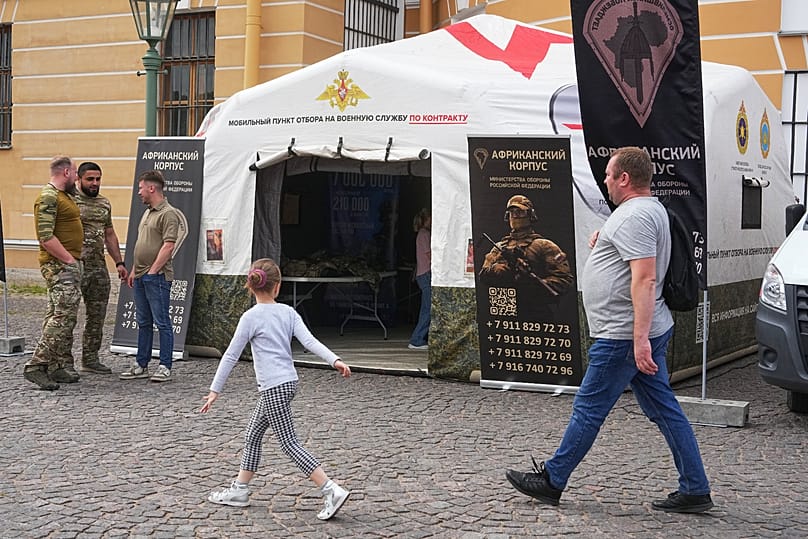
From the ashes of Wagner Group, the Kremlin resurrected its own public-private expeditionary force, known as the Africa Corps. In June, this organization took over Wagner Group’s operations in Mali. It expanded into Niger and Burkina Faso, but it was continually kneecapped by the Kremlin’s prioritization of the Ukraine conflict.

The Africa Corps has failed to recover from this loss, and this limited capacity contrasts with empowered jihadist and separatist movements across the Sahel. Jama’at Nusrat al-Islam wal-Muslimin (JNIM), the local al-Qaeda branch, has been very active in Mali over the summer. First, JNIM launched a series of coordinated attacks on several military bases across the country. Then, it resorted to blocking the country’s major roads, laying siege to some important cities, and setting fire to fuel trucks coming from western and southern Mali. This strategy reflects JNIM’s new aim on the battlefield: to choke Bamako and overthrow the military junta, while simultaneously demonstrating the extent of the Malian state’s collapse. Meanwhile, not only have fuel prices spiked across Mali, but the shortage is now so severe that Bamako and other major towns have been completely paralyzed. Rumors swirling around the army suggest that military officials in Kati and elsewhere are losing their patience.

Western governments are sounding the alarm. On Oct. 24, the U.S. State Department upgraded Mali to a level 4 “Do Not Travel” warning, and other countries like the Netherlands and Canada followed suit. The potential outcomes are varied—from another military coup to an extended siege evoking images of Mogadishu in the 1990s to a complete jihadist takeover. Regardless, change is coming for Bamako, and the region may never be the same again.

While Bamako is in dire straits, its neighbors could be the next dominoes to fall. Burkina Faso now ranks at the top of the infamous Global Terrorism Index. The country’s junta government made the fateful decision to arm civilian militias, exacerbating violence. Jihadist groups have responded with drone attacks, which are also proliferating in Mali and Niger.

Niger isn’t faring any better. Nigeriens are four times more likely to die due to jihadist violence since the withdrawal of Western military support. One local cleric noted that jihadist forces “are beginning to feel legitimate, bold and entitled to the taxes, not just by force, but as if they were a recognized government.” Self-defense militias such as the zankai and the garde nomade have become the only state-supported or condoned forces in the country’s most violence-affected areas, as the military struggles to reach them.

All three countries are experiencing a collapse of the state. Jihadist and separatist insurgencies have fundamentally altered their capacity to conduct international affairs and manage sovereignty. No Sahelian government can claim full sovereignty or control over the means of violence within its borders. The Sahel is experiencing feudalization, the progressive fragmentation of the state. In this context, armed groups, rebel organizations, and self-defense militias engage in violence across different parts of the territory, and countries exist only in name.

Looking forward, prospects appear particularly bleak for the Sahel. Jihadist partial or total rule will spur mass migration, most likely into Mauritania, Algeria, and Libya. While European and American leaders are focused on Russia and China, a volatile jihadist source of insecurity is looming in West Africa. The consequences of jihadist statelets near the Atlantic and the Mediterranean can and should stir fear in Washington, Paris, Brussels, and beyond.

Yet, cooler heads are needed. African migration bans and militarily focused policies are short-term approaches that will flounder in the face of a more profound crisis plaguing the Sahel. Responsible policies must center around the failures of governance in the Sahel—enormous gaps in public infrastructure, poor access to education, and a hollowed job market—which build grievances in peripheral communities and push individuals into armed violence. From the governance side, foreign partners will need to try harder against the corrupt networks that continue to manage the Sahel’s gold and human trafficking trade, which perpetuates instability and robs these countries of resources. Part of this push will fall on states that encourage these criminal behaviors, particularly the United Arab Emirates.

For now, most analysts prefer investment in the Sahel’s littoral neighbors. A full-capacity military and political campaign in the Sahel would be an expensive endeavor at a time when foreign policy budgets are being slashed around the world.

On the other hand, a new and evolving Syrian government suggests that there is potential for normalized relations between the Global North and former jihadists. Indeed, JNIM leadership in 2021 claimed that the war in Mali would not touch French soil. Any approaches along these diplomatic lines, though, would require a re-evaluation of Western relations with former client regimes in the Sahel and a degree of communication with jihadist organizations that does not exist today.


About the authors:

Raphael Parens is a Fellow in the Foreign Policy Research Institute’s Eurasia Program. He is an international security researcher focused on Europe, the Middle East, and Africa and specializes in small armed groups and NATO modernization processes.

Delina Goxho is an independent security analyst who works for several European foundations and civil society organizations.

Source: This article was published by FPRI

Published by the Foreign Policy Research Institute
Founded in 1955, FPRI (http://www.fpri.org/) is a 501(c)(3) non-profit organization devoted to bringing the insights of scholarship to bear on the development of policies that advance U.S. national interests and seeks to add perspective to events by fitting them into the larger historical and cultural context of international politics.

Saturday, November 01, 2025

Ukraine’s elite HUR forces turn the tide in the battle for Pokrovsk, as Russia’s effort to capture key logistics hub fails

Ukraine’s elite HUR forces turn the tide in the battle for Pokrovsk, as Russia’s effort to capture key logistics hub fails
In the morning of November 1 it looked like the key logistics hub of Pokrovsk was about to fall to the Russian invaders. Then a bold counter attack by elite Ukraine intelligence agency forces turned the tide. / Euromaidan Press
By Ben Aris in Berlin November 1, 2025

The battle for Pokrovsk became intense on November 1. In the first part of the day it looked like the fall of the key logistics hub to Russia that could end the war was imminent. But a bold special operation by Ukraine’s elite forces seems to have turned the tide at the last moment, according to military blogger reports coming out of the city.

It's hard to be sure of what is happening and there is little formal reporting on this key battle, but milbloggers in touch with individual soldiers are posting updates on social media. In addition, think tanks like the Institute for the Study of War (ISW) have access to satellite imagery that is also a source of information.

As bne IntelliNews reported, at the start of last week, Russia's chief of the general staff Valery Gerasimov has triumphantly reported to President Vladimir Putin that the city was surrounded by the Armed Forces of Russia (AFR). By the end of the week, the situation had become critical as Russian forces broke into the city and fierce street battles broke out.

However, the situation deteriorated further by the start of November 1 as Russian forces captured increasing sections of the city as well as pushing Armed Forces of Ukraine (AFU) troops out of their defensive pockets and the supply lines to the city were almost completely cut, threatening to trap hundreds of defenders in pockets, surrounded by Russian forces.

In desperation, Ukraine mounted a daring counter operation, flying in elite troops by US-made Black Hawk helicopters and dropping them behind enemy lines who appear to have struck a devastating blow that has reversed the tide, according to unconfirmed reports from the city. The offensive was reported by Kyrylo Budanov, Ukraine’s spy master and chief of the Main Directorate of Intelligence of the Ministry of Defence of Ukraine himself, the architect behind much of Ukraine’s defensive strategy, and was spotted on the ground in Pokrovsk leading the defence.

As the day ends, Pokrovsk remains in Ukrainian hands, but with a reported 11,000 AFR troops massed for the assault, intense fighting is expected to resume tomorrow.

Pokrovsk and Myrnohrad encirclement

The AFU remains on its backfoot. Despite having repelled the onslaught, the cities of Pokrovsk and the neighbouring city of Myrnohrad, which is supplied from Pokrovsk, are almost encircled by the “steady but slow” AFR advances, reports Institute for the Study of War (ISW), at the culmination of weeks of preparatory strikes and infiltration missions. Russian forces have been taking advantage of the kilometre-long holes that have appeared in Ukraine’s lines, due to the increasingly acute manpower shortage and more than 200 AFR soldiers broke into the city this week. AFR forces were clearing Ukrainian defensive pockets and asserting growing control over the course of the last week, with Russian drones targeting Ukrainian reconnaissance and supply operations with increasing effectiveness.

Nevertheless, Ukrainian forces had managed limited tactical gains during the week. “Ukrainian forces marginally advanced during recent counterattacks north of Pokrovsk… Geolocated footage published on October 31 indicates that Ukrainian forces recently marginally advanced in eastern Rodynske. Additional geolocated footage… shows Ukrainian forces striking Russian positions in northern Pokrovsk and eastern Rih… ISW assesses that these infiltration missions did not change the control of terrain or the forward edge of the battle area (FEBA),” according to the ISW analysts.

While Russian troops had infiltrated Pokrovsk in small groups, the city remained a “contested grey zone” for most of last week.

By the morning of November 1 the defence of the city looked to be close to collapsing. Russian milblogger @Zlatti71 claimed that Pokrovsk’s defenders were “hours away from encirclement”

“Only a few kilometres remain before Russian forces close the ring… a thousand-strong contingent of the Armed Forces of Ukraine — including the 25th Airborne, 79th Air Assault, and 82nd Air Assault Brigades — will be completely trapped,” @Zlatti71 said in a social media post.

He reported that HUR special forces had been dispatched to break the encirclement, but Russian drones were already tracking their movements. Russian units were also said to be consolidating control of Pokrovsk’s northern outskirts, enabling forward movement of assault troops and had cut supply lines into the city. AFU reports said that troops were still receiving supplies that were being delivered by drones.

However, by around mid-day reports of a Ukrainian special operations forces coordinated counter-attack appeared from within Pokrovsk itself. Acting on Budanov’s direct orders, these HUR units conducted counter-sabotage sweeps across key areas of the city, targeting Russian defence positions and recapturing parts of the city taken by the AFR.

“Ukrainian media report HUR chief Budanov was spotted in Pokrovsk personally overseeing the operation,” military bloggers said, releasing an image of Budanov in fatigues at a field command post.

Within hours, several Russian operatives were captured—including members of Russia's own military intelligence service (GRU), milbloggers reported. Drone footage showed Ukrainian operators ambushing isolated Russian soldiers who had been misled by their own command to believe the city was already completely under Russian control.

Reports of the HUR special operations first appeared the previous evening when The Economist correspondent Oliver Carroll posted video of a Ukrainian operated Black Hawk helicopter landing in a field purportedly near Pokrovsk.

“New. Hearing Ukraine’s military intelligence is conducting a daring counter-offensive near Pokrovsk to reopen key logistics lines. Videos shared with me purport to show a heli drop in areas Russia claims to hold. Have not been able to verify videos independently,” Carroll posted.

It is not clear how big the HUR operation was. In addition to Carroll’s video another video surfaced showing two more Black Hawks flying into the Pokrovsk area, but given the effectiveness of the counter punch it seems likely that more HUR forces were deployed.

Still, the cost was high. One Black Hawk insertion attempt on the northwestern outskirts of Pokrovsk ended in disaster.

As milblogger @OSINTWarfare reported: “Most of the deployed troops were killed or wounded, and the American-made UH-60 Black Hawk helicopter that transported them was destroyed.”

@AMK_Mapping later detailed how the 11 Ukrainian soldiers seen deploying from the drop into the surrounding countryside were hunted down by Russian FPV drones shortly afterwards. Russia confirmed the kill, releasing video from some of the drones as they targeted the fleeing soldiers as well as footage of the helicopter being destroyed by a Russian missile.

Crucial battle

The battle for Pokrovsk is even more important than those for Bakhmut Avdiivka, which both eventually fell to Russia after many months of fighting in May 2023 and February 2024 respectively and allowed Russia to advance deeper into the Donbas. Pokrovsk lies at the nexus of several important road and rail lines that supply most of the AFU’s defence of the Donbas.

If it falls to Russia there is a chance that the whole AFU defence of the Donbas region could collapse shortly afterwards. There are also no more major defensible cities beyond Pokrovsk that would allow Russian troops to advance almost unimpeded all the way to the Dnipro River that divides Ukraine in two and allow them to occupy almost all of the eastern half of the country.

The significance of Pokrovsk is not lost on Ukrainian soldiers. A serviceman with the callsign “Kyianyn” told @SitrepLinks: “There are virtually no fortifications behind these towns. A flat road leads directly to the city of Pavlohrad.”

The political consequences would be significant too. Completing the capture of Donbas is one of Russian President Vladimir Putin’s stated war goals and the collapse of the proposed meeting between between Putin and US President Donald Trump in Budapest this month was due to the Russian president’s refusal to compromise on his demand that the AFU completely quit the Donetsk region, which Russia doesn’t entirely control, according to a report by the Financial Times.

Shortly after the announcement that the meeting has been “postponed” Trump introduced his new oil sanctions, hitting Russia’s two biggest oil companies, the state-owned Rosneft and privately owned Lukoil.

The prominent and public use of US-made Black Hawk helicopters strongly suggests the US were involved in planning and providing satellite intelligence for the HUR’s special operation. The US has not officially admitted to supplying Ukraine with these sophisticated helicopters, although sightings of UH-60A Black Hawks with Ukrainian markings were reported by outlets including The Drive – The War ZoneForbes, and Militarnyi in February 2023. But there have been no other reports that bne IntelliNews could find since then. The helicopters are controlled by Budanov’s HUR, according to local reports, but are not widely used.

Ukraine and its European allies also have very little or no capacity to provide detailed satellite intelligence on Russian troop movements that would allow the selection of suitable drop sites for troops behind enemy lines. Kyiv is entirely reliant on the US for this sort of information. The US admitted this month that it has also provided Ukraine with satellite intelligence in his strikes on Russian refineries using its homemade long distance drones.

HUR elite troops turn the tide

The HUR operation appears to have been a big success and turned the tide in the battle for Pokrovsk. By lunchtime on November 1 reports started coming in of Ukrainian troops recapturing sections of the city taken by the AFR and surrounding villages, suggesting that the scale of the operation was much larger than the scant video of a few helicopters flying over the countryside on their way to Pokrovsk suggests. And it came just in time as the Ukrainian defence seems to be collapsing.

By roughly midday, milblogger @AMK_Mapping described the situation as “catastrophic”: “In Pokrovsk City, Russian forces continued their advance… capturing the rest of the northwestern industrial zone, the administrative building, and the railway station.”

In Myrnohrad, 5km to the southeast of Pokrovsk, Ukrainian forces were withdrawing under heavy bombardment, and Russian troops were consolidating gains in the city’s high-rise districts and industrial zones. At least 500 Ukrainian troops were reportedly cut off in and around Myrnohrad, with several units attempting to escape through narrow corridors under drone and artillery fire.

But perhaps most critically, Russian troops began attempting to cross the dam near Hryshyne, a village 3km to the west of Pokrovsk, threatening to outflank and encircle Ukrainian units stationed there.

Russian heavy FAB glide bombs, including the massive FAB-3000 that can smash any defences the AFU has, were used to destroy entrenched positions—a tactic that has become a hallmark of Russian urban assaults. More of a gravity bomb than a missile, Ukraine has no defences against these hugely powerful WWII-vintage munitions.

In addition to the major pushes in Pokrovsk and Myrnohrad, @AMK_Mapping also noted a series of coordinated Russian advances in smaller but strategically significant locations around the frontline:

  • Lysivka and Sukhyi Yar, towns located deep inside the emerging pocket, were reportedly still under Ukrainian control, raising questions about Kyiv’s priorities in defending what some now call “PR cities.”
  • Russian forces advanced from the Kapitalna Industrial Zone into the low-rise residential areas of Myrnohrad, taking control of at least 12 blocks.
  • In the northeastern suburbs of Myrnohrad, Russian troops entered and fortified at least 10 high-rise buildings, consolidating gains with support from artillery and air strikes.
  • The southern Myrnohrad garrison withdrew from 3-storey residential blocks after intense FAB strikes, leaving minimal presence in the southern suburbs.
  • In northern Myrnohrad, Russian forces pushed through forested areas and dachas to establish a foothold in local schools and residential quarters.
  • In Pokrovsk’s eastern suburbs, Russian troops bypassed the high-rise district to seize control of a church and a major factory, pushing further west.

These smaller breakthroughs are not isolated gains; they represent a cumulative tightening of the noose around Ukrainian defensive positions across the axis by the massed troops Putin is using in what he clearly hoped would be a knock-out blow. Each one chips away at Ukrainian ability to manoeuvre and resupply, and together they could enable a larger breakthrough if left unchecked.

Russia's commander in chief Gerasimov was ebullient and reportedly met Putin to tell him the encirclement was complete and presumably that he was confident the AFR was on the verge of taking the Pokrovsk.

But a few hours later it all began to unravel. Reports began to emerge that the much-vaunted encirclement was falling, and the HUR were sweeping through the city with devastating effect.

Launching an attack from the north of Pokrovsk, according to Euromaidan Press, Ukrainian units from the 14th Chervona Kalyna Brigade cleared Russian infiltration groups from Rodynske, a small town located immediately north-east of Pokrovsk, using another bit of top flight Ukrainian kit, the BTR-4E armoured personnel carrier (APC) developed and produced in Ukraine, guided by drone reconnaissance. The same forces then withdrew before Russian drones could retaliate.

“The supposed encirclement never materialised… Russian generals appear to have oversold their progress to the Kremlin, while Ukrainian special forces systematically dismantled the infiltration attempt,” Euromaidan Press enthusiastically reported.

Despite Russia’s Ministry of Defence claiming a successful encirclement after reporting directly to Putin a few hours earlier, the Ukrainian forces managed to keep the supply routes open and remain active in both Pokrovsk and Myrnohrad, pushing the AFR back.

Russian analysts celebrated the AFR infiltration tactics but offered contradictory narratives—on the one hand claiming that Ukrainian drones were neutralised, and on the other lamenting continued drone strikes and resistance.

Maybe an appropriate parallel for the stunning turnaround would be the Athenians defence of their city in the face of Emperor Darius’ overwhelming invasion force at the battle of Marathon, where the massively outnumbered army of motivated free men defeated the invaders, fighting for their homes and families against an army of slaves.

Bravery and boldness played a key role, but Ukraine’s mastery of drones has also been the lethal sling and stone in the outnumbers and outgunning AFU army’s hand. A video filmed by Russian soldiers themselves showed a sky "swarming with Ukrainian drones", refuting earlier Russian claims that they had successfully eliminated the drone operations.

“This exposed the Russian announcement for what it was—another premature declaration meant to please political leadership rather than reflect battlefield truth,” Euromaidan Press concluded.

Russian encirclement narrative collapses

In the final analysis, Ukraine's ability to quickly deploy elite forces, supported by real-time intelligence, strategic use of its best Western-supplied weapons and precision strikes, appears to have blunted Russia’s encirclement attempt—at least for now. Ukrainian General Staff confirmed that while the situation remains “extremely difficult,” the defenders are not encircled and will live on to fight another day.

Still, the broader threat remains. Russia’s ability to concentrate firepower—especially through air-delivered munitions—and its use of infiltration groups and “meat assaults” presents a continuing challenge to Ukraine’s overstretched front. The AFU showed similar tenacity at the battle for Bakhmut but was eventually overwhelmed by Wagner PMC leader Evgeny Prigozhin’s tactic of simply throwing in wave after wave convict soldier on the calculus that it didn’t matter how many Russians died, as long as they managed to kill some Ukrainian soldiers in each attack to eventually wear the defence down. And it worked, after eight months of fighting and massive Russian casualties.

But for now, the defenders are still holding the line.

Sunday, October 26, 2025

How deepfakes and cloned voices are distorting Europe's elections

Europe’s busy election schedule in 2025 and 2026 is being targeted by AI-generated manipulation on social media. But this time around, Europe’s political landscape is transforming. The fight for voters’ hearts is no longer waged on the streets but on screens, through artificially generated images, cloned voices and sophisticated deepfakes.


Issued on: 24/10/2025 - RFI


A woman looks at a phone as she uses the Albanian government portal "E - Albania", now assisted by government artificial intelligence cabinet minister avatar "Diella". AFP - ADNAN BECI

By:Jan van der Made


It began in Moldova. In late December 2023, a video purportedly showing President Maia Sandu disowning her government and mocking the country’s European ambitions went viral on Telegram.

The Moldovan government swiftly dismissed the clip as fake, but the damage was done.

According to Balkan Insight, an investigative news website, and Bot Blocker, a fake-news watchdog, the Kremlin-linked bot network “Matryoshka” generated the clip using the Luma AI video platform.

The footage, voiced in Russian, caricatured Sandu as ineffective and corrupt, recycling earlier disinformation tied to fugitive oligarch Ilan Shor.

French cybersecurity agency Viginum later described how AI-generated deepfake videos, including the one mimicking President Sandu, were distributed through Telegram and TikTok by a pro-Russian propaganda network affiliated with the Russian media outlet Komsomolskaya Pravda.

Viginum said websites like moldova-news.com were backed by what it called a “structured and coordinated pro-Russian propaganda network.”
Troll factories and cloning

Saman Nazari, a researcher with Alliance4Europe, a Europe-wide pro-democracy platform, told RFI the use of AI to influence elections is massively increasing.

In the past, he said people who wanted to influence elections would copy-paste the same text over and over again.

“They just have AI rewrite them, publish them across different accounts, different pages, with small variations aimed at specific target audiences,” Nazari said.

Nazari also said AI tools are now used to make disinformation operations look legitimate.

France’s Foreign Ministry said Storm 1516, a cyber-attack group, had launched 77 Russian disinformation campaigns targeting France, Ukraine and other Western countries since 2023.

According to Nazari, the operations were run by the successor to the Saint-Petersburg-based Internet Research Agency [founded by Yevgeny Prigozhin in 2013 and dissolved in 2023], the Russian Foundation for Battling Injustice – which created websites that look exactly like well-known media outlets.

The groups running these websites clone news sites, fill them with stolen articles that are rewritten or translated and then re-publish them to appear credible, Nazari said.

Alliance4Europe has counted hundreds of such websites during European elections.

"In the past, it was quite a big job to create a website and fill it with content, but now it's being done almost automatically," Nazari said.

Yevgeny Prigozhin, founder of the Internet Research Agency, later head of the Wagner group and killed in a plane crash in 2023. AP - Alexander Zemlianichenko

Personal targets

The threat is spreading into Western Europe. Professor Dominique Frizon de Lamotte of CY Cergy Paris University was targeted by an AI-generated video that faked his image and voice and attempted to link him to pro-Russian groups in Moldova.

“I have no connection with Moldova; I don’t even use Telegram,” he told France 3 television. The video was flagged by EUvsDisinfo, an EU misinformation monitoring group, and French media as an attempt to undermine trust in academics.


The older generation may not be able to distinguish between a real video and a deep fake. And there is a large portion of the voting popultation which is in that upper bracket.


The older generation may not be able to distinguish between a real video and a deep fake. And there is a large portion of the voting popultation which is in that upper bracket.

03:11

REMARKS by Saman Nazari, researcher 

with Alliance4Europe

Jan van der Made

The 2024 presidential election in Romania brought further evidence of AI-linked interference.

Officials said the interference, widely attributed by European governments to Russian-backed actors, led to the annulment of the election results by Romania’s Constitutional Court, an unprecedented move in Europe.

During the rerun in mid-2025, far-right narratives and fabricated content circulating on TikTok and Telegram sought to influence public opinion. Pro-European candidate Nicusor Dan ultimately won the repeat vote.
All eyes on Hungary

Hungary is preparing for a flood of AI-influenced content ahead of its 2026 elections.

Pro-government groups, including the National Resistance Movement, have already spent over €1.5 million promoting unlabelled AI videos attacking opposition leader Peter Magyar.

Some clips show fabricated scenes of Hungarian soldiers dying in Ukraine to provoke nationalist sentiment. Magyar has called the videos “pathetic” and “election fraud”.

Analysts say that even when viewers think content might be fake, emotional impact still shapes opinions.

Within a larger legal framework, the European Union has rules forcing platforms to show who is behind political adverts.

Within a wider framework, the European Union has already introduced the Digital Services Act in 2022 to strengthen platform rules on transparent political advertising.

The commission also operates a Rapid Alert System and an AI Integrity Taskforce to detect and counter manipulative content across languages and borders.

French cyber agency warns TikTok manipulation could hit Romania's vote, again


Voters at risk

Nazari said young people are used to seeing altered images and deepfakes online.

“Young people have grown up with memes, with people making deep fakes. Edited images and videos and so on. [They] are familiar with the concept.”

But older voters, he told RFI, are more likely to be misled.

“They might not be able to distinguish between a real video and a deep fake video,” Nazari said, adding they are especially vulnerable in countries where digital literacy is not very high.