Since mid-October, Israel has carried out an assassination campaign in Gaza targeting resistance leaders. Contacts within the resistance say Israel is trying to lure them back into direct confrontation to avoid fulfilling its ceasefire obligations.
December 18, 2025
MONDOWEISS
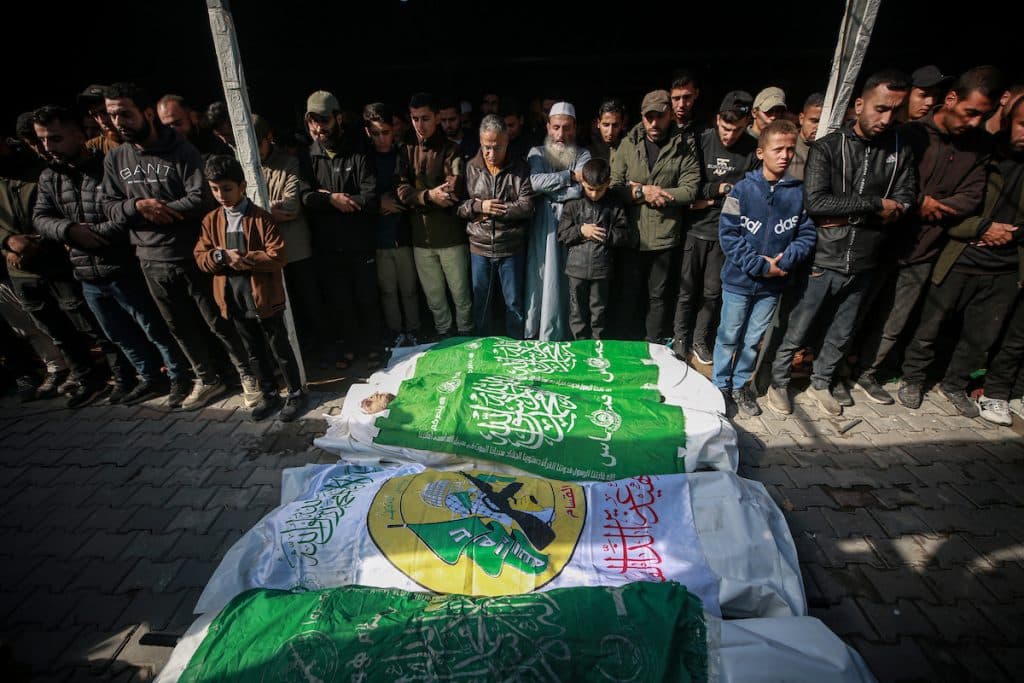
Palestinians participate in the funeral procession for Raed Saad, a prominent commander in the Izz ad-Din al-Qassam Brigades, the military wing of Hamas, and three of his aides, who were killed in an Israeli airstrike in Gaza City, on December 14, 2025.
(Photo: Omar Ashtawy/APA Images)
On December 13, the Israeli army assassinated Raed Saad, a senior commander in the Qassam Brigades and head of its weapons production. It was not the first strike deep into Hamas’s military wing or that of other resistance factions in Gaza. In fact, it was a continuation of Israel’s policy in Gaza since the ceasefire agreement was signed in October 2025.
Since the first days of the ceasefire, Palestinian civilians have been targeted for crossing the “yellow line,” which demarcates Israeli-controlled areas but is not clearly delineated. Later, beginning in mid-October, a clear pattern of assassinations began to emerge. The assassination of five fighters from the Qassam Brigades’ elite unit on October 17 marked the beginning of Israel’s assassination campaign during the ceasefire, which has not eased since.
On October 19, Yahya Al-Mabhouh, the commander of an elite unit, and Ahmad Abu Mutair, a broadcast engineer, were assassinated. Both were affiliated with the Qassam Brigades.
On October 29, several Qassam commanders were assassinated, including Hatem Al-Qudra, along with other martyrs.
On November 17, a field commander in Gaza City, Wisam Abdelhadi, a commander in the Al-Nasser Salah al-Din Brigades, was assassinated.
On November 20, five senior leaders in Hamas were assassinated, including Ahmed Abu Shammala, head of the naval unit, Nihad Abu Shahla, head of intelligence, Fadi Abu Mustafa, and others.
Likewise, on November 22, the Israeli army announced the assassination of five additional commanders.
And then, on December 13, Raed Saad.
“Sa’ad was one of the last remaining veteran senior militants in the Gaza Strip and a close associate of Marwan Issa, the deputy head of Hamas’ military wing. He held several senior positions and was a central figure within the organization’s military leadership,” the Israeli army said in a statement following the assassination, making no mention of its violation of the ceasefire.
During the ceasefire, the Israeli army has targeted all Palestinians in Gaza engaged in resistance activities, regardless of their political affiliations—whether with Hamas or other factions—just as they had during the war. These assassinations have been in addition to the 386 civilians whom Israel has killed in Gaza during this period as well.
Instigating the resistance
The resistance in Gaza believes that the Israeli army is trying to fabricate pretexts in order to target Palestinians in the Gaza Strip, especially political and military figures. It is also attempting to push the resistance back into direct confrontation to evade the ceasefire, using all available means to achieve its objectives in Gaza.
“The Israeli occupation army is working to create pretexts in the areas under its control classified as yellow zones in order to target our people, particularly political and military leaders, and to drag the resistance into a new confrontation that would lead to the resumption of the war and evasion of the ceasefire agreement, as well as international and U.S. pressure to adhere to the agreement,” a security source in the resistance in Gaza City told Mondoweiss.
“We have monitored new methods for tracking military leaders at both the technological and human levels,” he said. “The occupation is using highly advanced technology and spying devices planted in various areas of the strip, as well as human intelligence through cooperation with armed militias allied to the Israeli army. It also assigns these groups the task of targeting security leaders inside the Gaza Strip.” Investigations taken by the resistance have revealed links between cells inside Gaza and the occupation, whose main mission is to carry out assassinations. As for the assassination of senior leaders, they were carried out directly by the occupation, according to the same source.
The source noted that the pretexts cited by the army are flimsy and unfounded excuses to carry out assassinations, most notably claims that its soldiers were subjected to gunfire and military operations in areas fully under its control.
“The resistance has no contact with those present in these areas, does not carry out any military operations there at the present time, and does not issue any instructions to any of its members to carry out such operations,” the source said.
The source described what is happening as a blatant violation by the occupation of the ceasefire, a disregard for regional and international mediators, and an attempt to evade the obligations of the agreement and delay the start of the second phase of the ceasefire. “For our part,” the source said, “we will not give the occupation any pretext to achieve its objectives.”
The source indicated that the resistance in Gaza will not accept the occupation imposing its equations and rules on Gaza, its population, and its resistance. “The Netanyahu government is seeking to do so, but we have sent several messages to the mediators, from whom we received assurances that such rules would not be imposed under any circumstances, especially from the United States, which confirmed to all parties its determination to implement the ceasefire in all its stages.”
He also pointed out that the political leadership remains in constant communication with the mediators to compel the Israeli occupation to adhere to the ceasefire agreement, and that “we continuously affirm our right to respond in the manner and at the time we deem appropriate to the occupation’s violations and breaches, and that we will not remain silent for long in the face of the occupation’s aggression and violations.”
A strategy to avoid the second phase of the ceasefire
The Israeli pattern of assassinating leaders and turning the Gaza Strip into an open area for Israeli military operations has been clear to any observer of the situation on the ground in Gaza. The assassinations, bombardments, seizure and destruction of large areas inside what are referred to as the “yellow line” zones are all taking place as negotiations over the second phase of the ceasefire agreement are being carried out. These actions appear to be Israel’s attempt to create a new reality on the ground while it can.
Political analyst and writer Ahed Farwana told Mondoweiss that “the occupation is attempting to establish new tactics through clear assassination operations or armed actions, through which it seeks to perpetuate a state of tension in Gaza and make it the prevailing condition.”
Farwana says Israel is periodically increasing the pace of assassinations and trying to normalize the situation, similar to what it has done in Lebanon, but is now carrying out this strategy on a much larger scale in the Gaza Strip.
He says the Israeli government wants to avoid the second phase of the ceasefire agreement because of the obligations it would carry with it.
“These include the withdrawal of the army, the opening of crossings, and reconstruction, and Netanyahu does not want to pay their political cost—especially as the coming year is an election year in Israel. Accordingly, they are doing everything possible to maintain the status quo,” he says. Farwana confirms Israel is expanding the yellow zone and destroying everything east of the yellow line on a daily basis, stressing that “the Israeli government is not prepared at all to move to the second phase.”
Farwana believes that international pressure—particularly from U.S. President Donald Trump—is what could make a difference. He says that if Trump wants to pressure Netanyahu to move to the second phase, he will do so. However, if there is no real pressure on Netanyahu, he will continue to do as he has during the first phase – grabbing land in Gaza, and killing any Palestinian who stands in their way.
On December 13, the Israeli army assassinated Raed Saad, a senior commander in the Qassam Brigades and head of its weapons production. It was not the first strike deep into Hamas’s military wing or that of other resistance factions in Gaza. In fact, it was a continuation of Israel’s policy in Gaza since the ceasefire agreement was signed in October 2025.
Since the first days of the ceasefire, Palestinian civilians have been targeted for crossing the “yellow line,” which demarcates Israeli-controlled areas but is not clearly delineated. Later, beginning in mid-October, a clear pattern of assassinations began to emerge. The assassination of five fighters from the Qassam Brigades’ elite unit on October 17 marked the beginning of Israel’s assassination campaign during the ceasefire, which has not eased since.
On October 19, Yahya Al-Mabhouh, the commander of an elite unit, and Ahmad Abu Mutair, a broadcast engineer, were assassinated. Both were affiliated with the Qassam Brigades.
On October 29, several Qassam commanders were assassinated, including Hatem Al-Qudra, along with other martyrs.
On November 17, a field commander in Gaza City, Wisam Abdelhadi, a commander in the Al-Nasser Salah al-Din Brigades, was assassinated.
On November 20, five senior leaders in Hamas were assassinated, including Ahmed Abu Shammala, head of the naval unit, Nihad Abu Shahla, head of intelligence, Fadi Abu Mustafa, and others.
Likewise, on November 22, the Israeli army announced the assassination of five additional commanders.
And then, on December 13, Raed Saad.
“Sa’ad was one of the last remaining veteran senior militants in the Gaza Strip and a close associate of Marwan Issa, the deputy head of Hamas’ military wing. He held several senior positions and was a central figure within the organization’s military leadership,” the Israeli army said in a statement following the assassination, making no mention of its violation of the ceasefire.
During the ceasefire, the Israeli army has targeted all Palestinians in Gaza engaged in resistance activities, regardless of their political affiliations—whether with Hamas or other factions—just as they had during the war. These assassinations have been in addition to the 386 civilians whom Israel has killed in Gaza during this period as well.
Instigating the resistance
The resistance in Gaza believes that the Israeli army is trying to fabricate pretexts in order to target Palestinians in the Gaza Strip, especially political and military figures. It is also attempting to push the resistance back into direct confrontation to evade the ceasefire, using all available means to achieve its objectives in Gaza.
“The Israeli occupation army is working to create pretexts in the areas under its control classified as yellow zones in order to target our people, particularly political and military leaders, and to drag the resistance into a new confrontation that would lead to the resumption of the war and evasion of the ceasefire agreement, as well as international and U.S. pressure to adhere to the agreement,” a security source in the resistance in Gaza City told Mondoweiss.
“We have monitored new methods for tracking military leaders at both the technological and human levels,” he said. “The occupation is using highly advanced technology and spying devices planted in various areas of the strip, as well as human intelligence through cooperation with armed militias allied to the Israeli army. It also assigns these groups the task of targeting security leaders inside the Gaza Strip.” Investigations taken by the resistance have revealed links between cells inside Gaza and the occupation, whose main mission is to carry out assassinations. As for the assassination of senior leaders, they were carried out directly by the occupation, according to the same source.
The source noted that the pretexts cited by the army are flimsy and unfounded excuses to carry out assassinations, most notably claims that its soldiers were subjected to gunfire and military operations in areas fully under its control.
“The resistance has no contact with those present in these areas, does not carry out any military operations there at the present time, and does not issue any instructions to any of its members to carry out such operations,” the source said.
The source described what is happening as a blatant violation by the occupation of the ceasefire, a disregard for regional and international mediators, and an attempt to evade the obligations of the agreement and delay the start of the second phase of the ceasefire. “For our part,” the source said, “we will not give the occupation any pretext to achieve its objectives.”
The source indicated that the resistance in Gaza will not accept the occupation imposing its equations and rules on Gaza, its population, and its resistance. “The Netanyahu government is seeking to do so, but we have sent several messages to the mediators, from whom we received assurances that such rules would not be imposed under any circumstances, especially from the United States, which confirmed to all parties its determination to implement the ceasefire in all its stages.”
He also pointed out that the political leadership remains in constant communication with the mediators to compel the Israeli occupation to adhere to the ceasefire agreement, and that “we continuously affirm our right to respond in the manner and at the time we deem appropriate to the occupation’s violations and breaches, and that we will not remain silent for long in the face of the occupation’s aggression and violations.”
A strategy to avoid the second phase of the ceasefire
The Israeli pattern of assassinating leaders and turning the Gaza Strip into an open area for Israeli military operations has been clear to any observer of the situation on the ground in Gaza. The assassinations, bombardments, seizure and destruction of large areas inside what are referred to as the “yellow line” zones are all taking place as negotiations over the second phase of the ceasefire agreement are being carried out. These actions appear to be Israel’s attempt to create a new reality on the ground while it can.
Political analyst and writer Ahed Farwana told Mondoweiss that “the occupation is attempting to establish new tactics through clear assassination operations or armed actions, through which it seeks to perpetuate a state of tension in Gaza and make it the prevailing condition.”
Farwana says Israel is periodically increasing the pace of assassinations and trying to normalize the situation, similar to what it has done in Lebanon, but is now carrying out this strategy on a much larger scale in the Gaza Strip.
He says the Israeli government wants to avoid the second phase of the ceasefire agreement because of the obligations it would carry with it.
“These include the withdrawal of the army, the opening of crossings, and reconstruction, and Netanyahu does not want to pay their political cost—especially as the coming year is an election year in Israel. Accordingly, they are doing everything possible to maintain the status quo,” he says. Farwana confirms Israel is expanding the yellow zone and destroying everything east of the yellow line on a daily basis, stressing that “the Israeli government is not prepared at all to move to the second phase.”
Farwana believes that international pressure—particularly from U.S. President Donald Trump—is what could make a difference. He says that if Trump wants to pressure Netanyahu to move to the second phase, he will do so. However, if there is no real pressure on Netanyahu, he will continue to do as he has during the first phase – grabbing land in Gaza, and killing any Palestinian who stands in their way.

No comments:
Post a Comment