Sunday, August 23, 2026

102 Rights Groups Call on Rubio to Secure Release of US Citizen Sama Safi, Imprisoned in Israel Since June

“The Israeli military had no right to take Sama in the first place, let alone repeatedly hold her in such inhumane conditions.”


Sama Safi is seen in a family photograph.
(Photo courtesy of Safi family)

Julia Conley
Aug 18, 2026
C0MMON DREAMS

More than 100 faith-based and civil society groups are calling on US Secretary of State Marco Rubio to fulfill one of his department’s top obligations—protecting the security of US citizens abroad—by securing the “immediate release” of 20-year-old Sama Safi, an American psychology student who was violently detained by armed Israeli soldiers in the West Bank 77 days ago and has been held in a military prison ever since.

The Institute for Middle East Understanding (IMEU), one of the signatories of a letter sent to Rubio on Monday, emphasized that “The Israeli military had no right to take Sama in the first place, let alone repeatedly hold her in such inhumane conditions” as those she’s been subjected to.


Safi, a student at Birzeit University in the West Bank, was abducted from her family’s home in the occupied territory at 3:00 am on June 2, after Israeli Defense Forces soldiers broke down the door in a raid.

Safi and three other women who were abducted on the same night have been accused of “hostile terrorist activity and additional terrorist-related activities” due to alleged involvement with a student group, but Safi has not been charged with any crimes.

Despite that, the groups said, “the Israeli military has illegally transferred Sama out of the West Bank to the Damon Israeli military prison near Haifa, which amounts to a grave breach of Article 147 of the 4th Geneva Convention.”


Article 147 bans the unlawful transfer, deportation, or confinement of protected persons from an occupied territory to the territory of the occupying power, and constitutes a war crime, wrote the groups, which include the Council on American Islamic Relations, Jewish Voice for Peace, and the Center for Constitutional Rights.

The groups also emphasized that Safi has been arbitrarily detained for nearly three months while suffering a severe chronic complex health condition, putting her “at risk of rapid deterioration without specialized ongoing care abroad.”

“Interruption of Sama’s specialized care abroad places Sama at high risk of clinical deterioration, severe inflammatory relapse, progressive organ damage, hospitalization, and potentially life-threatening repercussions,” said the groups.

Her condition causes “fevers up to 105°F and requires daily medication and a quarterly injection she travels abroad to receive,” Drop Site News reported in June.

The letter included a statement from Safi in which she described being “shackled, blindfolded, driven around for several hours” on the night she was abducted.

“I was given no food or water for the first 24 hours,” she said. “I was subjected to repeated verbal abuse... I was blindfolded, shackled, and placed in painful stress positions.”

Israel’s military prisons have been called a “network of torture camps” by the Israeli human rights group B’Tselem, and human rights groups and the United Nations have documented the widespread use of torture against Palestinians in the prisons, including sexual abuse and denial of medical care, food, and water.

According to Drop Site News, a new report released Monday by the Palestinian Prisoners’ Society found that at least 10 Palestinian women at Damon prison have contracted scabies “amid overcrowding, poor ventilation, and shortages of basic supplies.

“Sama has always been fascinated by people, and her deep love for others is what led her to study psychology,” reads the letter. “Sama just celebrated her 20th birthday in April. She should be focusing on building her future, not being unjustly abducted by the Israeli military and enduring this nightmare.”

Nearly 10,000 “security” inmates are being held in Israeli prisons as of this month, according to the human rights group HaMoKed.

Last week, Israeli forces abducted 46-year-old Hussein Jabarin, a US citizen, from his family’s home in the West Bank. He was detained for several days before being released Sunday.

Another American citizen, 16-year-old Mohammed Ibrahim, spent nearly 10 months in an Israeli prison last year after being detained for allegedly throwing rocks at vehicles. He was not permitted to speak to his family the entire time he was imprisoned.

“This is how adversaries, not allies, act,” said Anthony Zenkus, a professor at Columbia University, of Safi’s abduction.
Conservationists Back Crowley in Wisconsin Over ‘Extremist Pro-Corporate Polluter’ Tiffany

“Tom Tiffany has put corporate profit ahead of local communities time and again.”


Wisconsin gubernatorial candidate David Crowley speaks onstage during Wisconsin Democrats’ 2026 Convention on June 14, 2026 in Madison, Wisconsin.
(Photo by Daniel Boczarski/Getty Images for WisDems)

Jake Johnson
Aug 18, 2026
COMMON DREAMS

The advocacy group Wisconsin Conservation Voters on Monday endorsed Milwaukee County Executive David Crowley in the state’s closely watched gubernatorial contest, arguing he is the obvious choice over “extremist pro-corporate polluter” Tom Tiffany, who has recently attempted to posture as anti-data center despite his voting and fundraising record.

“The momentum across Wisconsin is clear—voters are ready for leaders who will hold corporate polluters accountable, stand up to corporate greed, regulate data centers, and protect our natural resources,” said Seth Hoffmeister, deputy director of Wisconsin Conservation Voters (WCV). “David Crowley has proven he understands the struggles of Wisconsin families. From cutting Milwaukee County’s carbon footprint in half to taking a firm stand against predatory data center growth, David is the leader we need to protect our environment and keep energy bills affordable.”

By contrast, according to WCV, Tiffany—who currently represents Wisconsin’s 7th Congressional District in the US House—has shown “a consistent pattern of prioritizing corporate interests, out-of-state polluters, and special interests over regular Wisconsinites.”

“Tiffany’s record is toxic,” the group said. “He took $75,000 from mining interests in exchange for introducing an open-pit mining bill. He voted to defund the Knowles-Nelson Stewardship Program—a popular and effective bipartisan conservation program. He gutted the [Wisconsin Department of Natural Resources’] scientific authority, and he voted for budget legislation that raised healthcare and electricity costs. Tom Tiffany has put corporate profit ahead of local communities time and again.”

The conservation group’s endorsement of Crowley came on the same day that Tiffany released an ad attacking Crowley’s position on data centers, part of a broader effort by the Tiffany campaign to take advantage of widespread voter backlash against the energy-devouring facilities.

But Tiffany’s critics and the Crowley campaign say the Republican nominee is obscuring his own record and misrepresenting the views of his Democratic opponent on an issue that has captured the attention of communities in Wisconsin and across the US.

Tiffany—who, like Crowley, opposes a moratorium on new data center construction—has characterized the facilities as “exciting new technology,” suggested they are necessary to compete with China, and voted as a member of Congress in favor of budget legislation that included a 10-year ban on state-level artificial intelligence regulations. (The US Senate later stripped the ban from the bill.)

Tiffany pledged on Monday that, if he wins in November, every proposed data center project in Wisconsin would have to meet “strict environmental standards,” despite his putrid voting record on environmental issues.

Crowley, unlike Tiffany, devotes a section of his website to data center policy.

“As governor, I will let communities decide for themselves whether they want a data center at all—and if they say no, that decision would be honored,” Crowley’s website states.

If a local community opts to support new data center construction, Crowley said he would require the developer to eschew non-disclosure agreements that hide the details of the project, fully cover the “costs of infrastructure and grid upgrades,” build with union labor, and contribute to a fund aimed at bringing down Wisconsinites’ utility costs.

“Wisconsinites are looking for practical solutions to real challenges, like rising utility rates and unsafe drinking water,” Hoffmeister of WCV said Monday. “David Crowley will put our communities first and advocate for policies that make our state cleaner, safer, and more affordable.”
Iran Denounces Trump as ‘Delusional’ for Posting False Strait of Hormuz Map

The Iranian Parliament speaker said the strait will stay closed until the US blockade and oil embargo are lifted, and any party continuing its “aggression or threats” would face a “more severe defeat.”


President Donald Trump shared this map labeling the Strait of Hormuz a “new US territory” on his Truth Social platform on August 18, 2026.
(Image by Donald Trump/Truth Social)

Jessica Corbett
Aug 18, 2026
COMMON DREAMS

Just days after threatening to declare the Strait of Hormuz a US territory, President Donald Trump on Tuesday posted a map on his Truth Social platform with that label over the crucial waterway—and was swiftly called out by a top Iranian diplomat.

“Just as Trump correctly wrote the name of the Persian Gulf, his illusion about the Strait of Hormuz will soon be corrected—or we will correct the delusions of this delusional individual,” Iran’s deputy foreign minister, Kazem Gharibabadi, responded in Arabic on X.

Gharibabadi included a screengrab of Trump’s post featuring a map that shows the strait, which is south of Iran and runs between the Persian Gulf and Gulf of Oman.


Since Trump and Israel began illegally bombing Iran on February 28, the Middle East country has restricted traffic through the strait, a key shipping route, particularly for fossil fuels. That has driven up fuel prices worldwide, including in the United States, where the cost for a gallon of gasoline just hit a record high for mid-August.

Despite the economic toll at home, the range of impacts across the Middle East—where nearly six months of war have killed thousands of people—and a plummeting approval rating, Trump said last week that “I’ll never apologize, I did the right thing.”

That declaration and Trump’s threat over the strait came in a Friday speech on Long Island, after which critics across the United States and beyond condemned the president as a “completely unhinged lunatic” and “sadistic violent menace to the world” who ought to be impeached again.

By Monday, a 60-day ceasefire deal expired, and neither side has signaled any progress on talks to end the war—which Trump claims is aimed at stopping Iran from building nuclear weapons, even though his own intelligence agencies have said it wasn’t trying to do so. Trump notably ditched the Obama administration’s Iran nuclear deal during his first term.

According to Palestine Chronicle, Iranian Maj. Gen. Mostafa Izadi, deputy commander-in-chief of the Islamic Revolutionary Guard Corps, said Tuesday that “the enemy failed to destroy Iran’s defensive capabilities and nuclear industries.”

As for the strait, Iranian Parliament Speaker Mohammad Bagher Ghalibaf said that it will stay closed until the US blockade and oil embargo are lifted, and warned that any party continuing its “aggression or threats” would face a “more severe defeat.”
‘Flashing Red Warning Sign’ for Lawmakers: Poll Shows Voters Reject US-Israel Military Integration

“It is the height of absurdity that Congress is even considering a proposal to become more entangled with the Israeli military and use our tax dollars to subsidize their weapons companies.”


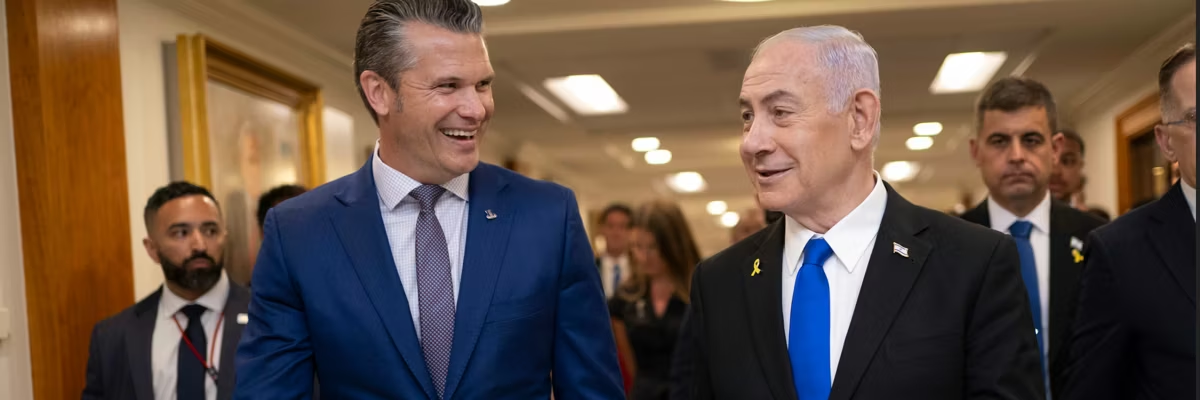
US Defense Secretary Pete Hegseth walks with Israeli Prime Minister Benjamin Netanyahu prior to a meeting at the Pentagon in Washington, DC on July 9, 2025.
(Photo by US Navy Petty Officer 1st Class Alexander Kubitza/Department of Defense)

Brett Wilkins
Aug 18, 2026
COMMON DREAMS

A new poll of US voters published on Tuesday offers a warning for congressional lawmakers backing a plan to deepen military ties between the United States and Israel, finding that a clear majority of voters oppose the proposal—which some critics have called “treasonous.”

The Data for Progress survey of 1,217 likely US voters—conducted August 3–7 for Demand Progress and the Institute for Middle East Understanding (IMEU) Policy Project—revealed that 61% of respondents oppose legislation in the National Defense Authorization Act (NDAA) for 2027 that would integrate Israeli weapons companies into the Pentagon at a level exceeding that of any other country. That figure rose to 78% among Democrats and 73% among independents.

“This poll is a flashing red warning sign for any member of Congress who supports the defense authorization bill,” Demand Progress senior policy adviser Cavan Kharrazian said in a statement. “A clear majority of voters do not support further integrating the Israeli military and Israeli military companies into the Pentagon, which the NDAA is set to do.”


The Republican-controlled House of Representatives voted last month 216-212, mostly along party lines, in favor of a record $1.15 trillion NDAA. The military spending bill contains Section 219, a provision that would create a US–Israel Defense Technology Cooperation Initiative, accelerating joint defense research, development, testing, and integration of technologies including artificial intelligence, missile defense, and counter-drone systems.

Reps. Thomas Massie (R-Ky.) and Ro Khanna (D-Calif.) submitted an amendment to strip Section 219 from the NDAA. The measure failed to pass.

Congresswoman Ilhan Omar (D-Minn.), who voted against the NDAA, described Section 219 as “an outrageous threat to our country’s security and autonomy.”

The Senate version of the military spending authorization bill has a related provision—Section 1217, the United States-Israel FUTURES Act—and the two chambers will need to reconcile their NDAA legislation before the final language is decided. Reconciliation is not expected to occur before November at the earliest.

“It’s time for Congress to listen to the American people for once, and not the same voices who always want to cut Israel a blank check,” Kharrazian said. That “blank check” has totaled more than $174 billion in non-inflation-adjusted aid since the modern state of Israel was founded in 1948.

The new poll found that 57% of respondents believe the Israeli military and Israeli weapons companies should not receive increased access to US military systems. Fifty-one percent said Israel benefits more from the US-Israel relationship, compared with just 12% who said the United States benefits more.

Although Republican voters support the Pentagon provision by a 16-point margin, when asked about it without additional context, they are considerably less enthusiastic about the idea of granting any foreign military special access, opposing it 62%-27%.

Forty percent of surveyed voters said they believe that the US-Israeli relationship is “too close,” compared with 42% who say it is “about right.” Among Democrats, 56% say relations are too close, versus just 23% who say about right. Twenty-two percent of Republicans and 43% of Independents said US-Israeli relations are too close.

Asked if they think President Donald Trump is too supportive of Israel’s right-wing government, 49% said yes, compared with only 33% who said the president is giving Israel the right amount of backing and just 8% who believe he’s not giving the key ally enough support.

Respondents’ views of Israel itself have deteriorated markedly, with 44% saying they now view the country less favorably than they did three years ago—compared with just 17% who say their views have improved amid the war of annihilation in Gaza that United Nations experts, human rights groups, and a South Africa-led case currently before the International Court of Justice call a genocide, as well as the wider Israeli occupation, colonization, ethnic cleansing, and apartheid in Palestine.

Looking only at the past six months, 41% of respondents said their view of Israel has become less favorable, versus 16% who say it has become more favorable. Among Democrats, the split is 56%-13%; among Independents it’s 42%-11%.

“Israel is a nation committing genocide that just dragged the American people into a disastrous war that is still hitting our pocketbooks,” IMEU Policy Project executive director Margaret DeReus said, referring to the Iran War. “Senators take an oath to do what is best for the American people above all; to uphold that oath, they must scrap this ridiculous proposal.”

“It is the height of absurdity,” DeReus added, “that Congress is even considering a proposal to become more entangled with the Israeli military and use our tax dollars to subsidize their weapons companies.”
‘Eight Million Americans Have Lost Their Healthcare’: Trump-GOP Cuts Wreak Havoc in All 50 States

New fact sheets detail how people in every US state are suffering from the Republican Party’s assault on Medicaid and the Affordable Care Act.


Workers protest Republican Medicaid cuts on June 23, 2025 in Washington, DC.
(Photo by Joe Raedle/Getty Images)

Jake Johnson
Aug 18, 2026
COMMON DREAMS

The unprecedented healthcare cuts that President Donald Trump and the Republican Party enacted last summer have impacted people in all 50 US states, stripping insurance coverage from around 8 million Americans total and wreaking havoc on hospitals and other providers nationwide.

The advocacy group Protect Our Care on Tuesday released state-by-state fact sheets detailing how many people have lost Medicaid, Children’s Health Insurance Program (CHIP), and Affordable Care Act coverage due to Republican policy decisions, including the party’s roughly $900 billion in cuts to Medicaid and decision to let enhanced ACA subsidies expire, sending premiums skyrocketing.


“Eight million Americans have lost their health care because Donald Trump and Republicans decided they would rather hand out tax breaks to billionaires than protect working families,” said Brad Woodhouse, the president of Protect Our Care. “Every day that healthcare becomes more expensive, a family is forced to make an impossible choice between putting food on the table and staying covered, a senior is forced to ration their medication, and an expectant mother has to travel farther to access maternity care.”

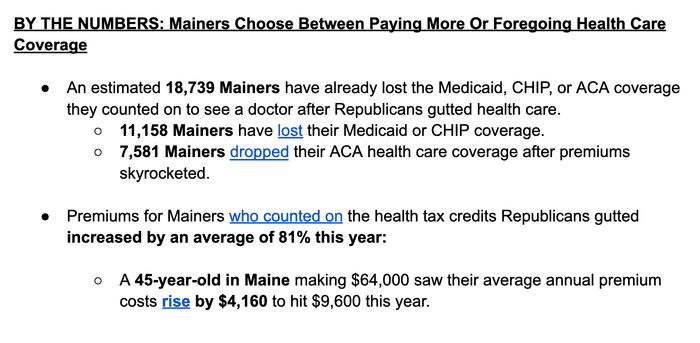
In Maine, where Democrats are looking to finally unseat vulnerable Sen. Susan Collins, more than 18,700 people have lost Medicaid, CHIP, or ACA coverage under the Republican budget law. Included in that total are the more than 7,500 Mainers who dropped ACA marketplace coverage after premiums soared due to the lapse of enhanced subsidies at the end of 2025.

Collins voted to advance GOP budget legislation that included the devastating Medicaid cuts, but voted against final passage.

Protect Our Care noted that “Maine hospitals and clinics are facing a $38 million loss in funding and a 6.7% spike in uncompensated care demand that will affect their ability to keep their doors open.”

“As of August 2026, 20 Maine healthcare providers are at-risk, announced cuts, are closing, or have closed,” the group added.


More than 25,600 Alaskans have lost health coverage under the Republican budget law and premiums have surged by an average of 346% this year, according to Protect Our Care’s fact sheets.

US Sen. Dan Sullivan (R-Alaska), who along with Collins is seen as one of the most vulnerable Republicans this election cycle, voted for the more than $900 billion in Medicaid cuts.

“From Alaska to Florida, these people are our neighbors, our parents, our kids, and they’re sick of paying the price for Republicans’ greed,” Woodhouse said on Tuesday. “They deserve better, and in November they will demand it at the ballot box.”
Over a Month After ICE Killing in Biddeford, Maine; Grieving Family Waits for Answers

“I ask only of God and of the justice system that my son’s case be brought to light, along with the cases of the many others who have had to go through something like this,” said the father of Johan Sebastián Durán Guerrero.


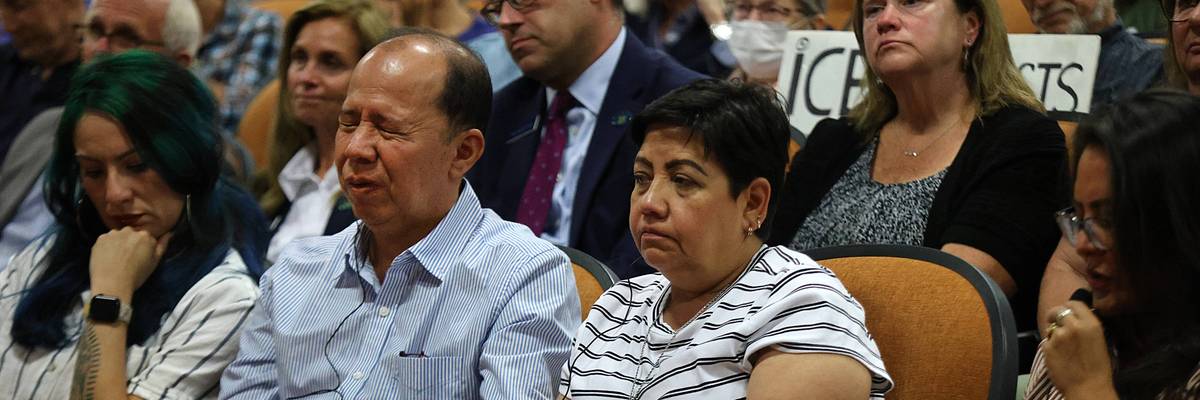
The parents of Johan Sebastián Durán Guerrero, Omar Durán and Dora Guerrero, attend a hearing at Biddeford High School on August 17, 2026.
(Photo by Suzanne Kreiter/The Boston Globe via Getty Images)

Julia Conley
Aug 18, 2026
COMMON DREAMS

With Republican lawmakers refusing to use their congressional authority to investigate a federal agent’s fatal shooting last month of Johan Sebastián Durán Guerrero in Biddeford, Maine, Democratic leaders assembled a “shadow hearing” on Monday at a local high school, where the 25-year-old’s grieving father was among those who spoke to a crowd of about 200 people and pleaded for answers about his son’s killing.

“The death of Johan Sebastián, under those conditions, at the hands of ICE, filled our community with fear and uncertainty,” said Omar Durán, referring to US Immigration and Customs Enforcement. “That is why I ask only of God and of the justice system that my son’s case be brought to light, along with the cases of the many others who have had to go through something like this.”

Durán Guerrero was at least the 11th person to be fatally shot by federal agents since President Donald Trump began deploying ICE and other agencies under the Department of Homeland Security (DHS) to cities and towns across the US to carry out his mass deportation operation.

Federal agents have shot at more than 20 people on US streets under the Trump administration; Durán Guerrero was among several who have been shot at while driving a vehicle, which is against ICE’s own policies.

Rep. Chellie Pingree (D-Maine) reported Monday that the ICE agents who were operating in Durán Guerrero’s neighborhood in Biddeford on the morning of July 13 were actually looking for his roommate, who owned the car he was driving.


Pingree said agents did not have a final removal order for the person who was the target of their operation, contrary to what DHS has said about the case.

“This shocking revelation in clear contradiction to what ICE and DHS have been saying about the operation raises fundamental questions,” Pingree said. “How is ICE deciding who to target and detain in Maine? What information are agents relying on?”

“If ICE cannot accurately determine a person’s immigration status or circumstance before taking enforcement action, that is a profound failure of competence and accountability,” the congresswoman added.

Even in cases where ICE has a deportation order for a person, agents are prohibited from using deadly force unless they have reason to believe the target of the operation poses an imminent threat to an officer’s or someone else’s safety.

An agent identified as David Michael Brouillette shot Durán Guerrero, who had a 3-year-old daughter with his partner, and DHS has claimed that the officer fired his weapon because Durán Guerrero was trying to flee and Brouillette feared “for public safety.”

The agents involved in the operation were not wearing body cameras that were turned on at the time of the shooting, but an eyewitness reported that Durán Guerrero said, “I tried to stop” when the officers pulled him out of his vehicle, bleeding profusely from his head. Surveillance footage taken from a nearby store showed a white car circling an intersection after the shooting before agents stopped it.

“If there were active body cameras on every law enforcement member who was participating there, we wouldn’t be looking at some scratchy videos from one store that’s over here, or one person that’s standing in their doorway that’s trying to get it,” Pingree said at a news conference after Monday’s hearing. “We would actually know every moment that’s happened at the scene.”

Durán Guerrero worked as a delivery driver and a cleaner at a veterinary clinic, and had a valid work permit and a pending asylum case.

A lawyer for Durán Guerrero’s family said state investigators have interviewed his partner, Karolina Rojas, but no federal agencies have ever contacted her following the killing.

“Any reasonable investigation would include interviewing the family and eyewitnesses,” the lawyer, Ben Gideon, said Monday.

DHS said after the shooting that its inspector general would investigate, but both the agency and the Justice Department refused to answer questions from The New York Times about whether the probe had begun.

The office of Maine Attorney General Aaron Frey is investigating the shooting, and is expected to present its findings to the Maine Deadly Force Review Panel. The panel can make recommendations to DHS, but it does not have jurisdiction over the federal agency.

Durán Guerrero’s parents traveled from his home country of Colombia for the shadow hearing. His mother did not speak publicly, while his father described the “deep pain” of hearing his young granddaughter ask where Durán Guerrero is.


“Our dream was always to be reunited and to hold each other again,” he said. “Today, that dream can no longer come true.”

Saturday, August 22, 2026

ICC Denounces US Sanctions as ‘Flagrant Attack’ on International Legal Order

“When judicial actors are threatened for applying the law, it is the international legal order itself that is placed at risk.”


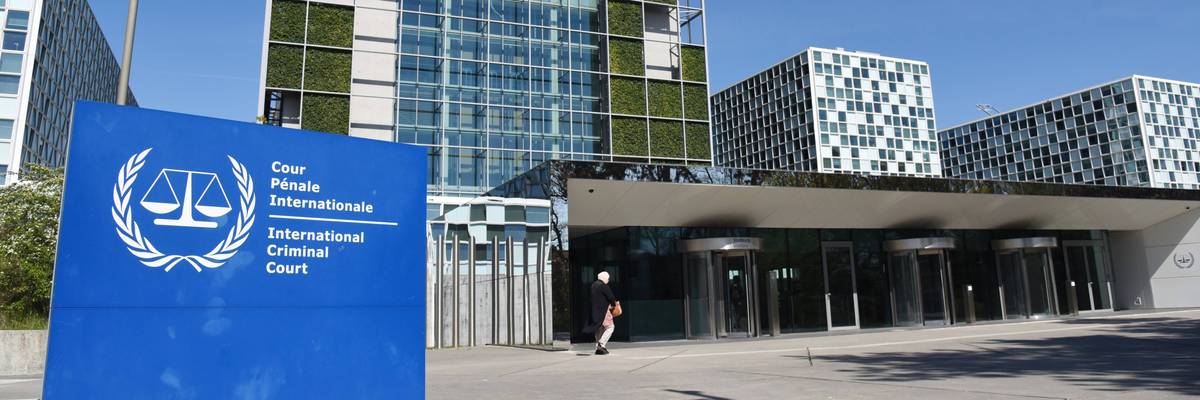
A woman walks into the International Criminal Court ICC in The Hague, the Netherlands, April 23, 2026.
(Photo by Shao Haijun/Xinhua via Getty Images)

Brad Reed
Aug 19, 2026
COMMON DREAMS


The International Criminal Court on Wednesday hit back at the Trump administration one day after US Secretary of State Marco Rubio announced new sanctions against ICC officials.

The ICC described the new sanctions, which target President Tomoko Akane and senior trial lawyer Abdoulaye Saye, as “a flagrant attack against the independence of an impartial judicial institution.”

“When judicial actors are threatened for applying the law, it is the international legal order itself that is placed at risk,” the ICC said. “Threats and coercive measures also impact the ability of victims to seek justice, as they turn to the court when all other avenues have been exhausted.”

However, the court said that it is “undeterred” from pursuing its mission, while pledging to stand “firmly behind its personnel and behind victims of unimaginable atrocities.”

In total, the US has now sanctioned half of the ICC’s 18 judges, as well as both of the court’s deputy prosecutors, a former prosecutor, and a staff member.

The sanctions on the ICC also drew condemnation from the government of the Netherlands, where the court is physically located.

In a social media post, Dutch Foreign Minister Tom Berendsen insisted that “international courts and tribunals must be able to freely carry out their mandates,” and pledged to “fully support the court and its staff.”

Balkees Jarrah, the Middle East and North Africa director at Human Rights Watch, said the sanctions were “just the latest example of the Trump administration’s utter contempt for international law and a naked attempt to shield American and Israeli officials implicated in serious crimes from justice.”

Although no American is currently under investigation or being tried by the ICC, the Trump administration has been targeting ICC officials who have been investigating alleged war crimes committed by Israel with the backing of the US government.

Saye, a target of Tuesday’s US sanctions, was charged with investigating war crimes allegedly committed by Israel during its yearslong assault on Gaza.

The Trump administration also sanctioned then-ICC prosecutor Karim Khan, who obtained arrest warrants for Israeli Prime Minister Benjamin Netanyahu and former Israeli Defense Minister Yoav Gallant for alleged war crimes and crimes against humanity in Gaza, last year.


‘Deranged Behavior’: Marco Rubio Slammed for US Sanctions on ICC President

“When you are shameless, contemptuous of international law, and morally bankrupt, you boast of disgrace as though it were an achievement,” said one critic.


Brad Reed
Aug 18, 2026
COMMON DREAMS

US Secretary of State Marco Rubio on Tuesday drew an outraged reaction from critics after he unveiled sanctions against Tomoko Akane, president of the International Criminal Court.

In announcing the sanctions, Rubio described the ICC as “a corrupt and fatally politicized” institution that has supposedly “abused its authority and exceeded its mandate.”

Rubio said the ICC “has repeatedly attempt to assert authority over... the United States and other countries that have not consented to its jurisdiction,” which he said “sets a dangerous precedent for all nations.”

In addition to sanctioning Akane, Rubio said the US would also be sanctioning ICC senior trial lawyer Abdoulaye Saye.

While Rubio did not mention what specific actions the ICC has taken to warrant such sanctions, a Tuesday report in The Guardian noted that Saye was charged with investigating war crimes allegedly committed by Israel during its years-long assault on Gaza.

The Trump administration had previously sanctioned then-ICC prosecutor Karim Khan—who obtained arrest warrants for Israeli Prime Minister Benjamin Netanyahu and former Israeli Defense Minister Yoav Gallant—and an additional eight ICC officials.

The social media account of Drop Site News accused Rubio of attacking the court solely to protect Netanyahu from war crimes prosecution, pointing out that “there is currently not a single American citizen under indictment, investigation, or facing an arrest warrant” from the ICC.

The sanctions earned the praise of the Israeli American Public Affairs Committee (AIPAC), which accused the ICC of conducting “politically motivated investigations and prosecutions targeting America and Israel.”

Rutgers Law School professor Adil Haque said the ICC sanctions showed the US was acting like a “rogue government” and engaged in “deranged behavior.”

Michael Karanicolas, law professor at Dalhousie University, didn’t just point fingers at the US over the sanctions, but at US allies who have sat back as international institutions have come under assault.

“I’m no longer surprised by the Trump administration’s efforts to destroy the ICC,” wrote Karanicolas. “What I keep waiting for is any response from Canada or the European governments who ostensibly still believe in international law to defend these institutions.”

War correspondent and international political analyst Elijah Magnier delivered a withering rebuke of Rubio’s announcement.

“When you are shameless, contemptuous of international law, and morally bankrupt,” wrote Magnier, “you boast of disgrace as though it were an achievement.”
Amnesty Warns of Right-Wing Argentinian Government’s AI-Driven Surveillance State

“When powerful people don’t want accountability, they attack those who ask questions and use whatever is at their disposal to monitor, control, and repress.”


Argentine President Javier Milei waves to supporters next to the spokesperson for the Presidency Manuel Adorni at the ruling party’s La Libertad Avanza headquarters in Buenos Aires on October 26, 2025.
(Photo by Luis Robayo/AFP via Getty Images)

Brad Reed
Aug 19, 2026
COMMON DREAMS


Amnesty International on Wednesday released a report detailing how the Argentine government under the leadership of right-wing President Javier Milei has created a massive artificial intelligence surveillance state that the human rights group described as “a techno-authoritarian infrastructure of social control.”


According to Amnesty, Argentina’s Military of National Security invested in several pieces of surveillance technology between 2024 and 2025, including licenses for Maltego, an open-source investigator platform that collects and organizes data from “social media, websites, the dark web, personal data, technical infrastructure, and other open sources”; and Clearview AI, a facial recognition platform with “a widely known track record of mass exploitation of biometric data without sufficient legal grounds.”

The government also procured drones equipped with automated tracking capabilities and thermal cameras capable of providing real-time image transmission, Amnesty found.

This surveillance state, Amnesty said, has created a “chilling effect” across the country that has reduced participation in protests and forced activists to reduce their public exposure and take further precautions when planning demonstrations.

Ana Tapia, an activist who has been protesting against pension cuts made by Milei’s government, described the government’s aggressive surveillance tactics against herself and her fellow demonstrators.

“We’ve all been fully identified for a long time now,” Tapia explained. “Sometimes as you’re walking... and suddenly you see the drone hovering just above your head. Sometimes within six feet. Why so close? Why is it so invasive?”

Matías Darabós, an activist who documents police abuses, similarly described the omnipresence of the surveillance state.

“There is a very strong feeling that you are being controlled and watched,” said Darabós. “In fact, when we go to marches to record what goes on, they are constantly pointing at us or filming us.”

Journalists described being subjected to what they believe are coordinated harassment campaigns in which they are swarmed with violent rhetoric and threats which they believe are related to increased state surveillance.

Paula Cejas, director of the Latin America Office of the International Federation of Journalists (IFJ), told Amnesty that “social media and the streets are no longer a safe space for journalists.”

“Even I myself think about what I’m going to post to the IFJ account,” Cejas explained, “what language to use so that I’m not put on a list and get us all harassed.”

Another journalist who spoke anonymously with Amnesty similarly said she had grown incredibly careful of what she posts on social media compared to the past.

“Before, I used to comment and give my opinion on everything, now I just use it recreationally,” the journalist said. “I think a lot about the words I use, I moderated my rhetoric and reduced my interaction 100%, especially on Twitter,” the platform Elon Musk renamed X.

Paola Garcia Ray, deputy director of Amnesty International Argentina, summed up the report by arguing that “pervasive surveillance is being used against Argentinians in both physical and digital spaces, to devastating effect” on civil society.

“These technologies have become an integral part of the infrastructure of state control, targeting dissent, deterring protest movements, and harassing marginalized groups, among other authoritarian practices,” Garcia Ray emphasized. “When powerful people don’t want accountability, they attack those who ask questions and use whatever is at their disposal to monitor, control, and repress.”

Milei is a political ally of US tech billionaire Peter Thiel, a co-founder of AI surveillance company Palantir whose presence in Argentina has resulted in protests demanding his ouster from the country.


Bring Back the Sears Home! Proposal Calls for 500,000 High-Quality, Affordable Starter Houses to Ease Crisis

“Policymakers must pursue creative, tangible, and lasting solutions that bring homeownership back into reach.”


A manufactured home in Syracuse, New York constructed as part of the state’s MOVE-IN NY program, on September 22, 2025.
(Photo by New York State Homes and Community Renewal)

Stephen Prager
Aug 19, 2026
COMMON DREAMS

As young families are increasingly priced out of the housing market, a group of economic researchers is pushing to revive an idea from the past to bring the distant dream of homeownership back within reach: mass-produced homes.

A report published Wednesday by the Groundwork Collaborative proposes a federal program to subsidize the creation of 500,000 prefabricated houses over the next eight years—starter homes that they estimate would be drastically more affordable than the ones currently on the market.

The report was written by three economic policy analysts who served under former President Joe Biden: Noah Ball-Burack and Emily DiVito, who worked on policy for the Treasury Department, and Alex Jacquez, who was Biden’s special assistant for economic development and industrial strategy at the White House National Economic Council.


The proposal draws from history: From 1908-40, around 75,000 Americans ordered mass-produced homebuilding kits from Sears, Roebuck & Co. through catalogs, which provided pre-cut lumber, doors, windows, and other materials to construct a home that ended up being considerably cheaper to build than those constructed conventionally.

These “Sears homes” were not only fully functional but also durable: More than 80 years after the program was discontinued, thousands of them are still standing today.


Groundwork’s researchers argued that marshaling the government’s resources, a modern Sears home program could go great lengths toward combating the housing affordability crisis.

“For too many families, homeownership has gone from a milestone to a mirage. Decades of under-building have left us with an affordable housing shortage that’s pricing people out of their communities,” DiVito said. “Policymakers must pursue creative, tangible, and lasting solutions that bring homeownership back into reach. The Modern Sears Home program does just that.”

The group called for the Congress to appropriate between $44 billion and $75 billion over eight years---less than the US spends on the military in a single month---to guarantee large orders of factory-built homes, acquire and prepare land for them, and then sell the completed houses to eligible buyers with government-backed affordable mortgages.

They estimate that factory-produced single-family homes could be sold for roughly $170,000-$215,000 each. That’s around half the median price of a new single-family home, which has increased nearly 25% since the start of the decade.

“Sears offered these homes for profit,” the researchers wrote. “The federal government—with greater resources, lower borrowing costs, and unmatched power to scale—can do it better.”

Unlike private capital, the Department of Housing and Urban Development (HUD), which would administer the program, doesn’t have a profit motive and is capable of guaranteeing large amounts of demand so that manufacturers can build scale.

And since the goal is to ensure that people are housed rather than to increase profit margins, the researchers argued that the homes are less vulnerable to the fluctuations of the housing market, which currently disincentivizes lowering rent.

“Private developers build only when projects pencil, meaning that expected rents, net of construction, and financing costs, clear the rate of return their investors demand,” the report explains. “This math ties new housing supply to high rents. If rents begin to fall, private capital will walk away.”

The researchers argued that their proposal would not just benefit those who are able to purchase new Sears homes, which HUD would target at households earning 60%-100% of a local area’s median income, but everyone in the housing market, by driving up supply.

“Sustainably lowering housing prices relative to other prices in the economy requires public investment,” they wrote. “The government can either build housing itself or finance private construction at below-market returns. It should do both.”

The proposal comes as pre-fab homes are being viewed increasingly as a policy solution to confront the housing crisis and as an opportunity for developers looking to attract young homebuyers.

Eager to build cheap starter homes fast, developers are experimenting with entire subdivisions of factory-built houses, as The Washington Post reported on Wednesday.

New York state, meanwhile, is trying out a miniature version of what Groundwork has proposed, building 1,500-square-foot homes in Syracuse, Schenectady, and Newcomb. The state has completed three homes so far and awarded funding for 211 more.

According to a 2023 report by the Harvard Joint Center for Housing Studies, these kinds of higher-end manufactured homes, known as “CrossMods,” cost 27% less on average compared to an identical home built on-site.

The ones that have gone up in New York have borne out these cost-saving projections. They took about a third of the time to construct as traditional homes and cost about $250,000 to build and install, about half the cost for a comparable house, according to the state’s affordable housing agency.


An affordable housing law that passed Congress in June also took steps toward expanding factory-built housing with a bipartisan bill passed last month that removed regulatory barriers to manufactured homes and sought to make construction easier to finance. However, the law does not provide any new federal funding for housing production.

The researchers said this was a good start that could help speed up the process of building homes. But they said it was far too narrow to really address the problem.

“It will take a government willing to act not at the margins of the market, but at its center—financing cheaply, building at scale,” they wrote. “The technology and policy levers to realize this vision already exist. The question is not whether the federal government can act at this scale—but whether it will.”
House Democrats Probe Use of Trump’s NSPM-7 to Target ‘Left-Leaning Political Groups’


“We are deeply troubled by public commitments to deploy the full force of the State and Treasury departments against loosely defined ‘far-left networks’ and their alleged ‘enablers.’”


Jessica Corbett
Aug 19, 2026
COMMON DREAMS
\
Dozens of Democrats in the US House of Representatives this week announced a congressional inquiry into the use of a widely decried memo from President Donald Trump to persecute “political dissent” and target “left-leaning political groups.”

Democratic Reps. Jim McGovern (Mass.), Ayanna Pressley (Mass.), and Delia Ramirez (Ill.) revealed Tuesday that they, along with over 20 others, wrote to Secretary of State Marco Rubio and Treasury Secretary Scott Bessent earlier this month to demand answers about the recent “Ministerial on the Resurgence of Political Terrorism” and directives under National Security Presidential Memorandum 7 (NSPM-7).


‘Outrageous’: Trump Officials Investigated Left-Wing Groups After Alex Pretti Killing in Minneapolis

“Specifically, we are alarmed by the Department of State’s new ideologically driven visa restriction policy and the Department of Treasury’s pledged financial enforcement mechanisms directed against civil society,” they wrote. “These policies dramatically escalate the administration’s deliberate and targeted attempts to silence any person, organization, or institution critical of its policies and abuses of power on a global scale.”

“We are deeply troubled by public commitments to deploy the full force of the State and Treasury departments against loosely defined ‘far-left networks’ and their alleged ‘enablers’ and urge you to immediately reverse course,” the lawmakers continued. “Rather than relying on law enforcement data—which consistently identifies right-wing violent extremists and white supremacist organizations as the predominant domestic terrorism threat—this administration has instead taken actions that manufacture an ideological enemy.”

The visa policy “bars foreign nationals from entry who ‘finance, recruit, incite, or otherwise enable terrorist, violent, and criminal far-left terrorist networks’ and defines ‘far-left terrorist networks’ as those with explicit aims to ‘undermine the political foundations of free and self-governing societies,’” the letter details. “This rhetoric and policy embody the core characteristics of fascist statecraft—using the security apparatus of the state to repress and criminalize political opponents and dissenters rather than specific violent acts.”

The letter notes the impacts of the administration’s policies beyond the United States, warning that “seeking to export an ideological mandate to more than 65 countries creates a dangerous precedent that authoritarian governments will eagerly exploit to delegitimize and criminalize political dissent and justify their own crackdowns on peaceful opposition.”

“Foreign nationals fleeing political persecution abroad—including persecution by governments that label peaceful dissidents ‘leftist terrorists’ to discredit them—may find themselves barred from the United States under the very same vague and subjective standard,” the lawmakers wrote. “Expanding transnational intelligence-sharing under this ill-defined and hyper-politicized definition of violent extremism opens the door to transnational repression—including cross-border monitoring and harassment—of international activists, researchers, and political dissidents, as well as potentially any individual within their networks.”

“We also risk fracturing critical alliances with governments whose own laws strictly protect political speech, civil liberties, and human rights—protections that these very policies are undermining here at home,” the Democrats stressed.

The letter also calls out White House Deputy Chief of Staff Stephen Miller’s description of leftists as “the enemies of civilization” and a “cancer” that can “destroy a society,” as well as Bessent’s comparison of leftists to the Islamic State and al-Qaeda—when he said that “the unified front between international Marxism and the radical Islamic movement need not share the same ultimate vision to share the same immediate enemy of free and self-governing societies.”

Rubio has similarly called leftists “the enemies of civilization” and recently faced criticism for a “McCarthyite” State Department report claiming that the Cuban government has, for decades, “infiltrated the highest reaches of the US government, recruited and cultivated generations of American activists, backed an unprecedented wave of left-wing terrorism on American soil, and carried out one of the most durable and damaging foreign intelligence penetrations in American history.” The document is seen as a signal that Trump may deliver on his threat to try to take over the island nation by force.