The question is not only how many seats we create, but what those seats make possible and whether we are willing and able to build the systems needed to sustain them.
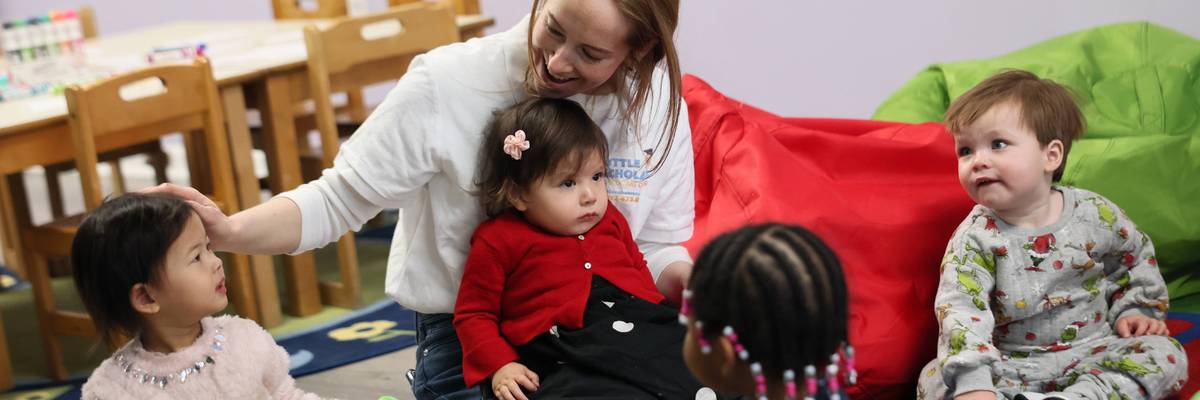
Students from Little Scholars await the arrival of New York City Mayor-elect Zohran Mamdani on December 11, 2025 in New York City.
(Photo by Michael M. Santiago/Getty Images)
Joaniko Kohchi
Aug 22, 2026
Aug 22, 2026
Common Dreams
Imagine 2-year-old Malek, growing up in an Arabic-speaking home, entering childcare for the first time. At home, language carries feeling, memory, and family connection. In care, it may be the first time he learns that only one language is recognized and that the other must stay behind. As New York City expands care for 2-year-olds, the public conversation has largely centered on key logistics: seats, speed to implementation, and salaries for home-based providers. Another fundamental question is how this expansion will shape children’s relationships to language, community, and belonging, especially for multilingual families whose experience with formal education is associated with estrangement from their home culture and language.
For decades, growing up with more than one language was wrongly framed as a deficit; it was once described as “semilingualism.” A large body of research has documented the social, communicative, and educational benefits of multilingualism, including stronger connections to family and community, and broader cultural and economic opportunities. The evidence is clear: Multilingualism is an asset, not a liability, supporting not only how children learn, connect, and participate in the world, but also adding to their professional pathways in the future.
Anyone who works in education knows the pattern of language loss that begins when a child enters the school system. Over time, heritage languages begin to fade, a loss that is often normalized as an inevitable part of schooling and assimilation. Research, including our own, shows that heritage language attrition follows a predictable pattern when children enter settings where one language dominates socially and institutionally, causing the dominant language to expand at the expense of the other. This is not only a cultural issue; it is foundationally developmental. Sustained exposure to both languages supports more stable language development, while early shifts away from the heritage language can disrupt that balance.
In one of the most linguistically diverse cities, we continue to reproduce monolingualism despite overwhelming evidence of the benefits of multilingualism. New York City’s 2-K program, with its focus on community- and home-based providers, is significant not only for expanding access, but for reshaping how early education is experienced. These programs, and their providers, who are often members of the same community as the families, offer services that are qualitatively different from formal institutional care, offering environments where language, culture, and relationships are not separated from learning, but are its foundation. They are truly a child’s home away from home.
Taken together, the expansion of 2-K home-based care can reshape how language, culture, and education interconnect as a foundation for learning.
In home-based settings, children are more likely to hear and use multiple languages in meaningful, everyday interactions with caregivers and children across ages. Care is organized around relationships and participation, rather than standardized expectations of academic performance. These are not incidental features. They are developmental conditions that support how language is sustained, how children come to belong, and how communities reproduce themselves across generations.
If supported intentionally with professional development opportunities, mentorship, and resources, these community environments could play a critical role in addressing one of the most persistent and overlooked challenges in US education: the systematic erosion of heritage languages beginning in early childhood. One proven way to enhance language development in home-based settings is strengthening the quality of adult-child interactions. In a randomized controlled trial we conducted in linguistically diverse communities, we found that babies in home-based child care vocalized far more when their providers used a program designed to strengthen relationships than did babies in the control group. We also found that the program led to reductions in background noise (such as television and other electronic sounds).
Together, these transformations in the babies’ language environment point to a simple lesson: When caregivers are intentionally supported in building warmer, more responsive interaction patterns, children’s language environments improve in measurable ways. This matters because early language development lays the groundwork for school and lifelong success. Providers can be supported to embed language-rich emotionally responsive interactions across home and care settings, and to facilitate collaboration between families and early learning environments. This potential will not realize itself; it requires deliberate investment.
In addition, home-based settings may address a critical gap in New York’s Early Intervention (EI) system. EI under federal law, is intended to provide support early in a child’s life, before small differences become larger barriers. Each state defines its own criteria. In New York, children with mild delays in a single developmental area, such as communication, often do not qualify for services. The result is inequity: Families with resources turn to private providers, while others must wait until delays become severe enough to meet eligibility thresholds. What is intended as early intervention becomes, in practice, delayed access.
Language can also be supported through family-centered approaches that sustain bilingual exposure when designed from a strengths-based perspective. In our work with Arab American families in New York, this meant creating community-based spaces where parents strengthened their children’s bilingual language use and their own sense of belonging, along with a renewed commitment to bilingualism, and greater confidence in navigating and engaging with public institutions such as libraries and educational spaces. In clinical treatment settings, birth-to-five therapists strive to provide both treatment and supervision in the home languages; it is simply best practice.
As early care becomes more widely available for younger children, providers in these settings are increasingly positioned to notice differences in children’s development, support social participation, and guide families toward resources. This requires ongoing professional support, not only in developmental frameworks, but in approaches that are culturally grounded, transdisciplinary, inclusive, and evidence-based. This means building an interprofessional, holistic, and community-based system of care that brings speech-language pathologists, early childhood educators, mental health professionals, and other healthcare providers to work alongside home-based caregivers and families collaboratively as partners embedded in the same communities.
Evidence from community-based programs shows that when caregivers are supported in building responsive, relational environments, children’s communication skills increase. They grow not through more instruction, but through more meaningful engagement. The question, then, is not only how many seats we create, but what those seats make possible and whether we are willing and able to build the systems needed to sustain them. Home-based providers are already embedded in the communities they serve, often sharing language, culture, and lived experience with families. With intentional and focused support, they will be uniquely positioned to sustain children’s languages, relationships, and development. Without it, expansion risks reproducing the very inequities it seeks to address.
Taken together, the expansion of 2-K home-based care can reshape how language, culture, and education interconnect as a foundation for learning. This direction challenges approaches that pathologize differences and individualize the effects of poverty. It offers a possibility we can realize in New York, where children thrive without giving up who they are, and systems, not families, are accountable.
For Malek, this means entering childcare without being pulled away from his language, home, and identity. Arabic does not stop at the classroom door; it lives in caregivers’ voices and neighborhood interactions. His mother is not measured against narrow expectations of “engagement,” but recognized as a partner in his learning through everyday interactions grounded in their culture. She is not positioned as lacking. Malek does not have to choose between belonging and opportunity because he grows within both.
Our work is licensed under Creative Commons (CC BY-NC-ND 3.0). Feel free to republish and share widely.
Reem Khamis
Dr. Reem Khamis is professor of communication sciences and disorders at Long Island University Brooklyn and director of the Culture, Language, and Society (CLaS) Lab. Her research focuses on Arabic language development, culturally responsive clinical practice, and equity in communication sciences. She has led community-based research with Arab American families in New York City on heritage language maintenance and bilingualism, and co-led randomized controlled research in home-based childcare demonstrating how strengthening caregiver-child interactions improves infants' and toddlers' language environments. She is managing co-editor of the Journal of the Critical Study of Communication and Disability and chair of the American Speech-Language-Hearing Association's Middle East and North Africa (MENA) Caucus.
Full Bio >
Imagine 2-year-old Malek, growing up in an Arabic-speaking home, entering childcare for the first time. At home, language carries feeling, memory, and family connection. In care, it may be the first time he learns that only one language is recognized and that the other must stay behind. As New York City expands care for 2-year-olds, the public conversation has largely centered on key logistics: seats, speed to implementation, and salaries for home-based providers. Another fundamental question is how this expansion will shape children’s relationships to language, community, and belonging, especially for multilingual families whose experience with formal education is associated with estrangement from their home culture and language.
For decades, growing up with more than one language was wrongly framed as a deficit; it was once described as “semilingualism.” A large body of research has documented the social, communicative, and educational benefits of multilingualism, including stronger connections to family and community, and broader cultural and economic opportunities. The evidence is clear: Multilingualism is an asset, not a liability, supporting not only how children learn, connect, and participate in the world, but also adding to their professional pathways in the future.
Anyone who works in education knows the pattern of language loss that begins when a child enters the school system. Over time, heritage languages begin to fade, a loss that is often normalized as an inevitable part of schooling and assimilation. Research, including our own, shows that heritage language attrition follows a predictable pattern when children enter settings where one language dominates socially and institutionally, causing the dominant language to expand at the expense of the other. This is not only a cultural issue; it is foundationally developmental. Sustained exposure to both languages supports more stable language development, while early shifts away from the heritage language can disrupt that balance.
In one of the most linguistically diverse cities, we continue to reproduce monolingualism despite overwhelming evidence of the benefits of multilingualism. New York City’s 2-K program, with its focus on community- and home-based providers, is significant not only for expanding access, but for reshaping how early education is experienced. These programs, and their providers, who are often members of the same community as the families, offer services that are qualitatively different from formal institutional care, offering environments where language, culture, and relationships are not separated from learning, but are its foundation. They are truly a child’s home away from home.
Taken together, the expansion of 2-K home-based care can reshape how language, culture, and education interconnect as a foundation for learning.
In home-based settings, children are more likely to hear and use multiple languages in meaningful, everyday interactions with caregivers and children across ages. Care is organized around relationships and participation, rather than standardized expectations of academic performance. These are not incidental features. They are developmental conditions that support how language is sustained, how children come to belong, and how communities reproduce themselves across generations.
If supported intentionally with professional development opportunities, mentorship, and resources, these community environments could play a critical role in addressing one of the most persistent and overlooked challenges in US education: the systematic erosion of heritage languages beginning in early childhood. One proven way to enhance language development in home-based settings is strengthening the quality of adult-child interactions. In a randomized controlled trial we conducted in linguistically diverse communities, we found that babies in home-based child care vocalized far more when their providers used a program designed to strengthen relationships than did babies in the control group. We also found that the program led to reductions in background noise (such as television and other electronic sounds).
Together, these transformations in the babies’ language environment point to a simple lesson: When caregivers are intentionally supported in building warmer, more responsive interaction patterns, children’s language environments improve in measurable ways. This matters because early language development lays the groundwork for school and lifelong success. Providers can be supported to embed language-rich emotionally responsive interactions across home and care settings, and to facilitate collaboration between families and early learning environments. This potential will not realize itself; it requires deliberate investment.
In addition, home-based settings may address a critical gap in New York’s Early Intervention (EI) system. EI under federal law, is intended to provide support early in a child’s life, before small differences become larger barriers. Each state defines its own criteria. In New York, children with mild delays in a single developmental area, such as communication, often do not qualify for services. The result is inequity: Families with resources turn to private providers, while others must wait until delays become severe enough to meet eligibility thresholds. What is intended as early intervention becomes, in practice, delayed access.
Language can also be supported through family-centered approaches that sustain bilingual exposure when designed from a strengths-based perspective. In our work with Arab American families in New York, this meant creating community-based spaces where parents strengthened their children’s bilingual language use and their own sense of belonging, along with a renewed commitment to bilingualism, and greater confidence in navigating and engaging with public institutions such as libraries and educational spaces. In clinical treatment settings, birth-to-five therapists strive to provide both treatment and supervision in the home languages; it is simply best practice.
As early care becomes more widely available for younger children, providers in these settings are increasingly positioned to notice differences in children’s development, support social participation, and guide families toward resources. This requires ongoing professional support, not only in developmental frameworks, but in approaches that are culturally grounded, transdisciplinary, inclusive, and evidence-based. This means building an interprofessional, holistic, and community-based system of care that brings speech-language pathologists, early childhood educators, mental health professionals, and other healthcare providers to work alongside home-based caregivers and families collaboratively as partners embedded in the same communities.
Evidence from community-based programs shows that when caregivers are supported in building responsive, relational environments, children’s communication skills increase. They grow not through more instruction, but through more meaningful engagement. The question, then, is not only how many seats we create, but what those seats make possible and whether we are willing and able to build the systems needed to sustain them. Home-based providers are already embedded in the communities they serve, often sharing language, culture, and lived experience with families. With intentional and focused support, they will be uniquely positioned to sustain children’s languages, relationships, and development. Without it, expansion risks reproducing the very inequities it seeks to address.
Taken together, the expansion of 2-K home-based care can reshape how language, culture, and education interconnect as a foundation for learning. This direction challenges approaches that pathologize differences and individualize the effects of poverty. It offers a possibility we can realize in New York, where children thrive without giving up who they are, and systems, not families, are accountable.
For Malek, this means entering childcare without being pulled away from his language, home, and identity. Arabic does not stop at the classroom door; it lives in caregivers’ voices and neighborhood interactions. His mother is not measured against narrow expectations of “engagement,” but recognized as a partner in his learning through everyday interactions grounded in their culture. She is not positioned as lacking. Malek does not have to choose between belonging and opportunity because he grows within both.
Our work is licensed under Creative Commons (CC BY-NC-ND 3.0). Feel free to republish and share widely.
Reem Khamis
Dr. Reem Khamis is professor of communication sciences and disorders at Long Island University Brooklyn and director of the Culture, Language, and Society (CLaS) Lab. Her research focuses on Arabic language development, culturally responsive clinical practice, and equity in communication sciences. She has led community-based research with Arab American families in New York City on heritage language maintenance and bilingualism, and co-led randomized controlled research in home-based childcare demonstrating how strengthening caregiver-child interactions improves infants' and toddlers' language environments. She is managing co-editor of the Journal of the Critical Study of Communication and Disability and chair of the American Speech-Language-Hearing Association's Middle East and North Africa (MENA) Caucus.
Full Bio >
Chin R. Reyes
Dr. Chin R. Reyes is assistant professor at the Yale Child Study Center and executive director of the Climate of Healthy Interactions for Learning & Development (CHILD) Program. She is an applied developmental psychologist by training. Dr. Reyes’ scientific work centers around the application of developmental science to inform and improve educational practice, programming, and social policymaking. Dr. Reyes serves as expert panelist on several research study committees and advisory board councils around issues of quality and equity in early education both domestically and globally. Her primary area of interest is the promotion of social and emotional learning skills in young children. She is executive director of the Climate of Healthy Interactions for Learning & Development (CHILD) Lab at the Yale Child Study Center.
Full Bio >
Joaniko Kohchi
Joaniko Kohchi is director of the Institute for Parenting at Adelphi University and president of the Alliance for the Advancement of Infant Mental Health. Ms. Kohchi is a clinical social worker with broad experience in multiple domains of infant- and child-serving systems and the interventions that contribute to healthy development and trauma resolution. She is endorsed as an Infant and Early Childhood Mental Health Clinical mentor, and enjoys teaching, training, supervising, consulting, and supporting programming for parents and caregivers of young children, as well as providing dyadic trauma treatment for families in need. As director of the Institute for Parenting at Adelphi University, Ms. Kohchi has contributed to the design and implementation of consultative services that support professional frameworks in early care and education, working closely with programs across the five boroughs and Long Island.
Full Bio >

No comments:
Post a Comment