Monday, February 17, 2020

Drought slashes Australian crop output to record low
Sydney (AFP) Issued on: 18/02/2020


Australia's hottest and driest year on record has slashed crop production, with summer output expected to fall to the lowest levels on record, according to official projections released Tuesday.

The country's agriculture department said it expects production of crops like sorghum, cotton and rice to fall 66 percent -- the lowest levels since records began in 1980-81.


"It is the lowest summer crop production in this period by a large margin," Peter Collins, a senior economist with the department's statistical body ABARES told AFP.


Early February downpours are likely to have come too late to help farmers.

Swathes of Australian farmland have suffered three or more years of drought. But 2019 saw rainfall below the previous record low set in 1902 and average temperatures 0.2 degrees Celsius (0.4 degrees Fahrenheit) above the previous warmest year in 2013.

The fall in the summer forecast follows a drop of winter crops -- which includes wheat, a major cash crop -- by an estimated five percent.

Australia is one of the world's leading agricultural producers, with the sector making up around three percent of total GDP.

The climate-change-fuelled drought also exacerbated a bushfire season that ripped through more than 10 million hectares (25 million acres) of tinder-dry landscape in Australia's south and east, killing 33 people.


© 2020 AFP
Timea will take your orders now: Kabul eatery first in Afghanistan to use robot

“Other restaurants may also introduce the same technology soon. Also, we have not fired any of our waiters to replace them with Timea.”


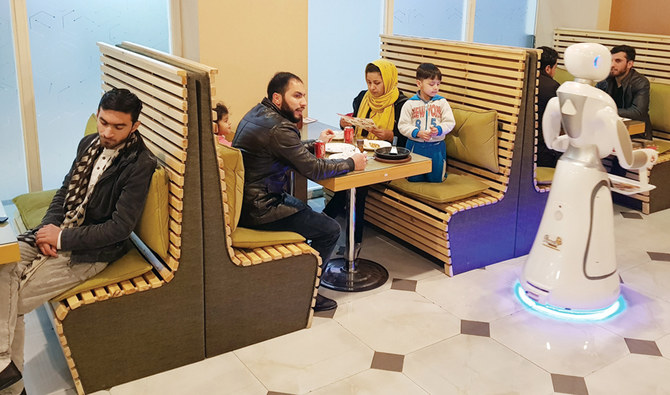
Weighing 30 kg, the petite 1.5-meter-tall robot has been designed to give the impression that she is wearing a headscarf. (AN photo by Sayed Salahuddin)
Short Url https://arab.news/8gfaf


Updated 16 February 2020

SAYED SALAHUDDIN
February 16, 2020

After taking an order and serving customers, Timea thanks them in audio messages

KABUL: A Kabul restaurant has become the first in Afghanistan to use a robot as its waiter, drawing flak from experts focusing on rampant joblessness in the country.

However, that hasn’t stopped regular and new diners from visiting the Times Restaurant, with its owners saying their cash registers haven’t stopped ringing since Timea began work last week.

Standing 1.5 meters tall and weighing 30 kg, the petite white and grey robot has been designed to give the impression that she is wearing a hijab or headscarf, and only serves women and families in the segregated section of the hotel, Mohammad Rafi Sherzad, the restaurant’s manager, told Arab News.

“It takes orders, processes it, serves food and delivers and bills the customers. It is a technological renovation here. We have regular customers, but new ones are also visiting to see the robot, too,” Sherzad said.

After taking an order and serving customers, Timea thanks them in audio messages that are prerecorded in Dari and Pashto, two of Afghanistan’s main languages.

And she doesn’t even take a tip.

“We usually go to other restaurants, but today came to see the robot,” said Mohammad Ajmal Raskh, a civil servant who visited the eatery with his wife and two children.

Another diner, school student Asadullah, said he was “thrilled” to see the robot in action.

“Hospitals and clinics could use this technology, too, based on their requirements,” he told Arab News.

However, in a country grappling with growing poverty, a high rate of joblessness and major power cuts, the use of the robot has drawn criticism, with experts saying it is a “ridiculous” move.

“This is unnecessary, perhaps, ridiculous and counter-productive, because 65 percent of people live below the poverty line, some barely live on a dollar a day, and the unemployment rate is very high. The restaurant owner should have dedicated it to a university for research,” Mohsin Amin, an analyst, said.

Sherzad, however, is taking the criticism in stride.

“Other restaurants may also introduce the same technology soon. Also, we have not fired any of our waiters to replace them with Timea.”


One fast-food restaurant in Afghanistan recently made a buzz by employing a robot as a waiter. Source: @IsmailHotak1

AFGHANISTAN - 02/17/2020
Afghanistan has its first robotic waiter – but is that a good thing?

One fast-food restaurant in Afghanistan recently made a buzz by employing a robot as a waiter. Many customers duly headed to the Times Restaurant in Kabul to see this high-end tech in action. Interestingly, just by having this robot in Afghanistan's capital as a waiter has highlighted some of the concerns among the country's conservative families. For example many of these families have not been happy with having male waiters, so this robot waiter has solved a problem.

Four months ago, Mohammad Naeimi opened the Times Restaurant in the Shahr-e-Now neighbourhood of Kabul. Then one month ago, he equipped his restaurant with a secret weapon: a robot.

'Everyone’s happy with this robot'

Naeimi claimed he imported this robot from Japan:

Our restaurant is not that big but we have 40 workers. Employing a robot was partly to attract the younger generation to our restaurant and to show them that it is possible to have new tech in Afghanistan too.

We wanted to familiarise them with new technolgies. This robot can welcome the customers, take their order, bring the order, give them the bill, receive the payment and also collect the dishes. It can manage eight tables at the same time, and it can speak in Persian, Pashtun and English. Its battery lasts for about 12 hours and then it has head to the charging station.
News about this robot has been everywhere on Afghan media and has even been covered by international media, such as Radio Free Europe. However many Afghans question the motivations behind employing a waiter robot in a country with 25 to 30 percent unemployment. The restaurant owner says he has not fired anyone for a robot’s job and it is just assistance to the restaurant's workers.

The Times Restaurant in Kabul. Source here

'With this robot, we no longer have unhappy conservative customers in our restaurant!'

Mohammad Naeimi continues:

The robot has also solved another problem that we had with conservative families. In many cases, they do not like that a male server approaches them to take orders or anything, so with this robot, we solved that problem.

When families are here with women with a hijab, we send our robot. So now they can eat our food and we have more customers. These customers can enjoy our restaurant without any problem. Everyone’s happy! So far everything is good. And we have customers who only come here to check out our robot.
Buy a robot or pay an Afghan worker for 10 years

However, many people havemade fun of this whole idea, saying it's not a good move. Others have suggested that the restaurant could employ a woman instead of the robot.

In addition, this robot came from China, not Japan. Its official name is “Amy” and it's produced by the Suzhou Pangolin Robot Corp. The price of this Chinese robotic waiter varies online from $6,000 to $7,500 (€5,537 to €6,921). This means that this robot costs between 463,000 and 579,000 Afghani, which is equivalent to a salary for eight to 10 years for an Afghan worker

Smog veils Central Asia cities as smoky stoves choke locals
Issued on: 18/02/2020


Bishkek (Kyrgyzstan) (AFP)

Snow-capped peaks used to be clearly visible from the streets of Almaty and Bishkek, two of the largest cities in Central Asia that both lie in plains surrounded by mountains.

But now a heavy cloud of dark smog often blots out the view as air pollution regularly soars to levels comparable to those in New Delhi and Lahore, even though Almaty and Bishkek have fewer people and industries than their Indian and Pakistani counterparts.

In the Kyrgyz capital of Bishkek, a city of one million, and Kazakhstan's second city of Almaty, which is twice as large, the onset of winter prompts a surge in pollution as people burn coal and other dirty fuels in stoves to heat their homes.

One of those monitoring the situation is Kyrgyz environmental activist Kunduz Adylbekova, who experiences the problem firsthand.

In the area of small private houses where she lives on the outskirts of Bishkek, the air quality is particularly bad.

"The air here has a kind of heavy feel," said Adylbekova, a programme manager at Archa Initiative non-profit

Many locals use highly polluting stoves to heat their homes and boil water because they are not hooked up to mains gas. Large numbers of ageing cars and trucks exacerbate the situation.

In this district, readings of PM 2.5 -- a measure of fine particles in the air -- regularly reach levels that the United States Environmental Protection Agency defines as hazardous to human health.

Sometimes readings are four times higher than the EPA minimum "hazardous" level, Adylbekova said, with locals suffering the ill-effects.

"Residents are often ill, some suffer from lung problems."

- 'We feel and see it' -

The bowl-shaped topography of both cities helps trap pollution.

Even worse, both have coal-fired power stations that date back to the Soviet era.

But other factors have led to a massive increase in the smog problem over the last two decades.

In Almaty, where gleaming skyscrapers reflect the country's oil wealth, many cite the huge growth in the number of cars since the breakup of the USSR.

Zhalgas Jakiyanov, a marketing specialist who works in the business district, said the growing pollution is "already having an effect on our health."

"We don't just feel it -- we can see it," he added, pointing to the leaden smog cloud that hangs over the city.

"We need to switch to gas heating instead of using solid fuels. There needs to be more emphasis on spaces for pedestrians," Jakiyanov said.

Smog also afflicts the capitals of former Soviet republics to the south, Uzbekistan and Tajikistan.

- Declare an emergency! -

While environmental groups have long sounded the alarm, now that people can easily access real-time air quality measurements online, pollution has become a talking point, particularly on social media.

Governments have been slower to acknowledge the problem, however.

This month, an online petition demanding that Almaty's authorities declare the poor air quality as an emergency gained 17,000 signatures on the first day.

The city administration responded by saying that it is looking into ways to modernise the main coal-burning power station to make it less polluting. However it said no decision on the upgrade will be made until the end of the year and ignored calls for an independent assessment of the plant.

Power stations account for just over a quarter of total emissions, the city administration said, while exhaust fumes from vehicles make up some 50 percent.

In Kyrgyzstan, authorities rely on Russian energy giant Gazprom to expand its gas pipeline network into new areas of the capital in order to wean house-owners off domestic stoves.

But activist Adylbekova said her family had to pay around $500 to hook up to the network last November.

That is too much for many residents, she said.

So they continue to burn coal to heat their home and the sour smell of coal smoke lingers in the nostrils.

The city carries out regular raids on residents suspected of burning banned fuels, while Adylbekova argued this measure is "reactive, rather than a solution."

Kasymbek Kerimov, a senior inspector from Bishkek's sanitary department, led one recent raid.

He said that only residents burning toxic substances and used cooking oil -- not wood and coal -- are fined.

"These substances can cause real damage to the respiratory tract and cancers," Kerimov said.

His team fined one woman around $107 -- over half the average monthly salary -- for burning left-over fabric from the garment industry.

She complained that authorities are indifferent to the challenges faced by local residents.

"We have asked the government about (installing) mains gas and plumbing," said Baktygul Beishereva, a housewife who wore a surgical mask.

"But no one is looking out for us here."

© 2020 AFP
Anti-Islam Pegida rally meets resistance in Dresden

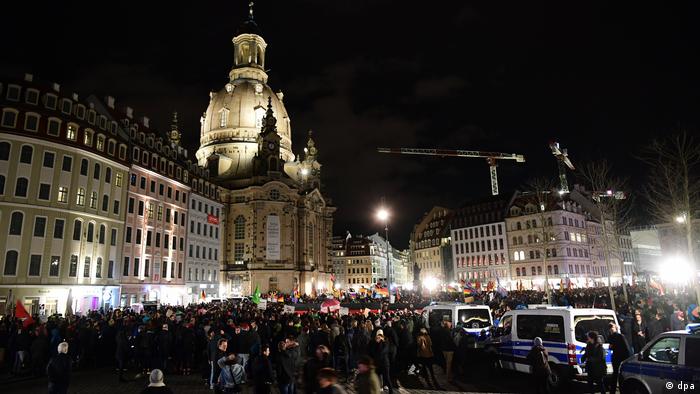
Members of the far-right xenophobic Pegida movement took to the streets of Dresden, but they didn't have the city to themselves. Thousands of counter-protesters gathered to stage a rival rally.

Thousands of people rallied in the eastern German city of Dresden on Monday to protest against Germany's anti-Islamic and xenophobic Pegida movement.

Pegida supporters, including Bjorn Hocke of the far-right party Alternative for Germany (AfD), gathered for the group's 200th demonstration in the city.

Hundreds of anti-Pegida demonstrators arrived in Neumarkt square, with posters carrying slogans such as "Red card for Nazis" and "Grandmas against the right."

Organizers of the counter-rally said earlier on Monday that they had expected around 1,000 people to attend, but 90 minutes into the event, they estimated that 2,500 people had arrived, according to German news agency DPA.

Local media reported that Pegida leaders complained and threatened to cancel planned speeches due to the level of noise from counter protesters.

Read more: Germany: Dresden declares 'Nazi emergency'

Nazi rhetoric

The Pegida movement, created in 2014, is led by Lutz Bachmann,who has previously been convicted for incitement.


Lutz Bachmann, who has been convicted for incitement, created the Pegida movement in 2014.

As one of the AfD's most contentious figures, Hocke has been accused of using Nazi rhetoric in his speeches.

tious figures, Hocke has been accused of using Nazi rhetoric in his speeches.

Pegida stands for "Patriotic Europeans against the Islamization of the West."

Local chapters of Chancellor Angela Merkel's Christian Democratic Union (CDU) and the liberal Free Democratic Party (FDP) in the state of Saxony called for a counter-rally under the slogan "Democracy needs backbone."

Both parties have the support of Saxony's Association of Jewish Communities, the Catholic Church and the Protestant Church.

State premier Michael Kretschmer, and a number of his ministers, have offered their support in a private capacity.


Bjorn Hocke has been accused of using Nazi rhetoric in his speeches.

AfD presence

AfD executive board member Alexander Wolf told the DPA news agency that Hocke's rally attendance was risky ahead of elections in the northern German city of Hamburg on Sunday.

"As legitimate as the issue may be, a demonstration does always hold risks because you cannot control who takes part," he said.


Thousands of anti-Pegida protesters took to Dresden's Neumarkt square

The Pegida movement has also had the support of Hocke in the past. In 2016, he said in a speech that: "Without them, the AfD would not be where it is."

Pegida held its first rally in Dresden in October 2014, calling for an end to the "Merkel dictatorship" and protesting against Islam and refugees

During the movement's peak, tens of thousands of people participated in Pegida rallies.

mvb/rc (dpa, EPD)

France's Alstom agrees to buy Bombardier's train division

The move would create the world's second-largest train manufacturer and a potential competitor to China's state-owned rail manufacturing behemoth. However, EU competition regulators must first give the green light.
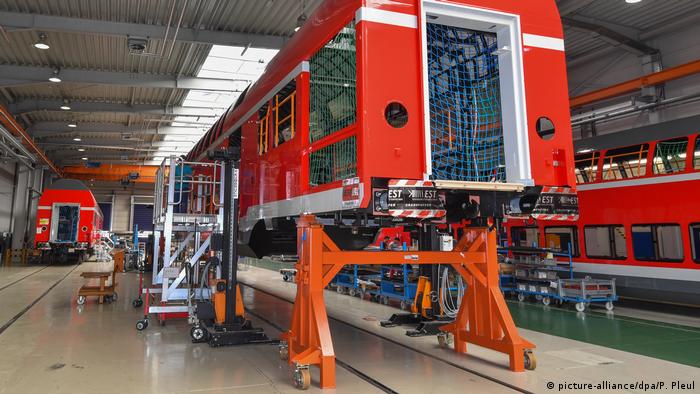
French transport manufacturer Alstom agreed Monday to buy the rail division of Bombardier, in a move that would create the world's second-largest train manufacturer.
Alstom, the manufacturer of France's high-speed TGV trains, offered to pay up to €6.2 billion euros ($6.8 billion) in a mix of cash and shares for the cash-strapped Canadian firm's rail division, according to a memorandum of understanding signed between the firms.
The acquisition must now be approved by EU competition regulators.
European train manufacturers have been trying to build scale to compete with China's state-owned China Railway Construction Corporation (CRCC), the world's largest train manufacturer.
Greenlight from Brussels?
Last year, Alstom tried to merge its rail manufacturing with that of German industrial giant Siemens, but Brussels put the brakes on the deal, ruling that a merged company would have dominated the European market at the expense of consumers.
This time around, Alstom Chief Executive Henri Poupart-Lafarge is optimistic, and said Monday that the Bombardier deal was different than that failed Siemens merger and that regulatory hurdles were "not a huge issue."
"If there are some issues, they will much easier to solve than the one we had with Siemens," he told Reuters news agency.
French Finance Minister Bruno Le Maire is due to meet with EU's competition commissioner Margrethe Vestager on Tuesday to discuss the deal.
France was critical of the EU's decision to block last year's merger attempt, and supports the potential Alstom-Bombardier merger.
"This deal will allow Alstom to prepare for the future, against the backdrop of increasingly intense international competition," Le Maire said.
German labor union rejects merger 
Germany's largest labor union, IG Metall, condemned the potential merger in a press release, and said EU anti-trust regulators should evaluate the deal in the same manner as the attempted Alstom-Siemens merger.
Germany's rail company, Deutsche Bahn, is a major customer of both Alstom and Bombardier.
If the deal goes through, the metalworkers union said it would "not accept unilateral consolidation" at the expense of German workers. 
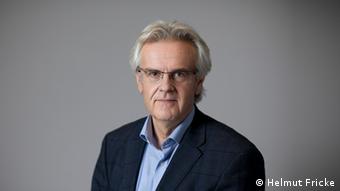
"It's an effort to create  challenger to China's CRRC, which is a behemoth of a train make. A combination of Alstom and Bombardier would get close, becoming the second biggest train maker in the world with 15.3 billion euros in sales in 2018, not quite as big as CRRC at nearly 21 billion euros, but much closer."
The deal would also help Bombardier cope with a falling share price and rising debt, Winter added.
wmr/rc (Reuters, dpa, AFP)
Opinion: Declaration of moral bankruptcy in Idlib

The USA has largely withdrawn from Syria. Europe never really got involved. The consequences are terrible — for Europe too, writes Rainer Hermann of the German daily Frankfurter Allgemeine Zeitung in a guest opinion.


A humanitarian catastrophe is taking place in Idlib, and the world is looking the other way. Photos like those taken towards the end of World War Two ought really to be a wake-up call: long treks of refugees moving northward through snow and frost to the Turkish border, where they hope to be saved. They have very few possessions still with them.

The Syrian regime, supported by Russian planes and pro-Iranian militias, is pursuing a scorched-earth strategy in Idlib. Helicopters drop barrel bombs on hospitals and schools, markets and homes. Large settlements have been depopulated and become ghost towns. The unmistakable message is: There will be no life here in future!

The Syrian war machine is driving hundreds of thousands of defenseless people before it like a steamroller. Aid organisations estimate that 290,000 of the displaced are children. Every night, some of them freeze to death. But to the Syrian regime, everyone in the province is a "terrorist." A great many of its inhabitants came to Idlib in recent years, fleeing Assad's army and henchmen. There's now no longer anywhere left for them to take refuge.

Read more: Idlib — The Syrian region abandoned by the world

Russian contempt for human life and Turkish fears

The Russian leadership is cynically participating in this contempt for human life and is permitting what Russia itself practiced in the Chechen capital, Grozny, to happen in Idlib. Meanwhile, the torture regime in Damascus has been completely discredited. Anyone who still believed they could negotiate Syria's political future with those in power there should finally ditch their naivety. Assad and the supporters of his regime want to bomb the country into one where only loyal Syrians still live, where all potential troublemakers have been driven out. But this won't bring peace to Syria.

Ankara fears that one in two of the current population of almost 4 million in the Idlib region may settle in Turkey if the border is opened. As things stand, the border is closed, sealed with a high wall. Because more refugees would destabilize Turkey — and because Europe also wants and needs to prevent another influx of refugees. This shows what power Russia has over Europe, when, as is now the case with Libya, it is sitting on a key point on a migration route.


Rainer Hermann is a political journalist at the Frankfurter Allgemeine Zeitung daily

Presidents Erdogan and Putin spoke again on Thursday, but the phone conversation brought them no closer. Turkey is embarking on a risky game. It's trying to drive the Syrian army back behind the 12 observation posts by military force. These posts were actually created to control a cease-fire for Idlib that was agreed on by Russia, Turkey and Iran.

Read more: Over 60 Germans among Islamists in Idlib

Disingenuous complaint from Germany

Turkey is not doing only itself a service with this, but Europe as well. The complaint that German weapons may also be used in this operation by the Turkish armed forces is therefore disingenuous. And when Angela Merkel offered to build winter-proof housing for 100,000 refugees in Idlib, she found herself facing a storm of outrage. Once again, Europe is helpless and powerless, even though all the values the continent stands for are being brutally bombed.

Much here is reminiscent of the war in Yugoslavia, when Europe stood by helplessly, at a loss, and watched the Serbian massacres. Back then, it was only an ultimatum from the bullish American diplomat Richard Holbrooke to the Serbian dictator Slobodan Milosevic, and then targeted American bombing, that put an end to the murder of the people.

The daily actions of the Syrian regime show what happens when the United States withdraws as a force of law and order — and Europe, the self-proclaimed guardian of human rights, makes another declaration of moral bankruptcy.

RELATED CONTENT

Syria: Assad's forces 'seize' crossroad town as Turkey sends convoy into Idlib 08.02.2020

Syrian forces claim to have seized the highway junction town of Saraqeb near Idlib, capital of the last major rebel enclave in Syria. Since Friday, neighboring Turkey has dispatched 430 military vehicles into the region.


'I feel totally alone': Life under siege in Idlib 15.02.2020

Desperation and hopelessness in the midst of shelling: This is what life is like for the millions of civilians trapped in Syria's Idlib province. Mona is one of them. She shares a day in her life with DW.


Idlib — The Syrian region abandoned by the world 04.02.2020

Aided by Russia, Syrian strongman Bashar Assad has continued to indiscriminately bomb the civilian population of Idlib. People there are desperate to flee to Turkey, but Ankara has closed its borders to keep them out.


Date 15.02.2020
Author Rainer Hermann
Related Subjects Recep Tayyip Erdogan, Turkey, Syria, Russia, Vladimir Putin, Dmitry Medvedev
Keywords Idlib, Syria, Turkey, Russia, Bashar Assad, Recep Tayyip Erdogan, Vladimir Putin
Send us your feedback.
Print Print this page
Permalink https://p.dw.com/p/3XoCf
Protein-powered device generates electricity from moisture in the air

By Brooks Hays

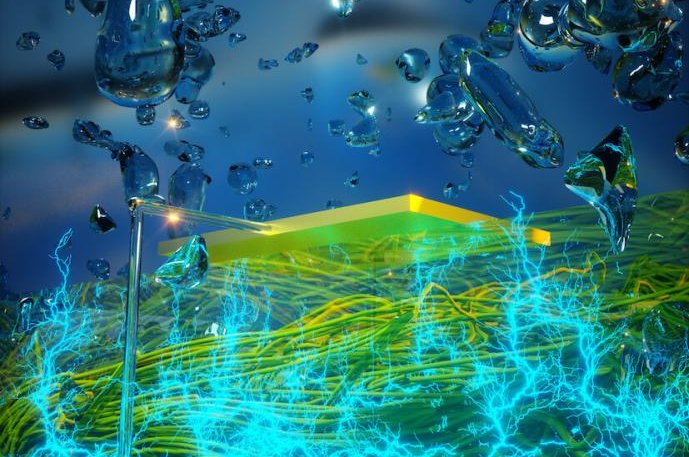
An illustration shows electric currents traveling between two electrodes as a film of protein nanowires absorbs water from the air. Photo by UMass Amherst/Yao and Lovley labs

Feb. 17 (UPI) -- Scientists have developed a new device powered by a naturally occurring protein that uses moisture in the air to generate electricity.

The so-called Air-gen technology links electrodes with electrically conductive protein nanowires synthesized by the microbe Geobacter sulfurreducens. The unique combination is capable of generating electricity from moisture that is naturally present in the air.

"We are literally making electricity out of thin air," Jun Yao, an electrical engineer at the University of Massachusetts Amherst, said in a press release. "The Air-gen generates clean energy 24/7."

The novel technology doesn't produce polluting byproducts and it is cheap to assemble. Best yet, Yao and his colleagues estimate the technology can be scaled.

RELATED Catalyst recycles greenhouse gases into hydrogen gas, fuel, other chemicals

"Connecting several devices linearly scales up the voltage and current to power electronics," researchers wrote in their paper on the technology, published Monday in the journal Nature. "Our results demonstrate the feasibility of a continuous energy-harvesting strategy that is less restricted by location or environmental conditions than other sustainable approaches."

Though the device requires moisture, it doesn't need to be all that humid for the technology to work. Lab tests showed the Air-gen device could generate electricity in places as arid as the Sahara Desert. And unlike solar cells and wind turbines, the technology isn't reliant on the weather. It can work day or night, indoors or outdoors.

To build the device, scientists placed a thin film of protein nanowires atop an electrode. Researchers positioned a second electrode on top, only partially covering the nanowires.

RELATED Neutrons, X-rays help scientists study aging process in lithium batteries

As the film absorbs water, the electrical conductivity and surface chemistry of the protein nanowires is excited. These unique properties, coupled with the porosity of the film, yield an electrical current between the two electrodes.

Once they've scaled the device, researchers hope to integrate Air-gen technology with smart watches, health monitors, phones and wearable electronics.

"The ultimate goal is to make large-scale systems. For example, the technology might be incorporated into wall paint that could help power your home," Yao said. "Or, we may develop stand-alone air-powered generators that supply electricity off the grid. Once we get to an industrial scale for wire production, I fully expect that we can make large systems that will make a major contribution to sustainable energy production."

RELATED Engineers develop thin, flexible touchscreen that can be printed like newspaper

In anticipation of the technology's commercialization, Yao's colleague Derek Lovley, a microbiologist at Amherst, has already developed a microbial strain capable of mass producing protein nanowires.

"We turned E. coli into a protein nanowire factory," Lovley said. "With this new scalable process, protein nanowire supply will no longer be a bottleneck to developing these applications."

Lovley discovered Geobacter sulfurreducens in the mud on the banks of the Potomac River some three decades ago. In his lab, he and his research partners discovered the microbe's ability to produce conductive protein nanowires.

Thirty years later and the discovery has opened up a new field of electronics research.

"This is just the beginning of new era of protein-based electronic devices" said Yao.

Catalyst recycles greenhouse gases into hydrogen gas, fuel, other chemicals

By Brooks Hays 
SCIENCE NEWS FEB. 17, 2020 / 11:30 AM


Researchers have developed a new catalyst that turns greenhouse gases into the ingredients needed to make hydrogen fuel. Photo by Korea Advanced Institute of Science and Technology

Feb. 17 (UPI) -- Scientists have developed a new catalyst that can turn greenhouse gases into hydrogen fuel and other chemicals.

Researchers and policy makers continue to hold out hope that hydrogen fuel, which doesn't emit CO2, can replace traditional fuels.


Engineers have already created a variety of ways to convert CO2 and other gases into hydrogen, but many require relatively rare and expensive elements. Other catalysts trigger brief chemical reactions, limiting their potential.

The catalyst developed by a team of researchers from Turkey, Saudi Arabia and South Korea, is longer-lasting and more economical.

RELATED New technology promises on-the-spot hydrogen fuel production

"We set out to develop an effective catalyst that can convert large amounts of the greenhouse gases carbon dioxide and methane without failure," lead study author Cafer T. Yavuz, associate professor of chemical and biomolecular engineering and of chemistry at the Korea Advanced Institute of Science and Technology, said in a news release.

The catalyst is composed of nickel, magnesium and molybdenum, all of which are abundant and relatively cheap. The catalyst, which works for more than a month, triggers chemical reactions that can convert CO2 and methane into hydrogen gas.

Previously, when researchers used nickel to catalyze reactions, carbon byproducts would accumulate, bind with nanoparticles on the surface of the catalyst and alter the reaction process.

RELATED New molecule harnesses full visible spectrum of sunlight

"The difficulty arises from the lack of control on scores of active sites over the bulky catalysts surfaces because any refinement procedures attempted also change the nature of the catalyst itself," Yavuz said.

For the new catalyst, scientists paired nickel-molybdenum nanoparticles with a single crystalline magnesium oxide, both sealed in a reductive environment, which is an environment free of oxygen and other oxidizing gases.

When heated with a reactive gas, the nanoparticles migrated across the crystalline surface seeking clean anchoring points. The catalyst, excited by the heat, produced its own high-energy active sites, locking the nanoparticles in place. The process prevented the nickel-based catalyst from acquiring carbon buildup.

RELATED Study details how hydrogen causes embrittlement of steels

"It took us almost a year to understand the underlying mechanism," said study author Youngdong Song, a graduate student in the department of chemical and biomolecular engineering at KAIST. "Once we studied all the chemical events in detail, we were shocked."

Because the nanoparticles bind continuously to the edge of the single-crystalline magnesium oxide, there are no breaks or deformities along the surface to disrupt the reaction process. As a result, the chemical reactions are precise and predictable.

Scientists dubbed the novel method "Nanocatalysts On Single Crystal Edges," or NOSCE.

The "technique could lead to stable catalyst designs for many challenging reactions," scientists wrote in their paper on the discovery, published in the journal Science.
Tesla's Berlin 'Gigafactory' halted by forest protection

A German court has halted the clearing of thousands of trees to make room for Elon Musk's electric car factory south-east of Berlin. Green groups forced the stop, just days after the felling began.


A German court has ordered the temporary halt of the development of a Tesla development site in a forest outside of Berlin.

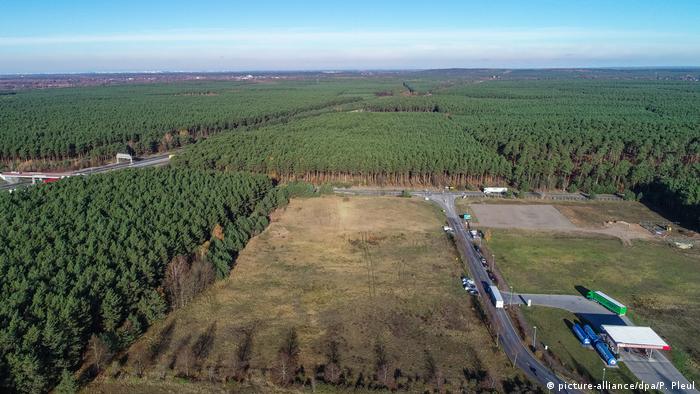
The Higher Administrative Court of Berlin-Brandenburg (OVG) ruled late on Saturday that it must first consider an appeal from the Green League Brandenburg, an environmental protection association, against the tree felling.

Environmental organizations became outraged once the cutting of trees over 91 hectares of forest commenced Thursday.

The Green League called for an immediate stop to the felling and had filed an emergency appeal on Friday to put a stop on the construction of Elon Musk's "Gigafactory."

"We are calmly awaiting the decision of the OVG," government spokesman Florian Engels said on Sunday. "This will be taken for granted," he added.

"We then focus on the timely decision of the OVG," minister of economics in the German state of Brandenburg Jörg Steinbach wrote on Twitter.

Court to consider appeal

The court said that the "already advanced" work at the forest would have been "completed within three days" and so decided on imposing a temporary halt. The court added it would not assume that the Green League's appeal "was obviously hopeless from the outset."

The US electric car giant wants to start production in Grünheide in Brandenburg as early as the middle of next year.

On Thursday, Germany's environment ministry had given Tesla permission to begin work "at its own risk."

The car manufacturing company initially wants to produce 150,000 electric vehicles per year in Grünheide. Later, annual production could rise to 500,000 vehicles. Up to 12,000 workers will be hired at the factory.

The final construction permit has not yet been issued. According to the environment ministry, complaints against the factory can still be filed up until March 5. After that, the final permit will be reviewed.

Wildlife threats

The state of Brandenburg sold Tesla the 300-hectare site in Grünheide for almost €41 million ($44 million).

In the next month, the area will be searched for any waste deposits or explosive artillery from the Second World War.

The German government also recently announced that protected animals in the forest will be "recovered and moved to suitable locations" by April.


Opinion: Tesla's Germany plans are no coincidence


In typical Elon Musk style, he almost casually announced plans to build the European Tesla factory on the outskirts of Berlin. For German carmakers the plans have come just at the right time, says DW's Henrik Böhme.


Let's pretend for a moment that Berlin's huge new airport has been operational for some time. Then, the new Tesla factory could have even been built on the site of the old Tegel airport — and thus in Berlin itself.

But it seems that the rumors about the Berlin-Brandenburg airport disaster — with its opening delayed until at least next year — has spread to Tesla's board room because the hectic and not uncontroversial Elon Musk could not resist cracking a joke at its expense. Tesla certainly aims to get its new factory finished much faster than the troubled airport's planners (construction began in 2006).

The new Tesla facilities — called a Gigafactory because Elon Musk always likes to go one bigger — will now be built in a little-known place called Grünheide, to the southeast of Berlin, close to what may be, eventually, the new airport. Above all, it is being built in the state of Brandenburg, which means the neighboring state and city of Berlin will miss out on any trade taxes generated from the project.

Speed is of the essence

The interstate rivalry probably doesn't much interest Musk, unless he simply doesn't trust the Berliners to be quick enough. Despite its tiny size, Berlin still has plenty of space to settle, especially in the eastern part. But Musk is in a hurry, and the new factory must be built fast.

Why? Because Germany's car manufacturers have (finally!) recognized the sign of the times and are stepping up their investment in electric-powered cars. And I'm sure Musk must have noticed that Volkswagen, a little over a week ago, gave the go-ahead for its own electric car factory in Zwickauin the Eastern state of Saxony. Once the plant is retrofitted from combustion-engine to electric car production in 2021, the world's largest auto manufacturer wants 330,000 purely electric-powered vehicles to run off its production lines every year.


DW business editor Henrik Böhme

But that's not all: two other VW facilities in Germany are just starting to be retrofitted, and VW is now also adding electric car factories in China and the United States.

If Tesla was initially a laughing stock, it will soon be a serious competitor to Germany's automakers. The ambitious startup has had problems with mass production and is carrying around a gigantic mountain of debt. So if VW, the world's largest volume manufacturer — besides Toyota — enters the fray in such an ambitious way, albeit belatedly, then this is a serious threat for Tesla. Therefore, Musk's decision to build a plant in Germany must be seen as a declaration of war.

Read more: Brandenburg in Eastern Germany happy to get a Tesla Gigafactory

New jobs at the right time

Even the so-called luxury car segment, in which Tesla predominantly plays, its biggest competition comes from Germany — Porsche with its Taycan, Audi with the E-Tron series and Daimler's Mercedes EQC. Even in China, where Tesla has built up its third Gigafactory in just 10 months and test production has just started, dozens of direct competitors such as Byton, Wey and Hongqi are lined up in the starting blocks. Tesla's decision to produce cars in Germany means the race for electric car supremacy is now underway in the same country where the car engine was first invented.

Despite many unanswered questions, the new factory is great news for people in the region. Several thousand new jobs will be created, and they couldn't come at a better time. Just south of the planned factory — in Lusatia — thousands of jobs are set to be lost as a result of the decision to phase out lignite (brown coal) extraction.

Bets are now being taken on which project will be finished sooner — the new Berlin airport or Tesla's German Gigafactory.

Man gives CPR to gecko found drowning in his beer

This Aussie hero saved a gecko that drowned in his beer. #9Today pic.twitter.com/hq9ISgv9Av— The Today Show (@TheTodayShow) February 16, 2020