Tuesday, February 18, 2020

Russians rally against torture after verdict against ‘terrorist cell’

There is reason to suspect that key confessions in the "Network" case were extracted by torture

Posted 15 February 2020
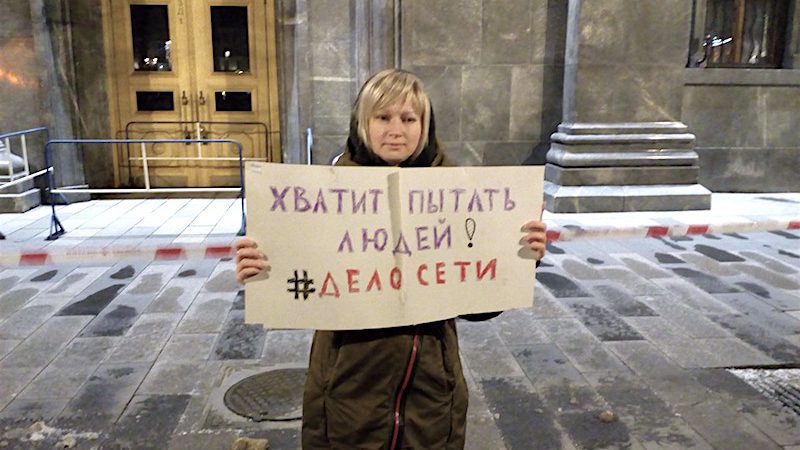
“Stop torture! #NetworkCase” reads this protester's placard outside the FSB headquarters in Moscow, February 14, 2020. Photo (c): Marc Bennetts. Used with permission.

A trial in the Russian city of Penza, south-east of Moscow, has brought a close to one of the country's most disturbing criminal cases of recent years. On Monday 10, seven anarchists and anti-fascists were sentenced to long prison sentences under Article 205.4 of Russia's criminal code, concerning “participation in terrorist activities,” along with several drugs and weapons charges. The youngest, Ilya Shakursky, is just 23 years old; the oldest, the musician Vasily Kuksov, is 31. Their prison sentences range from six to 18 years. The length of these sentences, which amounts to 87 years overall, have shocked the country — the 18 years handed to Dmitry Pchelintsev is longer than some sentences received by convicted murderers in Russia.

The “Network Case,” named after the terrorist group to which the young men are alleged to belong, has prompted a nationwide discussion about the use of torture by Russia's law enforcement bodies. Prominent human rights defenders argue that key evidence for the existence of “The Network” was obtained through torture. Over the past week, hundreds of protesters have held solitary pickets outside the headquarters of the FSB, the Russian security services, in Moscow and several other cities. They have launched an online flashmob under the hashtags #делосети (the Network case), #мывсевсети (we are all Network), #судебныйбеспредел (lawless courts), and #НетПыткам (no to torture.)


Пыточное дело “Сети” – история о страхе. Напугавшееся до истерики ФСБ хочет этими дикими сроками напугать кого-то, кого себе там в ужасе напридумывала. Но в реальности лишь убеждает народ, что ФСБ сейчас – дикая истеричка, нестабильная, недалекая и злобная

— Олег Козырев (@oleg_kozyrev) February 10, 2020


The “Network” torture case is a story about fear. Hysterically fearful, the FSB wants these harsh sentences to terrify somebody who they have conjured up in the midst of their own horrors. But in reality, all this has done is convince the people that the FSB has become wildly hysterical, unstable, myopic, and vicious.

Such accounts are not uncommon in Russia today. According to a poll by the Levada Centre last year, as many as one in ten Russians claim to have been tortured at the hands of law enforcement, while an analysis of court data in 2018 indicated that most perpetrators face only mild repercussions. The “Network” case has been marred by accusations of torture since its inception, in keeping with harsh repression of anarchists and antifascist groups in recent years.

In mid-October 2017, Yegor Zorin, a student from Penza, was arrested and charged with terrorist conspiracy. His acquaintances suggested that he had been tortured in custody, during which the first allegations of the existence of “The Network” were made. Then in January 2018, two Russian antifascists, Viktor Filinkov and Igor Shishkin, went missing in St Petersburg. Filinkov stated that FSB agents demanded that he admit to membership of a terrorist cell known as “The Network,” alongside several acquaintances from Penza, who had been arrested in 2017. He later provided a detailed testimony of torture and retracted his confession. Shishkin, on the other hand, did not make any allegations against the authorities despite a medical report indicating signs of torture. He instead pled guilty and agree with the investigators’ account of events. He received three and a half years’ imprisonment. By 2019, “The Network” was officially designated an extremist organisation.

The young men in Penza whom Filinkov incriminated were a group of local activists from Penza's anarchist and antifascist scene. According to independent publication Novaya Gazeta, there is reason to believe that several members of the group did not know one another. Other members of the accused had filmed videos of themselves playing AirSoft, which was presented by the prosecution as evidence of military training to prepare for attacks. Investigators also claimed that the group, which they claimed had cells in Belarus, St Petersburg, and Moscow, planned to target the 2018 World Cup and presidential elections in Russia, charges which were not included in the final case against them.

Several members of the group, such as Ilya Shakursky, Dmitry Pchelintsev, and Ilya Kapustin, also provided detailed testimonials of torture at the hands of FSB agents, all of which allege severe beating and electric shocks all over their bodies. Nevertheless, Russia's investigative committee repeatedly refused to open a comprehensive investigation into the allegations of torture; in 2018, officials even concluded that the bruises and electrocution marks on Kapustin's body were the result of bedbug bites.

These graphic and often disturbing testimonies have resonated with a society already deeply disturbed by state officials’ lack of accountability. The political beliefs of the convicted men have also prompted some soul-searching among the opposition about the meaning of solidarity. In March 2018, Novaya Gazeta correspondent Yan Shenkman called on Russians to understand that, whatever their political differences, the Network case sets a disturbing precedent for all citizens:

Translation
Original Quote


In St Petersburg and Moscow there are developed systems of assistance. There are independent journalists and human rights defenders. There's nothing like that in Penza. The context also matters. The Bolotnaya case, under which many left-wingers, including myself, were sentenced was important for the entire liberal-democratic opposition. It was a story which the average journalist from the capital could understand. And here are people who face extremely harsh accusations. They're not liberals. They're not Moscow activists. We need to cut through the preconceptions towards them […] This case isn't about anarchism and isn't even about antifascism, but about the fact that tomorrow, they could come for you — for whatever reason. The electric shocker doesn't distinguish between “us” and “them.”

That solidarity took some time to materialise. But over the two years since Shenkman's column, the case has come to broader public awareness. In December 2018, the celebrated theatre company Teatr.Doc staged a production based on the torture testimonies of the accused men from Penza. On 12 February, prominent academics published an open letter against the “fabricated” case, and the following day prominent opposition campaigner Alexey Navalny harshly criticised the “barbaric” court verdict on his popular YouTube channel. The following post by Dmitry Bavyrin, a journalist for the Vzglyad newspaper, is a good indication of the mood among Russia's online opposition:

Translation
Original Quote


I haven't attempted to dig into the details of the “Network” case, as I can only act as a jury on a superficial level.

Do you believe that, on messengers or over a few drinks, a group of anti-fascists and anarchists might hypothetically discuss the possibility of overthrowing the state by violent means? Yes, I can easily believe that.

Do you believe that FSB officers might apply torture to their detainees in this case? Yes, I can easily believe that?

Which of these, in your opinion, represents a greater danger to society: students’ chats about overthrowing the regime or torture in detention centres. I think it's the second one.

— Dmitry Bavyrin, Facebook, 14 February 2020

The popular video blogger Yury Dud voiced a similar sentiment, alongside a film by Yevgeny Malyshev, a journalist for the independent media outlet 7×7, about the case. It features interviews with over 40 acquaintances of the convicted men.


И обязательно посмотрите вот этот фильм. Никакой героизации подсудимых (среди них были вполне проблемные чуваки), просто пошаговое исследование дела. От этой пошаговости волосы на голове шевелятся еще сильнее https://t.co/NECTn4nTsR

— Юрий Дудь (@yurydud) February 10, 2020


You must watch this film. There's no heroisation of the defendants (among whom are some wholly problematic guys), just a step-by-step investigation of the case. And it's that step-by-step analysis which will make your hairs stand on end even more.

Unsurprisingly, some of the loudest voices raising the alarm over Monday's verdict are from the left wing of Russia's opposition — such as the activist Sergey Udaltsov and singer Kirill Medvedev. Placards held outside the FSB building in Moscow frequently featured the logo of the opposition RSD, or Russian Socialist Movement. The verdict in the “Network” case also comes at a resonant moment for Russia's antifascists — a month after the ten year anniversary of the murder of antifascist human rights lawyer Stanislav Markelov and journalist Anastasia Baburova.

Responses to the verdict also suggest that the Russian opposition is aware that whatever their political differences, the threat (and sometimes experience) of torture unites them. Comparisons to Stalinist show trials are not uncommon. On February 9, the independent politician Alexey Minyaylo posted a picture of himself holding a placard which asked the question “What would you confess to under torture?” He soon received an answer from Ildar Dadin, who in 2015 became the first Russian to be imprisoned for repeated violation of the country's draconian law on non-violent protest. Dadin, who was released in 2017, alleged brutal torture at the hands of his guards at a prison colony in Karelia, in Russia's north-west. His answer drew on this trauma:

Translation
Original Quote


Firstly, I would put the word “confessed” in quotation marks. When criminal terrorists force you to incriminate yourself under torture, that can hardly be called a confession. Secondly, they also broke me in the Karelian torture colony, through savage physical torture […] As a result, I can only say that under conditions of terror and wild, prolonged, maddening pain, I'm convinced that the overwhelming majority of people would not only say they did things they did not do; they'll invent anything, be ready to betray their NEAREST AND DEAREST (no matter how wild that sounds to ordinary people.) When you experience that maddening, ongoing pain, all your human principles and concepts, your moral compass, are all turned off. They are overwhelmed by the animal instinct which grows under that pain, which demands, screams, just one thing: end this maddening pain, which literally switches off your mind.

Russian society's attempts to make sense of this harsh verdict speak to the unease at relations with the state. As the political scientist Ekaterina Shulmann writes, draconian measures in the name of “anti-extremism” are self-defeating, and are more likely to convince ordinary Russians that there are no legal ways to express their discontent.

Perhaps, in those circumstances, the authorities are merely determined to remind the opposition that the truth is often what those in power wish it to be, however it is extracted.




Written by Maxim Edwards
The feminist translators and interpreters revolutionizing the profession in Argentina

TEIFEM was the best way for me to get closer to feminism.

Translation posted 16 February 2020 

Some members of Feminist Translators and Interpreters of 
Argentina (TEIFEM). Photo by Lía Díaz, used with permission.

Feminism is always growing and diversifying, and the need is arising for feminists to come together and create areas of common interest and practice unique forms of activism that move away from hegemonic feminism, the manifestation of the movement that is most visible to the general public.

The world of translation is no exception, and that's the reason I joined the Feminist Translators and Interpreters of Argentina (TEIFEM). We are a group of women and gender-nonconforming translation and interpreting professionals, students and teachers, who have come together in order to “speak up in favour of gender equality and to challenge the structures established within the profession” and to promote growth and solidarity amongst colleagues.


Bookmarks designed for the Mujeres colectivas book launch. Credit TEIFEM.

TEIFEM was created in May 2018, when Argentina was debating the draft bill to legalize abortion. At that time, several professional groups were voicing their support and some feminist translators wanted to do the same. Within a few hours of its creation, 100 members had joined, and 178 signatures had been collected on a letter of support. After fifteen days there were four hundred of us! There is no doubt that we very much needed something like this.

I joined TEIFEM days after its creation. A friend and colleague who was already a member recommended it to me, and it was something entirely different from what I was used to seeing in other translation groups. It was a pleasant surprise to find several acquaintances (fellow students, teachers and professionals) whom I very much respected.

It's also been a pleasure to engage with debates and questions concerning various feminist issues that are presented and explained with respect, without arrogance or belittling of others’ lack of knowledge, and by considering what we have in common when arriving at agreements.

Although the abortion law failed to muster enough votes in the Senate to be enacted, TEIFEM continued beyond its initial aim of gathering support. We therefore sought new ways to practice a different style of activism, both professionally and linguistically, through activities where we could debate the various aspects of our work.
Linguistic sexism and translation meets non-binary language

Non-binary language is another major debate that has created considerable controversy in Argentina and several other Spanish-speaking countries. Also known as inclusive language, it involves modifying the Spanish language in order to introduce a neutral gender to refer to individuals whose gender expression isn't fixed, or a group of individuals with various genders.

For example, because third person pronouns either have a feminine or masculine gender in Spanish, where the “-a” ending generally indicates feminine and the “-o” indicates masculine, it has been suggested that the neutral gender pronoun “elle/elles” be used in place of “ella/ellas” and “él/ellos” (“she/they” and “he/they”). When adjectives are used to describe nouns or pronouns it is also important that they agree with the gender of the noun or pronoun, which is why the use of alternative neutral gender characters such as “x”, “@” or “e” has been suggested for the endings indicating the gender of adjectives and nouns—”todes” as opposed to “todas” or “todos” (all/every).


During the first TEIFEM Meeting, 28 September 2019. Credit: TEIFEM.

Interestingly, it is in the field of translation and interpreting, professions practiced mainly by women, where linguistic sexism is most evident. Each time that articles or comments concerning inclusive language are published, or when it is used in a written text, the most common reactions from many translators tend to be outright rejection, and sometimes forceful jibes, insults and attacks, as can be seen in the comments of this post from Las 1001 Traducciones, a well-known page dedicated to translation that shared a news story about TEIFEM.

Although TEIFEM's members are not unified on the subject of non-binary language, we have arrived at a basic consensus on how to deal with it. Mariana Rial, one of the group's creators, summarized this perspective in the translation podcast series En Pantuflas:

Translation
Original Quote


As language professionals, we have to be mindful of these phenomenona, irrespective of what seems good or bad to people as indviduals, what they like or dislike and what they think they can or cannot use… Essentially, it's about looking at it from a professional perspective.

Personally, except for in special circumstances, I'm not in the habit of using non-binary language in daily or work communications, although I do closely monitor this phenomenon with great interest. For me, it's a way doing my part, linguistically, to highlight a social and political issue: It has nothing to do with “forcibly” changing the language, but rather with showing how language reflects the social order.

The reality is also that many publishers, LGBT+ and trans rights organizations, and even official and international bodies have already started to consider using non-binary or gender-neutral language in some of their communications. The phenomenon has become difficult to ignore, and from a practical perspective, for those of us who translate, it's way to broadens our professional horizons.
An area that is revolutionizing the profession

The practice of translation is known for being relatively lonely and highly competitive. A translator or proofreader spends many hours in front of a screen, virtually connected to the world; a simultaneous interpreter generally spends hours in a booth with a headset and notes.

At TEIFEM, we are always looking for reasons to organize meetings that remove us from this isolation, that celebrate the professional achievements of our colleagues and encourage professional solidarity.


Many TEIFEM members are also members of other feminist and human rights organizations, giving us many opportunities for collaboration and strategic exchanges of knowledge and tools in order to achieve common objectives.

One example of this is the translations done by a few colleagues for the book The tragedy of woman's emancipation and other texts, a compilation of the writings of Emma Goldman produced by Red Editorial in which non-binary language was used. Also, as part of some of our activities, we donate menstrual hygiene products to organizations that distribute them to people living on the street or in extreme poverty.


A flyer for TEIFEM's participation in the Modern Languages information seminar of the University of La Plata, 2019.

Since it began almost two years ago, TEIFEM has become a highly active community, organizing and participating in talks, seminars and meetings. Some of its members have been interviewed for news articles, podcasts and there is even a chapter to us in a book published in 2019 called Mujeres colectivas.

On the time the Spanish version of that article was published, TEIFEM had more than 1,100 members. We maintain a private Facebook group, but many of the ideas that arise within it are shared externally on an Instagram account and on Twitter using the #TEIFEM hashtag, including information, recommendations, cultural stories and a variety of feminist- and linguistically-themed activities.

Like the languages we work with, TEIFEM is active and dynamic, developing in step with these fast-changing times in order to deal with new challenges creatively, professionally and, above all, through sisterhood between women.

For me, TEIFEM was the best way to get closer to feminism. I found a community where I am completely at ease, where the only rule is respect and tolerance, where I can ask questions without apprehension and share opinions that inspire us and make us all grow.


Written by Romina Navarro

Translated by Laura
‘Luanda Leaks': How Africa's richest woman plundered the Angolan state
The investigation was based on more than 715,000 documents

Translation posted 13 February 2020 10:10 GMT

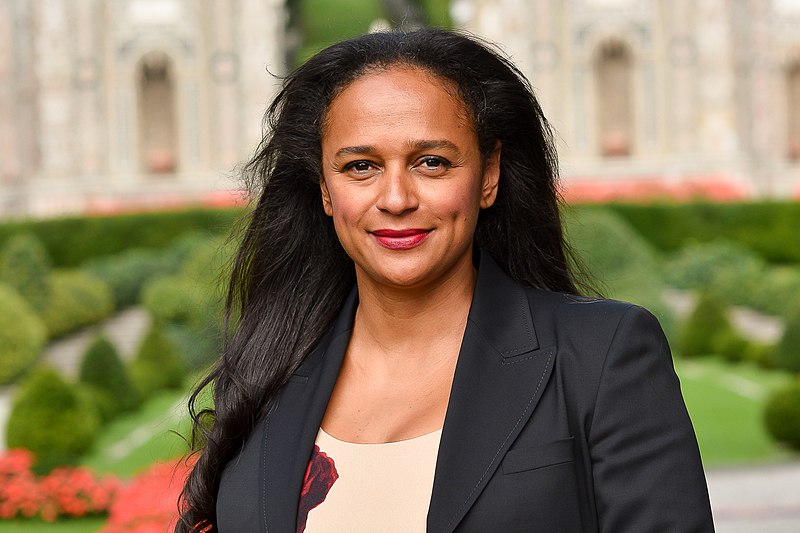
Isabel dos Santos | ©NunoCoimbra – Cross-wikimedia CC BY-SA 4.0

In January 2020, the investigation “Luanda Leaks,” led by the International Consortium of Investigative Journalists (ICIJ) and a team of journalists from different countries, revealed how Isabel dos Santos, the daughter of former Angolan President José Eduardo dos Santos, illegally accumulated a fortune of more than 2 billion US dollars while being advised by North American and European consulting firms.

The investigation was based on more than 715,000 documents received by the Platform to Protect Whistleblowers in Africa (PPLAAF), a Paris-based nonprofit.

The investigation revealed Dos Santos directed millionaire contracts from state-oil company Sonangol, where she served as chairwoman from 2016 to 2017, to her own firms or those linked to her. It also indicates that the businesswoman managed to hid her fortune through companies based in tax havens such as Malta, Mauritius, and Hong Kong.

Angola is the second-largest oil producer and the fourth-largest diamond producer in Africa. Although poverty levels have improved in the past 15 years, half of the population still lives in poverty according to data by the Oxford Poverty and Human Development Initiative.

Isabel dos Santos’ father, José Eduardo dos Santos, known in Angola as “JES”, served as president of Angola from 1979 to 2017. His government was marked by violations of human rights, and persecution to journalists and critics were widespread.

In 2016, JES appointed Isabel dos Santos as chairwoman of Sonangol, but she was dismissed as soon as a new president took office the following year. João Lourenço replaced JES as the leader of the ruling party Popular Movement for the Liberation of Angola (MPLA) and became president after the party obtained a parliamentary majority in the August 2017 elections.

In contrast with his predecessor, João Lourenço has been pushing anti-corruption reforms and opening channels of dialogue with civil society. In 2018, he received in his office activists and journalists who in the past had been persecuted by the authorities. In the same year, Lourenço said in an interview that he found the state coffers “practically empty” when he took over from JES.

In February 2018, the new Sonangol chief, Carlos Saturnino, revealed that Isabel dos Santos had ordered a bank transfer of 38 million US dollars from Sonangol to a bank account in Dubai shortly after she was fired from her job.

Dos Santos, who holds Russian citizenship due to her maternal ancestry, currently lives in Dubai.

Carlos Saturnino was fired from Sonangol in May 2019 amid a fuel shortage crisis in Angola.

Dos Santos has since denied any wrongdoing during her time as Sonangol's chairwoman. Through her social networks, she alleges that she is a victim of political persecution by the new Angolan government.


Consórcio ICIJ recebeu fuga de informação das “autoridades angolanas “??!! Interessante ver o estado angolano a fazer leaks jornalistas e para SIC-Expresso e depois vir dizer que isto não é um ataque político ?

— Isabel Dos Santos (@isabelaangola) January 19, 2020


So the ICIJ consortium received leaked information from “Angolan authorities” ?? !! Interesting to see the Angolan state leaking to journalists and to SIC-Expresso [a newspaper in Portugal] and then come saying that this is not a political attack?


Se houvesse interesse na verdade e não no assassinato de caracter,a SIC-Expresso teria entrevistado o actual PCA da Sonangol,teria entrevistado Dr.Edeltrudes Costa, teria entrevistado Dr.Archer Mangueira.
Como é um ataque político comandado e orquestrado só entrevistam o PGR.

— Isabel Dos Santos (@isabelaangola) January 19, 2020


If there was an interest in the truth rather than character assassination, SIC-Expresso would have interviewed the current Sonangol chief, it would have interviewed Dr. Edeltrudes Costa, it would have interviewed Dr. Archer Mangueira. As this is a commanded and orchestrated political attack, they have only interviewed the prosecutor-general.

Isabel dos Santos’ sister, Tchizé, suggested that Isabel returned an amount of 75 million US Dollars to the Angolan State:

Translation
Original Quote


Is it the debt of 75 million that is at stake? Pay, then, if they are asking for euros and do not want kwanzas, although a state would normally want to receive in its own currency, but if they need dollars and they are asking [dos Santos], the citizen who has benefited the most from business opportunities in Angola, it is time for her to repay everything the state has provided her, allowing her to close great deals and become the woman she is today… So, send money to Angola.

Rafael Marques, the Angolan journalist who had long investigated corruption in the Dos Santos family, commented to DW Africa about ICIJ's investigation:

Translation
Original Quote


This is news for which I have effectively waited for many years, but it also makes me sad. It makes me sad because only when foreigners speak the citizens listen, the world listens.

As an Angolan journalist, many of the facts that were revealed by these documents had already been revealed by me, but no one paid attention because I am an African journalist.

Only when European and American journalists talk about the issue that it becomes serious enough for certain governments and many countries’ societies to begin to pay attention. But it is important.

Amid the revelations, Isabel dos Santos has been disconnecting herself from several companies of which she holds shares, particularly businesses located in Portugal.

The director of the Portuguese bank Eurobic, where Sonangol had an account, was found dead in Lisbon on January 22, the same day Angola's prosecutor-general named him as a suspect in an inquiry into Sonangol and Isabel dos Santos.

The inquiry was opened in March 2018 following complaints made by Carlos Saturnino, but had been moving slowly until the more recent developments.


Written Translated byDércio Tsandzana
In Lebanon, journalists and activists who cover protests face threats 

Lebanon needs laws to protect journalists and media practitioners


Posted 14 February 2020


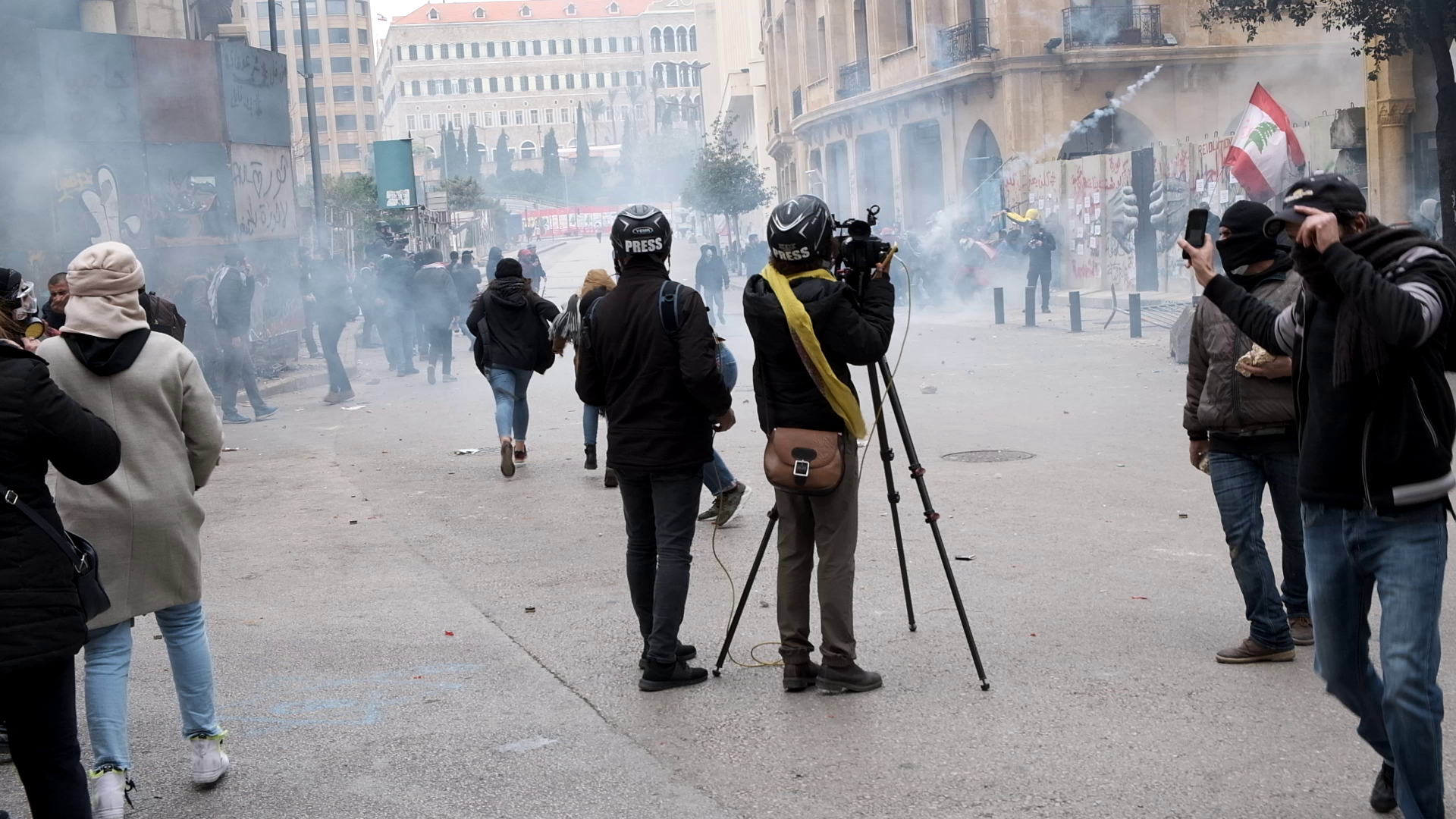
Journalists covering an anti-government protest near one of the blocked entrances to the Lebanese Parliament in the capital Beirut. Photo credit: Hassan Chamoun, used with permission.

Since the anti-austerity protests broke out in Lebanon on October 17, 2019, reporters and journalists have been flocking to the scene to provide up-to-date coverage.

Tens of thousands of people reflecting Lebanon’s diverse religious and class sectors took to the streets to demand social and economic reforms. What started as socio-economic protests have grown into a movement demanding the fall of political rulers who have governed the country under a sectarian political system since the end of the civil war in 1990, using the popular slogan, “All of them means all of them.”

Journalists and camera crews who showed up at the protests became the target of harassment by not only the country’s police and army but in some cases by protesters.

Media professionals have raised their voices against the use of excessive force against journalists who cover the mass protests. Many said they were harassed or had their equipment confiscated, or both. The SKeyes Center for Media and Cultural Freedom at the Samir Kassir Foundation (SKeyes) reported multiple incidents of injury and harassment of journalists from the Lebanese Broadcasting Corporation (LBC), Murr Television (MTV), Agence France Presse (AFP) and Al-Jadeed on January 18 alone.

In one incident reported by Skeyes center on January 15, 2020 freelance journalist Saada Saada was covering a roadblock staged by protesters in the Furn al-Shubak area in Beirut, the capital, when a couple of soldiers started to beat him. He declared that he was a journalist and presented his press identification card, but soldiers reportedly tried to snatch his phone from his hands as they dragged, kicked and beat him. His injuries demanded medical attention and transfer to a local hospital.

In another incident on January 22, a correspondent for France 24, Leila Molana-Allen shared a video in which she says the police targeted a camera crew with water cannons:


Just got hit by water cannon myself after riot police turned the cannon on a group of journalists and onlookers filming the scene.#LebanonProtests https://t.co/x2eXL7dtfO

— Leila Molana-Allen (@Leila_MA) January 22, 2020

On January 21, SKeyes reported that an Associated Press photographer was pepper-sprayed by the police as he was covering protests in Beirut:


@LebISF also decide to mace journalists in downtown #Beirut tonight, after shooting them with rubber bullets two nights ago. #LebanonProtests https://t.co/JbVDVXYnfm

— Bachar EL-Halabi | بشار الحلبي (@Bacharelhalabi) January 21, 2020

On February 11, the same organisation reported that another journalist was hit with a rubber bullet.


Security forces shot photojournalist Jad Ghorayeb in the mouth with a rubber-coated steel bullet. #LebanonProtests #لبنان_يتنفض https://t.co/IPlVUCykc9

— Timour Azhari (@timourazhari) February 11, 2020

This treatment also extends to activists who report from the ground and express their views about the protests. This puts almost every active citizen at risk of harassment or arrest. Political expression on social media is getting more popular but also more risky, as several independent journalists and activists face interrogation or physical violence and threats for sharing their opinions on their social media profiles.

When the protests started, activist and blogger Joey Ayoub was one of many who headed to the scenes of the protests to report what he witnessed. On October 25, 2019, when he was recording on his mobile phone, a soldier tried to snatch the phone away, in an attempt to stop him from filming.

You can hear Ayoub tell the soldier in Arabic, “I have the right to record.”


Soldiers tried to take my phone away. Furn El Chebbak now#lebanonprotests#لبنان_ينتفض pic.twitter.com/gn3qFIb1tQ

— ابن بالدوين (@joeyayoub) October 25, 2019

This is problematic not only because it violates freedom of expression and freedom of the press, but also because digital media and content creators on digital media platforms are not protected under the Lebanese press law.

The current press law — adopted in 1962 and amended in 1977, 1994 and 1999 — covers print media only. Cases concerning broadcast journalists and content creators on digital platforms like web outlets and social media are dealt with under criminal law. As social media becomes increasingly more widespread among youth, activists and even officials, Lebanon has yet to adapt its legislation to expand protections to freedom of expression online and digital media.
Privacy threats

Police have reportedly taken away phones of people they arrest and force detainees to give up their passwords to grant authorities full access to their devices.

Mohamed Najem, the executive director of Social Media Exchange (SMEX), a digital rights advocacy group working in the Arab region, told Global Voices that his organization received complaints and reports of cases of protesters having to leave their phones behind even after they have been released, and police stations asked them later to go back and give them the passwords to their phones.

Najem says this issue has not gotten the attention it deserves yet and has called for a law that protects the personal data and the privacy of citizens:


We really need a law for data protection in #Lebanon. After the release of protestors, the security agency kept the protestors phone in custody and now asking them to give their phone passwords. This is a breach of privacy, and laws are not protective. #LebanonProtests

— Mohamad محمد (@monajem) January 22, 2020

Protests are ongoing in different parts of Lebanon, as the parliament approved a new government on February 12. Protesters, who have been calling for an independent transitional government and new parliamentary elections, see the this government as part of the old political establishment.

As the protests continue, journalists and activists remain at risk of arrest, harassment and physical violence.

SMEX has circulated tips to help activists and journalists minimise risks to their privacy during protests. The Committee to Protect Journalists (CPJ) has put out a list of steps and measures journalists should take before heading out to cover the protests — including logistical planning and things to pack —to digital security and privacy protection.

These tips and precautions are useful for journalists and activists seeking to protect their right to privacy and avoid harassment and attacks as they report on the ground. However, unless the Lebanese authorities put strong measures in place to ensure the protection of press freedom and freedom of expression, violations will continue to take place.


Written byFaten Bushehri
Russian pranksters target Bernie Sanders
Vovan and Lexus posed as Greta Thunberg in a call with the Vermont senator

Posted 16 February 2020


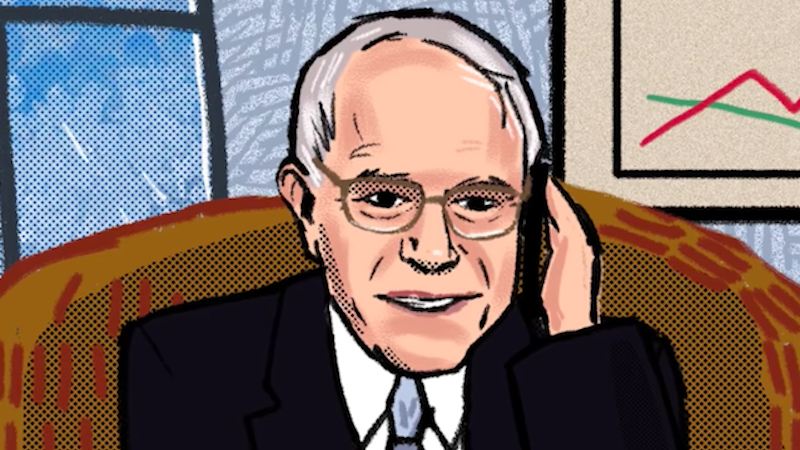
Screenshot from Vovan and Lexus’ YouTube video of their prank call with US Senator Bernie Sanders.

In the heat of the US Democratic primary, Senator Bernie Sanders would appear to be the latest international politician to fall victim to Russian pranksters Vovan and Lexus, the pseudonyms of Vladimir Kuznetsov and Alexey Stolyarov. At least, that's what the pranksters claim: the Vermont senator's campaign office has not yet commented on the recording's authenticity.

On 13 February, an animated video was uploaded to the comedians’ YouTube channel featuring the audio of Sanders’ 11-minute call with whom he believes to be Greta Thunberg and her father Svante. “Greta” praised the senator's ecological proposals and offered to provide an endorsement for his presidential campaign. The video soon descends to the strange when the pranksters suggest that Sanders would gain the youth vote if he starred in a rap video with Kanye West and Billie Eilish. The senator laughs cordially at the suggestion that he would have to wear gold jewellery.

It doesn't take long for Russia to feature in the call, when “Greta” and her father express their concerns about an upcoming trip to the country and ask Sanders for his advice. The senator tells them that “to the best of [his] knowledge, Putin is very bad on climate change,” warning them against “just walking in there and getting used as a photo opportunity,” and advising them to research the ecological situation in Russia and urge the Russian leadership to “transform their energy system.”

Sanders is then asked whether he believes it is possible to “lead the United States towards communism,” to which he responds that democratic socialism has far more in common with governance in Sweden than in the Soviet Union.

Then things go downhill when “Greta” and her father express interest in Sanders’ visit to the Russian city of Yaroslavl in 1988. They jokingly suggest that he was a sleeper agent for the KGB, the Soviet secret police, which has altered the senator's memory in case the CIA discover the truth. “Is this what you really believe?” asks Sanders, incredulously. “Greta” responds that it is time for her to activate him with a special phrase. The call abruptly ends.

It is not known when Vovan and Lexus recorded their latest call, but they did allude to a prank with Sanders in a Tweet shortly before its release:


Сделать ли нам пранк с Берни Сандерсом? / Should we do a prank with Bernie Sanders?

— Пранкер Вован (@evilprank) February 12, 2020

Sanders, if the voice is indeed the senator's, was not the first politician pranked by Vovan and Lexus and will probably not be the last. This January, they used much the same script against Califonia Congresswoman Maxine Waters, and then in a call with actor Joaquin Phoenix. The duo shot to international prominence in 2015, when they phoned Elton John posing as Vladimir Putin — the singer believed he was speaking to the Russian president via a translator.

The mischievous pranksters insist that they have no political agenda, stressing that they have also pranked celebrities. Nevertheless, it has not escaped the attention of international media that their choice of victims seems to coincidentally align with whoever is in the Kremlin's bad books — particularly if they are Ukrainian politicians and western public officials deemed hostile to Russian interests. These have included French President Emmanuel Macron, former Ukrainian President Petro Poroshenko, North Macedonian Prime Minister Zoran Zaev, Turkish President Recep Tayyip Erdoğan, Governor of Alaska Sarah Palin, the Ukrainian oligarchs Ihor Kolomoiskyi and Rinat Akhmetov, and many others. There has been much speculation as to how two pranksters are able to dial through directly to foreign heads of state with such ease — leading some to suspect, such as the lawyer Mark Feygin, that they may have a helping hand from the Russian security services.

The pranksters laugh off that suggestion, but have been asked on several occasions why they have never once prank called Putin. In a January 2019 interview with Ukrainian news portal Strana.Ua, they claimed that Putin knew who they were, and cited technical problems in reaching him:

Translation
Original Quote


It's not that easy to call through to Putin. Putin, and several other heads of state, have a completely different system of communications. Putin doesn't have a telephone, first of all. The channels through which he communicates are encrypted. If we're talking about the CIS states, then every president has encrypted communications. Theoretically, even if we wanted to, we wouldn't be able to reach them.

In a March 2016 interview with the BBC's Russian service, Lexus was more open about their reticence:

Translation
Original Quote


We are nevertheless aimed at doing what is necessary for Russia. We understand that some recordings, including incriminating ones, would be harmful to our country; other political forces would play on them and get dividends. We believe that corrupt officials and others have to be fought in any case. But every concrete case needs to be assessed so that the country does not suffer politically as a result.

Questions about Vovan and Lexus's intentions will no doubt continue to be asked — until and unless the pranksters be their boldest yet by trying to dupe a prominent Russian politician.


Written by RuNet Echo


Hong Kong's labor laws aid and abet the abuse of foreign domestic workers

Written byKatie McQue

Posted 16 February 2020 14:38 GMT


Foreign domestic workers take a break on their rest day in central Hong Kong. Photo by author.

Her body is heavy with fatigue after a 17-hour shift, but Janey*, 29, finds it impossible to fall asleep. She scrolls through her Facebook newsfeed in an effort to distract herself from the hunger pangs. It’s midnight, and her working day will begin again in six short hours.

Janey traveled to Hong Kong from the Philippines two years ago to take up a job as a live-in domestic maid for a family. She knew the work was going to be hard, but she didn’t expect her living conditions to be so difficult. Janey told me in an interview that:

The food here is very limited. My employer just gives me instant noodles, you have to train yourself to be able to eat them every day. I can also eat leftovers but sometimes there isn’t enough.

Families that employ maids are legally obligated to provide them with a private room, yet Janey sleeps on the sofa in the living room of the 700-square-foot apartment that houses the five people she waits on. She keeps her possessions in bags.

Hong Kong’s 350,000 domestic workers come mainly from poorer Asian countries such as the Philippines and Indonesia and are essential to the functioning of the city. Getting a job as a maid enables these women to send money back home to provide much-needed support to their families. Janey, a graduate in computer programming, is ambitious and determined to start a career in her field, but there aren't jobs in the Philippines, she says.

According to a 2017 report by Mission For Migrant Workers, a Hong Kong-based NGO, nine out of ten maids suffer from insufficient rest, two out of five do not have a private room, one in five have reported ill-treatment by their employers, and 25 percent are given insufficient food.

Much of the abuse these maids face is abetted by employment laws. For instance, Hong Kong’s domestic workers are legally required to live with their employers. This rule has created a breeding ground for abuse. According to Nicole Lai, Organisation Secretary at the Hong Kong Confederation of Trade Unions:

Because maids have to live with their employers, the hours are long. They either work or sleep. Sleep may also be interrupted; they are often asked to work and are often caring for children and the elderly, which can involve working at night.

Living with their employers affords maids very little privacy, and makes them more vulnerable to physical and sexual abuse. In cases where this happens, it is very difficult for them to get help. They are afraid to report cases to the police and cannot easily leave the home to do so anyway, adds Lai.

It is commonplace for Hong Kong households to have at least one maid. The busy and expensive city has a scarcity of daycare facilities for young children. By law, the minimum wage for a domestic worker is HK$4,630 (595 US dollars) per month. Families who may not be able to comfortably afford this sum may be tempted to squeeze as much work as possible from their domestic worker.

Gabriela*, 32, from Mindanao island in the Philippines, reports experiencing this. She took out a loan to pay a recruitment agency US$ 1,200 to place her with a supposedly reputable employer. The agency assured her that she would be treated well and would work a standard eight hours per day, six days per week, in her new home. She told me:

When I arrived at my employers’ house, I gave them my contract. But they told me that it is just a piece of paper that doesn’t mean anything, and I must live by the family’s rules because they paid a lot for me.

In reality, Gabriela is made to work from sunrise until past midnight, doing everything from cooking, helping look after three children and two elderly parents, and cleaning and washing the family car:

I can’t sit down for even one second because my employer doesn’t want to waste it. Sunday is my holiday but I still work 8 hours then, when I’m supposed to have the whole day off.

But leaving is almost impossible. Gabriela must earn money to pay back her loan, and she needs to send money home to support her elderly mother. She’d like to complain to Hong Kong’s Labour Department, but she’s afraid of being fired.

Breaking an employment contract through resignation or by being fired puts foreign maids in an impossible situation, because immigration laws stipulate that a domestic worker must find a new employer within two weeks, or leave Hong Kong. Finding a new job in the space of two weeks is highly unlikely. As Lai points out:

The Hong Kong labour department can’t issue new documents in that time even if they do find a new employer. It also takes four to six weeks for the immigration department to issue new visa documents.

Leaving and re-entering Hong Kong also means incurring the expense of costly recruitment agency fees and flights all over again.

Should a domestic worker get pregnant, Hong Kong's maternity laws are often not upheld by the employer. In such cases, a domestic worker is typically fired, meaning she swiftly loses her income, home, residency visa and access to healthcare.

Children born to women who overstay their visas inherit the same immigration status as their mothers — undocumented.

Migrant workers who become pregnant often seek help from Pathfinders, a local NGO focused on helping foreign domestic workers which operates several shelters for migrant workers who are pregnant or have recently given birth. Pathfinders’ CEO, Catherine Gurtin, told me that:


Our beneficiaries often arrive hungry, sick, undocumented and homeless. They are often unable to return home financially, or because they are too pregnant to fly or because their Hong Kong-born baby is undocumented.

Jessie*, from Luzon island in the Philippines, is in her early 20s. She was just eight weeks from her due date when I interviewed her in one of Pathfinders’ shelters. She learned she was pregnant after taking a mandatory pregnancy test before beginning a new contract as a maid, and then lost her job. She says she’s too scared to tell her family and can’t go home out of fear of her safety.

Pregnant maids not fired by their employers still encounter significant challenges. Under the government’s live-in rule, domestic workers have to live in their employer’s home even during their maternity leave. Unsurprisingly, most employers are unwilling to accommodate a baby, so they are often left in the care of the state until the mother can take them home.

A joint statement provided to Global Voices by the Hong Kong government’s Labour and Immigration Department said:


Any change to the “live-in requirement” that foreign domestic helpers must reside in employers’ residences will go against the rationale for importing Foreign Domestic Helpers and the fundamental policy that local employees (including local domestic helpers) should enjoy priority in employment.

The Hong Kong Special Administrative Region Government does not tolerate and takes stringent actions against any abuse or exploitation of foreign domestic helpers. Any reported case of physical abuse or violation of the statutory provisions such as non-payment/under-payment of wages, non-granting of weekly rest days and statutory holidays, etc. will be thoroughly investigated, and if there is sufficient evidence, the culprits will be prosecuted.

*Names have been changed to protect identities.

Harold Burson (1921-2020), the PR giant!

Published Feb 06, 2020 11:38am
"He saw the potential for PR to be a global enterprise, and he did more than anyone to professionalize the discipline."
The passing away of ‘the most influential PR person of the 20th century’ is critical to this time and age (the 21st century) in terms of finding someone with his foresight and calibre and able to wear that mantle responsibly - as did Harold Burson.
They don’t come like him anymore and it would probably take courage and leadership for successors to reinvent the prerequisites of PR in a global space that is becoming more disruptive with every passing day.
Burson played that distinguished and critical role to make the world he lived, worked and indulged in, a better place for the generations that are in his boots today. Therefore, we, as practitioners of multiple mediums of communications, have a solemn responsibility to use this management tool of bridging relationships – national, corporate and personal – effectively.
To understand that “he saw the potential for public relations to be a global enterprise…” speaks volumes of a man who, coming back from reporting World War II in 1946, tried to figure out why it was necessary to have a good communications handle on how nations and industry wanted to move on. To turn a new page and be perceived in a world that was rushing towards new inventions and business models.
IBM were experimenting with their first computers during this period; there were no Twitter handles then and neither the notion of ‘fake news’ exist. Everything that stemmed from the minds and pens of great wordsmiths like Burson and his contemporaries were the last word. In the true sense, his persuasive pen, which churned out strategic messaging, was mightier than the sword! No wonder, he went on to be recognised as the most influential PR person of the 20th century.
The world at that time, with the US in the limelight, was on the threshold of development and industrialisation. It was a time of high economic growth and prosperity for America during the period 1945 to 1964 - and Burson was at the centre of all that was evolving. He saw the opportunity, for the US and for the profession of public relations, took decisive measures, invested in people and in a countrywide infrastructure and achieved his goals with conviction and success.
Burson opened his PR business in 1953 and found himself immersed in everything that was occurring at that time. He identified opportunities and took up challenges that were critical to the country, economy and businesses. He nurtured talents and built a team of people with exceptional skills. He formalised the research function and used data to develop strategies to measure the impact of campaigns.
“As a living legend in the business of public relations Harold Burson was always accessible, he was always surrounded by throngs of people, mainly young professionals from various agencies at industry events. He was humble, modest and gracious but always precise and forever one to offer a suggestion with a smile,” writes John Graham of Fleishman Hillard.
Burson was a thinker, emphasising the importance of ethical practice and of treating PR as a management discipline. The critical part of that definition is that “there are two components that comprise public relations: one is behaviour, the other is communications.” Of the two, he clearly saw corporate behaviour as the most important: “Our job as public relations professionals is two-fold. It is to help our clients or employers fashion and implement policies and actions that accord with the public interest.”
This humble PR giant was often called upon during crisis situations, developing a reputation for deft crisis management that made him a favourite of embattled corporations and foreign governments. From advising Johnson & Johnson in the aftermath of the cyanide-laced-Tylenol murders in 1982 to representing Union Carbide in 1984, after the gas-leak that killed 2000 people in a pesticide plant in Bhopal, Burson was the go-to-man for deliverance.
He told New York Times, “We are in the business of changing and moulding attitudes and we aren’t successful unless we move the needle, get people to do something. But we are also a client’s conscience, and we have to do what is in the public interest.”
In a speech to the Institute for Public Relations Research and Education in October 2004, he offered his definition of PR as the “discipline that helps reconcile institutional or individual behaviour in a manner that accords with the public interest and, when effectively communicated, creates opinions or attitudes that motivate target audiences to specific courses of action.”
He founded Burson-Marsteller in 1953 via a partnership with ad executive Bill Marsteller and then built the firm into an industry powerhouse with $4.4 million in revenue by 1969 and then $64 million, with 2,500 employees in 50 offices, a decade and a half later. In 1979, Burson sold the firm to Young & Rubicam, which was in turn bought by WPP in 2000. He stepped down as Burson’s CEO in 1988. Burson-Marsteller was merged with Cohn & Wolfe into BCW in early 2018.
Before starting Burson-Marsteller, he had already planted the seed of his future empire by establishing the Harold Burson Public Relations firm in 1946, soon after the war had ended.
According to Donna Imperato, global CEO of Burson Cohn & Wolfe: “He was the wisest person I knew, with the highest level of integrity, humility and kindness. Harold inspired tens of thousands of public relations and communications professionals around the world. His values and affinity for life will always be the core DNA of Burson Cohn & Wolfe. It has been my extraordinary privilege to have known Harold Burson as a colleague, a mentor and a friend.”
Burson was born in Memphis on February 15, 1921, the son of English immigrants, Maurice and Esther (Bach) Burson. He graduated from high school at 15 and worked his way through the University of Mississippi writing articles (at 14 cents per column inch) for The Commercial Appeal in Memphis.
In addition to his career in PR, Burson made many contributions to society, serving as a presidential appointee to the Fine Arts Commission, founder of the Kennedy Centre Corporate Fund, a board member of the World Wildlife Fund, and an executive council member for the Centre for the Study of Southern Culture at the University of Mississippi, his alma mater.
Menin Rodrigues is a corporate communication consultant, writer and historian.meninr@gmail.com

Pakistan will not be blacklisted, say scholars
Anwar Iqbal February 18, 2020
The Financial Action Task Force (FATF) is unlikely to blacklist Pakistan during its annual meetings in Paris but may keep it on its watch list, says a US scholar of South Asian studies. — FATF website/File


WASHINGTON: The Financial Action Task Force (FATF) is unlikely to blacklist Pakistan during its annual meetings in Paris but may keep it on its watch list, says a US scholar of South Asian studies.

The meetings began on Monday but the plenary session, which will decide whether to keep Pakistan on its watch list, also known as the grey list, begins on Feb 19.

“It’s too early for Pakistan to be removed from the grey list — that will be decided at a meeting later in the year,” says Michael Kugelman, a scholar of South Asian affairs at the Woodrow Wilson Center, Washington.

“What is clear to me is that Pakistan will not be blacklisted.”

But Uzair Younus, a non-resident fellow at the Atlantic Council, Washington, says “indications are that Pakistan will probably be off the grey list in the coming months, if not weeks”. This, he argues, “will allow financial capital flows to grow further, which is good for the economy, at least in the short term”, said the scholar at a recent seminar on Pakistan at the US Institute of Peace, Washington.

FATF’s plenary session, which will decide whether to keep Pakistan on grey list, begins on Feb 19

“US officials believe Pakistan has made enough progress with its FATF action plan, and the conviction of Hafiz Saeed on terror financing charges will be an encouraging sign for FATF members too,” says Mr Kugelman.

“The question of the grey list is more complicated. Washington is still looking for wholesale and irreversible steps, and the revelation that Masood Azhar is ‘missing’ won’t go down well. This suggests that unless things change in the coming weeks, Pakistan may have trouble convincing FATF to be removed from the grey list.”

Madiha Afzal of Brookings Institution, Washington, says in a tweet that militant leader Hafiz Saeed’s conviction is “significant” but it’s important to see how his appeal is dealt with.

She raises the question being asked by some in Washington: Will Hafiz Saeed’s “conviction eventually be overturned, especially if Pakistan comes off the FATF grey list?”

Some are also raising the concern expressed when Pakistan was first put on the grey list in 2018, the “listing can push Pakistan further into China’s orbit.”

Pakistan was previously placed on the grey list in 2012-2015 but was removed in 2016 after legislating drastic reforms to its anti-money laundering and counter-terrorist financing regulations. Pakistani officials pleading the country’s case in Paris believe that if they convince a few Western nations that the actions they have taken since the last FATF meeting in October 2019 would eradicate terrorist financing, Islamabad could be out of the grey list.

Recently, China, which now chairs the FATF, issued a list of priorities for its presidency, which includes “closely monitoring and reporting on the financing of ISIL, AQ and Affiliates”.

It also highlights the need to “work on confiscation and asset recovery; best practices to improve the transparency of beneficial ownership”.

The priorities also talk about “mutual evaluations of Russia, Turkey, United Arab Emirates, Korea, Japan and South Africa; and the first 5th year follow-up assessments of effectiveness for Norway, Spain, Australia, Belgium and Malaysia”.

But it does not mention Pakistan. In a statement issued after FATF’s October 2019 meeting in Beijing, China warned against targeting Pakistan to please others (India) and hailed Islamabad’s effort to fight terrorist financing and money laundering.

Another key FATF member, Turkey, also strongly supports Pakistan. On Saturday, Turkish President Recep Tayyip Erdogan had told Pakistan’s parliament: “We will be supporting Pakistan at the Financial Action Task Force meetings, where Pakistan is subject to political pressure.”

Malaysia also supports Pakistan’s efforts to get off the grey list. And the support of these three countries is enough to block India’s moves to blacklist Pakistan.

But to get off the watch list, it needs support from other nations, particularly the United States. Last week, a senior US official, Assistant Secretary Alice Wells, appreciated Hafiz Saeed’s conviction. Her statement was interpreted as indicating that Washington does not want to blacklist Islamabad, but it may want Pakistan to do more before supporting its efforts to come off the grey list.

Published in Dawn, February 18th, 2020
Right-wing minister claims being trans is a Jewish plot to make humanity androgynous

JOSH MILTON FEBRUARY 17, 2020

Rick Wiles spoke to Jana Ben-Nun during a run of TruNews. (Screen captures via TruNews/Right Wing Watch)


A right-wing minister Rick Wiles has claimed that being trans is a “Zionist plot” that will destroy humanity as we know it.

Uh, sure, Jan.

This is the latest anti-LGBT+ salvos by evangelical Wiles after he said that the Wuhan coronavirus outbreak is somehow caused by trans children.

Right Wing Watch reported on last Wednesday’s edition of the program TruNews.

Messianic Jewish folk Steve and Jana Ben-Nun of Israeli News Live trafficked in similar anti-LGBT+ attitudes to Riles on the show; Jana and Wiles discussed the conspiracy that trans folk are “putting specific things” in food and water to make the world “androgynous”.

Yup.

What happened?

The strand of the Jewish faith states that Jesus is the Jewish Messiah, and that salvation comes only from accepting him as your saviour.

Jana spewed out hurtful, unvarnished stereotypes on the show: “They want to get Gentile riches, and they want to run the Gentiles.

“They don’t consider Gentiles [to be] fully human beings.”

Moreover, Jana later explained that the “endgame” is to remake humanity in the image of Adam.
Rick Wiles, self-proclaimed “citizen reporter” and host of TruNews. (Right Wing Watch)

In the Haggadah, a sacred text recited at the Seder on the first two nights of the Jewish Passover, it states that Adam was androgynous.

Adam “wasn’t male or female, he was made male and female in one body, and this is why you see the transgender agenda today”.

The comment prompted Wiles to ask: “Is the transgender movement get its origin in Zionism?”

Oh, boy.

Jana responded with a resounding: “Yes.

“It gets its origin in Zionism, and it gets its origin in the Talmud, Zohar, and Kabbalah.

“It’s a Kabbalahistic doctrine of Adam Kadmon. They have this doctrine called Tikkun Olam – repairing the world – so how do they want to repair the world.

“They want to bring [humanity] to the original.

“Who was original? Adam, he was androgynous.

“So now they’re putting specific things in food, in drink, and basically their end game is to make humans on Earth that will survive – whatever it is they are bringing – androgynous.”

“What they are really trying to do is undo God’s creation,” Wiles said.

“They are at odds with the Creator.”

In other words, the pair claimed that trans folk are conspiring to make people androgynous, like Adam, a creation of God, which is apparently an affront to God because it goes against his creation, which was Adam, who was androgynous.

Right.

Rick Wiles: Wuhan coronavirus is God ‘purging’ trans children.

The pastor’s claim comes after he blamed COVID-19 on the “vile, disgusting people” who are “transgenderising little children”.

Speaking on TruNews, Wiles said: “Spirit bears witness that this is a genuine plague that is coming upon the earth, and God is about to purge a lot of sin off this planet.”

The morality rate of the coronavirus strain had hurtled towards the 2,000 mark across the last week, but, Chinese health officials said, has since levelled off and stalled to around 1,770 deaths with 70,500 infected in mainland China alone.

Authorities issued an edict to round-up those who have, even potentially, acquired the virus as part of a “wartime” campaign to contain the outbreak.

Pinning global disasters on people who don’t correspond with his own worldview is entirely in keeping with Wiles, who has previously blamed “gay Nazis” for the Las Vegas mass shooting, and “the sexual perversion movement” for Hurricane Harvey.

More: adam, God, Judaism, rick wiles, zionism
Gay sauna

Gay saunas and bathhouses could be about to return to San Francisco for the first time in almost 40 years