Monday, March 16, 2020

HEY DON'T FORGET ABOUT THE UBIQUITOUS BIRD FLU

Germany confirms case of H5N8 bird flu in poultry farm

Reuters•March 16, 2020

HAMBURG (Reuters) - A case of H5N8 bird flu has been confirmed in a poultry farm in the eastern German state of Saxony, German authorities said on Monday.

The social affairs and protection ministry in the state of Saxony said the case involved bird flu of type H5N8 found on a farm in Bad Lausick near Leipzig. All poultry on the farm has been slaughtered and a quarantine area set up around it.

A series of outbreaks of the disease, which in the past has led to major disruptions and slaughtering programs in Europe's poultry industry, have been reported in Europe in past months.

Bird flu cases have appeared in the four central European countries of Slovakia, Poland, Hungary and the Czech Republic since the end of last year. A previous case was found in a wild bird in Germany in January.

Philippines detects bird flu outbreak in quail farm

Reuters•March 16, 2020
File Photo: A Filipino worker feeds hundreds of chickens at 
a poultry farm in Santa Maria town of Pampanga. 
REUTERS/Romeo Ranoco

MANILA, March 16 (Reuters) - The Philippines has detected an outbreak of avian flu in a northern province after tests showed presence of the highly infectious H5N6 subtype of the influenza A virus in a quail farm, the country's farm minister said on Monday.

Agriculture Secretary William Dar said the bird flu virus, the same strain that hit some local poultry farms in 2017, was detected in Jaen municipality in Nueva Ecija province, where about 1,500 quails had died on one farm alone.

A total of 12,000 quails have been destroyed and buried to prevent further infections, Dar said, citing field reports.

"We are on top of the situation," he said. "Surveillance around the 1-km and 7-km radius will be carried out immediately to ensure that the disease has not progressed around the said perimeter."

Animal quarantine checkpoints have also been set up to restrict the movement of all live domestic birds to and from the quarantine area, he said.

"We would like to emphasise that this is a single case affecting one quail farm only," Dar said.

Dr. Arlene Vytiaco, technical spokeswoman for avian flu at the agriculture department, said that while there is a possibility of transmission to humans through excretion and secretion, "the chances are very slim".

"There is also zero mortality rate," she said.

Dar said his department and the local government were jointly conducting an investigation and contact-tracing to determine the source of infection.

To ensure steady domestic supply of poultry, he said the transport of day-old chicks, hatching eggs and chicken meat will be allowed provided the source farms have tested negative for bird flu.

(Reporting by Enrico dela Cruz; Editing by Stephen Coates)

Mnuchin Shills for Trump’s Botched Oval Office Address


Justin Baragona,The Daily Beast•March 15, 2020


On Sunday, Treasury Secretary Steve Mnuchin waved off the numerous misstatements made by President Donald Trump in his much-criticized Oval Office address last week. Mnuchin insisted that the president didn’t get “things wrong at all” despite the Trump administration having to clarify and correct multiple inaccuracies.

Appearing on ABC’s This Week, Mnuchin boasted that the stock market reacted positively to the announcement of a bipartisan bill to address the coronavirus crisis and Trump’s Rose Garden speech in which private sector companies committed resources to the government.

But host Jonathan Karl retorted that the market had acted “severely negative” to Trump’s address.

“The president said several things. He said that cargo would be banned coming in from Europe,” Karl continued. “He failed to mention that the American citizens would not be subjected to the ban. These were all false statements. How, in an Oval Office address, do statements about the president’s own proposals end up being wrong?”
- ADVERTISEMENT -


Trump’s Coronavirus Speech Sparks ‘Total Chaos’ in His Own Administration

Mnuchin, meanwhile, said that Trump wanted to be “very clear” that he was making a “move to shut down travel so that we shut down more cases coming” into the country.

“He wanted to reassure the American public,” Mnuchin added. “I don’t think in an Oval Office address you can address every single issue as you’re discussing it.”

Shortly after Trump’s Wednesday night address, however, the Department of Homeland Security had to scramble and clarify that the proclamation would not impact Americans and legal permanent residents abroad. Despite the clarification, the 30-day European travel ban has resulted in massive overcrowding at airports due to Americans rushing home, causing lengthy customs waits and heightening the risk of infection through community spreading.

“How does he get things wrong about his own proposal?” Karl shot back, prompting Mnuchin to answer: “I don’t think he got things wrong at all.”

The ABC host would go on to note that Trump also incorrectly said that cargo would be banned, causing Mnuchin to place the blame on the public.

“We were very clear that people misinterpreted the comment on cargo and we immediately put out a statement to clarify that,” Mnuchin insisted. “So the president said this is similar to China and China cargo is not banned.”

Later in the interview, Karl would also press the Treasury secretary on another botched announcement by the president: his claim Google was working on a coronavirus testing website that would be “very quickly done.”

Karl pointed out that Google has since contradicted the president, noting that they are only in the early stages of development of a pilot program in the Bay Area that they had the “hope of expanding more broadly over time.”

When asked when he thought the website would be up and running, Mnuchin admitted that he really doesn't know. But then he optimistically added that he believes it would be made "as quickly as possible."
I DUNNO I SAW THIS PIC AND I THOUGHT OF THIS 
WHEN MAKING THIS MEME


WHILE THIS REMINDS ME OF BERNIE


The US government clarifies when workers must get paid amid coronavirus shutdowns


Alexis Keenan
Reporter,
Yahoo Finance•March 13, 2020


SEATTLE, WA - MARCH 08: The Steelhead Diner, owned by Kevin and Terresa Davis, is closed on March 8, 2020 in Seattle, Washington. According to the owners, the restaurant will be closed :due to the social and economic impacts" over the coronavirus, COVID-19. (Photo by Karen Ducey/Getty Images)More

The U.S. Department of Labor (DOL) posted new guidance this week clarifying compensation requirements for employees who have worked only partial work weeks due to coronavirus-related business closures.

Salaried workers exempt from being paid overtime, if mandated by their employers to stay home, must be paid in full even if they complete only a partial week’s work. Non-exempt workers are not similarly protected. Under the Fair Labor Standards Act (FLSA), employers need only pay non-exempt employees for hours worked, regardless of whether they had been scheduled to work additional time.

“The general rule is that you don't have to pay [exempt workers] for a week in which they perform no work, but if they work a portion of the week then you owe an exempt employee their full salary,” Zach Hutton, an employment lawyer with the Paul Hastings law firm, told Yahoo Finance.

Hutton said he’s been fielding questions from employer clients uncertain of their responsibilities to compensate employees when the quantity of an employee’s work is compromised as a result of working outside the usual place of business. Until the DOL issued its new guidance it was unclear whether a viral outbreak would justify reducing employee compensation.
“The new guidance reinforces that if an employer has a shutdown and instructs employees to stay at home and not work, an exempt employee doesn't have to be paid for a week in which they perform no work, but they generally do have to be paid for a week in which they perform some work,” he said.

Do employers have to pay for work-at-home expenses?

Additional unforeseen expenses that may arise for employers are tied to local rules that can require reimbursement of employee expenses incurred during a work-from-home mandate. In certain states the scenario triggers non-negotiable costs for employers.

In California, for example, employers must reimburse reasonable and necessary employee business expenses, Hutton said. “So if [employers] suggest, or strongly suggest, or require that an employee telecommute,” he said, “then you can unwittingly end up with an obligation to pay for a portion of the employees’ expenses.”

Expenses could include home office equipment, supplies and internet connectivity, just to name a few.

“In the aggregate, that cost can be substantial,” Hutton said.

Though expense reimbursement may be somewhat offset by savings realized due to less trafficked offices, the extent of savings will largely depend on the size and scope of an employer's workforce. Employers that save on maintenance, cleaning services and utilities can’t avoid major fixed costs such as rent, mortgage and insurance premiums.

Ira Klein, also a Paul Hastings attorney, said a decision to instruct employees to work from home during the outbreak should be based on an assessment of an employee’s exposure risk. Exposure risk, he said, can be difficult to assess because they allow for interpretation. Risk levels — low, medium and high — are based on the likelihood of transmission at work, where employees may either contract COVID-19 or spread it to others.

“There's so many different ways to look at risk,” Klein said, explaining that guidance comes from separate agencies and laws that must be read together, including the Centers for Disease Control and Prevention (CDC), the Occupational Safety and Health Administration (OSHA), and state and local authorities.

Under OSHA, he said, healthcare workers who engage in close person-to-person contact are considered high risk. Other layers of risk analysis under OSHA are based on whether the work is performed in an area of widespread transmission, and whether a worker’s job places her in contact with people returning from areas of widespread transmission. Whether a job places a worker in contact with the general public is also considered. CDC guidance differs, Klein said, in that it is more focused on individual employee actions such as travel and sanitary practices.

As COVID-19 spreads, challenges for employers to make the right call are becoming increasingly difficult.

“Guidance from agencies, including the CDC and OSHA, and state level agencies and local health departments, are being updated in nearly real time,” Klein said. “If an employer is doing everything that’s reasonable, given agency guidance from the CDC and OSHA, and an employee still says, ‘I don't want to come to work,’ I think that those are where the hard questions will come up.”

Alexis Keenan is a reporter for Yahoo Finance. Follow her on Twitter @alexiskweed.
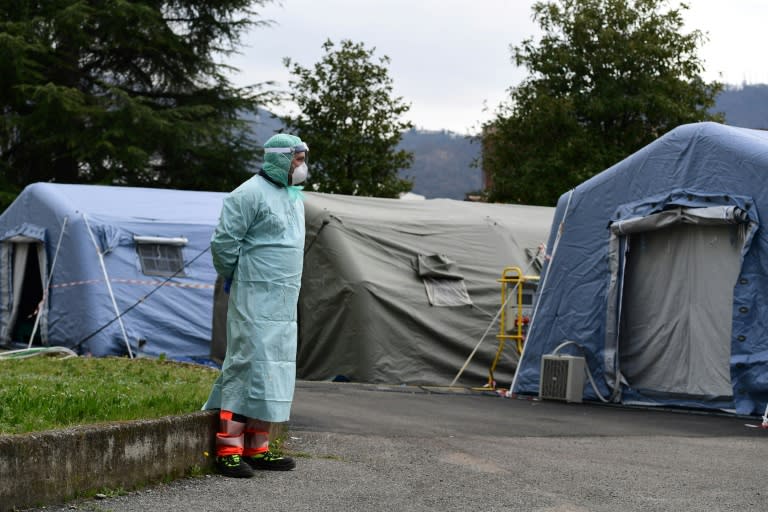
Italy's health workers on edge of exhaustion in virus fightFranck IOVENE, AFP•March 14, 2020


On Thursday Italian media reported that in the northern town of Bergamo alone around 50 doctors had tested positive for the virus (AFP Photo/Miguel MEDINA)

Nationwide Italy has more than 1,400 deaths from the virus and 21,000 infections, with a quarter of the country's intensive care beds taken up by those with the illness (AFP Photo/Miguel MEDINA)

Rome (AFP) - A worn-out nurse slumps over her keyboard in a widely shared image symbolic of the extreme fatigue that Italian healthcare workers are facing as they battle Europe's worst outbreak of the novel coronavirus pandemic.

The picture is of Elena Pagliarini, a nurse in the northern region of Lombardy which has been worst hit by the disease.

Nationwide Italy has more than 1,400 deaths from the virus and 21,000 infections, with a quarter of the country's intensive care beds taken up by those with the illness.

In normal times Lombardy is the economic heart of Italy, equipped with one of the world's best health systems.

But those who staff it -- like Pagliarini -- have been put under enormous strain.

"On one hand I was annoyed to see my photo everywhere, I was ashamed of showing my weakness," Pagliarini told the Corriere della Sera newspaper.

"But then I was happy because I got beautiful messages from people who empathised with my story," she said.

"I actually don't feel physically tired, I can work for 24 hours straight if it's necessary but I won't hide the fact that right now I'm anxious because I'm fighting an enemy that I don't know," she added.

She's just one of many healthcare workers who have expressed their concern at the toll that the outbreak is taking, on facilities and personnel alike.

"It's almost two weeks since I've seen my son or my family because I'm worried about infecting them," Daniele Macchini, a hospital doctor in the northern city of Bergamo, (also in Lombardy) wrote in a widely-shared Facebook post.

"I settle for some photos of my son which I look at through my tears, and a few video calls," he says.

- 'Psychologically tired' -

Further south in Tuscany, the health system is also starting to feel the pressure.

A nurse in the Tuscan town of Grossetto, Alessia Bonari, posted an image on Instagram of her face bearing marks from a long day of wearing a surgical mask.

"I'm worried because the mask might not be fitting right on my face, I might touch myself accidentally with dirty gloves, the glasses might not totally cover my eyes," she wrote in the caption.

She said that the protective gear staff had to wear meant that she couldn't drink or go to the toilet for six hours at a time.

To add to the physical fatigue she said she and all her colleagues had been "psychologically tired" for weeks from the workload.

The San Giovanni Bosco hospital in the northern city of Turin this week put a mental health team in place to help its staff counter the stress of the current situation, above all for those working in emergency departments and in intensive care.

"All those who need it can come forward, we're there for everyone," Monica Agnesone, one of the 20 psychologists in the team, told the La Stampa newspaper.

She explained that other doctors and hospital staff were suffering from the "fear of making mistakes, of being infected, of not being able to carry on in these conditions".

On Thursday Italian media reported that in the northern town of Bergamo alone around 50 doctors had tested positive for the virus.

Further south in a hospital in the Puglia region,local media reported that 76 employees had to go into quarantine after being in contact with patients who tested positive for the virus.

Six of them had to be admitted to hospital, with one needing intensive care.

Agnesone's strategies for coping with the stress will no doubt be increasingly called on in the weeks to come.

She recommends "carving out moments where you can detach, re-centre yourself, lowering the level of tension by using breathing exercises and focusing on other things."

Otherwise, she warns, "stress ends up wearing out your energy".

The NBA’s Coronavirus Cancellation and the Workers Left Behind

The season had to be put on hold, but the economic repercussions must be addressed.


By Dave ZirinTwitter MARCH 12, 2020

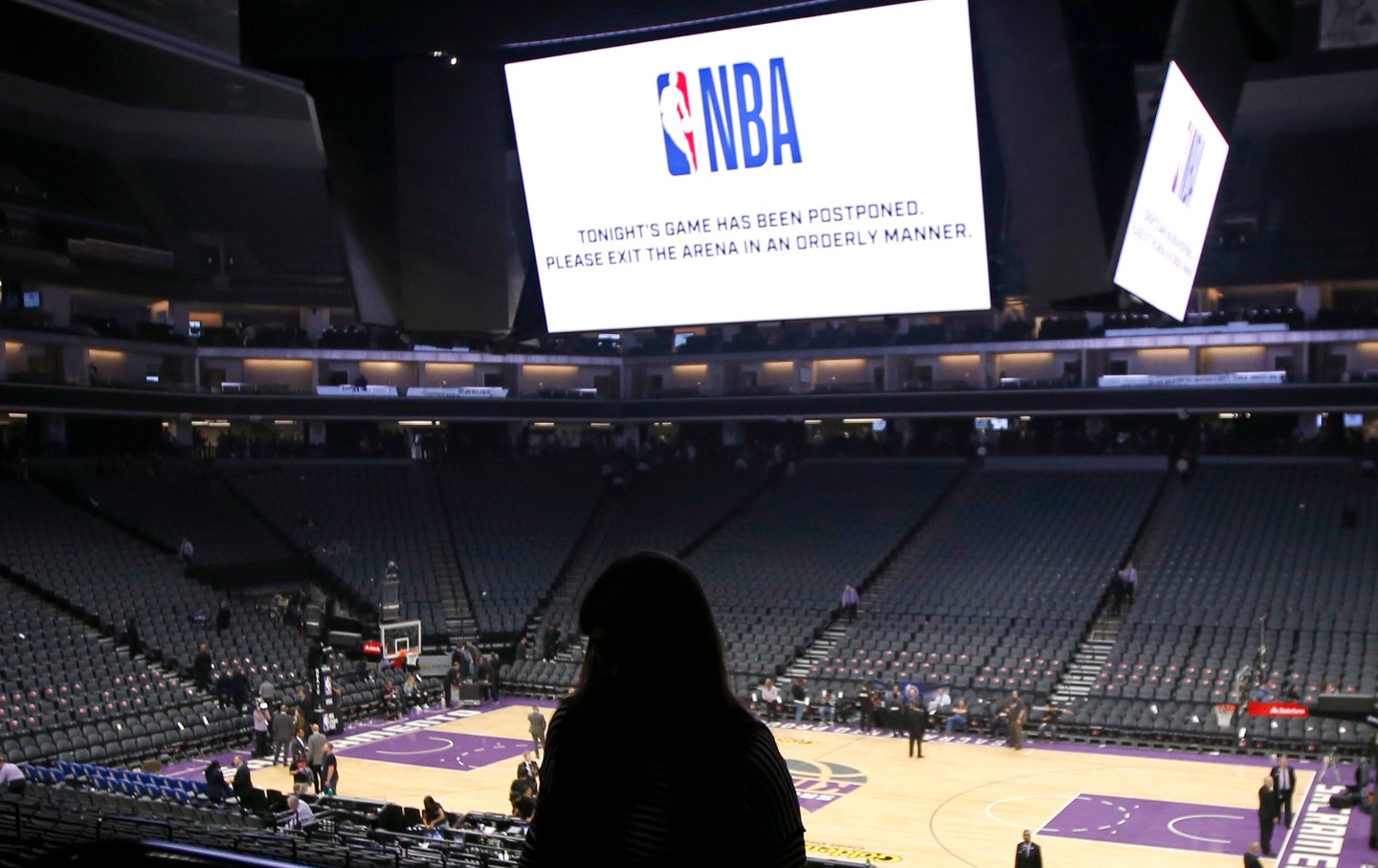
Fans leave the Golden 1 Center after an NBA game in Sacramento, California was postponed as a precaution against the coronavirus on March 11, 2020. (Rich Pedroncelli / AP

The National Basketball Association has acted with a speed that is putting other sports leagues, the NCAA, and particularly the federal government to shame. In the course of a single day, March 11—a day we will perhaps remember as the turning point when people began taking the coronavirus seriously—the NBA moved from planning to wait out the virus, only asking players to fist bump instead of high-fiving the fans, to calling for games to be played in empty arenas, to finally putting the entire season on hiatus.

The NBA made this unprecedented decision after Utah Jazz All-Star center Rudy Gobert tested positive for the virus. Earlier this week, in an act that will go down in history as a symbol of our own hubris, Gobert touched every microphone in the press room—mocking the very idea that there was a communicable virus in our midst. After his diagnosis, the Jazz game in Oklahoma City against the Thunder was canceled right before tip-off, with confused fans milling about the concourses and both teams quarantined back in their locker rooms. If there was one scene that speaks to how quickly we’ve gone from blasé to terrified, it was seeing Chris Paul, the All-Star point guard for the Thunder and a respected union leader, come over to the Jazz bench to see what the hell was going on and be waved away fiercely as if he was about to walk through hell in a gasoline suit.

The NBA had to make this decision, for the players’ safety as much as the public’s. Few professions involve more travel and interaction with literally millions of people than professional basketball. The league could have become a COVID-19 roadshow, infecting populations in city after city. Commissioner Adam Silver had no choice but to pull the plug.


The collateral damage will be stark. It’s not merely about the integrity of the 2019–20 season. That seems pretty irrelevant at the moment. The bigger concern is the pain this will cause communities, particularly the thousands of low-wage workers who labor in NBA arenas. For many families, one paycheck away from calamity, this loss of income is catastrophic. Only one NBA owner thus far, Mark Cuban of the Dallas Mavericks, has stepped forward and said that he is developing a plan for employees of the team and the arena, saying, “I reached out…to find out what it would cost to financially support people who aren’t going to be able to come to work.”

The 29 other billionaires who own these teams, for public relations reasons alone, need to step up and tell the public how they are going to help the workers, particularly the low-wage workers who make arenas run, through this difficult time. Bob Myers, the president of the Golden State Warriors, did say, “We feel for the workers, mostly, the low-wage earners that count on working our games.” But workers need more than their sympathy. They need paid leave.

And even paid leave won’t help the people who sell bootleg goods outside the arenas, making their living through the underground, informal economy that surrounds sporting events around the world. I spoke to one of those workers last night, who said to me, “I don’t know what I’m going to do. I need that money. Without it, my family is in hella trouble. And if we get sick, I don’t even know.”


We also need more NBA players’ using their platform to speak out during this difficult time. Monty Williams, coach of the Phoenix Suns, said earlier this week, “I heard the test costs like $1,400. Who can pay for that other than folks who have excess money? People are dying. That test should be free.”

That is step one. NBA players now affected by this could make a tremendous difference by spreading public awareness.

For now, given first the death of Kobe and Gianna Bryant and now the hiatus of the season, I think many fans echo the words of LeBron James, who tweeted, “Man we cancelling sporting events, school, office work, etc etc. What we really need to cancel is 2020!”

Dave ZirinTWITTER

Dave Zirin is the sports editor of The Nation.
Billionaire NBA Owners Have an Obligation to Help Suffering Arena Workers—Now

It’s unconscionable that half the teams are still dragging their feet.


By Dave ZirinTwitter 3/15/2020

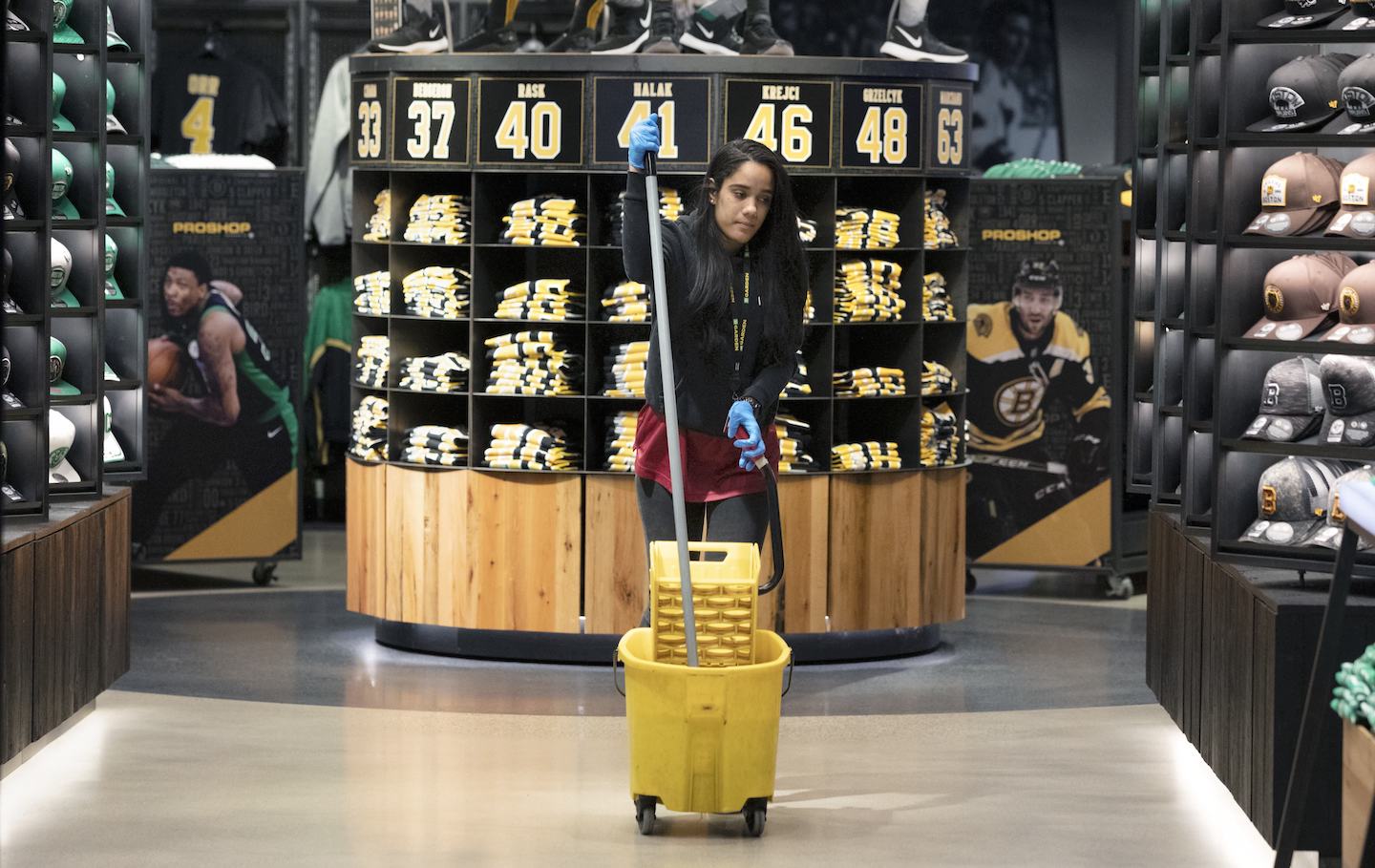
A cleaning person works in the pro shop at TD Garden in Boston, Saturday, March, 14, 2020. (Michael Dwyer / AP Photo)


New Orleans Pelicans rookie Zion Williamson is about as exciting and interesting an NBA player as we’ve seen in years. The 19-year-old has stepped up in a crisis, offering to pay all wages for the stadium workers at the Smoothie King Arena where he plays while the NBA season is on hold because of the COVID-19 crisis.

In a post on Instagram, Williamson said,
some of the most special people I have met are those who work at smoothie King Center…. these are the folks who make our games possible, creating the perfect environment for our fans and everyone involved in the organization. Unfortunately, many of them are still recovering from long term challenges created by Katrina, and now face the economic impact of the postponement of games because of the virus. My mother has always set an example for me about being respectful for others and being grateful for what we have, and so today I am pledging to cover the salaries for all of those Smoothie King Center workers for the next 30 days.

Zion is not the only NBA player who has ponied up some of his own mega-salary to help those most hurt by the stadium closures. Kevin Love of the Cleveland Cavaliers, MVP Giannis Antetokounmpo of the Milwaukee Bucks, and the Detroit Pistons’ Blake Griffin have all donated $100,000 to arena workers. The Golden State Warriors’ Steph Curry brought together players and management to pay $1 million in order to aid Chase Center employees in the Bay Area.

RELATED ARTICLE

OUR CAPITALIST, CORPORATIST COUNTRY IS DRASTICALLY UNPREPARED FOR THE CORONAVIRUS


Elie Mystal

President Obama gave them a backslap on Twitter, writing, “A shout out to Kevin, Giannis, Zion, Blake, Steph and all the players, owners and organizations who are setting a good example during a challenging time. A reminder that we’re a community, and that each of us has an obligation to look out for each other.”

Let’s unpack that term, “obligation.” What the generosity of individual players really highlights is just how few billionaire NBA owners have stepped up to aid the low-wage workers that make their stadium economies hum. So far, owners of only roughly half the teams have pledged to help.


NBA spokesman Mike Bass said in a statement: “NBA teams, arena owners and players are working together in partnership to support arena employees impacted by our season hiatus. Within the last day, many have already announced their plans while others are in the process of formulating them.”

They need to move faster. Credit to Mark Cuban of the Mavericks, for leading the way. And credit to Atlanta Hawks franchise owner Tony Ressler, who said,

We have a pretty clear set of priorities in this kind of remarkable time that we’re living through. Protecting our fans, protecting our employees, and protecting the reputation of our league, all of which is important, but let there be no confusion, that means taking care of all of our employees, our full-time, our part-time.

This commitment to “taking care of all of our employees, our full-time, our part-time” should be league wide. As Obama said, they have an obligation to do so. This isn’t about feel-good generosity, it’s about right and wrong. When NBA teams get hundreds of millions of dollars in taxpayer funds to build new stadiums, it is always done with the promise of jobs. These promises are always problematic, since they often, when not unionized, don’t come with a living wage and of course by their nature comprise seasonal, as opposed to year round, work. The coronavirus response has shown just how precarious these workers’ jobs are.

Now is put up or shut up time. The ownership plutocracy must provide paid leave for these workers, because promises made have to be matched by promises kept. One team, my hometown squad the Washington Wizards. and team governor Ted Leonsis will be doing the right thing and funding salaries of arena workers during this crisis. I spoke to one, who said to me, “Paid leave means I can stay home, care for my kids when they’re home from school. That means groceries. That means everything.” It’s unconscionable that half the teams are still dragging their feet. It shouldn’t take a 19-year-old rookie to shame these cosseted billionaires into doing their duty and to make sure everyone can play a role in getting us through this pandemic in one piece.


Dave ZirinTWITTER
Dave Zirin is the sports editor of The Nation.
Think Exotic Animals Are to Blame for the Coronavirus? Think Again.
Scientists have fingered bats and pangolins as potential sources of the virus, but the real blame lies elsewhere—with human assaults on the environment.


By Sonia Shah FEBRUARY 18, 2020


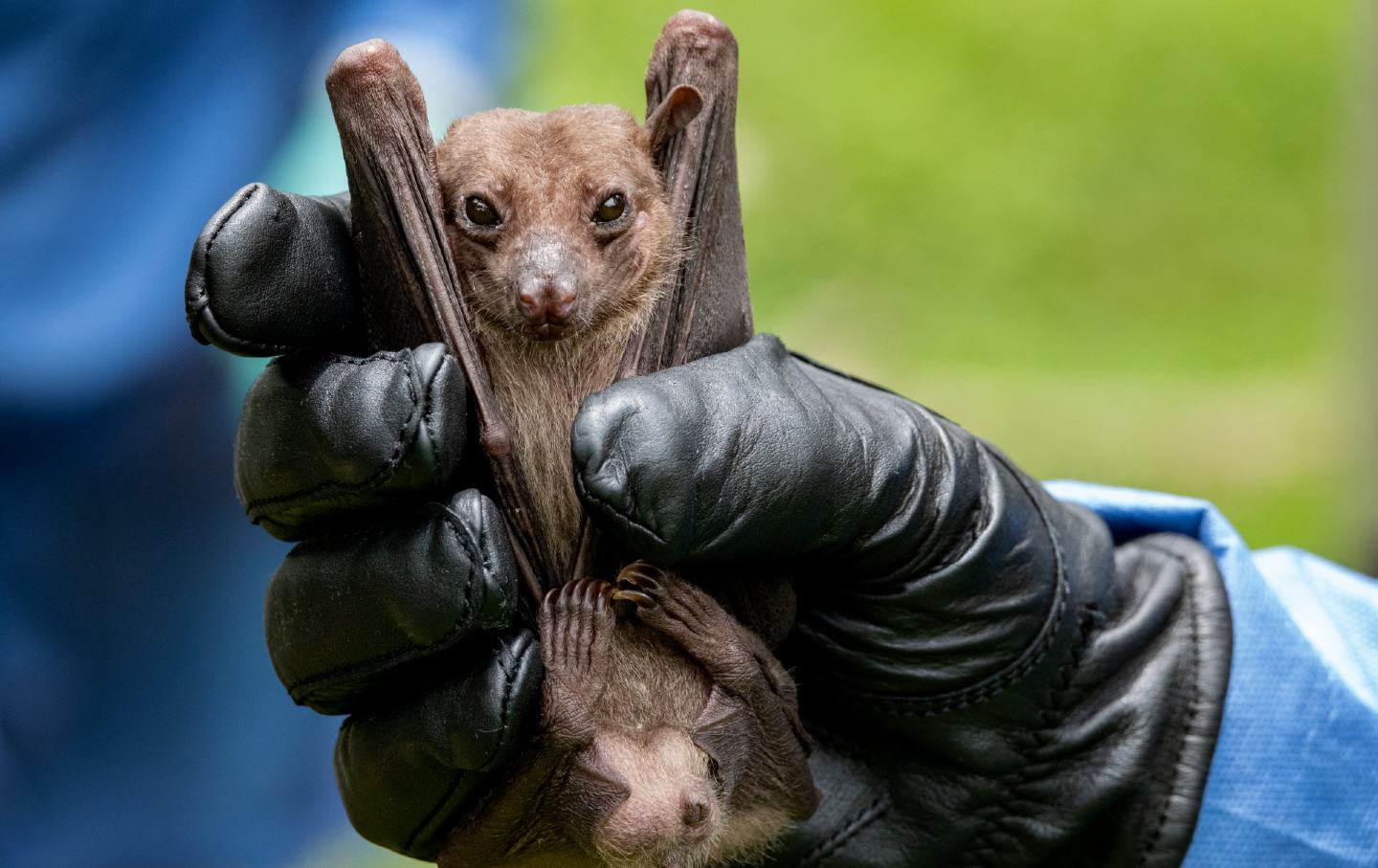
A fruit bat captured by CDC scientists Brian Amman and Jonathan Towner in Queen Elizabeth National Park on August 25, 2018. (Photo by Bonnie Jo Mount / The Washington Post via Getty Images)

It could have been a pangolin. Or a bat. Or, as one now-debunked theory that made the rounds suggested, a snake.

The race to finger the animal source of COVID-19, the coronavirus currently ensnaring more than 150 million people in quarantines and cordons sanitaires in China and elsewhere, is on. The virus’s animal origin is a critical mystery to solve. But speculation about which wild creature originally harbored the virus obscures a more fundamental source of our growing vulnerability to pandemics: the accelerating pace of habitat loss.

Since 1940, hundreds of microbial pathogens have either emerged or reemerged into new territory where they’ve never been seen before. They include HIV, Ebola in West Africa, Zika in the Americas, and a bevy of novel coronaviruses. The majority of them—60 percent—originate in the bodies of animals. Some come from pets and livestock. Most of them—more than two-thirds—originate in wildlife.

But that’s not the fault of wild animals. Although stories illustrated with pictures of wild animals as “the source” of deadly outbreaks might suggest otherwise, wild animals are not especially infested with deadly pathogens, poised to infect us. In fact, most of these microbes live harmlessly in these animals’ bodies.

The problem is the way that cutting down forests and expanding towns, cities, and industrial activities creates pathways for animal microbes to adapt to the human body.

Habitat destruction threatens vast numbers of wild species with extinction, including the medicinal plants and animals we’ve historically depended upon for our pharmacopeia. It also forces those wild species that hang on to cram into smaller fragments of remaining habitat, increasing the likelihood that they’ll come into repeated, intimate contact with the human settlements expanding into their newly fragmented habitats. It’s this kind of repeated, intimate contact that allows the microbes that live in their bodies to cross over into ours, transforming benign animal microbes into deadly human pathogens.

Consider Ebola. According to a 2017 study, Ebola outbreaks, which have been linked to several species of bats, are more likely to occur in places in Central and West Africa that have experienced recent episodes of deforestation. Cutting down the bats’ forests forces them to roost in trees in backyards and farms instead, increasing the likelihood that a human might, say, take a bite of a piece of fruit covered in bat saliva or hunt and slaughter a local bat, exposing herself to the microbes sheltering in the bat’s tissues. Such encounters allow a host of viruses carried harmlessly by bats—Ebola, Nipah, and Marburg, to name a few—to slip into human populations. When such so-called “spillover” events happen frequently enough, animal microbes can adapt to our bodies and evolve into human pathogens.
CURRENT ISSUE

Mosquito-borne disease outbreaks have been similarly linked to the felling of forests, although less because of the loss of habitat than to its transformation. As trees’ leaf litter and roots disappear, water and sediment flow more readily along the shorn forest floor, newly open to shafts of sunlight. Malaria-carrying mosquitoes breed in the sunlit puddles. A study in 12 countries found that mosquito species that carry human pathogens are twice as common in deforested areas compared to intact forests.

Habitat destruction also scrambles the population sizes of different species in ways that can increase the likelihood that a pathogen will spread. West Nile virus, a virus of migratory birds, is one example. Squeezed by habitat loss as well as other affronts, bird populations in North America have declined by more than 25 percent over the past 50 years. But species don’t decline at a uniform rate. Specialist bird species, like woodpeckers and rails, have been hit harder than generalists like robins and crows. That increases the abundance of West Nile virus in our domestic bird flocks because, while woodpeckers and rails are poor carriers of the virus, robins and crows excel at it. The likelihood that a local mosquito will bite a West Nile virus–infected bird and then a human grows.

Similarly, the expansion of suburbs into the Northeastern forest increases the risk of tick-borne disease by driving out creatures like opossums, which help control tick populations, while improving conditions for species like white-footed mice and deer, which don’t. Tick-borne Lyme disease first emerged in the United States in 1975; in the past 20 years, seven new tick-borne pathogens have followed.

It’s not only the fact of habitat destruction that ratchets up the risk of disease emergence, it’s also what we’re replacing wild habitat with. To sate our species’ carnivorous appetites, we’ve razed an area around the size of the continent of Africa to raise animals for slaughter. Some of these animals are then delivered through the illicit wildlife trade or sold in so-called “wet markets.” There, wild species that would rarely if ever encounter each other in nature are caged next to one another, allowing microbes to jump from one species to the next, a process that begot the coronavirus that caused the 2002–03 SARS epidemic and possibly the novel coronavirus stalking us today.

But many more are reared in factory farms, where hundreds of thousands of individuals await slaughter, packed closely together, providing microbes lush opportunities to turn into deadly pathogens. Avian influenza viruses, for example, which originate in the bodies of wild waterfowl, rampage in factory farms packed with captive chickens, mutating and becoming more virulent, a process so reliable it can be replicated in the laboratory. One strain called H5N1, which can infect humans, kills more than half of those infected. Containing another strain, which reached North America in 2014, required the slaughter of tens of millions of poultry.

The avalanche of excreta produced by our livestock introduces yet more opportunities for animal microbes to spill over into human populations. Because animal waste is far more voluminous than croplands can possibly absorb as fertilizer, it is collected in many places in unlined cesspools called manure lagoons. Shiga toxin–producing Escherichia coli, which lives harmlessly inside the guts of over half of all cattle on American feedlots, lurks in that waste. In humans, it causes bloody diarrhea and fever and can lead to acute kidney failure. Because cattle waste so frequently sloshes into our food and water, 90,000 Americans are infected every year.

This process of transforming animal microbes into human pathogens is accelerated today, but it is not new. It began with the Neolithic revolution, when we first cleared wildlife habitat to make way for crops and yoked wild animals into servitude. The “deadly gifts” we received from our “animal friends,” as Jared Diamond put it, include measles and tuberculosis, from cows; pertussis from pigs; and influenza from ducks. It continued during the era of colonial expansion. Belgian colonists in Congo built the railroads and cities that allowed a lentivirus in local macaques to perfect its adaptations to the human body; British colonists in Bangladesh cut down the Sundarbans wetlands to build rice farms, exposing humans to water-borne bacteria in the wetlands’ brackish waters.

The pandemics those colonial-era intrusions created plague us to this day. The macaque’s lentivirus evolved into HIV. The water-borne bacteria of the Sundarbans, now known as cholera, has caused seven pandemics so far, the latest churning just a few hundred miles off the coast of Florida in Haiti.

The good news is that, because we are not passive victims of animal microbes invading our bodies but fully empowered agents who turn harmless animal microbes into pandemic-causing pathogens, there’s much we can do to reduce the risk that these disease-causing microbes emerge at all.

We can protect wildlife habitat, so that animal microbes stay in their bodies and don’t cross over into ours, an approach championed by the “One Health” movement, among others.

We can conduct active surveillance in places where animal microbes are most likely to transform into human pathogens, hunting for ones that show signs of adapting to the human body—and squelching them before they cause epidemics. For the past 10 years, scientists funded by the USAID’s Predict program did just that. While the human footprint has continued to expand across the planet, Predict scientists have pinpointed more than 900 novel viruses around the world that emerged as a result, including new strains of SARS-like coronaviruses

Today, the shadow of the next pandemic looms. But that’s not just because of the novel coronavirus. The Trump administration’s liberation of extractive industries and industrial development from environmental and other regulatory constraints can be expected to accelerate the habitat destruction that brings animal microbes into human bodies. At the same time, the administration is reducing our ability to pinpoint the next spillover microbe and to contain it when it starts to spread. The administration decided to end the Predict program in October. Officials reportedly felt “uncomfortable funding cutting-edge science.” Last week, the administration proposed cutting funds to the World Health Organization too, by 53 percent.

The epidemiologist Larry Brilliant once said, “Outbreaks are inevitable, but pandemics are optional.” But pandemics only remain optional if we have the will to disrupt our politics as readily as we disrupt nature and wildlife. In the end, there is no real mystery about the animal source of pandemics. It’s not some spiky scaled pangolin or furry flying bat. It’s populations of warm-blooded primates: The true animal source is us.

Clarification: A previous version of this article stated that E. coli lives harmlessly inside the guts of over half of all cattle on American feedlots. While the prevalence of E. coli in cattle can reach that high on particular feedlots, it is more complicated to calculate the figure nationwide, since the presence of E. coli varies according to geography and time of year. This post has been updated.

Sonia ShahSonia Shah is a science journalist and the author of PANDEMIC: Tracking Contagion from Cholera to Ebola and Beyond (Farrar, Straus & Giroux, 2016). Her fifth book, The Next Great Migration: The Beauty and Terror of Life on the Move, will be published in June.
Prayer Will Not Stop the Coronavirus

The pandemic lays bare how American politicians have ignored the past and its injustices. It’s time for repentance, not just prayer.


By Rev. Dr. William J. Barber II and Jonathan Wilson-Hartgrove

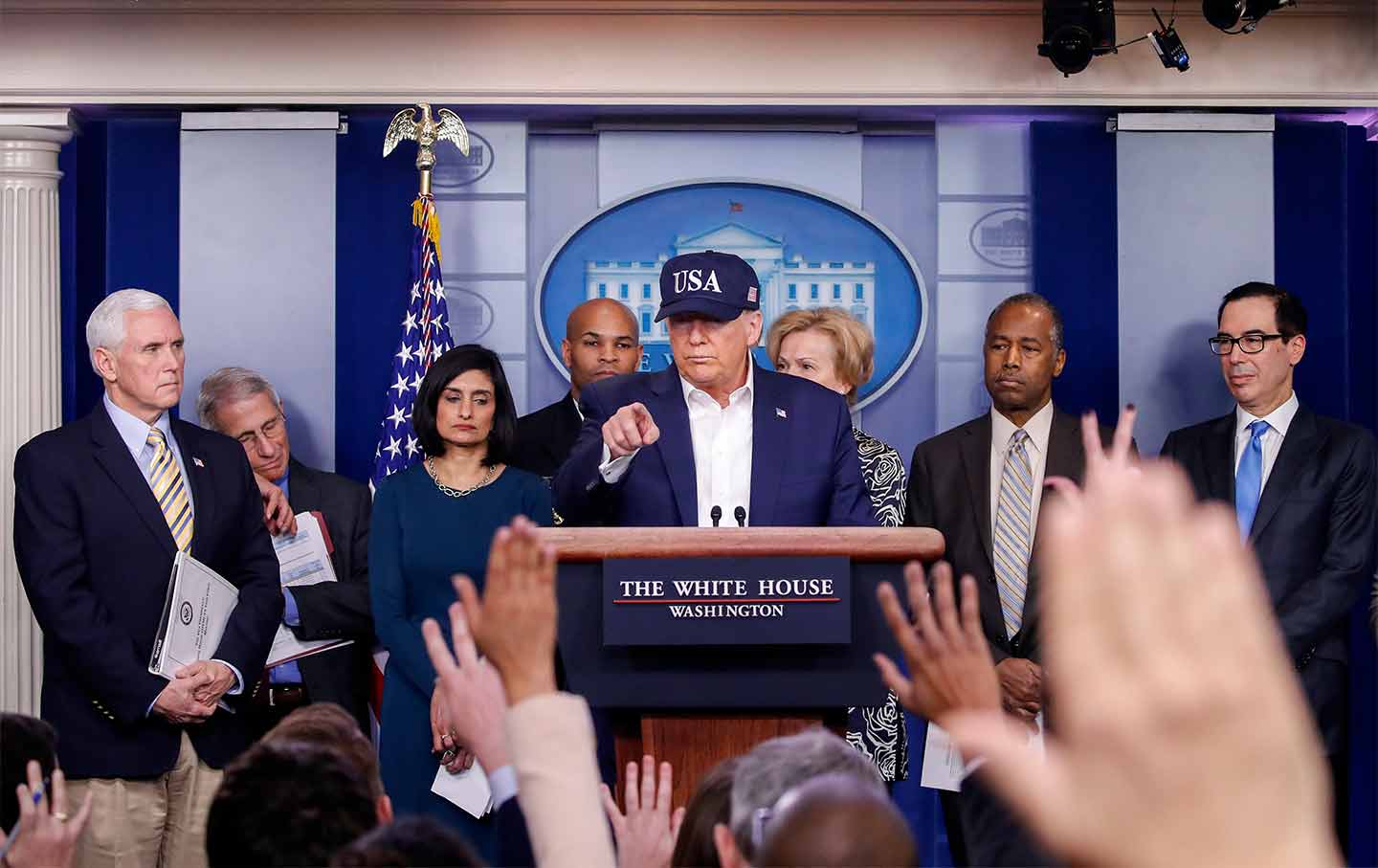
President Donald Trump speaks during a White House briefing on coronavirus. (Alex Brandon / AP Photo)


When President Donald Trump, Vice President Mike Pence, and public health officials held a Saturday press conference on their plans to address the coronavirus, Secretary of Housing and Urban Development Ben Carson was a surprising addition to the line-up.

Yes, Carson is a medical doctor. But his specialty was neurosurgery, not epidemiology. A public health crisis will certainly impact Americans who live in public housing and are housing insecure, but Carson did not address those issues either. Instead, he stepped to the microphone to celebrate Trump’s call for a National Day of Prayer Sunday.

But America is not in trouble because people are not praying; we face an exacerbated public health crisis because this administration has spent more time preying on the most vulnerable than lifting all people.

As Christian ministers who are called to preach the truth to God’s people, we are deeply troubled by the way this president continues to hypocritically manipulate faith as a cover for his ungodly policies. Though he has used racism to stoke fears in the nation and pushed policies that exacerbate racial inequality, Trump called on a black man to whitewash his incompetence and corruption at precisely the moment when the harsh reality of a global pandemic has exposed him.

Carson drew on the language of religious nationalism to frame the Trump administration’s response to the present crisis for a reason. “Developing your God-given talents to the utmost so you become valuable to the people around you, having values and principles—those are the things that made America zoom to the top of the world in record time,” Carson said. “And those are the things that will keep us there too.”

By obscuring America’s original sin of race-based slavery and the Doctrine of Discovery, which claimed divine right to seize native land, the myth of Christian nationalism that Carson was parroting allows Trumpvangelicals to hope for a triumphant future to match their imagined past. “No matter where you may be,” Trump tweeted, “I encourage you to turn toward prayer in an act of faith. Together, we will easily PREVAIL.”

Public health officials have made clear that the weeks and months ahead will not be easy. For those of us who pray, our posture must not be one of ALL-CAPS CONFIDENCE, but of humble confession. The day of prayer we need is a day of repentance. And it should begin in the White House. The Trump administration got rid of the White House global pandemic office, played down the threat of the coronavirus, and continues to portray a disease spreading within US communities as a foreign threat that can be shut out at the border. He has also attacked the Affordable Care Act, cut food stamps, proposed a budget that would cut Medicaid and Medicare, and systemically worked to defund government programs we need now.

But Trump is not the only one who must repent. The extreme poverty and systemic racism that will be exposed by this public health crisis were here long before Trump. One hundred forty million Americans are poor and unable to afford basic supplies to prepare for quarantine, uninsured or underinsured at a moment when the health of food and service workers directly impacts all of us. The United States has the largest incarcerated population in the world, and the more than 2 million Americans who live in jails, prisons, and detention centers cannot practice social distancing or self-quarantine if they are exposed to the coronavirus.

For decades now, we have invested the majority of our nation’s resources in arming ourselves with bigger and bigger weapons that could destroy the world hundreds of times over. But we have met an enemy that could be more deadly than any war this nation has ever fought, and we are ill-prepared to even test our citizens for infection.

We must be clear: It is not only Republicans who must repent. House Democrats passed a needed Families First Act to ensure access to coronavirus testing, paid family and sick leave, and economic protections as we all face uncertainty. But they allowed provisions that leave out millions of workers—many of them among the most vulnerable. We do not need prayer for protection. We need repentance and prayer for political courage and will to do justice. Then we need action because, as the Bible says, “Faith without works is dead.”
TRUMPISM

TRUE RELIGIOUS FAITH DEMANDS AN UNWAVERING REBUKE OF TRUMPISM

Rev. Dr. William J. Barber II and Jonathan Wilson-Hartgrove

In the Christian church, this is the season of Lent—a time when we confess the ways we have fallen short and turned away from God’s justice. Though many churches have canceled services to prevent the spread of the coronavirus, the psalm appointed for this Sunday is a song of penance from ancient Israel (Psalms 95). It is not a song of triumph, but a pointed reminder that the potential for self-centeredness we see in corrupt leadership is in each of us. “Harden not your hearts as your forebears did,” the psalm says. The people who passed this song from one generation to the next also passed down the story of an evil ruler, Pharaoh, who had “hardened his heart” against their people during a plague and refused to grant them freedom. When we pray Psalms 95, we remember that Pharaoh’s have always triumphed at the expense of the poor and marginalized. But we also remember that the hard heart of Pharaoh is a temptation for each of us. We must repent in order to open ourselves to the needs of the most vulnerable among us.

As we face the uncertainty of a global pandemic, the lies of religious nationalism cannot save us. We cannot ignore the past and its injustices, which still shape our present. Nor can we put our faith in the false promise that our wealth and power will save us. No, we must humble ourselves and remember what every faith tradition reveals: that God is present among the most vulnerable among us, and that if we act now to protect those at the bottom we have the greatest chance of protecting us all.

Rev. Dr. William J. Barber IIThe Rev. William J Barber, II is co-chair of the Poor People’s Campaign: A National Call for Moral Revival. His latest book is Revive Us Again: Vision and Action in Moral Organizing.


Jonathan Wilson-HartgroveJonathan Wilson-Hartgrove is author of the newly released Revolution of Values.
Dr. Ben Carson QUACK!!

Dr. Ben Carson talks power of prayer at coronavirus press briefing
By Anugrah Kumar, Christian Post Contributor| Sunday, March 15, 2020


Backing President Donald Trump’s decision to make Sunday a National Day of Prayer to address the coronavirus outbreak, Housing and Urban Development Secretary Dr. Ben Carson on Saturday underlined the importance of prayer and faith in maintaining America’s greatness.

Talking about the coronavirus, or COVID-19, during President Trump’s press briefing at the White House Saturday, Carson said he hoped that Americans “can use this as an opportunity to pull together for good.”

“President Trump is going to be recommending a national day of prayer. And you know, we’ve gotten away from prayer and faith a lot in this country,” he said.

“There’s nothing wrong with godly principles, no matter what your faith is — loving your neighbor — caring about the people around you,” he continued. “Developing your God-given talents to the utmost, so you become valuable to the people around you. Having values and principles that guide your life. Those are things that made America zoom to the top of the world in record time — and those are the things that will keep us there too.”

On Friday evening, the president declared Sunday as a National Day of Prayer.

“It is my great honor to declare Sunday, March 15th as a National Day of Prayer. We are a Country that, throughout our history, has looked to God for protection and strength in times like these,” the president wrote on Twitter. “No matter where you may be, I encourage you to turn towards prayer in an act of faith. Together, we will easily PREVAIL!”

Since 1988, the first Sunday of March has been designated as a National Day of Prayer each year. Trump urged that the event be used this year to pray for protection from the coronavirus pandemic.

Responding to Trump’s call to pray for America’s safety, pastor Allen Jackson of World Outreach Church in Tennessee, the Christian nonprofit group My Faith Votes and pastor Rob Morgan of Donelson Fellowship, also in Tennessee, have announced that they will hold a joint service called “America, Its Time to Pray,” which will be live-streamed.

Congregations across the nation are invited, they said in a statement, to join them “in praying for faith over fear and God’s intervention in the spread of COVID-19.”

Speaking at the same press briefing on Saturday, U.S. Surgeon General Jerome Adams encouraged the media to focus on dealing with the disease and not on criticizing the Trump administration’s efforts to combat the coronavirus.

“I want you all to understand — straight talk from the nation’s doctor — we really need you all to lean into and prioritize the health and safety of the American people,” he said. “No more bickering, no more partisanship, no more criticism or finger-pointing; they’ll be plenty of time for that. But we all need to hit the reset button and lean forward, the health and safety of the American people are top priority.”

Adams said the spread of the novel coronavirus “will get worse before it gets better but we are making progress to flatten the curve. We are making progress.” He also assured that almost all who get infected will recover, “98, 99 percent of the people will recover.”

Also on Saturday, the Trump administration extended the existing ban on travel from Europe to include the U.K. and Ireland. The travel restrictions will come into force midnight on Monday, the administration said.

Excluded from the ban are American citizens, legal permanent residents, and their immediate families, among others.

During Saturday’s press briefing, Trump said he’s also considering domestic travel restrictions. “If you don’t have to travel, I wouldn’t do it. We want this thing to end. We don’t want a lot of people getting infected,” he said.