Monday, March 16, 2020
Five dead in fire at Petronas-Aramco refining complex in Malaysia
A. Ananthalakshmi
KUALA LUMPUR (Reuters) - A fire killed five people at an oil refining complex in southern Malaysia owned by Petronas and Saudi Aramco commercial operations this year.
It was the second fire in less than a year at the $27 billion Pengerang Integrated Complex (PIC) in Malaysia’s southern state of Johor.
The massive project includes a refinery, which will process around 300,000 barrels per day of crude oil when fully operational, and petrochemical plants with annual production capacity of 3.3 million tonnes.
Petronas [PETR.UL] and Saudi Aramco each have a 50% stake in the PRefChem joint venture, which owns and operates the refinery and some petrochemical plants at PIC.
The Johor state fire and rescue department said the fire and a blast occurred on Sunday night at the diesel hydro treater unit, which was removing sulfur from raw diesel using hydrogen gas.
Other than the fatalities, one person has suffered burns, the fire department said, adding that the cause of the fire was under investigation.
Pengerang Refining and Petrochemical (PRefChem), the joint venture, said a thorough investigation was ongoing and that it was cooperating with authorities.
“The emergency response team is working closely with the relevant authorities and the situation is under control and the site is shut down,” it said in a statement.
It also confirmed the five deaths and the injury.
In April 2019, an explosion and fire occurred at the plant’s atmospheric residue desulphurisation unit (ARDS), a unit that removes sulfur from fuel oil, which is then used to produce gasoline. There were no casualties then.
The ARDS has been scheduled for operation by mid-2020, and full commercial operations for PRefChem was targeted for the second half of 2020.
Malaysia’s Pengerang peninsula sits between the Malacca Strait and the South China Sea, through which almost all the Middle East oil and gas bound for northern Asia’s industrial powerhouses of China, Japan and South Korea is shipped.
The PIC project is state energy firm Petronas’ biggest investment in Malaysia.
Saudi Aramco came on board in 2017, agreeing to pump in $7 billion in its biggest downstream investment outside the kingdom. It also agreed to supply up to 70% of the crude feedstock requirement of the refinery.

Crowded, poor South Asia sees steady rise in coronavirus cases
KARACHI/KABUL (Reuters) - Health authorities across South Asia reported rising tallies of coronavirus cases on Monday, raising the prospect of rapidly spreading outbreaks overwhelming poor medical facilities in a region that is home to a quarter of the world’s people.

South Korean soldiers in protective gear make their way while they disinfect buildings downtown, following the rise in confirmed cases of coronavirus disease (COVID-19) in Daegu, South Korea, March 15, 2020. REUTERS/Kim Kyung-Hoon
South Asia has been relatively lightly hit by the virus compared with neighbors to the east, like China and South Korea, and to the west like Iran and parts of Europe.
But measures that have reined in epidemics in China, where the coronavirus emerged late last year, and South Korea are unlikely to work in poor, crowded parts of South Asia, health officials say.
“As compared to developed countries like the United States and China it will be difficult to (enforce) social distancing, especially in slum areas,” said Giridhara R Babu, an epidemiologist at the Indian Institute of Public Health in the city of Bengaluru.
“The living environment itself is crowded and it may not be practical to ask them to maintain minimum distance from each other.”
Pakistan recorded a sharp rise in coronavirus cases on Monday, up 40 to 94, according to a Reuters tally of statistics from central and provincial governments.
The majority of new cases were in the southern province of Sindh in patients who had recently traveled from Iran - which has one of the world’s worst outbreaks.
Saeed Ghani, a cabinet minister in the Sindh government, told reporters on Monday existing quarantine facilities in Pakistan’s Baluchistan province on the Iranian border were inadequate, resulting in large numbers of coronavirus cases.
“Out of 100 plus samples, 50 resulted positive, which is a huge number,” he said.

AFGHAN PANIC
Afghanistan saw its tally rise to 21 with the majority of cases in the western province of Herat, which borders Iran and where thousands of Afghans cross back into their home country every day, some after being deported and others to escape a worsening Iranian economy.
Transport costs from the Iranian border to Herat city have quadrupled since the outbreak of the virus, officials said.
“We beg politicians and the central government to take this matter seriously,” said Herat governor Abdul Rahim Qayomi.
“We need food, we need medicines and we need all the basic facilities to be able to handle this problem.”
Afghanistan’s health infrastructure has been devastated by decades of war and a lack of funds and would be hard pressed to mount any sort of concerted action against a coronavirus epidemic.
Matin Noorzai, a wholesaler in the one of the main markets in the Afghan capital of Kabul, said he had seen unprecedented demand and soaring food prices in recent days as worried shoppers stocked up.
“If the situation continues like this, I am sure in the coming week there will be no food left in the market,” he said.
CLOSURES CONTINUE
Elsewhere, Sri Lanka reported a near-doubling of cases to 18 from 10. India’s tally rose to 110, while total cases in the Maldives and Bangladesh rose to 13 and 8, respectively.
New Delhi followed several other Indian states by ordering the closure of night clubs and gyms, and banning gatherings of 50 or more people.
Bangladesh, like other countries in the region, canceled international cricket matches and shut schools until the end of the month.
On Sunday, Indian Prime Minister Narendra Modi offered $10 million from India to get a regional emergency fund going.
Speaking to fellow South Asian leaders via video conference, Modi said India would also offer rapid response teams and other expertise to deal with the crisis.
Around the world, the coronavirus has infected nearly 170,000 people and killed more than 6,500, according to a Reuters tally of official data.
Reporting by Asif Shahzad in Islamabad, Syed Raza Hassan in Karachi, Pakistan, Abdul Qadir Sediqi in Kabul, Storay Karimi in Herat, Afghanistan, Alasdair Pal in New Delhi, Ruma Paul in Dhaka and Waruna Karunatilake in Colombo; Writing by Alasdair Pal; Editing by Robert Birsel and Giles Elgood
Blinded Chilean student says protests won't end until president steps down
Aislinn Laing
Aislinn Laing
MARCH 16, 2020
SANTIAGO (Reuters) - A Chilean student who became a lightning rod for broad social unrest after police shot him in the face during a demonstration has said President Sebastian Pinera will never regain the trust of citizens and should step down.

Gustavo Gatica, 22, a Chilean student blinded in both eyes by police rubber bullets in a protest last year, receives lessons by an expert to learn to walk as blind next to his mother and girlfriend at subway station in Santiago, Chile, February 5, 2020. Picture taken, February 5, 2020. REUTERS/Edgard Garrido
Gustavo Gatica, 22, a psychology student at a Santiago university, said Pinera, a conservative billionaire two years into a second term in office, squandered an early window to engage with demonstrators’ complaints of social inequality and elitism when unrest began in October.
Instead, Gatica told Reuters in his first interview since he lost his sight in November, Pinera had said Chile was “at war” with those perpetrating violence and failed to rein in rights abuses by police.
“This unrest could have broken out at any moment because politicians had no idea what people were feeling, they lived in a bubble,” he said.
“The difference is that Pinera declared war, brought soldiers out, there were deaths, shootings. That’s why people remain in the streets, why there is so much violence, because he remains in office.
“His resignation would dial down the tension.”
The protests resulted in at least 31 people killed, 3,000 injured, and 30,000 detained. Prosecutors are probing allegations of abuse made by over 5,000 people against the security forces.
Chile’s human rights watchdog says 445 people suffered eye injuries, primarily due to police tear gas canisters and rubber bullets. Gatica became one of two people blinded in both eyes after he was shot with rubber bullets on Nov. 8.
The end of the southern hemisphere summer vacation and the second anniversary of Pinera’s return to office last week has seen protests surge again.
In response to the protests, Pinera has announced measures to improve pensions, lift the minimum wage, cut hospital waiting lists, and address white collar crime and the price of medicines, as well as agreeing to demands for a referendum on a new constitution.
In a local television interview on Thursday, he renewed his backing for Chile’s police, saying there had been some “excessive use of force” but they had found themselves “overwhelmed” by “unprecedented and organized” violence.
Elected in 2017 with 54% of the second round vote against a leftist candidate, center-right Pinera insisted he would see out his last two years in office, saying: “I was voluntarily chosen by a large majority of Chileans.”
On Wednesday, Gatica was mobbed by well-wishers after he returned to Plaza Italia, the hub of protests in the capital, to join a demonstration.
The same day, police chief General Mario Rozas said the officer responsible for shooting remains on active duty while prosecutors investigate the case. In reference to the case, he told a congressional human rights committee that “all actions were conducted within the law and the rules.”
Gatica said that was proof of a culture of impunity.
“While there is no justice people will continue to go to the streets,” he said. “Justice would be those responsible paying the price in all these cases, not just mine, including going to jail.”
Reporting by Aislinn Laing, Editing by Rosalba O'Brien
SANTIAGO (Reuters) - A Chilean student who became a lightning rod for broad social unrest after police shot him in the face during a demonstration has said President Sebastian Pinera will never regain the trust of citizens and should step down.
Gustavo Gatica, 22, a Chilean student blinded in both eyes by police rubber bullets in a protest last year, receives lessons by an expert to learn to walk as blind next to his mother and girlfriend at subway station in Santiago, Chile, February 5, 2020. Picture taken, February 5, 2020. REUTERS/Edgard Garrido
Gustavo Gatica, 22, a psychology student at a Santiago university, said Pinera, a conservative billionaire two years into a second term in office, squandered an early window to engage with demonstrators’ complaints of social inequality and elitism when unrest began in October.
Instead, Gatica told Reuters in his first interview since he lost his sight in November, Pinera had said Chile was “at war” with those perpetrating violence and failed to rein in rights abuses by police.
“This unrest could have broken out at any moment because politicians had no idea what people were feeling, they lived in a bubble,” he said.
“The difference is that Pinera declared war, brought soldiers out, there were deaths, shootings. That’s why people remain in the streets, why there is so much violence, because he remains in office.
“His resignation would dial down the tension.”
The protests resulted in at least 31 people killed, 3,000 injured, and 30,000 detained. Prosecutors are probing allegations of abuse made by over 5,000 people against the security forces.
Chile’s human rights watchdog says 445 people suffered eye injuries, primarily due to police tear gas canisters and rubber bullets. Gatica became one of two people blinded in both eyes after he was shot with rubber bullets on Nov. 8.
The end of the southern hemisphere summer vacation and the second anniversary of Pinera’s return to office last week has seen protests surge again.
In response to the protests, Pinera has announced measures to improve pensions, lift the minimum wage, cut hospital waiting lists, and address white collar crime and the price of medicines, as well as agreeing to demands for a referendum on a new constitution.
In a local television interview on Thursday, he renewed his backing for Chile’s police, saying there had been some “excessive use of force” but they had found themselves “overwhelmed” by “unprecedented and organized” violence.
Elected in 2017 with 54% of the second round vote against a leftist candidate, center-right Pinera insisted he would see out his last two years in office, saying: “I was voluntarily chosen by a large majority of Chileans.”
On Wednesday, Gatica was mobbed by well-wishers after he returned to Plaza Italia, the hub of protests in the capital, to join a demonstration.
The same day, police chief General Mario Rozas said the officer responsible for shooting remains on active duty while prosecutors investigate the case. In reference to the case, he told a congressional human rights committee that “all actions were conducted within the law and the rules.”
Gatica said that was proof of a culture of impunity.
“While there is no justice people will continue to go to the streets,” he said. “Justice would be those responsible paying the price in all these cases, not just mine, including going to jail.”
Reporting by Aislinn Laing, Editing by Rosalba O'Brien
Few U.S. shale firms can withstand prolonged oil price war
HOUSTON (Reuters) - For the last five years, U.S. shale oil producers have been battling suppliers for lower costs and running equipment and crews hard to drive drilling costs down by about $20 a barrel.
The oil market rout last week, however, has left most shale firms facing prices below their costs of production. The Organization of the Petroleum Exporting Countries (OPEC) and major oil producers including Russia have turned on each other to launch a price war that threatens to sink shale companies burdened with higher costs.
The cause of OPEC and Russia’s disagreement was what to do about plummeting oil demand as coronavirus curbs travel and economic activity worldwide. When oil producers failed to agree on coordinated cuts, they abandoned all attempts to keep global markets balanced.
With U.S. crude CLc1 falling 50% this year to near $31 a barrel, only a handful of the hundreds of U.S. shale firms today can profit from their newest wells, according to a Reuters analysis of field-by-field data provided by consultancy Rystad Energy.
Shale producers, most of which budgeted for oil between $55 per barrel and $65 per barrel in 2020, have moved quickly to idle rigs, cut staff and generate cash for expenses. The industry is on the ropes for the second time since 2014, when de facto OPEC leader Saudi Arabia launched the last price war to drive shale producers out of the market.
That effort pushed many shale producers into bankruptcy but ultimately failed because the industry made quick technological advance that drove costs down.
REDOUBLING COST CUTS
“A limited amount of activity will be able to go on,” said Matt Gallagher to Reuters, chief executive of Parsley Energy, who estimates that “activity levels will likely decrease 50% plus.”
FILE PHOTO: A pump jack operates in the Permian Basin oil and natural gas production area near Odessa, Texas, U.S., February 10, 2019. REUTERS/Nick Oxford
Parsley last week led the charge of shale producers pressuring oilfield service firms for price cuts.
Most U.S. shale production is “at risk with the current oil prices,” and new drilling projects are likely “to be put on hold relatively quickly,” said Artem Abramov, head of shale research at researcher Rystad Energy.
(For a graphic on the shale price producers need to cover costs, please click here: tmsnrt.rs/3cUpDwQ)
Parsley Energy is one of the few that can cover its costs with oil in the $30s, according to analysts’ estimates. But, said Gallagher, that is not good enough. “We fully expect that (cost) structure to reduce quickly from here,” he said.
Gallagher plans to cut spending and idle equipment, although the magnitude of the latest price collapse has not allowed him or others to precisely say how much and for how long. It will take six months for service costs to come down, he said.
Competitors are still deciding how deeply they need to go. EOG Resources Inc (EOG.N), one of the largest U.S. shale producers, is “evaluating our activity” and “in the process of finalizing our specific plans,” CEO Bill Thomas said.
Denver-based shale producer SM Energy Co (SM.N) has hedged 80% of this year’s oil production, giving it a guaranteed price of about $55 to $58 per barrel, and does not need to make quick cuts, said Vice President Jennifer Martin Samuels. Still, it is “evaluating the current plan in terms of modifying activity.”
“There are no good answers for the industry in a $30 per barrel environment,” Stephen Richardson, a shale analyst at Evercore ISI, wrote on Thursday in a report titled: “Let’s not fool ourselves, it’s all uneconomic and likely to stay that way.
HOUSTON (Reuters) - For the last five years, U.S. shale oil producers have been battling suppliers for lower costs and running equipment and crews hard to drive drilling costs down by about $20 a barrel.
The oil market rout last week, however, has left most shale firms facing prices below their costs of production. The Organization of the Petroleum Exporting Countries (OPEC) and major oil producers including Russia have turned on each other to launch a price war that threatens to sink shale companies burdened with higher costs.
The cause of OPEC and Russia’s disagreement was what to do about plummeting oil demand as coronavirus curbs travel and economic activity worldwide. When oil producers failed to agree on coordinated cuts, they abandoned all attempts to keep global markets balanced.
With U.S. crude CLc1 falling 50% this year to near $31 a barrel, only a handful of the hundreds of U.S. shale firms today can profit from their newest wells, according to a Reuters analysis of field-by-field data provided by consultancy Rystad Energy.
Shale producers, most of which budgeted for oil between $55 per barrel and $65 per barrel in 2020, have moved quickly to idle rigs, cut staff and generate cash for expenses. The industry is on the ropes for the second time since 2014, when de facto OPEC leader Saudi Arabia launched the last price war to drive shale producers out of the market.
That effort pushed many shale producers into bankruptcy but ultimately failed because the industry made quick technological advance that drove costs down.
LOWEST COSTS
Just 16 U.S. shale companies operate in fields where the average new well costs are below $35 per barrel, according to Rystad. Among those, Chevron Corp (CVX.N), Devon Energy Corp (DVN.N) and EOG Resources said they plan or are weighing new spending cuts.
The largest U.S. oil producer, Exxon Mobil Corp (XOM.N), turns a profit at $26.90 per barrel on its New Mexico properties, which are about a quarter of its Permian holdings, according to Rystad. The company declined to comment for this story, but earlier this month said it would slow its development in the Permian Basin, the largest U.S. shale field that spans Texas and New Mexico.
Occidental Petroleum Corp (OXY.N), and privately held CrownQuest Operating, both have costs below $30 per barrel, according to Rystad Energy.
But just covering output costs leaves producers lacking cash for shareholder dividends and corporate costs. Despite Occidental’s low-cost advantage, its shares on Friday traded at $14.26, down about 65% this year over worries it will not be able to shoulder its $40 billion debt load.
In Oklahoma, Continental Resources Inc (CLR.N) can profit below $40 per barrel while EOG. Magnolia Oil & Gas Corp (MGY.N) and Murphy Oil Corp (MUR.N) can withstand the price onslaught in South Texas’ Eagle Ford shale play, according to Rystad.
In North Dakota only six producers can cover costs at that level. In the Permian, a dozen can.
The very few able to cover production costs will lead to a wholesale reduction in industry spending as unprofitable producers stop drilling, say analysts.
Already, producers are asking oil service companies, which supply them with what they need for drilling in the shale patch to cut the price they charge for those services by 25%.
Producers are already working with restructuring firms, hoping to cut deals with creditors, people familiar with the matter said, and others are checking the value of their hedges, a means of locking in prices for future output.
Just 16 U.S. shale companies operate in fields where the average new well costs are below $35 per barrel, according to Rystad. Among those, Chevron Corp (CVX.N), Devon Energy Corp (DVN.N) and EOG Resources said they plan or are weighing new spending cuts.
The largest U.S. oil producer, Exxon Mobil Corp (XOM.N), turns a profit at $26.90 per barrel on its New Mexico properties, which are about a quarter of its Permian holdings, according to Rystad. The company declined to comment for this story, but earlier this month said it would slow its development in the Permian Basin, the largest U.S. shale field that spans Texas and New Mexico.
Occidental Petroleum Corp (OXY.N), and privately held CrownQuest Operating, both have costs below $30 per barrel, according to Rystad Energy.
But just covering output costs leaves producers lacking cash for shareholder dividends and corporate costs. Despite Occidental’s low-cost advantage, its shares on Friday traded at $14.26, down about 65% this year over worries it will not be able to shoulder its $40 billion debt load.
In Oklahoma, Continental Resources Inc (CLR.N) can profit below $40 per barrel while EOG. Magnolia Oil & Gas Corp (MGY.N) and Murphy Oil Corp (MUR.N) can withstand the price onslaught in South Texas’ Eagle Ford shale play, according to Rystad.
In North Dakota only six producers can cover costs at that level. In the Permian, a dozen can.
The very few able to cover production costs will lead to a wholesale reduction in industry spending as unprofitable producers stop drilling, say analysts.
Already, producers are asking oil service companies, which supply them with what they need for drilling in the shale patch to cut the price they charge for those services by 25%.
Producers are already working with restructuring firms, hoping to cut deals with creditors, people familiar with the matter said, and others are checking the value of their hedges, a means of locking in prices for future output.
REDOUBLING COST CUTS
“A limited amount of activity will be able to go on,” said Matt Gallagher to Reuters, chief executive of Parsley Energy, who estimates that “activity levels will likely decrease 50% plus.”
FILE PHOTO: A pump jack operates in the Permian Basin oil and natural gas production area near Odessa, Texas, U.S., February 10, 2019. REUTERS/Nick Oxford
Parsley last week led the charge of shale producers pressuring oilfield service firms for price cuts.
Most U.S. shale production is “at risk with the current oil prices,” and new drilling projects are likely “to be put on hold relatively quickly,” said Artem Abramov, head of shale research at researcher Rystad Energy.
(For a graphic on the shale price producers need to cover costs, please click here: tmsnrt.rs/3cUpDwQ)
Parsley Energy is one of the few that can cover its costs with oil in the $30s, according to analysts’ estimates. But, said Gallagher, that is not good enough. “We fully expect that (cost) structure to reduce quickly from here,” he said.
Gallagher plans to cut spending and idle equipment, although the magnitude of the latest price collapse has not allowed him or others to precisely say how much and for how long. It will take six months for service costs to come down, he said.
Competitors are still deciding how deeply they need to go. EOG Resources Inc (EOG.N), one of the largest U.S. shale producers, is “evaluating our activity” and “in the process of finalizing our specific plans,” CEO Bill Thomas said.
Denver-based shale producer SM Energy Co (SM.N) has hedged 80% of this year’s oil production, giving it a guaranteed price of about $55 to $58 per barrel, and does not need to make quick cuts, said Vice President Jennifer Martin Samuels. Still, it is “evaluating the current plan in terms of modifying activity.”
“There are no good answers for the industry in a $30 per barrel environment,” Stephen Richardson, a shale analyst at Evercore ISI, wrote on Thursday in a report titled: “Let’s not fool ourselves, it’s all uneconomic and likely to stay that way.
The US might already be in a recession
Let’s just say it: The longest economic expansion in U.S. history may already be over, killed by Covid-19.
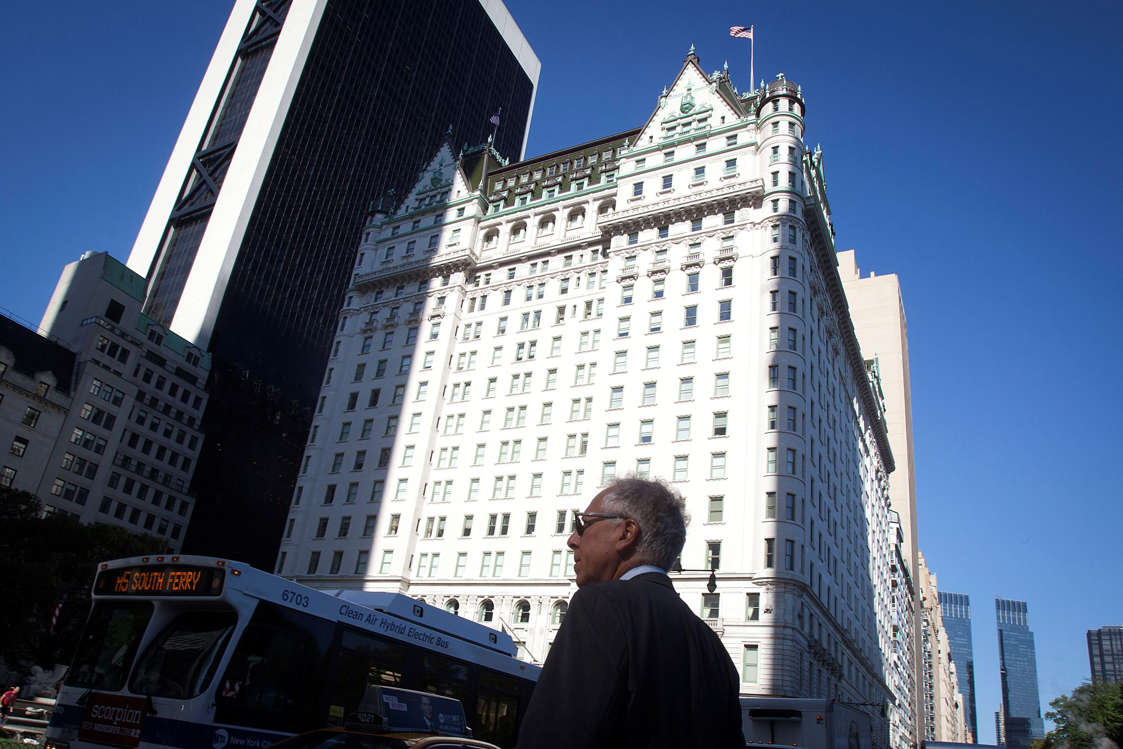
© Carlo Allegri / Reuters
Manhattan
It might seem crazy to talk about a recession when jobs are plentiful. Today the Bureau of Labor Statistics announced a decline in the February unemployment rate to 3.5%, tying a 50-year low.
But a recession isn’t when things are bad. It’s when they aren’t quite as good as they were at the peak. (Conversely, an “expansion” begins when the economy hits bottom and starts back up.)
When economic historians look back, they may pick February as the peak of the expansion that began in June 2009. That would give it a longevity of 128 months, the longest in records maintained by the National Bureau of Economic Research going back to 1854.
This wouldn’t be the first time the U.S. was in a recession without knowing it. In the summer of 2008 policymakers of the Federal Reserve were still predicting decent economic growth for that year and the next—even though a recession had begun the previous December, as later determined by the business cycle dating committee of the National Bureau of Economic Research.
The February jobs report that just came out is based on household and business surveys conducted in the week containing the 12th of the month. A lot has changed since then. On Feb. 12 there were still almost no cases of Covid-19 reported in the U.S. By March 5 there were 99, including 10 deaths, reported to the Centers for Disease Control and Prevention.
New research from State Street Associates and Massachusetts Institute of Technology indicates that the U.S. economy was vulnerable to a recession even before Covid-19 struck. In January the chance of recession over the next six months was about 70%, even though the stock market was then up about 22% over the previous year, it says.
The stock market’s sharp decline since January damages growth by making households feel poorer and businesses more pessimistic. The chance of a recession with stock prices where they were this week is around 75%, according to Will Kinlaw, a senior managing director and head of Cambridge, Mass.-based State Street Associates, the research unit of financial giant State Street Corp. If stocks give up all of their gains over the past 12 months, Kinlaw says, the likelihood of a recession will grow to 80%.
In addition to the stock market, the State Street Advisers forecasting model takes into account industrial production, the shape of the Treasury yield curve, and jobs. It’s based on a statistical concept called the Mahalanobis distance, which was developed to compare human skulls in India.
Covid-19 hit an economy that was less robust than it might have appeared. Nonfarm payroll employment was up 1.4% in January from a year earlier, which is OK. But industrial production was down 0.8% in January from a year earlier. And the Treasury yield curve was perilously close to inversion in January. (Inversion of the yield curve—in which long-term interest rates are lower than short-term ones—is a strong indicator of recession.)
The only strong indicator in January was the stock market, and now, thanks to the coronavirus, that indicator is flashing red as well.
While few economists have said the economy may already be in recession, some are beginning to say one is probably imminent. Mark Zandi, chief economist of Moody’s Analytics, says the chance of a recession this year is at least 50%.
In the financial markets, in contrast, recession talk is rampant. “This is what the start of a recession after a long bull market feels like,” John McClain, a portfolio manager at Diamond Hill Capital Management, told Bloomberg News today. “This is the first day of seeing some panic in the market.”
Kissing is frowned upon in the age of the coronavirus, but you might want to think about kissing goodbye to the longest economic expansion in U.S. history.
Read more: Coronavirus Could Cost the Global Economy $2.7 Trillion. Here’s How
Manhattan
It might seem crazy to talk about a recession when jobs are plentiful. Today the Bureau of Labor Statistics announced a decline in the February unemployment rate to 3.5%, tying a 50-year low.
But a recession isn’t when things are bad. It’s when they aren’t quite as good as they were at the peak. (Conversely, an “expansion” begins when the economy hits bottom and starts back up.)
When economic historians look back, they may pick February as the peak of the expansion that began in June 2009. That would give it a longevity of 128 months, the longest in records maintained by the National Bureau of Economic Research going back to 1854.
This wouldn’t be the first time the U.S. was in a recession without knowing it. In the summer of 2008 policymakers of the Federal Reserve were still predicting decent economic growth for that year and the next—even though a recession had begun the previous December, as later determined by the business cycle dating committee of the National Bureau of Economic Research.
The February jobs report that just came out is based on household and business surveys conducted in the week containing the 12th of the month. A lot has changed since then. On Feb. 12 there were still almost no cases of Covid-19 reported in the U.S. By March 5 there were 99, including 10 deaths, reported to the Centers for Disease Control and Prevention.
New research from State Street Associates and Massachusetts Institute of Technology indicates that the U.S. economy was vulnerable to a recession even before Covid-19 struck. In January the chance of recession over the next six months was about 70%, even though the stock market was then up about 22% over the previous year, it says.
The stock market’s sharp decline since January damages growth by making households feel poorer and businesses more pessimistic. The chance of a recession with stock prices where they were this week is around 75%, according to Will Kinlaw, a senior managing director and head of Cambridge, Mass.-based State Street Associates, the research unit of financial giant State Street Corp. If stocks give up all of their gains over the past 12 months, Kinlaw says, the likelihood of a recession will grow to 80%.
In addition to the stock market, the State Street Advisers forecasting model takes into account industrial production, the shape of the Treasury yield curve, and jobs. It’s based on a statistical concept called the Mahalanobis distance, which was developed to compare human skulls in India.
Covid-19 hit an economy that was less robust than it might have appeared. Nonfarm payroll employment was up 1.4% in January from a year earlier, which is OK. But industrial production was down 0.8% in January from a year earlier. And the Treasury yield curve was perilously close to inversion in January. (Inversion of the yield curve—in which long-term interest rates are lower than short-term ones—is a strong indicator of recession.)
The only strong indicator in January was the stock market, and now, thanks to the coronavirus, that indicator is flashing red as well.
While few economists have said the economy may already be in recession, some are beginning to say one is probably imminent. Mark Zandi, chief economist of Moody’s Analytics, says the chance of a recession this year is at least 50%.
In the financial markets, in contrast, recession talk is rampant. “This is what the start of a recession after a long bull market feels like,” John McClain, a portfolio manager at Diamond Hill Capital Management, told Bloomberg News today. “This is the first day of seeing some panic in the market.”
Kissing is frowned upon in the age of the coronavirus, but you might want to think about kissing goodbye to the longest economic expansion in U.S. history.
Read more: Coronavirus Could Cost the Global Economy $2.7 Trillion. Here’s How
The plumbing behind world's financial markets is creaking. Loudly
Tommy Wilkes

LONDON (Reuters) - The coronavirus panic is jolting stock markets, with steep drops in major indexes grabbing the public’s attention. But behind the scenes, there is less understood and potentially more worrying evidence that stress is building to dangerous levels in crucial arteries of the financial system.
Bankers, companies and individual investors are dashing to stock up on cash and other assets considered safe in a downturn to ride out the chaos. This sudden flight to safety is causing havoc in markets for bonds, currency and loans to a degree that hasn’t been seen since the financial crisis of a dozen years ago.
The key concern now, as in 2008, is liquidity: the ready availability of cash and other easily traded financial instruments - and of buyers and sellers who feel secure enough to do deals.
Investors are having trouble buying and selling U.S. Treasuries, considered the safest of all assets. It’s a highly unusual occurrence for one of the world’s most readily tradable financial instruments. Funding in U.S. dollars, the world’s most traded currency, is getting harder to obtain outside the United States.
The cost of funding for money that companies use to make payrolls and other essential short-term needs is rising for weaker-rated firms in the United States. The premium investors pay to buy insurance on junk bonds is increasing. Banks are charging each other more for overnight loans, and companies are drawing down their lines of credit, in case they dry up later.
Taken together, warn some bankers, regulators and investors, these red flags are starting to paint a troubling picture for markets and the global economy: If banks, companies and consumers panic, they can set off a chain of retrenchment that spirals into a bigger funding crunch - and ultimately a deep recession.
Francesco Papadia, who oversaw the European Central Bank’s market operations during the region’s debt crisis a decade ago, said his biggest fear is that the “illiquidity of markets, generated by extreme uncertainty and panic reaction” could “lead to markets freezing, which is an economic life-threatening event.”
“It does not seem to me we are there already, but we could get there quickly,” Papadia said.
A sign of the times is a hashtag now trending on Twitter: #GFC2 - a reference to the possibility of a second global financial crisis.
The warning signals so far are nowhere near as loud as they were in the 2008-2009 financial crisis, or the 2011-2012 euro zone debt crisis, to be sure. And policymakers are acutely aware of the weaknesses in the financial-market plumbing. In recent days, they have ramped up their response.
Central banks have cut interest rates and pumped trillions of dollars of liquidity into the banking system. On Sunday, the U.S. Federal Reserve slashed rates back to near zero, restarted bond buying and joined with other central banks to ensure liquidity in dollar lending to help shore up the economy.
“The one thing central banks know how to do following the experience of 2008 is to prevent a funding crisis from happening,” said Ajay Rajadhyaksha, head of macro research at Barclays Plc and member of a committee that advises the U.S. Treasury on debt management and the economy.
TODAY VS 2008
While the panic sweeping markets is reminiscent of the 2008 financial crisis, comparisons only go so far. Central bankers have last decade’s shocks fresh in their memories. Another key difference: Banks are in better shape today.
In 2008, banks had far less capital and far less liquidity than they have now, said Rodgin Cohen, senior chairman of Wall Street law firm Sullivan & Cromwell LLP and a top advisor to major U.S. financial firms.
Instead, investors and analysts said, the risk this time comes from the pandemic’s impact on the real economy: shuttered shops, travel bans and sections of the labor force sick or quarantined. The freeze means a severe blow for corporate revenues and earnings and overall economic growth, and for now, there is no end in sight.
Countrywide quarantines to block the virus, such as Italy’s, mean “businesses are going to be hit really hard when it comes to receipts, to revenue,” said Stuart Oakley, who oversees forex trading for clients at Nomura Holdings Inc. “However, liabilities are still the same: If you own a restaurant and you borrow money for the rent, you’ve still got to make that monthly payment.”
JPMorgan Chase & Co economists expect first-half contractions in growth across the globe. And this is as the U.S. response to the coronavirus is only getting started.
GRAPHIC: Coronavirus hits financial markets - here

RED FLAGS
Investors and regulators have been alarmed, in particular, by liquidity problems in the $17 trillion U.S. Treasuries market.
There are several signs that something is off. Interest rates, or yields, on Treasuries and other bonds move in inverse relation to their prices: If prices fall, the yields rise. Changes are measured in basis points, or hundredths of a percent.
Typically, yields move a few basis points a day. Now, large and unusually quick swings in yields are making it hard for investors to execute orders. Traders said dealers on Wednesday and Thursday significantly widened the spread in price at which they were willing to buy and sell Treasury bonds - a sign of reduced liquidity.
“The tremors in the Treasury market are the most ominous sign,” said Papadia, the ex-ECB official.
Another alarming signal is the premium non-U.S. borrowers are willing to pay to access dollars, a widely watched gauge of a potential cash crunch. The three-month euro-dollar EURCBS3M=ICAP and dollar-yen JPYCBS3M=ICAP swap spreads surged to their widest since 2017, before dropping on Friday after central banks pumped in more cash.
A measure of the health of the banking system is flashing yellow. The Libor-OIS spread USDL-O0X3=R, which indicates the risk banks are attaching to lending money to one another, has jumped. The spread is now 76 basis points, up from about 13 basis point on Feb. 21, before the coronavirus crunch began in the West. In 2008, it peaked at around 365 basis points.
GRAPHIC: Dollar funding - here

WEAK CORPORATE LINK
As funding markets creak, heavily indebted companies are feeling the heat.
Credit ratings firm Moody’s warns that defaults on lower-rated corporate bonds could spike to 9.7% of outstanding debt in a “pessimistic scenario,” compared with a historical average of 4.1%. The default rate reached 13.4% during the financial crisis.
The cost of insuring against junk debt defaults jumped on Thursday to its highest level in the United States since 2011 and the loftiest in Europe since 2012.
Some companies are now paying more for short-term borrowing. The premium that investors demand to hold riskier commercial paper versus the safer equivalent rose to its highest level this week since March 2009.
Several companies are drawing down on their credit lines with banks or increasing the size of their facilities to ensure they have liquidity when they need it. Bankers said companies fear lenders may not fund agreed credit lines should the market turmoil intensify.
An official at a major central bank said the situation is “pretty bad, as all stars are aligned in a negative way.””Cracks will start to emerge soon,” the official said, “but whether they will develop into something systemic is still hard to say.”
Additional reporting by Sujata Rao and Yoruk Bahceli in London, Tom Westbrook in Singapore and Lawrence Delevingne and Matt Scuffham in New York.; Editing by Paritosh Bansal, Mike Williams and Edward Tobin

A woman a wearing protective face mask, following an outbreak of the coronavirus disease (COVID-19), is reflected in a screen displaying NASDAQ movements outside a brokerage in Tokyo, Japan March 16, 2020. REUTERS/Edgard Garrido
Stocks dive as rescue bids by Fed, peers fail to calm panicky markets
Wayne Cole, Kane Wu
SYDNEY/HONG KONG (Reuters) - Stock markets were routed and the dollar stumbled on Monday after the Federal Reserve slashed interest rates in an emergency move and its major peers offered cheap U.S. dollars to ease a ruinous logjam in global lending markets.
European markets were also poised to open sharply lower, with EUROSTOXX 50 futures down 3.4% and FTSE futures down down 2.7%. E-mini futures for the S&P 500 index hit their downlimit in the first quarter-hour of Asian trade as investors rushed for safety.
The Fed’s emergency 100 basis point cut on Sunday was followed on Monday by the Bank of Japan easing policy further with a pledge to ramp up purchases of exchange-traded funds and other risky assets.
New Zealand’s central bank also shocked by cutting rates 75 basis points to 0.25%, while the Reserve Bank of Australia (RBA) pumped more money into a strained financial system.
Japanese Prime Minister Shinzo Abe said G7 leaders would hold a teleconference at 1400 GMT to discuss the crisis.
The drastic maneuvers were aimed at cushioning the economic impact as the breakneck spread of the coronavirus all but shut down more countries, though they had only limited success in calming panicky investors.
MSCI’s index of Asia-Pacific shares outside Japan tumbled 4% to lows not seen since early 2017, while the Nikkei fell 2% as the Bank of Japan’s easing steps failed to stabilize market confidence.
Data out of China also underscored just how much economic damage the disease had already done to the world’s second-largest economy, with official numbers showing the worst drops in activity on record. Industrial output plunged 13.5% and retail sales 20.5%.
“By any historical standard, the scale and scope of these actions was extraordinary,” said Nathan Sheets, chief economist at PGIM Fixed Income, who helps manage $1.3 trillion in assets. “This is dramatic action and truly does represent a bazooka.”
“Even so, markets were expecting extraordinary action, so it remains to be seen whether the announcement will meaningfully shift market sentiment.”
He emphasized investors wanted to see a lot more U.S. fiscal stimulus put to work and evidence the Trump administration was responding vigorously and effectively to the public health challenges posed by the crisis.
“The performance of the economy and the markets will be mainly determined by the severity and duration of the virus’ outbreak.”
Shanghai blue chips fell 3% even as China’s central bank surprised with a fresh round of liquidity injections into the financial system. Hong Kong’s Hang Seng index tumbled 3.4%.
Australia’s S&P/ASX 200 plunged, finishing down 9.7% for its steepest fall since the 1987 crash.
UNDER STRAIN
Markets have been severely strained as bankers, companies and individual investors stampeded into cash and safe-haven assets, while selling profitable positions to raise money to cover losses in savaged equities.
Such is the dislocation the Fed cut interest rates by 100 basis points on Sunday to a target range of 0% to 0.25%, and promised to expand its balance sheet by at least $700 billion in coming weeks.
Five of its peers also joined up to offer cheap U.S. dollar funding for financial institutions facing stress in credit markets.
U.S. President Donald Trump, who has been haranguing the Fed to ease policy, called the move “terrific” and “very good news.”
“It may be a shot in the arm for risk assets and help to address liquidity concerns...however, it also raises the question of whether the Fed has anything left in the tank should the spread of the virus not be contained,” said Kerry Craig, global market Strategist at J.P. Morgan Asset Management.
“We really need to see the fiscal side...to prevent a longer than needed economic slowdown.”
The Fed’s rate cut combined with the promise of more bond buying pushed U.S. 10-year Treasury yields down sharply to 0.68%, from 0.95% late on Friday.
That pressured the U.S. dollar at first, though it regained some ground as the Asian session wore on. The dollar was last down 1.4% on the Japanese yen at 106.37. The euro was flat at $1.1123.
The commodity-exposed Australian dollar fell 0.3% to $0.6166 while the New Zealand dollar slipped 0.2% to $0.6044.
Oil prices fell on concerns about global demand. Brent crude was last off $1.31 at $32.54 per barrel while U.S. crude slipped 78 cents to $30.94 a barrel.
Gold rallied 0.8% to $1,541.34.

Tommy Wilkes
LONDON (Reuters) - The coronavirus panic is jolting stock markets, with steep drops in major indexes grabbing the public’s attention. But behind the scenes, there is less understood and potentially more worrying evidence that stress is building to dangerous levels in crucial arteries of the financial system.
Bankers, companies and individual investors are dashing to stock up on cash and other assets considered safe in a downturn to ride out the chaos. This sudden flight to safety is causing havoc in markets for bonds, currency and loans to a degree that hasn’t been seen since the financial crisis of a dozen years ago.
The key concern now, as in 2008, is liquidity: the ready availability of cash and other easily traded financial instruments - and of buyers and sellers who feel secure enough to do deals.
Investors are having trouble buying and selling U.S. Treasuries, considered the safest of all assets. It’s a highly unusual occurrence for one of the world’s most readily tradable financial instruments. Funding in U.S. dollars, the world’s most traded currency, is getting harder to obtain outside the United States.
The cost of funding for money that companies use to make payrolls and other essential short-term needs is rising for weaker-rated firms in the United States. The premium investors pay to buy insurance on junk bonds is increasing. Banks are charging each other more for overnight loans, and companies are drawing down their lines of credit, in case they dry up later.
Taken together, warn some bankers, regulators and investors, these red flags are starting to paint a troubling picture for markets and the global economy: If banks, companies and consumers panic, they can set off a chain of retrenchment that spirals into a bigger funding crunch - and ultimately a deep recession.
Francesco Papadia, who oversaw the European Central Bank’s market operations during the region’s debt crisis a decade ago, said his biggest fear is that the “illiquidity of markets, generated by extreme uncertainty and panic reaction” could “lead to markets freezing, which is an economic life-threatening event.”
“It does not seem to me we are there already, but we could get there quickly,” Papadia said.
A sign of the times is a hashtag now trending on Twitter: #GFC2 - a reference to the possibility of a second global financial crisis.
The warning signals so far are nowhere near as loud as they were in the 2008-2009 financial crisis, or the 2011-2012 euro zone debt crisis, to be sure. And policymakers are acutely aware of the weaknesses in the financial-market plumbing. In recent days, they have ramped up their response.
Central banks have cut interest rates and pumped trillions of dollars of liquidity into the banking system. On Sunday, the U.S. Federal Reserve slashed rates back to near zero, restarted bond buying and joined with other central banks to ensure liquidity in dollar lending to help shore up the economy.
“The one thing central banks know how to do following the experience of 2008 is to prevent a funding crisis from happening,” said Ajay Rajadhyaksha, head of macro research at Barclays Plc and member of a committee that advises the U.S. Treasury on debt management and the economy.
TODAY VS 2008
While the panic sweeping markets is reminiscent of the 2008 financial crisis, comparisons only go so far. Central bankers have last decade’s shocks fresh in their memories. Another key difference: Banks are in better shape today.
In 2008, banks had far less capital and far less liquidity than they have now, said Rodgin Cohen, senior chairman of Wall Street law firm Sullivan & Cromwell LLP and a top advisor to major U.S. financial firms.
Instead, investors and analysts said, the risk this time comes from the pandemic’s impact on the real economy: shuttered shops, travel bans and sections of the labor force sick or quarantined. The freeze means a severe blow for corporate revenues and earnings and overall economic growth, and for now, there is no end in sight.
Countrywide quarantines to block the virus, such as Italy’s, mean “businesses are going to be hit really hard when it comes to receipts, to revenue,” said Stuart Oakley, who oversees forex trading for clients at Nomura Holdings Inc. “However, liabilities are still the same: If you own a restaurant and you borrow money for the rent, you’ve still got to make that monthly payment.”
JPMorgan Chase & Co economists expect first-half contractions in growth across the globe. And this is as the U.S. response to the coronavirus is only getting started.
GRAPHIC: Coronavirus hits financial markets - here
RED FLAGS
Investors and regulators have been alarmed, in particular, by liquidity problems in the $17 trillion U.S. Treasuries market.
There are several signs that something is off. Interest rates, or yields, on Treasuries and other bonds move in inverse relation to their prices: If prices fall, the yields rise. Changes are measured in basis points, or hundredths of a percent.
Typically, yields move a few basis points a day. Now, large and unusually quick swings in yields are making it hard for investors to execute orders. Traders said dealers on Wednesday and Thursday significantly widened the spread in price at which they were willing to buy and sell Treasury bonds - a sign of reduced liquidity.
“The tremors in the Treasury market are the most ominous sign,” said Papadia, the ex-ECB official.
Another alarming signal is the premium non-U.S. borrowers are willing to pay to access dollars, a widely watched gauge of a potential cash crunch. The three-month euro-dollar EURCBS3M=ICAP and dollar-yen JPYCBS3M=ICAP swap spreads surged to their widest since 2017, before dropping on Friday after central banks pumped in more cash.
A measure of the health of the banking system is flashing yellow. The Libor-OIS spread USDL-O0X3=R, which indicates the risk banks are attaching to lending money to one another, has jumped. The spread is now 76 basis points, up from about 13 basis point on Feb. 21, before the coronavirus crunch began in the West. In 2008, it peaked at around 365 basis points.
GRAPHIC: Dollar funding - here
WEAK CORPORATE LINK
As funding markets creak, heavily indebted companies are feeling the heat.
Credit ratings firm Moody’s warns that defaults on lower-rated corporate bonds could spike to 9.7% of outstanding debt in a “pessimistic scenario,” compared with a historical average of 4.1%. The default rate reached 13.4% during the financial crisis.
The cost of insuring against junk debt defaults jumped on Thursday to its highest level in the United States since 2011 and the loftiest in Europe since 2012.
Some companies are now paying more for short-term borrowing. The premium that investors demand to hold riskier commercial paper versus the safer equivalent rose to its highest level this week since March 2009.
Several companies are drawing down on their credit lines with banks or increasing the size of their facilities to ensure they have liquidity when they need it. Bankers said companies fear lenders may not fund agreed credit lines should the market turmoil intensify.
An official at a major central bank said the situation is “pretty bad, as all stars are aligned in a negative way.””Cracks will start to emerge soon,” the official said, “but whether they will develop into something systemic is still hard to say.”
Additional reporting by Sujata Rao and Yoruk Bahceli in London, Tom Westbrook in Singapore and Lawrence Delevingne and Matt Scuffham in New York.; Editing by Paritosh Bansal, Mike Williams and Edward Tobin
A woman a wearing protective face mask, following an outbreak of the coronavirus disease (COVID-19), is reflected in a screen displaying NASDAQ movements outside a brokerage in Tokyo, Japan March 16, 2020. REUTERS/Edgard Garrido
Stocks dive as rescue bids by Fed, peers fail to calm panicky markets
Wayne Cole, Kane Wu
SYDNEY/HONG KONG (Reuters) - Stock markets were routed and the dollar stumbled on Monday after the Federal Reserve slashed interest rates in an emergency move and its major peers offered cheap U.S. dollars to ease a ruinous logjam in global lending markets.
European markets were also poised to open sharply lower, with EUROSTOXX 50 futures down 3.4% and FTSE futures down down 2.7%. E-mini futures for the S&P 500 index hit their downlimit in the first quarter-hour of Asian trade as investors rushed for safety.
The Fed’s emergency 100 basis point cut on Sunday was followed on Monday by the Bank of Japan easing policy further with a pledge to ramp up purchases of exchange-traded funds and other risky assets.
New Zealand’s central bank also shocked by cutting rates 75 basis points to 0.25%, while the Reserve Bank of Australia (RBA) pumped more money into a strained financial system.
Japanese Prime Minister Shinzo Abe said G7 leaders would hold a teleconference at 1400 GMT to discuss the crisis.
The drastic maneuvers were aimed at cushioning the economic impact as the breakneck spread of the coronavirus all but shut down more countries, though they had only limited success in calming panicky investors.
MSCI’s index of Asia-Pacific shares outside Japan tumbled 4% to lows not seen since early 2017, while the Nikkei fell 2% as the Bank of Japan’s easing steps failed to stabilize market confidence.
Data out of China also underscored just how much economic damage the disease had already done to the world’s second-largest economy, with official numbers showing the worst drops in activity on record. Industrial output plunged 13.5% and retail sales 20.5%.
“By any historical standard, the scale and scope of these actions was extraordinary,” said Nathan Sheets, chief economist at PGIM Fixed Income, who helps manage $1.3 trillion in assets. “This is dramatic action and truly does represent a bazooka.”
“Even so, markets were expecting extraordinary action, so it remains to be seen whether the announcement will meaningfully shift market sentiment.”
He emphasized investors wanted to see a lot more U.S. fiscal stimulus put to work and evidence the Trump administration was responding vigorously and effectively to the public health challenges posed by the crisis.
“The performance of the economy and the markets will be mainly determined by the severity and duration of the virus’ outbreak.”
Shanghai blue chips fell 3% even as China’s central bank surprised with a fresh round of liquidity injections into the financial system. Hong Kong’s Hang Seng index tumbled 3.4%.
Australia’s S&P/ASX 200 plunged, finishing down 9.7% for its steepest fall since the 1987 crash.
UNDER STRAIN
Markets have been severely strained as bankers, companies and individual investors stampeded into cash and safe-haven assets, while selling profitable positions to raise money to cover losses in savaged equities.
Such is the dislocation the Fed cut interest rates by 100 basis points on Sunday to a target range of 0% to 0.25%, and promised to expand its balance sheet by at least $700 billion in coming weeks.
Five of its peers also joined up to offer cheap U.S. dollar funding for financial institutions facing stress in credit markets.
U.S. President Donald Trump, who has been haranguing the Fed to ease policy, called the move “terrific” and “very good news.”
“It may be a shot in the arm for risk assets and help to address liquidity concerns...however, it also raises the question of whether the Fed has anything left in the tank should the spread of the virus not be contained,” said Kerry Craig, global market Strategist at J.P. Morgan Asset Management.
“We really need to see the fiscal side...to prevent a longer than needed economic slowdown.”
The Fed’s rate cut combined with the promise of more bond buying pushed U.S. 10-year Treasury yields down sharply to 0.68%, from 0.95% late on Friday.
That pressured the U.S. dollar at first, though it regained some ground as the Asian session wore on. The dollar was last down 1.4% on the Japanese yen at 106.37. The euro was flat at $1.1123.
The commodity-exposed Australian dollar fell 0.3% to $0.6166 while the New Zealand dollar slipped 0.2% to $0.6044.
Oil prices fell on concerns about global demand. Brent crude was last off $1.31 at $32.54 per barrel while U.S. crude slipped 78 cents to $30.94 a barrel.
Gold rallied 0.8% to $1,541.34.
In Indian capital, riots deepen a Hindu-Muslim divide
Rupam Jain, Aftab Ahmed
NEW DELHI (Reuters) - For years, Hindus and Muslims lived and worked peacefully together in Yamuna Vihar, a densely populated Delhi district.
Security force personnel stand guard in a street following Hindu-Muslim clashes triggered by a new citizenship law, in Mustafabad in the riot-affected northeast of New Delhi, India, March 4, 2020. REUTERS/Anushree Fadnavis
But the riots that raged through the district last month appear to have cleaved lasting divisions in the community, reflecting a nationwide trend as tensions over the Hindu nationalist agenda of Prime Minister Narendra Modi boil over.
Many Hindus in Yamuna Vihar, a sprawl of residential blocks and shops dotted with mosques and Hindu temples, and in other riot-hit districts of northeast Delhi, say they are boycotting merchants and refusing to hire workers from the Muslim community. Muslims say they are scrambling to find jobs at a time when the coronavirus pandemic has heightened pressure on India’s economy.
“I have decided to never work with Muslims,” said Yash Dhingra, who has a shop selling paint and bathroom fittings in Yamuna Vihar. “I have identified new workers, they are Hindus,” he said, standing in a narrow lane that was the scene of violent clashes in the riots that erupted on Feb. 23.
The trigger for the riots, the worst sectarian violence in the Indian capital in decades, was a citizenship law introduced last year that critics say marginalizes India’s Muslim minority. Police records show at least 53 people, mostly Muslims, were killed and more than 200 were injured.
Dhingra said the unrest had forever changed Yamuna Vihar. Gutted homes with broken doors can be seen across the neighborhood; electricity cables melted in the fires dangle dangerously above alleys strewn with stones and bricks used as makeshift weapons in the riots.
Most Hindu residents in the district are now boycotting Muslim workers, affecting everyone from cooks and cleaners to mechanics and fruit sellers, he said.
“We have proof to show that Muslims started the violence, and now they are blaming it on us,” Dhingra said. “This is their pattern as they are criminal-minded people.”
Those views were widely echoed in interviews with 25 Hindus in eight localities in northeast Delhi, many of whom suffered large-scale financial damages or were injured in the riots. Reuters also spoke with about 30 Muslims, most of whom said that Hindus had decided to stop working with them.
Suman Goel, a 45-year-old housewife who has lived among Muslim neighbors for 23 years, said the violence had left her in a state of shock.
“It’s strange to lose a sense of belonging, to step out of your home and avoid smiling at Muslim women,” she said. “They must be feeling the same too but it’s best to maintain a distance.”
Mohammed Taslim, a Muslim who operated a business selling shoes from a shop owned by a Hindu in Bhajanpura, one of the neighborhoods affected by the riots, said his inventory was destroyed by a Hindu mob.
He was then evicted and his space was leased out to a Hindu businessman, he said.
“This is being done just because I am a Muslim,” said Taslim.
Many Muslims said the attack had been instigated by hardline Hindus to counter protests involving tens of thousands of people across India against the new citizenship law.
“This is the new normal for us,” said Adil, a Muslim research assistant with an economic think tank in central Delhi. “Careers, jobs and business are no more a priority for us. Our priority now is to be safe and to protect our lives.”
He declined to disclose his full name for fear of reprisals.
Emboldened by Modi’s landslide electoral victory in 2014, hardline groups began pursuing a Hindu-first agenda that has come at the expense of the country’s Muslim minority.
Vigilantes have attacked and killed a number of Muslims involved in transporting cows, which are seen as holy animals by Hindus, to slaughterhouses in recent years. The government has also adopted a tough stance with regard to Pakistan, and in August withdrew semi-autonomous privileges for Jammu and Kashmir, India’s only Muslim-majority state.
In November, the Supreme Court ruled that a Hindu temple could be built at Ayodhya, where a right-wing mob tore down a 16th-century mosque in 1992, a decision that was welcomed by the Modi government.
The citizenship law, which eases the path for non-Muslims from neighboring Muslim-majority nations to gain citizenship in India, was the final straw for many Muslims, as well as secular Indians, sparking nationwide protests.
Modi’s office did not respond to questions from Reuters about the latest violence.
NIGHT VIGILANTES
During the day, Hindus and Muslims shun each other in the alleys of the Delhi districts that were hardest hit by the unrest in February. At night, when the threat of violence is greater, they are physically divided by barricades that are removed in the morning.
And in some areas, permanent barriers are being erected.
On a recent evening, Tarannum Sheikh, a schoolteacher, sat watching two welders install a high gate at the entrance of a narrow lane to the Muslim enclave of Khajuri Khas, where she lives. The aim was to keep Hindus out, she said.
“We keep wooden batons with us to protect the entrance as at any time, someone can enter this alley to create trouble,” she said. “We do not trust the police anymore.”
In the adjacent Hindu neighborhood of Bhajanpura, residents expressed a similar mistrust and sense of insecurity.
“In a way these riots were needed to unite Hindus, we did not realize that we were surrounded by such evil minds for decades,” said Santosh Rani, a 52-year-old grandmother.
She said she had been forced to lower her two grandchildren from the first floor of her house to the street below after the building was torched in the violence, allegedly by a Muslim.
“This time the Muslims have tested our patience and now we will never give them jobs,” said Rani who owns several factories and retail shops. “I will never forgive them.”
Hasan Sheikh, a tailor who has stitched clothing for Hindu and Muslim women for over 40 years, said Hindu customers came to collect their unstitched clothes after the riots.
“It was strange to see how our relationship ended,” said Sheikh, who is Muslim. “I was not at fault, nor were my women clients, but the social climate of this area is very tense. Hatred on both sides is justified.”
China allows detained Canadian ex-diplomat to call sick father


Former Canadian diplomat Michael Kovrig has been languishing in China's opaque legal system since December 2018 for allegedly gathering state secrets (AFP Photo/Julie DAVID DE LOSSY)Mo
China has allowed a former Canadian diplomat detained for allegedly gathering state secrets to speak on the phone to his ill father, the foreign ministry said Monday.
Michael Kovrig has been languishing in China's opaque legal system since he was apprehended in December 2018, along with Canadian businessman Michael Spavor, who faces similar accusations.
Their detention has been widely seen as retribution by Beijing for Canada's arrest days earlier of Huawei chief financial officer Meng Wanzhou on a US extradition request.
Beijing said it had allowed the phone call "after understanding the serious illness of Kovrig's father".
"The Chinese departments handling the case made special arrangements within the scope allowed by Chinese law, and agreed to allow Kovrig to speak on the phone with his father," foreign ministry spokesman Geng Shuang said at a regular press briefing.
Geng added that during the coronavirus outbreak which emerged in China late last year, authorities have taken "relevant measures to realistically protect the health and safety of people in custody including Kovrig and Spavor".
Former Canadian ambassador to Beijing Guy Saint-Jacques told AFP that it was "not in the habit of Chinese authorities" to allow these kinds of calls, and said the news was "a little encouraging".
"I don't think that his chances of getting out have increased because of this, but it shows a little bit of goodwill on the part of Chinese authorities," he said.
However, he warned that if Meng's extradition is to go ahead then he expects the Chinese authorities to formally charge the two Canadians, which would complicate efforts to secure their release.
Canada's foreign minister Francois-Philippe Champagne expressed his country's "deep concern" over the condition of the two men's detention in talks with his Chinese counterpart late last year.
Beijing has insisted the men are being held in "good" conditions, but people familiar with the matter have told AFP the two have endured hours of interrogation and in the first six months of detention were forced to sleep with the lights on.
IMPERIALIST COLONIZERS
First Russian-Turkish patrol on Syrian highway cut short by protests
Reuters•March 15, 2020

First Russian-Turkish patrol on Syrian highway cut short by protests
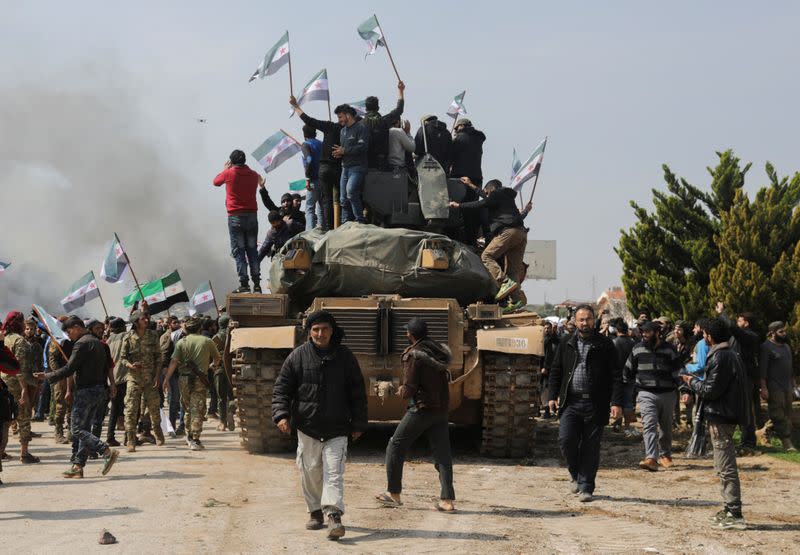
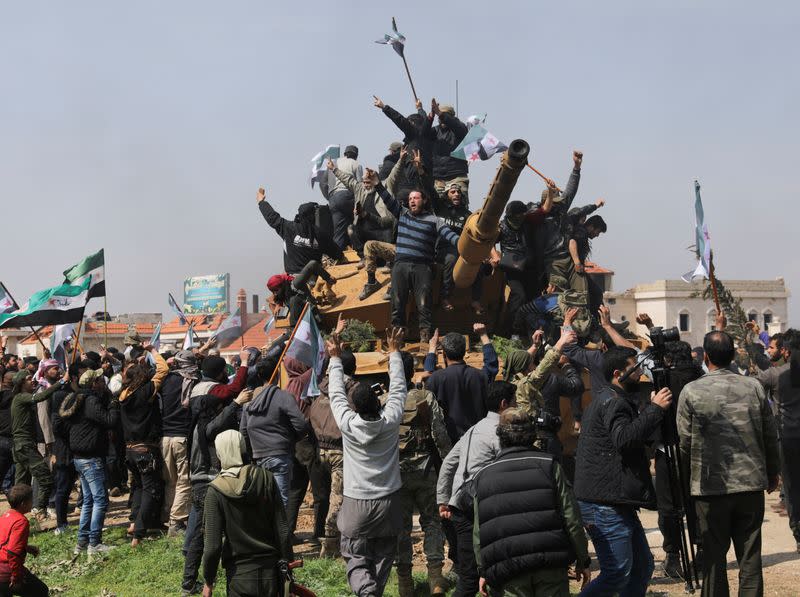
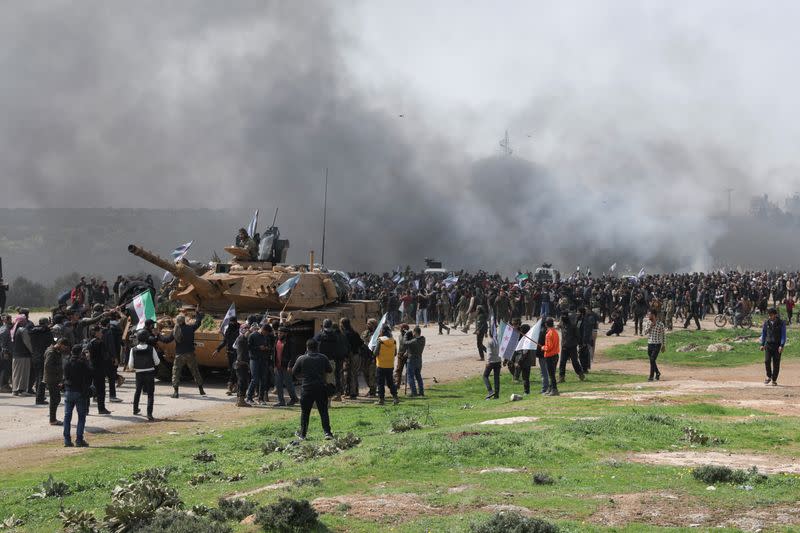
People stand on a Turkish military vehicle during a protest against an agreement on joint Russian and Turkish patrols, at M4 highway in Idlib province
IDLIB,SYRIA/MOSCOW (Reuters) - Russia and Turkey cut short their first joint patrol in Syria's Idlib on Sunday after rebels and civilians opposed to a ceasefire agreement cut off a main roadway to block its path, according to witnesses and Russian news agencies.
The patrol on the M4 highway in Idlib province was the result of a March 5 ceasefire accord between Moscow and Ankara, which back opposing sides in Syria's nine-year war. The ceasefire has largely held since then.
Under the deal, which halted hostilities after an escalation of violence that displaced nearly a million people, Turkish and Russian forces are to establish a security corridor on either side of the M4, as well as carry out joint patrols along it.
But on Sunday hundreds of civilians and rebels cut off the roadway, rejecting the presence of Russian forces and what they said was an agreement that did not guarantee their re-settlement after being pushed out by violence.
"If the patrols happen without people being able to return to their lands, we oppose them," said Osama Rahal, a military commander with the Syrian National Army, a Turkey backed rebel group.
Protesters, some waving Syrian National Army flags, climbed atop Turkish tanks or stood in their path, according to witnesses. Photos posted by the Syrian Observatory, a Britain-based war monitor, showed people lighting fires in the street and forming human chains.
"We are at odds with Russians who have been killing us for six years and have bombed us by air. So we oppose their entry into our towns," said Ahmed Shehad, 22.
The Russian Defense Ministry said the joint patrols were cut short because of rebel "provocations" and civilians being used as a human shield, forcing them to take a shorter route, according to Russian news agency RIA.
Ankara has been given more time to rein in rebels undermining the patrols, the Russian defense ministry said.
The Turkish Defense Ministry said the first patrol had been completed with air and land assets. It released photos showing Russian and Turkish military vehicles traveling along a highway and officers in discussion as they looked at a map.
It subsequently said the two sides in coordination "took necessary measures, with the aim of preventing potential provocations and harm to the civilian population in the region". It did not give further details.
(Reporting by Khalil Ashawi, Andrey Ostroukh and Daren Butler; Editing by Alexandra Hudson)
First Russian-Turkish patrol on Syrian highway cut short by protests
Reuters•March 15, 2020
First Russian-Turkish patrol on Syrian highway cut short by protests
People stand on a Turkish military vehicle during a protest against an agreement on joint Russian and Turkish patrols, at M4 highway in Idlib province
IDLIB,SYRIA/MOSCOW (Reuters) - Russia and Turkey cut short their first joint patrol in Syria's Idlib on Sunday after rebels and civilians opposed to a ceasefire agreement cut off a main roadway to block its path, according to witnesses and Russian news agencies.
The patrol on the M4 highway in Idlib province was the result of a March 5 ceasefire accord between Moscow and Ankara, which back opposing sides in Syria's nine-year war. The ceasefire has largely held since then.
Under the deal, which halted hostilities after an escalation of violence that displaced nearly a million people, Turkish and Russian forces are to establish a security corridor on either side of the M4, as well as carry out joint patrols along it.
But on Sunday hundreds of civilians and rebels cut off the roadway, rejecting the presence of Russian forces and what they said was an agreement that did not guarantee their re-settlement after being pushed out by violence.
"If the patrols happen without people being able to return to their lands, we oppose them," said Osama Rahal, a military commander with the Syrian National Army, a Turkey backed rebel group.
Protesters, some waving Syrian National Army flags, climbed atop Turkish tanks or stood in their path, according to witnesses. Photos posted by the Syrian Observatory, a Britain-based war monitor, showed people lighting fires in the street and forming human chains.
"We are at odds with Russians who have been killing us for six years and have bombed us by air. So we oppose their entry into our towns," said Ahmed Shehad, 22.
The Russian Defense Ministry said the joint patrols were cut short because of rebel "provocations" and civilians being used as a human shield, forcing them to take a shorter route, according to Russian news agency RIA.
Ankara has been given more time to rein in rebels undermining the patrols, the Russian defense ministry said.
The Turkish Defense Ministry said the first patrol had been completed with air and land assets. It released photos showing Russian and Turkish military vehicles traveling along a highway and officers in discussion as they looked at a map.
It subsequently said the two sides in coordination "took necessary measures, with the aim of preventing potential provocations and harm to the civilian population in the region". It did not give further details.
(Reporting by Khalil Ashawi, Andrey Ostroukh and Daren Butler; Editing by Alexandra Hudson)
The Sanders-Biden debate was all about competence, and recent coronavirus poll shows us why
Business Insider•March 15, 2020


Business Insider•March 15, 2020
Former Vice President Joe Biden, left, and Sen. Bernie Sanders, I-Vt., right, participate in a Democratic presidential primary debate at CNN Studios in Washington, Sunday, March 15, 2020.
AP Photo/Evan Vucci
Senator Bernie Sanders and former Vice President Joe Biden debated each other one-on-one for the first time Sunday night.
This was also the first debate to take place after the coronavirus pandemic exploded in the United States.
Insider has been polling Americans on how they view the preparedness of the government in light of the pandemic.
The results show that people, especially Democrats, don't think the government is prepared.
The first debate to have just two contenders took place Sunday, with the immediate focus of Sen. Bernie Sanders and Vice President Joe Biden being the coronavirus pandemic response from the United States government.
Sanders highlighted the work he and colleagues on the Hill had done to get a initial relief bill through, and emphasized other efforts he wanted to pursue to help workers. Biden laid out his proposal as released late last week for a governmental response, and also spoke about his role in the Obama administration's performance during the previous H1N1 and Ebola epidemics.
The remainder of the debate after the coronavirus portion was much of the same theme: two men with decades of government service arguing that they were the more competent one at various points in their assorted legislative and executive experiences, and saying that they would be the most prepared.
There's a key reason why: Americans, especially Democrats, think the government is not prepared for coronavirus.
From March 13-14, 2020 Insider conducted a poll of 1,081 American adults, asking them "Do you feel the US government is sufficiently prepared to handle coronavirus cases?"
8% said the government was "extremely prepared"
12% said the government was "very prepared"
26% said the government was "somewhat prepared,"
25% said the government was "not so prepared"
25% said the government was "not at all prepared," up 9 percentage points from the previous week.
4% didn't know.
AP Photo/Evan Vucci
Senator Bernie Sanders and former Vice President Joe Biden debated each other one-on-one for the first time Sunday night.
This was also the first debate to take place after the coronavirus pandemic exploded in the United States.
Insider has been polling Americans on how they view the preparedness of the government in light of the pandemic.
The results show that people, especially Democrats, don't think the government is prepared.
The first debate to have just two contenders took place Sunday, with the immediate focus of Sen. Bernie Sanders and Vice President Joe Biden being the coronavirus pandemic response from the United States government.
Sanders highlighted the work he and colleagues on the Hill had done to get a initial relief bill through, and emphasized other efforts he wanted to pursue to help workers. Biden laid out his proposal as released late last week for a governmental response, and also spoke about his role in the Obama administration's performance during the previous H1N1 and Ebola epidemics.
The remainder of the debate after the coronavirus portion was much of the same theme: two men with decades of government service arguing that they were the more competent one at various points in their assorted legislative and executive experiences, and saying that they would be the most prepared.
There's a key reason why: Americans, especially Democrats, think the government is not prepared for coronavirus.
From March 13-14, 2020 Insider conducted a poll of 1,081 American adults, asking them "Do you feel the US government is sufficiently prepared to handle coronavirus cases?"
8% said the government was "extremely prepared"
12% said the government was "very prepared"
26% said the government was "somewhat prepared,"
25% said the government was "not so prepared"
25% said the government was "not at all prepared," up 9 percentage points from the previous week.
4% didn't know.
Former Vice President Joe Biden, left, and Sen. Bernie Sanders,
I-Vt., right, participate in a Democratic presidential primary
debate at CNN Studios in Washington, Sunday, March 15, 2020.
(AP Photo/Evan Vucci)
AP Photo/Evan Vucci
The percentage who said "somewhat prepared" or more was down 6 points from two weeks prior, and the percentage who said "not so" or "not at all" prepared is up 10 percentage points.
There's a fairly striking partisan element to this as well.
Among those who identified as slightly liberal or more, 73% say the government is not so or not at all prepared compared to 25% who say they are somewhat, very, or extremely prepared.
Among those who identified as slightly conservative or more, 25% say the government is not so or not at all prepared compared to 72% who say they are somewhat, very, or extremely prepared.
Overall, the U.S. is split on the topic, with a 5 percentage point edge in favor of those who think the federal government is not prepared. But left-leaning voters don't trust the federal government, and as the remaining Democratic primary voters go to the polls, the global pandemic may have put a few people who thought they had made their choice between the candidates in a position to change their mind.
The one thing that Democrats mostly agree on is that the federal government has botched the preparation for coronavirus, and may be looking for a candidate who is more prepared on the issue. That's why tonight's debate left most of the issues that split the primary to the side, and instead focused on one of the core issues for Democrats now: Who was ahead of the curve when it counted, because in their view the government is not ahead of the curve right now.
Read more:
We hired 2 comic creators from the world of DC and Marvel to tell the full story of why Trump was impeached, and what he got away with
Here's how Democrats will elect their presidential nominee over the next several months
DELEGATE COUNT: Here's who's winning the race for the 2020 Democratic nomination
SurveyMonkey Audience polls from a national sample balanced by census data of age and gender. Respondents are incentivized to complete surveys through charitable contributions. Generally speaking, digital polling tends to skew toward people with access to the internet. SurveyMonkey Audience doesn't try to weigh its sample based on race or income. A total of 1,081 respondents were collected March 13-14 2020, a margin of error plus or minus 3.08 percentage points with a 95% confidence level. Previous poll conducted February 27, 2020: 1,051 US Adults were collected via SurveyMonkey Audience , a margin of error plus or minus 3.09 percentage points with a 95% confidence level.
Read the original article on Business Insider
AP Photo/Evan Vucci
The percentage who said "somewhat prepared" or more was down 6 points from two weeks prior, and the percentage who said "not so" or "not at all" prepared is up 10 percentage points.
There's a fairly striking partisan element to this as well.
Among those who identified as slightly liberal or more, 73% say the government is not so or not at all prepared compared to 25% who say they are somewhat, very, or extremely prepared.
Among those who identified as slightly conservative or more, 25% say the government is not so or not at all prepared compared to 72% who say they are somewhat, very, or extremely prepared.
Overall, the U.S. is split on the topic, with a 5 percentage point edge in favor of those who think the federal government is not prepared. But left-leaning voters don't trust the federal government, and as the remaining Democratic primary voters go to the polls, the global pandemic may have put a few people who thought they had made their choice between the candidates in a position to change their mind.
The one thing that Democrats mostly agree on is that the federal government has botched the preparation for coronavirus, and may be looking for a candidate who is more prepared on the issue. That's why tonight's debate left most of the issues that split the primary to the side, and instead focused on one of the core issues for Democrats now: Who was ahead of the curve when it counted, because in their view the government is not ahead of the curve right now.
Read more:
We hired 2 comic creators from the world of DC and Marvel to tell the full story of why Trump was impeached, and what he got away with
Here's how Democrats will elect their presidential nominee over the next several months
DELEGATE COUNT: Here's who's winning the race for the 2020 Democratic nomination
SurveyMonkey Audience polls from a national sample balanced by census data of age and gender. Respondents are incentivized to complete surveys through charitable contributions. Generally speaking, digital polling tends to skew toward people with access to the internet. SurveyMonkey Audience doesn't try to weigh its sample based on race or income. A total of 1,081 respondents were collected March 13-14 2020, a margin of error plus or minus 3.08 percentage points with a 95% confidence level. Previous poll conducted February 27, 2020: 1,051 US Adults were collected via SurveyMonkey Audience , a margin of error plus or minus 3.09 percentage points with a 95% confidence level.
Read the original article on Business Insider
Subscribe to:
Posts (Atom)