It’s possible that I shall make an ass of myself. But in that case one can always get out of it with a little dialectic. I have, of course, so worded my proposition as to be right either way (K.Marx, Letter to F.Engels on the Indian Mutiny)
Monday, April 06, 2020
Insect wings hold antimicrobial clues for improved medical implants
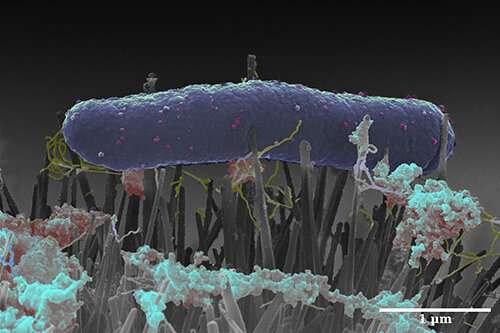
E. coli bacteria lying on a bed of nano-nails. Credit: Professor Bo Su, University of Bristol
Some insect wings such as cicada and dragonfly possess nanopillar structures that kill bacteria upon contact. However, to date, the precise mechanisms that cause bacterial death have been unknown.
Using a range of advanced imaging tools, functional assays and proteomic analyses, a study by the University of Bristol has identified new ways in which nanopillars can damage bacteria.
These important findings, published in Nature Communications, will aid the design of better antimicrobial surfaces for potential biomedical applications such as medical implants and devices that are not reliant on antibiotics.
Bo Su, Professor of Biomedical Materials at the University of Bristol's Dental School, who authored the research said:
"In this work, we sought to better understand nanopillar-mediated bactericidal mechanisms. The current dogma is that nanopillars kill bacteria by puncturing bacterial cells, resulting in lysis. However, our study shows that the antibacterial effects of nanopillars are actually multifactorial, nanotopography- and species-dependent.
"Alongside deformation and subsequent penetration of the bacterial cell envelope by nanopillars, particularly for Gram-negative bacteria, we found the key to the antibacterial properties of these nanopillars might also be the cumulative effects of physical impedance and induction of oxidative stress.
"We can now hopefully translate this expanded understanding of nanopillar-bacteria interactions into the design of improved biomaterials for use in real world applications."
Funded by the Medical Research Council, the implications of the research are far-reaching. Prof. Su explains:
"Now we understand the mechanisms by which nanopillars damage bacteria, the next step is to apply this knowledge to the rational design and fabrication of nanopatterned surfaces with enhanced antimicrobial properties.
More information: J. Jenkins et al, Antibacterial effects of nanopillar surfaces are mediated by cell impedance, penetration and induction of oxidative stress, Nature Communications (2020). DOI: 10.1038/s41467-020-15471-x
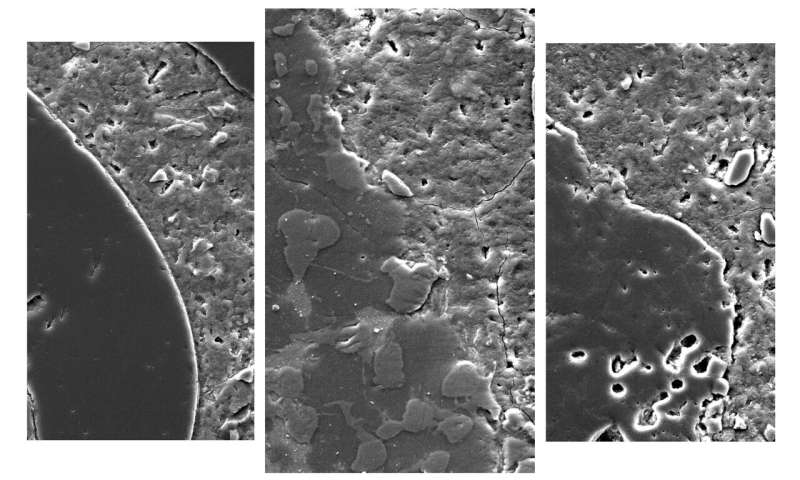
Magnified images showing concrete made with treated slag (centre), conventional aggregates (left) and raw slag (right). The treated slag forms a more seamless bond with the cement paste, making the concrete stronger. Credit: RMIT University
Researchers have shown how a by-product of steel making can be used to both treat wastewater and make stronger concrete, in a zero-waste approach to help advance the circular economy.
Produced during the separation of molten steel from impurities, steel slag is often used as a substitute aggregate material for making concrete.
Steel slag can also be used to absorb contaminants like phosphate, magnesium, iron, calcium, silica and aluminum in the wastewater treatment process, but loses its effectiveness over time.
Engineering researchers at RMIT University examined whether slag that had been used to treat wastewater could then be recycled as an aggregate material for concrete.
The concrete made with post-treatment steel slag was about 17% stronger than concrete made with conventional aggregates, and 8% stronger than raw steel slag.
Water engineer Dr. Biplob Pramanik said the study was the first to investigate potential applications for "sewage-enhanced" slag in construction material.
"The global steel making industry produces over 130 million tons of steel slag every year," Pramanik said.
"A lot of this by-product already goes into concrete, but we're missing the opportunity to wring out the full benefits of this material.
"Making stronger concrete could be as simple as enhancing the steel slag by first using it to treat our wastewater.
"While there are technical challenges to overcome, we hope this research moves us one step closer to the ultimate goal of an integrated, no-waste approach to all our raw materials and by-products."
In the study, civil and water engineering researchers found the chemical properties of the slag are enhanced through the wastewater treatment, so it performed better when used in concrete.
"The things that we want to remove from water are actually beneficial when it comes to concrete, so it's a perfect match," Pramanik said.
Civil engineer Dr. Rajeev Roychand said the initial study was promising but further research was needed to implement the approach at a larger-scale, including investigating the long-term mechanical and durability properties of enhanced slag.
"Steel slag is currently not in widespread use in the wastewater treatment industry—just one plant based in New Zealand uses this by-product in its treatment approach," he said.
"But there is great potential here for three industries to work together—steel making, wastewater treatment and construction—and reap the maximum benefits of this by-product."
The study, "Recycling steel slag from municipal wastewater treatment plants into concrete applications—A step towards circular economy," with RMIT School of Engineering co-authors Professor Sujeeva Setunge and Professor Kevin Zhang, is published in Resources, Conservation and Recycling.Cement made from steel production by-product can lead to a huge CO2 reduction
More information: Rajeev Roychand et al. Recycling steel slag from municipal wastewater treatment plants into concrete applications – A step towards circular economy, Resources, Conservation and Recycling (2019). DOI: 10.1016/j.resconrec.2019.104533
Wearing a face mask in shared public spaces could protect vulnerable people against coronavirus
Wearing a face-mask while out-and-about on public transport, in shops and in crowded places could help protect vulnerable people from COVID-19—according to a new systematic review from the University of East Anglia.
However, the researchers say the evidence is not strong enough to recommend widespread use of masks in the general population.
Researchers studied all existing data about whether using a face mask reduces the spread of illnesses with COVID-19-like symptoms such as fever and cough/sore throat or other respiratory infection symptoms.
They found 31 studies that had analysed whether wearing face masks stopped people getting symptoms. The UEA researchers found that masks had a consistent but small protective effect—particularly in shared public spaces.
While the evidence is not strong enough to recommend widespread use of masks in the general population, the researchers say that there is enough evidence to support vulnerable people deciding to use them for short periods when in temporary higher risk situations—such as on public transport, visiting shops or in healthcare settings.
Due to the rapid-response nature of this research, it has not yet been peer-reviewed.
Study author Prof Paul Hunter from UEA's Norwich Medical School, and an expert in infectious diseases, said: "There has been a lot of debate about whether wearing a face-mask could help protect people from COVID-19 and reduce the spread of the disease.
"We wanted to evaluate all the available evidence to see what the best advice for people is.
"We studied when respiratory symptoms appeared that were similar to COVID-19—fever and cough or sore throat. But it's important to remember that we have not been able to look specifically at COVID-19 because there have been no specific studies to date."
Lead researcher Dr. Julii Brainard, also from UEA's Norwich Medical School, said: "We found that using a face mask and other face coverings had a consistent but small protective effect against influenza-type symptoms while people are out-and-about in the community.
"People who wore masks, usually surgical grade, were less likely to get respiratory symptoms from casual exposure in the community. Something like a sneeze or cough near you would become less likely to cause infection. It's a small reduction in risk, but might be very important to especially vulnerable people.
"Wearing masks at home also seemed to reduce the odds of well housemates become ill. The risk reduction was greatest, a 19 percent reduction, if both an ill person and their well contacts wore masks.
"The protective effect is probably small within a home setting because people have lots of repeated types of contact, so there are many ways for the germs to transmit. This is why washing hands remains so important. Washing hands well only requires 20 seconds of concentration occasionally throughout the day.
"In contrast, it is difficult to wear masks correctly for many hours over many days. They can be uncomfortable, hot, cause skin reactions or simply feel anti-social. Masks also need to be disposed of correctly to prevent transmission.
"And of course, wearing a mask interferes with things like sleep, eating and brushing teeth. It's impossible to keep them on all the time.
"We found that wearing face masks was also not that protective during large gatherings. But something to consider is that the only studies available on mass events were based on people attending the Islamic Hajj pilgrimage to Mecca, Saudi Arabia—which is especially large and crowded and lasts for many days. It may not be comparable to other large group gatherings.
"Overall, we found that the evidence was too uncertain to support the widespread use of face masks as a protective measure against COVID-19. However there is enough evidence to endorse the use of face masks for short periods of time by vulnerable individuals when in transient higher risk situations—such as on public transport or visiting shops.
"Although we can support vulnerable people who choose to wear masks to avoid infection, we want to remind everyone that the people who most need to wear masks, to protect us all, are health care workers. We are all in more danger from COVID-19 if health care workers cannot obtain the safety equipment they need, which could happen if community demand for face masks becomes too high."
'Facemasks and similar barriers to prevent respiratory illness such as COVID-19: A rapid systematic review' is published on the preprint server MedRvix, on April XXX, 2020.
Frequently asked questions, based on this research:
Should we all be wearing masks?
No. Overall, the study found that the evidence was too uncertain and the possible protective effects too small to recommend widespread use of face masks to protect against COVID-19.
For the general population—the best way to protect yourself and others is to follow the government guidelines for social distance and wash your hands regularly.
Masks are currently in very short supply and it is important that the people who are most at risk of catching the infection and possibly spreading it to others are health care workers. We are all in danger if doctors and nurses can't wear masks because the general public bought up all available supplies.
What about vulnerable people?
The best way for vulnerable people to stay protected is to follow the government's guidelines on self-isolation.
However, there is enough evidence to endorse the use of face masks for short periods of time by vulnerable individuals when in transient higher risk situations—such as on crowded public transport or visiting busy shops.
Should I wear a mask for appointments at doctors surgeries, hospitals, dentists, or when visiting a pharmacy?
If these are not crowded environments then there is little chance of protecting yourself by wearing a mask. If you do have symptoms of respiratory illness, then wearing a mask could help protect others from your germs, especially if the place is crowded.
What about frontline NHS staff and carers?
The people who most need to wear masks, to protect us all, are health care workers dealing with possibly infectious patients. We are all in more danger from COVID-19 if health care workers cannot obtain the safety equipment they need. This could happen if community demand for face masks becomes too high.
When should face masks be worn?
Wearing a face mask while out-and-about on busy public transport, in shops and other crowded places could help protect people from respiratory infections like COVID-19.
The study conclusions are that people who wore masks, usually surgical grade, were less likely to get respiratory symptoms from casual exposure in the community. Something like a sneeze or cough near you would become less likely to cause infection.
It's a small reduction in risk, but it might be important to especially vulnerable people who may choose to wear face masks.
Masks are currently in very short supply and it is important that the people who are most at risk of catching the infection and possibly spreading it to others, especially doctors and nurses, are not stopped from wearing them because supplies have run out due to the general public buying up available supplies.
We also need to remind everyone that the reduction in risk from wearing a mask may be fairly small. So people need to be vigilant about all their habits, and not rely on face masks.
What about at home?
Wearing masks at home seemed to reduce the odds of well housemates become ill. The risk reduction was greatest, at 19 percent, if both an ill person and the well people in the home wore masks.
The protective effect is not large within a home setting because people have lots of repeated types of contact, so there are many ways for the germs to transmit.
Also, it's hard to wear masks correctly for many days at home. Wearing a mask correctly is difficult because masks interfere with things like sleep, eating and brushing teeth. It's usually unrealistic to keep them on all the time. They can be uncomfortable, hot, cause skin reactions or simply feel anti-social. Masks also need to be disposed of correctly to prevent transmission. Most of the original controlled experiments reported that people who were assigned in the experiment to wear masks most of the time found this difficult.
This is why washing hands remains so important. Washing hands well only requires 20 seconds of concentration occasionally throughout the day. In contrast, it is difficult to wear masks correctly for many hours over many days.
What's the correct way to use a face mask?
It actually depends on the design of the mask and what kinds of activities you have been doing. Each mask comes with its own instructions. A very general rule would be to assume a mask is no longer protective after wearing it for three hours. Wearers should wash their hands before they put on a mask, and importantly after they take it off and dispose of it.
What about non disposable masks (eg made from cloth, and veils?)
Face veils did not prevent developing respiratory symptoms at the Hajj (a very large annual religious mass gathering). But surgical masks weren't that protective at the Hajj, either. There is no evidence about whether other types of cloth face coverings have ever helped to prevent respiratory infections when worn by ordinary people doing ordinary activities. In laboratory experiments, the cloth alternatives didn't seem to perform as well as surgical masks could to stop transmission droplets.
Are disposable respirator masks much better than surgical masks?
In lab experiments or when health professionals wear them: Yes. When people in households and the community wore inexpensive respirators, the respirators were only about as protective as an ordinary surgical mask. Wearing a respirator correctly is harder than wearing a surgical mask correctly. There's probably no advantage to wearing a respirator if it hasn't been fitted correctly to your individual face.
What about using masks for large gatherings?
The study found that wearing face masks was not that protective during large gatherings.
However the only studies available on mass events were based on people attending the Islamic Hajj pilgrimage to Mecca, Saudi Arabia—which is especially large and crowded and lasts for many days. It may not be comparable to other large group gatherings.
More information: Julii Suzanne Brainard et al. Facemasks and similar barriers to prevent respiratory illness such as COVID-19: A rapid systematic review, (2020). DOI: 10.1101/2020.04.01.20049528
New species of ancient horsetail with gall reveals relationship between plants and parasitoid insects about 300 million
April 6, 2020 by Pedro Correia
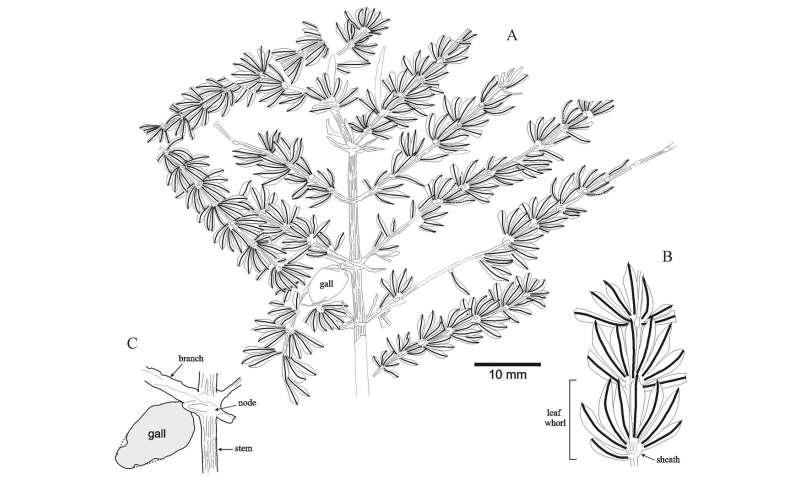
Artistic reconstruction of the calamitalean sphenopsid Annularia paisii sp. nov. showing an insect-induced gall, Paleogallus carpannularites ichnosp. nov. Credit: Correia et al. 2020 (Artwork: Andrey Atuchin)
We have published an article describing a new calamitalean species named Annularia paisii with an insect gall about 303 million years old. This new fossil species was discovered in the region of São Pedro da Cova, municipality of Gondomar, in the Douro Carboniferous Basin of the Upper Pennsylvanian of Portugal. Our study also includes a report of the worldwide record of arthropod herbivory on sphenophytes.
Evolutionary history of ecological interactions between terrestrial arthropods and vascular plants
The interactions between terrestrial arthropods and vascular plants encompass complex and intriguing terrestrial ecosystems that have persisted from Early Devonian times until today. These interactions are diverse, with multiple species of arthropods, mainly insects, and host plants interacting over a range of trophic levels through predation (i.e., herbivory), parasitism and pollination. The features, intensity and diversity of these interactions are mainly influenced by climatic and environmental conditions.
Galling represents the most biologically complex of all major arthropod–plant interactions, consisting of parasitic relationships characterized by the endophytic insect-induced plant tissue damage that can occur on all major plant organs. The insect-induced galling damage consists of atypically enlarged plant structures that are three-dimensional, conspicuous, generally of bilateral or radial symmetry and externally hardened. This offers to the encapsulated insect larvae a suitable microclimate, nutrition and protection from natural enemies. Insect galls usually affect plants only locally, but in some instances, can cause systemic effects.
Annularia paisii sp. nov. (holotype UP-MHNFCP-155167), from the São Pedro da Cova region, Douro Carboniferous Basin (DCB), northwestern Portugal. Credit: Correia et al. 2020
Insect galls have a long evolutionary history, and the earliest fossil records of galls are known from the Pennsylvanian strata. These occurred on stems of arborescent ferns and calamitalean sphenopsids. Although insect galls have been well-documented in a wide range of host plant species, about 80% of extant galls occur on leaves. The Pennsylvanian-age galls are very poorly known because they are rarely found and only occasionally reported in the fossil record.
Ancient "horsetail" host shows insect gall preserved in situ
Horsetails are plants with a very old historical lineage, occurring in the fossil record from the Late Devonian to the present day, existing in abundance in Portugal. The new species Annularia paisii shows an insect gall induced by parasitoid insects (popularly known as galling insects), an a previously unknown ichnospecies that received a name Paleogallus carpannularites. This shows the existence of complex insect-plant relationships 303 million years ago, and reiterates the importance of the fossil record of the Portuguese Carboniferous. The patterns of herbivory of insects and other arthropods on horsetails are little known. In our paper, recently published in the International Journal of Plant Sciences, we addressed this subject, documenting 315 million years of sphenophyte herbivory relationships by arthropod.
Structure of the insect-induced gall Paleogallus carpannularites ichnosp. nov. and its attachment to host Annularia paisii sp. nov. Credit: Correia et al. 2020
Annularia paisii sp. nov. (paratype UP-MHNFCP-155168), from the São Pedro da Cova region, Douro Carboniferous Basin, northwestern Portugal. Credit: Correia et al. 2020
Structure of the insect-induced gall Paleogallus carpannularites ichnosp. nov. and its attachment to host Annularia paisii sp. nov. Credit: Correia et al. 2020
Annularia paisii sp. nov. (paratype UP-MHNFCP-155168), from the São Pedro da Cova region, Douro Carboniferous Basin, northwestern Portugal. Credit: Correia et al. 2020
Interpretative view drawing of the holotype specimen of Annularia paisii sp. nov. and Paleogallus carpannularites ichnosp. nov. (UP-MHNFCP-155167). Credit: Correia et al. 2020
Ecological adaptation of Annularia paisii
The arrangement of the leaves of Annularia paisii appears anomalous for a species of Annularia. Its leaves are arranged in cup-shaped whorls, a typical characteristic of other calamitalean sphenopsid-like fossil genus Asterophyllites. Several explanations can account for this condition. The leaves of Annularia paisii were perhaps retracted into a cup shape during their burial. Alternatively, the cup shape could have been an induced feature resulting from their sensitivity to sunlight or an external tactile stimulus similar to the modern sensitive plant, Mimosa pudica. Another possibility is a physiological reaction from an herbivorous insect, such as a gall antagonism.
Annularia paisii is named in honor of the Portuguese paleobotanist João Pais (1949–2016) from Nova University in Lisbon (Portugal).
This story is part of Science X Dialog, where researchers can report findings from their published research articles. Visit this page for information about ScienceX Dialog and how to participate.
More information: Pedro Correia et al. The History of Herbivory on Sphenophytes: A New Calamitalean with an Insect Gall from the Upper Pennsylvanian of Portugal and a Review of Arthropod Herbivory on an Ancient Lineage, International Journal of Plant Sciences (2020). DOI: 10.1086/707105
Bio: I am a PhD paleontologist and naturalist from Portugal. My research focus on Paleozoic paleobotany, paleoentomology, paleoclimate, paleogeography of Euramerica.
RESIST KENNEY'S CUTS
We are weeks into the global health pandemic caused by COVID-19 and our lives, workplaces and how we function continues to change. As we watch how the crisis is impacting our communities, we are monitoring responses from different levels of government, workplaces and approaches from different jurisdictions. The AFL wants to continue to share some of this work we are doing with you and keep you informed about how the crisis is being handled.
Please join AFL President, Gil McGowan, for a Facebook Live session next Tuesday, April 7, 2020 at 1:30 p.m. MST. He will discuss the impact of the UCP's austerity policies during a crisis and ask the question: Is enough being done to protect the health of people still working during the pandemic?
Email your MLA
Jason Kenney fired 25,000 workers last weekend. Laying people off during a global pandemic is heartless, reckless and cruel. We can't let it happen.
Please add your voice by emailing your MLA using our email tool here.
TELL THE UCP: STOP FIRING WORKERS
Kenney just fired 25,000 education workers
Just two weeks ago, Adriana LaGrange, Minister of Education for the Kenney government, said:
“My department and I will work with school authorities throughout this process, and school authorities will receive their full allotment of funding for the 2019-2020 school year.”
They lied.
Now, 25,000 education assistants, bus drivers, administrators, substitute teachers, and custodial workers have been thrown out of work by this government at a time when families are struggling to make ends meet because of COVID-19.
This is on top of lay-offs in the provincial government, at post-secondary institutions, and by our municipal governments due to Kenney’s budget cuts.
Laying people off during a global pandemic is heartless, reckless, and cruel. We can’t let it happen.
Email your MLA to demand they stop firing workers.
There's a new disease-detecting technology in the lab of Sanjiv "Sam" Gambhir, MD Ph.D., and its No. 1 source of data is number one. And number two.
It's a smart toilet. But not the kind that lifts its own lid in preparation for use; this toilet is fitted with technology that can detect a range of disease markers in stool and urine, including those of some cancers, such as colorectal or urologic cancers. The device could be particularly appealing to individuals who are genetically predisposed to certain conditions, such as irritable bowel syndrome, prostate cancer or kidney failure, and want to keep on top of their health.
"Our concept dates back well over 15 years," said Gambhir, professor and chair of radiology. "When I'd bring it up, people would sort of laugh because it seemed like an interesting idea, but also a bit odd." With a pilot study of 21 participants now completed, Gambhir and his team have made their vision of a precision health-focused smart toilet a reality.
Gambhir's toilet is an ordinary toilet outfitted with gadgets inside the bowl. These tools, a suite of different technologies, use motion sensing to deploy a mixture of tests that assess the health of any deposits. Urine samples undergo physical and molecular analysis; stool assessment is based on physical characteristics.
The toilet automatically sends data extracted from any sample to a secure, cloud-based system for safekeeping. In the future, Gambhir said, the system could be integrated into any health care provider's record-keeping system for quick and easy access.
A paper describing the research will be published April 6 in Nature Biomedical Engineering. Gambhir is the senior author. Seung-min Park, Ph.D., senior research scientist; David Won, MD, Ph.D., former visiting scholar in the Molecular Imaging Program at Stanford; and postdoctoral scholar Brian Lee, Ph.D., share lead authorship.
Pulling double duty
The toilet falls into a category of technology known as continuous health monitoring, which encompasses wearables like smart watches. "The thing about a smart toilet, though, is that unlike wearables, you can't take it off," Gambhir said. "Everyone uses the bathroom—there's really no avoiding it—and that enhances its value as a disease-detecting device."
Although the idea may take some getting used to, Gambhir, who holds the Virginia and D.K. Ludwig Professorship for Clinical Investigation in Cancer Research, envisions the smart toilet as part of the average home bathroom. In facilitating that broad adaption, Gambhir designed the "smart" aspect as an add-on—a piece of technology that's readily integrated into any old porcelain bowl. "It's sort of like buying a bidet add-on that can be mounted right into your existing toilet," he said. "And like a bidet, it has little extensions that carry out different purposes."
These extensions sport an array of health-monitoring technologies that look for signs of disease. Both urine and stool samples are captured on video and are then processed by a set of algorithms that can distinguish normal "urodynamics" (flow rate, stream time and total volume, among other parameters) and stool consistencies from those that are unhealthy.
Alongside physical stream analysis, the toilet also deploys uranalysis strips, or "dipstick tests," to measure certain molecular features. White blood cell count, consistent blood contamination, certain levels of proteins and more can point to a spectrum of diseases, from infection to bladder cancer to kidney failure. In its current stage of development, Gambhir said, the toilet can measure 10 different biomarkers.
It's still early days, though, with a total of 21 participants having tested the toilet over the course of several months. To get a better feel for "user acceptance" more broadly, the team surveyed 300 prospective smart-toilet users. About 37% said they were "somewhat comfortable" with the idea, and 15% said they were "very comfortable" with the idea of baring it all in the name of precision health.
ID please
One of the most important aspects of the smart toilet may well be one of the most surprising—and perhaps unnerving: It has a built-in identification system. "The whole point is to provide precise, individualized health feedback, so we needed to make sure the toilet could discern between users," Gambhir said. "To do so, we made a flush lever that reads fingerprints." The team realized, however, that fingerprints aren't quite foolproof. What if one person uses the toilet, but someone else flushes it? Or what if the toilet is of the auto-flush variety?
They added a small scanner that images a rather camera-shy part of the body. You might call it the polar opposite of facial recognition. In other words, to fully reap the benefits of the smart toilet, users must make their peace with a camera that scans their anus.
"We know it seems weird, but as it turns out, your anal print is unique," Gambhir said. The scans—both finger and nonfinger—are used purely as a recognition system to match users to their specific data. No one, not you or your doctor, will see the scans.
By no means is this toilet a replacement for a doctor, or even a diagnosis, Gambhir said. In fact, in many cases, the toilet won't ever report data to the individual user. In an ideal scenario, should something questionable arise—like blood in the urine—an app fitted with privacy protection would send an alert to the user's health care team, allowing professionals to determine the next steps for a proper diagnosis. The data would be stored in a secure, cloud-based system. Data protection, both in terms of identification and sample analyses, is a crucial piece of this research, Gambhir said. "We have taken rigorous steps to ensure that all the information is de-identified when it's sent to the cloud and that the information—when sent to health care providers—is protected under HIPAA," he said, referring to the Health Insurance Portability and Accountability Act, which restricts the disclosure of health care records.
Smart toilet 2.0
As Gambhir and his team continue to develop the smart toilet, they're focusing on a few things: increasing the number of participants, integrating molecular features into stool analysis and refining the technologies that are already working. They're even individualizing the tests deployed by the toilet. For example, someone with diabetes may need his or her urine monitored for glucose, whereas someone else who is predisposed to bladder or kidney cancer might want the toilet to monitor for blood.
Gambhir's other goal is to further develop molecular analysis for stool samples. "That's a bit trickier, but we're working toward it," Gambhir said. "The smart toilet is the perfect way to harness a source of data that's typically ignored—and the user doesn't have to do anything differently."
More information: A mountable toilet system for personalized health monitoring via the analysis of excreta, Nature Biomedical Engineering (2020). DOI: 10.1038/s41551-020-0534-9 , https://nature.com/articles/s41551-020-0534-9
Link between air pollution and corona mortality in Italy could be possibleby Aarhus University
Credit: CC0 Public Domain
4/6/2020
The world has been hit hard by coronavirus, and health services and authorities everywhere are struggling to reduce the spread, combat the disease and protect the population. Nevertheless, the pandemic will cost lives throughout the world. An environmental researcher from Aarhus University has studied whether there could be a link between the high mortality rate seen in northern Italy, and the level of air pollution in the same region. The short answer is "yes possibly." The long answer is in the article below.
The outbreak of Severe Acute Respiratory Syndrome CoronaVirus2 had its source in the Wuhan Province in China in December 2019. Since then, the coronavirus has spread to the rest of the globe, and the world is now treating patients with the disease that follows virus infection: COVID-19. The course of the disease differs for patients the world over: many experience flu-like symptoms, while many others need hospital treatment for acute respiratory infection that, in some cases, leads to death.
However, what factors affect the course of the disease and the possibilities to combat COVID-19 remains unclear, as long as there is no medical treatment or vaccine. At the moment, there are more questions than answers, and researchers all over the world are therefore working to find new insights into the global pandemic.
At Aarhus University, the environmental scientist Dario Caro from the Department of Environmental Science, and two health researchers, prof. Bruno Frediani and Dr. Edoardo Conticini, from the University of Siena in Italy have found yet another small piece in the puzzle of understanding the deadly disease. They have focused on examining why the mortality rate is up to 12% in the northern part of Italy, while it is only approx. 4.5% in the rest of the country.
They have just published an article entitled "Can Atmospheric pollution be considered as a co-factor in the extremely high level of SARS-CoV-2 lethality in Northern Italy?", in which they demonstrate a probable correlation between air pollution and mortality in two of the worst affected regions in northern Italy: Lombardy and Emilia Romagna.
The research project has been published in the scientific journal Environmental Pollution.
"There are several factors affecting the course of patients' illness, and all over the world we're finding links and explanations of what is important. It's very important to stress that our results are not a counter-argument to the findings already made. At the moment, all new knowledge is valuable for science and the authorities, and I consider our work as a supplement to the pool of knowledge about the factors that are important for the course of patients' illness," says environmental scientist Dario Caro, and clarifies that there are a number of other factors that could possibly play a role in the Italian situation:
"Our considerations must not let us neglect other factors responsible of the high lethality recorded: important co-factors such as the elevated median age of the Italian population, the wide differences among Italian regional health systems, ICUs capacity and how the infects and deaths has been reported have had a paramount role in the lethality of SARS-CoV-2, presumably also more than pollution itself," he explains. Different datasets show a link
The two northern Italian regions are among the most air-polluted regions in Europe. The recently published article took its outset in data from the NASA Aura satellite, which has demonstrated very high levels of air pollution across precisely these two regions. The group compared these data with the so-called Air Quality Index; a measurement of air quality developed by the European Environment Agency. The index gathers data from several thousand measuring stations all over Europe, providing a geographical insight into the prevalence of a number of pollutant sources in the EU.
The figures speak for themselves. The population of the northern Italian regions lives in a higher level of air pollution, and this may lead to a number of complications for patients with COVID-19 in the regions, simply because their bodies may have already been weakened by the accumulated exposure to air pollution when they contract the disease.
Dario Caro explains that the situation in the Italian regions has been a challenge for several years, with high levels of air pollution that have accumulated over a long period of time in the population. It is therefore unlikely that there is any reason to imagine that people in Denmark are exposed to the same factors or the same levels of pollution as people in northern Italy, where the authorities have been trying to reduce pollution levels for many years.
"All over the world, we're seeing different approaches from countries' authorities, in countries' general public health outset and in the standards and readiness of different countries' national healthcare systems. But this doesn't explain the prevalence and mortality rates that we're seeing in northern Italy compared with the rest of Italy. This feeds hope that we may have found yet another factor in understanding the high mortality rate of the disease in northern Italy," says Dario Caro.
A framework for indoor robot navigation among humans
by Ingrid Fadelli , Tech Xplore
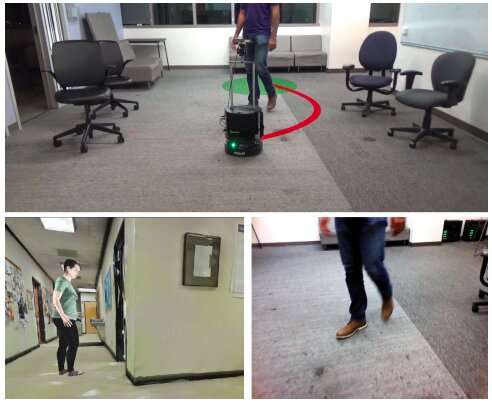
(Top) An autonomous visual navigation scenario considered by the researchers, in a previously unknown, indoor environment with humans, using monocular RGB images (bottom right). To teach machines how to navigate indoor environments containing humans, the researchers created HumANav, a dataset that allows for photorealistic rendering in simulated environments (e.g. bottom left). Credit: Tolani et al.
In order to tackle the tasks that they are designed to complete, mobile robots should be able to navigate real world environments efficiently, avoiding humans or other obstacles in their surroundings. While static objects are typically fairly easy for robots to detect and circumvent, avoiding humans can be more challenging, as it entails predicting their future movements and planning accordingly.
Researchers at the University of California, Berkeley, have recently developed a new framework that could enhance robot navigation among humans in indoor environments such as offices, homes or museums. Their model, presented in a paper pre-published on arXiv, was trained on a newly compiled dataset of photorealistic images called HumANav.
"We propose a novel framework for navigation around humans that combines learning-based perception with model-based optimal control," the researchers wrote in their paper.
The new framework these researchers developed, dubbed LB-WayPtNav-DH, has three key components: a perception, a planning, and a control module. The perception module is based on a convolutional neural network (CNN) that was trained to map the robot's visual input into a waypoint (i.e., the next desired state) using supervised learning.
The waypoint mapped by the CNN is then fed to the framework's planning and control modules. Combined, these two modules ensure that the robot moves to its target location safely, avoiding any obstacles and humans in its surroundings.
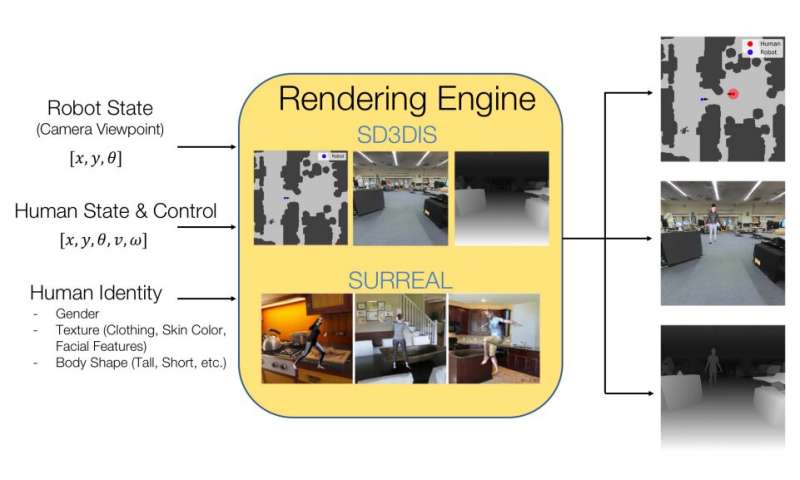
Image explaining what the HumANav dataset contains and how it achieves photorealistic rendering of indoor environments containing humans. Credit: Tolani et al.
The researchers trained their CNN on images included in a dataset they compiled, dubbed HumANav. HumANav contains photorealistic, rendered images of simulated building environments in which humans are moving around, adapted from another dataset called SURREAL. These images portray 6000 walking, textured human meshes, arranged by body shape, gender and velocity.
"The proposed framework learns to anticipate and react to peoples' motion based only on a monocular RGB image, without explicitly predicting future human motion," the researchers wrote in their paper.
The researchers evaluated LB-WayPtNav-DH in a series of experiments, both in simulations and in the real world. In real-world experiments, they applied it to Turtlebot 2, a low-cost mobile robot with open-source software. The researchers report that the robot navigation framework generalizes well to unseen buildings, effectively circumventing humans both in simulated and real-world environments.
"Our experiments demonstrate that combining model-based control and learning leads to better and more data-efficient navigational behaviors as compared to a purely learning based approach," the researchers wrote in their paper.
The new framework could ultimately be applied to a variety of mobile robots, enhancing their navigation in indoor environments. So far, their approach has proved to perform remarkably well, transferring policies developed in simulation to real-world environments.
In their future studies, the researchers plan to train their framework on images of more complex or crowded environments. In addition, they would like to broaden the training dataset they compiled, including a more diverse set of images.
How Google is teaching a robot dog to learn to move like a real dog
YOU KNOW ITS REAL WHEN IT LEARNS TO SNIFF BUTTS
by Bob Yirka , Tech Xplore
Robot imitating various skills from a dog. Credit: Google
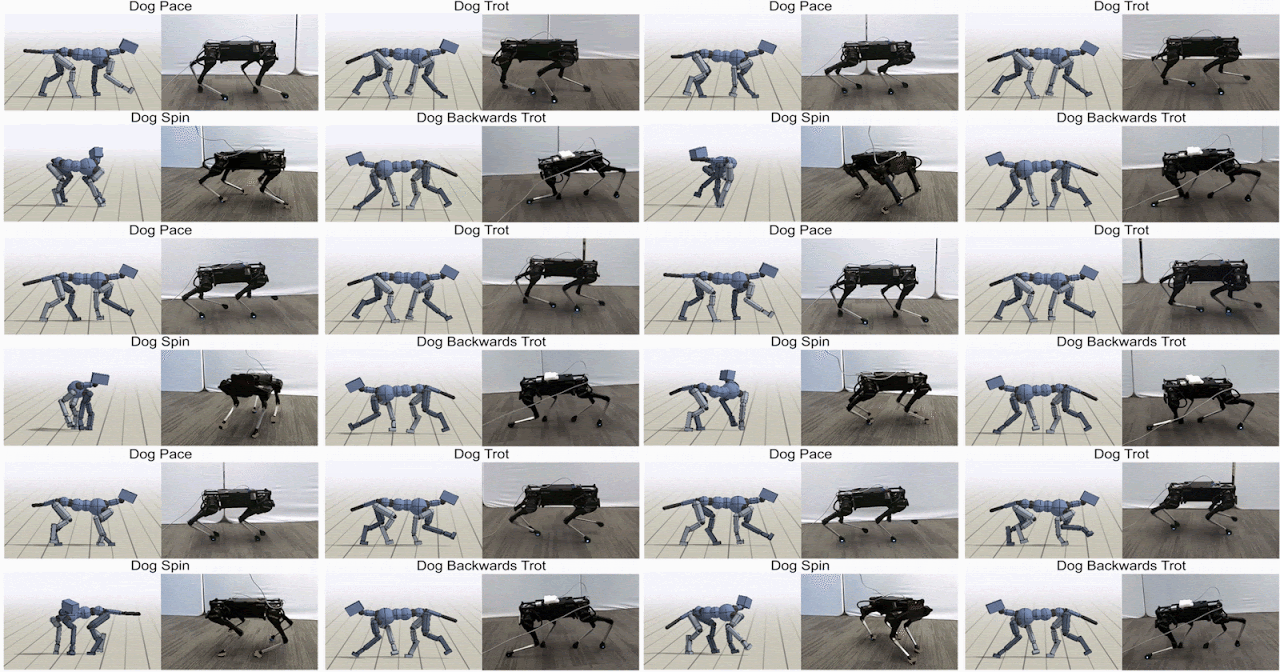
A team of researchers at Google's AI lab is seeing results in its effort to develop a dog-like robot quadruped that learns dog behavior by studying how real dogs move. The team has posted an outline of the work they are doing on the Google AI blog. Training a robot to perform tasks by mimicking the movements of a living creature is not new—robot arms that build cars, for example, are taught how to spot weld or tighten bolts by mimicking the desired action as performed by a human arm. But teaching a robot by showing it video of a real dog is definitely new. And that is just what Google is doing. The robot in this case is a quadruped called Laikago (after Laika, the first dog in space)—it is being trained to walk, run and even chase its tail like a real dog by showing it motion-capture footage of a real dog in action.
In practice, the video is actually first processed by an AI system that translates the action in the video into an animated version of Laikago. To work out possible interpretation errors (because the digital dog is made from metal and wire and motors instead of bones, muscles and sinews), the team shows the AI system multiple stop-action videos of a real dog in action. The AI system builds up a toolset of possible moves depending on scenarios that might be encountered in the real world. Once the simulation has built up a knowledge base, its "brain" is uploaded to Laikago, who then uses what the simulation has learned as a starting point for its own behavior.
Video of Laikago in action shows that the technique works—the robotic dog is able to walk and trot very much like a real dog—and even simulates chasing its tail. But it also has some deficiencies compared to other advanced robotic animals, such as those from Boston Dynamics,which get their skills through programming—getting back on its feet after stumbling or tripping, for example, is still troublesome. But the researchers at Google are undaunted, believing more research will lead to ever more lifelike behavior by their robot.