Wednesday, May 05, 2021

The ants, bees and wasps of Canada, Alaska and Greenland - a checklist of 9250 species

PENSOFT PUBLISHERS

Research News

IMAGE

IMAGE: AMERICAN PELECINID WASP (PELECINUS POLYTURATOR) FROM DRIFTWOOD PROVINCIAL PARK, ONTARIO, CANADA view more 

CREDIT: HENRI GOULET

Knowing what species live in which parts of the world is critical to many fields of study, such as conservation biology and environmental monitoring. This is also how we can identify present or potential invasive and non-native pest species. Furthermore, summarizing what species are known to inhabit a given area is essential for the discovery of new species that have not yet been known to science.

For less well-studied groups and regions, distributional species checklists are often not available. Therefore, a series of such checklists is being published in the open-access, peer-reviewed Journal of Hymenoptera Research, in order to address the issue for a group of organisms that, despite its size and diversity, is still poorly known: the insect order Hymenoptera, which includes ants, bees and wasps. The surveyed area spreads across northern North America, which comprises Canada, Alaska (U.S.) and Greenland (Denmark), and occupies about 9.3% of the world's total land mass.

The last distributional survey of Hymenoptera in North America was published in 1979, where about 6000 described species were recorded from Canada and 600 from Alaska. The current survey lists 8933 species in Canada and 1513 in Alaska, marking an increase of 49% and 152%, respectively. A total of 9250 described species are recorded from northern North America. Considering that there are approximately 154,000 described species of Hymenoptera, northern North America has about 6% of the current world total.

Highlights of the series will include updated distributions of over 900 species of bees, which will provide valuable insight into native pollinators at a time when honey bees are in decline. Nearly 230 species of ants and over 100 species of vespid wasps (hornets and yellow jackets) are recorded, including pest species such as the widespread pharaoh ant and the newly invasive Asian giant hornet in British Columbia.

By far, the majority of species of Hymenoptera found in northern North America and the world are parasitoids, which develop on or in other invertebrate hosts and are therefore of great interest to the biological control of pests. Of the 9250 species recorded, more than three-quarters (over 7150 species) are parasitoids. These distributional lists provide essential baseline information required prior to undertaking studies to introduce biological control agents of invasive pests that may have escaped their native, natural enemies when they arrived in North America.

The topical collection "Checklists of the Hymenoptera of Canada, Alaska and Greenland" is to contain a total of eleven papers, where the introduction and the first two checklists: of sawflies (758 species) and one of the groups of "microhymenoptera" (the chalcidoid parasitic wasps) (1246 species) have just been published.The other checklists are to follow over the next several years. The associated data are also being uploaded to the Global Biodiversity Information Facility (GBIF), allowing for periodic updates over time.

When complete, this will be the largest species checklist for any group of organisms in northern North America. Considering that it is estimated that we currently have documented less than half of the species of Hymenoptera present in northern North America, there is still a great amount of work to do on this fascinating group of insects.


CAPTION

A cuckoo wasp of the genus Hedychridium from Manitoulin Island, Ontario, Canada

CREDIT

Henri Goulet


Original sources:

Bennett AMR (2021a) Checklists of the Hymenoptera of Canada, Alaska and Greenland - Introduction. Journal of Hymenoptera Research 82: 1-19. https://doi.org/10.3897/jhr.82.60054

Bennett AMR (2021b) Checklist of the Hymenoptera of Canada, Alaska and Greenland. Agriculture and Agri-Food Canada. Checklist dataset https://doi.org/10.5886/4piso5 [accessed via GBIF.org: 12 March 2021].

Goulet H, Bennett AMR (2021) Checklist of the sawflies (Hymenoptera) of Canada, Alaska and Greenland. Journal of Hymenoptera Research 82: 21-67. https://doi.org/10.3897/jhr.82.60057

Huber JT, Bennett AMR, Gibson GAP, Zhang YM, Darling DC (2021) Checklist of Chalcidoidea and Mymarommatoidea (Hymenoptera) of Canada, Alaska and Greenland. Journal of Hymenoptera Research 82: 69-138. https://doi.org/10.3897/jhr.82.60058

Disclaimer: AAAS and EurekAlert! are not responsible for the accuracy of news releases posted to EurekAlert! by contributing institutions or for the use of any information through the EurekAlert system.


CAPTION

Pigeon tremex (Tremex columba) from Manitou Lake, Manitoulin Island, Ontario, Canada

CREDIT

Henri Goulet

USAGE REST

Bees thrive where it's hot and dry: A unique biodiversity hotspot located in North America

PENSOFT PUBLISHERS

Research News

IMAGE

IMAGE: ONE OF THE SPRING-ACTIVE DESERT BEES, FEMALE CENTRIS CAESALPINIAE ON FLOWER OF KRAMERIA view more 

CREDIT: BRUCE D. TAUBERT

The United States-Mexico border traverses through large expanses of unspoiled land in North America, including a newly discovered worldwide hotspot of bee diversity. Concentrated in 16 km2 of protected Chihuahuan Desert are more than 470 bee species, a remarkable 14% of the known United States bee fauna.

This globally unmatched concentration of bee species is reported by Dr. Robert Minckley of the University of Rochester and William Radke of the United States Fish and Wildlife Service in the open-access, peer-reviewed Journal of Hymenoptera Research.

Scientists studying native U.S. bees have long recognized that the Sonoran and Chihuahuan deserts of North America, home to species with interesting life histories, have high bee biodiversity. Exactly how many species has largely remained speculation. Together with students from Mexico, Guatemala and the United States, the authors made repeated collections over multiple years, identifying more than 70,000 specimens.

Without such intensive collecting, a full picture of the bee diversity would not have been possible. Most of these bee species are solitary, without a queen or workers, which visit flowers over a 2-4 week lifespan and specialize on pollen and nectar from one to a few plants. Furthermore, these desert species experience periodic drought, which the immature stages survive by going into dormancy for years, much like the seeds of the desert plants they pollinate.


CAPTION

One of the late-summer desert bees, a long-horned female bee of the Svastra genus, on a flower of Verbesina enceliodes

CREDIT

Bruce D. Taubert


Additionally, bee diversity is notoriously difficult to estimate and compare among studies, because of differences in the collecting techniques and the size of the studied area. An unexpected benefit of the regular and intensive sampling for this study was the opportunity to test if the observed bee diversity approached the true bee diversity in this region, or if many more species were yet to be found. In this case, the larger San Bernardino Valley area is home to 500 bee species, only slightly above the number of species recovered along the border - an unusually robust confirmation of the researchers' estimate.

What we know about the decline of bees due to human activity, along with that of other pollinators, is based primarily on diversity data from human-modified habitats. Needed is baseline information on native bees from pristine areas to help us assess the magnitude and understand the ways in which humans impact bee faunas. This study from the Chihuahuan Desert is therefore an important contribution towards filling that knowledge gap from one of the bee biodiversity hotspots in the world.

Original source:

Minckley RL, Radke WR (2021) Extreme species density of bees (Apiformes, Hymenoptera) in the warm deserts of North America. Journal of Hymenoptera Research 82: 317-345. https://doi.org/10.3897/jhr.82.60895


CAPTION

One of the spring-active desert bees, male Centris caesalpiniae on a flower of Acacia

CREDIT

Bruce D. Taubert

USAGE RESTRICTIONS

The secret life of bee signals can

communicate colony health

Recording the electrostatic energy of honeybee hives offers a 'canary in the coalmine' look into ecosystem threats and environmental conditions

FRONTIERS

Research News

IMAGE

IMAGE: HIVE CONSTRUCTION AND MEASURING DEVICES. (A) FRONT AND SIDE VIEW OF THE HIVE. A PLASTIC TUBE CONTAINING A GPS RECEIVER WAS FIXED TO A SIDEWALL (NOT SHOWN). THE WEIGHT OF... view more 

CREDIT: BENJAMIN H. PAFFHAUSEN, JULIAN PETRASCH, UWE GREGGERS ET AL.

Honeybees have a complex communication system. Between buzzes and body movements, they can direct hive mates to food sources, signal danger, and prepare for swarming - all indicators of colony health. And now, researchers are listening in.

Scientists based in Germany - with collaborators in China and Norway - have developed a way to monitor the electrostatic signals that bees give off. Basically, their wax-covered bodies charge up with electrostatic energy due to friction when flying, similar to how rubbing your hair can make it stand on end. That energy then gets emitted during communications.

"We were thrilled by the potential of directly accessing the social communication of bees with our method," says Dr. Randolf Menzel, of the Free University of Berlin. "For the first time we can ask the bees themselves whether their colony is in a healthy condition or whether they suffer from unfavorable environmental conditions including those caused by humans."

The paper, recently published in the open access journal Frontiers in Behavioral Neuroscience, likens honeybee colonies to a canary in a coal mine. Bees are usually among the first species to be affected by pollutants such as insecticides, and weakened communications can signal their damaging effects. Such evidence may point to potential harm to other wildlife and ecosystems in a way that is quicker and cheaper than other methods.

Menzel and his colleagues worked with 30 beekeepers across Germany over a period of five years. They placed sensors and a central recording device inside and outside a specially designed hive, and monitored the honeybees' electrostatic field (ESF) data.

They were particularly interested in what is known as the "waggle dance," a sophisticated messaging system in which honeybees walk in a figure-eight pattern, then "waggle" back and forth through the stretched part of the intersection. This bee ballet communicates flight directions and distance. "Other bees follow the dancing bee, read the message of the dancer, and apply the information about distance and direction to an attractive food source in their outbound flights," says Menzel.

The primary purpose of their research study was to measure the feasibility of their recording system, which did indeed work, although Menzel notes that scaling up their system would be challenging, and "to get meaningful knowledge about the impact of pesticides and health conditions of bees in a larger area, we will have to use many devices across that area."

Still, the researchers learned more about hive communication, and found what Menzel described as "unexpected phenomena." For example, they found that bees perform waggle dances at night as well as during the day, and that insecticides used for treatment against pest mites had a negative impact on honeybees' communication. They also found that ESF signals were emitted in preparation of swarming, and that their strength didn't depend on environmental conditions such as humidity and UV radiation.

Menzel says that their system collected a large amount of data, and that they need further studies to improve and finetune interpretation. "So far we have only begun to apply machine learning algorithms to separate and quantify the electrostatic field signals." In the future though, it's possible that eavesdropping on bees may provide rich and important information beyond the local pollen hotspot. Their communications could be crucial in understanding - and protecting - whole ecosystem


CAPTION

Representative examples of three classes of ESF (electrostatic field) signals. (A) Waggle-dance-related signals (WRS). The electrograms show the time/frequency diagram in false colors (signal power) for two frequency bands, the low frequency of the abdomen waggling (WRS_L) and the high frequency of the wing vibrations (WRS_H). (B) Short pulse related signals (SRS) with the time courses and corresponding electrograms for two kinds of SRS. (C) Fanning related signals (FRS). Note the different time scales.

CREDIT

Benjamin H. Paffhausen, Julian Petrasch, Uwe Greggers et al.


James George Frazer and The Golden Bough

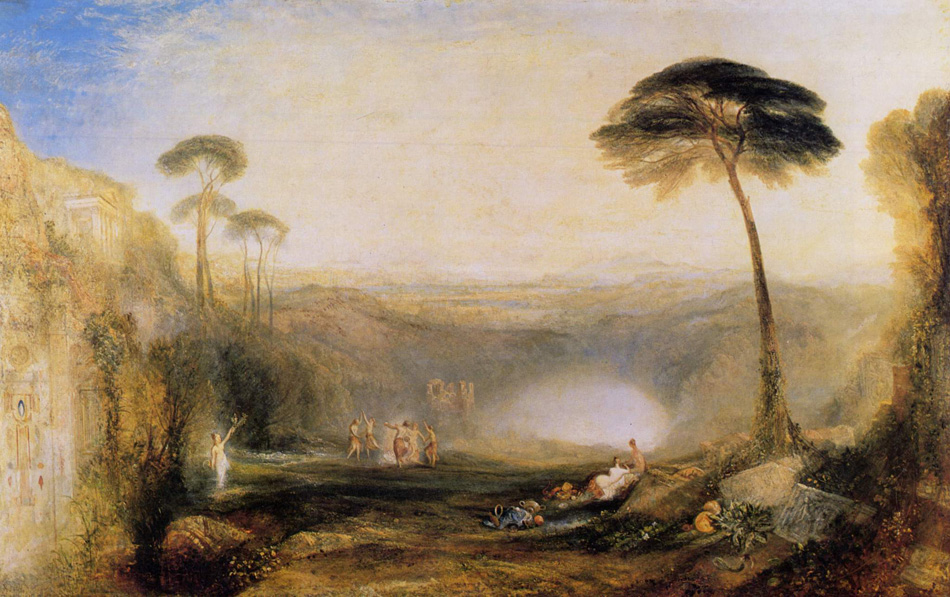
The Golden Bough, Joseph Mallord William Turner (1775–1851), Exhibited 1834. Medium Oil paint on canvas. Photo: © Tate, London 2014. This subject comes from Virgil’s poem, The Aeneid. The Trojan hero, Aeneas, has come to Cumae to consult the Sibyl, a prophetess. She tells him he can only enter the Underworld to meet the ghost of his father if he offers Proserpine a golden bough cut from a sacred tree. Turner shows the Sibyl holding a sickle and the freshly cut bough,in front of Lake Avernus, the legendary gateway to the Underworld. The dancing figures are the Fates. Like the snake in the foreground, they hint at death and the mysteries of the Underworld, amidst the beauty of the landscape.

Plant Folklore is a specialized, interdisciplinary field of study. Historical evidence indicates that humankind has sought to divine meaning from the natural world, often by explaining its origins through mythology and folktales. Advances in agriculture and horticulture had an obvious impact on human development, but to study the mythology of a plant in addition to its taxonomy, characteristics, and habitat can bring about enriched layers of understanding.

What is the human-plant connection?


Mutually dependent and beneficial (or toxic) relationships between plants and humans have existed for millennia. Economy, utility, and sustainability factor into human-horticultural application, but there are equal measures of superstition and tradition thrown into the mix. The study of plant lore is beneficial in stimulating our imaginations by seeking plant-human connections throughout history. The best discoveries are accidental.

Scottish social anthropologist Sir James George Frazer’s classic work, The Golden Bough: A Study in Magic and Religion, is an extraordinary work on the fundamentals of natural history. Labyrinthine and universal in scope, the Bough explores society’s relationship with its natural environment, and how cycles of nature are reflected in human ceremony and tradition. When you consider our current reliance upon technology, it’s easy to forget that our dependence upon nature used to be more pervasive, and at times even desperate.

Although not trained as a botanist, James G. Frazer (1854-1941) mounted this comprehensive study of human and natural history. Frazer devotes an entire chapter to the worship of trees, another to the influence of tree-spirits. We will explore these in a later installment. First, let’s consider the work and its general impact.
What does the title The Golden Bough refer to?

Frazer was inspired by Joseph Mallord William Turner‘s painting which depicts an episode from Virgil’s Aeneid: Having arrived at the gates of the underworld, the Trojan hero Aeneas seeks admittance to Hades so he may consult the spirit of his deceased father Anchises. The Sibyl (prophetess) of the adjoining lake instructs Aeneas how he may accomplish his task:

. . . Hidden in a dark tree
is a golden bough, golden in leaves and pliant stem,
sacred to Persephone, the underworld’s Juno, all the groves
shroud it, and shadows enclose the secret valleys.
But only one who’s taken a gold-leaved fruit from the tree
is allowed to enter earth’s hidden places.
This lovely Proserpine has commanded to be brought to her
as a gift: a second fruit of gold never fails to appear
when the first one’s picked, the twig’s leafed with the same metal.
So look for it up high, and when you’ve found it with your eyes,
take it, of right, in your hand: since, if the Fates have chosen you,
it will come away easily, freely of itself . . .Virgil’s Aeneid Book Six, “Aeneas Asks Entry to Hades

Aeneas acts as instructed, and having picked the Golden Bough, presents it to Proserpine at the gates, is granted admittance to Hades, and ultimately finds his father who prophesizes the founding of Rome. Romulus and Remus, the legendary founders of Rome, are direct descendants of Aeneas [family tree].

Frazer states that this part of The Aeneid took place at Lake Nemi, also called Diana’s Mirror, located just southeast of Rome [GPS]. However, according to the metadata hosted by The Tate Gallery London, Turner’s painting depicts the scene at Lake Avernus, closer to Naples [GPS]. (At least we’re still in Italy . . . )
The King of the Wood at Diana’s Mirror

Turner’s artwork compelled Frazer to uncover the origin of a curiously macabre, pagan ritual that took place at Lake Nemi. Its human-plant connection is apparent:

“In antiquity this sylvan landscape was the scene of a strange and recurring tragedy. On the northern shore of the lake . . . stood the sacred grove and sanctuary of Diana Nemorensis, or Diana of the Wood [fertility goddess of Classical Roman tradition] . . . . [in] this sacred grove there grew a certain tree round which at any time of day, and probably far into the night, a grim figure might be seen to prowl. In his hand he carried a drawn sword, and he kept peering warily about him as if at every instant he expected to be set upon by an enemy. He was a priest and a murderer; and the man for whom he looked was sooner or later to murder him and hold the priesthood in his stead. Such was the rule of the sanctuary. A candidate for the priesthood could only succeed to office by slaying the priest, and having slain him, he retained office till he was himself slain by a stronger or craftier . . . The post which he held by this precarious tenure carried with it the title of king [King of the Wood–Rex Nemorensis]; but surely no crowned head ever lay uneasier, or was visited by more evil dreams, than his.”James Frazier, “The King of the Wood,” The Golden Bough

Here is a parallel with Aeneas: the challenger of Diana’s priest was to pick a Golden Bough from that same sacred tree of the sanctuary. The ritual is said to have endured well into the Julio-Claudian dynasty (27 BC-68 AD) of Imperial Rome. The mad Emperor Caligula (12 AD-41 AD) even sent a “more stalwart ruffian” to slay the standing priest, whom he’d thought had overextended his devout tenure.

One cannot ignore the irony that a ritual of perpetual violence and temporality operated as an essential component to the worship of a fertility goddess. Why break off a tree branch and then confront a fight to the death? Was this meant to be an act of self-sacrifice combined with harming another human being? Who would want any part of this priesthood, if its destiny would result in an untimely death? What made that particular tree sacred to the worship of Diana? Why did the requisite challenger of the priest have to be a runaway slave? Frazer realized that he needed to go “farther afield” to trace the origins or even make sense of this ritual, and he ultimately concluded that the majority of old religions were fertility cults that practiced rituals involving the periodic worship and sacrifice of a sacred king. This sacrifice was crucial for a bountiful harvest—the deification/sacrifice of an individual for the common good. We may consider the universality of such religious beliefs.

In The Golden Bough, Frazer details the similarities of numerous world religions, in which death and rebirth are crucial elements of fecundity and survival. Consider the sheltering, recumbent winter followed by the recuperative spring. In a similar manner to religious rites, arts and literature may venerate nature.
The Golden Bough book cover

The Bough’s Impact


Although greeted by considerable controversy by Victorian society (due in part to Frazer’s comparison of Jesus Christ with the sacred king sacrifice), this daring study of human ritual and its links to natural history influenced a new era of modern thought. Scientists (particularly anthropologists) and poets alike have found inspiration in this book. Indeed, his proposal that human belief developed directly from elemental magic to scientific method is a poignant and encouraging reminder of our own potential for inquiry and evolution.

Frazer published his first edition of The Golden Bough in two volumes (1890), expanded into three volumes for the second edition (1900), and finally a massive third edition issued in twelve volumes (1906-15). Various single-volume abridgements are the only editions currently in print. My favorite abridgment by far is the Oxford University Press edition, held by the Arnold Arboretum Library, because explanatory notes are contained in the margins of each section. I also recommend the Penguin Classics abridgement.

RESOURCES
The Golden Bough (complete) at the Internet Sacred Text Archive.
1890 edition online.
Audiobook (1894 edition).

Larissa Glasser, Library Assistant

Aug 18, 2014

Researchers create new lunar map to help guide future exploration missions

The map, along with proposed paths for robotic rovers, provides new details on a scientifically important region of the moon's south pole.

UNIVERSITY OF ARKANSAS

Research News

IMAGE

IMAGE: VIEW OF THE SOUTHERN, MIDLATITUDE FAR SIDE OF THE MOON SHOWING THE SPA BASIN OUTLINED IN WHITE AND THE SCHRÖDINGER BASIN OUTLINED IN YELLOW (MODIFIED FROM LPI LUNAR SOUTH POLE... view more 

CREDIT: ELLEN CZAPLINSKI

FAYETTEVILLE, Ark. - A new map including rover paths of the Schrodinger basin, a geologically important area of the moon, could guide future exploration missions.The map was created by a team of interns at the Lunar and Planetary Institute, including Ellen Czaplinski, a University of Arkansas graduate student researcher at the Arkansas Center for Planetary Sciences and first author of a paper published in The Planetary Science Journal.

The researchers identified significant geologic features of the Schrödinger basin, located near the lunar south pole. Schrödinger is the second-youngest impact basin on the moon and includes diverse crustal features and rock types that are important to understanding the moon's geological history.

"When the Schrödinger basin was formed, some of these lithologies (the general physical characteristics of the rocks) may have been uplifted from very deep below the lunar surface," Czaplinski said. "Therefore, investigating these rocks up close is extremely important for answering high-priority science goals."

In 2007, the National Research Council outlined scientific objectives and goals of future lunar missions, including exploration of the South Pole-Aitken basin, the oldest and deepest impact basin on the moon. Because the Schrödinger basin is located within the South Pole-Aitken basin, it presents a unique opportunity to study rocks that possibly originated deep below the surface, Czaplinski said.

"Many of these rock types are exposed at the surface in multi-kilometer long exposures of rock outcrops in Schrödinger's 'peak ring,' an inner ring of uplifted rocks that formed with the basin. Sampling these rocks within the peak ring provides high scientific potential for further understanding the context of Schrödinger's lithologies."

Along with the map, researchers created three potential paths for robotic rovers to travel through the Schrödinger basin to collect high-priority rock samples.

###

The students' study at the Lunar and Planetary Institute was supported by NASA's Solar System Exploration Research Virtual Institute

New look at a bright stellar nursery

VLA observations reveal changes over time

NATIONAL RADIO ASTRONOMY OBSERVATORY

Research News

IMAGE

IMAGE: THIS COMPOSITE COMBINES RADIO (ORANGE) AND INFRARED IMAGES OF THE W49A MOLECULAR CLOUD, WHERE YOUNG STARS ARE FORMING. view more 

CREDIT: CREDIT: DEPREE, ET AL.; SOPHIA DAGNELLO, NRAO/AUI/NSF; SPITZER/NASA.

This overlay shows radio (orange) and infrared images of a giant molecular cloud called W49A, where new stars are being formed. A team of astronomers led by Chris DePree of Agnes Scott College used the National Science Foundation's Karl G. Jansky Very Large Array (VLA) to make new, high-resolution radio images of this cluster of still-forming, massive stars. W49A, 36,000 light-years from Earth, has been studied for many decades, and the new radio images revealed some tantalizing changes that have occurred since an earlier set of VLA observations in 1994 and 1995.

The VLA radio images show the shape and movement of giant clouds of ionized hydrogen gas formed by the intense ultraviolet radiation from young stars. Comparing old and new VLA images of these ionized regions has shown changes indicating new activity in some of the regions. This new activity includes a narrow, fast-moving jet in one region, supersonic gas motions in three others, and an unexpected reduction in the radio brightness in another.

The astronomers, who reported their findings in the Astronomical Journal, plan to continue observing this region regularly to track changes that will reveal new details about the complex processes of star formation and interactions of the outflows from young stars.

###

The National Radio Astronomy Observatory is a facility of the National Science Foundation, operated under cooperative agreement by Associated Universities, Inc.

CREDIT: DePree, et al.; Sophia Dagnello, NRAO/AUI/NSF; Spitzer/NASA.

Confirmation of an auroral phenomenon discovered by Finns

UNIVERSITY OF HELSINKI

Research News

A new auroral phenomenon discovered by Finnish researchers a year ago is probably caused by areas of increased oxygen atom density occurring in an atmospheric wave channel. The speculative explanation offered by the researchers gained support from a new study.

Observations made by University of Helsinki researchers increased the validity of a speculative mechanism according to which a type of aurora borealis named 'dunes' is born. In the new study, photographs of the phenomenon taken by an international group of hobbyists in Finland, Norway and Scotland were compared to concurrent satellite data.

The rare type of aurora borealis was seen in the sky on 20 January 2016 and recorded in photos taken by several hobbyists.

"The dunes were seen for almost four hours in a very extensive area, with the pattern extending roughly 1,500 kilometres from east to west and some 400 kilometres from north to south," says Postdoctoral Researcher Maxime Grandin from the Centre of Excellence in Research of Sustainable Space coordinated by the University of Helsinki.

Useful photographic and video material was collected in close cooperation with Finnish aurora borealis hobbyists, utilising both the internet and social media. Among other things, a time lapse video shot on the night in question by a Scottish hobbyist was found. The video was used to estimate the dunes' propagation speed at over 200 m/s.

The study was published in the esteemed AGU Advances journal.


CAPTION

Places and photographers associated with the images: (a) Aura, Finland, Jukka Hilska; (b) Engerdal, Norway, Knut Holmseth; (c) Karmøy, Norway, Kjetil Vinorum; (d) Isle of Mull, Scotland, Barry Whenman; (e) Lendalfoot, Scotland, Mark Ferrier, and (f) Rattray, Scotland, Graeme Whipps. The bottom row shows the same pictures with annotations indicating the cardinal directions and the most prominent dune elements. (figure reproduced from Grandin et al., 2021)

CREDIT

Grandin et al., 2021


Validity of the wave guide theory confirmed

Northern Lights are born when charged particles ejected by the Sun, such as electrons, collide with oxygen atoms and nitrogen molecules in Earth's atmosphere. The collision momentarily excites the atmospheric species, and this excitation is released in the form of light.

New types of aurora borealis are rarely discovered. The identification of this new auroral form last year was the result of an exceptional collaboration between hobbyists who provided observations and researchers who started looking into the matter.

The new auroral form named dunes is relatively rare, and its presumed origin is peculiar.

"The differences in brightness within the dune waves appear to be caused by the increased density of atmospheric oxygen atoms," says Professor Minna Palmroth.

A year ago, researchers at the Centre of Excellence in Research of Sustainable Space concluded that the dune-like shape of the new auroral emission type could be caused by concentrations of atmospheric oxygen. This increased density of oxygen atoms is assumed to be brought about by an atmospheric wave known as a mesospheric bore travelling horizontally within a wave guide established in the upper atmosphere.

This rare wave guide is created in between the boundary of the atmospheric layer known as the mesosphere, which is called the mesopause, and an inversion layer that is intermittently formed below the mesopause. This enables waves of a certain wavelength to travel long distances through the channel without subsiding.

The electron precipitation and temperature observations made in the recently published study supported the interpretations of the dunes' origins made a year earlier. An independent observation was made of the wave channel appearing in the area of the dunes, but there are no observation data for the mesospheric bore itself yet.

"Next, we will be looking for observations of the mesospheric bore in the wave guide," Maxime Grandin says.

According to the observation data, electron precipitation occurred in the area where the dunes appeared on 20 January 2016. Therefore, it is highly likely that electrons having the appropriate energy to bring about auroral emissions at an altitude of roughly 100 kilometres were involved. The observations were collected by the SSUSI instrument carried by a DMSP satellite, which measures, among other things, electron precipitation.

On the night in question, there was an exceptionally strong temperature inversion layer in the mesosphere, or a barrier generated by layers of air with different temperatures. The inversion layer associated with the origins of the wave channel was measured with the SABER instrument carried by the TIMED satellite. The observation supports the hypothesis according to which the auroral form originates in areas of increased oxygen density occurring in the upper atmosphere wave guide.


CAPTION

A new auroral phenomenon discovered by Finnish researchers a year ago is probably caused by areas of increased oxygen atom density occurring in an atmospheric wave channel. The speculative explanation offered by the researchers gained support from a new study.

CREDIT

Graeme Whipps.

The photographic and video material was acquired from aurora borealis hobbyists in three countries: Graeme Whipps (Scotland), Mark Ferrier (Scotland), Jukka Hilska (Finland), Kjetil Vinorum (Norway), Knut Holmseth (Norway) and Barry Whenman (Scotland).

Article:

Grandin, M., Palmroth, M., Whipps, G., Kalliokoski, M., Ferrier, M., Paxton, L. J., Mlynczak, M. G., Hilska, J., Holmseth, K., Vinorum, K., and Whenman, B. (2021). Large-scale dune aurora event investigation combining Citizen Scientists' photographs and spacecraft observations. AGU Advances, 2, e2020AV000338, https://doi.org/10.1029/2020AV000338

Time lapse video: https://youtu.be/F6xM-XY6NYg

Further information:

Maxime Grandin, postdoctoral researcher, +358 50 316 9905, maxime.grandin@helsinki.fi, @Maxime_Grandin, University of Helsinki

Minna Palmroth, professor, +358 50 311 1950, minna.palmroth@helsinki.fi, @MinnaPalmroth, University of Helsinki and Finnish Meteorological Institute


UBCO researcher uses geology to help astronomers find habitable planets

Findings will help better identify Earth-like planets that could sustain life

UNIVERSITY OF BRITISH COLUMBIA OKANAGAN CAMPUS

Research News

IMAGE

IMAGE: UBCO'S BRENDAN DYCK IS USING HIS GEOLOGY EXPERTISE ABOUT PLANET FORMATION TO HELP IDENTIFY OTHER PLANETS THAT MIGHT SUPPORT LIFE. view more 

CREDIT: IMAGE CREDIT: NASA/GODDARD SPACE FLIGHT CENTER.

Astronomers have identified more than 4,000, and counting, confirmed exoplanets -- planets orbiting stars other than the sun -- but only a fraction have the potential to sustain life.

Now, new research from UBC's Okanagan campus is using the geology of early planet formation to help identify those that may be capable of supporting life.

"The discovery of any planet is pretty exciting, but almost everyone wants to know if there are smaller Earth-like planets with iron cores," says Dr. Brendan Dyck, assistant professor of geology in the Irving K. Barber Faculty of Science and lead author on the study.

"We typically hope to find these planets in the so-called 'goldilocks' or habitable zone, where they are the right distance from their stars to support liquid water on their surfaces."

Dr. Dyck says that while locating planets in the habitable zone is a great way to sort through the thousands of candidate planets, it's not quite enough to say whether that planet is truly habitable.

"Just because a rocky planet can have liquid water doesn't mean it does," he explains. "Take a look right in our own solar system. Mars is also within the habitable zone and although it once supported liquid water, it has long since dried up."

That, according to Dr. Dyck, is where geology and the formation of these rocky planets may play a key role in narrowing down the search. His research was recently published in the Astrophysical Journal Letters.

"Our findings show that if we know the amount of iron present in a planet's mantle, we can predict how thick its crust will be and, in turn, whether liquid water and an atmosphere may be present," he says. "It's a more precise way of identifying potential new Earth-like worlds than relying on their position in the habitable zone alone."

Dr. Dyck explains that within any given planetary system, the smaller rocky planets all have one thing in common -- they all have the same proportion of iron as the star they orbit. What differentiates them, he says, is how much of that iron is contained in the mantle versus the core.

"As the planet forms, those with a larger core will form thinner crusts, whereas those with smaller cores form thicker iron-rich crusts like Mars."

The thickness of the planetary crust will then dictate whether the planet can support plate tectonics and how much water and atmosphere may be present, key ingredients for life as we know it.

"While a planet's orbit may lie within the habitable zone, its early formation history might ultimately render it inhabitable," says Dr. Dyck. "The good news is that with a foundation in geology, we can work out whether a planet will support surface water before planning future space missions."

Later this year, in a joint project with NASA, the Canadian Space Agency and the European Space Agency, the James Webb Space Telescope (JWST) will launch. Dr. Dyck describes this as the golden opportunity to put his findings to good use.

"One of the goals of the JWST is to investigate the chemical properties of extra-solar planetary systems," says Dr. Dyck. "It will be able to measure the amount of iron present in these alien worlds and give us a good idea of what their surfaces may look like and may even offer a hint as to whether they're home to life."

"We're on the brink of making huge strides in better understanding the countless planets around us and in discovering how unique the Earth may or may not be. It may still be some time before we know whether any of these strange new worlds contain new life or even new civilizations, but it's an exciting time to be part of that exploration."


Scientists have developed a new "key-hole surgery" technique to extract metals from Earth

UNIVERSITY OF EXETER

Research News

Scientists have developed a new "key-hole surgery" technique to extract metals from the earth - which could revolutionise the future of metal mining

A team of international researchers, including Dr Rich Crane from the Camborne School of Mines, University of Exeter, have developed a new method to extract metals, such as copper, from their parent ore body.

The research team have provided a proof of concept for the application of an electric field to control the movement of an acid within a low permeability copper-bearing ore deposit to selectively dissolve and recover the metal in situ.

This is in contrast to the conventional approach for the mining of such deposits where the material must be physically excavated, which requires removal of both overburden and any impurities within the ore (known as gangue material).

The researchers believe the new technique has the potential to transform the mining industry, because it has the capability to dissolve metals from a wide range of ore deposits that were previously considered inaccessible.

Furthermore, due to the non-invasive nature of the extraction, the research team are hopeful that the study will help usher in a more sustainable future for the industry.

This is urgently required now in order to provide the plethora of metals required to deliver green technology, such as renewable energy infrastructure and electrified vehicles, whilst limiting any potential environmental damage associated with the mining of such vitally important metals.

The study was recently published in Science Advances.

Dr Rich Crane from the Camborne School of Mines, University of Exeter, and co-author of the study, said: "This new approach, analogous to "key-hole surgery", has the potential to provide a more sustainable future for the mining industry, by enabling the recovery of metals, such as copper, which are urgently needed for our global transition to a new Green Economy, whilst avoiding unwanted environmental disturbance and energy consumption."

The central principle behind most modern mining techniques has not fundamentally changed since their original conception, which marked the beginning of the Bronze Age: metals are recovered from the subsurface via physical excavation, i.e., the construction of tunnels to gain access to the deposits, or by creating "open cast" mines.

This technique demands large volumes of surface soil, overburden and gangue material to also be excavated, which can contain millions of tonnes of material - and can also lead to habitat destruction.

In this new publication, experts from the University of Western Australia, the Commonwealth Scientific and Industrial Research Organisation (CSIRO), the Technical University of Denmark and the University of Exeter, have demonstrated that a targeted electric field can be used to dissolve and then recover copper in situ from the ore - avoiding any requirement to physically excavate the material.

This new technology comprises the construction (drilling) of electrodes directly into an ore body. An electric current is then applied which can result in the transport of electrically charged metal ions, such as copper, through the rock via a process called electromigration.

The research team have now provided a Proof of Concept for this new technology at laboratory scale, which has also been verified using computer modelling. They are confident that the idea will work beyond the laboratory-scale.

###