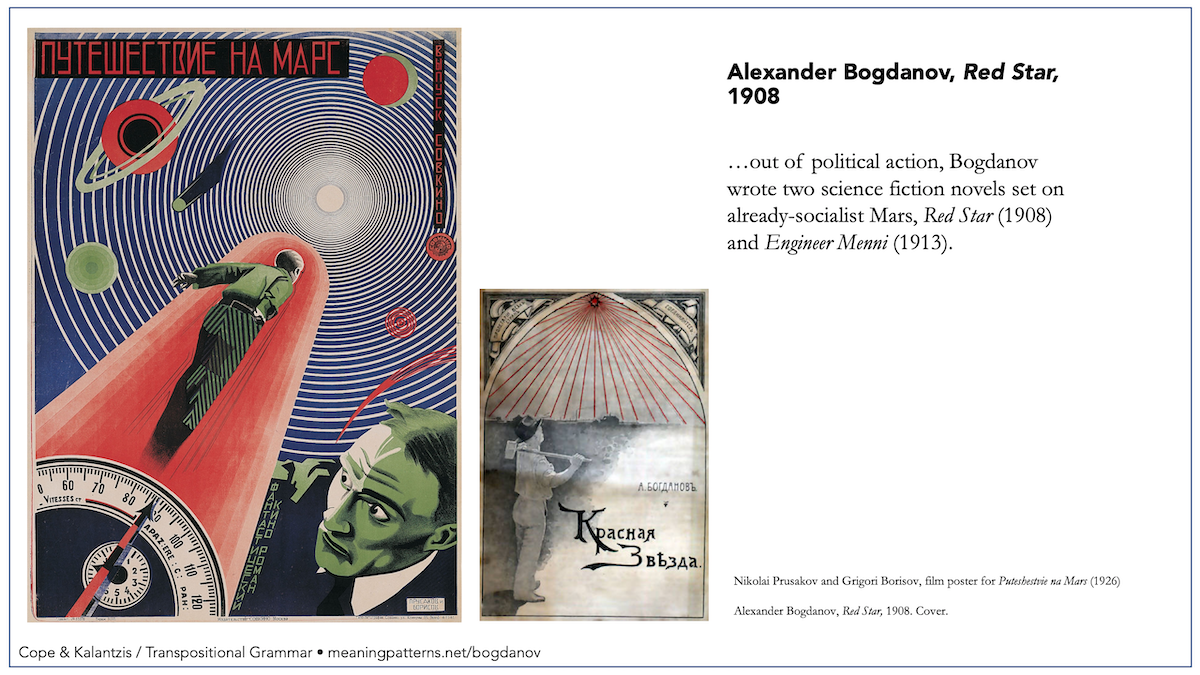
Friday, May 21, 2021


Proletkult Manifestos

Updated: Apr 22

A. Bogdanov " The Proletariat and Art»


Bogdanov A. A. (1873-1928)

"The earliest germs of art are the love song of many animals and of man, and the labor song of man. The first is a means of organizing the family, marriage, and the second is an instrument of organizing labor. Later there was a battle song. It was a means to unite the combat team in the unity of mood." (p. 117)

"The ancient myth was even at the same time the embodiment of both science and poetry: it gave people in living images of the word what science now gives in abstract concepts. "(p. 118)

"What is the difference between science and art? The fact that art organizes experience in living images, and not in abstract concepts. Thanks to this, its area is wider: it can organize not only people's ideas, their knowledge and thoughts, but also their feelings, their moods." (p. 118)

"Different arts in different ways connect people in the unity of mood, educate and socially shape their relationship to the world and to other people. "(p. 118)

"Art is not only broader than science, it has hitherto been stronger than science as a tool for organizing the masses, because the language of living images was closer and more understandable to the masses. It is clear that the art of the past cannot in itself organize and organize the proletariat as a special class with its own tasks and its own ideal. Art is religious-feudal, authoritarian, introduces people to the world of power, submission, educates the masses in submission, humility and blind faith. Bourgeois art, having as its constant hero a person who is fighting for himself and his own, educates an individualist." (p. 118-119)


"Faust is a brilliant work of the secret adviser W. Goethe, a bourgeois aristocrat. It would seem that there is nothing valuable in it for the proletariat, but you know that our thinkers often quote from Faust. What is the inner meaning of this work, what is its "artistic idea", i.e., from our point of view, its organizational tasks? In it, ways are found for such an arrangement, such an organization of the human soul, so that complete harmony is achieved between all its forces and abilities. Faust is a representative of the human soul, always searching, always restless, longing for harmony. " (p. 120)


Johann Wolfgang von Goethe (1749-1832)

"More than 2000 years ago, a statue of the goddess was created, which gathered a lot of people in the temple, uniting it in one, even if alien to us, mood. This was the Venus Urania-the celestial Venus, the representative of pure love, as it was understood by the ancients-the harmonious love of the spiritual and physical. The temple was the center of communication, the goddess the center of the temple. Consequently, it was the center of the collective organization. It reflected an alien world in a calm, majestic, far from effort, tension and impulse, but in real, divine beauty." (p. 121)


Statue of " Venus Urania"

"And folk poetry?.. Take the epics about Ilya Muromets. This is the embodiment in one hero of the collective strength of the peasantry of feudal Russia, the true builder and defender of our land. Let it be an individualistic image, otherwise the peasantry is not able to express its soul, and even now it is not able to express its collective strength in one person. "(p. 122)


Ilya Muromets (painting by Vasnetsov)

"Comrades, we need to understand: we live not only in the collective of the present, we live in the cooperation of generations. This is not class cooperation, it is the opposite of it. All the workers, all the leading fighters of the past — are our comrades, no matter what class they belong to. "(p. 122-123)


"So, comrades, we need the art of the past, but just like the science of the past, in a new understanding, in a critical interpretation of a new, proletarian thought.

This is a matter for our critics. It must go hand in hand with the development of proletarian art itself, helping it with advice and interpretation, and guiding it in the use of the artistic treasures of the past. These treasures it must hand over to the proletariat, explaining to them all that is useful and necessary for them, and what is lacking in them for them. Artistic talent is individual, but creativity is social: it comes from the collective and returns to it, and serves it vitally. And the organization of our art must be built on comradely cooperation, just as the organization of our science is. " (p. 123)

[1]


A. Gastev " Contours of Proletarian culture»


A. K. Gastev (1882-1939)

"The definition of proletarian culture must be approached with the greatest caution. They say that this is, first of all, the culture of work. But labor has existed since the creation of the world. This is the psychology of hired labor. But even here it is difficult to distinguish between slave psychology and proletarian psychology. Psychology of struggle, insurrection, and revolution... "


"After all, the 'Soviet' constitution is nothing but a democracy with electoral restrictions for the propertied classes, and, moreover, the Soviets are a political bloc of the proletariat, the peasant poor, and even the 'middle peasants'. Somewhere far away, somewhere up from these temporary formations, one must go in order to probe the rising culture of the proletariat."

"For the new industrial proletariat, for its psychology, for its culture, first of all, industry itself is characteristic. Buildings, pipes, columns, bridges, cranes and all the complex constructiveness of new buildings and enterprises, the catastrophism and inexorable dynamics – this is what permeates the everyday consciousness of the proletariat. The whole life of modern industry is steeped in movement, disaster, embedded at the same time in the framework of organization and strict regularity. Catastrophe and dynamics, bound by a grandiose rhythm, are the main, overshadowing moments of proletarian psychology."


"The proletariat, gradually broken down by the new industry into certain 'types', 'types', into people of a certain 'operation', into people of a certain gesture, on the other hand, absorbs into its psychology all the grandiose assembly of the enterprise that passes before its eyes. This is mainly the open and visible assembly of the factory itself, the sequence and subordination of operations and fabrications, and finally the general assembly of the entire production, which is expressed in the subordination and control of one operation to another, of one "type" to another, and so on."


"The psychology of the proletariat here is already turning into a new social psychology, where one human complex works under the control of another, and where often the "controller" in the sense of labor qualifications is below the controlled and very often personally completely unknown. This psychology reveals a new working collectivism, which manifests itself not only in the relationship of man to man, but also in the relationship of integral groups of people to integral groups of mechanisms. Such collectivism can be called mechanized collectivism."


"In the face of the proletariat, we have a growing class that simultaneously deploys the living labor force, the iron mechanics of its new collective, and a new mass engineering that turns the proletariat into an unprecedented social automaton."

"We do not want to be prophets, but, in any case, we must associate with proletarian art a stunning revolution of artistic techniques. In particular, the artists of the word will have to solve not such a task as the futurists set themselves, but much higher. If futurism has put forward the problem of" word-making", then the proletariat will inevitably put it forward too, but it will not reform the word itself grammatically, but it will risk, so to speak, the technicalization of the word. The word taken in its everyday expression is clearly no longer sufficient for the workers ' and production goals of the proletariat."


"We are going to an unprecedented objective demonstration of things, mechanized crowds and a stunning, open grandiosity that knows nothing intimate and lyrical."

[2]


A. Bogdanov " The Ways of proletarian Creativity»

"Creativity, everything — technical, socio-economic, everyday, scientific, artistic-is a kind of work, and in the same way it is composed of organizing (or disorganizing) human efforts. This is nothing but labor, the product of which is not a reproduction of the finished model, it is something "new"." (p. 192)


"Creativity is the highest, most complex type of work. Therefore, his methods are based on the methods of labor. All methods of work — and with it, creativity-lie within the same framework. Its first phase is the combining effort, the second is the selection of its results, the elimination of the unsuitable, the preservation of the suitable. In the "physical" work, material things are combined, in the "spiritual" — images; but, as the latest psychophysiology shows, the nature of the efforts of combining and selecting is the same — neuromuscular." (p. 192-193)

"Creativity combines materials anew, not according to the usual pattern, which leads to a more complex, more intense selection. The combination and selection of images is incomparably easier and faster than material things. Schiller put it in words: "Thoughts easily get along in the mind, but bodies collide sharply in space." "Therefore, creativity often proceeds in the form of "spiritual" work, but not exclusively. "(p. 193)


Friedrich Schiller
"Human labor, always relying on collective experience and using collectively developed means, is always collective in this sense, no matter how narrowly individual its goals and its external, direct form are in particular cases (i.e., even when it is the work of one person, and only for oneself). "(p. 194)

"The methods of proletarian creativity have their basis in the methods of proletarian labor, that is, the type of work that is characteristic of the workers of the latest large-scale industry.

Features of this type: 1) the combination of elements of "physical" and "spiritual" labor; 2) transparent, not hidden or disguised collectivism of its very form. The first depends on the scientific nature of the latest technology, in particular on the transfer of the mechanical side of effort to the machine: the worker is increasingly becoming the " leader "of the iron slaves, and his work is increasingly reduced to" spiritual " efforts — attention, consideration, control, initiative, while the role of muscular tension is relatively reduced. The second depends on the concentration of labor in mass cooperation and on the convergence of specialized types of labor by the power of machine production, which increasingly transfers the direct, physical specialization of workers to machines." (p. 194-195)


"In science and philosophy, Marxism was the embodiment of both the monism of the method and the conscious-collectivist tendency. Further development on the basis of the same methods should develop a universal organizational science that monistically unites the entire organizational experience of humanity in its social work and struggle." (p. 195-196)


Karl Marx

"In the field of artistic creativity, the old culture is characterized by uncertainty and unconsciousness of methods ("inspiration", etc.), their isolation from the methods of labor practice, from the methods of creativity in other areas. Although the proletariat is only making its first steps here, the general tendencies peculiar to it are already clearly outlined. Monism manifests itself in the desire to merge art with working life, to make art an instrument of its active and aesthetic transformation along the entire line. Collectivism, at first spontaneous, and then increasingly conscious, appears vividly in the content of artistic works, and even in the form of artistic perception of life, illuminating the image not only of human life, but also of the life of nature: nature as a field of collective labor; its connections and harmonies, as the germs and prototypes of the organization of the collective." (p. 196)


"Conscious collectivism transforms the whole meaning of the artist's work, giving it new incentives. The former artist saw in his work the identification of his individuality; the new one will understand and feel that in and through him a great whole — the collective-is creating." (p. 197)

"The awareness of collectivism, by deepening the mutual understanding of people and the connection of feeling between them, will make possible an incomparably wider development of direct collectivism in creativity, i.e., direct cooperation of many people in it, even to the mass. "(p. 197)


"The object of production technology is nature, its natural forces. The meaning of technical techniques is the subordination of these forces, the conservation and accumulation of human energy.

The object of the ideological technique is the living experience of the collective The meaning of its techniques is the adaptation of this experience to the tasks and needs of the collective, its organization in accordance with them." (p. 197-198)


"In the art of the past, as in its science, there are many hidden elements of collectivism. By revealing them, proletarian criticism makes it possible to creatively perceive the best works of the old culture, in a new light and with a huge enrichment of their value. This is the way to acquire the world cultural heritage that legally belongs to the proletariat. "(p. 199)


Proletkult Manifestos (wixsite.com)

Konstantin E. Tsiolkovsky Monism of the Universe

#Panpsychism
, or everything feels


Konstantin Eduardovich Tsiolkovsky


"The ability of organisms to sense pleasant and unpleasant things I call sensitivity. Note this, since this word often means responsiveness (in the living – reflexes). Responsiveness is something else entirely. All the bodies of the cosmos are responsive. Thus, all bodies change in volume, shape, color, strength, transparency, and all other properties depending on temperature, pressure, light, and generally the influence of other bodies.”


"Every particle of the universe is responsive. We think she's also sensitive."

"Of the animals known to us, humans are the most sensitive. The other known animals are the less sensitive the lower their organization."

"...with the death or transition of the organic to the inorganic, sensitivity ceases.

"The feeling disappears, but the responsiveness remains in the dead body, only it becomes less intense and more accessible to the scientist than to the average person."

"Every atom of matter feels according to its surroundings."

"Since all matter can always pass into an organic state under favorable conditions, we can conditionally say that inorganic matter is potentially alive."

The three bases of judgment

"It (time) has two directions – past and future-and a certain quantity, that is, it is measurable, like any quantity. Like any quantity, it is infinite, that is, it has neither beginning nor end.”

In nature, space has no boundaries.

Without matter, there is no time, no space, no force.

The law of repeatability

"...the number of planets in space is still increasing almost a million times and already reaches hundreds of millions of billions (1017)."

"...the ethereal islands [have] no end. Their group is a unit of the 5th order. The number of digits of astronomical units is probably as infinite as time and space, i.e. there is both the 6th and 7th digits-without end."

"The phenomena of the cosmos are periodic."

"In general, the universe has always had one view"

"People tend to think that everything dies as they die. This is one of the illusions of the mind, called anthropomorphism, or the assimilation of the surrounding phenomena of human life."

"The conclusion is that the universe, in general, has always presented the same picture. Even though our planetary system was a nebula billions of years ago, the appearance of the Milky Way has remained the same for quadrillions of years. It was a cluster of hundreds of millions of suns, ranging in age from planetary nebulae to dark suns frozen from the surface."

Periodicity of the structure of atoms and their positions in celestial bodies

"From a simple, probably single matter (substance – essence – principle), the whole variety of so-called chemical elements and their compounds is obtained. Conversely, the explosion of extinct suns and the formation of planetary nebulae results in simple matter from complex matter."

" ...everything is continuously and periodically moved and transformed. This process of exchange and transformation of elements is always carried out, in addition to catastrophic phenomena."

"...the process of exchange and transformation of elements is always carried out, in addition to catastrophic phenomena."

Monism


K. Tsiolkovsky Monism of the Universe, Kaluga 1931

"Then, the theories show that all the planets separated from the sun, first touching it, and only then gradually moved away. So any planet for a certain period of time was at a temperature suitable for the self-generation and development of life. On the contrary, every planet, including Earth, was not once in these conditions. Also, every planet that currently has a favorable degree of heat will eventually lose it, as it moves away from the sun. In addition, this central star itself, when it flares up or fades out, also gives all the planets convenient moments for the development of life, regardless of the change in their distance from the sun."

"...most of the major planets, or rather planets with gas shells, are, or have been, or will be inhabited."

"Thus, the number of people, having reached its limit, will not increase, but the quality of people will continuously change for the better. Natural selection will be replaced by artificial selection, and science and technology will come to its aid."

"Colonization of the Solar System and the Milky Way, that is, our spiral nebula

The technology of the future will make it possible to overcome the Earth's gravity and travel throughout the Solar System. They will visit and explore all its planets. Imperfect worlds will be eliminated and replaced with their own homes, borrowing material from asteroids, planets and their satellites."

"...the most perfect type of organism that lives in the ether and feeds directly on solar energy will prevail."

"After the settlement of our Solar System, other solar systems of our Milky Way will begin to settle."

Populating the universe


"On all planets with atmospheres, the beginnings of life were revealed in due time. But on some of them, due to the conditions, it flourished more luxuriantly and faster, gave beings technical and mental power, and became the source of higher life for other planets of the universe."

"...sowers of higher life. In some places they destroyed the rudiments of primitive or ugly life, in some places they waited for good fruits and renewal of the life of the cosmos."

"The torturous life of the Earth is rare, because it turned out to be self-birth, not settlement."

"The Earth's improved life stream is designed to replenish the decline of the regressing rocks of the cosmos."

The sense of the atom and its parts


"The atom then decomposes, and its weight, or mass, decreases, then it is created, and its atomic weight increases ... in addition, the atom moves."

"Absolute time is that which is observed by a long-living, non-dying, and non-sleeping being."

"Subjective time is something quite different. This is the apparent time experienced by organisms."

"...in the subjective sense, the course of the higher life of any atom is not only unlimited, but also continuous."

"...death ends all suffering and gives, subjectively, immediate happiness."


Pictorial representation of the sensuous life of the atom


"In the new life, only happiness and contentment will remain."


"...the wave-life has a beginning and an end, and there is one period out of many of them.

All these periods are, in fact, quite monotonous: happiness, contentment, the consciousness of the universe, the consciousness of its never-ending destiny, the understanding of the truth, which is the right way to support the cosmos in a brilliant state of perfection."


SEE

  1. REVENANTS AND REVOLUTIONARIES: BODY AND SOCIETY IN ...

    https://monoskop.org/images/b/b0/Greenfield_Douglas_2006_Revenants_and...

    Bogdanov dreamed of a universal science of organization that would maximize the efficiency of all life systems, from the circulation of goods to the circulation of blood. His theory of organization, which he called tectology, guides the regulation of the body and society. Put into practice, tectology would maintain social and bodily equilibrium as humans evolve. Its creator …

 COMMIES ON MARS


Red Star - The First Bolshevik Utopia : Alexander Bogdanov : Free Download, Borrow, and Streaming : Internet Archive


Red Star - The First Bolshevik Utopia

by Alexander Bogdanov

Publication date 1913

Publisher Indiana University Press

Contributor Loren R. Graham and Richard Stites

Language English

Red Star - Engineer Menni - A Martian Stranded on Earth

Edited by: Loren R. Graham and Richard Stites

Translated by: Charles Rougle

Published by: Indiana University Press 1984


The Soviet web: the tale of how the USSR almost invented the internet


Still from Soviet sci-fi film, A Dream Come True (Mechte Navstrechu) (1963)

When brilliant Soviet cyberneticist Viktor Glushkov designed a blueprint for a computerised planning system, the Soviet Union looked on track to become web pioneers. In the end, however, there was to be no digital network. Justin Reynolds tells the story of how the Soviets nearly created the internet

7 February 2017
Text Justin Reynolds

Visions of an advanced postcapitalist economy run by digital networks have long haunted the socialist imagination. Alexander Bogdanov’s 1909 Bolshevik sci-fi fantasy novel Red Star imagined the achievement of communist utopia on Mars, an abundance of wealth and leisure made possible by a sophisticated command economy planned and automated by prototype computers. Cerebral Martian engineers, their “delicate brains” connected to the machines through “subtle and invisible” threads, fine-tune economic inputs and outputs from a control room tracking production gluts and shortfalls.

Bogdanov’s thought experiment anticipated contemporary speculations about the possibilities digital networks open for new forms of economic exchange. One current best-seller, Paul Mason’s Postcapitalism, suggests that the ease with which information can be shared online, together with the advent of 3D printing technologies, is seeding a new economy in which goods and services can be exchanged for free. Another, Nick Srnicek and Alex Williams’s Inventing the Future, envisages an automated economy set in motion by the seamless interactions of millions of connected devices.


Cybersyn control room, Chile. Image: Gui Bonsieppe under a CC license


Many of today’s digital utopians draw inspiration from a real world attempt to implement electronic socialism: Salvador Allende’s abortive 1970s programme that sought to rationalise and democratise the planning of the Chilean economy through a nationwide network of telex machines. “Project Cybersyn” was cut short by Pinochet’s coup, but, helped by the surviving images of its iconic retro-futurist central operations room, the episode continues to symbolise radical aspirations to harness technology to break through to an alternative economic system.

Cybersyn was conceived during the same era as a still more ambitious but less well documented project: a well-resourced programme to digitise the planning of the Soviet Union’s vast command economy. The labyrinthine story of the “Soviet internet” is told in detail in a new book by Tulsa University professor Benjamin Peters, who, venturing into Moscow archives “lit by a single flickering light bulb”, pieces together the tale of plans to supercharge the USSR’s stuttering economy through the installation and networking of a constellation of mainframe computers at major production points from Leningrad to Siberia. The project was one of the most spectacular manifestations of the restless Soviet ambition to lever technology to create the material conditions for “full communism”.

The 1970s was an era of harnessing technology to break through to an alternative economic system


From the beginning the USSR was intoxicated by an aesthetic of the machine. Lenin equated the achievement of socialism with the electrification of the nation. Planners sought to apply Fordist production techniques on an unprecedented scale. And avant-garde designers, architects and filmmakers insisted engineering was art, and art was engineering. But those visions far outran the technology available to the impoverished state. Stalin resorted to a forced march industrialisation programme that rammed Russia’s patchwork economy into a rigid pyramid structure, the output of factories and farms coordinated through targets set by regional authorities reporting to a central planning ministry.

This hulking machinery carried the USSR through successive five year plans achieved at the cost of monumental waste of human life and natural resources. Calculation errors caused chronic production shortfalls or overshoots that cascaded up and down the command chain and rolled on from year to year. By 1960, 3 million officials were attempting to track the economy’s unfathomable information flows, and it was forecast that if future growth targets were to be met, a bureaucracy equivalent to the entire working population would be required with 20 years.


Map of OGAS computer centres, 1964

To get things done, planners, managers and workers resorted to informal networks that criss-crossed official hierarchies. Far from being the rigid hierarchy of popular imagination, the Soviet economy relied on a vortex of informal ties and personal favours. But by the Khrushchev era, science seemed to be catching up with those early revolutionary dreams. Inspired by the new field of cybernetics — the study of information systems in nature, machines and human societies — Soviet economists began to reimagine the command economy as a reflexive system capable of recalibrating planning flows in response to new inputs. Emerging mainframe computing technologies would provide the number-crunching firepower to make it possible.

By the late 1950s a comprehensive blueprint for a computerised planning system had emerged: the All-State Automated System — known as the OGAS — designed by the brilliant cyberneticist Viktor Glushkov. Glushkov proposed overlaying a vast digital network on the economy’s pyramid structure: some 20,000 mainframes at major production points would be connected to hundreds of regional administrative centres pushing data to a central processing hub in Moscow.

By the late 1950s a comprehensive blueprint for a computerised planning system had emerged: the All-State Automated System — known as the OGAS


The OGAS anticipated cloud computing, allowing authorised workers, managers and administrators to input information to a central database accessible to all users, and looked ahead to today’s virtual currencies, proposing that physical money would be rendered redundant by the system’s capacity to process transactions using electronic receipts. The proposal was unashamedly utopian. Glushkov’s design aspired to the Marxist ideal of a rational economic system guided by worker inputs, and, like the engineers who led the Soviet space programme, he was captivated by the Russian cosmist desire for a kind of synthetic immortality. Rather like 21st century advocates of a “technological singularity”, Glushkov believed that, one day, ever more advanced networks would make it possible to upload personalities embedded in human neural circuits to a supercomputer.


The scale of the OGAS matched its philosophical grandeur: costing 20 billion rubles (today approximately $333.4 million) and requiring some 300,000 operators it would be rolled out over 30 years. And, in the beginning at least, it was an ambition the Soviet leadership shared. Glushkov was appointed head of a new Institute of Cybernetics, one of several well-funded research centres with a remit for digital innovation.


Viktor Glushkov speaking about management information systems. Image: ResearchGate
The project prospered during the Cold War high point of post-war Soviet technological optimism, the era of Sputnik and Gagarin. When rumours of Russian ambitions for rapid economic expansion reached an American government already concerned that Soviet space exploits signalled an emerging communist supremacy, the US redoubled efforts to build its own network, the ARPANET, the forerunner of today’s internet.

By 1970 Glushkov’s plan was ready to go before the Politburo for approval, which, with the promised backing of General Secretary Leonid Brezhnev and Premier Aleksei Kosygin, it seemed destined to secure. But it was not to be. Entering Stalin’s former office in the Kremlin to formally present his proposal, Glushkov noticed that Brezhnev and Kosygin’s chairs were empty. Their absence — ostensibly to attend state functions elsewhere — emboldened Finance Minister Vasily Garbuzov to force through a counterproposal that ripped the heart out of the plan. Permission was given to install computers at key production centres but not, crucially, for linking them together. The existing planning bureaucracy would be retained: there was to be no digital network. The OGAS, it seemed, whatever its promise, threatened too many vested interests.


In the end, there was to be no digital network as the OGAS, it seemed, threatened too many vested interests

After repeatedly failing over the following years to revive interest in his plan, the rational Glushkov began to succumb to conspiracy theories, suggesting interference by American spies, and that the emergency landing of a flight he had taken shortly after the Politburo meeting had been caused by sabotage. Glushkov died in 1982, by which time the Soviet leadership had pinned its hopes for economic renewal on limited market liberalisation, an approach that rendered the concept of a computerised command economy redundant.

In retrospect, the OGAS seems absurdly ambitious. The development of such a vast network would have necessitated a depth and duration of political commitment even an authoritarian regime could unlikely sustain, and it is doubtful that early mainframe technology would have been capable of processing so much data (quite apart from the vexed question of whether the very concept of a complex planned economy makes sense.) The OGAS could only have been conceived during an era when boundless faith in the possibilities of new technology, and Cold War imperatives, made utopian thinking possible.

And yet their remarkable space programme gave the Soviets some justification for believing that they were capable — quite literally — of aiming for the stars. Why did economic modernisation, a project of similar scope and importance, to which thousands of their best minds had been dedicated, fail so completely?


New Planet, Konstantin Yuon (1921)


Peters’s narrative suggests Glushkov’s plan failed precisely because it promised radical efficiencies, even had it only been partially fulfilled. Its implementation would have required the support of the bureaucracy that benefited from the wasteful processes computerisation sought to eradicate. State ministries enjoying the powers and privileges associated with managing the Soviet economy, and fearing the prospect of looming redundancy, had tried to scupper the OGAS for years prior to Garbuzov’s intervention at that fateful Politburo meeting. The Soviet bureaucracy was more akin to an unregulated market in which self-interested administrators competed for influence than a monolithic structure in which private interests were suppressed.

For Peters the paradox is that the first civilian digital networks were created by “cooperative capitalists, not competitive socialists”. The US succeeded in developing the ARPANET by nurturing a collaborative culture between government, military and civilian institutions that a chaotic Soviet administrative system was unable to cultivate. The moral of the sad story of the Soviet internet is that making new technologies work for the common good depends on mutual obligation and effective regulation: the rule of law, clear governmental structures, and coordination between the public and private sectors.

The moral of the sad story of the Soviet internet is a cautionary tale that haunts our 21st century internet


It’s a cautionary tale that haunts our 21st century internet. Whereas Glushkov’s OGAS was destroyed by competing bureaucrats, today’s “open web”, nurtured in its infancy by collaboration between state, civilian and commercial actors, is being broken apart by private interests, parcelled into closed platforms dominated by giant corporations and exploited by authoritarian governments taking advantage of unprecedented opportunities for monitoring citizens.

Today, Bogdanov’s Red Star is usually remembered for its unabashed utopianism and steampunk contraptions. But Bogdanov was less interested in the technology he dreamt up than the capacity of his Martian engineers to use it wisely. The disciplined Martians had succeeded where fractious humans had so far failed.

Similar thoughts preoccupied Glushkov in his final years. The last book he wrote was intended for young readers: a brief introduction to the possibilities digital networks might offer for — one day — producing Red Plenty. Disillusioned by what his peers had made of his great design, Glushkov invested his hopes in future generations who might yet cultivate the wisdom to make technology work for all.


From the Unity of Science to the Unity of Systems Paradigm: Foundational Importance and Contemporary Relevance of Alexander Bogdanov's Work

Published 2020
15 Pages
This is a presentation I delivered at the SAE 2020 conference, organised by the Financial University of Moscow and the Centre for Systems Studies (CSS) of the University of Hull. The presentation gives a summary of my current research at the CSS about the importance and relevance of the work and life of Russian polymath and revolutionary Alexander Bogdanov (1873-1928).

The Legacy of Alexander Bogdanov: From Rediscovery to Full Recovery

Published 2021
0 Views4 Pages
Slides for the introduction to the Online Mini-Symposium The Legacy of Alexander Bogdanov- From Rediscovery to Full Recovery - https://execeducation.hull.ac.uk/the-centre-for-systems-studies-annual-mike-jackson-lecture/


The Influence of Friedrich Engels on Alexander Bogdanov's _Basic Elements of the Historical View of Nature_

David G . Rowley

2021, Studies in East European Thought

Friedrich Engels,
Alexander Bogdanov
Show more ▾
Read online: https://rdcu.be/ce7nY Alexander Bogdanov’s first work of philosophy, Basic Elements of the Historical View of Nature, was fundamentally influenced by Friedrich Engels. As a Marxist philosopher seeking to elaborate a comprehensive, systematic, and scientific worldview appropriate for worker–students, Bogdanov found inspiration in Engels’s Anti-Dühring, which provided him with his monist conception of being and his ‘historical view of nature’ and pointed him toward three critical elements of his work: the monism of motion (energy), Spinoza’s naturalist and determinist system, and Charles Darwin’s conception of natural selection. Bogdanov’s overall goal was to demonstrate that in nature, life, the psyche, and society there is no such thing as self-generated motion; all change occurs because of external action. For the individual and for society this means that existence determines consciousness, and societies evolve as a result of their struggle for existence, which is manifested first and foremost in labor.

 Bogdanov, "Philosophy of Living Experience" - New Learning Online

Reference: Cope, Bill and Mary Kalantzis, 2020, Making Sense: Reference, Agency and Structure in a Grammar of Multimodal Meaning, Cambridge UK: Cambridge University Press, pp. 34-39.


What Can We Learn from Dystopian Fiction About Climate Change?
If you haven’t heard of cli-fi yet, you are not alone; however, you have probably either read or watched some already.

June 30, 2017
Support Hyperallergic’s independent arts journalism. 


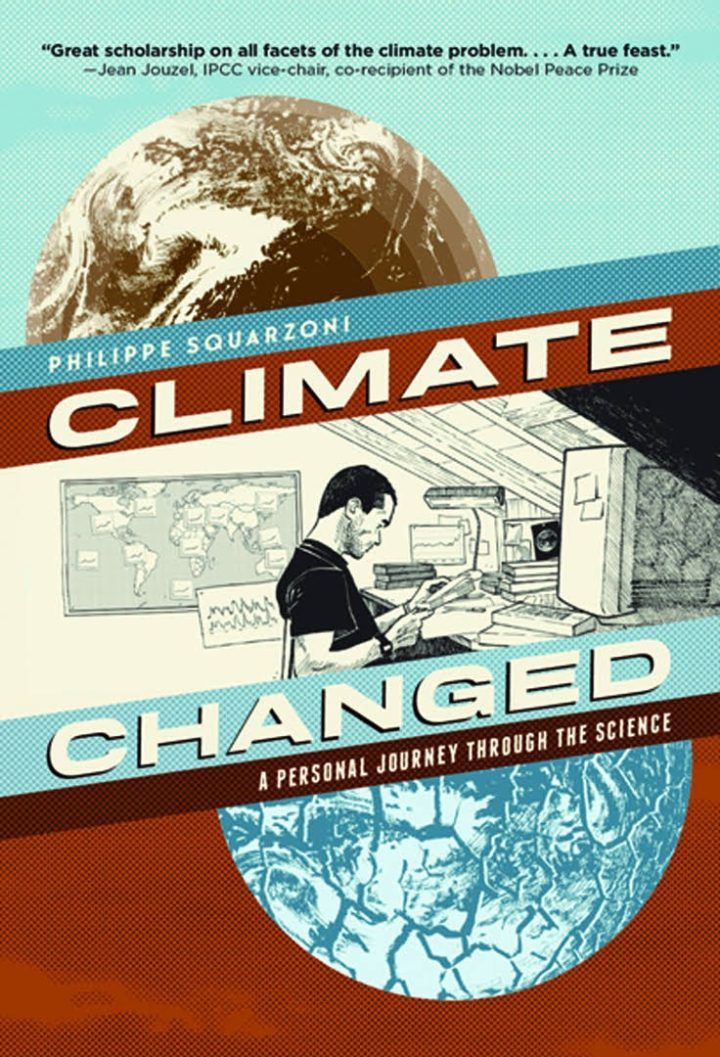
Philippe Squarzoni, Climate Changed: A Personal Journey through the Science, copyright Harry N. Abrams (cover image courtesy of Abrams ComicArts)

Recently, a friend asked on social media, “What do you people read to wind down?” He was referring to the distress we all suffer from the endless negative news coming from the Trump administration. I first suggested sci-fi, but upon remembering that he is a lobbyist for international corporations’ divestiture from the fossil fuel industry, I decided to do some research on sci-fi novels which focus on climate change. That’s when I discovered the so called cli-fi (climate change fiction) genre.

If you haven’t heard of it yet, you are not alone; most of the people I mentioned it to were unaware of it too. However, you have probably either read or watched some cli-fi already. IMBd’s cli-fi page has more than a dozen titles. The Goodreads list of cli-fi novels is over 130 titles long. During the recent months, Lidia Yuknavitch’s The Book of Joan, Zachary Mason’s Void Star, Jane Harper’s The Dry, Margaret Drabble’s The Dark Flood Rises, Kim Stanley Robinson’s New York 2140, Cory Doctorow’s Walkaway, and Sally Abbot’s Closing Down have all hit the shelves described as cli-fi. And, since February of this year, the Chicago Review of Books has published a monthly column on its web site exclusively dedicated to the genre.


Steven Amsterdam,The Things We Didn’t See Coming, copyright Anchor (image courtesy Steven Amsterdam)

Still, there is strong skepticism about the genre’s originality. When I mentioned it to my sci-fi and graphic novel enthusiast friends, they mostly rolled their eyes. Nothing was new about stories focusing on a man-made ecological disasters; they just showed up in other literary categories. For example, Alan Moore’s graphic novel The Swamp Thing, a story based on the consequences of mismanaged nuclear waste was published in 1971. This was also the year in which Dr. Seuss wrote his infamous Lorax, a children’s classic about deforestation and environmental irresponsibility. Even older is Alexander Bogdanov’s communist sci-fi novel, The Red Star – now almost 110 years old – which refers to an ecological crisis very much like ours. Older yet are the ancient religious and mythological Mesopotamian, Hindu, Chinese, and Abrahamic narratives, all of which refer to eco-disasters caused by human mischief.

Octavia Butler,, copyright Grand Central Publishing (photo courtesy of Hachette Book Group)

Yet, it is also true that there has been a growing emphasis on ecology during the last two decades in almost every field. In history, there is the so called spatial turn, which refers to a growing interest in geography and ecology. In philosophy, Glenn Albrecht has coined the term solastalgia to describe “a form of psychological or existential distress caused by environmental change, such as mining or climate change.” In the field of geology, there is widespread acknowledgment of the anthropocene, re-popularized in reference to a new epoch defined by the “significant human impact on the Earth’s geology and ecosystem” according to Wikipedia. So, cli-fi can be understood as modern literature’s response to our anxieties about the current consequences of climate change.

In her book, Antonia Mehnert defines cli-fi as:

literature dealing explicitly with anthropogenic climate change,” which “gives insight into the ethical and social ramifications of this unparalleled environmental crisis, reflects on current political conditions that impede action on climate change, explores how risk materializes and effect society, and finally plays an active part in shaping our conception of climate change.

In Wikipedia, cli-fi means the “literature that deals with climate change and global warming. Not necessarily speculative in nature, works of cli-fi may take place in the world as we know it or in the near future.” Hence, cli-fi is not any eco-conscious or eco-apocalyptic literature. It focuses specifically on the current climate change, which we are experiencing. (One place to build your familiarity with cli-fi is to read a recent interview with Dan Bloom, the man who originally coined the term.)


Area X, The Southern Reach Trilogy by Jeff VanderMeer, copyright FSG (image courtesy of Jeff VanderMeer)

Most commonly cited examples of the genre are Cormac McCarthy’s The Road, Kim Stanley Robinson’s the Science in The Capital trilogy, Margaret Atwood’s The Maddaddam trilogy, Nathaniel Rich’s Odds Against Tomorrow, and Barbara Kingsolver’s Flight Behavior. However, Octavia E. Butler’s The Parable of the Sower tops my list, since it predates (in 1993) those novels mentioned above, and it seems to have inspired Atwood’s The Maddaddam trilogy and Cormac McCarthy’s The Road, which are considered pillars of the genre. It also reads like a masterpiece, along the lines of Jean Rhys’s Wide Saragossa Sea. The Parable of the Sower is the coming-of-age story of a an African-American minister’s daughter who lives in a racially mixed and charged community, which gated itself due to an ongoing ecological crisis. A less acknowledged, but excellent novel is Steven Amsterdam’s Things We Didn’t See Coming, which is experimental and enchanting till the very last page. There are large gaps in the story-line, that make it read like Andre Breton’s surreal novel Nadya, but these gaps also mimic how we deal with moments of disaster and stress by taking refuge in collective amnesia. By far the best cli-fi out there must be Jeff VanderMeer’s The Southern Reach trilogy. This is indeed a story about our changing climate: how a territory called Southern Reach becomes a self conscious ecology, starts to remember, thinking, and communicate with human beings. VanderMeer also shifts between genres; the first volume is a horror story that gave me serious nightmares three nights in a row. The second volume is a detective story, and the third one is a mystery.

As for graphic novels, Philippe Squarzoni’s award winning Climate Changed, a graphic documentary about his personal struggle to understand climate change is a remarkable artistic feat. Brian Wood’s, The Massive, series relates the story of an eco-activist gang who roam the international seas in the near future, trying to save the planet from further harm. The fifth volume of Paul Chadwick’s Concrete: Think Like a Mountain is also a personal favorite of mine, and the last issue of World War 3 from AK Press is entirely dedicated to climate change chaos.


The Massive, written by Brian Wood and Illustrated by Kristian Donaldson and Garry Brown, copyright Dark Horse Comics (courtesy of Dark Horse Comics)

Last but not the least, I have to mention The Dark Mountain Project, which is active since 2009. It is best known for its Dark Mountain Manifesto, which opens with the statement: “Those who witness extreme social collapse at first hand seldom describe any deep revelation about the truths of human existence. What they do mention, if asked, is their surprise at how easy it is to die.” They have so far published 10 volumes of collected short fiction, poetry, critical essays, graphic fiction, and visual art, all of which explore climate change, and how we write or tell stories about it. Its past editorial boards have included authors like the famous feminist sci-fi writer Ursula La Guin and late cultural critic John Berger. Each volume delivers a serious punch and could generate more debate about cli-fi.


Uncivilised Poetics, Dark Mountain #10, October 2016, copyright The Dark Mountain Project (courtesy of The Dark Mountain Project)

We all know the news about the future of our planet is not good. At the current rate, we have only 60 more harvests left. Marine life is in dramatic decline, and Antarctica has joined the North Pole in melting, which has far more disastrous implications. Weather temperatures are regularly record breaking, sea and river levels are rising, the salinity of our oceans is quickly changing, and the behavior of our atmosphere is evermore unpredictable. Climate refugees are no longer a thing of fiction; parts of Africa and the Middle East will become uninhabitable in the near future, and the World Bank has already advised a number of countries to revise their immigration policies, because they will be hit by a tsunami of migrants. Meanwhile, in the US, we are governed by those who prefer to erase the climate-change data, withdraw from the Paris climate accords, sell our natural reserves to the developers, and eliminate the Environmental Protection Agency. Pathetic as it may sound, cli-fi offers a type of relief from this bigotry. It imagines that one day such idiocies will be washed off clean, and the earth will continue its adventure — probably without us. And even if anyone is left to survive, they would most likely strike a far better covenant with this planet than the one we have at present.
Related

Two Books Take on the Vast Ecological and Social Consequences of Climate Change
May 21, 2019
An Anime Fantasy Combines Myth With Climate Change
January 16, 2020
Many Stories Are Told Through the Typography in Science Fiction Films
December 26, 2018


Murat Cem Mengüç is a freelance writer, artist and a historian who holds a PhD in history of MENA. He is the founder of Studio Teleocene, and currently based outside of Washington, DC. More by Murat Cem Mengüç