Monday, July 12, 2021

Teardrop star reveals hidden supernova doom

W. M. KECK OBSERVATORY

Research News

IMAGE

IMAGE: ARTIST'S IMPRESSION OF THE HD265435 SYSTEM AT AROUND 30 MILLION YEARS FROM NOW, WITH THE SMALLER WHITE DWARF DISTORTING THE HOT SUBDWARF INTO A DISTINCT 'TEARDROP' SHAPE. view more 

CREDIT: UNIVERSITY OF WARWICK/MARK GARLICK

Maunakea, Hawai'i - Astronomers have made the rare sighting of two stars spiraling to their doom by spotting the tell-tale signs of a teardrop-shaped star.

The tragic shape is caused by a massive nearby white dwarf distorting the star with its intense gravity, which will also be the catalyst for an eventual supernova that will consume both. Found by an international team of astronomers and astrophysicists led by the University of Warwick, it is one of only a very small number of star systems discovered that will one day see a white dwarf star reignite its core.

The team's new research is published in today's issue of the journal Nature Astronomy.

With the help of W. M. Keck Observatory on Maunakea in Hawai'i, the astronomers were able to confirm that the two stars are in the early stages of a spiral that will likely end in a Type Ia supernova - a type that helps astronomers determine how fast the universe is expanding.

The couple - a binary star system called HD265435 - is located roughly 1,500 light-years away; it is comprised of a hot subdwarf star and a white dwarf star orbiting each other closely at a dizzying rate of around 100 minutes. White dwarfs are 'dead' stars that have burned all their fuel and collapsed in on themselves, making them small but extremely dense.

A type Ia supernova is generally thought to occur when a white dwarf star's core reignites, leading to a thermonuclear explosion. There are two scenarios where this can happen. In the first, the white dwarf gains enough mass to reach 1.4 times the mass of our Sun, known as the Chandrasekhar limit. HD265435 fits in the second scenario, in which the total mass of a close stellar system of multiple stars is near or above this limit. Only a handful of other star systems have been discovered that will reach this threshold and result in a Type Ia supernova.

Lead author Ingrid Pelisoli from the University of Warwick Department of Physics explains: "We don't know exactly how these supernovae explode, but we know it has to happen because we see it happening elsewhere in the universe."

"One way is if the white dwarf accretes enough mass from the hot subdwarf, so as the two of them are orbiting each other and getting closer, matter will start to escape the hot subdwarf and fall onto the white dwarf. Another way is that because they are losing energy to gravitational wave emissions, they will get closer until they merge. Once the white dwarf gains enough mass from either method, it will go supernova," she says.

Using data from NASA's Transiting Exoplanet Survey Satellite, the team was able to observe the hot subdwarf. While they did not detect the white dwarf, the researchers observed the brightness of the hot subdwarf varied over time; this suggests a nearby massive object was distorting the star into a teardrop shape.

The astronomers then used Palomar Observatory and Keck Observatory's Echellette Spectrograph and Imager (ESI) to measure the radial velocity and rotational velocity of the hot subdwarf star, which allowed them to confirm that the hidden white dwarf is as heavy as our Sun, but just slightly smaller than the Earth's radius. Combined with the mass of the hot subdwarf, which is a little over 0.6 times the mass of our Sun, both stars have the mass needed to cause a Type Ia supernova.

"Keck's ESI data was crucial in determining that the compact binary system exceeds the Chandrasekhar mass limit, which makes HD265435 one of the very few supernova Ia progenitor systems known," says co-author Thomas Kupfer, assistant professor at Texas Tech University's Department of Physics and Astronomy.

As the two stars are already close enough to begin spiraling closer together, the white dwarf will inevitably go supernova in around 70 million years. Theoretical models produced specifically for this study also predict that the hot subdwarf will contract to become a white dwarf star before merging with its companion.

Type Ia supernovae are important for cosmology as 'standard candles.' Their brightness is constant and of a specific type of light, which means astronomers can compare what luminosity they should be with what we observe on Earth, and from that work out how distant they are with a good degree of accuracy. By observing supernovae in distant galaxies, astronomers combine what they know of how fast this galaxy is moving with our distance from the supernova and calculate the expansion of the universe.

"The more we understand how supernovae work, the better we can calibrate our standard candles. This is very important at the moment because there's a discrepancy between what we get from this kind of standard candle, and what we get through other methods," says Pelisoli.

She adds, "The more we understand about how supernovae form, the better we can understand whether this discrepancy we are seeing is because of new physics that we're unaware of and not taking into account, or simply because we're underestimating the uncertainties in those distances."

"There is another discrepancy between the estimated and observed galactic supernovae rate, and the number of progenitors we see. We can estimate how many supernovae are going to be in our galaxy through observing many galaxies, or through what we know from stellar evolution, and this number is consistent. But if we look for objects that can become supernovae, we don't have enough. This discovery was very useful to put an estimate of what a hot subdwarf and white dwarf binaries can contribute. It still doesn't seem to be a lot, none of the channels we observed seems to be enough," Pelisoli says.

###

This research was funded by the Deutsche Forschungsgemeinschaft (DFG, German Research Foundation) and the Science and Technology Facilities Council, part of UK Research and Innovation.

ABOUT ESI

The Echellette Spectrograph and Imager (ESI) is a medium-resolution visible-light spectrograph that records spectra from 0.39 to 1.1 microns in each exposure. Built at UCO/Lick Observatory by a team led by Prof. Joe Miller, ESI also has a low-resolution mode and can image in a 2 x 8 arc min field of view. An upgrade provided an integral field unit that can provide spectra everywhere across a small, 5.7 x4.0 arc sec field. Astronomers have found a number of uses for ESI, from observing the cosmological effects of weak gravitational lensing to searching for the most metal-poor stars in our galaxy.

ABOUT W. M. KECK OBSERVATORY

The W. M. Keck Observatory telescopes are among the most scientifically productive on Earth. The two 10-meter optical/infrared telescopes atop Maunakea on the Island of Hawai'i feature a suite of advanced instruments including imagers, multi-object spectrographs, high-resolution spectrographs, integral-field spectrometers, and world-leading laser guide star adaptive optics systems. Some of the data presented herein were obtained at Keck Observatory, which is a private 501(c) 3 non-profit organization operated as a scientific partnership among the California Institute of Technology, the University of California, and the National Aeronautics and Space Administration. The Observatory was made possible by the generous financial support of the W. M. Keck Foundation. The authors wish to recognize and acknowledge the very significant cultural role and reverence that the summit of Maunakea has always had within the Native Hawaiian community. We are most fortunate to have the opportunity to conduct observations from this mountain.


Electric delivery vehicles: When, where, how they're charged has big impact on greenhouse gas emissions

UNIVERSITY OF MICHIGAN

Research News

The transportation sector is the largest contributor to greenhouse gas emissions in the United States, and a lot of attention has been devoted to electric passenger vehicles and their potential to help reduce those emissions.

But with the rise of online shopping and just-in-time shipping, electric delivery fleets have emerged as another opportunity to reduce the transportation sector's environmental impact.

Though EVs represent a small fraction of delivery vehicles today, the number is growing. In 2019, Amazon announced plans to obtain 100,000 electric delivery vehicles. UPS has ordered 10,000 of them and FedEx plans to be fully electric by 2040.

Now, a study from University of Michigan researchers shows that when, where and how those fleet vehicles are charged can greatly impact their potential to reduce greenhouse gas emissions.

A key point of the study is that both the emissions directly tied to charging the vehicles and emissions that result from manufacturing the batteries must be considered. Charging practices that shorten a battery's lifetime will lead to early battery replacement, adding to the total greenhouse gas emissions associated with that vehicle.

The U-M researchers found that 50% to 80% of the lifetime emissions associated with an electric delivery vehicle's battery occur during charging. Therefore, charging from a cleaner energy source--such as an electrical grid with lots of renewables--is one of the most impactful ways to lower the emissions of an electric vehicle.

When both charging and battery degradation were considered, the researchers found that greenhouse gas emissions could be lowered by as much as 37% by optimizing charging strategies.

And, surprisingly, they also found that even in the most carbon-intensive regions of the United States, electric delivery vehicles resulted in fewer greenhouse gas emissions than their gasoline or diesel counterparts.

"Our evaluation strategy leads to two main recommendations for companies investing in fleets of electric vehicles," said Maxwell Woody of U-M's Center for Sustainable Systems, lead author of the study published online July 9 in the journal Environmental Science & Technology.

"The first is to consider battery degradation when determining when to charge and how much to charge. Some charging strategies can extend battery lifetime, and this will both lower greenhouse gas emissions and protect the company's investment."

The U-M team's second recommendation to fleet owners is to consider where the energy charging the vehicle comes from. A vehicle charged from solar or wind energy and a vehicle charged from a coal- or natural gas-fired power plant will have very different environmental impacts.

"Considering the charging source can help companies determine the best places to charge, as local grids vary across the country. Companies should prioritize fleet electrification in regions that provide the greatest carbon-reduction benefits," said Woody, a recent master's graduate of U-M's School for Environment and Sustainability who now works as a research area specialist at the Center for Sustainable Systems.

In their modeling study, the researchers analyzed four charging strategies and looked at their lifetime environmental impacts. The new U-M study goes beyond previous work by combining the regional and temporal variation in charging emissions with the impact of charging on battery degradation.

The researchers showed that a baseline charging scenario in which a vehicle is fully charged immediately upon returning to a central depot resulted in the highest emissions. Employing alternative charging methods led to emissions reductions of 8% to 37%.

"Charging the vehicle as soon as it returns and charging the vehicle up to 100% result in a lot of time spent sitting at the depot/charging station with a full battery. This extra time spent fully charged will cause the battery to wear out more quickly--so quickly that the battery may need to be replaced sometime in the vehicle's lifetime," said study corresponding author Parth Vaishnav, assistant professor at the U-M School for Environment and Sustainability.

"Creating this additional battery produces additional greenhouse gas emissions, as well as additional costs."

Charging the battery only enough to complete the day's route, a practice the researchers called sufficient charging, led to a large increase in battery lifetime--in some cases more than doubling it. As a result, emissions tied to battery production were reduced.

Overall, charging strategies that minimized greenhouse gas emissions typically lowered costs as well. In most cases, delaying charging until the vehicle was close to departure, combined with sufficient charging, was the optimal strategy for both cost and emissions.

"The most important finding is that there is a big opportunity here to lower emissions," said study co-author Greg Keoleian, U-M professor of environment and sustainability and director of the U-M Center for Sustainable Systems.

"Electric delivery vehicles only make up a small proportion of delivery vehicles right now, but that number is expected to increase in the coming years. Establishing the best practices for charging now, as these vehicles are starting to be deployed in larger numbers, is a critical step toward lowering greenhouse gas emissions."

###

The other authors of the study, "Charging Strategies to Minimize Greenhouse Gas Emissions of Electrified Delivery Vehicles," are Michael Craig of the U-M School for Environment and Sustainability and Geoffrey Lewis of the U-M Center for Sustainable Systems. The work was supported by the Responsible Battery Coalition.

Study abstract: Charging Strategies to Minimize Greenhouse Gas Emissions of Electrified Delivery Vehicles


The fine nose of storks

Smell leads storks to freshly mown meadows

MAX-PLANCK-GESELLSCHAFT

Research News

IMAGE

IMAGE: THE PREY OF STORKS LIKE TO LIVE IN TALL GRASS. FORAGING IS EASIER FOR THE BIRDS WHEN THE MEADOWS ARE FRESHLY MOWED. view more 

CREDIT: MPI OF ANIMAL BEHAVIOR/ C. ZIEGLER

The sharp eyes of an eagle, the extraordinary hearing of an owl - to successfully find food, the eyes and ears of birds have adapted optimally to their living conditions. Until now, the sense of smell has played a rather subordinate role. When meadows are freshly mowed, storks often appear there to search for snails and frogs. Researchers at the Max Planck Institute for Animal Behavior in Radolfzell and the Max Planck Institute for Chemistry in Mainz have now studied the birds' behavior and discovered that the storks are attracted by the smell of the mown grass. Only storks that were downwind and could thus perceive the smell reacted to the mowing. The scientists also sprayed a meadow with a spray of green leaf scents released during mowing. Storks appeared here as well. This shows that white storks use their sense of smell to forage and suggests that the sense of smell may also play a greater role in other birds than previously thought.

For farmers around Lake Constance, it's a familiar sight: when they start mowing their meadows, storks often appear next to the tractors as if out of nowhere. The white storks live in the wet areas around the lake, feeding on snails, frogs and small rodents that find shelter in high meadows. If these meadows are mowed, the small animals are easy prey. However, the storks do not always appear when mowing takes place. Until now, it was not known how the storks locate the rich food source.

Previously, it was believed that birds relied primarily on their eyes and ears rather than their sense of smell. "It was simply assumed that birds can't smell well because they don't have real noses," says Martin Wikelski, director at the Max Planck Institute of Animal Behavior. "Yet they have a very large olfactory bulb in the brain with many receptor molecules for scents." So birds have the best prerequisites for a fine nose.

Testing for smell

Wikelski has spent many years observing storks and researching their migratory behavior, among other things. When he talked to his colleague Jonathan Williams about the storks' puzzling reaction to mowed meadows, Williams had an idea. Williams works at the Max Planck Institute for Chemistry in Mainz, Germany, studying volatile organic compounds and their effects on humans and the environment. "My guess was that the storks were reacting to the intense smell of freshly cut grass," Williams says. This typical smell is produced by so-called green leaf odorants and consists of only three different molecules. "These are also added to perfumes, for example, to give them a fresh, "green" note," explains Williams.

The researchers now wanted to find out whether the sense of smell actually leads the storks to freshly mown meadows. To do this, they monitored the birds' movements both from aircraft and via GPS sensors of tagged animals. "We first had to rule out the possibility that the storks could hear the tractor or see the mowing process," Wikelski says. Therefore, they only included storks in the observation that were more than 600 meters away from the mowed meadow and did not have direct visual contact. The researchers also made sure that the storks were not alerted to the mowing process by the behavior of conspecifics or other birds.


CAPTION

Often, the first storks appear shortly after mowing begins. The smell of the freshly cut grass attracts them.

CREDIT

MPI of Animal Behavior/ C. Ziegler

Direction downwind

When mowing began, only the storks that were downwind flew to the meadow in question. The conspecifics that were upwind and thus could not perceive the grass smell did not react. To test whether the smell of the cut grass alone attracted the storks, the researchers switched to a meadow that had been mowed two weeks earlier. "The grass of this meadow was still very short. Therefore, it is uninteresting for the storks to forage," Wikelski explained. On this meadow, he and colleagues spread grass that had been mowed a short time before at a greater distance. A short time later, the first storks flew in and searched for food in the mown grass.

The researchers finally mixed a solution of green leaf scents and sprayed it on a meadow with short grass. The meadow then smelled intensely of mown grass and also attracted storks from the surrounding area. "This proves that storks find their way to feeding sites via scents in the air," Williams says.

This finding contradicts the previous assumption that storks primarily use their eyes to find food. Rather, the birds rely on their sense of smell to do so. "There have been storks that have flown more than 25 kilometers from the other side of Lake Constance to mowed meadows," Wikelski says. The researchers suspect that the sense of smell may also play a greater role than previously thought in the foraging activities of other bird species. Birds of prey such as buzzards and red kites are regularly observed flying over freshly mown meadows.

###

Original publication

Martin Wikelski, Michael Quetting, Yachang Cheng, Wolfgang Fiedler, Andrea Flack, Anna Gagliardo, Reyes Salas, Nora Zannoni & Jonathan Williams Smell of green leaf volatiles attracts white storks to freshly cut meadows. Scientific Reports: 18 June, 2021

 TOBACCO GROWING STATE

New technique reduces nicotine levels, harmful compounds simultaneously in tobacco

NORTH CAROLINA STATE UNIVERSITY

Research News

IMAGE

IMAGE: OVEREXPRESSED PAP1 AND TT8 GENES TURN TOBACCO PLANTS RED, BUT ALSO HELP REDUCE CARCINOGENIC CHEMICAL COMPOUNDS. view more 

CREDIT: DE-YU XIE

North Carolina State University researchers have developed a new technique that can alter plant metabolism. Tested in tobacco plants, the technique showed that it could reduce harmful chemical compounds, including some that are carcinogenic. The findings could be used to improve the health benefits of crops.

"A number of techniques can be used to successfully reduce specific chemical compounds, or alkaloids, in plants such as tobacco, but research has shown that some of these techniques can increase other harmful chemical compounds while reducing the target compound," said De-Yu Xie, professor of plant and microbial biology at NC State and the corresponding author of a paper describing the research. "Our technology reduced a number of harmful compounds - including the addictive nicotine, the carcinogenic N-nitrosonornicotine (NNN), and other tobacco-specific nitrosamines (TSNAs) - simultaneously without detrimental effects to the plant."

The technique uses transcription factors and regulatory elements as molecular tools for new regulation designs. Regulatory elements are short, non-coding DNA fragments that control the transcription of nearby coding genes. Transcription factors are proteins that help turn certain genes on or off by binding to regulatory elements. Xie hypothesized that these could be useful molecular tools to design new regulations for engineering new plant traits. Two Arabidopsis transcription factors in particular, PAP1 and TT8, are known to regulate the biosynthesis of anthocyanins, or classes of nutraceutical compounds with antioxidant properties. Xie further hypothesized that these proteins could be used as molecular tools to help repress a number of harmful chemical compound levels, such as nicotine.

"PAP1 regulates pigmentation, so tobacco plants with our overexpressed PAP1 genes are red," Xie said. "We screened plant DNAs and found that tobacco has PAP1- and TT8-favored regulatory elements near JAZ genes, which repress nicotine biosynthesis. We then proposed that these elements were appropriate tools for a test. In all, we found four JAZ genes activated in red tobacco plants with a designed PAP1 and TT8 cassette overexpressed."

Xie and his colleagues tested the hypothesis by examining tobacco plants in the greenhouse and in the field and showed the reductions of harmful chemical compounds and nicotine in both types of experiments. NNN levels were reduced from 63 to 79% in leaves from tobacco plants that had PAP1 and TT8 overexpressed, for example. Overall, four carcinogenic TSNAs were significantly reduced by the technique.

Xie believes that the technique holds the potential to be used in other crop plants to promote other beneficial traits and make some foods healthier.

The paper appears in Journal of Advanced Research. Research associate Mingzhu Li is a first author of the paper. Former postdoctoral fellows Xianzhi He and Christophe La Hovary are co-first authors. The research was supported by the R.J. Reynolds Tobacco Co.

###

Note to editors: An abstract of the paper follows.

"A De Novo regulation design shows an effectiveness in altering plant secondary metabolism"

Authors: Mingzhuo Li, Xianzhi He, Christophe La Hovary, Yue Zhu, Yilun Dong, Shibiao Liu, Hucheng Xing, Yajun Liu, Yucheng Jie, Dongming Ma, Seyit Yuzuak and De-Yu Xie, NC State University

Published: June 20, 2021 in Journal of Advanced Research

DOI: 10.1016/j.jare.2021.06.017

Abstract:

Introduction

Transcription factors (TFs) and cis-regulatory elements (CREs) control gene transcripts involved in various biological processes. We hypothesize that TFs and CREs can be effective molecular tools for De Novo regulation designs to engineer plants.

Objectives

We selected two Arabidopsis TF types and two tobacco CRE types to design a De Novo regulation and evaluated its effectiveness in plant engineering.

Methods

G-box and MYB recognition elements (MREs) were identified in four Nicotiana tabacum JAZs (NtJAZs) promoters. MRE-like and G-box like elements were identified in one nicotine pathway gene promoter. TF screening led to select Arabidopsis Production of Anthocyanin Pigment 1 (PAP1/MYB) and Transparent Testa 8 (TT8/bHLH). Two NtJAZ and two nicotine pathway gene promoters were cloned from commercial Narrow Leaf Madole (NL) and KY171 (KY) tobacco cultivars. Electrophoretic mobility shift assay (EMSA), cross-linked chromatin immunoprecipitation (ChIP), and dual luciferase assays were performed to test the promoter binding and activation by PAP1 (P), TT8 (T), PAP1/TT8 together, and the PAP1/TT8/Transparent Testa Glabra 1 (TTG1) complex. A DNA cassette was designed and then synthesized for stacking and expressing PAP1 and TT8 together. Three years of field trials were performed by following industrial and GMO protocols. Gene expression and metabolic profiling were completed to characterize plant secondary metabolism.

Results

PAP1, TT8, PAP1/TT8, and the PAP1/TT8/TTG1 complex bound to and activated NtJAZ promoters but did not bind to nicotine pathway gene promoters. The engineered red P+T plants significantly upregulated four NtJAZs but downregulated the tobacco alkaloid biosynthesis. Field trials showed significant reduction of five tobacco alkaloids and four carcinogenic tobacco specific nitrosamines in most or all cured leaves of engineered P+T and PAP1 genotypes.

Conclusion

G-boxes, MREs, and two TF types are appropriate molecular tools for a De Novo regulation design to create a novel distant-pathway cross regulation for altering plant secondary metabolism.


Mapping extreme snowmelt and its potential dangers

Rapid snowmelt can be dangerous, and understanding its drivers is important for understanding the world under the influence of climate change

UNIVERSITY OF ARIZONA

Research News

Snowmelt - the surface runoff from melting snow - is an essential water resource for communities and ecosystems. But extreme snow melt, which occurs when snow melts too rapidly over a short amount of time, can be destructive and deadly, causing floods, landslides and dam failures.

To better understand the processes that drive such rapid melting, researchers set out to map extreme snowmelt events over the last 30 years. Their findings are published in a new paper in the Bulletin of the American Meteorological Society.

"When we talk about snowmelt, people want to know the basic numbers, just like the weather, but no one has ever provided anything like that before. It's like if nobody told you the maximum and minimum temperature or record temperature in your city," said study co-author Xubin Zeng, director of the UArizona Climate Dynamics and Hydrometeorology Center and a professor of atmospheric sciences. "We are the first to create a map that characterizes snowmelt across the U.S. Now, people can talk about the record snowmelt events over each small area of 2.5 miles by 2.5 miles."

Zeng and lead study author Josh Welty, who received his doctoral degree under Zeng's advising, created a map that catalogs the top-10 extreme snowmelt events in terms of frequency, magnitude, temperature and precipitation over every 2.5-mile square of the U.S. between 1988 and 2017. They also used machine learning to understand how large-scale weather patterns affect extreme snow melt.

They found that in the western half of the country, winds transport water vapor from the Pacific Ocean eastward. However, in the eastern half of the country, weather patterns transport moisture primarily south to north from the Gulf of Mexico all the way to the Great Lakes and New England.

Their maps also reveal that in most cases, extreme snowmelt is caused by unusually warm temperatures. This conclusion is fairly intuitive, but a surprising finding revealed that in certain regions, particularly in the Pacific Northwest and the northeastern U.S., extreme snowmelt events are driven by rain - which is relatively warm - falling on snow. In these cases, extreme snowmelt events become immediately dangerous.

The paper outlines one such example in detail: The Oroville Dam in Butte County, California, holds the second-largest reservoir in the state. In 2017, a series of storms dropped huge amounts of warm rain on the snowcapped Sierra Nevada Mountains, resulting in rapid snowmelt that filled the dam past its brim. Spillways, which provide controlled water runoff, failed, and over 180,000 people were evacuated.

Such events might happen more often in the future, according to Zeng and Welty's findings. The researchers found only a slight increase in the frequency of such events over the 30-year period, and they didn't see a trend in terms of the magnitude of extreme snowmelt events. However, 30 years isn't long enough to establish a trend, said Zeng, who is also the Agnes N. Haury Endowed Chair in Environment in the UArizona Department of Hydrology and Atmospheric Sciences. That means future research will be especially important.

"This paper serves as foundation and a reference point to see if and how things will be changing in different regions over the next 10 to 15 years," Welty said.

###

CRISPR CRITTER

Sweet success: CABBI demonstrates first precision breeding of sugarcane with CRISPR-Cas9

Gene-editing offers a targeted, efficient way to develop new varieties of this productive but complex plant

UNIVERSITY OF ILLINOIS AT URBANA-CHAMPAIGN INSTITUTE FOR SUSTAINABILITY, ENERGY, AND ENVIRONMENT

Research News

IMAGE

IMAGE: CABBI'S FREDY ALTPETER, PROFESSOR OF AGRONOMY AT THE UNIVERSITY OF FLORIDA'S INSTITUTE OF FOOD AND AGRICULTURAL SCIENCES, EVALUATES FIELD-GROWN GENETICALLY MODIFIED SUGARCANE (OILCANE) AT THE UF/IFAS PLANT SCIENCE RESEARCH UNIT.... view more 

CREDIT: AMY STUART, UF/IFAS

Sugarcane is one of the most productive plants on Earth, providing 80 percent of the sugar and 30 percent of the bioethanol produced worldwide. Its size and efficient use of water and light give it tremendous potential for the production of renewable value-added bioproducts and biofuels.

But the highly complex sugarcane genome poses challenges for conventional breeding, requiring more than a decade of trials for the development of an improved cultivar.

Two recently published innovations by University of Florida researchers at the Department of Energy's Center for Advanced Bioenergy and Bioproducts Innovation (CABBI) demonstrated the first successful precision breeding of sugarcane by using CRISPR/Cas9 genome editing -- a far more targeted and efficient way to develop new varieties.

CRISPR/Cas9 allows scientists to introduce precision changes in almost any gene and, depending on the selected approach, to turn the gene off or replace it with a superior version. The latter is technically more challenging and has rarely been reported for crops so far.

In the first report, researchers demonstrated the ability to turn off variable numbers of copies of the magnesium chelatase gene, a key enzyme for chlorophyll biosynthesis in sugarcane, producing rapidly identifiable plants with light green to yellow leaves. Light green plants did not show growth reduction and may require less nitrogen fertilizer to produce the same amount of biomass. That study, published in Frontiers in Genome Editing, was led by CABBI researchers Fredy Altpeter, Professor of Agronomy at the University of Florida's Institute of Food and Agricultural Sciences (IFAS), and Ayman Eid, a Postdoctoral Research Associate in Altpeter's lab.

The second study, also published in Frontiers in Genome Editing, achieved efficient and reproducible gene targeting in sugarcane, demonstrating the precise substitution of multiple copies of the target gene with a superior version, conferring herbicide resistance. Scientists co-introduced a repair template together with the gene-editing tool to direct the plant's own DNA repair process so that one or two of the thousands of building blocks of the gene, called nucleotides, were precisely replaced in the targeted location. The result was that the gene product was still fully functional and could no longer be inhibited by the herbicide. That study was led by Altpeter and former CABBI Postdoc Mehmet Tufan Oz.

Altpeter's lab, part of CABBI's groundbreaking project to develop new oil-rich sugarcane varieties, has pioneered research with sugarcane genome editing using the TALEN gene-editing system. But the two recent publications are the first to successfully demonstrate CRISPR gene-editing in sugarcane as well as gene targeting for precision nucleotide substitution in sugarcane using any genome-editing tool.

"Now we have very effective tools to modify sugarcane into a crop with higher productivity or improved sustainability," Altpeter said. "It's important since sugarcane is the ideal crop to fuel the emerging bioeconomy."


CAPTION

Ayman Eid, CABBI Postdoctoral Research Associate at the University of Florida, displays gene-edited sugarcane with reduced chlorophyll content. Two recent studies by CABBI researchers at Florida's Institute of Food and Agricultural Sciences demonstrated the first successful precision breeding of sugarcane by using CRISPR/Cas9 genome editing.

CREDIT

Rajesh Yarra, UF/IFAS Agronomy

Sugarcane is a hybrid of two kinds of parent plants, so it has multiple sets of chromosomes rather than just two, as with humans or "diploid" plants. That creates genetic redundancy -- with many sets of genes doing the same job -- which may contribute to the plant's productivity: If one set breaks, there's a backup. But it makes sugarcane extremely difficult to modify. Crop scientists have to target all the genes and copies that govern a particular trait in order to make improvements.

With conventional breeding, two types of sugarcane are cross-bred to reshuffle the genetic information present in each parent in the hope of enhancing a desirable trait such as disease resistance. The problem is that genes are transferred from the parents to offspring in blocks, and desirable traits are often linked with deleterious genetic material. This means scientists often have to do multiple rounds of backcrossing and screen thousands of plants to restore the elite background, or underlying plant characteristics, in addition to improving one trait they’re attempting to modify. The process is more time-consuming and costly in plants with complex genomes like sugarcane.

Precise gene-editing technologies such as CRISPR-Cas9 offer a much more targeted path to crop improvement because it avoids the reshuffling of genetic information and simply changes inferior gene versions into superior ones. Given the sugarcane genome's complexity, Altpeter and his team focused initially on genes that control noticeable traits -- leaf color and herbicide resistance -- so they could determine if the edits worked.

Beyond providing an easily identifiable phenotype, the targeted genes may prove useful in future research. Changing the chlorophyll content of sugarcane has the potential to increase canopy level photosynthesis or reduce the requirement for nitrogen fertilizer, based on previous plant modeling. Sugarcane is a tall, dense plant, with the top leaves getting lots of sun and shading lower foliage. If the upper leaves have less chlorophyll, sunlight can penetrate deeper into the plant, increasing its biomass with the same amount of light and less fertilizer. Herbicide resistance is not only an agronomically desirable trait to facilitate weed management; it will also facilitate future gene-editing efforts by enabling suppression of non-edited plant cells.

At CABBI, Altpeter and his team are already applying the results to develop improved sugarcane lines. Sugarcane has many different gene targets that can translate into more biomass or the production of lipids or specialty fatty acids -- all of which would advance CABBI's goals to produce fuels and other products from plants to replace petroleum. Because the crop is already harvested and processed for sugar extraction, the basic infrastructure to process its raw material into a product on a shelf is essentially in place.

"Adding value streams is relatively inexpensive compared to other crop alternatives," Altpeter said.

###

Coauthors on the first study included CABBI visiting scientist Chakravarthi Mohan, CABBI Lab Technician Sara Sanchez, and former CABBI Postdoc Duoduo Wang, all in Altpeter's lab. Coauthors on the second study included Angelika Altpeter, Ratna Karan, and Aldo Merotto of the Agronomy Department at UF/IFAS.


CAPTION

Mehmet Tufan Oz, former CABBI Postdoctoral Research Associate at the University of Florida's Institute of Food and Agriculture, sequences data of gene-edited sugarcane. Two recent studies by CABBI researchers at Florida demonstrated the first successful precision breeding of sugarcane by using CRISPR-Cas9 genome editing.

CREDIT

Baskaran Kannan, UF/IFAS Agronomy


You can snuggle wolf pups all you want, they still won't 'get' you quite like your dog

After 14,000 years of domestication, dogs have some of the same cognitive abilities as human babies.

DUKE UNIVERSITY

Research News

IMAGE

IMAGE: IF YOU FEEL LIKE YOUR DOG GETS YOU IN A WAY THAT MOST OTHER ANIMALS DON'T, YOU'RE RIGHT. NEW RESEARCH COMPARING DOG PUPPIES TO HUMAN-REARED WOLF PUPS OFFERS SOME CLUES... view more 

CREDIT: CANINE.ORG, JARED LAZARUS

DURHAM, N.C. -- You know your dog gets your gist when you point and say "go find the ball" and he scampers right to it.

This knack for understanding human gestures may seem unremarkable, but it's a complex cognitive ability that is rare in the animal kingdom. Our closest relatives, the chimpanzees, can't do it. And the dogs' closest relative, the wolf, can't either, according to a new Duke University-led study published July 12 in the journal Current Biology.

More than 14,000 years of hanging out with us has done a curious thing to the minds of dogs. They have what are known as "theory of mind" abilities, or mental skills allowing them to infer what humans are thinking and feeling in some situations.

The study, a comparison of 44 dog and 37 wolf puppies who were between 5 and 18 weeks old, supports the idea that domestication changed not just how dogs look, but their minds as well.

At the Wildlife Science Center in Minnesota, wolf puppies were first genetically tested to make sure they were not wolf - dog hybrids. The wolf puppies were then raised with plenty of human interaction. They were fed by hand, slept in their caretakers' beds each night, and received nearly round-the-clock human care from just days after birth. In contrast, the dog puppies from Canine Companions for Independence lived with their mother and littermates and had less human contact.

Then the canines were tested. In one test, the researchers hid a treat in one of two bowls, then gave each dog or wolf puppy a clue to help them find the food. In some trials, the researchers pointed and gazed in the direction the food was hidden. In others, they placed a small wooden block beside the right spot -- a gesture the puppies had never seen before -- to show them where the treat was hidden.

The results were striking. Even with no specific training, dog puppies as young as eight weeks old understood where to go, and were twice as likely to get it right as wolf puppies the same age who had spent far more time around people.

Seventeen out of 31 dog puppies consistently went to the right bowl. In contrast, none out of 26 human-reared wolf pups did better than a random guess. Control trials showed the puppies weren't simply sniffing out the food.

Even more impressive, many of the dog puppies got it right on their first trial. Absolutely no training necessary. They just get it.

It's not about which species is "smarter," said first author Hannah Salomons, a doctoral student in Brian Hare's lab at Duke. Dog puppies and wolf puppies proved equally adept in tests of other cognitive abilities, such as memory, or motor impulse control, which involved making a detour around transparent obstacles to get food.

It was only when it came to the puppies' people-reading skills that the differences became clear.

"There's lots of different ways to be smart," Salomons said. "Animals evolve cognition in a way that will help them succeed in whatever environment they're living in."

Other tests showed that dog puppies were also 30 times more likely than wolf pups to approach a stranger.

"With the dog puppies we worked with, if you walk into their enclosure they gather around and want to climb on you and lick your face, whereas most of the wolf puppies run to the corner and hide," Salomons said.

And when presented with food inside a container that was sealed so they could no longer retrieve it, the wolf pups generally tried to solve the problem on their own, whereas the dog puppies spent more time turning to people for help, looking them in the eye as if to say: "I'm stuck can you fix this?"

Senior author Brian Hare says the research offers some of the strongest evidence yet of what's become known as the "domestication hypothesis."

Somewhere between 12,000 and 40,000 years ago, long before dogs learned to fetch, they shared an ancestor with wolves. How such feared and loathed predators transformed into man's best friend is still a bit of a mystery. But one theory is that, when humans and wolves first met, only the friendliest wolves would have been tolerated and gotten close enough to scavenge on the human's leftovers instead of running away. Whereas the shyer, surlier wolves might go hungry, the friendlier ones would survive and pass on the genes that made them less fearful or aggressive toward humans.

The theory is that this continued generation after generation, until the wolf's descendants became masters at gauging the intentions of people they interact with by deciphering their gestures and social cues.

"This study really solidifies the evidence that the social genius of dogs is a product of domestication," said Hare, professor of evolutionary anthropology at Duke.

It's this ability that makes dogs such great service animals, Hare said. "It is something they are really born prepared to do."

Much like human infants, dog puppies intuitively understand that when a person points, they're trying to tell them something, whereas wolf puppies don't.

"We think it indicates a really important element of social cognition, which is that others are trying to help you," Hare said.

"Dogs are born with this innate ability to understand that we're communicating with them and we're trying to cooperate with them," Salomons said.

###

This research was supported by the Office of Naval Research (N00014- 16-12682), the Eunice Kennedy Shriver National Institute of Child Health and Human Development of the National Institutes of Health (NIH-1Ro1HD097732) and the AKC Canine Health Foundation (#2700).

CITATION: "Cooperative Communication with Humans Evolved to Emerge Early in Domestic Dogs," Hannah Salomons, Kyle Smith, Megan Callahan-Beckel, Margaret Callahan, Kerinne Levy, Brenda S. Kennedy, Emily Bray, Gitanjali E. Gnanadesikan, Daniel J. Horschler, Margaret Gruen, Jingzhi Tan, Philip White, Evan MacLean, Brian Hare. Current Biology, July 12, 2021. DOI: 10.1016/j.cub.2021.06.051

The Call of the Wild - ibiblio.org

https://www.ibiblio.org/ebooks/London/Call of Wild.pdf · PDF file

Book: The Call of the Wild Author: Jack London, 1876–1916 First published: 1903 The original book is in the public domain in the United States and in most, if not all, other countries as well. Readers outside the United States should check their own countries’ copyright laws to …


GOOD NEWS
Scientists: Pup births hopeful sign for Isle Royale wolves

By JOHN FLESHER

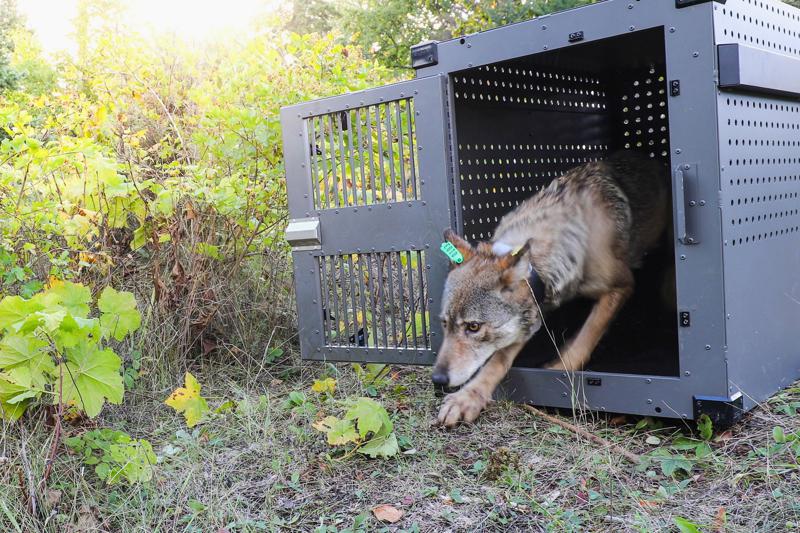
FILE - In this Sept. 26, 2018, file photo, provided by the National Park Service, a 4-year-old female gray wolf emerges from her cage as it is released at Isle Royale National Park in Michigan. Wolf pups have been spotted again on Isle Royale, a hopeful sign in the effort to rebuild the predator species' population at the Lake Superior national park, scientists said Monday, July 12, 2021. (National Park Service via AP, File)

TRAVERSE CITY, Mich. (AP) — Wolf pups have been spotted again on Isle Royale, a hopeful sign in the effort to rebuild the predator species’ population at the U.S. national park, scientists said Monday.

It’s unknown how many gray wolves roam the island chain in northwestern Lake Superior. The coronavirus pandemic forced cancellation of the census that Michigan Technological University experts had conducted each winter for 63 years.

Remote cameras detected four pups on the park’s eastern end in January, the researchers said in a new report. The sightings, and additional clues such as previously observed scats and tracks, suggest that two litters were born in the area last year and perhaps another on the western side.

Park officials said last fall that at least two pups likely were born in 2019.

The population was 12 to 14 during the last Michigan Tech survey in winter 2020. The latest births would indicate it is higher now, but some older wolves may have died.

“It most likely will be winter of next year before we have firm information,” said Sarah Hoy, a research assistant professor and animal ecologist, adding that the presence of young wolves is reason for optimism. “Things are definitely looking up.”

Scientists with Michigan Tech, the National Park Service and State University of New York will combine available information with genetic analyses to produce a population estimate based on death rates and numbers of litters.

An initial data summary should be finished this month, said Mark Romanski, a biologist and natural resources program manager at Isle Royale.

“Because of constraints placed on field activities during the pandemic, we are especially pleased to have multiple lines of evidence to enumerate the population,” he said.

Wolves are believed to have migrated to Isle Royale from Minnesota or the Canadian province of Ontario around the middle of the 20th century, crossing about 15 miles (24 kilometers) over the frozen lake surface.

Once established, they began feasting on the park’s abundant moose and helped keep the herd from outgrowing its food supply. But wolf numbers plummeted in the past decade, which scientists blamed primarily on inbreeding.

The National Park Service announced plans in 2018 to restore the population, which had fallen to two. Crews took 19 wolves from Minnesota, Ontario and Michigan’s Upper Peninsula to the island in a series of airlifts. Some have died and at least one wandered back to the mainland but most appear to be settling in.


“They’re killing moose, starting to function as they should,” Hoy said.

The goal is to have 20-30 wolves within three to five years. Officials haven’t decided whether to bring more in, park spokeswoman Liz Valencia said.

“A healthy park ecosystem includes a variety of wildlife and abundant food sources,” said Christine Goepfert, Midwest associate director for the National Parks Conservation Association. “As wolves bounce back after nearly disappearing from the park, their presence as a predator on the island will help all wildlife and native plants thrive at Isle Royale.”

The wolves’ decline fueled a moose boom between 2012 and 2019, when the population may have reached 2,000 before dropping to 1,876 last year. It appears to have fallen further since, the report said.


During vegetation surveys this spring, researchers found 15 moose dead from starvation. Balsam fir saplings, their primary winter food source, were in “the worst condition ever observed” as moose munched every available branch, Hoy said. Blood-sucking ticks that thrived during the mild winter made things worse.


Also during the past year, personnel with the park service and Michigan Tech organized thousands of moose bones that have been gathered at Isle Royale. They’re being cleaned, photo-documented and entered into a database. The collection eventually will be housed in a museum.

“It is gratifying to see the National Park Service invest in the long-term preservation of moose bones, and it is almost certain that the scientific value of the collection will increase over time,” Michigan Tech wildlife ecologist Rolf Peterson said. “We have already put it to use in ways never anticipated when the bones were first collected and saved.”
A FAIR ASSEMENT CONSIDERING
Braid: Federal election campaign will come with challenges for Notley

For the Alberta NDP, the most dangerous player in the looming federal election might be the federal NDP

Author of the article:
Don Braid • Calgary Herald
Publishing date: Jul 11, 2021 • 
NDP leader Rachel Notley speaks to reporters while calling for faster relief for small businesses.
Thursday, May 20, 2021. PHOTO BY BRENDAN MILLER/POSTMEDIA


For the Alberta NDP, the most dangerous player in the looming federal election might be the federal NDP.

Opposition Leader Rachel Notley is in Calgary for Stampede. She won’t be riding any ziplines this year, but she’s spending a lot of time connecting with people in parks and communities.

Notley and her party are well ahead of the UCP and Premier Jason Kenney in the polls, even in Calgary, largely because of unhappiness with government performance on provincial issues.

But the federal election campaign, expected to launch in coming weeks, could be a challenge.

Federal NDP Leader Jagmeet Singh has been wildly contradictory about pipelines and energy development.

He calls for supporting workers in the energy transition without much reference to Alberta, which will obviously be most affected by the race to net-zero emissions.

Singh has said he would give every province — especially Quebec — the ability to stop energy projects. He would somehow do that without denying the federal constitutional power to override provincial opposition to works of national interest.

Prime Minister Justin Trudeau’s Liberals could capture a majority, rendering Singh irrelevant after the election.

But to win the support they need in Quebec and Ontario, the Liberals may have to steal more NDP policies and attitudes than usual.

Kenney will find all this very useful. We can expect him to pin any hostile NDP suggestion on Notley. Hurting her chances might be the only benefit he gets from this election.

Asked about the obvious policy conflict with her federal party, Notley says: “It’s a bit of a work in progress. We’ve got a very good MP in Heather McPherson (Edmonton Strathcona). She talks to the (NDP) caucus every day about the reality of oil and gas workers, and the oil and gas economy and its contribution to quality of life for regular folks in Alberta and across the country.

“The more we can have people like that in the NDP caucus, and also in all the caucuses across the country, the better that is.

“We will see what level of emphasis the federal party puts on oil and gas infrastructure as part of their campaign. There may well be certain things we agree to disagree on.

“Jason Kenney’s federal leader (Erin O’Toole) supports the carbon tax, yet nobody seems to call him out for otherwise supporting the federal leader on other issues.”

(Maybe that’s because O’Toole’s policy on carbon pricing, sort of a supermarket points scheme, is even murkier than Singh’s position on pipelines.)

But Notley is all in for many federal NDP policies.

“There are elements of what they’re proposing that we do strongly support.

“They’re pushing very hard for a comprehensive overhaul in how we provide long-term care for seniors in Canada, and I think that is long overdue.

“They’re pushing for pharmacare . . . and for more sustainable income support for people who have not been able to find work as we come out of the pandemic.

“Those are important bread-and-butter issues that we do support.”

If there’s energy conflict, she concludes, “We might have to allow for the complexity of national politics within the party.”

Notley’s Stampede style, meanwhile, is distinctly different from Kenney’s. While he appears in public without a mask, Notley and her crew wear them even outdoors.

“We’re not going to those big centralized events,” she said. “Even in the more careful events that we are creating, I’m connecting with hundreds of people a day and so I feel I have to be responsible in terms of how I interact with them.”

Overall, she said, “The (COVID-19) numbers right now are awfully low, so that’s encouraging . . . I’m going to be cautiously optimistic that we come through this without accelerating any negative consequences.

“Stampede is a hopeful event for Calgarians. I’m not interested in stomping on that hope.”

As for the federal campaign, her chore will be to get through unscathed.

Don Braid’s column appears regularly in the Herald

NOT FOR PROFIT
UN calls for global database of human gene editing research


LONDON (AP) — The World Health Organization issued new recommendations Monday on human genome editing, calling for a global registry to track “any form of genetic manipulation” and proposing a whistle-blowing mechanism to raise concerns about unethical or unsafe research.

The U.N. health agency commissioned an expert group in late 2018 following a dramatic announcement from Chinese scientist He Jiankui that he had created the world’s first gene-edited babies.

In two reports Monday, WHO’s expert group said all studies involving human genome editing should be made public, although the committee noted that wouldn’t necessarily stop unprincipled scientists.

“In the field of stem cell research, unscrupulous entrepreneurs and clinics have deliberately misused clinical trial registries by registering procedures they plan to undertake as if they were properly sanctioned clinical trials,” the group said, calling for WHO to ensure that all genetic editing research registered in their database are reviewed and approved by an ethics committee.

When Chinese scientist He announced he had altered the DNA of twin babies to prevent them from catching HIV, he said the university where he worked was not aware and that he had funded the work himself. He was later sentenced to three years in jail for conducting “illegal medical practices.”

WHO’s expert group also said the U.N. agency should develop ways to identify any potentially concerning gene editing trials, saying a mechanism should be developed “for reporting violations of research integrity.”

Robin Lovell-Badge of the Francis Crick Institute, one of the experts on the committee, cited several instances where scientists in Russia, Ukraine and Turkey planning controversial genetic editing experiments were pressured not to proceed and called for a more formal whistle-blowing mechanism.

Still, the group acknowledged that as gene editing techniques become cheaper and easier to use, the ability of WHO to monitor such research is limited. The U.N. agency also has no authority to compel countries to cooperate, even during a public health emergency.

During the coronavirus pandemic, for example, WHO chief Tedros Adhanom Ghebreyesus has repeatedly criticized rich countries for not sharing their vaccines, warning in January that the world was on the brink of a “catastrophic moral failure.”

But rich countries have made little effort to immediately share their doses with poor countries, even as COVID-19 spikes across Africa and Southeast Asia. Of the more than 3 billion vaccines that have been administered globally since then, fewer than 2% have been in poor countries.