Wednesday, July 28, 2021

Sexy secret life of basking sharks uncovered in Hebrides

Scientists record fin-to-fin contact in gentle giants, most likely part of courtship, for first time


Fin-to-fin synchronised swimming recorded in basking sharks for first time – video


Damian Carrington 
Environment editor
THE GUARDIAN
Wed 28 Jul 2021 


Fin-to-fin synchronised swimming, thought likely to be part of courtship, has been seen in groups of basking sharks for the first time. Video cameras attached temporarily to the sharks gave scientists an unprecedented view of their hitherto secret underwater world.

The gentle giants are usually solitary creatures and virtually nothing is known about their breeding behaviour. The researchers also recorded one shark shooting out above the water, the first time a full breaching has been captured from the shark’s point of view. This may also be part of wooing a mate, perhaps by showing off the fish’s size.


Basking sharks are found in temperate water around the world, but are endangered, after being hunted in the past for the oil in their huge livers. They are the second largest fish in the ocean, with adults usually reaching 8 metres in length.

The scientists carried out their study in the Sea of the Hebrides, off the Scottish islands of Coll and Tiree. The site was known to attract the fish to feed in the summer and in December was declared a marine protection area, the first in the world to be designated specifically to protect basking sharks.

“One of the most exciting times in my career on basking sharks was seeing that footage of them all grouped together on the seabed,” said Matthew Witt, of the University of Exeter, in south-west England. “It was utterly phenomenal – you just don’t think of them doing that.”

“It’s been really fascinating to have this incredible insight,” said Jessica Rudd, also at the University of Exeter and who led the fieldwork. “It feels like a privilege to get a shark’s eye view into what they get up to. There were large congregations of the sharks, just swimming very slowly, side by side, or on top of each other, or nose-to-tail swimming, their fins touching, and in groups of up to 13.”

Video cameras attached temporarily to the sharks gave scientists an unprecedented view of their hitherto secret underwater world. 
Photograph: University of Exeter and NatureScot

Copulation was not captured on camera but Witt said that, based on behaviours seen in other sharks, these congregations and social behaviours are often what precedes mating.

“It could be that feeding in these [food] hotspots also gives the opportunity for these solitary sharks to meet other sharks,” said Rudd. Scientists have been tagging animals for a long time, she said, but usually data is recorded once a day or only when a satellite tag breaks the surface.

“With video cameras, it is essentially around the clock,” she said. This means scientists cannot only determine where a shark is but also why it is there.

Breaching uses a lot of energy, especially for giants like basking sharks. Various reasons have been suggested for the behaviour, such as dislodging parasites or even just for fun, but courtship is another explanation.

“It’s a really eerie video, where the shark emerges from a depth of 77 metres and then reaches the surface in 70 seconds and breaches,” said Rudd. “We can see it fully out of the water and these are sharks that reach up to over a tonne in weight.”

Other research by the group, using Fitbit-like tags, showed basking sharks can breach four times in 45 seconds.

Is it time to begin rewilding the seas?


The researchers were also surprised to find the sharks spent up to 88% of daylight hours near the seabed, rather than near the surface where they mostly fed. Such information could be useful when considering whether to restrict fishing activity such as bottom trawling.

The research was published in the journal Plos One and followed six sharks for a cumulative total of 123 hours. The cameras were attached to the sharks using a darting pole and weighed just 300g in the water. The sharks quickly resumed normal activity within minutes and the cameras automatically detached and floated to the surface after a few days. More cameras will be attached to the sharks this summer.

Suz Henderson, at NatureScot, said: “The group behaviours described in this work, as well as the habitats the behaviours are associated with, could well be important in answering the key conservation question of where these sharks breed.”
Ancient Roman ship laden with wine jars discovered off Sicily

Submarine robot takes photos of vessel and cargo of amphorae dating back to second century BC


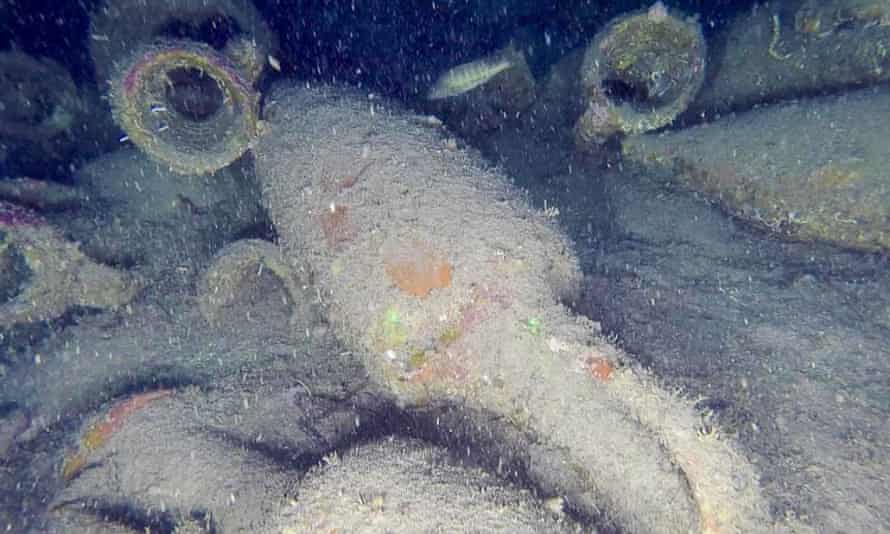
The discovery was described by the Sicilian authorities as one of the most important archaeological finds of recent years. 
Photograph: Soprintendenza del Mare Regione Sicilia


Lorenzo Tondo in Palermo
THE GUARDIAN
Wed 28 Jul 2021

An ancient Roman vessel dating back to the second century BC has been discovered in the Mediterranean Sea off the coast of Palermo.

The ship lies 92 metres (302ft) deep in the ocean, near Isola delle Femmine, and from the first images taken by a submarine robot it was carrying a copious cargo of wine amphorae.

“The Mediterranean continually gives us precious elements for the reconstruction of our history linked to maritime trade, the types of boats, the transport carried out,’’ said the superintendent of the sea of the Sicilian region, Valeria Li Vigni, who launched the expedition. “Now we will know more about life on board and the relationships between coastal populations.’’

The discovery was described by the Sicilian authorities as one of the most important archaeological finds of recent years.

A few weeks ago, Sicilian archeologists discovered another wreck: an ancient Roman ship about 70 metres deep near the island of Ustica. That ship also carried a huge load of amphorae, containing wine dating back to the second century BC.

The findings will shed light on Rome’s trade activity in the Mediterranean, where the Romans traded spices, wine, olives and other products in north Africa, Spain, France and the Middle East.

There are numerous wrecks of Roman ships throughout the Mediterranean, such as the almost intact Roman ship from the second century BC found in 2013 off the coast of Genoa. The vessel, which contained roughly 50 valuable amphorae, was spotted by police divers, roughly one mile from the shore of Alassio, 50 metres underwater.


In that case, police were tipped off about the whereabouts of the boat during a year-long investigation into purloined artefacts sold on the black market in northern Italy.

Every year, hundreds of ancient Roman amphorae, taken illegally, are found by the Italian police in the homes of art dealers.

In June, Italian authorities recovered hundreds of illegally gathered archeological finds from a Belgian collector, dating as far back as the sixth century BC and worth €11m (£9.4m).

The nearly 800 pieces “of exceptional rarity and inestimable value”, including stelae, amphorae and other items, came from clandestine excavations in Puglia, in Italy’s south-eastern tip, according to the carabinieri in charge of cultural heritage. The collector is awaiting trial.
Caffeine may help bumblebees pollinate more effectively, study shows

Experiment using caffeine concoction on bees’ nests 
may help farmers ensure crops are pollinated

Researchers were keen to see whether bumblebees are attracted to flowers that smell similar to caffeine concoction Photograph: Peter Devlin/Alamy


Natalie Grover 
Science correspondent
THE GUARDIAN
Wed 28 Jul 2021 

The caffeine in the morning coffee that primes many humans for the day appears to inject bumblebees with a similar dose of purpose, helping them pollinate more effectively, a study has found.

The impact of the climate crisis, habitat loss and pesticide use has strained wild pollinator populations, including bees, moths, wasps, butterflies, beetles and birds. As a result, some fruit growers have resorted to relying on “managed pollinators” such as commercial bumblebee colonies to pollinate their crops.

But these handy helpers aren’t quite as efficient as the farmers would like – some do not leave the nest, while others are easily distracted by other flora in the vicinity – which means the crop is not fully tended to.

The study was designed to evaluate whether the bees could be primed to target specific odours.

In order to do this, the researchers concocted a special blend of caffeine, sugar and the specific “target flower” smell (the scent of strawberry flowers) they wanted their bees to find, and wafted it through the nest.

The bees were then let loose in the lab where robotic flowers were either doused in the target odour or the soft, citrusy notes of linalool, a compound not present in strawberry flowers. “We were interested in seeing whether the bees would go for all of the flowers equally since they were all equally rewarded, or whether they go for the flowers that smell like the ones that they been kind of trained on in the nest,” said the study author, Dr Sarah Arnold of the natural resources institute at the University of Greenwich.

The bees that had trained using the caffeine concoction were far more interested in the target flowers with the strawberry odour than the distractor flowers, the authors said, adding that the experiment did not appear to be toxic because there was no impact on the bees’ lifespans.

The study was funded by the Biotechnology and Biological Sciences Research Council, Biobest (a supplier of bumblebees to fruit farms) and Berry Gardens (a fruit growers’ production and marketing group).

Previous research designed to alter bee behaviour involved putting caffeine directly on to the flowers to attract them, which is impractical on a large scale.

This experiment, however, could be a good start to making it easier for farmers to ensure their crop is pollinated, Arnold said. “In a field situation … the bees would have to deal with different weather conditions, they would have further to fly and other challenges,” she cautioned, noting that it would take a successful field-scale trial before this approach could be used in the real world.

If the results are replicated, then everyone stands to benefit, she added. “The growers get more value for money out of their commercial bumblebees, the wild bees potentially get a bit less competition for their natural food resources. And, as consumers, hopefully, we also get more fruit.”
‘Wiggly’ fossils found in Canada may be oldest known sign of animal life


Scientists believe the unusual tubular structures may be the remnants of prehistoric sponges

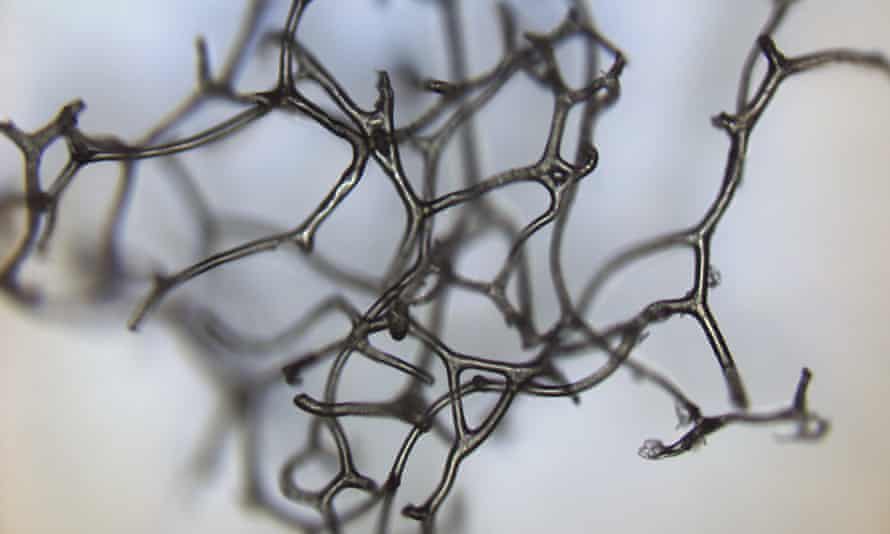
A fragment of the skeleton of a modern keratose sponge (a bath sponge from Greece – Spongia officinalis), highlighting its 3D meshwork. Photograph: EC Turner


Ian Sample Science editor
THE GUARDIAN
Wed 28 Jul 2021 

Intricate patterns of tubular structures discovered in giant ancient reefs may be the remnants of prehistoric horny sponges and the oldest known fossils of animal life on Earth.

Researchers found the unusual features in vast reefs that were built by bacteria 890m years ago and then pushed up by geological processes to form part of the Mackenzie Mountains in north-western Canada.

Examined under a microscope, a small number of rock samples revealed tubules about half the width of a human hair that branch and reconnect to form 3D structures that are strikingly similar to those seen in fossils of bath sponges.

“Initially, when you look at these features they look like a bunch of wiggles, but when you try to follow each of the strands, you realise that even in thin sections they form complicated 3D meshworks,” said Prof Elizabeth Turner, at Laurentian University in Sudbury, Ontario.
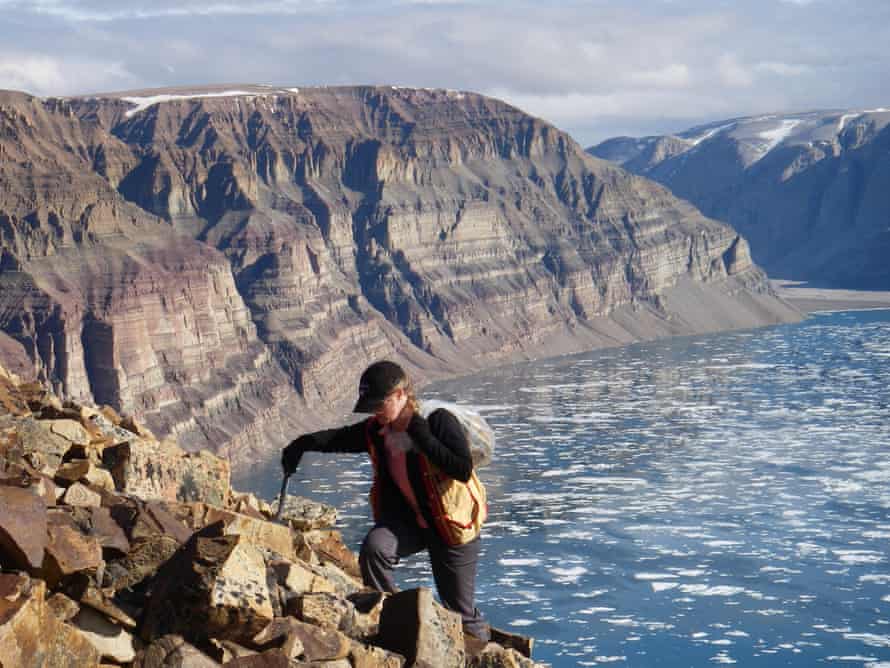
Prof Elizabeth Turner on northern Baffin Island, Nunavut. 
Photograph: C Gilbert

“Thanks to the wonderful work of others, younger examples of the same microstructures have been found in sponge body fossils and these structures have been compared to the skeletons of a variety of keratose, or horny, sponges,” she added.

While modern reefs are built by corals and algae, in Earth’s distant past communities of photosynthetic cyanobacteria created enormous carbonate reefs measuring many kilometres wide and hundreds of metres thick.

Prof Turner first spotted the weird tubules in a handful of thin sections of rock she gathered as a PhD student during field work at the site. Two decades on, she has built up the collection and discovered more examples of the features in the rocks.

Writing in the journal Nature, Turner describes how the fossils may have formed when putative sponges, measuring a few millimetres to a centimetre across, became mineralised. The soft tissue is first to fossilise, encasing the 3D network of collagen-like fibres that form the sponge’s skeleton. Over time, these skeletal fibres decay, leaving hollow tubules that fill up with calcite crystals.

If the structures are confirmed as early sponge fossils, they would predate the next-oldest undisputed sponge fossils by about 350m years.


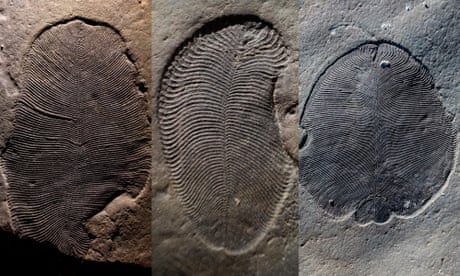
558m-year-old fossils identified as oldest known animal

According to previous studies, sponges are some of the earliest animals on Earth and emerged during the early Neoproterozoic era one billion to half a billion years ago. However, the exact timing is uncertain. Other research suggests that oxygen levels were too low for animals to thrive until they rose in the Neoproterozoic Oxygenation Event between 800m and 540m years ago.

But even on an oxygen-starved Earth, early sponges may have found a way to survive in the nooks and crannies of microbial reefs if the photosynthetic bacteria that smothered the reefs released enough oxygen into the water. “These possible sponges, or whatever they were, were living in a reef that was an oxygen factory, it was nirvana,” said Prof Turner. For food, they could have consumed the polysaccharide slime that sloughed off the microbial mats into the surrounding ocean.

“If I’m right about the interpretation of this material, then the earliest animals may not have had the same oxygen requirements that we have assumed so far. It’s possible that we had early sponges emerge some time ago, and certainly by 890m years ago, living in a comparatively low oxygen world, but the more complicated animals had to wait a while,” she added.

Far more work is now needed to see whether other rocks of a similar age contain traces of early animal life. “We have to approach it with a much more open mind,” said Prof Turner. “We have to think about what we should expect from early animals. Anything we think of as animal may be too complicated. We want to look for something that expresses the essence of animals, without being too conspicuously familiar.”


Sponge structures may be Earth's oldest animal life


Issued on: 28/07/2021
Genetic evidence from modern sponges suggests they could have been 
around for up to 1 billion years IBRAHIM CHALHOUB AFP/File


Paris (AFP)

Fossilised structures discovered in northwestern Canada may be from sponges that lived in oceans as long as 890 million years ago, making them the earliest known animal life on Earth, research showed on Wednesday.

The findings also challenge the long-held idea that animals did not arise on Earth until after a major infusion of oxygen into the atmosphere and oceans.

Sponges are simple animals with an ancient history. Genetic evidence gathered from modern sponges has shown they likely emerged between 1 billion and 500 million years ago.

But until now there has been no evidence of fossilised sponge bodies from this period, known as the early Neoproterozoic era.


Elizabeth Turner, a professor at Canada's Laurentian University's Harquail School of Earth Sciences, looked for evidence of sponges in 890-million-year-old reefs that were constructed by a type of bacteria that deposited calcium carbonate.

She found networks of tiny tube-shaped structures containing crystals of the mineral calcite -- suggesting they were contemporaneous to the reef -- that closely resemble the fibrous skeleton found within some modern sponges.

If her structures Turner identified end up being verified as sponge samples, they will outdate the current oldest known sponge fossils by 350 million years.


Although the implications of her possible discovery, published in the journal Nature, Turner said she was not getting carried away.

"The earliest animals to emerge evolutionarily were probably sponge-like. This too is not surprising, given that sponges are the most basic animal in the tree of animal life," she told AFP.

"The nature of the material is familiar from the bodies of much younger body fossils of sponges," Turner said.

She said the possible sponges were around one centimetre across, and "would have been tiny and inconspicuous, living in shadowy nooks and crannies below the upper surfaces of the reefs"

If the structures do turn out to be confirmed as sponge specimens, that means they would have lived roughly 90 million years before Earth's oxygen levels reached levels thought to be necessary to support animal life.

Turner said that if confirmed to be sponges, she believed that they lived before the Neoproterozoic oxygenation event, during which oxygen levels increased, subsequently leading to the emergence of animal life.

"If I am correct in my interpretation of the material, the earliest animals appeared before that event and may have been tolerant of comparatively low oxygen levels, relative to modern conditions," she said.

"It is possible that the earliest animals were tolerant of low oxygen -- some modern sponges are -- but that more complex animal types that require a higher oxygen level did not appear until after the Neoproterozoic oxygenation event," Turner added.

© 2021 AFP

Morocco team hails stone age tool site dating back 1.3m years

Find pushes back by hundreds of thousands of years start of stone-tool industry associated with Homo erectus


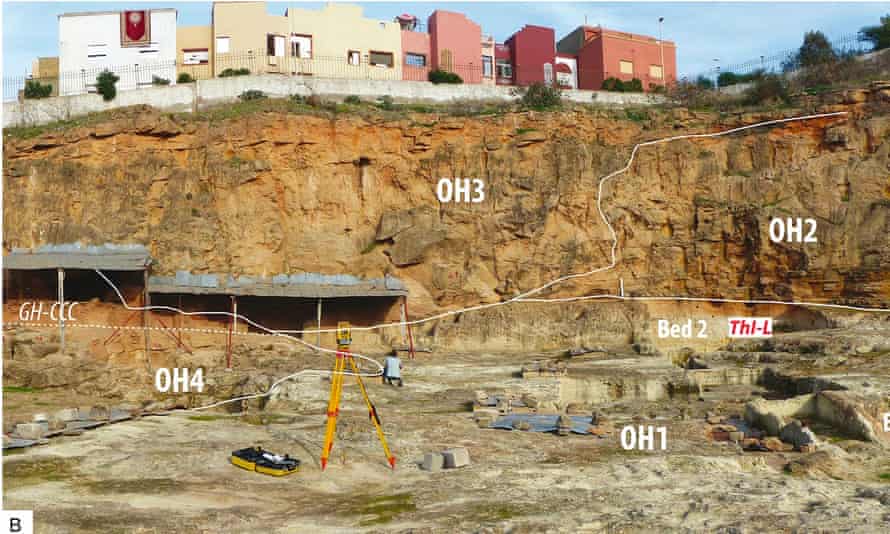
The excavations took place at a quarry on the outskirts of Casablanca, Morocco. Photograph: D Lefèvre


Agence France-Presse in Rabat
Wed 28 Jul 2021 

Archaeologists in Morocco have announced the discovery of north Africa’s oldest stone age hand-axe manufacturing site, dating back 1.3m years, an international team has reported.
  
TOOL MAKING TECHNOLOGY, INDUSTRIAL PRODUCTION FOR ITS AGE*

The find pushes back by hundreds of thousands of years the start date in north Africa of the Acheulian stone-tool industry, associated with the human ancestor Homo erectus, researchers told journalists in Rabat on Wednesday.


The discovery was made during excavations at a quarry on the outskirts of Morocco’s economic capital, Casablanca.

This “contributes to enriching the debate on the emergence of the Acheulian in Africa,” said Abderrahim Mohib, the co-director of the Franco-Moroccan prehistory of Casablanca programme.
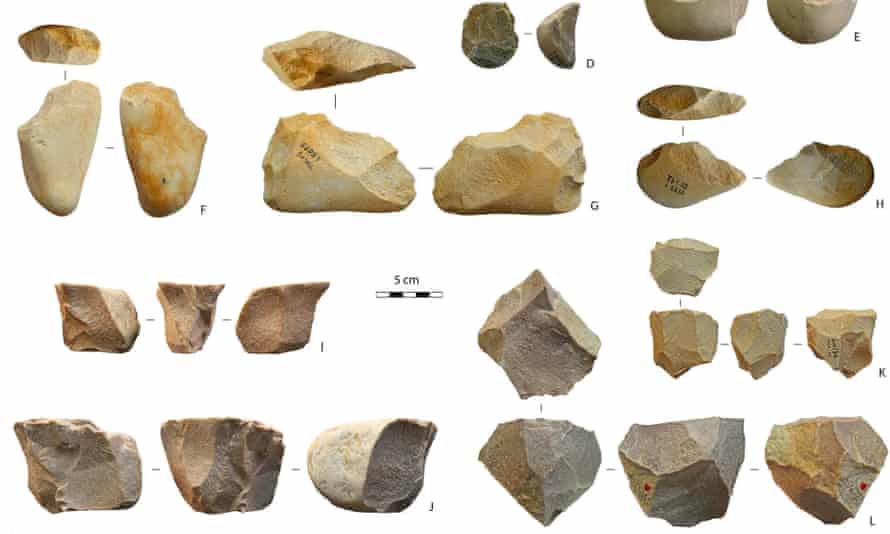
Discoveries from the Thomas Quarry I site outside Casablanca.
 Photograph: R Gallotti

Previously, the presence in Morocco of the Acheulian stone-tool industry was thought to date back 700,000 years. The discoveries at the Thomas Quarry I site, made famous in 1969 when a human half mandible was discovered in a cave, mean the Acheulian there is almost twice as old.

The 17-strong team behind the discovery comprised Moroccan, French and Italian researchers, and their findings are based on the study of stone tools extracted from the site.

The Moroccan archaeologist Abdelouahed Ben-Ncer called the news a “chronological rebound”. He said the beginning of the Acheulian in Morocco is now close to the south and east African start dates of 1.6m and 1.8m years ago respectively.

Earlier humans had made do with more primitive pebble tools, known as Oldowan, after their east African-type site. Research at the Casablanca site has been carried out for decades, and has “delivered one of the richest Acheulian assemblages in Africa”, said Mohib. “It is very important because we are talking about prehistoric time, a complex period for which little data exists.”

Mohib said the study also made it possible to attest to “the oldest presence in Morocco of humans” who were “variants of Homo erectus”.

In 2017, the discovery of five fossils estimated at 300,000 years old 100km west of Marrakesh at Jebel Irhoud, overturned evolutionary science when they were designated Homo sapiens.

The Moroccan fossils were much older than some with similar facial characteristics excavated from Omo Kibish in Ethiopia, dating back about 195,000 years.

  1. *The Part Played by Labor in the Transition From Ape to Man

    https://www.marxists.org/archive/marx/works/1876/part-played-labour/...

    This was the decisive step in the transition from ape to man. All extant anthropoid apes can stand erect and move about on their feet alone, but only in case of urgent need and in a very clumsy way. Their natural gait is in a half-erect posture and includes the use of the hands. The majority rest the knuckles of the fist on the ground and, with legs drawn up, swing the body through their long ...

Scientists in Morocco unearth Stone Age hand-axe site dating back 1.3 million years

Issued on: 28/07/2021 -
These Stone-Age tools belong to the same archaeological period as a hand axe, which was unearthed in Morocco in July 2021, and dates back 1.3 million years. © MusĂ©e de Toulouse, Creative Commons

Text by: NEWS WIRES

Archaeologists in Morocco have announced the discovery of North Africa's oldest Stone Age hand-axe manufacturing site, dating back 1.3 million years, an international team reported Wednesday.

The find pushes back by hundreds of thousands of years the start date in North Africa of the Acheulian stone tool industry associated with a key human ancestor, Homo erectus, researchers on the team told journalists in Rabat.

It was made during excavations at a quarry on the outskirts of the country's economic capital Casablanca.

This "major discovery ... contributes to enriching the debate on the emergence of the Acheulian in Africa," said Abderrahim Mohib, co-director of the Franco-Moroccan "Prehistory of Casablanca" programme.

Before the find, the presence in Morocco of the Acheulian stone tool industry was thought to date back 700,000 years.

New finds at the Thomas Quarry I site, first made famous in 1969 when a human half mandible was discovered in a cave, mean the Acheulian there is almost twice as old.

The 17-strong team behind the discovery comprised Moroccan, French and Italian researchers, and their finding is based on the study of stone tools extracted from the site.

Moroccan archaeologist Abdelouahed Ben Ncer called the news a "chronological rebound".

He said the beginning of the Acheulian in Morocco is now close to the South and East African start dates of 1.6 million and 1.8 million years ago respectively.

Earlier humans had made do with more primitive pebble tools, known as Oldowan after their East African type site.

Research at the Casablanca site has been carried out for decades, and has "delivered one of the richest Acheulian assemblages in Africa", Mohib said.

"It is very important because we are talking about prehistoric time, a complex period for which little data exists."

Mohib said the study also made it possible to attest to "the oldest presence in Morocco of humans" who were "variants of Homo erectus".

In 2017, the discovery of five fossils at Jebel Irhoud in Morocco, estimated at 300,000 years old, overturned evolutionary science when they were designated Homo sapiens.

The Moroccan fossils were much older than some with similar facial characteristics excavated from Omo Kibish in Ethiopia, dating back around 195,000 years.

(AFP)


Maude Charron shares weightlifting gold with Canadian denied triumph in 2012

Zack Smart 5 hrs ago

© Vincenzo Pinto/Getty Images Maude Charron of Rimouski, Que., poses with her Olympic gold medal after winning the women's 64-kilogram weightlifting competition at Tokyo 2020 on Tuesday.

Canada's newly crowned Olympic champion Maude Charron got mentally prepared to compete on the biggest stage by telling herself it was just another day at the office.

"I told myself all week that it's just a regular competition, do what you know best," Charron said told CBC Sports the day after she powered her way to Canada's first Olympic gold medal in weightlifting since Christine Girard did it in London in 2012.

One day later, the magnitude of the accomplishment is starting to sink in for the Rimouski, Que., native.

"All the media, the calling, knowing my hometown is going crazy, I'm coming to realize what's happened," Charron said.

Charron's moment atop the podium was one of triumph for the 28-year-old, in marked contrast to the experience Girard had nine years earlier. Girard, from Rouyn-Noranda, Que., was originally awarded the bronze, but it was later discovered that Maiya Maneza of Kazakhstan and Russia's Svetlana Tsarukaeva, who finished first and second, respectively, both tested positive for banned substances.

Girard was eventually elevated to the gold, but not until six years later in 2018. There was no anthem or flag-raising for her.


"Her story is devastating," Charron said. "There's a lot of funding coming with the Olympic gold medal, sponsorships, attention to that sport, young kids watching and finding interest in trying that sport. She was kind of robbed of this, and Canada too, so I think we were due to have this."

Following in Girard's footsteps, Charron captured gold on the Olympic stage and brought a sense of justice to the national team in a moment that was significant on multiple levels.

"Christine Girard for me is an idol. She was the one giving me my first gold medal at the national championship, and I'm always impressed by her," said Charron, just the fourth Canadian to win a weightlifting medal. "There's a little bit of her in that gold medal, for sure."


Charron won her 64 kg weight class by finishing with a 236 kg total, lifting 105 kg in the snatch and 131 kg in the clean and jerk. She let out a cry of joy as she received the judge's signal.

© Vincenzo Pinto/Getty Images Charron triumphs in her final clean and jerk attempt.
Inspiring a new generation of female athletes


The women's weightlifting competition only made its Olympic debut at the Sydney Games in 2000, but Charron, who won a gold medal at the Pan American championships in April, has the potential to inspire a new generation of female weightlifters with her list of accolades.


"I hope I will encourage young girls to believe in themselves and believe in their bodies, the woman body, the woman image, muscles and being bulky," Charron said.

"I was ashamed of my body when I was a teenager, but as of today I'm just so glad about what my body can do. I hope that it will motivate girls to try to lift weights and train and be grateful about their body that was given to them."


As Canada's latest female Olympic medallist in Tokyo, Charron is part of a group who are showing young girls across the country that dreams can become reality.

Dealing with weightlifting's uncertain Olympic future

With the 2024 Paris Games approaching, Charron has the potential to become the first Canadian weightlifter to win back-to-back Olympic medals since Girard, who won bronze in her Olympic debut in Beijing.

But the International Olympic Committee (IOC) said there is a risk that weightlifting could be dropped from the Olympic program for Paris, citing a failure by the International Weightlifting Federation to improve anti-doping efforts.

"There are so many things we can't control in that case. We don't know yet if weightlifting will be on the Paris program because of the doping scandals, so I don't know what will happen in Paris," Charron said. "For now, I'm just going day by day. We'll see what the IOC decides about the weightlifting future."

© Vincenzo Pinto/Getty Images Charron reacts after securing her lead with her final lift.
Training during a global pandemic


Charron's path to gold was filled with obstacles that made the winning moment even more gratifying, as she overcame training challenges and found a way to get ready for a postponed Olympics during a pandemic.

But Charron was thankful to be home with the people she loved. She made a makeshift training facility in her dad's garage to get around gyms being closed in Quebec because of COVID restrictions, a place where she could prepare and stay motivated.

"I was glad to be at home with my family, my dog, my friends. I couldn't really see them, but my dad made some space in his garage so I took my equipment and put it in his garage. We had to insulate it for the winter because it was very cold," Charron said with a laugh.

"I found ways and it paid off."

Unique path to Olympics


Charron started the sport of weightlifting in 2015 at the relatively late age of 22, and she's had a unique journey to the Olympic throne. She was a gymnast as a kid, attended the Quebec Circus School as a teenager, and has also competed in CrossFit.

After realizing she wouldn't reach her Olympic dream as a gymnast, she had to find another route to reach her destination. And for Charron, the ultimate goal was just to get there.

"As a young girl in gymnastics everyone dreamed about going to the Olympics, so I dreamed about going to the Olympics. I realized that I didn't have the level to go there in Gymnastics, but I just found another way to get here," Charron said.

"I never really dreamed about winning a medal here; I just wanted to get here."

Tokyo 2020 is the first time Canada has had four female weightlifters competing. Fellow Olympic newcomers Rachel Leblanc-Bazinet, Kristel Ngarlem and Tali Darsigny are also part of the national team competing in Tokyo.


Leblanc-Bazinet finished 12th in the 55 kg event, while Darsigny placed ninth in the 59 kg event. Ngarlem is set to compete on Aug. 1 in her 76 kg weight class, and Canada's lone male weightlifter at the Games, Boady Santavy, competes on July 31 in the 96 kg event.

Girard's first Olympic medal in 2008 was Canada's first weightlifting medal at the Games in 24 years, following Jacques Demers' silver at the 1984 Olympics in Los Angeles. The only other Canadian weightlifter to reach the Olympic podium is Gerry Gratton, who won silver in 1952.
Freedom-flavoured silver medal for Iranian-born judoka competing for Mongolia

Issued on: 28/07/2021
Iranian-born judoka Saeid Mollaei won the silver medal for Mongolia at the Tokyo Olympic Games on July 27, 2021. © Franck Fife, AFP

Saeid Mollaei, an Iranian-born judoka now competing for Mongolia, has won the silver medal for his sport at the Tokyo Games. Mollaei left his country and became a naturalised Mongolian citizen after Iran effectively prohibited him from facing an Israeli opponent in 2019.

Saeid Mollaei had dreamt of gold, but still sported a big smile when he was awarded his silver medal on Tuesday at the Tokyo Games. The Iranian-born and naturalised Mongolian judoka was narrowly defeated in the 81kg final by Japan’s star Takanori Nagase, but claimed victory over his own destiny.

Mollaei was world champion in 2018 when he competed for Iran. But during 2019 Judo World Championships held in Tokyo's very same Budokan Hall where the Games are currently taking place, he was ordered by the Iranian Olympic committee to lose in the semi-finals against the Belgian Matthias Casse, to avoid facing Israeli judoka Sagi Muki in the final.

An Iranian embassy employee approached Mollaei in the warm-up hall before the fight and told him security forces were at his parents’ house, according to a Deutsche Welle report.

“You’re supposed to be brave in life. But a thousand questions went through my head. What will happen to me or my family? So I listened to the order,” Mollaei was quoted by DW. He narrowly lost to Casse, and Muki ended up winning the final.

Mollaei subsequently congratulated the Israeli jodoka on his Instagram feed, raising the hackles of Iranian authorities.


‘A new life’

Mollaei left Iran for Germany and fought for the refugee team before becoming a Mongolian national.

In February 2021, he fought in Israel and met Muki, who called him his “brother”.

“I left everything behind me and started a new life,” Mollaei said after his narrow defeat to Nagase in Tokyo.

“I’m with a great team of athletes. The Mongols are nice, very warm and I’m very happy to have won this medal for Mongolia and the Mongol people.”

Muki, with whom Mollaei trained for two months in Israel before the Games, also reacted after the medal. “I’m super happy for Saeid,” he told Israeli reporters at a news conference Tuesday. “I know what he’s gone through, and how much he wanted it. He’s a very close friend of mine, and I’m so happy that he succeeded in achieving his dream. He deserves it — his journey is incredibly inspiring.

So inspiring, in fact, that MGM/UA Television and Israel’s Tadmor Entertainment are preparing a television series based on the lives of the two world champions, Muki announced on his Instagram account.

Iran does not recognise Israel and its athletes usually refuse to face Israeli opponents, either by forfeiting the match or simply not participating.

One of the most famous cases was current Iranian judo federation president Arash Miresmaeili, a two-time judo world champion who showed up overweight for his bout against an Israeli at the 2004 Olympics in Athens and was disqualified.

During the Tokyo Games, the Algerian judoka Fethi Nourine withdrew in order to avoid facing an Israeli opponent, explaining his decision was due to his support for “the Palestinian cause”. He was first scheduled to face Sudan's Mohamed Abdalrasool on Monday in the first round, before fighting Israeli Tohar Butbul in the next round. He has since been suspended by the International Judo Federation and his accreditation has been withdrawn.

This article was translated and adapted from the original in French.

(FRANCE 24 with AFP)
Fiji’s sevens triumph is symbolic of their ‘work together, love one another’ spirit


The sunshine of successive Olympic golds will spread far and wide throughout a Pacific island community ravaged by Covid

The sevens gold winners Fiji celebrate on the podium after retaining the title they won at Rio, for only the small Pacific nation’s second Olympic medal. Photograph: Jeon Heon-Kyun/EPA

Wed 28 Jul 2021 

Igot asked on Twitter why the Fijian players always cry when the national anthem is played. It’s true - most of the time that happens and sometimes it’s so emotionally overwhelming it derails the performance if not kept in check. The initial reaction was to say: “Well it’s obvious isn’t it?” But, that would assume the wider public know about what it really means to all Fijians.

On Wednesday the beautiful nation of Fiji won only its second Olympic gold medal, both in the country’s national sport, rugby sevens. There are now 25 Fijians from those two teams who have won a gold medal and now become a signpost to what is possible.


Fiji stun All Blacks in rugby sevens final to win Olympic gold again


They have smashed the glass ceilings that so often exist in developing countries. Babies born now and in the future will be named Jerry after the team’s captain, Jerry Tuwai – the only survivor of the Rio 2016 winning team and now Fiji’s only double gold medallist. Depending on their local fanbase, others in the squad will have domestic pets and taxis given their moniker. No doubt, civil honours and other awards will follow too. Bridges, schools and roads – they will all have the sunshine of this victory on Wednesday shone on to them and named in its honour and to remember their deeds.

Why? Pride in the team, in the nation. Belonging. The team all come from the people. When I say that, I mean they often have worked or work and certainly live among them. Nearly everyone will have met or know someone who is related to all those who played. No six degrees of separation here – just like the team this week as they play as one, connections everywhere

Most of the population also have very little, so they share and care for each other. Village life and the tribal system has been affected by modern living but the old Fijian phrase of “vei lomani” – work together; love one another – still shines brightly across the Pacific archipelago. In 2016 the captain, Osea Kolinisau, used to take it in turns with his siblings to go to school because they couldn’t afford the bus fare for them all.

Tuwai learnt how to play rugby on a traffic roundabout and used to sell fish on the side of the street to make ends meet for his family. Copper mines, sugar cane fields, farms and hotel resorts – the team have their origin stories wrapped up in those places. One of the team was homeless and unemployed when he made his debut in 2016. He is now an Olympic champion.

Yes, some of the players have gone or are going overseas to play professionally and their income will rocket. It will also – nearly always and nearly all of it – be sent home to the family and the village. Even when they have more, they still share, they still work together. The main island, Viti Levu, where more than 70% of the 1 million population live and the other 300-plus islands that make up the nation, will also be in sevens heaven right now.

Growing up on the islands, you never really know what’s in store for you, so you stay in the present and it means in moments of celebration such as this – you really live them. Covid is ravaging Fiji and the health service is close to melting point. It is causing political unrest too and so the sevens triumph will give hope, will ease those tensions and will lift a million spirits.
Napolioni Bolaca and Asaeli Tuivuaka celebrate after beating New Zealand in the sevens final to claim gold in Tokyo. Photograph: Dan Mullan/Getty Images

Upbringing, culture and history all get thrown into the tanoa bowl when explaining just why there are so many world-class Fijian rugby players. In fact, after sugar, it is rugby players that is the nation’s second biggest export. The talent is there but the money isn’t.

I mostly kept my counsel when I heard other nations complaining of their funding levels and support, but I wanted to tell them there is another way. Fiji do things simply. They show in sevens that togetherness and a common purpose is more important than any funding. That vision is shared by the people and it means that in moments such as this that pressure elevates all they do.

So, when I sat in front of my laptop watching the Olympic final unfold – as Fiji edged towards victory against New Zealand – it filled me with hope, with love and with an overriding feeling that when it is at its best, sport really can change lives.


Ben Ryan was Fiji’s coach when they won their first Olympics gold medal at Rio 2016.
TOKYO OLYMPICS OUT GAMES

The Tokyo Games are shaping up as a watershed for LGBTQ Olympians. 

A wave of rainbow-coloured pride, openness and acceptance is sweeping through Olympic pools, skateparks, halls and fields.

The website Outsports.com has been tallying the number of publicly out gay, lesbian, bisexual, transgender, queer and non-binary Olympians in Tokyo. The list is now up to 168. That's three times more than at the last Olympics in Rio de Janeiro.

 When Olympic diver Tom Daley announced in 2013 that he was dating a man and “couldn't be happier,” his coming out was an act of courage that, with its rarity, also exposed how the top echelons of sport weren't seen as a safe space by the vast majority of LGBTQ athletes.

Back then, the number of gay Olympians who felt able and willing to speak openly about their private lives could be counted on a few hands. There'd been just two dozen openly gay Olympians among the more than 10,000 who competed at the 2012 London Games, a reflection of how unrepresentative and anachronistic top-tier sports were just a decade ago and, to a large extent, still are.

Whereas LGBTQ invisibility used to make Olympic sports seem out of step with the times, the Games in Tokyo are starting to better reflect human diversity.

“It's about time that everyone was able to be who they are and celebrated for it,” said U.S. skateboarder Alexis Sablone, one of at least five openly LGBTQ athletes in that sport making its Olympic debut in Tokyo.

“It's really cool,” Sablone said. “What I hope that means is that even outside of sports, kids are raised not just under the assumption that they are heterosexual."


Carl Hester becomes latest gay Team GB athlete to win Olympic medal

JOSH MILTON JULY 28, 2021

Carl Hester has become the second Britain to score a medal at the Tokyo Olympics. (Julian Finney/Getty Images)


Carl Hester has become the latest Team Great Britain athlete to win a medal at the Toyko Olympic Summer Games after picking up bronze in team dressage.

Hester, 54, was one of the only openly gay Olympians competing for Team GB in 2012 when he helped his equestrian team strike gold at the London Olympics – now he’s one of 13.


Together with his two teammates Lottie Fry and Charlotte Dujardin, as well as horse En Vogue, Hester delivered a sublime performance on Tuesday (27 July) to earn third place in dressage, a stylised form of riding that can be traced back to calvary riders in classical Greece.
Carl Hester thanks ‘incredible team and horses’ after winning Olympic bronze

In the opening round of the competition, Hester scored a thumping 2577.5 to thrust Team GB to second place.

After Fry and Dujardin strolled onto the Baji Koen equestrian park they clinched third with a sturdy 7727, being topped by the Americans (7747) and the Germans (8178) to grab silver and gold respectively.

“An incredible day yesterday taking the Bronze medal,” Hester tweeted.

“So proud of the team and the horses. It’s been such a memorable experience so far.

“This afternoon we did press and TV interviews ahead of the freestyle tonight. Crossed fingers.”

Hester joins other openly queer Brits such as Tom Daley who have had made it big in this year’s Olympic games. Daley picked up his first-ever gold medal during Monday’s men’s synchronised 10 metres platform.

But Hester isn’t the only queer man throwing their hat – or should we say riding tack – into the ring as gay Dutch couple Edward Gal and Hans Peter Minderhoud competed side-by-side during the team dressage, winning fifth place.

The couple, who have been together for more than a decade, celebrated dressage as an inclusive game that feels far removed from the many sports that are, at times, snarled by homophobia, such as football.

“There has always been a level playing field for all genders,” Minderhoud said of dressage, according to OutSports.

“I think it is still one of very few sports where men and women compete together, have no advantage and as such blend happily.”

SEXIST, AGEIST, RACIST, A REPUBLICAN
Texas official calls Simone Biles ‘childish, selfish’ for Olympics team withdrawal


BY TJ MACIAS
JULY 28, 2021 


Simone Biles, of the United States, waits to perform on the vault during the artistic gymnastics women’s final at the 2020 Summer Olympics, Tuesday, July 27, 2021, in Tokyo. The American gymnastics superstar has withdrawn the all-around competition to focus on her mental well-being. (AP Photo/Gregory Bull) GREGORY BULL AP

U.S. gymnast Simone Biles received global support after she announced Tuesday that she was withdrawing herself from the Olympics gymnastics team final due to mental health reasons.

But not everyone was empathetic toward Biles, who was a heavy favorite to take home multiple gold medals in the Tokyo Olympics.

One in particular is a government official from her home state of Texas who voiced his displeasure on Twitter.

Aaron Reitz, a deputy attorney general (not an elected position), quote-tweeted a video of former U.S. Olympian Kerri Strug and her famous landing after performing on the vault in the 1996 games with an injured her ankle.


“Whenever you get in a high stress situation, you kind of freak out,” Biles said after Team USA took silver in the event with the Russia Olympic Committee winning gold. “I have to focus on my mental health and not jeopardize my health and well-being.”


On Wednesday, Biles removed herself from Thursday’s individual all-around competition.

Strug was among those embracing Biles for her decision.

“Sending love to you @Simone_Biles,” Strug tweeted out along with a goat emoji meaning “greatest of all time.”

Biles said that she was going through “the twisties” during practice, which contributed to her withdrawing from the team event. While the word may sound innocent enough, getting them as a gymnast could be life threatening, the Washington Post reported.


“You’re upside down in midair and your brain feels disconnected from your body,” the Post described. “Your limbs that usually control how much you spin have stopped listening, and you feel lost. You hope all the years you’ve spent in this sport will guide your body to a safe landing position.”

Biles explained that she caught a case of the “twisties” after pushing off the vaulting table on Tuesday.

“I had no idea where I was in the air,” Biles said. “I could have hurt myself.”

The Houston native has won a combined 30 Olympic and World Championship medals, making her the most decorated American gymnast and considered one of the greatest and most iconic gymnasts of all time.

Reitz ran for a District seat in the Texas House of Representatives in 2020 and lost.

NATIONAL
Gymnast Simone Biles scratched from Olympics team final due to ‘medical issue’
JULY 27, 2021 4:48 AM


TJ MACIAS

TJ MacĂ­as is a Real-Time national sports reporter for McClatchy based out of the Dallas/Fort Worth Metroplex. Formerly, TJ covered the Dallas Mavericks and Texas Rangers beat for numerous media outlets including 24/7 Sports and Mavs Maven (Sports Illustrated).