Tuesday, August 10, 2021

Follow the money: It sure looks as if Jan. 6 was planned and funded by oligarchs in the shadows
Chauncey Devega, Salon
August 10, 2021

US President Donald Trump - US President Donald Trump
- Michael Kappeler/dpa

Donald Trump and his allies and followers were involved in a conspiracy against American democracy, the Constitution, the general welfare and the rule of law. Trump may have been president by title, but not in spirit or through his actions. At almost every opportunity he betrayed the presidential oath and worked to undermine the United States and its interests.

The examples are legion: Trump was elected with the help of a hostile foreign power and appeared to do its leader's bidding throughout his presidency. Trump engaged in acts of democide against the American people through sabotage and willful neglect in response to the coronavirus pandemic. Trump is directly and indirectly responsible for the deaths of more than 600,000 people in America. He was impeached twice — something unprecedented in American history — for crimes against democracy and the Constitution.

Donald Trump was grossly corrupt as president, using the office to enrich himself, his family and his political allies.

Trump and his regime debased America's democracy and political culture, elevating neofascism and white supremacy in an attempt to create a new form of apartheid. The damage Trumpism caused to American society has created a full-blown political and social crisis. Matters are so dire that many observers, including President Biden, have described the Age of Trump and beyond as the greatest threat to American democracy since the Civil War.

Of course there were also the events of Jan. 6, with Donald Trump's coup attempt and his followers' lethal attack on the Capitol.

What new information have we learned? Trump's coup attempt came much closer to succeeding than was known even several weeks ago. The coup attempt was not "amateurish" or a joke. Trump and his allies' attempts to overthrow American democracy were entirely in earnest. Trump's followers who overran the Capitol should not be described as a "mob." At least some of them were organized, dedicated and well-financed, as well as zealously loyal.

The danger that Trump would invoke martial law and declare himself president for life after his defeat by Joe Biden was so great that the country's senior military leaders were preparing to stop him.

Last week it was revealed that Jeffrey Clark, a Trump loyalist within the Justice Department, attempted to pressure acting Attorney General Jeffrey Rosen to declare that there were "irregularities" in the votes in key battleground states such as Georgia, where Trump had narrowly lost to Biden.

On CNN's "State of the Union" last weekend, Sen. Dick Durbin, D-Ill., who chairs the Judiciary Committee, said that testimony from Rosen and another Justice Department official had "lifted the lid on 'frightening' maneuverings at the department after November's election." Sen. Richard Blumenthal, D-Conn., told CNN's Manu Raju he was struck by "how close the country came to total catastrophe" in the last days of Trump's presidency. According to CNN, Clark "drafted a letter that he asked Rosen to send to Georgia state legislators to say they should convene to examine irregularities in the election." The New York Times has reported that Clark's letter suggested the Georgia legislature should void Biden's victory in the state, while falsely claiming the Justice Department was investigating allegations of fraud. CNN's report on Durbin's Sunday interview continues:

The Illinois senator said that he was surprised by "just how directly, personally involved the President was, the pressure he was putting on Jeffrey Rosen." He added: "It was real, very real. And it was very specific. This President's not subtle when he wants something, the former President. He is not subtle when he wants something."

Asked by Bash whether Trump tried to get Rosen to overturn election results, Durbin replied: "It was not that direct, but he was asking him to do certain things related to states' election returns, which he refused to do."

The New York Times has reported that Rosen "told investigators from the inspector general's office about five encounters with Mr. Clark, including one in late December during which his deputy admitted to meeting with Mr. Trump and pledged that he would not do so again." Clark reportedly urged Rosen and other DOJ officials on several occasions "to falsely assert that continuing voter fraud investigations cast doubt on the election results."

For those who choose to see the truth, there is nothing "shocking" or "revelatory" about what is now known about Donald Trump and his agents' attempt to overthrow American democracy.

Trump and his agents and followers repeatedly said in public that they would not respect the results of the election if he did not win. From the beginning of his presidential campaign in 2015 and throughout his presidency, Trump and his movement have publicly and repeatedly displayed their contempt for democracy.

While the mainstream news media is now trying to present itself as sounding the alarm in defense of democracy, too many in the media spent the last five years downplaying the Trump regime's existential danger to the country.

In his role as chief law enforcement officer of the United States, Joe Biden should declare that investigating and punishing Donald Trump and his regime's crimes against democracy are a national priority. Attorney General Merrick Garland should initiate a full investigation of Trump and his regime's many crimes as well.

Unfortunately, it is unlikely that either Biden or Garland will do that. In a new op-ed for the Washington Post, the constitutional law experts Laurence Tribe, Barbara McQuade and Joyce White Vance warn that "failing to investigate Trump just to demonstrate objectivity would itself be a political decision — and a grave mistake. If we are to maintain our democracy and respect for the rule of law, efforts to overturn a fair election simply cannot be tolerated, and Trump's conduct must be investigated."

To fully expose and unravel the conspiracy to overthrow American democracy — in which Jan. 6 was just one element — will require that investigators follow the money.

Jane Mayer of the New Yorker has already begun that necessary work. In her new essay "The Big Money Behind the Big Lie," Mayer details how a small number of billionaires and elite right-wing interest groups and activists are working across the country to overthrow America's multiracial democracy.

She offers this context about the Arizona "audit," a model for the methods these neofascist oligarchs hope to use to overthrow democracy:

Arizona is hardly the only place where attacks on the electoral process are under way: a well-funded national movement has been exploiting Trump's claims of fraud in order to promote alterations to the way that ballots are cast and counted in forty-nine states, eighteen of which have passed new voting laws in the past six months. Republican-dominated legislatures have also stripped secretaries of state and other independent election officials of their power. The chair of Arizona's Republican Party, Kelli Ward, has referred to the state's audit as a "domino," and has expressed hope that it will inspire similar challenges elsewhere….

Mayer reports that the Arizona audit was "fed by sophisticated, well-funded national organizations whose boards of directors include some of the country's wealthiest and highest-profile conservatives. Dark-money groups, whose donors may remain anonymous but are clearly linked to influential right-wing think tanks and interest groups such as the Heritage Foundation and the American Legislative Exchange Council (ALEC), "have relentlessly promoted the myth that American elections are rife with fraud, and, according to leaked records of their internal deliberations, they have drafted, supported, and in some cases taken credit for state laws that make it harder to vote."

The nonprofit groups behind the Big Lie, Mayer reports, have all received funding from the Lynde and Harry Bradley Foundation, an obscure Milwaukee tax-exempt organization that supports "radical challenges to election rules — a tactic once relegated to the far right." Since 2012, the Bradley foundation has spent $18 million, Mayer says, supporting right-wing groups pushing to restrict voting rights.

It might seem improbable that a low-profile family foundation in Wisconsin has assumed a central role in current struggles over American democracy. But the modern conservative movement has depended on leveraging the fortunes of wealthy reactionaries. ...

For now, though, conservative groups seem to be doubling down on their investments in election-fraud alarmism. In the next two years, Heritage Action plans to spend twenty-four million dollars mobilizing supporters and lobbyists who will promote "election integrity," starting in eight battleground states, including Arizona. It is coördinating its effort with the Election Transparency Initiative, a joint venture of two anti-abortion groups, the Susan B. Anthony List and the American Principles Project. The Election Transparency Initiative has set a fund-raising goal of five million dollars. Cleta Mitchell, having left her law firm, has joined FreedomWorks, the free-market group, where she plans to lead a ten-million-dollar project on voting issues. She will also head the Election Integrity Network at the Conservative Partnership Institute, another Washington-based nonprofit. As a senior legal fellow there, she told the Washington Examiner, she will "help bring all these strings" of conservative election-law activism together, and she added, "I've had my finger in so many different pieces of the election-integrity pie for so long."

The campaign against multiracial democracy involves multiple fronts on which culture-war issues — in this case, the white right's moral panic over "critical race theory" — are a powerful tool for mobilizing white "conservatives" and other neofascists. At Popular Information, Judd Legum and Tesnim Zekeria expose the money and networks behind this most recent battle, noting that the attack on CRT "didn't happen on its own":
Rather, there is a constellation of non-profit groups and media outlets that are systematically injecting CRT into our politics. In 2020, most people had never heard of CRT. In 2021, a chorus of voices on the right insists it is an existential threat to the country.

A Popular Information investigation reveals that many of the entities behind the CRT panic share a common funding source: The Thomas W. Smith Foundation.
The Thomas W. Smith Foundation has no website and its namesake founder keeps a low public profile. Thomas W. Smith is based in Boca Raton, Florida, and founded a hedge fund called Prescott Investors in 1973. In 2008, the New York Times reported that The Thomas W. Smith Foundation was "dedicated to supporting free markets."

Legum and Zekeria report that Smith personally "opposes all efforts to increase diversity at powerful institutions and laments the introduction of curriculum about the historical treatment of Black people."

These big-money financiers of the plot against America benefit from a system of laws that allows them to evade taxes and conceal their resources. America's extreme inequalities of race, income and wealth are reflections of long-standing systemic and other forms of institutional racism and simultaneously a means through which such systems and outcomes are maintained, protected and advanced.

In a recent interview with Ruth Ben-Ghiat, sociologist Brooke Harrington discusses her research into the views and actions of ultra-wealthy individuals, who wield, she says, a transnational, unaccountable power. ... They regard states as playthings. The law is their marionette. They interfere in democratic processes and legislative processes":
They gave me a picture of what the world looks like to not just Fascist leaders, but to the larger group to which Fascist leaders belong: people who've purchased complete impunity, for whom the rule of law and the boundaries of nation states are just a set of shopping opportunities. If you can't find what you want at one shop, you just move on to the next. ...

This matters because in the 21st century, Fascism cannot exist without an offshore system: Vladimir Putin, Viktor Orbán, all of them depend on it. If you want to get to a Fascist in the 21st century, you turn off the money taps and those money taps are not in their home nations, they are overseas, in offshore financial centers.

The spread of fascism, Harrington says, "is funded in large part by a strain of offshore financial networks, like the ones that were behind Brexit and behind the Trump campaign." Neoliberalism (a nicer word for "gangster capitalism") cannot entirely be separated from neofascism and the assault on multiracial democracy, if one seeks to understand America's democracy crisis. Those forces are in a symbiotic relationship.

In a new essay at Boston Review, economist Prabhat Patnaik explores this further:
As the old prop of trickle-down economics lost its credibility, a new prop was needed to sustain the neoliberal regime politically. The solution came in the form of an alliance between globally integrated corporate capital and local neofascist elements.
This dynamic has played out in countries around the world, from the rise of Narendra Modi in India and Jair Bolsonaro in Brazil to Donald Trump in the United States.…
The neofascist assault on democracy is a last-ditch effort on the part of neoliberal capitalism to rescue itself from crisis. To escape this state of affairs, world public opinion has to be mobilized decisively against neoliberalism, and the support of global democratic movements has to be garnered. Only then will this breeding ground for neofascism at last be undone.


The American neofascist movement is a very well-funded hydra. Pro-democracy forces must of course be focused on the immediate goal of defeating the Republican Party in the 2022 and 2024 elections, which will be an uphill battle. But America's pro-democracy forces must also understand that these are battles in a longer cultural, political and social war that has been fought for decades, with no end in sight.


Northrop Grumman will launch a Cygnus cargo ship to the space station today. 
Here's how to watch live.


By Amy Thompson 

WALLOPS ISLAND, Va. — NASA and Northrop Grumman are teaming up to launch a cargo capsule to the International Space Station today (Aug. 10), and you can watch the action live online.

The Cygnus NG-16 spacecraft will blast off atop a two-stage Antares rocket from Pad 09A at Wallops Flight Facility in Virginia at 5:56 p.m. EDT (2156 GMT) as part of the company's 16th resupply mission to the ISS for NASA.


You can watch the launch live here on Space.com, courtesy of NASA TV, beginning at 5:30 p.m. EDT (2130 GMT). You can also watch it directly from NASA TV here.


A Northrop Grumman Antares rocket carrying a Cygnus resupply spacecraft is seen on Pad-0A at NASA's Wallops Flight Facility in Virginia, on Aug. 7, 2021. (Image credit: Terry Zaperach/NASA)

Northrop Grumman is one of NASA's commercial partners that keeps the space station well-stocked with supplies as part of the agency's commercial cargo resupply program. The silvery spacecraft is loaded with 8,200 pounds (3,700 kilograms) of crew supplies, hardware and research experiments for the Expedition 65 crew.

Following liftoff, the bus-sized Cygnus spacecraft will spend two days in space chasing after the International Space Station (ISS). Once it arrives, the spacecraft will berth to the orbital outpost with the help of the station's Canadarm2 robotic arm.

"I'm looking forward to our sweet 16 mission in support of NASA and our commercial partners as we continue the journey of human space exploration," Frank DeMauro, vice president and general manager of Northrop Grumman's Tactical Space Systems division said during a news conference Monday (Aug. 9).

Northrop Grumman built both the rocket and the spacecraft, and the contractor has a tradition of naming each of its cargo capsules after an individual who made a significant contribution to human spaceflight. For this mission, the Cygnus is named the S.S. Ellison Onizuka, after the first Asian American astronaut, who lost his life on the space shuttle Challenger in 1986.

Born in Hawaii, Onizuka always dreamt about flying to the stars. He got his chance in 1978 when he was selected by NASA to become an astronaut. Following a successful career in the military as a test pilot, Onizuka was an inspiration for the Asian-American community and for those who wanted to explore new horizons.

"The S.S. Ellison Onizuka will serve as a shining example that racial barriers and glass ceilings are meant to be shattered," DeMauro said during Monday's briefing.

According to NASA officials, the S.S. Ellison Onizuka will remain attached to the space station for approximately three months. At the end of its mission, the space station astronauts will load it with trash before sending it off for a destructive reentry into the Earth's atmosphere. (The freighter will burn up in the atmosphere and poses no threat to anyone on Earth.)


Northrop Grumman's Antares rocket and Cygnus spacecraft are transported to the launchpad on Aug. 10, 2021. (Image credit: Brian Bonsteel/NASA)


A Northrop Grumman Antares rocket carrying the Cygnus NG-16 resupply spacecraft arrives at the Mid-Atlantic Regional Spaceport's Pad-0A, on Aug. 6, 2021, at NASA's Wallops Flight Facility in Virginia. (Image credit: Brian Bonsteel/NASA)


A Northrop Grumman Antares rocket carrying a Cygnus resupply spacecraft is seen at sunrise on Pad-0A at NASA's Wallops Flight Facility in Virginia, on Aug. 7, 2021. (Image credit: Terry Zaperach/NASA)

Five days prior to launch (Aug. 5), the team ran through a mission dress rehearsal, during which the launch conductors put the launch team through its paces. Then on Friday (Aug. 6), the rocket and spacecraft rolled to the pad and went through two days of system checkouts.

On Monday afternoon, approximately 24-hours before launch, the rocket was lowered to horizontal in order to open up the spacecraft for some last-minute payloads. These are time-sensitive payloads (like those dealing with biological sciences) that cannot sit inside the cargo craft for too long. Typically the Cygnus is packed weeks before liftoff.)


Kurt Eberly of Northrop Grumman said in Monday's news conference that the ability to put payloads into the spacecraft later was added to the Antares rocket specifically for the company's second commercial resupply services contract (CRS-2) with NASA, which started last year. The rocket now flies in what the company calls its 230+ configuration, which means that it has late load capabilities and can carry a variety of cargo, including larger objects that may not fit inside other spacecraft. (That's also in part due to the fact that the Cygnus berths to the space station at a larger port than the ones used by other vehicles.)

Weather forecasters have predicted there's an 80% chance of favorable weather conditions on Tuesday. The primary concerns are cumulus clouds. If needed, there are several backup launch opportunities, with the first being on Wednesday (Aug. 11).

"We're very excited to be a part of another commercial resupply mission," Brittney McKinley, Wallops range and Antares program manager at Wallops, said during Monday's briefing. "The Wallops team is ready to support the NG-16 mission with the launch of Antares and the Cygnus spacecraft."

"Range is green, all systems are nominal and we look forward to a beautiful Tuesday evening launch."

Follow Amy Thompson on Twitter @astrogingersnap. Follow us on Twitter @Spacedotcom or Facebook.


After 9/11 families told Biden not to attend memorials, FBI could release some secret files

Family members of Sept. 11 victims say the information could shed light on whether any Saudi Arabian officials were involved in the attacks.

A man looks at The Tribute in Light installation from Liberty State Park, marking the 19th anniversary of the 9/11 attacks in New York City, as seen from Jersey City, N.J., Sept.11, 2020.Eduardo Munoz / Reuters

Aug. 10, 2021
By Rebecca Shabad

WASHINGTON — The Justice Department signaled Monday that it could release some classified information from its investigation into the Sept. 11 attacks, which families of the victims say could show connections between the Saudi government and the terrorist attackers.

In a letter in federal court, the Biden administration said the FBI recently closed part of the investigation and is now reviewing classified documents and evidence to determine whether more of them can be disclosed.


“The FBI has decided to review its prior privilege assertions to identify additional information appropriate for disclosure,” the letter said. “The FBI will disclose such information on a rolling basis as expeditiously as possible.”

The move comes after victims' family members, first responders and survivors called on President Joe Biden to skip Sept. 11 memorial events this year unless he releases the documents, which they believe implicate Saudi officials in supporting the acts of terrorism. They said that Biden pledged as a candidate to release as much information as possible, but that his administration has since then ignored their letters and requests.

Biden expressed support for the Justice Department’s move, saying in a statement Monday that he promised during his campaign that his administration would be committed to maximum transparency under the law. The department has previously cited state secrets privilege in refusing to declassify the documents.

“In this vein, I welcome the Department of Justice’s filing today, which commits to conducting a fresh review of documents where the government has previously asserted privileges, and to doing so as quickly as possible,” he said.

The Justice Department’s letter was filed in federal court in Manhattan as part of a long-running lawsuit brought by those victims’ families against the Saudi Arabia. The administration did not provide any information about the findings from the probe.

The plaintiffs have said they believe that as many as 25,000 pages of documents have been withheld from discovery in their case.

Brett Eagleson, whose father, Bruce, died at the World Trade Center in 2001, said he and the others who urged Biden not to attend upcoming memorial events are “collectively are at our wits’ end with our own government.”

“We are frustrated, tired and saddened with the fact that the U.S. government for 20 years has chosen to keep information about the death of our loved ones behind lock and key,” he said.
New peak body and CRC for Aus seaweed industry

Monday, 09 August, 2021


Australia’s emerging seaweed sector has launched a new peak body, the Australian Sustainable Seaweed Alliance (ASSA), to help accelerate industry growth towards its target of $100 million in production by 2025.

Launched in July, ASSA will work with industry members, government and research agencies to coordinate the establishment and growth of sustainable seaweed aquaculture. The Australian Seaweed Institute, CH4 Global, FutureFeed and the University of Tasmania (UTAS), as leaders in the development of seaweed aquaculture and bioproducts in Australia, have joined forces to set up ASSA, with support from AgriFutures Australia.

“Our vision for the Australian seaweed industry is for a high-tech and high-value, sustainable industry to support thriving oceans and coastal communities,” ASSA Chair Jo Kelly said. “We invite current and future seaweed investors, farmers and product creators to join ASSA and be part of an industry that delivers for people and planet.”

“It is essential that we fast-track the R&D needed to really show the potential in seaweed aquaculture and products, and the University of Tasmania is committed to support the industry with that,” added UTAS Associate Professor Catriona Macleod. “ASSA is key to making sure that research efforts are strategic, and that funding and resources are optimised — which is essential if we really want to kick-start this industry.”

Asparagopsis investment


The opportunity for an Australian seaweed industry is important from an economic, environmental and social impact lens. Just one of the native seaweeds found off the Australian coast, Asparagopsis, has been shown to reduce methane emissions from cattle to almost zero when added to their feed. This is significant given around 10% of greenhouse gas emissions in Australia come from the digestion process of cattle.

As the only IP holder globally for Asparagopsis, FutureFeed is proud to be a cornerstone partner in establishing ASSA as an industry leadership group. According to FutureFeed CEO Dr Regan Crooks, the company is committed to working with government, research and supply chain collaborators to achieve industry potential.

“ASSA is prioritising the establishment of a National Hatchery Network that will facilitate access to seedstock and the research capability to enable the industry to scale rapidly,” Crooks said.

“Commercial cultivation of Asparagopsis is the next step and there are groups both here in Australia and internationally who are making significant headway. We believe that with adequate investment and continued momentum, supported by groups like ASSA, we will see commercial quantities growing rapidly.”

The FutureFeed Asparagopsis solution is the result of a collaboration of CSIRO, Meat & Livestock Australia and James Cook University, and is supported by almost a decade of research by leading institutions around the world. CH4 Global is now working closely with FutureFeed on actually making environmental, economical and socially sustainable Asparagopsis aquaculture a reality.

Seaweed futures


The federal government has also boosted its investment in the seaweed sector, providing $59 million to fund the Marine Bioproducts Cooperative Research Centre (MB-CRC) over the next 10 years. Kelly said this funding will “be a critical enabler to increasing value and industry innovation”, noting that low-emissions animal feed is “just the tip of the iceberg” and that “research into bioproducts from native Australian seaweed species has potential to contribute to global health and nutrition while adding significant value to the Australian environment and economy”.

The funding comes a year after AgriFutures Australia released the Australian Seaweed Industry Blueprint, which outlines plans for a $1.5 billion Australian seaweed industry that could employ 9000 people and reduce greenhouse gas emissions by 10% in the coming decades. The blueprint also highlighted the role of state government aquaculture policy and access to ocean lease space as critical to support industry development. According to Kelly, “This is one of the big issues that ASSA will be working on to support our growers.”

Major opportunities identified by the report include:

Large-scale open water cultivation of Asparagopsis seaweed is projected to feed at least 25% of Australia’s feedlot cattle herd by 2025.

Extension of kelp farming around fish farms to improve environmental outcomes and provide additional revenue streams for aquaculture businesses across temperate southern Australia.

Development of seaweed biofilters to remove excess nutrients and protect the Great Barrier Reef while providing beneficial agricultural products in an innovative circular economy solution.

Development of offshore integrated food, energy and carbon sequestration platforms for sustainable food production into the future.

Biodiscovery — uncovering valuable compounds from native Australian seaweeds.
Development of new seaweed products using advanced manufacturing techniques.


“Seaweed offers a huge opportunity for Australia’s sustainable ocean economy and regional economic development,” Kelly said. “The blueprint identified a $100 million-plus opportunity for seaweed production over the next five years, with potential to scale to $1.5 billion over the next 20 years. This will create thousands of jobs in regional towns and reduce Australia’s national greenhouse gas emissions significantly.”

Image caption: Kelp cultivation. Image ©University of Tasmania

Reaping double benefits with solar farming

Gero Rueter
Solar panels generate electricity in the fields, helping both farmers and climate protection. DW visits a German solar farm — and looks at other places this combination is paying off. How widely can agrovoltaics spread?

https://beta.dw.com/en/farmers-reap-double-benefits-with-solar-power-in-fields/a-58284134

Fabian Karthaus grew up with solar energy.

"My father built the first photovoltaic system on the barn roof and you could see that it worked," he says.

Today, the farmer is 33 and owns two large solar power systems himself. Berries now grow underneath one of them. Five years ago, Karthaus took over his father's farm near the western German town of Paderborn and runs it on the side.

The trained electrical engineer works during the day as a product manager for agricultural electronics because: "I can't feed a family with the earnings from growing 80 hectares of field beans, grain, rapeseed, and corn crops."

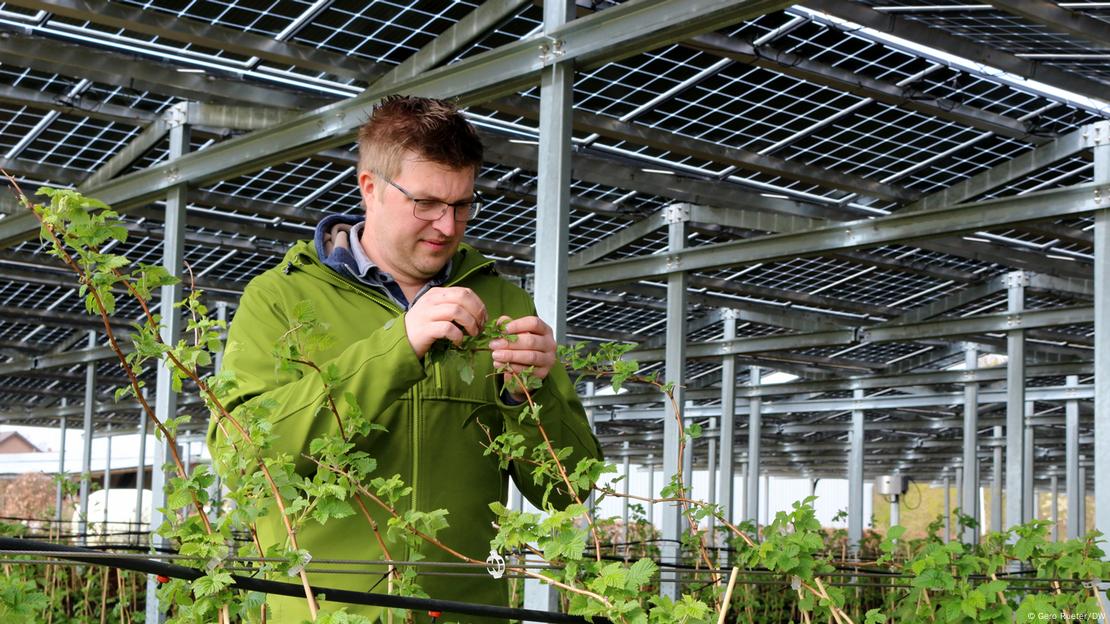
Fabian Karthaus grows berries beneath solar panels and is looking to expand in the future
Image: Gero Rueter/DW

Heat and drought have also caused a significant drop in yield over recent years.

"My wife and I started thinking about how we could continue to operate the farm in a meaningful way," Karthaus says. That's how the idea of growing berries under a solar roof with translucent modules was born.

"We thought about which kind of berry goes with what sort of light and shade. Blueberries and raspberries are woodland plants, so that works really well," he says.

The first harvest from the seedlings last year was good. Usually, the plants are grown outdoors or in foil tunnels.

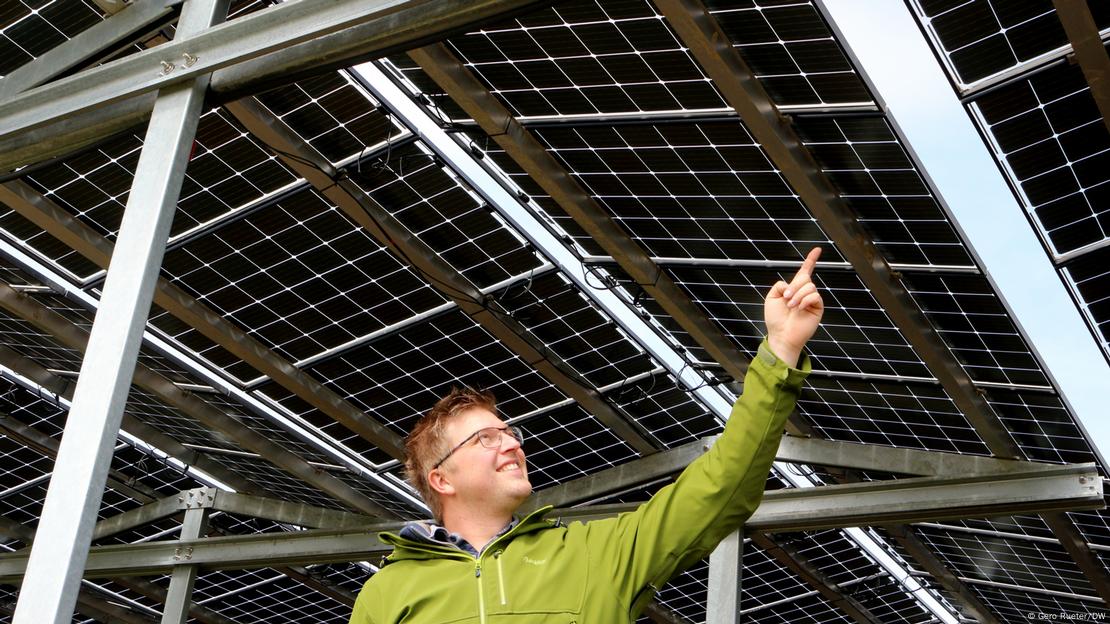
But Karthaus suspects the shade under the modules could increase yields. Extremely hot summers are now an increasing problem for plants, even in Germany. As Karthaus explains, roofs made of solar modules reduce evaporation and thus, save water.

"We once measured it here. The evaporation is about a quarter compared to plants in the open field," he explains.

The panels are put together to allow a certain amount of light through
Image: Gero Rueter/DW

Power above, berries below

Of course the modules also provide electricity. With 750 kilowatts of power, the system generates about 640,000 kilowatt hours a year, which is equivalent to the electricity needs of 160 households.

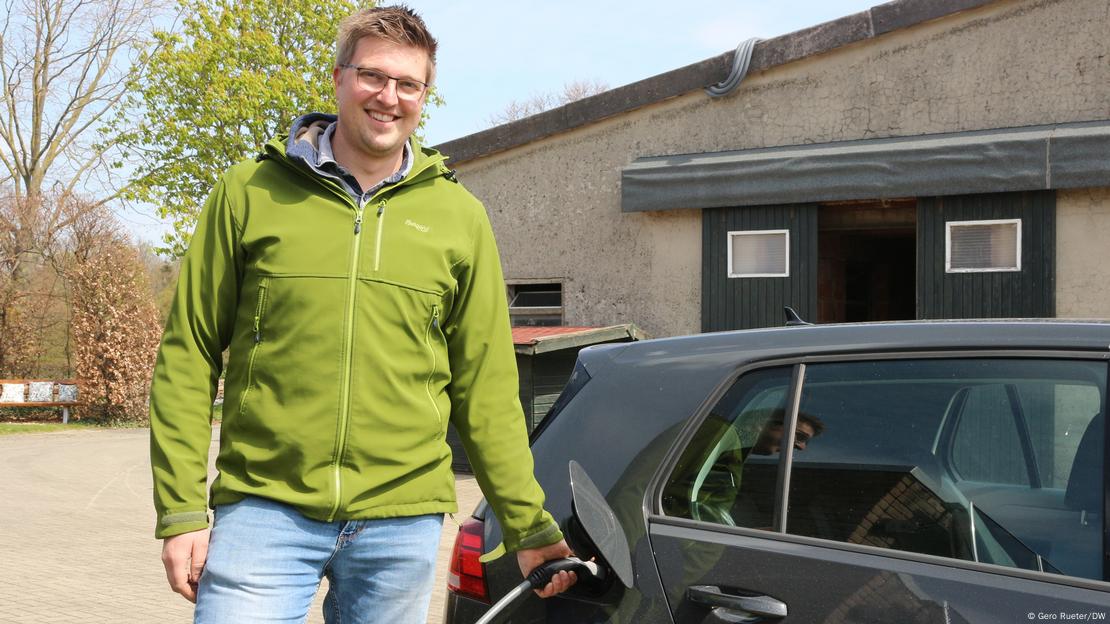
Karthaus receives just under €0.06 ($0.07) per kWh for feeding it into the grid. He wants to use part of the solar power himself to operate his own refrigeration and freeze-drying systems. If he had to buy the electricity from the energy supplier, that would cost him around €0.25 per kWh.

"It's a win-win situation for everyone. It means that we can generate green power locally, decentralized, where the energy is consumed," says Karthaus.

Karthaus uses the solar energy from his farm to power his car, among other things
Image: Gero Rueter/DW

In Germany, this method of cultivation works well for soft fruits, apples, cherries, potatoes, and produce such as tomatoes and cucumbers. In other regions of the world, differing plants and module designs might be more suitable.
Huge potential worldwide

What exactly grows where, is something interested parties from all over the world can learn from Max Trommelsdorff, an expert in agrivoltaics at the Fraunhofer Institute for Solar Energy Systems in the southern German town of Freiburg. Agrivoltaics is the exciting approach of using agricultural areas to simultaneously produce food and generate photovoltaic electricity. Trommsdorff and his colleagues advise governments worldwide and recently organized an international conference on solar energy and farming.

Depending on the location, one has to estimate the optimal light conditions for the plants as well as local demand for electricity, says Trommelsdorff.

"There are big regional differences: It depends on what is being grown, what the climate zones are, what the rural structures are."

Farmers in southern Germany are conducting tests in these fields to see what grows best there
Image: Fraunhofer ISE

The big challenge, he says, is mutual understanding: "What can photovoltaics do? What does agriculture need for successful integration?"

Trommsdorff and his colleagues see huge potential for agrivoltaics worldwide. There are already some agrivoltaic plants in Europe, Mali, Gambia and Chile; but the vast majority so far are in Asia.

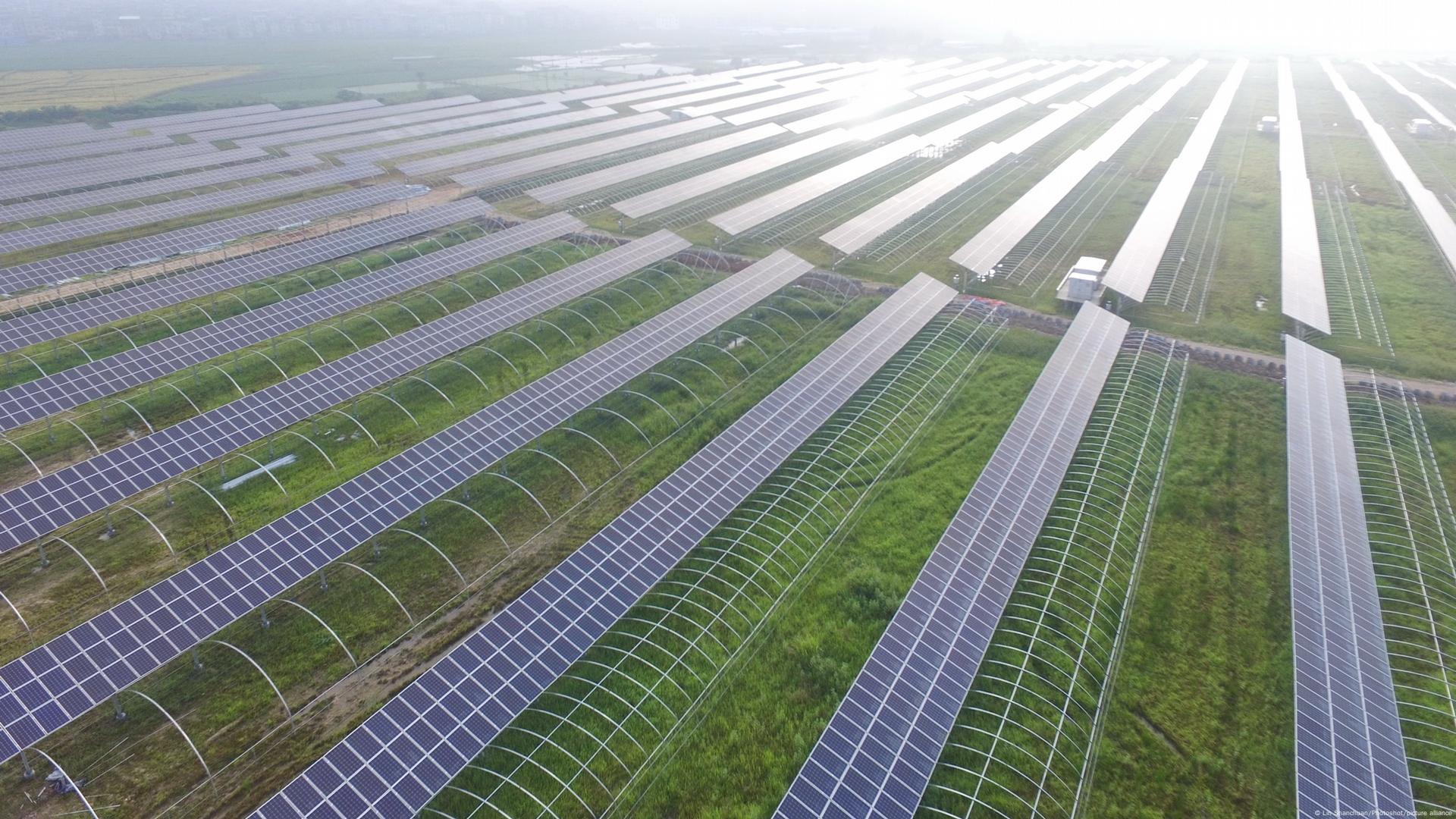
The world's largest plant, with a capacity of around 1,000 megawatts and covering 20 square kilometers (about 8 square miles), is located on the edge of the Gobi Desert in China. The cultivation of goji berries under the module roofs is intended to make the dry earth fertile again.

And in Japan, farmers are already harvesting from more than 2,000 agrivoltaics systems.

"The aim here is to support structural change, stop the rural exodus, and create prospects for the rural population," says Trommsdorff.

Some berry farmers in the Netherlands are swapping traditional roofs of plastic for solar panels
Image: BayWa r.e.

In Europe, France is a pioneer, especially in winegrowing. There, government subsidies for modular roofs are intended to protect vines.

"Many grape varieties get too much sun and heat due to climate change," Trommsdorff explains. "Shade can bring some benefits here."
New prospects for agriculture

Fabian Karthaus is planning on expanding his solar field in the future. At the moment, his berries grow under 0.4 hectares (about 1 acre) of solar panels. "I would like to expand this to an area of 8 or 10 hectares, then it will really be worthwhile."

However, Karthaus will have to be patient. So far, he says, the expansion is still cumbersome for farmers in Germany.

But he hopes that will change soon. And he is already advising other farmers to "definitely start dealing with the topic," even if it still takes a while to implement in their own fields.

This article was adapted from German.

Japan apologizes, pledges reform after woman's death in immigration detention

Issued on: 10/08/2021 - 

Japan's justice minister Yoko Kamikawa has pledged reform after the death of a Sri Lankan woman in immigration detention Charly TRIBALLEAU AFP/File

Tokyo (AFP)

Japan on Tuesday apologised for the death of a Sri Lankan woman in immigration detention and pledged to reform conditions in the system.

Justice Minister Yoko Kamikawa said a report on the March death of 33-year-old Wishma Sandamali concluded she received inadequate treatment as her health deteriorated.

Sandamali was detained for overstaying her visa after seeking police protection, reportedly to escape an abusive relationship.

She reportedly complained repeatedly of stomach pain and other symptoms starting in January, and campaigners allege she was given inadequate medical care.

"I express my heartfelt condolences to her mother and bereaved family, and my heartfelt apologies for (the) loss of this precious life in the detention centre," Kamikawa said.

The minister said the report had not conclusively determined the cause of Sandamali's death but found the detention centre in Nagoya in central Japan "lacked a system to assess the health of detainees and provide medical services".

"I have instructed the chief of the immigration services agency to take control and supervise regional outlets appropriately," Kamikawa said.

"We will carry out reforms with the determination that this never happens again."

National broadcaster NHK said four officials at the detention centre were "reprimanded" over the death, but none were fired.

Human rights campaigners have long criticised conditions at Japanese detention centres, including how guards respond to medical emergencies.

In May, Japan's ruling lawmakers dropped a controversial push to change rules on handling asylum seekers and deportations after opposition pressure over Sandamali's death.

The proposed legislation included changes making it easier to deport unsuccessful asylum seekers, something that was heavily criticised by rights groups, who also say Japan should do more to take in refugees.

© 2021 AFP
Bayer loses another appeal against Roundup cancer verdict

Issued on: 10/08/2021 - 
Roundup is the subject of thousands of lawsuits in the United States 
Mark RALSTON AFP/File

San Francisco (AFP)

German pharmaceutical and chemical giant Bayer on Monday lost another appeal against a verdict that found its Roundup weedkiller causes cancer, the latest setback in its bid to end thousands of lawsuits over the product.

An appeals court in San Francisco upheld the 2019 ruling in favor of a couple who claimed they got non-Hodgkin's lymphoma after using Roundup for years.

The court also upheld a judge's decision to reduce the jury's compensation award to Alva and Alberta Pilliod from $2 billion to $86.7 million.

Bayer has been plagued by problems since it bought Monsanto, which owns Roundup, in 2018 for $63 billion and inherited its legal woes.

The German firm says it has not committed any wrongdoing, and maintains that scientific studies and regulatory approvals show Roundup's main ingredient glyphosate is safe.

Glyphosate is nonetheless classified as a "probable carcinogen" by the International Agency for Research on Cancer at the World Health Organization (WHO).

In the latest ruling, the appeals court said Monsanto displayed an "intransigent unwillingness to inform the public about the carcinogenic dangers of a product it made abundantly available at hardware stores and garden shops across the country."

"Monsanto knew that studies supporting the safety of Roundup were invalid when the Pilliods began spraying Roundup in their yards, wearing no gloves or protective gear, spurred on by television commercials."

"We respectfully disagree with the Court's ruling as the verdict is not supported by the evidence at trial or the law," a Bayer spokesperson said. "Monsanto will consider its legal options in this case."

"We continue to stand strongly behind the safety of Roundup, a position supported by four decades of extensive science and the assessments of leading health regulators worldwide that support its safe use."

Bayer has set aside more than $15 billion to deal with a wave of US lawsuits linked to the weedkiller.

After allotting its latest tranche of $4.5 billion for potential costs, the German company posted huge losses for its second quarter last week.

In February, it said it had settled some 90,000 cases.

In May, a San Francisco court upheld a damages award of $25 million against Bayer and in favor of California resident Edwin Hardeman.

Bayer has said it will petition the US Supreme Court to review the Hardeman case this month.

© 2021 AFP

KARMA
BAYER USED NAZI SLAVE LABOURERS


Hong Kong's largest union disbands citing crackdown

Issued on: 10/08/2021 - 
Hong Kong has seen a crackdown on dissent since pro-democracy protests engulfed the city two years ago DALE DE LA REY AFP/File


Hong Kong (AFP)

Hong Kong's largest union announced it decided to disband on Tuesday citing "huge pressure" as authorities stamp out the city's democracy movement and impose political orthodoxy on the finance hub.

Founded in 1973, the Professional Teachers' Union (PTU) was the city's single largest union with some 95,000 members and was a prominent player in the democracy movement.

"After discussions, the executive committee unanimously decided to disband the union," Fung Wai-wah, PTU president, told reporters, describing the decision as "heart-wrenching".

"The social and political environment has quickly changed in recent years, we are under huge pressure. We can't find a way to resolve the crisis we are now facing," he added.

China has cracked down on its opponents since huge and often violent democracy protests convulsed the city two years ago.

A sweeping security law has criminalised much dissent while an official campaign has been launched to purge the city of those deemed unpatriotic.

The PTU was one of the more moderate voices within the democracy movement -- often shunned by more radical forces who felt it was too soft on the government.

But it still came under sustained attack by local and Chinese authorities who believe teachers played a key role in motivating Hong Kong's youth to hit the streets in huge numbers two years ago.

Last month, multiple Chinese state media outlets ran articles criticising the union as "a malignant tumour that must be removed".

Hours later, Hong Kong's education bureau said it was severing ties with the union, saying it had become "no different from a political body".

City leader Carrie Lam later accused the union of allowing "anti-government and anti-Beijing sentiments" into classrooms and campuses.

Since Beijing imposed its national security law just over a year ago more than 30 political and professional groups have disbanded to avoid legal risks according to an AFP tally.

More than 120 opposition leaders and activists have been arrested by a new national security police unit. Some 60 have been charged, most of them denied bail.

© 2021 AFP


The forced disbanding of the Professional Teachers’ Union is another flagrant breach by China of its international obligations to Hong Kong


Today, the Professional Teachers’ Union, Hong Kong’s biggest teaching union announced that it is disbanding as a result of pressure from the Chinese Government.

The teaching union, which has existed for 47 years and has 95,000 members, has increasingly come under pressure from the Hong Kong Government which announced it would no longer recognise it following pro-Beijing outlets describing the union as “a malignant tumour” that needs to be eradicated.

Kevin Yeung Yu-Hung, Hong Kong’s Education Secretary, this week called for teachers to rethink their association with the union and the Hong Kong Police Commissioner has said that the police will investigate the union for any potential national security violations.

Under Article 27 of Hong Kong’s Basic Law, Hong Kongers are guaranteed the right and freedom to join trade unions and to strike.

Commenting on the disbanding of the Professional Teachers’ Union, Benedict Rogers, Hong Kong Watch’s Chief Executive, said:

“The forced disbanding of the Professional Teachers’ Union is a new low for human rights in Hong Kong. Not content with jailing pro-democracy activists, journalists, and students, Beijing and its acolytes in the Hong Kong Government have turned their attention to attacking trade unions and teachers under the pretence of state security.

China has once again flagrantly breached its international obligations to the people of Hong Kong and their previous commitments to respect their right and freedom to join and participate in trade unions.

The international community must respond by finally sanctioning Hong Kong and Chinese officials who appear to be breaching the Sino-British Joint Declaration, suspending basic freedoms, and violating human rights on an almost weekly basis.”


Germany's train drivers go on three-day strike


Germany's train drivers union had demanded a wage increase for drivers. Deutsche Bahn said the strike was an "unnecessary escalation" in wage negotiations.

Germany's train drivers will go on strike starting Tuesday night through Friday morning, the GDL train drivers' union said, after negotiations with rail operator Deutsche Bahn fell through.

GDL head Claus Weselsky said 95% of the union's members voted in favor of the labor stoppage. "That is more than we expected. The results shows very clearly the mood among Deutsche Bahn's personnel," Weselsky said.

The strike would be the first hitting rail traffic since December 2018, when drivers stopped working for four hours. It will affect regional and long-distance trains all over the country.

Both freight and passenger rail across Germany will be affected by the strike. Deutsche Bahn's cargo drivers are said to cease operations at 19:00 local time (17:00 UTC), while passenger rail will be affected starting 02:00.

Hundreds of thousands of travelers will be affected by the strike, though customers who have already bought tickets will be entitled to refunds. It remains unclear how Deutsche Bahn will handle the disruption in freight and supply lines.

German floods destroy rails, train stations

Deutsche Bahn: Strike is an 'unnecessary escalation'


It all comes during the busy summer holiday season and as rail travel has picked up, due to diminishing coronavirus restrictions.

Nonetheless, GDL has demanded a 3.2% wage increase and a one-time coronavirus allowance of $600 ($703) for its drivers.

But Deutsche Bahn is already struggling to cover some €1.3 billion euros ($1.52 billion) worth of damage caused by the historic flooding that hit western Germany last month.

The firm called the decision to strike this week an "unnecessary escalation on the back of rail customers."

"Just as people are travelling more again and using trains, GDL leaders are destroying the upswing that we urgently need given the huge damage from the coronavirus pandemic," said Martin Seiler, DB board member for human resources and legal affairs.

But Weselsky shot back at the company, accusing DB managers of "lining their pockets while the little guys are getting their pockets picked."

The union boss stressed that there is never a good time to strike, but that the labor stoppage would end Friday morning, to not disrupt weekend travel.

jcg/aw (dpa, AFP, Reuters)

From the toilet to the sink: water recycling battles scarcity

"No astronaut has ever gotten sick from the reuse of water" 


Issued on: 10/08/2021 - 
Treating wastewater to put it back into public use for irrigation, industrial uses and even drinking could help alleviate water crises. Noemi Cassanelli AFP/File

Paris (AFP)

Would you take a swig of water from your faucet if it originally came from the sewer?

Treating wastewater to put it back into public use can help against water crises around the world, according to the United Nations, though the practice has to overcome the "yuck" factor among the public.

Wastewater that has been through a treatment plant is typically discharged into rivers.

But there is a push to tap recycled water -- also known as water "reuse" -- in order to ease pressure on sources of freshwater threatened by growing populations, pollution and climate change.

"Water reuse for sure will just increase and increase worldwide, because there's no other option," Richard Connor, editor-in-chief of the United Nations World Water Development Report published by UNESCO, told AFP.

Namibia's capital, Windhoek, has been a pioneer, transforming wastewater into potable water since the 1960s, while Singapore has also developed a much-vaunted recycling system.

A potable water project is in the works in western France.

Turning recycled water -- also known as reclaimed water -- into something you can drink is not the main purpose of the technology.

In Mediterranean countries as well as Texas and Mexico, reclaimed water is used for irrigation in agriculture, which consumes two-thirds of freshwater abstractions around the world.

Reclaimed water can also be used for industries, to clean streets or cool power stations.

- 'Untapped resource' -


There are two ways to turn wastewater into potable water.

It can be treated and then blended with freshwater in a surface reservoir or groundwater aquifer before undergoing additional treatment and being distributed.

But the other, rarer method does not use such environmental buffers, as wastewater is purified and then sent directly to a drinking water distribution system.

"Water 'reuse' is definitely part of the solution. It's a way to increase our supply," Connor said.

Singapore transforms sewage into water clean enough to drink, meeting 40 percent of the island nation's water demand. ROSLAN RAHMAN AFP

"If you can reuse the water several times, then you don't have to extract it from the source," Connor said.

Recycling wastewater is less expensive and uses up less energy than desalinating sea water, which is considered another solution against water scarcity.

"It's better to jump on the train now," Connor said.

"The longer you wait, the more expensive it's going to be, and the more difficult it's going to be. It's better to start right away."

- Astronaut drink -

The western French department of Vendee is joining the fray, announcing plans last month to turn wastewater into potable water by 2024.

The water will go though several stages of filtration and disinfection before being discharged into a reservoir.

"Everyone now understands that we must be frugal with groundwater," said Nicolas Garnier of Amorce, an association of cities.

In the past two years, 90 percent of communities in France have had to restrict water use due to droughts, Garnier said.

Europe represents a small percentage of the global recycled water market, according to Water Reuse Europe, a non-profit association.

It is five times more expensive to treat wastewater than water from a river or a lake because it is much dirtier, Connor said.

More than 80 percent of the world's wastewater is dumped in the environment without treatment, especially in poor countries, according to a 2017 UN report that called wastewater the "untapped resource".

"We have to find ways, especially in developing countries that don't have the funds, to pay to treat water," he said.

A project in southern France recycles wastewater to irrigate fields. 
Sylvain THOMAS AFP/File

One way to reduce costs would be to take sludge from the treated water to obtain biogas or extract nutrients such as nitrogen and phosphorus which can be converted into fertiliser.

But the "yuck factor is not just for drinking water", Connor said, even though the food people consumer has been safely grown thanks to reused water.

Connor points out that astronauts on the International Space Station drink water that was recovered from the crew's sweat and urine.

"No astronaut has ever gotten sick from the reuse of water," he said.


she passes Jessica the Water of Life . This is a life-altering substance that can “open the universe” to Jessica.

Water represents life on numerous levels in Dune: survival at the individual level, well-being and spiritual faith for Fremen communities, and universal prosperity in enabling the production of spice as a commodity that enables technological and cognitive progress.